Wild Creek Web Studio
  • About Wild Creek
    • Awards
    • Case Studies
    • Portfolio
    • Testimonials
  • Services
    • SEO Services
    • Paid Marketing Services
    • Social Media Marketing
    • Consulting and Strategy
  • Resources
    • Blogs
    • Free SEO Tools
    • Digital Marketing Glossary
  • Contact

SEO Case Study: How We Boosted Organic Traffic by 49.92% for a Leading Metal Fabrication Manufacturer

Businesses must stay in an era where digital visibility determines success. A holistic online presence has transcended being a mere advantage; it’s now a staple. When a leading metal fabrication manufacturer reached out to us at Wild Creek Web Studio, they presented a challenge that resonated with us: their online invisibility shadowed their strong offline reputation. And we were determined to change that narrative.

In this Article

Toggle
  • Background
  • Objective
  • Our Strategy
  • The Results
    • Organic Traffic:
    • Engagement Metrics:
    • User Acquisition:
    • Bounce Rate:
  • Feedback from Our Client
  • Conclusion

Background

Metal fabrication is a niche industry with its own set of challenges. While the company was a powerhouse in offline circles, its online story differed. They were also battling declining website traffic, losing potential clients to competitors with a more pronounced online presence. This was a wake-up call: they needed more than a digital facelift; they needed a comprehensive digital strategy.

Objective

  1. Amplify organic traffic: Drive relevant, high-intent traffic to the website.
  2. Refine user metrics: Enhance user experience metrics, ensuring visitors find value and stay engaged.
  3. Broaden the user base: Reach a wider audience, positioning the company as the go-to metal fabrication authority online.

Our Strategy

On-Page Optimization: Every page of a website sends signals to search engines. These signals determine how a page ranks. We initiated a detailed audit, identifying gaps and opportunities. We ensured the website communicated effectively with search engines and users by rectifying structural issues, optimizing meta tags, and streamlining content.

Content Enhancement: Quality content does more than engage visitors; it establishes authority. We embarked on a mission to rejuvenate existing content, making it more relevant, engaging, and SEO-friendly. We transformed the site’s content narrative by integrating targeted keywords and ensuring a balance between user and search engine needs.

Strategic Content Development: To stay ahead in the digital curve, businesses must anticipate and address future needs. Our team developed a dynamic content calendar, focusing on emerging trends and pain points in the metal fabrication industry. We diversified content types, integrating blog posts, how-to guides, video content, and industry reports.

Backlink Acquisition: In the world of SEO, backlinks act as endorsements. However, not all backlinks are created equal. We pursued a rigorous link-building strategy, targeting high-authority, relevant domains. Each backlink acquired was a testament to the site’s growing authority and relevance.

The Results
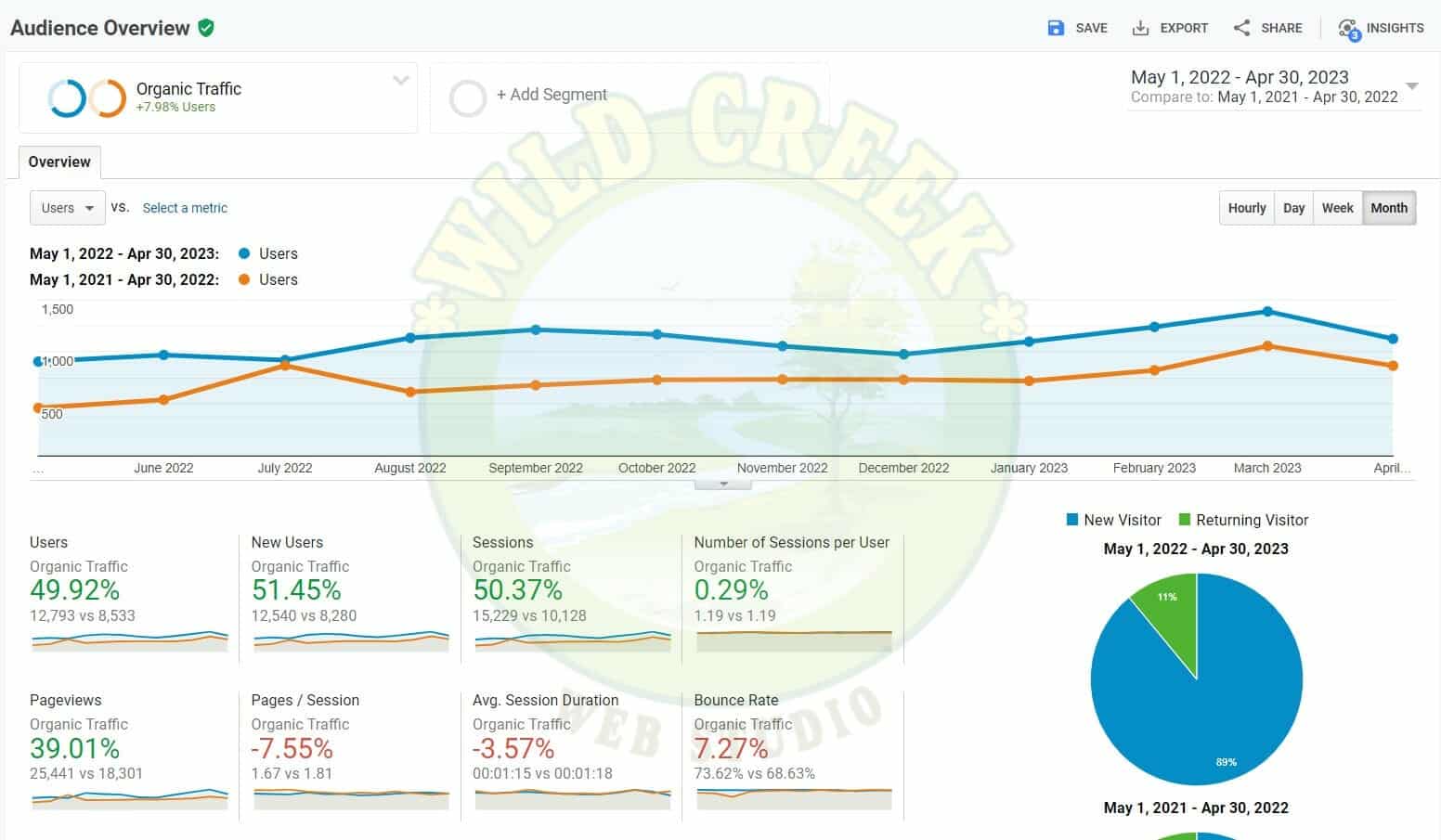
Google Analytics Screenshot - SEO Case Study for a Metal Fabrication Company

Organic Traffic:

Our efforts bore fruit, leading to a 49.92% surge in organic users. This wasn’t just about numbers but about attracting the right audience, translating to increased inquiries and sales.

Engagement Metrics:

We saw a significant uptick in pageviews, signalling visitors were finding value in the content. While some metrics, like session duration, posed challenges, they offered insights for our next optimization phase.

User Acquisition:

The growth in new users and sessions underscored our strategy’s success. We weren’t just driving traffic; we were attracting potential clients.

Bounce Rate:

While the bounce rate saw an increase, it presented an opportunity. We’re actively analyzing this metric to ensure content alignment with user intent.

Metrics Previous Year Current Year
Organic Traffic Increase – +7.98%
Users 8,533 12,793
New Users 8,280 12,540
Sessions 10,128 15,229
Pageviews 18,301 25,441
Pages/Session 1.81 1.67
Average Session Duration 00:01:18 00:01:15
Bounce Rate 68.63% 73.62%

Feedback from Our Client

Collaborating with Wild Creek Web Studio was a game-changer. Their strategic approach, combined with their hands-on execution, turned our digital challenges into growth opportunities. The results speak for themselves, and we’re excited about our ongoing digital journey.

Conclusion

Digital transformation is a journey; every milestone achieved paves the way for the next. This case study is a testament to our commitment to our clients at Wild Creek Web Studio. Our data-driven approach, combined with our industry insights, ensures we deliver tangible results repeatedly. If you want to rewrite your digital success story, we’re ready to partner with you.


0 comments
Schema Markup

How To Use Schema Markup for Improved SEO Results

It’s no secret that search engine optimisation (SEO) is an essential part of any successful online business. It helps ensure your website appears at the top of relevant searches, increasing visibility and driving more traffic to your site. But there’s a powerful tool you may not be taking advantage of – schema markup. This efficient little bit of code can help ensure your website stands out from the competition in organic search results.

This article will explore how schema markup works and why it should be part of your SEO arsenal. We’ll also provide step-by-step instructions on implementing schema markup so you can see improved SEO results immediately! Finally, we’ll look at best practices for optimising your use of schema markup to get maximum benefit from it.

Schema Markup

If you’re ready to take control of your organic search rankings, read on! With just a few simple steps, you can unlock the power of schema markup and boost yourself significantly in the ever-changing world of SEO.

In this Article

Toggle
  • What Is Schema Markup?
  • Benefits Of Incorporating Schema Markup
  • Types Of Schema
  • How To Implement Schema Markup
  • Testing Your Markup
  • Troubleshooting Tips
  • Keeping Up With Updates
  • Frequently Asked Questions
    • Is Schema Markup Difficult To Use?
    • Is There A Cost Associated With Using Schema Markup?
    • Can Schema Markup Help My Website Rank Higher In Search Engine Results?
    • Are There Any Risks Associated With Using Schema Markup?
    • How Often Should I Update My Schema Markup?
  • Conclusion

What Is Schema Markup?

Did you know that Google processes over 40,000 search queries each second? That’s an astonishing number of searches, highlighting how important SEO is for online businesses. One way to help improve your website’s visibility in the search engine results pages (SERPs) is to use schema markup. So, what exactly is schema markup, and how can it help SEO?

Schema markup is a code used on websites to identify various elements within webpages, such as titles, headings, text content, images and videos. This allows search engines like Google to easily read the content to rank them in their SERPs properly. Schema helps provide more detailed information about the page, giving users better context when searching for something specific. It also increases click-through rate because search engine results will include additional details from schemas like reviews or prices.

By implementing schema markup into your website’s HTML code, you are helping search engines understand your content better and improving its chances of appearing higher in SERP rankings. With this enhanced understanding comes increased visibility and potential customers looking specifically for products or services related to your business. This could lead to more tremendous success for your business overall.

Benefits Of Incorporating Schema Markup

The benefits of incorporating schema markup into a website are numerous. Not only does it improve the visibility of webpages in search engine results, but it also increases click-through rates and provides more detailed information to users. This can be especially helpful for eCommerce sites because the additional elements like reviews or prices help customers make informed decisions about their purchases. Furthermore, schema markup can help websites become eligible for rich snippets, which provide even more visual appeal to SERP listings and attract potential customers.

In addition to these advantages, implementing schema markup is relatively easy compared to other SEO strategies, such as content optimisation or link building. As long as you have basic HTML knowledge and an understanding of schemas, you should be able to implement them with minimal effort. And if not, plenty of online tutorials will walk you through each step of the process.

Adding schema markup to your website could prove incredibly beneficial for improving its visibility in search engines and driving traffic towards your business. It’s one way to edge over competitors who may not yet understand this powerful tool. Hence, it’s worth considering as part of your overall SEO strategy. With all these benefits in mind, let’s look at some of the different schema markups today.

Types Of Schema

Today, several different schema markups are available to website owners. From local business information and product reviews to events and articles, it’s essential to understand the various options to choose the best fit for your needs.

To illustrate this point, let’s look at an example. Suppose you own an online store that sells kitchen appliances. In that case, you should add structured data for item availability and price. This way, when potential customers search for items related to what you sell on Google or other search engines, they can immediately see basic information about each item. Similarly, if you run a restaurant with weekly specials or have upcoming event listings, you could also benefit from adding corresponding schemas.

By understanding the different types of schemas and how they relate to your specific site goals and content offerings, you can ensure that the most relevant pieces of info are presented in SERP results. With the right combination of markup selection and implementation tactics, businesses can ensure their websites stand out from competitors without sacrificing user experience.

How To Implement Schema Markup

Now that you understand the available schema markups, it’s time to explore how they can be implemented. For starters, two main ways to do this are manually adding HTML code directly onto your website or using a third-party tool. Let’s take a look at each method in more detail.

Manual implementation is often seen as the most effective way to add markup to websites if done correctly. This involves going through your site’s HTML and inserting relevant microdata where needed. Unfortunately, this can become tedious for more significant sites with multiple pages and products; if not done correctly, errors may occur that could negatively impact SEO performance.

On the other hand, many businesses implement structured data via tools such as Google Tag Manager or Schema App. These services allow marketers to quickly insert markup without returning to their source code whenever changes need to be made. Additionally, since these platforms utilise automated processes when generating tags, chances of human error are significantly reduced – which helps ensure better search engine visibility over time.

Testing Your Markup

Once you’ve implemented your schema markup, it’s crucial to test it. This will ensure the code is running as intended and help identify potential issues before they become problematic. Fortunately, there are many tools available online that can make this process easier.

One such tool is Google’s Structured Data Testing Tool. By simply entering the URL into the testing console, users can get an overview of their coding in just minutes – including errors or warnings that should be addressed immediately. This resource also provides insight into what information search engines have indexed from each page, giving marketers even more visibility into how Google is receiving their structured data.

Another excellent option for verifying structured data accuracy is checking via browser extensions like Schema Builder for Structured Data (for Chrome). It offers real-time validation so companies can track changes immediately upon implementation – helping them stay proactive with SEO efforts while improving overall site performance.

Troubleshooting Tips

It’s not uncommon to run into issues when first implementing schema markup. To ensure a successful implementation, it’s important to remember the basics: pay attention to detail, double-check your work and test regularly. This will help prevent errors such as incorrect tags or missing data points that can disrupt performance results.

In addition, keeping up with changes is also crucial when it comes to structured data optimisation. Search engines are constantly tweaking their algorithms, so marketers should stay on top of updates to remain competitive – primarily if competitors use similar coding techniques for SEO purposes. Fortunately, several resources are available online to provide guidance, from Google’s official documentation to industry newsletters and blogs offering helpful tips and tricks.

Finally, enlisting a third-party consultant may also be beneficial; they can offer additional insight into how a company’s website is performing relative to others in its sector or region – helping them take advantage of any existing opportunities while minimising potential risks down the road.

Keeping Up With Updates

Staying current with the ever-evolving world of web technology is essential for success. As search algorithms continue to adapt and evolve, understanding how to make the most of these advancements can mean the difference between thriving and surviving in today’s competitive marketplace.

Fortunately, several resources are available online to help keep marketers abreast of changes that may impact their SEO efforts. From Google’s official documentation to industry newsletters and blogs offering tips and tricks – staying up-to-date on developments has never been easier. Additionally, trade shows provide an invaluable opportunity to connect with experts who can offer insight into emerging trends and what tactics competitors may use to remain relevant.

With a little extra effort and attention, companies can ensure they take full advantage of all the tools while avoiding potential pitfalls. By staying informed about recent updates and leveraging third-party consultations where needed, businesses can develop comprehensive strategies that maximise their return on investment across digital channels.

Frequently Asked Questions

Is Schema Markup Difficult To Use?

Using schema markup can be simple or complex, depending on how much information you’re trying to display. For example, implementing the code should take a little time if you want to share basic information like business hours and contact info. On the other hand, if your goal is to create more detailed content, such as recipe instructions or product reviews, the task may require some technical knowledge and additional coding skills.

Overall, while the complexity of using schema markup may vary from one project to another, plenty of resources available online can assist during implementation. From articles explaining what schema markup is and why it’s essential for SEO results to videos demonstrating how to add it into HTML code – anyone can find helpful guidance to get started.

Is There A Cost Associated With Using Schema Markup?

According to a study by Moz, as much as 80% of websites have implemented some form of structured data markup. This makes it clear that schema markup is becoming increasingly popular and can be used to improve SEO results. But is there a cost associated with using this type of technology?

The good news is that using Schema Markup has no direct costs. The markup is free for anyone to implement on their website or in code snippets. However, it’s essential to understand how best to use it for your specific needs. Implementing the wrong schema type could do more harm than good, so understanding which types are most appropriate for your situation is critical. You may also need help from an experienced developer if you’re working with complex coding projects.

In addition, no matter what kind of markups you choose, they must be kept up-to-date to continue performing properly when search crawlers index them. That means regular maintenance and additional costs depending on who performs the work. While these factors don’t necessarily create significant expenses directly related to schema usage, they should still be considered before moving forward with implementation plans.

Can Schema Markup Help My Website Rank Higher In Search Engine Results?

The answer is yes! Adding schema markup to your site provides additional information about specific elements on each page, allowing search engines better access to the data they need to evaluate how relevant the content is. Because this extra detail improves the accuracy with which pages are indexed and ranked by search engines, adding schema markup increases the chances of achieving higher rankings in SERPs (Search Engine Results Pages).

In addition, schema markup helps create rich snippets — the short pieces of text that appear underneath titles when searching topics related to your website. Rich snippets generally contain details like ratings or author information, making them attractive features designed to entice users into clicking through from SERPs. By using schema markup, you ensure these snippets are accurate and up-to-date. Hence, when visiting your site, people get a correct impression of what’s on offer.

Are There Any Risks Associated With Using Schema Markup?

Schema Markup is an attractive proposition for boosting a website’s ranking in search engine results. But is there any risk associated with it? The answer is yes. It’s essential to be aware of the potential pitfalls before investing time and money into adding schema markup to your website.

Schema markup has many benefits, but if misused, it can significantly harm your website’s integrity. If you need to implement schema markup or create incorrect code correctly, this could lead to errors that severely damage your SEO rankings. Even worse, these mistakes are hard to detect, which means they’re difficult to fix; you will lose valuable time rectifying them and precious search engine visibility.

Therefore, while using schema markup may have its advantages when appropriately implemented, those who don’t take due care risk significant penalties from search engines that could significantly reduce their business efforts. To ensure success when incorporating Schema Markup into your website strategy, understand best practices and follow through on implementing them accurately.

How Often Should I Update My Schema Markup?

Using schema markup to improve SEO results is a great way to increase traffic and visibility online. But how often should you update your schema markup? This is an important question that demands consideration.

Updating your schema markup too often can be counter-productive, so it’s best not to do this unnecessarily. On the other hand, if you don’t update your schema markup regularly enough, you may miss out on potential improvements to your website’s performance in search engine rankings. It’s, therefore, essential to strike the right balance between updating frequently and leaving alone when no immediate changes or updates are needed.

A good rule of thumb for most websites is to review their existing schema markup at least once per quarter – depending on the size and complexity of the site – and make any necessary adjustments. Doing this will ensure that website owners take advantage of any new opportunities provided by improved search algorithms while avoiding over-optimisation, which could result in being penalised by Google and other search engines.

Conclusion

If you want to improve your SEO results, implementing Schema Markup should be your top priority! With just a few hours of effort, you can ensure that your website stands out and helps increase traffic to your site in no time.

1 comment
Five Compelling Reasons to Initiate Business Automation Today

Maximize Efficiency: The Top Five Benefits of Business Automation

Humans are creative, and we can change the world with our imagination. Now, technology is changing the business world, which tends to make some complicated works complete automatically with a human touch. Are you a businessperson running your own business? It is essential to know about automation techniques and processes. You might have noticed that your employees are bored of doing the same work repeatedly for a long time, which could make them postpone doing influential tasks.

Now is the time for you to realize the value of automation techniques. If you do not keep your business processes functioning well, you might worry about it. I like to inform people that technology is not set up in our kitchens to cook food for us to save time. Let us focus on why we need automation software in business and how it can help us grow. What are the advantages of implementing automation software in your online business?

Five Compelling Reasons to Initiate Business Automation Today

Businesspersons and individuals will seek ways to improve their business and achieve productivity. There are numerous ways to help your business acquire productivity. However, business process automation is one advantageous technique that can improve your work process by making your work quicker and saving time. A workflow automation tool can make your work life easier and better. Automation is the future of business that could save you valuable time. You can ask why we should automate business and what is the motive.

Automation is different from what most people are thinking. Technology will not destroy the jobs of humans. Automating your business can help us to make the work process easy. This article will explore why initiating business automation can be beneficial. If you are still thinking about why you need to start automating the work in your business, the following five compelling reasons will make you realize.

In this Article

Toggle
  • What Is Automation in the Business Process?
  • 5 Reasons Why Businesses Need to Initiate Automation
    • Reduce of Human Mistakes
    • Enhanced Customer Service
    • Boost Accountability
    • Enhanced Employee Morale
    • Compatible and Consistent Marketing
  • Advantages of Automating Business Process
    • Quicken up the Work Process
  • SEO (Search Engine Optimization) Automation
  • It Saves Money and the Times
  • Final Thoughts

What Is Automation in the Business Process?

Automation is the process of automating manual functions using software technology and modernizing to the finish of a particular workflow to improve complete business performance quality, is called business process automation.

The automation process does not mean that computer technology is replacing humans. Employees are essential to initiate automation processes in the workplace to ensure the most favorable efficiency.

5 Reasons Why Businesses Need to Initiate Automation

Reduce of Human Mistakes

Making mistakes is a common thing among human beings that does not matter how much time they work on the same thing, careless mistakes can identified in their work. Humans can avoid mistakes with concentration and effort that can protect their outcome from massive damage lacking can pave to rework a particular thing.

Here comes the technology that avoids such types of human errors, self-operation different from humans because they function appropriately without making any mistakes and do not get bored of doing the same work repeatedly because it is programmed.

Compared to humans’ robots can do more work in less time. Using automation software in your business can reduce human errors and improve quality. To meet industry standards

You should provide quality products to satisfy the customers’ needs. Making your business automatically function using automation software will never cause errors and provide high-quality outcomes for your business that will cost money.

Enhanced Customer Service

Providing service to your customers can be automated and speed up the process of gathering information needed for customer service skillfully. With the help of an automation system, you can keep track of customer interactions, and following them can be done immediately.

The information about your customer can be collected automatically and helps you understand customers well. To clear the doubts of your customers, you can set up a live chatbot on your website so that answers to their questions can be provided in real-time using automation and can reduce the waiting time of your customers. You can remind your customers about their appointments using an automated system.

Aiming to provide better customer service to your client’s automation can help you achieve successful customer data management, and the process will be super-fast. The act of assistance you intend to provide your customer will be available 24 hours and solving your customer’s problems can be quick with the presence of chatbots on your websites or applications. Information provided to the audience can be accurate answers with the help of automation tools that can enhance customer service.

Customer experience is the most important thing for your business to grow. By automating your business processes, you can able to satisfy your clients. When customers are happy with the service provided to them, they will come back to you with a smile to gain benefits.

Boost Accountability

In business project management, multiple processes need to be in charge of identifying the project’s progress. The manager should have a clear understanding of who is working on what, and he needs to keep track of the project workflow process in business. Introducing an automation process can do everything for him.

Customer data management is a process of managing all your client’s details. Using automation software can make it easy to store all the information in a directory that has easy access to data with just a few clicks. Automation will help you monitor every process and update the status by showing the project progress.

The Workflow automation system can take control of the responsibility of the work. If any obstacles occur, it can automatically assign tickets to your IT support teams to check on them. You can check the complete status of the works that are still pending and completed clearly in a dashboard.

All work responsibilities can achieved when you automate business processes in your organization, and there will be no chance of excuses. The automation system helps you to set up reminders of later work that needs to be worked by employees and sends a notification to make them remind and start the work.

Enhanced Employee Morale

The employees’ mental and emotional conditions are significant in the workplace. Introducing automation in your business can pave the way to productivity. The employees can be able to work without any pressure because the work can get simple with the automation process.

The approval process can be faster when compared to manually because employees do not need to spend more time. After all, it can make the approval function quick in a fleeting period.

The workers in your organization do not need to struggle with using multiple platforms because automation software comes with various tools to make your work effortless. For example, a programming platform like a no-code platform can used to generate applications without writing any code.

Even non-technical people can create simple applications and websites using drag-and-drop tools that do not require programming knowledge. It is one of the effective ways to generate applications for business work using this kind of automation software that can help your small business grow and accomplish success.

No-code platforms are booming currently, and extraordinary programming uses a development interface to build applications and manage workflow in the work process. Using automation tools in business can make complicated work easy for employees to get stress-free and achieve peace of mind.

Compatible and Consistent Marketing

Refusal to comply with industry and lawful regulations can prove expensive for organizations in every industry. Automation process systems can assist businesses in protesting with ease. Automating your online business can be significant because you can consistently feed content to your website and improve content marketing.

You can fix the proper time when you must post content, and the number of content needed on the organization’s website automation tools can be for scheduling purposes. Establishing Informative content using tools will be incredibly helpful for content creators.

The purpose of creating content is to share valuable information and inspire readers. The created content can be automatically distributed on various platforms using tools. Generating content takes more time for any creator, but using content-creating automation tools like CHATGPT can make it easier and save time.

If you need to keep your business active, creating content and updating it on social media, websites, and other channels is essential to growing your business. You think it can be done with a few clicks when you automate your business. How amazing it is automation can help your business expand and increase organic traffic to your network. It can engage and manage your audience by automating messages on social media platforms because immediate responses can satisfy your customers.

Automating your business workflow can be beneficial if you intend to collect your customer information and can be easy for you to access as stored information in one location. Workflow automation is fantastic and saves your energy and enjoyable time.

Advantages of Automating Business Process

Quicken up the Work Process

Comparing humans with robots does not take much time because they are programmed. It can complete more work without the consumption of more time. The significant thing is manual errors can minimized by introducing automation software techniques.

SEO (Search Engine Optimization) Automation

Automation tools can help in keyword research. We can identify relevant keywords quickly so that you can target the audience for traffic opportunities to your sites.

It assists you in understanding what types of content the audience likes, how many people visit your websites, and where they are coming from all over the performance can generated using analytics tools.

Target keywords can monitored and track ranking in search engine result pages (SERs). Automation helps you find backlink opportunities and observe competitor links.

It Saves Money and the Times

In some conditions, the deadline will be for every project that should completed within the period. In this case, the organization requires more workers, which could cost more money. Using the right automation software can reduce the number of employees in your organization and save more time, and even labor costs can reduced in the company and improve efficiency.

Final Thoughts

To accomplish remarkable results in your business, you can introduce automation software in your organization that can help you beat competitors and stay ahead of them. Business process automation is one of the ways to achieve business success.

You can harness this excellent opportunity before other organizations utilize it so you can stay one step ahead, but choosing the right software tools is significant. Automation finds ways to save time and decrease costs can be a beneficial thing for your business. If you intend to grow your company, business process automation can help you accomplish success.

Around the world, small business companies are identifying that automation can yield productivity and profitability. To utilize automation effectively, see how other companies use automation software in their organization. It could be a clever idea that can help you find the right automation software platform for your business.

The significant purpose of automating your business is to enhance the workflow process, see where you can implement automation, and find out the necessary place where you need it the most that can make you benefit from automation.

Eventually, technology can be advantageous for your business to satisfy your customers. I think this article about business process automation was informative to you people, and thank you for your time.

0 comments
How To Optimize Your Blog Posts for SEO and Increase Traffic

How To Optimize Your Blog Posts for SEO and Increase Traffic

Are you tired of your blog posts not getting the attention they deserve? It’s time to take control and optimize your content for SEO. Following a strategic approach can increase traffic and attract more readers to your blog. In this article, we’ll show you how to conduct keyword research, write high-quality content, optimize your titles and meta descriptions, use headers and subheadings effectively, optimize images, build links, promote on social media, and monitor performance. Let’s dive in and make your blog posts stand out!

How To Optimize Your Blog Posts for SEO and Increase Traffic

In this Article

Toggle
  • Key Takeaways
  • Conduct Keyword Research
  • Write High-Quality Content
  • Optimize Your Blog Post Titles and Meta Descriptions
  • Use Headers and Subheadings
  • Optimize Your Images
  • Build Internal and External Links
  • Promote Your Blog Post on Social Media
  • Monitor and Analyze Your Blog Post Performance
  • Frequently Asked Questions
    • How long does it usually take to see an increase in traffic after optimizing a blog post for SEO?
    • Is it necessary to include keywords in every header and subheading of a blog post?
    • How often should I update and optimize my old blog posts for better SEO?
    • What are the steps to optimize a blog post for SEO?
  • Conclusion

Key Takeaways

  • Internal and external links are crucial in improving user navigation, increasing time on site, and reducing bounce rates.
  • Link-building tools and techniques, such as Moz, SEMrush, Ahrefs, guest blogging, and broken link building, can help identify new link opportunities and enhance content credibility.
  • Social media promotion drives traffic, increases visibility, collaborates with influencers, and shares compelling snippets and teasers.
  • Optimizing social media posts by including relevant keywords, using eye-catching visuals, and making posts engaging. Shareable can significantly increase traffic to a website.

Conduct Keyword Research

When conducting keyword research, it’s essential to identify popular search terms relevant to your blog post. To optimize your blog posts for SEO and increase traffic, you must understand what keywords your target audience is searching for. Start by performing competitor analysis to see which keywords they are ranking for and how you can differentiate yourself.

Long tail keywords should be a key focus during your keyword research. These are longer, more specific phrases with lower competition but higher conversion rates. Incorporating long-tail keywords into your content can attract more targeted traffic and improve your chances of ranking higher in search engine results.

To conduct adequate keyword research, use tools like Google Keyword Planner or SEMrush to find relevant keywords with high search volume and low competition. Look for variations of these keywords that align closely with the topic of your blog post.

Once you have identified the right keywords, strategically incorporate them throughout your blog post. Please include them in the title, headings, meta description, URL, and within the body of the content. However, ensure the usage feels natural and doesn’t compromise readability or user experience.

By conducting thorough keyword research and incorporating relevant long-tail keywords into your blog posts, you can optimize for SEO and increase organic traffic to your website.

Write High-Quality Content

To ensure your blog posts are compelling and attract more readers, focus on creating valuable and engaging content. High-quality content is essential for optimizing your blog posts for SEO and increasing traffic. By providing helpful information and engaging your target audience, you can establish yourself as an authority in your niche and attract more readers.

When writing high-quality content, it is essential to consider your target audience. Understand their needs, interests, and pain points to create content that resonates with them. Use a writing style that is relatable and easy to understand. Incorporate storytelling techniques or personal experiences to make the content more enjoyable.

Additionally, following a strategic, keyword-focused approach can help improve the visibility of your blog posts in search engine results. Conduct keyword research to identify relevant keywords that align with your target audience’s search queries. Incorporate these keywords naturally throughout your content while maintaining readability.

Data-driven writing is another effective technique for optimizing blog posts. Back up your statements with statistics or studies to add credibility and demonstrate expertise on the topic.

By implementing these strategies and creating high-quality content, you can optimize your blog posts for SEO, increase traffic, and ultimately grow your audience. Remember, quality always trumps quantity when it comes to attracting readers and establishing yourself as a trusted source of information.

Optimize Your Blog Post Titles and Meta Descriptions

Improve your blog’s visibility and click-through rate by crafting compelling titles and meta descriptions that grab the attention of potential readers. How you present your blog post titles and meta descriptions is crucial in attracting organic traffic from search engines. To optimize your blog post titles, it is essential to use a strategic writing style with keyword-focused content. Conduct keyword research to identify relevant keywords that resonate with your target audience’s search queries. Incorporate these keywords naturally into your title while maintaining clarity and relevance.

Formatting techniques also play a significant role in optimizing your blog post titles and meta descriptions. Use header tags (H1, H2, etc.) to structure your content and make it easier for readers and search engines to understand the hierarchy of information on the page. Additionally, consider using bullet points or numbered lists within your meta description to highlight key points and increase readability.

Furthermore, data-driven optimization can help enhance the effectiveness of your titles and meta descriptions. Analyze data from tools like Google Analytics or SEO platforms to understand which titles drive more traffic or generate higher click-through rates. Experiment with different variations of headlines and analyze their performance over time.

By following these strategies for optimizing your blog post titles and meta descriptions, you can increase the visibility of your content in search engine results pages (SERPs) and attract more organic traffic to your blog.

Use Headers and Subheadings

Headers and subheadings are essential for organizing your blog post content and improving readability. Regarding formatting techniques for headings and subheadings, there are a few key things to remember. First, ensure your header tags (H1, H2, etc.) are correctly formatted using HTML markup. This helps search engines understand the hierarchy of your content and can improve SEO. Additionally, consider incorporating relevant keywords into your headers and subheadings. This helps with SEO and makes it easier for readers to quickly scan and understand the main points of your blog post.

The impact of headers and subheadings on user experience and readability cannot be underestimated. Breaking up your content into smaller sections with clear headings makes it easier for readers to navigate through your blog post. This is especially important as more people are reading content on mobile devices where attention spans tend to be shorter.

Moreover, headers and subheadings provide visual cues that guide readers through the different sections of your blog post. They help highlight the central ideas or topics discussed in each area, making it easier for readers to find what they want quickly.

In conclusion, proper formatting techniques for headers and subheadings can significantly improve SEO and user experience. By strategically incorporating keywords into these elements, you can optimize your blog posts for search engines while enhancing readability for your audience.

Optimize Your Images

Using adequately formatted and optimized images can significantly enhance the visual appeal of your blog post. Regarding image optimization techniques and SEO strategies, there are some key factors to consider.

Firstly, make sure to choose high-quality images that are relevant to your blog post’s content. These images should be visually appealing and engaging for your readers. Compressing the image files can also reduce size without compromising quality, improving your website loading speed.

Another critical aspect of image optimization is using descriptive file names and alt tags. This helps search engines understand what the image is about and improves its visibility in search results. Incorporate relevant keywords into these descriptions while keeping them concise and accurate.

Additionally, resizing the images according to their display dimensions on your blog post is crucial for optimal performance. This ensures that they load quickly and appear correctly across different devices.

Lastly, remember to add captions or context around the images when necessary. This provides additional information and allows you to incorporate relevant keywords naturally into your content.

By implementing these image optimization techniques and following proper image SEO strategies, you can increase the visual appeal of your blog posts while improving their search engine visibility and attracting more traffic to your website.

Build Internal and External Links

To enhance the visibility and credibility of your blog, it’s essential to incorporate internal and external links. Link-building strategies are crucial in optimizing your blog posts for SEO and increasing traffic. By strategically including relevant links within your content, you can provide additional value to your readers and improve search engine rankings.

Internal links point to other pages within your website or blog. They help establish a hierarchical structure and improve user navigation. By linking related articles or resources together, you can encourage visitors to explore more of your content, thus increasing their time on site and reducing bounce rates.

External links, on the other hand, direct users to websites outside of your domain. These links can cite sources, reference studies or statistics, and build relationships with other bloggers or industry influencers. When choosing external sources to link to, make sure they are reputable and authoritative to enhance the credibility of your content.

Here is a table highlighting some popular link-building tools and techniques:

Tool/Technique Description
Moz Provides insights into link analysis and competitor research
SEMrush Offers competitive analysis and backlink tracking
Ahrefs Helps identify new link opportunities
Guest Blogging Writing articles for other blogs in exchange for backlinks
Broken Link Building Finding broken links on influential sites and offering replacements


 By employing these link-building strategies and utilizing practical tools like Moz, SEMrush, and Ahrefs, engaging in guest blogging activities, or incorporating broken link-building techniques into your strategy, you can significantly boost the SEO value of your blog posts while attracting more traffic from search engines.

Promote Your Blog Post on Social Media

One effective way to generate more exposure for your blog post is by sharing it on social media platforms. Social media has become a powerful tool for promoting content and reaching a wider audience. By leveraging the popularity of various social media platforms, you can drive traffic to your blog and increase its visibility.

Influencer collaborations are an excellent strategy to promote your blog post on social media. Partnering with influencers in your niche can help you tap into their existing audience and gain more exposure for your content. When working with influencers, ensure they align with your brand’s values and have an engaged following that matches your target audience.

Another cross-promotion strategy is to share snippets or teasers of your blog post on social media. Create compelling captions that entice users to click through and read the full article on your blog. You can also include eye-catching visuals, such as images or videos, to make the post more engaging and shareable.

Additionally, remember to optimize your social media posts with relevant keywords related to the topic of your blog post. This will improve the searchability of your content within each platform’s search algorithms.

By implementing these influencer collaborations and cross-promotion strategies, you can effectively promote your blog post on social media and drive more traffic to your website.

Monitor and Analyze Your Blog Post Performance

Monitor and analyze your blog post’s performance by regularly monitoring and diagnosing its metrics. Tracking analytics and measuring engagement are crucial in optimizing your blog posts for SEO and increasing traffic. By understanding how your audience interacts with your content, you can make data-driven decisions to improve its performance.

To effectively monitor and analyze your blog post’s performance, utilize tools like Google Analytics or other website analytics platforms. These tools provide valuable insights into key metrics such as page views, bounce rate, time on page, and conversions. By studying these metrics over time, you can identify trends and patterns that help you understand what resonates with your audience.

Metric Definition Importance
Page Views The number of times your blog post has been viewed Indicates popularity
Bounce Rate Percentage of visitors who leave after viewing only one page Measures engagement
Time on Page Average duration visitors spend on your blog post Reflects content quality
Conversions Number of desired actions completed by visitors (e.g., sign-ups) Measures effectiveness


 By regularly tracking these metrics, you can gain valuable insights into how well your blog post is performing. Use this data to optimize future posts, improve user engagement, and ultimately increase traffic to your blog.

Frequently Asked Questions

How long does it usually take to see an increase in traffic after optimizing a blog post for SEO?

It typically takes a few weeks to see an increase in traffic after optimizing a blog post for SEO. The impact of backlinks on SEO performance and factors like website authority and competition can influence the speed of optimization results.

Is it necessary to include keywords in every header and subheading of a blog post?

Including relevant keywords in every header and subheading of your blog post is unnecessary, but it can provide benefits. Using long tail keywords in headings and subheadings can improve SEO ranking, while including keywords in titles and meta descriptions increases visibility and attracts more traffic.

How often should I update and optimize my old blog posts for better SEO?

To maximize SEO, update and optimize old blog posts regularly. Repurposing old content is like breathing new life into it, attracting more traffic and boosting your search engine rankings. Employ effective strategies for updating blog content to stay relevant and engage your audience.

What are the steps to optimize a blog post for SEO?

When it comes to creating blog posts, optimizing them for SEO is crucial for gaining visibility on search engines like Google. This guide will walk you through the steps to optimize your blog posts effectively and drive more visitors to your website using SEO techniques.

How can strategically placing keywords in a blog post improve its visibility on search engine results pages?
First and foremost, you should focus on optimizing your blog post for SEO. This involves researching and selecting relevant keywords to include throughout your content. By strategically placing these keywords in your blog post, you can enhance its visibility on search engine results pages (SERPs) and improve your chances of ranking higher on Google.

Additionally, it’s essential to optimize your blog post for Google specifically. The most popular search engine is Google, so tailoring your content to its algorithms can significantly increase your chances of attracting organic traffic. By implementing proven SEO strategies, such as using descriptive titles, incorporating relevant headers, and including meta descriptions, you can optimize your blog post to meet Google’s ranking criteria.

Another effective way to optimize your blog posts for SEO is by leveraging SEO techniques to drive visitors to your blog. You can achieve this by building high-quality backlinks, as they serve as a vote of confidence from other reputable websites. Additionally, internal linking within your blog can help search engines navigate your website more effectively, further driving traffic and boosting your SEO rankings.

Optimizing blog topic pages is also essential for SEO success. By structuring your blog topics in a clear and organized manner, search engines can easily comprehend your website’s content structure, making it more likely for your blog pages to rank higher in search results. Incorporate relevant keywords, create user-friendly URLs, and ensure a logical hierarchy for your blog topic pages to optimize them for readers and search engines.

Lastly, remember to optimize your blogspot’s social meta in English. Social meta tags are vital in how your blog posts are displayed on social media platforms. By optimizing these tags with descriptive and compelling content, you can enhance the click-through rates from social media referrals, ultimately driving more visitors to your blogspot.

Optimizing your blog posts for SEO and Google, utilizing SEO to drive visitors, optimizing blog topic pages, and optimizing social meta are all critical elements in optimizing your blog posts effectively. By implementing these strategies, you can make your blog more visible, attract organic traffic, and achieve tremendous success in the blogosphere.

Conclusion

Congratulations on completing your blog post! By following the steps outlined in this article, you have mastered optimizing your blog posts for SEO and driving more traffic to your website. You have set yourself up for success with keyword research, high-quality content, and strategic use of headers and subheadings. Remember to optimize your images and build internal and external links to enhance your rankings further. Remember to promote your blog post on social media platforms for maximum exposure. Finally, monitor and analyze your performance to continuously improve. Happy blogging!

1 comment
How To Choose the Right CMS for Your Website

How To Choose the Right CMS for Your Website

Did you know that there are over 1.5 billion websites on the internet today? With such a vast number of websites, choosing the right content management system (CMS) for your site can be overwhelming. But fear not! In this article, we will guide you through selecting the perfect CMS by considering your website’s goals and requirements, evaluating ease of use and customization options, researching support and security, and seeking user reviews and recommendations. Let’s get started on finding the best CMS for your website!

How To Choose the Right CMS for Your Website

In this Article

Toggle
  • Key Takeaways
  • Define Your Website’s Goals and Requirements
  • Evaluate Ease of Use and User Interface
  • Consider Customization Options and Flexibility
  • Assess Available Plugins and Extensions
  • Research Support and Documentation
  • Compare Pricing and Licensing Options
  • Look for Security and Updates
  • Seek User Reviews and Recommendations
  • Frequently Asked Questions
    • Are there any limitations on the number of pages or users managed with the CMS?
    • How frequently do updates and security patches for the CMS software get released?
    • Are there any restrictions on the type of content that can be published using the CMS?
  • Conclusion

Key Takeaways

  • Evaluate upfront costs, additional expenses, and hosting fees.
  • Prioritize security as a top concern and ensure robust security measures are in place.
  • Seek valuable user feedback and read reviews from users who have used the CMS.
  • Evaluate cost savings, customization options, and customer support when choosing a CMS.

When contemplating the selection process for a content management system (CMS), it is crucial to understand the steps involved in choosing the best CMS for your specific needs. Determining the suitable CMS requires careful consideration and evaluation. How do you go about choosing a CMS?

Define Your Website’s Goals and Requirements

Firstly, it is imperative to research and gather information about different CMS options available in the market. This will assist you in comprehending the various features and functionalities offered by each CMS. You can begin to narrow down your choices by comparing and contrasting the offerings.

Before choosing a suitable CMS for your website, you need to define your website’s goals and requirements. This step is crucial in ensuring that your website design and content management align with your goals. By clearly outlining your objectives clearly, you can select a CMS that effectively meets those needs.

Start by considering the purpose of your website. Are you looking to create an online store, a blog, or a portfolio? Understanding this will help determine the features and functionalities required from your CMS. Next, identify the specific goals you wish to accomplish through your website. Do you want to increase brand awareness, generate leads, or drive online sales?

Additionally, consider the scale at which your website will operate. Will it be a small personal site or a large enterprise platform? This assessment will guide you in selecting a CMS that can handle the expected traffic and content volume.

Lastly, examine any unique requirements essential for your website’s success. For instance, if you plan on integrating third-party applications or require multilingual support, consider these aspects when evaluating potential CMS options.

By thoroughly defining your goals and requirements upfront, you set yourself up for success in choosing a CMS that aligns perfectly with your vision and objectives.

Evaluate Ease of Use and User Interface

Next, you must evaluate your requirements and objectives for using a CMS. Consider the purpose of your website and the specific features you require. For example, if you aim to build an e-commerce platform, prioritize CMS options that excel in this area.

When choosing a CMS for your website, it’s essential to consider how easy it is to use and navigate its user interface. Evaluating the user experience and UI design considerations will ensure that you have a seamless content management system that meets your needs. Here are some factors to keep in mind:

Intuitive Interface:

  • Look for a CMS with an intuitive interface that allows you to navigate different sections and perform tasks without confusion efficiently.
  • Consider whether the layout is clean and organized, making it simple to find what you need.

Customization Options:

  • Check if the CMS allows you to customize the user interface according to your preferences.
  • Look for options like drag-and-drop functionality or customizable dashboards, which can enhance your workflow.

A smooth user experience is crucial as it saves time and makes managing your website more enjoyable. A cluttered or complicated UI can lead to frustration and inefficiency. By evaluating ease of use and considering UI design, you can choose a CMS that aligns with your expertise and ensures a positive experience for administrators and end-users on your website.

Consider Customization Options and Flexibility

One vital aspect of the CMS selection process involves detecting the CMS platform that a website is currently using. By employing various techniques, you can uncover the underlying CMS of a website. This knowledge can be crucial in determining the efficacy and limitations of different CMS platforms.

To detect the CMS platform of a website, you may employ methods like examining the source code for CMS-specific identifiers. Additionally, some online tools and plugins can assist in identifying the CMS used by a website. By detecting the CMS platform in English, you can gather valuable insights into its capabilities and make an informed decision regarding its suitability for your requirements.

To ensure a personalized experience, consider the customization options and flexibility different CMS platforms offer. When choosing a CMS for your website, evaluating its customization capabilities and limitations is crucial. Look for a CMS that allows you to easily customize the appearance and functionality of your website to align with your brand identity and meet your specific needs.

A flexible CMS will provide you with various templates, themes, and plugins that can be tailored to suit your requirements. These customization options enable you to create a unique and visually appealing website without extensive coding knowledge or skills. Additionally, check if the CMS allows you to seamlessly integrate third-party tools or services. This flexibility ensures you can add new features or functionalities as your business grows or changes.

Scalability is another important aspect when considering customization options. A good CMS should offer scalability options, allowing your website to grow alongside your business without significant disruptions. It should handle increased traffic, content updates, and additional pages without compromising performance.

In summary, choosing a CMS with ample customization options and flexibility is essential for creating a personalized website that aligns with your brand image. Ensure the platform provides enough customizability within its limitations and offers scalability options for future growth.

Assess Available Plugins and Extensions

Evaluate the available plugins and extensions to enhance your website’s functionality and meet your needs. When choosing a CMS for your website, it is crucial to consider the range of available plugins and extensions. These tools can significantly expand the capabilities of your site and provide additional features that may be essential for your business or personal goals.

Firstly, look at the various available themes offered by different CMS platforms. A wide selection of pieces ensures you find one that suits your brand image and aligns with your overall design aesthetic. Additionally, consider whether these themes are customizable so that you can make adjustments as needed.

Another aspect to assess is performance optimization. Look for plugins and extensions that can help improve the speed and efficiency of your website. These tools will ensure smooth navigation for users and ultimately lead to higher user satisfaction.

Furthermore, examine if there are plugins or extensions specifically designed for any unique functionalities you require on your website. Whether it’s an e-commerce integration, social media sharing options, or advanced analytics tracking, having access to these additional features can significantly enhance the overall user experience.

In conclusion, thoroughly evaluating the available plugins, extensions, and themes will help you choose a CMS that meets your current needs and provides room for future growth and development.

Research Support and Documentation

Researching support and documentation is essential to ensure that you have access to the necessary resources for troubleshooting and maximizing the functionality of your chosen CMS. When selecting a CMS, it’s crucial to consider the availability of research tools and technical support.

To make your research process easier, here are three sub-lists with critical points to consider:

  1. Documentation: Look for a CMS that provides comprehensive and up-to-date documentation. This includes user guides, FAQs, tutorials, and developer resources. Having thorough documentation will save you time and frustration when understanding how to use different features or troubleshoot issues.
  2. Community Forums: Check if the CMS has an active community forum where users can ask questions, share experiences, and seek help from fellow users or experts. Engaging with a vibrant community can provide valuable insights, tips, and solutions to common challenges.
  3. Technical Support: Evaluate the technical support the CMS provider offers. Consider factors such as response time, availability (24/7 or specific hours), and modes of contact (email, live chat, phone). Prompt and reliable technical support ensures that any critical issues are addressed promptly.

By thoroughly researching these aspects before selecting a CMS, you’ll equip yourself with the necessary tools and support system needed for smooth website management and troubleshooting in the long run.

Compare Pricing and Licensing Options

Now that you have gathered all the necessary research support and documentation for choosing the suitable CMS for your website, it’s time to delve into one of the most critical factors: comparing pricing and licensing options. This step will help you decide based on your budget and specific needs.

To assist you in this process, here is a comprehensive cost analysis and licensing comparison table below:

CMS Pricing Model License Type
WordPress Free Open Source
Drupal Free Open Source
Joomla Free Open Source
Squarespace Subscription-based Proprietary
Wix Subscription-based Proprietary


 As you can see, open-source CMS like WordPress, Drupal, and Joomla offer free usage with no licensing fees. On the other hand, platforms like Squarespace and Wix require a subscription fee to access their services.

When considering pricing options, it’s essential to evaluate the upfront costs and any additional expenses such as themes, plugins/extensions, hosting fees, or premium support.

By conducting a thorough cost analysis and reviewing different licensing models available in the market, you can make an informed decision that aligns with your budgetary constraints while ensuring all your website requirements are met.

Look for Security and Updates

When looking for a CMS, it’s important to prioritize security and regular updates. Your website’s security should be a top concern, as it can significantly impact the trust of your users. Look for a CMS offering robust security measures to protect your website from threats and vulnerabilities.

A good CMS should provide features like user authentication, secure data storage, and protection against malware attacks. It should also have built-in tools to monitor and detect suspicious activities on your site. Regular updates are crucial to keep your CMS up-to-date with the latest security patches and fixes. Outdated software is more vulnerable to cyber-attacks, so ensure that the CMS you choose has a track record of prompt and frequent software maintenance.

Choosing a CMS with solid security measures and regular updates can minimize the risk of breaches and keep your website safe from potential threats. Remember, maintaining the security of your website is an ongoing process that requires constant vigilance. So, regularly update your CMS and implement best practices in web security to safeguard your business and your users’ valuable information.

Seek User Reviews and Recommendations

Seek user reviews and recommendations to find a CMS that meets your needs. User feedback is invaluable when choosing a suitable CMS for your website. By reading what other users have experienced, you can get a sense of the strengths and weaknesses of different content management systems. Online communities are great places to find these reviews and recommendations. They provide a platform for users to share their experiences and advise others in similar situations.

When seeking user reviews and recommendations, keep in mind the following:

  • Real-life experiences: Look for reviews from users who have used the CMS for their websites. Their firsthand accounts will give you a better understanding of how well the system performs in real-life scenarios.
  • Specific features: Review reviews that mention particular parts or functionalities vital to you. This will help you gauge whether the CMS has everything you need.
  • Overall satisfaction: Consider the general satisfaction level expressed by users in their reviews. Many positive studies indicate that the CMS is reliable and effective.

Taking the time to seek user feedback can save you from pitfalls. So, tap into online communities and learn from others’ experiences before deciding on a content management system.

Frequently Asked Questions

Are there any limitations on the number of pages or users managed with the CMS?

There are limitations on scalability with CMS, including the number of pages and users that can be managed. It is essential to consider these when choosing a CMS. Pricing options may vary depending on the scale of your website.

How frequently do updates and security patches for the CMS software get released?

Staying up to date with frequent updates and security patches for your CMS software is crucial. It directly impacts your website’s security, ensuring protection against vulnerabilities and potential breaches. Make it a priority to stay informed and implement these updates promptly.

Are there any restrictions on the type of content that can be published using the CMS?

You’ll be glad that most CMS platforms have few content restrictions. With a wide range of customization options, you can easily publish any content you want on your website.

Conclusion

Once armed with all the necessary information, you can embark on the process of choosing the suitable CMS for your website. Consider factors such as ease of use, scalability, security features, customization options, and customer support. Additionally, consult with industry experts or seek recommendations from peers with experience with different CMS platforms.

By following these guidelines on choosing a CMS, you can navigate the plethora of options available and find the best CMS to meet your specific needs. Remember, an informed decision regarding your CMS selection is pivotal in laying a solid foundation for your website’s success.

So there you have it! After meticulously considering all the factors and diving deep into content management systems, you are now equipped with the knowledge to choose the suitable CMS for your website. With a touch of finesse and a dash of satire, you have become an expert in this realm. Remember, your website’s goals and requirements are paramount, but remember ease of use, customization options, support, security, and user reviews. May your CMS journey be filled with wisdom and success!

0 comments
ROI of Your SEO Campaigns

How To Calculate the ROI of Your SEO Campaigns

When it comes to digital marketing, one of the most critical metrics for measuring success is the return on investment (ROI). Determining how much you get from what you put in can take time and effort. Knowing how effectively your SEO campaigns generate ROI can make or break your online strategy. In this article, we will explore the various ways to calculate the ROI of your SEO campaigns and offer tips on getting the most out of them.

The importance of calculating ROI cannot be overstated; it provides insight into which strategies are working well and provides guidance on where best to allocate resources to maximize profits. Understanding exactly how to calculate ROI for SEO campaigns is essential to optimize digital marketing efforts.

By exploring standard methods used by digital marketers as well as specific tactics that can help improve SEO performance and generate higher returns, this article aims to equip readers with an understanding of how they can measure their own campaign’s success and ultimately make better decisions when it comes to allocating funds towards search engine optimization activities.

ROI of Your SEO Campaigns

In this Article

Toggle
  • Definition Of Return On Investment (ROI)
  • Calculating Seo Roi
  • Measuring Metrics
  • Factors To Consider
  • Analyzing Results
  • Adjusting Strategies
  • Enhancing Performance
  • Frequently Asked Questions
    • What Is The Best Way To Track My SEO Campaign Performance?
    • Are There Any Tools I Can Use To Simplify The Roi Calculation Process?
    • How Often Should I Adjust My SEO Strategy?
    • What Are The Most Important Metrics To Measure For SEO Success?
    • How Do I Determine Which Factors Have The Most Impact On My SEO Roi?
  • Conclusion

Definition Of Return On Investment (ROI)

Return on Investment (ROI) is a calculation used to measure the profitability of an investment. It’s measured by comparing the money earned through that investment versus how much was spent to acquire it. ROI helps business owners and investors decide where to invest their funds for maximum return.

To calculate ROI, you must first determine your initial costs – both in terms of time and resources invested – and any potential future costs or benefits associated with the project. You’ll also need to track income from the investment as accurately as possible over time. This will allow you to calculate your total profits or losses relative to the cost invested.

When calculating ROI for SEO campaigns, many variables may not be immediately apparent when considering the overall picture. To properly understand whether or not your campaign has been successful, it’s crucial to consider all factors influencing performance before making a final decision. With this in mind, let’s look at how we can measure our SEO campaign ROI more closely.

Calculating Seo Roi

To accurately gauge your SEO campaigns’ ROI, tracking and measuring key performance indicators (KPIs) is essential. These KPIs should include short-term direct results – such as clicks, conversions, impressions, and rankings – and longer-term indirect benefits like brand visibility and website traffic. When assessing the success of an SEO campaign, you need to look at all these variables to gain a complete picture of how effective your efforts have been.

It’s important to note that there may be some discrepancies between initial expectations and actual outcomes when measuring KPI performance. For example, while ranking position is undoubtedly one factor that can give insight into whether or not a particular keyword strategy was successful, it shouldn’t be viewed as a definitive indicator on its own. This is because different search engines use varying algorithms for ranking websites differently based on numerous factors.

Ultimately, capturing comprehensive data from multiple sources will help you evaluate which tactics work best for your goals. Utilizing analytics tools such as Google Analytics can provide valuable insights into organic user behavior related to your SEO activities by helping you understand where visitors come from. What actions do they take once they arrive on-site? Assessing this type of information can help inform future optimizations to maximize ROI over time.

Measuring Metrics

It’s essential to take a comprehensive approach when measuring the return on investment (ROI) of SEO campaigns. According to research from HubSpot, nearly half of marketers found that organic search engine traffic was their primary source for generating leads. This statistic alone highlights the importance of understanding how your efforts impact key performance indicators like conversions, clicks, and rankings.

When calculating ROI, measuring other less tangible metrics, such as website visits and brand visibility, is essential. Analyzing user behavior on-site can help you determine whether visitors engage with content as intended and provide insight into where adjustments may be necessary. Tracking total impressions across channels will further paint a picture of awareness levels associated with specific keyword strategies or campaigns.

Your measurement strategy should include assessing short-term direct results and longer-term indirect benefits to understand how practical your SEO activities have been over time. Armed with this information, you’ll be better equipped to adjust tactics accordingly and maximize future gains.

Factors To Consider

When determining ROI for SEO campaigns, it’s essential to consider the following factors: budget, resources, and timeline. For example, a large-scale campaign may require more time and money than a smaller one. Consideration should also be given to any seasonality or external influences that could affect the success of your efforts. Additionally, understanding how your competition is approaching their search engine optimization strategy can help you assess where you stand in comparison.

The type of content produced as part of the campaign must also be considered when measuring ROI. From blog posts and videos to infographics and webinars, each piece of content requires different levels of investment with varying potential returns – understanding which most effective formats will allow you to optimize future strategies accordingly.

Finally, analytics become invaluable during this process as they provide insight into performance metrics such as click-through rate (CTR) and bounce rate. Analyzing these data points over time can identify trends that can inform decisions about what tactics should be applied moving forward. With these considerations in mind, marketers are better equipped to ensure successful outcomes from their SEO initiatives. 

Analyzing Results

Armed with the factors discussed in the previous section, it’s time to analyze the results. The success of an SEO campaign is determined by its ability to meet or exceed expectations set out when the planning begins. Identifying and tracking key performance indicators (KPIs) should be a priority throughout the process. This could include engagement metrics like page views, click-through rate (CTR), and bounce rate, as well as more tangible goals such as organic traffic increase or overall leads generated.

Comparing these KPIs to initial objectives will provide insight into your efforts’ success and where improvements are needed moving forward. Upon completion of this analysis, marketers can then adjust their strategies accordingly. For instance, if content formats that require higher investment levels don’t generate the desired ROI, they may need to explore alternative tactics that offer better value for money.

Ultimately, measuring ROI helps marketers ensure campaigns deliver positive returns on investments, enabling them to make informed decisions about future search engine optimization initiatives. With clear objectives in mind, adjusting strategies becomes more accessible than ever before – allowing businesses to maximize their return from every dollar spent.

Adjusting Strategies

Having analyzed results and identified areas of improvement, it’s time to adjust strategies accordingly. This involves taking a closer look at the investments in SEO campaigns and ensuring they deliver desired returns. One interesting statistic to note here is that according to recent research, businesses investing more than $25,000 on SEO saw an average return of 613%. That said, there’s no one-size-fits-all approach to optimizing for search engines – what works for one company may not work as well for another.

Marketers need to consider all available options to maximize ROI and determine which will best meet their objectives. This could involve reevaluating content formats or exploring new keyword opportunities based on customer feedback. Additionally, revisiting technical elements like page loading speeds and mobile optimization should be part of any strategy adjustment process if better performance is desired.

With careful analysis and strategic adjustments, marketers can ensure their efforts yield maximum ROI for their organization. From there, the focus shifts towards enhancing performance further with additional tactics such as link-building or local SEO initiatives.

Enhancing Performance

With the proper adjustments, it’s time to take things one step further. Enhancing performance requires a comprehensive approach beyond just optimizing campaigns. It includes additional tactics such as link-building or local SEO initiatives.

Link building involves creating content with high-quality backlinks from other websites, which can help increase the visibility of your website. This could include guest blogging on relevant sites or reaching out to influencers within your industry who may be willing to share your content with their followers. Local SEO is another important tactic for driving more traffic to your site, as this method focuses on targeting potential customers near you through localized keywords, geo-targeting strategies, and reviews management.

These strategies represent an opportunity to drive even greater returns from SEO investments by helping improve the rankings of critical pages and increasing organic search traffic over time. To maximize ROI, marketers should continue making necessary adjustments while taking advantage of the latest opportunities available across channels.

Frequently Asked Questions

What Is The Best Way To Track My SEO Campaign Performance?

Tracking the performance of SEO campaigns can be challenging. Still, there are ways to monitor campaign performance effectively without requiring specialized tools or significant time for analysis. Google Analytics is a valuable tool for measuring success. It provides real-time data on user behavior, such as page views, session duration, and bounce rate. This information helps identify which campaigns are performing well. It also offers insights into the keywords potential customers use when searching for products or services related to yours, allowing for necessary adjustments in tactics. Monitoring competitor activity is also beneficial as it provides valuable clues about effective SEO strategies in your industry. By combining data from these sources, informed decisions can be made to improve your own campaigns and optimize ROI over time.

Are There Any Tools I Can Use To Simplify The Roi Calculation Process?

Calculating the return on investment (ROI) of SEO campaigns is challenging yet crucial for businesses. It can be time-consuming and difficult to obtain accurate numbers, making it vital to utilize tools that simplify the process.

Imagine yourself in a room full of tech professionals, all eager to learn about new ways to track performance. As you rise from your seat to address their question – are there tools to simplify ROI calculation? – you feel motivated to help them streamline their workflows.

You explain how specific analytics programs enable marketers to measure website traffic and link popularity. Next, you discuss how keyword research tools provide insights into consumer behavior patterns and trends. Lastly, you mention how automated reporting suites offer customizable dashboards with easy-to-understand visual data. These powerful resources have made ROI calculation easier than ever before!

How Often Should I Adjust My SEO Strategy?

To ensure the effectiveness of your SEO strategy, it is crucial to find the right balance between adjusting too often and needing more. If you are new to SEO, create a comprehensive plan considering short-term and long-term goals. Continuously evaluate the progress of this plan against Key Performance Indicators (KPIs) to identify areas that require changes for desired outcomes. Stay updated on industry trends and SEO best practices, such as link building and content optimization.

To ensure the correctness of your SEO strategy, conduct A/B tests on different aspects of your website. This will help determine which elements have the most significant impact on user engagement and search engine rankings. Incorporate these findings into your core strategy for future improvements.

Regularly reviewing and monitoring progress will provide insights into effective website optimization for search engines. This knowledge will enable informed decisions regarding adjustments and improvements. Businesses can outperform their competition by staying ahead in terms of organic visibility and search engine traffic growth.

What Are The Most Important Metrics To Measure For SEO Success?

Measuring metrics is crucial for achieving SEO success. It is essential to understand what to assess and when to adjust your strategy to determine the effectiveness of your campaigns. Awareness of the key elements that indicate progress or failure is essential for improving ROI in your search engine optimization efforts.

Evaluating SEO performance involves wisely allocating resources and diligently tracking relevant data. It is essential to monitor organic traffic levels, time spent on a page, click-through rates, conversions, backlinks, and other factors that impact your content’s online ranking. An accurate understanding of these elements will help you identify necessary changes and determine the appropriate scaling of initiatives.

Regularly assessing metrics such as keyword rankings, engagement stats, bounce rate, and more provides valuable insights into the most effective strategies for increasing visibility and generating leads. With this valuable data, you can optimize your campaigns and maximize returns over time.

How Do I Determine Which Factors Have The Most Impact On My SEO Roi?

Determining the factors that impact SEO ROI most can take time and effort for businesses. Understanding which metrics to measure and how they influence return on investment to optimize campaigns is crucial. To calculate a successful ROI, it is essential to consider quantitative and qualitative measurements that provide insights into customer behavior and preferences.

Quantitative data allows marketers to track performance relative to goals before launching an SEO campaign. This includes metrics such as website visits, time spent on a page, conversions, and more. On the other hand, qualitative data helps marketers understand why customers make certain decisions within their campaigns. It provides insights into what content resonates with them and where they engage the most. By understanding the interplay between these two types of data, marketers can identify areas of improvement and adjust strategies accordingly.

Besides analyzing content performance through analytics reports and surveys, keyword research is essential when determining SEO ROI. By conducting thorough research and testing different keywords, brands can ensure they target the right audience and increase organic search visibility through improved rankings. This proactive approach ensures that search engine optimization efforts yield tangible results while providing valuable insights into user behavior.

Conclusion

The success of an SEO campaign relies heavily on effectively tracking and measuring its performance. Determining the ROI of an SEO campaign can be challenging, but tools are available to simplify this process. It is crucial to consistently adjust your strategy based on the most impactful metrics for success and closely monitor those factors that have the most significant influence on ROI. Remember that achieving successful SEO campaigns takes time, effort, and commitment. Through careful planning and continuous monitoring of results, you will ultimately benefit from excellent organic search visibility.

0 comments
Building A Strong Link Profile for SEO

Building A Strong Link Profile for SEO

Link building is essential to any successful search engine optimization (SEO) strategy. Link building involves creating inbound links from other websites to your website, which can help increase the visibility and ranking of your site on search engines. This article will provide a comprehensive overview of link building and discuss how to create a strong link profile for SEO purposes.

The purpose of link building is to build relationships with other websites that are authoritative and relevant to yours. By doing this, you improve the chances of increasing traffic and rankings for your website on search engine results pages. Link building also increases brand awareness by exposing more users to your content through these third-party sites.

For link-building efforts to be practical, ensuring that all created links follow best practices regarding relevancy, trustworthiness, and quality is essential. This article will provide actionable steps to take in order to build a strong link profile that adheres to these criteria and drives positive outcomes for SEO campaigns.

Building A Strong Link Profile for SEO

In this Article

Toggle
  • Benefits Of A Good Link Profile
  • Components Of A Link Profile
  • Strategies For Creating Links
  • Tips For Finding Quality Links
  • How To Monitor And Improve Your Link Profile
  • Frequently Asked Questions
    • How Often Should I Update My Link Profile?
    • What Is The Most Effective Way To Build A Link Profile?
    • Can I Buy Links To Improve My Link Profile?
    • How Do I Know If A Link Is Of Good Quality?
    • Is There Any Way To Automate Link Building?
  • Conclusion

Benefits Of A Good Link Profile

Link building is fundamental to successful search engine optimization (SEO) strategies. Link profiles, which represent the number and quality of links pointing to a website, are closely monitored by search engines when indexing web pages. A high-quality link profile can help websites rank higher in organic searches and gain more traffic from external sources. Therefore, having a compelling link profile is essential for businesses looking to increase their visibility online.

Due to these benefits, there has been much research into what makes up an optimal link profile. Many studies have concluded that it comprises various backlinks with specific characteristics such as relevance and authority. Additionally, managing existing links effectively will allow businesses to maintain or improve their ranking over time. Furthermore, creating new links should be done carefully to retain the overall quality of the link profile.

Overall, developing and maintaining a solid link profile is vital for SEO success because it drives more traffic and establishes credibility among search engines. Companies can better optimize their online presence through targeted campaigns and strategic acquisitions or partnerships by understanding the components necessary for reasonable backlinking efforts.

Components Of A Link Profile

A good link profile requires more than just acquiring backlinks from external websites. Considering the components that make up an effective link structure is essential to maximize SEO potential and ensure sustained ranking benefits over time.

The first component of a strong link profile is relevance. Search engines are looking for links that relate to the topic or industry of the website, so it is essential to acquire backlinks from sources on similar topics and themes. Links should also come from authoritative sites with high domain authority ratings, as this will demonstrate trustworthiness and reliability among search engine algorithms. Additionally, diversifying anchor text can help create natural-looking link profiles instead of ones dominated by exact match keywords, which search engines might view as suspicious.

Finally, managing existing links is equally important when crafting an optimized link profile. This entails regularly checking whether incoming links need removal due to broken pages or flagging for spam content, amongst other factors. By cleaning up unhealthy links, businesses can maintain their reputation online and prevent any adverse penalties affecting their page rankings.

Strategies For Creating Links

When it comes to creating links, businesses can employ several strategies. Firstly, they should consider guest posting on relevant websites. This entails contacting other website owners in their industry and providing articles or content that links to the original business’s site. Such an approach helps increase visibility and earn valuable incoming links from authoritative sources.

Another effective strategy is using social media platforms for link building. For example, companies can create exciting content, such as infographics or blog posts, which readers are likely to share across different networks and thus generate more potential traffic and connections with external sites. Including keywords within anchor text when submitting content via social media channels can also help boost SEO rankings over time.

Finally, collaborating with influencers who have large followings may be beneficial too. Businesses can leverage their connection and authority by partnering with popular figures in their sector while gaining access to wider audiences that might not otherwise hear about them. As a result of these collaborations, brands could acquire quality backlinks and increase brand awareness amongst target demographics.

Tips For Finding Quality Links

Finding high-quality links can be a challenging task, but there are several tips that businesses should follow to ensure the quality of their link profile. Firstly, companies must build relationships with reputable sources within their industry. This could involve researching potential partner sites and reaching out to critical figures or organizations to establish mutually beneficial connections. Additionally, when creating content for external websites, businesses must maintain editorial control and ensure that any outgoing links from third-party pages are genuine and relevant.

Furthermore, investing time in developing broken link opportunities may also prove worthwhile. This strategy involves identifying 404 error pages that still reference valid content. It enables brands to replace them with updated versions featuring backlinks pointing toward their site. Lastly, businesses should look at diversifying their link profiles by incorporating different links, such as image references or video embeds, alongside regular text-based hyperlinks. By ensuring a varied mix of incoming links from various sources, companies can strengthen their website’s overall authority and trustworthiness over time.

How To Monitor And Improve Your Link Profile

Once a company has established a link profile, it is essential to regularly monitor its progress to identify any changes or issues that may need addressing. To do this, businesses should use backlink analysis tools such as Google Search Console and Moz Link Explorer which provide detailed insights into their incoming links. These pieces of software allow users to track the quality of each external source by providing metrics such as Domain Authority (DA), Page Authority (PA), and Trust Flow (TF). Using these tools continuously allows companies to spot patterns within their link profiles that may point toward spammy sources or other potential problems.

In addition to monitoring their existing links, businesses are advised to take steps to improve the overall strength of their link profile over time. This could involve producing fresh content for partner sites regularly or researching new opportunities via outreach campaigns, which will help increase the relevancy and diversity of external pages linking back to theirs. Furthermore, carrying out competitor analyses can be beneficial too; this involves comparing one’s website against those belonging to similar brands regarding DA/PA scores and anchor text distribution to gain deeper insight into competitors’ successful strategies.

By ensuring companies adhere to best practices regarding building high-quality links and continuously assessing the performance of their link profile through various analysis tools, they can ensure that their websites remain well-positioned across search engine result pages for years to come.

Frequently Asked Questions

How Often Should I Update My Link Profile?

Updating a link profile can be crucial in crafting successful search engine optimization (SEO) strategies. Link building is the practice of increasing the number and quality of links to a website from other websites to improve visibility on major search engines such as Google or Bing. Regularly updating a link profile helps ensure that it remains up-to-date for SEO purposes.

The frequency at which one should update their link profile varies based on several factors. For instance, if numerous changes are made to the content or structure on your site, you may need to regularly update your backlinks more often than those whose sites remain relatively static. Additionally, monitoring competitors’ link profiles will help inform how often yours needs updates-if they have increased their link numbers recently, this could suggest that doing so may also benefit your own strategy.

One way to track when updates are necessary is through regular audits of internal and external links. Internal link audits evaluate all the existing links within a website. In contrast, external ones check outbound links pointing away from it. Keeping track of what’s linking where and whether these must still be active can help determine when adjustments might be needed. Moreover, since algorithms used by search engines change periodically, it is beneficial to frequently examine and adjust any tactics being used according to current standards for optimal results.

What Is The Most Effective Way To Build A Link Profile?

Creating a link profile is an essential part of Search Engine Optimization (SEO) as it helps increase website relevancy and visibility when searched. Therefore, determining the most effective way to build a link profile is essential for success in SEO.

Link building involves creating backlinks from other sites that point toward your website or web page. This can be done through various methods, such as content promotion and guest posting. It is essential to focus on obtaining quality links from reputable sources instead of quantity; this includes having relevant anchor texts and avoiding malicious activities like buying links. Additionally, monitoring existing backlinks for broken ones should also be conducted regularly so no harm is done to the website’s credibility.

To conclude, understanding what makes up a compelling link profile must be acknowledged to achieve successful SEO results. Employing techniques such as content promotion and guest posting will help create valuable backlinks while also ensuring no broken links are present by monitoring them frequently.

Can I Buy Links To Improve My Link Profile?

Link building is an integral part of search engine optimization (SEO). It helps improve a website’s ranking in the search results, increasing traffic and potential customers. The question then becomes: can I buy links to improve my link profile?

The answer to this question depends on the type of link being purchased. Search engines consider Some links unethical, such as buying low-quality backlinks or using automated tools to generate hundreds of spammy links. These tactics will not help your SEO efforts and may even lead to penalties from Google and other search engines.

On the other hand, purchasing high-quality backlinks from reputable websites can be beneficial for improving your link profile. High-quality backlinks come from websites that have relevant content related to yours and target audiences who would find value in what you offer. Building relationships with these sites through guest blogging or social media outreach can result in natural links over time, which provide long-term benefits for your website’s rankings. Ultimately, it is best practice to acquire links naturally rather than buying them outright when attempting to build a strong link profile for SEO purposes.

How Do I Know If A Link Is Of Good Quality?

When it comes to building a successful link profile, understanding what makes up a quality link is essential. Quality links are determined by the type of website they provide and the value they give back to the recipient’s website regarding trust and credibility. Knowing which websites have high-quality content, good rankings in search results, and many established external links can help determine whether a given link is worth pursuing.

Its source must be identified and assessed to evaluate whether a link has any potential for providing SEO benefits. Links from domains with solid domain authority will generally pass more value than those originating from low-ranking sites; thus, determining the Domain Authority (DA) score is critical when assessing whether or not a given link could improve one’s link profile. Furthermore, examining existing backlinks on these sources can also provide insight into how much traffic may come from such sites and ultimately measure their impact on one’s overall SEO performance.

Evaluating the relevance of an incoming link should also be considered when deciding if it would make sense for inclusion in one’s link profile. The anchor text used to send users from another site to yours needs to be relevant enough to appear natural within a page’s context. Additionally, related topics between the two websites should match sufficiently so that the outgoing link does not seem out of place or too promotional for either party involved.

Is There Any Way To Automate Link Building?

Link building is an essential part of SEO, as it helps increase a website’s authority and visibility. The use of automation in link building can be beneficial for those who are looking to save time when constructing their profile. Automation can help with processes such as finding relevant websites, creating content for outreach campaigns, and submitting backlinks. However, there are some potential drawbacks associated with automated link building that should be taken into consideration before using this approach.

Automated link building saves time but has risks. The links generated could be low-quality or even spammy, damaging the website’s reputation and its search engine ranking. Additionally, automated tools often rely on algorithms that may have yet to be tested thoroughly enough to identify good quality sites wherein backlinks should be placed accurately. Any links created through automation may not achieve desired results regarding increased traffic or improved rankings on SERPs (Search Engine Results Pages).

When selecting an automated link-building tool, it is essential to assess how well the algorithm works and whether it produces high-quality links or creates irrelevant ones. Furthermore, manual reviews must still be conducted occasionally to ensure that all existing relations remain valid and are up-to-date with current trends in SEO practices. While automation offers convenience and efficiency when building a solid link profile for SEO purposes, it must always be used responsibly and monitored closely by experienced professionals.

Conclusion

The development of a strong link profile is essential for any website looking to rank high in search engine results. Link building provides an effective way to increase the visibility and relevance of websites, as well as access to valuable target audiences. Websites must regularly update their link profiles to keep up with the ever-changing landscape of SEO best practices.

When constructing a link profile, it is essential to focus on quality over quantity when selecting links. Webmasters should research potential sources before including them in their portfolio, as significant penalties can be associated with using low-quality or spammy links. Additionally, webmasters must weigh the risks and rewards related to buying links; At the same time, these may provide more immediate gains; Google has severe penalties for those caught engaging in this practice.

Finally, automated tools have been developed which allow SEOs to streamline many aspects of the link-building process. These programs can help automate repetitive tasks such as acquiring new backlinks or monitoring existing ones. However, caution should still be taken when utilizing automation software; algorithms cannot yet replicate human judgment when assessing link quality, so the manual review will always remain necessary within a complete SEO strategy.

0 comments
SEO-Optimized Content

Want to Write SEO-Optimized Content? A Guide Based on Customer Journey

“Content is the atomic particle of all Digital Marketing,”

says Rebecca Lieb, a prominent Digital Marketing and Content Marketing Strategist.

Globally, the migration to digital platforms for businesses has significantly improved after the covid era. Within six months, digital adoption had accelerated by 22%, and the number is only mounting.

When it comes to building a business online, content takes center stage. Publishing quality content consistently places your business on the industry’s map, raises its reputation, brings conversions, and aids in growth. All this without spending on brand campaigns or ads.

SEO-Optimized Content

Did you know? 97% of respondents in a survey say that developing content forms an integral part of their business’s overall marketing strategy.

In this Article

Toggle
  • Writing SEO Content is not just for the search engines
  • Why is SEO content necessary?
    • To target potential customers
    • To build relevance and authority
    • To gain search engine visibility
    • To achieve conversions
  • What is SEO content?
  • How to write SEO content?
    • Research
      • On Industry
      • On Topics
      • On Keywords
    • Creation
      • Use Content Calendar
      • Optimize Existing Content
      • Understand User Persona and Suitable Content Type
      • Prepare Flow, Keywords and CTA
    • Writing
    • Post Publishing
  • Different Types of SEO Content according to the marketing funnel
    • Top of the Funnel (TOFU) – Awareness
    • Middle of the Funnel (MOFU) – Engagement
    • Bottom of the Funnel (BOFU) – Conversion
    • Post Offer Follow-Up (POFU) – Retention
  • Final Thoughts

Writing SEO Content is not just for the search engines

Content is the key to successful digital marketing because search engines discover businesses through content, and the algorithms are becoming increasingly clever in understanding what people are looking for. This is where the importance of publishing optimized content steps into the picture. Search Engine Optimized content can help your business stay ahead of competitors and be more visible in the market.

But due to the search engines’ goal of optimizing their tools for the people, we need to understand that creating content is for more than just the search engines. At the end of the day, content is for recognizing and understanding people’s pain points and paving the way for technology that solves these problems.

The good news is, knowing what SEO-optimized content is and how to write SEO-optimized content is relatively easy. We have detailed all you should know on optimally using content to achieve your business goals.

Why is SEO content necessary?

Think back to all the websites you have seen on the first page of search engine results. What is the common trait among these pages that you can notice?

Almost all the webpages ranked high in search engines organically contain user-friendly content, interface, and information or data that provide insights into an industry in the business that wants to claim expertise. Such kind of content is content optimized for search engines.

SEO content helps your business on specific key parameters evaluated by search engines. What are these, and why are they crucial?

To target potential customers

In the large pool of people using search engines daily, your business should reach people who need your product or service to solve their pain points. They are your potential customers. Building SEO content that helps them with valuable and insightful information about your industry enables you to target them and introduce your business.

To build relevance and authority

Your brand does not gain a reputation among users and search engines through just one piece of content. The most overlooked aspect of SEO content is consistency. By creating a repository of high-quality content on your business’s website or page using relevant keywords, you can show search engines and visitors that you are experts in the particular domain.

This helps search engines understand your product or service’s relevance in the industry and establish your authority in the business area.

To gain search engine visibility

What is the use of SEO content if not for better search engine visibility? Many businesses have grown in the digital world by only focusing on creating optimized content. Search engines analyze your content on several parameters and decide where to list your business depending on its quality and how it meets the end user’s query.

SEO content aids businesses to gain access to a prominent position in search engine result pages and, therefore, makes your business visible to the masses.

To achieve conversions

The average conversion rate through organic search traffic was a whopping 16%, compared to 9.47% on Amazon ads and 3.75% on Google Ads. Getting listed at the top of search engine result pages substantially increases your business’s conversion rate. And what should you do for a top ranking? SEO content!

What is SEO content?

Traditionally, which content gets recognition was only controlled and regulated by the masses. With search engines, content is now evaluated by neutral algorithms that learn the user’s intent and behavior while performing a search. SEO content is, therefore, content that search engines understand and also content that caters to the searcher’s intent and answers their query.

Content successfully optimized for search engine viz. SEO content partners with search engines to reach, target, and solve users’ pain points by providing correct answers to their searches.

In a nutshell, SEO content is content that helps you rank higher among search engine results.

Alright. Now that you know what SEO content is and why it is necessary, it is high time we tell you how to write SEO content. We will not keep you waiting anymore. Here you go!

How to write SEO content?

Much like strategizing traditional marketing for businesses, SEO content also requires careful evaluation and laying out plans and strategies before, during, and after creating content. Let us explore each stage of creating SEO content below:

Research

The beginning step of developing a content marketing strategy is conducting in-depth research. What should you research on?

On Industry

Carry out a detailed analysis of the industry your business is in. Focus on finding answers to some questions like:

  • What are your competitors doing?
  • Who are the stakeholders in this industry?
  • How to educate the user new to or experienced in the industry?
  • What are the industry trends concerning content?

An A to Z research on all conventional aspects of your business’s industry is the foundation for developing comprehensive SEO content.

On Topics

Identify, classify, and create a framework for industry-related topics you can write about. Brainstorm on user pain points your business can address, add value to, and categorize them based on sub-topics.

On Keywords

Once you figure out the industry you are focusing on and the topics you want to cover in your content, the next crucial step is to research keywords. Keywords are phrases that people typically use to search for and obtain information on a particular topic. Use keyword planners of search engines to know about the commonly searched keywords, their frequency, and competition among the millions of other searches.

Creation

Now that you have performed your research, you will have particular topics you can start writing about. How to make this content creation process seamless?

Use Content Calendar

Decide on the periodicity of publishing different content and use digital tools to create and keep track of it. This will also help you keep everything content related in one place that you can quickly come back to for reference.

Optimize Existing Content

Optimizing content doesn’t stop with publishing new pieces. As SEO keeps updating itself, optimizing your website’s existing content for new parameters is mandatory.

Understand User Persona and Suitable Content Type

Content can be of many forms: short-form, long-form, audio, video, etc. Write content that best resonates with your target customer personas and create SEO content according to what will appeal to them.

Prepare Flow, Keywords and CTA

Before writing an entire article or copy, it helps to prepare the content’s flow, the keywords necessary for that piece, and a relevant Call to Action that will redirect the visitors to your business’s product or service. Without CTA, there will be no point in publishing content.

Writing

There are specific SEO parameters that are to be fulfilled for content to be optimized for search engines. They are:

  • Headings: Write eye-catching content headings
  • Meta Descriptions: Brief on the article, answering the query or triggering a visit
  • Structure Content: Use lots of white space, content variations, and consistent style
  • Header Tags: Use H1. H2, H3… header tags for topics and sub-topics covered
  • Keywords: Include keywords at a reasonable frequency and avoid stuffing
  • Internal Links: Add links to other pages in your website’s content
  • External Links: Add links to external pages with high domain authority
  • Clarity of Content: Ensure what you write is clear, concise, and accurate
  • Answer to User’s Query: The point of your content is to answer the user’s query

These are called on-page SEO parameters, which you should pay attention to while writing a content piece. Upon fulfilling these, you will be writing search-engine-optimized content.

Post Publishing

The role of SEO is not just in the research, creation, and writing stages. Post-publishing articles, you need to regularly monitor your content’s parameters, identify pieces that are doing good, and effectively utilize the good ones to market your business.

Checking content performance using Analytics tools and consistently optimizing your content is called content auditing. 65% of the companies that are successful in content marketing perform content audits at least half yearly.

Also, one of the most common mistakes you might be making is not using your published content for distribution on other channels like social media, audio & video channels, etc. You need not create SEO content separately for every platform. Reuse the content post publishing per the channel’s tone to reach a larger audience and gain familiarity.

We have outlined the basic SEO practices that you should know about before starting to create content. But all forms of content will not work on all purchase stages of the user.

So how to effectively use different content to meet your conversion goals?

Different Types of SEO Content according to the marketing funnel

There are three main stages to any marketing funnel, and content marketing is no exception. These stages are interdependent, and their primary purpose is to attract visitors, engage with them, and convert them into leads.

What is the SEO content relevant to each of these stages?

Top of the Funnel (TOFU) – Awareness

The goal of content created for potential customers on top of the marketing funnel is to raise awareness about the business. At this stage, you must ensure that your content gives them the necessary inputs for making a well-informed decision. Concentrate on making users sign up for your content rather than force-feed them your product or service.

What are the content types ideal for TOFU?

  • Blogs: Content providing broad answers to long-tail keyword searches. They help gain topical authority.
  • Listicles: Collection of solutions in response to user’s pain points. Add the number of solutions in brackets [ ] in the heading.
  • Articles: Information about industry trends, latest updates, or news. These can be short-form content that provides users with just a brief about any industry-related happenings.
  • Landing Pages: Paint a broad picture of what your business’s story is, why your business does what it does, and how your product or service solves the user’s pain points.
  • Social Media: Twitter, Facebook, LinkedIn, Instagram, and TikTok are some of the leading social media instruments for digital marketing. Depending upon what your business does, decide which platform can set the tone of your business, give access to your target customers, publish periodic content, and re-share website content. Social media lets you get in touch with users and quiz them on their preferences and interests.
  • Product Descriptions: Exclusive to B2C companies, product descriptions should have SEO content in their title, key features, description, images, and videos.

Additionally, use simple and attractive infographics, informative videos, or podcasts throughout all the mediums for users to access your content in multiple easy-to-use forms.

Middle of the Funnel (MOFU) – Engagement

Once you get users to sign up for your content, the next step is to keep them engaged. In this stage, you can bring your business’s solutions and discuss them in your content. Although content for MOFU customers can feel complex and challenging, it is an essential part where you can push potential customers to convert and purchase your product or service. Unfortunately, the percentage of marketers who create content for MOFU customers, in general, drops by 11%.

You can be ahead of most businesses by creating content for this stage. So, what is the SEO content relevant to MOFU?

  • How-to Articles/ Videos: Identify the user’s problem and the solution they are looking for. Explain to them through articles or videos how they can resolve the particular issue and how your product or service can help them in or as part of the process.
  • Gated E-Books/ Whitepapers: Provide an in-depth analysis of the problem through whitepapers or delve deeper and explore various sub-topics under the main one in E-Books. You can also add teasers to such pieces in the TOFU content, which can trigger users to access the complete information by signing up for your content. This type of content can also help raise your authority over the topic.
  • Warm Emails: 73% of marketers say email marketing is the most effective channel. Once visitors have signed up after your TOFU content, get in touch with them, and introduce them to your product or service through delightful emails.
  • Webinars: Hands-on workshops and webinars with industry experts are other ways to establish authority on niche topics. Announce such events to signed-up users to trigger curiosity and get them intrigued about your business.

Bottom of the Funnel (BOFU) – Conversion

The ultimate goal of marketing is set to be achieved in this stage: conversion. BOFU customers now have all the information they need and know that your product or service can be valuable to them. What is remaining at this point is to convince them to take that final leap. Content helpful for this stage includes:

  • Sales Presentations: A detailed pitch of your business and its effectiveness compared to its competitors.
  • Landing Pages: Web pages detailing your product or service’s features and unique selling points.
  • Case Studies: Articles on how your product or service has proven effective for some other business or customer in the industry and how you solved their pain points.
  • ROI Calculators: Anybody looking to invest in your business wants to know what they gain from it financially. Include tools that calculate their Return f Investment.
  • Self-Setup Articles/ Demos: A brief overview of how your business solution works. Get into the user’s head and make this content an easy-to-understand one.

Post Offer Follow-Up (POFU) – Retention

Gone are the days when marketing ends with selling your business. 73% of customers say that one of the most critical factors that drive their purchase decisions is Customer Experience.

But how is customer retention connected to creating SEO content? Getting in touch with customers through educational content, newsletters, emails, etc., increases the probability of customers returning to your business and, in turn, your website. This is a major green light for search engines when deciding your business’s authority and value, among others.

Final Thoughts

No matter what your business sells, you must know that you are developing content to target people. Therefore, the most effective content strategy is fulfilling SEO parameters while keeping in mind that your content’s primary purpose is to answer people and solve their problems.

A good Digital Marketing strategy keeps content in the forefront and closely associates with the search engines and the users.

Check out how we work to improve your digital visibility with SEO. Reach out to us to learn more about our digital marketing services!

0 comments
AI in Digital Marketing

The Power of AI in Digital Marketing: Unlocking Success in a Hyper-Connected World

In today’s hyper-connected world, digital marketing has become increasingly competitive as businesses strive to reach their target audience effectively. To gain an edge in this dynamic landscape, companies are turning to the power of artificial intelligence (AI).

AI revolutionizes marketing strategies, providing invaluable insights and tools that enhance campaigns. In this article, we will explore the remarkable impact of AI in digital marketing and its role in unlocking success.

AI in Digital Marketing

In this Article

Toggle
  • The Role of AI in Digital Marketing
    • Harnessing the Power of Data Analysis and Insights
    • Personalization: Delivering Targeted Experiences
    • Automation: Boosting Efficiency and Productivity
  • AI in Video Content Creation and Marketing
    • Simplifying Video Content Creation
    • Personalization and Targeting in Video Marketing
    • AI-powered Analytics for Video Marketing
  • Benefits and Opportunities of AI in Digital Marketing
    • Enhanced Customer Engagement and Experience
    • Improved Decision-making and Predictive Analytics
    • Cost-effective Marketing Strategies through Automation
    • Unlocking Creativity and Innovation
  • Challenges and Considerations of AI in Digital Marketing
    • Ethical Implications and Privacy Concerns
    • Fairness and Transparency in AI Algorithms
    • Skill Gap and Training Requirements
  • Case Studies: Real-World Examples of AI-powered Digital Marketing
    • Netflix
    • Amazon
    • Spotify
    • Coca-Cola
    • Buzzfeed
    • Sephora
    • eBay
  • Future Outlook: The Continued Influence of AI in Digital Marketing
    • Advancements in AI Technology
    • Integration of Marketing Channels and Data Analysis
  • Conclusion

The Role of AI in Digital Marketing

Harnessing the Power of Data Analysis and Insights

In the realm of digital marketing, the vast amount of data generated can be overwhelming for businesses to analyze and extract meaningful insights from. This is where AI steps in, offering powerful tools and algorithms that can efficiently process and analyze massive volumes of data. By harnessing the power of AI-driven data analysis and insights, businesses can unlock valuable information that can drive data-driven decisions and optimize their marketing strategies.

AI algorithms are capable of processing data from various sources, including customer interactions, social media, website analytics, and more. These algorithms can sift through large datasets, identifying patterns, correlations, and trends that may not be immediately apparent to human analysts. This ability to uncover hidden insights gives businesses a competitive edge by providing a deeper understanding of their target audience, their preferences, and their behavior.

Personalization: Delivering Targeted Experiences

One of the remarkable strengths of AI in digital marketing lies in its ability to deliver personalized experiences to customers. By harnessing the power of AI algorithms, companies can create tailored and customized interactions that resonate with individual customers. 

AI algorithms analyze vast amounts of customer data, such as browsing histories, purchase histories, demographics, and other relevant information. Artificial intelligence can generate valuable insights into each individual customer by processing this data. This allows companies to offer personalized recommendations, product suggestions, and targeted content that aligns with each customer’s specific interests and desires.

Automation: Boosting Efficiency and Productivity

AI is a powerful solution for boosting efficiency and productivity in digital marketing. By leveraging AI tools and algorithms, businesses can streamline mundane activities such as data entry, report generation, and social media scheduling. This automation not only saves valuable time but also enables marketers to shift their focus towards more strategic and high-value activities.

By automating repetitive tasks, AI liberates marketers’ time, allowing them to focus on more strategic activities. With reduced administrative burdens, marketers can invest their efforts in tasks that require creativity, critical thinking, and relationship-building. They can devote more time to crafting compelling marketing campaigns, developing innovative strategies, and fostering meaningful interactions with customers. This shift in focus towards higher-value activities ultimately drives innovation, enhances customer experiences, and contributes to the overall success of digital marketing initiatives.

AI in Video Content Creation and Marketing

Simplifying Video Content Creation

AI has revolutionized video content creation and marketing, allowing businesses to produce high-quality videos quickly and easily. With the advent of AI-driven video creation tools, marketers can now create professional-looking videos without requiring extensive technical skills or expensive production equipment. These tools analyze existing content, automatically generate video scripts, and provide suggestions for suitable templates and styles.

The simplicity and accessibility offered by AI-powered video creation tools have democratized the process of video content production. In the past, businesses often faced challenges because creating videos calls for specialized knowledge in videography, editing, and graphic design. Today, with AI, marketers can leverage intelligent algorithms that analyze their content, such as AI images, text, and other media assets, to automatically generate video clips.

Personalization and Targeting in Video Marketing

AI plays a significant role in enhancing personalization and targeting in video marketing. By leveraging AI algorithms, businesses can analyze viewer preferences, browsing history, and demographics to deliver highly tailored video recommendations.

This personalization leads to increased engagement, sharing, and audience satisfaction. Additionally, AI-driven targeting helps businesses optimize their video distribution strategies, ensuring that videos reach the most relevant and receptive viewers. 

AI-powered Analytics for Video Marketing

AI-powered analytics tools have transformed video marketing by providing marketers with valuable insights into viewer behavior. These tools analyze metrics like view duration, click-through rates, and audience demographics to help marketers optimize their video content and marketing strategies. By understanding viewer engagement patterns and demographics, marketers can create more targeted and impactful videos. Additionally, AI-powered analytics allow marketers to assess campaign effectiveness and make data-driven decisions to enhance their video marketing efforts.

Benefits and Opportunities of AI in Digital Marketing

Enhanced Customer Engagement and Experience

AI integration brings numerous benefits and opportunities for businesses. Firstly, AI enhances customer engagement and experience. Personalized content and targeted recommendations build stronger connections with customers, fostering loyalty and advocacy. AI-powered chatbots provide instant and personalized customer support, improving satisfaction.

Improved Decision-making and Predictive Analytics

AI enables improved decision-making and predictive analytics. By analyzing large volumes of data, AI algorithms identify patterns and trends, providing valuable insights for informed decisions. Predictive analytics helps businesses anticipate customer behavior, optimize campaigns, and allocate resources effectively.

Cost-effective Marketing Strategies through Automation

AI offers cost-effective marketing strategies through automation. By automating repetitive tasks, businesses save time and streamline processes. AI-powered tools handle social media scheduling, email marketing, and customer segmentation, allowing marketers to focus on strategic activities.

Unlocking Creativity and Innovation

AI unlocks new avenues for creativity and innovation in digital marketing. AI-generated content allows marketers to experiment and push boundaries. AI algorithms generate variations of ad copy, design options, or entire campaigns, providing fresh perspectives and fueling innovation.

Challenges and Considerations of AI in Digital Marketing

Ethical Implications and Privacy Concerns

While AI brings immense potential, there are also challenges and considerations that businesses must address. One major concern is the ethical implications and privacy concerns associated with AI. As AI algorithms analyze vast amounts of personal data, it is crucial to ensure that privacy rights are respected, and data is handled securely. Transparent and ethical practices are essential to maintain customer trust.

Fairness and Transparency in AI Algorithms

Another consideration is the need for fairness and transparency in AI algorithms. AI systems should not perpetuate biases or discrimination. Businesses must invest in diverse and inclusive datasets and regularly audit AI models to mitigate bias and ensure fairness in decision-making processes.

Skill Gap and Training Requirements

Implementing AI in digital marketing requires a skilled workforce. There is a skill gap that needs to be addressed through training and upskilling employees. Providing the necessary training and education ensures that marketers have the knowledge and expertise to effectively leverage AI tools and technologies.

Case Studies: Real-World Examples of AI-powered Digital Marketing

Netflix

Netflix uses AI algorithms to analyze user data and give personalized recommendations. By understanding what viewers like and how they behave, Netflix suggests content tailored to their preferences, keeping them engaged and coming back for more.

Amazon

Amazon is well-known for its advanced AI-driven product recommendations. By looking at what users have bought, browsed, and who they are, Amazon suggests products that match their interests, making shopping easier and boosting sales.

Spotify

Spotify relies on AI algorithms to create personalized playlists for users. Taking into account the music genres they enjoy, their listening history, and even their mood, Spotify makes each listening session unique.

Coca-Cola

Coca-Cola introduced an AI-powered chatbot on its website to interact with customers and provide personalized beverage recommendations. The chatbot understands customer questions using natural language processing and offers suggestions tailored to their preferences and dietary needs.

Buzzfeed

Buzzfeed, the popular media company, uses AI to create personalized quizzes. The Buzzfeed quiz generates personalized results based on user responses, making the experience engaging and shareable. Buzzfeed’s website receives a lot of traffic because users can’t help sharing their results.

Sephora

Sephora, the renowned beauty retailer, employs AI to offer personalized beauty recommendations. Sephora recommends products based on factors like skin tone, concerns, and preferences. This personalized touch enhances the shopping experience and helps customers discover the perfect beauty products.

eBay

eBay harnesses the power of AI for product search and recommendations. AI algorithms analyze user behavior, purchase history, and browsing patterns to provide personalized product suggestions. This AI-powered feature helps users find relevant products, making their shopping experience on eBay more enjoyable.

Future Outlook: The Continued Influence of AI in Digital Marketing

Advancements in AI Technology

Looking ahead, the influence of AI in digital marketing will continue to expand. Advancements in AI technology, such as natural language processing and image recognition, will enhance customer experiences and enable more sophisticated personalization. AI-powered chatbots will become even more intelligent, providing seamless and human-like interactions with customers.

Integration of Marketing Channels and Data Analysis

AI will play a pivotal role in integrating marketing channels and data analysis. Businesses will rely on AI-powered platforms that centralize data from multiple sources, enabling comprehensive insights and cohesive marketing strategies across channels.

Conclusion

The power of AI in digital marketing is undeniable. AI empowers businesses to connect with their customers in meaningful ways, from data analysis and personalization to automation and video content creation.

By leveraging AI algorithms and tools, companies can optimize marketing strategies, enhance customer experiences, and drive success in today’s hyper-connected world. Embracing AI unlocks a new era of marketing, where businesses of all sizes can thrive by harnessing the full potential of AI technology. 

As we move forward, it is essential to navigate the ethical considerations, address skill gaps, and stay at the forefront of AI advancements to unlock the true power of AI in digital marketing.

0 comments
Enterprise SEO Vs. Traditional SEO.

Enterprise SEO Vs. Traditional SEO: What’s The Difference?

SEO, or search engine optimization, is essential for any business looking to get noticed online. But when it comes to SEO strategies, you can take two distinct paths: Enterprise SEO and Traditional SEO. So what’s the difference between these two approaches?

The truth is that both have their advantages and disadvantages depending on your particular needs. With Traditional SEO, companies often rely on specific tactics, such as keyword stuffing, to rank higher in search engine results pages (SERPs). On the other hand, Enterprise SEO takes a more holistic approach by considering different factors like website architecture, user experience, and content quality.

Enterprise SEO Vs. Traditional SEO.

So, understanding the differences between Enterprise vs. Traditional SEO is vital if you’re looking to maximize visibility and gain an edge over the competition while still adhering to best practices. We’ll explore exactly how they differ so you can decide which strategy works best for you!

In this Article

Toggle
  • Defining Enterprise SEO And Traditional SEO
  • Critical Comparisons Between The Two Types Of SEO
  • Factors Influencing Enterprise SEO Vs. Traditional SEO
  • Challenges Faced By Both Strategies
  • Best Practices For Implementing Enterprise SEO and Traditional SEO
  • Deciding Which Is Right For Your Business
  • The Future Of SEO For Businesses
  • What Distinguishes Enterprise SEO From Traditional SEO?
  • Why Investing In Enterprise SEO Solutions Is Necessary
  • Understanding The Challenges Of Enterprise SEO
  • How To Implement an Effective Enterprise Strategy
  • Benefits Of Utilizing Traditional Strategies
  • Analyzing The Cost-Benefit Ratio Of Each Option
  • Recommended Resources and Tools For Optimal Results
  • Addressing Potential Risks Associated With Each Approach
  • Frequently Asked Questions
    • What Is The Ideal Budget For Enterprise SEO?
    • Can Traditional SEO And Enterprise SEO Be Used Together?
    • How Do I Measure The Success Of My Enterprise SEO?
    • Is The Cost Of Enterprise SEO Worth It?
    • Can a Small Business Benefit From Enterprise SEO?
  • Conclusion

Defining Enterprise SEO And Traditional SEO

It’s no coincidence that SEO is becoming more and more critical as businesses strive to increase their online visibility. But many people need to realize how two different types of SEO – enterprise SEO and traditional SEO – can be used in tandem or independently. Understanding the distinction between these two forms of optimization is critical to making informed decisions about marketing strategies.

Enterprise SEO focuses on larger websites with multiple levels of content, often owned by large organizations like international corporations or universities. Traditional SEO involves optimizing individual web pages for maximum visibility, usually within smaller companies or personal projects. The definition of each type of search engine optimization also applies to other digital marketing techniques, such as link-building and keyword research.

Comparing the two approaches reveals some stark differences: enterprise-level sites require much more knowledge and resources than those associated with traditional optimization tactics. Additionally, the overall goal for both may differ; while traditional SEO aims at improving organic rankings only, enterprise-level campaigns include additional objectives such as brand awareness, lead generation, and customer acquisition. With this in mind, let us look at some critical comparisons between the two types of SEO.

Critical Comparisons Between The Two Types Of SEO

A few critical comparisons should be considered when comparing enterprise and traditional SEO. The most important comparison is in the strategies employed by each type of search engine optimization. Traditional SEO focuses on optimizing websites for consumer-based searches, whereas enterprise SEO takes into account more complex queries from businesses as well as consumers. Additionally, cost can also be compared between the two approaches. Enterprise SEO tends to require more significant investments due to its complexity.

In contrast, traditional SEO often requires less money upfront but may take longer to achieve desired results. Lastly, another noticeable difference between the two types of search engine optimization is how they use data analysis and reporting methods; enterprise SEO typically involves more sophisticated processes than traditional SEO. This leads us seamlessly into discussing factors influencing enterprise seo vs. conventional seo.

Factors Influencing Enterprise SEO Vs. Traditional SEO

Moving on from the previous section, several factors influence enterprise SEO versus traditional SEO. These include enterprise seo factors, such as improving search engine results and optimizing website performance, and conventional SEO factors, like using effective optimization techniques and implementing successful strategies.

When it comes to enterprise SEO, some of the most important considerations are user experience, content relevance, page speed, mobile compatibility, and structured data markup. Improving these aspects can have a significant impact on overall search engine rankings. Additionally, following best practice guidelines for keyword targeting, link building, and URL structure can help improve organic visibility in SERPs (Search Engine Results Pages).

One must employ various techniques for traditional SEO tactics to maximize their efforts. This includes developing an optimized technical infrastructure through good site architecture and well-structured URLs; creating compelling content with relevant keywords; leveraging social media presence; tracking analytics data for insights into user behavior patterns; establishing backlinks with other websites; and conducting A/B testing for landing pages. All these elements should be considered when striving towards improved search engine rankings.

To compare both methods effectively against each other, it’s also necessary to consider the challenges faced by both strategies: limited resources or budget constraints, competition from more significant players within an industry, lack of knowledge about current trends related to search engines algorithms; changing customer preferences over time, etc. Understanding how these obstacles affect either approach is essential in making the right decision when choosing between enterprise SEO vs. traditional SEO.

Challenges Faced By Both Strategies

It’s estimated that 94% of search engine users must look past the first page of results. This means optimizing enterprise SEO and traditional SEO strategies is essential if businesses want to compete in today’s digital landscape. However, several challenges for both methods need to be addressed.

Traditional SEO can be time-consuming and costly due to its manual nature. It requires significant effort from professionals who understand algorithms and have keyword research experience. Additionally, traditional SEO is limited to what a business can do on their website; they need to be able to control backlinks or external content affecting rankings.

Enterprise SEO also comes with issues such as scalability and cost. As businesses grow more prominent, so does the amount of content being created, making it more challenging to keep up with optimization efforts across all pages. There might also be a need for more resources available within the organization, which could drive costs up when outsourcing help from experienced professionals.

Both enterprise SEO and traditional SEO present unique obstacles for businesses looking to increase visibility online - but with proper planning and strategy, these hurdles can be overcome by implementing best practices for each approach.

Best Practices For Implementing Enterprise SEO and Traditional SEO

When it comes to SEO implementation and optimization, there are distinct differences between enterprise SEO practices and traditional SEO practices. Enterprise SEO is often more complex in its strategy than conventional SEO, as it focuses on a holistic approach that coordinates all aspects of the business’s digital presence, including website design, content development, social media outreach, and analytics tracking. On the other hand, conventional SEO approaches focus mainly on improving content quality and link building while using keyword research to better target users searching for specific terms within search engines.

The main difference between enterprise SEO and traditional SEO lies in their respective strategies. Whereas enterprise SEO requires an overarching strategy across many channels, traditional SEO only needs one medium, such as organic search traffic or pay-per-click campaigns. Additionally, enterprise SEO considers how customers interact with different types of content from various channels. In contrast, traditional SEO solely optimizes web pages for specific keywords.

Knowing the best practices for each type of optimization can help businesses decide which is right for them based on their goals and objectives. When considering either option, understanding what works best for your company’s marketing plan should be a top priority. Investing in professional services may also be beneficial if you need more resources or experience to successfully implement either form of optimization.

Deciding Which Is Right For Your Business

As the sun sets on traditional SEO, a new dawn of enterprise SEO emerges. Businesses must consider many differences between these two approaches to search engine optimization when deciding which is right for them. While both strategies have their advantages and disadvantages, understanding what makes each one unique can help you reach an informed decision about which strategy is best suited to meet your business needs.

Regarding implementation, enterprise SEO requires an overarching strategic approach, while traditional SEO relies heavily on tactical solutions. Enterprise strategies involve considering numerous website elements, including design, content, user experience (UX) features, technical structure, backlinks, and more, to create an integrated environment that meets the individual requirements of a particular business model or industry sector. Traditional SEO focuses mainly on optimizing existing web pages through keyword research and targeted link-building activities. However, this tactic often fails to provide long-term SEO success as technologies advance rapidly.

Choosing between enterprise SEO and traditional SEO will ultimately depend upon the specific objectives of a given organization – budget constraints, timeline parameters, and other factors should also play a role in determining which type of solution is most suitable for meeting those goals. Businesses who invest time into researching both options thoroughly before making their final decision stand to realize greater returns over time than those who rush headlong into investing in either strategy without fully understanding how they align with their overall marketing plan.

The Future Of SEO For Businesses

Moving forward, businesses need to be aware of the current trends in SEO and how they can affect their overall strategies. Search engine optimization (SEO) constantly evolves as technology advances, so companies must ensure that their website content is optimized for search engines. Businesses need to stay up-to-date on the latest SEO solutions, techniques, and strategies available in order to remain competitive in a crowded online landscape.

Businesses should also watch for new technological developments such as voice recognition software like Alexa or Google Home, which are becoming more popular with consumers daily. This means optimizing your website for natural language queries is no longer optional; it’s essential to reach more customers. Additionally, mobile devices have revolutionized the way people access information online, and companies must ensure that their websites are responsive and accessible across multiple platforms if they want to maximize visibility.

When creating an effective SEO strategy, businesses should focus on providing relevant content tailored specifically to target audiences while adhering to best practices established by search engines like Google. Investing time and resources into understanding customer needs will help organizations create valuable content that stands out from competitors and helps them build trust within their respective markets. Ultimately, this will pay off when potential customers discover your business through organic searches – leading them to purchase products or services from you over other brands who have yet to take the same steps toward improving their SEO presence.

With these considerations in mind, it’s clear why enterprises must invest in enterprise seo instead of traditional SEO: enterprise seo offers comprehensive insights into a company’s digital marketing performance along with advanced analytics tools for measuring ROI, whereas traditional SEO focuses only on keyword rankings without taking into account any other factors related to user experience or engagement levels.

What Distinguishes Enterprise SEO From Traditional SEO?

When considering enterprise SEO versus traditional SEO, there are several distinct differences. While the goals of both approaches remain the same-increasing visibility and traffic for a website-the methods used to achieve those goals differ significantly. Here are three significant distinctions between enterprise SEO and traditional SEO:

  1. Size and Scope – Enterprise SEO is more expansive than traditional SEO as it requires an in-depth analysis of a brand’s entire web presence across multiple websites, platforms, countries, languages, etc. At the same time, conventional SEO typically focuses on one domain or section of a site at a time.
  2. Resources – The resources dedicated to an enterprise SEO strategy tend to be much larger than those allocated to standard search engine optimization efforts due to their size and scope. Additionally, enterprise-level organizations may require additional technical expertise, such as developers or UX/UI designers, compared to smaller businesses that can often handle their digital marketing initiatives using off-the-shelf tools.
  3. Budget – Since enterprise-level organizations usually access more excellent resources and personnel capabilities, they naturally require higher financial investments for optimal results when investing in an effective long-term organic search campaign strategy. These budgets could include costs associated with content creation, link-building activities like outreach campaigns or sponsored blog posts, external audits from third-party vendors specializing in large-scale projects, etc.

In light of these decisive differences between enterprise seo vs. traditional SEO, it’s clear why investing in enterprise solutions is necessary for any organization that wants to succeed online. By leveraging the right combination of tactics explicitly tailored to your business objectives within an appropriate budget range, you can maximize ROI potential over time, resulting in increased leads and revenue growth opportunities down the line.

Why Investing In Enterprise SEO Solutions Is Necessary

In an ever-evolving digital sphere, investing in enterprise SEO solutions is a necessity of the times. Enterprise SEO, or search engine optimization tailored to larger businesses and corporations, fundamentally differs from traditional SEO tactics used by individuals and small business owners. Whereas traditional SEO focuses on optimizing content for specific keywords and phrases, enterprise SEO considers the entire user journey: understanding how users interact with your website to find what they need quickly and easily. With this information at hand, optimizing the customer experience across multiple devices becomes easier while ensuring that you’re delivering results faster than ever before.

As such, investing in enterprise SEO solutions can help build brand trust and improve overall visibility within the online landscape. It also helps increase organic traffic by providing better ranking opportunities for targeted keyword searches related to your products and services, thus allowing customers to find exactly what they are looking for when searching through Google or any other major search engine. Furthermore, enterprise seo investments can further enhance user engagement rates by helping customers navigate web pages more efficiently, which leads to higher conversion rates over time.

It’s clear then that investing in enterprise SEO solutions is necessary not just because of its potential ROI but because of the potential for improved customer satisfaction & loyalty down the line. By staying ahead of algorithm updates & adapting to emerging trends & technologies early enough, companies can gain a competitive edge that will benefit them long after their initial investment. Understanding the challenges of enterprise SEO requires analysis & strategic planning both upfront & ongoing, so companies must be proactive if they want to see success in today’s digital world.

Understanding The Challenges Of Enterprise SEO

Enterprise SEO presents a different set of challenges than traditional SEO. While the benefits of traditional SEO are tangible, enterprise SEO comes with more risks. It requires more excellent strategy implementation to realize its full potential. This can lead to additional costs in terms of resources and time that must be accounted for when considering an enterprise seo approach versus a traditional one.

The success or failure of an enterprise-level SEO campaign depends mainly on how well the strategy is implemented. A good SEO strategy must account for multiple stakeholders, content across various platforms, and technical components such as website architecture and coding standards. In addition, it’s essential to consider the cost-benefit analysis of implementing an enterprise seo plan versus continuing a traditional SEO strategy.

Organizations need to weigh these factors carefully before deciding their SEO strategies. The complexities associated with enterprise-level campaigns require considerable dedication from all parties involved to achieve desired results without incurring excessive costs or other risks. With careful planning and sufficient resources, organizations can position themselves for successful outcomes with their enterprise search engine optimization efforts. As we move ahead, let’s explore how best to implement an effective enterprise strategy.

How To Implement an Effective Enterprise Strategy

Implementing an effective enterprise SEO strategy requires a comprehensive understanding of the resources and risks associated with such techniques. This section will provide insight into how to implement an effective enterprise SEO strategy, including what risks it entails and its cost-benefits.

Enterprise SEO Strategies Cost Benefits
Optimize content for better organic search rankings Time to produce quality content + implementation costs Increased website visibility & leads
Implement technical SEO improvements on site (indexability) Development time & skills required for implementation Improved user experience, increased page speed performance & improved indexation by search engines
Quality link-building outreach campaigns Resources dedicated to research/outreach efforts & reporting tools needed Authority is built over time, creating more trust in the brand with search engine algorithms


It’s important to understand that while implementing these strategies may incur certain costs, they can generate long-term benefits that outweigh the initial investment. For example, technical optimizations may take development time but result in faster site speeds and higher rank positions in search results due to improved indexation by search engines. Quality link-building campaigns require dedicated resources but offer immense authority over time and trust from search engine algorithms. In this way, enterprises can realize a positive return on their investment when utilizing proper enterprise SEO solutions.

Benefits Of Utilizing Traditional Strategies

It’s like the adage: you can have your cake and eat it too. Utilizing traditional strategies for SEO alongside enterprise ones is a great way to get the best of both worlds, ensuring that all bases are covered to maximize search engine visibility. The benefits of combining these two approaches cannot be understated – from increased traffic, higher rankings, and better ROI to improved reputation management and brand consistency.

When it comes to traditional strategies, there are numerous advantages they offer over their enterprise counterparts. Traditional SEO typically requires fewer resources due to its more straightforward approach. Traditional techniques also take less time than enterprise ones since they focus on specific aspects rather than an entire website overhaul. Furthermore, while enterprise SEO may require specialized skillsets such as coding knowledge or experience with analytics tools, many traditional strategies don’t need this expertise, thus allowing companies without extensive technical backgrounds to benefit from them.

Another critical advantage of utilizing traditional strategies is cost-effectiveness; because the process tends to be simpler and quicker than its counterpart, businesses save money by avoiding hiring specialists or investing in expensive software programs. Finally, thanks to the widespread availability of free online tutorials and other helpful resources related to basic SEO practices such as keyword research or meta tag optimization (among others), any business owner should be able to learn how to employ effective techniques within minimal time frames at little expense.

With so many tangible benefits associated with traditional SEO methods – including greater reach and lower costs – analyzing the cost-benefit ratio of each option becomes essential when deciding which strategy will yield optimal results for one’s particular needs.

Analyzing The Cost-Benefit Ratio Of Each Option

When considering the cost-benefit ratio of enterprise SEO and traditional SEO, it is essential to understand that each option comes with its pros and cons. The costs associated with each type of SEO will vary depending on several factors, such as the website’s size, geographic location, and whether or not specialized services are needed. However, enterprise SEO can be more expensive than traditional SEO due to the enormous scope and complexity involved in an enterprise solution.

The benefits associated with both types of SEO also differ significantly. Traditional SEO tends to yield quicker results because campaigns have a narrow focus compared to an enterprise solutions. On the other hand, while it may take longer for an enterprise campaign to show results, they often provide higher ROI over time since they address all aspects of digital marketing rather than just focusing on one part, such as organic ranking. Furthermore, enterprises can access specialized tools that track performance across multiple channels and optimize based on actual data.

When comparing the two options from a cost-benefit perspective, businesses need to consider their long-term objectives when deciding which route to go down. For example, if achieving quick wins is desired, then traditional SEO might be better suited; however, an enterprise solution would be recommended if there’s a need for comprehensive visibility across multiple channels. It is worth noting that regardless of the chosen option, resources and tools are available to help optimize results even further.

Recommended Resources and Tools For Optimal Results

Seo resources and tools can be a great way to ensure optimal results for both enterprise SEO and traditional SEO. Here are three recommended solutions for businesses looking to optimize their online presence:

  1. Cost-benefit analysis – This is an essential part of any successful strategy, regardless of your approach. It involves comparing the costs associated with each type of SEO technique against the potential benefits they could yield.
  2. Enterprise Strategies – When it comes to enterprise SEO, some unique techniques need to be employed to maximize success. An experienced SEO provider will have access to specialized tools and knowledge that may not be available through traditional methods.
  3. Traditional techniques – Traditional SEO exists in today’s digital landscape and should always be remembered when creating an optimization plan. Utilizing a combination of these approaches can often lead to superior results compared to either method alone. It is also essential to recognize the time commitment needed when using different seo resources and tools effectively; this aspect must also factor into your cost-benefit analysis. With careful consideration given to all elements involved, businesses can make sure they choose the right solution for their needs while maximizing return on investment (ROI).

Addressing Potential Risks Associated With Each Approach

Moving on from the recommended resources and tools for optimal results, it’s essential to consider potential risks associated with enterprise SEO and traditional SEO strategies. Enterprise SEO is known for its comprehensive approach requiring more significant financial investments. If a company fails to see returns or properly maintain its campaigns, it could suffer severe losses due to mismanaged funds. Traditional SEO has its own risks, too; as algorithms evolve quickly over time, companies must be prepared to adjust their tactics accordingly.

When weighing up the risks associated with either strategy, specific considerations should be taken into account. Firstly, businesses should understand how each type of SEO works and what metrics need monitoring before investing any money into a campaign – this will help them decide whether an enterprise or traditional approach would generate better outcomes. Secondly, they should also ensure access to sufficient resources such as technical expertise and staff hours to monitor campaigns effectively. Without these essential components, even the best SEO strategies may fail.

Finally, enterprises using both approaches together might face additional complexity when managing multiple campaigns simultaneously – understanding critical differences between both types of SEO can help reduce confusion and maximize efficiency within the workplace. With careful consideration given upfront about potential risks involved with either strategy, organizations should be well-positioned to make informed decisions on which route is more likely to bring success.

Frequently Asked Questions

What Is The Ideal Budget For Enterprise SEO?

When allocating resources for enterprise SEO, it’s essential to consider how much budget should be given. But what is the ideal budget for enterprise SEO? Well, that depends on a range of factors, such as the scope and scale of your goals, competition in the market, and other such considerations.

The cost of enterprise SEO can vary widely depending on your required services. Generally speaking, pricing models for enterprise SEO may include fixed-fee projects or retainer-based monthly contracts. When determining an appropriate budget allocation for enterprise SEO, one should consider opportunities like link-building campaigns and content-creation initiatives, which could benefit the long-term.

It’s important to remember that all businesses are unique regarding their SEO needs and budgets. That said, before investing in any kind of SEO activity, organizations must conduct thorough research on the current competitive landscape so they can make informed decisions about how much they need to spend on enterprise SEO services. This will help them ensure maximum return from their investment in increased visibility, site traffic, leads, and sales over time.

Can Traditional SEO And Enterprise SEO Be Used Together?

Can traditional SEO and enterprise SEO be used together? This question is gaining attention as businesses seek to maximize their search engine optimization (SEO) efforts. The answer lies in understanding how the two types of SEO differ and how they can work together.

Traditional SEO focuses on optimizing webpages, using keywords highly searched by consumers. It relies heavily on metadata tags and technical elements like image alt-texts and header tags. Enterprise SEO takes a more comprehensive approach, incorporating content strategy, audience targeting, competitive analysis, outreach campaigns, and brand positioning into its system. It also emphasizes user experience when crafting pages around topics instead of specific keywords.

The good news is that both forms of SEO don’t have to be mutually exclusive; there are several scenarios where using them together could improve overall results. Combining traditional keyword research with the enterprise’s focus on topic clusters may help boost rankings significantly as it creates cohesive content with multiple relevant keywords per page. Additionally, combining the technical know-how from traditional SEO with a strategic plan from enterprise SEO can create an effective long-term solution for driving traffic to your website.

Ultimately, you want to get the most out of your SEO efforts. In that case, it pays off to use both approaches strategically – leveraging the strengths of each one while minimizing any potential overlap or redundancies between them.

How Do I Measure The Success Of My Enterprise SEO?

Measuring the success of enterprise SEO is like trying to unravel a complex web – it can be difficult. Still, you’ll eventually get there with the right metrics and tracking methods. When it comes to understanding how to measure SEO success for any business, big or small, there are several ways that you can track progress to ensure your efforts are paying off.

When looking at enterprise SEO metrics, one of the most critical aspects is tracking performance against key objectives. This could include anything from website traffic and conversions to rankings on significant search engines like Google and Bing. To understand if your SEO campaign has succeeded, you should also look at factors such as time spent on a page, bounce rate, user engagement levels, and referral sources. All these elements will help indicate whether or not people have found what they were searching for when visiting your site.

Another way to measure SEO success is using specific tools designed to track results over time. Many companies have invested in software development solutions that enable them to monitor their organic search engine ranking positions across all major search engines. These systems provide insight into areas where improvement may be needed and identify opportunities that may increase visibility within search engine results pages (SERPs). Additionally, some services offer detailed reports showing how visitors interact with each page once they reach it – giving valuable insight into why certain landing pages perform better than others.

By monitoring how users engage with content and making changes accordingly, businesses can improve their chances of achieving long-term SEO success. From analyzing keyword trends over time to setting up goals around website visits and conversion rates, plenty of practical measures are available for enterprises wanting to maximize their ROI from their digital marketing strategies.

Is The Cost Of Enterprise SEO Worth It?

When considering whether or not the cost of enterprise SEO is worth it, there are a few essential things to consider. When looking at pricing for enterprise SEO, it’s necessary to analyze both the pros and cons associated with this search engine optimization strategy.

To understand if the cost of enterprise SEO is indeed worth it, here are three key points to evaluate:

  • The initial investment required in comparison to traditional SEO strategies
  • The time needed to implement an effective plan
  • Potential returns on investments (ROI) that could be made by utilizing enterprise SEO

On the one hand, investing more money upfront can mean faster results when leveraging enterprise SEO versus other options due to its comprehensive approach. Additionally, without needing as much time invested into marketing, businesses can concentrate their focus elsewhere while achieving organic solid visibility gains over time. However, depending on your organization’s specific needs and budget constraints, large outlays upfront might not be feasible nor necessarily provide long-term value in terms of ROI.

Therefore, before committing resources to implement an enterprise SEO program, companies should carefully assess what will work for them based on current goals and future objectives. It may require some trial and error, but finding the right balance between price point and effectiveness can make all the difference in realizing success from an organizational standpoint.

Can a Small Business Benefit From Enterprise SEO?

Can a small business benefit from enterprise SEO? This is an essential question for any company, large or small. Many advantages of enterprise SEO come with higher costs than traditional SEO services – but what about smaller businesses? Are there still benefits to be gained from investing in this type of service? The answer is yes. Though it may appear more expensive at first glance, it can provide significant cost savings in the long run when you factor in all the potential rewards associated with enterprise SEO. For example, while traditional SEO focuses on optimizing individual pages and keywords, enterprise SEO takes a broader approach to marketing by targeting entire industries and market segments. This allows small businesses to take advantage of more significant trends rather than simply hoping their website will rank organically over time. Additionally, because enterprise SEO often involves working directly with digital marketing experts familiar with specific markets, they can help pinpoint opportunities that may have been overlooked before embarking on a campaign.

When considering whether or not to invest in enterprise SEO, it’s also important to consider how much value your team will gain from such an investment – both tangible and intangible. On the definite side, having access to cutting-edge technology and tools tailored specifically for search engine optimization can improve efficiency substantially. Moreover, leveraging data-driven insights into consumer behavior provides invaluable knowledge which can be used to shape future campaigns with precision and accuracy. Intangible benefits include improved employee morale and enhanced customer credibility due to increased visibility online. In short, taking full advantage of every available resource is essential for success today, which only becomes possible through powerful strategies like Enterprise SEO. Small businesses should weigh up the pros and cons carefully before deciding between traditional vs. enterprise solutions – but ultimately, those willing to make the extra effort stand to reap considerable dividends down the road.

Conclusion

In conclusion, enterprise SEO and traditional SEO can both be beneficial for businesses of all sizes. When considering which type of SEO to invest in, it is essential to consider the cost, time commitment, and desired results.

For those with a larger budget and looking for long-term success, enterprise SEO could be an ideal solution as it offers more comprehensive strategies tailored specifically to their business needs. Traditional SEO can still be successful if implemented correctly for smaller businesses with different resources available.

Ultimately, when deciding between enterprise or traditional SEO, it’s best to evaluate your current situation and determine what will give you the most return on investment. With careful consideration and research into these two options, any business can succeed with the right strategy and implementation plan.

0 comments
Newer Posts
Older Posts

Recent Posts

  • Free SEO Audit Tools: Which Ones Actually Help You Grow?

  • Bing vs Google: Which Search Engine Delivers Better Results Today?

  • What Is SaaS SEO and How Can It Grow Your Software Business?

  • What Is AEO and How It Influences AI Search Results?

Recent Case Studies

  • [Case Study] How We Helped a Website Get Back 90% of Lost Traffic by Removing Half Its Content

  • [SEO Case Study] How Wild Creek Web Studio Transformed a Banking Client’s Online Presence

  • [SEO Case Study] How We Drove Growth for a B2B Industrial Client

  • SEO Case Study: How We Boosted Organic Traffic by 49.92% for a Leading Metal Fabrication Manufacturer

Wild Creek Web Studio

Wild Creek Web Studio

With over 18+ years of industry expertise and a roster of 100+ satisfied clients, we specialize in providing top-notch SEO services, SEO consulting, and PPC services.

More About Us
  • Services
    • SEO Services
    • Paid Marketing
    • Social Media Marketing
    • Consulting & Strategy
  • Human Algorithm
  • Free SEO Tools
    • Word and Character Counter
    • Case Converter Tool
    • Color Converter Tool
    • JavaScript Compress Tool
More Web Tools

Latest Blogs

Free SEO Audit Tools: Which Ones Actually Help You Grow?
Bing vs Google: Which Search Engine Delivers Better Results Today?
What Is SaaS SEO and How Can It Grow Your Software Business?
What Is AEO and How It Influences AI Search Results?

© 2025 – All Right Reserved. Wild Creek Web Studio.

Facebook Twitter Linkedin
  • Privacy Policy
  • GDPR Policy
  • Cookie Policy
  • Disclaimer
  • SCAM Alert
  • About Wild Creek
    • Awards
    • Case Studies
    • Portfolio
    • Testimonials
  • Services
    • SEO Services
    • Paid Marketing Services
    • Social Media Marketing
    • Consulting and Strategy
  • Resources
    • Blogs
    • Free SEO Tools
    • Digital Marketing Glossary
  • Contact