Key Highlights
- A strong client pitch focuses on outcomes and clarity rather than listing services or features.
- Understanding the client’s business, goals, and decision context significantly improves pitch relevance.
- Clear structure, simple messaging, and confident delivery increase trust and engagement during pitches.
- Adapting tone, examples, and metrics helps pitches resonate across different industries and audiences.
- Common pitch failures stem from generic presentations, weak research, and unclear next steps.
- Successful pitches balance preparation, proof, and follow-up to maintain momentum and close deals.
You’ve just finished a client pitch, and everything seemed to go well. The conversation was positive, you had the right answers, and your offer was solid. Yet, the deal didn’t move forward, leaving you wondering what went wrong. For many, the frustration comes not from lack of skill, but from uncertainty about what decision-makers actually want to hear.
The challenge usually shows up in the details. Pitches drift into features instead of outcomes, presentations feel too generic, or conversations end without a clear next step. Over time, this creates a pattern of missed opportunities where effort does not translate into results, even when the work itself is strong.
This blog breaks down how to approach client pitching with clarity and intention. You will learn how to structure your message, tailor it to different audiences, and avoid common mistakes that quietly cost you deals. By the end, you will have a practical framework to deliver client pitches that feel focused, confident, and easier to win.
What Is A Client Pitch And Why Does It Matter?
A client pitch is often misunderstood as a chance to showcase everything you offer. In reality, it’s a structured conversation where you explain how your service or solution addresses a specific business challenge. It’s not about overwhelming the client with every feature, but about connecting their goals with outcomes you can realistically deliver. What truly works is a pitch that feels focused, relevant, and clear, one that speaks directly to their needs without the clutter.
This matters because unclear or unfocused pitches often lead to lost deals, stalled decisions, or being compared to cheaper alternatives. Clients need confidence that you not only understand their needs but also have a clear, actionable plan to address them. When done right, a client pitch builds trust, reduces uncertainty, and makes it easier for decision-makers to say yes. It’s not about convincing them you’re the best; it’s about proving you understand and can solve their unique challenges.
What Are The Primary Components Of A Successful Pitch?
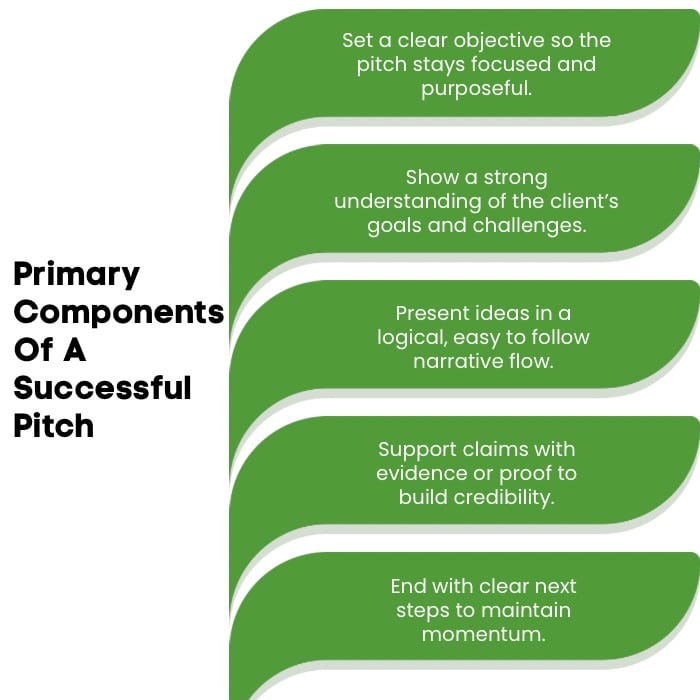
An Infographic on Primary Components Of A Successful Pitch
A successful pitch works when every part supports a clear message and moves the conversation forward. These core components help structure your thinking and ensure your pitch feels confident, relevant, and easy to follow.
1. Clear Objective and Focus
Every pitch needs a defined purpose. Whether the goal is approval, buy-in, or a next step, clarity keeps the conversation grounded and avoids unnecessary detours. Clients disengage when the pitch lacks focus and direction, causing confusion or hesitation in making a decision.
2. Strong Understanding Of The Client
Demonstrating awareness of the client’s goals, challenges, and context builds immediate trust. It reassures them that your recommendations are based on insight, not assumptions. Clients hesitate when they feel the pitch doesn’t directly address their needs or situation.
3. Compelling Narrative Flow
A strong pitch follows a logical story rather than isolated talking points. This makes your message easier to absorb and more persuasive. Clients disengage when the pitch lacks flow and structure, leaving them unsure of the overall value or direction.
4. Evidence and Proof
Credibility comes from showing real outcomes, experience, or results. Proof reduces uncertainty and strengthens confidence in your recommendations. Without solid evidence, clients are more likely to doubt your ability to deliver, weakening their commitment.
5. Clear Next Steps
A successful pitch always ends with direction. Clear actions prevent delays and help maintain momentum after the conversation ends. Without defined next steps, clients may feel uncertain or put off, stalling the decision-making process.
What Are The Different Types Of Pitches?
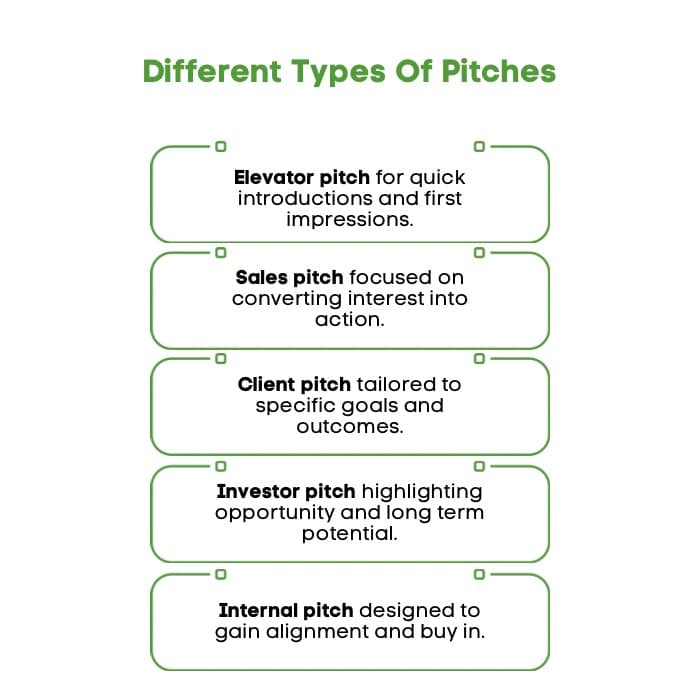
An Infographic on Different Types Of Pitches
Different situations call for different pitching styles. Understanding when to use each type helps you communicate effectively without overcomplicating the message.
1. Elevator Pitch
A short, focused explanation designed to quickly communicate value. It is ideal for first impressions, introductions, or unexpected opportunities. The goal here is to spark interest and make the audience want to hear more.
2. Sales Pitch
A more structured conversation aimed at converting interest into action. This pitch focuses on the client’s needs, your solution, and decision-making criteria. The objective is to turn curiosity into a commitment or purchase.
3. Client Pitch
Tailored to a specific organisation or stakeholder, this pitch emphasises relevance, outcomes, and alignment with business goals. The decision goal is to secure agreement, approval, or partnership by showing how your solution addresses their unique needs.
4. Investor Pitch
Used to secure funding or strategic support, this pitch highlights opportunity, scalability, and long-term vision rather than immediate delivery. It’s designed to convince investors of the market potential and long-term growth.
5. Internal Pitch
Presented to teams or leadership to gain buy-in for ideas or initiatives. Clarity, alignment, and feasibility are key here. The goal is to gain approval for new initiatives or strategic directions.
Strong pitches are built on clarity, relevance, and intent. By selecting the right pitch type and aligning it with the specific decision you are trying to unlock, your message lands with purpose and confidence.
Looking to strengthen your strategy beyond pitching? Explore The Complete Digital Marketing Checklist For Businesses to align your outreach, messaging, and growth efforts more effectively.
How Can You Win Your Next Client Pitch? (15 Actionable Strategies)
Winning a client pitch isn’t just about talent; it’s about understanding the client, communicating value clearly, and guiding the conversation confidently. Mastering the basics of a strong pitch helps you apply a structured approach across industries and services.
Each tip builds on the previous one, helping you move from preparation to presentation to follow-up with clarity and intent.
1. Research The Client Beyond The Brief
Go deeper than the surface requirements by understanding the client’s business model, market size, and competitive pressures. When you reference their target market and challenges accurately, your pitch feels prepared and credible. This level of research shows respect for the opportunity and the potential customer behind it.
2. Start Your Client Pitch With Their Problem
Opening with the client’s pain points immediately captures the prospect’s attention. It shows that you understand the prospect’s needs before talking about yourself. This approach works far better than jumping straight into a sales pitch or credentials.
3. Tailor Every Client Pitch To The Audience
Decision-makers expect relevance, not recycled slides. A pitch built around the target audience, whether founders, marketing heads, or potential investors, feels intentional and thoughtful. Personalisation also helps your message connect on a personal level.
4. Clearly Define The Outcome You Will Deliver
Clients care about results, not tools. Focus on impact, transformation, and what success looks like after working with you. A good sales pitch clearly answers what will change and why it matters.
5. Keep Your Client Pitch Simple And Structured
A clear flow helps people follow your thinking and trust your recommendations. Strong structure is one of the key elements of an effective pitch deck. Simplicity also makes your pitch presentation easier to remember.
6. Position Yourself As A Problem Solver, Not A Vendor
Avoid sounding transactional or pushy. When you approach the conversation like a business pitch built on insight, you build confidence faster. Consultative positioning supports a successful pitch over a short-term sale.
7. Use Real Examples Or Case Studies
Specific results and outcomes act as social proof and reduce hesitation. Referencing sales pitch examples or a proven track record helps clients visualise success. Proof reassures prospective customers that your claims are realistic.
8. Anticipate Objections In Advance
Think through concerns around timelines, resources, or risk before they come up. Addressing objections early shows experience with the sales process. It also keeps the conversation focused instead of defensive.
9. Show Your Process Step By Step
Walking through how you work helps clients picture collaboration with your team members. Transparency reduces friction and builds trust. It also reinforces that your approach is repeatable, not improvised.
10. Focus On Value Before Pricing
Value framing makes pricing strategy discussions easier and more logical. When clients understand outcomes first, cost feels contextual instead of confrontational. This is especially effective for small businesses evaluating limited budgets.
11. Align Your Client Pitch With Business Goals
Creativity matters, but alignment matters more. Show how your solution supports their business plan and long-term objectives. This positions your idea as a strategic investment, not an experiment.
12. Keep Slides Or Visuals Clean And Minimal
Visuals should support your message, not compete with it. A clean sales presentation pitch improves clarity and keeps focus on your words. A strong pitch presentation uses visuals as a powerful tool, not decoration.
13. Practice Delivery, Not Just Content
Confidence, pacing, and tone influence how your message lands. Whether it is an elevator pitch or a longer sales presentation, delivery shapes perception. Practise until the message feels natural, not rehearsed.
14. End Your Client Pitch With A Clear Next Step
Unclear endings stall momentum. A direct call to action keeps the sales funnel moving forward. Whether it is a follow-up call, proposal, or free trial, clarity prevents hesitation.
15. Follow Up Strategically After The Client Pitch
A thoughtful follow-up reinforces your compelling narrative and brand’s personality. It reminds the prospect of your unique experience and competitive advantage. Strong follow-ups often decide a winning sales pitch.
A successful sales pitch blends preparation, clarity, and relevance. When your message reflects best practices, highlights unique selling points, and stays focused on real outcomes, your client pitch becomes a consistent driver of trust and growth across different types of sales pitches.
If you are refining how you position your services, read our blog Is 4s Marketing the Upgrade Your Strategy Needs In 2026 to explore a modern framework that strengthens strategy, clarity, and execution.
What Are The Common Reasons Client Pitches Fail?
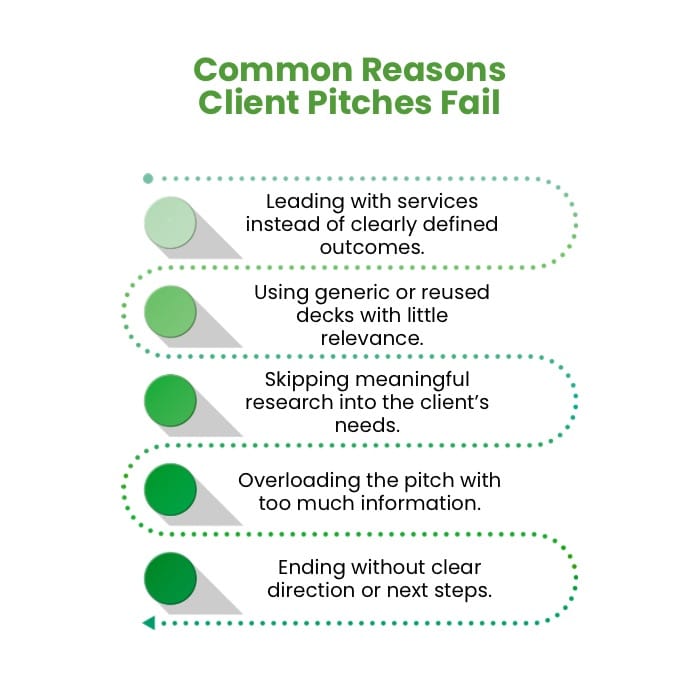
An Infographic Common Reasons Client Pitches Fail
Even strong teams lose opportunities because small but critical details are overlooked. Most failed pitches are not the result of weak offerings but unclear thinking, poor structure, or misaligned messaging.
Understanding the patterns below helps you fix gaps before they cost you the deal and strengthens every client pitch presentation going forward.
1. Leading With Services Instead Of Outcomes
Many pitches focus heavily on what is being offered rather than why it matters. When the value proposition is unclear, decision-makers struggle to see relevance. The best way to pitch is to frame outcomes first and let services support the result.
2. Relying On Generic Or Reused Decks
Recycled slides dilute your unique selling proposition and make the pitch feel impersonal. Generic decks fail to communicate a clear central idea or market opportunity. Without context, even strong creative ideas lose impact.
3. Skipping Meaningful Client Research
A lack of research leads to assumptions instead of insight. When you do not understand the client’s business idea or challenges, your key points feel disconnected. Effective pitches are built on a deep dive into what actually matters to the client.
4. Overloading The Pitch With Too Much Information
Trying to cover everything at once often creates confusion. An unfocused elevator pitch deck with no clear hierarchy overwhelms rather than convinces. Clarity comes from choosing what to exclude, not what to add.
5. Ending Without Clear Ownership Or Direction
Many pitches fail at the finish line. When next steps are vague or responsibility is unclear between you and the sales team, momentum drops. A strong close ties insights back to action and sets the stage for progress.
Client pitches fail when clarity is sacrificed for volume and relevance is replaced with assumptions. Fixing these gaps early ensures your pitch supports a strong narrative, clear direction, and better outcomes before moving into improvement strategies.
How To Adapt Your Client Pitch For Different Industries?
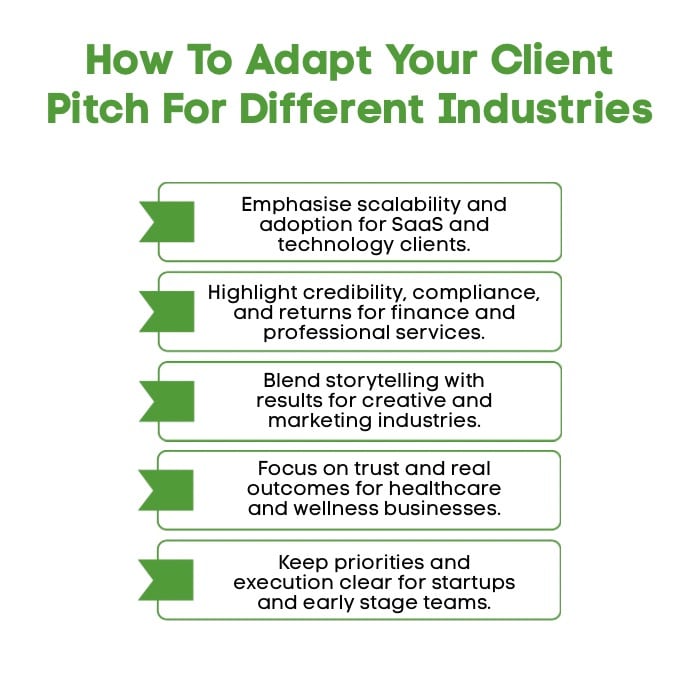
An Infographic on How To Adapt Your Client Pitch For Different Industries
No two industries evaluate value the same way. A client pitch that works well in one sector may fall flat in another if the tone, proof points, or success metrics feel misaligned. Adapting your approach shows brand awareness and signals that you understand how decisions are made in that space.
1. For SaaS And Technology Companies: Focus on Proof and Scalability
Focus on scalability, adoption, and long-term value rather than features alone. Use product-led examples, clear workflows, and measurable outcomes. Decision-makers in this space respond well to clarity around implementation and future growth.
2. For Finance And Professional Services: Emphasize Trust and Risk Management
Precision and credibility matter most here. Emphasise risk management, compliance, and structured processes while keeping the tone confident and restrained. Metrics should highlight stability, efficiency, and return on investment.
3. For Creative And Marketing Industries: Highlight Creativity and Proof of Impact
Storytelling plays a larger role in these pitches. Balance performance metrics with strong narratives that show brand impact and audience connection. Flexibility, originality, and results-driven creativity resonate more than rigid frameworks.
4. For Healthcare And Wellness Businesses: Build Trust and Show Sensitivity
Trust and sensitivity shape decision-making in this space. Use real-world outcomes, ethical considerations, and long-term value to build confidence. A calm, informative tone often works better than aggressive persuasion.
5. For Startups And Early-Stage Businesses: Prioritize Speed and Momentum
These audiences look for clarity and momentum. Keep the pitch focused on priorities, quick wins, and realistic execution. Showing adaptability and clear thinking helps founders feel supported rather than overwhelmed.
Adapting your client pitch to industry expectations improves relevance, trust, and decision-making. When tone, examples, and metrics align with how each sector thinks, your message feels considered rather than generic.
To better understand what influences buying decisions, explore What Drives Information Search in Consumer Behaviour Today and refine how you position your message during key decision moments.
Why Choose Wild Creek Web Studio For Stronger Client Pitches?
A winning client pitch needs clarity, relevance, and strategic thinking, not just polished slides. Wild Creek Web Studio helps businesses sharpen their positioning and messaging so pitches feel confident, focused, and aligned with real business goals.
With close to two decades of digital experience, their team combines data-backed strategy with human-led insight to shape pitches that decision-makers trust. From refining value propositions to strengthening digital presence, Wild Creek Web Studio ensures every pitch is supported by a solid growth foundation.
Looking to pitch with more clarity and impact? Contact Wild Creek Web Studio to build strategies that convert conversations into long-term wins.
Final Thoughts
A strong client pitch is not about polished slides or clever wording. It is about clarity, relevance, and intent. When you understand who you are pitching to, structure your message around real outcomes, and communicate with confidence, pitching stops feeling like persuasion and starts feeling like problem-solving.
The most successful pitches are built through preparation, not improvisation. By refining how you research, present, adapt, and follow up, you create consistency in how prospects experience your work. Over time, this approach turns pitching into a repeatable process rather than a high-pressure moment, helping you win better clients and build long-term partnerships instead of one-off wins.
Frequently Asked Questions
How to pitch a client for digital marketing?
Start by framing the client’s growth goals and current gaps, then explain how your digital marketing approach addresses them. Use relevant examples, realistic timelines, and measurable outcomes to show how your strategy supports visibility, engagement, and conversions.
How to pitch a service to a client?
Focus on the problem your service solves rather than listing features. Explain the impact, expected results, and working process in clear terms. Clients respond better when they can see how your service fits into their priorities and delivers tangible value.
How can I make my client pitch stand out from competitors?
Differentiate your pitch through relevance and clarity. Show a strong understanding of the client’s situation, present a focused solution, and communicate with confidence. A pitch that feels tailored and outcome-driven naturally stands out from generic competitor messaging.
What do clients typically look for in a business pitch?
Clients usually look for clarity, credibility, and confidence. They want to understand how well you grasp their needs, whether your solution is practical, and if you can deliver consistent results. Clear next steps also signal professionalism and reliability.
How can I customize my pitch to fit a specific client’s needs?
Customization starts with research. Align your messaging to the client’s goals, challenges, and decision criteria. Use their language, reference their context, and adjust examples accordingly so the pitch feels relevant rather than templated.
How to pitch a client on call?
Keep the call structured but conversational. Open with their priorities, guide the discussion around solutions, and pause to invite feedback. Clear pacing and active listening help build trust and keep the conversation focused and productive.
How to pitch a client on email?
An effective email pitch to new clients should be concise, personalised, and value-led. Open with a relevant insight, clearly state how you can help, and end with a simple call to action. Avoid long explanations and keep the message scannable.
How should I structure my pitch when presenting services to a potential client?
Structure your pitch with a clear flow. Start with the problem, move to your solution, support it with proof, and close with next steps. This logical sequence helps potential clients follow your thinking and make confident decisions.