Key Highlights
- Content marketing and SEO serve different roles but work best as a unified system to drive consistent, long-term growth.
- Content marketing focuses on building trust, authority, and engagement, while SEO ensures that content is discoverable by the right audience at the right time.
- Aligning search intent with valuable content improves traffic quality, user experience, and conversion potential.
- Combining both strategies helps content remain relevant and perform well long after publication.
- Over-optimising for keywords or prioritising volume over value weakens readability, credibility, and long-term results.
- Measuring success requires tracking engagement, topic performance, and conversions, not just rankings or traffic volume.
- Human judgement remains essential for interpreting data, refining strategy, and creating content that truly resonates.
Many businesses reach a point where growth feels inconsistent, even though they are publishing content and investing time in optimisation. Blog posts go live, keywords are tracked, and traffic numbers move, yet the results rarely match expectations. The confusion often starts with one question: Should the focus be on content marketing or SEO?
The problem deepens when both are treated as separate efforts. Content may read well but fail to attract the right audience, while SEO driven pages may rank yet struggle to keep visitors engaged. This disconnect leads to wasted effort, unclear priorities, and constant second-guessing about where time and budget should really go.
This blog breaks down content marketing vs SEO in practical terms. It explains how the two differ, how they support each other, and how to use them together to drive sustainable growth without choosing one at the expense of the other.
What Is Content Marketing?
Content marketing is often mistaken for simple content creation or just sharing promotional material, but what truly makes it effective is its focus on providing value that addresses the target audience‘s real needs. Instead of pushing direct promotions, it builds trust by offering useful content, such as blogs, guides, and case studies, that genuinely helps solve problems and foster connections.
The goal is not just visibility, but connection. Strong content marketing helps brands educate their audience, establish authority in their space, and stay top of mind throughout longer decision journeys, especially in B2B and SaaS environments where trust matters just as much as traffic.
What Is SEO?
SEO, or search engine optimisation, is the process of improving a website so it appears more prominently in search engine results when people look for specific topics or solutions. It focuses on helping search engines understand your pages while making sure the content matches what users are actually searching for.
Rather than relying on paid promotion, SEO works to attract consistent, high-intent traffic over time. When done well, it helps the right content reach the right audience and potential customers at the moment they are actively looking for answers, products, or services.
What Is The Relationship Between SEO And Content Marketing?
SEO and content marketing are closely connected, even though they serve slightly different purposes within digital marketing. SEO helps content get discovered by aligning it with search behaviour, while content marketing gives SEO something valuable to rank. Without content, SEO has nothing to optimise, and without SEO, even strong content can struggle to reach the right audience.
In practice, they work best as a single system. SEO insights guide what topics to create and how to structure them, while quality content improves engagement, authority, and trust signals that search engines value. When both are aligned, brands see more sustainable traffic, stronger visibility, and content that continues to perform long after it is published.
Is There A Difference Between Content Marketing And SEO?
Yes, there is a difference, though they often overlap. Content marketing is focused on creating valuable, engaging messages for your audience, while SEO optimises that content so it can be easily found and ranked by search engines. Content marketing is about storytelling and building relationships, while SEO ensures the content is structured for search intent, technical best practices, and performance.
When businesses blur the lines between SEO and content marketing, things can go wrong. If SEO leads without content, you may rank for keywords, but the content won’t engage or convert visitors. On the other hand, if content leads without SEO, it might be valuable but hidden from the right audience. A balance of both ensures content is not only valuable but also discoverable and effective.
What Are The Benefits Of Combining SEO And Content Marketing?
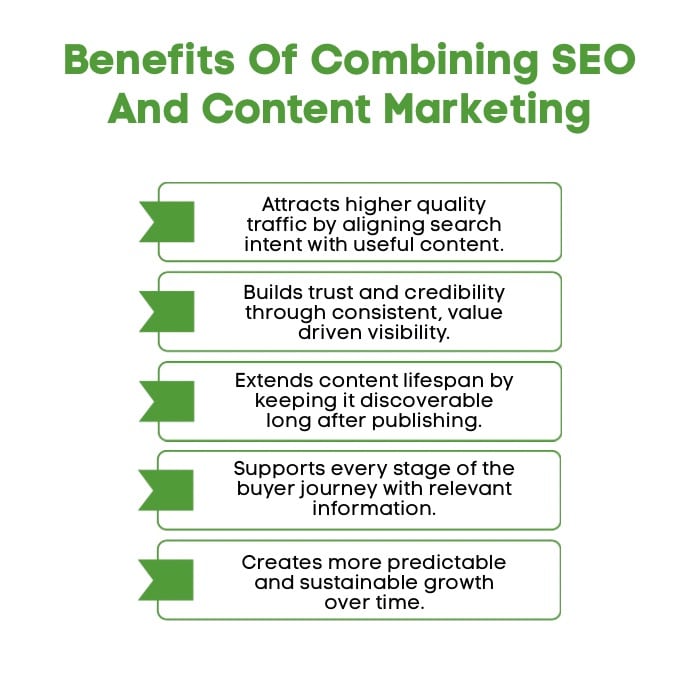
An Infographic on Benefits Of Combining SEO And Content Marketing
When SEO and content marketing work together, the impact on user experience goes beyond rankings or traffic alone. The combination creates a stronger, more reliable system for attracting the right audience and supporting long-term growth. Below are the key benefits businesses see when SEO and content marketing are aligned:
1. Attracts Higher Quality Traffic
SEO helps bring in people who are actively searching, while content marketing ensures they find useful, relevant information that satisfies user intent when they arrive. This alignment improves engagement and increases the likelihood that visitors stay, explore, and convert.
2. Builds Trust And Brand Credibility
Helpful, well-structured content positions a brand as a reliable source of information. Over time, consistent visibility paired with genuine value strengthens credibility, especially in competitive or research-driven industries.
3. Improves Content Longevity
Content supported by SEO continues to generate results long after it is published. Instead of short-lived attention, optimised content assets compound in value and improve the quality of traffic, remaining discoverable as search behaviour evolves.
4. Supports The Entire Buyer Journey
SEO and content marketing together address different stages of decision-making. Informational content educates early-stage users, while deeper resources and comparisons support consideration and conversion.
5. Creates More Predictable Growth
When both strategies are aligned, performance becomes easier to track and refine. Insights from search behaviour and content engagement guide better decisions, leading to steadier and more sustainable growth over time.
Combining SEO and content marketing creates a unified growth system that drives sustained visibility, engagement, and long-term success.
What Are Effective Strategies To Combine SEO With Content Marketing?
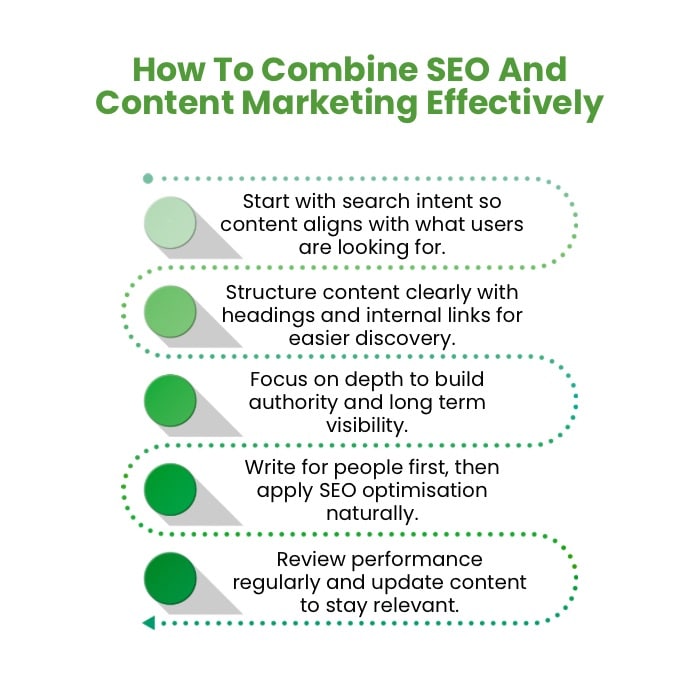
An Infographic on How To Combine SEO And Content Marketing Effectively
Bringing SEO and content marketing together is not about adding keywords at the last minute. It is about creating valuable content with a clear purpose, then shaping it so it can be easily found, understood, and trusted.
Here is how teams can combine both approaches in a way that feels natural and sustainable.
1. Start With Search Intent, Not Just Keywords
Every strong piece of content begins with understanding intent. SEO research reveals what people are trying to solve, while content marketing translates that insight into clear, helpful answers. This approach keeps content aligned with real user needs instead of surface-level keyword targeting. Over time, intent-led content earns stronger engagement and more meaningful traffic.
2. Create Content That Is Built To Be Discovered
Even the best content needs structure to perform well in search. Clear headings, logical flow, internal links, and clean formatting help search engines understand your message and improve web traffic. At the same time, this structure improves readability for users. A well-planned SEO and content marketing strategy balances discoverability without sacrificing tone or clarity.
3. Let Content Depth Support Authority
Depth plays a major role in building trust and visibility. Content that fully explores a topic signals expertise to both readers and search engines, particularly when considering the various types of content available. Instead of publishing many shallow articles, focus on creating fewer, stronger resources. This depth supports long-term rankings and reinforces authority across related topics.
4. Optimise After Writing, Not Before
Writing should always start with people in mind. Once the content clearly delivers value, optimisation can follow through with refined titles, meta descriptions, and internal links. This keeps the message natural while still improving performance. It is a simple but effective seo and content marketing practice that avoids forced optimisation.
5. Review Performance And Improve Regularly
SEO and content marketing are not set-and-forget efforts. Performance data shows what resonates, but context and judgement determine what to improve. Updating content, refining structure, and expanding sections based on real behaviour leads to more effective seo and content marketing over time.
The strongest results come from treating SEO as a guide and content marketing as the experience, working together to create content that stays relevant, visible, and valuable.
What Are The Common Mistakes When Combining SEO With Content Marketing?
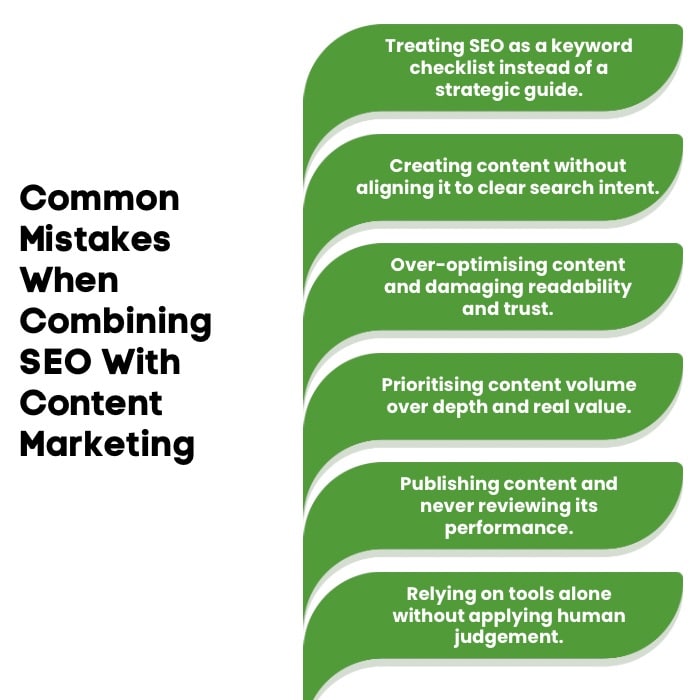
An Infographic on Common Mistakes When Combining SEO With Content Marketing
When SEO strategy and content marketing are not aligned properly, the result is often content that ranks poorly in search engine rankings or fails to engage. These mistakes usually come from prioritising shortcuts, automation, or volume over clarity, intent, and audience value.
Below are the most common problems teams face, along with clear ways to fix them.
1. Treating SEO As A Keyword Checklist
Focusing only on keywords often leads to content that feels forced or repetitive. Pages are written to satisfy search engines rather than real readers. This approach may deliver short-term visibility but rarely builds trust or sustained engagement. Over time, performance drops as content fails to meet user expectations.
Solution: Use keywords to guide topic selection and structure, then focus on answering search intent clearly and naturally.
2. Creating Content Without Clear Search Intent
Content created without intent alignment often misses the mark, even if it is well-written. Readers may arrive but quickly leave when their question is not answered. This results in low engagement, weak conversions, and poor long-term performance in organic search results. Search engines recognise this mismatch over time.
Solution: Identify whether users want information, comparison, or action, and shape content depth and format accordingly.
3. Over-Optimising At The Cost Of Readability
Excessive optimisation can make content difficult to read and trust, especially when it fails to address readers’ pain points. Keyword-heavy sentences and rigid structures disrupt flow and clarity. Readers notice when content feels written for algorithms instead of people. This weakens credibility and reduces engagement signals.
Solution: Write for people first, then apply SEO refinements that support clarity and natural reading.
4. Prioritising Volume Over Value
Publishing large amounts of shallow content spreads authority thin. Similar topics compete with each other instead of strengthening topical relevance. Readers gain little value from surface-level coverage. Over time, this approach limits ranking potential and brand credibility.
Solution: Focus on fewer, deeper pieces that fully explore topics and remain useful long term.
5. Ignoring Performance After Publishing
Content is often treated as complete once it goes live within an effective SEO content marketing strategy. Without review, declining performance or missed opportunities go unnoticed. Rankings, engagement, and relevance can slip quietly over time. This prevents continuous improvement.
Solution: Review performance regularly and update content based on real user behaviour and results.
6. Relying Too Heavily On Tools Alone
Tools can drive decisions without context or judgement. This often leads to generic content that mirrors competitors. Data alone cannot capture nuance, audience understanding, or brand voice. The result is content that blends in rather than stands out, hindering SEO success.
Solution: Use tools for insight, but rely on human judgement to apply relevance, context, and prioritisation.
Avoiding these mistakes allows SEO to support content, not control it, resulting in clearer messaging, stronger engagement, and more sustainable long-term results.
How To Effectively Measure The Success Of SEO And Content Marketing Integration?
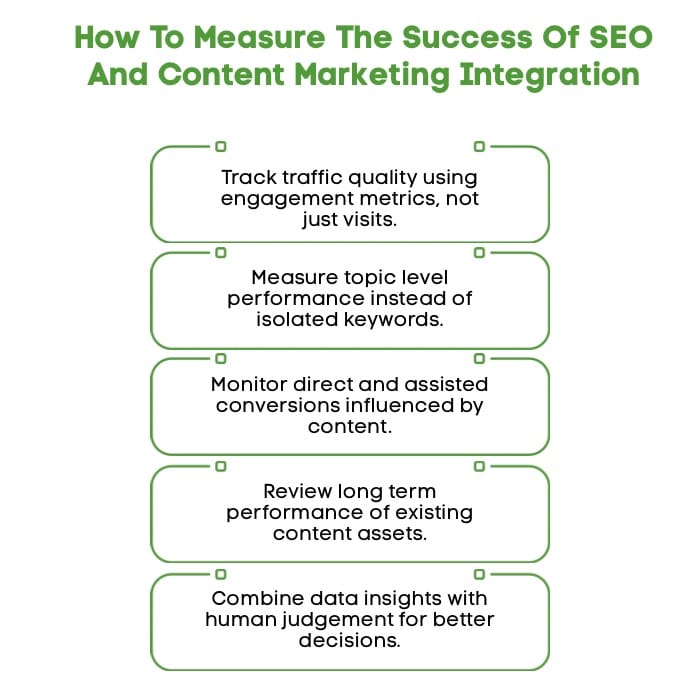
An Infographic on How to Measure The Success Of SEO And Content Marketing Integration
Measuring success is not about tracking more metrics, but tracking the right ones. When SEO and content marketing are working together, to achieve the best results, performance should reflect both visibility and meaningful engagement, not just raw traffic numbers.
Below are the key ways to evaluate whether your efforts are moving in the right direction.
1. Track Organic Traffic Quality, Not Just Volume
Rising traffic only matters if the right users are arriving. Look at metrics such as time on page, pages per session, and bounce rate to understand whether content is meeting expectations. Strong alignment between search intent and content usually results in better engagement signals.
2. Measure Keyword And Topic Performance Together
Instead of focusing on individual keywords, assess how entire topics are performing, including their search volume. Improvements across related terms often indicate that your content is building authority. This approach reflects how modern SEO in content marketing supports broader visibility rather than isolated rankings.
3. Monitor Conversion And Assisted Conversion Paths
SEO driven content often plays a supporting role in conversions, especially in local SEO contexts. Track form fills, sign-ups, demo requests, or other actions, including assisted conversions where content influences decisions earlier in the journey.
4. Evaluate Content Longevity And Ongoing Performance
Well-integrated SEO and content marketing should deliver results over time through an effective SEO content strategy. Review how older content continues to attract traffic, rankings, and engagement. Sustained performance is a strong indicator of successful integration.
5. Combine Data With Human Insight
Metrics show what is happening, but context explains why. Review performance trends alongside audience feedback, behaviour patterns, and qualitative insights to decide what needs refinement, expansion, or repositioning.
Successful measurement focuses on relevance, engagement, and long-term impact, not isolated metrics or short-term spikes.
Why Choose Wild Creek Web Studio for Sustainable SEO-Led Content Growth?
At Wild Creek Web Studio, we do not treat SEO and content marketing as separate efforts. With nearly two decades of experience, we focus on building integrated strategies where search insights, content clarity, and business goals work together to drive steady, long-term growth.
What sets us apart is our emphasis on human judgement alongside data. We use tools to uncover opportunities, but real impact comes from how we interpret intent, understand audiences, and make informed decisions. This ensures your content ranks for the right reasons and resonates with real people, not just algorithms.
Ready to build a smarter, more connected digital strategy? Get in touch with Wild Creek Web Studio and let us help you create content that performs with purpose.
Final Thoughts
Content marketing and SEO work best as a single system, not separate strategies. Content builds trust, answers real questions, and shapes how your brand is perceived, while SEO ensures that value reaches the right audience at the right moment. When aligned, they create visibility that is meaningful, not just measurable.
Sustainable growth comes from integrating both with clear intent and human judgement. Instead of chasing rankings or publishing for volume, brands that focus on relevance, clarity, and audience needs see stronger engagement and longer-lasting results.
Frequently Asked Questions
How do SEO and content marketing work together for online growth?
SEO helps content get discovered, while content marketing builds trust and engagement. Together, they drive sustainable website traffic by attracting the right users from Google search, delivering valuable information, and guiding them towards a profitable customer action through consistent, audience-focused messaging.
SEO vs PPC vs content marketing, which is better?
Each serves a different purpose. PPC delivers quick visibility, SEO supports long-term search rankings, and content marketing builds brand awareness. For sustainable growth, combining content marketing SEO with organic optimisation often delivers stronger returns than relying on short-term paid campaigns alone.
How does content marketing help improve SEO?
Content marketing strengthens SEO by improving content quality and relevance. High-value website content attracts engagement, supports keyword rankings, and earns trust signals. Over time, useful content helps search engines view your site as authoritative and worthy of higher rankings.
What are the basics of creating SEO-friendly content in content marketing?
Start with keyword research to identify specific keywords your audience uses. Create a clear blog post structure, focus on relevant keywords naturally, and ensure content creation is aligned with user intent rather than search engines alone.
How do search engines evaluate content for SEO in content marketing?
Search engines assess web pages based on relevance, usefulness, and technical performance. Factors include content quality, mobile optimisation, technical SEO, and how well the content serves a clearly defined audience looking for accurate and helpful answers.
How do I optimise content marketing campaigns for better SEO results?
Optimise campaigns by aligning topics with audience needs, updating existing website content, and improving internal structure. Distribute content across social media platforms to increase reach, support discovery, and reinforce authority beyond search alone.
Can social channels support SEO-focused content marketing?
Yes, sharing content on social media helps increase visibility and engagement. While social signals are indirect, consistent promotion supports discovery, strengthens brand awareness, and encourages users to explore deeper site content organically.