
Key Highlights
- SaaS SEO focuses on increasing organic visibility for software products and attracting users searching for solutions, tools, comparisons, and alternatives.
- A strong SaaS SEO strategy targets the full buyer journey using educational content, comparison pages, feature guides, and integration pages.
- Keyword research should prioritise problem, category, comparison, alternative, and feature-based searches that signal software evaluation intent.
- Technical SEO for SaaS includes clear site architecture, fast page performance, proper indexation control, and strong internal linking across product, blog, and documentation sections.
- Link building for SaaS often comes from data-driven research, guest contributions, integration partnerships, and in-depth educational resources.
- Startups typically target long-tail opportunities, while enterprise SaaS companies expand into highly competitive categories and ecosystem-level keywords.
- Wild Creek Web Studio helps SaaS companies build scalable SEO strategies through technical optimisation, strategic content, and data-driven organic growth planning.
Customer acquisition is one of the biggest challenges for SaaS companies, especially as paid advertising costs continue to rise. At the same time, 68% of online experiences begin with a search engine, which highlights how important organic visibility is for software discovery.
However, SEO for SaaS companies is more complex than traditional SEO. SaaS businesses must target multiple stages of the buyer journey, from early problem awareness to solution research and product comparisons. Without a structured SaaS SEO strategy, many companies struggle to capture high-intent traffic and convert visitors into trials or demos.
This SaaS SEO guide explains how SaaS companies can build a sustainable organic growth channel. You will learn how to develop an effective SaaS SEO strategy, implement technical SEO for SaaS platforms, and create content that attracts qualified users throughout the SaaS buying journey.
What Is SaaS SEO?
SaaS SEO is the process of optimising a Software-as-a-Service website to increase its visibility in search engines and attract users searching for software solutions. The goal is to drive qualified organic traffic that can convert into product signups, free trials, or demo requests.
Unlike traditional SEO, SaaS SEO focuses on capturing demand across different stages of the buyer journey. This includes educational searches, solution research, and product comparison queries such as “best CRM software” or “[tool] alternatives.”
An effective SaaS SEO strategy combines keyword research, product-led content, and technical optimisation to help SaaS companies attract high-intent users and generate consistent organic growth.
How Important Is SEO In A SaaS Business?
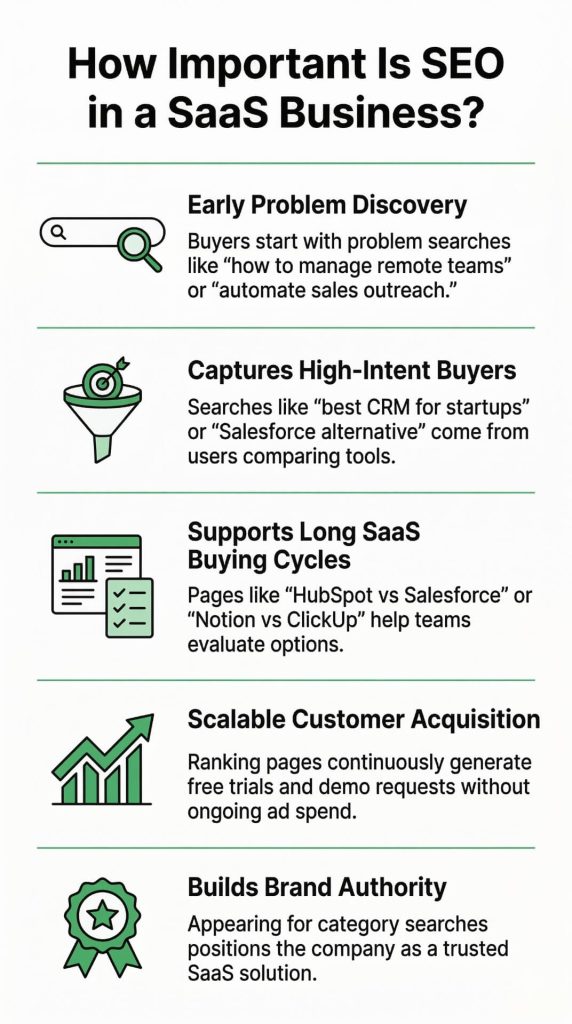
SEO plays a critical role in how SaaS companies acquire users because most software buyers start by researching solutions online. Instead of discovering a product directly, they typically search for problems, software categories, feature comparisons, or alternatives before choosing a tool.
A strong SaaS SEO strategy allows companies to appear during these discovery and evaluation stages and capture demand before competitors do.
For SaaS businesses, SEO contributes to growth in several important ways:
- Reaches buyers during early problem research: Many users begin with searches like “how to manage remote teams,” “how to automate sales outreach,” or “how to organize marketing campaigns.” Ranking for these topics allows SaaS companies to introduce their product category before buyers even start comparing tools.
- Captures high-intent users who are actively evaluating software: Queries like “best CRM for startups,” “project management tools for remote teams,” or “Salesforce alternative for SMBs” usually come from buyers comparing options and getting closer to choosing a platform.
- Supports longer SaaS buying cycles with research-driven content: Pages such as “HubSpot vs Salesforce,” “Notion vs ClickUp,” or “Slack alternatives for large teams” help teams evaluate features, pricing, and integrations before making a purchase decision.
- Creates a scalable customer acquisition channel: When pages rank for searches like “email marketing software for ecommerce” or “help desk software for small businesses,” they can continuously generate qualified traffic, free trials, and demo requests without ongoing ad spend.
- Builds category visibility and brand authority: Appearing consistently for searches like “marketing automation tools,” “CRM platforms for SaaS,” or “customer support software comparison” helps position a company as a trusted option within its software category.
Want to build a stronger growth foundation? Explore our guide on developing a clear customer acquisition strategy to understand how SaaS companies attract, convert, and retain the right users.
How Do You Create an Effective SaaS SEO Strategy?
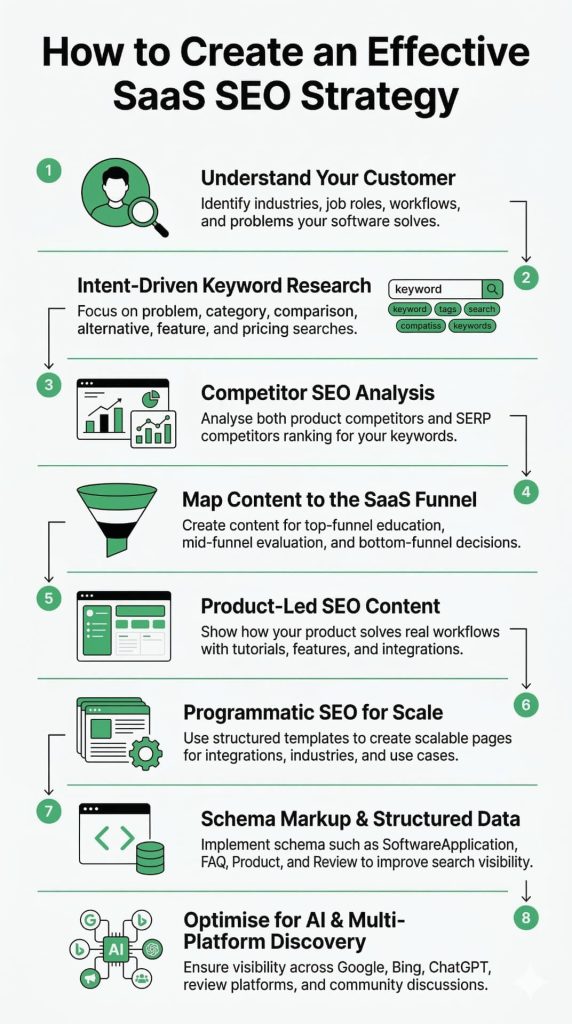
A strong SaaS SEO strategy focuses on capturing demand across the entire product discovery journey. Unlike many industries, SaaS buyers often research extensively before choosing a tool. They compare features, evaluate alternatives, read tutorials, and explore integrations. An effective strategy, therefore, combines search intent research, product-led content, and scalable SEO structures that support long-term organic growth.
1. Understand Your Ideal Customer and Their Search Behaviour
Successful SaaS SEO starts with understanding how your potential customers search for solutions. Instead of focusing only on keywords, SaaS companies should identify the problems users are trying to solve and the workflows they want to improve.
Key areas to analyze include:
- Target industries and company size
- Job roles involved in product evaluation
- Common operational problems your software solves
- Tools or workflows users currently rely on
These insights help shape SEO content that matches real search behaviour rather than generic traffic-driven topics.
2. Perform SaaS-Focused Keyword Research
Keyword research for SaaS should focus on intent-driven searches, especially those indicating software discovery or evaluation. Unlike many industries, SaaS keywords often fall into predictable categories that align closely with the buyer journey.
Important SaaS keyword categories include:
- Problem keywords: Example: “how to manage sales pipeline.”
- Category keywords: Example: “best CRM software.”
- Comparison keywords: Example: “HubSpot vs Salesforce.”
- Alternative keywords: Example: “HubSpot alternatives.”
- Feature keywords: Example: “CRM with email automation”
- Pricing keywords: Example: “HubSpot pricing,” “Salesforce pricing for small business.”
- Review platform keywords: Example: “HubSpot G2 reviews,” “Notion Capterra rating,” “ClickUp user reviews.”
Prioritisation tip: For early-stage SaaS companies, it often makes sense to prioritise comparison and alternative keywords first. Searches like “HubSpot alternatives” or “HubSpot vs Salesforce” typically come from buyers already evaluating tools and close to making a decision, even if these keywords have lower search volumes than broader category terms like “CRM software.”
3. Analyze Competitor SEO Strategies
Competitor analysis is especially valuable in SaaS because many successful companies rely heavily on organic search for customer acquisition. Studying competitor websites helps identify the content formats, page types, and keyword themes that drive traffic and conversions.
A key concept to understand is the difference between product competitors and SERP competitors. Product competitors offer similar software solutions, but SERP competitors are the websites that rank for your target keywords.
These are not always the same. For example, a tool like Slack may compete with other collaboration platforms as a product, but in search results, it may compete with software directories, review sites, or publishers that rank for queries like “best team communication tools.”
When analyzing competitors, focus on identifying:
- High-traffic blog topics that attract problem-aware users
- Comparison and alternatives pages targeting evaluation searches
- Integration and feature pages built around specific product capabilities
- Content clusters covering categories, use cases, and related tools
Reviewing both product competitors and SERP competitors helps reveal keyword gaps and proven content strategies your SaaS site can compete with.
4. Build Content Around the SaaS Funnel
A SaaS SEO strategy should support the entire customer journey, not just early research queries. This requires creating different content types that match search intent at each stage.
Common SaaS funnel content includes:
- Top of funnel
Educational guides, industry insights, beginner tutorials - Middle of funnel
“Best tools” lists, category pages, solution comparisons - Bottom of funnel
Alternatives pages, feature comparisons, integration pages
These pages help guide users from discovery to product evaluation.
5. Create Product-Led SEO Content
Many high-performing SaaS companies use product-led SEO, where content directly connects search intent with product functionality. Instead of publishing only educational blog posts, they create pages that show how the product solves real tasks.
Examples of product-led SEO content include:
- Workflow tutorials: Step-by-step guides showing how to complete tasks using the product
- Feature-based guides: Pages explaining specific capabilities and how they solve user problems
- Integration pages: Dedicated pages explaining how the product connects with other tools
- Use-case landing pages: Pages tailored to specific industries, roles, or workflows
Many successful SaaS companies rely heavily on this approach. For example, Ahrefs’ comparison pages (such as “Ahrefs vs SEMrush”) consistently rank for high-intent searches and guide users toward starting a trial. Similarly, HubSpot’s integration directory captures thousands of long-tail searches like “HubSpot + Slack integration” or “HubSpot + Shopify integration.”
6. Build Scalable SEO Structures with Programmatic SEO
As SaaS companies grow, their SEO strategy must scale. Many successful SaaS brands achieve this using programmatic SEO, a strategy that creates large sets of structured pages targeting related long-tail searches through repeatable templates and data.
Instead of publishing each page manually, programmatic SEO allows companies to build scalable page frameworks that capture thousands of variations of similar search queries.
Common examples include:
- Integration directories: Pages targeting searches like “HubSpot + Slack integration” or “Notion + Google Drive integration.”
- Template libraries: Pages such as “marketing campaign template,” “content calendar template,” or “sales pipeline template.”
- Industry-specific landing pages: Pages like “CRM for real estate,” “CRM for startups,” or “project management software for agencies.”
- Use-case pages: Content targeting workflows such as “project management for remote teams” or “customer onboarding automation.”
These programmatic page structures allow SaaS companies to systematically capture thousands of long-tail searches, expanding organic reach and generating consistent traffic as the product ecosystem grows.
7. Implement Schema Markup and Structured Data
Schema markup is now a core technical element of SaaS SEO, helping search engines and AI systems better understand product information and page content. Properly structured data can improve eligibility for rich results, product panels, and AI-generated answers.
Important schema types for SaaS websites include:
- SoftwareApplication: Defines product details such as name, category, pricing model, and platform compatibility.
- FAQPage: Helps common product questions appear in rich search results.
- HowTo: Useful for tutorials and workflow guides.
- Product: Adds structured product attributes and plan details.
- Review: Highlights ratings and user feedback.
Structured data also supports AI search visibility. At SMX Munich 2025, Microsoft’s Fabrice Canel noted that schema markup helps large language models interpret webpage content, making it increasingly important for multi-surface discovery.
8. Optimise for Multi-Platform and AI Search
SaaS buyers now research tools across multiple platforms, not just Google. Many evaluate software using AI assistants, review platforms, and community discussions before choosing a tool.
Important discovery surfaces include:
- AI assistants: ChatGPT, Perplexity
- Review platforms: G2, Capterra
- Community discussions: Reddit and industry forums
- Search engines: Google and Bing
To improve visibility across these channels, SaaS companies should:
- Publish clear comparison and evaluation content
- Maintain consistent product information across directories
- Encourage authentic customer reviews
- Structure content so it can be easily cited by AI systems
Optimising for these platforms helps SaaS brands stay visible throughout the modern software buying journey.
Curious how search demand influences your SEO strategy? Explore our guide on search volume optimisation to see how analysing keyword search volume can help you prioritise content and capture more organic traffic.
How Do You Conduct Keyword Research for SaaS SEO?
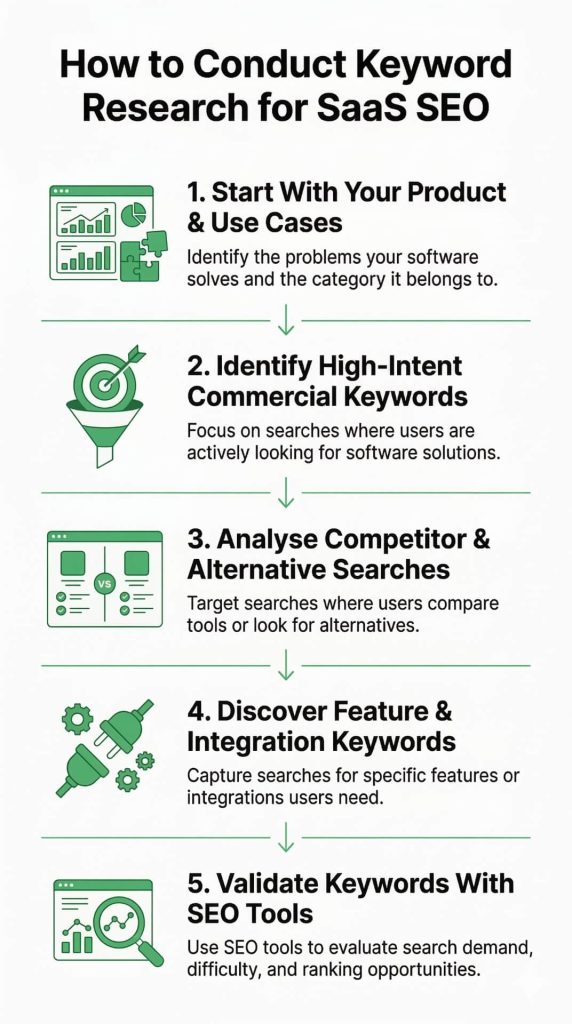
Keyword research for SaaS SEO is about understanding how potential customers search when they are looking for software solutions. Instead of chasing only high-volume keywords, SaaS companies should identify queries that indicate users are discovering tools, comparing Saas SEO platforms, or evaluating specific features.
A structured approach helps you prioritise keywords that can drive qualified traffic and product signups, not just visitors.
1. Start With Your Product and Core Use Cases
The easiest way to begin keyword research is to start with your product itself. Ask what problem your software solves and what category it belongs to. These answers usually reveal the core keywords that define your SaaS product.
For example, a CRM platform may target searches such as:
- CRM software
- customer relationship management tools
- CRM for small businesses
- sales pipeline management software
These keywords form the foundation of your SEO strategy because they reflect the main software category users are exploring.
2. Identify High-Intent Commercial Keywords
Not all searches bring the same value. Some keywords indicate that users are actively evaluating software solutions. These queries often have stronger commercial intent and are more likely to lead to trials or demos.
Examples include:
- best CRM software
- project management tools for agencies
- email marketing platforms
- customer support software for startups
Targeting these keywords helps SaaS companies appear when users are actively looking for a tool to adopt.
3. Analyse Competitor and Alternative Searches
Many SaaS buyers compare tools before making a decision. Because of this behaviour, comparison and alternative searches can be extremely valuable for SaaS SEO.
Common examples include:
- HubSpot vs Salesforce
- Asana vs Monday
- Slack alternatives
Creating pages that address these comparisons allows your website to appear when users are actively deciding which product to choose.
It is also useful to distinguish between two types of alternative searches:
- Head-term alternatives: Broad queries such as “HubSpot alternatives” that attract large search volumes and users exploring multiple tools.
- Feature-specific alternatives: More detailed searches like “HubSpot alternative with better reporting” or “Slack alternative for large teams.” These keywords typically have lower competition and higher intent, because users are already aware of a tool but want a solution that solves a specific limitation.
Targeting both types helps SaaS companies capture buyers at different stages of the evaluation process while uncovering high-converting long-tail opportunities.
4. Discover Feature and Integration Keywords
Users often search for tools with very specific capabilities. These queries typically relate to product features or integrations with other software.
Examples include:
- CRM with email automation
- project management software with time tracking
- Slack integration with Google Drive
These keywords are powerful because they attract visitors who already know exactly what functionality they need.
5. Validate Keywords With SEO Tools
Once you identify potential keywords, SEO tools help evaluate their search demand, competition, and ranking opportunities. Different tools provide different types of insights that are useful for SaaS SEO.
Key tools include:
- Ahrefs: Useful for analysing competitor rankings, backlink profiles, and identifying pages driving the most organic traffic to competing SaaS products.
- SEMrush: Strong for keyword gap analysis and intent mapping, helping identify keywords competitors rank for that your site does not yet target.
- Google Search Console: Reveals queries already bringing impressions or partial traffic, helping SaaS teams find quick-win keywords where pages are close to ranking higher.
Using these insights allows SaaS companies to prioritise keywords that are both relevant to their product and realistically achievable, improving the effectiveness of their SEO strategy.
Not sure who your content should target? Read our guide on finding your ideal audience to learn how understanding user pain points and search behaviour helps create content that attracts the right traffic and converts visitors into customers.
What Technical SEO Factors Should SaaS Websites Focus On?
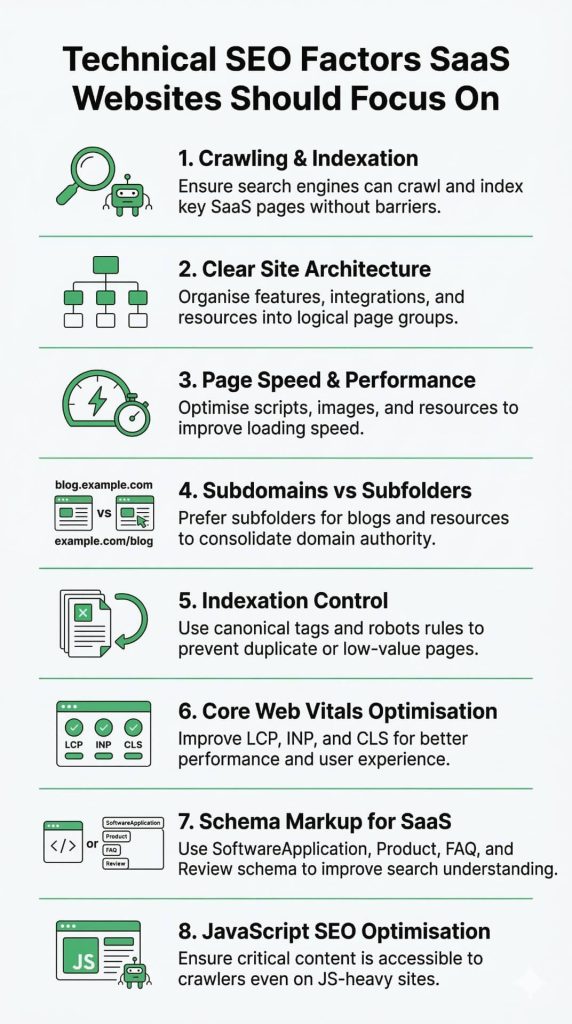
When people think about SaaS SEO, they often focus on content and keywords. But even the best content will struggle to rank if search engines cannot properly crawl or understand your website. This is where technical SEO for SaaS becomes essential.
SaaS websites are often more complex than traditional websites. They may include product dashboards, documentation hubs, integration pages, and dynamic frameworks built with JavaScript. Without proper optimisation, these elements can create indexing issues, slow loading speeds, or fragmented site structures that make it harder for search engines to evaluate the site.
1. Ensure Proper Crawling and Indexation
Search engines must be able to crawl and index important pages before they can rank them. SaaS websites often include dynamic content, gated product areas, or JavaScript-heavy elements that may block search engine crawlers.
Key practices include:
- Creating and maintaining XML sitemaps for important pages
- Ensuring critical content is accessible without login barriers
- Avoiding crawl traps created by filters, parameters, or dynamic URLs
- Using robots.txt carefully so essential pages remain crawlable
Ensuring clean crawling and indexation helps search engines discover and evaluate your most important SaaS pages.
2. Build a Clear and Scalable Site Architecture
One of the most important foundations of SEO strategies for SaaS companies is a well-organised site structure. When pages are logically grouped, search engines can better understand the relationship between your product, features, and supporting content.
A typical SaaS website structure may include sections such as:
- product features
- use cases or solutions
- integrations
- blog or learning resources
This structure helps distribute authority across the site and ensures important pages are easier for search engines to discover.
3. Optimise Page Speed and Performance
Many SaaS platforms rely on modern frameworks and interactive elements. While these features improve product functionality, they can sometimes slow down page loading times.
Improving performance can involve:
- compressing images and media files
- Reducing unnecessary scripts
- improving server response times
- optimising code and resources
Faster pages not only improve search performance but also create a better user experience.
4. Manage Subdomains and Product Resources
It is common for SaaS companies to host different parts of their website across multiple subdomains. For example:
- example.com
- example.com
- example.com
Without proper internal linking, these sections may operate like separate websites in the eyes of search engines. Connecting them through strategic linking helps consolidate authority and improve overall SEO performance.
As a general rule, prefer subfolders (example.com/blog) over subdomains (blog.example.com) for content whenever possible. Subfolders consolidate domain authority more effectively because they remain part of the main site structure, while subdomains are often treated by search engines as separate sites.
For SaaS companies, this means hosting resources such as blogs, learning hubs, and documentation within subfolders can help strengthen overall domain authority and improve the ranking potential of product and feature pages.
5. Control Indexation and Duplicate Pages
SaaS websites often generate many URLs through documentation pages, templates, filters, or dynamic content. If these pages are not managed correctly, search engines may crawl low-value or duplicate pages instead of focusing on important ones.
Common technical practices include:
- using canonical tags to avoid duplicate content
- controlling indexation with robots.txt,
- prioritising important product and resource pages
When handled properly, technical SEO creates a strong foundation that allows your SaaS SEO strategy to perform more effectively.
6. Improve Core Web Vitals
Core Web Vitals are key performance metrics that measure how quickly and smoothly a page loads for users. Since many SaaS websites rely on interactive interfaces, dashboards, and dynamic elements, performance optimisation is essential for both user experience and search rankings.
The three primary Core Web Vitals include:
- Largest Contentful Paint (LCP): Measures how quickly the main content of a page loads.
- Interaction to Next Paint (INP): Evaluates how responsive a page is when users interact with it.
- Cumulative Layout Shift (CLS): Measures visual stability and whether page elements shift while loading.
SaaS websites can improve these metrics by optimising images, reducing unused scripts, implementing caching, and improving server performance. Strong Core Web Vitals help ensure that product pages, documentation, and learning resources load quickly for both users and search engines.
7. Implement Schema Markup for SaaS
Schema markup helps search engines better understand your website’s content and product information. For SaaS companies, structured data can improve eligibility for rich results, product information panels, and AI-driven search experiences.
Important schema types for SaaS websites include:
- SoftwareApplication schema for describing the product, pricing model, and application category
- Product schema for plan details and software features
- FAQPage schema for product FAQs and support content
- HowTo schema for tutorials and workflow guides
- Review schema for user ratings and testimonials
Using schema markup helps search engines and AI systems interpret your content more accurately, improving visibility across search results and other discovery platforms.
8. Address JavaScript SEO Challenges
Many SaaS websites are built using JavaScript frameworks such as React, Angular, or Vue, which can create challenges for search engines when rendering content.
If critical content loads only after JavaScript execution, search engines may struggle to crawl or index the page properly.
Best practices for JavaScript SEO include:
- Ensuring important content is rendered server-side or through static rendering when possible
- Avoiding reliance on JavaScript for core navigation or internal links
- Testing pages using tools like Google Search Console URL Inspection to confirm that search engines can render content correctly
- Making sure key product pages, integrations, and documentation are fully accessible to crawlers
Proper JavaScript optimisation ensures that SaaS websites remain crawlable, indexable, and visible in search results, even when using modern web frameworks.
SEO attracts attention, but social media builds recognition. Discover practical social media strategies that help brands increase visibility, engage audiences, and grow stronger brand awareness online.
How Does Link Building Work for SaaS Companies?
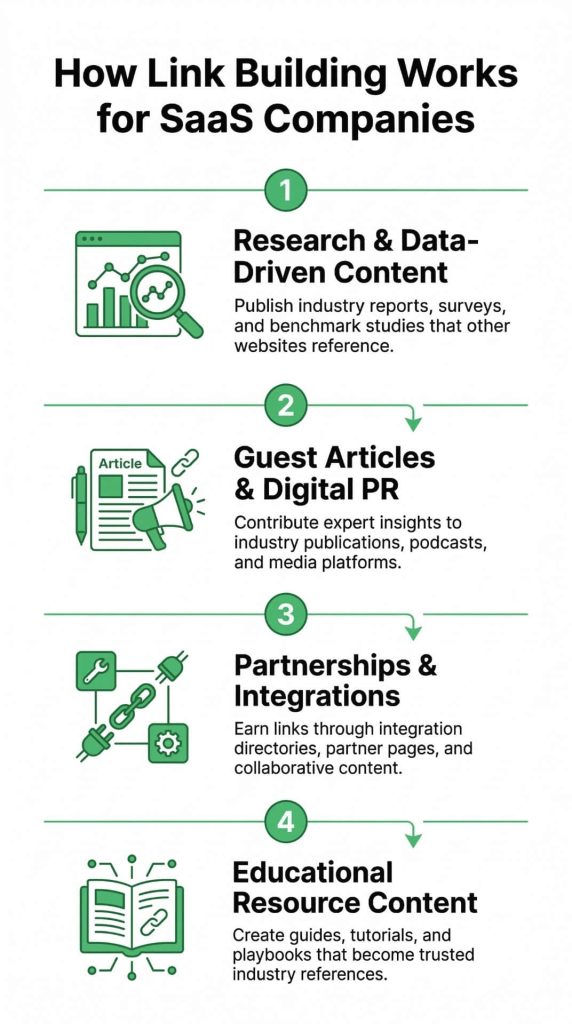
Backlinks remain one of the most important ranking factors in search. For SaaS businesses, link building helps establish credibility and authority within competitive software categories. When trusted websites link to your content, search engines interpret it as a signal that your site provides valuable information.
In B2B SaaS SEO, backlinks are particularly important because software markets are often dominated by well-established brands with strong domain authority. Building high-quality links helps newer or growing SaaS companies compete in search results and improve visibility for important keywords.
1. Create Research and Data-Driven Content
One effective way to earn backlinks is by publishing original research, reports, or data insights related to your industry. Journalists, bloggers, and industry publications often reference credible data when writing about trends or best practices.
Examples include:
- industry benchmark reports
- market trend studies
- survey-based insights
- original research on product usage
This type of content naturally attracts links because other websites cite it as a source.
2. Contribute Guest Articles to Industry Publications
Guest posting on reputable industry websites can help strengthen your backlink profile. Publishing articles on marketing, technology, or SaaS-focused platforms allows companies to reach new audiences while earning relevant links.
These collaborations are particularly valuable for enterprise SaaS SEO, where links from trusted industry publications can significantly improve authority and search visibility.
In addition to guest posting, many SaaS companies use digital PR and founder thought leadership to earn backlinks. This includes expert commentary, podcast appearances, interviews, and data-driven reports that get cited by industry media, often generating authoritative links and brand mentions.
3. Build Links Through Partnerships and Integrations
SaaS companies often integrate with other tools or platforms. These partnerships can create natural linking opportunities through integration directories, partner pages, and co-marketing content, which are highly relevant because they connect related software ecosystems.
Examples include:
- Integration partner listings
- Joint webinars or guides
- Collaborative case studies
Integration partner pages are particularly powerful for SaaS SEO. They often capture high-intent searches such as “[Your Product] + Salesforce integration” or “Slack + Google Drive integration,” while also earning a contextual backlink from a trusted partner website. Because both tools benefit from promoting integration, these links are usually natural and highly relevant.
Many successful SaaS companies have built significant organic visibility through this approach. For example, Zapier expanded much of its authority through thousands of integration pages, each targeting combinations like “Zapier + [tool] integration,” while also earning backlinks from partner platforms that promote the integration.
4. Earn Links Through High-Value Educational Content
Another sustainable approach to link building is creating educational resources that people naturally reference. Comprehensive guides, tutorials, and expert insights can attract links over time as they become trusted resources in the industry.
For SaaS companies, this might include:
- detailed how-to guides
- industry playbooks
- technical tutorials
- long-form educational resources
When combined with strong content and technical optimisation, link building helps strengthen the overall SEO for SaaS startups and established platforms alike.
Want your SaaS content to rank better? Learn how a strategic internal link structure connects related pages, improves crawlability, and helps search engines understand your site’s content hierarchy.
What Are Common SaaS SEO Mistakes to Avoid?
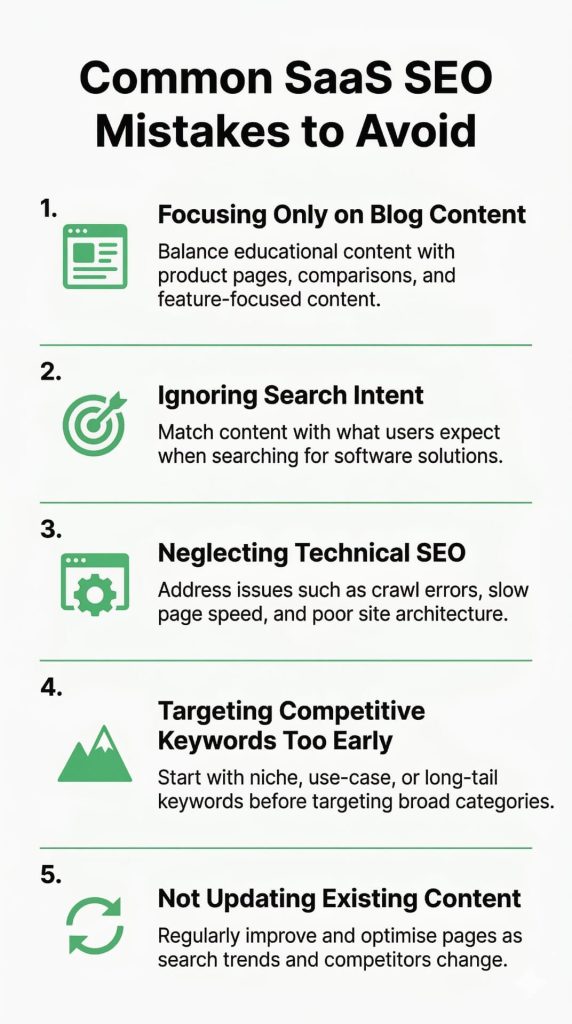
Even with a strong SaaS SEO strategy, many companies struggle to see results because of common strategic or technical mistakes. SEO for SaaS requires a long-term, structured approach, and small missteps can limit visibility or reduce the impact of your efforts.
Being aware of these common mistakes can help SaaS teams refine their approach and improve their organic growth over time.
1. Focusing Only on Blog Content
Many SaaS companies invest heavily in blog posts but overlook other page types that often drive higher conversions. While educational content is useful for awareness, decision-stage pages such as comparisons, alternatives, and feature pages often attract users who are closer to choosing a tool.
A balanced SaaS marketing SEO approach should include both educational and product-focused content.
2. Ignoring Search Intent
Targeting keywords without understanding the user’s intent can lead to content that does not match what people are looking for. For example, someone searching for the best CRM software expects a comparison or evaluation, not a basic informational article.
Aligning content with search intent helps ensure your pages meet user expectations and perform better in search results.
3. Neglecting Technical SEO
Technical issues can quietly affect SEO performance, especially for complex SaaS websites. Problems such as slow page speed, crawl errors, or poor site architecture may prevent search engines from properly indexing important pages.
Regular audits and improvements in technical SEO for SaaS help ensure that content and product pages are fully accessible to search engines.
4. Targeting Highly Competitive Keywords Too Early
For newer companies, competing immediately for extremely competitive keywords can be difficult. A more effective strategy is to start with specific use cases, niche queries, or industry-focused topics.
This approach is particularly important for SEO for SaaS startups, where building authority gradually can lead to more sustainable growth.
5. Failing to Update and Improve Existing Content
SEO is not a one-time effort. Over time, search trends change, competitors publish new content, and rankings shift. Updating existing pages with new insights, improved structure, or additional data can help maintain strong search performance.
Regular content optimisation ensures your SEO strategies for SaaS companies continue delivering results.
How Long Does SaaS SEO Take to Show Results?
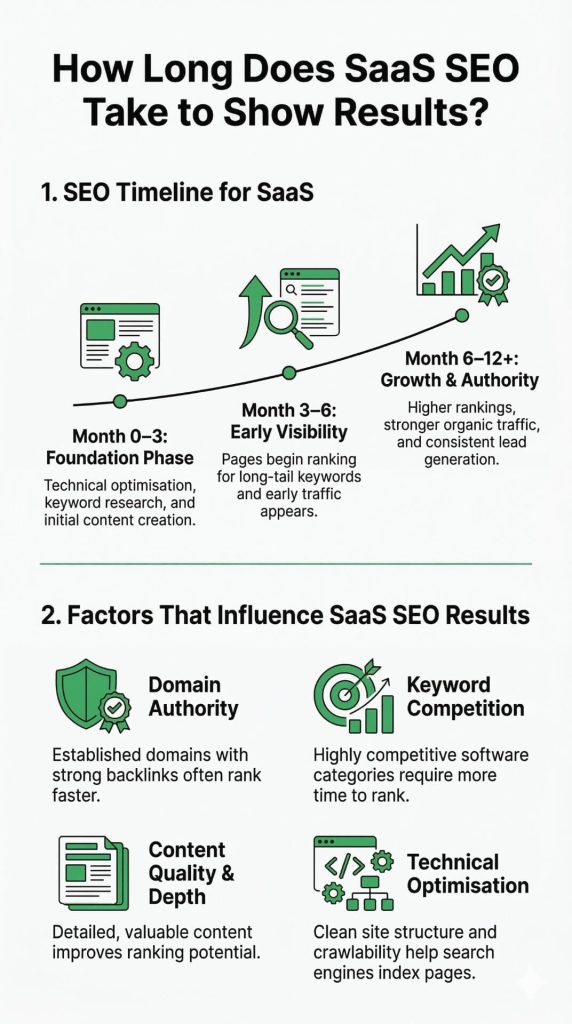
One of the most common questions founders and marketers ask when starting with SaaS SEO is how long it takes to see meaningful results. The honest answer is that SEO rarely delivers immediate outcomes. Instead, it builds momentum over time as search engines discover, evaluate, and rank your content.
For most SaaS companies, noticeable improvements in rankings and traffic can begin within a few months, but stronger results often take longer as your website gains authority and publishes more relevant content.
Several factors affect how quickly a SaaS SEO strategy begins to generate results. These include:
- Domain authority: Established websites with strong backlink profiles tend to see results faster than new domains.
- Keyword competition: Highly competitive software categories often require more time and consistent effort to rank.
- Content quality and depth: Well-researched, comprehensive content is more likely to perform well in search results.
- Technical optimisation: Strong technical SEO for SaaS ensures search engines can crawl and index pages effectively.
What Early SaaS SEO Progress Looks Like?
In the early stages, SEO progress may not always appear as dramatic traffic growth. Instead, improvements often happen gradually.
Early signs of progress may include:
- new keywords starting to rank in search results
- steady growth in impressions and clicks
- improved rankings for existing pages
- increased organic traffic to educational content
Over time, as more pages rank and domain authority grows, SEO can become one of the most reliable acquisition channels for B2B SaaS SEO and long-term organic growth.
Why SaaS SEO Becomes Stronger Over Time?
Unlike paid advertising, SEO results compound. Content that ranks well today can continue attracting users months or even years later.
As SaaS companies publish more high-quality content, improve technical performance, and earn backlinks, their website builds stronger authority in search engines. This is why many successful SEO strategies for SaaS companies focus on consistent long-term optimisation rather than quick wins.
Looking for an SEO Partner That Understands SaaS? Meet Wild Creek
Building a strong SaaS SEO strategy requires more than publishing blog posts or targeting a few keywords. SaaS companies need a structured approach that combines technical optimisation, strategic content, and long-term organic growth planning. This is where Wild Creek Web Studio comes in.
We are a digital strategy and SEO consulting agency that helps businesses improve their online visibility through data-driven marketing strategies. With 18+ years of experience and over 100 client partnerships, our team focuses on creating measurable SEO growth rather than chasing short-term ranking gains.
So, Why SaaS Companies Choose Us?
Wild Creek works closely with brands to design SEO strategies that align with real business goals such as lead generation, product visibility, and customer acquisition.
Our key areas of expertise include:
- SaaS-focused SEO strategies that attract high-intent users searching for software solutions
- Technical SEO for SaaS platforms to improve crawlability, performance, and site architecture
- Content strategies designed to support the entire software buying journey
- Competitor and keyword analysis to uncover growth opportunities in competitive markets
- Ongoing optimisation and transparent reporting to continuously improve performance
By combining strategy, technical expertise, and content planning, we help SaaS companies turn SEO into a scalable and sustainable growth channel.
Final Words
If there is one thing to remember about SaaS SEO, it is this: the goal is not just to bring people to your website, but to show up exactly when potential customers are searching for solutions like yours.
From building a clear SaaS SEO strategy and targeting the right keywords to improving technical SEO for SaaS and creating helpful content, each step plays a role in turning search visibility into real product interest.
As competition in the software market continues to grow, businesses that invest early in strong SEO strategies for SaaS companies will have a clear advantage. Done well, SEO becomes more than a marketing tactic. It becomes a long-term growth engine for your SaaS product.
Frequently Asked Questions
Will SEO be replaced by AI?
AI will not replace search engine optimisation. The best way forward combines AI with content marketing, valuable content, and strong content creation that answers real search queries and pain points across the buyer’s journey.
Which SEO India Company deserves to have business?
A reliable SEO agency like Wild Creek Web Studio understands your target audience, identifies relevant keywords, and delivers strategic content creation. By combining search engine optimisation, content marketing, and valuable content, it improves brand awareness and strengthens your sales funnel.
Can a SaaS business be successful solely through SEO traffic?
SEO can drive strong growth, but relying solely on it is rarely the best way. SaaS companies benefit from combining search engine optimisation with content marketing, social media, and saas content that supports the buyer’s journey and builds brand awareness.
Why should you invest in SaaS SEO?
Investing in search engine optimisation helps SaaS companies attract the right target audience through relevant keywords and valuable content. It strengthens brand awareness, supports the buyer’s journey, and drives qualified traffic that moves potential customers through the sales funnel.
How Much Does SaaS SEO Typically Cost?
SaaS SEO costs vary depending on the scope of content creation, target keywords, and technical optimisation required. Businesses often invest in content marketing, internal links, and an ongoing SEO strategy to consistently rank for relevant keywords and reach their target audience.
What to do if you’re struggling to improve Google rankings and drive qualified leads to your website?
Improving rankings often starts with strong search engine optimisation and content creation that targets real search queries. Focusing on valuable content, relevant keywords, and internal links helps attract the right target audience and guide them through the buyer’s journey.
What are the best SEO practices for SaaS companies to follow in 2026?
In 2026, SaaS SEO should focus on topical authority, product-led content, entity-based SEO, AI search optimisation (AEO), strong internal linking, high-intent comparison pages, structured data, fast Core Web Vitals, programmatic SEO, and aligning content with the buyer journey.



One nuance that’s often overlooked: targeting comparison and alternative keywords like “tool X vs tool Y” works best when the SaaS already has strong review and integration pages feeding those terms. Without a solid link profile on those comparison pages, Google tends to rank big media sites instead. We run a similar approach internally, so I appreciate the full-funnel framing here.