Wild Creek Web Studio
  • About Wild Creek
    • Awards
    • Case Studies
    • Portfolio
    • Testimonials
  • Services
    • SEO Services
    • Paid Marketing Services
    • Social Media Marketing
    • Consulting and Strategy
  • Resources
    • Blogs
    • Free SEO Tools
    • Digital Marketing Glossary
  • Contact
Banking Client

[SEO Case Study] How Wild Creek Web Studio Transformed a Banking Client’s Online Presence

When establishing a solid online presence, companies face numerous challenges in the competitive banking industry. Our client, a leading banking institution, encountered similar difficulties. However, with the help of Wild Creek Web Studio, they were able to overcome these hurdles and achieve remarkable results.

In this Article

Toggle
  • Background:
  • Objective:
  • Our SEO Strategy:
    • 1. On-Page Optimization:
    • 2. Content Enhancement:
    • 3. Content Publishing Process:
    • 4. Backlink Acquisition:
  • Results:
  • Client Feedback:
  • Conclusion:

Background:

Before engaging with Wild Creek Web Studio, the client faced several obstacles that hindered their online visibility and growth. They needed a comprehensive solution to enhance their digital presence, from on-page issues to content deficiencies. Additionally, their limited content publishing process and lack of high-quality backlinks made it challenging to compete with industry giants. These limitations hindered their ability to reach their target audience and achieve their business goals.


Objective:

The primary goals our client aimed to achieve were as follows:

  1. Fix on-page issues to improve website performance and user experience.
  2. Enhance content to provide valuable information and address user needs.
  3. Establish a streamlined content publishing process.
  4. Acquire high-quality backlinks to boost domain authority.

Our SEO Strategy:

1. On-Page Optimization:

We comprehensively audited the client’s website to identify and fix on-page issues. The team optimized page titles, meta descriptions, and URLs to align with relevant keywords, ensuring that the content reflected user search intent and matched Google’s ranking for relevant search queries. 

Strategic internal linking and structured data markup were implemented to enhance the website’s visibility and user experience.

We also created new category pages targeting specific keywords to expand keyword visibility.

2. Content Enhancement:

  • Conducted thorough keyword research to identify user search intent.
  • Ensured that content aligned with Google’s ranking for relevant search queries.
  • We also added content addressing user needs and preferences.
  • Strategically placed content to prioritize important information.
  • Supplement the primary content with additional information, such as general content blocks and FAQ sections.
  • Addressed vital user pain points to enhance engagement and satisfaction.

3. Content Publishing Process:

  • Assisted the client in establishing a streamlined content publishing process.
  • Guided content creation, optimization, and scheduling.
  • Ensured consistency in content quality and relevancy.

4. Backlink Acquisition:

We performed extensive link prospecting to find niche-relevant websites for potential backlinks. The team also manually verified the relevance of each website and identified online communities within the client’s niche. Personalized outreach pitches were crafted to establish connections and acquire high-quality backlinks. The team obtained email addresses for outreach, ensuring effective communication with potential link partners.

Results:

The implementation of these strategies led to remarkable improvements for our client:

  • Organic traffic grew by 47.04%, increasing from 92,290 to 135,707 users.
  • Sessions increased by 41.58%, rising from 331,609 to 469,481.
  • The keywords ranked in the top 10 positions increased by 152%.
  • Overall keyword visibility within the top 100 positions grew by 90%.
  • The client’s website achieved higher rankings, outperforming heavyweight competitors.
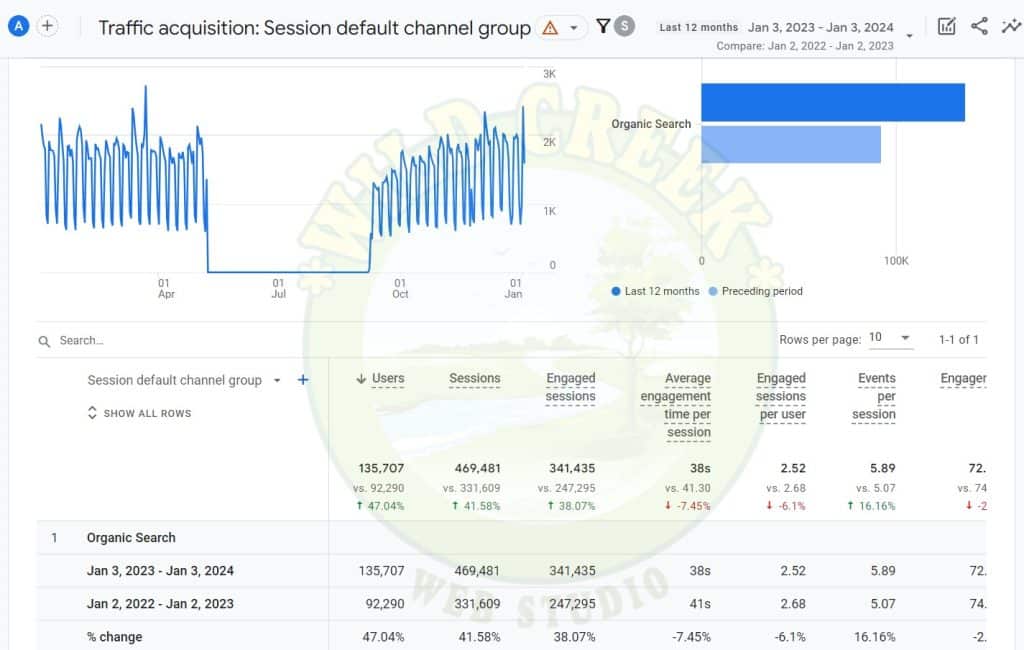
Banking Client Analytics Screenshot

These achievements resulted from content optimization, UX optimization, topical authority building, and an AI-driven backlink strategy.

Client Feedback:

“[Wild Creek Web Studio] has been instrumental in transforming our online presence. Their SEO, content optimization, and backlink-building expertise have significantly impacted our organic traffic and search engine rankings. We have seen significant improvements in organic traffic and keyword rankings, increasing user engagement. We highly recommend Wild Creek Web Studio to anyone looking to enhance their SEO efforts. ” – Vice President, Marketing. 

Conclusion:

Wild Creek Web Studio’s comprehensive SEO strategy successfully transformed the client’s online presence. 

By addressing on-page issues, optimizing content, establishing a content publishing process, and acquiring high-quality backlinks, our client experienced significant growth in organic traffic, improved keyword rankings, and overall domain authority. 

With the right SEO approach, it is possible to outperform heavyweight competitors, enhance user experience, and establish a solid online reputation.

Do you need help to improve your online presence? Contact Wild Creek Web Studio today and unlock the potential of your digital strategy.

0 comments
UI Vs UX: The Impact on Website Performance

UI Vs UX: The Impact on Website Performance

Did you know that 38% of users will only engage with a website if they find the content or layout attractive?

The design of your website is crucial for its success, and UI and UX play a significant role in this. But how exactly do these elements impact your website’s performance?

In this discussion, we will explore the potential impact of UI vs UX on your website’s success. From reducing bounce rates to improving brand perception and SEO performance, we will uncover the secrets behind creating a website that captures attention and keeps users returning for more.

Get ready to discover the power of UI and UX in enhancing your website’s performance.

UI Vs UX: The Impact on Website Performance

UI Vs UX: The Impact on Website Performance

In this Article

Toggle
  • Reduced Bounce Rates
  • Brand Perception and Credibility
  • SEO Performance
  • Conversion Rates
  • Mobile Responsiveness
  • Addressing Negative User Feedback
  • Frequently Asked Questions
    • What Is the Impact of User Experience on Website Performance?
    • What Is the Difference Between UX and UI Website?
    • What Is the Difference Between UI and UX, and Tell Us About the Factors that impact UX in General.
    • What Is the Impact of UX UI Design?
    • UI vs UX Design: Which Career Option Should You Choose?
    • How important is it for developers to have a strong understanding of both UI and UX?
  • Conclusion

Reduced Bounce Rates

Good user interface (UI) and user experience (UX) design can significantly reduce bounce rates on your website. Users quickly decide whether to stay or leave when visiting a website. Suppose your website has a poor UI/UX design. In that case, users may become frustrated or confused, causing them to bounce back to search results or navigate away quickly.

However, with a well-structured and engaging UI/UX design, you can keep users interested and involved, ultimately reducing bounce rates.

Websites with robust UI/UX design tend to have lower bounce rates. When users have a positive experience navigating your website, they will stay longer and explore further. Good UI design ensures that your website is visually appealing and easy to navigate, making it enjoyable for users. Meanwhile, UX design focuses on the overall user experience, ensuring that the website is efficient, relevant, and meets users’ needs. Incorporating effective web design is crucial for reducing bounce rates and keeping users engaged on your website.


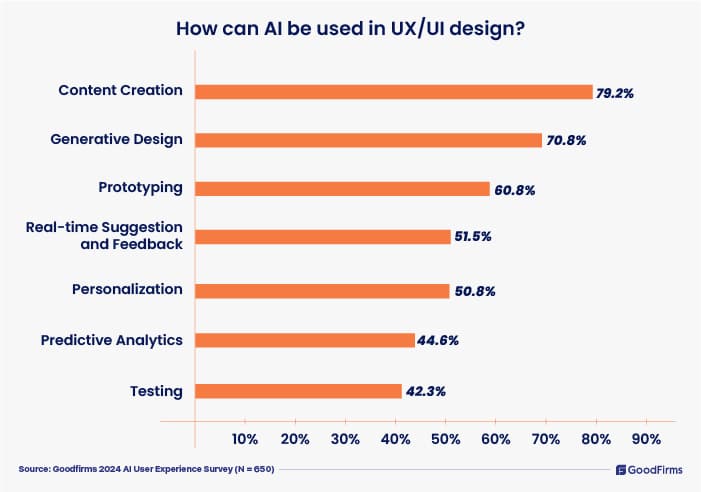
Uses of AI in UX/UI Design - Survey

Uses of AI in UX/UI Design – Survey

Source

Brand Perception and Credibility

UI and UX design are crucial in shaping brand perception and credibility. A website with a well-designed UI and UX creates a visually appealing and easy-to-navigate interface. This consistency in design elements enhances the brand’s image and trustworthiness, making it appear more professional and reliable. This is where graphic design and visual design principles, such as typography, come into play, as they help to create a cohesive and visually appealing look and feel of the product, incorporating critical visual elements. To ensure product and brand consistency, UI designers follow a specific UI design process, starting with research to understand user needs and expectations. This research is then used to determine the best colour palettes, patterns, fonts, and other visual elements to incorporate into the design to create a good user experience. By following a structured UI design process and utilizing design systems, designers can create a consistent and visually appealing interface that enhances brand perception and credibility, resulting in a positive user experience. Additionally, UI designers must prepare a UI style guide with all the necessary documentation, components, and references for better collaboration with multiple stakeholders. This ensures that the design remains consistent and aligned with the brand’s overall aesthetic and messaging.

Furthermore, a good UI and UX design can increase user confidence in the website and the brand. When users have a positive experience interacting with a website, they trust its functionality and reliability. This trust translates into confidence in the brand, leading to repeat visits and conversions.

A professional-looking UI and UX design can also establish brand credibility and reliability. When a website has a polished and professional design, it conveys the impression that the brand is trustworthy. Users are more likely to engage with a brand that invests in creating a visually appealing and user-friendly website.

SEO Performance

UI and UX design are crucial for optimizing the SEO performance of a website. When it comes to search engine optimization, search engines consider factors such as user experience, website accessibility standards, and overall website performance.

A well-designed UI and UX can significantly improve these aspects, leading to better website ranking and visibility on search engine result pages.

Search engines consider user experience an important factor in determining website rankings. Websites with good UI and UX tend to have lower bounce rates, meaning that users stay on the website for more extended periods. This tells search engines that the website is relevant and valuable, improving SEO performance.

In addition, a well-designed UX can make it easier for users to convert. By removing barriers and guiding users towards desired actions, a good UX can increase the likelihood of users completing actions such as purchasing or filling out a form. This improves the overall user experience and increases the chances of achieving conversion goals, including a smooth and efficient checkout process, which further boosts the website’s SEO performance and app usage through design thinking methodology.

Furthermore, mobile responsiveness is crucial for website performance. With the increasing use of mobile devices for internet browsing, search engines prioritize websites optimized for mobile devices. By ensuring that the UI and UX are tailored for mobile users, websites can reduce bounce rates and increase engagement, ultimately improving their SEO performance.

Conversion Rates

To improve conversion rates, it’s crucial to have a well-designed user interface (UI) and user experience (UX). The impact of UI and UX on conversion rates can’t be overstated.

Here are three critical ways in which UI and UX design can positively influence conversion rates:

  1. Increased customer satisfaction and retention: A visually appealing and user-friendly interface, combined with a seamless user experience, can enhance customer satisfaction, leading to improved conversion rates. When users find websites easy to navigate and interact with, they’re more likely to stay, explore further, and ultimately convert.
  2. Competitive advantage: Well-designed UI and UX can make a website stand out from competitors. Businesses can gain preference and attract more conversions by creating a unique and enjoyable user experience.
  3. Enhanced brand perception and credibility: A professional-looking website with good UI and UX design instils trust and confidence in users. This positive perception of the brand can directly impact conversion rates, as users are more likely to engage and convert on a website they perceive as trustworthy.

Mobile Responsiveness

Mobile responsiveness is essential for ensuring a website functions smoothly and adapts well to different mobile devices. In today’s mobile-centric world, prioritizing mobile responsiveness is crucial for improving website performance and user satisfaction. Optimizing the user interface and experience for mobile devices helps reduce bounce rates and increase engagement, leading to improved conversion rates.

When a website isn’t mobile responsive, users may struggle to navigate and interact with the interface, resulting in a frustrating experience that can drive them away. A mobile-friendly website enhances user experience and allows for a wider reach, as more and more people primarily access the internet through their smartphones and tablets.

Addressing Negative User Feedback

When users provide negative feedback, listening to and addressing their concerns is essential to improve the overall user experience. By addressing negative user feedback, you can enhance the design of your website and ultimately improve its performance.

Here are some critical steps to effectively address negative user feedback:

  • Actively listen and identify recurring issues: Take the time to understand users’ specific problems and look for patterns in their feedback. This will help you identify the most critical issues that need to be addressed.
  • Prioritize feedback based on impact: Not all negative feedback will have the same effect on the user experience. Prioritize the problems that have the most significant impact on design and address them first.
  • Implement iterative design improvements: Use the feedback received to make iterative design improvements. Test and implement changes that address the identified issues and enhance the website’s usability.

Frequently Asked Questions

What Is the Impact of User Experience on Website Performance?

User experience plays a crucial role in determining the performance of a website. It directly influences user engagement, conversion rates, and overall satisfaction. When businesses prioritize creating a seamless and enjoyable experience for their users, they can significantly increase customer satisfaction and retention, giving them a competitive edge in the market. By understanding the needs and preferences of their audience, staying up-to-date with current trends, and using clear and straightforward language, businesses can enhance the user experience on their websites and achieve better results.

What Is the Difference Between UX and UI Website?

The difference between UX and UI on a website lies in their respective focuses. UX, or user experience, is concerned with the user’s overall experience, including factors such as usability and satisfaction. On the other hand, UI, or user interface design, is focused on creating visually appealing and user-friendly interfaces that facilitate easy navigation for digital products. In simpler terms, UX is about how the website feels, while UI is about how it looks and how users interact with it in digital product design. Understanding the key differences between UX and UI is crucial for creating a successful and high-performing website that incorporates effective digital design.

What Is the Difference Between UI and UX, and Tell Us About the Factors that impact UX in General.

UI and UX are both essential for the optimal performance of a website. UI, or User Interface, creates visually appealing and aesthetically pleasing interfaces. On the other hand, UX, or User Experience, considers users’ overall experience while interacting with a website.

Several factors impact the UX of a website. One of the critical factors is ease of use. Users should be able to navigate the website effortlessly, finding the information they need and completing tasks without confusion or frustration. Efficiency is another important aspect of UX. Users expect websites to be fast and responsive, with quick loading times and smooth interactions. Relevance is also crucial for a positive user experience. The content and features of a website should be tailored to the needs and interests of the target audience, providing them with value and meaningful experiences.

By combining UI and UX effectively, websites can achieve better user engagement, higher conversion rates, and increased user satisfaction. A visually appealing and intuitive interface and a seamless and enjoyable user experience create a positive impression and encourage users to spend more time on the website, explore its offerings, and take desired actions. This includes menu bars, buttons, icons, and, most importantly, colour palettes, crucial in creating an aesthetically pleasing and user-friendly interface. However, it is essential to consider the best practices of UX design, such as using a flat design, proper image icons, and eliminating unnecessary pages, to ensure the best overall product and user experience.

What Is the Impact of UX UI Design?

The impact of UX/UI design is significant as it enhances the performance of websites. By creating visually appealing interfaces and improving user experience, UX/UI design leads to higher engagement, conversion rates, and overall satisfaction for website visitors. This improvement in website performance is crucial for businesses looking to succeed in the competitive digital world. Understanding the nuances of UX/UI design and its implications is essential as it continues to make significant strides in improving website efficiency and requires strong design skills. Through clear and straightforward language, UX/UI design ensures that even users with limited knowledge can navigate websites effectively. Overall, UX/UI design plays a crucial role in elevating the user experience and driving the success of websites in today’s ever-evolving digital landscape. With the growing demand for UX/UI design skills, individuals need to develop and hone their design skills to stay competitive in the job market and contribute to the success of businesses in the digital world.

UI vs UX Design: Which Career Option Should You Choose?

UI (User Interface) and UX (User Experience) design are essential to creating successful digital products. Still, they focus on different elements of the design process.

UI design primarily concerns a product’s visual and interactive elements, including layout, colours, typography, and overall aesthetic. UI designers are responsible for creating visually appealing and user-friendly interfaces that make it easy for users to interact with a product.

On the other hand, UX design, or user experience design, is focused on users’ overall experience when using a product. This includes factors such as ease of use, efficiency, accessibility, and satisfaction. UX designers research to understand user needs and behaviours, create user personas and user flows, and prototype and test designs to ensure a positive user experience.

UI and UX design are crucial for creating successful digital products; many professionals work in both areas. However, I enjoy working more with visual design and have a strong sense of aesthetics. UI design may be a better fit. Suppose you are more interested in understanding user behaviour and designing intuitive experiences. In that case, UX design may be the right career path.

Ultimately, the choice between UI and UX design depends on your interests, skills, and career goals. It can also be helpful to gain experience or take courses in both areas to develop a well-rounded skill set.

How important is it for developers to have a strong understanding of both UI and UX?

Developers must understand UI (User Interface) and UX (User Experience). UI includes visual design and layout, while UX focuses on the overall experience. Understanding UI helps developers create visually appealing interfaces that are easy for users to navigate. This involves designing buttons, menus, and forms, understandably.

UX is about creating a positive user experience. This includes ease of use, efficiency, and accessibility. Developers with strong UX knowledge can ensure applications meet the needs of their target audience.

Knowledge in UI and UX enables developers to create products that look great and have a seamless user experience. This increases user satisfaction and engagement, leading to a successful product.

Conclusion

In summary, incorporating effective UI and UX design principles into your website can significantly impact its performance.

Creating visually appealing and user-friendly interfaces can reduce bounce rates and increase user engagement. This, in turn, enhances brand perception and credibility.

Additionally, implementing good UI and UX practices can improve your website’s SEO performance, leading to higher visibility and organic traffic.

Furthermore, a well-designed website with a seamless user experience can increase conversion rates and drive more sales or leads.

It’s also essential to promptly address any negative user feedback to maintain a positive user experience.

By prioritizing UI and UX design, you can create a website that looks great and provides an excellent experience for your visitors on desktop and mobile devices.

4 comments
Future Proof SEO Strategy

Future-Proofing Your SEO Strategy in 2024

Are you ready to take your SEO strategy to the next level in 2024?

Picture this: you have just launched a new website for your business, and within a few weeks, it climbs to the top of the search engine rankings, generating a significant increase in organic traffic and conversions.

How did you achieve this remarkable success? This blog will unveil the essential SEO strategies and tactics that will help you accomplish similar results in 2024.

From leveraging the power of artificial intelligence and machine learning to optimizing your website for voice search and prioritizing user experience, there are plenty of exciting developments to explore.

So, let’s dive in and uncover the secrets to succeeding in the ever-evolving world of SEO in 2024.

In this Article

Toggle
  • Key Takeaways
  • AI and Machine Learning Dominance
  • Voice Search Optimization
  • User Experience as a Ranking Factor
  • Video SEO Across Platforms
  • Local SEO for Business Success
  • E-A-T and Thought Leadership
  • Diversification of Content Strategy
  • Sustainable SEO Practices
  • Frequently Asked Questions
    • How vital will user experience be in SEO strategy for 2024?
    • What kind of content should be prioritized in the SEO strategy for 2024?
    • Is SEO still effective in 2024 with the rise of AI?
    • What Will Be the Future of Seo?
    • Will SEO Exist in 5 Years?
  • Conclusion

Key Takeaways

  • AI and machine learning play a significant role in shaping search engine algorithms and improving user experience in SEO.
  • Optimizing voice search behaviour, mobile user experience, and user intent is essential for successful SEO strategies in 2024.
  • Video SEO across different platforms and incorporating local SEO strategies can contribute to business success.
  • Prioritizing user experience, thought leadership through E-A-T, diversifying content strategy, and implementing sustainable SEO practices are crucial for long-term success in SEO strategy in 2024.

AI and Machine Learning Dominance

AI and machine learning have revolutionized the SEO industry, shaping search engine algorithms and content optimization. These technologies have become crucial for developing effective SEO strategies in the digital marketing landscape in 2024. Major search engines like Google heavily rely on AI and machine learning, including generative AI, to enhance their algorithms and improve user experience. Search engines can better understand user intent through machine learning, leading to more relevant and accurate search results. SEO professionals use AI-driven tools, such as generative AI, to optimize content creation, improve accuracy, and create relevant content that responds to user inquiries.

Incorporating AI and machine learning into your SEO strategy is essential for staying ahead of the competition.

To leverage AI and machine learning in your SEO strategy, optimise your website for user experience and incorporate AI-powered SEO tactics, including internal linking. With AI, search engines can evaluate the usability and engagement of websites, rewarding those that offer a smooth and satisfying experience with higher rankings. Additionally, AI-powered SEO tools can help you analyze user behaviour and preferences, allowing you to tailor your content and SEO efforts accordingly. By adapting to algorithm changes and incorporating effective SEO tactics, including internal linking, you can effectively improve your website’s visibility and reach your target audience.

Voice Search Optimization

Voice search optimization is an increasingly important aspect of SEO strategy in 2024. With the rapid growth of voice search, optimising your SEO strategies to align with this emerging trend is crucial.

Here are some key facts and strategies to consider:

  • Optimizing for voice search behaviour: As more searches are conducted through voice, optimising your website for spoken-word search terms and long-tail keywords is essential. Understand user intent and create content that addresses their needs and queries.
  • Creating FAQ-style content and featured snippets: Voice search queries often resemble natural language questions. Creating content in a FAQ-style format and optimizing for featured snippets increases the chances of your website being featured in voice search results.
  • Improving mobile user experience: Voice searches are frequently conducted on mobile devices. To enhance voice search rankings, ensure your website is mobile-friendly, loads quickly, and offers a seamless user experience on mobile devices.

Incorporating these strategies into your SEO efforts will help you stay ahead in the ever-evolving landscape of search engine optimization. By understanding and adapting to the rise of voice search and catering to user intent, you can position your website for success in 2024 and beyond.

User Experience as a Ranking Factor

To enhance your website’s ranking on search engines, prioritizing user experience, one of the latest trends in SEO is crucial as Google emphasizes its significance as a ranking factor. User experience encompasses various aspects such as responsive design, mobile optimization, fast loading speed, interactivity, and Google search optimisation. By focusing on these elements, including technical SEO, you can deliver high-quality, relevant information and valuable information and improve both the user experience and your search engine results rankings, ultimately leading to higher user engagement, dwell time, and lower bounce rate on your web page.

Consider the following table that highlights the key factors to enhance user experience:

User Experience Factors

Importance

Responsive Design

High

Mobile Optimization

High

Fast Loading Speed

High

Interactivity

Medium

Responsive design ensures your website adapts to different screen sizes, providing a seamless experience across devices. Mobile optimization is vital as more and more users access the internet through their smartphones. Fast loading speed is essential to prevent users from getting frustrated and leaving your website. Interactivity, including visual elements such as smooth navigation and engaging content, keeps users engaged and encourages them to explore further.

Video SEO Across Platforms

Optimize your video content across multiple platforms to improve visibility and rankings.

Video SEO Across Platforms encompasses optimizing video content for various platforms to improve visibility and rankings. Tailoring video content for specific platforms like YouTube, TikTok, and Instagram Reels is essential for reaching diverse audiences.

Here are three key strategies to evoke an emotional response in your audience:

  • Customize your video content for social media platforms: Each platform has its unique audience and content format. You can effectively engage with your target audience and maximize your visibility by tailoring your videos to suit the platform’s requirements.
  • Optimize your video titles, descriptions, and tags: Just like optimizing written content, optimizing your video metadata is crucial for search engines to understand and rank your videos. Use relevant keywords and compelling descriptions to attract viewers and improve your search engine rankings.
  • Transcribe your videos for accessibility and SEO-friendliness: Adding captions or transcripts to your videos not only makes them accessible to a broader audience but also helps search engines understand the content of your videos. This can improve your video SEO and make your content more discoverable.

Incorporating these strategies into your video SEO across platforms will help you optimize your content, reach a wider audience, and improve your rankings on search engines and social media platforms.

Stay ahead in the digital landscape by leveraging the power of video SEO.

Local SEO for Business Success

Incorporating local SEO strategies is essential to ensure business success in today’s digital landscape. Local SEO is optimizing your online presence to attract more customers and improve visibility in local search results. It’s an integral part of any SEO strategy, as search engines prioritize local results when users search for products or services in their area. Organic search is essential to local SEO, as it drives more than half of trackable website traffic. Keyword research and optimization, also known as keyword optimization, is crucial for local SEO, as it focuses on strategic placement and natural integration of keywords to improve search engine rankings and drive business growth.

To achieve success with local SEO, start by leveraging Google My Business. Claim and optimize your Google Business Profile listing by providing accurate and up-to-date information about your business, including your name, address, and phone number (NAP). Consistency is critical, so ensure your NAP information is consistent across all online platforms. Google’s prioritization of search intent emphasizes location-based information, making a complete and up-to-date GBP profile crucial for appearing in Google’s search results.

In addition, incorporating local keywords and creating location-specific content can significantly impact your local search rankings. Focus on targeting keywords that include your city or region to attract local customers actively searching for your products or services.

Encouraging customer reviews is another powerful local SEO strategy. Positive reviews enhance your online reputation and signal to search engines that your business is trustworthy and reliable. Engage with your customers, respond to their reviews, and encourage them to leave feedback.

Participating in local events and engaging with the local community can boost your SEO efforts. By getting involved in local activities, you increase your visibility and establish your business as an active community member.

Lastly, don’t overlook the importance of local business directories and citations. Listing your business on reputable directories and ensuring that your information is accurate and consistent can enhance your credibility and visibility in local search results.

E-A-T and Thought Leadership

Expertise and thought leadership are essential for boosting online credibility and improving search engine rankings. In the ever-evolving world of SEO strategy in 2024, it’s crucial to understand the importance of E-A-T (Expertise, Authoritativeness, and Trustworthiness) and how it relates to thought leadership.

Here are some key points to consider:

  • High-quality content: Creating valuable and insightful content is the foundation of showcasing expertise and building authority. You can establish yourself as a thought leader in your niche by offering unique perspectives, addressing industry challenges, and providing innovative solutions.
  • Building authority: Backlinks from reputable sources can significantly enhance your authority. When other websites link to your content, it signals to search engines that you’re a trusted source of information. Guest blogging and collaborations with industry influencers can further enhance your credibility.
  • Trustworthiness: Transparency and credibility are vital for establishing trust with your audience. This can be achieved by providing accurate information, citing credible sources, and fostering engagement through user-generated content and customer reviews.

Diversification of Content Strategy

To strengthen your online presence and capture the attention of diverse audiences, it’s crucial to diversify your content strategy by creating engaging content.

Implementing a diversified content strategy involves creating various formats such as videos, blogs, infographics, and podcasts to cater to different audience preferences and reach a broader range of individuals.

By leveraging content distribution channels like social media, email newsletters, and guest posting, you can expand the reach and visibility of your content.

Diversifying your content strategy allows you to engage different audience segments and capture their attention through various formats and platforms. This approach helps you adapt to changing user preferences and consumption habits. It ensures a more comprehensive and practical approach to content marketing.

Additionally, repurposing existing content into different formats maximizes its impact and reach across various channels, further enhancing your content strategy.

Sustainable SEO Practices

As you continue to enhance your content strategy and capture the attention of diverse audiences, it’s crucial to implement sustainable SEO practices that prioritize creating high-quality, relevant, and authoritative content for long-term success. Staying ahead of algorithm updates and trends is essential in the rapidly evolving SEO industry.

To ensure your SEO strategy in 2024 is sustainable, consider the following practices:

  • Ethical link building and outreach strategies: Building a natural backlink profile is crucial for long-term success. Focus on acquiring high-quality backlinks from authoritative websites relevant to your industry.
  • User experience optimization: Search engines prioritize websites that offer a seamless and satisfying user experience. Ensure your website is mobile-friendly, loads quickly, and provides a smooth navigation experience.
  • Regular content updates: To maintain relevance and value to users, regularly update and refresh your content. This helps with SEO and keeps your audience engaged and coming back for more.

Frequently Asked Questions

How vital will user experience be in SEO strategy for 2024?

User experience is set to play a crucial role in SEO strategy for 2024. Google’s algorithm updates have increasingly emphasized the importance of a positive user experience. Websites with poor user experiences may struggle to rank higher on search engine results pages. Prioritizing user experience can lead to better engagement, longer dwell time and higher rankings.

What kind of content should be prioritized in the SEO strategy for 2024?

To create an effective SEO strategy for 2024, prioritize quality and informative content. Focus on creating long-form content that provides value to readers. Additionally, give importance to visual content like videos and infographics. Building a solid online community through user-generated content and social media mentions can boost your website’s visibility.

Is SEO still effective in 2024 with the rise of AI?

Despite the rise of AI, SEO is still effective in 2024. While AI has made search engines more intelligent, they rely on traditional SEO factors like keywords, backlinks, and quality content. AI has helped identify and penalize black hat SEO practices. SEO strategies must adapt to changing algorithms and user behaviour.

What Will Be the Future of Seo?

In the future, SEO will continue to evolve and adapt. AI and machine learning will dominate the industry, voice search optimization will be crucial, user experience will play a pivotal role, videos will be necessary, and local SEO will remain essential.

Will SEO Exist in 5 Years?

SEO will exist in 5 years. It will continue to evolve and adapt to the changing digital landscape. AI and machine learning will dominate, voice search optimization will be crucial, user experience will play a vital role, and local SEO will remain essential for businesses.

Conclusion

In conclusion, mastering the ever-changing world of SEO in 2024 requires staying ahead of the trends and strategies that shape the industry.

You can ensure your website stays relevant and competitive by harnessing the power of artificial intelligence and machine learning, optimizing for voice search, prioritizing user experience, and leveraging video SEO across platforms.

Don’t forget to focus on local SEO for business success and establish yourself as a thought leader through E-A-T.

Lastly, diversify your content strategy and embrace sustainable SEO practices for long-term success.

1 comment
Google Zero Click Searches

Boosting SEO with Zero Click Searches

In the ever-evolving world of search engine optimization (SEO), staying ahead of the latest trends and strategies is crucial for online success. One such trend that has gained significant traction in recent years is zero-click searches. These searches allow users to find the information they need directly on the search engine results page (SERP) without needing a click-through to a website. In this blog, we will explore the phenomenon of zero-click searches, their impact on user behaviour, and strategies to optimize your SEO efforts in this new search landscape.

Google Zero Click Searches

In this Article

Toggle
  • Understanding Zero-Click Searches
    • The Phenomenon of Zero-Click Searches
    • Impact of Zero-Click Searches on User Behavior
  • Types of Zero-Click Search Results
    • Featured Snippets and Their Significance
    • Knowledge Graphs and Their Role in Zero-Click Searches
  • SEO Optimization Strategies for Zero-Click Searches
    • Importance of Keyword Research
    • Role of Content in Targeting Zero-Click Searches
    • Optimizing for Voice Search and its Impact
  • Leveraging Schema Markup in Zero-Click Search Environment
    • Understanding Schema Markup
    • How to Implement Schema Markup Effectively
  • Tools for Tracking Zero-Click Searches
    • Utilizing Google Search Console for Zero-Click Searches
  • The Future of SEO in the Era of Zero-Click Searches
    • How will Zero-Click Searches impact SEO in the long run?
  • Conclusion

Understanding Zero-Click Searches

As the name suggests, zero-click searches refer to search queries that are answered directly on the SERP, eliminating the need for users to click on a specific search result. The rise of zero-click searches can be attributed to the growing demand for quick answers and the search engines’ efforts to provide relevant information instantly. Understanding the implications of zero-click searches and their impact on user behaviour is paramount for digital marketers and SEO professionals.

The Phenomenon of Zero-Click Searches

Zero-click searches have revolutionized the way users interact with search engines. Instead of clicking on a search result and visiting a website, users can now find instant answers to their queries directly on the SERP. This phenomenon of zero-click searches has reshaped user behaviour, impacting organic traffic, website visits, and brand visibility.

One of the critical features of zero-click searches is the ability to provide quick answers to user queries. For example, if a user searches for the capital of a country, the search engine may display the answer directly on the SERP, eliminating the need for the user to click on a specific search result. This convenience has significantly changed how users consume information online, as they can find the answers they seek without navigating multiple websites.

Furthermore, zero-click searches have a direct impact on organic traffic. With users finding the answers they need on the SERP itself, the number of times users click on organic search results decreases. This decrease in organic clicks poses a challenge for website owners and marketers who rely on organic traffic for brand visibility and conversions.

Additionally, zero-click searches influence searcher behaviour. Users who find the information they need without leaving the search engine are less likely to explore other search results or click on paid advertisements. This user behaviour shift impacts how marketers strategize their SEO efforts and digital marketing campaigns.

Impact of Zero-Click Searches on User Behavior

The influence of zero-click searches on user behaviour significantly impacts the digital landscape. With the rise of SERP features like instant answers and table snippets, the number of organic clicks has reduced, affecting the CTR for marketers. Google Maps results and other apps cater to the target audience without clicking through to a website. This shift in user behaviour necessitates an excellent example of adaptation for digital marketing efforts, ultimately influencing online presence and SEO metrics.

Types of Zero-Click Search Results

Understanding the different types of zero-click search results is essential for SEO optimization. These types include featured snippets, knowledge panels, image packs, video carousels, and more. Each type caters to different user intents and provides valuable information without the need to click through to a website. Marketers must consider the prominence of these organic results and SERP features in catering to the target audience. It’s crucial to track metrics such as CTR and user engagement across various zero-click search results to gauge their impact effectively.

Featured Snippets and Their Significance

Featured snippets offer concise and direct answers to user queries, impacting their search experience. They influence search queries and increase brand visibility, affecting organic results and the click-through rate (CTR). For instance, some features include include good examples, table snippets, and Google Map results. These snippets cater to various search intents, making them valuable for marketers aiming to reach their target audience effectively.

Knowledge Graphs and Their Role in Zero-Click Searches

Influencing user behaviour, the knowledge graph significantly impacts click content and organic clicks. It dramatically affects the overall user experience, shaping organic search results. By understanding searcher intent, the knowledge graph enables search engines to provide instant answers and relevant information through SERP features like table snippets and Google Map results. This is an excellent example of how NLP contributes to creating a seamless search experience for the target audience in desktop and mobile searches.

SEO Optimization Strategies for Zero-Click Searches

Implementing SEO optimization strategies for zero-click searches involves understanding the significance of organic results and SERP features. Marketers should focus on creating content that targets the target audience’s specific needs, providing instant answers for both desktop and mobile searches. Utilizing table snippets and Google Map results can be an excellent example of enhancing visibility and CTR. Tracking metrics such as paragraphs, headings, and info in tools like Ahrefs can further refine optimization for apps and social media platforms like Twitter and LinkedIn.

Importance of Keyword Research

Effective keyword research is essential for impacting zero-click searches, as it influences relevant, targeted keywords and their difficulty. Specific keywords are crucial in shaping the zero-click search landscape and organic search results, making them an excellent example of the impact of keyword research. Marketers must focus on understanding the target audience to optimize for SERP features, including table snippets and Google Map results, across desktop and mobile searches.

Role of Content in Targeting Zero-Click Searches

The content strategy plays a crucial role in impacting zero-click searches. When optimizing for organic results, marketers should consider using bullet points and high-quality content to enhance the chances of appearing in SERP features such as table snippets and Google Map results. Schematic markup and social media can influence instant answers and attract the target audience. Marketers should focus on creating valuable content that aligns with the needs of desktop searches and enhances the CTR.

Optimizing for Voice Search and its Impact

Voice search significantly impacts zero-click searches, altering search engine results and user experience. This shift also affects featured snippets and knowledge graph results. Marketers must optimize content to cater to the changing landscape of voice search, which directly influences organic results and various SERP features. Understanding the target audience is crucial for providing instant answers that voice search users seek, such as table snippets and Google Map results.

Leveraging Schema Markup in Zero-Click Search Environment

Leveraging Schema Markup for better visibility in search engines is crucial for increasing organic results. Optimizing schema for SERP features can enhance CTR and user engagement. Utilizing schema for table snippets, Google Map results and instant answers can provide an excellent example of how to capture a broad target audience. Marketers can track these metrics using tools like Ahrefs and apps, ensuring the content meets the needs of both desktop and mobile searches.

Understanding Schema Markup

Schema markup enhances content understanding for search engines, aiding in creating relevant search results. A specific vocabulary provides context and enables search engines to display content more accurately. The structured data from schema markup helps search engines recognize crucial information, contributing to improved organic results and SERP features. For instance, table snippets and Google Map results are good examples of schema markup in action, catering to the target audience with instant answers and increasing CTR.

How to Implement Schema Markup Effectively

Implementing schema markup involves identifying relevant schema types and adding schema.org structured data to the website’s HTML. When executed correctly, it can enhance search visibility and display content in knowledge panels and featured snippets, improving user experience. Compelling schema markup can lead to better organic results and increased visibility in SERP features like table snippets and Google Map results, making it an excellent example of SEO optimization.

Tools for Tracking Zero-Click Searches

Tracking zero-click searches requires specialized tools for monitoring organic results and various SERP features. Metrics such as clicks, impressions, and good examples can be analyzed to understand user behaviour and target audience preferences. Tools like Ahrefs, Bing Webmaster Tools, and Google Search Console provide valuable insights into the performance of instant answers, table snippets, and Google Map results. Marketers can track CTR for desktop searches and social media platforms like Twitter and LinkedIn.

Utilizing Google Search Console for Zero-Click Searches

To maximize SEO, leveraging Google Search Console is crucial. This tool offers valuable data on search queries leading to zero clicks. It provides insights into content appearance in organic results and SERP features. It’s an excellent example of understanding user behaviour for desktop searches and tailoring content to target the audience effectively. Marketers can track metrics such as CTR and analyze instant answers and table snippets to optimize content for maximum visibility. Utilizing Google Search Console is integral in adapting to the evolving search landscape.

The Future of SEO in the Era of Zero-Click Searches

Adapting to zero-click searches necessitates a content strategy shift. SEO should prioritize optimizing for featured snippets and knowledge panels. Brands must adjust to evolving search result landscapes. Voice search optimization becomes crucial with the rise of zero-click searches. SEO’s future is maximizing visibility beyond traditional organic results, including instant answers, table snippets, and Google map results. This ensures reaching the target audience through various SERP features.

How will Zero-Click Searches impact SEO in the long run?

Zero-click searches have a significant impact on SEO in the long run. Content creators should prioritize providing quick answers and targeting zero-click search results. Thorough keyword research and visibility in featured snippets and knowledge graph results are necessary. Brand awareness on search engines is crucial as well.

Conclusion

In conclusion, zero-click searches have revolutionized how users interact with search engines. As a website owner or SEO professional, you must adapt your strategies to optimize these searches. By understanding the phenomenon of zero-click searches and their impact on user behaviour, you can tailor your content and SEO efforts accordingly.

Featured snippets and knowledge graphs are significant in zero-click searches, so optimizing your content to appear in these formats is essential. Additionally, focusing on keyword research, creating high-quality content, and optimizing for voice search can improve your chances of appearing in zero-click search results.

Utilizing schema markup and tracking tools like Google Search Console and SEMrush can provide valuable insights and help you stay ahead in the zero-click search environment. Finally, keep an eye on the future of SEO as it evolves in response to zero-click searches.

Remember, adapting and staying proactive can boost your SEO rankings and drive more organic traffic to your website.

0 comments
martech marketing strategy

Get Ahead of the Game: Marteching for Business Growth

As businesses navigate the digital landscape, marketing technology, or martech, is becoming increasingly crucial for driving growth and success. In this blog, we will explore what martech is, its significance for business growth, the components of martech, and how it can be utilized for small business growth. We will also discuss the challenges of martech implementation, the future outlook of martech, and key takeaways for implementing martech in business. By the end of this blog, you will understand the importance of martech in driving your business forward in the digital age.

martech marketing strategy

In this Article

Toggle
  • Understanding Martech
    • What is Martech?
    • The Concept of Marketing Technology
  • Significance of Martech for Business Growth
    • Reasons Businesses are Investing in Martech
    • Benefits of Using Martech
    • Martech as a Competitive Advantage
  • Delving Deeper: The Components of Martech
    • Overview of a Martech Stack
    • Critical Martech Tools and Their Functions
  • How Innovations are Shaping the MarTech Landscape
  • Utilizing Martech for Small Business Growth
    • Martech Strategies for Small Businesses
  • Overcoming Challenges with Martech Implementation
    • Common Martech Challenges and Solutions
    • Mitigating the Risk of Martech Overload
  • The Future Outlook of Martech
    • Predictions for Martech’s Evolution
    • Emerging Trends in Martech
    • The Role of Martech in Future Business Growth
  • Critical Takeaways for Implementing Martech in Business
    • How can Martech Accelerate Your Business Growth?
  • Frequently Asked Questions
    • How has marketing evolved over the years?
    • What are some standard martech tools and platforms used by marketers today?
    • How does AI affect the future of marketing?
    • Can small businesses also benefit from using Martech, or is it only for larger companies?
  • Conclusion

Understanding Martech

Marketing technology, or martech, is essential to modern marketing strategies. The fusion of marketing and technology drives marketing efforts and strategies. Martech encompasses many tools, platforms, and software marketers use to streamline marketing activities and workflows.

What is Martech?

At its core, martech is about leveraging technology solutions to target, engage, and analyze data for marketing activities. It involves using tools, platforms, and software to optimize marketing efforts, personalization, automation, analytics, and customer relationship management.

The Concept of Marketing Technology

Marketing technology uses solutions to streamline marketing activities, workflows, and processes. It empowers businesses with tools for customer data management, analytics, advertising technology, content management, and automation. By leveraging marketing technology, companies can target their audience more effectively, improve marketing decisions, and drive return on investment.

Significance of Martech for Business Growth

Martech plays a significant role in driving business growth in the digital age. Businesses of all sizes are investing in martech solutions to optimize their marketing strategies, improve customer experience, and gain a competitive advantage in the market.

Reasons Businesses are Investing in Martech

There are several reasons why businesses are investing in martech. First, Martech enables companies to optimize their digital marketing, social media, and customer relationship management. It provides tools and platforms for data management, content marketing, search engine optimization, and advertising technology. By investing in martech, businesses can improve marketing activities, analyze customer behaviour, and leverage technology solutions for marketing strategies.

Benefits of Using Martech

The use of martech offers numerous benefits to businesses. Firstly, it allows companies to optimize marketing campaigns, attribution, and project management. Martech tools enable businesses to leverage analytics, workflows, advertising technology, customer data platforms, email marketing, social media platforms, and content management systems. By using martech, businesses can improve marketing processes, algorithms, customer experience, data privacy, and marketing technology tools.

Martech as a Competitive Advantage

Martech is often seen as a competitive advantage for businesses. By harnessing martech tools, businesses can enhance their marketing platforms, content management, social media management, advertising technology, and customer behaviour analysis. This competitive advantage is achieved through marketing automation, data analysis, personalization, search engine optimization, and technology solutions. By utilizing the martech stack, businesses can gain an edge over their competitors and drive growth.

Delving Deeper: The Components of Martech

To fully understand a match, it is essential to delve deeper into its components. A martech stack combines tools, platforms, and software marketers use to drive marketing strategies, analytics, automation, content management, social media management, advertising technology, customer data platforms, email marketing, search engine optimization, and technology solutions.

Overview of a Martech Stack

A martech stack comprises tools and platforms across various marketing activities and workflows. It includes customer data platforms, content management systems, marketing technology tools, advertising technology, analytics tools, social media management tools, email marketing, search engine optimization, project management, and customer relationship management. A martech stack is essential for data management, marketing efforts, customer experience optimization, marketing decisions, smaller businesses, internet technologies, and marketing platforms.

Critical Martech Tools and Their Functions

Martech tools play a crucial role in marketing technologies. Some of the critical martech tools include analytics tools, email marketing tools, automation tools, content management tools, customer relationship management tools, ad tech tools, search engine optimization tools, social media management tools, and technology solutions. These tools enable businesses to optimize marketing efforts, customer data analysis, marketing platforms, technology solutions, customer relationship management, social media management, content marketing, search engine optimization, advertising technology, workflows, analytics, email marketing, automation, and content management.

How Innovations are Shaping the MarTech Landscape

Innovations in technology are constantly shaping the martech landscape. Artificial intelligence is revolutionizing marketing technologies, making them more efficient, personalized, and data-driven. Advanced martech solutions are optimizing marketing platforms, advertising technology, customer data analysis, social media management tools, digital marketing efforts, algorithms, artificial intelligence algorithms, ad tech strategies, and search engine optimization strategies.

Utilizing Martech for Small Business Growth

Incorporating marketing technology (martech) tools can effectively streamline marketing efforts for small businesses. The key benefit lies in automating marketing processes and enhancing efficiency and productivity. Additionally, leveraging customer data platforms offered by martech solutions enables small businesses to optimize their marketing strategies through personalized and targeted approaches. Integrating content management systems further improves marketing processes, allowing for seamless content creation and distribution. By implementing martech solutions, small businesses can significantly enhance their marketing activities, ensuring a competitive edge in the digital landscape.

Martech Strategies for Small Businesses

Martech strategies allow small businesses to manage their social media presence efficiently, facilitating enhanced customer engagement. Leveraging email marketing as part of martech strategies can significantly boost customer outreach and lead conversion rates. Moreover, the integration of martech solutions amplifies digital marketing efforts, enabling small businesses to reach and resonate with their target audience more effectively. Successful implementation of martech strategies for small companies necessitates effective project management to ensure streamlined operations and optimized outcomes.

Overcoming Challenges with Martech Implementation

While Martech is undoubtedly valuable, it comes with its own challenges. Overcoming these challenges is crucial for successful martech implementation and maximizing its benefits for business growth.

Common Martech Challenges and Solutions

Addressing and overcoming common martech challenges relies heavily on data analysis, enabling businesses to make informed decisions and optimize their marketing strategies. Automation emerges as a pivotal solution for streamlining processes and maximizing operational efficiency in facing martech challenges. Furthermore, understanding customer experience at a profound level is essential for overcoming hurdles effectively. Adopting best practices and prioritizing customer relationship management is crucial in tackling common martech challenges. By integrating these solutions, businesses can mitigate obstacles and harness the true potential of their marketing technology tools.

Mitigating the Risk of Martech Overload

In mitigating the risk of martech overload, establishing proper workflows is crucial. Implementing artificial intelligence can reduce the risk by automating processes and analyzing vast amounts of data. Utilizing content management systems also plays a pivotal role in efficiently organizing and managing marketing content. Furthermore, personalization strategies help tailor marketing efforts to the target audience, reducing the risk of overload. Additionally, analytics tools provide valuable insights for making informed marketing decisions and optimizing strategies. By incorporating these practices, businesses can navigate the complex martech landscape while maximizing the benefits of marketing technology tools.

The Future Outlook of Martech

The Martech landscape is continuously evolving, and it is essential to look ahead and understand the future of Martech. Several predictions and emerging trends are shaping the martech landscape, providing businesses with insights into what lies ahead.

Predictions for Martech’s Evolution

  • The evolution of martech will see a surge in the use of artificial intelligence, with marketing platforms increasingly focusing on smaller businesses.
  • Advancements in customer data platforms will play a crucial role in shaping mar-tech’s future, and the integration of Salesforce and marketing automation will be pivotal.
  • Additionally, the martech landscape is expected to witness increased use of algorithms, signifying a shift towards more sophisticated and data-driven marketing technologies.
  • These predictions highlight the continuous development and innovation within the martech industry, emphasizing the growing importance of technology solutions for marketing activities and processes.
  • As Martech continues to evolve, it will become indispensable for businesses aiming to stay ahead in the competitive landscape.

Emerging Trends in Martech

  • Personalization is one of the key trends as businesses strive to target their audience more effectively.
  • Social media platforms are driving emerging trends as companies utilize platforms like Facebook, Twitter, and Instagram to engage with their audience.
  • Smaller businesses increasingly influence emerging trends in martech as they adopt marketing technologies to compete with larger companies.
  • Adtech is another emerging trend as enterprises seek to optimize their advertising technology strategies.
  • Search engine optimization is a crucial emerging trend as companies aim to improve their rankings and visibility.

The Role of Martech in Future Business Growth

The future role of martech in business growth will continue to be defined by using vast quantities of data and driving marketing decisions and strategies. This evolution will further encompass Internet of Things technology, enabling businesses to harness the power of interconnected devices for targeted marketing activities. AI-driven marketing technologies are set to play a pivotal role in shaping future business growth, leveraging algorithms to enable personalized marketing campaigns. As the martech landscape evolves, marketing platforms will become increasingly sophisticated, providing businesses with advanced tools and solutions to enhance their marketing efforts and better engage their target audience.

Critical Takeaways for Implementing Martech in Business

To successfully implement marketing technology (martech), businesses need to understand their customers’ behaviour and preferences. The Return on Investment (ROI) must also be considered when integrating martech solutions into their operations. Adopting best practices for successful martech implementation is crucial, ensuring the selected strategies and tools align with the organization’s objectives. Additionally, having a comprehensive comprehension of marketing processes is essential for effective martech implementation.

Engaging stakeholders and obtaining their buy-in is critical as it can significantly influence the success of martech initiatives. It is also essential to involve all relevant departments in the planning, execution, and evaluation stages of martech implementation. Doing so can help ensure everyone understands the solution’s value and how it contributes to achieving business goals.

Another critical factor in successful martech implementation is a data-driven approach. Accurate data collection and analysis are vital in making informed decisions about which technologies to invest in and how to optimize them for maximum ROI. Continuous monitoring and optimization are also necessary to ensure that martech solutions remain relevant and practical.

Finally, it’s worth noting that selecting Martech solutions isn’t a one-size-fits-all process. Organizations have different needs, resources, and goals, so choosing solutions that align with your specific requirements is essential. Careful consideration of these factors can help businesses successfully implement marketing technology and gain a competitive edge in today’s digital landscape.

How can Martech Accelerate Your Business Growth?

Martech has the potential to accelerate business growth in multiple ways. It aids targeted marketing, streamlines marketing processes through automation, and facilitates informed decision-making through data analysis. Personalization is critical to enhancing the customer experience, and martech plays a vital role in integrating large amounts of data for marketing activities.

One of the most significant benefits of martech is its ability to enable targeted marketing efforts. With the help of advanced targeting techniques, businesses can reach their desired audience with precision. This allows them to communicate effectively with potential customers and improve their chances of conversion.

Automation is another area where Martech offers tremendous value. Businesses can free up valuable time and resources that can be better utilised elsewhere by automating repetitive tasks such as email marketing, social media management, and lead scoring. Moreover, automation ensures consistency and accuracy in marketing efforts, which helps maintain brand identity.

Data analysis is another critical area where Martech can provide a competitive edge. Businesses can gain insights into their target audience’s preferences and needs by analyzing data from various sources, such as customer behaviour, demographics, and sales trends. This information can then tailor marketing messages that resonate with customers’ interests.

Finally, personalization is another crucial aspect of modern-day marketing that cannot be ignored. Martech helps integrate vast quantities of customer behaviour and preferences data into the marketing strategy to offer personalized experiences across all touchpoints.

In conclusion, Martech has revolutionized how businesses approach marketing by making it more targeted, automated, data-driven, and personalized. It offers immense value to companies looking to accelerate growth by optimizing their marketing strategies.

Frequently Asked Questions

How has marketing evolved over the years?

Matching has come a long way, from essential email marketing and website analytics to sophisticated marketing automation systems. With AI and machine learning integration, marketing has become more efficient, personalized, and data-driven. It now encompasses various channels like social media, mobile apps, and chatbots. Integrating martech with CRM systems enables better customer segmentation and personalized marketing campaigns.

What are some standard martech tools and platforms used by marketers today?

In today’s digital age, marketers rely on various martech tools to streamline their marketing efforts and enhance their overall effectiveness. Some of the most widely used martech tools include marketing automation software, customer relationship management (CRM) software, social media management platforms, and email marketing software such as Mailchimp or Constant Contact. Analytical tools like Google Analytics and SEMrush can also help marketers track the performance of their campaigns and gain valuable insights into consumer behaviour. Additionally, marketing orchestration platforms like HubSpot or Marketo can help marketers manage and optimize their entire marketing process from lead generation to conversion. By leveraging these powerful martech tools, marketers can improve their efficiency, better target their audience, and achieve tremendous success in their digital marketing efforts.

How does AI affect the future of marketing?

The impact of AI on the future of marketing cannot be overstated. With its ability to process and analyze vast amounts of data, AI enables businesses to make informed decisions that drive growth and improve customer engagement. AI-powered chatbots are also transforming how businesses interact with their customers, providing 24/7 support and personalized recommendations.

As we move forward, the role of AI in marketing is only expected to grow. AI will continue revolutionising how businesses operate and market themselves, from predictive analytics to automated advertising campaigns. However, it’s important to note that the success of these technologies depends on how they are implemented and used. While AI can provide valuable insights and automation, marketers must maintain a human touch and ensure customer interactions remain authentic and meaningful. Overall, the future of marketing looks bright with the continued integration of AI technology.

Can small businesses also benefit from using Martech, or is it only for larger companies?

Yes, small businesses can also benefit from using Martech. Martech tools enable the automation of marketing tasks, allowing small businesses to compete with larger companies. These tools also help improve customer targeting and engagement, providing a cost-effective solution for business growth.

Conclusion

In conclusion, implementing Martech in your business is crucial for driving growth and staying ahead of the competition. With the ever-evolving digital landscape, companies must leverage marketing technology to optimize their strategies, streamline operations, and improve customer experiences. Martech provides numerous benefits, such as enhancing targeting and personalization, increasing efficiency, and enabling data-driven decision-making. It also empowers small businesses to compete with larger companies by providing cost-effective solutions and levelling the playing field. As we look towards the future, the evolution of Martech will continue to shape the marketing industry with emerging trends and advancements in AI. To accelerate your business growth, embracing Martech and leveraging its capabilities to drive success in today’s digital age is essential.

0 comments
Track Your SEO Progress and Measure Success

How To Track SEO Performance and Measure Success

Suppose you’ve recently launched a website or online business. In that case, you may wonder how to track your SEO progress and measure success. Search engine optimization (SEO) is vital for any site that wants to succeed digitally. Understanding how it works can help you stay ahead of the competition. But tracking your SEO progress and measuring success can be challenging – especially if you’re new to this field. SEO is a lot of work, so it’s important to know if all that effort is paying off. Unfortunately, most companies don’t track SEO results. I’ve seen it firsthand… A company goes “all-in” with an SEO campaign, creating tons of content and building links.

Fortunately, anyone can take some simple steps to understand their SEO performance better. From monitoring web traffic and keyword rankings to analyzing backlinks and assessing user engagement metrics, learning to track progress properly will help you make informed decisions about improving your search engine presence.

In this article, we’ll provide an overview of practical strategies for tracking your SEO progress and measuring success so that you can maximize the potential of your online business. Keep reading to find out more!

Track Your SEO Progress and Measure Success

In this Article

Toggle
  • Definition Of SEO
  • Setting Goals And Expectations
  • Keywords & Content Strategy
  • Tools For Tracking Results
  • Analyzing The Data
  • Optimizing Your Results
  • Evaluating Success
  • Frequently Asked Questions
    • What Is The Best Strategy For Choosing Keywords?
    • How Often Should I Track My Seo Progress?
    • How Do I Incorporate SEO Into My Overall Marketing Strategy?
    • What Are The Most Important Metrics To Measure Seo Success?
    • What Is The Best Way To Optimize My Website For Seo?
  • Conclusion

Definition Of SEO

Search Engine Optimization (SEO) is optimizing your website to make it easier for search engines like Google, Bing, and Yahoo to understand what the site is about and how relevant it is to user queries. It involves using carefully chosen keywords, improving page speed, creating quality content, gaining backlinks from other websites, and more. SEO helps you get higher rankings in organic search results so that people can find you when looking for something related to your business or industry.

SEO can be an effective way of driving targeted traffic to your website, which could lead to increased sales and revenue. However, if not managed well enough, it can also result in penalties from search engines and decreased visibility among potential customers. That’s why tracking progress and measuring success with SEO campaigns is essential. Conversion tracking is the only way to directly tie your SEO efforts to generating revenue. This is what likely matters the most to your boss, clients, or stakeholders.

By understanding where you are starting from and setting goals accordingly, you’ll be able to monitor better any changes made over time and see whether the work being put into optimization efforts has been successful. With this information, we’ll be ready to move on to our next step: setting goals and expectations for our SEO campaign.

Setting Goals And Expectations

Before beginning any SEO campaign, setting realistic goals and expectations is essential. This helps in determining whether or not the work being done impacts your website’s visibility and overall performance.

When setting goals for SEO campaigns, you should consider factors such as current rankings, budget constraints, audience size, and target keywords. Once these have been established, they can be used to create a strategy focusing on improving those areas while aiming for higher rankings over time. Additionally, setting specific timelines can give you a better idea of how quickly progress may be made throughout the campaign.

Finally, measuring success with SEO comes down to tracking data points related to organic traffic growth, search engine rankings, and other metrics relevant to your industry and website type. By keeping track of this information regularly and adjusting your approach, you can determine whether or not your efforts are paying off. From there, we’re ready to move on to our next step: creating an effective keyword & content strategy that engages with your site content and drives organic traffic.

Keywords & Content Strategy

Have you ever wondered which keywords and content strategies will give your website the best chance of success? While there’s no one-size-fits-all approach to SEO, understanding how search engines work and what users are looking for makes it possible to create a plan that can help improve visibility in organic search results.

A successful keyword & content strategy starts with researching relevant topics and finding out which terms people use when searching for them. This process involves analyzing existing content on similar websites and utilizing tools like Google Trends or Keywordtool.io to identify popular phrases related to the topic at hand. Once these have been identified, they should be incorporated into blog posts, product descriptions, and other forms of the content found on the site. It’s also essential to ensure that all content is optimized for search engine crawlers and human readers alike – this means ensuring headings are correctly formatted, using strategically placed internal links where appropriate, and providing images that include alt tags to describe their contents accurately.

These steps form the foundation of an effective SEO campaign. Still, it’s just as important to track progress over time to make adjustments if needed. To do this effectively, we’ll need the right tools.

Tools For Tracking Results

Regarding tracking results, several SEO tools are available that can be used to measure SEO progress accurately. Google Analytics is one of the most popular and comprehensive SEO tools, offering detailed reports on website performance and user behavior. It’s also possible to set up custom goals to track specific metrics such as page views or time spent on site. This data can then be analyzed to determine which content strategies, including the use of SEO tools, have the most significant impact.

Another valuable tool for monitoring SEO success is Search Console. This platform allows users to keep tabs on how their website appears in organic search results, spot any potential issues with indexing, and identify opportunities for improvement. By regularly checking these reports, website owners can ensure they’re always making the most out of their efforts by optimizing content where necessary and targeting relevant keywords. Additionally, Google Search Console (GSC) is a free tool that can be used to monitor your client’s search traffic and performance. GSC provides valuable insights into website issues and helps optimize for favorable search rankings. It also tracks SEO-related metrics such as queries, keywords, and specific pages that drive the most traffic to your client’s website.

Ultimately, when it comes to measuring SEO success, the key lies in gathering accurate data points and analyzing them accordingly. With the right tools, businesses can gain valuable insights into what works best for their target audience and make informed decisions about future campaigns.

Analyzing The Data

Once all the data has been gathered and tracked, it’s time to analyze it. But before concluding their findings, one must first understand how best to interpret the numbers they’re looking at. After all, as every savvy marketer knows, there’s more than meets the eye regarding SEO success: more than analyzing raw figures is needed; instead, professionals need to consider trends over time to spot patterns and make meaningful improvements.

Fortunately for those who may not have a background in statistics or analytics, many of today’s tracking tools come with built-in features that make this process easier. For example, Google Analytics offers customizable dashboards which enable users to visualize their data quickly and easily – allowing them to identify areas where improvement is needed without getting bogged down in complex calculations. Additionally, most search engine algorithms regularly update their ranking systems based on user behavior and feedback – meaning SEO strategies should be reevaluated every few months if businesses want to stay ahead of the curve. The Moz and STAT APIs (among other tools) can also be pulled into Google Sheets or other customizable dashboard platforms for clients and quick at-a-glance SEO check-ins. This also allows you to provide more refined views of only the metrics you care about.

Marketers can gain valuable insights into customer engagement levels and uncover new growth opportunities by taking an analytical approach to understand website performance data. This information allows companies to optimize their content accordingly and maximize ROI across multiple channels.

Optimizing Your Results

At this point, it’s time to take action and put the data into practice. Optimization is critical when it comes to achieving successful SEO results, as even small changes can have a significant impact on search engine rankings. When making adjustments, marketers should consider both short-term gains and long-term objectives: for example, while some strategies may result in an immediate increase in organic traffic, they might not be sustainable over several months or years.

When optimizing content, professionals should improve user experience by providing helpful information that meets their needs. This could include adding internal links between related pages, revising existing copy with more relevant keywords, or restructuring navigation menus so that crucial topics are easily accessible. Additionally, businesses should look at page loading speeds and mobile optimization. These factors significantly determine whether users stay on a website or quickly move on to another one.

Taking steps towards effective SEO requires careful consideration and an analytical mindset; properly assessing current performance levels first, companies can save valuable resources on tactics that don’t produce tangible results. By understanding how best to interpret website data and using it to inform strategic decisions moving forward, organizations can ensure they make the most out of every opportunity available online. One crucial step in this process is conducting an SEO audit, which helps evaluate the performance of a website’s SEO efforts. By conducting an SEO audit, companies can identify areas that need improvement and prioritize their tasks accordingly. Ready to get started? Create a Semrush account to run your first SEO audit for free.

Evaluating Success

At this point, marketers have already done the hard work of optimizing their SEO efforts – so it’s time to get down to business and measure success. With a wealth of data available for analysis, evaluating progress and tracking SEO metrics can be intimidating; however, with the right approach in place, it doesn’t have to be complicated. Here are some critical tips on how businesses can track their SEO performance and identify areas for improvement.

First, tracking rankings is essential when assessing ROI from any search engine optimization activity. The first thing you’ll want to monitor as part of your SEO performance is what position your website is showing as in SERPs (for relevant search queries). Regularly keeping tabs on where websites appear in SERPs will provide valuable insights into which strategies work effectively and require more attention in the future. Secondly, monitoring website traffic over time should also be part of any evaluation process: if overall visits don’t increase after implementing specific changes, adjustments may need to be made accordingly. Most importantly, though, analyzing user behavior while they’re on-site is crucial in understanding what content resonates best with customers and whether or not they convert into paying customers.

In short, examining your SEO performance is integral in determining how successful campaigns have been and providing invaluable feedback that can help shape future initiatives. By considering the above steps during reviews and making necessary tweaks, businesses can stay ahead of the competition both now and in the long run.

Frequently Asked Questions

What Is The Best Strategy For Choosing Keywords?

Choosing the right keywords for SEO is critical to achieving success in search engine optimization. It can be not easy, as you need to find words that accurately describe your product or service while being popular enough with users to generate traffic and engagement. To ensure you are picking the best keywords for SEO, it’s essential to have an effective keyword strategy in place.

Your keyword selection should focus on relevancy and user intent. Relevance means selecting terms related to your business; this will help Google understand what content they should associate with your website. User intent refers to understanding why potential customers might use those particular phrases when searching online; if you know their goal, you can tailor content to help them reach it. Additionally, researching competitors’ strategies and analyzing recent changes in search trends can give valuable insights into which keywords may be most beneficial for your goals. When optimizing your content, it’s important to track your focus keyphrases, such as the search term “search term”. By tracking your focus keyphrases, you can monitor how well your blog post or landing page is ranking on Google for the targeted search term and make necessary adjustments to improve your SEO performance.

Once you’ve determined the ideal keywords for your site, monitoring their performance over time is essential. You’ll want to track clicks, impressions, rankings, conversions, etc., so you can see how well each keyword performs and adjust accordingly. This data will provide vital information about where visitors are coming from and whether or not they’re finding what they’re looking for once they get there – allowing you to tweak campaigns and maximize ROI.

How Often Should I Track My Seo Progress?

How often should I track my SEO progress? This is a question many marketers ask themselves when creating an SEO strategy. It’s essential to keep on top of your analytics and website data, as this will help you determine what changes need to be made to optimize search engine rankings.

The frequency with which you check your SEO progress depends mainly upon the type of industry you are in and how competitive it is. Tracking regularly can ensure you stay ahead if you’re in a highly competitive field. On the other hand, if your industry could be more time-sensitive or cutthroat, checking once every few months may be enough.

No matter what kind of business you have, monitoring your SEO progress is essential for success. Keeping tabs on your website traffic and keyword performance allows you to identify any problem areas quickly so they can be addressed before any damage is done. Regularly assessing your SEO efforts also gives you insight into what works best for your company’s specific needs and goals, allowing you to refine strategies accordingly and maximize effectiveness over time. Additionally, monitoring your organic traffic is crucial in determining the success of your SEO efforts. By comparing traffic from previous months, you can see if you’ve gained or lost traffic. If you notice a decline in organic search traffic, it may indicate the need for improvement in your SEO strategies. Furthermore, a decline in search traffic can help identify other technical issues, such as your website not indexing on Google or being too slow.

How Do I Incorporate SEO Into My Overall Marketing Strategy?

Incorporating SEO into your overall marketing strategy can be a daunting task. Still, it is also essential for success in the digital age. It requires an understanding of organic and paid tactics, an eye for detail, and continuous monitoring to ensure that all elements are working together. Understanding how to incorporate SEO into your broader marketing plan will help you maximize its effectiveness and reach tremendous success.

When incorporating SEO into your overall marketing strategy, there are two main components: optimizing content for search engines and building links from other websites back to yours. Optimizing content involves researching keywords that people use when searching for products or services like yours and creating high-quality pages filled with relevant information that target those searches. Building links means finding ways to build relationships with external websites so they link back to yours; this helps boost rankings on significant search engines such as Google and Bing.

Both aspects require ongoing effort if you want to stay ahead of the competition – optimizing website content regularly to ensure it remains up-to-date while seeking new sources of quality links from reputable sites and building backlinks and social media profiles. Leveraging existing relationships within your industry can also be beneficial here; connecting with influencers with large followings may provide additional exposure and direct visitors to your website. Not only does this help increase visibility, but it’s also more likely to bring qualified leads who are already interested in what you offer.

By creating a thoughtful SEO plan that works alongside other marketing activities, you’ll find yourself better positioned for long-term success across multiple channels. Whether through organic optimization or strategic outreach efforts, by implementing various techniques designed around reaching potential customers through search engine results page (SERP) rankings, you’ll be able to get a wider audience and build brand loyalty over time.

What Are The Most Important Metrics To Measure Seo Success?

When it comes to SEO, measuring success is critical. It’s essential to track your progress and understand which metrics matter most when determining whether or not you’re achieving the desired results. So what are the crucial indicators of SEO success?

Analyzing website traffic, engagement rate, conversion rate, organic reach, keyword rankings, backlinks, and time on site can help pinpoint areas that need improvement and those that are performing at an optimal level. Website traffic lets you know how many people visit your site. At the same time, conversions show if they’re taking action after landing there. Engagement rate measures user interactions with content like clicking links or viewing videos; organic reach looks at how often users see your posts in their newsfeeds without any influence from paid campaigns; keywords tell you where a page ranks for targeted terms; backlinks measure how many sites link to yours; and on-site time shows how long visitors are staying once they arrive. To measure SEO success, it’s important to track conversions. This helps connect your efforts to revenue, which is crucial to stakeholders.

Using these metrics together paints a clear picture of exactly how successful (or unsuccessful) your SEO efforts have been – enabling you to make smarter decisions about future strategies. Regularly monitoring performance across each metric allows you to identify growth opportunities and adjust tactics quickly.

What Is The Best Way To Optimize My Website For Seo?

Search engine optimization (SEO) can be tricky for website owners. Still, it’s necessary to ensure the best performance of any online entity. Knowing how to optimize your website is essential if you want to see success in SEO and reach new heights with your content. But what is the best way to achieve this?

Like many issues that arise on the web, there are multiple strategies one can use when optimizing their site for SEO. From fine-tuning backlinks, utilizing keywords effectively, and creating high-quality content – each step is vital in achieving desired results. These tools, including meta descriptions, can make all the difference in increasing visibility and driving traffic to your website.

The ultimate goal behind SEO should always be focused on providing value – not just plain numbers or rankings. As tempting as metrics may sound, they will only do much good if they’re correctly implemented into an effective strategy that produces tangible outcomes over time. When done correctly, optimizing your website will result in improved search engine rankings, increased user engagement, and enhanced visibility for potential customers – satisfying both short-term goals and long-term objectives alike!

By taking a holistic approach toward improving your website’s ranking position through informed decision-making and strategic execution, you’ll have greater chances of succeeding with SEO. With patience and persistence coupled with quality methods designed to meet specific needs, you, too, can create a successful strategy for optimizing your website for maximum impact!

Conclusion

Successful SEO is a long-term investment that requires consistent attention. To ensure your efforts are well-spent, tracking and measuring progress regularly is essential. By understanding the right metrics to measure success, you can adjust your strategy quickly if needed and keep up with any new trends or changes in search engine algorithms.

For example, I recently worked with a client who wanted to increase their website traffic. After carefully tracking our results every week for several weeks, we noticed a significant improvement after making adjustments based on our data analysis. The phrase’ data-driven marketing’ suddenly made sense! We could consistently see the impact of our strategies over time and identify areas where further optimization was necessary.

The key takeaway is that analytics are essential for SEO – by having clear visibility into how your efforts pay off, you can make sure you’re always one step ahead and get the most out of your SEO campaigns. With this approach, you’ll be well on your way toward achieving greater online visibility and reaching more potential customers than ever before!

0 comments
Online Shopping

Optimizing The 5As Of Marketing For Customer Journey: A Guide To The Kotler 5a Model

Are you looking to enhance your marketing strategy and improve your customer journey? Look no further than the Kotler 5A Model. In this guide, we will explore how to optimize the 5 A’s of marketing for a successful customer journey.

Understanding the 5 A’s importance is essential in today’s competitive market. By creating awareness for your brand, appealing to customers’ curiosity, assisting them in their research process, encouraging action, and building advocacy and loyalty, you can effectively engage with your target audience at every stage.

Following this strategic model, you can tailor your marketing efforts to cater to different brand journeys. Whether in the B2B or B2C space, understanding how each A fits into your overall strategy will allow you to create a seamless and impactful customer experience.

In this article, we will delve into each step of the Kotler 5A Model and provide insights on optimizing it for maximum results. Get ready to take your marketing game to the next level!

In this Article

Toggle
  • Key Takeaways
  • Understanding the Importance of the 5 A’s of the Customer Journey
  • The First A: Creating Awareness for Your Brand
  • The Second A: Appealing to Your Customers’ Curiosity
  • The Third A: Assisting Customers in Their Research Process
  • The Fourth A: Encouraging Customers to Take Action
  • The Fifth A: Building Customer Advocacy and Loyalty
  • Adapting the 5 A’s Model to Different Brand Journeys
  • Frequently Asked Questions
    • How can the 5 A’s model be applied to different industries?
    • What are some common challenges in implementing the 5 A’s model?
    • How can businesses measure the effectiveness of each A in the customer journey?
    • Are there any specific strategies or tactics recommended for each A?
    • Can the 5 A’s model be used with other marketing frameworks or models?
  • Conclusion

Key Takeaways

  • The Kotler 5A Model enhances marketing strategy and improves customer journey.
  • The 5 A’s framework helps guide customers through their journey and enhance their experience.
  • Tailoring messaging to address customer concerns establishes credibility and trust.
  • Building customer advocacy and loyalty is essential for long-term success.

Understanding the Importance of the 5 A’s of the Customer Journey

Now that you’re diving into the world of marketing let’s talk about why understanding the importance of the 5 A’s of the Customer Journey will be a game-changer for your business. In today’s digital age, where customers have access to abundant information and options at their fingertips, it has become crucial for companies to optimize their customer journey. Doing so can create a seamless and memorable experience for your customers at every stage of their interaction with your brand.

The customer journey refers to a potential customer’s process before making a purchase or becoming a loyal advocate for your brand. It consists of several stages: awareness, consideration, purchase, retention, and advocacy. The 5 A’s framework developed by Kotler provides a strategic approach to optimizing each stage of this journey.

By focusing on the 5 A’s – awareness, attraction, action, affinity, and advocacy – you can effectively guide customers through their journey and enhance their overall experience with your brand. This framework helps you identify opportunities to create awareness for your brand among potential customers. It also enables you to attract them by offering valuable content or solutions that address their needs and desires.

Understanding the importance of the 5 A’s allows you to strategically plan and execute marketing initiatives that align with each stage of the customer journey. Doing so can strengthen your relationship with existing customers while attracting new ones. Now let’s discuss the first aspect: creating awareness for your brand without delay!

Optimizing The 5 A's Of Marketing For Customer Journey: A Guide To The Kotler 5a Model

The First A: Creating Awareness for Your Brand

The first step in creating brand awareness in the 5 A’s is establishing a solid market presence. This involves ensuring your target audience knows who you are and what you offer. To do this effectively, you need to consider three key elements:

  • Advertising: Utilize channels such as television, social media, and print ads to reach your potential customers. Develop compelling messages that highlight the unique value proposition of your brand.
  • Advocacy: Encourage satisfied customers to become advocates for your brand by sharing their positive experiences with others. Word-of-mouth marketing can be compelling in building awareness and credibility.
  • Awareness campaigns: Engage in activities that raise awareness about your products or services, the industry, and related issues. This positions you as an authority and thought leader within your field.

Incorporating these strategies into your marketing efforts can create a solid foundation for brand awareness. According to Philip Kotler’s framework, the first stage of mapping out the customer journey is about generating interest and familiarity with your brand.

Transitioning into the subsequent section about ‘the second A: appealing to your customers’ curiosity,’ it’s crucial to build upon this initial awareness by piquing their interest through engaging content and targeted messaging.

The Second A: Appealing to Your Customers’ Curiosity

Engage your audience by creating captivating content that sparks their curiosity and leaves them wanting to learn more about your brand. The second A of the Kotler 5A model, “Appealing to Your Customers’ Curiosity,” is crucial in optimizing the customer journey. By piquing their interest through elaborative and catchy ads, carousel ads, and more, you can guide potential customers through the marketing funnel and increase the likelihood of conversion. Adding social media posts to your marketing strategy can also be an effective way to attract and engage your target audience.

To effectively appeal to your customers’ curiosity, it is essential to understand their behavior and preferences. Implementing data-driven marketing strategies allows you to tailor your content to specific segments of your target audience, increasing relevance and engagement. Providing valuable information, teasing upcoming product launches or exclusive offers, or sharing compelling storytelling are all effective ways to captivate your audience and improve performance through automation.

One way to engage your audience is through interactive experiences encouraging active participation. Incorporating quizzes, surveys, or contests into your content can create a sense of excitement and make customers feel involved with your brand.

By appealing to customers’ curiosity throughout their journey, you enhance customer retention and foster customer advocacy as they become more invested in exploring what else you have to offer. As we discuss the third A-assisting customers in their research process-we will explore how you can provide valuable resources that facilitate informed decision-making.

The Third A: Assisting Customers in Their Research Process

To effectively assist customers in their research process, it’s essential to provide valuable resources that empower them to make informed decisions about your brand. As potential customers move through the customer path or funnel, they will engage in research activities to gather information and evaluate their options. You can guide them toward choosing your brand by offering informative content and tools.

Offline and online channels are crucial in assisting customers during their research phase. Offline methods like brochures, pamphlets, and physical stores provide tangible resources that showcase your products or services. Online platforms such as websites, blogs, social media, and email marketing campaigns offer information that educates potential customers about your brand.

A well-designed marketing campaign should strategically align with each customer journey stage. By understanding your target audience’s specific needs and preferences during the research phase, you can tailor your messaging to address their concerns and provide relevant solutions. This approach establishes credibility for your brand while fostering trust among potential customers.

As we transition into ‘the fourth A: encouraging customers to take action,’ it is essential to remember that practical assistance during the research process sets the foundation for converting potential customers into loyal advocates for your brand.

The Fourth A: Encouraging Customers to Take Action

Ready to take the next step? It’s time for you to seize the opportunity and move towards achieving your goals with our brand. We understand that encouraging customers to take action is crucial in optimizing the 5 A’s of marketing for customer journeys. By effectively guiding customers through the sales process, we can ensure they have a positive experience and are likelier to become loyal advocates.

To help you navigate this critical stage, here are five key strategies we recommend incorporating into your digital marketing strategy:

  • Implement targeted email marketing campaigns to engage with customers at different stages of their customer path.
  • Create personalized landing pages with relevant information and incentives to encourage action.
  • Optimize your website’s user experience by making it easy for customers to find what they need and complete desired actions.
  • Leverage social media platforms to create buzz and drive excitement around your offerings.
  • Utilize retargeting ads to remind potential customers about your brand and entice them into the sales process.

By implementing these strategies, you can encourage customers to take action and move forward in their journey. Next, explore how building customer advocacy and loyalty is crucial in sustaining long-term success.

The Fifth A: Building Customer Advocacy and Loyalty

Developing a solid base of loyal customers who passionately advocate for your brand is essential for long-term success in the ever-evolving digital business world. Building customer advocacy and loyalty is the final step in optimizing the 5 A’s of marketing for the customer journey. It involves creating an emotional connection with your customers, ensuring they continue purchasing from you, and actively promoting your brand to others.

To build customer advocacy and loyalty, it is crucial to understand the entire customer journey. This includes identifying touchpoints where customers will likely engage with your brand, such as social media platforms or review websites. By delivering exceptional customer experiences at each touchpoint, including websites and apps, you can increase customer satisfaction and encourage them to advocate for your brand.

A successful marketing campaign is crucial in building customer advocacy and loyalty. By consistently delivering valuable content and personalized offers, you can keep your customers engaged and interested in what your brand offers. Additionally, monitoring key metrics like conversion rate and customer lifetime value can help identify areas where improvements can be made. To further enhance your marketing efforts, it is important to leverage platforms like YouTube to keep users engaged and consistently reminded of your product or offering. By incorporating YouTube into your ad campaigns, you can deliver rich, personalized ad experiences to consumers who are ready to discover and engage with your brand. This will not only increase brand visibility but also strengthen customer loyalty.

Focusing on building customer advocacy and loyalty is vital for long-term success. By understanding the customer journey, implementing effective marketing campaigns, and monitoring key metrics, you can create a loyal base of customers who will not only continue purchasing from you but also actively promote your brand. Transitioning into the next section about adapting the 5 A’s model to different brand journeys allows businesses to cater their strategies based on unique needs and goals while keeping sight of these core principles.

Adapting the 5 A’s Model to Different Brand Journeys

Adapting the 5 A’s model to different brand journeys is crucial for tailoring marketing strategies to meet the unique needs and goals of sales professionals, ensuring maximum effectiveness. By understanding the customer journey and applying the principles of the Kotler 5A model – awareness, appeal, ask, act, and advocacy – marketers can optimize each stage of the process.

To create a clear image in your mind, consider two sub-lists that showcase how adapting the 5 A’s model can benefit different brand journeys:

1. Customized Awareness:

  • Utilize targeted advertising campaigns to raise brand awareness among specific demographics.
  • Leverage social media platforms to reach younger audiences more likely to engage with online content.

2. Enhanced Appeal:

  • Tailor messaging and visuals to resonate with different cultural backgrounds or regional preferences.
  • Incorporate user-generated content and testimonials to build trust and credibility with potential customers.

By strategically adapting each stage of the 5 A’s model according to specific brand journeys, marketers can optimize their efforts in reaching target audiences more effectively. This analytical approach allows for better customization of marketing strategies based on individual customer journeys, including attribution. Ultimately, this increases customer satisfaction, loyalty, and advocacy for brands across various industries.

Frequently Asked Questions

How can the 5 A’s model be applied to different industries?

To apply the 5 A’s model to different industries, first, identify your target audience’s specific needs and preferences. Then, tailor your marketing strategies to address these factors at each customer journey stage.

What are some common challenges in implementing the 5 A’s model?

Common challenges in implementing the 5 A’s model include:

  • Aligning all departments with a customer-centric approach.
  • Collecting and analyzing relevant data.
  • Ensuring consistent messaging across channels.
  • Adapting strategies to changing customer needs and measuring the effectiveness of each stage.

How can businesses measure the effectiveness of each A in the customer journey?

To measure the effectiveness of each A in the customer journey, businesses can track metrics such as awareness through brand recognition surveys, acquisition by analyzing conversion rates, activity with website analytics, advocacy through customer reviews and referrals, and analysis via ROI calculations.

Are there any specific strategies or tactics recommended for each A?

To optimize each A in the customer journey:

  1. Employ specific strategies.
  2. For awareness, focus on creating compelling content and leveraging social media.
  3. For Attention, personalize messaging and emphasize unique selling points.
  4. For action, simplify the process and offer incentives.
  5. For advocacy, encourage reviews and referrals.

Can the 5 A’s model be used with other marketing frameworks or models?

Yes, the 5 A’s model can be used alongside other marketing frameworks and models. By combining different approaches, you can better understand your customers and develop effective strategies that address all aspects of the marketing process.

Conclusion

When understanding the customer journey, a customer journey model is an influential tool marketers can utilize. Kotler, a renowned marketing expert, has introduced the 5A’s of marketing concept, emphasizing the importance of analyzing, attracting, engaging, activating, and nurturing customers throughout their journey.

By implementing the 5A customer journey model, businesses can gain insightful knowledge about their target audience’s behaviours, preferences, and motivations. This holistic marketing approach allows companies to create personalized experiences tailored to each customer journey stage.

Marketers can identify potential touchpoints for attracting new customers by analyzing customer data and feedback and crafting strategies to engage and activate them. Moreover, the 5A’s framework enables businesses to nurture relationships with existing customers, ensuring their continued satisfaction and loyalty.

Kotler’s 5A customer journey concept provides marketers with a comprehensive roadmap for effective marketing campaigns. By understanding the different stages of the customer journey, businesses can strategically allocate resources, implement relevant marketing techniques, and optimize customer experiences at each touchpoint.

In conclusion, embracing Kotler’s 5A customer journey model allows businesses to enhance their marketing efforts and ensure a seamless customer experience. By aligning marketing strategies with the various stages of the customer journey, companies can maximize their potential for success and long-term customer satisfaction.

0 comments
Victim of Cyber Crime

8 Lessons Learned from Being a Victim of Cyber Crime

About a month ago, we got hit by a cyber impersonation scam. It was a tough time, and a lot of people lost money they had worked hard for.

In the past month, we have talked to victims who lost amounts ranging from INR 25k (USD 300) to INR 1 Million (USD 12K). A couple of claims were suspiciously high, which made us skeptical.

So, what have we learned from all of this?

In this Article

Toggle
  • No Substitute for Hard Work
  • Limitations of Law Enforcement
  • Importance of Online Reputation Management
  • Phishing Awareness
  • The Trap of Greed
  • The Power of Fakes
  • Too Good to Be True? It Probably Is
  • Emotional Manipulation Tactics

No Substitute for Hard Work

The idea of making quick money is tempting. But those “get rich quick” offers are bait. The only guaranteed way to earn money is to put in the time and effort. The only place where money comes easy is in the movies. In the real world, you have to roll up your sleeves and work.

Limitations of Law Enforcement

We did everything by the book – filed reports, talked to the police. Still, no progress. Their best advice was to put out an ad warning others. It’s frustrating but shows you can’t rely solely on the authorities to sort things out.

One of the cyber crime officer said they have a backlog of 500,000 cases.

Importance of Online Reputation Management

Keeping an eye on my online profiles helped us act fast when false reviews appeared. If you’re in business, monitor your digital reputation like a hawk.

Phishing Awareness

Be super careful with emails and messages from unknown senders. Banks and the police keep telling us to watch out for scams, but people still click on fishy links. Just take an extra second to double-check. Before you click anything, check who sent it. If you’re not sure, verify by contacting the organization directly. One wrong click can compromise your data, and recovering from that mess isn’t easy.

The Trap of Greed

When money’s tight, a promise of quick cash can cloud your judgment. But always remember: there’s no such thing as easy money. The scammers play on this desperation. Take a step back and think about the risks before you dive in.

The Power of Fakes

Technology has given us amazing things, but it’s also a double-edged sword. Today, AI can create fake videos and voices that are frighteningly convincing. It’s crucial to fact-check and verify before believing what you see and hear.

Too Good to Be True? It Probably Is

You get a random message promising incredible returns on a small investment. Sounds like a dream, right? Well, wake up because it’s most likely a scam. Report it and steer clear. Your gut usually knows when something’s not right.

Emotional Manipulation Tactics

Scammers know how to mess with your feelings. They create a sense of urgency or use fear to make you act without thinking. Before you make a move, pause and ask yourself, “Does this make sense?”

The experience was harsh but eye-opening. Our digital lives are a mix of opportunities and pitfalls. We need to stay sharp and look out for each other.

Let’s keep it safe.

0 comments
B2B Industrial Client

[SEO Case Study] How We Drove Growth for a B2B Industrial Client

Navigating the online world for businesses that sell to other companies can be tricky, especially in the industrial sector. So many competitors are out there, and standing out can feel overwhelming. This case study is about a journey we took with an industrial business to help them grow online. Read on to see how the right online tactics can make a big difference, even for specialized businesses.

In this Article

Toggle
  • Summary
  • Client Background and Initial Challenges
    • Competitive Landscape
  • Objective
  • Strategies and Tactics Employed
    • On-Page SEO Optimization
    • Content Enhancement and Strategy
    • Quality Backlink Acquisition
    • Technical SEO Overhaul
    • Keyword Research and Competitor Analysis
    • User Experience (UX) Enhancement
  • Challenges Faced and Overcome
  • Impact and Results
  • Client Testimonial
  • Looking Ahead
  • Engage with the Best

Summary

Wild Creek Web Studio’s comprehensive approach to SEO improved the client’s visibility and drove user engagement to unprecedented levels. Every aspect was meticulously addressed, from enhancing on-page elements to crafting a robust content strategy and securing high-quality backlinks.

B2B Industrial Client

Client Background and Initial Challenges

Our client, a prominent figure in the industrial product sector, offers industrial belts, hoses, couplings, equipment, and parts. While their website boasted a comprehensive product range and technical resources, they faced significant challenges regarding online visibility and engagement.

Operating in a niche yet competitive market, they grappled with challenges like:

  1. Limited online visibility despite having high-quality products.
  2. Stagnant growth in organic traffic.
  3. Low user engagement despite having resourceful content.

Given the technical nature of their products, it was vital to ensure that the content was SEO-optimised and catered to their audience’s specific needs, ranging from engineers to procurement specialists.

Competitive Landscape

The industrial product sector is no stranger to online competition. Standing out becomes arduous, with numerous manufacturers, suppliers, and distributors vying for a digital foothold. Major players invest heavily in digital marketing, making it challenging for individual companies to secure top-ranking positions. Keyword competition is fierce, and user intent varies greatly, adding complexity to SEO efforts.

Objective

  • Enhance the website’s organic visibility
  • Improve user engagement,
  • Drive growth in website traffic over 12 months.

Strategies and Tactics Employed

On-Page SEO Optimization

Importance: On-page SEO ensures the website is friendly for search engines and users. It encompasses optimizing web page content, meta descriptions, title tags, and internal links.

Execution: Wild Creek Web Studio overhauled existing content, optimized meta tags, and ensured keyword relevancy. We also improved the site structure for a better user experience.

Content Enhancement and Strategy

Importance: High-quality, relevant content attracts and retains users. A solid content strategy ensures that content serves user intent and SEO objectives.

Execution: The team revamped existing content for quality and relevance. We also identified and filled content gaps based on keyword research, ensuring consistent content updates. Wild Creek Web Studio recognized the importance of maintaining technical accuracy while optimizing SEO. A collaborative approach was adopted, where product experts from the client’s team worked closely with content creators. This synergy ensured that product descriptions, technical specifications, and user guides were accurate and optimized for search engines. 

Quality Backlink Acquisition

Importance: Backlinks are crucial for domain authority and search rankings. Quality trumps quantity; high-authority backlinks can significantly improve search visibility.

Execution: We identified and reached out to high-authority domains relevant to the client’s niche, securing valuable backlinks.

Technical SEO Overhaul

Importance: Ensuring that the site’s technical aspects are optimized is crucial, especially for sites with extensive product listings and resources.

Execution: We identified and rectified issues related to crawl errors, broken links, and site speed. Given the increasing number of users accessing sites via mobile devices, they also ensured mobile optimization.

Keyword Research and Competitor Analysis

Importance: Understanding the competitive landscape and identifying high-potential keywords can drive targeted traffic.

Execution: An in-depth analysis was conducted to identify primary competitors and their keyword strategies. This data and the client’s unique offerings were used to craft a bespoke keyword strategy.

User Experience (UX) Enhancement

Importance: A seamless user experience can significantly reduce bounce rates and increase conversions.

Execution: The team worked on improving site navigation, optimizing product pages for clarity and speed, and enhancing the overall user journey.

Challenges Faced and Overcome

Every SEO journey comes with challenges, and this was no exception. One significant challenge was striking a balance between technical jargon and user-friendly content. Given the specialized nature of the products, it was essential to cater to experts while being accessible to newcomers.

Additionally, the competitive landscape meant securing high-authority backlinks was challenging. However, with a targeted outreach strategy and a focus on creating high-value, informative content, we managed to secure backlinks from industry-relevant sites, further boosting the client’s online authority.

Impact and Results

Over a year, the client experienced significant improvements in website metrics:

  • Users: A remarkable growth of 62.12%, increasing from 45,443 to 73,671.
  • Pageviews: A 53.57% jump, growing from 128,467 to 197,284.
  • New Users: An impressive 69.74% rise, from 42,553 to 72,230.
  • Sessions: An increase of 68.72%, from 68,443 to 115,457.
  • Sessions Per User: A modest but positive growth of 4.07%, from 1.51 to 1.57.

B2B Industrial Client SEO Analytics Screenshot

Client Testimonial

Partnering with Wild Creek Web Studio was transformative for our online presence. Their expertise, strategies, and efforts yielded results beyond our expectations. The growth we’ve experienced in just a year is remarkable. One of the hallmarks of Wild Creek Web Studio’s approach is their commitment to continuous improvement. Monthly reviews and client feedback ensured strategies were tweaked in real-time to maximize results. This iterative process, grounded in data-driven insights, was pivotal in achieving impressive results.

Looking Ahead

The journey with Wild Creek Web Studio signifies the importance of expert SEO strategies in driving tangible growth. While the results are commendable, the ever-evolving realm of SEO presents new challenges. The team looks forward to continual optimization and exploring novel strategies to ensure sustained growth for the client, specifically on 

  1. Expanding their content strategy to cover more topics related to industrial products.
  2. Exploring opportunities in video content to cater to the growing demand for visual resources.
  3. Strengthening their backlink profile by targeting industry-specific publications and forums.

Engage with the Best

Are you looking to rewrite your brand’s online story? Get in touch with us today.

0 comments
Google Core Update

5 Ways to Recover from a Google Core Update

Are you wondering why your website’s rankings suddenly dropped after Google’s latest core update? Don’t worry, you’re not alone. Many website owners need help to recover their lost visibility. In this article, we’ll provide recovery tips to help you navigate the aftermath of Google’s core update and regain rankings. From understanding the purpose of core updates to implementing technical SEO improvements, we’ll guide you through the necessary steps to bounce back from this shake-up. Get ready to reclaim your rankings and adapt to Google’s evolving algorithms.

Google Core Update

image via freepik

In this Article

Toggle
  • Key Takeaways
  • Understanding Google’s Core Updates
    • Timeline of Recent Google Updates
  • Recovery Checklist for Lost Rankings
  • Ensuring In-depth Coverage of Topics
  • Building Authority and Relevance in Google’s Eyes
    • 10 Tips for Building Authority and Relevance
  • Technical SEO Improvements for Recovery
  • Publishing New Content to Recover Rankings
  • Frequently Asked Questions
    • How Often Are Google’s Search Algorithms Updated?
    • What Are Broad Core Updates and How Do They Affect Search Rankings?
    • Can a Website Recover Its Rankings After Being Demoted in Google’s Index?
    • What Steps Can Be Taken to Improve a Website’s Relevance and Authority?
    • How Can Technical SEO Improvements Help in Recovering Search Rankings?
  • Conclusion

Key Takeaways

  • Core updates are significant changes to Google’s search algorithms that aim to deliver relevant and authoritative content.
  • Pages that drop rankings after a core update may need fixes, and incremental improvements are recommended.
  • To recover from a core update, it is crucial to improve the relevance and authority of problem pages, conduct competitor analysis, and optimize content for user intent.
  • In-depth coverage of topics, building authority and relevance, technical SEO improvements, and publishing new content can help improve rankings over time.

Understanding Google’s Core Updates

YouTube video

To understand Google’s core updates, you need to stay updated on the changes made to the search algorithms. These broad core updates significantly impact search rankings and can shake up the rankings for many websites. The most recent core update, which occurred in October 2023, aimed to deliver users more relevant and authoritative content. 

Timeline of Recent Google Updates

  • August 2023 Core Update – started on August 22nd and was completed on September 7th
  • September 2023 Helpful Content Update – started on September 14th and completed on September 28th
  • October 2023 Spam Update – started on October 4th and is expected to be completed in 2 weeks.
  • October 2023 Core Update – started on October 5th and is expected to be completed in 2 weeks.

However, some websites experienced a demotion in Google’s index due to relevance and authority issues. Recovery strategies for websites that have been negatively affected by a core update include:

  • Identifying and improving problem pages.
  • Conducting competitor analysis.
  • Optimizing content for user intent.
  • Staying calm while waiting for the update rollout.

It’s essential to regularly check for updates from Google Search Central and use SEO tools to track rankings and identify affected pages.

Recovery Checklist for Lost Rankings

First, don’t panic and take a deep breath to begin recovering your shaken rankings. Improving page quality and analyzing user intent are critical steps in recovering from a Google core update.

  • Use data to identify content that needs improvement and focus on making it more relevant and authoritative.
  • Conduct competitor analysis to see what they’re doing right and find ways to enhance your content.
  • Ensure your pages and posts are current and optimized for user intent.
  • Stay calm and wait for the core update rollout to complete while checking for updates from Google Search Central and official algorithm updates.
  • Use SEO tools to track rankings, identify affected pages, and monitor traffic drops using Google Search Console and Google Analytics.
  • Continuously monitor and adjust your strategy based on data to improve your rankings over time.

Ensuring In-depth Coverage of Topics

When creating content, cater to readers who want quick answers and in-depth information by providing more detail on specific issues within the topic. Optimizing content length is crucial to strike a balance between depth and readability.

Long-form blog posts tend to perform better in Google search results, indicating the importance of providing comprehensive coverage.

Analyze pages and posts that outrank yours to identify aspects you may have missed and consider incorporating them into your content. Utilize summaries or quick answer boxes at the top of the page to cater to readers looking for brief information.

By ensuring in-depth coverage of topics, you can appeal to both types of readers and improve your chances of ranking higher in search results.

Building Authority and Relevance in Google’s Eyes

Improve the authority of your problem pages by gaining trust through high-quality links and seeking out mentions of your brand on other sites to help Google view your content as authoritative.

  • Building authority and relevance is crucial for Google to consider your content reliable and valuable.
  • Focus on creating highly relevant content that prioritizes user experience and is easy to read and trust.
  • Avoid keyword stuffing and conduct user testing to gather feedback from your target audience.
  • Encourage readers to provide feedback on your existing and revised content to identify areas that need improvement.

Validate the effectiveness of content improvements through user testing and sense-check your content against Google’s relevance questions. Enhance on-page authority by focusing on trustworthiness and off-page authority by gaining high-quality links. Conduct competitor analysis to improve your content’s relevance and authority.

10 Tips for Building Authority and Relevance

  1. Create highly relevant content
  2. Prioritize user experience
  3. Avoid keyword stuffing
  4. Conduct user testing
  5. Encourage feedback from readers
  6. Validate content improvements through testing
  7. Enhance on-page authority
  8. Gain high-quality links
  9. Seek out brand mentions on other sites
  10. Conduct competitor analysis

Technical SEO Improvements for Recovery

To facilitate recovery after Google’s core update, consider implementing technical SEO improvements to enhance your website’s performance and user experience. One crucial aspect to focus on is improving site speed. Google has stated that site speed is a ranking factor, and slow-loading pages can negatively impact user experience and rankings. Conduct a thorough analysis of your website’s speed using tools like Google PageSpeed Insights or GTmetrix. Address issues causing slow loading times, such as optimizing image sizes, minimizing code, or leveraging browser caching.

Additionally, enhancing user experience is essential. Ensure your website is easy to navigate, with clear headings and intuitive menus. Improve the overall design and layout to make it visually appealing and user-friendly. These technical SEO improvements can enhance your website’s performance and provide a better user experience, leading to potential recovery after the core update.

Publishing New Content to Recover Rankings

If you want to recover your rankings after Google’s core update, consider publishing new, relevant and authoritative content. Here are four tips to help you with publishing new content:

  • Conduct keyword research to identify popular search terms in your niche. This will help you create content that aligns with what people are searching for.
  • Use user testing to gather feedback from your target audience. This will give you insights into how well your content meets their needs and expectations.
  • Continuously improve your content based on user feedback. Identify areas needing improvement and validate your content improvements’ effectiveness through user testing.
  • Ensure that your new content contains relevance and authority signals. Focus on quality and make sure your content is well-researched, accurate, and provides valuable information to your audience.

Frequently Asked Questions

How Often Are Google’s Search Algorithms Updated?

Google’s search algorithms are frequently updated, impacting user experience. The frequency of Google’s search algorithm updates varies, but they aim to deliver relevant and authoritative content.

What Are Broad Core Updates and How Do They Affect Search Rankings?

Broad core updates are significant changes to Google’s algorithms that aim to deliver relevant and authoritative content. They can impact search rankings and user experience. To adapt, focus on improving your content’s relevance, authority, and user satisfaction.

Can a Website Recover Its Rankings After Being Demoted in Google’s Index?

Your website can recover its rankings after being demoted in Google’s index. Implement website recovery strategies by improving relevance, authority, and user experience. Factors influencing search rankings include content quality, user feedback, and technical SEO.

What Steps Can Be Taken to Improve a Website’s Relevance and Authority?

Focus on website optimization and content marketing to improve your website’s relevance and authority. Analyze data to identify areas for improvement, prioritize user experience, and optimize your content for user intent.

How Can Technical SEO Improvements Help in Recovering Search Rankings?

Improving website performance and enhancing user experience through technical SEO improvements can help recover search rankings. Address critical issues like page loading times, navigation structure, and structured markup to generate a positive user experience.

Conclusion

In conclusion, recovering from Google’s core update and regaining your rankings requires a strategic approach. By understanding the purpose of these updates and implementing technical SEO improvements, you can optimize your website for better visibility. Building authority and relevance and ensuring in-depth coverage of topics will further enhance your chances of bouncing back. Remember to consistently publish new content to stay relevant and recover your rankings in the search results. Stay proactive and adapt to the ever-evolving algorithms for continued success.

5 comments
Newer Posts
Older Posts

Recent Posts

  • Free SEO Audit Tools: Which Ones Actually Help You Grow?

  • Bing vs Google: Which Search Engine Delivers Better Results Today?

  • What Is SaaS SEO and How Can It Grow Your Software Business?

  • What Is AEO and How It Influences AI Search Results?

Recent Case Studies

  • [Case Study] How We Helped a Website Get Back 90% of Lost Traffic by Removing Half Its Content

  • [SEO Case Study] How Wild Creek Web Studio Transformed a Banking Client’s Online Presence

  • [SEO Case Study] How We Drove Growth for a B2B Industrial Client

  • SEO Case Study: How We Boosted Organic Traffic by 49.92% for a Leading Metal Fabrication Manufacturer

Wild Creek Web Studio

Wild Creek Web Studio

With over 18+ years of industry expertise and a roster of 100+ satisfied clients, we specialize in providing top-notch SEO services, SEO consulting, and PPC services.

More About Us
  • Services
    • SEO Services
    • Paid Marketing
    • Social Media Marketing
    • Consulting & Strategy
  • Human Algorithm
  • Free SEO Tools
    • Word and Character Counter
    • Case Converter Tool
    • Color Converter Tool
    • JavaScript Compress Tool
More Web Tools

Latest Blogs

Free SEO Audit Tools: Which Ones Actually Help You Grow?
Bing vs Google: Which Search Engine Delivers Better Results Today?
What Is SaaS SEO and How Can It Grow Your Software Business?
What Is AEO and How It Influences AI Search Results?

© 2025 – All Right Reserved. Wild Creek Web Studio.

Facebook Twitter Linkedin
  • Privacy Policy
  • GDPR Policy
  • Cookie Policy
  • Disclaimer
  • SCAM Alert
  • About Wild Creek
    • Awards
    • Case Studies
    • Portfolio
    • Testimonials
  • Services
    • SEO Services
    • Paid Marketing Services
    • Social Media Marketing
    • Consulting and Strategy
  • Resources
    • Blogs
    • Free SEO Tools
    • Digital Marketing Glossary
  • Contact