
Key Highlights
- Google dominates the search market with stronger accuracy, scale, and mobile reach.
- Microsoft Bing performs better for structured queries, desktop users, and lower-cost ads.
- Google leads in research, local search, shopping, and ecosystem integration.
- Bing stands out with conversational AI, visual search, and rewards-driven engagement.
- Google offers scale and competition, while Bing provides easier SEO and cost efficiency.
- Using both platforms improves reach, visibility, and performance across use cases.
- Wild Creek Web Studio helps align Google and Bing into one ROI-focused growth strategy.
Choosing the right search engine affects how you find information and show up online. Google still dominates with 89.85% global market share, while Microsoft Bing holds around 5.13% as of March 2026. That gap is massive, but it raises a real question: are you missing opportunities by relying on just one platform?
Most comparisons focus on popularity, not performance. They skip what actually matters, like search accuracy, AI answers, and visibility, which makes it hard to choose the right platform.
This blog breaks it down clearly. You will get a research-backed comparison so you can decide which one actually works best for your goals.
What Is Google and How Does It Work?
Google is the world’s most widely used search engine, built to understand user intent and deliver highly relevant results at scale through advanced indexing, ranking systems, and AI-driven features. It prioritises intent and massive scale to surface the most useful content across its ecosystem.
What Is Microsoft Bing and How Does It Work?
Bing is Microsoft’s search engine, designed as an AI-first alternative that blends traditional results with conversational search via Copilot. It focuses on structured results, AI integration, and cost-efficiency within the Microsoft ecosystem.
Bing vs Google Comparison at a Glance
If you want a quick summary before diving deeper, here is how this Bing and Google comparison plays out across key areas:
| Feature | Bing | |
| Interface | Minimal, fast, distraction-free | Visual, content-rich, exploratory |
| Web Search Results | Better for complex and intent-driven queries | Better for exact and structured queries |
| Image Search | Strong accuracy with Lens | Better filters and visual browsing |
| Video Search | Deep content via YouTube | Better previews and browsing experience |
| News | Personalised and diverse sources | Clean and easy to scan |
| AI Summaries | Concise and integrated | More detailed and conversational |
| AI Search | Enhances traditional search | Full conversational experience |
| Shopping | Strong ecosystem and comparisons | Simpler, direct listings |
| Maps & Local | Highly detailed and trusted | Basic but functional |
| Rewards | No rewards | Microsoft Rewards programme |
| Travel | Integrated tools like Google Flights | Limited integration |
| Mobile Apps | Deep ecosystem integration | Feature-rich but less embedded |
| SEO | Complex but powerful | Easier and more predictable |
| Ads | High reach, higher competition | Lower cost, less competition |
| Analytics | Advanced and comprehensive | Behaviour-focused tools |
| Market Share | ~90% global dominance | Smaller but growing |
What Is the Difference in Interface Between Bing and Google?
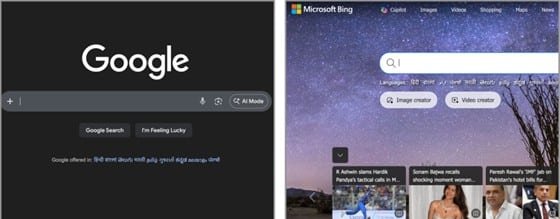
Google is designed for speed and task completion. Its minimalist interface reduces distractions and helps users focus on the query. This aligns with UX research showing that simpler layouts improve scan speed and decision-making.
- Clean homepage with minimal elements
- Linear, easy-to-scan results layout
- Features like snippets and AI Overviews support, not interrupt
- Optimised for fast, repeat searches
Microsoft Bing takes a more visual and layered approach. It introduces more entry points and content on both the homepage and results page, encouraging exploration.
- Visual homepage with daily backgrounds and trending topics
- Rich results with image strips, video previews, and side panels
- Strong AI visibility through Copilot integration
- Designed to increase engagement and browsing
The core difference is intent. Google focuses on efficiency and quick answers, while Bing is built for discovery and deeper interaction.
Curious how people actually search before choosing between Bing and Google? Dive into this breakdown of consumer behaviour to see what drives their decisions.
Which Search Engine Delivers Better Web Search Results?
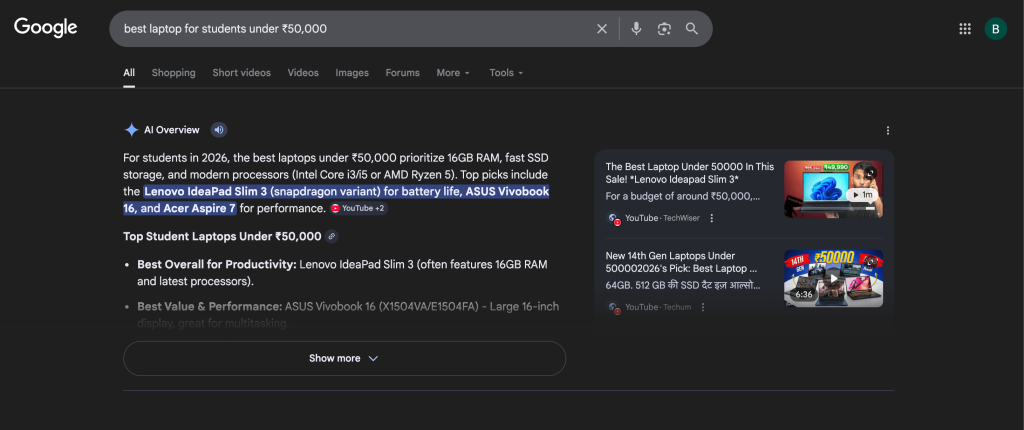
Google tends to perform better when queries are vague, layered, or intent-driven. For example, if you search “best laptop for students under ₹50,000”, Google usually interprets the buying intent and shows comparison articles, reviews, and curated lists rather than just product pages.
Here is what that looks like in practice:
- Interprets intent beyond exact keywords
- Strong performance on long-tail and research queries
- Surfaces diverse results like guides, comparisons, and forums
- More consistent results across complex topics
Microsoft Bing performs well when the query is clear and specific. For example, a search like “iPhone 15 Pro price in India” or “Nike Air Max size chart India” typically returns more direct results, often from official or high-authority sources.
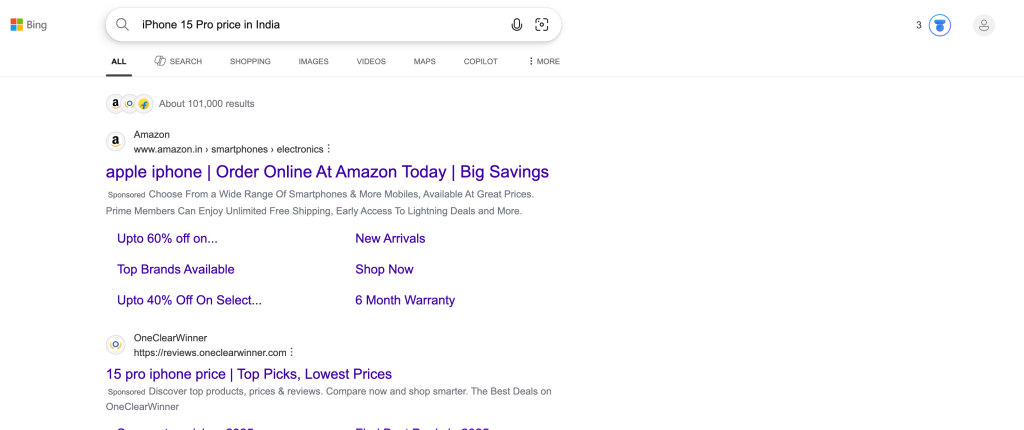
Here is how Bing typically behaves in those cases:
- Strong for exact, transactional, or brand-led queries
- Prioritises official and authoritative domains
- More keyword-aligned results
- Cleaner results for straightforward searches
For research-heavy or exploratory searches, Google usually performs better. For clear, specific queries, Bing can be just as effective and sometimes quicker to navigate.
Which Platform Has Better Image Search Capabilities?
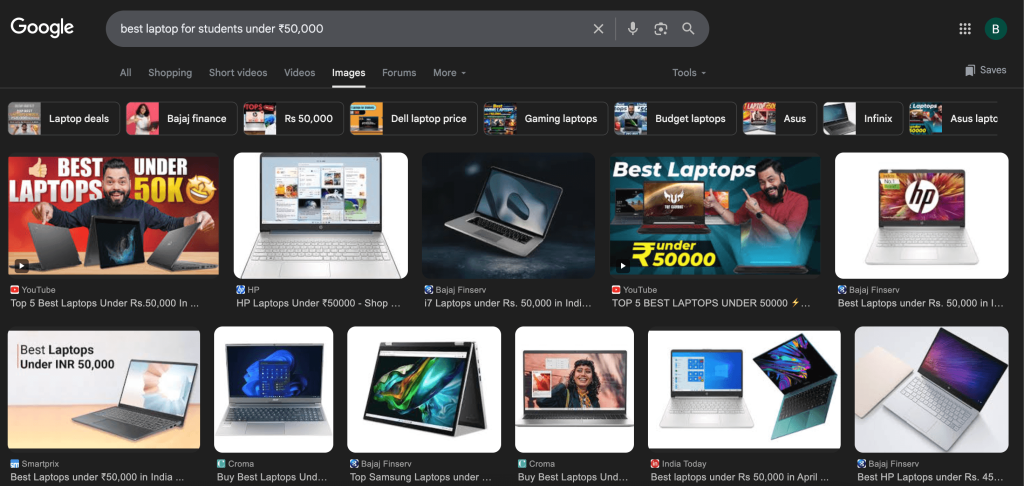
Google focuses on accuracy and real-world context in image search. Tools like Google Lens allow users to search using images instead of text. For example, if you upload a picture of a sneaker, Google can identify the exact model, show similar products, and even find where to buy it in India.
This makes Google particularly effective for:
- Identifying products, landmarks, and objects
- Connecting images to shopping, reviews, and locations
- Extracting text and contextual information from images
- Handling reverse image searches with high accuracy
Microsoft Bing takes a more visual-first approach. Its image search interface is often considered more user-friendly, with advanced filters and a layout designed for browsing. For example, searching “modern bedroom design ideas” on Bing often feels more like scrolling through a curated gallery.
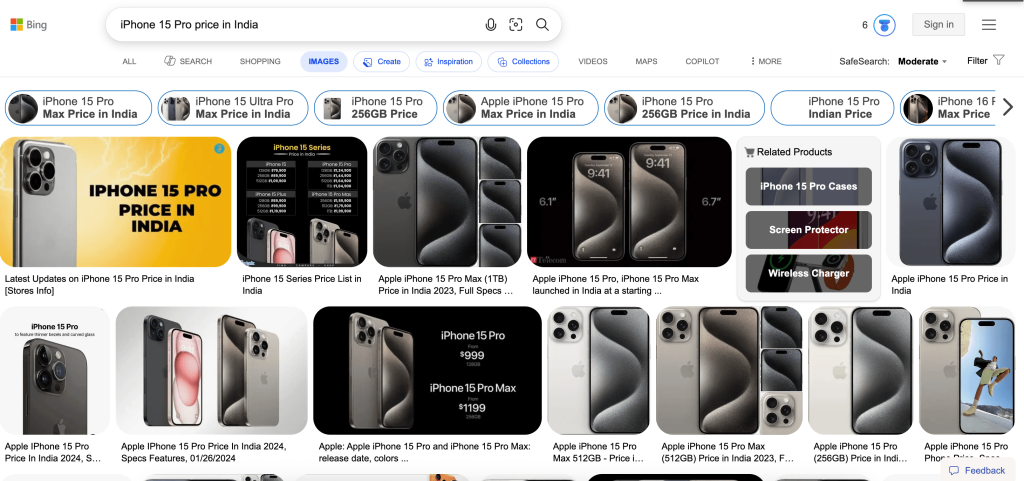
This makes Bing a stronger choice for:
- Browsing and visual inspiration
- Using filters like size, colour, and layout
- Exploring design ideas and creative content
- Interacting with visual search tools
Google is better when you want to identify or act on an image. Bing is better when you want to explore or get inspired.
Want to understand why users search for your brand directly? This guide on branded search breaks it down clearly.
How Do Bing and Google Compare in Video Search?
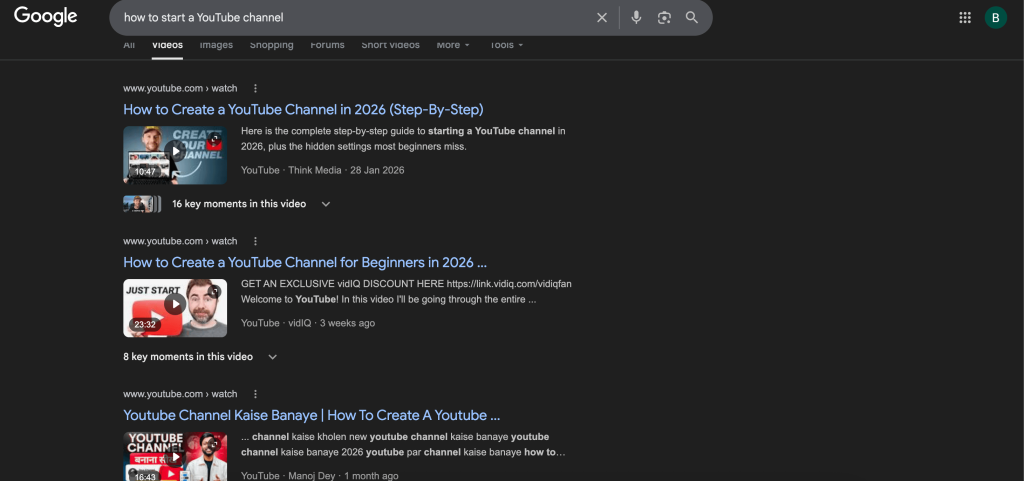
Google has a clear advantage in video search because of its integration with YouTube. For example, if you search “how to start a YouTube channel”, Google prioritises YouTube videos, often showing chapters, key moments, and highly relevant content directly in results.
This makes Google strong for:
- Access to the largest video library via YouTube
- High relevance for tutorials, reviews, and educational content
- Features like key moments and video snippets
- Better alignment with search intent
Microsoft Bing approaches video search differently. It focuses more on the browsing experience. For example, when you search “football highlights”, Bing often shows hover-to-play previews, allowing users to watch clips without leaving the results page.
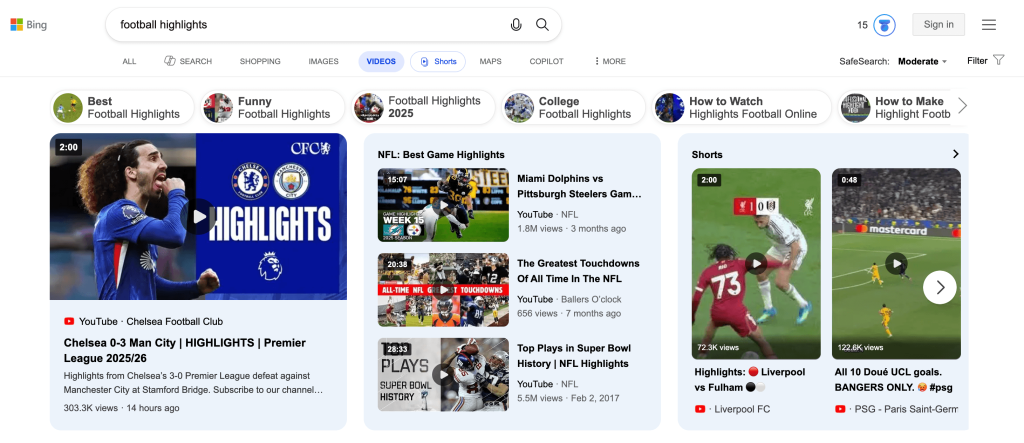
This makes Bing stand out for:
- Hover previews that play videos instantly
- Cleaner video grid layout
- Easier browsing across multiple sources
- Faster content discovery without extra clicks
Google is better when you want the most relevant and in-depth video content. Bing is better when you want to quickly browse and preview videos.
Which Search Engine Provides Better News Coverage?
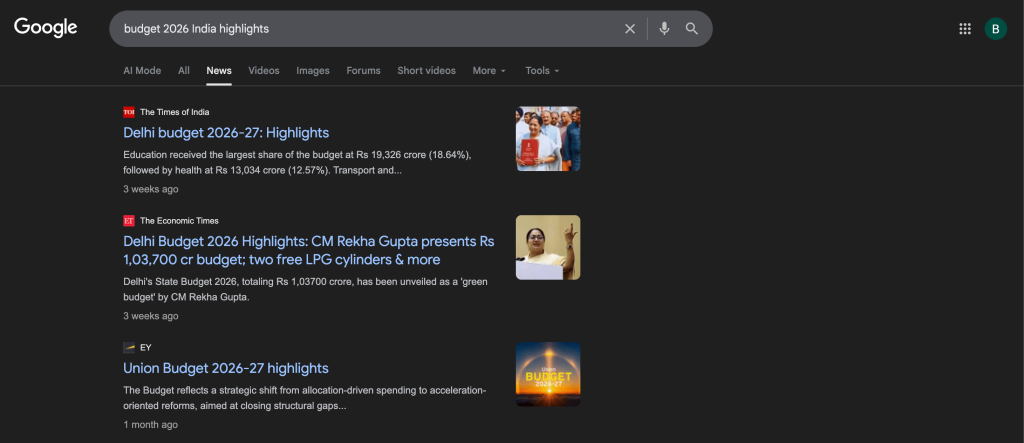
Google delivers a highly personalised news experience, largely powered by Google News. For example, if you search “budget 2026 India highlights”, Google not only shows top stories but also clusters coverage from multiple publishers, giving different perspectives on the same topic.
This makes Google particularly strong for:
- Aggregating multiple sources around the same story
- Personalised news based on interests and behaviour
- Highlighting “Top stories” with real-time updates
- Showing diverse viewpoints across publishers
Microsoft Bing offers a cleaner and more structured news layout. For example, a search like “India election results” often displays neatly organised headlines with clear categorisation, making it easy to scan quickly.
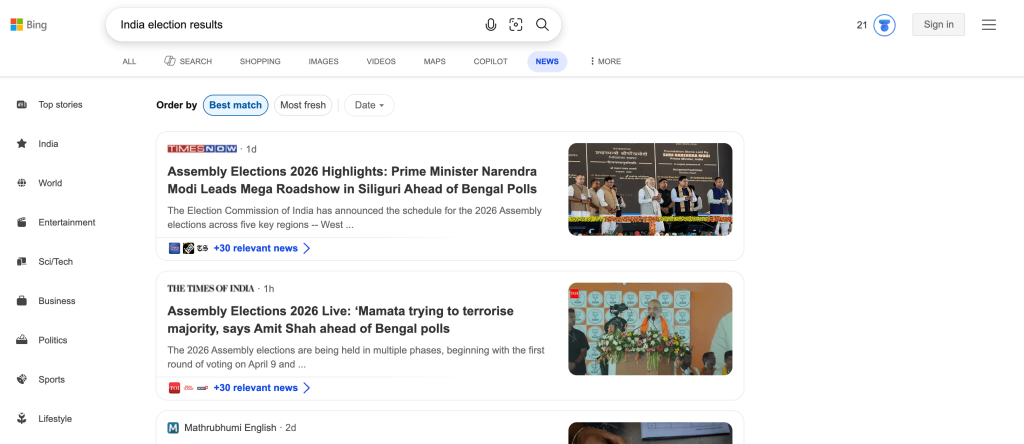
This makes Bing more effective for:
- Quick scanning of headlines
- Clean, distraction-free news layout
- Categorised news sections
- Straightforward access to major publications
Google is better for depth, diversity, and staying updated across multiple sources. Bing is better for quickly scanning headlines without too much personalisation.
How Do AI Summaries Differ Between Bing and Google?
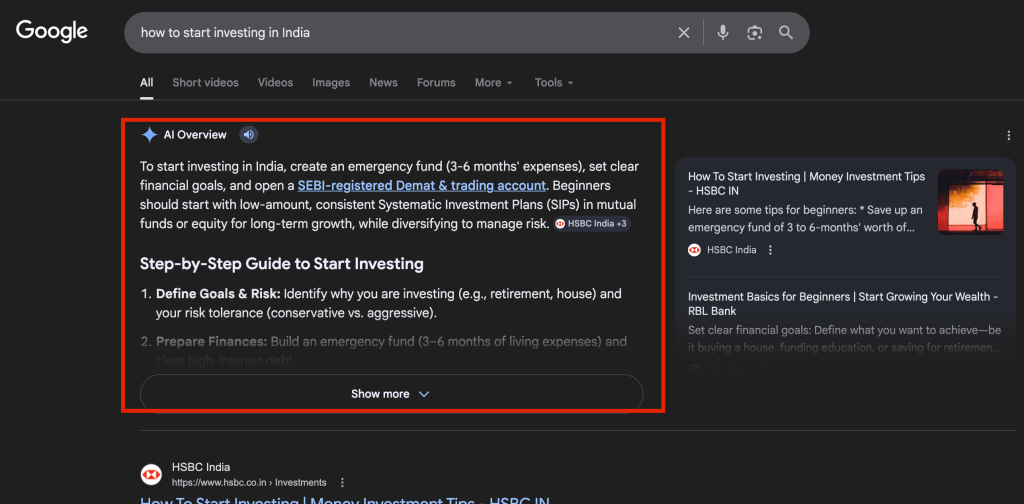
Google integrates AI summaries directly into search results through AI Overviews. For example, a query like “how to start investing in India” often triggers a concise summary at the top, pulling together key points from multiple sources.
This makes Google’s AI summaries useful for:
- Quick, condensed answers at the top of results
- Seamless integration within traditional search
- Summarising multiple sources into a single view
- Reducing the need to click through multiple links
Microsoft Bing delivers AI summaries through its Copilot experience, which is more conversational. Instead of just showing a short answer, it expands on the topic and often includes citations alongside responses.
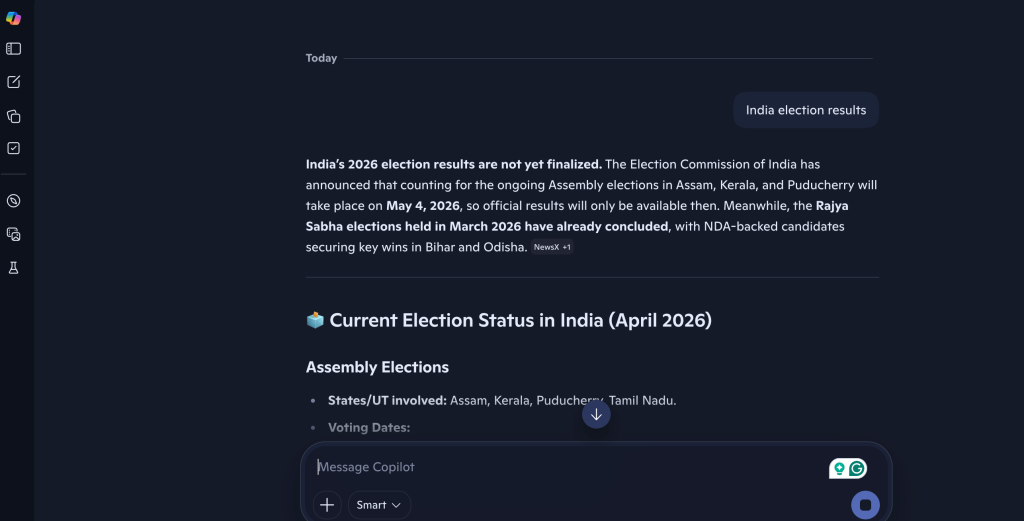
This makes Bing’s approach stronger for:
- More detailed, step-by-step explanations
- Conversational follow-up questions
- Clear citations and source references
- Handling multi-part or exploratory queries
In practice, the difference is noticeable. Google focuses on speed and brevity, while Bing focuses on depth and interaction. If you want a quick overview, Google works well. If you want to explore a topic further, Bing’s AI summaries are often more useful.
Wondering how to rank in ChatGPT, voice search, and AI results? This guide to Answer Engine Optimisation breaks it down.
Which Search Engine Is Better for Shopping?
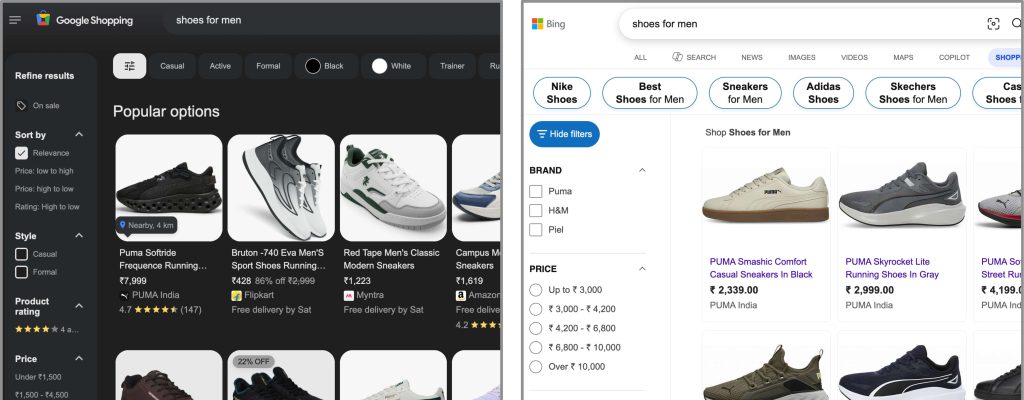
Google has built a strong shopping ecosystem that goes beyond simple product listings. For example, if you search “best smartphones under ₹30,000 in India”, Google shows product carousels, price comparisons, reviews, and seller options all in one place.
This makes Google particularly effective for:
- Comparing prices across multiple sellers
- Accessing reviews, ratings, and product details
- Discovering products through Google Shopping integrations
- Handling both research and purchase intent in one flow
Microsoft Bing also offers shopping results, but they are generally more straightforward and less integrated. For example, a search like “Samsung Galaxy S23 price in India” often surfaces direct listings and retailer links without as much comparison depth.
This makes Bing more suitable for:
- Quick product lookups
- Direct navigation to retailer sites
- Simpler, less cluttered shopping results
- Straightforward purchase intent
Google supports the full buying journey, from discovery to comparison. Bing works better when you already know what you want and just need to find it quickly.
Which Platform Is Better for Maps and Local Search?
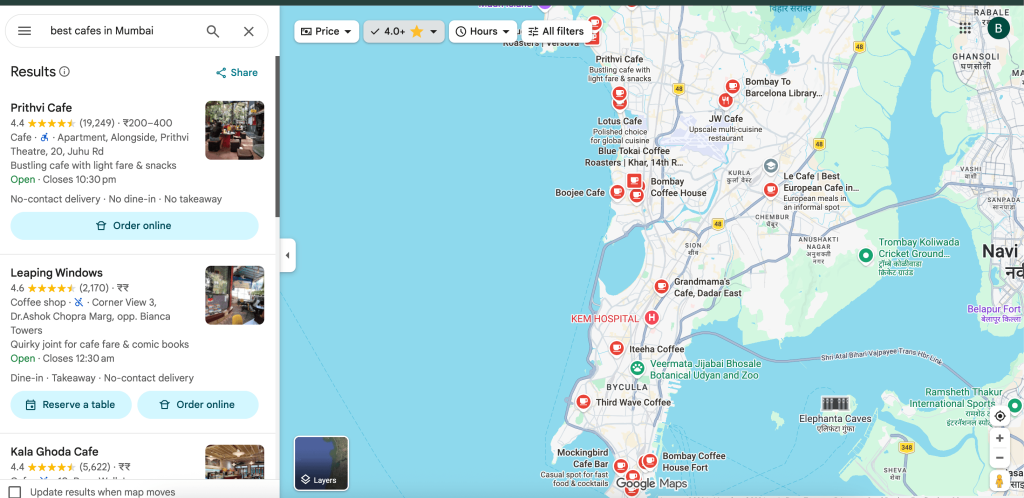
Google has a clear advantage in local search, largely due to the depth of Google Maps. For example, a search like “best cafes near me” in India typically shows a local pack with ratings, reviews, photos, peak hours, and directions, all tightly integrated into search results.
This makes Google especially strong for:
- Highly accurate local business listings
- Rich user-generated content like reviews and photos
- Real-time data, such as busy hours and directions
- Strong integration between search and maps
Microsoft Bing, powered by Bing Maps, offers similar functionality but with less depth and fewer user-generated signals. For example, local searches may show listings and directions, but often with limited reviews and less detailed insights.
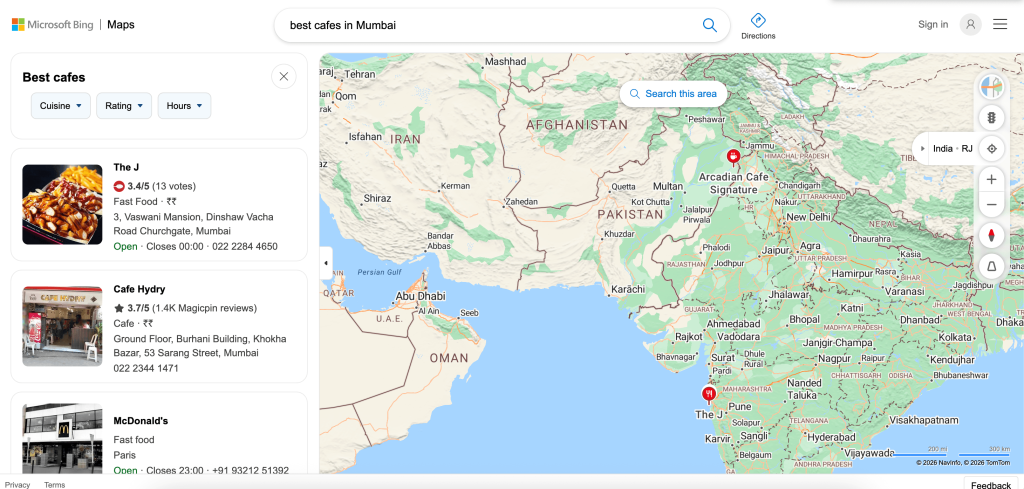
This makes Bing more suitable for:
- Basic location and navigation queries
- Simpler local search needs
- Quick access to directions without extra layers
- Users within the Microsoft ecosystem
Google dominates local discovery and decision-making, while Bing covers the basics but lacks the same level of detail and trust signals.
Does Bing or Google Offer Better Rewards Programs?
Google does not offer any rewards for using its search engine. Its model is focused on delivering results and monetising through ads rather than incentivising user behaviour directly.
Here is what that means for users:
- No points or rewards for searches
- No gamification of usage
- Focus remains purely on search experience
Microsoft Bing stands out with Microsoft Rewards, which gives users points for searching, browsing, and completing small tasks. These points can be redeemed for gift cards, subscriptions, or other perks.
Here is how Bing adds value through rewards:
- Earn points for daily searches
- Redeem rewards like gift cards and vouchers
- Encourages consistent usage through incentives
- Adds a gamified layer to search
The impact is subtle but important. While rewards alone may not shift power users away from Google, they do increase engagement and retention, especially for casual users.
Want to win the Bing vs Google battle? Start by mastering how to rank higher in Google search results with proven SEO strategies.
Which Search Engine Is Better for Travel Reservations and Info?
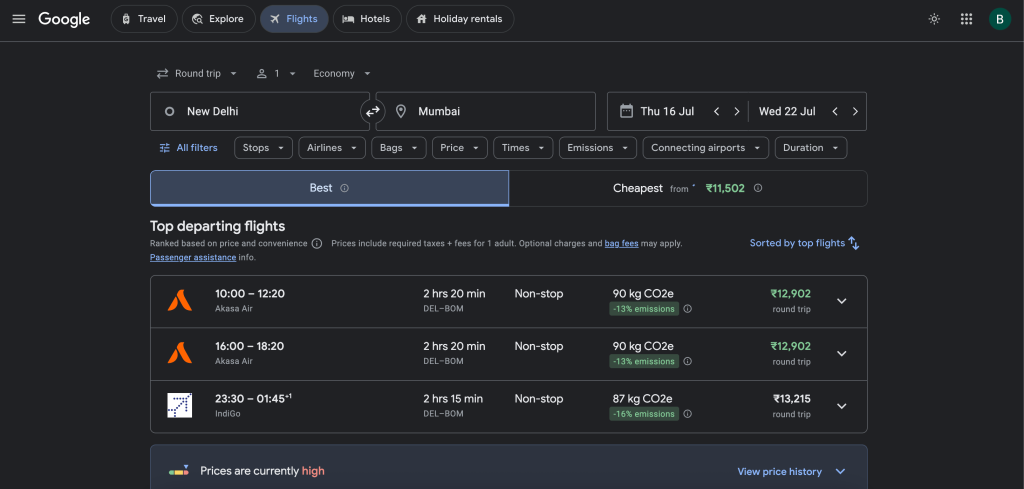
Google has built a strong travel ecosystem that goes beyond basic search. For example, if you search “flights from Delhi to Mumbai”, Google surfaces live prices, date comparisons, and airline options through Google Flights, along with hotel suggestions and travel insights.
This makes Google especially useful for:
- Comparing flight prices across dates and airlines
- Exploring hotel options with filters and reviews
- Accessing travel insights like price trends and best times to book
- Planning trips within a single interface
Microsoft Bing offers travel-related results, but they are more limited and less integrated. For example, similar searches may show links to booking sites rather than a built-in comparison experience.
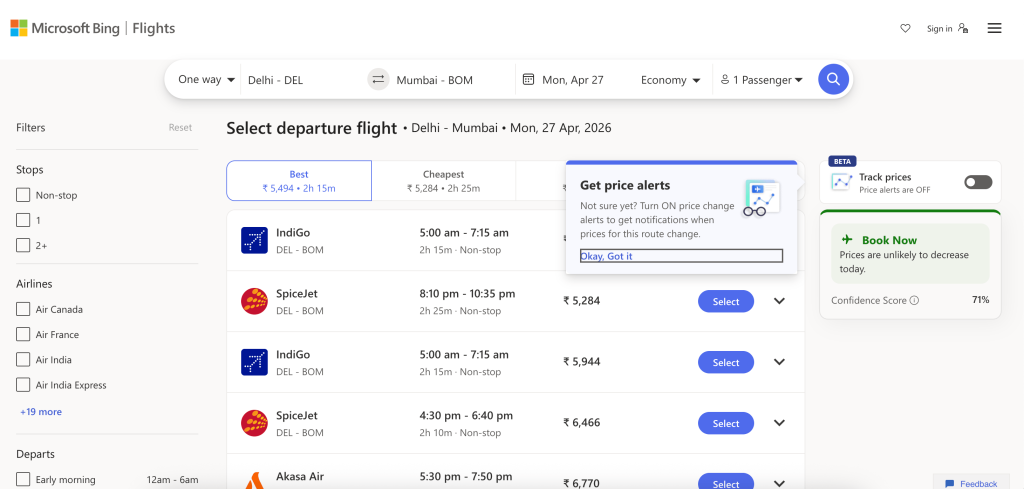
This makes Bing more suitable for:
- Quick access to travel websites
- Simple search-to-book journeys
- Users who already know their preferred booking platforms
- Basic travel queries without deep comparison
Google supports end-to-end travel research and decision-making, while Bing acts more as a gateway to external booking platforms.
How Do Bing and Google Compare on Mobile Apps?
Google benefits from a deeply integrated mobile ecosystem, especially on Android devices. Search is built into the operating system through widgets, voice search, and apps like Chrome and Google Maps. For example, many users in India interact with Google without even opening a browser, simply by using voice search or the search bar on their home screen.
This gives Google a strong advantage in everyday usage:
- Seamless integration across Android devices
- Built-in voice search and assistant features
- Tight connection with apps like Maps, Chrome, and YouTube
- Default search engine on most devices
Microsoft Bing offers a dedicated mobile app that focuses heavily on AI through Microsoft Copilot. The app combines search, chat, and rewards into a single interface, creating a more feature-rich but less native experience.
This makes Bing’s mobile experience distinct:
- AI chat integrated directly into the app
- Access to Microsoft Rewards within the same interface
- Visual and voice search features included
- Less deeply embedded compared to Google’s ecosystem
The difference comes down to integration versus features. Google wins on accessibility and default usage, while Bing offers a more feature-rich, AI-focused experience within its app.
What Is the Market Share Difference Between Bing and Google?
Google dominates global search by a wide margin, not just in percentage share but in sheer volume. Estimates suggest Google handles over 8.5 billion searches per day, highlighting the scale at which it operates.
Microsoft Bing, while significantly smaller, still processes a meaningful volume of searches, especially on desktop through Windows and Edge integration.
This difference becomes clearer when you look at Bing search volume vs Google. Google’s dominance is driven by mobile usage and default positioning, while Bing’s share is more concentrated in specific environments.
In practical terms, this shows up as:
- Google is capturing the majority of mobile and global search demand
- Bing is having a stronger presence on desktop and Microsoft-owned platforms
- Google is benefiting from default placement across devices and browsers
- Bing is gaining traction in specific user segments rather than mass scale.
Google drives global scale, while Bing captures more targeted pockets of traffic that are often overlooked.
How Does Bing SEO vs Google SEO Differ?
Google uses highly sophisticated ranking systems that prioritise intent, content quality, and authority. It evaluates factors like E-E-A-T (experience, expertise, authority, trust), user behaviour signals, and semantic relevance. This makes ranking on Google more competitive but also more aligned with high-quality content.
In practice, this means:
- Strong focus on content depth and usefulness
- Prioritises intent over exact keyword matching
- Heavy competition across most niches
- Frequent algorithm updates impacting rankings
Microsoft Bing takes a slightly different approach. While it also values quality, it tends to rely more on traditional signals like exact keywords, domain authority, and on-page optimisation. This often makes rankings easier to achieve, especially for newer or niche websites.
This shows up in how Bing SEO works:
- Greater weight on exact-match keywords
- Easier ranking opportunities with less competition
- Strong emphasis on metadata and on-page signals
- Faster visibility for newer sites
The key difference is predictability versus complexity. Google is more advanced but harder to optimise for, while Bing is more straightforward and often quicker to show results.
How Does Bing Ads vs Google Ads Compare?
Google dominates the advertising space through Google Ads, largely because of its massive search volume. For example, if you run ads for “digital marketing course in India”, Google gives you access to a much larger audience and higher impression potential.
This makes Google Ads strong for:
- Massive reach and high search volume
- Strong performance for competitive industries
- Advanced targeting and automation features
- Access to YouTube and display networks
Microsoft Bing offers ads through Microsoft Advertising, which reaches a smaller but often more specific audience. In many cases, advertisers report lower cost-per-click and less competition compared to Google.
This makes Bing Ads effective for:
- Lower cost-per-click in many niches
- Less competition for keywords
- Strong performance on desktop audiences
- Reaching users within the Microsoft ecosystem
The trade-off is scale versus efficiency. Google Ads delivers reach and volume, while Bing Ads often delivers better cost efficiency and less competition.
How Does Bing Analytics vs Google Analytics Compare?
Google offers Google Analytics, which is one of the most widely used analytics tools globally. It provides deep insights into user behaviour, traffic sources, conversions, and engagement across websites and apps.
This makes Google Analytics powerful for:
- Detailed tracking of user journeys and behaviour
- Advanced reporting and custom dashboards
- Integration with Google Ads and Search Console
- Scalable insights for businesses of all sizes
Microsoft Bing does not have a direct equivalent to Google Analytics, but offers tools like Microsoft Clarity and Bing Webmaster Tools. These focus more on user interaction insights, such as heatmaps and session recordings.
This makes Bing’s analytics ecosystem useful for:
- Visualising user behaviour through heatmaps
- Understanding click patterns and engagement
- Identifying usability issues on pages
- Complementing, rather than replacing, full analytics tools
The key difference is depth versus focus. Google Analytics provides a complete data ecosystem, while Bing’s tools offer more focused insights into how users interact with your site.
Which Search Engine Wins Overall?
The answer to which is better, Google or Bing, depends on your goal.
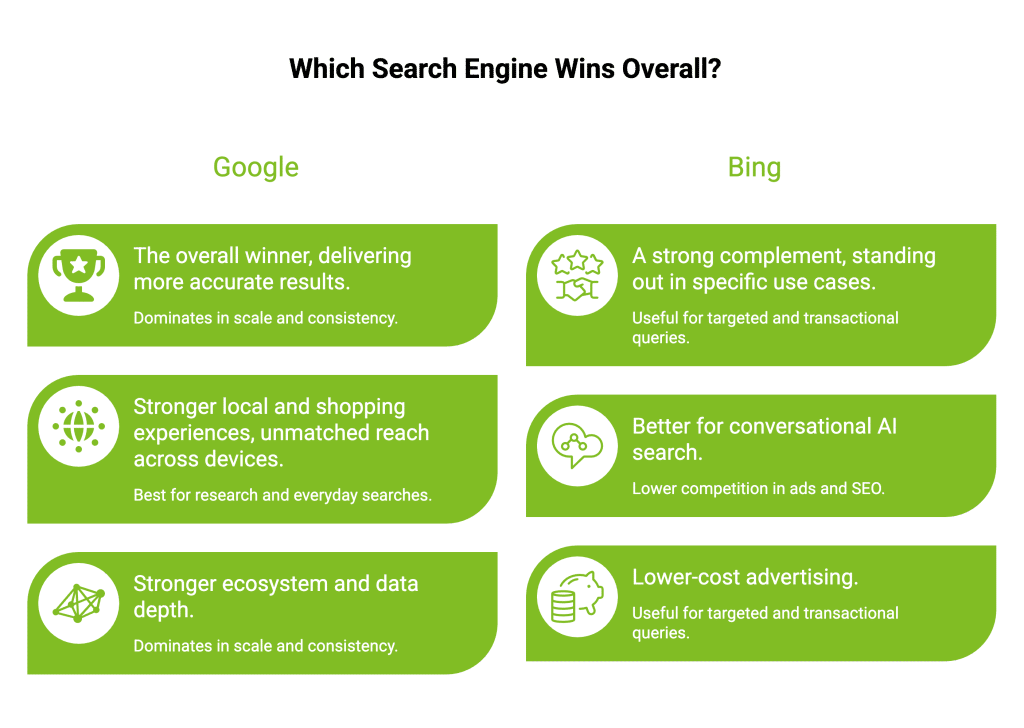
Google is still the overall winner. It delivers more accurate results, stronger local and shopping experiences, and unmatched reach across devices.
- Best for research and everyday searches
- Stronger ecosystem and data depth
- Dominates in scale and consistency
Microsoft Bing is not a replacement, but a strong complement. It stands out in AI search, lower-cost advertising, and specific use cases.
- Better for conversational AI search
- Lower competition in ads and SEO
- Useful for targeted and transactional queries
The real advantage comes from understanding where each performs best. Relying on one limits your reach, while using both gives you a more complete view of how search works today.
How Can Wild Creek Web Studio Help You Win Across Google and Bing?
Most businesses waste budget by using the wrong platform at the wrong time. They invest in SEO or ads but lack a clear strategy, which leads to inconsistent results and missed opportunities.
Wild Creek Web Studio solves this by taking a multi-platform, ROI-first approach. Instead of choosing between Google and Microsoft Bing, we help you use both where they perform best.
Here is how we approach it:
- Prioritise Google for scale and visibility
- Use Bing for cost-efficient, high-intent traffic
- Align SEO, ads, and content into one strategy
- Focus on ROI, not just traffic
With 18+ years of experience and 100+ brands served, we focus on what actually drives growth. The result is simple. Better decisions, better allocation, and better returns across platforms.
Final Words
Search is no longer dominated by a single platform. While Google still leads in scale and accuracy, Microsoft Bing is reshaping how users interact with search through AI and alternative discovery paths.
The key shift is this. Search is no longer just about ranking; it is about visibility across multiple systems. Relying on one platform limits reach. Understanding how each platform works unlocks new opportunities.
That is where the real advantage lies.
Frequently Asked Questions
How do the user demographics differ between Bing and Google?
In the global search engine market, Google search attracts a broader user base across mobile devices, while Microsoft’s Bing skews towards older, desktop users. Bing search engine users often engage via Windows, while Google dominates younger, mobile-first audiences.
How to change Bing to Google?
To switch from Microsoft’s Bing to Google search, go to your browser settings, update the default web search engine, and replace the search box provider. This improves user experience and ensures Google results appear at the top of the page.
Who is Bing’s biggest competitor?
In the search engine market, Google search is Bing’s biggest competitor. As the most popular search engine and market leader, Google dominates the global search market with superior search engine results, advanced machine learning, and a significantly larger user base.
Is Bing as good as Google now?
Microsoft’s Bing has improved with generative AI and Bing AI features like Bing Chat. However, Google search still leads in search engine results, natural language processing, and overall user experience, making it the most reliable web search engine.
How much bigger is Google than Bing?
In the global search market, Google search is significantly larger than the Bing search engine, with far higher search engine market share and daily search queries. Its dominance across mobile devices and web pages reinforces its position as market leader.
Why would someone use Bing instead of Google?
Users may choose Microsoft’s Bing for features like Bing Chat, rewards, and strong artificial intelligence integration. It offers a different user interface, useful related searches, and can provide cost advantages in search ads within the search engine market.
What do Gen Z use instead of Google?
Gen Z increasingly uses social media platforms and AI chatbot tools alongside Google search. They prefer visual content, live search experiences, and natural language queries, often bypassing traditional web search engine behaviour for faster, more interactive results.