Wild Creek Web Studio
  • About Wild Creek
    • Awards
    • Case Studies
    • Portfolio
    • Testimonials
  • Services
    • SEO Services
    • Paid Marketing Services
    • Social Media Marketing
    • Consulting and Strategy
  • Resources
    • Blogs
    • Free SEO Tools
    • Digital Marketing Glossary
  • Contact
Unlock PAA Boxes

Unlock PAA Boxes: Rank Higher With User-Friendly Content

People Also Ask (PAA) boxes have become essential for improving website visibility and attracting targeted traffic. These boxes appear on search results pages and provide users with a list of related questions to their query. By optimizing your content to rank in these boxes, you can increase your chances of being found by potential customers and improve your website’s search engine optimization (SEO).

Understanding how PAA boxes work and how Google analyzes search queries is crucial to optimizing your content and ranking higher in these boxes. Explore the PAA feature description and how PAA works, and provide tips for optimizing your content to rank higher in these boxes.

Unlock PAA Boxes

By following these tips, you can unlock the power of PAA boxes and drive targeted traffic to your website, ultimately increasing your online visibility and improving your search engine rankings.

In this Article

Toggle
  • PAA Feature Description
  • How PAA Works
  • Optimizing for PAA
  • Frequently Asked Questions
    • What are some common mistakes to avoid when optimizing content for the PAA feature?
    • How can businesses track the success of their PAA strategy and make adjustments accordingly?
    • Can the PAA feature be used effectively for local SEO, or is it more relevant for national or international businesses?
    • Are any specific industries or niches particularly well-suited for the PAA feature, or is it applicable to all types of content?
    • How does the PAA feature differ from other SERP features, such as featured snippets or knowledge panels, and what are the unique advantages of each?

PAA Feature Description

Google’s Natural Language Processing algorithms analyze the query to bring a relevant answer, providing users with the most relevant and up-to-date information. The PAA feature is intended to help users discover new and relevant information and broaden their understanding of the topic.

Moreover, the PAA feature has a significant impact on SEO. Creating content in the same format as the PAA box can help rank in the feature, bringing targeted traffic to the site. PAA boxes help refine the questions typed into Google, assisting users to ask a better question.

Providing related questions to users can also benefit those who use uncommon keywords or terminology in their search queries. Overall, the PAA feature offers users substantial benefits and allows businesses to optimize their content for better search engine ranking.

How PAA Works

Google’s People Also Ask (PAA) feature operates through machine learning algorithms to display a dynamic list of related questions to the user’s initial search query to provide the most relevant and up-to-date information. The feature uses natural language processing to understand complex queries and identify the most common related questions users have searched.

PAA boxes appear on around 70% of desktop search results, making it a valuable tool for SEO professionals to optimize their content and rank higher on Google’s search engine results page. One of the benefits of the PAA feature for SEO is that it helps refine the user’s search query, allowing them to ask better questions and find more relevant answers.

It also allows content creators to optimize their content for the PAA boxes, which can bring targeted traffic to their sites. By analyzing user behavior, PAA also helps businesses understand the types of questions their target audience asks, which can inform their content creation strategy. Overall, PAA is a valuable feature that benefits both users and content creators, providing relevant and up-to-date information to users while helping businesses optimize their content for better search rankings.

Optimizing for PAA

Optimizing for the People Also Ask (PAA) feature requires understanding the related questions that users are asking and creating content that provides valuable and relevant information. Keyword research is essential in identifying the common queries that users have made. This helps create content that targets those keywords and answers the related questions.

It is also essential to create content that is user-friendly and easy to read. This can be achieved using simple language, bullet points, and images to break down complex ideas.

Content creation is a crucial aspect of optimizing for the PAA feature. Creating content in the same format as the PAA box can help rank in the feature. This includes creating content that is in a question-and-answer format. Providing clear and concise answers to the related questions can help improve the chances of ranking in the PAA feature.

It is also essential to keep the content up-to-date and relevant by regularly updating it. Optimizing for the PAA feature can bring targeted traffic to a website and improve its visibility in search engine results pages.

Frequently Asked Questions

What are some common mistakes to avoid when optimizing content for the PAA feature?

When optimizing content for the PAA feature, avoiding common mistakes such as keyword stuffing and providing incomplete answers is crucial. Using natural language and considering the impact of voice search is also essential.

How can businesses track the success of their PAA strategy and make adjustments accordingly?

To track the success of their PAA strategy, businesses can use tools like Rank Ranger’s SERP Feature Monitor to monitor PAA rankings and track changes. Adjustments can be made based on the data collected to improve PAA performance.

Can the PAA feature be used effectively for local SEO, or is it more relevant for national or international businesses?

The PAA feature can be used effectively for local SEO, as it helps refine the search query and provides relevant information to users. Small businesses can benefit from optimizing their content for PAA, regardless of their geographical location.

Are any specific industries or niches particularly well-suited for the PAA feature, or is it applicable to all types of content?

The PAA feature has limitations and may not apply to all types of content. Its effectiveness depends on the industry and niche. PAA can complement traditional keyword research, but testing and tracking its results is essential.

How does the PAA feature differ from other SERP features, such as featured snippets or knowledge panels, and what are the unique advantages of each?

The PAA feature differs from other SERP features, such as featured snippets or knowledge panels, by presenting a list of related questions to the user. The unique advantage is that it helps refine the user’s search query while optimizing content for PAA can bring targeted traffic to the site. Best practices for PAA optimization include creating content in the same format as the PAA box and tracking the PAA strategy.


0 comments
Target Your Content - Find Your Audience

Target Your Content: Find Your Audience

In the digital marketing era, content creation has been established as a tool for businesses to reach their target audience and convert them into paying customers. However, creating such content requires a comprehensive understanding of the intended audience. The absence of audience research can lead to wasted efforts, resulting in minimal returns.

It is, therefore, essential to conduct thorough research on the audience’s pain points, interests, and search behavior to create compelling content that resonates with them. This article delves into the importance of targeting content and provides tips on how to find the audience.

Targeting content requires understanding the audience’s needs and preferences by conducting thorough research on their behavior and pain points. By doing this, businesses can create content that speaks to the audience’s needs, which would resonate with them, increase engagement, and drive conversions.

Target Your Content - Find Your Audience

This article aims to provide valuable insights into the importance of audience research and how businesses can effectively target their content to find their audience.

In this Article

Toggle
  • Why Audience Research Matters
  • Understanding Pain Points and Behavior
  • Effective Content Creation
  • Frequently Asked Questions
    • What are some common mistakes in content marketing when targeting the right audience?
    • How can audience research help with creating compelling content?
    • What are some methods for understanding audience pain points and search behavior?
    • Can skipping target audience research impact the success of content creation efforts? If so, how?
    • How can businesses ensure they are targeting the right audience for their content?

Why Audience Research Matters

The significance of audience research in content marketing lies in its ability to inform content creation by identifying the target audience’s pain points and search behavior.

Demographic analysis is one of the critical components of audience research, which involves understanding the age, gender, income, education, and other relevant characteristics of the target audience. This information helps content creators tailor their content to suit the specific needs and preferences of the audience, making it more relevant and engaging.

Another important aspect of audience research is competitor analysis. This involves identifying competitors’ content strategies and tactics in the same niche or industry. By analyzing the strengths and weaknesses of their content, content creators can gain insights into what works and what doesn’t and use this information to improve their content.

Neglecting audience research, including demographic and competitor analysis, can result in futile content creation efforts that fail to attract the right traffic and convert leads into customers.

Understanding Pain Points and Behavior

Understanding audience pain points and search behavior is crucial for creating compelling content that attracts and converts potential customers. Identifying demographics and conducting keyword research are essential steps in this process.

Marketers should create content that resonates with their target audience by addressing their needs and pain points. By doing so, they can establish themselves as an authority in their industry and build trust with their audience.

Furthermore, understanding the target audience’s search behavior is essential in creating content that can rank highly on search engine results pages (SERPs). Keyword research can help marketers identify the search terms their target audience uses to find information related to their industry.

By incorporating these keywords into their content, marketers can increase their chances of ranking higher on SERPs and driving more organic traffic to their websites. Understanding audience pain points and search behavior is essential for compelling content to attract and convert potential customers.

Effective Content Creation

Creating content that resonates with the intended audience requires thorough research and analysis of their pain points and search behavior. Content targeting is an essential aspect of content marketing, as it helps businesses create content that appeals to a specific audience segment. Audience segmentation involves dividing a larger target audience into smaller groups based on common characteristics such as demographics, interests, and behaviors.

This enables businesses to create content that speaks directly to the needs and interests of each group, resulting in higher engagement and conversion rates. Effective content creation involves understanding each audience segment’s unique needs and preferences and creating content that addresses their pain points. This can include creating blog posts, videos, social media content, and other content that resonate with each segment.

Businesses can also use data analytics tools to track user behavior and preferences, enabling them to refine their content strategy and create more targeted and compelling content. By taking the time to research and understand their target audience, businesses can create content that attracts the right traffic and converts leads into customers, resulting in long-term growth and success.

Frequently Asked Questions

What are some common mistakes in content marketing when targeting the right audience?

Audience misconceptions and narrow targeting are common mistakes in content marketing. Failing to research the target audience’s pain points and search behavior can render content creation efforts useless. Effective content brings in the right traffic and converts leads into customers.

How can audience research help with creating compelling content?

Audience persona research helps to understand the target audience, their pain points, search behavior, and preferences. This insight enables the creation of relevant and compelling content, which attracts the right traffic and converts leads into customers.

What are some methods for understanding audience pain points and search behavior?

Understanding audience pain points and search behavior can be achieved through understanding demographics and conducting thorough keyword research. Analyzing demographics can provide insights into audience needs and preferences, while keyword research can reveal common search queries and interests.

Can skipping target audience research impact the success of content creation efforts? If so, how?

Skipping target audience research can significantly impact the success of content creation efforts by rendering them useless. The importance of audience research lies in understanding pain points and search behavior, which helps create compelling content and convert leads into customers. Avoiding common mistakes in audience research can ensure a successful content strategy.

How can businesses ensure they are targeting the right audience for their content?

To ensure content relevance and audience engagement, businesses must conduct thorough research to identify their target audience’s specific needs, interests, and pain points. This involves analyzing search behavior, social media activity, and feedback to produce content that resonates with the audience.

0 comments
Revolutionize Your SEO With Chat GPT

Revolutionize Your SEO With Chat GPT: Tips & Insights

In the current digital era, search engine optimization (SEO) has become crucial for businesses to thrive online. With the increasing competition, staying ahead of the curve and adopting the latest technology to enhance SEO strategies is essential. One such technology that has been creating a buzz in the SEO world is Chat GPT.

Chat GPT is an AI-generated content tool that can help streamline research, save time, and generate quality content for SEO. In this article, we will delve deeper into the benefits of Chat GPT and how it can revolutionize your SEO strategy. We will provide insights and tips on how to use Chat GPT effectively to enhance your SEO efforts.

Revolutionize Your SEO With Chat GPT

Through the insights shared by industry experts, we aim to provide a comprehensive understanding of the potential of Chat GPT in optimizing SEO and how businesses can leverage it to improve their online presence.

In this Article

Toggle
  • AI for SEO
  • Benefits of Chat GPT
  • Using Chat GPT effectively
  • Frequently Asked Questions
    • What are some potential drawbacks or limitations of using AI for SEO?
    • Can Chat GPT be used for other digital marketing purposes besides content creation?
    • How does Chat GPT compare to other content creation tools on the market?
    • Are there any industries or niches where Chat GPT may need to be more effective?
    • What technical knowledge is required to use Chat GPT for SEO effectively?

AI for SEO

AI advancements, particularly Chat GPT, present exciting opportunities for generating SEO content faster while ensuring that essential factors such as expertise, authority, and trustworthiness (E-A-T) are still prioritized.

This was highlighted in the In Search SEO podcast’s three-part series on Chat GPT for SEO, which featured industry experts such as Julia McCoy and Alizée Baudez. With Chat GPT applications, content creation becomes more efficient as the technology can help write content 5-10 times quicker than traditional methods.

AI has been a game-changer for the SEO industry. Chat GPT’s ability to quickly generate high-quality content has made it a valuable tool for digital marketers. As Google has already stated that using AI is not a reason for the penalty, Chat GPT’s potential for SEO applications is significant.

However, it is essential to note that while Chat GPT can streamline research and save time, being an expert voice is still critical for SEO. Chat GPT is not meant to replace human expertise but to complement and enhance it.

Benefits of Chat GPT

One advantage of utilizing Chat GPT in search engine optimization is its ability to streamline research and save time by producing 5-10 times quicker content. Chat GPT can generate personalized content for various digital marketing topics, enabling SEO professionals to focus on other essential aspects of their work. AI technology can create high-quality content that aligns with Google’s E-A-T (expertise, authority, trustworthiness) guidelines, ensuring that the content is relevant and valuable to the audience.

Moreover, Chat GPT can provide a unique angle to stand out, especially in a crowded market. By personalizing the questions asked to Chat GPT, SEO professionals can tailor the content to their target audience, making it more engaging and relevant. The ideation feature of Chat GPT is also helpful in generating new ideas, saving time and resources in the process.

Despite its initial challenges, Chat GPT has come a long way in generating quality content, and refining its initial questions and providing context can further improve its response.

Using Chat GPT effectively

Effectively utilizing Chat GPT in search engine optimization requires a structured approach to prompt training, trial and error, and the verification of information to achieve optimum results.

First and foremost, structured prompts are essential to training Chat GPT effectively. Providing clear and concise prompts, including subheadings and avoiding jargon, can help the AI generate high-quality content. Personalizing the questions to the audience can make them more engaging and hook the reader. Refining the initial questions provided by Chat GPT and providing context can also improve its response and generate more relevant content.

Furthermore, trial and error is the best way to learn how to use Chat GPT effectively. Trying different prompts, refining questions, and verifying information can lead to better results. It is crucial to double-check the accuracy of the generated content and ensure it aligns with the E-A-T principles of expertise, authority, and trustworthiness.

Lastly, providing all necessary information to Chat GPT can lead to optimum answers, saving time and streamlining the research process. With a structured approach and trial and error, Chat GPT can revolutionize SEO by generating quality content 5-10 times quicker.

Frequently Asked Questions

What are some potential drawbacks or limitations of using AI for SEO?

Limitations of AI for SEO include the risk of producing low-quality content and over-reliance on technology. However, Chat GPT’s impact on SEO strategy can streamline research and save time while maintaining E-A-T factors and personal expertise.

Can Chat GPT be used for other digital marketing purposes besides content creation?

Chat GPT can be utilized for lead generation and customer support in digital marketing. The technology’s ability to generate human-like responses and streamline research can aid in creating engaging conversations with potential leads and providing efficient customer support.

How does Chat GPT compare to other content creation tools on the market?

When comparing Chat GPT to traditional SEO strategies, Chat GPT’s automated content creation can save time and streamline research. It can also provide a unique perspective and improve content marketing ROI. However, it is important to note that expertise, authority, and trustworthiness are still essential for successful SEO.

Are there any industries or niches where Chat GPT may need to be more effective?

Chat GPT may be less effective in highly regulated and scientific industries due to the need for precise language. Similarly, local businesses with a limited online presence may not benefit from Chat GPT as they require a more personalized approach to their content creation.

What technical knowledge is required to use Chat GPT for SEO effectively?

Effective use of Chat GPT for SEO automation requires a basic understanding of natural language processing and content optimization. Technical knowledge is not a prerequisite, but trial and error, verifying information, and refining prompts are crucial for optimal Chat GPT applications.

0 comments
AI Writing Tool

How does AI Writing & Automated Writing Tools Affect SEO

Web content is one of the most important aspects of SEO. The challenge for many businesses is finding someone who can create them and have time to do it. In fact, the majority of companies outsource their web content writing to freelance writers & agencies. AI writing is changing the way we write. It is also changing the way we work, play, and live. Artificial intelligence has the potential to fundamentally alter our world, and it’s happening with incredible speed.

In this Article

Toggle
    • What is Artificial Intelligence and How does it Work?
    • Impact of AI Writing on Marketing Strategies and the Future of SEO
    • How Artificial Intelligence Affects SEO Ranking Factors
  • Improving Content Quality and SEO with an AI Detector
  • Conclusion and Possible Solutions for a Better Future

What is Artificial Intelligence and How does it Work?

Artificial intelligence can be defined as a system that is capable of performing tasks and responding to stimuli without human input.

Artificial intelligence is nothing new. It has been around for decades. However, it has become more popular in the last few years due to its advancements and how much it’s helped people in their personal lives.

AI is not just limited to making decisions for us or undoing our mistakes, but now they are able to make decisions for us by creating content that we would never think of. AI writers can take a lot of weight off the shoulders of human copywriters by generating content ideas at scale without any need for input from the person who will ultimately use them.

AI Writing Tool

AI Writing Tool

Impact of AI Writing on Marketing Strategies and the Future of SEO

Digital marketing is a crucial part of any business strategy. AI will play an even bigger part in the future of digital marketing. With AI, marketers can get personalized content suggestions, learn what content resonates with their audiences and more.

AI will help marketers generate better content that is highly relevant to their audience’s needs and wants. This personalization will be key for marketers to succeed in the future because it is what drives conversions and builds customer trust for businesses.

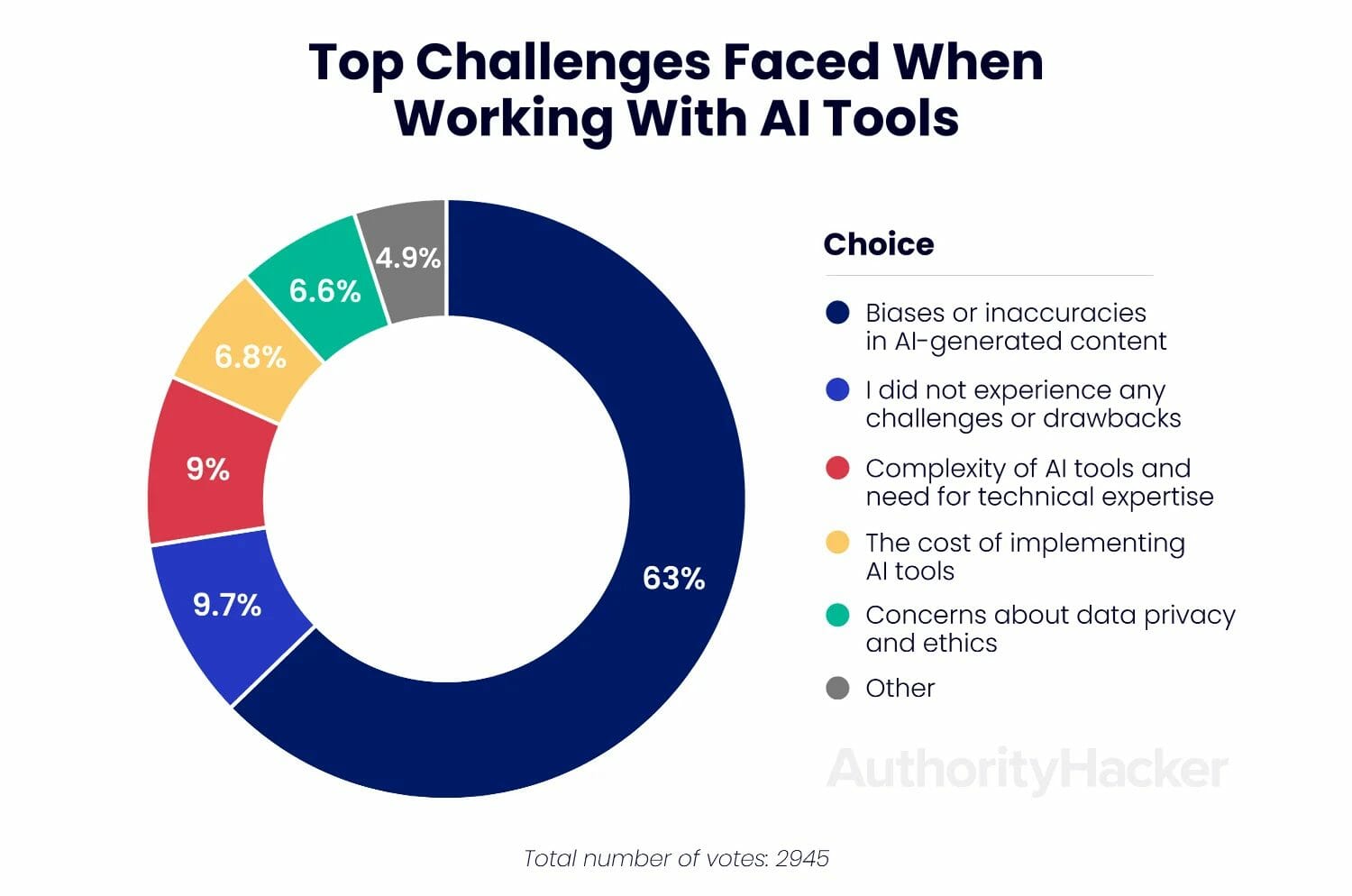
According to a survey done by Authority Hacker, 63% of people reported bias and inaccuracies in AI-generated content as the biggest challenge.

Top Challenges Faced When Working with AI Tools

Credit: Authority Hacker

How Artificial Intelligence Affects SEO Ranking Factors

Artificial intelligence has become an essential part of search engine optimization in the digital marketing industry. It can help marketers get a better understanding of what the user wants, so that they can create content with high engagement metrics.

AI will be able to analyze huge amounts of data, which is why it has become crucial for SEO ranking factors. Marketers can then use this data to improve their content and optimize it for search engines and searchers.

Improving Content Quality and SEO with an AI Detector

As more and more businesses turn to AI writing tools to generate content, it’s become increasingly important to ensure that the content produced is high-quality and free from errors or biases. This is where an AI detector comes in. An AI detector is a tool that can be used to analyze content generated by an AI writing tool and identify any potential issues, such as grammatical errors, factual inaccuracies, or inappropriate language. By using an AI detector, businesses can ensure that the content they produce is well-written, ethical, and in line with their values.

One of the key benefits of using an AI detector is that it can help improve a website’s SEO. Search engines like Google constantly update their algorithms to provide users with the most relevant and high-quality content. By using an AI detector to analyze the content on your website, you can ensure that it meets these standards and is more likely to rank well in search engine results pages. Additionally, an AI detector can help you identify any potential issues with your content, such as keyword stuffing or low-quality backlinks, which can negatively impact your SEO. Addressing these issues can improve your website’s overall SEO performance and attract more traffic.

Conclusion and Possible Solutions for a Better Future

As we can see, technology has made a significant impact in our writing lives. It has not only simplified the process of writing but also opened up many new opportunities that were not possible before. This is why it is important for us to embrace the change and use it to our advantage.

In conclusion, AI has made many changes in the world of copywriting that will undoubtedly have a great impact on both professional writers and businesses. We should be open to these changes and make sure we are prepared for them as much as possible.

0 comments
SEO for a US Manufacturer

Driving Organic Growth: Unleashing the Power of SEO for a US Manufacturer

This case study report focuses on a successful digital marketing campaign conducted by our agency for a US-based manufacturer. The client approached us intending to improve their website’s organic traffic, sessions, and new users. To achieve these goals, we implemented a comprehensive digital marketing strategy, including website optimization, content creation, and link building. This report will discuss the target audience, the marketing strategy used, and the results achieved through our campaign.

In this Article

Toggle
  • Target Audience:
  • SEO Strategy:
  • Results:
  • Conclusion:

Target Audience:

Our client’s products’ target audience included B2B and B2C customers. The products were primarily industrial components and equipment used in various industries, including construction, manufacturing, and energy. The target audience consisted of engineers, contractors, project managers, and other professionals involved in purchasing or specifying industrial components and equipment.

SEO Strategy:

We implemented a multi-faceted marketing strategy to increase the client’s organic traffic, sessions, and new users. The critical components of our process included:

  1. Website Optimization: We conducted a comprehensive audit of the client’s website and identified several on-page issues that negatively impacted their search engine rankings. We fixed these issues, including optimizing metadata, improving site speed, and addressing technical errors.
  2. Content Creation: We developed a strategy to create high-quality, informative, and engaging content that would appeal to the client’s target audience. This included blog posts, infographics, and white papers on topics related to the client’s products and services.
  3. Link Building: We acquired high-quality backlinks from authoritative websites in the client’s industry. This helped to improve the client’s search engine rankings and drive traffic to their website.

Results:

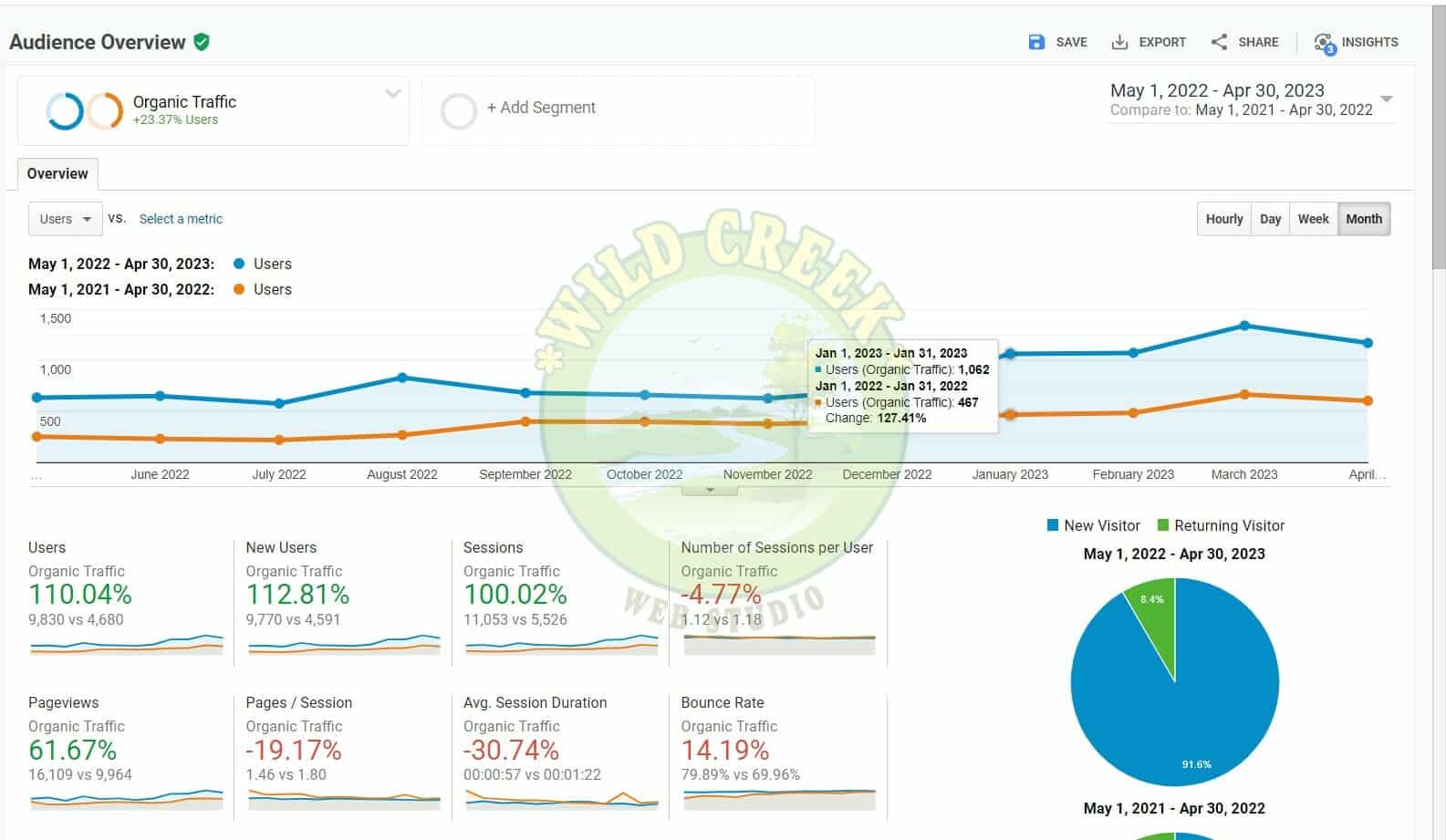
Our digital marketing campaign for the client was highly successful, significantly improving their organic traffic, sessions, and new users. The key results achieved through our campaign included the following:

Google Analytics - SEO for a US Manufacturer

  1. Organic Traffic: The client’s organic traffic increased by 110% throughout the campaign. This significantly improved their previous traffic levels and helped drive more leads and sales for their business.
  2. Sessions: We improved the client’s sessions by 100%, which was a remarkable achievement given the highly competitive nature of their industry.
  3. New Users: The number of unique users visiting the client’s website increased by 112% during our campaign. This was a critical metric for the client, as it indicated that our marketing efforts were reaching new potential customers and expanding their reach.

Conclusion:

In conclusion, our digital marketing campaign for the US-based manufacturer was highly successful, significantly improving organic traffic, sessions, and new users. Our strategy focused on website optimization, content creation, and link building, which helped to improve the client’s search engine rankings and drive traffic to their website. The target audience included B2B and B2C customers in various industries, including construction, manufacturing, and energy. Our results demonstrate the effectiveness of our marketing strategy, and we look forward to continuing to support the client’s growth in the future.


0 comments
The Benefits of Automating Digital Marketing Tasks

The Benefits of Automating Digital Marketing Tasks

Digital marketing is essential for businesses to succeed in today’s digital world. Automating certain aspects of digital marketing tasks can reduce the time and effort needed to manage campaigns effectively, allowing marketers to focus more on other areas of their business. This article explores how automating digital marketing tasks can benefit companies by increasing efficiency and streamlining workflows.

We will start by looking at some of the most common digital marketing activities that can be automated, from email campaigns and social media posts to website analytics tracking. We’ll also discuss how automation tools like chatbots and AI-driven content creation engines transform how marketers reach customers online. Finally, we’ll examine the potential cost savings associated with automating these tasks and the potential risks involved with relying too heavily on automation technology.

By understanding why it’s worth investing in automated solutions for your digital marketing needs, you will gain insight into what this powerful tool can do for your business and its bottom line. So let’s get started!

In this Article

Toggle
  • Definition Of Automation
  • Cost Savings
  • Increased Efficiency
  • Improved Accuracy And Quality
  • Time Savings And Resources Allocation
  • Enhanced Customer Experience
  • Conclusion

Definition Of Automation

Digital marketing automation is a process that reduces the need for manual labor by using specialized software to streamline and optimize tasks. Take, for example, an online retailer who uses automated emails to increase customer engagement. By leveraging digital automation technologies, they can segment their audience into different categories and send personalized messages tailored to each group’s interests.

Automation has many advantages when it comes to running digital marketing campaigns. Automating tasks eliminates the need for manual input from marketers. It allows them to focus on other aspects of their business. It also ensures accuracy in data entry, helping reduce errors caused by human oversight or fatigue. And since products are delivered faster with automation, businesses experience shorter campaign turnaround times and increased efficiency with fewer resources needed overall.

The most notable benefit of automating digital marketing tasks is cost savings. By reducing costs associated with hiring additional staff or outsourcing services, companies can reinvest those funds into their operations without sacrificing quality results. This makes automation a valuable tool for any business looking to maximize profits while providing exceptional customer service.

Cost Savings

Regarding cost savings, automating digital marketing tasks is a tremendous asset. Automation reduces the need for manual labor, allowing businesses to reallocate those funds elsewhere. It also cuts down on human error and leads to faster delivery of products or services, which also helps reduce overall costs. As a result, companies can save money without sacrificing quality results due to automation technology.

In addition to cost savings, automating marketing tasks allows businesses to work more efficiently with fewer resources needed overall. This increases efficiency by streamlining specific processes like customer segmentation or targeting user demographics that would otherwise take longer if done manually. Furthermore, automation software makes it easy to track performance metrics so marketers can quickly make adjustments to maximize their campaigns’ effectiveness.

The advantages of automating digital marketing tasks are vast; from reduced costs and increased efficiency to improved accuracy and faster delivery times – all these factors contribute significantly toward successful online campaigns. With the right tools in place, businesses can reap the rewards of automated solutions while seeing an increase in ROI over time.

Increased Efficiency

By automating digital marketing tasks, businesses can harness the power of increased efficiency in their operations. With automated solutions, companies no longer have to worry about manually completing mundane processes and are able to instead focus on higher level development or creative endeavors. This not only saves time but also allows marketers to quickly adjust campaigns as needed when metrics change. Automated solutions also provide improved accuracy with user segmentation and targeting – ensuring that messages reach the right people at the correct times.

Task automation further offers advantages like a reduction in human errors, faster delivery times for products or services, and even better insights into customer behaviors. All these factors combined help create an efficient workflow where staff members complete each step with precision and minimal effort is required. When done correctly, this type of automation can drastically reduce costs while improving overall organizational performance levels.

The benefits of automating digital marketing tasks are straightforward, providing greater efficiency across all aspects of a business’s online presence. Organizations can reap numerous rewards from implementing automated solutions into their strategies by streamlining specific processes through task automation and leveraging detailed analytics data. The improved accuracy and quality brought by such technologies will ensure successful online campaigns for many years to come.

Improved Accuracy And Quality

In addition to the improved efficiency gained from automating digital marketing tasks, businesses benefit from increased accuracy and quality assurance. Automating specific processes ensures customers receive accurate results when interacting with a brand online. This is especially true when it comes to customer segmentation and targeted content delivery – as automated solutions are able to quickly identify user interests and customize messaging accordingly.

Quality control also becomes more straightforward with task automation in place. Companies no longer have to check for errors or inconsistencies throughout campaigns manually; instead, automated systems monitor each step of the process, providing detailed feedback on any issues encountered. This helps maintain quality standards while minimizing the risk associated with manual oversight.

Automating digital marketing tasks leads to more reliable outcomes that help organizations stay competitive in today’s market. By leveraging technology-driven strategies like automation accuracy and digital marketing automation, companies can reduce costs while ensuring high-quality products or services reach their target audience at all times. In turn, this creates an enhanced customer experience that keeps users coming back again and again.

Time Savings And Resources Allocation

The time-saving and resource allocation benefits of automating digital marketing tasks are clear. Businesses can streamline their processes by leveraging automation while maximizing efficiency at every step. This is especially beneficial as it allows teams to focus on more critical projects or campaigns instead of spending valuable resources monitoring manual procedures. Automation also helps reduce operational costs in the long run by eliminating unnecessary labor expenses associated with manual efforts.

In terms of time savings, automation drastically reduces the time needed for specific tasks – such as data analysis, reporting, and customer segmentation – that would take much longer if done manually. Additionally, automated solutions help ensure all steps within a process are completed correctly, saving marketers from having to double-check everything themselves. As a result, companies spend less time managing tedious operations and more energy creating innovative strategies that drive growth and engagement.

Overall, the automation benefits of digital marketing tools provide numerous advantages regarding time savings and resource allocation. With these advancements, organizations have greater control over their workflows while ensuring consistency throughout each campaign or project. All this leads to improved customer experiences without sacrificing quality or accuracy – something that is invaluable in today’s competitive landscape.

Enhanced Customer Experience

Digital marketing automation has the potential to enhance customer experiences significantly. Automated customer experience solutions reduce repetitive tasks, allowing marketers to focus their efforts on developing creative and engaging campaigns that capture customers’ attention. These automated tools are also designed to improve customer journey mapping by providing insights into how customers interact with a brand across various channels. This data can then be used to inform personalized messages explicitly tailored toward each user’s needs, ultimately leading to more successful sales and higher levels of satisfaction among customers.

Furthermore, digital marketing automation enables companies to track individual customer journeys over time to understand their behavior and preferences better. By applying these learnings, businesses can create even more effective strategies for delivering content at the right moments along the customer journey – increasing engagement and reducing churn rates. Additionally, this technology allows marketers to automate processes such as collecting user feedback or running loyalty programs that further boost customer satisfaction.

Overall, automating digital marketing tasks provides numerous advantages when it comes to enhancing customer experiences. It allows organizations to save time and resources. It gives them greater control over their workflows to deliver targeted, meaningful content that resonates with users like never before. As a result, companies can build stronger relationships with their audiences without sacrificing quality – something that is invaluable in today’s competitive landscape.

Conclusion

Automating digital marketing tasks is a powerful tool that can benefit businesses of all sizes. By leveraging automation, companies can save costs, increase efficiency and accuracy in their processes, free up time and resources to focus on more complex or creative tasks and provide customers with an enhanced experience. The potential benefits are clear – it’s just a matter of taking the plunge into implementing automated solutions into your digital marketing strategy.

To take full advantage of this technology, however, requires thoughtful planning and execution. It will be challenging; you may encounter roadblocks or even hit a few speed bumps along the way. But if you stay focused on your end goal – making life easier through automation – you’ll be soaring above the competition.

It’s like stepping onto an express train. Once you set off down the tracks toward automating your digital marketing tasks, there will be no stopping you! So what are you waiting for? Get ready to embark on this exciting journey today!

0 comments
Common SEO Mistakes

Six Common Mistakes That Can Hurt Your SEO ROI

Are you looking to maximize your SEO ROI? You may be surprised to learn that some common mistakes can hold you back from achieving the success you’re striving for. This article will discuss five of these common mistakes and provide tips on avoiding them.

Search engine optimization (SEO) is essential to any digital marketing strategy. It helps businesses increase their visibility and reach potential customers with relevant content. However, it can waste time and resources if done incorrectly – not something any company wants! This is why knowing the pitfalls that can affect your SEO return on investment (ROI) is essential.

Common SEO Mistakes

This article will cover five of the most common SEO mistakes that could hurt your ROI. Read on to find out what they are and how to ensure your SEO efforts are worthwhile.

In this Article

Toggle
  • Poor Keyword Selection
  • Ignoring Site Speed
  • Not Optimizing For Mobile
  • Neglecting Content Quality
  • Failing To Track And Measure Results
  • Inconsistent Brand Messaging
  • Conclusion

Poor Keyword Selection

It’s a common mistake for SEOs to need to be more knowledgeable about keyword selection. We’ve all heard the horror stories of companies investing heavily in targeting keywords with no search volume or utterly unrelated to their business. Unfortunately, this is still a prevalent practice among marketers – and it can have disastrous consequences for your ROI!

Take the ‘ABC Widgets company as an example. They wanted to promote their new product on Google but chose keywords like ‘widget repair,’ ‘how to fix widgets,’ and other irrelevant terms. Not surprisingly, they got zero impressions in search results, spent tons of money on campaigns, and ultimately experienced a huge disappointment in their ROI.

If you don’t want your business to suffer similarly, then make sure you choose relevant and high-volume keywords when creating your SEO campaign. Researching what people are searching for will help you identify promising opportunities while avoiding those costly mistakes – so invest some time into understanding which words will work best for you. A little bit of effort upfront will pay off significantly over time!

Ignoring Site Speed

More than having the right keywords is needed – you also need to ensure your website runs as efficiently as possible. Site speed is an essential element of SEO, and it can play a huge role in determining how well your pages rank on search engine results pages (SERPs). Suppose visitors experience long loading times or frequent lags while they’re trying to navigate through your site. In that case, that’s going to harm their overall user experience.

It’s important to remember that Google uses page speed as a core ranking factor, so having slow-loading webpages could cause significant issues for your ROI. To ensure this doesn’t happen, you should use tools like PageSpeed Insights or Pingdom Website Speed Test to evaluate the performance of your website and identify any potential areas for improvement. Once identified, try using caching plugins, compressing large images, and minifying code where necessary – all steps that can help eliminate unnecessary bloat from your pages and improve page speeds significantly.

Ultimately, suppose you want people to visit and stay on your website longer. In that case, giving them an enjoyable user experience is critical. Investing time into optimizing your site’s load time will not only benefit users. Still, it can also help boost organic traffic levels – ultimately leading to greater returns on investment down the line!

Not Optimizing For Mobile

As more and more people use their mobile devices to access the internet, it’s becoming increasingly important for websites to be optimized for mobile. Not only should your content be easy to read on a small screen, but all your pages must load quickly – which can be difficult when you need an optimized website.

Google has made it clear they prefer sites with fast loading times regardless of device type, so if you still need to, now is the time to start optimizing your site for desktop and mobile users. To ensure your webpages are up-to-scratch in terms of speed, consider implementing AMP (Accelerated Mobile Pages), which will help reduce page loading times across different platforms. Furthermore, ensure all images used throughout your website are correctly compressed and manageable, which could also slow down page loads considerably.

By taking these steps and ensuring visitors get a great user experience regardless of their device or connection speed, you’ll increase the chances of spending longer onsite – something that can lead to greater returns on investment in the long run!

Neglecting Content Quality

A website with fast loading times and an optimized design is all good. Still, if the content you’re providing is of low quality, then it won’t matter how snappy your pages are. Content must be relevant, engaging, informative, accurate, and up-to-date for visitors to benefit. Otherwise, they’ll move on to another site.

To ensure this doesn’t happen, research thoroughly before writing or creating content and know who your target audience is so that you can tailor what you produce accordingly. Additionally, consider using visuals such as videos or infographics where appropriate; these media types often perform better than text alone, providing readers with something different.

Finally, remember SEO when producing content, too; by ensuring titles are descriptive yet succinct and including targeted keywords throughout your pieces, you will increase the chances of them being found when users search online. This will also help drive more organic traffic to your website – essential for boosting ROI over time!

Failing To Track And Measure Results

Now that you’ve got the ball rolling with a well-crafted content strategy, tracking and measuring your results is essential. You need to do so to know what works best for your website or how successful your efforts are at driving ROI. Doing this will also help identify any areas of improvement; if something isn’t working as effectively as expected, you can quickly adjust it to get better performance.

To start evaluating your SEO campaigns, consider using tools such as Google Analytics or Hotjar to monitor user behavior onsite and see which pages they visit most often and where they might drop off. Additionally, keep an eye out for things like page bounce rate (the percentage of people who leave after viewing only one page) or average time spent on particular pages – these metrics can give valuable insight into customer engagement levels.

Taking note of organic search rankings is another excellent way to assess progress over time; by keeping tabs on keyword positions, you’ll have more clarity when reviewing competitors’ overall performance. Making small changes here and there should eventually lead to improved visibility further down the line – don’t expect overnight success!

Inconsistent Brand Messaging

One of the most common mistakes that can hurt SEO ROI is inconsistent brand messaging. Potential customers may become confused and disengaged if a website’s content fails to tell a cohesive story. This could stem from having too many different voices on the site or contradicting messages across pages – either way, and it’s essential to make sure all your content works together as one unified narrative.

To ensure you’re broadcasting a single message throughout your website, create an overarching theme and mission statement for your business. Everything should tie back into this central idea in some capacity; each page should have its purpose within the context of the whole picture without going off-brand. Having strong calls-to-action (CTAs) scattered throughout will also help keep visitors focused and engaged with what you’re offering them.

Any visuals used must be relevant to the topic, too; using stock images that match up with your copy will only do a little to strengthen user trust or engagement levels. When done correctly, though, quality visuals can play a huge role in helping convey specific points more effectively – so be sure to invest time in finding assets that best represent your company values!

Conclusion

Search engine optimization (SEO) is an essential part of any online marketing strategy, and it can be easy to make mistakes that hurt your ROI. These five common SEO blunders are the most frequently seen pitfalls in today’s digital landscape:

  • Need for keyword selection.
  • Ignoring site speed.
  • Not optimizing for mobile.
  • Content quality needs to be improved.
  • Need to track and measure results.
  • Inconsistent brand messaging.

All of these must be addressed to maximize your return on investment in this arena.

Think of SEO as a garden – without regular care and attention, it will become overgrown with weeds and won’t produce the desired fruits. Suppose you don’t tend to your garden regularly by ensuring each aspect is optimized correctly. In that case, you may never see those sweet rewards from search engines. Take the time to ensure all elements of your SEO plan work together harmoniously; only then will you start harvesting maximum returns from your efforts.

By avoiding or fixing these top 5 mistakes in SEO ROI, businesses increase their chances of achieving success through organic search engine rankings. Companies must invest time into understanding what drives good performance in SEO so they can reap its many benefits effectively. With dedication and hard work, organizations can achieve long-term growth with improved visibility on SERPs-and better ROI too!

0 comments
Driving Explosive Growth Supercharging SEO for a Startup

(Case Study) Driving Explosive Growth: Supercharging SEO for a Startup

Introduced to us by a satisfied client, this innovative startup company wanted to boost its website’s organic traffic. Despite creating great content and investing in Google Ads, their organic growth had hit a plateau. Our expert team audited their site, identified issues, and executed a comprehensive strategy to achieve outstanding results.

In this Article

Toggle
  • Client Background
  • Challenges and Solutions
  • Results Generated
  • Conclusion

Client Background

Our startup client, working with limited resources, had created great content but needed help to attract more organic traffic. They understood the importance of organic growth but needed a cost-effective solution beyond Google Ads.

Challenges and Solutions

  1. Cleaning Up the Site: We removed outdated content cluttering the website, simplifying its structure and making it easier to navigate.
  2. Optimization: We improved page speed and fix technical issues to ensure faster loading times and a smoother user experience.
  3. Google Search Console: We resolved issues flagged by the Google Search Console, making the website more search engine-friendly.
  4. Content Guidelines: Working closely with the internal content team, we developed simple guidelines for creating high-quality, SEO-friendly content to attract organic traffic.
  5. Building Backlinks: We secured over 200 guest post links on reputable websites through outreach and relationship building, establishing the client’s authority and expanding their online presence.

Results Generated

Our comprehensive strategy led to remarkable results, transforming the client’s organic growth:

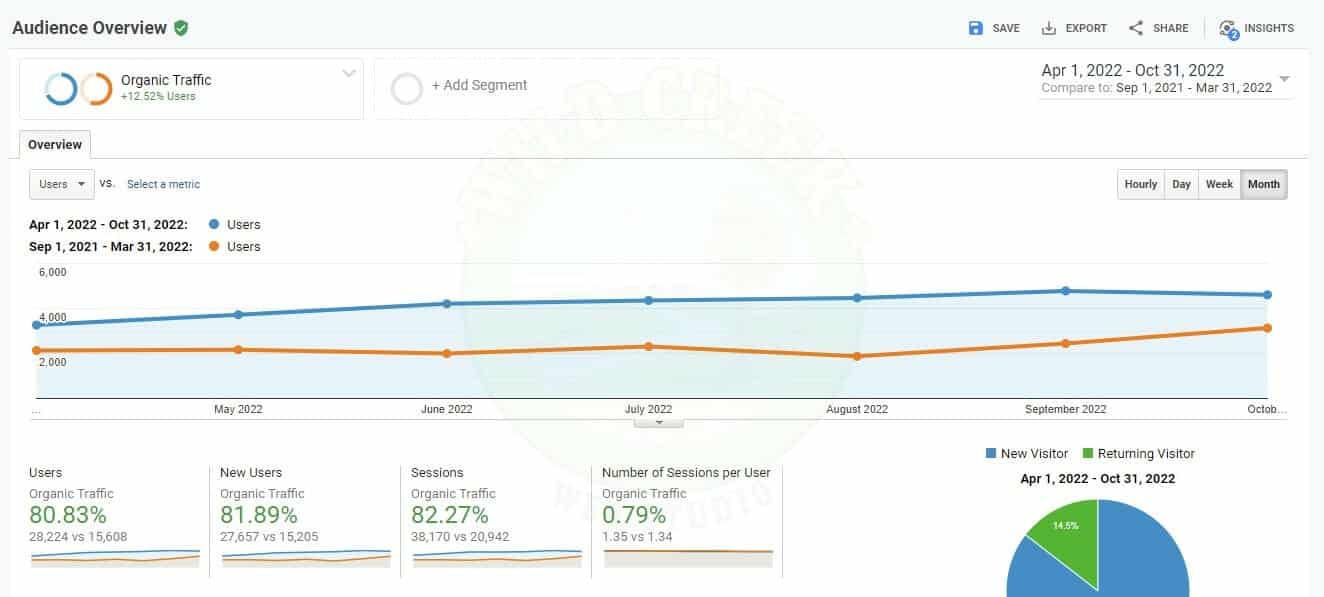
6 Months Google Analytics Growth Results

  1. 80% Increase in Organic Users: Within six months, the client experienced an impressive 80% surge in organic user traffic, expanding their visibility and generating more leads.
  2. 82% Increase in New Users: The influx of new users visiting the website grew by an astounding 82%, indicating a growing customer base and the success of our targeted SEO efforts.
  3. 82% Increase in Organic Sessions: Optimization and strategic backlink acquisition contributed to an impressive 82% growth in organic sessions, making the website a trusted resource for its target audience.

Conclusion

By addressing site issues, optimizing performance, establishing content guidelines, and building backlinks, our agency successfully revitalized the organic growth of our startup client. The remarkable 80% increase in organic users, 82% surge in new users, and 82% growth in organic sessions demonstrate the effectiveness of our tailored SEO strategy. This collaboration has empowered them to achieve sustainable development, expand their customer base, and solidify their industry leadership. If you’re ready to unlock your website’s true potential, we’re here to help you succeed.

0 comments
The Power of Consistency in Digital Marketing

The Power of Consistency in Digital Marketing!

In the fast-paced world of digital marketing, consistency has emerged as a critical factor that distinguishes successful businesses from those who struggle. With the rise of social media and search engine optimization, companies must have a solid online presence to succeed in today’s digital age.

Consistency is essential to building that online presence, as it helps to establish a brand identity, improve SEO ranking, and gain traction on social media platforms.

Consistency in digital marketing refers to the ability of a business to deliver high-quality content regularly across all channels and platforms. This could include blog posts, social media updates, email marketing campaigns, and more.

The Power of Consistency in Digital Marketing

Companies can create a cohesive online presence that resonates with their target audience by maintaining a consistent brand voice, messaging, and imagery. This article will explore the power of consistency in digital marketing and provide insights into how businesses can leverage this strategy to achieve their marketing goals.

In this Article

Toggle
  • Importance of Consistency
  • Benefits of Consistency
  • Measuring and Adjusting Strategy
  • Frequently Asked Questions
    • What are some common mistakes that digital marketers make regarding consistency?
    • How can a company maintain consistency across multiple platforms and channels?
    • How does consistency impact customer loyalty and retention?
    • What role does automation play in maintaining consistency in digital marketing?
    • Can consistency be achieved without sacrificing creativity and innovation in digital marketing campaigns?

Importance of Consistency

Consistency in digital marketing is emphasized for building a solid online presence, gaining traction on social media, and improving SEO ranking. Consistency requires delivering high-quality content relevant and valuable to the audience while maintaining a consistent tone, style, and messaging across all platforms.

More than posting sporadically or running a few ads are needed to create engagement and brand loyalty. To succeed, digital marketers must establish a relationship with their audience by providing consistent content that resonates with their needs and interests.

Consistency is the key to building brand loyalty and creating engagement. By delivering high-quality content that aligns with their interests and needs, digital marketers can establish a connection with their audience. With a consistent tone, style, and messaging, the audience can recognize the brand’s voice and value proposition, which helps to build trust and loyalty.

By monitoring and measuring the results regularly, digital marketers can adjust their strategy to ensure the content remains relevant and resonates with their audience. In conclusion, consistency is the foundation of a successful digital marketing strategy, and it separates successful digital marketers from those who struggle.

Benefits of Consistency

Achieving consistency in content creation and messaging across online platforms can lead to improved brand recognition, increased customer engagement, and higher conversion rates. By consistently delivering high-quality content that resonates with the target audience, businesses can establish themselves as thought leaders in their respective industries. This, in turn, helps build customer trust and credibility, which can translate into increased brand recognition and customer loyalty.

Companies that successfully leveraged consistency in their digital marketing efforts include Coca-Cola, Nike, and Apple.

Coca-Cola, for instance, has always maintained a consistent brand voice and messaging across all its social media platforms. This has helped the company establish a strong brand identity and connect with its audience on a deeper level.

Similarly, Nike’s ‘Just Do It’ slogan has been consistent with its messaging for over three decades. This consistency has helped the company build a strong brand image and connect with customers who value the company’s commitment to fitness and athleticism.

On the other hand, Apple has consistently delivered high-quality products and an exceptional user experience, which has helped it build a loyal customer base and establish itself as a leader in the technology industry.

Measuring and Adjusting Strategy

Measuring and adjusting a company’s strategy is crucial for ensuring success in its digital marketing efforts. Tracking metrics and analyzing the data can help identify what is working and what is not. Adjusting the approach accordingly can improve the effectiveness of the strategy.

To effectively measure and adjust a digital marketing strategy, companies must focus on the following:

  • Identifying key performance indicators (KPIs) to track progress
  • Regularly monitoring and analyzing metrics to identify trends and areas for improvement
  • Adapting the approach as needed to optimize results

By consistently tracking and analyzing metrics and adapting the approach, companies can ensure that their digital marketing efforts are practical and achieve the desired results. This improves the ROI of digital marketing efforts, helps build a robust online presence, and improves SEO ranking.

Frequently Asked Questions

What are some common mistakes that digital marketers make regarding consistency?

Common mistakes in digital marketing consistency include a need for more adherence to brand voice and inconsistent messaging across platforms. These errors hinder building trust with the audience and undermine the efficacy of marketing efforts.

How can a company maintain consistency across multiple platforms and channels?

Maintaining consistency across multiple platforms and channels requires cross-platform branding and target audience segmentation. Standardizing tone, style, messaging, and visual elements are crucial for successful brand representation.

How does consistency impact customer loyalty and retention?

Frequency and reliability are crucial in building customer loyalty. Inconsistency can negatively impact brand perception and trust. Consistent messaging and delivery of high-quality content across all platforms are critical to maintaining customer loyalty and retention.

What role does automation play in maintaining consistency in digital marketing?

Marketing automation can aid in maintaining consistency in digital marketing by automating repetitive tasks such as scheduling social media posts, sending emails, and personalizing content. However, balancing automation with a human touch is essential to ensure authenticity and relevance to the audience.

Can consistency be achieved without sacrificing creativity and innovation in digital marketing campaigns?

Balancing branding with creativity is crucial in achieving consistency without sacrificing innovation in digital marketing campaigns. Strategic planning and monitoring helps maintain a consistent tone and style while allowing for creative experimentation within brand guidelines.

0 comments
Revolutionizing Marketing With Generative Ai

Revolutionizing Marketing With Generative Ai

In the age of digital marketing, businesses are constantly seeking new ways to engage with their target audience and gain a competitive edge. One of the most promising tools to emerge in recent years is generative AI, which has the power to automate tasks, increase efficiency, and even create content independently.

These tools have the potential to revolutionize the field of marketing, providing businesses with the ability to streamline their operations and create more effective communication with consumers.

Prompt engineering is at the heart of this shift. This technique involves refining instructions or queries for generative AI tools to improve effectiveness. By carefully crafting prompts, businesses can train AI models to generate content tailored to their needs.

Revolutionizing Marketing With Generative Ai

This includes everything from creating buyer personas and identifying keywords to developing briefs and frameworks for marketing campaigns. As more businesses adopt these tools, the potential for generative AI to transform the marketing landscape is becoming increasingly evident.

In this Article

Toggle
  • The Power of Prompt Engineering
  • Benefits and Risks of AI
  • Tips for Effective AI Implementation
  • Frequently Asked Questions
    • How does generative AI impact consumer behavior and decision-making?
    • What are some ethical considerations when using generative AI for marketing purposes?
    • Can generative AI completely replace human creativity and intuition in marketing and content creation?
    • How can businesses ensure the accuracy and reliability of generative AI outputs in their marketing strategies?
    • What potential drawbacks or limitations of using generative AI in marketing, and how can they be mitigated?

The Power of Prompt Engineering

Prompt engineering is a valuable technique for marketers and content creators to leverage the power of generative AI tools such as ChatGPT. This process involves defining the goal, setting context, providing examples and guidance, and iterating and refining prompts to achieve desired results. Prompt engineering is practical when generating content ideas, brainstorming, background research, and persona creation. It helps marketers and content creators to streamline their workflow, automate repetitive tasks, and focus on more strategic activities.

Applications of prompt engineering are vast and varied. For example, a marketer can use ChatGPT to generate buyer personas by providing prompts such as demographics, interests, and pain points. Another example is identifying keywords for SEO by providing prompts such as the topic, target audience, and competitors.

Moreover, prompt engineering can create briefs and frameworks for content creation, social media posts, and email marketing. Overall, prompt engineering is an essential skill for marketers and content creators to master as generative AI tools become more prevalent in the industry.

Benefits and Risks of AI

One crucial aspect to consider when discussing the application of artificial intelligence in various industries is the potential benefits and risks associated with its use. AI has the potential to revolutionize marketing and content creation by automating tasks, increasing efficiency, and generating new ideas. However, as with any new technology, ethical considerations and potential risks also need to be addressed.

Here are four key points to remember to understand the current AI adoption trends landscape better. First, AI is being adopted by companies across all industries, focusing on those in the SaaS space. Second, while AI has the potential to generate significant value and improve productivity, it also has the potential to replace jobs and exacerbate inequalities.

Third, there is a growing need for ethical considerations and guidelines around the use of AI, as well as greater transparency and accountability from companies. Finally, AI is still in its early days, and there is much to learn about its potential applications and limitations. As such, it is essential for companies to stay informed about the latest developments in AI and to approach its use with caution and care.

Tips for Effective AI Implementation

Effective implementation of artificial intelligence requires clear and specific wording, provision of examples, affirmative instructions, and experimentation with prompts to ensure accuracy and efficiency. The performance of AI can be challenging due to the complexity of the technology and the need for human oversight.

However, successful case studies showcase the benefits of prompt engineering and AI implementation in various industries. One such case study is using AI tools in the healthcare industry. AI-powered chatbots are being used to provide personalized healthcare recommendations to patients, reducing the workload on healthcare professionals and improving patient outcomes.

In the financial services industry, AI tools are used to analyze large amounts of data to identify patterns and fraud, increasing efficiency and reducing costs. These examples demonstrate the potential of AI to revolutionize industries and improve business operations. However, it is essential to approach AI implementation cautiously and ensure the technology is being used ethically and responsibly.

Frequently Asked Questions

How does generative AI impact consumer behavior and decision-making?

Generative AI can impact consumer behavior and decision-making by enabling personalized marketing messages. Its role in future marketing trends is expected to grow as companies seek to create more targeted and effective campaigns.

What are some ethical considerations when using generative AI for marketing purposes?

Privacy concerns and algorithm bias are critical ethical considerations when using generative AI for marketing. Companies must ensure that sensitive information is protected and that AI-generated content is free from discriminatory or prejudiced language.

Can generative AI completely replace human creativity and intuition in marketing and content creation?

While Generative AI tools like ChatGPT have shown remarkable abilities in generating content and assisting in marketing tasks, they have limitations in replicating human creativity and intuition. The future of marketing will involve a balance between human and AI collaboration.

How can businesses ensure the accuracy and reliability of generative AI outputs in their marketing strategies?

Businesses must implement data validation and AI monitoring methods to ensure the accuracy and reliability of generative AI outputs in marketing strategies. This involves verifying results against established benchmarks, conducting regular quality checks, and integrating human oversight to address inaccuracies and biases.

What potential drawbacks or limitations of using generative AI in marketing, and how can they be mitigated?

Potential drawbacks of using generative AI in marketing include inaccuracies, misinformation, and the need for human oversight. These can be mitigated by vetting outputs for accuracy, providing clear prompts, and using AI as a tool rather than replacing human creativity.

0 comments
Newer Posts
Older Posts

Recent Posts

  • Free SEO Audit Tools: Which Ones Actually Help You Grow?

  • Bing vs Google: Which Search Engine Delivers Better Results Today?

  • What Is SaaS SEO and How Can It Grow Your Software Business?

  • What Is AEO and How It Influences AI Search Results?

Recent Case Studies

  • [Case Study] How We Helped a Website Get Back 90% of Lost Traffic by Removing Half Its Content

  • [SEO Case Study] How Wild Creek Web Studio Transformed a Banking Client’s Online Presence

  • [SEO Case Study] How We Drove Growth for a B2B Industrial Client

  • SEO Case Study: How We Boosted Organic Traffic by 49.92% for a Leading Metal Fabrication Manufacturer

Wild Creek Web Studio

Wild Creek Web Studio

With over 18+ years of industry expertise and a roster of 100+ satisfied clients, we specialize in providing top-notch SEO services, SEO consulting, and PPC services.

More About Us
  • Services
    • SEO Services
    • Paid Marketing
    • Social Media Marketing
    • Consulting & Strategy
  • Human Algorithm
  • Free SEO Tools
    • Word and Character Counter
    • Case Converter Tool
    • Color Converter Tool
    • JavaScript Compress Tool
More Web Tools

Latest Blogs

Free SEO Audit Tools: Which Ones Actually Help You Grow?
Bing vs Google: Which Search Engine Delivers Better Results Today?
What Is SaaS SEO and How Can It Grow Your Software Business?
What Is AEO and How It Influences AI Search Results?

© 2025 – All Right Reserved. Wild Creek Web Studio.

Facebook Twitter Linkedin
  • Privacy Policy
  • GDPR Policy
  • Cookie Policy
  • Disclaimer
  • SCAM Alert
  • About Wild Creek
    • Awards
    • Case Studies
    • Portfolio
    • Testimonials
  • Services
    • SEO Services
    • Paid Marketing Services
    • Social Media Marketing
    • Consulting and Strategy
  • Resources
    • Blogs
    • Free SEO Tools
    • Digital Marketing Glossary
  • Contact