Wild Creek Web Studio
  • About Wild Creek
    • Awards
    • Case Studies
    • Portfolio
    • Testimonials
  • Services
    • SEO Services
    • Paid Marketing Services
    • Social Media Marketing
    • Consulting and Strategy
  • Resources
    • Blogs
    • Free SEO Tools
    • Digital Marketing Glossary
  • Contact
7 Steps to Creating a Customer Acquisition Strategy for Your Business & Top Techniques.

7 Steps to Creating a Customer Acquisition Strategy for Your Business & Top Techniques

In our previous blog, we discussed the importance of a Customer Acquisition Strategy and gained knowledge on the Customer Acquisition Funnel. Today, without further ado, let’s get into the 7 steps to creating a customer acquisition strategy for your business.

7 Steps to Creating a Customer Acquisition Strategy for Your Business & Top Techniques.

In this Article

Toggle
  • 1. Determine who your ideal customer is
  • 2. Establish your goals
  • 3. Now, choose your customer acquisition channels wisely
  • 4. Create a unique strategy for each channel
  • 5. Make sure you communicate with your customers
  • 6. Watch out for competitor strategies
  • 7. Constantly evaluate and improve your strategy
  • Top 10 Customer Acquisition Techniques
    • 1. Paid Marketing
    • 2. Email Marketing
    • 3. Social Media Marketing
    • 4. Organic search marketing
    • 5. Affiliate marketing
    • 6. Your audience needs content that solves problems
    • 7. Product integrations that your audience needs
    • 8. Giveaways & Referral
    • 9. Thought Leadership
    • 10. Influencer marketing
  • Okay, so what’s next?

1. Determine who your ideal customer is

Identifying ideal customers and setting marketing objectives will be easier if you know your product-market fit. Understanding your customer base is the first step toward customer acquisition.

Ask yourself the following questions if you don’t know who your audience is yet:

  1. What are the challenges your customers face?
  2. How does your product or service help customers?
  3. Which demographics do they fall into?
  4. Why do customers buy/not buy your product(s)?
  5. How did they know about your business?

You can use the above questions to develop a customer profile. You can use these profiles to understand, analyze, and expand your customer base as your business grows. By identifying the traits and behaviors of your highest-value customers, you can choose the best channels for acquiring them. More on the channels in the sections to come.

2. Establish your goals

Setting goals is relatively easy when it comes to acquiring customers. Goals can be assessed using plenty of measurable data. For instance, by defining your ideal customers’ needs, you can formulate a customer acquisition plan and map out a strategy to meet them.

Depending on your needs, you can measure customer lifetime value, acquisition costs, and recurring revenue weekly or monthly. Taking customer churn and current customer growth into account when planning your customer acquisition strategy will help you meet your revenue expectations.

Marketing efforts work if they’re practical, and it’s not hard to prove it. In order to create a strategy that aligns with your overall business goals, you need to measure metrics such as monthly recurring revenue (MRR), customer lifetime value (CLV), customer acquisition costs (CAC), and churn rate.

3. Now, choose your customer acquisition channels wisely

A crucial first step for creating a successful strategy is pinpointing your ideal customers and customer acquisition goals. But remember, there’s more to it. Determine the content types and channels based on your research on customer profiles, buyer persona, and goals.

But what is a customer acquisition channel? It is a place where your customer meets your brand. These are mediums where you bring in new customers. It could be social media, organic search, or a paid ad. For instance, your customer acquisition channel could be YouTube if your customers constantly want informative content for a longer duration. You can choose paid social media as your medium for short, catchy ads with engaging visuals.

So once you set your channel(s) for customer acquisition, what next?

4. Create a unique strategy for each channel

Your customer acquisition strategy may be hindered if you try to get on every channel possible. As an example, if your goal is to reach millennials, Instagram or TikTok may be your best bet. A Facebook or Google Shopping ad won’t be worth all your resources.

Create marketing strategies for each channel by focusing on the following:

  • What kind of content your audience engages with.
  • Follow your competitors’ posts.
  • You can learn a lot from your KPIs.

To maximize your customer acquisition efforts, research the best strategies for each channel you use. In case your customers are mostly on Facebook, you may decide not to use TikTok. Alternatively, if a video is more effective than words, YouTube or Instagram may be better options than long-form blogs.

Once the strategy is up and running, what next?

5. Make sure you communicate with your customers

Customer feedback is critical to identifying gaps in your customer acquisition process. The only way to collect this valuable information is to request it. How? Customer communication can be achieved through surveys, email contact forms, customer interviews, social media posts, and blog posts.

For instance, offering a deal, requesting feedback with some helpful goodies (eBooks, how-to guides), or being available to answer questions is a good idea. Keep in touch with your customers regularly with a communication plan. With those insights, you can determine and capitalize on the value your customers expect from you and your products.

And? That’s it? Well, there’s always something happening in the neighborhood.

6. Watch out for competitor strategies

Please hold your judgment for a moment before saying, “I already knew that!” Sure, you know to analyze your competition, but do you really investigate all your prospects’ options?

For instance, do you consider a content brewing firm a competitor if you provide sophisticated digital marketing solutions? Do you lose most often to one of these competitors? How often do you beat out your competition?

With this data in hand, you can analyze your main competitors’ strategies. Examine your competitors’ marketing plans closely. Study their websites, social media, and paid advertisements. How would you rate their reputation? Have they got good reviews? Revisioning your customer acquisition strategy is easier with this data.

We said revisioning, not replicating. In such a content-rich world, duplication is easy to find, and customers are wise-enough to eliminate such businesses.

Once you refine your strategies according to your customers and roll out your plan, you need to

7. Constantly evaluate and improve your strategy

You cannot build an online business without applying analytics. If you are unaware of what is working (or not), where people are coming from, and how your pages are performing, you are on the verge of failing. It’s like driving in the dark with your eyes closed.

But what exactly can contribute to success in customer acquisition? Many factors. That’s why measuring and analyzing your results is so important. Analyzing customer acquisition can help you determine the following: customers’ perception of your products, their purchasing details, and demographics are a few to name.

Plan out which metrics you will monitor for customer acquisition before you start tracking. Customer acquisition costs (CAC), Customer lifetime value (LTV), LTV:CAC ratio, new customer growth, and Churn rate are a few common metrics.

It can be challenging to acquire new customers. However, with careful planning and effective strategies, you can attract high-value customers, keep them for a longer period of time, and achieve sustainable growth.

So, these are the steps toward creating a killer customer acquisition strategy. Now, how does it work? What are the effective ways to implement it? Will it work for B2B and B2C alike? Woah! Scroll down, please!

Top 10 Customer Acquisition Techniques

1. Paid Marketing

New businesses or online stores will likely need to invest more in paid advertising to grow. Often ads produce results straight away, including traffic, leads, and sales. In addition, paid ads can be an excellent way to help you discover keywords to drive organic search engine traffic. In the wrong hands, pay-per-click (PPC) can be expensive fast. PPC works best for B2C industries where the advertisements directly impact customers. To maximize ad spending, follow these best practices:

  • Remarketing is a vital part of your campaign that has been proven to yield a 1300% ROI.
  • Take advantage of Google’s Dynamic Search Ads. These ads display relevant content from your website based on what a person was searching for. This helps you save time, get more conversions, and keep your ads relevant.
  • Create interactive experiences for potential customers through ad automation.

2. Email Marketing

A good tactic for acquiring new customers, this tactic has been around as long as the internet. It allows you to reach your target audience and promote your content, discounts, and products.

The content that might initiate the engagement of customers should be more appropriate for those in the first two steps.

A great way to do this is by sending personalized emails to people depending on their stage in the customer acquisition process.

An email with product information would be of greater interest to those that consider you. This allows them to make a more informed purchase decision. It’s also the easiest way to connect with and acquire new customers. A promotional email that offers a discount can also entice people in the final stages to make that purchase.

Ecommerce biggie Amazon does a great job in this. They send out customized emails to their audience. It could be regarding their wish list, abandoned carts, or even a push toward making a purchase. Although it seems like a sure shot for the B2C segment, the right proportion of personalization, addressing the pain points, and delivering value through solid communication can help the B2B marketing latch on to email marketing.

3. Social Media Marketing

If you don’t have a solid game plan for social media, it can be a lot of work for little reward. What are your hotspot networks to engage with your audience, and which ones to avoid? This list is crucial because only some social media platforms can have your target audience. Identify your brand’s social voice and how you can develop a frame in the market. Have you put together a crisis plan? Do not be alarmed by these questions.

The sound of organically posting on social media can seem as if you’re shouting into the void. Social Media Marketing works well for both B2B and B2C marketing segments alike. A well-defined audience is crucial to accessing the right networks. Pinterest, for instance, would have little value if you were targeting a mostly male audience because only 15% of men use it. Facebook, Instagram, and Snapchat should be part of your playbook if you’re trying to reach millennials. So, be sure of your strategies and target group here.

4. Organic search marketing

As the name suggests, you don’t pay for any marketing activities here. Any traffic you achieve to your products, services, and business, on the whole, through unpaid strategies is called organic search marketing. Organic search marketing works wonders for the B2B industry. How to get organic traffic and customers?

  1. You can beat the competition by researching keywords you intend to target through paid advertising. Search for organic opportunities to rank for those keywords. The more conversions you get, the less ad spend you will need. Always look for new converting keywords and rank organically for them to boost conversions with a lower budget.
  2. Making your website more attractive to visitors is another way to acquire more customers. Track user journeys and identify why visitors leave your website.
  3. You can also gain more insights by tracking bounce rates and average session duration. You can even integrate heat maps into your website.
  4. The content you publish today won’t take long to become outdated. Therefore, Google will decrease your ranking, resulting in fewer visitors. Update it with newer facts to boost its ranking again.
  5. In the same vein, you can share the content in other formats. For example, if you wrote a blog post, you can repurpose that like a carousel post. Use Canva to make snackable images and share them on your social media or image-sharing platforms. You can draw some insights with attractive and digestible infographics for the Linkedin family.

5. Affiliate marketing

Getting new customers through affiliate marketing is another solid strategy. Affiliate marketing is the key to Uber’s success. You can use affiliate marketing to break into the market as a startup and acquire customers. It’s a wrong assumption that affiliate marketing works only for B2C. It’s no wonder it’s a killer strategy for B2B markets as well.

  • Many software solutions are available in the market with the affiliate tracking program. These tools make it easy for you to create an affiliate program for your website. For example, Affiliatly is a good choice in the market right now.
  • When associating with affiliate marketing, you may have to offer bloggers a better commission rate. Their commissions could be dynamic. So, it is suggested to keep customer LTV in mind.
  • The first step is to develop a sales strategy that works for you. After that, make slabs based on different sales numbers. You can get more ideas as you progress with your strategy.

6. Your audience needs content that solves problems

Content is the easiest way to connect with your target audience. A content marketing approach provides three times as many leads and costs 62% less compared to outbound marketing. The primary purpose of the content is to provide a solution to the audience.

Nowadays, consumers are more informed than ever before. Creating personalized, solution-oriented content can attract more prospects to your business. Understanding your target audience’s pain points and online search intentions is essential. In all likelihood, you will gain your prospects’ trust by empowering them to make informed purchases.

Helping them feel valued and addressed can be rewarding. For B2C, establishing a personal touch goes a long way. For B2B segments, creating product guides, downloadable templates, and tutorials allows you to illustrate how your business fits in with the challenges your target audience faces.

Creating relevant and authoritative content is the easiest way to become a thought leader in your niche. Gaining consumer trust is half the battle, and content marketing enables you to win that battle. Creating engaging, valuable, informative, and insightful content will help you acquire new customers.

7. Product integrations that your audience needs

Enhancing customer experience is any business’s ultimate goal, which helps the ROI come back effortlessly. With an evolving user base, try and find the gaps where your user needs an assistant. For instance, see how the food apps Swiggy & Zomato ensure the customer is informed of every detail of their order.

Live tracking, instant chatbots, transferring complaint tickets to human executives, and speeding up problem-solving can make a business stand out. The same example of live chat or chatbots can be outsourced with an application in the market with which you’re adding value to their business, yours, and customer satisfaction.

8. Giveaways & Referral

For customers to make a purchase, you need more than just words or promises. Running giveaways is an effective way to win consumer loyalty.. Giveaways work well for the B2C segment. Giving them a chance to experience your products firsthand. It will give them an extra push to consider your offerings. Social media is the best medium to run such giveaway campaigns.

New businesses often rely on referral programs to find new customers, especially when they’re fledgling. You can reward existing users with extra features or discounts to get them to recommend your service. Furthermore, you can onboard new customers with similar offers to leverage your products or services.

9. Thought Leadership

Brand affinity is the first benefit of thought leadership. Developing thought leadership enables you to become part of the conversation from the very beginning of the consumer’s journey. In this way, you allow your audience to learn more about you. Like, Anand Mahindra, Gary Vee, Seth Godin, and Neil Patel are a few to name who are influential in their niche while also stirring inspiration in the youth.

In the end, a solid Content Strategy leads to Thought Leadership. The world is full of leaders. Your business becomes social when you expose your thought leaders to the world. Real people with real faces interacting with the audience on a large scale definitely creates a ripple effect.

10. Influencer marketing

Often, marketers find innovative ways to advertise products. Although influencer marketing isn’t new, it has become a point of attention among millennials. Why is the attention? Influencer marketing acts as social proof among customers. But, it is associated with significant costs that depend on the influencer’s follower base and product demand.

It is very beneficial for customer acquisition in B2C. You should remember that not every influencer can help you generate customer acquisition. Select your influencer carefully based on their niche and whether their audience aligns with yours. The right influencer recommendation can go a long way if all is in place.

So, that’s the complete list of strategies and techniques for customer acquisition in B2B and B2C. Step up your growth with it. It is best to test each of these strategies before implementing them. Stick with those that work best for your business.

Okay, so what’s next?

Any company, big or small, relies on customer acquisition. It means you can’t give up on marketing – regardless of the cost.

But what plays a key role here is customer satisfaction. A customer acquisition strategy is all about getting the right customers and keeping them. It’s always a team effort when acquiring new customers because the responsibility increases as you onboard new ones.

Equipping them with the best products, services, and experience makes the difference all the more. But how to go about it? We understand your hesitation. Hold on. We have a solution. When talking about customer acquisition, Wild Creek Web Studio has the best strategies in the plan for businesses that can be tailored to their needs. With exceptional experience and a team of experts, spin your business game like never before.

0 comments
The Beginner's Guide to Customer Acquisition Strategy

The Beginner’s Guide to Customer Acquisition Strategy

So, tell us this – Is there a business on the planet that doesn’t need new customers?

All I need is some new customers

Sounds silly? Sorry to say, but that’s precisely how it resonates if a company doesn’t have a customer acquisition strategy.

What is a customer acquisition strategy? Is it that important? How does it work for B2B and B2C segments?

Well, let’s get to the business, then.

In this Article

Toggle
  • Defining Customer Acquisition Strategy
  • Importance of Customer Acquisition Strategy
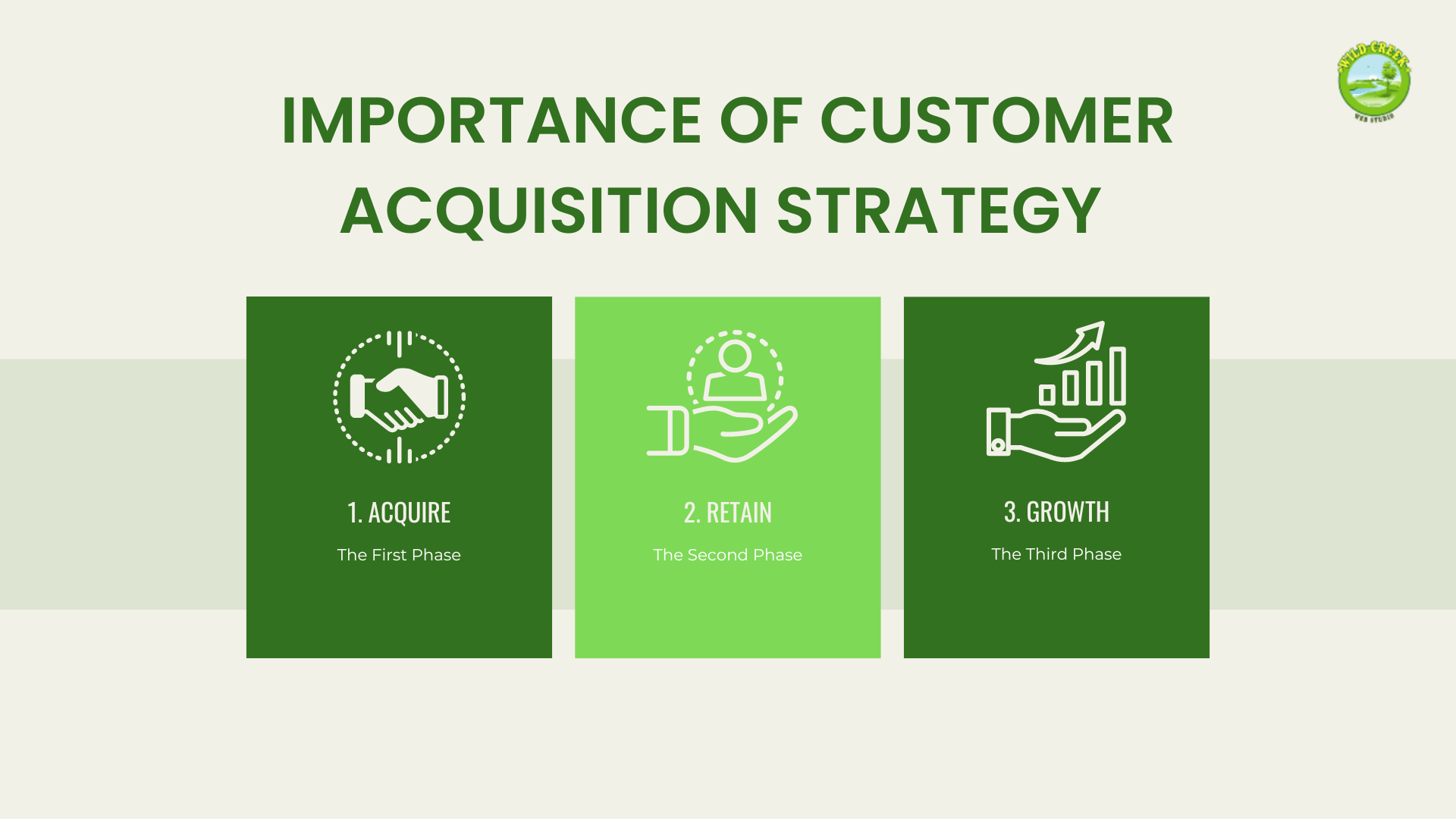
    • 1. Acquire: The First Phase
    • 2. Retain: The Second Phase
    • 3. Growth: The Third Phase
  • Understanding the Customer Acquisition Funnel
    • Awareness:
    • Interest:
    • Consideration:
    • Intent:
    • Evaluation:
    • Purchase:

Defining Customer Acquisition Strategy

An organization’s efforts to gain new customers is called customer acquisition.

To achieve that, you need a strategy – Customer Acquisition Strategy (CAC), which will

  1. Identify potential customers,
  2. Encourage them into sales, and
  3. Turn them into customers.

Importance of Customer Acquisition Strategy

Importance of Customer Acquisition Strategy

Customer acquisition involves finding a scalable, systematic way to attract new customers. A robust customer acquisition strategy has the following phases.

1. Acquire: The First Phase

Of course, you did your best marketing and boom! Congratulations, you have gained new customers.

2. Retain: The Second Phase

What percentage of these customers can you keep? Your ability to provide value to your customers will determine whether or not you succeed. Customer churn varies across industries but ranges from 5% to 7%.

3. Growth: The Third Phase

Does your business actually grow because of your customers? How many customers bring you more of them? Can you upsell or cross-sell your products to most customers?

First impressions matter when it comes to acquiring a prospective customer. What follows is a retention strategy. To put it simply, there are not two different things. Rather, acquiring and retaining work together to achieve a successful marketing plan.

In the end, whatever your customer retention strategy may be, customers won’t always stay, so your business needs to fill the gaps and keep moving the puzzles. But how do you do it? That calls for an understanding of the customer acquisition funnel.

Understanding the Customer Acquisition Funnel

How many of your leads turn into customers? To be frank, only 10 to 15%. What happens to the 90% that is lost?

After encountering a brand, a prospect goes through many stages. The 90% could have lost interest anywhere along the journey. Customers may have lost interest because of changing needs, or your product may have yet to meet their demands, or there is a better option.

Without analyzing your Customer Acquisition Funnel, you will not know for sure.

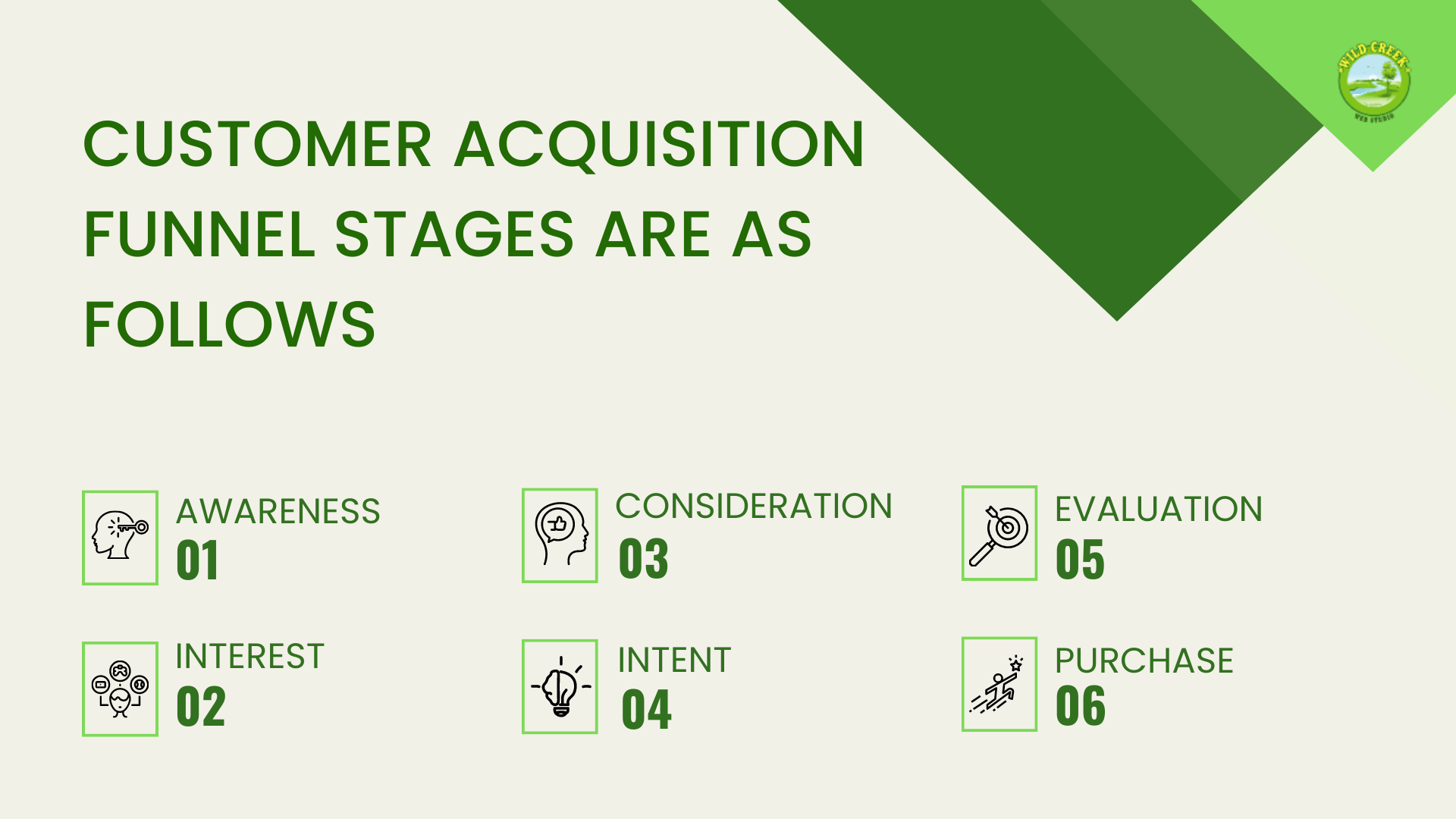
Customer Acquisition Funnel stages are as follows –
Understanding the Customer Acquisition Funnel

Awareness:

Awareness means making your brand reach a large group of audience. It includes a variety of techniques. But, inbound marketing approaches work wonders. Some of them are content marketing, social media marketing, referral, etc. There is no hard and fast rule. Check which of those strategies works in alignment with your business, brand, and requirement.

Interest:

Okay, now you have created awareness of your brand. What next? How will you propel that interest further? By being their light in the tunnel. Okay, melodramatic? But that’s what it is. Consistently serving customer needs by answering their pain points and showcasing that your brand would be the perfect solution is the right way. How-to guides, case studies, ebooks, educational videos, engaging webinars, and the list goes on. What approach can drive them to the next phase? Think of it from your brand perspective.

Consideration:

Well, well, well – congratulations, you have finally pulled your customers to consider your brand. How will you push your customer further? It would be best if you could be a little specific here. Openly communicate your brand’s unique selling point. The message should directly address what makes your brand different from the competition. It could be white papers, comparison charts, product review videos, etc.

Intent:

Do you have some frequent web page visits? More significant email or campaign engagement? Is subscriber counts increasing for some eBook sign-up? Great, that’s called buyer intent, and clearly, the customer is interested in what your business has to offer. Now, the game is with your marketing team to help them convert into your customer. The key differentiator is understanding what’s moving them closer to your brand and catching that pulse.

Evaluation:

By now, your lead may have tried the demo or signed up for a free trial of your product. That means you’re already in the glare. Your product, customer service, and effort are all weighing factors. It’s a crucial step to make your customer a purchaser. Good service may also compensate for your price disadvantage (if you have any). So, how can they evaluate you better to purchase your brand?

Purchase:

Now, this is the treasure every business wants. How much effort would you have taken to drive your prospect into a customer? We know that’s a herculean task. But then, the show hasn’t ended there. Now, the new puzzle begins to retain the acquired customers, up-sell, cross-sell, or turn them into your brand ambassadors.

And, it’s the same story repeating all again. Clearly, a customer acquisition strategy is a consistent approach that evolves with changing customer needs. What are the best ways to keep customers engaged throughout their journey? How to create such a strategy? Check out our next article on the 7 steps to creating a customer acquisition strategy for your business.


0 comments
Why SEO Is the Best Long-Term Investment for Your Business

Why SEO Is the Best Long-Term Investment for Your Business

Are you looking for a way to give your business an edge in the online marketplace? SEO, or search engine optimization, is one of the best strategies for long-term success. 

SEO has become increasingly important in recent years as more and more people use search engines like Google and Bing to find what they’re looking for. Businesses that don’t invest in SEO miss out on valuable opportunities to reach new customers and gain a better visibility within their industry. With proper implementation, SEO can bring higher website traffic and improved conversions.

This article explores why SEO should be part of every business’s growth strategy. From improving brand awareness to increasing customer loyalty, these reasons show how investing in SEO now can pay dividends later. Read on to learn why SEO is the best long-term investment for your company!

Why SEO Is the Best Long-Term Investment for Your Business

In this Article

Toggle
  • Definition Of SEO
  • Benefits Of SEO
  • Understanding Search Engine Algorithms
  • Creating Quality Content
  • Measuring Results
  • Building Brand Awareness
  • Frequently Asked Questions
    • What Is the Typical Cost of SEO Services?
    • How Long Will It Take to See Results From SEO?
    • How Often Should I Update My Website With SEO-Friendly Content?
    • What Is The Most Effective Way To Build Backlinks?
    • Are There Any Potential Risks Associated With SEO?
  • Conclusion

Definition Of SEO

Search engine optimization (SEO) is a marketing technique that drives organic website traffic and increases search engine visibility. It typically involves using keywords, links, and other methods to improve the position of webpages on search engine results pages (SERPs). SEO can also be called “search engine optimization” or “SEO.

It understands that SEO truly takes some research. SEO aims to ensure your content is seen by as many people as possible who are looking for it. This includes creating accessible content for humans and robots, optimizing page titles and descriptions, creating internal link structures, optimizing meta tags, and ensuring all URLs are crawlable and accessible.

Optimizing a website’s visibility in SERPs requires ongoing effort. Keeping track of changes in the algorithm, making adjustments based on analytics data, and following best practices are essential components of any successful SEO strategy. To maximize potential success with SEO efforts, you must stay up-to-date with industry trends and understand how Google ranks sites in their index. With this knowledge comes the ability to create more effective strategies tailored to your business’s needs.

Benefits Of SEO

SEO offers numerous advantages for businesses, making it an excellent long-term investment. Here are some of the benefits that SEO can provide:

  1. Improved Search Engine Visibility: You can improve how your business shows up in search engine results pages (SERPs) through targeted keyword optimization and website optimization strategies. This means more people will be able to find your website when they’re searching for relevant products or services.
  2. Higher Rankings: Ranking higher on SERPs helps establish credibility, encourages brand awareness, and makes it easier for potential customers to find what they need quickly. By optimizing your content and using keyword research, you can ensure that your business will appear near the top of organic searches related to your offering.
  3. Increased Traffic and Conversions: When users see higher rankings for specific keywords associated with their search queries, they’re more likely to click through to visit the site, leading to increased traffic and potential conversions. With better visibility comes an increase in opportunities for building relationships with customers and turning them into loyal followers of your brand.

Ultimately, investing in SEO is a smart move if you want to set yourself apart from competitors while improving user experience and increasing visibility within SERPs at the same time. Understanding how search engines rank websites and employ algorithms requires knowledge beyond basic SEO techniques; however, following best practices will help maximize its effectiveness over time and yield measurable results in traffic growth and ROI.

Understanding Search Engine Algorithms

It is important to understand search engine algorithms if you want your website or business to be successful. Search engines use complex algorithms that are constantly evolving and changing, making it difficult for businesses to keep up with the latest trends in SEO. Understanding how search algorithm optimization works can help companies to develop an effective SEO strategy that will bring them more traffic and higher rankings.

Search engine algorithms consider many factors when ranking websites, such as content relevance, keyword usage, page speed, internal linking structure, and backlinks. Knowing these algorithm ranking factors can help businesses create a well-optimized website that will rank higher than their competitors’ sites. Additionally, understanding how these elements affect overall website performance is essential for creating an effective SEO campaign.

Understanding search engine algorithms can give businesses the edge they need to succeed online. By taking the time to research and understand what makes a successful website from an algorithmic perspective, companies can gain an advantage over their competition by implementing strategies that help their site stand out from the rest. With this knowledge, businesses have the tools necessary to stay ahead of the ever-changing landscape of SEO and ensure sustained success in their digital marketing efforts.

Organizing quality content around specific topics through careful keyword research provides another opportunity to leverage algorithmic understanding while simultaneously improving user experience on web pages.

Creating Quality Content

Search engine algorithms are complex, and optimizing for them takes commitment. Quality content creation is an essential part of any SEO strategy. It will be the key to success in the long term. In this section, we’ll look at how to incorporate quality content into your business’s website and explain why it matters.

When creating a content strategy, businesses should prioritize quality over quantity. Developing high-quality content that provides value to users can help you build trust with search engines and rank higher on SERPs. It’s also essential to ensure that each piece of content is relevant to your target audience and explicitly tailored towards their interests or needs. Additionally, having well-researched topics that are well-organized can increase user engagement with your site, helping boost your rankings even further.

Creating quality content begins by researching topics related to what customers are looking for when they use specific keywords related to your industry or product offerings. Once you have identified these topics, create a plan detailing which topics need fresh posts and which existing articles need updating or refreshing based on new information. When writing or revising the post, remember to include internal links between pages within your site and outbound links from authoritative sources such as government websites or research journals where applicable. Following these steps will ensure that you create valuable content and prove its relevance and accuracy through external sources.

Creating quality content requires time and effort but is worth the investment if done correctly because it can bring more visitors organically while increasing visibility in search results without needing paid ads like other forms of marketing require. Plus, developing great content allows you to establish yourself as an expert in the field, which leads customers back again and again for advice or additional services down the road. By taking the time upfront to develop a comprehensive yet concise content strategy focused on customer needs, businesses can reap long-term rewards from organic traffic generated from search engine queries backed up by reliable facts sourced elsewhere online. Measuring results effectively is one-way companies can track progress made via their SEO campaign...

Measuring Results

When it comes to website optimization, the results speak for themselves. According to BrightEdge research conducted in 2020, SEO drives a staggering 53% of all traffic on the web. This statistic shows how important measuring SEO results is when assessing your business’s success and growth potential.

Tracking and analyzing key performance metrics is essential to any successful SEO campaign. Understanding these KPIs will allow you to track progress and identify opportunities. Using tools such as Google Analytics, you can assess how effectively specific strategies work for your business and adjust accordingly. You may also consider tracking organic search engine rankings, backlinks, bounce rates, page views, etc., which can provide valuable insight into user engagement with your website.

Evaluating SEO efforts requires an ongoing process that involves regularly monitoring metrics, making adjustments based on trends or changes in user behaviour patterns, and continuously optimizing content for better visibility online. It is critical to have an established system for evaluating successes and failures so that improvements can be made quickly and efficiently. With this information, businesses can make informed decisions about their marketing strategy in the future and remain competitive within the industry.

Building Brand Awareness

Building brand awareness through organic traffic is one key benefit that must be considered. Branding and visibility are essential in increasing customer loyalty and attracting new customers to your business.

Organic traffic generated by SEO efforts will create more consistent visibility over a more extended period compared to other marketing forms. This type of branding can increase audience engagement and conversions due to higher trust levels with potential customers who have seen your content multiple times online. As search engine algorithms become increasingly complex, optimizing websites for organic searches remains an effective way to reach target audiences without spending money on paid advertisements or promotions.

SEO allows businesses to connect with their target market and build relationships with customers who are already interested in what they offer. Investing in long-term strategies such as optimizing keywords, creating high-quality content, and building reliable backlinks can increase your web presence while expanding your reach beyond traditional methods like print and television ads. With improved website visibility, businesses can drive organic leads and boost sales revenue at minimal costs.

Frequently Asked Questions

What Is the Typical Cost of SEO Services?

When deciding whether or not SEO is the best long-term investment for your business, you may also be asking yourself: what is the typical cost of SEO services? Understanding SEO pricing and expenses can help you make an informed decision.

SEO service prices vary greatly depending on many factors, including the size of your website, industry competition, and desired outcomes. Generally, most businesses will pay between $1,000-$5,000 monthly for ongoing SEO services. Smaller websites often require less work than larger ones because they have fewer pages and are easier to optimize. However, competitive industries with higher search volumes may require more resources. Ultimately, SEO pricing depends mainly on a company’s specific needs.

It’s important to note that some companies offer one-time fees for specific projects, such as audits or link-building campaigns. These projects cost around $1,000 but could increase if the client requires additional tasks. Additionally, some providers charge hourly rates instead of flat monthly fees, so asking about their payment structure before signing any contracts is essential.

Investing in quality SEO services can yield numerous benefits for your business over time; however, it’s essential to understand how much this type of service typically costs so that you can properly budget for it accordingly.

How Long Will It Take to See Results From SEO?

Many business owners may need clarification on how long it will take to see results from SEO as they weigh up the cost and return on investment of search engine optimization strategies. However, when done right, SEO offers a fantastic long-term return worth more than any immediate benefit. Here’s why investing in SEO can be your best bet over time:

Firstly, there is yet to be a definitive answer for the timeframe needed to see SEO results. It depends on many factors, such as keyword competition and website structure, that vary from business to business. While some companies may start seeing tangible outcomes relatively quickly, others could take several months or even longer before enjoying the full effects of an effective SEO campaign.

Secondly, if you are looking for a good ROI (return on investment), look no further than an effective SEO strategy. As well as providing organic traffic at no extra cost after initial setup fees have been paid, optimizing content with keywords also helps capture leads that can be converted into sales over time. Furthermore, unlike other short-term marketing strategies like pay-per-click advertising campaigns, once ranking positions have been secured on search engines through cleverly crafted content and optimized web pages – those rankings stay put!

Here are three key advantages of implementing an effective SEO plan:

  1. Longer shelf life – Rankings achieved through natural means tend to last much longer than other digital marketing techniques.
  2. Increased visibility & credibility – Ranking high organically makes customers think highly of your brand’s reputation and expertise in its field.
  3. Lower costs – Once basic setup costs are covered by hiring an experienced agency or consultant, ongoing maintenance costs are minimal while delivering great returns over time.

To sum up, investing wisely in quality SEO services allows you to reap the rewards far into the future without worrying about maintaining expensive ad campaigns every month or quarter. Investing in SEO now will bring your desired results and continued growth in traffic and conversions down the line!

How Often Should I Update My Website With SEO-Friendly Content?

Updating your website with SEO-friendly content is a great way to ensure you get the most out of your business’s long-term investment in SEO. It doesn’t just help boost visibility but also helps keep readers engaged and interested in what you have to offer. But how often should you update and optimize your website?

It’s important to regularly update your website with fresh, optimized content if you want to get the best from SEO. This can include anything from blog posts and articles to product descriptions or other up-to-date information about your business. Here are four key points to consider when updating:

  • Ensure all new content is keyword-optimized for maximum relevancy
  • Make sure any images used on webpages are high quality and relevant
  • Update existing pages regularly so they stay current
  • Include links within the copy which guide visitors further into the site

Overall, businesses must regularly update their websites with SEO-friendly content if they want to reap the rewards of investing in search engine optimization over time. Regular updates give visitors more reasons to explore deeper parts of your website, resulting in greater engagement and improved online visibility.

What Is The Most Effective Way To Build Backlinks?

Building backlinks to your website is an essential part of SEO, and a strategic link-building plan can make or break the success of your online presence. Link-building tactics are becoming increasingly crucial for businesses that want to stand out from their competitors regarding search engine rankings. Launching campaigns with targeted link-building strategies is an effective way to build backlinks.

Link-building campaigns should be tailored based on the type of content being promoted and the desired audience you’re targeting. For example, suppose you’re attempting to get more organic traffic. In that case, it’s best to focus your efforts towards getting quality links from authoritative websites related to your niche. Additionally, creating shareable content such as videos and infographics can help expand the reach of your campaign and increase the number of potential referral sources.

Using tools like Google Analytics can provide valuable insight into which sites provide higher engagement levels and could lead to successful link-building opportunities. Keeping up with industry trends will also help ensure that link-building efforts remain relevant and beneficial for long-term success. With careful planning and attention to detail, businesses can create powerful link-building campaigns that positively affect their overall website visibility and performance.

Are There Any Potential Risks Associated With SEO?

Regarding SEO investments, one must consider the potential risks associated with this strategy. Though SEO can be an excellent long-term investment for businesses, some possible pitfalls arise from investing in this digital marketing platform. Companies should take into account any potential SEO risks and how they will affect their business goals in the long run.

One of the main potential risks to consider is the possibility of wasted time and resources when implementing an SEO campaign. Suppose the targeted keywords have a low search volume or competitors use more effective strategies. In that case, companies may find themselves in a situation where their efforts don’t yield desired results. This can lead to disappointment and frustration and create financial losses for the business.

Another risk is that SEO tactics can change over time due to algorithm updates by major search engines like Google and Bing. Companies must stay up-to-date on new changes to ensure their website remains visible within organic search engine rankings. This means investing additional money into research and development, which can prove costly if done incorrectly.

Businesses should also remember that while SEO offers numerous benefits, including increased visibility across multiple channels, those benefits may only sometimes outweigh the costs of running such campaigns or paying for outside help. It’s essential to assess whether these investments are worth making before diving head first into them since there is no guarantee of success at all times.

Conclusion

In conclusion, SEO is a cost-effective and long-term investment that can generate significant business returns. Understanding the risks associated with investing in SEO services is essential, but the potential rewards make it worth considering. By dedicating time and resources to developing an effective SEO strategy, you will reap the benefits of increased visibility, website traffic, and higher conversions over the long term.

SEO should not be viewed as a quick fix or a silver bullet solution; instead, think of it as building a solid foundation for your business to grow. With commitment and dedication from both sides – yours and your chosen service provider’s – you can create sustainable success through search engine optimization techniques. Investing in SEO now will provide lasting results that drive growth for years.

The power of SEO lies in its ability to help propel businesses forward on their journey towards greater heights of success. As long as I keep up with best practices and stay informed about developments within the industry, I’m confident that my business will enjoy all the advantages of having an optimized online presence for many years to come!

0 comments
The Importance Of Anchor Text In Backlinks

The Importance Of Anchor Text In Backlinks

When it comes to search engine optimization (SEO), backlinks are one of the most critical factors in determining your website’s ranking. But not all backlinks are created equal.

The anchor text used in those links can significantly impact how search engines view your website and, ultimately, where it appears in search results.

Anchor text is the clickable text that appears as a hyperlink within the content. It serves as an indicator to search engines about the content on the linked-to page.

Using relevant and descriptive anchor text, you can signal to search engines what topics your website is authoritative on and increase its visibility in organic search results.

In this article, we’ll explore anchor text, why it matters for SEO, and best practices for optimizing it to improve your website’s rankings.

In this Article

Toggle
  • Understanding Backlinks and Their Role in SEO
  • The Basics of Anchor Text and Its Significance
  • Types of Anchor Text and When to Use Them
  • Best Practices for Creating Effective Anchor Text
  • The Impact of Anchor Text on Search Engine Rankings
  • Analyzing Your Backlink Profile and Anchor Text Usage
  • Strategies for Improving Your Website’s Ranking Through Anchor Text Optimization
  • Frequently Asked Questions
    • Can you have too many backlinks with the exact anchor text?
    • Is it necessary to use exact match anchor text?
    • Can using too many different types of anchor text hurt your SEO?
    • How do you know which anchor text to use for external backlinks?
    • Can internal anchor text affect your website’s ranking as well?
  • Conclusion

Understanding Backlinks and Their Role in SEO

You may have heard that backlinks are crucial to your SEO success, but do you know how they work and why they matter?

In simple terms, backlinks refer to links from other websites that point to your website. Search engines like Google use these links to measure your website’s authority, credibility, and popularity.

The more high-quality backlinks you have, the higher your website will likely rank in search engine results. Link-building techniques are used to obtain backlinks from other websites.

Some popular link-building techniques include guest posting on other blogs or websites, creating shareable content such as infographics or videos, participating in online forums and communities relevant to your niche, and reaching out to influencers for collaborations or partnerships.

It’s important to note that not all backlinks are created equal. The importance of domain authority must be balanced when it comes to backlinks.

A high-quality link from a reputable website with a strong domain authority will carry much more weight than multiple low-quality links from less credible sources. Understanding nofollow links is also crucial – these links tell search engines not to follow them and therefore do not contribute towards improving your SEO rankings.

In addition to traditional link-building tactics, social media can play an essential role in backlinking.

Sharing blog posts or articles on social media platforms can increase visibility and lead to more shares and links from other users. Finally, seeking out guest posting opportunities on relevant blogs or websites can be a great way of obtaining high-quality backlinks while exposing your content and brand to new audiences.

The Basics of Anchor Text and Its Significance

Get your website noticed by search engines and increase your chances of ranking higher by using descriptive phrases that link to relevant content. This is where anchor text comes into play. Anchor text is a clickable phrase or word that appears as a hyperlink on a page, leading users to another web page. It helps guide users to related content and sends signals to search engines about the linked page’s relevance.

Anchor text diversity plays an essential role in backlink optimization. Using different variations of anchor texts can help avoid over-optimization and prevent penalties from search engines for spammy practices. Keyword placement within the anchor text is crucial as well since it correlates with relevancy signals sent to search engines. However, avoid stuffing keywords in the anchor text, which could result in penalties and negatively impact user experience.

Branding opportunities are also present when using anchor texts effectively. Incorporating branded terms or brand names within the anchor text can help increase brand awareness and recognition among users while providing valuable links to related content. Ultimately, using relevant and diverse anchor texts improves SEO and enhances user experience by guiding visitors through a website more efficiently.

Emotion Description Example
Trust Establishing credibility through reliable sources “As seen on Forbes.”
Curiosity Creating intrigue and prompting further exploration “The surprising truth about…”
Urgency Encouraging immediate action “Limited time offer – act now!”
Exclusivity Making customers feel special with exclusive deals or information “Members-only access”
FOMO (Fear of Missing Out) Tapping into people’s desire to be included “Don’t miss out on this opportunity!”


Incorporating these emotional triggers into your website’s calls to action can significantly enhance user engagement and improve conversion rates. These tactics can help create a cohesive and effective SEO strategy when used alongside well-crafted anchor texts.

Types of Anchor Text and When to Use Them

When optimizing your website’s links, understanding the different types of anchor text and their appropriate usage can significantly impact your SEO strategy.

There are five main types of anchor text that you can use: exact match, branded, generic, naked, and image anchor. Each type serves a specific purpose and can affect your search engine rankings differently.

Exact match anchor text is when the linked text matches the target keyword exactly. It used to be an effective way to rank for targeted keywords; however, overusing this type of anchor text can lead to penalties from Google.

Branded anchor text uses your brand name as the linked text. This type builds brand awareness and credibility, making it ideal for natural linking opportunities.

Generic anchor texts are general phrases like ‘click here,’ ‘read more,’ or ‘learn more.’ While they offer little SEO value, they help improve user experience by guiding users to relevant pages within your site.

Naked anchors refer to plain URLs as linked texts without any additional words or phrases around them.

Image anchors involve using images with alt tags as links instead of traditional hyperlinked texts. They provide visual appeal and accessibility benefits. Still, they should be used judiciously since Google doesn’t consider them as valuable as other types of links.

In conclusion, choosing the right type of anchor text is essential for a successful backlinking strategy that will help improve your website’s rank on search engines’ results pages (SERPs). Varying the types of anchors, you use shows search engines that your website has legitimate traffic sources rather than relying solely on exact-match anchors. Following these guidelines and incorporating various anchors into your linking strategy, help increase organic traffic while avoiding potential penalties from Google’s algorithms.

Best Practices for Creating Effective Anchor Text

To ensure the effectiveness of your website’s links, following these best practices for crafting optimal anchor text is crucial.

Firstly, conduct thorough keyword research before choosing anchor text. This ensures that your keywords are relevant to your content and will help boost your ranking on search engine results pages. Overusing exact-match keywords can result in over-optimization, harming your rankings.

Secondly, link relevance is critical when creating compelling anchor text. Your links should be relevant to the content they’re linking to and provide value to readers. Avoid using generic phrases like ‘click here’ or non-descriptive words as anchor text. Instead, use descriptive terms that accurately reflect the linked content and entice users to click through.

Lastly, consider branding considerations when crafting anchor text. Using branded terms as anchors can help increase brand visibility and recognition online. However, relying on something other than branded terms is essential, as this can limit your reach and diversity in search results. Diversifying anchors with a mix of branded terms and descriptive phrases will increase the chances of ranking for various keywords while maintaining a solid online brand presence.

The Impact of Anchor Text on Search Engine Rankings

Optimizing your website’s links with strategic anchor text can significantly boost your search engine rankings and drive more organic traffic to your site. But what makes anchor text so important? The answer lies in its impact on search engine algorithms.

Search engines use anchor text to determine a webpage’s relevance to a particular keyword or topic. Anchor text diversity is crucial in this regard, as overuse of the exact anchor text can signal spammy behaviour and lead to penalties from search engines. Therefore, using relevant and natural-sounding phrases as anchor text is essential.

Anchor text length also plays a role in search engine rankings. Shorter, more concise phrases perform better than longer ones, making them easier for search engines to understand and categorize. Additionally, proper placement of anchor text within content can make a big difference in its effectiveness – using it too frequently or in irrelevant contexts can harm rankings by appearing manipulative or unnatural.

By following these best practices for creating compelling anchor text, you’ll be well on your way towards improving your website’s visibility and driving more traffic through organic searches.

Analyzing Your Backlink Profile and Anchor Text Usage

In the previous section, we discussed how anchor text impacts search engine rankings. Now, let’s analyze your backlink profile and anchor text usage. Regularly reviewing your backlinks is essential to ensure they are diverse and relevant.

One way to analyze your backlink profile is by examining the diversity of your anchor text usage. Anchor text diversity refers to the variety of keywords used in the hyperlink pointing to your website. A diverse range of anchor text helps demonstrate natural linking patterns and can prevent over-optimization penalties from search engines.

Speaking of over-optimization penalties, it’s crucial to remember anchor text over-optimization. This occurs when too many links point to a website using exact-match anchor texts, which can be spammy or manipulative. To avoid this issue, use different variations of keywords and phrases and natural language in your anchor texts. Additionally, please pay attention to the relevance and placement of these texts within the context of the surrounding content.

Aspect Importance Description
Anchor Text Diversity High Using a variety of keywords in hyperlinks shows natural linking patterns
Anchor Text Over Optimization Low Too many exact match anchors can trigger spam alerts
Natural Anchor Text Usage High Use variations and natural language for more organic-looking links


To summarize, analyzing your backlink profile involves examining your anchor texts’ diversity, relevance, placement, and optimization level. Doing so regularly and making necessary adjustments through natural linking practices can improve your search engine rankings while avoiding penalties associated with manipulative tactics like over-optimization or irrelevant link-building strategies.

Strategies for Improving Your Website’s Ranking Through Anchor Text Optimization

You can boost your website’s search engine ranking by crafting natural and relevant phrases that seamlessly blend into the context of your content. This is what anchor text optimization is all about. With the right strategies, you can improve your website’s visibility on search engine results pages (SERPs) and attract more organic traffic.

To achieve this goal, here are some actionable tips for improving your website’s ranking through anchor text optimization:

  1. Anchor text diversity: Avoid repeatedly using the exact match keyword phrase as anchor text throughout your content. Use various keywords and phrases to create a diverse backlink profile.
  2. Keyword research: Conduct thorough keyword research to identify your niche’s most relevant and high-ranking keywords. Use these keywords strategically in internal and external links to boost their relevance and authority.
  3. Link building outreach: Reach out to reputable websites in your industry and request backlinks with relevant anchor texts. This will help establish your site’s credibility while providing valuable referral traffic.
  4. Internal linking strategy: Incorporate internal links within your content using relevant anchor texts. This enables users to navigate different pages on your site while signalling to search engines which pages are most important.

By implementing these strategies along with competitor analysis, you can create a strong foundation for improved search engine rankings by effectively using anchor texts. Remember, seeing results takes time and effort, but incorporating these tactics will set you up for long-term success.

Frequently Asked Questions

Can you have too many backlinks with the exact anchor text?

Yes, having fewer backlinks with the exact anchor text can help your website’s ranking. Google prefers anchor text diversity for a better user experience. Link-building strategies should prioritize varying anchor text to measure its effectiveness.

Is it necessary to use exact match anchor text?

When building backlinks, using exact match anchor text is sometimes okay. Alternative strategies like diversifying anchors with brand mentions and focusing on contextual relevance can provide natural anchor variation and improve overall SEO performance.

Can using too many different types of anchor text hurt your SEO?

Using too much anchor text diversity can harm your SEO efforts. Keyword stuffing, unnatural anchor text usage, and irrelevant links can negatively affect search rankings. Including brand mentions and using natural anchor text is essential for maintaining link relevance.

How do you know which anchor text to use for external backlinks?

To choose the best anchor text for external backlinks, conduct keyword research and competitor analysis to identify niche-specific anchor text and long-tail variations. Consider using brand mentions to increase visibility and credibility in your industry.

Can internal anchor text affect your website’s ranking as well?

Yes, internal anchor text can impact your website’s ranking. Using diverse anchor text and implementing effective internal linking strategies can improve user experience and increase relevance for search engines. Analyzing competitor anchor text profiles can also provide insight for optimizing your process.

Conclusion

Congratulations! You now understand the importance of anchor text in backlinks and how it can impact your website’s search engine rankings.

By creating compelling and relevant anchor text, you signal to search engines what your content is about and increase its visibility to users.

Remember, using a variety of anchor text types can help diversify your backlink profile and improve your website’s authority.

It’s essential to analyze your current backlink profile and adjust accordingly, ensuring that your anchor text usage aligns with best practices for optimal SEO results.

By implementing these anchor text optimization strategies, you can improve your website’s ranking on search engine results pages, drive more traffic, and ultimately achieve tremendous success online.

Good luck!

0 comments
The Impact of Google's AI

The Impact of Google’s AI Answers, Snippets, and SERP Redesign on SEO and User Experience

Google’s search engine has undergone significant changes in recent years, with the introduction of AI-generated answers and snippets and redesigning of the search engine results page (SERP). These changes have implications for both SEO and user experience, raising concerns around redundancy, liability, and accessibility of information.

The Impact of Google's AI

The AI answer feature, which uses natural language processing to provide direct answers to user queries, aims to improve the search experience by reducing the need for users to click through multiple pages to find the information they need. However, its implementation has raised concerns about the accuracy and liability of the information provided and the potential negative impact on website traffic.

Similarly, AI snippets, which aim to provide concise summaries of web pages in search results, have been criticized for potentially reducing the need for users to visit websites directly and increasing the risk of misinformation and biased summaries.

The SERP redesign, which includes a more visually appealing layout and additional features such as ‘People also ask’ and ‘Related searches,’ has also raised concerns about the accessibility of information and the potential impact on website traffic and visibility.

In this Article

Toggle
  • AI Answer Feature
  • AI Snippets
  • SERP Redesign
  • SEO Importance
  • Frequently Asked Questions
    • How does Google determine which queries generate AI answers?
    • Can AI answers be trusted for my medical and financial information queries?
    • How can SEOs react to changes in AI-generated search results?
    • Will the new AI answer feature replace website visits entirely?
    • How can small publishers take advantage of the preference for specialized websites in AI snippets?

AI Answer Feature

The AI Answer Feature in Google’s search results has been released as early access, incorporating generative AI in search results. While it offers an alternative to visiting websites, there are concerns about liability for ymyl (Your Money or Your Life) queries. These queries pertain to financial, medical, and other sensitive topics where inaccurate information could have serious consequences.

Furthermore, there is potential for decreased website traffic as users may choose to read AI answers instead of clicking on website links. The AI answer takes 8-12 seconds to pop up after typing a search query. Users have the choice to read AI answers or click on website links. However, AI answers are hidden if users scroll down on the SERPs.

Not all queries generate AI answers, and AI answers’ redundancy and contradictory nature with featured snippets may pose challenges for SEOs. While there is uncertainty about the final form of these changes, businesses need to evolve and adapt to stay ahead of the curve.

AI Snippets

Specialized websites may have an advantage in ranking for commercial queries over larger publishers due to the implementation of AI snippets in search results.

AI snippets are short summaries that appear at the top of search results and aim to answer the user’s query quickly. These snippets are generated using Google’s machine learning algorithms, which scan web pages to extract information that can be used to answer search queries.

However, AI snippets have been criticized for their lack of attribution and links, which can lead to plagiarism and content theft without proper credit.

Despite these issues, AI snippets present opportunities for small publishers to rank for big commercial queries. Specialized websites that offer niche content may have an advantage over larger publishers because they are more likely to have relevant and concise information that can be used in AI snippets.

However, whether Google will continue to prioritize specialized sites over larger publishers remains to be seen. Additionally, attribution and link issues must be addressed to ensure that AI snippets are not used to promote certain websites or unfairly steal content without proper credit.

In conclusion, while AI snippets offer opportunities for small publishers to rank for commercial queries, attribution and link issues must be addressed to ensure fairness. As Google continues refining and updating its search algorithms, SEO professionals and website owners must remain vigilant and adapt to these changes.

SERP Redesign

With the recent changes to the presentation of search results, there is a greater emphasis on branding and visual elements, potentially shifting click-through rates towards multimedia widgets.

As part of the SERP redesign, all search results now show favicons, with links to websites in black instead of blue, blending in more with the other elements on the page. This may make it more challenging for websites to rank lower on the page, as users are more likely to be drawn to widgets such as images and videos.

In addition, the SERPs now feature infinite scroll, allowing users to continuously scroll through search results without the need to click on a separate page. This can affect user experience and SEO, as users may be more likely to stay on the search results page rather than venture onto the websites themselves.

As a result, branding impact is now more critical than ever, as users will be more drawn to multimedia widgets and favicons when scrolling through the infinite consequences.

SEO Importance

SEO remains a critical factor in online marketing, as it delivers website traffic with high intent, despite the recent changes to Google’s search engine. Introducing AI-generated search results and snippets and redesigning SERPs may shift CTR towards widgets like images and videos. However, SEO still plays a vital role in driving traffic to websites.

SEO tactics must evolve to adapt to Google’s search engine changes. Still, the importance of SEO in delivering intent-driven traffic cannot be overstated. To maintain their ranking on the SERPs, website owners must focus on providing high-quality content that satisfies user intent. Websites that provide comprehensive information and add value to the user experience are likelier to rank high on the SERPs.

Optimizing website structure, metadata, and keywords can significantly improve a website’s performance on search engines. SEO professionals must also stay updated on the latest changes in Google’s search engine and adjust their tactics accordingly. The importance of SEO may remain the same with the introduction of AI-generated search results and snippets. Still, it will require SEO professionals to be more strategic.

Frequently Asked Questions

How does Google determine which queries generate AI answers?

Google determines which queries generate AI answers based on AI answer accuracy and query relevance. Not all questions generate AI answers; liability concerns Your Money or Your Life (YMYL) queries. The AI answer is based on search results.

Can AI answers be trusted for my medical and financial information queries?

The trustworthiness of AI answers for YMYL medical and financial information queries remains questionable, and user perception of their accuracy is mixed. More research is needed to determine their reliability and potential impact on user decision-making.

How can SEOs react to changes in AI-generated search results?

Reacting to changes in AI-generated search results requires a strategic SEO approach that considers user intent. To remain relevant, SEO strategies should focus on providing in-depth solutions that meet user needs, despite introducing new features such as AI answers and snippets.

Will the new AI answer feature replace website visits entirely?

The potential consequences of the new AI answer feature on website visits cannot be predicted. User behaviour may shift towards AI-generated answers. Still, it is unlikely to replace website visits for in-depth solutions completely.

How can small publishers take advantage of the preference for specialized websites in AI snippets?

Small publishers can implement a content strategy focusing on niche marketing to take advantage of the preference for specialized websites in AI snippets. By creating high-quality, targeted content, they can increase their chances of being featured in AI snippets and attracting relevant traffic.

0 comments
competitor analysis

How To Conduct Competitor Analysis for Improved SEO Results

Are you looking for ways to improve your SEO results? Knowing what the competition is up to can help inform your strategies and get a better return on investment. Conducting competitor analysis provides valuable insight into how others are getting their content seen and ranked by search engines. It also helps ensure that you’re staying ahead of trends in your industry.

This article will explore how to conduct practical competitor analysis for improved SEO results. We will look at which metrics should be monitored and provide tips on where to find valuable data sources and tools. With this information, you’ll be able to assess your market’s current state of play, identify opportunities, and make informed decisions about future campaigns.

So if you want to boost the visibility of your website or blog, read on to discover everything you need to know about conducting competitor analysis for SEO success!

competitor analysis

In this Article

Toggle
  • What is Competitor Analysis
  • Assessing The Marketplace
  • Identifying Keywords And Content Strategies
  • Analyzing Website Performance
  • Monitoring Competitors’ Tactics
  • Implementing Strategies For Success
  • Conclusion

What is Competitor Analysis

Competitor analysis is researching and analyzing your competitors’ business strategies, products, services, and performance. It’s essential to developing a successful SEO strategy for any organization or website. By understanding what your competitors are doing, you can get ahead by identifying opportunities to improve upon their offerings or better target potential customers.

When conducting competitor analysis, it’s essential to assess the marketplace as a whole. This involves taking into account the current market trends and how those trends could be affecting other businesses within the same industry. Additionally, research should look at customer reviews and feedback on competitors’ websites to gain insight into their user experience and satisfaction levels. Finally, analyzing competitor pricing models provides valuable information about which strategies may be working well for them relative to yourself.

From here, we can move on to assessing the marketplace further – understanding who our competition is and ensuring we have a good grasp of their strengths and weaknesses.

Assessing The Marketplace

What’s the best way to assess the marketplace? By becoming a fly on the wall, of course! Imagine if you could sneak into your competitors’ offices and observe how they operate. You’d be able to quickly identify their strengths and weaknesses and any areas where you have an edge over them in terms of SEO performance. Alas, unless you possess superpowers, this isn’t an option – so let’s look at some other methods for conducting competitor analysis.

One of the most effective ways is using digital intelligence tools such as SpyFu or SEMrush. These platforms provide invaluable insights into what tactics work best for competitors regarding website rankings and keyword performance. Additionally, these services make it easy to compare different websites side by side when assessing traffic levels and backlinks profiles – giving us greater insight into how our efforts stack up against the competition.

Another great tool is Google Trends which can help us track changes in search engine popularity across various industries over time. This gives us a better idea of current market sentiment, which can inform decisions about content creation strategies. All being said, plenty of resources are available that enable us to stay ahead of our rivals without resorting to espionage!

With a thorough understanding of the marketplace under our belts, we can now move on to identifying keywords and content strategies that will lead us toward success.

Identifying Keywords And Content Strategies

Armed with a comprehensive view of the competitive landscape, it’s time to start uncovering opportunities for improved SEO performance. To do this, we’ll need to identify which keywords and content strategies will be most beneficial in achieving our desired outcomes.

One approach is to research relevant topics using Google Autocomplete or Keyword Tool. These tools can help us gain insight into what people are searching for online. We can then create content around those topics (or optimize existing pages) to capture search traffic that would otherwise have gone elsewhere. Additionally, reviewing competitor websites is an effective way to spot any missed keyword opportunities or unique angles that could give us an edge over our competition regarding organic rankings.

Another strategy involves leveraging social media insights such as hashtags or trending topics on Twitter and Facebook. This allows us to quickly handle conversations within specific industries while identifying potential new audiences who may need to know our brand. Once identified, we can use this information to craft tailored campaigns to engage prospective customers and drive more traffic to our website.

By combining traditional keyword analysis with modern social listening tactics, we’re well-positioned to devise carefully crafted content strategies that yield maximum benefits from SEO efforts…

Analyzing Website Performance

Now that we’ve established a set of potential content strategies and keywords, it’s time to analyze website performance. This involves comparing our pages with those of competitors while considering metrics such as backlinks, organic rankings, page load times, bounce rates, etc.

By making this side-by-side comparison, we can pinpoint any areas where the competition may have an advantage – whether in terms of SEO architecture or keyword optimization. We can then use this information to inform efforts like link-building campaigns or redesigns to improve overall visibility on search engine results pages (SERPs).

Additionally, monitoring competitor tactics is essential for staying ahead of the curve while keeping up with industry trends. Keeping tabs on what others are doing not only helps us stay informed but also allows us to adapt quickly if needed. With all these insights combined, we can create effective optimization plans designed to outrank rivals and improve organic reach.

Monitoring Competitors’ Tactics

It may seem daunting to stay abreast of our competitors’ SEO tactics. Still, there are plenty of tools available that can help make the process easier. By utilizing these resources, we can quickly understand their target keywords and which pages have been optimized for maximum visibility. With this information in hand, it’s possible to develop a plan to outpace them on SERPs while avoiding missteps or oversights.

Another valuable tactic is to monitor social media channels like Facebook and Twitter for mentions of related topics or products. This allows us to keep tabs on how our competition engages with users and identify potential opportunities for collaboration or partnership-building. Additionally, monitoring their blog posts gives us insight into their content marketing strategy, providing valuable data points about industry trends and customer preferences.

With all this intel gathered together, we now possess enough knowledge base to effectively evaluate our performance against those of others – allowing us to take actionable steps towards improving our overall ranking on search engine results pages (SERPS).

Implementing Strategies For Success

Armed with a thorough understanding of our competition, it’s time to start implementing strategies for success. To get the most out of SEO efforts and ensure that we remain ahead of the curve in visibility on SERPs, there are several components to consider: keyword optimization, content creation, link building, technical optimization, and more.

By considering each area separately and weighing its impact on search engine results pages (SERPS), we can begin formulating an effective strategy tailored toward achieving maximum ranking potential. For example, suppose competitors have already optimized their websites for specific keywords or phrases. In that case, targeting alternative ones may prove beneficial – allowing us to capture additional traffic by appearing alongside them in related searches.

Once all these tactics are put into motion, and data is collected over an appropriate period, we can analyze our progress against that of others, measuring how successful our approach has been at gaining higher rankings and identifying areas where further improvement may be possible.

Conclusion

In conclusion, conducting a comprehensive competitor analysis can be a powerful tool for improving SEO performance. By assessing the marketplace and understanding competitors’ content strategies, website performance metrics, and tactics, businesses can develop an informed plan of action to help them stay ahead in their industry. Furthermore, by implementing these strategies effectively, they will have the best chance of success through improved search engine optimization results.

It should also be noted that competition in any industry is fierce. Therefore, companies must remain agile and continuously monitor their rivals’ activities to gain an advantage. With effective competitor analysis techniques, businesses will be well-positioned to reach new heights in organic search visibility and brand recognition.

Ultimately, with the right approach and strategy, businesses can leverage competitive research data to create more targeted campaigns that generate higher ROI over time. By utilizing all available resources and staying one step ahead of the competition, companies will likely see positive outcomes from their current and future efforts.

0 comments
Long Tail Keywords

The Importance of Long-Tail Keywords for SEO

Search engine optimization (SEO) is crucial to any successful online marketing strategy. It involves optimizing websites to gain better visibility in search engines, and one essential part of that process is using long-tail keywords. Long-tail keywords are longer phrases or sentences that people searching for content might type into a search engine, and they can be invaluable for improving your SEO ranking.

By understanding the power of long-tail keywords and utilizing them correctly, businesses can make sure their target audience finds their content quickly – leading to higher engagement rates, stronger customer relationships, and ultimately more sales. Keep reading to learn about the importance of using long-term keywords for SEO!

Long Tail Keywords

In this Article

Toggle
  • Definition Of Long-Tail Keywords
  • Benefits Of Using Long-Tail Keywords In Seo
  • Strategies To Create Effective Long-Tail Keywords
  • Optimizing Content For Long-Tail Keywords
  • Tracking the Performance Of Your Long-Tail Keywords
  • Challenges Of Utilizing Long-Tail Keywords
  • Conclusion

Definition Of Long-Tail Keywords

Long-tail keywords are like a needle in a haystack regarding SEO. They may be small and hard to find, but they can make all the difference in visibility. So what exactly is a long-tail keyword?

Long-tail keywords are longer phrases or strings of words with more specific meanings than one word. For example, instead of using just ‘shoes’ as your keyword, you could use “men’s leather dress shoes.” The tail component of these keywords refers to their length, usually containing three or more words. Long-tail keywords allow websites to target even more niche audiences through search engine results pages (SERPs). These keywords often receive less traffic overall compared to shorter, famous phrases. Still, due to their specificity, they tend to convert better since people searching for them know exactly what they are looking for.

The definition of long-tail keywords is broad and encompasses many different variations. Business owners need to research which will be most effective for their campaigns before implementing any changes to their content marketing strategies. Understanding the meanings behind each term used in your chosen keyword phrase can help ensure you create targeted content that resonates with potential customers rather than wasting time on irrelevant topics. With this knowledge, businesses can improve their organic rankings while providing valuable information that meets readers’ needs. Transitioning seamlessly into understanding how beneficial long-tail keywords can be for SEO efforts is critical to success online.

Benefits Of Using Long-Tail Keywords In Seo

The benefits of utilizing long-tail keywords in SEO are numerous. Not only can they help boost organic ranking and increase website traffic, but when used correctly, these phrases can potentially be more cost-effective than shorter terms. With the right strategy for implementation, businesses can benefit from higher clickthrough rates (CTR) and improved visibility on SERPs without draining their budget or wasting time optimizing content irrelevant to their target audience.

When creating content focusing on long-tail keywords, it is essential to remain aware of search engine algorithms so as not to become penalized by them. Writing quality blog posts and pages using keyword phrases that contain natural language will ensure your work is seen favorably by Google bots and other crawlers while providing valuable information readers seek. Doing this successfully requires careful research into what people type into search engines; understanding the meanings behind each word you choose helps create targeted content directed toward customers interested in what you offer. This process also allows companies to connect with users who may still need to learn about their products or services.

By including more specific phrasing within webpages, businesses can improve overall optimization efforts and draw attention from niche audiences who wouldn’t usually find their sites otherwise, leading to increased conversions and higher ROI. Long-tail keywords should always be integral to any successful SEO campaign due to the many advantages they provide over traditional one-word terms.

Strategies To Create Effective Long-Tail Keywords

Creating effective long-tail keywords requires careful research and a thorough understanding of what customers seek. A great place to start is by considering the target audience you’re reaching. Identifying their interests, needs, wants, and pain points can help inform the words used in keyword phrases so that they remain relevant and valuable. Marketers should also focus on researching competitor content to discover which terms are already being utilized – this allows them to come up with unique phrase variations or niche topics which appeal directly to their desired demographic.

Once enough information has been gathered about potential keywords, marketing strategies need to be devised utilizing those phrases. This includes planning how each word will fit within the overall SEO architecture and developing creative titles and descriptions incorporating those key terms to draw attention from SERPs. Additionally, it’s essential to pay attention to standard one-word terms when creating long-tail phrases; including these and more specific wording helps ensure even greater visibility online.

By taking the time to develop effective long-tail keywords tailored towards your particular niche, businesses have the opportunity to capture additional web traffic while simultaneously optimizing existing SEO efforts. Doing so enables companies to reach a more significant portion of their target market while allowing them to stand out amongst competitors using common language instead of keyword phrases crafted specifically for their industry. With a strategic approach, organizations can create powerful search term combinations to drive higher engagement levels across all digital channels.

Optimizing Content For Long-Tail Keywords

Once businesses have identified the best long-tail keywords and formulated an SEO strategy, they must optimize their content accordingly. This includes adding relevant phrases throughout blog posts, website copy, product descriptions, titles, and meta tags. Doing so helps search engines better understand what information is being offered and ensures that customers are served pages that match their specific needs. Additionally, when selecting keyword variations for optimization efforts, it’s important to remember that quality should be prioritized over quantity; too many terms can come across as spammy or make it difficult for readers to determine the overall message behind the text.

It’s also important to pay attention to the importance of site structure when optimizing for long-tail keywords. Creating internal links between related topics on different web pages allows users to easily find more detailed information about specific subjects while simultaneously helping search engines crawl through them efficiently. Furthermore, by utilizing structured data such as schema markup – HTML elements that provide extra context regarding page contents – organizations can give additional signals to Google bots so that they can rank sites higher in SERPs than those without this type of coding.

Finally, taking advantage of voice searches and natural language queries is another critical factor in successful content optimization with long-tail keywords. By recognizing conversational phrasing used by potential customers, businesses can craft sentences around these terms instead of relying solely on traditional one-word options. Doing so enables companies to appear at the top of results lists even if there isn’t a perfect match within their existing library of words and phrases, ultimately increasing visibility online for targeted demographic groups. With today’s technology making it easier for marketers to stay ahead of trends and target particular audiences, leveraging long-tail keywords has never been more advantageous!

With all these considerations made toward effective keyword strategies and optimized content creation techniques, now is the time to begin tracking the performance of your long-tail keywords.

Tracking the Performance Of Your Long-Tail Keywords

Once businesses have begun implementing long-tail keywords into their content, the next step is to track the performance of these terms. This process involves monitoring how often specific phrases are used in search results and what rankings they’re achieving within SERPs. Additionally, keyword tracking allows organizations to see if changes made over time – such as adding new words or altering existing ones – have positively or negatively affected online visibility.

To achieve success with this strategy, marketers need to use advanced tools which can provide detailed information about keyword performance. Doing so enables them to determine which combinations should be kept, modified, or removed from their optimization efforts to maximize ROI and attract more potential customers. Furthermore, solutions like Google Analytics allow companies to analyze user behavior after landing on their sites – including time spent per page and whether visitors remain engaged– to make further adjustments as necessary.

By understanding how current SEO tactics affect overall website traffic and sales leads, businesses can fine-tune their strategies for better results. Tracking the performance of long-tail keywords not only ensures that campaigns remain effective but also helps ensure that goals set by marketing departments are met efficiently and effectively! With this knowledge firmly established, it’s now possible to further explore the challenges associated with utilizing these key phrases.

Challenges Of Utilizing Long-Tail Keywords

It’s easy to understand the potential benefits of long-tail keywords. Still, it’s also important to recognize that utilizing them can be difficult. For starters, finding relevant and specific terms to attract qualified leads is often time-consuming and challenging. Additionally, creating successful content for these phrases requires an in-depth understanding of the target audience’s interests and needs and the ability to craft meaningful messages that will appeal to them.

Moreover, targeting certain keyword combinations may require businesses to invest more resources into SEO campaigns than initially planned. Companies must carefully consider their budget before embarking on such endeavors –especially if efforts are not guaranteed to increase visibility or improve rankings within SERPs.

Although implementing this optimization strategy carries risks, there’s still much potential for success when done correctly. Organizations can improve their online presence by investing time and effort into researching relevant topics and crafting quality content tailored towards the desired keyphrases while increasing website traffic and engagement rates.

Conclusion

In conclusion, long-tail keywords can powerfully affect your SEO strategy. While there are challenges to using them effectively, the benefits far outweigh the costs of time and resources needed to find and optimize these phrases for use in content. Not only do they help you appear higher in search engine rankings, but they also bring more qualified leads to your website or product page.

The challenge is finding the right balance between short-tail and long-tail keywords that will provide maximum value for SEO. Ultimately, as an SEO professional or marketer, it’s up to you to decide which type of keyword best suits your needs. Are you willing to take the risk of investing heavily in long-term keyword optimization? Can you successfully identify high-value opportunities with long-tail keywords?

It’s essential to understand how critical long-tail keywords are when optimizing your website for organic search traffic – after all, why settle for handfuls of visitors when you could be reaching hundreds or even thousands more? What steps are you taking today to ensure your target audience finds their way through the door?

0 comments
Programmatic Seo

Why Programmatic SEO Is the Future of Search Engine Optimization

Search Engine Optimization (SEO) is critical to any digital marketing strategy. SEO can differentiate between success and failure for businesses looking to maximize online visibility. But what if there was an even better way to optimize your website for search engines? Enter Programmatic SEO – the future of SEO!

Programmatic SEO has revolutionized traditional SEO practices by allowing marketers to tailor their approach based on real-time data analysis. Unlike standard SEO, which relies on manual optimization processes, programmatic SEO uses automated tools and software to adjust content and keyword rankings quickly in response to changing user behaviour or other factors. This makes it easier for companies to achieve maximum visibility quickly.

The benefits of programmatic SEO are clear: more efficient use of resources and improved results. With these advantages, it’s no wonder that many experts believe this new method is set to become the go-to solution for all things related to search engine optimization. In this article, we’ll explore why programmatic SEO may be the future of search engine optimization – so read on and find out more!

Programmatic Seo

In this Article

Toggle
  • What is Programmatic SEO?
  • Benefits Of Programmatic SEO
  • How Programmatic SEO Works
  • Examples Of Programmatic SEO In Action
  • Machine Learning and Automation
  • Dynamic Keyword Insertion
  • Real-Time Bidding
  • Data-Driven Optimization
  • Audience Targeting and Ad Exchanges
  • Predictive Analytics and Personalization
  • Common Mistakes To Avoid in Programmatic SEO Campaigns
  • Optimizing A Programmatic SEO Campaign For Success
  • AI’s Impact On The SEO Industry
  • Benefits Of Combining AI With Programmatic SEO
  • Tips For Using Programmatic Advertising In SEO
      • Develop an Automated Strategy
      • Utilize Targeted Ads
      • Leverage Big Data
  • Frequently Asked Questions about Programmatic SEO
    • What Is The Difference Between Programmatic SEO And Traditional SEO?
    • How Long Does It Take To See Results From A Programmatic SEO Campaign?
    • What Is The Cost Difference Between Programmatic SEO and Traditional SEO?
    • Are There Any Risks Associated With Programmatic SEO?
    • Is Programmatic SEO Suitable For Businesses Of All Sizes?
  • Conclusion

What is Programmatic SEO?

Programmatic SEO uses software and automation to optimize website performance in search engine results. It involves analyzing data, keyword optimization, content creation, and link building tailored to meet a specific need. Programmatic SEO maximizes visibility across top-tier search engines like Google, Bing and Yahoo!

By automating processes that previously had to be done manually, Programmatic SEO can help save time and money while improving efficiency at an unprecedented level. With sophisticated algorithms that process vast amounts of data quickly and accurately, programmatic SEO helps marketers make real-time decisions based on current trends in online searches. This allows them to stay ahead of their competition by responding quickly to changes as they happen.

These advantages offer tremendous potential for businesses looking to increase traffic from organic searches without spending too much money or effort. By taking advantage of this technology now, companies can position themselves for success in the future. Now let’s look into the benefits of utilizing Programmatic SEO for Search Engine Optimization efforts.

Benefits Of Programmatic SEO

Now that we better understand programmatic SEO let’s look at its key benefits. Firstly, programmatic SEO allows for more efficient use of resources and time by automating manual processes such as keyword analysis or website optimization. This means businesses don’t need to spend valuable hours manually optimizing their websites or researching keywords – freeing up employees’ time to focus on other essential tasks.

Secondly, programmatic SEO provides much greater accuracy compared to manual methods when it comes to tracking results from search engine optimization efforts. By using automated algorithms that are constantly updated with new data, marketers can be sure they are getting the most accurate information about their campaigns’ performance and make changes accordingly.

Finally, programmatic SEO gives businesses access to real-time insights into user behaviour which can help them optimize their campaigns for maximum return on investment. With these insights, marketers can identify trends in customer behaviour and adjust their strategies accordingly – something that would only be possible with automation tools like those provided by programmatic SEO solutions. This makes it easier for companies to stay ahead of the competition. One thing is clear as we transition into talking about how exactly programmatic SEO works. This technology has revolutionized the way marketers approach search engine optimization and will continue to do so in the future.

How Programmatic SEO Works

Programmatic SEO uses data-driven algorithms to drive organic search engine optimization. It works by collecting, analyzing and interpreting data on consumer behaviours, website performance and ranking factors to optimize content for better results. By leveraging machine learning technology, programmatic SEO can focus on specific areas needing improvement and make informed decisions about improving a website’s visibility.

The first step in programmatic SEO is gathering as much information as possible from various sources such as search engines, analytics tools and other webmaster resources. Once these insights are collected, they’re analyzed using sophisticated algorithms that look at user intent, keyword relevance, page load times and more. This helps identify any potential weaknesses or opportunities that could be improved upon.

Finally, based on this analysis, automated strategies are put into place which continually monitor progress and update content accordingly. The goal is to ensure maximum visibility so customers can find exactly what they’re looking for quickly and easily – an essential component of good SEO today. With regular monitoring measures, sites can remain competitively ranked over time with minimal effort required from marketers or webmasters. Transitioning smoothly now onto examples of programmatic SEO in action…

Examples Of Programmatic SEO In Action

Programmatic SEO is already being used in many different ways. It can be used to automate optimizing content for search engines, improve website performance, and even manage advertising campaigns. Here are some common examples of programmatic SEO:

Automation:

  • Creating meta tags and other page elements automatically
  • Setting up automatic redirects when needed
  • Scheduling content updates based on user behaviour or market trends

Performance Improvement:

  • Analyzing keyword density to identify gaps between competitors’ optimization strategies
  • Tracking social engagement metrics such as shares, likes, and comments
  • Assessing website speed and making improvements accordingly. Businesses can save time by leveraging programmatic SEO tools while maintaining high-quality control over their online presence. Additionally, this technology makes it easier for marketers to adjust their strategy if necessary due to changes in customer demand or industry best practices. With its ability to provide insights into consumer behaviour that would otherwise take hours or days to uncover manually, programmatic SEO has become an essential tool for any business looking to stay competitive in today’s digital landscape. As we move into an era of machine learning and automation, understanding how Programmatic SEO works will prove invaluable for staying ahead of the competition.

Machine Learning and Automation

“The future is here,” as the adage goes, and programmatic SEO is ushering us into a new era of search engine optimization. Machine learning and automation are critical components in this transition. The ability to quickly analyze large datasets, create models that can predict user behaviour, and automate tasks such as content generation makes it possible for marketers to handle their workloads faster than ever before.

Feature Benefit Who Benefits?
Quick data analysis Improved decision-making capabilities Marketers & Organizations alike
Predictive modeling More accurate targeting of customers’ needs/wants/behaviors Customers & Businesses alike
Automated task management Time-saving tools for streamlined workflow processes Marketers & Companies both benefit from increased productivity gains

 With all these advantages, it’s no wonder why machine learning and automation have become so popular in SEO. This allows businesses to focus on other aspects of marketing while still getting great results from their organic traffic campaigns. By leveraging AI technology, companies can stay ahead of the competition and remain relevant in an increasingly crowded marketplace.

Moreover, this shift towards automation has made SEO activities more efficient overall by reducing manual efforts involved with keyword research and link-building practices. Not only does this save time but also money since there’s less need for human intervention when optimizing websites or running ads. As we move forward into a more automated digital landscape, dynamic keyword insertion will be essential to ensure successful searches now and in the future.

Dynamic Keyword Insertion

Programmatic SEO is the future of search engine optimization, and it relies heavily on machine learning, automation, and dynamic keyword insertion to be successful. This section will explore how programmatic SEO contributes to optimizing websites for better search rankings through these tools.

Dynamic keyword insertion (DKI) allows marketers to create customized ads that include a user’s search phrase or keywords from Google Ads in their ad copy. DKI helps marketers target more relevant audiences with specific messaging based on each individual’s searches and interests. Here are some key benefits of using DKI:

  • Improved CTR by delivering highly targeted content
  • Increased visibility into what users are searching for
  • Ability to tailor ads specifically to searchers’ needs
  • Allows you to use longer phrases without having too many characters
  • Increases relevancy so customers feel like they’re finding exactly what they need

By utilizing DKI within an SEO strategy, businesses can optimize their campaigns for higher ROIs and generate more leads. It also ensures that your website appears as prominently as possible when people search for related terms, increasing organic traffic, brand awareness, customer loyalty, and conversions. The data collected from DKI provides valuable insights about consumer behaviour, which can be used to refine marketing strategies over time.

These strategic advancements allow companies to continually evolve their approach to stay competitive in an ever-changing digital landscape. With programmatic SEO techniques such as DKI, businesses can benefit from real-time bidding opportunities while continuing to drive high-quality traffic and lead.

Real-Time Bidding

Real-Time Bidding (RTB) is a form of programmatic SEO that allows businesses to bid on keywords in real time. It enables marketers to target specific audiences, adjust their bids accordingly and get better campaign results. RTB also provides an opportunity for advertisers to reach a large number of potential customers quickly and cost-effectively.

Advantages Disadvantages
Quicker Results High Cost
Highly Targeted Ads Complexity
Increased Reach Limited Availability

 The advantages of using Real Time Bidding are numerous:

  1. It allows businesses to achieve quicker results by targeting only relevant customer segments with tailored messages at scale.
  2. RTB offers highly targeted ads that enable marketers to tailor their messaging according to user intent and interest levels.
  3. This method has increased reach as keyword bids can be placed across multiple channels simultaneously.

Despite these benefits, RTB has some drawbacks, such as high costs associated with bidding on competitive keywords or limited availability due to its complexity. Additionally, managing ad performance requires frequent monitoring and optimization of campaigns, which may not be feasible for many small business owners who need more resources or expertise in running digital marketing campaigns.

Programmatic SEO through Real Time Bidding opens up new opportunities for businesses but comes with certain disadvantages which need to be taken into consideration before investing in the technology. Data-driven optimization techniques will become increasingly crucial for optimizing online presence and achieving desired campaign outcomes.

Data-Driven Optimization

It’s undeniable that data-driven optimization is the future of search engine optimization. By utilizing advanced analytics and machine learning, marketers can better understand what their customers are searching for and how they interact with content across multiple platforms. This allows them to create more targeted campaigns and optimize web pages to maximize visibility and reach. With this knowledge, SEO professionals can adjust keywords, titles, metadata, links and other on-page elements that will help propel rankings up organic SERPs.

In addition to these technical aspects of SEO, businesses also need to consider consumer behaviour when executing a successful strategy. For instance, it’s important to know what popular searches your audience uses so you can remain relevant. Tracking user engagement metrics such as page views, time spent on pages, or conversions help uncover which topics drive interest from potential customers. Taking cues from this information gives companies an advantage over their competitors – allowing them to stay ahead of the curve by creating content tailored specifically for target audiences.

By leveraging data-driven optimization techniques within their overall marketing approach, businesses can gain higher website traffic and convert leads into sales opportunities. As technology evolves further down the line, we’ll likely see even more sophisticated methods used in digital marketing initiatives – making programmatic SEO increasingly essential for success online. Moving forward into the realm of audience targeting and ad exchanges promises to bring further advancements in optimizing sites for maximum efficiency.

Audience Targeting and Ad Exchanges

Programmatic SEO is changing the way search engine optimization works. It’s allowing for more accurate audience targeting and ad exchanges. Through data-driven marketing, companies can use programmatic techniques to target customers according to their preferences and interests. This allows them to reach potential customers with a greater level of accuracy, as well as save time and money.

Ad exchanges are also becoming increasingly popular because they allow advertisers to bid on specific keywords or phrases related to their product or service. Companies can then easily purchase ads through these platforms to increase visibility and traffic to their website. As a bonus, ad exchanges often provide detailed insights into how users interact with those ads so businesses can optimize campaigns accordingly.

By leveraging the power of programmatic SEO, companies have access to a new set of tools that help them maximize returns from online advertising efforts. Audience targeting and ad exchanges are two examples of how this technology revolutionizes our business today. With predictive analytics and personalization now at our fingertips, it’s easy to see why more companies are turning towards programmatic tactics for success in the digital world.

Predictive Analytics and Personalization

Given the increasing importance of personalization in today’s digital world, predictive analytics is becoming an invaluable tool for search engine optimization. By leveraging data from various sources, such as user profiles and web behaviours, marketers can utilize predictive analytics to identify opportunities for optimizing content and targeting specific audiences. With this powerful technology, SEO professionals can make better decisions about where to allocate the best resources and craft campaigns that deliver maximum impact with minimal effort.

Predictive analytics allows SEOs to accurately measure their performance in real-time by tracking how users interact with their website or content across different channels. This helps them understand which tactics are working and what needs improvement so they can adjust accordingly – allowing them to stay ahead of the competition. Additionally, predictive analytics tools provide valuable insights into customer behaviour patterns, allowing marketers to anticipate trends and develop strategies to target potential customers effectively.

By utilizing predictive analytics and other forms of audience targeting, businesses can create highly personalized experiences for their customers – resulting in higher engagement levels and increased conversions. Furthermore, when combined with programmatic advertising platforms, these technologies offer unprecedented access to precise consumer data that enables hyper-targeted campaigns tailored specifically for each user based on their interests and preferences. This combination of cutting-edge technologies gives businesses more control over who sees their ads, when they see them and how often than ever before – creating more efficient marketing operations and improving overall ROI.

Common Mistakes To Avoid in Programmatic SEO Campaigns

Ironically, in an era of technological advancement, businesses are still making the same mistakes regarding programmatic SEO. With so many opportunities for growth and optimization, there is no excuse for not staying on top of your SEO game.

Companies’ most common mistake is focusing solely on keywords and ignoring user experience. Content should be written with users in mind first and foremost. Otherwise, you’ll have a website with irrelevant content that won’t generate organic traffic or leads. Remember meta tags and descriptions, as these can help boost rankings.

Another pitfall to avoid is neglecting technical aspects such as page speed or schema markup. These elements may seem small, but they can have a huge impact on how friendly your site is to search engines, ultimately affecting its ranking. Finally, another major blunder businesses make regarding programmatic SEO is failing to measure results properly. It’s important to track progress over time and identify areas where improvements must be made to maximize ROI.

Knowing what errors to look out for allows us to focus our efforts towards optimizing a programmatic SEO campaign for success.

Optimizing A Programmatic SEO Campaign For Success

Once the common mistakes to avoid in programmatic SEO campaigns have been identified, it is time to focus on optimizing a campaign for success. This involves considering several essential elements, such as target audience, content optimization and keyword research.

Targeting the right audience is critical when optimizing a programmatic SEO campaign. Knowing who the target market is allows advertisers to create appropriate messaging that will resonate with their intended demographic. Tools like Google Adwords can help identify relevant keywords potential customers use online searching. It’s also essential to track website analytics data so that marketers can understand which pages generate the most interest among visitors, what type of content is clicked on the most and how long users stay on particular web pages. All this information helps inform future marketing decisions.

Content optimization becomes critical in ensuring search engine algorithms index websites accordingly. This means creating quality content that uses targeted keywords within headlines, body copy and meta descriptions. Quality content should also be engaging enough for readers to want to stick around longer and share it with others through social media channels or other forms of promotion, such as email newsletters or blog posts featuring guest writers from industry experts. Additionally, an up-to-date sitemap ensures all URLs are indexed correctly. It enables search engines to easily crawl sites while finding new pages created over time due to regular updates or additional features added onto existing web pages.

With a well-rounded programmatic SEO strategy in place, businesses have higher chances of achieving better results than traditional methods alone would achieve. By doing proper research before launching any campaigns, brands can make informed decisions that will eventually lead them closer to their desired goals. Now more than ever before, artificial intelligence (AI) has become an increasingly integral part of the SEO industry, allowing machines to learn faster than humans making specific processes more accessible, and providing valuable insights into consumer behaviour along with trends influencing user engagement levels across different platforms, including search engines themselves.

AI’s Impact On The SEO Industry

The emergence of AI and machine learning technology in recent years has significantly impacted the SEO industry. As algorithms become increasingly complex, it’s no longer enough for marketers to adjust keywords or incorporate backlinks into their content. Instead, they must utilize advanced automated tools and technologies to understand the nuances of search engine optimization (SEO) and maximize their website rankings. Here are four ways that AI is transforming the way we think about SEO:

  1. Automated keyword analysis – AI-driven tools can rapidly analyze large amounts of data to identify relevant keywords quickly and accurately.
  2. Predictive analytics – By predicting future trends, AI systems can provide valuable insights into how users interact with websites and which strategies will most effectively increase organic traffic.
  3. Natural language processing – NLP allows machines to interpret user searches more effectively by understanding context and literal meanings.
  4. Machine learning algorithms – ML algorithms allow computers to learn from past behaviours and make better decisions when optimizing sites for specific queries or topics.

These advances have made it easier for companies to track user behaviour, improve site performance, and increase visibility across multiple platforms – all without sacrificing quality or accuracy. With these capabilities, businesses can stay ahead while boosting their bottom line through increased web traffic and higher search engine rankings. It’s clear that AI is revolutionizing the world of SEO – but what are some benefits of combining AI with programmatic SEO?

Benefits Of Combining AI With Programmatic SEO

AI has revolutionized the SEO industry, and its potential for further optimization is far from over. Programmatic SEO, by utilizing AI to automate processes, helps businesses to increase their visibility in search engine results pages (SERPs). It also allows marketers to create more personalized content while optimizing website performance.

Programmatic SEO takes advantage of AI’s predictive capabilities; this makes it easier to identify trends in user behaviour and anticipate customer needs. Additionally, programmatic SEO can track user clicks on SERP listings and provide insights about what customers want when they click through. This information can be used to optimize a website’s content to meet customer demands better. Companies can use this data to improve organic rankings and target specific keywords with PPC campaigns.

By combining AI with programmatic SEO, companies have access to powerful tools that enable them to maximize their online presence and attract more customers. They can quickly adjust their strategies according to changing market conditions or new opportunities available within the SERPs, giving them an edge over competitors who need to take full advantage of these technologies. With all these benefits in mind, taking steps towards implementing programmatic advertising into your digital marketing strategy is essential for success in today’s highly competitive landscape. Understanding tips for using programmatic advertising in SEO will become increasingly important to keep up with current trends and remain competitive.

Tips For Using Programmatic Advertising In SEO

Using programmatic advertising in SEO is quickly becoming the norm. It allows companies to target users more precisely, measure their success in real time, and optimize campaigns with minimal hassle. Here are some tips for using programmatic advertising to boost your search engine optimization efforts:

Develop an Automated Strategy

Developing a strategy for automated ad buying can be daunting, but maximising your ROI is essential. Start by determining which keywords and placements will deliver the best results. Then create ads tailored to those audiences and track their performance over time. Finally, use analytics tools to determine which tactics work best for your company so that you can continue optimizing them as needed.

Utilize Targeted Ads

Programmatic platforms offer incredibly detailed targeting options that allow you to reach customers who are likely interested in what you have to offer. Look at factors such as location, age, gender, interests, device type, etc., when creating your ads so that they’re displayed only to people who would benefit from them – this helps keep costs low while boosting conversions significantly.

Leverage Big Data

Big data gives marketers incredible insights into how consumers think and behave online. You can leverage these insights to refine targeting parameters and further improve campaign performance. For example, analyzing user behaviour across multiple channels allows you to identify new opportunities or adjust existing strategies to be better suited for driving long-term conversions.

Invest in quality control processes and automate reporting where possible to ensure your programmatic campaigns hit all the right notes. This will ensure that everything runs smoothly and help you stay on top of changes within the industry that could affect future campaigns.

Frequently Asked Questions about Programmatic SEO

What Is The Difference Between Programmatic SEO And Traditional SEO?

The world of SEO is ever-evolving, and the distinction between traditional SEO and programmatic SEO has become increasingly important to understand. While both methods involve optimizing a website for better visibility on search engine results pages (SERPs), significant differences must be considered to ensure success in any digital marketing campaign.

Programmatic SEO takes an algorithmic approach to optimizing websites, using machine learning and artificial intelligence (AI) technologies to identify patterns within SERP data. Programmatic SEO can make automated adjustments to content and other elements by analyzing trends over time, improving rankings more quickly than manual optimization efforts. This allows businesses to stay competitive by continuously adapting their strategies as search engines evolve and algorithms change. Additionally, programmatic SEO often requires much less effort from marketers overall, allowing them to focus on creating valuable content instead of constantly adjusting code or spending hours manually optimizing web pages.

On the other hand, traditional SEO relies heavily upon individualized optimizations like editing HTML tags or crafting meta descriptions; this type of optimization may not yield the same impressive results as quickly as with programmatic SEO, but it does have its advantages. For example, traditional SEO offers complete control over how a webpage looks and functions since all changes are made by hand – something that’s impossible when relying solely on AI technology. Furthermore, manual optimizations allow the targeting of specific keywords. In contrast, programmatic optimization usually involves broader terms due to its default reliance on extensive data analysis rather than detailed keyword research.

By understanding the strengths and weaknesses of both approaches, businesses can create comprehensive digital marketing plans that combine the best aspects of both worlds while avoiding common pitfalls along the way. With thoughtful planning, companies can leverage both optimization techniques to stay ahead of the competition with consistently high SERP ranks and maximum exposure online.

How Long Does It Take To See Results From A Programmatic SEO Campaign?

Regarding programmatic SEO, the biggest question on most marketers’ minds is how long they can expect to wait before seeing results. After all, a successful search engine optimization campaign requires time and effort to be effective.

The answer depends mainly on your campaign’s scope and your website’s size. Suppose you have a relatively small site with limited changes required. In that case, you may see improvements within weeks or even days. However, for more significant sites requiring extensive content updates or other modifications, it could take several months before any tangible progress begins to appear in organic search rankings.

Fortunately, however, programmatic SEO makes tracking and measuring progress over time more accessible. By utilizing sophisticated analytics software and tracking tools like Google Search Console and Bing Webmaster Tools, marketers can monitor their websites’ performance more closely than ever. This means that if any problems or discrepancies are noticed along the way, they can be addressed quickly to ensure the overall improvement process is completed on time. With this kind of insight at their fingertips, businesses now have more control over their digital marketing efforts than ever before – allowing them to achieve top-level results faster than traditional methods would allow.

Programmatic SEO offers an opportunity for businesses to get ahead of the competition regarding online visibility and success. With its ability to provide accurate insights into website performance and rapidly deploy necessary changes based on those insights, starting with programmatic SEO is one surefire way to ensure sustained growth through organic search rankings over time.

What Is The Cost Difference Between Programmatic SEO and Traditional SEO?

Programmatic SEO and traditional SEO are two distinct approaches to search engine optimization. While they aim to increase a website’s visibility in organic searches, the way these goals are achieved differs considerably, as does their cost. What is the difference between programmatic SEO and traditional SEO regarding prices?

The cost of programmatic SEO campaigns can vary depending on the size of the project and its complexity. Generally speaking. However, programmatic SEO will be more expensive than traditional methods due to automation tools that require an investment upfront but provide long-term value. Traditional SEO requires manual labour for content creation and link-building efforts, which makes it less expensive upfront. Still, it takes longer to see results from this kind of campaign.

When assessing the differences in terms of cost between programmatic SEO and traditional SEO, one must consider what type of return you expect from your investment. Programmatic projects may have higher initial investments but offer greater returns over time because fewer resources are needed for ongoing maintenance once automated tools are set up correctly. Traditional methods may require constant work to sustain rankings but usually deliver little increases in traffic or conversions compared to those with an automated approach. It all depends on each business’s needs and budget limitations.

Ultimately, while there is a cost difference between programmatic SEO and traditional methods, businesses should think carefully about how much they would like to invest into each approach before making their decision – taking into account not just what their budgets allow them but also what kind of returns they wish to receive.

Are There Any Risks Associated With Programmatic SEO?

Are there any risks associated with programmatic SEO? This is an important question to consider when weighing the pros and cons of incorporating this form of optimization into your online presence. In today’s digital landscape, it’s more important than ever for companies to understand the potential risk factors of using a new technology or platform. Let’s take a closer look at some of these risks.

  • Programmatic SEO can be challenging to track and measure. You won’t know if your efforts produce tangible results without accurate data tracking.
  • It takes time to learn how to use programmatic SEO properly – while traditional SEO strategies typically require less technical knowledge and experience, mastering programmatic SEO requires a steep learning curve due to its complexity.
  • There is no guarantee of success – although programmatic SEO has the potential to generate better organic search engine rankings quicker than traditional methods, there are no guarantees that it will work as expected every time.
  • Lack of expertise could lead to costly mistakes – since understanding how to optimize for maximum efficiency requires considerable technical skills and insights, hiring inexperienced professionals may result in wasted resources and poor returns on investment (ROI).
  • Algorithmic changes can quickly render tactics obsolete – Search Engine Optimization algorithms and best practices change frequently; one day, something might work great for ranking but suddenly lose effectiveness due to algorithm updates from Google or other major players in the industry.

Investing in this type of optimization involves taking certain risks. However, by recognizing those risks and preparing accordingly, businesses can minimize unnecessary losses while leveraging programmatic SEO techniques’ power. With careful planning and execution, organizations can reap tremendous rewards from investing in this cutting-edge marketing technique.

Is Programmatic SEO Suitable For Businesses Of All Sizes?

Programmatic SEO is an effective tool for businesses of all sizes. Still, it’s essential to understand how it functions and the potential risks associated with its use. Many organisations can benefit from programmatic tools, from small local shops to large corporations. Here are four reasons why:

  1. It provides access to more data than ever before.
  2. It automates tedious tasks that would otherwise take hours or days.
  3. It helps companies target their audiences more effectively by using real-time analytics and machine learning algorithms.
  4. It offers better insights into customer behaviour and preferences so marketers can optimize campaigns accordingly.

With the right combination of technology, tactics, and strategy, businesses can leverage programmatic SEO to maximize their visibility on search engines and cost-effectively reach their desired audience. The ability to quickly identify gaps in content performance and adjust strategies accordingly gives organizations an advantage over traditional marketing optimization methods-all without sacrificing quality or accuracy. Plus, as new technologies emerge each day, the power of programmatic SEO only continues to grow stronger and provide even greater value for businesses looking to get ahead in today’s competitive digital landscape.

Given these advantages and countless others, there’s no doubt that programmatic SEO is suitable for any business size looking to enhance its online presence via organic search engine optimization results – underscoring its importance in modern marketing success stories everywhere!

Conclusion

As we can see, Programmatic SEO is the future of search engine optimization. It provides businesses with a cost-effective way to get their content seen by millions worldwide. This SEO campaign is relatively quick and easy to implement, meaning businesses can immediately start seeing results. Plus, it’s suitable for companies of all sizes.

However, like any other marketing strategy, there are certain risks associated with Programmatic SEO, which should be considered carefully before investing in such a campaign. Businesses must ensure their campaigns are appropriately managed and monitored to avoid penalties from search engines or losing out on potential business opportunities due to poor visibility.

Overall, though, Programmatic SEO offers massive potential for businesses wanting more exposure online – especially those operating on smaller budgets. 

0 comments
Digital Marketing Team

What Does a Digital Marketing Agency Do

Digital marketing is becoming increasingly important in how businesses promote their products and services. With the rise of social media, search engine optimization and mobile marketing, companies must understand what a digital marketing agency can do for them.

A digital marketing agency can provide invaluable services to help businesses reach their target audiences more effectively. From content creation to website design, they offer various services to increase visibility, improve customer engagement and boost sales. But what exactly does a digital marketing agency do?

In this article, we’ll explore the different tasks these agencies undertake to help companies achieve their goals. We’ll look at how they create strategies tailored to specific businesses and industries and discuss the various tools and techniques used by these agencies to ensure success.

Digital Marketing Team

In this Article

Toggle
  • Definition Of A Digital Marketing Agency
  • Services Offered
  • Strategies Used
  • Benefits Of Working With An Agency
  • How To Choose The Right Agency
  • Cost Considerations
  • Frequently Asked Questions
    • How Long Does It Take To See Results From A Digital Marketing Strategy?
    • What Types Of Digital Marketing Strategies Are Most Effective?
    • What Is The Average Cost Of Working With A Digital Marketing Agency?
    • What Kind Of Support Does A Digital Marketing Agency Provide?
    • How Often Should A Digital Marketing Strategy Be Updated?
  • Conclusion

Definition Of A Digital Marketing Agency

A digital marketing agency is a company that specializes in providing online marketing services. It works to help businesses reach their target customers through various digital channels, such as websites, search engines, and social media. Digital marketing agencies often have a team of professionals with expertise in different areas of digital marketing, including SEO and PPC advertising.

By using these services, businesses can increase their visibility and maximize the return on investment from their online campaigns. For example, an agency may recommend website optimization to ensure the site appears higher in search engine results and to make it easier for potential customers to find the business. They may also suggest strategies for boosting engagement on social media platforms or creating targeted PPC ads that direct visitors to the business’s website.

Digital marketing agencies also help businesses track their performance to measure their campaigns’ success and determine what areas need improvement. By doing this, organizations can continually refine their strategies to succeed tremendously with each new campaign.

Services Offered

Digital marketing agencies offer a wide range of services to their clients. According to the Search Engine Journal, over 90% of marketers believe digital marketing strategies are essential for achieving online success. As such, these agencies can provide various solutions for businesses looking to maximize their online presence and reach more potential customers.

Some of the most common services offered by digital marketing agencies include website design and optimization, search engine optimization (SEO), content creation and promotion, social media marketing, pay-per-click (PPC) advertising, and email marketing. These services help businesses create a robust online presence that reaches the right people at the right time.

By utilizing these services, businesses can gain an advantage over the competition by increasing their visibility in the digital space. This can lead to increased sales and higher levels of customer loyalty. In addition, it helps businesses build credibility with potential customers by providing them with valuable information about their products or services. With this in mind, it’s easy to see why many companies rely on digital marketing agencies to help them achieve success online.

With the right strategies in place, businesses can take advantage of all that digital marketing offers and increase their profits significantly. Next, we’ll look at some of the methods digital marketing agencies use to help their clients succeed online.

Strategies Used

Digital marketing agencies employ several strategies to help their clients succeed online. They do this by using website optimization techniques such as keyword research and content optimization. This helps potential customers find the business’s website quickly, using search terms relevant to their needs. Additionally, agencies can implement campaigns on social media sites such as Facebook and Twitter to reach new audiences efficiently. Digital marketing agencies often use analytics tools to track and measure the success of their efforts. This allows them to gain insights into how their campaigns perform so they can make adjustments as needed to maximize results. These analytics tools also provide valuable data about customer behaviour which can be used for future campaigns or content creation.

Finally, digital marketing agencies often work with clients to create custom marketing plans that consider the client’s goals and objectives. They help businesses build a comprehensive strategy that includes all aspects of digital marketing, from website design to content creation and promotion. Companies can develop an effective plan for reaching their target audience and achieving success online by working together.

Benefits Of Working With An Agency

Working with a digital marketing agency can provide a range of benefits for businesses. Firstly, agencies have extensive experience in the field and can provide valuable insights into which strategies will be most effective for a particular company. They understand the nuances of different techniques, from search engine optimization to social media campaigns. They can work with businesses to create targeted plans tailored to their needs.

Secondly, hiring an agency can save time and money for businesses. Agencies are able to take care of the majority of the work needed to create successful campaigns, meaning that companies can spend less time or money doing it themselves. This allows them to focus on other aspects of their business while still being able to take advantage of digital marketing strategies.

Finally, agencies can monitor progress and adjust campaigns as needed during their course. This ensures that businesses get the best results possible from their efforts and gives them peace of mind knowing they are working with professionals who understand how to do the job effectively. With this level of support, businesses can rest assured that they are getting the most out of their digital marketing efforts.

With so many benefits associated with working with an agency, it is easy to see why more companies choose this route for their digital marketing needs. However, picking the right agency ensures these advantages translate into tangible results.

How To Choose The Right Agency

With so many digital marketing agencies, finding the right fit for a business can be challenging. To make sure that the chosen agency can provide the best service, there are a few key factors to consider. According to a recent survey, 83 percent of companies believe finding the right agency is essential for successful digital marketing campaigns.

When choosing an agency, it is essential to understand what services they offer and how well their strategies align with a business’s goals. Researching past campaigns and testimonials from other companies are great ways to get an idea of how effective the agency’s work has been in the past. It is also a good idea to speak with representatives from the agency directly to get a sense of their approach and communication style.

Additionally, businesses should ensure that they are comfortable working with any agency staff members before making any commitments. After all, if there is not a strong rapport between both parties, then this could negatively affect how smoothly campaigns run and ultimately impact results. Thus, taking time to get to know who will be involved in helping create campaigns can go a long way towards ensuring success.

Considering these factors before making a selection helps guarantee that businesses will be working with an agency that understands their needs and can deliver on its promises. With this done, companies can move on to exploring cost considerations and other details necessary for forming lasting partnerships with agencies.

Cost Considerations

Having identified the right agency for a business, cost considerations come into play. It is essential to know what services are included in an agency’s fees and how much these will cost. In some cases, it may be beneficial for businesses to negotiate with the agency to get a price that works for both parties.

When examining costs, businesses should also bear in mind that additional expenses may be involved in running campaigns. This could include fees for any external software or ads placed on external platforms. Awareness of these upfront can help companies plan their budgets more effectively and ensure they have enough resources to commit to digital marketing efforts.

At the same time, investing too little money in campaigns can also have an impact on outcomes. Low budgets can limit the scope of activities available and take away crucial resources which could otherwise be used to stand out from competitors and create successful campaigns.

Therefore, businesses must find a balance between investing enough money into campaigns rather than overspending on them too. With this done, they can begin working with their chosen agency and create engaging content that meets their goals while staying within budget.

Frequently Asked Questions

How Long Does It Take To See Results From A Digital Marketing Strategy?

The concept of time is a curious one, particularly when it comes to digital marketing strategies. It can feel like an eternity trying to wait for the results you hope to achieve from your efforts. But the truth is how long it takes to see results from a digital marketing strategy depends on a few factors.

Like a butterfly emerging from its cocoon, digital marketing results take time and patience to unfold. Much like nature, there is no specific timeline for when you will finally start seeing an impact. The time will depend on the strategy implemented, how often it’s updated and tweaked, and whether or not the target audience has been accurately identified.

Symbolically speaking, digital marketing is much like planting a seed in fertile soil – you nurture and care for it until it sprouts up into something beautiful before you can reap the rewards of your hard work. To ensure success with your digital marketing strategy, you must be willing to invest your resources in the right place at the right time to get what you desire out of your efforts.

What Types Of Digital Marketing Strategies Are Most Effective?

Digital marketing strategies are powerful for businesses looking to increase their reach and visibility. There are many different approaches to digital marketing, each offering unique benefits. Understanding which methods are most effective can help you get the best results from your efforts.

Search engine optimization (SEO) is one popular strategy to help your website rank higher in search engine results pages (SERPs). SEO involves optimizing website content and structure to make it easier for search engines to find, index, and understand your content. This will result in increased organic traffic and higher visibility in SERPs. Additionally, SEO can also help build trust with customers.

Social media marketing is another essential digital marketing strategy that businesses should consider. Social media platforms such as Instagram, Twitter, and Facebook allow companies to engage directly with their target audiences. Companies can use these platforms to create compelling visuals and share exciting content that will drive engagement with their followers. Additionally, many social media networks offer paid advertising options that allow companies to customize their targeting parameters and reach larger audiences more precisely than traditional advertising methods like TV or print ads.

Content marketing is also an effective way of reaching potential customers online. Content marketing involves creating valuable content related to your business, such as blog articles, infographics, videos, or podcasts designed to inform and educate readers about your brand’s offerings or services. Content marketing helps establish customer credibility and can be used alongside other strategies, such as SEO or social media campaigns, for maximum impact on the bottom line.

Overall, a successful digital marketing strategy requires a combination of different tactics, including SEO, social media marketing, and content marketing- all of which have unique advantages depending on the business owner’s or marketer’s goals. With careful planning and execution of these strategies, businesses can maximize their ROI while building trust with potential customers online.

What Is The Average Cost Of Working With A Digital Marketing Agency?

When running a successful digital marketing campaign, a few things are as important as understanding the cost of working with an agency. It’s no secret that many companies are turning to digital marketing agencies for their expertise, but how much does it cost?

The price of hiring a digital marketing agency depends on several factors, such as the size and scope of the project. A small business might pay less than $2,000 monthly for simple services like website optimization or developing social media campaigns. On the other hand, more complex projects can cost tens of thousands of dollars each month for larger agencies.

It’s not uncommon for some businesses to spend upwards of $20,000 or more each month on strategy consultation and analytics services. However, this is usually only necessary if they’re looking to build out an entire marketing stack from scratch or get access to specialized tools and resources. The average cost of working with a digital marketing agency can vary significantly depending on the type and amount of work required.

No matter what budget you have available for your digital marketing endeavours, there are always ways to maximize your ROI without breaking the bank. Working with an experienced team that understands your company’s needs and goals will ensure you get the most bang for your buck when it comes time to invest in a comprehensive strategy.

What Kind Of Support Does A Digital Marketing Agency Provide?

When it comes to digital marketing, working with a digital marketing agency can be beneficial for businesses. But before committing to any services, it’s essential to understand the kind of support they provide. 

A digital marketing agency typically offers SEO optimization, website design, content creation, and social media management services. They also provide guidance on which strategies will work best for your business. Moreover, the agency will have extensive knowledge of the latest trends in the industry, helping you stay ahead of the competition.

It’s not just about providing services – an excellent digital marketing agency will give helpful advice and tips on maximizing your success. They’ll collaborate with you to ensure that your campaigns are successful and that you’re maximizing your budget. Working with an experienced digital marketing team is an excellent way to get help growing your business online.

How Often Should A Digital Marketing Strategy Be Updated?

When it comes to digital marketing, having a strategy and keeping it updated is essential. How often should a digital marketing strategy be updated? This question can be challenging to answer as there is no one-size-fits-all solution. It depends on factors such as the type of business, target audience, market conditions, and more.

The frequency of updating your digital marketing strategy will vary depending on the goals you have set for your business. For example, if you want to launch a new product or service, your process should be regularly reviewed and revised to stay on track with your goals. Additionally, suppose you’re trying to reach a new demographic or enter a new market. In that case, your strategy should be updated more frequently to keep up with the changing conditions.

It’s important to remember that while regular updates are necessary, they should be manageable and manageable. Review and revise your digital marketing strategy periodically to remain relevant and effective for achieving your desired results. Setting aside time to update your strategy will ensure that all digital marketing efforts remain up-to-date and aligned with your objectives.

Conclusion

Digital marketing agencies are essential to helping businesses reach their goals. They provide a suite of services beyond just creating ads, and they can help develop an effective strategy that will yield results. Working with a digital marketing agency is often cost-effective in the long run, giving businesses access to expertise and resources they wouldn’t have otherwise. Additionally, an agency can provide ongoing support to ensure the strategy is up-to-date and continuously meeting objectives.

The efficacy of digital marketing strategies depends on how well they are implemented and kept up-to-date. While it may take some time to see results from a new strategy, it’s essential to keep at it – Rome wasn’t built in a day! Working with an experienced agency is the best way to ensure success; having someone who understands the industry and what works can be invaluable for businesses looking to impact digitally.

In conclusion, working with a digital marketing agency is one of the best ways for businesses, big or small, to achieve their goals online. An experienced team can provide tailored strategies that suit the business’s needs while giving them access to resources they need for success – all while providing ongoing support. With an effective digital strategy, companies can “open doors” to new opportunities that would otherwise be impossible without professional help.

0 comments
Digital Marketing Strategy

Why You Need a Digital Marketing Strategy

In today’s digital age, a successful digital marketing strategy is essential for any growing business. With a good plan, you could stay caught up with competitors and retain valuable customers. But why exactly do you need a digital marketing strategy?

As digital technology advances and more people use the internet to search for products and services, it’s increasingly important to have an effective online presence. A well-crafted digital marketing strategy can help your business reach new audiences and capture their attention with targeted campaigns. It also allows you to track results quickly to make informed decisions about where to invest your resources in the future.

An effective digital marketing strategy is critical to unlocking the potential of your business in the digital world. Find out why you need a digital marketing strategy and how it can help you succeed in today’s competitive landscape.

Digital Marketing Strategy

In this Article

Toggle
  • Definition Of Digital Marketing
  • Benefits Of A Digital Marketing Strategy
  • Elements Of A Digital Marketing Strategy
  • Platforms For Digital Marketing
  • Creating An Effective Digital Marketing Plan
  • Measuring The Results Of Your Efforts
  • Frequently Asked Questions
    • What Type Of Skill Set Do I Need To Develop A Digital Marketing Strategy?
    • How Much Budget Should I Allocate To Digital Marketing?
    • What Is The Best Way To Reach My Target Audience Using Digital Marketing?
    • What Is The Best Way To Measure The Success Of My Digital Marketing Efforts?
    • How Often Should I Update My Digital Marketing Strategy?
  • Conclusion

Definition Of Digital Marketing

It’s no secret that digital marketing is essential to the success of any business. But what exactly is it? Digital marketing, also known as online marketing, utilizes and leverages digital technologies to reach customers and prospects. It involves all forms of online advertising, from search engine optimization (SEO) and email campaigns to social media engagement and paid ads. While traditional marketing methods such as radio, television, print, and outdoor still have their place in many businesses’ strategies, digital marketing offers a more targeted approach that can result in more significant ROI.

Nowadays, consumers are connected to their devices 24/7. They use them to search for information, compare products and services, and make decisions about purchases-all while on the go or even in bed! As a result of this near-constant connectivity, companies must adjust their strategies accordingly. That’s where digital marketing comes into play-it’s an invaluable tool for reaching increasingly mobile customers or seeking out information online first.

However, more than merely having a website or engaging in some form of online activity is needed; businesses must create an intentional plan for reaching their target audience through digital channels. This requires understanding how each platform works differently and how best to get your message across on each one; it also demands staying current with industry trends so you know when something new has come along that could benefit your business. With a deliberate strategy in place-one that considers both traditional approaches and emerging tech-you can ensure more people than ever before will see your brand.

Benefits Of A Digital Marketing Strategy

Given the ever-changing digital landscape, a well-thought-out strategy is essential for businesses looking to advance in their respective industries. A digital marketing plan can provide numerous benefits, from improved visibility and increased web traffic to greater customer loyalty and conversion rates. Let’s examine some of the most prominent advantages of creating a digital marketing strategy.

One advantage to developing a comprehensive plan is that it enables businesses to stay competitive in the marketplace. Companies must differentiate and stand out with so many competitors vying for customers’ attention online. A smart strategy can help you reach your target audience more quickly while expanding your reach beyond those who already know about your brand. It also gives you insights into what strategies are working best for other organizations in your industry so that you can find ways to replicate their success or improve upon them.

Finally, having an effective strategy allows businesses to make the most out of their budget. Digital marketing campaigns are generally more cost effective than traditional ones since they require less time, resources, and money to produce results. Plus, when done right, they provide data such as website visits and conversions that can be used to measure ROI more accurately than with traditional methods like TV or radio ads. By leveraging this data, businesses can adjust their strategies if needed to maximize their return on investment-all while saving valuable time and money.

The importance of having an organized plan cannot be overstated; with its myriad benefits, there’s no better way to ensure success online than by creating a custom-tailored digital marketing strategy. Moving forward, let’s explore what elements makeup such a plan so that you have all the tools necessary for building one for yourself or your business.

Elements Of A Digital Marketing Strategy

With the benefits of a digital marketing strategy, let’s look at the elements required to create an effective plan. Crafting a unique design that meets your business’s needs and objectives is no small feat. Still, by following specific guidelines, you can ensure your campaign succeeds.

First and foremost, it’s essential to develop a clear understanding of who your target audience is. This requires researching their buying behaviors, interests, and other demographic information so that you know what strategies will work best for reaching them. Once you have this data, you can use it to create content tailored specifically for this group-such as blog posts, videos, or social media posts-that will appeal to them the most.

The next step is to identify which platforms are best suited for reaching your target audience. Different social media channels may be more popular with one type of consumer than another; likewise, some platforms may be better suited for B2C marketing while others are more appropriate for B2B campaigns. It’s essential to familiarize yourself with each platform before building out your digital strategy to select the ones that will deliver the most ROI and reach your desired goals.

Now that we have discussed an effective digital marketing strategy let’s explore some of the most popular platforms businesses use to launch their campaigns online.

Platforms For Digital Marketing

Many businesses may find launching a digital marketing campaign daunting due to the numerous platforms available. While there’s no one-size-fits-all solution, understanding which channels are most popular and effective can help make your decision easier. Let’s look at some of the most common options for businesses looking to establish an online presence.

Social media is one of the most used platforms for digital marketing campaigns and with good reason. With millions of users across various networks like Facebook, Instagram, Twitter, LinkedIn, and Pinterest, businesses have access to a vast potential audience that they can reach with their message. Additionally, many of these platforms offer features such as paid advertising and analytics tools that allow companies to measure the impact of their campaigns in real-time.

Search engine optimization (SEO) should also be integral to any digital marketing strategy. Optimizing your website or blog content for specific keywords related to your business or services can improve its visibility on search engine results pages (SERPs), thus increasing your chances of organically reaching more customers. Additionally, SEO can help improve user experience by making it easier for people to find relevant information on your site quickly and efficiently.

In addition to social media and SEO tactics, email is another powerful tool for connecting with customers online. Email campaigns can be tailored specifically to target particular audiences and deliver targeted messages that drive engagement with your brand while providing valuable insights into customer behavior through metrics such as open rates and click-through rates. Furthermore, email automation allows companies to send personalized emails on a schedule that works best for them without manually inputting each message whenever they want to reach out to their customers.

By taking advantage of these popular digital marketing channels, businesses have access to vast new audience segments that they may not have been able to reach before-opening up exciting opportunities for growth and success. Now let’s discuss creating an effective digital marketing plan for your business goals.

Creating An Effective Digital Marketing Plan

With the right approach, digital marketing can be a powerful tool for businesses of all sizes. To make sure you get the most out of your efforts, creating a comprehensive plan that outlines your specific goals and strategies is essential. This plan should include an assessment of your current situation, a clear understanding of your target audience, and an outline of how you will reach them.

First, take stock of where you are currently in digital marketing. What platforms are you already using? Are they working for you or not? Do you have any existing campaigns running? Understanding your current state is essential to creating an effective strategy. It allows you to build on what’s already working and eliminate anything that needs to be added.

Once you have a good grasp on your current situation, it’s time to start mapping out the specifics of your new plan. Here, it’s essential to identify who exactly your target audience is and what their needs are. Knowing this information will help determine which channels are best suited to reaching them and the type of content that will resonate most with them. Additionally, consider setting measurable goals based on what success looks like for your company so that you can easily track progress over time.

Having laid out a clear plan for achieving success with digital marketing, all that’s left is to put it into action-and measure the results of those efforts to make any necessary adjustments along the way.

Measuring The Results Of Your Efforts

Now that the groundwork has been laid for a successful digital marketing strategy, it’s time to implement the plan and monitor its performance. As the saying goes: “you can’t improve what you don’t measure.” By gathering data and analyzing key metrics, businesses can gain valuable insights into their campaigns’ performance and make adjustments as needed.

The first step in measuring your efforts is setting up tracking links to easily track clicks, impressions, conversions, etc. This will enable you to identify which channels drive the most traffic and conversions and which may need improvement. Additionally, it’s essential to keep an eye on user engagement with your content-how long people are staying on your pages, how often they’re returning, etc.-so you can better understand what resonates with them.

Finally, understanding where your digital marketing stands is essential for creating effective strategies down the line. The more data you have on hand about past successes (or failures), the better positioned you will be to make informed decisions about what works and what doesn’t. It’s also important to remember that digital marketing is ever-evolving; by regularly evaluating your results and staying up-to-date with industry trends, you can ensure that your strategies remain effective in the long run.

Frequently Asked Questions

What Type Of Skill Set Do I Need To Develop A Digital Marketing Strategy?

Developing a digital marketing strategy requires a variety of skills and knowledge. From understanding the basics of SEO and content marketing to using analytics to determine what’s working and what isn’t, having solid skills in this area is essential for success.

You must understand website design, social media management, and data analysis to create an effective digital marketing strategy. You should also have a basic knowledge of search engine optimization (SEO), which can help you generate more organic traffic. Additionally, it’s essential to use analytics tools such as Google Analytics or Adobe Analytics to track the effectiveness of your efforts.

Lastly, you should be well-versed in creating compelling content for your target audience. This could include blog posts, videos, webinars, eBooks, infographics, and more. Content should be tailored for each specific platform you are using. It should be optimized for the relevant keywords people search online. To ensure your content is engaging and effective in reaching its intended audience, staying up-to-date with industry trends and best practices is essential.

With these skill sets in place, you will have the foundation to create a successful digital marketing strategy that drives results.

How Much Budget Should I Allocate To Digital Marketing?

As digital marketing continues to expand and evolve, one of the most important decisions you must make is how much of your budget you should allocate. Recent research has found that businesses are giving an average of 30% of their overall marketing budget to digital channels like search engine optimization (SEO), social media, content marketing, email campaigns, and more.

The budget you should assign for digital marketing depends on several factors. Suppose you’re an established business with limited resources and time. In that case, you should focus more on SEO since it takes a while to see results but can yield long-term success. On the other hand, if you’re a startup or a small business looking for quick results and brand awareness, investing in social media campaigns may be the best option.

In addition to budget allocation, it’s also essential to consider the type of skills needed for successful digital marketing initiatives. Depending on the size and scope of your business goals, you may need to hire staff with specific training in areas such as SEO, graphic design, website development, or online advertising. Alternatively, suppose your company has limited resources and time constraints. In that case, plenty of platforms offer easy-to-use tools so you can create and manage your campaigns without any technical expertise.

No matter what industry or market segment you’re targeting with your digital marketing strategy, it’s essential that you carefully consider how much budget is necessary to achieve success. By properly assessing your needs and making smart investments in digital channels early on, your business can enjoy long-term rewards while staying within its allocated budget.

What Is The Best Way To Reach My Target Audience Using Digital Marketing?

Reaching your target audience is one of the most important aspects of a successful digital marketing strategy. Knowing how to get the best will ultimately determine the success of your campaign. The best way to reach your target audience depends on who they are and their preferred platforms.

For example, if you’re targeting young people, social media channels like Instagram and Snapchat might be more effective than traditional ads. Alternatively, if you’re targeting business professionals, then LinkedIn could be a better option for reaching them. It’s also important to consider which platform has the most engagement for your market segment.

Another factor to consider when deciding how to reach your target audience is budget. Depending on the size of your budget, you may have access to different advertising options, such as targeted ads or influencer partnerships. Additionally, organic content such as blog posts or videos can also attract potential customers without requiring much money. Ultimately, choosing the right approach for connecting with your target audience will take some experimentation and research to find what works best for you.

What Is The Best Way To Measure The Success Of My Digital Marketing Efforts?

Measuring the success of digital marketing efforts is an integral part of any strategy. With it, marketers can tell if their campaigns are effective. It’s also essential to set objectives before launching a campaign so that you can track progress and take corrective action if needed. There are many ways to measure success in digital marketing, and each approach has benefits and drawbacks.

One way to measure success is through analytics tools such as Google Analytics or Adobe Analytics. These tools provide insights into website performance, including page views, click-through rate, bounce rate, average time on site, conversions, cost per acquisition (CPA), return on investment (ROI), and more. This data can help marketers assess the effectiveness of their campaigns and determine which strategies need improvement.

Another approach is to use surveys or focus groups to get direct feedback from customers about their experiences with the product or service being promoted. This qualitative research gives marketers a better understanding of how their target audience perceives their brand, product, or service and what could be improved. Additionally, this method allows them to identify any potential issues that could affect their campaigns’ success in the future.

Overall, there are many different approaches for measuring the success of digital marketing efforts that can help marketers better understand their campaigns’ performance and take corrective action if necessary. By assessing data from analytics tools or gathering customer feedback through surveys or focus groups, marketers can make informed decisions about optimizing their digital marketing efforts for maximum results.

How Often Should I Update My Digital Marketing Strategy?

It’s essential to stay up-to-date with your digital marketing strategy. Having a plan in place that is regularly updated is critical to achieving success with your online marketing efforts. But how often should you update your digital marketing strategy?

First, assess the situation and decide if a complete overhaul of your digital marketing strategy is needed. Is there a new trend or technology that could be beneficial to incorporate? Are there any areas where you need to see the results you expected? Answering these questions can help you decide how often to update your strategy.

It’s also important to watch the competition and see what they’re doing. If their approach is working better than yours, it could be time for a refresh. Staying on top of industry trends and developments can give you ideas for improving your digital marketing efforts and staying ahead of the competition.

Regularly reviewing and updating your digital marketing strategy can ensure that it remains effective, relevant, and successful. Doing so will also keep you one step ahead of the competition and ensure that you are using the latest technologies and trends to maximize effectiveness. Taking these steps will help ensure that your digital marketing efforts remain successful for years.

Conclusion

The bottom line is that digital marketing is essential to any successful business strategy. With a solid digital marketing plan, businesses can stay caught up with their competitors and retain potential customers. Not only does it require a specialized skill set, but it also requires an adequate budget and the ability to track and measure results.

In conclusion, investing in a comprehensive digital marketing strategy is now optional; it is necessary for any business that wants to stay competitive in today’s market. The results of a well-crafted digital marketing campaign can be staggering: increased brand awareness, higher conversion rates, and more engagement with customers. It’s almost impossible to overstate the importance of having an effective digital marketing plan in place – not just for now but for the long-term success of your business.

0 comments
Newer Posts
Older Posts

Recent Posts

  • Free SEO Audit Tools: Which Ones Actually Help You Grow?

  • Bing vs Google: Which Search Engine Delivers Better Results Today?

  • What Is SaaS SEO and How Can It Grow Your Software Business?

  • What Is AEO and How It Influences AI Search Results?

Recent Case Studies

  • [Case Study] How We Helped a Website Get Back 90% of Lost Traffic by Removing Half Its Content

  • [SEO Case Study] How Wild Creek Web Studio Transformed a Banking Client’s Online Presence

  • [SEO Case Study] How We Drove Growth for a B2B Industrial Client

  • SEO Case Study: How We Boosted Organic Traffic by 49.92% for a Leading Metal Fabrication Manufacturer

Wild Creek Web Studio

Wild Creek Web Studio

With over 18+ years of industry expertise and a roster of 100+ satisfied clients, we specialize in providing top-notch SEO services, SEO consulting, and PPC services.

More About Us
  • Services
    • SEO Services
    • Paid Marketing
    • Social Media Marketing
    • Consulting & Strategy
  • Human Algorithm
  • Free SEO Tools
    • Word and Character Counter
    • Case Converter Tool
    • Color Converter Tool
    • JavaScript Compress Tool
More Web Tools

Latest Blogs

Free SEO Audit Tools: Which Ones Actually Help You Grow?
Bing vs Google: Which Search Engine Delivers Better Results Today?
What Is SaaS SEO and How Can It Grow Your Software Business?
What Is AEO and How It Influences AI Search Results?

© 2025 – All Right Reserved. Wild Creek Web Studio.

Facebook Twitter Linkedin
  • Privacy Policy
  • GDPR Policy
  • Cookie Policy
  • Disclaimer
  • SCAM Alert
  • About Wild Creek
    • Awards
    • Case Studies
    • Portfolio
    • Testimonials
  • Services
    • SEO Services
    • Paid Marketing Services
    • Social Media Marketing
    • Consulting and Strategy
  • Resources
    • Blogs
    • Free SEO Tools
    • Digital Marketing Glossary
  • Contact