Wild Creek Web Studio
  • About Wild Creek
    • Awards
    • Case Studies
    • Portfolio
    • Testimonials
  • Services
    • SEO Services
    • Paid Marketing Services
    • Social Media Marketing
    • Consulting and Strategy
  • Resources
    • Blogs
    • Free SEO Tools
    • Digital Marketing Glossary
  • Contact
A person typing on a laptop at a desk with colorful sticky notes and office supplies in the background

Is AI Content Editing Enough Without the Human Touch?

In this Article

Toggle
  • Key Highlights
  • What is AI Content Editing and How Does It Work?
  • Why Does AI-Generated Content Lack Depth and Personality?
    • 1. Relies on Patterns, Not Experiences
    • 2. Limited Emotional Intelligence
    • 3. Generic and Repetitive Output
    • 4. Misses Cultural Nuances
    • 5. Lacks Creativity
  • Why AI-Generated Content Often Feels Flat
    • How Can Human Editing Enhance AI-Generated Content?
  • Fix AI’s Weak Spots With Human Editing Checklist
  • What Tools Turn AI Drafts Into Polished Content?
    • 1. Grammar & Clarity Platforms
    • 2. AI Detectors and Analysis Software
  • Humanizing AI Content for Target Audiences
    • 1. Localizing Language and Tone
    • 2. Adding Empathy, Humor, and Storytelling
  • How To Turn AI Editing Into A Seamless Workflow?
    • 1. Generate the AI Draft
    • 2. Initial Review
    • 3. Apply AI Editing Tools
    • 4. Human Enhancement
    • 5. SEO Optimization
    • 6. Final Proofread
    • 7. Feedback Loop
  • Why Should Businesses Prioritize Human-Edited Content Over Fully Automated AI Content?
  • How Wild Creek Studio Helps You Perfect AI-Generated Content
  • Conclusion
  • Frequently Asked Questions
    • Why was my content flagged as AI?
    • Is it legal to use AI content?
    • Is it okay to use AI for editing?
    • How do professional editors improve AI-generated writing?
    • Can I use automated tools to check grammar and style in AI content?
    • How can AI content editing improve content consistency across multiple platforms?
    • Can AI content editing tools replace professional human editors?

Key Highlights

  • AI content is fast but often generic, flat, and lacks emotion or cultural nuance
  • Human editing adds personality, storytelling, clarity, and brand voice
  • AI content editing involves reviewing drafts, correcting errors, improving flow, and enhancing context
  • AI limitations: pattern-based writing, limited emotional intelligence, repetitive phrasing, misses cultural nuances, lacks creativity
  • Human editing strategies: infuse brand voice, improve readability, fact-check, add context, optimize SEO naturally, correct grammar and style
  • Editing checklist: review tone/style, check readability, verify facts, enhance engagement, SEO optimization, final proofread
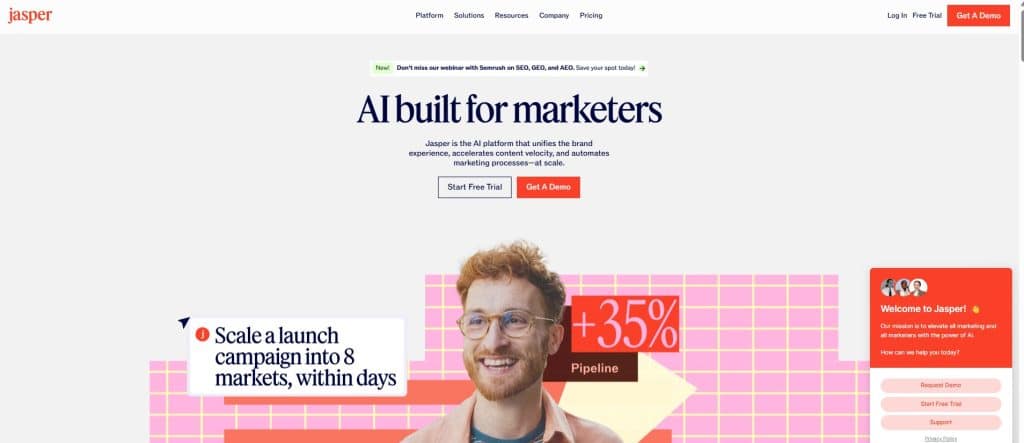
  • Tools for human editing: Grammarly, Hemingway, Wordtune, Jasper, Frase, Originality.ai, GPTZero
  • Humanizing content: localize language, adjust tone, add empathy, humor, and storytelling
  • Human-edited content benefits: higher engagement, improved SEO, brand consistency, error prevention, audience relevance
  • Wild Creek Studio helps refine AI content into polished, authentic, and engaging output
  • FAQs cover AI detection, legality, editing, consistency, and limits of AI tools

Can AI truly replace the creativity and intuition that humans bring to content creation? With AI tools promising instant text and image generation, it’s natural to wonder where the human touch still fits in. Yet many businesses struggle when the output feels robotic, lacks personality, or fails to connect with their audience.

This blog explains how to edit AI content effectively, showing how a human touch can transform automated drafts into engaging, authentic content. By exploring common pitfalls of AI-generated content and practical editing strategies, you’ll gain a clear understanding of how to make AI work for you, without losing creativity, context, or authenticity.

What is AI Content Editing and How Does It Work?

AI content editing focuses on refining, restructuring, and improving content that has already been produced by artificial intelligence tools. Unlike AI content creation, which involves generating text or visuals from prompts, AI content editing begins after the draft is ready. The goal is to make machine-generated content sound natural, align with the brand voice, and connect with real audiences.

Editors carefully review the AI-generated draft to correct inaccuracies, enhance flow, adjust tone, and improve clarity. They also ensure SEO optimization, add missing context, and bring in emotion and creativity that AI often overlooks. In essence, AI content editing is where human skill turns an automated draft into high-quality, authentic content.

Why Does AI-Generated Content Lack Depth and Personality?
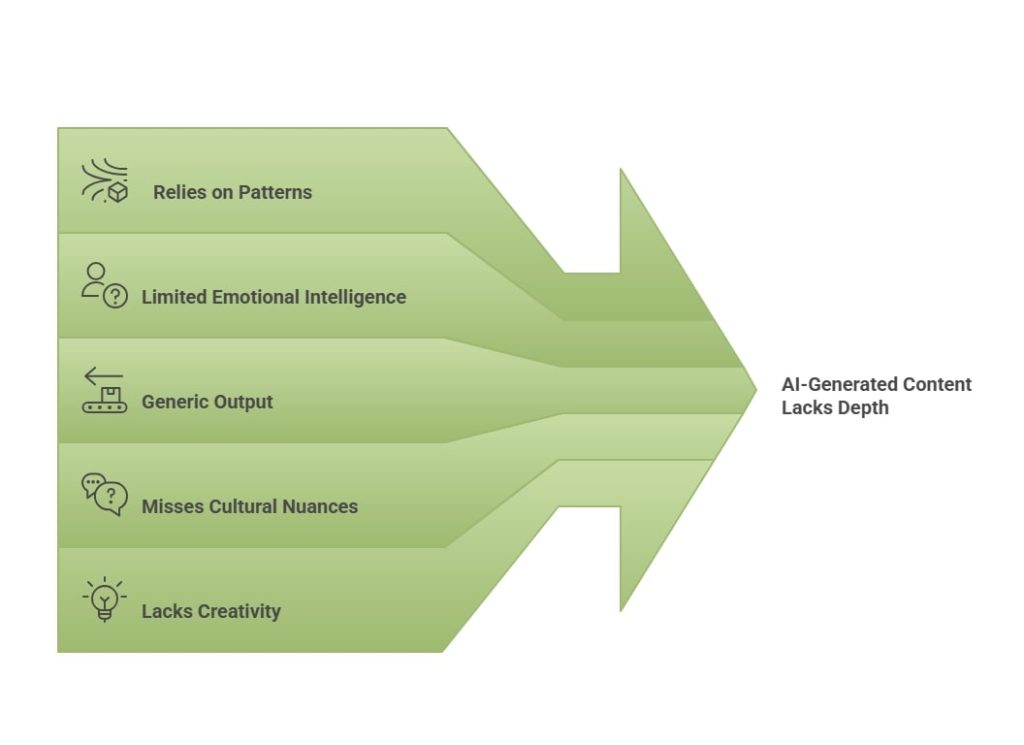
Infographic of Why Ai generated content lack of depth

Infographic of Why Ai generated content lack of depth

1. Relies on Patterns, Not Experiences

AI generates content by analyzing data and identifying patterns, but it lacks personal experiences or storytelling ability. For example, if asked to describe a sunrise at a beach, AI might write, “The sun rises over the water, casting orange and yellow hues.” A human, however, could capture the moment more vividly: “The first rays of the sun kissed the gentle waves, and the salty breeze carried the scent of morning as seagulls danced above.”

2. Limited Emotional Intelligence

AI struggles to convey emotions, humor, or empathy, which are crucial for connecting with readers. For instance, when writing about a farewell party, AI may produce a generic sentence like, “Everyone said goodbye at the party.” A human could describe it as, “Tears glistened in eyes as friends exchanged hugs and laughter, trying to hold onto memories of countless shared moments.”

3. Generic and Repetitive Output

AI can quickly generate content, but it often feels formulaic and lacks a unique voice. A product review from AI might read, “The phone is good. It has a fast processor and a clear camera.” A human reviewer could make it engaging: “Snapping photos feels like a breeze with this phone, and apps open instantly, making every task seamless and satisfying.”

4. Misses Cultural Nuances

Subtle language cues, local expressions, and context are difficult for AI to interpret accurately. For example, AI might describe a traditional festival as “People celebrate with food and music.” A human could convey it more authentically: “Families gather to savor spicy tamales, laughter echoing as children chase fireworks in the warm night air.”

5. Lacks Creativity

AI cannot innovate or think beyond its programming, so imaginative ideas and fresh perspectives are missing. For instance, AI might describe a story plot plainly: “A hero defeats a villain to save the town.” A human storyteller could make it compelling: “Against the backdrop of a stormy night, the hero’s courage ignited hope as the villain’s shadow receded, leaving the town to breathe freely again.”

Because of these limitations, human editing is essential to add personality, depth, and authenticity to AI-generated content, transforming flat drafts into writing that resonates with real readers.

Why AI-Generated Content Often Feels Flat

AI content tools are fast and efficient, but their output often lacks depth, personality, and emotional resonance. This is because AI relies on patterns rather than real experiences, struggles to convey emotions, produces generic or repetitive content, misses cultural nuances, and cannot think creatively beyond its programming.

For example, AI describing a sunrise at a beach might write, “The sun rises over the water, casting orange and yellow hues.” A human could make it vivid and emotional: “The first rays of the sun kissed the gentle waves, and the salty breeze carried the scent of morning as seagulls danced above.”

Similarly, AI might describe a festival as “People celebrate with food and music,” while a human could capture, “Families gather to savor spicy tamales, laughter echoing as children chase fireworks in the warm night air.”

How Can Human Editing Enhance AI-Generated Content?

Even the most advanced AI tools cannot fully replicate the creativity, context, and authenticity of human writing. Human editing is essential to transform AI drafts into content that truly connects with readers.

  • Adding personality and brand voice: AI might write, “Our product is good and useful.” A human editor can turn it into, “Our product makes your mornings easier and your tasks lighter, just like a trusted companion you can rely on every day.”
  • Improving clarity and readability: AI can produce long, awkward sentences such as, “The software is designed in a manner that allows for efficient use by users.” Human editing simplifies it to, “The software is easy to use and helps you work efficiently.”
  • Fact-checking and adding context: AI may state, “The city has many historic sites.” A human editor can enhance it: “The city boasts landmarks like the 18th-century cathedral and cobblestone streets that tell centuries of history.”
  • Optimizing for SEO naturally: Instead of keyword stuffing, human editors incorporate terms seamlessly: “Travelers exploring Rome will enjoy hidden gems beyond the Colosseum, perfect for an authentic Italian experience.”
  • Correcting grammar and style: AI might produce, “Each of the team members are responsible for their tasks,” which human editing fixes to, “Each team member is responsible for their tasks.”

By combining AI efficiency with human insight, businesses can create quality content that is not only accurate and optimized but also engaging, memorable, and truly reflective of their brand. Start leveraging human editing today to turn automated drafts into compelling stories that resonate with your audience.

Fix AI’s Weak Spots With Human Editing Checklist
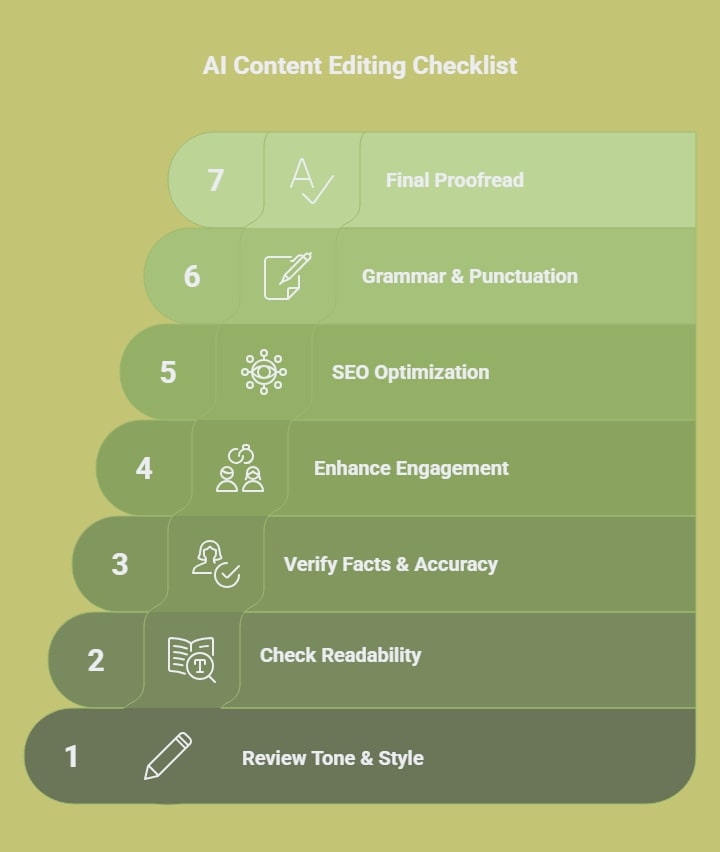
Infographic of AI content editing checklist

Infographic of AI content editing checklist

To make the most of AI-generated drafts, follow this practical checklist with actionable tips and examples:

  • Review tone and style: Ensure the content reflects your brand voice. For instance, change “Our software helps users” to “Our software empowers you to breeze through tasks,” if your brand voice is friendly and approachable.
  • Check readability: Break up long sentences and simplify complex phrasing. AI might write, “The implementation of this feature allows for enhanced productivity in multiple workflows,” which can be edited to, “This feature helps you work faster and smarter.”
  • Verify facts and accuracy: Confirm dates, statistics, names, and references. AI may misstate facts like “The Eiffel Tower was built in 1900”, correcting it to 1889 ensures credibility.
  • Enhance engagement: Add storytelling, anecdotes, or examples to make content relatable. For a travel blog, replace “The city has many parks” with “Families flock to Sunflower Park, where children chase ducks across the pond and locals enjoy morning yoga sessions.”
  • SEO optimization: Integrate target keywords naturally into headings, meta descriptions, and content. Avoid keyword stuffing; for example, instead of repeating “best travel tips” multiple times, use variations like “top travel hacks” or “must-know travel advice.”
  • Grammar and punctuation: Correct errors and awkward phrasing. AI may write, “Each of the team members are responsible for their tasks,” which should be, “Each team member is responsible for their tasks.”
  • Final proofread: Read aloud to catch repetitive phrases, robotic patterns, or inconsistent tone. Experienced editors should also look for AI quirks, like repeated sentence starters or unnatural transitions, and smooth them out.

Following this checklist ensures AI-generated content becomes polished, engaging, and professional, ready to capture readers’ attention and reflect your brand’s authenticity.

What Tools Turn AI Drafts Into Polished Content?

While human editing is essential for refining AI-generated content, leveraging the right tools can make the process faster, more accurate, and effective. These tools assist editors in improving grammar, clarity, SEO performance, and even detecting AI-generated patterns that need more human touch.

1. Grammar & Clarity Platforms

Grammar and clarity platforms are essential tools for refining AI-generated content. They go beyond simple spell-checking to suggest improvements in punctuation, sentence structure, readability, and word choice. These tools help ensure your content is error-free, easy to read, and aligned with your brand’s style guide.

Here’s a quick comparison of how these tools can help:

Tool Key Editing Features Best For
Grammarly Grammar, punctuation, style suggestions, tone detection Polishing AI-generated drafts for professional writing
Hemingway Readability scoring, sentence simplification, passive voice detection Making content concise and easy to read
Wordtune Rewriting suggestions, tone adjustment, sentence variation Improving clarity and adapting content for different audiences
Jasper Brand voice alignment, content phrasing suggestions, SEO integration Refining AI-generated marketing copy
Frase Content gap analysis, SEO suggestions, structure improvement Optimizing AI-generated blog posts and long-form articles

2. AI Detectors and Analysis Software

AI detectors and analysis tools help editors identify sections of content that may feel robotic, repetitive, or lacking originality. These tools are especially useful for spotting predictable phrasing or overused patterns in AI-generated drafts, allowing editors to focus on adding creativity, context, and personality.

  • Originality.ai evaluates content for AI-generated text, plagiarism, and SEO compliance. It provides a percentage score indicating how likely the content was created by AI versus written by a human. Editors can use this score to pinpoint sentences that need more authentic phrasing or deeper insights.
  • GPTZero, on the other hand, focuses on detecting predictability and burstiness in text. It highlights parts of the content that follow overly structured or formulaic patterns typical of AI. By reviewing these flagged sections, human editors can introduce natural variations, storytelling elements, or emotional nuance.

Humanizing AI Content for Target Audiences

AI-generated content often reads like a set of facts on autopilot, it can be accurate, but it usually lacks the subtle touches that make writing relatable and memorable. Human editors bring these touches, shaping content so it resonates with your audience on a personal level. By tailoring language, tone, and storytelling, editors turn robotic drafts into content that feels authentic, approachable, and engaging.

1. Localizing Language and Tone

Human editors adapt AI-generated content to match the preferences, culture, and expectations of specific audiences. This involves:

  • Adjusting vocabulary and idioms: Swap generic phrases like “make use of” with local-friendly terms such as “use” or “try out.”
  • Modifying tone: Make it formal, casual, or conversational depending on your readers. For example, a casual blog post could say, “You won’t believe how easy this is!” instead of a stiff, AI-style sentence.
  • Aligning cultural references: Replace generic examples with locally relevant ones, like swapping “Fourth of July” with “National Day” for Singapore readers.

This localization makes content feel personal and relevant, increasing the likelihood that readers will connect and engage.

2. Adding Empathy, Humor, and Storytelling

Facts alone don’t make content memorable. Human editors inject emotion, personality, and narrative to create a connection:

  • Share relatable anecdotes: Start with a small story, e.g., “When I first tried this productivity tool, I spent an hour figuring out the settings… only to discover a hidden shortcut that saved me days!”
  • Inject light humor: A playful observation, like, “Even my coffee needed a coffee this morning”, can make the content feel more human.
  • Use empathetic language: Show readers you understand their challenges, e.g., “Ever felt overwhelmed by endless to-do lists? Here’s a simple trick to ease the chaos.”

By incorporating these elements, editors transform AI drafts into content that doesn’t just inform, it entertains, relates, and builds trust. Every small tweak adds warmth, personality, and credibility, making your brand feel like it’s speaking directly to the reader.

How To Turn AI Editing Into A Seamless Workflow?
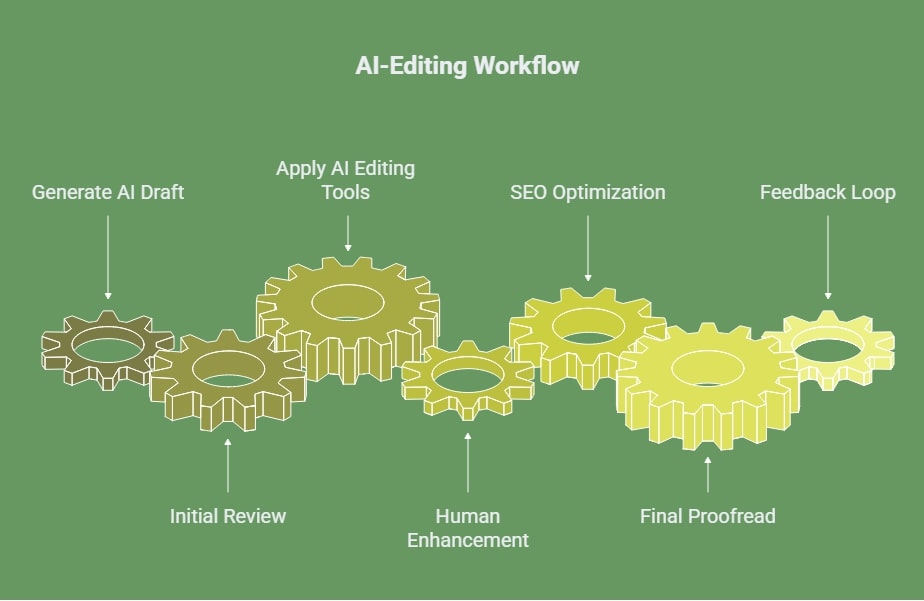
A visual representation of a Ai editing workflow configuration 1

A visual representation of a Ai editing workflow configuration 1

Editing AI-generated content becomes faster, easier, and more consistent when you follow a structured workflow. A repeatable process helps teams produce polished, engaging, and SEO-ready content every time. Here’s a step-by-step guide to making AI editing work for you:

1. Generate the AI Draft

Start with a clear prompt in your AI content tool to create the first draft. A well-defined prompt saves time and gives you content that is closer to what you need.

Tip: Include specifics like tone, audience, and word count in your prompt to get a stronger starting point.

2. Initial Review

Skim the draft to spot glaring errors, off-topic sections, or missing context. This step ensures you don’t spend time polishing content that needs major revisions.

Example: Highlight a paragraph where AI lists generic tips without examples, then note what’s missing before editing.

3. Apply AI Editing Tools

Use grammar, clarity, and style platforms to fix language issues and improve readability. This helps your draft sound professional and easy to understand.

Quick tip: Tools like Grammarly or Hemingway can point out overly long sentences, passive voice, or unclear phrasing.

4. Human Enhancement

Add creativity, personality, and audience-specific touches. Include empathy, humor, storytelling, or local references to make the content relatable and engaging.

Example: Turn “The software is useful for managing tasks” into “This software takes the stress out of your to-do list, letting you focus on what really matters.”

5. SEO Optimization

Integrate keywords, meta descriptions, and headings naturally without sacrificing readability. This ensures your content performs well in search while still feeling human.

Tip: Use variations of your keywords to avoid repetition and keep the content smooth.

6. Final Proofread

Read through the draft carefully to catch any remaining errors and ensure tone, style, and messaging are consistent. Reading aloud often helps spot awkward phrasing.

7. Feedback Loop

Track performance metrics and audience engagement to refine future prompts and editing practices. Continuous learning helps your workflow get smarter over time.

Example: If readers bounce from a section, consider reworking that part with more engaging storytelling or clearer explanations next time.

By turning AI editing into a structured workflow, teams can save time, maintain quality, and ensure human creativity consistently enhances AI-generated content. With practice, this approach makes AI a reliable partner rather than just a shortcut.

Why Should Businesses Prioritize Human-Edited Content Over Fully Automated AI Content?

AI can produce content instantly, but speed alone doesn’t make it memorable or persuasive. Without human insight, AI drafts often feel generic, flat, or disconnected from what readers actually care about. Human editing adds the depth, personality, and context that turn automated text into content that resonates, builds trust, and drives real engagement.

Here’s why human-edited content gives businesses a real advantage:

  • Enhanced quality and engagement: Editors add nuance, storytelling, and personality, transforming robotic text into content that captivates readers.
  • Improved SEO performance: Human oversight ensures keywords, headings, and meta descriptions are naturally integrated, balancing search visibility with readability.
  • Brand consistency: Every piece reflects your company’s tone, values, and messaging, reinforcing brand identity across channels.
  • Error prevention: Humans catch factual inaccuracies, awkward phrasing, or culturally insensitive language that AI may miss, protecting credibility.
  • Audience relevance: Editors tailor content to specific demographics, regions, and interests, creating a stronger connection with readers.

Human-edited content is more than polished, it’s purposeful. By blending AI efficiency with human creativity and insight, businesses produce content that not only informs but also engages, persuades, and leaves a lasting impression. Investing in human editing ensures your content works harder for your audience and your brand.

How Wild Creek Studio Helps You Perfect AI-Generated Content

Struggling to make your AI-generated content sound less robotic? At Wild Creek Studio, we specialize in bridging the gap between artificial intelligence and human connection. Our expert editors refine your AI drafts, transforming them into engaging, high-quality content that truly represents your brand. We understand that a successful content marketing strategy relies on more than just speed; it requires authenticity and a deep understanding of your audience.

Our content creation process involves using a combination of advanced tools and human expertise. We act as your professional AI humanizer, applying industry best practices to improve readability, inject personality, and ensure every piece of content meets the highest standards of quality. Let our team of professional editors handle the refinement, so you can focus on what you do best, running your business. Contact us today.

Conclusion

AI content editing provides efficiency and speed, the human touch remains essential for creating compelling and relatable content. Human editors infuse depth, personality, and empathy into AI-generated material, transforming it into something that truly resonates with audiences. By prioritizing human-edited content, businesses can enhance their brand’s voice, engage readers more effectively, and stand out in a crowded digital landscape. Remember, the integration of AI and human creativity can lead to the best outcomes. If you’re ready to elevate your content strategy, contact Wild Creek Studio today to see how we can help you perfect your AI-generated writing!

Frequently Asked Questions

Why was my content flagged as AI?

Content is usually flagged as AI-generated when it shows patterns typical of machine-generated text. This can include overly structured sentences, repetitive phrasing, lack of emotional nuance, or predictability in word choice. AI detectors analyze these patterns to determine the likelihood that the content was produced by an AI tool. Human editing can reduce these markers and make content feel more natural and authentic.

Is it legal to use AI content?

Yes, using AI-generated content is legal in most contexts. However, you must ensure the content does not infringe on copyrights, contain plagiarism, or violate local regulations. Businesses and creators should also disclose AI usage where necessary, especially in academic, legal, or professional settings.

Is it okay to use AI for editing?

Absolutely. AI tools can help improve grammar, readability, style, and SEO, making the editing process faster and more efficient. However, human oversight remains crucial to ensure the content aligns with your brand voice, adds creativity, and resonates with your audience. Combining AI assistance with human editing yields the most polished and engaging results.

How do professional editors improve AI-generated writing?

Professional editors enhance AI output by infusing it with a human touch. Through a detailed editing process, they refine the tone, check for accuracy, and add emotional nuance. This improves content quality and ensures the final draft is polished, engaging, and perfectly aligned with your brand’s voice.

Can I use automated tools to check grammar and style in AI content?

Yes, you can and should use automated AI tools to check for grammar mistakes and ensure adherence to a style guide. These content generation tools are excellent for streamlining the initial creation process, but they work best when followed by a final review from a human editor to catch what they miss.

How can AI content editing improve content consistency across multiple platforms?

AI content editing promotes consistency by establishing a unified workflow for all content creation. By applying the same style guide and editing standards to blog posts, social media updates, and marketing copy, you ensure a coherent brand voice across every channel, strengthening your brand identity.

Can AI content editing tools replace professional human editors?

No, AI tools cannot fully replace professional human editors. Despite the power of AI, these tools lack the human creativity, critical thinking, and emotional understanding that content writers provide. Human input remains essential for creating content that is truly authentic, nuanced, and impactful.

0 comments
Enhancing Leadership AI Agent Decision Making Explained 1

AI Agent Decision Making and Ethical Leadership in 2025

In this Article

Toggle
  • Key Highlights
  • What Is AI Agent Decision Making?
  • How Do AI Agents Make Decisions?
  • Is An AI Agent Just An LLM With Decision Capabilities?
  • Why Do Leaders Need Agentic AI For Decision-Making?
    • 1. Speeding Up Decisions Without Compromising Accuracy
    • 2. Providing Unbiased, Data-Backed Insights
    • 3. Running Multiple Scenarios Simultaneously
      • 4. Automating Low-Value Tasks So Leaders Focus on Vision
  • How Do AI Agents Enhance Decision-Making Processes In Businesses?
    • Real-World Examples
  • How Can Agentic AI Strengthen My Strategic Planning?
  • How Does Agentic AI Ensure Ethical Decision-Making?
  • Why Human Judgment Remains Vital In Decision-Making?
    • AI Agents vs. Human Judgment in Decision-Making
  • How Wild Creek Web Studio Leads With the Human Algorithm?
  • Conclusion
  • Frequently Asked Questions
    • How do AI agents make decisions without human intervention?
    • What safeguards ensure ethical decision-making by AI agents?
    • Which industries benefit the most from agentic AI-driven leadership?
    • Is an AI agent just another form of traditional software?
    • How do autonomous agents handle complex problems in business processes?
    • What role does natural language processing play in AI agents?
    • How do AI agents improve security in decision-making?
    • Can AI agents learn and adapt from new information like human agents?

Key Highlights

  • AI agents transform leadership by turning slow, complex decisions into faster, proactive strategies.
  • Agentic AI analyzes data, sets goals, and executes complex tasks with minimal human input.
  • The decision-making loop covers goal setting, data collection, reasoning, evaluation, execution, and monitoring.
  • Unlike LLMs, AI agents deliver outcomes by completing tasks across enterprise systems.
  • Leaders gain faster decisions, unbiased insights, scenario simulations, and freedom from routine tasks.
  • Real-world uses include finance, healthcare, marketing, HR, and supply chain optimization.
  • The Human Algorithm blends AI efficiency with human empathy, ethics, and contextual judgment.

Business leaders are drowning in endless reports, shifting markets, and constant pressure to act quickly. Every decision feels like a high-stakes gamble where one mistake can cost revenue, reputation, and trust.

The frustration grows when outdated tools slow leaders down instead of helping them see clearly. Opportunities slip away, teams lose confidence, and competitors race ahead. The cost of hesitation is brutal, with shrinking margins and leadership teams scrambling to catch up.

AI agents change this dynamic by analyzing data in seconds, simulating outcomes, and delivering clear insights. The real breakthrough comes when their efficiency is combined with human judgment. At Wild Creek Web Studio, we call this the Human Algorithm. It helps leaders think better, not just faster, by blending AI-driven clarity with empathy, ethics, and context. This blog explores how AI agents are reshaping leadership while keeping the human touch irreplaceable.

What Is AI Agent Decision Making?

AI agent decision-making is when intelligent systems do more than just process data. They can analyze information, plan actions, and even carry out tasks with minimum human assistance. Unlike dashboards that only show past results, agents adapt in real-time, learn from feedback, and provide leaders with clear, actionable insights.

Think of it this way: a chatbot like ChatGPT can give you an answer, but an AI agent can take action. For example, instead of only suggesting an email draft, an agent could design and run the entire campaign. It bridges the gap between gathering information and taking action.

This matters for leaders because traditional tools leave them guessing about the next step. AI agents cut through the noise, spot opportunities quickly, and respond to changes as they happen. The real power comes when their efficiency is combined with human judgment, ensuring decisions are not only faster but also smarter and aligned with values.

How Do AI Agents Make Decisions?

Every leader knows how frustrating slow decision-making can be. Reports arrive late, data feels incomplete, and meetings drag on without clear answers. By the time a decision is made, the market has shifted, customers have moved on, and competitors are already ahead.

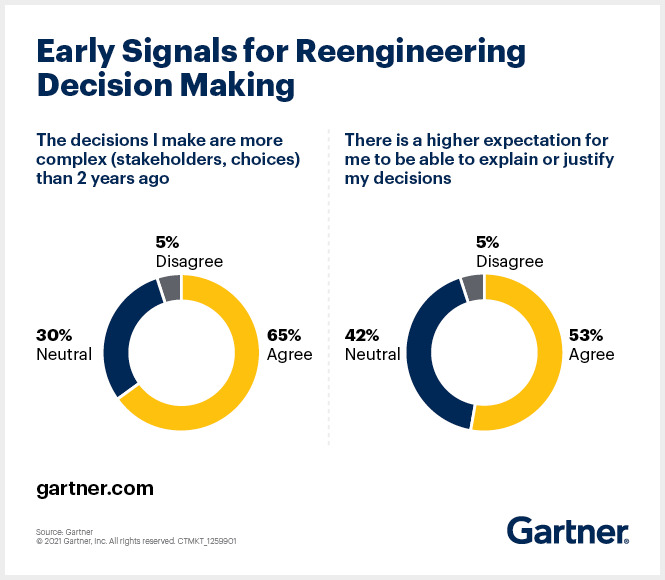
Gartner reports that 65% of leaders say their decisions are more complex today than just two years ago, while 53% feel greater pressure to explain or justify every choice. The cost of this complexity is wasted time, missed opportunities, and shrinking margins.

Early Signals for Reengineering Decision Making Gartner

Early Signals for Reengineering Decision Making Gartner

Source

AI agents change this dynamic. They follow a structured AI agent decision making process that turns raw data into action with speed and confidence. Instead of surface-level analysis, they provide real-time clarity, helping leaders stay proactive rather than reactive.

The decision-making loop of AI agents works like this:

Stage What Happens Business Benefit
1. Goal Setting AI receives objectives and constraints. Aligns actions with strategy.
2. Data Collection Pulls structured and unstructured data. Creates a complete picture.
3. Reasoning & Planning Generates possible solutions. Surfaces smarter options.
4. Evaluation Simulates outcomes. Reduces risk in choices.
5. Execution Connects with tools and automates steps. Speeds up implementation.
6. Monitoring Tracks results and adapts in real time. Ensures continuous improvement.

This structured loop explains how do AI agents make decisions and why they are more than digital assistants. They act as strategic partners, managing complexity while giving leaders space to focus on ethics, context, and long-term vision. That is the essence of the Human Algorithm: combining AI efficiency with human judgment to make decisions that are not only faster, but smarter and more accountable.

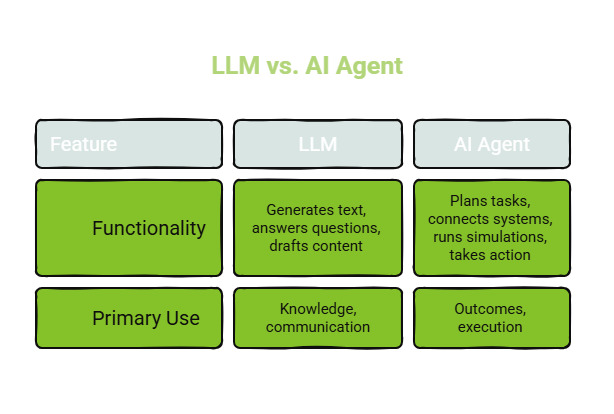
Is An AI Agent Just An LLM With Decision Capabilities?

Comparison chart of LLM vs AI Agent

Comparison chart of LLM vs AI Agent

It is tempting to believe that AI agents are just large language models with a fancy name. Leaders see ChatGPT generating text and assume agents are simply smarter chatbots. However, that view overlooks the actual transformation. Treating agents as just LLMs risks holding on to old tools when smarter, more autonomous systems are already available.

As Andrew Ng once said: “Just as electricity transformed almost everything 100 years ago, today I actually have a hard time thinking of an industry that I don’t think AI will transform in the next several years.” Just as electricity powered industries far beyond lighting, agentic AI autonomous decision-making goes far beyond generating words. Agents perceive, plan, and act in ways that redefine the nature of leadership decision-making.

The difference looks like this:

LLM (Large Language Model) AI Agent
Generates text, answers questions, and drafts content based on patterns in data. Plans multi-step tasks, connects with CRMs or financial tools, runs simulations, and takes action with minimal human oversight.
Useful for knowledge and communication. Designed for outcomes, bridging the gap between insight and execution.

So, is an AI agent just an LLM with decision capabilities? That’s a common misconception, but the reality is much broader. An LLM provides information, while an AI agent delivers results. The real advantage comes when leaders pair AI efficiency with human judgment to ensure that decisions remain ethical, contextual, and strategic.

Curious about AI’s impact on search? Check out: What Is LLMO & How Does It Impact Your SEO Strategy in 2025?

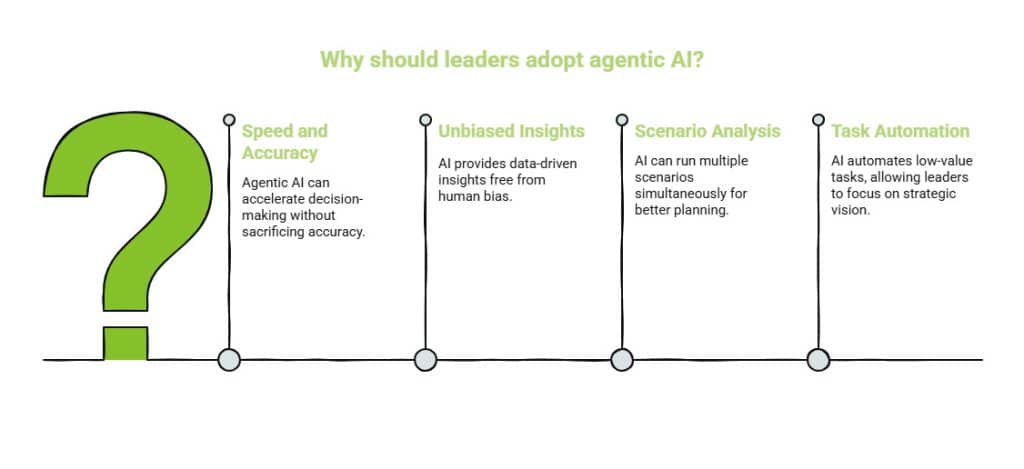
Why Do Leaders Need Agentic AI For Decision-Making?

Why Leaders Need Agentic AI visual selection

Why Leaders Need Agentic AI visual selection

Markets shift overnight, customer expectations evolve constantly, and teams look to leadership for clarity and direction. Traditional tools often add to the frustration by showing past data without guiding the next move. Agentic AI changes that by turning information into timely, actionable strategies.

1. Speeding Up Decisions Without Compromising Accuracy

Delays in decision-making cost both money and momentum. Reports take days, data is fragmented, and by the time leaders act, opportunities are gone.

With agentic AI, insights arrive in real time. What once took weeks now happens in minutes. For example, retail chains use AI agents to adjust pricing daily based on competitor moves and customer demand, boosting margins while staying agile.

2. Providing Unbiased, Data-Backed Insights

Human judgment is strong but can be swayed by bias or the loudest voice in the room. This creates blind spots in critical choices.

AI agents ground decisions in objective data, surfacing patterns leaders may overlook. In financial services, they flag lending risks based purely on numbers, not assumptions, helping executives make sharper, more informed decisions.

3. Running Multiple Scenarios Simultaneously

Strategic choices such as whether to launch now, expand into a market, or cut costs require exploring trade-offs. Doing this manually overwhelms already stretched leadership teams.

AI agents run countless “what-if” simulations instantly. Healthcare networks, for instance, use agents to test staffing models across hospitals, finding the best way to cut costs without reducing quality of care.

4. Automating Low-Value Tasks So Leaders Focus on Vision

Leaders should focus on culture and long-term growth, not routine approvals or firefighting. Yet many are stuck in repetitive, low-value tasks.

AI agents automate workflows, reporting, and operational decisions. In HR, they screen candidates and schedule interviews, giving leaders more time to drive strategy and nurture teams.

Agentic AI gives leaders speed, scale, and sharper insights, but it does not replace the human algorithm. At Wild Creek Web Studio, we believe the future of leadership lies in blending AI efficiency with human judgment. Our approach helps organizations harness agentic AI decision making while keeping empathy, ethics, and context at the center.

Forward-thinking organizations are beginning to explore how agentic AI can support ethical, long-term decisions. At Wild Creek, we partner with them to navigate this journey.

How Do AI Agents Enhance Decision-Making Processes In Businesses?

Business leaders collaborating with an AI robot to improve decision making

Business leaders collaborating with an AI robot to improve decision making

Leaders lose valuable hours on routine choices that add little strategic value. Every minute spent reviewing spreadsheets, chasing anomalies, or prioritizing tasks is a minute stolen from vision and growth. This daily grind not only wastes time, but it also creates fatigue and hinders the most important decisions.

AI agents productivity decision-making daily routines solve this by automating repetitive tasks and surfacing sharper insights that leaders can act on instantly.

Real-World Examples

Here are some real-world examples of how AI agents streamline decision-making across daily business routines:

  • Drafting Executive Briefs: Summarize key reports and highlight the essential information leaders need to know each morning.
  • Monitoring Financial Anomalies: Flag risks in real time before they spiral into bigger problems.
  • Optimizing Workforce Scheduling: Balance workloads and cut inefficiencies automatically.
  • Prioritizing Marketing Campaigns: Rank opportunities so teams invest where ROI is highest.

McKinsey research shows that agentic AI can deliver a 20–60% increase in productivity in complex decision-making workflows, giving leadership teams more capacity to focus on growth. By enhancing productivity, AI agents free leaders to think strategically instead of drowning in operational noise. The result is faster, more confident decisions that shift leadership from a reactive to a proactive approach.

How Can Agentic AI Strengthen My Strategic Planning?

When leaders rely solely on intuition, they risk falling into blind spots that can undermine their strategy and performance. Agentic AI data driven decisions minimize that risk by turning scattered information into clear, actionable insights.

Here are the key advantages leaders gain from using agentic AI in data-driven decision-making:

  • Synthesizing Data Across Silos: Integrate information from multiple departments to create a complete and unified view.
  • Spotting Hidden Correlations: Identify trends and connections that remain invisible to human analysis.
  • Supporting Predictive Modeling: Anticipate outcomes with greater accuracy and strengthen foresight in planning.
  • Enhancing Speed and Accuracy: Process large volumes of data instantly, reducing delays while improving reliability.
  • Reducing Human Bias: Counteract the influence of personal or unconscious bias in high-stakes decisions.
  • Improving Resource Allocation: Direct time, talent, and budgets toward areas with the greatest potential ROI.
  • Driving Competitive Advantage: Enable leaders to move ahead of competitors by acting on insights faster.

Leaders can shift from reactive to proactive strategies with data-backed confidence, ensuring decisions are accurate, fair, and aligned with long-term growth.

Do you want to break free from outdated marketing playbooks? Read: Stay Ahead with Modern Digital Marketing Frameworks

How Does Agentic AI Ensure Ethical Decision-Making?

The biggest fear with AI in leadership is bias and flawed outputs. Leaders worry that one wrong recommendation could damage trust, spark compliance issues, or even harm people directly. The risk of flawed AI-driven choices is real and costly.

So, how does agentic AI ensure ethical decision-making? It begins with governance frameworks, human oversight, and built-in checks that prevent automated decisions without oversight. Agentic AI combines efficiency with accountability by following clear thresholds and transparent systems.

Here are the practices that keep agentic AI ethical and reliable:

  • Transparent Audit Logs: Record every action for traceability and accountability.
  • Human-in-the-Loop Reviews: Require leader approval for sensitive or high-impact choices.
  • Bias Detection Systems: Continuously test and correct training data to minimize unfair outcomes.
  • Policy-Driven Guardrails: Encode compliance, legal, and ethical standards into agent operations.
  • Regular Audits: Review performance to ensure decisions remain fair, consistent, and aligned with human values.

Ethics cannot be outsourced to machines. Leaders must pair agentic AI with governance and oversight to ensure decisions are not only fast but also fair, transparent, and human-centered.

Why Human Judgment Remains Vital In Decision-Making?

Machines may process data at lightning speed, but they lack empathy, context, and ethical reasoning. Leadership is more than numbers; it is about understanding people, culture, and the ripple effect of every choice. That’s where human judgment remains irreplaceable.

As Bernard Marr notes, “Instead of replacing humans, AI is becoming our most powerful tool for augmentation. Think of it as having a brilliant assistant who … ultimately needs human wisdom to guide its application.” Leaders provide meaning, perspective, and accountability that no algorithm can replicate.

AI Agents vs. Human Judgment in Decision-Making

wo professionals discussing with an AI agent represented by a humanoid robot on a green background

wo professionals discussing with an AI agent represented by a humanoid robot on a green background

AI agents deliver efficiency, but humans deliver vision. This is the essence of the Human Algorithm: combining AI’s ability to act fast with the uniquely human capacity to think better.

AI Agents Handle Human Leaders Handle
Data analysis at scale Contextual interpretation
Speed and automation Empathy and ethics
Pattern recognition Strategic vision
Predictive simulations Relationship management
Task optimization Cultural and emotional awareness

The future of leadership depends on balance. AI agents optimize efficiency, while human leaders guide decisions with empathy, ethics, and strategic foresight.

Also read: How To Drive More Traffic via Small Business SEO Services?

How Wild Creek Web Studio Leads With the Human Algorithm?

At Wild Creek Web Studio, we believe the future of leadership is not humans versus machines, but humans and AI thinking together. That is why we created The Human Algorithm, our proprietary framework that blends AI efficiency with human judgment to deliver ethical, strategic, and measurable growth.

Here are the five pillars of the Human Algorithm that guide everything we do:

  • Purpose Over Tools: We do not start with technology; we start with outcomes. Every AI deployment is directly tied to strategic goals, such as market growth, visibility, or operational efficiency.
  • Trust at the Core: Transparency, auditability, and bias checks are not add-ons. They are non-negotiables that keep AI accountable and leaders in control.
  • Adaptive by Design: Business environments change quickly. Our systems are built to learn, refine, and adapt so you are always one step ahead.
  • Human Insight as the Compass: AI delivers speed, but humans deliver meaning. We ensure empathy, ethics, and context remain central to every decision.
  • From Intelligence to Impact: Insights alone do not grow businesses. We connect strategy to execution, from SEO to paid media, turning AI-driven clarity into measurable results.

The Human Algorithm is not just a philosophy. It is a leadership framework we built for the AI-first era, and it is how we help organizations think better, act faster, and grow with confidence.

👉 Connect with Wild Creek Web Studio to explore how the Human Algorithm can reshape your leadership and decision-making.

Conclusion

AI agents are transforming leadership by taking on routine decisions, surfacing insights faster, and helping leaders act with greater confidence. Yet, the real advantage lies in pairing this efficiency with human judgment, ethics, and contextual thinking. Machines deliver speed, but only people deliver meaning.

Start small with pilot projects, embed strong governance, and identify areas where AI agents can deliver the most impact. Leaders who learn to combine efficiency with ethics and foresight will shape organizations that thrive in an AI-first world.

Frequently Asked Questions

How do AI agents make decisions without human intervention?

AI agents follow a loop of perception, reasoning, and action. They analyze real-time data, align it with goals, and execute tasks autonomously, requiring human oversight only for exceptions or high-risk scenarios.

What safeguards ensure ethical decision-making by AI agents?

Ethical safeguards include setting decision boundaries, human-in-the-loop oversight, data privacy protections, and transparent frameworks. Regular audits ensure agentic AI aligns with organizational values while minimizing risks from bias, privacy issues, or unintended outcomes.

Which industries benefit the most from agentic AI-driven leadership?

Finance uses agents for fraud detection, healthcare for resource optimization, and manufacturing for supply chain efficiency. Any sector with complex, data-heavy operations benefits from agentic AI data driven decisions and automation.

Is an AI agent just another form of traditional software?

No, AI agents differ from traditional software. They are intelligent agents powered by machine learning and deep learning, designed to adapt, learn from user interactions, and autonomously complete tasks across enterprise systems and complex workflows.

How do autonomous agents handle complex problems in business processes?

Autonomous agents analyze vast amounts of data, identify patterns in complex scenarios, and use reinforcement learning to improve over time. They can manage specific tasks like supply chain management or optimize customer service, ensuring better operational efficiency and cost savings.

What role does natural language processing play in AI agents?

Through natural language processing, AI agents understand user behavior, interpret customer data, and extract relevant information from diverse data sources. This allows them to enhance customer support, improve enterprise software usability, and manage complex challenges across industries like financial services.

How do AI agents improve security in decision-making?

AI agents apply strict security measures such as monitoring for unauthorized access, safeguarding customer data, and ensuring ethical considerations in business processes. With built-in guardrails, they help leaders manage external tools and external systems responsibly while ensuring compliance.

Can AI agents learn and adapt from new information like human agents?

Yes. AI agents use feedback loops and reinforcement learning to adapt to new information, much like human agents refining judgment. This adaptability gives them a crucial role in process automation, software development, and tackling complex challenges with context awareness.

0 comments
A person using ChatGPT on their laptop

How to Use Chat GPT for SEO: Strategies That Actually Work

In this Article

Toggle
  • Key Highlights
  • What role can ChatGPT play in SEO?
  • How to use ChatGPT to do SEO?
    • 1. Use a Strong Prompt Framework
    • 2. Keyword Research & Topic Ideation
    • 3. Create SEO Content Briefs & Outlines
    • 4. Optimise Existing SEO Articles
    • 5. Technical and On-Page SEO Tasks
    • 6. Competitive Analysis Support
    • 7. Internal Linking & Site Structure
    • 8. Meta Tags, Snippets, and Social Copy
    • 9. Local & Niche SEO Support
    • 10. Review, Test, and Refine
  • The Impact of ChatGPT on the SEO Industry
    • 1. Changing the Way SEO Content Is Created
    • 2. Enhancing Keyword Research and Strategy
    • 3. Streamlining On-Page SEO and Optimization
    • 4. Supporting SEO Teams and Decision-Making
    • 5. The Future of ChatGPT in SEO
  • Best Practices and Tips for Maximizing SEO Results with ChatGPT
    • Strategies for Ranking in AI-Powered Search Results
    • Avoiding Common Mistakes When Using ChatGPT for SEO
  • Finding It Hard to Keep Up with SEO Trends? Wild Creek Web Studio Can Help
  • Conclusion
  • Frequently Asked Questions
    • How do you talk to your website content using ChatGPT?
    • Can Google SEO detect ChatGPT?
    • Can ChatGPT do an SEO audit?
    • Is ChatGPT text bad for SEO?
    • Can ChatGPT-generated content rank well in Google search results?
    • What are the limitations of using ChatGPT for keyword research?
    • How do I ensure my ChatGPT prompts produce SEO-friendly content?
    • Will ChatGPT replace Google Search?

Key Highlights

  • ChatGPT streamlines SEO tasks like content creation, keyword research, and on-page optimization while supporting human judgment.
  • It helps generate fresh content ideas, suggest topic clusters, draft articles, and refine meta descriptions.
  • SEO focuses on global search visibility using keywords, backlinks, content quality, and technical optimization, while GEO targets local searches with location-based keywords, maps, reviews, and business listings.
  • Effective use includes generating content ideas, performing keyword research, analyzing competitors, optimizing articles and meta elements, and creating structured FAQs.
  • Best practices involve maintaining high-quality content, updating regularly, combining AI with human oversight, and avoiding keyword stuffing or factual errors.
  • Wild Creek Web Studio helps implement AI-driven SEO strategies, optimize websites, and produce high-quality content for better search rankings.
  • ChatGPT content can rank with human editing, keyword research lacks real-time data, prompts should be specific, and ChatGPT won’t replace Google Search.

Struggling to keep up with the ever-changing world of SEO? Generating fresh content ideas, optimizing for keywords, and keeping up with search engine guidelines can feel overwhelming.

That’s where ChatGPT for SEO optimization comes in, a powerful generative AI tool that can streamline your SEO workflow, spark creative content ideas, and assist with on-page optimization.

In this blog, we’ll show you how to use ChatGPT for SEO effectively, providing practical strategies that complement your SEO efforts without replacing the critical human thinking needed to achieve real results.

What role can ChatGPT play in SEO?

As SEO grows more sophisticated, so do the demands on marketers and content teams. From keyword research and content planning to on-page optimization and content refreshes, modern SEO requires both strategic oversight and relentless execution. This is where ChatGPT can serve as a powerful ally.

Used thoughtfully, ChatGPT doesn’t replace SEO expertise; it accelerates it.

By acting as an AI-powered assistant, ChatGPT helps streamline many time-consuming SEO tasks:

  • Content Ideation: Quickly brainstorm blog topics, subheadings, and FAQs aligned with your target keywords.
  • Keyword Support: Explore related keyword suggestions and semantic clusters to enrich your content.
  • Meta & Snippet Optimization: Generate or refine meta titles and descriptions for better CTRs.
  • Content Drafting: Create SEO-friendly drafts that follow your structure and tone, ready for human editing and refinement.
  • Prompt Testing & Iteration: Experiment with different prompt styles to improve content outcomes and scale content variations.

ChatGPT can also assist in building topical authority by suggesting internal linking structures, pillar page ideas, and content clusters that support a long-term SEO strategy.

The result? Faster execution without sacrificing quality, and the ability to maintain a consistent content pipeline that supports both search engine performance and user engagement.

When integrated properly into your workflow, ChatGPT becomes more than a writing tool. It’s a scalable SEO co-pilot, helping you stay agile in a constantly evolving search landscape.
For more insights, take a look at “What Is the Relationship Between SEO and Content Marketing?”.

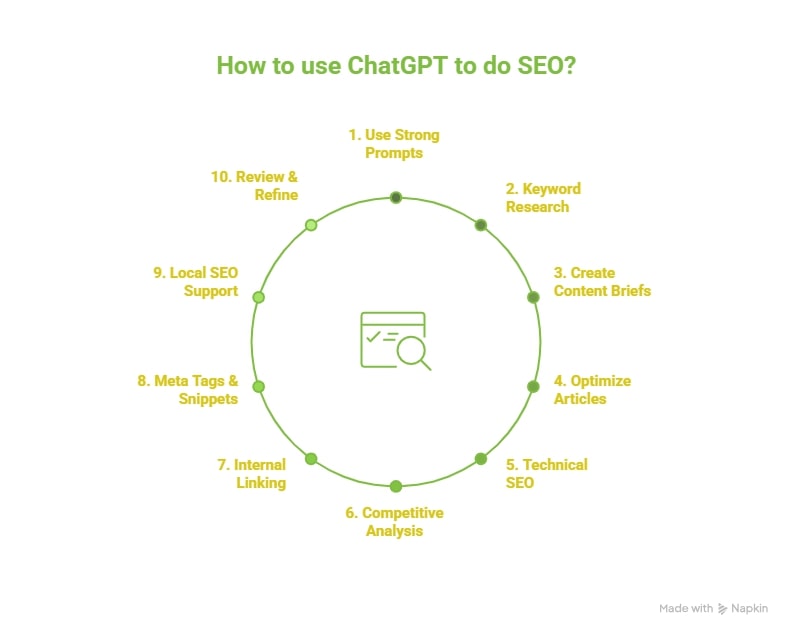
How to use ChatGPT to do SEO?

Infographic of How to use ChatGPT to do SEO

Infographic of How to use ChatGPT to do SEO

Using ChatGPT effectively for SEO isn’t just about asking it to “write me a blog post.” To make it work for your SEO strategy, you need to structure prompts, analyse data, and refine outputs. Below are practical methods, with examples, to help you create better SEO content, improve rankings, and streamline your workflow.

1. Use a Strong Prompt Framework

Before anything else, build a clear prompt framework. Well-structured prompts guide ChatGPT to deliver results that match your SEO strategy. Many marketers (including those at Backlinko) follow a four-part structure:

  • Persona / Role – Define who ChatGPT should be: an SEO expert, strategist, or content writer.
  • Context / Background – Explain your business niche, target readers, or website goals.
  • Task / Request – Be specific, such as “optimise existing SEO articles” or “suggest long-tail keywords.”
  • Format / Output – Specify the response format: table, bullet points, or markdown outline.

Example prompt:

“You are an SEO strategist for a SaaS company. Optimise this article for the keyword ‘project management tools review.’ Provide new meta titles, headings, and internal link ideas. Present everything in a two-column table (current vs. optimised).”

This method gives ChatGPT clarity and purpose, helping it create structured, SEO-ready content that supports your overall SEO strategy.

2. Keyword Research & Topic Ideation

ChatGPT can assist in generating a list of keywords, keyword ideas, and article topics, great for planning SEO articles around your target audience. Though it doesn’t have real-time search data, it’s ideal for brainstorming content clusters, long-tail keywords, and related themes that fit within your SEO strategy.

Example prompts:

  • “List 15 long-tail keywords related to ‘remote work software’ that target informational intent.”
  • “Suggest SEO article topics around ‘AI in marketing’ for mid-level professionals.”
  • “Provide common user questions on ‘ecommerce checkout optimisation.’”

You can even share competitor blog titles and ask ChatGPT to identify missing keyword gaps or new angles worth covering in your upcoming SEO articles.

3. Create SEO Content Briefs & Outlines

Use ChatGPT to prepare content briefs and outlines before drafting your SEO content. This saves time and ensures your content follows the right structure.

Example prompt:

“Create an SEO content brief for the topic ‘benefits of no-code platforms’ aimed at startups. Include keyword targets, suggested headings, meta tags, and internal link ideas.”

This process keeps your SEO strategy aligned across all articles, covering relevant subtopics, keywords, and user search intent consistently.

4. Optimise Existing SEO Articles

One of ChatGPT’s most valuable uses is improving existing content. Feed your published article into ChatGPT and ask for enhancements, keyword integration, readability, or on-page SEO adjustments.

Example prompt:

“Here’s a blog post. Optimise it for ‘email automation tools.’ Suggest better headings, meta description, internal links, and areas for adding more context or data.”

This ensures older SEO content stay fresh, relevant, and aligned with your ongoing SEO strategy.

5. Technical and On-Page SEO Tasks

ChatGPT can’t replace technical tools, but it can generate foundational elements that support your SEO strategy:

  • Schema markup – Ask it to write JSON-LD for FAQs, products, or reviews.
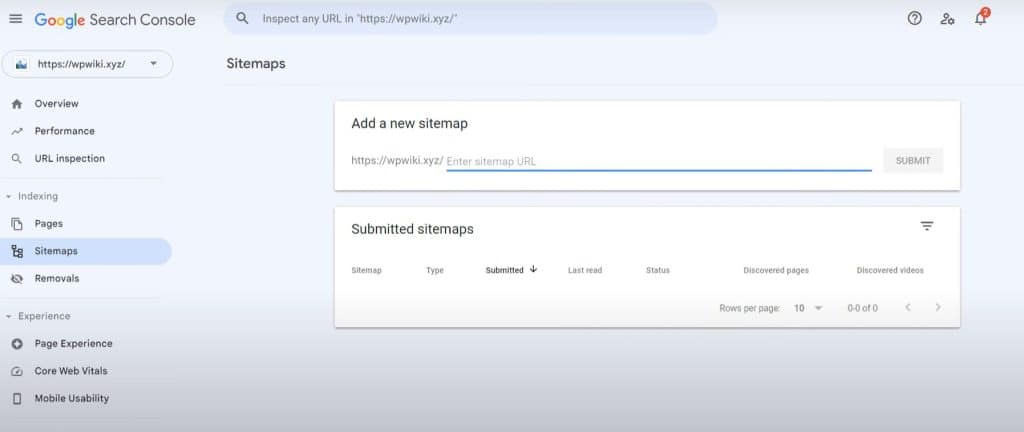
  • Robots.txt & sitemap – Generate or edit files to guide crawlers efficiently.
  • hreflang tags – Request code for multilingual pages.

Example prompt:

“Generate FAQ schema in JSON-LD format for these five Q&A pairs.”

These elements strengthen your site’s technical SEO base, making your SEO content more discoverable.

6. Competitive Analysis Support

ChatGPT can analyse competitor data (that you export from Ahrefs, SEMrush, etc.) to find backlink opportunities or keyword patterns that fit your SEO strategy.

Example prompt:

“Here’s a list of 50 backlinks from competitor X. Summarise trends, anchor text patterns, and suggest 5 domains we could target for backlinks.”

This gives a clearer picture of how your SEO content can compete in search results.

7. Internal Linking & Site Structure

Proper internal linking supports crawlability and content hierarchy, key parts of any SEO strategy. ChatGPT can help identify linking opportunities within your site.

Example prompt:

“Here’s a list of my published SEO articles. Suggest 5 internal links (with anchor text) to add in a new post about ‘remote team productivity.’”

It can also create a topic cluster plan:

“For a SaaS website, create 3 pillar topics and suggest cluster articles under each.”

8. Meta Tags, Snippets, and Social Copy

Strong meta tags can boost your click-through rate. ChatGPT can write multiple versions of meta titles, descriptions, and social captions for your SEO content.

Example prompt:

“Write three meta titles and descriptions for the keyword ‘email deliverability best practices.’ Include the main keyword, and keep it under Google’s character limits.”

This makes your SEO strategy more consistent across search and social channels.

9. Local & Niche SEO Support

For location-based sites, ChatGPT can create localised outlines or landing page structures aligned with your SEO strategy.

Example prompt:

“Create a local landing page outline for a plumbing business in New Delhi. Include service area keywords and customer FAQs.”

Such content helps you reach location-specific audiences effectively while maintaining SEO relevance.

10. Review, Test, and Refine

The most successful marketers treat ChatGPT as a support tool for digital marketing, not a replacement. Always review its outputs, refine them with your expertise, and measure results. Look at how each update affects the performance of your SEO content, and adjust your SEO strategy accordingly.

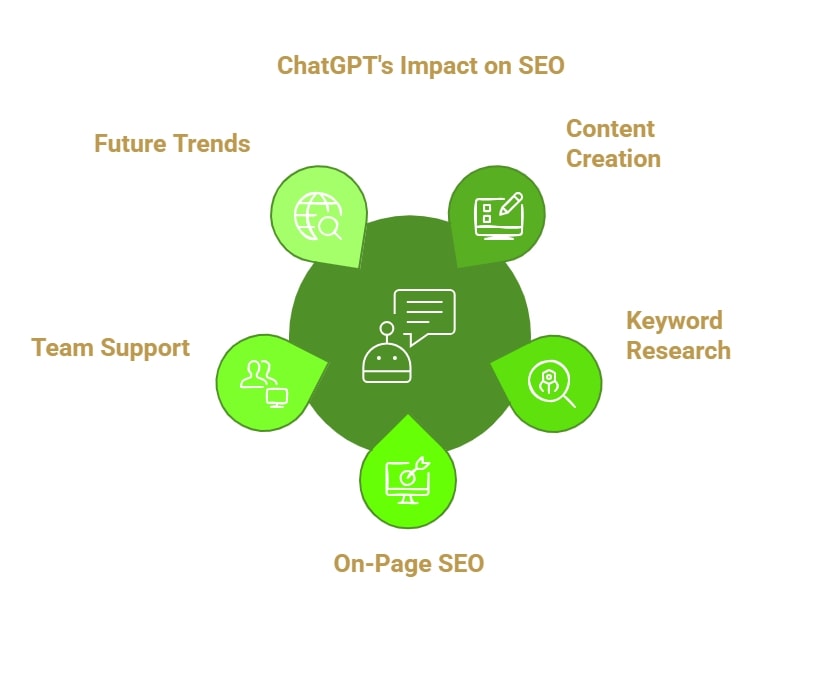
The Impact of ChatGPT on the SEO Industry

Infographic of the Impact of ChatGPT on the SEO Industry

Infographic of the Impact of ChatGPT on the SEO Industry

The rise of ChatGPT has completely reshaped how professionals approach SEO. From speeding up keyword research to improving content quality, Chat GPT for SEO has become a reliable tool for both strategists and content creators. It’s not just about automating tasks, it’s about using artificial intelligence to make smarter, data-driven decisions that strengthen overall SEO performance.

1. Changing the Way SEO Content Is Created

Before AI, writers spent hours researching, planning, and structuring every article. Now, with Chat GPT SEO tools, marketers can instantly brainstorm outlines, find new angles, and create search-friendly drafts that showcase their writing style in minutes. A well-designed Chat GPT SEO article can be optimized from the start, targeting the right keywords, covering intent-based topics, and maintaining a natural tone that fits user expectations.

For example, content teams use GPT Chat SEO prompts to generate multiple article ideas for a single keyword, thus enhancing their search engine visibility. This helps them plan clusters, pillar pages, and long-form content more strategically. As a result, ChatGPT has made content ideation faster and more organized while keeping it relevant to what users actually search for.

2. Enhancing Keyword Research and Strategy

ChatGPT has also influenced the way businesses build their Chat GPT SEO strategy. Instead of relying solely on keyword tools, marketers can ask ChatGPT to expand keyword lists, categorize terms by search intent, and even suggest secondary keywords that fit naturally within content. When combined with traditional analytics tools, this hybrid approach leads to a more complete keyword plan that supports higher visibility.

Using ChatGPT SEO optimization techniques, marketers can also identify related phrases (LSI keywords) or create semantic topic maps around main keywords. These AI-driven insights help shape content that aligns with how modern search algorithms interpret context rather than just keywords.

3. Streamlining On-Page SEO and Optimization

On-page optimization has become more efficient with Chat GPT SEO optimization techniques. Writers and editors now use ChatGPT to polish headings, generate meta descriptions, and check keyword distribution. It can also rewrite or rephrase content to sound more natural while keeping important SEO elements intact.

ChatGPT assists in improving readability, suggesting structured layouts, and creating FAQs or featured snippet sections, all of which contribute to stronger on-page performance. The process that once required several tools and manual effort can now be handled with a single Chat GPT for SEO workflow.

4. Supporting SEO Teams and Decision-Making

Another key impact is how ChatGPT supports collaboration among SEO teams. Whether for brainstorming campaigns, planning backlink content, or generating outreach templates, GPT Chat SEO enables teams to save time while maintaining quality. AI-generated insights can highlight new opportunities, such as untapped content gaps or under-optimized topics, helping teams adjust their SEO approach more effectively.

This has also encouraged SEO professionals to focus less on repetitive tasks and more on strategy, creativity, and user experience, all crucial elements in any successful Chat GPT SEO strategy.

5. The Future of ChatGPT in SEO

As AI continues to evolve, ChatGPT’s role in SEO is expected to grow even further. Its ability to understand search intent, generate contextual keywords, and assist with technical and creative aspects of optimization makes it a valuable long-term asset. When used responsibly and combined with human expertise, Chat GPT for SEO serves as more than a content generator, it becomes a strategic partner that enhances every part of the SEO process.

Read our blog to discover which SEO types can boost your rankings faster

Best Practices and Tips for Maximizing SEO Results with ChatGPT

To get the most out of ChatGPT for SEO optimization, it’s important to follow proven methods that improve content quality, maintain relevance, and ensure effective AI usage. Implementing ChatGPT search SEO optimization techniques helps you generate content that is both user-friendly and search engine-ready.

Strategies for Ranking in AI-Powered Search Results

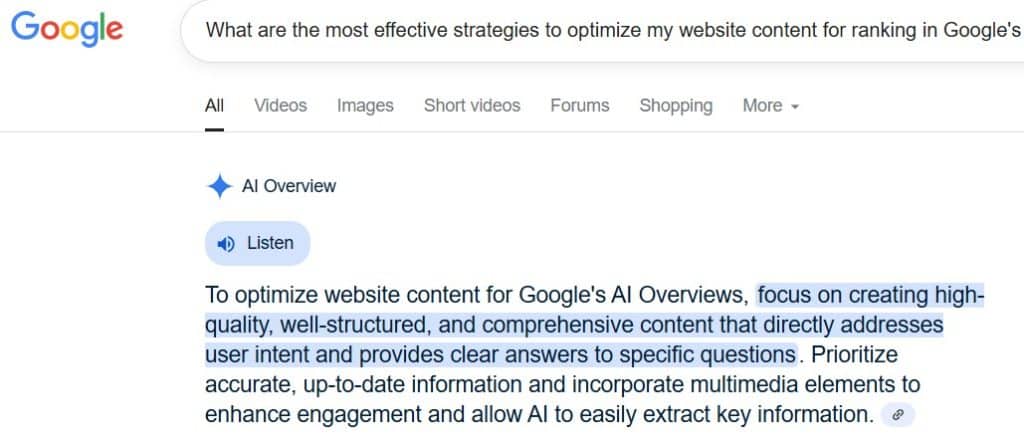
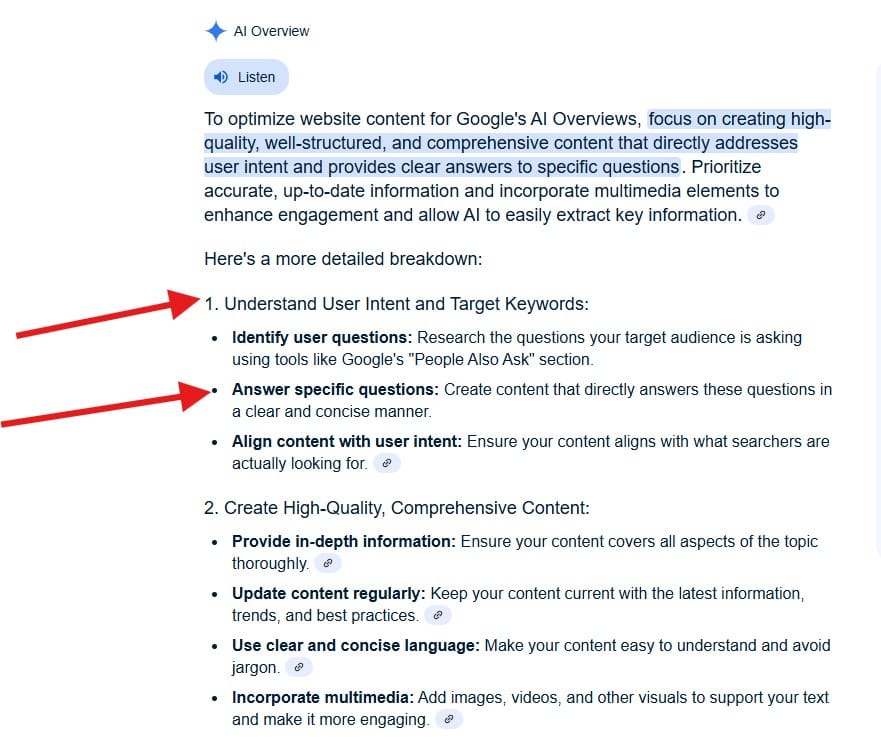
  • Focus on creating high-quality, authoritative content that clearly addresses user intent.
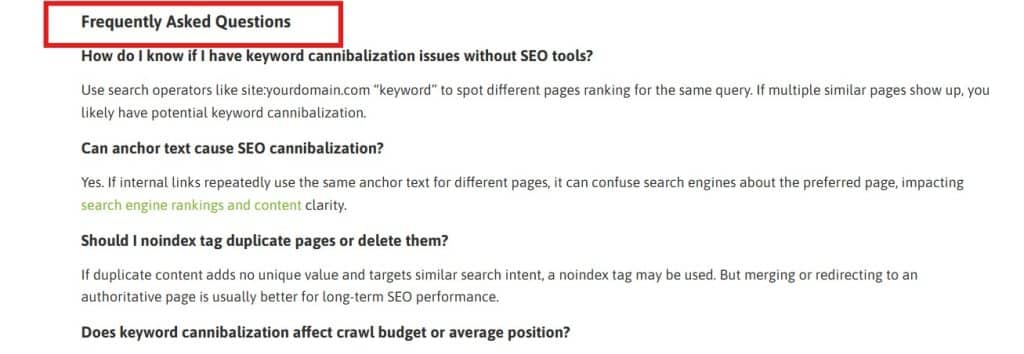
  • Incorporate structured data, FAQs, and headings to make your content easy for AI and search engines to interpret.
  • Use ChatGPT to refine meta titles, descriptions, and headings for better relevance and click-through rates.
  • Keep content updated and comprehensive to maintain trust and authority, which can boost your Chat GPT SEO performance.
  • Leverage GPT chat SEO by consistently generating fresh content ideas and maintaining topical authority.

Avoiding Common Mistakes When Using ChatGPT for SEO

  • Don’t rely solely on AI-human oversight is crucial for accuracy and nuance in chat gpt seo optimization.
  • Avoid keyword stuffing or repetitive phrasing, which can negatively affect search rankings.
  • Ensure AI-generated content is fact-checked and aligns with your brand voice.
  • Pay attention to technical SEO elements such as site speed, internal linking, and mobile optimization.
  • Use clear prompts when working with ChatGPT to ensure the tool contributes effectively to your chat gpt for SEO efforts.

Finding It Hard to Keep Up with SEO Trends? Wild Creek Web Studio Can Help

Keeping up with constantly changing SEO rules, generating fresh content, and ensuring your website ranks high can feel overwhelming. Many businesses spend hours on strategies that don’t yield results, losing time and potential customers.

Wild Creek Web Studio solves this problem by combining expert SEO strategies with practical AI tools like ChatGPT. We help you generate high-quality content, optimize your website, and create actionable SEO plans that actually work. With our guidance, you can focus on growing your business while we ensure your online presence gets the visibility it deserves.

Reach out today to schedule a session with our SEO specialists.

Conclusion

In summary, leveraging ChatGPT as a powerful tool for your SEO strategy can significantly enhance your content creation and optimization efforts. By utilizing its capabilities for generating SEO-friendly content ideas, performing keyword research, and analyzing competitors, you position yourself ahead in the digital landscape. Always remember to focus on high-quality, authoritative content while ensuring your website structure supports better indexing. With expert voice SEO insights, you can make more informed decisions that drive measurable results. As you embark on this journey, don’t hesitate to reach out for a free consultation to explore how ChatGPT can elevate your SEO game. Your path to improved search rankings starts today!

Frequently Asked Questions

How do you talk to your website content using ChatGPT?

You interact via prompts. Ask ChatGPT to draft, optimize, or rewrite content, suggest headings, meta tags, FAQs, or keywords for your website. This helps maintain a consistent tone and ensures your content aligns with your SEO goals.

Can Google SEO detect ChatGPT?

No. Google cannot directly detect if content was generated by ChatGPT. However, content must still be high-quality, relevant, and useful to rank well.

Can ChatGPT do an SEO audit?

ChatGPT can assist by analyzing content, suggesting improvements, and checking on-page elements. It is best used alongside dedicated SEO tools for a complete technical audit.

Is ChatGPT text bad for SEO?

Not inherently. ChatGPT text can perform well if optimized, accurate, and original. Using AI content responsibly and adding human editing improves SEO results and readability.

Can ChatGPT-generated content rank well in Google search results?

Yes, content generated by an AI model can rank well in Google Search, but it requires human oversight from content creators. For the best search engine ranking, use ChatGPT for initial content creation and drafts, then have a human expert edit, fact-check, and add unique insights before publishing to the search engine.

What are the limitations of using ChatGPT for keyword research?

The main limitations of using an AI model for keyword research are its lack of real-time data and search volume metrics. While it’s great for brainstorming relevant keywords and ideas, it can’t replace dedicated search engine optimization tools that provide current data directly from the search engine, especially when considering the dynamics of SEO today.

How do I ensure my ChatGPT prompts produce SEO-friendly content?

To ensure your ChatGPT prompts lead to SEO-friendly content creation, be as specific as possible. Include your target keyword, audience, desired tone, and any structural requirements. Following best practices for best results in search engine optimization in your prompts will guide the AI to produce better results for any search engine.

Will ChatGPT replace Google Search?

It’s unlikely that ChatGPT will completely replace Google Search. While the AI model is powerful at answering a search query using natural language, its function is different. A search engine like Google crawls the web in real-time to provide the latest information links, whereas ChatGPT synthesizes information from its training data.

0 comments
AI robot interacting with digital marketing interface

Will AI Replace Digital Marketers? What You Need to Know

In this Article

Toggle
  • Key Highlights
  • What Is AI In Digital Marketing?
  • Why Are Marketers Worried About AI Taking Over?
    • When Routine Work Turns Against You
    • The Hidden Cost Of Standing Still
  • Is AI Taking Over Digital Marketing Jobs?
  • How Is AI Changing Marketing Right Now?
    • Where You See the Change Already
  • How Are Companies Using AI Effectively?
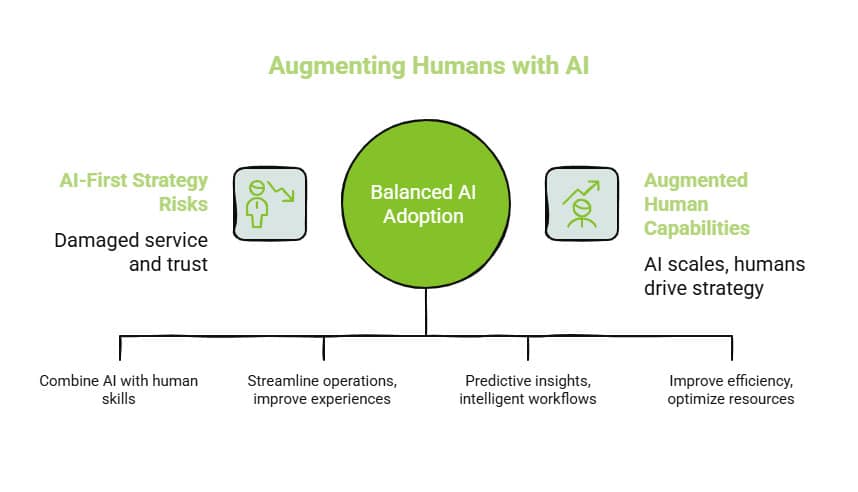
  • What Is an AI-First Approach?
    • How Companies Are Testing AI-First Strategies?
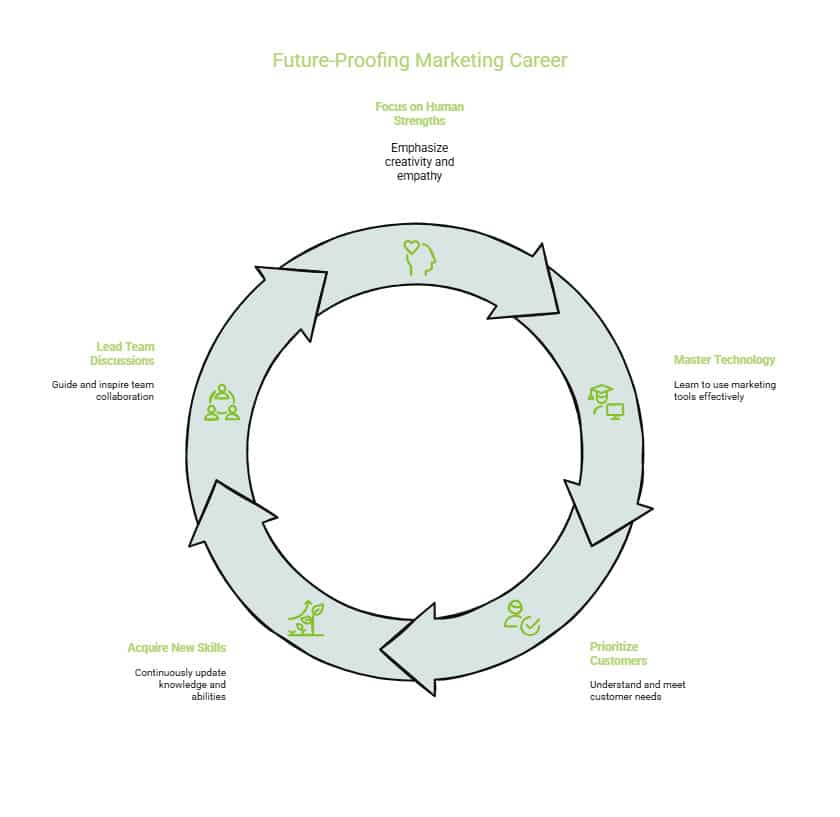
  • 5 Smart Moves to Future-Proof Your Marketing Career
    • 1) Double Down on Human Strengths
    • 2) Learn to Steer the Technology
    • 3) Put Customers at the Centre
    • 4) Keep Building New Skills
    • 5) Lead the Conversation in Your Team
  • Struggling to Balance AI With Human Creativity?
  • Final Words
  • Frequently Asked Questions
    • Has AI already led to job losses in digital marketing?
    • Will AI ever handle creative work as well as humans?
    • Is AI expected to create more jobs or new roles for marketers?
    • What do industry experts like Sam Altman say about AI replacing marketing jobs?
    • How will AI impact social media marketing campaigns?
    • Can AI improve content marketing results?
    • What are the main use cases of AI in marketing?
    • How does AI affect marketing teams today?
    • What is the bottom line for marketers in the age of AI?

Key Highlights

  • AI is reshaping routine marketing tasks but cannot replace creativity, empathy, and strategy.
  • The fear of AI replacing marketing jobs is real, but it is more about role evolution than elimination.
  • Tasks like reporting, keyword research, and first-draft content are best suited for AI.
  • Humans still lead in cultural nuance, brand voice, ethics, and storytelling.
  • Marketers must embrace AI as a team member to free up time and boost efficiency.
  • “Will AI replace digital marketing?” The answer is no, but the discipline itself will evolve.
  • Smart adoption requires human-in-the-loop oversight for accuracy and trust.
  • Wild Creek’s Human + Algorithm approach balances machine speed with human judgment.

You open your laptop, and the panic sets in. Ten unread client emails. Three campaigns are overdue. A report your boss wants “right now.” And just when you think you cannot take on more, someone says, “Why not let AI do it instead?”

That question stings because deep down, you have thought about it too. If AI can write copy, run ads, and crunch numbers in seconds, where does that leave you? Ignoring it could cost you clients, credibility, and maybe even your job.

Here is the truth: AI is not a replacement for you. It is your secret weapon. Used wisely, it takes the grind off your plate so you can do what no tool can: create, connect, and lead. In this blog, you will see why AI will not replace digital marketers, how ignoring it could cost you dearly, and how making it your teammate helps you stay ahead of the curve.

What Is AI In Digital Marketing?

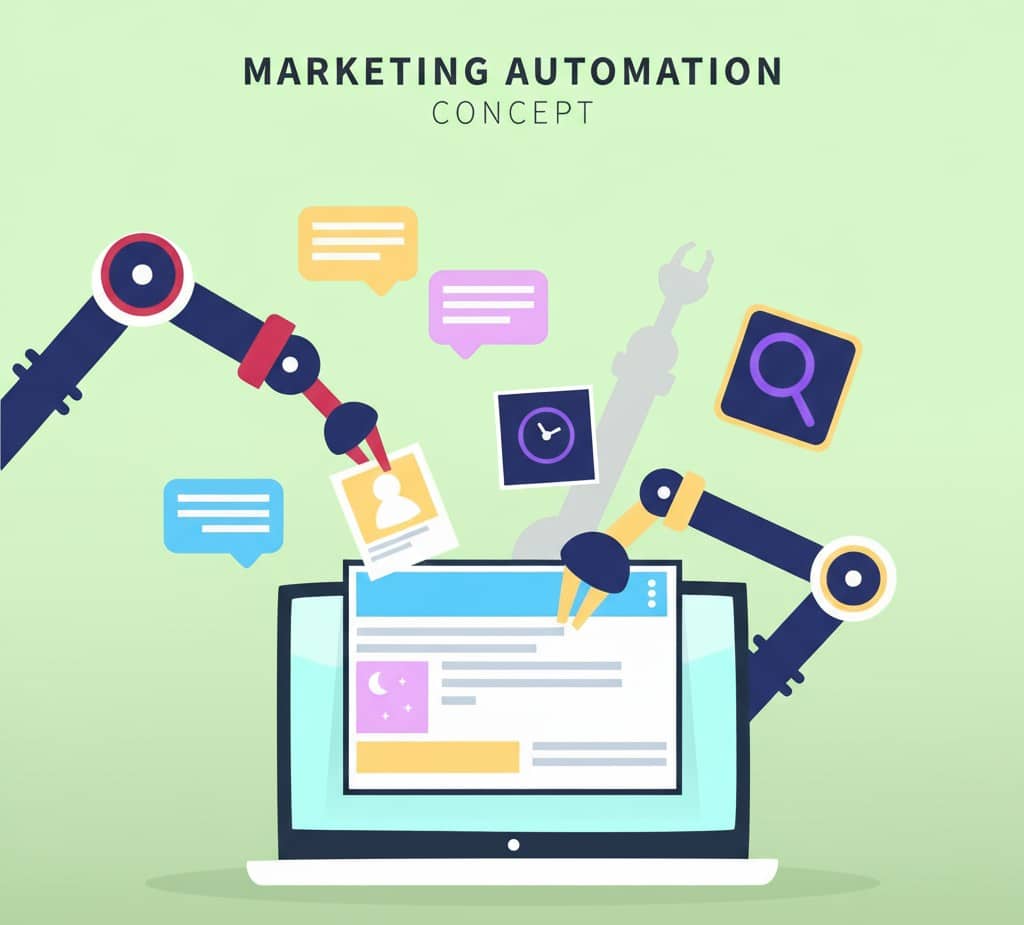
Marketing Automation Concept

Marketing Automation Concept

Think about all the hours wasted on manual reports, endless keyword lists, or testing ad copy variations. These are the kinds of tasks AI can now handle in seconds. Ignore it, and you risk falling behind competitors who are already using it to gain an edge.

AI in digital marketing refers to the use of algorithms and machine learning to automate, optimise, and personalise tasks such as content creation, targeting, reporting, and customer engagement.

As Sundar Pichai said, “The future of AI is not about replacing humans, it is about augmenting human capabilities.” That is exactly what makes it powerful in marketing. It does not think like a human but identifies patterns in data to deliver speed, accuracy, and scale.

Why Are Marketers Worried About AI Taking Over?

Artificial Intelligence in Technology

Artificial Intelligence in Technology

Be honest. How many nights have you stayed up tweaking ad copy, double-checking reports, or manually pulling SEO data? You pour hours into routine tasks, only to hear someone say, “An AI tool can do this in minutes.” That hits hard, doesn’t it?

The fear is not imaginary. If you keep relying only on repetitive tasks, AI will outpace you. The danger is clear: if you don’t adapt, your value risks being measured in tasks machines can do faster and cheaper. And that’s a game no human wins.

When Routine Work Turns Against You

Here’s how the everyday tasks you slog through suddenly look different once AI steps into the picture.

Your Daily Grind How AI Shakes It Up What You Could Lose
Endless reporting AI tools build dashboards instantly Your manual hours feel redundant
Content drafting AI creates blog outlines in seconds Clients may question paying for drafts
Ad testing AI scales hundreds of copy variations Your time is pulled from strategy
Keyword research AI analyses search data at scale Your role risks looking like data entry

Marketers who stick to repetitive work risk being replaced, but those who move up to strategy and creativity will remain indispensable!

The Hidden Cost Of Standing Still

When clients seek to cut costs, they often view AI as the more cost-effective choice. When bosses demand speed, they see AI as the faster choice. If you stick to only manual tasks, your role shrinks. That is why the fear of AI replacing marketing jobs is spreading quickly.

But here is the truth. This is not the end of your career. It is your chance to shift from task-doer to strategist, from executor to value-creator. AI is not the rival; it is the tool that can free you to do work no machine can.

Is AI Taking Over Digital Marketing Jobs?

You may already sense it in your role: fewer junior openings, job descriptions demanding AI skills, and growing pressure to deliver faster with fewer resources. AI is not only reshaping the broader workforce; it is also rewriting the future of digital marketing jobs.

At the same time, the anxiety is real. Influencer Marketing Hub reports that 60% of marketers fear AI could replace parts of their roles, while over 70 per cent believe AI tools can already outperform humans in specific tasks.

It is no surprise that many marketers feel threatened. Yet the picture is not all dark. As Ginni Rometty puts it, “AI will not replace humans, but those who use AI will replace those who don’t.”

For digital marketers, the takeaway is simple. Routine tasks, such as keyword research, content drafting, and reporting, will be automated first. At the same time, new opportunities are opening in AI strategy, prompt design, and data-driven decision-making. The ones who thrive will be those who pair AI’s speed with human creativity and empathy.

Digital marketing jobs are not vanishing; they are evolving. Stick to manual execution, and you risk fading out. Use AI as your teammate, and you not only stay relevant, but you also lead.

How Is AI Changing Marketing Right Now?

The impact of AI is already visible in your daily work. From faster reports to instant ad copy, tools are streamlining repetitive tasks. For marketers, this means less time on the grind and more pressure to show results. However, without adapting, you risk being outpaced by your peers who have already embraced these tools.

Where You See the Change Already

AI is no longer a future trend; it is here now. It is in your inbox, your ad manager, and your SEO dashboard. The tools you use every day are already weaving in automation. You are probably experiencing some of these shifts right now:

Area of Work Immediate AI Impact What It Means for You
Reporting Dashboards and summaries generated instantly You spend less time compiling and more time interpreting
Content Creation Drafts, outlines, and social captions created in seconds First drafts are faster, but editing and brand voice are still on you
Email Marketing Subject line testing and personalisation automated Smarter campaigns, but empathy and persuasion remain human
SEO and Keyword Research AI scans search patterns at scale Quicker suggestions, but strategy requires your judgment
Ad Copy Multiple variations produced instantly Faster testing, but the winning idea still needs human insight

The speed is exciting, but it is also unsettling. Suddenly, tasks that defined your role can be completed in minutes. The fear is that your value will shrink with them. The truth is that marketers who win are those who shift their focus to higher-value skills, such as strategy, creativity, and client trust.

How Are Companies Using AI Effectively?

Automation Strategy Presentation

Automation Strategy Presentation

From Zomato to Airtel, Indian brands are already using AI to personalise experiences and boost efficiency. The promise is real, but for marketers, the pressure is clear: use it wisely or risk being left behind. But here is the catch. While businesses see the promise, the pressure falls directly on you, the marketer. If you cannot show how to use these tools well, you risk being left behind.

At the top, leaders are under just as much strain. CMOs and marketing directors face constant demands to prove efficiency gains and productivity boosts. AI looks like the golden ticket, yet choosing the wrong platform or using it blindly can backfire, damaging brand trust, misusing data, or losing the human voice customers connect with.

This raises urgent questions every marketer should be asking:

  • Which AI tools actually save time without compromising quality?
  • Which functions can be automated safely, and which must stay human?
  • How do you protect your work from AI risks such as bias, inaccuracy, or lack of transparency?

Across India, several brands are experimenting with AI in different ways:

  • Zomato utilises AI-driven chatbots to handle customer queries, while human support addresses more complex complaints.
  • Swiggy leverages AI for predictive order recommendations, but creative teams still craft marketing campaigns.
  • Vedantu applies AI to personalise student learning paths, while educators shape the content and pedagogy.
  • Tata CLiQ and Flipkart apply AI for automated product suggestions and search, but brand storytelling and ad strategy remain human-led.

The smart move is not to resist AI, but to master it. Marketers who treat AI as a teammate, freeing themselves from repetitive tasks to focus on creativity and strategy, will stand out. Those who ignore it will find their roles shrinking fast.

This is the space we thrive in at Wild Creek. We let AI do the heavy lifting, but it’s our human touch that drives campaigns forward. Discover our Human + Algorithm approach.

What Is an AI-First Approach?

More and more companies are racing to call themselves “AI-first.” For leaders, this phrase signals ambition, faster production, lower costs, and a future-ready workforce. But for employees, it sparks uncertainty. The promise of efficiency often comes with the fear of job cuts, loss of creativity, and increased reliance on algorithms over human judgment.

An AI-first approach is not just about adopting technology; it is about rethinking entire business functions, from marketing campaigns and content generation to customer service and product recommendations. The challenge lies in finding the balance where AI drives scale and speed, while people continue to provide strategy, empathy, and the human connection that keeps brands alive.

How Companies Are Testing AI-First Strategies?

Augmenting Humans with AI

Augmenting Humans with AI

Some firms have rushed to prove they are at the cutting edge of innovation. Fintech player Klarna announced an AI-first pivot, freezing hiring and replacing parts of its customer service with AI. But customer frustration rose, and the company quickly rolled back, realising that empathy and nuance still need a human touch.

Others, like Duolingo, heavily rely on automation to reduce their reliance on contractors. The decision backfired with young users, who took to TikTok to protest the shift, proving that brand trust can suffer when AI feels impersonal.

At the same time, several global companies are experimenting with AI-first adoption in different ways:

  • Wild Creek Studio – Championing the Human + Algorithm philosophy to combine AI-driven efficiency with human creativity, empathy, and strategic insight
  • Shopify – Using AI to power customer experiences and streamline internal operations
  • Cisco – Deploying AI for predictive insights and more intelligent workflows
  • UPS – Leveraging AI to improve logistics and delivery efficiency
  • Intuit – Embedding AI in financial planning and tax solutions
  • IKEA, Mastercard, Uber Eats, L’Oréal – Rolling out AI-powered chatbots for customer interactions
  • U.S. Bank – Running campaigns with AI-generated audience models for testing content
  • John Deere  – Using AI-powered “See & Spray” to optimise farming resources

These examples show both the promise and the risk of going AI-first. Move too fast, and you damage service and trust. Strike the right balance, and AI scales the work while humans drive strategy, creativity, and empathy. AI-first is not about replacing people; it is about augmenting them.

5 Smart Moves to Future-Proof Your Marketing Career

Future Proofing Marketing Career Framework

Future Proofing Marketing Career Framework

The fear is real. Every week, a new headline appears about AI replacing marketing jobs or automating entire workflows. However, the truth is clear: AI will not replace marketers who adapt; it will replace those who remain stagnant. Here are five practical ways to ensure your skills remain valuable.

1) Double Down on Human Strengths

AI excels at scale, but struggles with emotion. It cannot handle nuance, empathy, or cultural context. As a marketer, your edge lies in creativity, persuasion, and understanding people, things no machine can replicate.

Example: AI replacing email marketing can optimise subject lines, but it cannot sense the subtle humour or urgency that makes people click.

2) Learn to Steer the Technology

Will AI replace marketers who ignore it? Possibly. That is why you need to master the tools. Experiment with AI for SEO, content, and reporting, but keep your role as the driver. When you steer the machine, you remain in control of the outcome.

Example: An AI tool can suggest keywords, but it is you who decides which ones fit your brand’s voice and strategy.

3) Put Customers at the Centre

AI can crunch demographics and predict behaviour, but it cannot fully grasp human desire. Marketers who prioritise empathy and real-world insights will always stand out.

Example: AI might segment your audience, but you know why a story about aspiration resonates better than one about discounts.

4) Keep Building New Skills

Digital marketing never stands still, and with AI moving faster than ever, learning is your armour. Develop AI-ready skills, including prompt writing, analytics, and creative direction, and continue to experiment. Every new skill widens the gap between you and the marketers who resist change.

Short online programmes, workshops, or even self-led practice sessions can help you stay ahead.

5) Lead the Conversation in Your Team

Every organisation needs someone to demystify AI. Be that person. Share prompts, run small experiments, and demonstrate how tools enhance value without compromising authenticity. Position yourself as the AI guide your team can trust.

Companies that adopt AI more quickly often have an internal champion who bridges the gap between technology and creativity. That champion can be you.

At the end of the day, it is not AI that decides your future, it is how you choose to use it.

Struggling to Balance AI With Human Creativity?

If you are worried about AI replacing marketing jobs or feel overwhelmed by endless tools, you are not alone. Many marketers struggle to keep up with automation while still maintaining brand voice, trust, and empathy. The result? Burnout, inconsistent results, and missed opportunities.

That is where Wild Creek Studio comes in. With its unique Human + Algorithm approach, Wild Creek helps you harness the speed of AI while preserving the creativity and strategy that make your brand stand out.

Here is why businesses trust Wild Creek Studio:

  • Human + Algorithm Philosophy – Blending AI efficiency with human creativity, empathy, and judgment.
  • 18+ Years of Expertise – Proven success across SEO, paid campaigns, and digital growth strategies.
  • Transparent, Tailored Solutions – No cookie-cutter plans, only strategies built for your unique goals.
  • Proven Track Record – 100+ clients served with measurable results and long-term growth.

Ready to think better, not just faster?
👉 Book a consultation with Wild Creek Studio and discover how to future-proof your marketing.

Final Words

AI is transforming digital marketing by automating tasks such as data analysis, content generation, and social media posting. Yet it cannot replace human marketers who add creativity, emotional intelligence, and authentic human connection.

Marketers who pair AI’s efficiency with strategic thinking and empathy will thrive. The future of marketing belongs to those who adapt, using AI as a tool to create more innovative campaigns and stronger relationships.

Frequently Asked Questions

Has AI already led to job losses in digital marketing?

Yes, some entry-level roles tied to basic content creation and administrative tasks have been reduced due to AI adoption. However, many new opportunities are emerging in areas like content optimization, predictive analytics, and AI-driven marketing strategy.

Will AI ever handle creative work as well as humans?

Artificial intelligence can support content generation, blog posts, product descriptions, and even social media posts, but it cannot fully replicate emotional intelligence or human connection. Human marketers remain essential for creativity, storytelling, and building relationships with audiences.

Is AI expected to create more jobs or new roles for marketers?

Yes, the rise of AI is creating demand for new use cases such as content creation tools, data analysis, and natural language processing. Marketing leaders now look for SEO specialists and AI strategists who can generate actionable insights and improve conversion rates.

What do industry experts like Sam Altman say about AI replacing marketing jobs?

Experts such as Sam Altman argue that while AI will automate many business functions, it will not fully replace human marketers. Instead, marketers who learn to know marketing with AI will become better marketers in the future of marketing.

How will AI impact social media marketing campaigns?

AI is already helping manage social media accounts, automate social media posts, and improve ad campaigns with A/B testing. However, human oversight is still needed to interpret customer behavior and ensure brand voice aligns with marketing strategy.

Can AI improve content marketing results?

Yes, AI-driven content creation tools assist with content optimization, content generation, and search engine optimization by analysing vast amounts of data. Yet, human marketers must guide tone, relevance, and storytelling to keep marketing campaigns authentic and effective.

What are the main use cases of AI in marketing?

AI is widely used in market research, predictive analytics, product recommendations, blog posts, email subject lines, and handling customer queries. These use cases free marketers to focus on strategic decisions, customer relationships, and campaign innovation.

How does AI affect marketing teams today?

AI automates repetitive tasks such as basic content creation, reporting, and b tests. This allows marketing teams to focus more on customer behaviour analysis, creative ad campaigns, and building relationships, making them more efficient in the marketing world.

What is the bottom line for marketers in the age of AI?

The bottom line is clear: AI will not replace digital marketing, but marketers who use AI effectively will outperform others. Human oversight, creativity, and emotional intelligence remain vital in turning AI insights into impactful marketing campaigns.

0 comments
Blog banner with title about best AI tools for content writing in 2025

What Are The Best AI Tools For Content Writing In 2025?

In this Article

Toggle
  • TL;DR
  • Which AI Tools Will Take Your Content Writing to the Next Level?
    • 1. Jasper
      • How Jasper Helps You Create Better Content
    • 2. Copy.ai
      • Why Marketers Love Copy.ai?
    • 3. Writesonic
      • What Makes Writesonic Stand Out?
    • 4. Rytr
      • Why Rytr Is A Favourite Among Content Marketers?
    • 5. ZimmWriter
      • Why Content Marketers Choose ZimmWriter?
    • 6. Frase
      • Why Marketers Choose Frase?
    • 7. Grammarly
      • Why Grammarly Is A Must-have Tool?
    • 8. ChatGPT
      • Why ChatGPT Is A Top Choice?
  • Which AI Tools Can Help You Create Stunning Social Media Content?
  • 1. Canva
      • What Sets Canva Apart In The World Of Design?
    • 2. AdCreative AI
      • What Makes AdCreative AI A Must-have Design Tool?
    • 3. Lumen5
      • Why You Should Consider Lumen5?
  • How To Get The Most Out Of AI For Content Writing?
    • 1. Craft a Killer Brief
    • 2. Think Beyond Drafting
    • 3. Use Templates To Your Advantage
    • 4. Always Verify And Personalise
    • 5. Pair With SEO Tools
    • 6. Polish In Passes
    • 7. Measure And Improve
  • How Can Wild Creek Web Studio Take Your AI-Driven Content To The Next Level?
  • Ready To See What AI Can Do for You?
  • Frequently Asked Questions
    • How accurate and original is content generated by AI writing tools?
    • What steps can users take to avoid plagiarism when using AI content writers?
    • Can AI writing tools help streamline content creation for businesses and individual writers in India?
    • What industries benefit most from using AI tools for content writing?
    • AI writing tools: useless for long-form content? Or am I missing something?
    • What is the best AI tool to rewrite content?
    • What is the AI tool to make my writing better?
    • What is the best AI based content writer?
    • Are AI writing tools good?
    • Which AI writing tool is better for content generation?
    • How do AI tools compare to traditional content writing methods?
    • Can AI tools help improve SEO in written content?

TL;DR

  • AI content tools are now essential and used by most of marketers for faster, better content creation
  • Best AI writing tools include Jasper, Copy.ai, Writesonic, Rytr, ZimmWriter, Frase, Grammarly and ChatGPT
  • Top AI design and social tools include Canva, AdCreative AI and Lumen5
  • AI success tips include starting with clear briefs, using AI beyond drafting, leveraging templates, fact-checking, combining with SEO tools, editing in stages and tracking results
  • Wild Creek combines AI capabilities with proven SEO strategy for brand-consistent, high-performing content

It’s 2025 and AI content creation tools aren’t just a fancy extra anymore. They’re part of the everyday toolkit for most creators and marketers.

In fact, 76% of marketers now use AI for basic content creation, whether that’s creating blog drafts, crafting email copy, or brainstorming social media posts.

These best AI content tools have come a long way. They’re quicker, smarter, and way better at capturing your brand’s voice while keeping your audience hooked.

In this post, we’ll check out the AI tools for content writing in 2025 that stand out, what makes them worth your time, and how to find the one that’s the perfect match for your needs.

Which AI Tools Will Take Your Content Writing to the Next Level?

There are so many AI tools for content marketing out there claiming they can transform your writing that it’s easy to feel overwhelmed. That’s why we’ve grouped the best AI content writing tools by use case, so you can quickly find the ones that actually fit your style, goals, and workflow. Let’s have a look at each one of them:

1. Jasper

Jasper Home page

Jasper Home page

Source

If you’re looking for an AI tool for content writing that can deliver high-quality, long-form content while keeping your brand voice intact, Jasper stands out. It blends powerful and advanced features with ease of use so you can go from idea to polished content quickly.

50+ Templates – From blog intros and product descriptions to full-length articles, Jasper offers a template for nearly every content need. Some are also well-suited for authors or book writers, such as long-form story outlines and manuscript drafts. This makes Jasper a helpful AI content writing tool for those working on books or longer narrative projects

How Jasper Helps You Create Better Content

  • Brainstorming – Generates fresh content ideas and topic suggestions to keep your pipeline full.
  • Detailed Outlines – Builds structured outlines so your content has a clear flow.
  • Draft Creation – Writes complete drafts tailored to your brand voice and audience.
  • Smart Editing – Suggests improvements for clarity, engagement, and SEO performance.

By combining creative assistance with SEO optimisation, Jasper saves you hours of post-editing work and ensures your content is ready to publish the moment it’s written, making it one of the best ai tools for writing blog posts.

Pricing: Pro plan at ₹ 5164.98 (billed monthly).

2. Copy.ai

Copy ai home page

Copy ai home page

Source

If you need to whip up engaging marketing copy in minutes, Copy.ai is a strong contender. Designed for speed and creativity, it helps you turn minimal input into polished outlines, blog articles, ad copy, and social posts. Perfect for those last minute deadlines, and with support for 25+ languages, it’s ready to power global campaigns without missing a beat.

Why Marketers Love Copy.ai?

  • Lightning-Fast Workflows – Go from idea to publish-ready copy in a fraction of the time.
  • Repeatable Automation – Create templates and processes you can use again and again.
  • Content Repurposing – Transform a single blog post into a week’s worth of social content.
  • Plagiarism Checking – Keep your copy clean and original.
  • Collaboration-Friendly – Great for solo content creators and marketing teams alike.

If you’re wondering Which AI tool is best for content and email writing? Copy.ai can be a strong pick

Pricing: Paid plans start at approximately ₹4,289.56 per month, with a free version available for basic use.

So, if you’re asking questions like What are some free AI tools for content writing? you can definitely give Copy.ai a try.

3. Writesonic

Writesonic homepage

Writesonic homepage

Source

If your goal is to create SEO-focused content that ranks well on Google, Writesonic is built with that in mind. It comes loaded with templates for long-form articles, landing pages, and social media captions, helping you crush writer’s block and deliver keyword-rich, high-quality content consistently.

What Makes Writesonic Stand Out?

  • SEO-Optimised Writing – Templates designed to help your content perform better in search results.
  • Credit-Based System – Lets you control quality and word count for every piece you create.
  • Integrated SEO Checker – Suggests primary and secondary keywords to improve ranking potential.
  • Landing Page & Product Copy Tools – Quickly generate marketing copy that drives clicks and conversions.
  • Direct Publishing – Push content straight to WordPress with built-in optimisation.

When paired with tools like Ahrefs or Semrush, Writesonic becomes a true SEO companion, making it easier to climb search rankings.

Pricing: Paid plans start at ₹4289.56 per month, with a free trial.

4. Rytr

Rytr home page

Rytr home page

Source

Rytr is a GPT-3-powered AI writing tool designed to help content writers, SEO professionals, and copywriters create high quality content faster. With over 40 use-case templates, it makes producing everything from Facebook ads to blog posts a breeze.

Why Rytr Is A Favourite Among Content Marketers?

  • 40+ Use-Case Templates – From Facebook ads and social media posts to service pages, web content, and blogs.
  • Research-Based Writing – Trained on historical data to produce fact-backed, high-quality copy.
  • Multi-Tone & Multi-Language Support – Create content in different styles across 30+ languages.
  • In-Built Quality Tools – Includes tone checker, plagiarism checker, and grammar checker for polished results.
  • Idea Library – Over 2,000 prompts for quick inspiration when you’re stuck.
  • Content Personalisation – Form Generator feature tailors copy to your specific needs.
  • Project Management – Save and organise content projects for easy access later.

Pricing: Free plan available. Paid plans include Saver at ₹787.88/month and Unlimited at ₹2,538.72/month, making it a cost-effective option for those exploring free AI content curation tools.

5. ZimmWriter

ZimmWriter Home page

ZimmWriter Home page

Source

Launched in early 2023, ZimmWriter has quickly become a favourite in the digital marketing community for producing search-engine-optimised content that ranks well on Google. Powered by OpenAI’s GPT-4 model, it delivers high-quality, plagiarism-free text that passes AI detection tools and reads like it was written by a human.

Unlike most browser-based AI tools, ZimmWriter is an AI writing software you install directly on your PC, making it one of the unique content curation AI tools. Whether you’re battling writer’s block or need to produce well-optimised blog posts and SEO copy fast, ZimmWriter offers a feature-rich toolkit for content marketers.

Why Content Marketers Choose ZimmWriter?

  • PC-Based Tool – Runs directly on your computer for speed and reliability.
  • Internet Access – Pulls live data for more accurate, up-to-date content.
  • 1-Click Blog Writer – Enter keywords and instantly get ready-to-publish articles.
  • Dedicated SEO Blog Writer – Combines AI input with internet scraping for tailored SEO content.
  • Local SEO Buffet – Creates location-specific service pages for better local rankings.
  • Bulk Blog Writer – Generates multiple pieces of content in one go.
  • Integrated Page Optimisation Prop Tool – Ensures every piece is search-ready.
  • Rewrite & Paraphrase Capabilities – Refresh existing content with ease.
  • Continue Writing – Extend long-form content without breaking flow.
  • Magic Commands – Speed up tasks with simple, efficient prompts.

Pricing: For Windows, plans start at approximately ₹2,081.03 per month.

6. Frase

Frase home page

Frase home page

Source

Frase stands out in the digital marketing space by combining SEO research capabilities with AI-powered writing. This makes it an all-in-one ai tools for digital marketing and ai tools for content marketing solution for creating search engine–optimised content quickly and effectively.

For content marketers, Frase is a complete solution, from researching topics and analysing SERPs to creating outlines, writing AI-assisted drafts, and optimising for search performance. Whether you need website copy, blog posts, or marketing materials, Frase streamlines the entire process.

Why Marketers Choose Frase?

  • SERP Analysis – Understand what’s ranking and why.
  • Competitor Evaluation – Compare your content against top-performing pages.
  • Content Outlining – Create structured outlines for blogs and marketing copy.
  • AI Copywriter – Generate copy for sections like FAQs, conclusions, intros, proposals, and H2s.
  • High-Quality Output – Produce polished, SEO-friendly content with minimal edits.
  • Multi-Language Support – Works in 25 languages for global campaigns.

Pricing: Plan starts at ₹3,936.84/month, with custom pricing for larger teams. Ideal for those asking What is the best AI writing tool for content teams?

7. Grammarly

Grammarly home page

Grammarly home page

Source

Grammarly is one of the most popular AI-powered writing assistants, trusted by millions of writers, marketers, and professionals to produce clear, mistake-free, and impactful content.

It goes beyond basic spell check, offering real-time grammar, spelling, punctuation, and style suggestions, making it equally useful for casual emails, marketing copy, and professional documents.

Why Grammarly Is A Must-have Tool?

  • Advanced Grammar & Spelling Checks – Real-time corrections for grammatical errors, typos, and punctuation mistakes
  • Tone & Clarity Suggestions – Adjusts tone for professionalism, friendliness, confidence, or formality
  • Style & Readability Improvements – Suggestions to make content more concise and engaging
  • Plagiarism Checker – Ensures content is original and free from unintentional copying
  • Multi-Platform Support – Works as a browser extension, desktop app, mobile keyboard, and Microsoft Office add-in
  • Custom Style Guides – Keep brand language consistent across teams

Pricing: Free plan available. Paid plans start at approximately ₹983.25/month.

8. ChatGPT

ChatGPT

ChatGPT

ChatGPT, developed by OpenAI, is one of the most widely used AI tools for generating text, answering questions, brainstorming ideas, and assisting with a variety of tasks. Built on large language models, it can help with everything from writing blog posts and ad copy to creating outlines, summarising research, and even coding.

It’s not just a writing tool, it’s a conversation partner that can adapt to your tone, style, and objectives. Marketers, writers, and businesses use ChatGPT for ai tools for longer content writing, SEO research, customer support, and creative ideation.

This makes it one of the best ai tools for writing blog posts and a solid pick if you’re asking Which AI writing tool is better for content generation

Why ChatGPT Is A Top Choice?

  • Multi-Purpose AI – Handles writing, keyword research, idea generation, coding help, and more
  • Customisable Tone & Style – Adapts to your brand voice or personal writing style
  • SEO-Friendly Writing – Can generate keyword-rich, optimised content for blogs, landing pages, and ads
  • Contextual Understanding – Produces coherent, relevant responses based on your prompts
  • Multi-Language Support – Communicates in dozens of languages for global use
  • Integration Options – Available via web, mobile apps, and API for embedding into workflows

Pricing: Free plan available with paid plan starting at approximately ₹1,749.21/month.

Which AI Tools Can Help You Create Stunning Social Media Content?

Apart from content writing AI tools, there’s a whole world of AI design and creative platforms that can help you level up your social media game. Think stunning visuals, scroll-stopping ads, and engaging videos, all created in minutes, no fancy design skills needed. Here are some great tools worth checking out.

1. Canva

Canva

Canva

Source

Canva is arguably one of the best ai content tools for design, used by over 125 million people globally. It now also offers ai content mapping tool features like Magic Write, making it both a design platform and an ai content creation tool.

Whether you’re looking for an invitation card, business card, resume, social media post, Facebook cover, Twitter banner, Instagram post, or anything else, Canva helps you custom design whatever you want , and works well if you’re wondering How to create a content marketing strategy using AI tools.

What Sets Canva Apart In The World Of Design?

  • Magic Resizing
  • Image generation
  • Magic Write tool – Online AI text generator that you can use to create compelling and engaging copy.
  • Changing Whole Color Pallet
  • Logo Designing
  • Canva Brand Kits
  • Free Templates for Social Media Posts Designing
  • Background Remover
  • Social Media Video Creation & Editing
  • Thousands of Customizable Templates
  • Create Custom Animation & GIFs
  • Canva Social Scheduler
  • And more!

Pricing: Canva is available in free and paid versions, with the paid version being ₹500 monthly or ₹4000 annually.

2. AdCreative AI

Ad Creative AI home page

Ad Creative AI home page

Source

AdCreative AI helps you create social media and advertisement creatives with just a click of a button. You can even share the creative posts directly to your social media accounts. AdCreative AI can create social media posts and headlines for all the major social media networks.

One of the major reasons why AdCreative AI is popular among social media marketers is it provides key insights into social media posts created using it.

With its data-driven approach, AdCreative AI claims to offer results that are 14x better than creatives that aren’t based on real-time data.

What Makes AdCreative AI A Must-have Design Tool?

  • Access to stock images.
  • Data analysis
  • Performance analysis
  • Snoring feature to identify best-performing creatives.
  • Generate multiple ad templates customised to align with your brand image and colors.
  • Quickly create high-quality social media posts and ad creatives with text-based inputs.

Pricing: Plan starts at ₹1,749.21 per month

3. Lumen5

Lumen5 home page

Lumen5 home page

Source

If you want to create customised videos quickly and efficiently without spending long hours or huge budgets, Lumen5 is a strong ai tools for digital marketing choice. It turns blog posts into videos and offers an extensive library of images, clips, and audio.

If you’re exploring How can AI tools enhance the content writing process? Well, with Lumen5 you can repurpose AI-written content into video scripts for greater reach.

Whether you want to create videos for brand awareness, social media platforms, thought leadership, or other content marketing needs, rest assured that Lumen5 will meet and exceed your expectations.

Why You Should Consider Lumen5?

  • Ability to transform blog posts into videos.
  • Exhaustive content library with millions of images, video clips, audio files, and other design elements.
  • Customise videos you create on AI-powered Lumen5’s platform itself.
  • Professional-looking videos to supercharge your social media content strategy.

Pricing: Plan starts at ₹2623.82 per month.

How To Get The Most Out Of AI For Content Writing?

Infographic of how to get most of AI for content writing

Infographic of how to get most of AI for content writing

Why you should use AI tools for content creation?  Well, AI can be a huge time-saver and creativity booster, but getting the best results means going beyond just typing a prompt and hitting “generate.” When you treat it like a creative partner instead of a magic button, the quality of your work improves dramatically. Here’s how to make AI truly work for you:

1. Craft a Killer Brief

Be specific about what you want. Include the topic, target audience, preferred tone, word count, structure, and any must-have keywords or points.

A vague prompt like “Write a blog on email marketing” might get you generic content, but a detailed one like “Write a 1,200-word blog on email marketing strategies for small businesses, in a friendly but professional tone, with 5 actionable tips” gives AI the direction it needs to nail your requirements.

2. Think Beyond Drafting

Don’t limit AI to writing full articles. Use it to brainstorm catchy titles, outline blog structures, come up with social media captions, draft ad copy variations, or even suggest content upgrades like infographics or FAQs. This way, AI becomes part of the entire creative process, not just the final step.

3. Use Templates To Your Advantage

Most AI tools come with built-in templates for blogs, ads, emails, product descriptions, and social media posts. These templates help maintain structure, tone, and formatting while cutting down on thinking time, perfect for keeping your brand voice consistent.

4. Always Verify And Personalise

AI is powerful but not infallible. It may produce outdated facts, misquote stats, or generalise complex topics. Always verify data, replace generic examples with brand-specific ones, and tweak the tone to sound authentically “you.” This is especially important if your audience expects expertise and credibility.

5. Pair With SEO Tools

AI can create keyword-rich content, but combining it with SEO tools like Ahrefs, Semrush, or SurferSEO ensures your writing targets the right search intent. You can feed AI your primary and secondary keywords so it weaves them in naturally without keyword stuffing.

6. Polish In Passes

Don’t expect your first draft to be perfect. Use the first pass to get the general structure and ideas, the second to refine tone and detail, and the third to polish flow and grammar. This layered approach produces more cohesive, engaging content.

7. Measure And Improve

After publishing, keep an eye on how your AI-assisted content performs. Look at engagement, ranking, and conversions. Note which prompts or approaches deliver the best results, and adjust your process accordingly for future content.

When you combine AI’s speed and scalability with your human creativity, critical thinking, and brand expertise, you get a winning formula for content that is produced faster, reads better, and works harder for your goals.

How Can Wild Creek Web Studio Take Your AI-Driven Content To The Next Level?

Using AI tools is only half the battle. Knowing how to combine them with a solid content and SEO strategy is what gets real results. That’s where Wild Creek Web Studio comes in.

At Wild Creek, we help brands and businesses go beyond simply generating content. Our team blends cutting-edge AI technology with proven SEO and digital marketing expertise to ensure every blog, landing page, and social media post is optimised for both search engines and human readers.

Why partner with Wild Creek Web Studio?

  • Strategic AI Integration: We choose and customise the right AI tools for your goals.
  • SEO-First Approach: Every piece is crafted to rank well and drive organic traffic.
  • Brand Voice Consistency: Your AI-assisted content will still sound authentically yours.
  • Full-Funnel Content Solutions: From ideation to optimisation, we handle it all.
  • Performance Tracking: Data-backed insights to improve future marketing campaigns.

Whether you are a startup looking to scale content fast, an established brand aiming to improve rankings, or an agency seeking expert support, Wild Creek Web Studio ensures your AI-generated content works smarter, not just faster.

Ready to make AI work harder for your brand? Contact Us to get started.

Ready To See What AI Can Do for You?

AI content writing tools in 2025 make creating high-quality, engaging content faster and easier than ever. The trick is to pair the right tools with a smart strategy and a bit of creativity so your content not only ranks but really connects with your audience.

Mix AI’s speed with your own insight, and you’ve got a winning formula for taking your brand to new heights.

Frequently Asked Questions

How accurate and original is content generated by AI writing tools?

AI writing tools can produce content that is both accurate and original, depending on their algorithms and data sources. While many tools strive for human-like quality, reviewing and editing by a skilled writer is often necessary to ensure clarity and uniqueness.

What steps can users take to avoid plagiarism when using AI content writers?

To avoid plagiarism when using AI content writers, users should always run their work through plagiarism detection tools, edit the generated content significantly, and ensure proper citation of sources. Additionally, incorporating personal insights enhances originality while maintaining compliance with copyright laws.

Can AI writing tools help streamline content creation for businesses and individual writers in India?

AI writing tools significantly enhance content creation efficiency for businesses and individual writers in India. By automating tasks such as drafting, editing, and optimizing, these tools allow users to focus on strategy and creativity, ultimately improving productivity and quality of written content.

What industries benefit most from using AI tools for content writing?

Marketing, e-commerce, publishing, real estate, education, and SaaS see the most gains due to their high demand for fresh, optimised content.

AI writing tools: useless for long-form content? Or am I missing something?

They’re not useless. They work well for long-form drafts if you use detailed prompts and edit for tone, accuracy, and flow. Without refinement, results can feel generic.

What is the best AI tool to rewrite content?

Jasper, ZimmWriter, and QuillBot are top options for rewriting while keeping meaning intact and improving clarity, SEO, and originality.

What is the AI tool to make my writing better?

Grammarly, the perfect AI writing assistant offers real-time grammar, tone, and clarity suggestions, making it a go-to for improving readability and professionalism.

What is the best AI based content writer?

It depends on your needs, but Jasper, Copy.ai, and Writesonic are leading choices, each excelling in different areas like long-form writing, marketing copy, and SEO.

Are AI writing tools good?

Yes, artificial intelligence when paired with human editing for accuracy, originality, and brand voice. They save time and boost productivity.

Which AI writing tool is better for content generation?

Jasper is often preferred for high-quality, brand-consistent content, while Writesonic and Copy.ai are strong for speed and SEO.

How do AI tools compare to traditional content writing methods?

AI is faster and scalable, while traditional methods excel in creativity and nuance. A mix of both delivers the best results.

Can AI tools help improve SEO in written content?

Yes. Many of the AI best tools offer keyword suggestions, content scoring, and optimisation tips to help content rank higher in search results.

1 comment
GEO SEO blog banner with map laptop and chart

How Can You Master GEO SEO and Rank Locally?

In this Article

Toggle
  • TL;DR
  • What Is Generative Engine Optimization (GEO)?
  • How GEO Works?
    • 1. Crack The Code On What Your Audience Wants Most
    • 2. Hook AI With Complete, Rich Answers
    • 3. Feed AI Exactly What It Loves
    • 4. Evolve Faster Than AI Changes
  • How GEO differs from SEO?
  • How Can GEO Boost Your Brand’s Visibility?
    • How Generative AI And Answer Engines Work?
  • How Do You Build a Winning Geo-Targeted SEO Plan?
    • 1. Pinpoint Your Audience With Smart Geo-Keyword Research
    • 2.  Leverage Local Directories and Social Proof
    • 3. Shine In Local Search With A Fully Optimised Google Business Profile
    • 4.  Make Your Website Mobile-Ready And Easy To Navigate
    • 5. Create Local Content That Connects
    • 6. Build Local Authority With Partnerships and Backlinks
    • 7. Boost Visibility With Local Schema Markup
  • Is Wild Creek The Partner Your Business Needs To Stand Out?
  • Final Thoughts
  • Frequently Asked Questions
    • What is the GEO full form in SEO?
    • Is generative engine optimization (GEO) or AI search optimization really a thing?
    • What is the difference between geo-targeted keywords and traditional SEO keywords?
    • Will GEO displace SEO as the biggest source of traffic?
    • What are some examples of successful GEO SEO strategies in India?
    • What trends should marketers watch for in GEO SEO in 2025 and beyond?
    • What is geo-generative SEO, and how is it transforming local search?
    • Is GEO more effective than SEO?
    • Does the geo sitemap help in local SEO?
    • How to target SEO for more than one geographical market?
    • What tools are available to optimize your website for GEO SEO?
    • Does AI Schema make any difference for GEO/ AI SEO?
    • How will GEO redirection affect SEO?
    • Is GEO the Future of Content Marketing?

TL;DR

  • Geo SEO ensures your business shows up when local customers search, while GEO (Generative Engine Optimization) makes your content AI-friendly and trustworthy.
  • Focus on intent-driven content, complete answers, structured data, and multi-format content (images, videos, FAQs) to boost AI citations.
  • GEO complements, not replaces, traditional SEO, use geo-targeted keywords, Google Business Profiles, local directories, and schema markup for maximum reach.
  • Create location-specific content, mobile-friendly sites, and local backlinks to increase authority and conversions.
  • Partner with Wild Creek Web Studio to implement these strategies and ensure your brand dominates both local search and AI-powered results.

The way people search is changing. Many still turn to Google for local recommendations, but 71.5% of users now report using AI tools for search, and 14% use them daily. If your business isn’t showing up in both, you’re missing opportunities.

That’s where Geo SEO and Generative Engine Optimisation (GEO) come in. Geo SEO helps local customers find you when they’re ready to act, while GEO makes sure AI( Artificial Intelligence) platforms choose your content as a trusted answer.

In this blog, we’ll cover what is GEO and how does it work? Not just that, we’ll also see how it differs from traditional SEO, how GEO works, and how to create AI-friendly local content that keeps your brand visible everywhere people search.

What Is Generative Engine Optimization (GEO)?

So, what is geo SEO and how does it work? Geo SEO is about making sure your business appears exactly when local customers are looking for you. Instead of chasing broad, generic keyword rankings, it focuses on connecting with people in specific locations, the ones most likely to convert.

Generative Engine Optimisation (GEO) is changing SEO by using Generative AI models to improve how content is seen. It is a new idea that uses AI engines, like Generative AI and Large Language Models, to create detailed answers GEO focuses on making unique words and providing relevant information to get greater visibility in search results

This is often done with SEO geo targeting strategies like geo tag integration SEO, geo meta tags SEO, and geo sitemap in SEO to help search engines understand your location relevance.

There is also a benefit of using geo tag in image as a SEO for local image discovery, as it helps search engines link your visuals to a specific location, boosting local and AI-powered search visibility.

How GEO Works?

Infographic of how GEO works

Infographic of how GEO works

If you want AI-powered search to feature your business, you need to understand how generative engines process, select, and present information. GEO (Generative Engine Optimization) is not just SEO with a twist. It is a shift in focus from chasing keywords to delivering value that AI can clearly interpret and trust.

Example: If you’re doing SEO for more than one geographical market, you’d structure location-based landing pages with geo-targeted keywords and structured data for each location.

Here’s what actually drives it:

1. Crack The Code On What Your Audience Wants Most

In GEO, the starting point is not “Which keyword do I want to rank for?” but “What problem is my audience trying to solve right now?” Generative engines like ChatGPT and Gemini are built to interpret search intent. If someone searches “best same-day flower delivery in Boston,” the AI aims to match them with a trustworthy answer that is specific, local, and helpful.
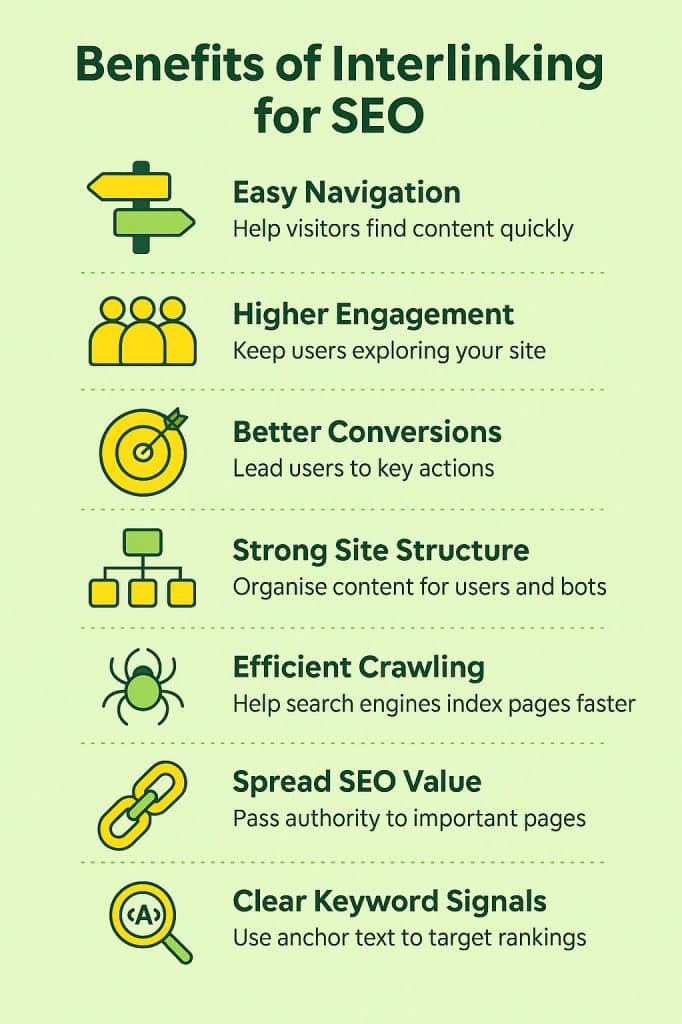
  • For businesses, this means researching the real questions your audience asks, mapping them to different stages of the buying journey, and creating direct, no-fluff answers.
  • The more precisely your content aligns with their intent, the higher your chances of being featured.

2. Hook AI With Complete, Rich Answers

Traditional SEO could sometimes get away with keyword repetition, but generative engines look for completeness. They scan for well-structured, well-rounded explanations that answer not only the main question but also related follow-ups.

  • If you run a dental clinic and write about “teeth whitening in Delhi,” you should not stop at procedure details. You would also want to cover cost, expected results, aftercare tips, and patient testimonials.
  • The deeper and more holistic your coverage, the more valuable it becomes for AI, which wants to give users everything they need in one go.

3. Feed AI Exactly What It Loves

AI systems do not just process text. They draw from structured data, visuals, videos, and publicly available datasets. The more formats you use, the easier it is for AI to find and validate your information.

  • Adding schema markup helps AI instantly understand your business hours, location, and services.
  • Photos, infographics, and how-to videos give extra context.
  • Embedding FAQs directly into your page structure makes it simple for AI to lift answers word-for-word.

4. Evolve Faster Than AI Changes

Generative engines are continuously retraining on new data, which means the ranking factors and preferred content formats can shift quickly. A GEO strategy is not something you “set and forget.” It is something you refine regularly.

  • Monitor how your content performs in AI platforms every month.
  • Update older pages to include new customer questions or industry trends.
  • Test different answer formats such as short direct summaries and detailed explanations to see what gets picked up.

Bottom line: GEO works by making your content the most relevant, reliable, and easy-to-use resource for both AI and humans. If you consistently deliver on intent, depth, variety, and adaptability, you give AI every reason to feature your business.

Ready to get found by more local customers? Boost your visibility with our SEO services

How GEO differs from SEO?

Aspect Search Engine Optimisation GEO (Generative Engine Optimisation)
Primary Focus Ranking high in Google search engine results Being cited in AI-generated answers
How It Works Uses keyword optimisation, backlinks, and site structure to climb search rankings Structures content for conversational queries, uses AI schema for GEO SEO, and ensures clarity for AI platforms
Key Outcome Increased visibility in traditional search results Increased authority and exposure through AI citations

Now the most asked question is GEO replacing SEO? The table makes the differences clear, but SEO and GEO are not in competition. Both rely on strong keyword research, high-quality content, and a technically sound website.

The key change with GEO is in delivery. Instead of only aiming to satisfy search engines, you are making your content easy for AI to understand, trust, and present in its answers.

By combining traditional SEO best practices with GEO-specific strategies such as structured data and conversational content, you can secure visibility in both search results and AI-generated responses, reaching your audience in more places than ever.

How Can GEO Boost Your Brand’s Visibility?

GEO is becoming a must-have if you want your brand to show up where people are actually looking. This applies to both geo SEO and generative engine optimisation for AI-powered search.

AI-driven search results are now a major part of the customer journey. Showing up in those generative answers means you can reach your audience even if they never click on a traditional Google listing. When your content is recognised and cited by AI, it builds authority, boosts local SEO, and keeps your brand in the conversation.

Top brands are already doing this by:

  • Optimising FAQs so AI can pull clear, ready-to-use answers
  • Using geo sitemap and geo meta tags to improve location signals
  • Adding geo tags in images for SEO to reinforce location-based relevance
  • Keeping local profiles active to stand out in location-based searches

When GEO works, here’s what you gain:

  • Engage more users with location-specific content that feels relevant
  • Climb higher in both traditional search engines and AI-powered search results
  • Add depth with structured answers that build authority
  • Boost visibility as AI platforms showcase your brand
  • Increase conversions by meeting specific local needs

How Generative AI And Answer Engines Work?

Generative AI engines, like ChatGPT or Gemini, run on advanced language models trained on huge amounts of data. These models learn patterns, context, and meaning from the information they process.

When someone asks a question, the AI does not just pull one source, it blends all the detailed information from many places to create a clear, detailed answer. For geo-generative SEO, you must also optimise local data, visuals, and structured content to be AI-readable.

Now, for marketers, this changes the game. If you want your website content to be part of those AI-generated answers, you need to think beyond traditional keywords. Focus on:

  • Using natural, conversational language that matches how people actually ask questions
  • Providing structured data such as schema markup so AI can easily interpret your content
  • Delivering factual, well-cited answers that position you as a trustworthy source

The clearer and more user-focused your content, the more likely AI is to pick it up, which means more brand engagement, brand visibility, more authority, and more opportunities to connect with your audience.

How Do You Build a Winning Geo-Targeted SEO Plan?

Infographic showing how to Build a Winning Geo Targeted SEO Plan

Infographic showing how to Build a Winning Geo Targeted SEO Plan

Some experts ask Is SGE & GEO the Future of SEO? with both working together to reshape visibility. By 2026, traditional search engine volume will drop by 25%, with search marketing losing market share to AI chatbots and other virtual agents. That makes mastering geo-targeting SEO now more critical than ever.

So, how can businesses benefit from implementing geo SEO strategies? Here’s what your geo-targeted SEO strategy needs to truly capture local search visibility:

1. Pinpoint Your Audience With Smart Geo-Keyword Research

Your keywords aren’t just words, they’re directions for search engines and signals to potential customers.

  • Think beyond generic product names. If you run a Mumbai bakery, keywords like “wedding cakes” aren’t enough. Focus on local intent: “bakery in Mumbai” or “Mumbai wedding cakes.”
  • Don’t forget voice search. People might say, “Hey Google, find a bakery Near me.” Long-tail phrases like this can make a huge difference and it also works best as a local SEO strategy.
  • Use your keywords strategically in headings, website copy, meta tags, alt text, and URLs.

Pro Tip: Build a geo-keyword list for each neighborhood or district you serve. Micro-targeting boosts local relevance.

2.  Leverage Local Directories and Social Proof

reviews

reviews

Source

Directories like Yelp, TripAdvisor, and Google Business Profile do more than list your business, they amplify visibility.

  • Ensure your NAP (Name, Address, Phone) is consistent everywhere.
  • Encourage customer reviews: they influence rankings and conversions.
  • Highlight collaborations with local events or causes. It reinforces your local presence and strengthens your community ties.

Pro Tip: Set up alerts to respond to every review within 24 hours. Quick responses signal professionalism to both users and search engines.

3. Shine In Local Search With A Fully Optimised Google Business Profile

Google Business Profile

Google Business Profile

Source

Your Google Business Profile (GBP) is your digital storefront. Many people see it before they visit your website.

  • Include accurate business details, hours, services, and photos.
  • Use AI tools like to craft a geo-focused, engaging profile.
  • Collect and manage reviews. Positive customer reviews build trust, while thoughtful responses to negative reviews demonstrate credibility.
  • Post local updates on your GBP, like promotions, events, or seasonal offerings.

Pro Insight: GBP posts show up in search results. Regular updates increase clicks and conversions.

4.  Make Your Website Mobile-Ready And Easy To Navigate

Most local searches happen on mobile, often on the go. If your site is hard to use, you lose customers fast.

  • Use fast-loading pages. A few seconds of delay can make visitors bounce.
  • Make your website responsive so it looks perfect on any screen.
  • Ensure directions, click-to-call buttons, and contact forms are easy to find.

Pro Insight: Google favours mobile-friendly sites in local rankings, so this isn’t optional, it’s essential.

5. Create Local Content That Connects

Content is how your business talks to the community. To stand out:

  • Write blogs about local events, news, or trends that relate to your business.
  • If you have multiple locations, create location-specific landing pages so visitors feel they’re in the right place.
  • Use geo-relevant visuals: local landmarks, staff in the community, or photos of your store.

Pro Insight: Local content doesn’t just help SEO. It builds trust, authority, and a sense of community.

6. Build Local Authority With Partnerships and Backlinks

Search engines love sites that are trusted by the local community:

  • Partner with local businesses, blogs, and organizations for backlinks.
  • Sponsor community events to gain mentions and links.
  • Engage in local forums or social media groups to increase visibility and engagement.

Pro Tip: Even a small backlink from a respected local source can boost your authority and rankings significantly.

7. Boost Visibility With Local Schema Markup

Local schema markup

Local schema markup

Schema markup is structured data that helps search engines understand your business better.

  • Include name, address, phone, business type, and reviews.
  • Schema can increase your chances of rich snippets, like maps, stars, and events, in search results.
  • Implementation can be done by a developer or using tools if you’re comfortable with code.

Pro Insight: Even simple schema, like adding your location and contact info, can give you a competitive edge in local SEO.

Remember, for small businesses, it’s not only about ranking better, it is about being the obvious choice when someone nearby is ready to buy. And, GEO targeting SEO and GEO specific SEO strategies ensure your business appears in local search packs, Google Business Profile, and generative AI recommendations.

Note: Be mindful of GEO blocking and Google seo, since access limits can affect how pages are crawled, indexed, and shown across regions.

Is Wild Creek The Partner Your Business Needs To Stand Out?

If you want more people to find you, whether they are right around the corner or halfway across the globe, Wild Creek Web Studio can help you get there.

They combine proven strategies to strengthen your digital presence, including:

  • Content optimisation that makes your website more engaging and relevant
  • Quality link building to boost authority and trust with search engines
  • Technical SEO fixes that ensure smooth crawling, indexing, and performance

The result?
A stronger overall online presence that:

  • Lifts your rankings in traditional search results
  • Naturally improves geo-targeting SEO and geo local SEO performance
  • Increases your chances of appearing in AI-powered search results

With Wild Creek in your corner, you are not just competing, you are leading the way in connecting with the right audience, wherever they are.

So, let’s put your business on the map. Reach out to us Today!

Final Thoughts

GEO SEO and its related strategies like GEO search SEO and GEO local SEO is changing the way brands get found. It is no longer just about ranking on page one. It is about appearing in the AI-generated answers, map packs, and local results where decisions are made in seconds.

By creating content that is easy for both humans and AI to understand, you can secure trust, boost visibility, and connect with potential customers at the exact moment they are ready to act. The brands that embrace this shift now will be the ones leading the conversation tomorrow.

Frequently Asked Questions

What is the GEO full form in SEO?

In SEO, GEO stands for Generative Engine Optimisation. It is a modern search strategy that optimises your content for AI-driven search engines, answer engines, and tools like ChatGPT, Perplexity, and SGE, ensuring your site is easily interpreted, cited, and trusted.

Is generative engine optimization (GEO) or AI search optimization really a thing?

Yes. Generative Engine Optimization (GEO) is an emerging practice focused on optimizing content specifically for AI-powered search engines and virtual assistants. It goes beyond traditional SEO by targeting user intent, structured data, and formats that AI can easily interpret and feature.

What is the difference between geo-targeted keywords and traditional SEO keywords?

Geo-targeted keywords are phrases linked to specific locations, such as “best pizza in Delhi,” while traditional SEO keywords are broader. GEO SEO focuses on local search results, using location-specific terms to improve search rankings and reach audiences looking for nearby services or products.

Will GEO displace SEO as the biggest source of traffic?

GEO will not replace traditional SEO, but rather integrate with it as search behaviour evolves. Generative AI and new paradigms in content creation mean that both methods will work together, ensuring brands remain visible in both classic and AI-driven search environments.

What are some examples of successful GEO SEO strategies in India?

Successful GEO SEO strategies in India include optimising Google Business Profiles for city-specific searches, creating location-based landing pages (e.g., “cafes in Bangalore”), targeting voice search queries like “near me,” leveraging local directories such as Justdial and Sulekha, and earning backlinks from regional news portals or community sites.

What trends should marketers watch for in GEO SEO in 2025 and beyond?

In 2025 and beyond, expect geo SEO to focus on AI-driven generative models, enhanced user experience, and deeper local engagement. Best practices will include structured data, mobile optimisation, and continuous monitoring, as voice and visual search further shape the digital marketing landscape.

What is geo-generative SEO, and how is it transforming local search?

Geo-generative SEO blends traditional geo-targeted optimisation with AI search readiness. It ensures your local content, such as business details, reviews, and service pages, is structured so AI tools can pull and recommend it when users request local suggestions.

Is GEO more effective than SEO?

GEO is not universally more effective, but it can outperform traditional SEO in AI-driven environments where structured, conversational, and intent-rich answers are prioritised over keyword-heavy content.

Does the geo sitemap help in local SEO?

Yes. A GEO sitemap provides search engines with structured information about your locations, service areas, and coordinates, improving local ranking signals and increasing the likelihood of appearing in map packs and location-based AI answers.

How to target SEO for more than one geographical market?

Create separate location-specific landing pages with unique content, local keywords, and structured data for each market.

What tools are available to optimize your website for GEO SEO?

Google Business Profile, Semrush, Ahrefs, Moz Local, and BrightLocal are popular for local keyword research, citations, and ranking tracking.

Does AI Schema make any difference for GEO/ AI SEO?

Yes. AI-friendly schema like LocalBusiness and FAQPage helps generative engines understand, cite, and rank your content more accurately.

How will GEO redirection affect SEO?

If implemented correctly, GEO redirection can improve user experience by showing region-specific content without harming rankings. Poor implementation can block crawlers and hurt visibility.

Is GEO the Future of Content Marketing?

It is becoming a core part of content marketing by ensuring AI and search engines feature your content in relevant local and generative results.

1 comment
Illustration of a website s internal linking structure for SEO

How To Build A Strong Internal Link Structure for SEO?

In this Article

Toggle
  • TL;DR
  • What Is Internal Linking And Its Connection With SEO?
  • Why Consider Interlinking for SEO?
  • What Are the Types of Internal Links?
    • 1. Navigational Links
    • 2. Sidebar Links
    • 3. Footer Links
    • 4. Breadcrumb Links
    • 5. Contextual Links
    • 6. CTA (Call-to-Action) Links
    • 7. Anchor Links
  • What Steps Should You Follow to Master Internal Linking?
    • 1. Design a Site Structure That Search Engines Love
    • 2. Turn Anchor Text Into a Click Magnet
    • 3. Give Your Star Pages the Links They Deserve
    • 4. Use Your Winning Pages to Lift the Rest
    • 5. When It Comes to Links, Less Can Be More
    • 6. Only Link What Makes Sense
    • 7. Make Every Internal Link Count
    • 8. Give Your Internal Links a Regular Check-Up
  • Which Tools Can Help Improve Your Internal Linking Structure?
    • 1. Screaming Frog SEO Spider
    • 2. Semrush
    • 3. Ahrefs
    • 4. Yoast SEO (WordPress)
    • 5. Link Whisper (WordPress)
  • Struggling With Internal Links? Wild Creek Web Studio Can Boost Your SEO
  • Conclusion
  • Frequently Asked Questions
    • How do internal links impact user experience and engagement?
    • Does Google treat internal and external links differently for SEO?
    • What is the best way to audit internal links for maximum SEO benefits?
    • How often should I update or revise my internal links?
    • Can excessive internal linking harm my website’s SEO?
    • Should I prioritize certain pages when creating internal links?
    • How can internal linking impact user engagement on a website?
    • How do internal links improve website navigation?
    • What is the best internal linking strategy for a large website?
    • What is the best way to organize internal links on a website?
    • How many internal links should a page have?
    • How many internal links are too many?
    • How do you find internal linking opportunities?
    • How do I create internal links using anchors?
    • What is your internal linking strategy for blog posts?

TL;DR

  • Internal linking connects pages within your site, improving navigation, SEO, and user engagement.
  • A clear site structure, relevant anchor text, and linking to high-value pages boost rankings.
  • Use different link types: navigation, contextual, breadcrumbs, footers, CTAs, and anchors.
  • Follow best practices: keep links relevant, vary anchor text, avoid overlinking, and audit regularly.
  • Tools like Screaming Frog, Semrush, Ahrefs, Yoast, and Link Whisper help identify and fix linking gaps.
  • Wild Creek Web Studio offers audits, link mapping, anchor optimisation, and ongoing link maintenance.

Internal links in SEO are links that connect pages within your own website. They help visitors find related content and guide search engines to your most important pages.

An effective internal linking structure makes your site easier to navigate, helps spread authority between pages, and can improve your search results and rankings. Without it, valuable pages can stay hidden. With it, both people and search engines can move smoothly through your site.

This guide will walk you through best interlinking SEO practices, explain how does internal linking help SEO, and show you exactly how to improve internal linking with smart strategies, examples, and tools.

What Is Internal Linking And Its Connection With SEO?

Internal linking, also called interlinking, is the process of linking one page of a website to another page within the same domain. This is usually done by adding hyperlinks, often using HTML internal link code, that give visitors more ways to navigate and find important content. It improves the overall user experience by guiding readers through your site and reinforcing important topics and themes.

For example, your homepage might link to your main category pages, and those categories link to specific articles or products. This hierarchy is visible to search engines through reports like Google Search Console internal links and Google internal links analysis.

An HTML internal linking example would be a blog post linking directly to a related guide with descriptive anchor text.

When it comes to interlinks in SEO, they are powerful because interlinks:

  • Help search engines find and index your pages so nothing important gets missed.
  • Share ranking power (link equity) between your pages, which can boost your positions in search results.
  • Improve user experience by leading readers to more useful or related content.
  • Strengthen keyword relevance when you use descriptive anchor text in your links.

In short, internal links keep visitors engaged, help search engines understand your site, and give your content a better chance to rank higher.

Why Consider Interlinking for SEO?

Infographic showing benefits of interlinking for seo

Infographic showing benefits of interlinking for seo

A strong interlinking strategy isn’t just about linking pages together. It improves how visitors navigate your site and how search engines understand it. When implemented well, it can make your content easier to discover, more engaging, and better positioned to rank.

Here are the main benefits of internal linking:

  • Make Browsing Effortless: Help visitors find exactly what they’re looking for without unnecessary clicks.
  • Keep People Engaged: Encourage readers to explore more pages and spend more time on your site.
  • Lead Visitors to Take Action: Guide them toward sign-ups, purchases, or other important goals.
  • Create a Solid Site Framework: Organise your individual pages in a way that’s easy for both humans and bots to follow.
  • Help Search Engines Work Efficiently: Ensure search engine crawlers can find and understand your content quickly.
  • Spread SEO Power Across Pages: Pass ranking strength from well-performing pages to others.
  • Send Clear Keyword Signals: Use descriptive anchor text to show search engines what each page should rank for.

What Are the Types of Internal Links?

Internal links come in different type and each of them plays a unique role in helping visitors and search engines move around your site. Understanding these types is essential if you want to answer the question “how does internal linking help SEO”, because each link type supports your website’s visibility and user experience in different ways.

Here are the most  common types of internal links you should be aware of:

1. Navigational Links

Screenshot showing navigational link

Screenshot showing navigational link

Source

These are the number of internal links in your main site menu or navigation bar. They connect to your most important pages, such as the homepage, category pages, or key service sections. Navigational links help users find the core areas of your site quickly and show search engines your main content hierarchy.

2. Sidebar Links

Sidebar links are placed in a vertical section (usually on the left or right side of a page). They often feature related articles, top categories, recent posts, or product filters. They keep your most important content visible and encourage visitors to explore beyond the page they’re on.

3. Footer Links

Screenshot showing footer link

Screenshot showing footer link

Source

Found at the bottom of every page, footer links provide quick access to essential information like your contact page, privacy policy, about page, or sitemap. From an SEO perspective, they ensure these pages are easily discoverable by both users and search engines.

4. Breadcrumb Links

Screenshot showing bread crumb link

Screenshot showing bread crumb link

Source

Breadcrumbs are a small navigational aid that shows visitors the path they took to reach a page. For example:
Home > Blogs > Stop Cannibalization In SEO Before It Kills Your Rankings
These links help users go back to broader sections with one click and give search engines clear signals about your site’s structure.

5. Contextual Links

Screenshot showing contextual link

Screenshot showing contextual link

Source

These are number of links placed within the main content of a page or article. They connect to other relevant pages or posts, helping readers dive deeper into related topics. For SEO, contextual links are powerful because they provide keyword-rich anchor text and strengthen topical relevance.

6. CTA (Call-to-Action) Links

Screenshot showing CTA link

Screenshot showing CTA link

Source

These are links inside buttons, banners, or highlighted text designed to drive a specific action, such as “Sign Up Now,” “Read More,” or “Get a Free Quote.” CTA links help guide visitors toward conversion goals while also linking to important pages.

7. Anchor Links

Screenshot showing Anchor link

Screenshot showing Anchor link

Source

Anchor links allow visitors to jump to a specific section within the same page. They are especially useful for long-form content, FAQs, or guides, improving usability by letting readers skip directly to the information they want.

What Steps Should You Follow to Master Internal Linking?

Infographic on master interlinking in 8 steps

Infographic on master interlinking in 8 steps

Internal linking isn’t just about adding random links to your pages, it’s about creating a clear path for both visitors and search engines to follow. Done right, it can boost your rankings, keep people on your site longer, and make your most important pages easier to find. Here’s how to make it work for you.

Below is a complete guide for the best internal linking strategy and internal linking tips that follows the best internal linking SEO practices.

1. Design a Site Structure That Search Engines Love

A well-structured site makes it easy for users to navigate and for search engines to crawl your content. The ideal setup follows a hierarchy with the homepage at the top, core category or pillar pages in the middle, and supporting articles or product pages at the bottom.

Here’s How to Make It Happen:

  • Group related content under category or pillar pages.
  • Use breadcrumbs to connect subpages to parent pages.
  • Keep important pages no more than three clicks from the homepage.

Example:

Pillar: /seo/keyword-research

Support: /seo/keyword-research/long-tail-keywords

Support: /seo/keyword-research/free-tools

2. Turn Anchor Text Into a Click Magnet

This is where anchor text internal links SEO strategies are essential. Anchor text should clearly describe the content of the page it links to. Using relevant, keyword-rich text helps search engines understand context and improves the user’s click decision.

Here’s How to Make It Happen:

  • Replace vague phrases like “click here” with meaningful anchors.
  • Keep it short, ideally between 2–6 words.
  • Use variations of the main keyword to avoid overuse.

Example:

  • Good: Read our technical SEO checklist :/seo/technical-seo-checklist
  • Bad: Click here :/seo/technical-seo-checklist

3. Give Your Star Pages the Links They Deserve

Some pages matter more for traffic, conversions, or authority. Directing more internal links to these high-priority pages ensures they receive greater visibility and ranking potential.

Here’s How to Make It Happen:

  • Identify cornerstone or revenue-driving pages.
  • Link to them from category hubs, homepage, and relevant articles.
  • Place these links where they are easy to find.

Example:

If your SEO Audit service page (/services/seo-audit) is a top priority:

  • From your SEO Basics pillar page, add a sentence like: For a complete site check-up, see our comprehensive SEO audit service.
  • From a blog post about Crawl Depth Errors, include a line like: Fix internal linking issues faster with our detailed SEO audit service.

4. Use Your Winning Pages to Lift the Rest

Pages that already have high authority can share that strength internally. Linking from these top-performing pages to other key pages helps boost their ranking potential.

Here’s How to Make It Happen:

  • Identify top donor pages using analytics or backlink tools.
  • Add relevant links from these to priority pages.
  • Maintain topical alignment when linking.

Example:

If your “Ultimate SEO Guide” has 200 backlinks, add links within the content to:

  • Technical SEO checklist : /seo/technical-seo-checklist
  • On-page SEO guide : /seo/on-page-seo
  • SEO audit service : /services/seo-audit

5. When It Comes to Links, Less Can Be More

Keep the number of outgoing internal links balanced for both usability and SEO. Repeating the same anchor text too often or placing too many links on a page can harm both user experience and SEO value. Variation and moderation create a more natural linking profile.

Here’s How to Make It Happen:

  • Use different anchor variations for the same page.
  • Only link when it benefits the reader.
  • Match link placement to the content flow.

Example:

Instead of always using internal linking strategy, rotate with:

  • internal linking best practices :/seo/internal-linking-best-practices
  • how to build internal links :/seo/how-to-build-internal-links
  • guide to internal links :/seo/internal-links-guide

6. Only Link What Makes Sense

Links should connect pages that share a related topic or serve a similar user intent. Relevant linking helps build strong topical clusters and guides visitors to useful content.

Here’s How to Make It Happen:

  • Build interlinked topic clusters around a pillar page.
  • Link between pages that genuinely support each other’s content.
  • Avoid linking to unrelated pages for the sake of SEO.

Example:

From meta descriptions guide, link to:

  • title tag optimization :/seo/title-tags
  • on-page SEO checklist :/seo/on-page-seo-checklist
  • SEO basics guide :/seo/seo-basics

7. Make Every Internal Link Count

Identify and fix broken internal links so they don’t disrupt navigation or waste link equity. Most internal links should be follow links so search engines can crawl and pass authority. Only certain utility or duplicate pages should be nofollow.

Here’s How to Make It Happen:

  • Keep all main internal links as follow.
  • Nofollow only admin, login, or filtered pages.
  • Avoid nofollowing links in navigation or content.

Example:

  • Good: A blog post about SEO tools links to your /services/seo-audit page with a follow link so search engines can pass authority.
  • Bad: A checkout page links to /cart with a follow link. This should be nofollow because it’s a utility page and not meant to rank.

8. Give Your Internal Links a Regular Check-Up

Internal linking needs regular maintenance to stay effective. Broken, outdated, or missing links reduce crawl efficiency and user experience. Use tools to find internal links to a page and check for any gaps.

Here’s How to Make It Happen:

  • Run monthly link audits with SEMrush Site Audit or Screaming Frog.
  • Fix or update broken links and redirects.
  • Add new links to fresh content from relevant older posts.

Which Tools Can Help Improve Your Internal Linking Structure?

Infographic on Tools to improve internal linking

Infographic on Tools to improve internal linking

If you’re asking “What’s the best internal linking tool currently?” here are options:

1. Screaming Frog SEO Spider

Screaming Frog SEO Spider is a powerful website crawler that scans your entire site like a search engine. It can:

  • Detect broken internal links and redirect chains
  • Identify orphan pages with no incoming links
  • Analyse anchor text usage and link depth
    Best for: Technical SEO audits and large websites that need a detailed link structure review.

2. Semrush

Semrush is another full-featured SEO platform with an Internal Linking Report that:

  • Shows which pages have too few internal links
  • Recommends where to add more links
  • Highlights broken or redirected links
    Best for: Businesses wanting SEO insights and internal linking optimisation in one place.

3. Ahrefs

Known for its link analysis tools, Ahrefs offers a Site Audit feature that:

  • Finds orphan pages and underlinked content
  • Analyses internal link distribution and anchor text variety
  • Flags broken internal links

Best for: Analysing link equity and finding opportunities to boost SEO for weaker pages.

4. Yoast SEO (WordPress)

Yoast SEO is a WordPress plugin that is deal for automating SEO internal linking suggestions. It offers:

  • Real-time internal linking suggestions as you write
  • Insights on cornerstone content and its linking structure
    Best for: WordPress users who want quick, automated link suggestions.

5. Link Whisper (WordPress)

Link Whisper, another specialised plugin for bulk internal linking. It:

  • Suggests multiple relevant link opportunities at once
  • Lets you quickly add internal links to older posts
  • Generates reports to monitor link counts per page
    Best for: Large WordPress sites needing fast, large-scale link updates.

Struggling With Internal Links? Wild Creek Web Studio Can Boost Your SEO

Even the best content can struggle to rank if your site’s structure and linking strategy are not working together. Poor internal linking makes it harder for search engines to find important pages and for visitors to explore your site. Wild Creek Web Studio  can help fix that.

At Wild Creek Web Studio, internal linking isn’t just an afterthought. It’s built into every SEO strategy we deliver. As part of our on-page optimisation process, we:

  • Audit Your Current Link Structure – We identify broken links, missing links, and “orphan pages” that aren’t getting the attention they deserve.
  • Plan a Strategic Link Map – We connect high-value pages with relevant supporting content, creating a network that boosts visibility for your most important URLs.
  • Optimise Anchor Text – We make your link text clear, relevant, and varied so it works for both search engines and readers.
  • Strengthen Topic Clusters – We connect related blogs, service pages, and resources so each one supports the others in rankings.
  • Monitor and Refine – As your content grows, we keep your internal links fresh and updated for maximum impact.

By blending internal linking expertise with our proven SEO approach, we makes sure your website is easy to navigate, more discoverable in search results, and primed to convert visitors into customers.

Ready to give your site a stronger internal linking structure? Contact us today to get started.

Conclusion

Internal linking is more than just connecting pages. It is a deliberate strategy that shapes how search engines crawl your site and how visitors move through your content. A clear site structure, well-planned topic clusters, and relevant anchor text all work together to pass authority, improve indexing, and keep users engaged.

By combining smart linking practices with regular audits and the right SEO tools, you ensure that every web page has its place and purpose. This is not a one-time task but an ongoing process that grows with your website. When done right, internal linking can lift rankings, strengthen your site’s authority, and make your content easier to find and enjoy.

Frequently Asked Questions

How do internal links impact user experience and engagement?

Internal links directly enhance user experience by simplifying navigation and guiding visitors to related content. This keeps users engaged, reduces bounce rates, and increases the time spent on your site, all of which are positive signals for SEO.

Does Google treat internal and external links differently for SEO?

Yes, Google interprets internal links as signals of site structure and page authority within your domain, while external links influence credibility and trust. Both are important, but internal linking gives you full control over how link equity is distributed on your site.

What is the best way to audit internal links for maximum SEO benefits?

The best approach is to use site audit tools like Screaming Frog or Semrush to analyse internal link structure, identify broken links, orphan pages, and interlinking issues. Regular audits and targeted fixes ensure ongoing SEO benefits and optimal site health.

How often should I update or revise my internal links?

Internal links should be updated whenever new content is published or significant site changes occur. Quarterly reviews are advisable to ensure all important pages remain well-connected and that your linking structure continues to support SEO goals.

Can excessive internal linking harm my website’s SEO?

Yes, excessive internal linking can overwhelm users and dilute link equity, making it harder for search engines to identify important pages. Aim for a balanced, purposeful approach, avoiding both orphan pages and link overload to maintain a healthy site structure.

Should I prioritize certain pages when creating internal links?

Yes, prioritise high-value pages that drive traffic or conversions. Focus on cornerstone content and key landing pages to enhance their visibility through internal links. This approach not only boosts SEO but also guides users toward important sections of your site effectively.

How can internal linking impact user engagement on a website?

Internal linking keeps visitors engaged by leading them to relevant, related content instead of letting them exit after one page. This encourages longer sessions, increases page views per visit, and helps build trust by showing depth in your content.

How do internal links improve website navigation?

They act as signposts that connect different sections of your site, guiding users to important or related pages with minimal effort. A well-structured linking system makes the browsing experience smoother and helps search engines map your content more effectively.

What is the best internal linking strategy for a large website?

For a solid internal linking strategy, create a clear site architecture with pillar pages supported by topic clusters to cover each main subject in depth. Regularly audit links to fix broken ones, connect orphan pages, and ensure high-authority pages pass link equity to underperforming ones.

What is the best way to organize internal links on a website?

Organise links by relevance and user intent, ensuring each link adds value to the page it’s on. Place them naturally within content, group them logically in navigation areas, and prioritise linking to high-value pages that drive conversions or traffic.

How many internal links should a page have?

There’s no strict limit, but aim for enough to guide readers naturally without cluttering the page. For most long-form content, 5–20 relevant internal links is a good range.

How many internal links are too many?

If the page feels spammy, overwhelming, or hard to read, you’ve added too many. Excessive links can dilute SEO value and hurt user experience. Focus on quality over quantity.

How do you find internal linking opportunities?

Use tools like Screaming Frog, Semrush, or Ahrefs to spot underlinked pages and related content. You can also search your own site in Google using site:yourdomain.com “keyword” to find different pages to link from.

How do I create internal links using anchors?

Highlight descriptive, relevant text in your content (anchor text) and link it to another page on your site. Avoid vague phrases like “click here”. Instead, use clear keywords that describe the linked page’s topic.

What is your internal linking strategy for blog posts?

For blog posts, prioritise linking to pillar pages and relevant content within topic clusters. Use descriptive anchor text to reinforce SEO value and ensure each post is connected to the broader site structure, enhancing both authority and user engagement.

0 comments
How to Rank in AI Overview Boost Your Search Visibility

How to Rank in AI Overview & Boost Your Search Visibility?

In this Article

Toggle
  • TL;DR
  • What Is AI Overview?
    • Why AI Overviews Matter For Your SEO Strategy?
    • What Are The Differences Between AI Overviews And Traditional SERPs?
  • How Do You Secure A Spot In Google’s AI Overviews? (8 Proven Strategies)
    • 1. Pinpoint The Questions People Are Actually Asking
    • 2. Write Like You’re Explaining It To A Friend
    • 3. Make Your Content Easy For AI And Humans To Scan
    • 4. Show Google You’re A Trusted Expert
    • 5. Optimise For The Way People Really Search
    • 6. Get Your Technical SEO In Top Shape
    • 7. Keep Improving Based On Real Performance Data
    • 8. Measure And Optimise For AI Overview Performance
  • What Are the Best Tools To Boost Your AI Overview Rankings?
    • 1. Keyword Research Tools For AI Overview Wins
    • 2. AI Structuring Tools for Readability
    • 3. Schema Markup Tools For Better Signals
    • 4. SERP & Competitor Tracking Tools To Learn From Those Already Ranking
    • 5. Performance Monitoring Tools To Track Results and Refine
  • Why Your Content Isn’t Making It Into AI Overviews?
  • How Can AI Insights Drive Real Business Growth Beyond Rankings?
    • 1. Personalisation That Feels Human
    • 2. Predicting What Customers Want Before They Do
    • 3. Customer Experiences That Matter
  •  What Could Go Wrong With AI?
  • How Wild Creek Web Studio Puts You In Google’s AI Overviews?
  • Wrapping It Up
  • Frequently Asked Questions
    • How to optimize content for AI search?
    • How to get featured in AI Overviews?
    • How to optimize your website for AI search?
    • How can I track if my site is appearing in Google’s AI Overview results?
    • Do content formats like FAQs and lists improve my chances of featuring in AI Overviews?
    • Is it better to focus on AI Overviews or regular search results?
    • What determines AI Overview rankings?
    • Are there any content formats, such as FAQs or lists, that improve visibility in AI Overview sections?
    • How do structured data and schema markup impact my chances of ranking in AI Overviews?
    • What best practices do top-ranking sites results follow to consistently appear in AI Overview snapshots?
    • How do Google’s AI Overviews determine which pages to feature, and what ranking factors matter most?

TL;DR

  • AI Overviews place Google’s AI-generated summaries at the top of search results, making them essential for visibility and authority.
  • AI Overviews differ from traditional SEO by focusing on clarity, structured content, semantic optimisation, and authority signals.
  • Key strategies include answering user questions, using schema markup, writing in simple language, fixing technical SEO, and updating content regularly.
  • Top tools for success include SEMrush, ChatGPT, schema generators, and Google Search Console, while avoiding keyword stuffing and outdated info is crucial.
  • Wild Creek Web Studio helps businesses optimise for AI Overviews and achieve top positions in search results.

If you have searched on Google lately, you have probably noticed those AI-generated summaries at the very top of the search engine results. That is AI Overview, Google’s way of giving quick, direct answers by pulling the best bits from multiple trusted sources.

Infact, AI Overviews now appear in almost 55% of Google search results. So, if you are not thinking about how to rank in AI Overview, you are missing out on a big slice of search visibility in the age of AI.

In this guide, we will cover what AI Overview is, how it works, and the exact strategies which is a perfect AI SEO guide to optimise your content for AI search so you can claim that prime top-of-page spot.

What Is AI Overview?

AI overview in Google page

AI overview in Google page

An AI Overview is Google’s latest artificial intelligence feature designed to give users instant, comprehensive answers directly on the search engine results page. Instead of only listing links, Google’s generative AI  overviews scans multiple high-quality content sources, extracts the most relevant information, and combines it into a single, easy-to-read summary.

This summary appears above traditional organic search results, making it one of the most valuable spots in the SERP for visibility. It is essentially Google’s way of saying, “Here is the answer you need, and here are the trusted sources we used to build it.”

AI Overviews can include:

  • Short text summaries of a topic or question.
  • Bullet points or numbered lists for steps and tips.
  • Tables for comparisons or data-heavy queries.
  • Links to the original sources for further reading.

Why AI Overviews Matter For Your SEO Strategy?

Why is it important to rank in Google’s AI Overviews? AI Overviews aren’t just a flashy new feature; they’re changing user behaviour. Google itself reports that AI overviews lead to higher search satisfaction, with users asking longer, more complex questions. They also drive better quality clicks, as visitors who arrive via an AI Overview are more likely to stay and engage because the content matches their intent.

If your content appears in an AI Overview, you gain:

  • Prime placement at the very top of search results.
  • Authority signals by being cited as a trusted source.
  • Potential traffic boosts from users clicking the citation links.

With AI Overviews becoming a regular part of the search experience, content optimisation for AI search is now essential. Learning these strategies early will help secure a top spot and keep it.

What Are The Differences Between AI Overviews And Traditional SERPs?

Feature Traditional Search Engines AI Search Engines (AI Overviews)
Ranking Focus Backlinks, keywords, page authority Topic authority, direct answers, structured data
Content creation Format Long-form, keyword-dense, general Concise, context-aware, user query driven
SERP Features Organic results, featured snippets AI summaries, interactive panels, tables, lists
Optimisation Tactics On-page SEO, link-building Clarity, schema markup, comprehensive coverage

So, what are the key differences between optimizing for traditional Google search results and optimizing for AI Overviews?

The main difference lies in how content is selected and presented. Traditional SEO rewards pages that rank highest based on backlinks, keywords, and relevance. But SEO in AI world rewards clarity, topical authority, and structured content that AI can interpret.

In other words, ranking first in organic results does not automatically get you into AI Overviews. Your content must be structured so the AI can quickly understand, summarise, and cite it as a credible source.

How Do You Secure A Spot In Google’s AI Overviews? (8 Proven Strategies)

If you want to know how to rank in AI Overview results, you need to understand what Google’s generative AI is looking for. When applying optimization techniques in AI, the goal is to make your content not only searchable but also easily digestible for Google’s generative models.

These methods align perfectly with AI for content creation and optimization, ensuring both human readers and AI engines find value.

Below are the most effective AI Overview SEO strategies to help you get featured.

1. Pinpoint The Questions People Are Actually Asking

People also ask section

People also ask section

AI Overviews are triggered most often by informational queries that start with “how to”, “what is”, “why”, or “best ways to”. These signals tell Google’s AI that the user is looking for a direct answer, making your content a prime candidate for inclusion.

How to optimize content for generative ai:

  • Use tools like Google’s People Also Ask section, AnswerThePublic, and SEMrush to find common question-based searches in your niche.
  • Include those questions as H2s or H3s in your content and answer them clearly. This is an important strategy of AI for content optimization
  • Keep your answers clear and factual so AI can easily extract and summarise them.

Example: When you’re writing a blog on AI Overview optimization, these are some of the keywords you can naturally target:

  • What is AI Overview? – Explaining the feature and its role in Google search results.
  • How to rank on AI Overview – Step-by-step tips for content creators to optimise for AI-triggering search queries.
  • Benefits of AI generative overviews SEO – Highlighting how it boosts search engine visibility, improves user experience, and drives more engaged clicks.

2. Write Like You’re Explaining It To A Friend

AI overview

AI overview

If you’re asking What are the most effective strategies to optimize my website content for ranking in Google’s AI Overviews? This is one of the best known strategies.

AI Overviews are powered by generative AI that is designed to simplify complex topics for users. If your content is too technical or cluttered, the AI might skip it in favour of clearer, more accessible sources.

How to optimise for this:

  • Use short sentences and plain natural language, avoiding jargon unless you explain it.
  • Break down complex ideas into bite-sized points.
  • Match your tone to natural search patterns, similar to the way someone might type a query into Google.

Pro Tip: When you review your draft, ask yourself: If I read this aloud, would it sound natural and easy to understand?

3. Make Your Content Easy For AI And Humans To Scan

Headings and Bullet points in AI Overview

Headings and Bullet points in AI Overview

One of the biggest factors in AI Overview optimisation is structure. The easier it is for AI to parse your content, the more likely it is to feature your site.

How to optimise for this:

  • Use H2 and H3 subheadings to organise content logically.
  • Use bullet points, numbered steps, and short paragraphs. This SEO optimization AI tactic helps both humans and AI summarise quickly.
  • Include a TL;DR or key takeaways section to summarise the main points.

Example:
If you are writing about how to optimise content for AI search, list each step clearly in order rather than burying them in long paragraphs.

4. Show Google You’re A Trusted Expert

For people still wondering, how does ai overview work. Yo should understand that Google’s AI does not just want content; it wants credible content. Trust signals and authority-building measures can set you apart from competitors.

How to optimise for this:

  • Provide accurate, well-researched valuable insights with references to reputable sources.
  • Add author bios that highlight expertise in the topic area.
  • Link to professional profiles like LinkedIn or industry publications.
  • Use structured data (schema markup) to clearly define your author, content type, and topic.
  • Build topical authority with content clusters around major themes in your niche.

5. Optimise For The Way People Really Search

Generative AI works differently from traditional keyword-matching algorithms. It understands context, which means your AI SEO strategy should prioritise semantic search and conversational language.

How to optimise for this:

  • Use related terms, synonyms, and contextually relevant phrases in your content.
  • Optimise for voice search by writing in a conversational tone and answering questions directly.
  • Include examples, comparisons, and scenarios that match how people phrase real search queries.

Example:
Instead of just targeting “AI overview optimisation”, also use variations like how to optimize for AI overviews, AI optimization techniques, and SEO in the AI world.

6. Get Your Technical SEO In Top Shape

XML sitemap

XML sitemap

Source

Even the best content will not get featured if your site is slow, hard to crawl, or not mobile-friendly. Technical optimisation is most effective AI optimization for visibility improvements.

How to optimise for this:

  • Ensure your site loads in under 2 seconds on both desktop and mobile.
  • Use responsive design for a seamless mobile experience.
  • Submit an XML sitemap and fix crawl errors in Google Search Console.
  • Apply structured data to clarify your content for AI processing.

Pro Tip: Check your Core Web Vitals regularly. Slow load times and poor mobile usability can hurt your AI Overview chances.

7. Keep Improving Based On Real Performance Data

FAQ section on Wild Creek blog

FAQ section on Wild Creek blog

Source

AI Overview rankings are dynamic. What works today might need updating in a few months. Tracking performance lets you adapt before your competitors do. And, this content optimization AI loop keeps you relevant as well.

How to optimise for this:

  • Use Google Search Console to see if your content is appearing in AI Overviews.
  • Monitor competitors who get featured and analyse their content format.
  • Refresh your content regularly to keep it accurate and up to date.
  • Test different formats like FAQs, comparison tables, and step-by-step guides (like the FAQ format shown above).

Remember: Consistency is key. AI rewards content that remains relevant, well-maintained, and trustworthy over time.

8. Measure And Optimise For AI Overview Performance

Google search console

Google search console

You cannot improve what you do not measure. To know whether your AI Overview strategy is delivering results, you need to observe AI overview by tracking metrics that directly connect to this search feature.

To do this you can focus on:

  • Impressions and clicks from queries that trigger AI Overviews
  • Click-through rates for those appearances, showing how enticing your snippet is
  • Average position changes for your targeted keywords
  • Conversions from visitors who arrive via AI Overviews

These insights reveal not just whether you are getting the search engine visibility, but whether that visibility is driving real business results.

What Are the Best Tools To Boost Your AI Overview Rankings?

Image showing some of the best tools to boost AI overview rankings

Image showing some of the best tools to boost AI overview rankings

If you want to rank in AI Overview results, you need more than great content. You need the right toolkit! So, let’s look at the tools that can help you identify opportunities, optimise effectively, and get your valuable content chosen by Google’s AI.

1. Keyword Research Tools For AI Overview Wins

Tools such as Semrush, Ahrefs, and SE Ranking help you discover the exact keywords that trigger AI Overviews. You can filter for question-based queries, “how-to” searches, and long-tail conversational phrases, which are more likely to generate AI Overview results.

Pro Tip: Look for keywords where AI Overviews appear but the competition is still low. This gives you a better chance of claiming visibility before the space becomes saturated.

Why it matters: If you do not know which queries trigger AI Overviews, you risk optimising SEO content that will never appear there. Targeting the right keywords puts you in contention from the start.

2. AI Structuring Tools for Readability

Google’s generative AI prefers content that is well-structured and easy to summarise. This helps in content optimization for AI search. Tools like ChatGPT, SurferSEO, and Frase can help you organise your web pages so they are AI-friendly. This includes:

  • Clear H2 and H3 headings
  • Concise paragraphs
  • Bullet points and numbered steps
  • Direct answers near the top of the page

Why it matters: Even strong content will be overlooked if it is hidden inside long, unstructured paragraphs. A clear structure makes it easy for AI to extract and display your information.

3. Schema Markup Tools For Better Signals

Google’s AI relies heavily on structured cues to interpret content. Using Google’s Rich Results Test, Schema.org Validator, or Merkle’s Schema Generator, you can add and test schema markup that labels your content type, authorship, and relevance.

Why it matters: Schema provides explicit signals that help AI identify the nature of your content. For example, marking up a guide as “HowTo” tells AI exactly what it is and increases the likelihood of being featured.

4. SERP & Competitor Tracking Tools To Learn From Those Already Ranking

Tools such as Advanced Web Ranking and Similarweb, along with manual incognito searches, allow you to see which competitors are winning AI Overview spots. Look at how they format their answers, the question types they target, and whether they use lists or tables.

Why it matters: AI Overview rankings are dynamic. By monitoring competitors, you can adapt your content quickly and identify openings before they are taken.

5. Performance Monitoring Tools To Track Results and Refine

Google Search Console is an essential tool for tracking impressions, clicks, and rankings for AI optimisation queries that could trigger AI Overviews. Pair it with GA4 to measure whether these appearances are driving traffic and engagement.

Why it matters: Without performance tracking, you are guessing. Monitoring results helps you identify what is working and refine your strategy for better outcomes.

Why Your Content Isn’t Making It Into AI Overviews?

Common mistakes to watch out while creating content for AI overviews

Common mistakes to watch out while creating content for AI overviews

If you’re asking What common mistakes should I avoid when trying to optimize for Google’s AI Overviews? Well, many sites miss AI Overview spots because they overlook how Google’s generative AI selects content. Here’s what to avoid:

  • Keyword stuffing makes content look unnatural and reduces relevance. Instead, write with the search intent in mind and let the target keywords flow naturally.
  • Overly complex language slows AI’s ability to summarise your content. Use clear, conversational language and keep sentences short.
  • Ignoring structured data means AI may misinterpret your content which may in turn hinder AI optimisation. Adding the right schema helps it understand your page.
  • Poor content structure hides important answers inside long text blocks. Use headings, bullet points, and concise sections.
  • Outdated information hurts your credibility. Keep pages updated with accurate stats and current best practices.

Avoiding these pitfalls gives AI a clear, trustworthy, and easy-to-use source, increasing your chances of being featured.

How Can AI Insights Drive Real Business Growth Beyond Rankings?

Infographic showing how AI insights drive business growth

Infographic showing how AI insights drive business growth

Ranking in AI Overview is great, but it is only the beginning. The real opportunity lies in using those AI-driven insights to transform how you attract, engage, and retain customers. Here is how successful brands are doing it:

1. Personalisation That Feels Human

The old version of personalisation was adding a first name to an email. Today, AI makes it possible to create experiences that feel truly individual.

It analyses browsing habits, purchase history, and real-time behavior to recommend products or content that customers genuinely care about.

Example:
You visit a fashion website and instead of random products, you see outfits that fit your size, match your style, and complement what is already in your cart. That is AI-powered personalisation in action, and customers respond to it.

2. Predicting What Customers Want Before They Do

Imagine knowing the next big trend before anyone else. AI makes that possible.

By studying search data, social media conversations, and purchase patterns, AI can forecast what your audience will want next. This gives businesses the chance to adjust inventory, launch campaigns, and position themselves ahead of competitors.

Example:
A food delivery app notices an upcoming demand for plant-based meals through AI trend analysis. They update their menu and promote vegan options early. By the time the trend peaks, they are already the preferred choice.

3. Customer Experiences That Matter

AI is not just about speed. It is about anticipation. It allows businesses to deliver the right content, at the right time, on the right platform.

From personalised landing pages to chatbots that solve problems instantly, AI creates a seamless user experience that keeps customers engaged and loyal. No more long wait times for responses. No irrelevant suggestions. Every interaction feels easy, relevant, and helpful.
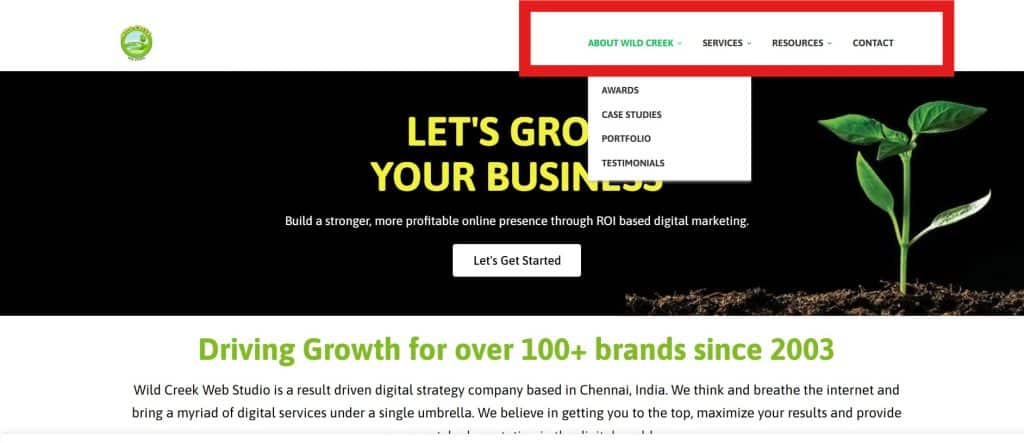
 What Could Go Wrong With AI?

Infographic showing What could go wrong with AI

Infographic showing What could go wrong with AI

While AI can transform digital strategies, businesses must approach it carefully. Here are challenges you need to keep in mind:

  • Data privacy concerns: Customers expect transparency about how their information is collected, stored, and used. Clear privacy policies and strong security measures build trust and reduce legal risks.
  • Bias in AI outputs : AI models can unintentionally reflect biases in the data they are trained on. Regular monitoring, fact-checking, and adjusting content are key to ensuring accuracy, fairness, and credibility.
  • Technical issues or limitations: Implementing AI effectively requires the right infrastructure, tools, and skills. Investing in training or partnering with experts can help teams overcome these barriers and make the most of AI’s potential.
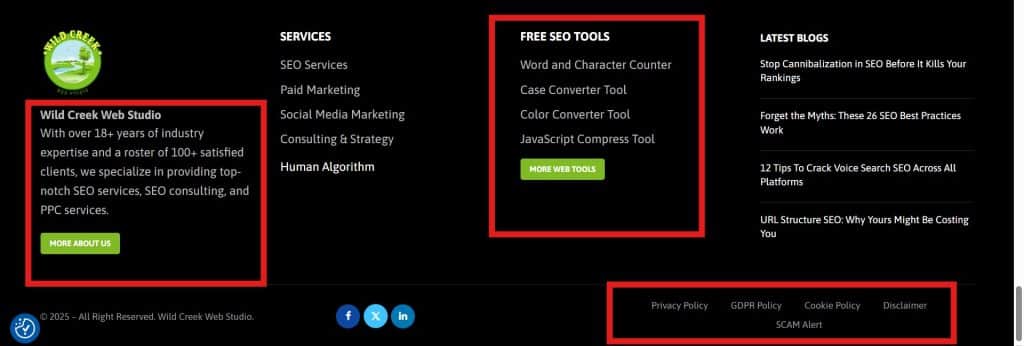
By recognising these challenges early, businesses can put safeguards in place and adopt AI in a way that delivers results without compromising trust or quality.
How Wild Creek Web Studio Puts You In Google’s AI Overviews?

Landing in Google’s AI Overviews isn’t about luck. It’s about showing up as the exact answer users and Google’s AI are looking for. And, if you’re worried on and align with how to use AI features in conversational search queries, that’s where  Wild Creek Web Studio comes in.

We don’t just tick SEO checkboxes. We:

  • Spot the right opportunities by identifying AI overviews SEO strategies before your competitors.
  • Shape content AI loves with clear, structured, and user intent-driven copy
  • Send the right signals with schema markup, technical SEO, and trust-building strategies
  • Adapt fast as Google’s AI keeps evolving

The result is more visibility, better clicks, and a stronger position in the search results of tomorrow.

Contact us today to get your brand into Google’s AI Overviews.

Wrapping It Up

AI Overviews aren’t just another Google feature; they’re the future of SEO optimisation AI. If your content is clear, trustworthy, and AI-friendly, you’ve got a real shot at landing there and reaping the rewards.

The sooner you start optimising, the sooner you’ll be showing up where your audience is already looking.

Frequently Asked Questions

How to optimize content for AI search?

Structure content with clear headings, bullet points, and concise answers. Use schema markup, target question-based queries, and keep language simple.

How to get featured in AI Overviews?

Provide direct, accurate answers to common questions, build topical authority, use structured data, and ensure your content is trustworthy and easy to scan.

How to optimize your website for AI search?

Combine technical SEO (speed, mobile-friendliness, crawlability) with AI-friendly content formatting, schema, and up-to-date, intent-focused information.

How can I track if my site is appearing in Google’s AI Overview results?

To track your site’s appearance in Google’s AI overview results, utilise Google Search Console. Regularly check for impressions and clicks related to your targeted keywords. Monitor analytics tools like Google analytics to analyze organic traffic sources and gauge visibility in relation to AI-driven search features.

Do content formats like FAQs and lists improve my chances of featuring in AI Overviews?

Yes, utilising content formats such as FAQs and lists can significantly enhance your chances of appearing in AI overviews. These structures not only improve readability but also align better with search engine algorithms that favor concise, well-organised information.

Is it better to focus on AI Overviews or regular search results?

Both matter. AI Overviews give top-of-page visibility, but regular organic search results still drive consistent traffic. Optimising for both maximises search engine visibility.

What determines AI Overview rankings?

Google’s AI looks for valuable content, topical authority, clarity, structured data, and trustworthy sources that match the search queries.

Are there any content formats, such as FAQs or lists, that improve visibility in AI Overview sections?

Yes. FAQs, bullet points, numbered steps, and tables make it easier for AI to extract and summarise information, improving chances of appearing in AI search results.

How do structured data and schema markup impact my chances of ranking in AI Overviews?

Schema markup helps AI understand your content’s type and relevance, boosting your likelihood of being featured in Google search results and AI mode.

What best practices do top-ranking sites results follow to consistently appear in AI Overview snapshots?

They maintain fresh, accurate content, use clear formatting, apply schema, and follow Google Search Essentials to align with artificial intelligence-driven ranking signals.

How do Google’s AI Overviews determine which pages to feature, and what ranking factors matter most?

Pages are chosen based on authority, clarity, structured data, and relevance to the user’s intent, as well as strong technical optimisation and user experience.

0 comments
What Is Branded Search Why Is It Important For Businesses Cover

What Is Branded Search & Why Is It Important For Businesses?

Ever typed “Nike running shoes” or “Apple MacBook Pro price” into Google? That’s branded search in action, and it’s one of the clearest signals that a customer is already interested in what you have to offer.

In today’s crowded digital marketplace, winning over new audiences is important, but holding the attention of those who already know your brand can be even more valuable. Branded searches are a direct reflection of your brand awareness, reputation, and trustworthiness. They also tend to bring in higher-quality traffic, better conversion rates, and a stronger return on your marketing investment.

In this guide, we’ll break down exactly what branded search is, why it matters for your business, and how you can optimise your presence so your brand dominates the search engine results page when people are looking for you.

In this Article

Toggle
  • What Is Branded Search?
  • What Is The Difference Between Generic And Branded Search?
  • What Are The Benefits Of Optimising For Branded Search?
    • 1. Higher Click-Through And Conversion Rates
    • 2. Lower Cost Per Click In Paid Campaigns
    • 3. Increased SERP Dominance And Brand Recall
    • 4. Stronger Customer Trust And Loyalty
  • How To Start Improving Your Brand’s Search Visibility?
    • 1. How Can Content Marketing Drive More Branded Searches?
    • 2. How Can PR And Influencer Mentions Boost Brand Visibility?
    • 3. How Does Local SEO And Community Engagement Improve Branded Search?
    • 4. How Can Social Media Increase Branded Search Visibility?
    • 5. How Can Non-Branded Keywords Boost Branded Search Intent?
    • 6. What Tools Can Help Identify Branded Keywords?
    • 7. How Can Branded Backlinks Strengthen Search Visibility?
  • What Are the Common Mistakes To Avoid When Optimising For Branded Search?
    • 1. Neglecting to Monitor Branded Search Performance
    • 2. Ignoring Negative Search Results
    • 3. Overlooking Paid Protection for Branded Keywords
    • 4. Using Inconsistent Brand Naming
    • 5. Not Leveraging Rich Results and Structured Data
  • How To Measure Branded Search?
    • 1. Use Google Search Console
    • 2. Leverage Google Analytics
    • 3. Use Insights From Third-Party SEO Tools
    • 4. Leverage Branded Search Data For Strategic Insights
  • What Are The Advanced Tactics To Maximise Branded Search Performance?
    • 1. How Can Structured Data Markup Enhance Branded Search Visibility?
    • 2. Why Should You Optimise For Voice Search And Mobile Queries?
    • 3. How Can Online Reviews Boost Branded Search Outcomes?
  • Boost Your Branded Search Success With Wild Creek Web Studio
  • Conclusion
  • Frequently Asked Questions
    • Do you consider branded search an SEO win?
    • What are some activities that can create branded searches?
    • Should I focus on branded or non-branded searches?
    • Is it bad that brand search are most successful?
    • How to count branded search query traffic?
    • How can social media influence branded search outcomes?
    • What role does brand reputation play in branded search performance?
    • Are branded searches being used more now?
    • How do branded search ads perform compared to non-branded search ads in terms of ROI?
    • Can you provide examples of branded keywords for different types of businesses?

What Is Branded Search?

A branded search happens when someone types your brand name or other brand terms into a search engine. This could be as simple as “Nike shoes” or as specific as “Apple iPhone 15 Pro Max reviews”.

These searches are a sign of clear search intent; the user is already aware of your specific brand and is actively looking for information, products, or services related to it.

Branded search terms usually deliver higher-quality search traffic because they’re coming from potential customers already partway down the customer journey.

What Is The Difference Between Generic And Branded Search?

Generic searches use broad search terms like “running shoes” to explore a category or product type, without favouring any particular brand. Branded searches, on the other hand, specifically include a brand name, such as “Nike running shoes”, showing a clear preference or awareness.

Here’s a closer look at the key differences:

Feature Generic Search Branded Search
Search Intent Broad, often research-oriented, focusing on comparing multiple options High intent, brand-focused, with the user seeking a specific brand or product
Search Demand Larger search volume, more competitive due to multiple players Lower volume but higher quality leads
Conversion Potential Lower, as users are still in the research stage Higher conversion rates as users are closer to making a purchase
Competition Multiple brands competing for the same search terms Mostly your branded search queries with limited competition
Cost In PPC Higher cost per click due to bidding wars Lower in branded paid search because of reduced competition

A balanced approach ensures your marketing teams can attract new audiences through generic search while also capturing branded traffic from loyal followers who are more likely to convert.

What Are The Benefits Of Optimising For Branded Search?

An Infographic on Benefits Of Optimising For Branded Search

An Infographic on Benefits Of Optimising For Branded Search

Focusing on branded search not only protects your existing audience but also maximises the value of every interaction with your brand. By capturing high-intent visitors who already know your name, you can achieve better results with less marketing spend.

1. Higher Click-Through And Conversion Rates

When people are already familiar with your brand, they’re more likely to click on your search ads or organic listings. This increased engagement cause higher search rankings and boosts ROI, as these visitors often convert faster than cold leads.

2. Lower Cost Per Click In Paid Campaigns

In a branded paid search setup, Google Ads targeting branded keywords usually cost less because there’s less bidding competition. This efficiency allows you to reallocate budget to broader marketing campaigns while still maintaining strong branded search coverage.

3. Increased SERP Dominance And Brand Recall

Owning the top spots for your branded keyword list pushes competitors off the search engine results page. This consistent presence reinforces brand recall, making your business the first choice when customers are ready to buy.

4. Stronger Customer Trust And Loyalty

High visibility in Google search results sends a signal of credibility and stability. Over time, this consistent exposure enhances your brand reputation, fostering loyalty among both new and returning customers.

How To Start Improving Your Brand’s Search Visibility?

An Infographic on How To Start Improving Your Brand s Search Visibility

An Infographic on How To Start Improving Your Brand s Search Visibility

Improving your brand’s search visibility means creating more opportunities for people to find and engage with your brand online. By combining strategic content, PR efforts, and technical optimisation, you can encourage more branded searches and capture high-intent traffic.

1. How Can Content Marketing Drive More Branded Searches?

Create high-quality content that answer your audience’s questions and showcase your expertise. Optimise these assets for both branded and organic search to increase website traffic. Over time, valuable content builds familiarity and encourages people to search for your brand specifically.

2. How Can PR And Influencer Mentions Boost Brand Visibility?

Strategic media placements and influencer collaborations can expose your brand to new audiences. When credible sources mention your brand, it sparks curiosity and prompts people to search for your name, increasing branded keyword searches.

3. How Does Local SEO And Community Engagement Improve Branded Search?

Claim and optimise your Google Business Profile so your brand appears in local Google search results for relevant brand terms. Participating in local events and community initiatives also builds offline awareness, which often translates into more branded online searches.

4. How Can Social Media Increase Branded Search Visibility?

Active social media management creates multiple brand touchpoints. By sharing engaging content, interacting with followers, and running campaigns, you make your brand more visible, driving users to search for your brand name later.

5. How Can Non-Branded Keywords Boost Branded Search Intent?

Well-planned content marketing can guide your target audience from discovering you through non-branded organic keywords to actively searching for your brand. This process turns casual visitors into loyal brand followers over time.

6. What Tools Can Help Identify Branded Keywords?

Use tools like your Google Search Console account, Google Trends, or a free keyword research tool to track branded search traffic and share of search. Analysing this data helps you spot opportunities and monitor growth.

7. How Can Branded Backlinks Strengthen Search Visibility?

Earn backlinks that use your brand’s name as anchor text. These not only improve your search rankings but also signal authority to search engines, boosting your organic traffic and making your brand more discoverable.

Discover how we increased organic traffic by 49.92% for a leading metal fabrication manufacturer with a targeted SEO approach. Read the full SEO case study.

What Are the Common Mistakes To Avoid When Optimising For Branded Search?

An Infographic on Common Mistakes To Avoid In Branded Search Optimisation

An Infographic on Common Mistakes To Avoid In Branded Search Optimisation

While optimising for branded search can deliver strong results, certain missteps can undermine your efforts. Avoiding these pitfalls will help you maintain brand credibility, protect your search presence, and get the most from your branded search campaigns.

1. Neglecting to Monitor Branded Search Performance

Failing to regularly track branded keyword rankings, click-through rates, and search volume means you could miss early signs of declining visibility. Regular monitoring helps you spot issues and adapt your strategy before they impact conversions.

2. Ignoring Negative Search Results

Leaving negative reviews, outdated information, or unfavourable news stories unaddressed in branded search results can damage your brand reputation. Proactively manage your online presence to ensure search results reflect your brand in a positive light.

3. Overlooking Paid Protection for Branded Keywords

Some brands skip running branded paid search ads because they already rank organically. This opens the door for competitors to bid on your brand terms and capture high-intent traffic that should be yours.

4. Using Inconsistent Brand Naming

Inconsistent use of your brand name, logo, or messaging across platforms can confuse users and weaken brand recognition. Ensure all marketing campaigns, profiles, and listings use a unified brand identity.

5. Not Leveraging Rich Results and Structured Data

Skipping schema markup for branded pages means missing opportunities to stand out with rich snippets, FAQs, or review ratings. Enhanced search listings build trust and can improve click-through rates for branded queries.

How To Measure Branded Search?

An Infographic on How To Measure Branded Search

An Infographic on How To Measure Branded Search

Measuring branded search performance helps you understand how visible your brand is in search engines and how effectively you’re capturing high-intent visitors. By tracking the right metrics, you can identify growth opportunities and fine-tune your marketing strategy for better results.

1. Use Google Search Console

Track your list of keywords and filter for branded ones with the new filter option. This allows you to see impressions, clicks, and average positions specifically for branded queries, helping you monitor visibility trends over time.

2. Leverage Google Analytics

Analyse branded vs non-branded organic search traffic to understand where you’re gaining traction. Comparing these segments reveals which search terms are driving conversions and where to allocate resources for maximum ROI.

3. Use Insights From Third-Party SEO Tools

Get detailed branded keyword data from platforms like Ahrefs, SEMrush, or Moz. These tools offer competitor comparisons, backlink profiles, and keyword trends to strengthen your branded search campaigns.

4. Leverage Branded Search Data For Strategic Insights

Apply your findings to adjust the sales funnel, improve user experience, and increase conversions. Insights from branded search can guide content updates, ad targeting, and brand messaging for stronger performance.

What Are The Advanced Tactics To Maximise Branded Search Performance?

An Infographic on Advanced Tactics To Maximise Branded Search Performance

An Infographic on Advanced Tactics To Maximise Branded Search Performance

Once your core branded search strategy is in place, the next step is to apply advanced techniques that give you a competitive edge. These methods strengthen your brand’s presence in competitive search results and build deeper trust with potential customers.

1. How Can Structured Data Markup Enhance Branded Search Visibility?

Adding schema markup to your website can make your listings stand out with rich snippets such as reviews, FAQs, product details, or event information. This not only improves organic search visibility but also builds trust by presenting useful details directly in search results.

2. Why Should You Optimise For Voice Search And Mobile Queries?

With the rapid growth of voice assistants and mobile browsing, many branded searches now happen through spoken commands. Voice queries often include your brand’s name, so ensure your site loads quickly, is mobile-friendly, and provides concise, natural-sounding answers.

3. How Can Online Reviews Boost Branded Search Outcomes?

Positive reviews are a powerful trust signal for both users and search engines. Encourage happy customers to share their feedback on platforms like Google Business Profile. Regularly responding to customer reviews also shows active engagement, improving rankings for branded search queries.

The influence of online reviews on branded search visibility, perception, and conversions can be significant. Here’s how positive and negative feedback stack up:

Factor Positive Reviews Negative Reviews
Impact on Branded Search Increased visibility for branded searches Decreased visibility for branded searches
Influence on Customer Perception Builds trust and credibility Creates doubt and uncertainty
Effect on Conversion Rate Increases likelihood of conversion Reduces likelihood of conversion

Actively managing and encouraging positive reviews is one of the simplest, most cost-effective ways to improve your branded search performance and maintain long-term customer trust.

Boost Your Branded Search Success With Wild Creek Web Studio

Knowing what is branded search is only the first step; turning it into measurable business growth is where the real challenge begins. That’s where Wild Creek Web Studio comes in.

With over 18 years of experience in SEO, PPC, and digital strategy, we help brands not just appear in search results, but dominate them. From refining your branded keyword strategy and protecting your brand in paid search to optimising your content, social media, and local SEO, our team ensures your brand is the one customers click on and trust.

If you’re ready to boost your branded search visibility, safeguard your online reputation, and convert high-intent traffic into loyal customers, let’s make it happen.

Contact us today!

Conclusion

Branded search is more than just people typing your name into Google. It is a direct reflection of your brand awareness, reputation, and trust. By optimising for branded keywords, protecting your presence in both organic and paid search, and actively engaging with your audience, you can convert high-intent searches into loyal customers.

The strategies in this guide, from creating brand-focused content to leveraging local SEO, social media, and backlinks, ensure that when someone looks for you, they find a consistent, credible, and compelling brand presence. Start implementing these steps today and you will not only safeguard your search visibility but also build stronger, lasting connections with your audience.

Frequently Asked Questions

Do you consider branded search an SEO win?

Yes. It shows strong brand awareness and signals high intent among searchers. Ranking well for branded terms means you’re effectively capturing potential customers already familiar with your business, increasing the likelihood of conversions and repeat visits.

What are some activities that can create branded searches?

Hosting events, securing PR coverage, influencer partnerships, and running consistent social media campaigns can encourage people to search for your brand. Effective content marketing and customer engagement strategies also increase curiosity and demand for your brand’s name.

Should I focus on branded or non-branded searches?

Both are important. Branded searches secure loyalty and protect existing traffic, while non-branded searches attract new customers. A balanced strategy ensures your business maintains visibility across the entire customer journey, from awareness to conversion and retention.

Is it bad that brand search are most successful?

Not at all. This indicates strong brand recognition and trust. High branded search performance often means your marketing is working effectively, leading to consistent customer engagement, repeat purchases, and a solid presence in your niche.

How to count branded search query traffic?

Use Google Search Console or analytics tools to filter search queries containing your brand’s name or related terms. Compare this data over time to track growth and measure the effectiveness of branding and marketing campaigns.

How can social media influence branded search outcomes?

Active social media presence increases brand visibility, making people more likely to search for your brand directly. Positive engagement, campaigns, and influencer collaborations can all boost curiosity and drive more branded traffic to your website.

What role does brand reputation play in branded search performance?

A positive brand reputation increases the likelihood of clicks when your listing appears in search results. Trustworthy brands enjoy higher click-through rates and better conversion potential, as customers are confident they’ll receive value from their purchase.

Are branded searches being used more now?

Yes. With more touchpoints online, like social media, reviews, and video content, customers often search for brands directly. The rise of multi-channel marketing has contributed to an overall increase in branded search queries across industries.

How do branded search ads perform compared to non-branded search ads in terms of ROI?

Branded search ads typically deliver a higher ROI because they target users who already know your brand and have strong purchase intent. They usually have lower CPCs, higher click-through rates, and better conversion performance than non-branded search ads.

Can you provide examples of branded keywords for different types of businesses?

For a fashion brand, examples include “Nike Air Max” or “Zara summer dress.” In tech, it could be “Apple iPhone 15” or “Samsung Galaxy S24.” Restaurants might target “Starbucks cappuccino” or “Domino’s cheese burst pizza.”

0 comments
3D illustration of a search engine interface with the terms LLMO and SEO featuring colorful UI elements and a search cursor

What Is LLMO & How Does It Impact Your SEO Strategy in 2025?

In this Article

Toggle
  • TL;DR
  • What is LLMO?
  • How to Optimise LLMs for AI Answers? A Practical LLMO Strategy
    • 1. Use Clear, Structured Formatting
    • 2. Write for Real, Conversational Queries
    • 3. Contribute to Authoritative Platforms
    • 4. Highlight Original Insights and Case Studies
    • 5. Ensure Accuracy and Consistency
    • 6. Be Visible Across the Web
    • 7. Understand and Align with AI Indexing
  • Why Choose LLMO Instead of Traditional SEO Methods?
    • 1. How Does LLMO Future‑Proof Your Content Strategy?
    • 2. How Can LLMO Boost Your Visibility on AI‑Driven Platforms?
    • 3. How Does LLMO Help Build Trust Through Indirect Signals?
    • 4. Can LLMO Increase Discoverability Without Rankings?
  • Are There Any Limitations or Challenges Associated with LLMO?
    • 1. No Standardised Tracking or Analytics (Yet)
    • 2. No Guarantee of Inclusion in LLM Outputs
    • 3. Potential for Misinformation
    • 4. Attribution Is Often Missing or Incomplete
    • So, How Should You Approach This?
  • How Do You Measure Success in LLM SEO?
    • 1. Brand Mentions in AI Tools
    • 2. Accuracy of AI-Generated Responses
    • 3. User Interaction and AI-Funnel Conversions
    • 4. Increased Mention Frequency on Public Forums
  • How Can LLMO Be Applied in Various Industries?
  • SEO vs LLMO for SaaS: What Should You Focus On?
    • How Can SaaS Brands Optimise for Both SEO and LLMO?
  • SEO vs. LLMO in 2025? Where Are We Headed?
    • So, Are AI Answers Replacing Search Results?
  • Why Choose Wild Creek Web Studio for LLMO and Future-Ready SEO Solutions?
  • Conclusion
  • Frequently Asked Questions
    • What are the AI definitions for SEO & LLMO?
    • What is the difference between LLM and SEO?
    • Are there any advice on AI SEO & LLMO tools?
    • Are there certain industries that benefit more from LLM SEO or LLMO?
    • Can LLMO strategies help overcome low visibility in traditional search?
    • How often should I update content to stay relevant for LLMs?
    • How does LLMO impact zero-click search behaviour?

TL;DR

  • LLMO (Large Language Model Optimization) is essential for visibility in AI search tools like ChatGPT and Perplexity.
  • Traditional SEO alone won’t help your content appear in AI-driven direct answers.
  • Businesses need to optimise for both search engines and large language models.
  • LLMO improves brand presence, organic traffic, and user engagement.
  • Now is the time to align your content strategy with this shift.

If you’re still treating SEO as just meta titles and keyword placement, you’re missing half the game. In 2025, search has expanded beyond search engines like Google and Bing. Users are asking questions directly to AI tools powered by large language models, and the answers they’re getting are no longer just blue links; they’re full summaries, recommendations, and lists.

That’s where large language model optimisation (LLMO) comes in. In this blog, we’ll break down what LLMO means, how it differs from traditional SEO, why it matters for modern search, and how you can start optimising your content to appear in AI-generated answers.

What is LLMO?

LLMO, or Large Language Model Optimisation, refers to the practice of making your content, website, or data assets more discoverable and favourable to AI models like ChatGPT, Google Gemini, Claude, and others that generate answers across AI search, chatbots, and embedded applications.

Just as SEO helps you rank better on Google, LLMO ensures that your brand becomes the trusted source AI models pull from when generating responses. But while SEO is about indexing and ranking for search engines, LLMO focuses on aligning with how language models are trained, how they retrieve content, and which sources they trust or cite.

Done right, LLMO can increase your visibility across AI-powered platforms, even when users never visit your website directly.

How to Optimise LLMs for AI Answers? A Practical LLMO Strategy

An Infographic on How to Optimise Your Content for LLMs

An Infographic on How to Optimise Your Content for LLMs

Here’s how you can align your content to show up more frequently, and more favourably, in AI-generated answers:

1. Use Clear, Structured Formatting

Make your content easy for AI models to read and understand. Organise pages with meaningful headings (like H1, H2, H3), use bullet points or numbered lists where appropriate, and include clear FAQ sections. Also, apply proper content formatting that signals structure. This helps LLMs break down and retrieve your content more accurately when generating answers.

2. Write for Real, Conversational Queries

Craft your content around how people naturally ask questions in chat or voice search. Instead of using vague phrases like “invoice automation tools,” reframe them as full, intent-driven questions. For example, “What’s the best invoicing tool for freelancers in India?” This aligns your content with the way users interact with AI tools.

3. Contribute to Authoritative Platforms

LLMs prioritise content from highly trusted sources. Try to get your brand mentioned or featured on platforms like Wikipedia, established media houses, government websites, or reputed industry publications. These high-authority signals help build trust and improve your chances of being cited by AI.

4. Highlight Original Insights and Case Studies

AI models favour content that offers depth and originality. Include customer success stories, real use cases, or unique data points from your business experience. The more specific and evidence-backed your content is, the more valuable it becomes for AI-generated responses.

5. Ensure Accuracy and Consistency

AI models rely on up-to-date and reliable information. Review your site regularly to keep facts, dates, pricing, and names accurate and consistent. Inconsistent or outdated information can lead to your content being ignored or deprioritised by language models.

6. Be Visible Across the Web

Your own website is not the only place LLMs look. Maintain consistent brand mentions on third-party platforms such as directories, comparison sites, forums, guest blogs, and news coverage. This broad presence helps reinforce your brand’s credibility in the AI ecosystem.

7. Understand and Align with AI Indexing

Different AI tools index content differently. Learn how platforms like Perplexity or ChatGPT source and surface answers. Make your content easy to crawl by ensuring open access (no unnecessary restrictions), minimal technical barriers, and availability in formats like RSS feeds or machine-readable summaries to aid discoverability.

Curious how AI is already transforming search? Read our blog on how effective Artificial Intelligence is in SEO.

Why Choose LLMO Instead of Traditional SEO Methods?

An Infographic on Advantages of LLMO Over Traditional Methods

An Infographic on Advantages of LLMO Over Traditional Methods

While traditional SEO focuses on ranking in search engines like Google, LLMO goes a step further by ensuring your content is discoverable through AI-powered platforms. Here’s how it gives your digital marketing strategy an edge:

1. How Does LLMO Future‑Proof Your Content Strategy?

Search behaviour is changing. As search engine dynamics evolve and more users turn to AI assistants, relying solely on keyword rankings won’t be enough. LLMO helps your content remain relevant and visible even as the search landscape shifts.

Think long-term: what ranks today might be replaced by what answers tomorrow.

2. How Can LLMO Boost Your Visibility on AI‑Driven Platforms?

Platforms like ChatGPT, Perplexity, and Gemini are becoming primary sources of information. By optimising for LLMs, your content is more likely to appear in these generative AI outputs, where users are already looking for direct answers.

3. How Does LLMO Help Build Trust Through Indirect Signals?

Even if your page doesn’t rank #1 in traditional search, AI tools value brand presence, contextual relationships, and mentions from authoritative sources. LLMO helps build those indirect signals of trust that influence AI responses.

4. Can LLMO Increase Discoverability Without Rankings?

LLMO ensures your content can be surfaced in conversations, summaries, or lists, even if it’s not ranking in traditional search engines. This means users can find your insights or solutions without ever clicking on a search result.

You don’t have to win the ranking war to win visibility in the AI era.

Are There Any Limitations or Challenges Associated with LLMO?

An Infographic on Limitations of LLMO

An Infographic on Limitations of LLMO

As powerful as LLMO is, it comes with its own set of challenges that marketers and businesses must be aware of before going all in. Here’s what we’ve observed:

1. No Standardised Tracking or Analytics (Yet)

Unlike traditional SEO, where tools like Google Analytics and Search Console offer clear performance metrics, LLMO lacks universal benchmarks. There’s currently no widely accepted tool to track how often your brand is mentioned or cited in AI-generated content.

You may show up in AI answers, but there’s no dashboard to quantify it, yet.

2. No Guarantee of Inclusion in LLM Outputs

Even with the right content, large language models might not reference your brand. These models pull from a wide training set and don’t prioritise recent content or well-optimised pages unless they’re reinforced through multiple authoritative signals like backlinks, citations, or external mentions.

Just because your content is excellent doesn’t mean an LLM will surface it.

3. Potential for Misinformation

AI tools can sometimes generate inaccurate or misleading answers. If your knowledge graph presence is weak or outdated, your brand could be misrepresented, or worse, ignored completely. That’s a big risk, especially in high-stakes industries like healthcare or finance.

4. Attribution Is Often Missing or Incomplete

Even when your content is referenced in an AI answer, it may not be explicitly attributed. This means you might influence a user’s decision without ever earning a visit, link, or measurable engagement.

So, How Should You Approach This?

We don’t see LLMO as a replacement for traditional SEO. Instead, we treat it as a complementary strategy, one that works alongside technical SEO, content strategy, and user intent mapping.

By integrating both, you’re not just optimising for clicks; you’re building visibility in the broader AI discovery ecosystem. And as AI-generated search continues to grow, that’s where your audience will increasingly be.

Curious how AI is reshaping search rankings? Check out our blog on How effective is Artificial Intelligence in SEO?.

How Do You Measure Success in LLM SEO?

An Infographic on How to Measure Success in LLM SEO

An Infographic on How to Measure Success in LLM SEO

Measuring success in traditional SEO often involves tracking traffic, keyword rankings, and conversions using tools like Google Analytics. But when it comes to LLMO, success metrics are less direct, but still measurable with the right focus.

Here are a few meaningful ways to assess how well your content is performing in the world of large language model optimization:

1. Brand Mentions in AI Tools

Regularly check if your brand or product is being cited in tools like ChatGPT, Gemini, and Perplexity. Type in relevant prompts and see whether your business shows up in the response, and how accurately.

2. Accuracy of AI-Generated Responses

Beyond visibility, quality matters. Monitor how LLMs describe your services, offers, or value proposition. Are they aligned with your current positioning? If not, it may indicate outdated training data or unclear messaging on your site.

3. User Interaction and AI-Funnel Conversions

While direct attribution is tricky, a rise in inbound queries that reference “I saw this on ChatGPT” or AI-assisted decision-making signals LLMO is working. Track changes in lead quality, form fills, or demo requests coming from new AI-influenced funnels.

4. Increased Mention Frequency on Public Forums

Monitor discussions on platforms like Reddit or Quora. If your brand is being organically recommended in answers or comparisons, that’s a strong indicator of LLM-influenced visibility, especially if it’s tied to contextual relationships and product relevance.

Discover how ChatGPT can supercharge your SEO on our blog Revolutionize Your SEO With ChatGPT.

How Can LLMO Be Applied in Various Industries?

LLMO is particularly effective in industries where authority, accuracy, and user trust are critical. These sectors often see higher inclusion in AI-generated responses due to their reliance on verified and contextual content.

Here’s how LLMO can support different industries:

  1. Healthcare: Precision matters. AI tools favour medically accurate, well-structured content that answers patient queries clearly.

Example: A hospital publishes FAQ-rich blogs like “What are the early signs of PCOS?” and uses schema markup, making it more likely for ChatGPT or Perplexity to summarise and cite it.

  1. Finance: Financial brands benefit when their content focuses on regulations, credibility, and trustworthy fact-checking to reduce misinformation.

Example: A fintech brand explains “How to file income tax returns for freelancers in India,” backed by government links and updated figures. This improves chances of inclusion in LLM-generated financial advice.

  1. SaaS: LLMO helps SaaS companies stand out through comparison guides, product explainers, and onboarding tutorials tailored to user needs.

Example: A CRM software company publishes a guide on “Best CRMs for remote teams,” using user-centric language, product comparisons, and case studies, ideal for summarised AI responses.

  1. Education: Educational platforms can improve LLM visibility with content that explains concepts, defines terms, and clarifies learning paths.

Example: An edtech company creates glossary-rich blogs like “What is the difference between machine learning and deep learning?”, increasing its chances of being referenced by LLMs in student queries.

  1. Local Services: Professionals offering local services gain traction when they optimise for conversational and intent-based questions tied to their region.

Example: A wedding planner in Chennai creates location-specific content like “Top 5 beachside wedding venues in Chennai,” optimised for local keywords and FAQs, making it easier for AI tools to recommend them for regional searches.

SEO vs LLMO for SaaS: What Should You Focus On?

SEO vs LLMO comparison graphic with the text What should you focus on for SaaS displayed on a split blue and yellow background

SEO vs LLMO comparison graphic with the text What should you focus on for SaaS displayed on a split blue and yellow background

SaaS companies operate in a highly competitive, fast-moving space, where discoverability, trust, and clarity matter at every stage of the user journey. To stay ahead, you need more than just rankings. You need to be present where your users are getting answers, including from AI-generated responses.

While SEO helps bring traffic through traditional search results, LLMO ensures your product, use cases, and brand name appear in AI tools like ChatGPT and Perplexity when users ask specific SaaS-related queries.

How Can SaaS Brands Optimise for Both SEO and LLMO?

SaaS companies compete in a crowded digital space where both search rankings and AI-driven discovery matter. To stay ahead, your content must align with both SEO and LLMO, optimised not just for Google, but also for language models powering AI tools and answer engines.

Here’s how SaaS brands can effectively optimise for both:

  • Optimise FAQs and Help Content: Convert product documentation, onboarding guides, and knowledge base content into clear, answer-ready formats. AI tools love content that directly addresses user questions.
  • Use Entity Mentions Strategically: Make sure your brand, product features, industry terms, and benefits are mentioned naturally and consistently. This strengthens contextual relationships that LLMs rely on.
  • Leverage Digital PR and Thought Leadership: Publish on reputable sites, contribute to expert roundups, and get cited by authoritative sources. These signals increase the likelihood of being included in LLM responses.
  • Monitor Community Signals: Mentions on platforms like Reddit, Quora, and GitHub can influence both AI training data and user trust. Encourage conversations around your product in these channels.
  • Target Comparison and Use Case Queries: Optimise for searches like “best HR software for startups” or “alternative to Salesforce for small teams.” These long-tail, intent-driven queries often trigger AI summaries.

SEO vs. LLMO in 2025? Where Are We Headed?

The way people discover content online is undergoing a major shift. While traditional SEO still plays a critical role in driving visibility via search engines like Google and Bing, the rise of generative AI has introduced a new player in the content discovery game: LLMO.

In 2025, we’re not looking at an either-or scenario. Instead, we’re entering a hybrid landscape, where users engage with both traditional search results and AI-generated answers depending on their intent and context.

For example, users still rely on Google to compare prices, read reviews, or explore e-commerce listings. But for quick explanations, definitions, or even product recommendations, they’re increasingly turning to tools like ChatGPT, Gemini, and Perplexity.

According to a recent study by SEMrush, 13.14% of all Google queries triggered AI Overviews in March 2025, up from just 6.49% in January. This spike has sparked a broader question across the industry: Where are we at with LLMs and search engines utilizing this technology? The answer lies in the growing overlap between AI-driven answers and traditional search.

This shift calls for a strategic blend of both SEO and LLMO in your content planning.

So, Are AI Answers Replacing Search Results?

Not entirely, but the landscape is undeniably evolving.

Instead of clicking through ten links on a search engine, users are now asking AI tools direct questions and receiving summary-style answers pulled from a mix of sources. These AI responses are built on language models trained on enormous datasets, often surfacing insights from brands without sending traffic to their websites.

This has several implications:

  • Search patterns are changing: More users are engaging with AI-first interfaces than ever before.
  • Marketing influence is shifting: Brands cited in AI tools can influence buyer decisions before a user even reaches the site.
  • Brand mentions carry weight: Being included in an AI-generated response builds trust, even without a click.
  • User experience expectations are rising: Users now expect fast, precise, and context-rich answers, whether from search or AI.

So, while traditional SEO is still essential for organic traffic, LLMO is what helps your content show up in the zero-click, AI-dominated discovery space.

Why Choose Wild Creek Web Studio for LLMO and Future-Ready SEO Solutions?

At Wild Creek Web Studio, we stay ahead of the curve, whether it’s Google’s ever-evolving algorithms or the rise of Large Language Models. Our tailored strategies blend traditional SEO best practices with cutting-edge LLMO techniques to ensure your content is visible, credible, and AI-ready.

From SEO content and digital PR to building topical authority and boosting generative AI traffic, we help future-proof your brand across all major search platforms, and beyond.

Ready to get your brand cited by AI? Let’s talk.

Conclusion

We’re still in the early days of AI-driven content discovery, but it’s clear that the future of SEO includes both traditional search engines and LLMO or search platforms powered by artificial intelligence. To remain competitive, brands must optimise for both, using established pillars of ranking alongside emerging LLMO strategies that cater to how users engage with AI-generated answers.

By focusing on topical authority, structured blog posts, and data from tools like Google’s Natural Language API, you can increase your visibility in AI results. Whether you’re targeting generative AI traffic, improving user interaction data, or strengthening your presence through press releases and social media, the goal is to create content that aligns with how and where users search today. It should also match how large language models (LLMs) interpret and surface information.

Frequently Asked Questions

What are the AI definitions for SEO & LLMO?

SEO refers to improving your website’s visibility on search engines like Google by optimising content, structure, and backlinks. LLMO, or Large Language Model Optimisation, focuses on making your content discoverable and trustworthy for AI models like ChatGPT and Gemini so it gets cited, summarised, or referenced in AI-generated answers.

What is the difference between LLM and SEO?

SEO focuses on improving your website’s visibility on search engines like Google. LLM optimisation, on the other hand, helps your content get discovered and cited by AI models like ChatGPT that power generative answers across search and chat platforms.

Are there any advice on AI SEO & LLMO tools?

To optimise effectively for AI discovery, combine traditional SEO tools with AI-focused platforms. Use Scalenut, SurferSEO, or SEO.ai for content planning, and LLMo metrics or Google’s NLP API to track brand visibility and align with large language model optimisation requirements.

Are there certain industries that benefit more from LLM SEO or LLMO?

Yes, industries like healthcare, finance, SaaS, education, and local services benefit the most. These sectors rely on trust, expertise, and detailed content that aligns well with how language models process and deliver information. Their content is often rich in user intent, which makes it ideal for AI-generated responses.

Can LLMO strategies help overcome low visibility in traditional search?

Yes, a well-executed LLMO strategy can boost visibility even when your pages don’t rank on Google Search. By optimising for generative engine optimization, you increase the chances of being referenced in AI responses. This is especially true when your brand appears in forums like Reddit, has a strong backlink profile, and covers relevant topics that LLMs prioritise.

How often should I update content to stay relevant for LLMs?

To remain visible in AI-generated answers, it’s best to review and update key content at least once every quarter. This ensures your facts, figures, and terminology remain current and aligned with the evolving training data used by large language models.

How does LLMO impact zero-click search behaviour?

LLMO plays a key role in zero-click search by increasing the chances of your content being featured in AI-generated summaries. Even if users don’t visit your website directly, your brand can still influence decisions through accurate, well-structured responses delivered by large language models.

0 comments
Newer Posts
Older Posts

Recent Posts

  • Free SEO Audit Tools: Which Ones Actually Help You Grow?

  • Bing vs Google: Which Search Engine Delivers Better Results Today?

  • What Is SaaS SEO and How Can It Grow Your Software Business?

  • What Is AEO and How It Influences AI Search Results?

Recent Case Studies

  • [Case Study] How We Helped a Website Get Back 90% of Lost Traffic by Removing Half Its Content

  • [SEO Case Study] How Wild Creek Web Studio Transformed a Banking Client’s Online Presence

  • [SEO Case Study] How We Drove Growth for a B2B Industrial Client

  • SEO Case Study: How We Boosted Organic Traffic by 49.92% for a Leading Metal Fabrication Manufacturer

Wild Creek Web Studio

Wild Creek Web Studio

With over 18+ years of industry expertise and a roster of 100+ satisfied clients, we specialize in providing top-notch SEO services, SEO consulting, and PPC services.

More About Us
  • Services
    • SEO Services
    • Paid Marketing
    • Social Media Marketing
    • Consulting & Strategy
  • Human Algorithm
  • Free SEO Tools
    • Word and Character Counter
    • Case Converter Tool
    • Color Converter Tool
    • JavaScript Compress Tool
More Web Tools

Latest Blogs

Free SEO Audit Tools: Which Ones Actually Help You Grow?
Bing vs Google: Which Search Engine Delivers Better Results Today?
What Is SaaS SEO and How Can It Grow Your Software Business?
What Is AEO and How It Influences AI Search Results?

© 2025 – All Right Reserved. Wild Creek Web Studio.

Facebook Twitter Linkedin
  • Privacy Policy
  • GDPR Policy
  • Cookie Policy
  • Disclaimer
  • SCAM Alert
  • About Wild Creek
    • Awards
    • Case Studies
    • Portfolio
    • Testimonials
  • Services
    • SEO Services
    • Paid Marketing Services
    • Social Media Marketing
    • Consulting and Strategy
  • Resources
    • Blogs
    • Free SEO Tools
    • Digital Marketing Glossary
  • Contact