Wild Creek Web Studio
  • About Wild Creek
    • Awards
    • Case Studies
    • Portfolio
    • Testimonials
  • Services
    • SEO Services
    • Paid Marketing Services
    • Social Media Marketing
    • Consulting and Strategy
  • Resources
    • Blogs
    • Free SEO Tools
    • Digital Marketing Glossary
  • Contact
Ai robot generate web interface automatically concept illustration

What Makes AI Copywriting So Powerful for Businesses?

Can a machine truly understand your brand voice, or your audience’s emotions? That’s the defining question behind the rise of AI copywriting.

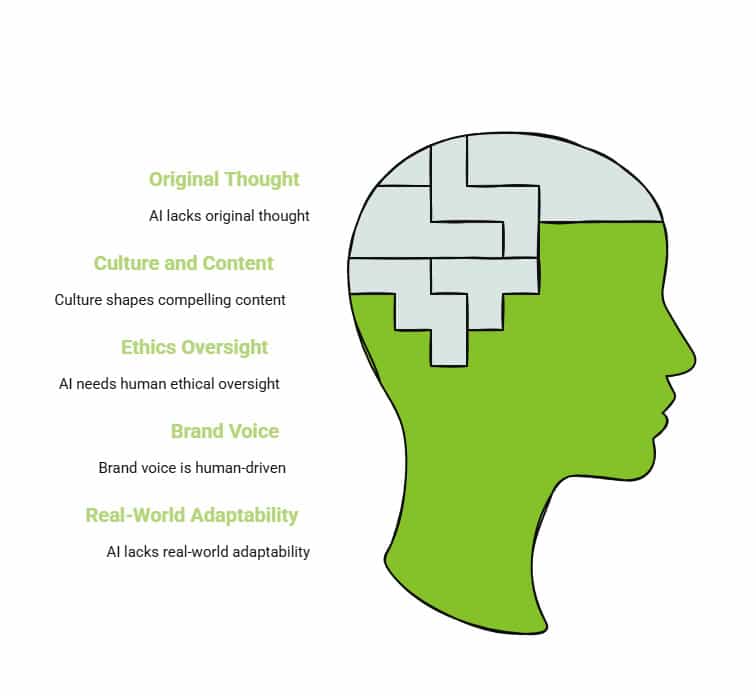
In this content-saturated world, speed alone doesn’t win attention; authenticity does. While AI copywriting software can generate paragraphs in seconds, what separates impactful content from generic noise is the human ability to think, feel, and connect.

At Wild Creek Web Studio, we see AI-enabled copywriting not as a shortcut but as a strategic advantage. It’s a way to amplify creativity, uncover insights faster, and maintain consistency across every piece of content, without losing the soul that makes a brand memorable.

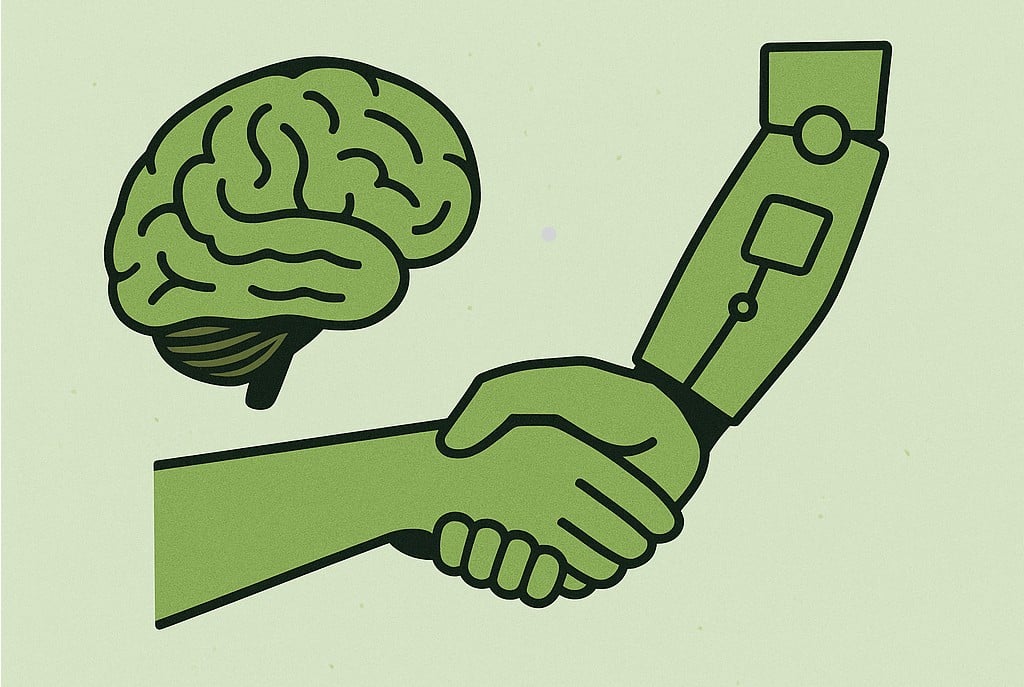
The future of content isn’t human or artificial, it’s both. And those who learn to combine storytelling intuition with intelligent automation will lead the next era of digital communication.

In this Article

Toggle
  • What Is AI Copywriting and Its Role in Modern Marketing?
  • How Does A.I. Write Beside Us?
  • What Are the Most Valuable Aspects of AI Copywriting?
    • 1. Turning Data Into Creative Direction
    • 2. Scaling Personalization Without Losing Personality
    • 3. Keeping Brand Voice Consistent Across Everything
    • 4. Accelerating the Drafting Stage, Elevating the Refining Stage
    • 5. Making SEO Feel Natural Again
    • 6. Fueling Creative Experimentation
    • 7. Building a System for Consistency and Growth
  • What Are The Common Mistakes Brands Make With AI Copywriting?
    • 1. Using AI as a Shortcut Instead of a Strategy
    • 2. Ignoring the Human Review Layer
    • 3. Failing to Train AI on Your Brand Voice
    • 4. Treating Every Type of Content the Same
    • 5. Over-Automating Creative Judgment
    • 6. Overlooking Ethics and Transparency
  • How Wild Creek Web Studio Does AI in Copywriting?
  • Conclusion
  • Frequently Asked Questions
    • What Are The Best AI Copywriting Tools Available Right Now?
    • How Can AI Copywriters Improve My Writing Efficiency?
    • Which AI Copywriting Tools Offer Free Versions?
    • What Are The Key Features To Look For In An AI Copywriting Software?
    • Are AI Copywriting Tools Effective For Marketing Content?
    • How Do Professional Copywriters Use AI In Their Daily Workflow?
    • What Are The Differences Between Paid And Free AI Copywriting Tools?
    • Can AI-Generated Copy Be SEO Optimized?
    • How Do Copy.ai And Jasper Compare For Copywriting Tasks?
    • What Limitations Should I Be Aware Of When Using AI For Copywriting?

What Is AI Copywriting and Its Role in Modern Marketing?

Marketing has always been a race for relevance, and AI just changed the pace. In an age where audiences scroll past more words in a day than they can remember in a week, brands need to create content that’s not only faster, but smarter, sharper, and more human.

That’s where AI copywriting comes in. It doesn’t just automate writing; it redefines how brands think about communication. Powered by machine learning and natural language processing, AI tools analyze audience behavior, tone, and intent to generate everything from headlines to campaign concepts that feel tailored in real time.

But speed isn’t the story, strategy is. The true power of AI lies in how marketers use it: turning raw data into creative direction, insights into narratives, and algorithms into authentic brand voices.

At Wild Creek Web Studio, we integrate AI copywriting into the creative process as an amplifier, not a replacement. Data shapes the message; human intuition gives it meaning. The result is copy that performs with precision but reads with personality, fast enough for the algorithm, and real enough for the human reading it.

How Does A.I. Write Beside Us?

Not long ago, the blank page was a writer’s biggest fear. Today, it’s the algorithm waiting to fill it.

Artificial Intelligence has become the new creative partner, one that never sleeps, never tires, and never stops suggesting the next sentence. From brainstorming ideas to crafting dialogue, A.I. is quietly reshaping storytelling.

Tools like ChatGPT, Sudowrite, and Novelcrafter act as digital muses. They generate character arcs, predict emotional beats, and even study reader behavior data to help creators fine-tune tone and pacing. For brands and writers alike, it’s like having a co-author with infinite memory and instant recall.

But this collaboration isn’t about outsourcing imagination, it’s about amplifying it.

A novelist might use A.I. to experiment with narrative structures. A filmmaker could generate alternate storyboards in seconds. A content strategist might test which story variation resonates most with different audiences. This isn’t automation for the sake of speed; it’s augmentation for the sake of depth.

Because when used well, AI-enabled copywriting doesn’t take over creativity, it expands its boundaries.
It lets us focus on what truly matters: the emotional truth behind every story.

Still, every partnership has its limits. Machines can recognize what makes a line beautiful, but not why it breaks your heart.

And that’s where the human storyteller remains irreplaceable.

At Wild Creek Web Studio, we call this balance The Human Algorithm: using data-driven intelligence to strengthen, not sterilize, the emotional core of storytelling. Because even as A.I. evolves, meaning will always be our greatest medium.

What Are the Most Valuable Aspects of AI Copywriting?
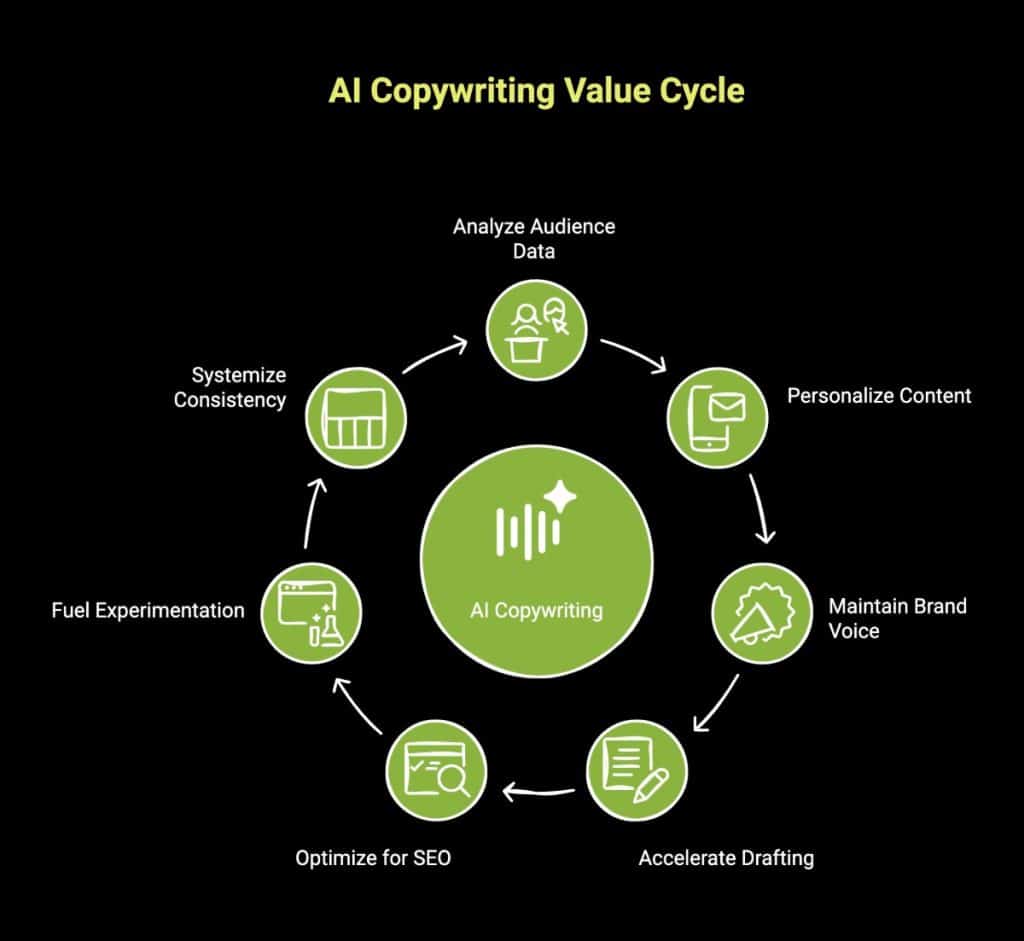
Infographic of What Are the Most Valuable Aspects of AI Copywriting

Infographic of What Are the Most Valuable Aspects of AI Copywriting

Copywriter AI based isn’t just about making writing faster; it’s about making it smarter. The real value lies in how it transforms content from guesswork into a system that blends creativity with precision. Here are the aspects that actually move the needle for brands and marketers today.

1. Turning Data Into Creative Direction

The most underrated power of AI copywriting is how it turns raw data into actionable storytelling cues. By analyzing what your audience searches for, how they respond to tone, and which formats perform best, AI helps you create with purpose. You’re not just writing another blog; you’re shaping content around real audience behavior.

2. Scaling Personalization Without Losing Personality

Personalization used to mean adding a first name to an email. Now, AI can help you adapt tone, structure, and even emotional depth based on audience segments. You can write one brand story in three distinct voices, professional for LinkedIn, casual for Instagram, and persuasive for email, without diluting your identity. That’s personalization with brand soul intact.

3. Keeping Brand Voice Consistent Across Everything

Whether you’re managing 10 writers or multiple campaigns, tone drift is real. AI solves this by learning your brand’s unique rhythm, how you phrase things, what emotions you lean into, and even what words you never use. It then acts like a voice guardian, ensuring every tweet, post, or article sounds like it came from one coherent brand personality.

4. Accelerating the Drafting Stage, Elevating the Refining Stage

AI doesn’t replace writers, it reorders their time. Imagine a content strategist opening an AI tool to generate five outline variations for a new blog post. Within seconds, they can see structure, tone, and SEO direction laid out. Instead of spending hours wrestling with a blank page, they start with a framework.

From there, the human takes over, refining phrasing, shaping emotion, and ensuring the story aligns with brand intent. The writer moves from word producer to idea sculptor.

It’s the difference between filling space and crafting meaning. AI handles the mechanical 60%, freeing creators to pour energy into the 40% that moves people, insight, nuance, and narrative flow.

5. Making SEO Feel Natural Again

Forget keyword stuffing. Modern AI writing tools understand semantic intent, helping you weave keywords into content the way people actually talk. It aligns what algorithms love with what audiences enjoy reading, making your SEO copy sound organic, something that used to take hours of manual tweaking.

6. Fueling Creative Experimentation

AI copywriting opens space to test ideas fearlessly. You can A/B test taglines, ad copy, or intros in minutes, discovering what resonates before launching a campaign. It’s like having a creative lab where insight meets iteration, allowing you to make bolder creative decisions backed by evidence, not instinct alone.

7. Building a System for Consistency and Growth

When used right, AI becomes part of your marketing infrastructure, not just a writing tool. That means your brand doesn’t just scale content, it scales consistency, creativity, and clarity at once.

AI may write faster, but can it write human? This deep dive explores why authentic voices still win over algorithms.
Also read: Is Blogging Dead After ChatGPT?

What Are The Common Mistakes Brands Make With AI Copywriting?
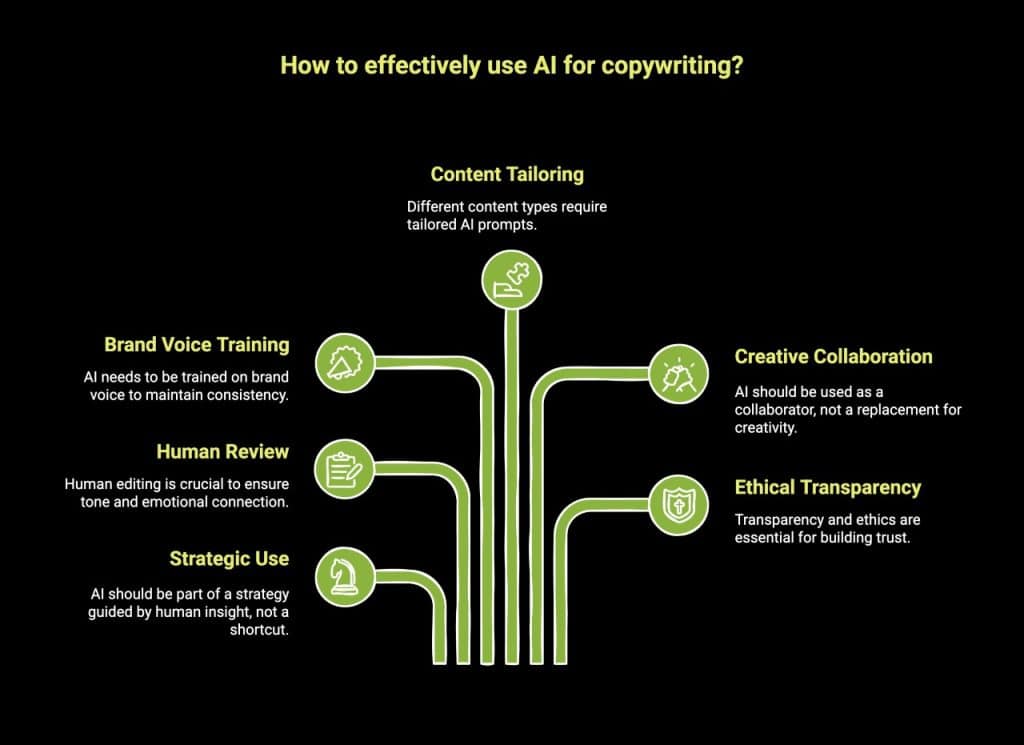
Infographic of What Are The Common Mistakes Brands Make With AI Copywriting

Infographic of What Are The Common Mistakes Brands Make With AI Copywriting

AI copywriting can be transformative for brands, but only when it’s used with the right intent and oversight. Many teams jump into automation before defining strategy, tone, or creative purpose, leading to copy that looks polished but lacks heart.

Here are some of the most common mistakes brands make when using AI for copywriting:

1. Using AI as a Shortcut Instead of a Strategy

AI isn’t a magic button for content creation. When brands rely on it to produce volume instead of value, the result is fast but forgettable. AI should be part of a strategy that’s guided by human insight, not a shortcut that replaces it.

2. Ignoring the Human Review Layer

AI can write, but it can’t feel. Skipping the human editing stage often leads to tone mismatches, awkward phrasing, or emotionally flat messaging. A thoughtful human review transforms AI-generated drafts into content that connects and converts.

3. Failing to Train AI on Your Brand Voice

Without guidance, AI defaults to generic language patterns. Feeding it your past content, tone samples, and audience insights helps it learn what makes your voice distinct. Training AI on your brand tone ensures every piece of content sounds like you, not like everyone else.

4. Treating Every Type of Content the Same

A blog post, social caption, and product ad each demand different tones and structures. When brands apply one AI formula to every channel, the result is disjointed storytelling. Tailoring AI prompts by platform and purpose keeps your content consistent and engaging.

5. Over-Automating Creative Judgment

AI can generate options, but it can’t choose emotion. Over-relying on automation risks stripping your brand of originality. True creativity comes from using AI as a collaborator, not a replacement, allowing humans to guide what feels real and right.

6. Overlooking Ethics and Transparency

Authenticity builds trust, and audiences can sense when something feels synthetic. Failing to disclose AI-generated content or fact-check outputs can hurt credibility. Responsible brands treat AI as a creative ally, using it transparently and ethically.

How Wild Creek Web Studio Does AI in Copywriting?

At Wild Creek Web Studio, we don’t use AI to replace creative thinking; we use it to sharpen it.
Our approach blends machine intelligence with human intuition to craft copy that performs with purpose and personality.

AI helps us go beyond writing faster. It helps us understand why stories work, how audiences respond, and where emotion meets data. Every campaign we build uses this insight to connect logic with feeling, because that’s where real brand impact happens.

Here’s how we bring AI and human creativity together in practice:

  • Human Intent as the Anchor
    Every project begins with clarity. We use AI tools to analyze audience sentiment and keyword intent, but the real direction comes from asking a simple human question: Why should anyone care?
    Data gives us patterns. Human intent gives us meaning, and that’s the difference between content that’s seen and content that’s remembered.
  • Machine Precision as the Amplifier
    AI helps us fine-tune what emotion alone can’t measure. We use it to test variations in tone, optimize phrasing for clarity, and predict what resonates most with your audience. It’s not about handing over control, it’s about scaling insight without sacrificing individuality.
  • Ethical Design as the Foundation
    Responsible storytelling is built into our workflow. We ensure every AI-assisted process aligns with brand ethics, creative integrity, and transparency. Empathy isn’t a filter we add at the end; it’s the standard we start from.

The result is what we call narrative intelligence with intention, a way to use technology not just to generate words, but to amplify truth, emotion, and connection.

At Wild Creek, that’s not future thinking. That’s our process.

Book a free Consultation and let’s discuss how we can strategize this balance for your brand wins!

Conclusion

As machines learn to replicate rhythm, emotion, and structure, the real test of storytelling won’t be how perfect a sentence sounds; it’ll be how deeply it makes us feel.
Because storytelling has never been about information; it’s always been about empathy.

The rise of narrative intelligence doesn’t signal the end of creativity. It signals a shift, from seeing technology as a tool to recognizing it as a creative collaborator. The future of storytelling belongs to those who know how to use machine precision to serve human imagination.

Frequently Asked Questions

What Are The Best AI Copywriting Tools Available Right Now?

The best AI copywriting tools like Gemini Advanced, Jasper, and Copy.ai help create social media content, landing page copy, and blog posts with ease of use and quick results for marketing teams.

How Can AI Copywriters Improve My Writing Efficiency?

An AI copywriter speeds up the writing process by generating ad copy, product descriptions, and web pages quickly, helping content writers overcome writer’s block and focus on quality content creation.

Which AI Copywriting Tools Offer Free Versions?

Tools such as Copy.ai and Rytr provide a free plan or free trial so you can test their AI writing tools for social posts, meta descriptions, or marketing copy before upgrading to paid plans.

What Are The Key Features To Look For In An AI Copywriting Software?

Look for an AI tool with strong tone of voice control, keyword research, and a clean user interface that supports multiple types of content like blog content, email campaigns, and landing page copy.

Are AI Copywriting Tools Effective For Marketing Content?

Yes, the best AI copywriting software helps create engaging social media marketing posts, marketing emails, and Google Ads while maintaining consistency in tone and delivering better results for your target audience.

How Do Professional Copywriters Use AI In Their Daily Workflow?

Professional content writers use AI writing tools to draft blog content, refine website copy, and A/B test marketing emails, improving content production speed while keeping messaging aligned with brand goals.

What Are The Differences Between Paid And Free AI Copywriting Tools?

A free version often limits word count or use cases, while paid plans unlock advanced templates for email marketing, Facebook posts, and detailed landing page testing, offering greater flexibility and better content creation control.

Can AI-Generated Copy Be SEO Optimized?

Yes, an AI writer can produce SEO-optimized AI copy for web pages, meta descriptions, and blog posts, ensuring search engines recognize relevant keywords while keeping your content marketing strategy natural and engaging.

How Do Copy.ai And Jasper Compare For Copywriting Tasks?

Both are great tools: Copy.ai suits quick social posts and ad copy, while Jasper excels in long-form blog content and email campaigns. Each offers different tools and templates for your preferred type of copy.

What Limitations Should I Be Aware Of When Using AI For Copywriting?

AI may struggle with emotional nuance, brand depth, or context. It’s best to refine AI copy manually to ensure authenticity across web pages, marketing copy, and social media content for consistent content marketing impact.

0 comments
Ai robot helps a human solve a work task with give an idea

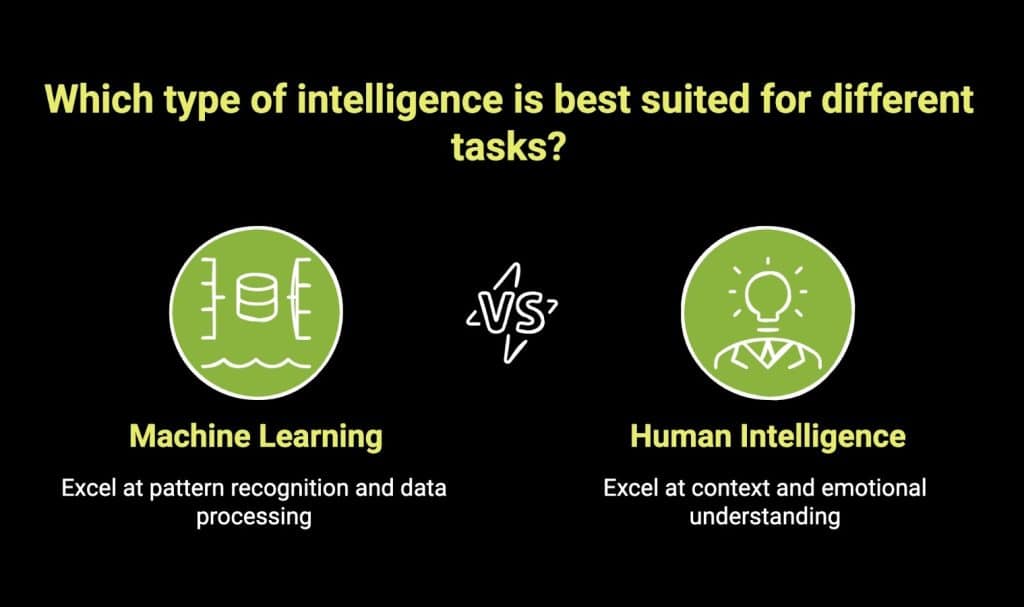
Is There A Difference Between Human Learning and Machine Learning?

In this Article

Toggle
  • Key Highlights
  • What Does It Really Mean for Humans to Learn?
  • How Do Machines Learn and What Do They Miss?
  • The Key Differences Between Human Learning and Machine Learning and Why They Matter?
    • 1. How Do We Learn? Meaning vs. Pattern
    • 2. How Do We Process Information? Intuition vs. Calculation
    • 3. How Do We Handle Experience? Context vs. Data
    • 4. How Do We Remember? Flexible vs. Exact
    • 5. How Do We Generalize? Conceptual Thinking vs. Pattern Matching
    • 6. How Do We Handle Uncertainty? Reasoning vs. Reliance
    • 7. How Do We Improve? Reflection vs. Retraining
    • 8. How Do We Decide? Ethics vs. Optimization
  • Why Businesses Should Care About This Difference in Machine Learning and Human Decision Making?
  • How Wild Creek Web Studio Keeps Humans at the Center?
  • Conclusion
  • Frequently Asked Questions
    • What Are the Main Differences Between How Humans and Machines Learn?
    • How Does Human Learning Rely on Experience Compared to Machine Learning?
    • Can You Explain How Machine Learning Models Process Information Differently From the Human Brain?
    • In Which Scenarios Do Humans Outperform Machine Learning Systems, and Why?
    • How Does Deep Learning by Humans Differ From Deep Learning by Machines?
    • What Role Does Intuition Play in Human Learning Compared to Machine Learning?
    • How Does the Ability to Generalize Knowledge Compare Between Humans and Machine Learning Algorithms?
    • Are There Examples Where Combining Human and Machine Learning Leads to Better Results?
    • What Limitations Do Machines Have in Learning Compared to Humans?
    • How Is Feedback Used Differently in Human Learning Versus Machine Learning?

Key Highlights

  • Difference between machine learning and human intelligence: emotion and intuition vs data and algorithms.
  • Humans learn from meaning; machines learn from patterns in big data.
  • Machine intelligence excels at accuracy, not understanding.
  • Deep learning models process data; humans process context.
  • Humans generalize knowledge; ML systems stay within training limits.
  • Human-in-the-loop machine learning boosts ethical, reliable AI performance.
  • Human decision-making drives creativity where automation can’t.
  • The future of work blends human intelligence with machine precision.

A few weeks ago, I watched my six-year-old niece try to teach our smart speaker how to play a game. She spoke slowly, repeated herself, even changed her tone, as if empathy could help the machine understand her better. After a few failed attempts, she sighed and said, “It just doesn’t get it.”

That moment stuck with me.

Not because the AI didn’t respond correctly, but because of how naturally she tried to connect with it, not command it. It was a small but powerful reminder of what sets human learning apart from machine learning: we learn to relate, not just to respond.

Machines learn from data, structure, and repetition. Humans learn from curiosity, mistakes, and emotion. One refines patterns; the other finds purpose. And as artificial intelligence becomes more embedded in our lives and work, the real question isn’t which learns better, but how the two can learn together.

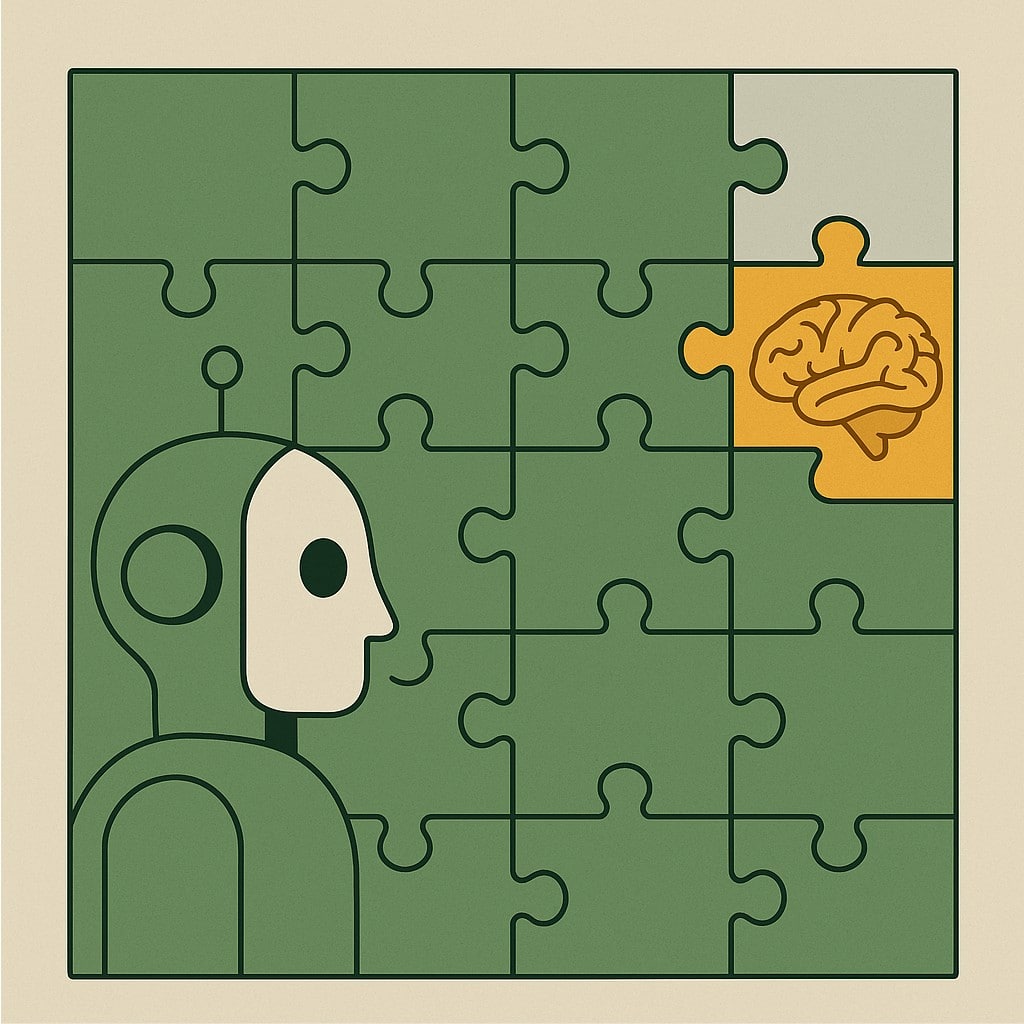
Because progress doesn’t come from choosing sides, it comes from finding harmony between human intuition and machine precision.

This is the heart of the Human Algorithm: a world where technology amplifies human potential, not replaces it.

So, how do humans and machines learn differently? Why do those differences matter, and how can organizations leverage both to drive innovation responsibly? Let’s get this started.

What Does It Really Mean for Humans to Learn?

Think about the last time you learned something new, maybe you tried to master a complex tool, gave a presentation that pushed your limits, or learned from a mistake that stung at first. You didn’t just download information; you processed, reflected, and adapted.

That’s how human learning works; it’s fluid, context-rich, and multidimensional. Our brains don’t follow a fixed algorithm. They combine logic, memory, emotion, and environment into something far greater than the sum of their parts.

Neuroscience shows that when we learn, multiple regions of the brain fire together, including emotional centers like the amygdala, memory structures like the hippocampus, and reasoning hubs in the prefrontal cortex. This interplay gives human learning its edge: we connect ideas to meaning.

We don’t just recognize patterns; we assign purpose. We learn not just what works, but why it matters. That’s why we can generalize across situations, why a lesson learned in a team project can influence how we approach a family conversation or a strategic business decision.

Human cognition is less about speed and more about sense-making, an ability that remains the most powerful differentiator in an era increasingly shaped by automation.

How Do Machines Learn and What Do They Miss?

Infographic of How Do Machines Learn and What Do They Miss

Infographic of How Do Machines Learn and What Do They Miss

Machine learning, by contrast, is structured, data-driven, and ruthlessly logical. An algorithm learns by analyzing vast amounts of data, adjusting its parameters until it minimizes error or maximizes accuracy. Every insight it produces is the outcome of mathematical optimization, no intuition, no emotion, just probability.

At its core, this process relies on three building blocks:

  • Data: The foundation of all machine learning. The more diverse and high-quality the data, the better the outcomes.
  • Algorithms: The learning engine, from decision trees and support vector machines to deep neural networks that mimic how our neurons fire.
  • Feedback Loops: The mechanism for continuous improvement. When an AI makes a prediction, the system measures accuracy and fine-tunes itself over time.

This is what powers everything from predictive maintenance in manufacturing to real-time fraud detection in banking. Machines can process patterns at a scale that far exceeds human capacity.

But while machines can learn patterns, they don’t comprehend context. A neural network can recognize a face, yet never understand a smile. It can generate flawless sentences, yet never feel what words mean.

That’s where human intelligence still leads – in connecting insight to intent, and data to meaning.

Because the next leap in technology won’t come from faster models or cleaner code, but from a deeper question:
Can machines ever truly learn what it means to understand?

Also Read: How to Use ChatGPT for SEO, discover how to integrate generative AI tools without losing your human touch or brand voice.

The Key Differences Between Human Learning and Machine Learning and Why They Matter?

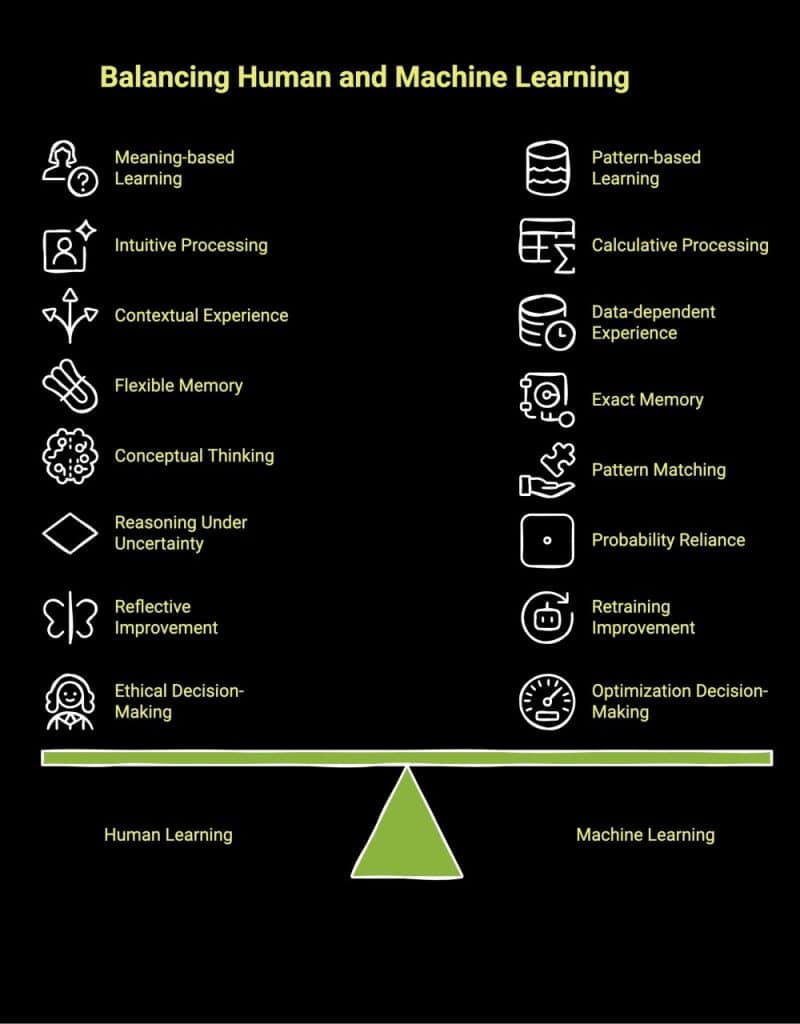
Infographic of The Key Differences Between Human Learning and Machine Learning

Infographic of The Key Differences Between Human Learning and Machine Learning

The conversation about AI often focuses on capability, what machines can do. But to understand where we’re heading, it’s far more important to understand how they do it differently from us. Human learning and machine learning aren’t two versions of the same process; they’re built on entirely different logics.

Let’s explore the fundamental differences that define both.

1. How Do We Learn? Meaning vs. Pattern

Humans learn through meaning. Every piece of knowledge connects to emotion, experience, and context. We remember things that move us, confuse us, or challenge our worldview.

Machines learn through patterns. Every insight they gain is the result of statistical correlation, recognizing which data points consistently appear together.

When you recognize a friend’s voice, your brain isn’t comparing sound frequencies; it’s connecting memory, emotion, and familiarity. When an AI does the same, it’s comparing patterns in sound waves. Both can identify the voice, but only one understands what it means to hear it.

2. How Do We Process Information? Intuition vs. Calculation

Human learning thrives on intuition. We make leaps, sometimes illogical, often inspired- that machines can’t replicate. Intuition allows us to make sense of incomplete information and trust our experience when data is scarce.

Machine learning thrives on calculation. Every decision is derived from a probability curve or optimization function. It doesn’t “guess”, it predicts. And it only predicts what it’s been trained to see.

This difference explains why humans can adapt to new situations faster, while machines excel within familiar, defined boundaries.

3. How Do We Handle Experience? Context vs. Data

Humans use life experience as a web of interconnected lessons. We apply knowledge from one field to another, a concept known as transfer learning in neuroscience.

Machines depend on training data, millions of examples fed to them in structured formats. Their knowledge is vast but narrow. They can outperform humans in a single task but struggle outside that domain.

When a person learns to drive a car, they can quickly adapt to driving a truck or even piloting a small boat. An AI model trained on cars can’t automatically make that leap, unless it’s retrained from scratch with new data.

4. How Do We Remember? Flexible vs. Exact

Human memory is adaptive. We forget details but retain meaning. We reconstruct memories, reshaping them with new insights and emotions. That imperfection is what enables creativity; it lets us connect ideas in unexpected ways.

Machine memory is precise. Every data point is stored and retrieved exactly as it was. This makes AI reliable for consistency but weak in creative synthesis. It doesn’t “remember”, it retrieves.

The human brain’s occasional errors, paradoxically, are what make it innovative. A machine’s perfection is what makes it predictable.

5. How Do We Generalize? Conceptual Thinking vs. Pattern Matching

Humans are exceptional generalizers. We learn a principle once and apply it widely. You can understand gravity and then predict how a ball will fall, even if you’ve never seen that particular ball before.

Machines are pattern matchers. They perform brilliantly within the boundaries of their training data but falter when faced with true novelty. They interpolate, not extrapolate.

This is why AI systems sometimes fail dramatically in “edge cases,” while humans improvise, reason, and move on.

6. How Do We Handle Uncertainty? Reasoning vs. Reliance

When faced with uncertainty, humans reason, debate, and hypothesize. We build mental models, weigh possibilities, and even embrace ambiguity.

Machines rely on probability. When uncertain, they estimate based on available data. The more unfamiliar the situation, the less reliable their output.

That’s why self-driving cars still struggle with rare events, like a pedestrian dressed in a Halloween costume. The machine can’t reason through what’s happening, only what’s statistically likely.

7. How Do We Improve? Reflection vs. Retraining

Human learning grows through reflection, feedback, mistakes, and insight. A single conversation or moment of awareness can transform understanding permanently.

Machine learning improves through retraining, adjusting weights and parameters based on performance data. It needs multiple cycles and massive datasets to evolve.

Both depend on feedback, but the nature of that feedback is different: humans need perspective; machines need precision.

8. How Do We Decide? Ethics vs. Optimization

Humans make decisions rooted in values, empathy, and context. Even in data-driven environments, we interpret numbers through a moral and social lens.

Machines make decisions through objective functions, optimizing for speed, accuracy, or efficiency. But optimization isn’t the same as fairness, empathy, or intent.

That’s why the human role in AI governance and design remains indispensable. Machines can optimize outcomes, but only humans can define what “good” looks like.

If you found this breakdown of the difference between human learning and machine learning thought-provoking, you’ll want to explore how these shifts impact search.

Also Read: How to Rank in AI: An Overview of Search in the Age of Algorithms.

Why Businesses Should Care About This Difference in Machine Learning and Human Decision Making?

When companies grasp how humans and machines learn differently, they stop forcing one to behave like the other. Machines process data; humans process meaning. Machines predict; humans interpret.

It’s in this balance, between speed and sense-making, that innovation truly happens.

  • Healthcare:
    AI scans images in seconds, spotting hidden anomalies.
    Humans connect pixels to patients, emotion, and ethics.
    Tension: speed vs empathy.
    At stake: trust.
  • Finance:
    Algorithms crunch data and predict market swings.
    Analysts read context, politics, and human behavior.
    Tension: precision vs perspective.
    At stake: stability.
  • Marketing:
    AI targets the right audience with data-driven accuracy.
    Creatives craft stories that make people feel something.
    Tension: data vs emotion.
    At stake: authenticity.

Or think of Garry Kasparov, the chess champion defeated by IBM’s Deep Blue. Years later, he reframed that moment, realizing that humans and machines together could outplay either alone, according to this article by Wired. Today’s most advanced chess systems are not pure AI, but human–machine teams that combine intuition with precision.

In the creative world, artist Sougwen Chung collaborates with robotic drawing systems that mimic her hand movements. The robot learns her style; she builds on its rhythm. The result isn’t man-made or machine-made, it’s co-created intelligence.

Each of these examples reveals the same truth: machines bring power; humans bring purpose.

How Wild Creek Web Studio Keeps Humans at the Center?

At Wild Creek Web Studio, this philosophy drives everything we do. We don’t just implement AI or automation; we architect human-aligned intelligence.

When designing digital ecosystems, we ask:

  • How do we make data interpretable for human decision-makers?
  • How do we ensure automation enhances creativity, not erodes it?
  • How can AI tools amplify brand voice without diluting authenticity?

We design systems that keep people in the loop, through transparent analytics, explainable AI layers, and workflows where human judgment shapes machine output.

Because the most powerful organizations of tomorrow won’t be those that automate everything. There’ll be those who know what not to automate, empathy, strategy, leadership, and trust.

At Wild Creek, we call this balance The Human Algorithm, where machine precision meets human perspective to drive lasting impact.

We don’t automate creativity, we scale it. Partner with Wild Creek to design intelligent systems that keep humans in control.

Conclusion

The real difference between human learning and machine learning isn’t about competition; it’s about collaboration. Machines process data with precision, but humans process meaning with empathy. The future belongs to those who can connect the two.

If your organization relies on automation without human oversight, you’re not innovating, you’re outsourcing judgment. The next phase of intelligent growth won’t come from faster algorithms, but from human-centered systems that use machine efficiency to amplify creativity, strategy, and purpose.

Frequently Asked Questions

What Are the Main Differences Between How Humans and Machines Learn?

Human learning vs machine learning differs fundamentally, human intelligence learns from emotion, context, and experience, while machine learning and artificial intelligence systems rely on big data and algorithms to enhance the level of accuracy in complex tasks.

How Does Human Learning Rely on Experience Compared to Machine Learning?

Human learning depends on life experience and human factors like emotion, intuition, and social interaction. Machine learning, however, relies on structured datasets, mathematical rules, and feedback loops within ML systems to improve intelligent behaviors and predictive performance.

Can You Explain How Machine Learning Models Process Information Differently From the Human Brain?

An ML model processes information through numerical optimization, detecting patterns in big data via neural networks. Human intelligence, on the other hand, interprets meaning through emotion, memory, and reasoning, combining perception from the physical world with intuitive understanding.

In Which Scenarios Do Humans Outperform Machine Learning Systems, and Why?

Humans outperform ML systems in problem solving that demands empathy, ethics, and creative reasoning. Machine intelligence excels in structured analysis, but humans lead in unstructured, ambiguous situations requiring human decision making and moral judgment.

How Does Deep Learning by Humans Differ From Deep Learning by Machines?

Human deep learning involves emotional reflection and real-world sensory experience. Machine learning and deep learning models use data layers within artificial intelligence systems to achieve precision in image recognition, facial recognition, and natural language understanding.

What Role Does Intuition Play in Human Learning Compared to Machine Learning?

Intuition allows humans to make quick, context-aware judgments beyond data. Machine learning lacks this, relying on algorithmic logic and fixed datasets, which limit its ability to adapt beyond the black box learning process of trained models.

How Does the Ability to Generalize Knowledge Compare Between Humans and Machine Learning Algorithms?

Humans generalize across diverse experiences through abstract thought. Machine learning algorithms generalize within training data boundaries, making their learning process efficient but narrow compared to the flexible adaptability and conceptual reasoning of human intelligence.

Are There Examples Where Combining Human and Machine Learning Leads to Better Results?

Yes. In facial recognition, medical imaging, and data science applications, human in loop machine learning enhances accuracy and fairness. This human centered machine learning approach merges human decision making with ML model efficiency for superior outcomes.

What Limitations Do Machines Have in Learning Compared to Humans?

Machine intelligence lacks emotional depth, intuition, and moral understanding. While ML systems deliver precision through big data, they struggle with contextual awareness, empathy, and adaptive reasoning, areas where human intelligence naturally excels in complex tasks.

How Is Feedback Used Differently in Human Learning Versus Machine Learning?

Humans learn through reflective feedback rooted in experience and emotion. Machine learning depends on retraining deep learning models using quantitative feedback loops to optimize performance of AI and improve model accuracy in structured environments.

0 comments
Digital AI agents in workspace

How Are AI-Powered SEO Agents Changing Digital Marketing?

In this Article

Toggle
  • Key Highlights
  • What Exactly Is an SEO AI Agent and Why It’s Changing the Game?
  • How AI Agent for SEO Strategy Are Transforming Modern Marketing?
  • Key Features Powerful AI Agents For SEO and Marketing Should Have?
      • 1. Automated Technical SEO Audits
      • 2. Intelligent Keyword Research and Clustering
      • 3. Competitor and SERP Analysis
      • 4. Content Optimization and On-Page Insights
      • 5. Rank Tracking and Performance Monitoring
      • 6. Link Intelligence and Outreach Assistance
      • 7. Data Analysis and Reporting Dashboards
  • What Are the 10 SEO AI Agent Strategies to Dominate Search Rankings?
      • 1. Automate Technical SEO Audits to Maintain Peak Performance
      • 2. Use Semantic SEO to Strengthen Topical Authority
      • 3. Streamline On-Page Optimization Across Multiple Sites
      • 4. Build a Real-Time Technical and On-Page Optimization Loop
      • 5. Enhance Content Production Through AI Writing Agents
      • 6. Develop Smarter Keyword Strategies Using Predictive Insights
      • 7. Accelerate Growth with Programmatic SEO
      • 8. Customize SEO Workflows for End-to-End Automation
      • 9. Optimize Content Structure and Intent Match Using Data Insights
      • 10. Enhance Readability and User Experience Through AI Content Refinement
  • AI Chatbots vs. AI Agents for SEO: What’s Different?
    • 1. Autonomy and Execution
    • 2. Real-Time Data and Integrations
    • 3. Context and Long-Term Memory
    • 4. Strategic Problem-Solving
    • 5. Accuracy and Reliability
  • How AI SEO Agents Will Shape the Future of Search?
  • Ready To See How AI Can Transform Your SEO Strategy?
  • Conclusion
  • Frequently Asked Questions
    • Which features should I prioritize when selecting an AI SEO agent?
    • How can AI SEO agents provide advanced insights and next steps?
    • Where can I find tutorials and resources to master AI SEO agents?
    • How can emerging AI tools expand my SEO strategy?
    • How do AI SEO agents improve content strategy over time?
    • Are AI SEO agents suitable for non-technical marketers?
    • Can AI SEO agents enhance local SEO performance?
    • Do AI SEO agents integrate with existing marketing tools?
    • Are there any limitations or drawbacks to using AI SEO agents?
    • What are the best AI tools for SEO?

Key Highlights

  • AI SEO agents are advanced AI tools that use machine learning to automate complex SEO tasks.
  • These agents handle everything from keyword research and content optimization to technical audits.
  • They differ from traditional tools by not just providing data but also taking action and managing entire workflows.
  • Using seo agents helps save time, scale efforts, and improve organic traffic more efficiently.
  • While powerful, they are designed to assist, not replace, human SEO professionals.
  • Choosing the right agent depends on your specific needs, whether you are a large agency or a small startup.

Marketers today face a brutal reality: SEO is harder than ever. Search algorithms evolve overnight, rankings swing unpredictably, and content that once dominated can disappear from page one in a matter of days. The pace of change is relentless, and human teams alone can’t keep up.

That’s where AI-powered SEO agents are rewriting the rules. These autonomous systems don’t just analyze data; they act on it. They learn, adapt, and execute strategies in real time, closing the gap between insight and action faster than any traditional SEO process ever could.

In this blog, we’ll explore how AI-powered SEO agents are transforming the way marketers work, and how you can leverage them to finally stay ahead of the curve.

What Exactly Is an SEO AI Agent and Why It’s Changing the Game?

So, what exactly is an SEO AI agent? Think of it as an intelligent digital assistant built to take care of the complex, time-consuming parts of search engine optimization.

It observes your website’s performance, plans optimization strategies, acts on them, and learns from the results, much like a human SEO specialist would, but at a much faster and more scalable pace. They work 24/7 to keep your site optimized for search engines.

For example, Surfer SEO might auto-insert internal links between related topics overnight.

At their core, these agents use advanced technologies like artificial intelligence and natural language processing (NLP) to understand complex data.

86.07% of SEO professionals have already integrated AI into their workflows, showing how quickly it’s become a standard part of SEO strategy.

By processing vast amounts of information, they can identify areas for improvement and implement changes to boost your rankings. This continuous cycle of analysis and action ensures your website stays competitive and visible.

How AI Agent for SEO Strategy Are Transforming Modern Marketing?

The introduction of an AI agent for SEO content creation is revolutionary. Instead of just presenting you with raw data, these AI tools provide actionable insights and even generate data-driven content briefs that can execute tasks automatically.

For example, an AI agent can analyze your site within the ever-evolving SEO landscape, find technical issues, suggest content improvements, and then implement those changes with your approval.

This proactive approach helps improve website rankings and traffic by ensuring your optimization efforts are always current and effective.

A recent NinePeaks study found that businesses using AI in SEO see 45% higher organic traffic and 38% better conversion rates compared to those relying solely on manual processes.

For marketers, this means less time spent on manual, repetitive tasks and more time focusing on high-level strategy and creativity. It’s about working smarter, not harder, to achieve better results.

But it is still worth noting that although AI handles automation and pattern recognition, humans are still needed for strategy, tone, and creative nuance.

Key Features Powerful AI Agents For SEO and Marketing Should Have?

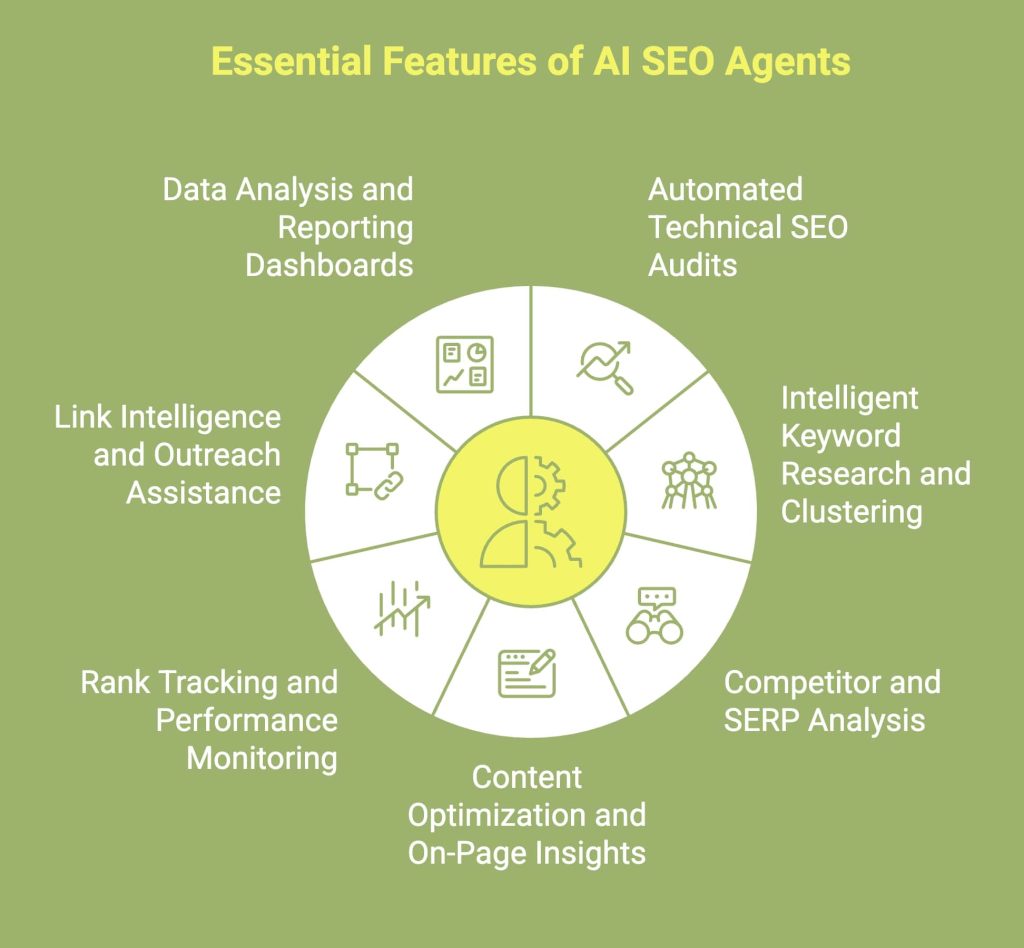
Infographic showcasing essential features of AI SEO agent

Infographic showcasing essential features of AI SEO agent

Not all AI SEO tools are created equal. The best SEO AI agents go beyond automating basic tasks; they think, adapt, and act like real strategists. Whether you’re trying to improve visibility, streamline content production, or track performance more efficiently.

In fact, 67% of small businesses now use AI for SEO, content planning, or analytics, proving how accessible and scalable these tools have become.

Here are the key features that truly define a high-performing SEO AI agent, along with a few tools that excel in each area.

1. Automated Technical SEO Audits

AI has completely changed how technical audit processes are done.

Instead of running manual crawls and sorting through endless reports, AI agents can scan entire sites in seconds, detect broken links, flag Core Web Vitals issues, and even rank problems by their impact on performance.

Tools such as Surfer SEO and NeuronWriter use AI to audit and recommend real-time improvements, helping teams maintain strong technical foundations.

However, AI doesn’t always understand business context; it might recommend removing a slow page that still converts well.

The best approach is to use AI to handle detection and prioritization while relying on human judgment to make final decisions that align with real business goals.

According to Google Web.dev’s Core Web Vitals Report (2024), sites that continuously track and optimize Core Web Vitals through AI-powered technical audits see up to a 32% improvement in overall page performance and ranking stability.

2. Intelligent Keyword Research and Clustering

AI now uses advanced language models and semantic understanding to group related topics based on meaning, not just similar words. This helps marketers uncover new opportunities and create content that better reflects how people actually search.

This allows platforms like Surfer SEO to generate smart clusters that mirror how search engines interpret meaning.

This evolution is supported by SEOClarity’s analysis of 2,700 keywords, which found that AI-driven topic clustering improves accuracy and relevance by over 30% compared to traditional keyword sorting

Still, AI can miss emerging topics or nuanced brand language that only humans can spot.

The smartest strategy is to let AI handle the heavy lifting, finding themes and intent gaps, while marketers refine messaging and positioning for authenticity.

3. Competitor and SERP Analysis

AI has turned competitor analysis into a data-rich, real-time process. Systems like Clearscope analyze SERP structures, content entities, backlink strength, and content depth to reveal why top pages rank.

It can track what competitors rank for, how long their content performs, and what backlink strategies drive results. By identifying missing entity optimization opportunities, AI helps reveal gaps in topical authority that manual audits might overlook.

Instead of manually comparing dozens of pages, marketers now get instant insights into what’s working across an entire industry.

Yet, AI can only analyze visible data; it doesn’t account for brand strategy, budgets, or offline marketing influences.

That’s why human perspective is key.

Use AI to uncover patterns, but rely on intuition and creative insight to shape a differentiated strategy.

4. Content Optimization and On-Page Insights

Modern AI SEO agents act like live editors, offering suggestions as you write. Tools such as Surfer SEO and Frase leverage NLP to suggest headings, semantic keywords, tone adjustments, and readability improvements as you write.

They analyze tone, structure, and keyword placement using natural language processing to ensure your content matches user intent and reads naturally.

This makes every piece of content more targeted and easier to optimize for both humans and algorithms.

Still, AI can’t capture emotion, originality, or voice, the traits that make content memorable.

Marketers should use AI for structure and clarity, then layer in creativity and storytelling to create content that connects and converts.

5. Rank Tracking and Performance Monitoring

Tracking keyword performance used to mean checking static rank reports every few days. AI has changed that with tools like Rankscale AI, by making tracking predictive.

It not only monitors positions but also detects trends, connects ranking shifts to algorithm updates, and forecasts how changes might affect visibility.

While this adds powerful insight, AI can still misinterpret anomalies or seasonal fluctuations.

The key is to use AI’s speed and pattern recognition while keeping a human eye on interpretation, ensuring data leads to informed, balanced decisions.

6. Link Intelligence and Outreach Assistance

Now, AI agents, like Postaga, identify relevant domains, craft personalized outreach messages, and track engagement automatically.

They analyze which pitches get responses and adjust strategies over time, turning a once slow process into an efficient growth system.

However, true relationship building still depends on human connection.

AI can open doors, but marketers must build trust and maintain partnerships that last.

Combining AI-driven prospecting with genuine outreach creates sustainable backlink growth that supports long-term authority.

7. Data Analysis and Reporting Dashboards

AI has made SEO reporting smarter and faster.

Instead of digging through spreadsheets, marketers can now access visual dashboards that highlight key performance patterns and even predict future outcomes.

These systems, like Surfer SEO’s Grow Flow, transform raw data into clear, actionable insights that save time and improve strategy.

Yet, AI reports are only as valuable as the context behind them.

Without human interpretation, even accurate numbers can miss the story.

The most effective marketers use AI dashboards to identify trends, then translate those insights into decisions that align with brand goals and business impact.

What Are the 10 SEO AI Agent Strategies to Dominate Search Rankings?

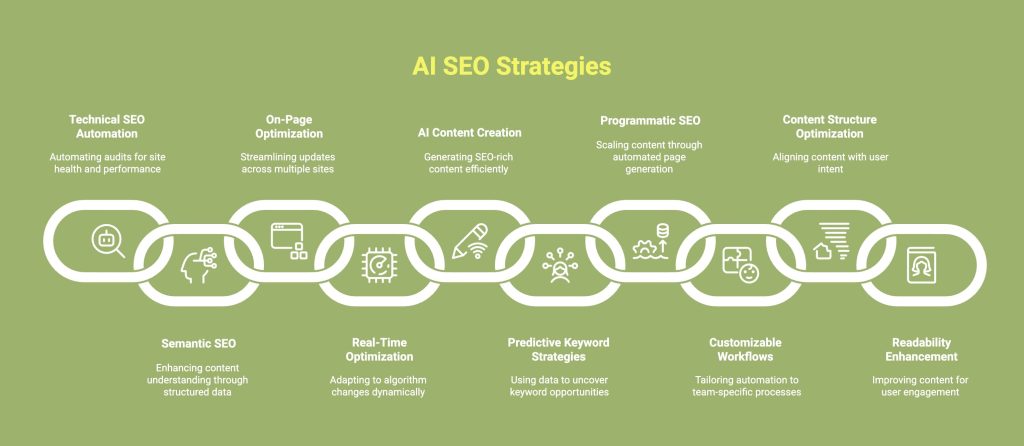
Infographic showcasing AI SEO strategies

Infographic showcasing AI SEO strategies

For modern marketers, ranking well isn’t just about keywords anymore; it’s about efficiency, adaptability, and innovation. AI-powered SEO agents are transforming how teams automate processes, identify opportunities, and scale results.

Here are 10 proven strategies using real AI SEO agents that help businesses dominate search results through smarter, data-driven workflows.

1. Automate Technical SEO Audits to Maintain Peak Performance

Manual SEO audits once meant hours of crawling, checking links, and fixing issues after rankings dropped. Today, AI SEO agents monitor your site in real time, spotting crawl errors, broken links, and Core Web Vitals issues before they cause damage.

This proactive approach keeps your site healthy and search-ready without constant manual oversight.

2. Use Semantic SEO to Strengthen Topical Authority

Keyword-based strategies often miss the deeper connections that build real authority. AI SEO agents now use semantic mapping and schema automation to help search engines understand how your content fits within a topic ecosystem.

The result is stronger topical relevance and improved visibility across multiple related searches.

3. Streamline On-Page Optimization Across Multiple Sites

Updating hundreds of pages by hand used to be slow, inconsistent, and prone to human error. With AI-powered automation, on-page changes like metadata, headings, and structure can now be rolled out across entire domains in minutes.

For agencies or large teams, that means consistent quality and performance at scale.

4. Build a Real-Time Technical and On-Page Optimization Loop

SEO once lagged behind fast-changing algorithms, leaving teams scrambling to catch up. AI agents now close that gap by tracking live metrics, detecting performance dips, and applying real-time fixes automatically.

That agility allows marketers to adapt instantly and maintain peak performance even during algorithm shifts.

5. Enhance Content Production Through AI Writing Agents

Content teams used to face a choice: create quickly or keep quality high. AI writing agents now combine speed with strategy, fusing live SERP insights and keyword data to produce optimized, ranking-ready drafts.

This balance helps teams scale content output without losing their brand’s tone or editorial standards.

6. Develop Smarter Keyword Strategies Using Predictive Insights

Traditional keyword research relied on outdated reports and instinct. AI SEO agents now analyze live data streams, uncover hidden keyword clusters, and predict which topics are gaining traction.

Predictive keyword clustering helps marketers plan smarter campaigns and capture emerging opportunities early.

By acting on forward-looking insights, marketers can stay ahead of competitors and target opportunities earlier.

7. Accelerate Growth with Programmatic SEO

Expanding visibility once meant manually creating thousands of landing pages, a time-consuming process. Now, AI SEO agents handle programmatic SEO by generating optimized pages automatically, covering countless long-tail searches efficiently.

This scalable strategy helps startups and growing brands multiply their reach without extra effort.

8. Customize SEO Workflows for End-to-End Automation

Every marketing team works differently, but traditional tools often force them into rigid processes. AI SEO agents adapt to each workflow, connecting keyword research, optimization, and publishing in one seamless loop.

That flexibility streamlines operations while aligning SEO efforts with unique business goals.

9. Optimize Content Structure and Intent Match Using Data Insights

Guessing how to match content with search intent used to waste time and effort. AI SEO agents now analyze top-performing pages, identify what structure and tone win engagement, and guide content creation accordingly.

When every page aligns with intent, rankings rise naturally, and audiences stay longer.

10. Enhance Readability and User Experience Through AI Content Refinement

Polishing tone, flow, and clarity was once a purely manual task. AI SEO agents now refine drafts with NLP-driven suggestions, improving readability and semantic depth without losing your voice.

By blending user-friendly writing with search precision, brands build trust, engagement, and stronger SEO results.

Optimizing readability enhances engagement and strengthens overall search performance.

Whether it’s NightOwl maintaining technical health, WordLift enhancing semantic depth, or Chatsonic scaling content, AI SEO agents enable smarter, faster, and more efficient workflows.

AI SEO agents aren’t just another upgrade; they’re your chance to work smarter. Start by automating repetitive tasks and using real-time data to guide your strategy.

As your system learns and adapts, focus your team’s energy on creativity and growth, not maintenance. That’s how you turn SEO into a true growth engine.

AI Chatbots vs. AI Agents for SEO: What’s Different?

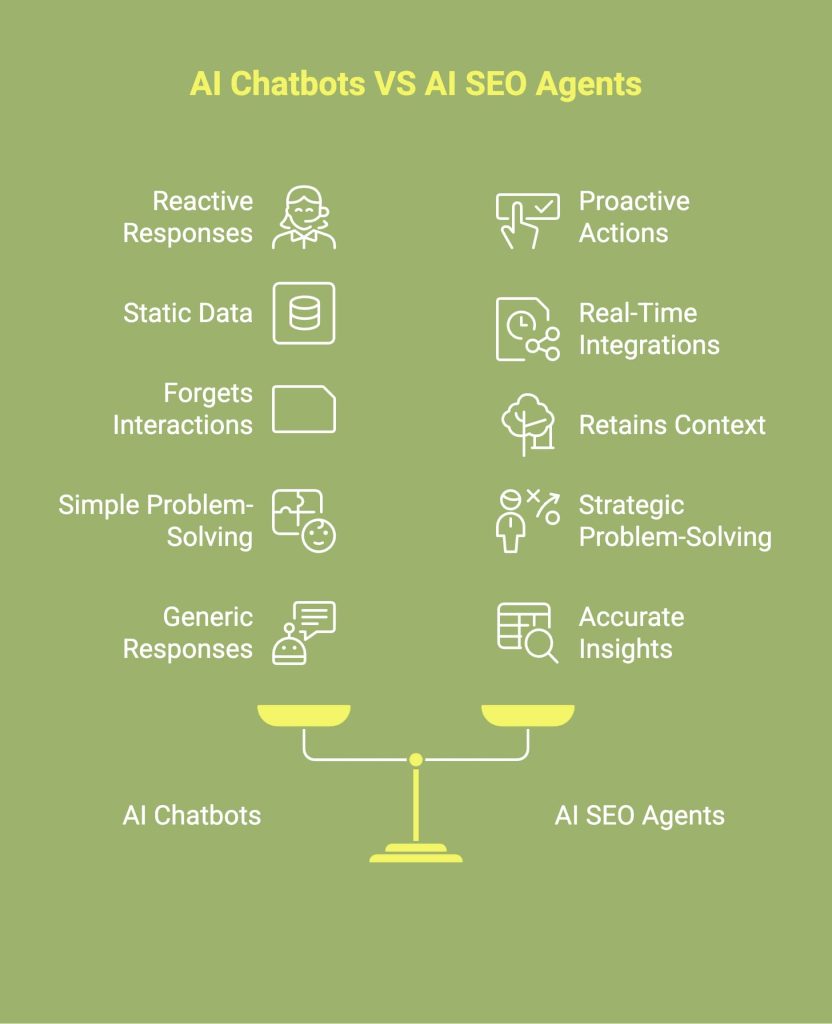
Infographic showcasing the difference between AI chatbot vs AI SEO agents

Infographic showcasing the difference between AI chatbot vs AI SEO agents

Many marketers still use AI chatbots for SEO tasks like keyword brainstorming or content ideation, but there’s a major difference between chatbots and AI SEO agents.

While chatbots are designed to respond to queries, SEO agents are built to act, adapt, and optimize in real time. Understanding how they differ helps marketers choose the right tools for real results.

Let’s explore how these two differ and what that means for marketers trying to grow visibility and traffic efficiently.

1. Autonomy and Execution

AI chatbots primarily exist to respond; they help you think, but they don’t do. In contrast, AI SEO agents are designed to act. They don’t just tell you what keywords to target; they can actually perform the research, map keyword clusters, analyze competitors, and optimize pages, often all in one continuous workflow.

For marketers, this shift from reactive conversation to proactive execution means less time spent juggling tools and more time focusing on strategy.

Small teams especially benefit because SEO agents can take over repetitive optimization tasks, helping them scale faster without adding headcount.

2. Real-Time Data and Integrations

Where chatbots depend on static or pre-trained information, SEO agents thrive on live data. They connect directly to analytics platforms like Google Search Console or keyword databases, pulling in real-time insights to guide decisions.

This matters for marketers because search trends evolve daily. A chatbot might tell you what worked last month; an SEO agent can detect what’s working today.

That ability to respond instantly to data helps brands stay aligned with shifting algorithms and user intent.

3. Context and Long-Term Memory

Most chatbots start from scratch every time you open a chat. They don’t remember what you’ve already asked or what your ongoing SEO goals are.

SEO agents, however, build memory over time, tracking keyword performance, remembering what content was optimized last week, and refining strategies as your site grows.

For marketing teams, this means a continuous SEO evolution rather than starting over each campaign. The agent effectively becomes a digital strategist that learns your brand’s patterns and priorities, ensuring consistent progress and smarter recommendations.

4. Strategic Problem-Solving

Chatbots are excellent for answering direct questions, but SEO challenges rarely have single-step solutions. Ranking well requires understanding site health, search intent, content gaps, backlinks, and user experience, all at once.

AI SEO agents approach this like an analyst and strategist combined. They interpret patterns, identify problems, and recommend or even execute improvements across multiple dimensions.

For marketers, this means moving from scattered insights to integrated, actionable strategies that drive real growth.

5. Accuracy and Reliability

Because chatbots don’t pull data from live sources, their advice can be generic or outdated. SEO agents, however, continuously validate their insights with live performance data.

They adapt to changes, ensuring that optimizations are grounded in what’s actually happening in search results, not just what theory suggests.

For marketers, this creates confidence. Instead of guessing what might work, they can rely on verified insights that directly impact rankings and ROI.

AI chatbots are great brainstorming partners; they help marketers explore ideas, clarify goals, or draft quick responses.

But AI SEO agents go several steps further. They think, plan, and act like data-driven SEO professionals, executing tasks, learning over time, and refining strategies automatically.

How AI SEO Agents Will Shape the Future of Search?

AI SEO agents are only at the beginning of their journey. As they evolve, they’ll move from automating tasks to orchestrating full SEO ecosystems, learning not just what works, but why it works.

In the near future, we’ll see agents that:

  • Predict algorithm changes before they happen, adapting site strategies automatically.
  • Personalize search optimization for each user segment based on behavior, intent, and device use.
  • Collaborate with human teams like digital strategists, not just assistants, offering insights, forecasting ROI, and recommending creative angles.
  • Integrate seamlessly with broader marketing tech stacks, uniting SEO, content, and paid channels into one intelligent growth engine.

As these systems mature, SEO will shift from reactive optimization to predictive, self-improving growth, where success depends less on manual input and more on how effectively teams train, trust, and collaborate with their AI agents.

Ready To See How AI Can Transform Your SEO Strategy?

At Wild Creek Web Studio, we help businesses turn SEO into a true growth engine. Using data-driven insights and AI-powered optimization, we create strategies that improve rankings, attract qualified leads, and boost long-term visibility.

With 18+ years of experience and over 100 brands trusting our expertise, we know what it takes to deliver results that last.

Let’s move your business beyond guesswork and into predictable, scalable growth. Book Your Free SEO Strategy Call Today!

Conclusion

As we navigate the evolving landscape of digital marketing, AI-powered SEO agents are becoming indispensable tools for businesses aiming to enhance their online presence.

These advanced technologies not only streamline the SEO process but also provide valuable insights that can transform your marketing strategies.

By leveraging the capabilities of AI, you can optimize content creation, improve on-page SEO, and stay ahead of the competition with data-driven decisions.

Frequently Asked Questions

Which features should I prioritize when selecting an AI SEO agent?

Prioritize features that solve pain points: automation, competitor analysis, keyword clustering, and optimization. Ensure your chosen agent enhances user experience, aligns with search intent, and drives sustainable long-term SEO growth.

How can AI SEO agents provide advanced insights and next steps?

Use AI agents to transform data into insights, automate reports, and streamline audits. Integrate these insights into workflows to improve performance, freeing your team for strategic, creative, and high-impact growth.

Where can I find tutorials and resources to master AI SEO agents?

Many AI agent providers offer tutorials, blog posts, and webinars to help users get started. Content creators and marketers can also find guides on third-party sites that compare external tools.

How can emerging AI tools expand my SEO strategy?

Explore tutorials, webinars, and knowledge bases offered by top AI platforms. Learning these tools helps marketers refine workflows, master automation, and achieve better SEO outcomes with less effort and resources.

How do AI SEO agents improve content strategy over time?

AI SEO agents continually analyze engagement patterns, search intent, and competitor data to refine keyword focus, optimize existing content, and ensure long-term growth aligned with evolving audience and algorithmic demands.

Are AI SEO agents suitable for non-technical marketers?

AI SEO agents simplify optimization through automated workflows, intuitive dashboards, and guided recommendations, allowing marketers without technical expertise to efficiently execute SEO tasks and enhance performance with minimal learning curve.

Can AI SEO agents enhance local SEO performance?

AI-powered systems identify high-value local keywords, optimize listings, and track regional visibility, empowering small businesses to reach nearby customers and strengthen their search presence within competitive local markets consistently.

Do AI SEO agents integrate with existing marketing tools?

Modern SEO agents integrate seamlessly with Google Analytics, Search Console, and CRM platforms, centralizing data insights, improving reporting accuracy, and maintaining cohesive visibility across diverse digital marketing ecosystems effectively.

Are there any limitations or drawbacks to using AI SEO agents?

AI SEO agents may misinterpret context, require human oversight, and depend on accurate data inputs. They’re powerful for automation but still need expert guidance for creativity, strategy, and nuanced decision-making.

What are the best AI tools for SEO?

Some of the best AI tools for SEO include Surfer SEO, Clearscope, and MarketMuse. These platforms enhance keyword research, content optimization, and competitive analysis, making it easier to improve search rankings. Leveraging AI-powered seo agents can improve your SEO strategy.

0 comments
Online Visibility

How to Build a Foundation for Sustainable Online Visibility

In today’s digital age, businesses and individuals alike recognize that simply having an online presence is no longer sufficient. The real challenge lies in achieving sustainable online visibility – being found, being trusted, and continuing to be seen even as the digital landscape shifts. This blog will walk you through how to establish a strong foundation for long–lasting visibility online.

Online Visibility

Online Visibility

In this Article

Toggle
  • Why Sustainable Online Visibility Matters
  • Step 1: Define Your Visibility Goals and Audience
    • Clarify your objectives
    • Understand your audience
  • Step 2: Build a Robust Technical and Structural Foundation
    • Technical SEO basics
    • Site structure and internal linking
    • On-page fundamentals
  • Step 3: Create Valuable Content with Longevity
    • Research keywords and user intent
    • Build topic clusters and authority
    • Focus on quality and user value
    • Update and maintain existing content
    • Leverage tools and workflows
  • Step 4: Build Authority and External Signals
    • Earn authoritative backlinks
    • Brand mentions and reputation
    • Leverage content promotion and partnerships
    • Prove social proof and trust
  • Step 5: Align SEO with Marketing for Holistic Growth
    • SEO as a central pillar
    • Cross-channel synergy
    • Measurement and attribution
    • Sustainable investment mindset
  • Step 6: Use the Right Tools and Measure Progress
    • Choose the right tools
    • Define meaningful KPIs
    • Create dashboards and a reporting rhythm
    • Continuous auditing and updating
  • Step 7: Adapt and Future-Proof Your Strategy
    • Stay ahead of algorithm changes
    • Embrace new formats and features
    • Maintain content freshness
    • Monitor competitors and market shifts
    • Invest in brand equity.
  • Common Pitfalls and How to Avoid Them
  • Putting It All Together: A Practical Roadmap
  • Conclusion

Why Sustainable Online Visibility Matters

When your website, content, or brand consistently appears in front of your audience in the right contexts, you gain more than fleeting clicks. You gain trust, authority, and resilience to changes in platforms, search engines, and audience behavior. According to a recent article, organic search still accounts for more than 53 % of traceable traffic in many sectors, making long–term visibility vital.

Short-term tactics may yield bursts of traffic, but if they’re not grounded in sound fundamentals, they may collapse when an algorithm changes or when competitors catch up. Sustainable strategies, assuming they’re built on a solid foundation, hold up better over the long run.

In short, a foundational approach means reducing dependence on paid ads, quick wins, or gimmicky tactics alone, and shifting instead to building systems, content, and processes that endure.

Step 1: Define Your Visibility Goals and Audience

Before diving into optimization, content, and links, it’s crucial to know what you’re aiming for. What does “visibility” mean for your business or project?

Clarify your objectives

Are you aiming to:

  • Increase brand awareness among a specific audience?
  • Drive organic traffic to your website or blog?
  • Generate leads or sales from organic search?
  • Expand into new markets or audience segments?

Set measurable goals aligned with your business objectives. For example: grow organic traffic by 20 % in 12 months, rank for ten key commercial terms, or increase branded search volume.

Understand your audience

Visibility is only meaningful if the right people see you. Conduct research to understand:

  • Who your target audience is (demographics, role, interests)
  • What they search for (keywords, questions, problems)
  • What their intent is (are they seeking information, buying, comparing?)

By aligning your visibility efforts with audience needs, you build relevance, and relevance is rewarded by search engines and audiences alike.

Step 2: Build a Robust Technical and Structural Foundation

Once you know your goals and audience, you must ensure your website and digital assets are built in a way that supports long-term visibility.

Technical SEO basics

Search engines need to crawl, index, and understand your website efficiently. Key areas include:

  • Fast page load times
  • Mobile-friendly design and responsive layouts
  • HTTPS security (SSL certificate)
  • A clean site architecture and URL structure
  • XML sitemap and robots.txt to guide crawlers

Site structure and internal linking

Your website should be organized logically, with URL paths, navigation, and internal links that reflect how content relates to your core topics. This helps users and search engines. For example:

  • Group related pages into clusters (pillar pages + supporting content)
  • Use internal links to surface authority pages and distribute value across pages
  • Ensure important pages aren’t too many clicks away from the homepage

On-page fundamentals

Each important page should be optimized for search engines and users. That includes:

  • Meaningful, concise title tags and meta descriptions
  • Headings (H1, H2, H3) that reflect structure
  • URLs that are clean and descriptive
  • Image optimization (alt text, size, lazy loading)

When the technical, structural, and on-page foundations are in good shape, you enable everything else (content, links, authority) to build on top of a strong platform.

Step 3: Create Valuable Content with Longevity

Content is the heart of online visibility. But sustainable visibility demands content that does more than just “throw keywords at the page.”

Research keywords and user intent

Effective content starts with proper keyword research-not just high-volume terms, but the phrases your audience truly uses, including long-tail and question-based queries. Understanding intent is key: are they looking to learn, compare, or purchase?

Build topic clusters and authority

Rather than a scattergun approach, create core topic hubs (pillar pages) and supporting content. This helps you become a recognized voice in a given topic area, which supports sustained visibility.

Focus on quality and user value

Search engines increasingly measure how users engage with your content. Content that truly meets user needs will:

  • Keep users on the page (lower bounce rate)
  • Be shared and linked to
  • Be updated and improved rather than left static

Update and maintain existing content

Sustainability means not only producing new content but also revisiting older content. Refresh data, update examples, refine language, improve performance. Content that decays over time loses value and visibility.

Leverage tools and workflows

Using content calendars, editorial processes, and measurement dashboards helps you consistently produce and maintain high-quality content. It also enables tracking of performance and optimization over time.

Step 4: Build Authority and External Signals

Visibility isn’t just about what happens on your site. Search engines and users both look outward: is your website cited, trusted, and referenced by others in your space?

Earn authoritative backlinks

Backlinks remain a vital signal for search engines. But the focus has shifted from quantity to relevance, trust, and context. High-quality links from respected sources in your niche drive sustainable authority.

Brand mentions and reputation

Even non-link citations of your brand matter. Mentions, reviews, social proof, and engagement build brand awareness and indirectly support visibility.

Leverage content promotion and partnerships

Publishing high-value research, participating as a guest contributor, and engaging via webinars or podcasts can generate visibility and backlinks. These relationships often last far longer than quick link-building tactics.

Prove social proof and trust

User reviews, case studies, testimonials, and consistent brand narrative help users trust you, and search engines reward trust, credibility, and transparent practices.

Step 5: Align SEO with Marketing for Holistic Growth

Visibility doesn’t exist in isolation. Your SEO efforts must connect with broader marketing channels to maximize reach, engagement, and conversion.

SEO as a central pillar

As one article notes, SEO is the foundation of digital marketing, ensuring that your website, content, and brand are discoverable when people search.

Cross-channel synergy

  • Content marketing: Use insights from SEO keyword research to inform blogs, videos, and landing pages.
  • Social media: While social signals may not directly influence rankings, social platforms amplify content, generate brand mentions, and drive referral traffic.
  • Email marketing: Use optimized landing pages as destinations for campaigns, ensuring consistency between messaging and optimization.
  • Paid advertising: Paid search and display campaigns benefit when your website and content are already optimized, and conversion rates often improve.

Measurement and attribution

Capturing data from across the funnel helps you understand how visibility translates to real business outcomes: traffic, leads, revenue. Use tools like analytics platforms and SEO software to monitor performance and refine strategy.

Sustainable investment mindset

Instead of one-off campaigns, invest in ongoing optimization, content creation, and measurement. SEO and visibility are long-term efforts, not short bursts.

Step 6: Use the Right Tools and Measure Progress

The foundation for visibility is only as good as the insights you have into how it’s performing. Measuring, analyzing, and refining are continuous parts of the process.

Choose the right tools

There are many tools available for keyword research, backlink analysis, site audits, and performance tracking. These tools help you diagnose issues, spot opportunities, and monitor ongoing progress.

For example, if you’re considering scalable software for agency SEO workflows, you might explore something like Click insights software, which offers features for visibility tracking, performance measurement, and more.

Define meaningful KPIs

Select indicators that reflect your visibility goals and business objectives:

  • Organic traffic (sessions, users)
  • Keyword rankings or share of voice for target terms
  • Backlink acquisition and referring domains
  • Time on page, bounce rate, pages per session
  • Conversion rate from organic traffic
  • Branded search volume increase

Create dashboards and a reporting rhythm

Set up monthly or quarterly reports that track these KPIs. Identify trends, wins, and areas for improvement. Use this data to inform decisions on content refreshes, technical fixes, or link-building strategy adjustments.

Continuous auditing and updating

Regular site audits help uncover technical issues (crawl errors, duplicate content, slow speed), and content audits ensure you’re updating or removing underperforming pages. Staying agile is part of sustaining visibility as search engines evolve.

Step 7: Adapt and Future-Proof Your Strategy

The digital environment is ever-changing. What worked last year may need adaptation this year. Building a foundation for visibility means building resilience.

Stay ahead of algorithm changes

Search engines continuously adjust how they evaluate and display content. Staying current with industry trends, algorithm updates, and new capabilities (for example, voice search or generative AI) helps you avoid being caught off guard.

Embrace new formats and features

Users increasingly engage with diverse formats, video, audio, interactive content, and generative AI responses. Optimizing for these formats helps your visibility beyond classic text-based search.

Maintain content freshness

Older content can lose relevance or accumulate outdated information. Refresh it. Add new insight. Re-optimize. By treating content as living rather than static, you maintain value.

Monitor competitors and market shifts

Visibility is relative. As competitors evolve, you may need to adjust your topics, strategy, or focus areas. Stay aware of what others in your niche are doing.

Invest in brand equity.

A recognizable brand is more likely to earn trust, links, and repeat visits organically. As one article puts it, visibility and marketing are two sides of the same coin.

Common Pitfalls and How to Avoid Them

Building sustainable online visibility isn’t without challenges. Here are some pitfalls to watch out for:

  • Chasing only keywords without intent: Focusing purely on high-volume terms without regard to what users actually want leads to high traffic but low engagement and poor sustainability.
  • Neglecting technical fundamentals: Even the best content will struggle if the site is slow, non-responsive, or poorly structured.
  • Focusing solely on links quantity: Building many low-quality links may lead to volatility and risk. Focus on relevance, authority, and context instead.
  • Ignoring measurement and audits: Without tracking performance and diagnosing problems, you can’t optimize efficiently or respond to degradation in visibility.
  • Treating SEO as a one-time project: Visibility efforts are ongoing. Treating them as once and done often leads to stagnation.
  • Overlooking brand and cross-channel aspects: SEO in isolation may yield results, but integrating with brand, content, and marketing ensures greater reach and sustainability.

Putting It All Together: A Practical Roadmap

Here’s a simplified roadmap summarizing how you might roll out a foundation for sustainable online visibility:

  1. Audit your current situation:
    • Review your website’s technical health
    • Analyze current traffic, content, and backlink profile
    • Map out current visibility and gaps
  2. Define goals:
    • Set 12-month visibility objectives aligned with business goals
    • Identify the target audience and search behaviors
  3. Build the foundation:
    • Ensure technical SEO hygiene (speed, mobile, structure)
    • Optimize on-page elements across key pages
    • Structure your site for scalability (clusters, internal links)
  4. Develop content strategy:
    • Conduct keyword research emphasizing intent and long-tail queries
    • Create pillar content and supporting pages
    • Set up an editorial calendar and refresh schedule
  5. Earn authority:
    • Develop outreach, guest contribution, and link-earning campaigns
    • Cultivate brand mentions and relationships
    • Promote content across channels (social, email, partnerships)
  6. Measure and optimize:
    • Use suitable tools to track organic traffic, rankings, backlinks, and conversions
    • Perform regular content and technical audits
    • Update or prune underperforming content
    • Report to stakeholders and refine strategy
  7. Adapt and evolve:
    • Stay aware of industry trends (AI, voice search, algorithm updates)
    • Experiment with new content formats and channels
    • Maintain brand coherence and multi-channel integration
    • Iterate on strategy, using data to guide direction

Conclusion

Building a foundation for sustainable online visibility is both a science and an art. It requires solid technical groundwork, audience-centric content, authoritative external signals, and continuous measurement and adaptation. When all these pieces come together, the result isn’t fleeting spikes of traffic but steady, dependable visibility that supports business goals and stands the test of time.

Investing in this foundation means your brand or website isn’t just visible today but prepared for whatever comes next. The path may not always be quick or easy, but the returns on a well-built visibility strategy extend far beyond immediate gains.

0 comments
Artificial Intelligence Brain Concept

Experts’ Thoughts on How AI Is Changing Everything in SEO

In this Article

Toggle
  • Key Highlights
  • How Is AI Changing SEO According To Experts?
    • Expert 1: Mike King – Why Many SEOs Still Underestimate AI’s Disruption
      • Traditional SEO vs AI-Era SEO (Based on Mike King’s Insights)
    • Expert 2: Leigh McKenzie – SEOs Must Become AI Visibility Leaders
      • Old SEO Role vs AI Visibility Leader Role (Based on Leigh McKenzie’s Insights)
    • Expert 3: Jennifer Cornwell – SEO Must Be The Thread Across Channels
      • Old Siloed SEO vs Integrated SEO Approach (Based on Jennifer Cornwell’s Insights)
    • Expert 4: Matthew Kay – SEOs Must Evolve Into Full-Stack Marketers
      • Old SEO Specialist vs AI-Era Full-Stack Marketer (Based On Matthew Kay’s Insights)
    • Expert 5: Devesh Khanal – We Need An AI Search Console
      • Old Exposure Tracking vs AI Visibility Metrics (Based On Devesh Khanal’s Insights)
    • Expert 6: Ryan Jones – Adapt And Evolve, Don’t Panic
      • Rigid SEO Practices vs Adaptive SEO Practices (Based On Ryan Jones’ Insights)
    • Expert 7: Nick Eubanks – The Attribution Crisis In SEO
      • Traditional SEO Metrics vs AI-Era Attribution Metrics (Based On Nick Eubanks’ Insights)
    • Expert 8: Matthew Melinger – SEOs Must Become Marketing Therapists
      • Traditional SEO Skills vs AI-Era SEO Leadership Skills (Based On Matthew Melinger’s Insights)
    • Expert 9: Gaetano DiNardi – Don’t Forget The Customer
      • AI-Driven Shortcuts vs Customer-Centric SEO (Based On Gaetano DiNardi’s Insights)
    • Expert Perspectives On How AI Is Changing SEO
  • Why Wild Creek’s Human + Algorithm Matters In The Age Of AI
  • Conclusion
  • Frequently Asked Questions
    • Will AI eventually replace human SEO professionals?
    • Are there risks to using AI tools for SEO that I should know about?
    • Which AI SEO tools are considered the most effective right now?
    • What is the role of AI in the future of SEO?
    • How is the AI impact on SEO changing strategies in 2025?
    • How can AI SEO specialists improve content marketing and optimization?
    • What are the benefits of AI and machine learning in SEO optimization?
    • How to use AI for SEO without losing human creativity?
    • What impact of AI should businesses expect on search engine rankings?
    • How will AI integration affect organic search and future of search?

Key Highlights

  • AI is changing how search engines interpret queries and display results.
  • Automation is reducing routine SEO tasks and improving efficiency.
  • Traditional tactics are giving way to AI-driven optimization models.
  • Human insight and storytelling remain essential for SEO success.
  • The ethical use of AI and reliance on first-party data are gaining importance.
  • SEO roles are evolving from specialists to visibility leaders.
  • Adaptability and clear communication are key to long-term success.

SEO feels like it’s standing at a major crossroads. Search engine result pages (SERPs) are no longer static lists of blue links. Instead, AI-powered summaries, conversational search tools, and machine learning algorithms decide what users see first. For marketers, the question isn’t just how is AI changing SEO, but how to adapt before being left behind.

At the same time, there’s growing frustration. Rankings that once drove traffic now often result in zero-click searches. Marketers are asking: how does AI affect SEO long term? Will SEO specialists be replaced, or will AI simply augment their work?

In this blog, we’ll weave together expert perspectives and the Human Algorithm lens to reveal where SEO is headed next.

How Is AI Changing SEO According To Experts?

On September 13, nine seasoned SEO practitioners gathered at an AI SEO roundtable in Miami to discuss how artificial intelligence is reshaping search optimisation. The conversation reflected the challenges many marketers face today: shifting algorithms, disappearing traffic patterns, and the pressure to adapt faster than ever before.

Expert 1: Mike King – Why Many SEOs Still Underestimate AI’s Disruption

Michael King

Michael King

Source

Mike King, founder and CEO of iPullRank, argues that most SEO professionals are still treating AI as just another tool. In reality, he says, AI is transforming the very foundation of search. Keywords and backlinks are not disappearing, but the way they are interpreted is shifting dramatically.

As King puts it, “Enterprise organizations especially are bought into the idea of this being an evolution of SEO … yet the SEO community is still trying to make it smaller than it is.”

This highlights a dangerous blind spot: by downplaying the scale of change, SEOs risk being left behind.

What Mike King Emphasizes:

  • AI Is A Paradigm Shift: AI is not a feature update but a structural change in how search engines process and deliver results.
  • Traditional SEO Tools Are Behind: King notes, “SEO tools are years behind how Google actually works today. … We’re 10 years behind.”
  • Relevance Engineering Is The Future: He promotes a new framework that blends content strategy, embeddings, UX, and PR to align with AI-driven search.
  • Content Alignment Matters More Than Ever: King’s team analyzes site embedding distances and removes or revises content that drifts too far from brand relevance. This approach has led to measurable site-wide improvements.
  • SEOs Must Redefine Their Role: In his words, “Do you all really want to stay the janitors of the web? This is our moment to really stand up and be something different.”

Traditional SEO vs AI-Era SEO (Based on Mike King’s Insights)

This comparison highlights how the responsibilities of SEOs are shifting in the AI era, moving from tactical execution to strategic leadership.

Traditional SEO Focus AI-Era SEO Focus
Keywords and backlinks Embeddings and intent modeling
On-page technical tweaks Site-wide content alignment
Traffic and rankings metrics Brand visibility and relevance

AI in SEO is like the mobile revolution. Those who adapt early will set the pace, while those who resist risk obsolescence. The Human Algorithm puts King’s idea of relevance engineering into practice by aligning content, UX, and brand signals, while pruning what drifts off-topic so AI surfaces the material that truly reflects your brand.

Expert 2: Leigh McKenzie – SEOs Must Become AI Visibility Leaders

Leigh McKenzie

Leigh McKenzie

Source

Leigh McKenzie emphasized that SEO professionals need to think bigger than rankings. In his view, AI is forcing SEOs to step up as leaders who own visibility across the entire organization, not just on search results pages. He believes this is the moment where SEOs can prove their value by driving how brands appear in AI-driven experiences.

McKenzie stressed that SEOs should not see themselves as traffic reporters anymore, but as visibility architects. This means connecting SEO signals with product, PR, content, and even customer experience teams.

What Leigh McKenzie Highlights:

  • SEO’s Role Has Expanded: SEO is no longer a siloed channel. It must influence how a brand is represented in AI-generated summaries, knowledge panels, and conversational search.
  • SEOs Must Lead Cross-Functionally: She suggests that SEOs should guide marketing, PR, and product teams on how AI impacts visibility and customer trust.
  • From Keywords To Brand Signals: McKenzie notes that optimizing for AI requires thinking beyond traditional keyword metrics and ensuring brand authority is reinforced across every digital channel.
  • Shift From Data Collectors To Strategists: As she put it during the roundtable, SEOs must step out of the “reporting role” and act as leaders who explain what AI-driven changes mean for business outcomes.

To see this shift clearly, let’s compare the traditional SEO role with the new AI visibility leader role.

Old SEO Role vs AI Visibility Leader Role (Based on Leigh McKenzie’s Insights)

This comparison highlights how the responsibilities of SEOs are shifting in the AI era, moving from tactical execution to strategic leadership.

Old SEO Role AI Visibility Leader Role
Reporting traffic numbers Explaining business impact
Optimizing keywords only Guiding brand visibility in AI
Working in silos Leading cross-functional teams
Ranking-focused Authority and trust-focused

AI is pushing SEO beyond rankings and reports, turning it into a leadership role that shapes how brands are seen across every channel. Through the Human Algorithm, this shift means using SEO to guide cross-functional teams and ensure that brand signals, from PR to product pages, stay consistent when surfaced by AI.

Expert 3: Jennifer Cornwell – SEO Must Be The Thread Across Channels

Jennifer Cornwell on SEO as the Thread Across Channels

Jennifer Cornwell on SEO as the Thread Across Channels

Source

Jennifer Cornwell, VP of SEO at Tinuiti, warned that SEO can no longer work in isolation. In her words, “AI is pushing SEOs to expand their roles, rethink strategies, and brace for uncertainty.” She sees AI causing overlaps among channels, so SEO needs to become the glue that holds them together.

Cornwell argues that when SEO fails to align with PR, paid, and content efforts, it loses visibility and voice. She believes SEO should orchestrate cohesive brand presence across all digital touchpoints.

What Jennifer Cornwell Highlights:

  • SEO cannot operate in Isolation: AI-driven summaries and conversational results pull from multiple brand sources, not just your pages.
  • Integration Reinforces Authority: She notes that consistency across channels enhances brand signals that AI trusts.
  • Collaboration With Paid Media Is Nonnegotiable: With AI blending organic and ad results, SEO and PPC must align, not compete.
  • Bottom-Line Focus Over Rankings: Cornwell encourages SEOs to connect their work to business metrics across all channels, not just organic traffic.

Old Siloed SEO vs Integrated SEO Approach (Based on Jennifer Cornwell’s Insights)

This comparison shows how SEO must evolve from a standalone practice into a cross-channel growth driver in the age of AI.

Old Siloed SEO Approach Integrated SEO Approach
Focuses solely on organic pages Aligns with paid, PR, and content
Measures rankings alone Measures brand impact and conversions
Works in isolation Collaborates across marketing
Content-driven only Channel-aware, brand-driven

Cornwell’s view highlights the need for SEO to act as connective tissue across channels. The Human Algorithm frames this as building consistency, making sure PR, paid campaigns, and organic content reinforce the same signals so AI-generated results reflect a unified brand story.

Expert 4: Matthew Kay – SEOs Must Evolve Into Full-Stack Marketers

Matthew Kay

Matthew Kay

Source

Matthew Kay delivered perhaps the bluntest wakeup call in the discussion: “AI search has made it impossible for SEO professionals to stay in a silo and still expect to find success… It’s time to evolve into a complete marketer or become irrelevant.”

He argues that the traditional divides between SEO, content, analytics, UX, and marketing are dissolving. In the AI era, success favors those who can span disciplines, understand customer journeys, and orchestrate content and experience across touchpoints.

Kay’s perspective elevates the role of the SEO specialist: no longer just a technical implementer, but a growth-minded marketer who can see the bigger picture.

What Matthew Kay Emphasizes:

  • SEO Can’t Be Isolated: As he told the panel, isolating SEO is no longer viable; AI search demands integration across marketing and content.
  • Skills Expansion Is Essential: SEOs need to master analytics, UX, brand storytelling, prompt engineering, and cross-channel strategy.
  • Metrics Must Link To Business Outcomes: Kay stresses that SEO metrics must be tied to conversion, engagement, and funnel progress, not just rankings.
  • Adaptability Over Rigid Plans: He warns against sticking to legacy roadmaps, emphasizing that the ability to pivot, test, and respond to new AI SERP behaviors is vital.

To see how this shift compares to traditional SEO roles, here’s a side-by-side:

Old SEO Specialist vs AI-Era Full-Stack Marketer (Based On Matthew Kay’s Insights)

This comparison shows how the demands on SEOs are changing, from narrow specialization to broad strategic ownership.

Old SEO Specialist Role AI-Era Full-Stack Marketer Role
Focused on keywords, tags, links Drives content, UX, analytics, and messaging
Works independently within SEO team Leads cross-team alignment across marketing
Tracks rankings and traffic Measures conversions, funnel impact, brand lift
Execution-focused Strategy-driven, responsive, adaptive

Kay’s point shows that SEO now demands broader skills and cross-team leadership. The Human Algorithm reflects this shift by blending data, UX, and storytelling so SEO evolves from a narrow function into a driver of business growth.

Expert 5: Devesh Khanal – We Need An AI Search Console

Devesh Khanal

Devesh Khanal

Source

Devesh Khanal, co-founder of Grow & Convert, raised a major concern: “We don’t have visibility into when our content is being surfaced in AI-driven answers.” At the roundtable, he warned that many SEOs will miss critical signals if they rely solely on traditional search engine optimization (SEO) analytics.

Khanal argues that marketers currently suffer from a visibility blind spot. AI summaries, answer boxes, and conversational snippets may draw on your content without sending traffic, leaving you unaware of which pages are performing in these AI surfaces.

What Devesh Khanal Highlights:

  • Lack of AI Visibility Tools: The tools we currently have (Search Console, analytics) often fail to detect AI-driven exposure and engagement.
  • First-Party Signals Become Crucial: Tracking direct engagement metrics (subscriptions, clicks, micro-conversions) becomes increasingly important when traffic may not be visible.
  • AI Mentions Without Clicks: Khanal notes that content may be referenced in AI responses without ever being clicked, so you lose attribution.
  • Measuring Assisted Conversions: Instead of focusing solely on last-click, SEOs should look for subtle signals, such as the number of users who were primed by the content before converting via another channel.

Old Exposure Tracking vs AI Visibility Metrics (Based On Devesh Khanal’s Insights)

This comparison shows the shift from click-based measurement toward AI-exposed metrics you cannot see in conventional tools.

Old Exposure Tracking AI Visibility Metrics
Page impressions and CTR Mentions in AI-generated answers
Organic clickthroughs Engagement without clicks (e.g. voice assistants)
Last-click attribution Assisted conversions and touchpoint modeling
SEO performance via Search Console AI exposure signals beyond traditional tools

Khanal’s warning about hidden visibility gaps underscores why human judgment still matters. The Human Algorithm approach balances machine signals with first-party insights, helping teams spot the blind spots AI misses and connect content performance back to real business outcomes.

Expert 6: Ryan Jones – Adapt And Evolve, Don’t Panic

Ryan Jonas

Ryan Jonas

Source

Ryan Jones, SEO director at Razorfish, reminded the audience that while AI is undeniably changing search, panic is not the answer. “SEO has always been about change. Algorithms evolve, interfaces evolve, and we’ve adapted every time. This is no different - it just feels bigger.”

Jones’ perspective provides balance: while others emphasized disruption, he argued that adaptability remains the most critical SEO skill. AI may alter how results are displayed and measured, but the fundamentals of providing value to users remain unchanged.

What Ryan Jones Highlights:

  • AI Change Is Part Of A Pattern: SEO has undergone similar shifts to those seen with mobile, voice, and Core Web Vitals. AI is the next in line.
  • Adaptability Is The Real Edge: SEOs who test, learn, and pivot quickly will outperform those who resist change.
  • Practical Experimentation Matters: Jones encourages running small, controlled tests in AI-impacted SERPs rather than chasing every new feature blindly.
  • Value To Users Remains The North Star: He insists that creating helpful, relevant, and trustworthy content is still the foundation, even as AI rewrites the interface.

To see how Jones frames this shift, here’s a comparison of rigid SEO approaches vs adaptive ones:

Rigid SEO Practices vs Adaptive SEO Practices (Based On Ryan Jones’ Insights)

This comparison underscores the importance of flexibility in thriving in the AI-driven SEO landscape.

Rigid SEO Practices Adaptive SEO Practices
Over-optimizing for one algorithm Testing across evolving SERPs
Sticking to outdated playbooks Pivoting based on new AI features
Measuring only rankings & CTR Exploring brand lift, engagement
Fear of algorithm changes Seeing change as opportunity

Ryan Jones reminds us that adaptability, not panic, defines SEO’s future. At Wild Creek Web Studio, we call this the Human Algorithm in action: using AI to test, learn, and move faster, while relying on human judgment to stay focused on real user value. It’s this balance that keeps brands resilient when search shifts.

Expert 7: Nick Eubanks – The Attribution Crisis In SEO

Nick Eubanks

Nick Eubanks

Source

Nick Eubanks, founder of From The Future and a Vice President of Owned Media at Semrush, cautioned that attribution is becoming one of the biggest challenges in the AI era. As he explained, “We are entering a time where organic visibility is harder to measure, because AI can use your content without ever driving a click.”

Eubanks argues that the traditional reliance on Google Analytics or Search Console data is no longer enough. AI can surface your content in summaries, voice results, or conversational search without it appearing in your dashboards. This means that SEO success is increasingly tied to brand authority and off-site signals, factors that influence visibility even if traffic doesn’t appear directly.

What Nick Eubanks Highlights:

  • Attribution Models Are Breaking: Old last-click models fail when AI reduces traditional site visits.
  • Brand Authority Matters More Than Ever: Strong off-site mentions and citations signal credibility to AI-driven search.
  • Organic Traffic Is No Longer The Sole KPI: Eubanks insists SEOs should also track brand search volume, direct visits, and engagement.
  • Cross-Channel Measurement Is Critical: Measuring SEO in isolation overlooks how AI impacts conversions across multiple channels.

To understand this shift, consider the following comparison between traditional SEO measurement and AI-era attribution.

Traditional SEO Metrics vs AI-Era Attribution Metrics (Based On Nick Eubanks’ Insights)

This comparison highlights how measurement must evolve when clicks alone no longer reflect impact.

Traditional SEO Metrics AI-Era Attribution Metrics
Organic sessions Brand search lift
Rankings and impressions Off-site mentions and citations
Last-click conversions Multi-touch attribution
Page CTR Direct and assisted conversions

Eubanks makes it clear that AI is creating an attribution crisis. SEO specialists who focus solely on traffic will miss the bigger picture. To stay relevant, brands must invest in building authority and track impact beyond clicks. The Human Algorithm approach helps here by pairing AI’s scale with human judgment, ensuring attribution reflects both data signals and real brand trust.

Expert 8: Matthew Melinger – SEOs Must Become Marketing Therapists

Matthew Melinger

Matthew Melinger

Source

Matthew Melinger, SEO consultant and founder of SEO Gets, pointed out that one of the hardest parts of AI’s impact on SEO isn’t just technical, it’s psychological. As Melinger noted, “Half the battle right now is explaining to leadership what these changes mean, calming the panic, and showing a path forward.”

He believes that SEOs today need to play a dual role: not only practitioners, but also communicators who can reassure stakeholders, translate AI’s changes into business terms, and guide leadership with realistic, test-driven strategies.

What Matthew Melinger Highlights:

  • Executives Are Nervous: Many leaders see AI as disruptive and fear losing visibility or ROI.
  • SEOs Must Guide and Explain: Melinger urges SEOs to frame changes in business-friendly terms, rather than using technical jargon.
  • Pilot Projects Build Confidence: Running small, controlled tests can help calm leadership while proving tangible results.
  • Communication Skills Are A Must-Have: Being able to “therapize” executives, as he puts it, is just as important as technical skills.

This shift is evident when comparing traditional SEO skills with the requirements of today’s digital landscape.

Traditional SEO Skills vs AI-Era SEO Leadership Skills (Based On Matthew Melinger’s Insights)

This comparison illustrates how SEOs must expand their scope beyond tactics to become trusted advisors within organizations.

Traditional SEO Skills AI-Era SEO Leadership Skills
Keyword research and on-page fixes Clear communication with executives
Technical audits Translating AI changes into business impact
Ranking and traffic reports Running pilot projects to prove ROI
Working independently Guiding leadership with reassurance

Melinger highlights a critical truth: SEOs must act as marketing therapists. By explaining, testing, and reassuring, they not only deliver results but also build the executive trust needed to navigate AI-driven uncertainty.The Human Algorithm echoes this by blending AI insights with human reassurance, helping leaders make sense of change with both clarity and confidence.

Expert 9: Gaetano DiNardi – Don’t Forget The Customer

Gaetano Nino

Gaetano Nino

Source

Gaetano DiNardi, growth advisor and marketing strategist, warned against getting too caught up in AI tools and forgetting the human side of marketing. As he put it, “AI might help you scale faster, but if you’re not listening to real customers, you’ll just scale the wrong message.”

DiNardi believes that while AI can enhance efficiency, it cannot replace the nuance, empathy, and insight that come from genuine customer interactions. He stresses that AI-driven SEO risks creating generic content unless brands ground their strategies in thorough research, insightful interviews, and authentic audience feedback.

What Gaetano DiNardi Highlights:

  • AI Alone Can’t Capture Human Nuance: People, not machines, must uncover customer motivations, pain points, and emotional triggers.
  • Audience Research Is Still Essential: DiNardi argues that surveys, interviews, and user testing provide insights AI cannot generate.
  • Risk of Generic Content: Overusing AI without human input often results in undifferentiated, forgettable messaging.
  • Customer-Centric SEO Wins: Brands that tie AI insights to honest customer feedback will build stronger trust and loyalty.

To illustrate this, here’s a comparison of AI-driven shortcuts versus customer-focused SEO.

AI-Driven Shortcuts vs Customer-Centric SEO (Based On Gaetano DiNardi’s Insights)

This comparison shows why grounding AI strategies in human understanding is essential for long-term success.

DiNardi’s message is clear: AI may speed up execution, but only customer insights give SEO its edge. The brands that strike a balance between machine-driven scale and human-driven empathy will win in both trust and visibility.

Expert Perspectives On How AI Is Changing SEO

Comparing expert perspectives at a glance:

Expert Core Belief / Insight Summary Of View
Mike King AI is a paradigm shift; traditional SEO tools and tactics are years behind. SEOs must embrace Relevance Engineering and redefine their role. AI As Structural Shift
Leigh McKenzie SEOs must step up as AI visibility leaders, guiding brand, PR, and product teams to ensure visibility in AI-driven search. SEOs As Visibility Leaders
Jennifer Cornwell SEO is no longer a silo. Success comes from integrating SEO with paid media, PR, and brand storytelling for unified visibility. Integrated SEO Approach
Matthew Kay SEOs must evolve into full-stack marketers who handle UX, analytics, content, and AI strategy - not just technical SEO. Full-Stack SEO Marketers
Devesh Khanal We lack an AI search console; content may be cited by AI without clicks. SEOs must measure brand lift, first-party data, and assisted conversions. AI Visibility Blind Spot
Ryan Jones Change is not new. SEO has always adapted. Success depends on flexibility and testing rather than fear of AI. Adaptability Is Survival
Nick Eubanks SEO faces an attribution crisis. AI can surface your content without clicks. SEOs must focus on brand authority and cross-channel attribution. Attribution Crisis Ahead
Matthew Melinger SEOs must act as marketing therapists, calming executive fears, running pilots, and translating AI’s impact into business outcomes. SEOs As Communicators
Gaetano DiNardi AI scales execution, but only customer research and empathy create truly effective SEO. Brands risk generic messaging without human insights. Customer Insight First

Why Wild Creek’s Human + Algorithm Matters In The Age Of AI

As experts agree, AI is changing SEO at a fundamental level. But there is one truth that remains: machines cannot think, empathise, or strategise the way humans do. That is where Wild Creek Web Studio’s Human + Algorithm approach becomes a differentiator.

Instead of treating AI as a replacement, we see it as a teammate. Tools can automate audits, drafts, and reports, but humans decide what to audit, what to draft, what to prioritize, what to discard, and when to pivot. That decision layer makes or breaks AI-driven SEO. This harmony helps brands:

  • Scale SEO efficiency without losing originality.
  • Align content with cultural context and brand storytelling.
  • Make data-driven decisions while preserving ethical judgement.
  • Build sustainable visibility across search, AI summaries, and cross-channel experiences.

👉 Want to see how Human + Algorithm can future-proof your SEO? Explore our approach and book a consultation today.

Conclusion

Search is changing fast. AI now shapes how intent is understood and how results are delivered. But this doesn’t mean SEO professionals are on their way out. What it really means is that those who adapt will thrive, and those who don’t will struggle to keep up.

The real advantage comes from blending what machines do best with what only humans can bring. With the Human + Algorithm approach, SEO leaders can move quicker, think smarter, and keep their brands visible even as search keeps shifting.

Frequently Asked Questions

Will AI eventually replace human SEO professionals?

While AI enhances SEO efficiency, it is unlikely to fully replace human professionals. The nuanced understanding of user intent, creativity, and ethical considerations remain essential. A collaborative approach combining AI capabilities with human expertise will shape the future of SEO.

Are there risks to using AI tools for SEO that I should know about?

While AI tools enhance efficiency in SEO, they present risks such as over-reliance on automation, potential loss of brand voice, and issues with data security. It’s essential to balance AI use with human insight to ensure strategies remain relevant and effective.

Which AI SEO tools are considered the most effective right now?

Top AI SEO tools currently gaining traction include Semrush (AI & brand visibility features), Surfer SEO (content optimization), SE Ranking (AI site audits & rank tracking), Ahrefs (AI-powered backlink and content ideas), and Writesonic (content research + generation).

What is the role of AI in the future of SEO?

AI and the future of SEO are closely linked, as machine learning, predictive analytics, and generative AI transform how search algorithms interpret search queries, search intent, and user behavior to deliver more relevant content in real time.

How is the AI impact on SEO changing strategies in 2025?

The AI impact on SEO 2025 means Google Search increasingly relies on generative experience and natural language processing. SEO experts now focus on content creation, local SEO, and digital marketing integration to meet evolving user needs and search trends.

How can AI SEO specialists improve content marketing and optimization?

AI SEO specialists use data analysis, predictive analytics, and natural language tools to generate deeper insights into search engine rankings. They support SEO efforts like link building, new content generation, and case studies to refine marketing strategy and organic search results.

What are the benefits of AI and machine learning in SEO optimization?

AI and machine learning in SEO help optimize content marketing by improving keyword targeting, link building, and understanding search intent. They allow SEO agencies to automate content generation while ensuring relevant content aligns with user needs and search engine algorithms.

How to use AI for SEO without losing human creativity?

The best practices combine AI-driven content generation, predictive analytics, and natural language models with human insight. This balance ensures SEO content remains engaging, supports organic search, and aligns with marketing strategy, social media integration, and case studies of successful campaigns.

What impact of AI should businesses expect on search engine rankings?

The impact of AI is seen in Google Search using natural language processing and generative AI to personalize results. SEO experts recommend generative engine optimization, creating relevant content, and refining SEO efforts to adapt to real time changes in search trends.

How will AI integration affect organic search and future of search?

Integration of AI will reshape organic search results by prioritizing user behavior signals and search queries. With generative AI, SEO agencies must focus on relevant content, specific needs, and future of search practices to ensure effective SEO optimization and content marketing.

0 comments
AI fact checking in action

AI Fact-Checking Techniques: Ensuring Accuracy in AI Content

In this Article

Toggle
  • Key Highlights
  • Why It’s Important to Fact Check AI Responses?
  • Why is human review essential for AI-generated content?
  • How can AI fact-checking techniques identify misinformation?
  • What Are the Steps to Verify AI-Generated Information?
    • 1. Cross-Verify with Credible Sources
    • 2. Check Context and Relevance
    • 3. Use AI Fact-Checking Tools
    • 4. Inspect Citations and References
    • 5. Human Review and Editing
  • Frustrated by AI Mistakes? Here’s How Wild Creek Studio Helps
  • Conclusion
  • Frequently Asked Questions
    • How can artificial intelligence help with fact checking?
    • Can AI help detect fake news more effectively than humans?
    • How can I quickly check if an AI-generated answer is factual?
    • What tools are best for fact-checking AI outputs?
    • How do I spot hidden bias or misinformation in AI content?
    • Can AI completely replace human editors in content verification?

Key Highlights

  • Fact-checking AI outputs is essential to avoid misinformation and maintain credibility.
  • Human review is necessary because AI lacks contextual understanding, nuance, and the ability to fully verify sources.
  • Plagiarism detection tools like Turnitin, Copyscape, and Grammarly help ensure originality in AI content.
  • Effective AI fact-checking combines automated tools with human oversight for accuracy and reliability.
  • Five key steps for fact-checking include cross-verifying with credible sources, checking context, using fact-checking tools, inspecting citations, and applying human review.
  • AI has limitations such as false confidence, reliance on training data, outdated information, and difficulty assessing source reliability.
  • Context strongly influences AI accuracy, as statements can be true in one scenario but misleading in another.
  • Wild Creek Studio helps businesses refine AI-generated content by combining AI tools with expert human review for accuracy, clarity, and trustworthiness.
  • Final takeaway: AI can speed up content creation, but only with careful fact-checking and human input can it deliver reliable, credible, and meaningful results.

AI tools can produce content at lightning speed, but speed doesn’t guarantee accuracy. Businesses and writers increasingly face a common problem: AI-generated text may look convincing yet contain errors, misleading statements, or outdated information. Without careful verification, relying on AI can damage credibility, misinform audiences, and erode trust.

This blog shows how fact-checking techniques and human oversight can help you ensure AI-generated content is reliable and accurate. You’ll learn practical strategies to verify sources, spot errors, and maintain content integrity, making your AI-assisted content trustworthy and impactful.

One key aspect of content credibility is originality. Plagiarism detection tools like Turnitin, Copyscape, and Grammarly can scan AI-generated text, compare it against billions of published sources, and highlight any copied or inadequately paraphrased sections. When combined with manual source verification, these tools help ensure your content is not only factually correct but also original and high-quality.

Why It’s Important to Fact Check AI Responses?

Laptop screen showing a checklist and a magnifying glass for search or review

Laptop screen showing a checklist and a magnifying glass for search or review

AI can produce content quickly and convincingly, but speed doesn’t guarantee accuracy. AI models generate responses based on patterns in the data they were trained on, which means they can sometimes include outdated information, misinterpret facts, or combine unrelated ideas in a way that seems plausible but can lead to hallucination or inaccuracy.

Fact-checking AI responses is crucial to prevent the spread of misinformation, maintain credibility, and ensure that the content aligns with real-world facts. Even when AI provides sources or citations, these may be incomplete, misrepresented, or inaccurate, making human verification essential.

By thoroughly reviewing AI outputs, verifying claims against trusted scholarly sources, and applying contextual judgment, content creators can produce accurate, reliable, and meaningful material. Fact-checking AI responses not only protects your audience from errors but also strengthens trust in your brand or platform, enhancing your visibility in search results.

Why is human review essential for AI-generated content?

Illustration of a robot and human working on a laptop

Illustration of a robot and human working on a laptop

AI can create content quickly, but it cannot fully understand context or verify facts on its own. For example, an AI might generate an article on health tips that correctly mentions “vitamin C helps immunity” but then incorrectly states a dosage for children, or mixes up symptoms for different conditions. Similarly, in finance content, AI could confuse interest rates across countries, giving readers misleading advice.

A human reviewer brings critical thinking, domain knowledge, and context awareness to catch these mistakes. They can clarify ambiguous statements, correct factual errors, and ensure that the content reflects real-world accuracy. For instance, a human editor can spot that a source cited by AI is outdated or irrelevant, preventing readers from being misinformed.

Without human oversight, these errors could damage credibility, mislead audiences, or harm a brand’s reputation. By combining AI with human review, automated drafts are transformed into content that is reliable, accurate, and contextually meaningful.

How can AI fact-checking techniques identify misinformation?

AI fact-checking tools help spot potential misinformation by analyzing content against trusted sources and patterns of reliability:

  • Compare Against Verified Sources: AI scans text against databases, fact-checking websites, and reputable publications to flag statements that don’t match verified information.
  • Detect Contradictions and Inconsistencies: Algorithms highlight claims that conflict with known facts or previously established data.
  • Identify Unsupported Statements: AI flags assertions that lack citations or credible references, helping focus human review where it’s needed most.
  • Prioritize Review for High-Risk Content: By marking suspicious claims, AI directs attention to the parts of content most likely to contain errors.

While AI can efficiently flag questionable content, pairing it with human judgment ensures context, nuance, and credibility are fully assessed.

What Are the Steps to Verify AI-Generated Information?

Infographic illustrating 5 steps to fact check AI contentInfographic illustrating 5 steps to fact check AI content

Infographic illustrating 5 steps to fact check AI contentInfographic illustrating 5 steps to fact check AI content

Maintaining the accuracy of AI-generated content is essential for building trust. A structured approach to fact-checking helps ensure your information is both credible and reliable.

1. Cross-Verify with Credible Sources

Never rely solely on AI outputs. For statistics or claims, verify the original data to ensure the source of the claims and their authenticity. This prevents the spread of outdated or false information.

Cross-check facts against trusted sources like:

  • Google results or Wikipedia for general claims.
  • Google Scholar for academic or research-based information.
  • Library catalogs to see if a cited book or article exists.
  • Reputable news organizations for current events.

2. Check Context and Relevance

AI can generate content that sounds plausible but may misinterpret the topic or audience intent. For instance, a GPT model might produce medically accurate facts created by skilled programmers but mix them up in a way that confuses context. Always review whether the AI’s statements make sense within your topic and intended readership.AI can produce content that seems accurate but may misplace information or misunderstand the intended context. This can make statements technically correct yet confusing or irrelevant to your topic or audience.

To assess whether AI-generated content fits your needs, ask:

  • Is the information in the right place? Ensure each fact or statement supports the overall narrative.
  • Does it answer the prompt accurately? Check that the AI’s response aligns directly with your intended question or topic.
  • Are there hidden assumptions? Identify any misinterpretations caused by ambiguities in your prompt that may have led the AI astray.

By reviewing context and relevance, you can ensure AI content is coherent, focused, and suitable for your readers.

3. Use AI Fact-Checking Tools

There are two main types of fact-checking tools: manual verification sites and automated AI checkers. Using both together gives a stronger and more reliable fact-checking process.

  • Manual fact-checking sites: Platforms like Snopes and FactCheck.org  are run by experts who review claims thoroughly. They help confirm whether a statement or URL is accurate and trustworthy.
  • Automated AI tools: Tools such as Originality.AI’s scan content quickly and flag claims that may need verification. Even AI-generated text can benefit from this extra layer of automated checking.

By combining human-verified sources and AI-powered tools, you can ensure content is both accurate and credible.

4. Inspect Citations and References

AI-generated content can include errors, misrepresented studies, or even fabricated references. Carefully checking each source ensures that every claim is backed by real, reliable, and relevant information. Tools like Zotero or EndNote not only help organize references but also allow you to quickly verify publication details, authorship, and relevance, making the verification process more efficient and accurate.

When inspecting citations, watch for these red flags and why they matter:

  • Fake articles attributed to real authors: Verifying authorship ensures the source is trustworthy and credible.
  • Citations that don’t support the claim: Cross-checking claims against the source prevents spreading misinformation.
  • Links that lead to unrelated or non-existent pages: Confirming links ensures readers can access the original content and that your references are valid.

Thorough citation inspection guarantees that AI-assisted content remains factual, credible, and dependable.

5. Human Review and Editing

No AI tool can replace the insight and judgment of a human reviewer. Editors or subject matter experts catch subtle errors, clarify ambiguous statements, and identify misleading phrasing that AI might overlook-including nuances related to the funding organization behind the content. Human input ensures the final material is not only factually correct but also aligned with human-centered AI principles, contextually accurate, and fully understandable. This final step safeguards credibility and reinforces the quality that only human oversight can guarantee

During your final review, consider:

  • Is the information true, misleading, or factually incorrect?
  • Can you re-prompt the AI to fix some of its errors?
  • Does the content as a whole make sense and meet your needs?

Frustrated by AI Mistakes? Here’s How Wild Creek Studio Helps

AI-generated content can save time, but it often comes with errors, misleading statements, or even false claims and context gaps that undermine credibility. Many businesses and content creators struggle with fact-checking AI-generated content while keeping their workflow efficient.

This is where Wild Creek Studio makes a difference. By combining advanced AI tools with expert human review, Wild Creek ensures every piece of content is accurate, reliable, and contextually sound. From verifying sources and checking for inconsistencies to refining tone and clarity, Wild Creek Studio handles the heavy lifting so you can focus on creating high-quality content.

Contact Wild Creek Studio today and let our team of experts help you fact-check, refine, and perfect your content with ease.

Conclusion

AI can generate content quickly, but the accuracy and validity of what AI produces is never guaranteed on its own. Knowing how AI can fact check content helps you leverage its strengths while avoiding errors, misleading statements, or context gaps. By combining AI tools with careful human review, cross-verification, and attention to context, you can produce content that is both efficient and trustworthy.

With the right techniques, including AI-assisted verification and expert oversight, the first step in fact-checking becomes a seamless part of your workflow, ensuring every piece of content maintains credibility and delivers value to your audience.

Frequently Asked Questions

How can artificial intelligence help with fact checking?

AI can quickly scan text, compare claims against verified sources, highlight inconsistencies, and flag unsupported statements, helping humans identify errors and verify information efficiently.

Can AI help detect fake news more effectively than humans?

AI can analyze patterns, cross-check multiple sources, and flag suspicious content faster than humans, but human judgment is still essential to understand context, nuance, and subtle misinformation.

How can I quickly check if an AI-generated answer is factual?

The fastest method is to use lateral reading. Break the AI output, which is a composite of multiple unidentifiable sources, including any organization name or logo, into specific claims, then open a new browser tab and use search engines to verify each claim against reliable sources. Never take the AI’s answer at face value, especially if your AI prompt was complex.

What tools are best for fact-checking AI outputs?

A combination of tools is best. Use manual sites like Snopes or FactCheck.org for debated topics and automated checkers like Originality.AI or a similar tool to scan text. For academic claims, use Google Scholar. No single AI tool is perfect, so combining them with lateral reading provides fewer pieces of information that lead to trustworthy results.

How do I spot hidden bias or misinformation in AI content?

Look for loaded language, unsourced claims, or a one-sided perspective. The easiest way to spot false information in an AI output is to inspect its citations. If the sources are fake, non-existent, or don’t support the claim, none of these bits of information should lead you to question the validity of the claims and the overall validity of the claims in the entire response.

Can AI completely replace human editors in content verification?

No, an AI tool cannot replace human review. Humans are essential for judging context, nuance, and the overall reliability of factual claims. AI lacks the critical thinking needed for thorough editing, making the most important method of analysis a final check by a person necessary to ensure true accuracy and quality.

0 comments
A robot and a man shaking hands symbolizing collaboration between technology and humanity

Hybrid SEO: How to Combine Human Insight and AI for Results

In this Article

Toggle
  • Key Highlights
  • What is Hybrid SEO?
    • Why Does Hybrid SEO Matter?
  • What Role Do Human Marketers Play in Hybrid SEO?
  • How Human + AI Collaboration Powers Hybrid SEO?
    • 1. Combining Classic Strategies With AI Support
    • 2. Defining The Human Role in Decision-Making
    • 3. Automating Tasks With AI Efficiency
    • 4. Building a Seamless Human–AI Workflow
  • How to Combine Human Insight and AI for Better Results?
    • Step 1: Identify Areas Where AI Can Assist
    • Step 2: Define Human-Led Strategy and Goals
    • Step 3: Align AI Outputs With Human Decisions
    • Step 4: Review, Refine, and Maintain Authenticity
  • How Does Hybrid SEO Improve Long-Term Digital Growth?
    • 1. The Role of AI in Sustaining SEO Performance
    • 2. Human Creativity for Brand Longevity
    • 3. Balancing Speed and Thoughtfulness
  • How Wild Creek Studio Helps You Master Hybrid SEO?
  • Conclusion
  • Frequently Asked Questions
    • What is hybrid marketing?
    • What are the three types of SEO services?
    • Can hybrid SEO strategies be tailored to specific industries?
    • How do hybrid SEO methods integrate geo-targeting and answer engine optimisation?
    • Are there tangible results or case studies that show the value of hybrid SEO?
    • Why Hybrid SEO is the Future?

Key Highlights

  • SEO is constantly evolving, making it challenging to rely solely on traditional methods.
  • Hybrid SEO combines human expertise with AI to create smarter, faster, and more effective search engine optimisation (SEO) strategies.
  • Humans guide brand voice, strategy, creativity, and ethical decisions.
  • AI handles data analysis, keyword research, content optimisation, and tracking performance.
  • Collaboration ensures that content is accurate, authentic, and resonates with the intended audience.
  • Human-AI workflows enhance efficiency, adapt to emerging trends, and mitigate errors.
  • Continuous review and refinement maintain quality and alignment with goals.
  • Hybrid SEO drives measurable results, sustainable growth, and a more substantial online presence.
  • Tailored strategies, like those from Wild Creek Studio, maximise the benefits of hybrid SEO.

SEO is constantly evolving. Just when you feel confident with a strategy, search algorithms change and new AI tools emerge, making it hard for marketers to know which approach to trust. As a result, many struggle to keep up, risking wasted effort or falling behind their competitors.

Hybrid SEO offers a solution. By combining human expertise with AI-powered tools, you can get the best of both worlds: the creativity, judgment, and brand insight of your team, paired with the speed, data analysis, and efficiency of AI. This approach helps you adapt faster to algorithm updates, optimise content more effectively, and make smarter decisions without losing your brand’s voice.

In this blog, you’ll learn what hybrid SEO really is, why it matters, and how blending human insight with AI can boost search rankings, improve content strategy, and deliver measurable results. By the end, you’ll see how this hybrid approach addresses common SEO challenges while maintaining the authenticity and effectiveness of your marketing.

What is Hybrid SEO?

Hybrid SEO is an approach that combines traditional SEO techniques with modern AI-powered tools to create more intelligent, effective strategies.

Instead of relying solely on algorithms or human intuition, it uses both: humans guide brand messaging, ensure authenticity, and make ethical decisions, while AI handles data analysis, keyword research, and optimisation to save time and improve accuracy, allowing for a deeper understanding of market dynamics.

Hybrid SEO often incorporates hybrid rendering SEO, ensuring content is indexed correctly and displayed for both search engines and users across devices, thereby enhancing the better user experience and adapting to evolving search behaviours, including strategies such as Google Ads.

Why Does Hybrid SEO Matter?

By blending human insight with AI efficiency, hybrid SEO enables brands to stay competitive, maintain authenticity, and deliver content that resonates with their audiences, shaping the future of digital marketing. It ensures SEO efforts and marketing efforts are not just technically correct but also strategically aligned and engaging. This approach enables marketers to respond promptly to shifting search trends while maintaining consistent and meaningful messaging. It also provides measurable results, giving teams clear insights into what drives traffic, engagement, and conversions.

What Role Do Human Marketers Play in Hybrid SEO?

A man and a robot collaborate on a laptop sharing ideas and working together on a project

A man and a robot collaborate on a laptop sharing ideas and working together on a project

Human marketers are the guiding force behind hybrid SEO, leveraging AI-generated insights to drive meaningful action. Their key roles include:

  • Strategic Decision-Making: Humans decide which AI recommendations to implement, ensuring every action supports the brand’s goals. This prevents irrelevant or misleading content from reaching your audience.
  • Content Voice and Authenticity: In today’s competitive digital landscape, marketers craft messaging to align with the brand’s tone, enabling content to resonate emotionally with readers and stand out in competitive search results.
  • Trend Interpretation: Humans analyse complex data trends AI may flag but cannot contextualise, turning raw insights into practical strategies.
  • Ethical Oversight: Marketers ensure AI-generated content adheres to ethical standards, avoiding misrepresentation or potentially harmful messaging.

When marketers step in, AI outputs become accurate, engaging, and aligned with real-world objectives, not just technically optimised. In hybrid SEO, human expertise is the difference between content that simply ranks and content that truly connects and converts.

How Human + AI Collaboration Powers Hybrid SEO?

Infographics of How Hybrid SEO Works

Infographics of How Hybrid SEO Works

Hybrid SEO combines human expertise with AI efficiency. Humans guide strategy, ensure brand authenticity, and make creative decisions, while AI handles repetitive, data-heavy tasks. Together, they create a faster, more innovative, and more effective SEO process that can enhance the results found in blog posts.

1. Combining Classic Strategies With AI Support

Hybrid SEO begins by combining proven traditional SEO methods, such as keyword research, on-page optimisation, and link building, with modern SEO and AI tools.

While classic strategies ensure that your content aligns with search engine best practices, AI adds speed and precision, analysing large datasets and spotting trends that would take humans hours to identify. Together, they create a foundation that’s both reliable and scalable.

2. Defining The Human Role in Decision-Making

Even with AI handling analysis, humans remain in control of strategy. Marketers interpret AI insights, prioritize actions, and make creative decisions that align with brand messaging.

Ethical considerations, storytelling, and audience understanding are all areas where human judgment is irreplaceable, ensuring that content remains authentic and engaging.

3. Automating Tasks With AI Efficiency

AI excels at repetitive and data-intensive tasks. From monitoring keyword performance to generating content suggestions and analyzing competitors, AI handles the heavy lifting, freeing marketers to focus on strategic thinking.

This efficiency reduces errors, speeds up execution, and allows for more informed decision-making.

4. Building a Seamless Human–AI Workflow

The key to hybrid SEO success is integration. Human insight and AI capabilities work best when coordinated in a seamless workflow, providing strategic direction and guidance. Humans define the goals, review AI outputs, and adjust strategies based on performance.

AI continuously provides data, identifies opportunities, and automates routine tasks. This collaboration ensures that SEO efforts are both efficient and aligned with the brand’s vision.

How to Combine Human Insight and AI for Better Results?

Infographic of Integrating AI and Human insights

Infographic of Integrating AI and Human insights

Artificial intelligence can crunch data and spot trends, but it can’t replace human judgment, creativity, or strategy. The real magic happens when AI insights meet human decision-making.

By defining clear roles and workflows, you can turn AI from a tool into a growth partner, boosting efficiency, improving content quality, and driving results that matter. Follow these steps, every step of the way, to master hybrid SEO and stay ahead of the competition.

Step 1: Identify Areas Where AI Can Assist

Start by evaluating which SEO and content tasks are repetitive, data-heavy, or time-consuming-these are ideal for AI assistance. Examples include:

  • Keyword research: Use tools like Ahrefs, SEMrush, or Ubersuggest to uncover high-value keywords faster.
  • Competitor analysis: AI can quickly analyse competitors’ content, backlink profiles, and performance metrics.
  • Content optimisation suggestions: Platforms like SurferSEO or Clearscope provide AI-driven recommendations for readability, keyword density, and structure on the server side.
  • Performance tracking: AI dashboards can automatically monitor traffic, rankings, and engagement trends to provide actionable insights.

Identifying the right areas is crucial because it frees up human resources for creative strategy, ensures AI outputs are relevant, and prevents over-reliance on automation, which can lead to misaligned content or missed audience insights. Common pitfalls include blindly following AI suggestions without human review and using AI on tasks that require nuanced judgment.

Step 2: Define Human-Led Strategy and Goals

After clarifying AI’s role, humans take the lead in crafting a human-led SEO strategy-one that combines brand vision with audience understanding and data-driven insights.

  • Set clear objectives: Define measurable goals, such as increasing organic traffic, boosting engagement, or improving conversions.
  • Plan content themes: Determine topics, tone, and messaging that align with your brand voice and resonate with your audience. This is the best way to ensure that your content is aligned with audience expectations.
  • Incorporate AI insights: Use AI tools to identify trending keywords, content gaps, and performance patterns, then evaluate which suggestions align with your strategy.
  • Analyse audience behaviour: Consider metrics such as search intent, engagement patterns, and demographic preferences to create content that truly resonates.

By leading strategy with human judgment while leveraging AI insights, every SEO action remains purposeful, aligned with brand identity, and audience-focused.

Step 3: Align AI Outputs With Human Decisions

AI can generate recommendations, insights, and content ideas, but humans must evaluate and decide which to implement. Alignment means filtering AI suggestions through strategy, brand voice, and audience needs so outputs support your goals rather than dictate them in the long run.

Practical ways to align AI and human decisions include:

  • Editorial workflows: Review AI drafts in collaborative platforms like Google Docs, Notion, or Airtable before publishing.
  • Content scoring: Use tools like SurferSEO or Clearscope to evaluate relevance, readability, and SEO alignment.
  • Team review sessions: Have editors or subject matter experts discuss AI outputs to ensure they align with the messaging, tone, and strategy.

This approach ensures AI enhances productivity while humans maintain control over quality, consistency, and audience engagement.

Step 4: Review, Refine, and Maintain Authenticity

Continuously monitoring performance data is key to improving AI-generated content. Track key metrics, including website traffic, engagement rates, bounce rates, and conversion statistics, using tools such as Google Analytics, SEMrush, or HubSpot.

Humans evaluate authenticity by reviewing tone, brand voice consistency, and alignment with the audience. They check that content resonates naturally, avoids generic phrasing, and reflects the brand’s unique perspective.

To refine AI content, use tools like Grammarly, Hemingway, or SurferSEO to improve readability, clarity, and SEO optimisation. Combining these insights with human judgment ensures that content is accurate, engaging, and true to your brand, while leveraging the efficiency of AI.

How Does Hybrid SEO Improve Long-Term Digital Growth?

Hybrid SEO combines the analytical power of AI with human creativity and strategic thinking, resulting in a balanced approach that yields sustainable results over time.

1. The Role of AI in Sustaining SEO Performance

AI continuously monitors trends, analyzes data, and identifies opportunities, ensuring your SEO efforts remain relevant and responsive to PPC campaigns. It helps brands quickly adapt to search algorithm changes and uncover insights that boost performance.

2. Human Creativity for Brand Longevity

Human marketers guide content strategy, maintain brand consistency, and craft messaging that resonates with audiences through effective content marketing. This creativity fosters trust, enhances engagement, and ensures that SEO efforts support meaningful connections, rather than just short-term gains.

3. Balancing Speed and Thoughtfulness

By combining AI’s speed with human judgment, hybrid SEO optimises both efficiency and quality, including a strong performance analysis component that provides a solid foundation. This synergy attracts loyal audiences, enhances search visibility, and provides brands with a competitive edge that endures over time.

How Wild Creek Studio Helps You Master Hybrid SEO?

Navigating hybrid SEO can feel overwhelming, but Wild Creek Studio makes it simple. We design personalized hybrid SEO strategies that align with your business goals, target audience, and growth vision. Unlike agencies offering generic solutions, we focus on real results, clear communication, and strategies that deliver measurable impact.

Ready to boost your online presence? Let Wild Creek Studio guide your SEO journey and turn insights into growth you can track and trust.

Conclusion

In conclusion, adopting a hybrid SEO approach means embracing the strengths of both human insight and AI technology, including effective organic SEO strategies. By aligning the two, marketers can create more effective strategies that not only enhance visibility but also resonate with audiences on a personal level. As you navigate this evolving landscape, it’s crucial to maintain authenticity and a unique brand voice while leveraging AI’s capabilities for greater efficiency. Remember, the goal is to foster long-term digital growth by continuously refining your organic SEO strategies based on insights and outcomes. If you’re ready to elevate your SEO game, contact Wild Creek Studio for personalised guidance on mastering hybrid SEO techniques.

Frequently Asked Questions

What is hybrid marketing?

Hybrid marketing combines traditional and digital strategies, blending offline methods, such as print or in-person events, with online tactics like social media, email, and SEO to reach a wider audience effectively.

What are the three types of SEO services?

The three primary SEO services are: On-page SEO, optimising website content and structure; Off-page SEO, building backlinks and authority; and Technical SEO, improving site speed, crawlability, and indexing.

Can hybrid SEO strategies be tailored to specific industries?

Absolutely. A hybrid SEO strategy is highly adaptable and can be tailored to fit any industry. Whether you’re a local business targeting nearby customers, an e-commerce store, or a B2B service provider, the blend of AI-driven data and human-led digital marketing agencies can be customized to meet your specific goals and improve user experience.

How do hybrid SEO methods integrate geo-targeting and answer engine optimisation?

In a hybrid SEO approach, humans define the geo-targeting strategy, such as optimising a Google My Business profile for local search to reach the top of Google. AI then helps by identifying relevant keywords and questions for answer engine optimisation, ensuring content directly addresses what users in that specific location are asking.

Are there tangible results or case studies that show the value of hybrid SEO?

Yes, many case studies prove the value of the hybrid model in SEO. From boosting search engine rankings and organic traffic to increasing leads and revenue, businesses have seen significant success. SEO experts often cite examples where this integrated approach has delivered faster and more sustainable results than traditional methods alone.

Why Hybrid SEO is the Future?

Hybrid SEO is the future because it combines the best of both worlds. It harnesses the speed and scale of artificial intelligence while retaining the strategic oversight and creativity of traditional SEO methods, including aspects of local SEO. In an ever-changing digital landscape, this balanced approach is the most effective way to drive organic traffic and achieve sustainable growth.

0 comments
People using devices with search icons

Understanding User Intent for Content That Connects

In this Article

Toggle
  • Key Highlights
  • What is User Intent?
    • What Are The Main Types of User Intent in Search Queries?
    • 1. Navigational
    • 2. Informational
    • 3. Commercial
    • 4. Transactional
  • What Does Understanding User Intent Really Mean in Content Creation?
  • How Do Search Engines Evaluate User Intent?
  • What tools help analyse user intent?
    • 1. Keyword Research
    • 2. Intent Classification
    • 3. Competitor Analysis
    • 4. Content Optimisation
  • How does misaligned user intent impact SEO performance?
  • How Does Wild Creek Studio Help Businesses Decode User Intent?
  • Conclusion
  • Frequently Asked Questions
    • How does optimising for user intent improve website conversions?
    • What are some practical tools for analysing user intent?
    • How can I adjust my content if user intent changes over time?
    • How do voice searches affect user intent analysis?

Key Highlights

  • Content fails when it doesn’t match user intent.
  • User intent refers to the goal behind an action, while search intent focuses on the queries themselves.
  • The main types are navigational, informational, commercial, and transactional.
  • Understanding intent guides topics, content format, and boosts conversions.
  • Search engines use query type, context, history, relevance, and engagement to evaluate intent.
  • Tools like Google Search Console, Ahrefs, SEMrush, and Surfer SEO help analyse and optimise intent.
  • Misaligned intent lowers rankings, engagement, and conversions.
  • Aligning content with intent improves SEO performance and user satisfaction.
  • Regular monitoring ensures that content remains relevant as user intent evolves.

Even the best content can fall flat if it doesn’t match user intent. Spending hours writing and optimising won’t help if your audience’s goals aren’t addressed.

User intent is the underlying reason someone visits your site, while search intent focuses on what they want to accomplish in a search. Understanding both helps you create content that attracts, engages, and converts visitors.

This blog explains how to identify user intent keywords and craft content that aligns with audience goals, turning casual readers into loyal followers.

What is User Intent?

Understanding user intent is key to creating content that truly meets what people are searching for. User intent reflects the goal behind a search query, helping marketers craft content that satisfies audience needs and drives engagement.

What Are The Main Types of User Intent in Search Queries?

Infographic of the Types of User Intent

Infographic of the Types of User Intent

Understanding the types of user intent and the corresponding content formats is essential for creating content that aligns with users’ expectations. Each type reflects a distinct goal behind a search query, enabling marketers to tailor their strategies effectively.

1. Navigational

Navigational intent occurs when a user is looking for a specific website or brand. For instance, a navigational query, such as searching for “Wild Creek Studio blog,” indicates that the user wants to reach a particular destination rather than gather general information.

Here are a few examples of navigational search queries:

  • “shaquille oneal instagram” – The user wants to go directly to Shaquille O’Neal’s Instagram profile.
  • “Squarespace customer service” – The searcher is looking for a specific company’s support page, not general information.
  • “AEP electric bill pay online” – The user intends to reach the exact page to pay their electric bill.

2. Informational

Informational intent shows that the user is seeking knowledge or answers to questions. Queries like “What is user intent?” or “How to perform user intent analysis” fall into this type of user intent category, making them ideal for educational or resource-driven content.

Examples of queries with informational intent include:

  • “What is the keto diet?” – The user wants to learn about the diet, not make a purchase.
  • “How to change your HVAC filter” – Seeking step-by-step guidance or instructions.
  • “Why do cats yawn?” – Looking for an explanation or understanding of behaviour.

3. Commercial

Commercial intent reflects a user’s interest in exploring products or services but is not yet ready to make a purchase. Searches such as “best tools for user intent analysis” indicate an evaluation and comparison process before a purchasing decision, while a focus on local intent shows an intent to find nearby options.

Here are some examples of commercial intent queries:

  • “best women’s hiking boots” – The user is comparing options before deciding which to buy.
  • “Top ecommerce SEO courses” – Evaluating training options to choose the most suitable.
  • “Best affordable smartphones” – Looking for recommendations or reviews before purchase.

4. Transactional

Transactional intent signals a strong desire to take action, usually a purchase or conversion. Queries like “buy SEO tools for user intent keywords” show the user is ready to complete a transaction and reach the product page.

Examples of searches with transactional intent are:

  • “Buy Apple AirPods” – The user intends to make an immediate purchase.
  • “pizza delivery near me” – Ready to order from a nearby restaurant.
  • “designer for web pages” – Seeking to hire or book a service.

What Does Understanding User Intent Really Mean in Content Creation?

Ever wonder why some well-optimised content drives traffic but fails to convert? The missing piece is understanding user intent, knowing precisely what your audience wants to achieve when they search.

In content creation, user intent isn’t just about keywords. It’s about delivering content that satisfies real needs, engages readers, and drives action. Here’s how it matters:

  • Influences Topic Selection: User intent enables you to choose topics that address actual questions, solve problems, or guide users toward practical solutions.
  • Shapes Content Format: Different intents require different formats, blogs for informational queries, comparison pages for commercial research, videos for step-by-step guidance, and product pages for transactional intent.
  • Improves Conversions and UX: Aligning content with intent ensures users find what they need quickly, boosting engagement, trust, and conversions.

By analysing user intent with tools like Google Search Console or keyword research platforms, you can map content to each stage of the customer journey, making your content strategy more innovative, more relevant, and more effective.

How Do Search Engines Evaluate User Intent?

Infographic on How Search Engines Understand User Intent

Infographic on How Search Engines Understand User Intent

Search engines like Google aim to deliver results that match what users are genuinely looking for. Ever wonder how Google seems to know exactly what you meant when you type a query? Understanding SEO user intent and researching the right keywords ensures your content meets these expectations. By considering how search engines evaluate user intent, content creators can craft pages that rank higher, engage readers better, and drive conversions.

Here’s how search engines assess user intent and what it means for your content strategy:

  • Analysing Query Type: Search engines categorise queries as navigational, informational, commercial, or transactional.
  • Why it matters: Knowing the query type helps content creators tailor their pages; informational queries benefit from detailed guides, while transactional queries require clear product or service calls-to-action.
  • Context and Semantics: Google examines the context of words, including synonyms, related terms, and natural language patterns, to understand the user’s intent.
  • Why it matters: Writers should use contextually relevant terms and variations in their content to cover the full spectrum of what users might be searching for, improving relevance and discoverability.
  • Search History and Personalisation: Search engines consider a user’s past behaviour, location, and preferences to predict intent more accurately.
  • Why it matters: Creating localised or audience-specific content can increase engagement and conversions, as it aligns better with the expectations and needs of different user segments.
  • Content Relevance and Quality: Pages that closely match user intent and deliver valuable information are ranked higher.
  • Why it matters: Focus on producing comprehensive, accurate, and actionable content that directly addresses the searcher’s question or need, rather than just stuffing keywords.
  • Click-Through and Engagement Metrics: Google monitors how users interact with content, including clicks, time on page, and bounce rates.
  • Why it matters: Higher engagement signals that your content effectively satisfies user intent, which in turn boosts your rankings. Structuring content for readability and usability becomes critical.
  • SERP Features: The presence of featured snippets, knowledge panels, or product listings shows how search engines understand user intent for specific queries.
  • Why it matters: Optimising content to appear in these features, through the use of structured data, concise answers, and clear headings, can increase visibility and traffic.

By understanding these factors, content creators can align their strategy with SEO user intent, choose the right keywords, optimise structure and readability, and deliver content that meets both search engine criteria and audience expectations. The result is better rankings, higher engagement, and more meaningful conversions.

What tools help analyse user intent?

Infographic showing a button selection for choosing a tool to analyze user intent

Infographic showing a button selection for choosing a tool to analyze user intent

Identifying and understanding user intent is easier with the right tools. These platforms help you perform keyword research, classify intent, analyse competitors, and optimise content to align with audience needs.

1. Keyword Research

  • Google Search Console – Reveals which queries bring traffic and which pages satisfy user intent.

Pro tip: Focus on high-impression queries with low CTR to identify pages that need content adjustment.

  • Ahrefs – Provides insights into keyword intent, search volume, and competitor strategies.

Pro tip: Filter keywords by “traffic potential” to prioritise high-value opportunities.

  • Ubersuggest – Offers keyword ideas along with search intent insights.

Pro tip: Use the “Top SEO Pages” report to see which content performs best for a keyword.

  • Moz Keyword Explorer – Offers keyword suggestions and intent categorisation.

Pro tip: Use the “Priority” score to focus on keywords that strike a balance between volume, difficulty, and opportunity.

2. Intent Classification

  • AnswerThePublic – Shows common questions and queries users search for, ideal for informational intent.

Pro tip: Group questions by theme to create content clusters targeting specific search intents.

  • SEMrush – Helps analyse SEO user intent, keyword difficulty, and content gaps.

Pro tip: Check the “Keyword Intent” filter to differentiate between informational, transactional, and navigational searches.

3. Competitor Analysis

  • SpyFu – Lets you see which keywords competitors rank for and the intent behind them.

Pro tip: Identify competitors’ high-intent keywords and create content targeting the same audience with added value.

  • Ahrefs (Competitor Analysis) – Examine competitor pages and their top-ranking keywords.

Pro tip: Use the “Content Gap” feature to uncover keywords your competitors rank for that you haven’t targeted yet.

4. Content Optimisation

  • Surfer SEO – Assists in optimising content based on user intent and SERP analysis.

Pro tip: Follow Surfer’s content score recommendations to match top-ranking pages while maintaining your brand voice.

Start by selecting one tool from each category to establish a basic workflow for intent-driven content planning.

How does misaligned user intent impact SEO performance?

Failing to align content with user intent can negatively affect your SEO performance, even if your content is well-written or technically optimised. Here’s how misalignment can hurt your strategy:

  • Lower rankings: Search engines prioritise content that satisfies the searcher’s goal. Poor user intent optimisation can lead to lower visibility in SERPs, as evidenced by a case study on search optimisation.
  • High bounce rates: If users don’t find what they expect, they leave quickly, signalling that the content does not meet intent.
  • Reduced engagement: Misaligned content discourages users from interacting with your pages, negatively impacting metrics such as time on page and click-through rates.
  • Wasted resources: Investing in content creation without proper user intent prediction can result in wasted effort and budget.
  • Missed conversion opportunities: Content that doesn’t match user goals fails to guide visitors through the conversion funnel.

By focusing on user intent optimisation and leveraging accurate user intent prediction, businesses can create content that meets audience expectations, improves SEO performance, and drives meaningful results.

How Does Wild Creek Studio Help Businesses Decode User Intent?

At Wild Creek Studio, we make understanding user intent simple. We help businesses uncover what their audience is truly searching for and create content that resonates with them. With our expertise in user intent keyword research, SEO user intent optimisation, and offering a 30-day free trial, we ensure your content connects with the right audience at the right time.

Ready to align your content with user goals? Let’s work together and turn insights into results.

Conclusion

Understanding user intent is crucial for creating content that not only attracts visitors but also engages them effectively, ultimately driving organic traffic. By aligning your content strategy with the various types of user intent - navigational, informational, commercial, and transactional - you can meet the needs of your audience while enhancing your SEO performance. Remember, it’s not just about optimising for search engines; it’s about providing valuable information that resonates with readers. If you want to dive deeper into how to decode user intent for your business, book a free consultation with our experts today. Your journey to meaningful connections starts now!

Frequently Asked Questions

How does optimising for user intent improve website conversions?

Optimising for user intent improves conversion rates by delivering the right content to the right person at the right time. This tailored content strategy, combined with an effective SEO strategy, enhances the user experience, guiding visitors smoothly through the buyer’s journey. By satisfying their needs at each step, you build trust and increase their likelihood of conversion.

What are some practical tools for analysing user intent?

Practical analytics tools for analysing user intent, including audience intent, include Google Analytics and Google Search Console, which provide data on keywords and user behaviour. For a deeper understanding, conducting a SERP analysis is crucial. This involves manually reviewing top-ranking pages to determine the type of content that search engines reward for a query.

How can I adjust my content if user intent changes over time?

To adjust your content as user intent evolves, regularly monitor your analytics and gather user feedback to inform your updates. Refreshing old blog posts, conducting A/B testing on calls-to-action, and staying up-to-date with search trends are key components of a flexible content strategy. This ensures you continue to provide relevant content that meets current user needs.

How do voice searches affect user intent analysis?

Voice searches often make user intent clearer because queries are typically longer and more conversational and can change based on the time of day. People ask full questions, which clarifies their query intent for the search engine. To optimise, focus on natural language search terms and provide direct answers, as this format performs well in voice search results.

0 comments
Will AI Replace Writers

Will AI Replace Writers? What Machines Miss That Humans Deliver

In this Article

Toggle
  • Key Highlights
  • What Is AI Writing?
  • How Does AI Writing Work?
  • How Has AI Changed The Writing Industry And Where Does It Actually Help?
    • Where AI Helps Writers The Most
    • Why This Matters to Writers in India?
  • Can AI Eliminate Writers Completely?
    • Reasons Why AI Cannot Replace Writers?
      • 1. Original Thought Beats Pattern Prediction
      • 2. Culture Shapes Content
      • 3. Ethics Demand Human Oversight
      • 4. Brand Voice Is Human-Driven
      • 5. Adaptability In Real Situations
  • What Are AI’s Main Limitations For Creative And Trustworthy Content?
    • 1. Hallucinations And Inaccuracies
    • 2. Bias And Ethical Risks
    • 3. Lack Of Emotional Depth
    • 4. Generic Tone And Missing Voice
    • 5. Inability To Handle Complex Or Evolving Contexts
  • Where Should Writers Use AI And How To Build An Efficient Workflow?
    • Practical Ways Writers Can Use AI
    • Building An Efficient Workflow
  • What Does The Future Of Writers Look Like In An AI-Driven World?
      • 1. Writers Become Strategic Partners
      • 2. The Rise Of Hybrid Roles
      • 3. Demand For Authenticity Will Increase
      • 4. Niches And Specialisations Will Thrive
      • 5. Global And Local Storytelling Will Grow
    • Statistics That Point To The Future
  • Struggling To Balance AI Speed With Human Creativity?
  • Conclusion
  • Frequently Asked Questions
    • Will AI-generated novels ever win major literary awards?
    • Has AI already replaced writers in any fields or industries?
    • What skills make human writers unique compared to AI?
    • Can AI completely replace content writers in the future?
    • How are businesses currently using AI for writing?
    • Is AI writing good enough for creative fields like poetry or scripts?
    • What are the risks of publishing unedited AI-generated content?
    • How can writers future-proof their careers against AI?
    • Can AI ever match the creativity of human authors?
    • Has AI already replaced writers in any fields or industries?

Key Highlights

  • AI creates drafts fast but lacks originality and emotional depth.
  • Writers bring unique perspectives, analysis, and storytelling.
  • Cultural and linguistic nuance is beyond AI’s current reach.
  • AI works best as a tool, not a replacement.
  • Demand for writers continues to grow in the digital economy.
  • Ethical oversight keeps humans essential in writing.
  • The Human Algorithm framework blends AI speed with human clarity.

You’ve spent years sharpening your craft, only to watch an AI tool generate a 1,000-word article in less than a minute. The fear is instant: what if clients stop needing me at all?

Across industries, writers are asking the same question: Will AI replace us? Businesses are dazzled by the speed, while writers quietly wonder if their creativity and voice have just been downgraded. Yet demand is far from shrinking, with India’s digital content market expected to touch USD 35 billion by 2030, a clear sign that human storytelling remains indispensable.

But here’s the truth: AI may be fast, but it is not human. It cannot feel the rush of storytelling, the nuance of culture, or the empathy of experience. That is why human writers will continue to be irreplaceable. This blog explores exactly why.

What Is AI Writing?

You sit down to write a blog, but instead of typing, you feed a short instruction into a tool. Within seconds, the screen lights up with a complete article. Convenient? Yes. But also unsettling.

This is what we refer to as AI writing. It is the process of generating text using Large Language Models (LLMs), systems trained on billions of words from books, articles, and websites. By analysing these patterns, AI produces sentences that look natural and human-like.

The catch is simple: AI only imitates, it does not understand. It cannot feel emotion, recall personal experiences, or make value-based judgements. While this makes AI fast and efficient, it also means the output often lacks originality, depth, and human connection.

That is where the role of real writers becomes non-negotiable. Machines generate content, but humans create meaning.

The rise of AI in content links directly to SEO shifts. Learn more in: What Is LLMO & How Does It Impact Your SEO Strategy in 2025?

How Does AI Writing Work?

Artificial Intelligence Concept

Artificial Intelligence Concept

On the surface, AI appears intelligent. You type a prompt, and within moments, it responds with structured text. But what is happening underneath is pure prediction, not real thought.

Step Process
Prompt Analysis The AI interprets your instruction (topic, tone, style).
Data Retrieval It searches through patterns in its training data for relevant context.
Text Generation It produces sentences word by word, following the patterns it identifies.

The result is content that appears polished but lacks genuine comprehension. This lack of understanding is why fact-checking and editing are always essential.

Even industry leaders echo this view. N. R. Narayana Murthy, founder of Infosys, explained it best:

“There is a mistaken belief that artificial intelligence will replace human beings. Human beings will not allow artificial intelligence to replace them. Computers have made our lives comfortable in certain areas. AI is assistive.”

His reminder is powerful. Just as computers became tools rather than replacements, AI too will remain a partner, not a master.

And that distinction between prediction and creativity is exactly why human clarity still wins.

How Has AI Changed The Writing Industry And Where Does It Actually Help?

AI and Machine Intelligence Concept

AI and Machine Intelligence Concept

You open LinkedIn and see yet another brand boasting, “This blog was written entirely by AI in under five minutes.” The pressure builds. As a writer, you start questioning: if machines can write so fast, do clients even need me anymore?

This fear is not unfounded. AI has already changed the writing industry in visible ways. Marketing teams use it for speed. Startups rely on it to publish daily updates. Even journalists are experimenting with AI-generated summaries for sports or stock market news. On the surface, it looks like AI is replacing writers one task at a time.

But here is the truth: AI is only effective for certain parts of the writing process, not the whole. It thrives on structure, data, and repetition. It struggles with creativity, context, and emotional depth. The industry shift is not about humans being eliminated, but about humans learning where AI can make them more productive.

Where AI Helps Writers The Most

  • Breaking Writer’s Block: Instead of staring at a blank page, AI can generate a quick outline to get you moving.
  • Summarising Information: AI condenses long reports into short insights, saving hours of manual effort.
  • Scaling Repetitive Tasks: Product descriptions, social captions, FAQs. AI can produce these at scale in minutes.
  • Boosting SEO: Many tools suggest keywords, meta descriptions, and headings to improve rankings.
  • Multilingual Drafts: AI can translate or generate text across languages, making global reach easier.

Why This Matters to Writers in India?

India’s content landscape is unique. With IBEF and IAMAI reporting that 98% of internet users access content in Indic languages, and 57% of urban users prefer regional language content, the demand for vernacular content is exploding. AI can help with translations, but cultural understanding is what makes writing resonate. A phrase that works in Hindi may not connect in Tamil, and a colloquial expression in Marathi may fall flat in Bengali.

As The Indian Express notes, “AI can’t replace a writer’s personal journey, their failures, triumphs, and everything in between.” That lived experience and human nuance is what gives writing its edge, especially in India’s diverse linguistic and cultural landscape.

This is where the differentiation becomes sharper:

  • Writers who integrate AI into their workflow become more efficient.
  • Writers who depend only on AI risk losing cultural authenticity and trust.

AI is not here to replace your voice. It is a support system that frees you from low-value tasks, so you can focus on what really matters: storytelling, strategy, and cultural nuance that only humans can deliver.

Worried about staying relevant in the AI era? Read: How to Future-Proof Your Career in the Age of Artificial Intelligence

Can AI Eliminate Writers Completely?

You might have heard the scary prediction: “AI will replace all writers in the next few years.” The thought is unsettling. Imagine pouring years into honing your craft, only to see a machine draft articles faster and cheaper. The fear is that if brands can cut costs, they will no longer need humans.

But the reality is more nuanced. While AI has speed, it lacks empathy, judgement, and lived experience. That is why it cannot fully eliminate writers. As Satya Nadella, CEO of Microsoft, said:

“AI will not replace people, but people who use AI will replace those who do not.”

This means writers who embrace AI as a partner will thrive, while those who resist may struggle. Let us break down the real reasons why AI cannot replace human writers.

Reasons Why AI Cannot Replace Writers?

Why AI Cannot Replace Human Writers

Why AI Cannot Replace Human Writers

While AI offers speed and convenience, it falls short in areas that define meaningful writing. Here are the core reasons why human writers remain irreplaceable.

1. Original Thought Beats Pattern Prediction

AI generates content by predicting the next word in a sequence. It is imitation, not invention. That is why most AI text feels repetitive, familiar, or safe. It cannot bring a fresh perspective or a bold, contrarian idea.

Writers, on the other hand, draw from real experiences, insights, and imagination. An opinion column, a thought leadership piece, or even a satirical take requires originality that AI cannot replicate.

2. Culture Shapes Content

Words are never neutral. A campaign that works in Mumbai may not resonate in Chennai. A joke that lands with Gen Z may offend Gen X. Cultural nuance is critical to connection.

AI lacks a lived cultural context. It may generate grammatically perfect content, but it risks being tone-deaf. Human writers instinctively know how to craft stories tailored to different communities, audiences, and platforms. This cultural intelligence is the difference between building trust and losing credibility.

3. Ethics Demand Human Oversight

AI sometimes fabricates facts, misquotes statistics, or reproduces hidden biases from its training data. In sectors such as health, finance, or education, this can be both dangerous and costly.

Writers and editors act as ethical filters. They take responsibility for accuracy, tone, and fairness. In fact, a Content Marketing Institute report found that only 4% of marketers fully trust AI-generated content that humans have not edited. The rest insist on human oversight for credibility. Without humans, brands risk reputational damage.

4. Brand Voice Is Human-Driven

Brands are not built on speed; they are built on trust and consistency. Every brand has a unique voice, whether warm, witty, authoritative, or conversational, that connects with its audience over time.

AI struggles to maintain that consistency. Its default tone often feels generic. Writers craft a brand voice through storytelling, emotional appeal, and subtle language choices. Authenticity is not a machine’s strength. It is a human one.

5. Adaptability In Real Situations

Writing is rarely straightforward. A client may change direction overnight. A product recall may require an urgent crisis response. A cultural event may demand sensitivity.

AI cannot handle ambiguity. If the prompt is vague, it produces vague content. Humans excel at interpreting messy, incomplete instructions and turning them into clear communication. In high-stakes contexts, adaptability is priceless. That is why in times of crisis, companies call writers, not algorithms.

Instead of just theory, here is what this means for you as a writer or marketer:

Concern Many Writers Have The Reality What You Should Do
Will AI take my job? No, but it will change your job. Use AI for drafting and research. Focus your energy on strategy and storytelling.
Can brands replace humans with AI? Some may try, but risk losing trust and quality. Position yourself as the human layer of quality control.
Is it worth upskilling? Absolutely. Writers using AI are already 40% more productive. Learn prompt engineering, editing AI drafts and SEO-driven storytelling.
Where is my opportunity? In areas AI cannot handle, such as cultural content, brand voice, ethics and creativity. Build expertise in niches requiring originality and context.

AI may automate tasks, but it cannot eliminate the role of writers. The ones who thrive will be those who adapt, utilizing AI for speed while maintaining creativity, culture, and credibility firmly human.

Wondering if AI made blogs irrelevant? See the truth in: Is Blogging Dead After ChatGPT? Key Insights Revealed

What Are AI’s Main Limitations For Creative And Trustworthy Content?

AI s Limitations in Creativity and Trustworthiness

AI s Limitations in Creativity and Trustworthiness

You have probably seen it happen. An AI tool generates a blog that looks perfect at first glance. The grammar is clean, the flow is logical, and the sentences are crisp. However, once you dig deeper, problems emerge: a fabricated statistic, a cultural misstep, or a tone that feels oddly hollow. Publishing such content without human review is risky and costly.

That is the heart of AI’s weakness. It can mimic language, but it cannot grasp meaning, nuance, or consequence. Here are the biggest limitations that prevent AI from completely replacing writers.

1. Hallucinations And Inaccuracies

AI sometimes fabricates information with total confidence. It can cite sources that do not exist, invent statistics, or misstate facts. For businesses, this can mean reputational damage and financial loss.

AI-generated outputs may contained factual errors, underscoring the importance of human fact-checking. Writers ensure accuracy, credibility, and trustworthiness, qualities no brand can risk losing.

2. Bias And Ethical Risks

AI learns from online data, which is often biased and inaccurate. Without human filters, it can unintentionally reinforce stereotypes, exclude voices, or promote misinformation.

For example, generative models have been criticised for gender and cultural biases in their output. Human oversight provides the ethical judgement needed to create fair and inclusive content.

3. Lack Of Emotional Depth

AI can copy the form of emotion, but not the experience. It cannot truly understand grief, humour, or love. This makes its writing feel flat when genuine emotional resonance is needed.

A machine may generate a condolence message, but it cannot feel the pain of loss. Human writers infuse empathy, sensitivity, and authenticity into their words, making content relatable and trustworthy.

4. Generic Tone And Missing Voice

Even the most advanced AI tools tend to default to a neutral, one-size-fits-all style. The output often feels polished but bland. For brands that rely on a strong, distinctive voice, this is a major disadvantage.

Consumers trust a brand before making a purchase. That trust comes from voice, personality, and consistency, which remain uniquely human strengths.

5. Inability To Handle Complex Or Evolving Contexts

Real-world communication is rarely static. Writers often deal with ambiguity, shifting briefs, and rapidly changing events. AI struggles in such scenarios, producing vague or inaccurate content when prompts are not crystal clear.

Humans adapt. They read between the lines, interpret messy inputs, and craft communication that works even in uncertain situations. This adaptability ensures that content remains relevant and responsible.

AI limitations, such as hallucinations, bias, lack of empathy, generic tone, and poor adaptability, are not minor flaws. They are core barriers that stop machines from fully replacing writers.

Check out this guide that breaks the myths and shares 26 SEO best practices that actually work.

Where Should Writers Use AI And How To Build An Efficient Workflow?

Every writer knows the frustration of spending hours on repetitive tasks, such as writing product descriptions, drafting similar emails, or condensing long reports into concise notes. These chores drain energy that could be better spent on creativity and strategy. This is where AI can help, not as a rival, but as a reliable assistant.

Used correctly, AI reduces workload and speeds up routine writing, leaving more time for high-value tasks that require originality and human judgement. The key is to understand where AI fits in your workflow and where it should never be used.

Practical Ways Writers Can Use AI

  • Breaking The Blank Page: AI can generate a quick outline or draft, helping you overcome writer’s block.
  • Summarising Content: It condenses research papers, reports and articles into digestible insights, saving time.
  • Scaling Simple Copy: Social captions, FAQs and product descriptions can be produced at scale in minutes.
  • Improving Readability: AI tools help with grammar, clarity, and sentence restructuring to achieve a smoother flow.
  • Repurposing Content: Turn a blog into social posts, newsletters or scripts with AI assistance.
  • Multilingual Support: AI can assist in creating initial drafts in regional languages, which can then be refined by human editors.

Building An Efficient Workflow

The most successful writers do not hand over their work entirely to AI. Instead, they design a process that blends AI speed with human creativity.

  1. Drafting: Use AI to generate outlines, first drafts, or bullet points.
  2. Editing: Apply human judgement to refine tone, check facts, and add originality.
  3. Voice Alignment: Ensure the content matches the brand’s personality and intent.
  4. Final Review: Writers take full responsibility for accuracy, ethics, and context before publishing.

This workflow lets AI handle the heavy lifting while writers focus on storytelling, strategy and cultural sensitivity. In fact, research by HubSpot shows that marketers who use AI for repetitive tasks save up to 3 hours per day, which can be redirected to more creative work.

AI should never replace the role of a writer. It should free writers from low-value tasks, allowing them to focus on high-value work, such as strategy, storytelling, and building trust.

At Wild Creek, we call this our Human + Algorithm approach. AI for speed, humans for creativity. Contact us to see how we make it work.

What Does The Future Of Writers Look Like In An AI-Driven World?

Human and AI Collaboration

Human and AI Collaboration

Every industry is asking the same question: what happens when AI becomes more powerful? For writers, the worry is sharper. Will clients still pay for words when machines can generate thousands in seconds? The uncertainty is real, and so is the pressure.

Yet history offers perspective. When computers entered offices, typists feared for their jobs. However, new roles emerged, such as content strategists, digital marketers, and social media managers, that no one had imagined before. The same shift is happening now. AI is not the end of writing, but the evolution of it.

This evolution is already shaping clear paths for writers. Here are the most important ways the profession will transform in an AI-driven world.

1. Writers Become Strategic Partners

Instead of just creating words, writers will guide how content shapes business goals. They will move higher up the value chain, working on storytelling, audience analysis and brand positioning.

2. The Rise Of Hybrid Roles

New roles are already appearing: AI content editor, content strategist, and narrative designer. Writers who learn AI tools will find themselves in demand for hybrid jobs that combine creativity with technology.

3. Demand For Authenticity Will Increase

In a world full of machine-generated noise, authentic human stories will stand out even more. Audiences will crave real voices, personal experiences and cultural nuance. Writers who bring authenticity will become irreplaceable.

4. Niches And Specialisations Will Thrive

Writers who specialise in industries like health, finance, law or education will continue to be valued. AI cannot replace subject expertise or ethical responsibility. Specialisation will be a strong defence against automation.

5. Global And Local Storytelling Will Grow

As brands expand globally while also targeting local communities, the demand for writers who understand cultural nuance and multilingual audiences will rise. AI may translate, but it cannot fully adapt tone or intent.

Statistics That Point To The Future

These shifts are not just predictions, they are already backed by data and industry research.

  • According to the Content Marketing Institute, 89% of marketers already utilise generative AI for content creation, but 96% still rely on human review before publishing.
  • The Indian digital content market alone is expected to reach USD 35 billion by 2030, ensuring steady demand for skilled human writers.

Writers who adapt will not just survive but lead. The future belongs to those who combine human insight with AI efficiency, positioning themselves as creators of trust, strategy and authenticity in a machine-assisted world.

Struggling To Balance AI Speed With Human Creativity?

Most businesses face the same challenge: AI helps with speed, but the content often feels generic, lacks voice, and risks losing audience trust. Without the right balance, your brand message gets lost in the noise.

At Wild Creek Web Studio, we solve this by blending AI efficiency with human-led clarity and creativity. Our Human Algorithm approach ensures your content is fast, strategic, and truly authentic.

Here’s how we make the difference:

  • Authentic Storytelling: We keep your brand voice consistent and trustworthy.
  • AI-Powered Efficiency: Use technology smartly without losing human touch.
  • Tailored Strategies: Content crafted for your goals, not one-size-fits-all templates.
  • Trusted Expertise: Years of experience helping brands stand out in crowded markets.

Ready to turn AI into your competitive advantage?
👉 Book a clarity call with Wild Creek Web Studio today.

Conclusion

AI may change the way we write, but it will not erase the role of writers. Machines bring speed, yet only humans bring originality, empathy, and cultural understanding. That is why the value of writers remains strong in an AI-driven world.

Writers who embrace AI as an assistant while sharpening their creativity, strategy, and storytelling will remain in demand. Those who adapt now will be the ones shaping tomorrow’s conversations and leading the future of content.

Frequently Asked Questions

Will AI-generated novels ever win major literary awards?

Not anytime soon. Awards value originality, emotional depth and authentic perspectives. AI may create technically sound stories, but it lacks lived experience and genuine voice that judges look for in meaningful literature.

Has AI already replaced writers in any fields or industries?

No. AI automates routine tasks like product descriptions or data-heavy summaries. Human writers are still needed for strategy, storytelling, and quality control to ensure content resonates with audiences and maintains trust.

What skills make human writers unique compared to AI?

Human writers excel in storytelling, emotional connection and critical thinking. They bring originality, cultural awareness and ethical judgement, qualities that AI cannot replicate, making them essential for content that is impactful and trustworthy.

Can AI completely replace content writers in the future?

Unlikely. AI may get smarter, but writing requires empathy, judgement and cultural nuance. These human elements are critical in communication, and cannot be fully replaced by algorithms, no matter how advanced.

How are businesses currently using AI for writing?

Most businesses use AI for first drafts, outlines, summaries, and SEO optimisation. However, they still rely on human writers for editing, storytelling, brand voice, and ensuring the final content connects authentically with audiences.

Is AI writing good enough for creative fields like poetry or scripts?

AI can mimic structure and style but struggles with originality and emotional resonance. Poetry, film scripts, and creative storytelling rely heavily on personal experience and cultural context, areas where humans excel far beyond machines.

What are the risks of publishing unedited AI-generated content?

The risks include factual errors, plagiarism, generic tone and cultural insensitivity. Without human review, content may harm brand credibility or even cause reputational and legal damage. Human oversight remains essential for quality control.

How can writers future-proof their careers against AI?

Writers should upskill in AI tools, SEO, content strategy and brand storytelling. By blending technology with creativity and cultural sensitivity, they can remain valuable and in demand despite growing AI adoption.

Can AI ever match the creativity of human authors?

No. AI can remix information and generate patterns, but it lacks lived experiences, emotions, and originality. Human authors create meaning through empathy, cultural context, and unique perspectives, qualities AI cannot truly replicate.

Has AI already replaced writers in any fields or industries?

No. AI has automated certain routine tasks like product descriptions, sports updates, and financial reports. However, it has not replaced writers in any field, as strategy, creativity, and contextual storytelling still demand human expertise.

0 comments
Illustration of an AI robot and human brain illustration with blog title text

AI vs Human Brain: Who Makes Better Decisions Today?

In this Article

Toggle
  • Key Insights
  • Human Brain vs Artificial Intelligence: Where Does AI Win the Race?
  • Where Does the Human Brain Still Hold Irreplaceable Ground?
  • Is AI Really Outthinking Us, Or Are We Simply Thinking Less?
  • How Can the Human Algorithm Help Us Think Better, Not Just Faster?
  • What Does True Leadership Look Like in the Age of AI?
  • How Can AI Shape the Small Decisions We Make Every Day?
    • 1. Deciding What’s Healthy for You
    • 2. Spending Money With Purpose
    • 3. Learning in a World of Infinite Content
    • 4. Buying Beyond the Algorithm
    • 5. Protecting Your Time and Attention
    • 6. Creating Work That Feels Like Yours
  • How Is Wild Creek Studio Shaping The Future With The Human Algorithm?
  • Final Thoughts
  • Frequently Asked Questions
    • Can AI make better decisions than humans in all situations?
    • How does human creativity compare to AI creativity?
    • What challenges does AI face when making complex decisions?
    • How do neural networks in AI compare to neurons in our brain?
    • Can artificial intelligence ever match or surpass the capabilities of the human brain?
    • Is AI as “real” as the human brain?
    • What are the energy requirements of AI compared to the human brain?
    • How do brain-machine interfaces aim to synchronize AI and human brain functions?
    • Does AI work like the human brain?
    • What is the difference between AI and human intelligence?

Key Insights

  • AI applications outperform humans in structured, data-heavy tasks by offering speed, scale, and precision, but they lack adaptability, ethics, and emotional depth.
  • Human intelligence excels in ambiguity, creativity, empathy, and ethical decision making, making it indispensable for guiding technology.
  • Research shows AI-only teams perform better in structured contexts, while human-AI collaboration thrives in creative and strategic work.
  • The real risk is not AI surpassing humans, but humans outsourcing judgment and failing to think critically.
  • True leadership in the AI era means leading with vision, prioritizing ethics, and creating space for human creativity.
  • The “Human Algorithm” blends machine efficiency with human judgment, helping leaders think better, not just faster.
  • Wild Creek Studio champions this philosophy, guiding organizations to combine AI and human wisdom for purposeful, confident growth.

Why do we keep imagining a showdown between AI and the human brain?

Every headline frames it as a rivalry, as if machines and humans are locked in a battle for dominance. It is a compelling story, but also a misleading one.

When we measure intelligence only by speed, scale, and efficiency, AI seems unstoppable. Yet in chasing this race, we risk overlooking the very qualities that define human intellect: intuition, empathy, creativity, and ethical judgment. The danger is not that AI will outthink us; it is that we will stop thinking for ourselves.

This blog takes you beyond the familiar AI versus human brain debate. Through Wild Creek Studio’s Human Algorithm philosophy, we will explore why it is not about choosing between human and machine, but about combining the best of both.

Human Brain vs Artificial Intelligence: Where Does AI Win the Race?

Illustration of a human brain racing against AI robot on a track

Illustration of a human brain racing against AI robot on a track

It is easy to think of AI as a passing trend or just another tool. However, that view underestimates its existing edge. In fields driven by data analysis, scale, and precision, AI does not merely compete with humans; it surpasses them.

Research from Cambridge Judge Business School illustrates this clearly. In a simulation of the automobile industry, AI models outperformed human executives in product design, supply chain optimization, and market response.

Even untuned generative models, when prompted well, produced fresh strategic ideas. AI was not simply following instructions. It was shaping strategy.

For leaders, the takeaway is straightforward. In contexts where decisions rely on structured data, such as forecasting demand, detecting disease, or modelling financial risk, AI consistently delivers better results than humans.

Not because it is smarter, but because it works without fatigue, without inconsistency, and with relentless focus.

Powered by machine learning, intelligent machines utilize computational power to tackle complex problems that require logical reasoning and swift task completion.

Yet this advantage has limits. AI is only as good as the data it learns from. If the input is biased or incomplete, the output will carry those flaws forward.

It is no longer a question of whether AI outperforms the human brain, as it already does in many areas. The challenge is to harness that power without compromising human responsibility.

This is where the human algorithm makes a difference. AI brings speed and efficiency. Humans bring discernment and judgment.

Where Does the Human Brain Still Hold Irreplaceable Ground?

Illustration showing a human hand shaking a robot arm beside a brain

Illustration showing a human hand shaking a robot arm beside a brain

AI performs well when tasks are structured, data is clean, and past patterns hold. But change, ambiguity, and emotional nuance expose its limits.

According to a 2024 meta-analysis published in the National Library of Medicine, which reviewed 106 experiments and 370 effect sizes, human and AI teams often underperformed compared to AI alone in structured decision-making tasks.

Yet, for creative tasks such as generating content, imagery, or summarizing social interactions among platforms, human-AI combinations showed significant gains over human-only teams. The findings highlight that humans add the refinement, emotional depth, and context that machines cannot sustain.

That balance is why human cognition remains indispensable in guiding technology, and it is especially clear in content creation, where AI tools for content writing enhance efficiency but still rely on human judgment to deliver quality results.

Is AI Really Outthinking Us, Or Are We Simply Thinking Less?

Illustration of a glowing human brain lighting paths with robot in dark

Illustration of a glowing human brain lighting paths with robot in dark

While the connection between artificial intelligence and human brain activities is often overstated, machines only replicate patterns, not consciousness. They lack the emotional and ethical grounding that defines human decision-making.

As Sundar Pichai, CEO of Google, said: “The future of AI is not about replacing humans, it’s about augmenting human capabilities.”

This is the perspective leaders must adopt. AI can amplify what we do, but it cannot decide why we do it or whether we should.

The danger comes when leaders treat machine outputs as unquestionable truths. Algorithms reflect the data they are trained on, along with their biases and blind spots. Accepting them uncritically means outsourcing judgment. Progress has never come from blind acceptance.

True leadership requires slowing down when technology tempts us to rush. It means asking not just “What did the model predict?” but “Why does this matter and what might it miss?”

The future will not be defined by whether AI mimics human brain processes. It will be determined by whether we continue to think deeply enough to guide them.

A good starting point is learning how to master prompt engineering, a skill that shows how human intent can shape AI outcomes.

How Can the Human Algorithm Help Us Think Better, Not Just Faster?

Illustration showing a robot head in puzzle with brain completing final piece

Illustration showing a robot head in puzzle with brain completing final piece

The real opportunity in the age of AI is not about building faster systems; it’s about creating smarter ones. The human algorithm offers that shift.

AI brings the scale and speed. Humans bring judgment, empathy, and strategy. Alone, each is incomplete. Together, they create clarity and have a lasting impact. Algorithms can process vast amounts of data, but only people can ask the questions that matter and make choices that endure.
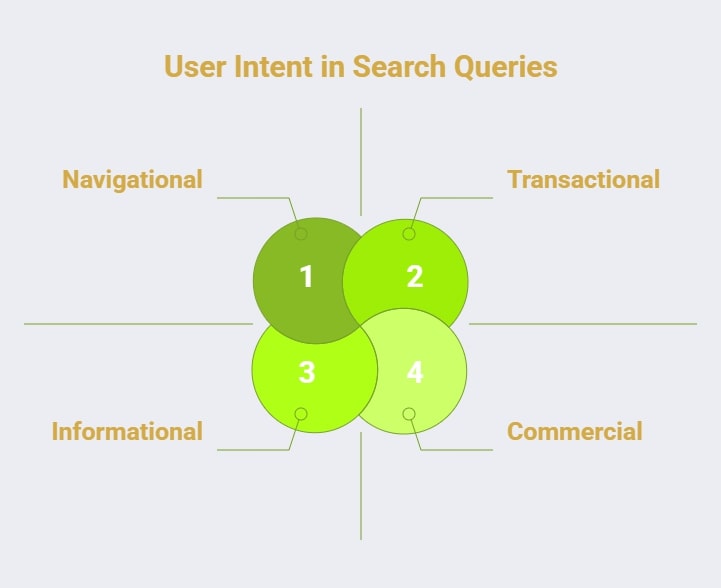
For leaders, this is not a choice between human and machine. It is about knowing when to let AI optimize and when to step in with a human perspective. Marketing campaigns, strategic pivots, and cultural decisions cannot be left to models. They demand human vision.

As Karim Lakhani said, “AI will not replace humans, but humans with AI will replace humans without AI.” That is the essence of the human algorithm. It does not remove human thinking. It elevates it.

The leaders who embrace this approach will not just keep pace with technology. They will shape the future of business by thinking better, not faster.

What Does True Leadership Look Like in the Age of AI?

True leadership in the AI era is not about knowing every tool. It is about setting the compass for how technology is used. Leaders who thrive will be the ones who bring human clarity to machine efficiency.

This means three things:

  1. Leading with vision. AI can generate insights, but it cannot decide which direction aligns with long-term purpose. Leaders must define the “why” before machines help with the “how.”
  2. Making ethics non-negotiable. Algorithms optimize for outcomes, not values. Leaders must ensure decisions are not only profitable but also fair, transparent, and responsible.
  3. Creating space for human creativity. While AI can accelerate analysis, innovation depends on human imagination and emotional intelligence. Leaders must cultivate cultures where people feel empowered to challenge, refine, and go beyond what the data suggests.

The leaders who succeed in this new era will not be the fastest adopters of AI. They will be the ones who use it as a partner while keeping judgment, empathy, and responsibility at the center of every decision.

And they will be the ones who help their teams future-proof their careers in the age of artificial intelligence.

How Can AI Shape the Small Decisions We Make Every Day?

Infographic of how to balance AI and human judgment in daily decisions

Infographic of how to balance AI and human judgment in daily decisions

Balancing AI and human judgment is not just a leadership question. It shows up in the small, ordinary choices you make every day. The challenge is not whether AI can help, but how to use it without surrendering your own judgment.

Here are some examples where the Human Algorithm comes alive outside the boardroom:

1. Deciding What’s Healthy for You

Your smartwatch may tell you that you slept only five hours and should hit 10,000 steps today. That data is useful, but it is not the whole picture. Maybe you need rest more than a run. AI can show you the numbers, but your body tells you the truth.

2. Spending Money With Purpose

A budgeting app might suggest cutting down on “non-essential” spending. But is that weekend art class non-essential, or is it the thing that keeps you inspired for the rest of the week? AI optimizes for efficiency; only you can optimize for meaning.

3. Learning in a World of Infinite Content

AI can summarize books, draft study notes, or map a learning path in seconds. Yet the decision is not what you can learn fastest, but what is worth learning deeply. That choice shapes who you become, and no algorithm can make it for you.

4. Buying Beyond the Algorithm

Online platforms feed you recommendations based on your clicks. It is efficient, but also narrow. If you only buy what AI serves up, you stop discovering new tastes, styles, or ideas. Sometimes the best choice is to step outside the feed and be surprised.

5. Protecting Your Time and Attention

AI schedulers can fill your calendar with “urgent” tasks. But they cannot tell you that dinner with a friend matters more than another email. Efficiency is useful, but attention is precious, and deciding where to spend it is a human act.
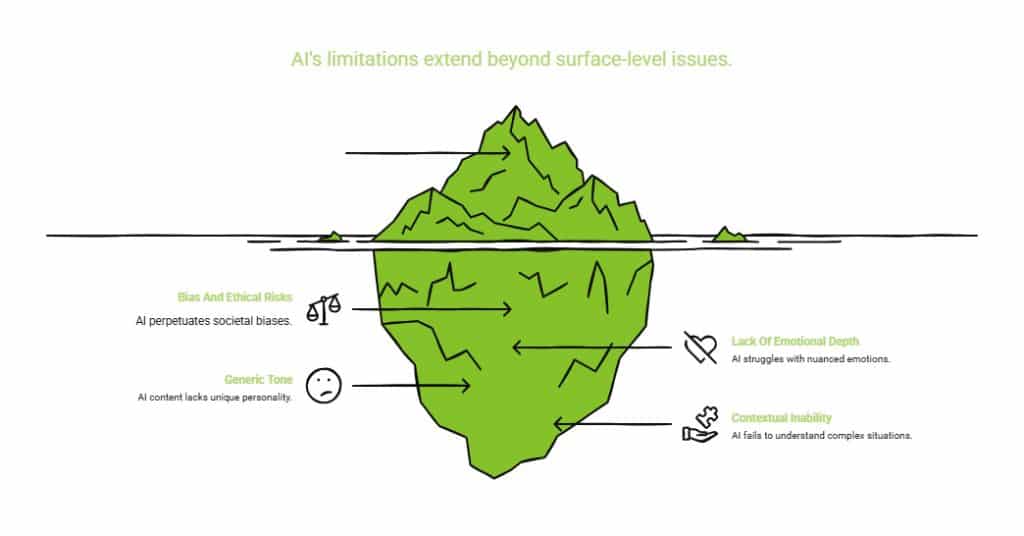
6. Creating Work That Feels Like Yours

Generative AI can draft copy, design slides, or suggest campaign ideas. But left unedited, it is just output. The moment you add your voice, your story, your judgment, it becomes something original. That is the difference between content and connection.
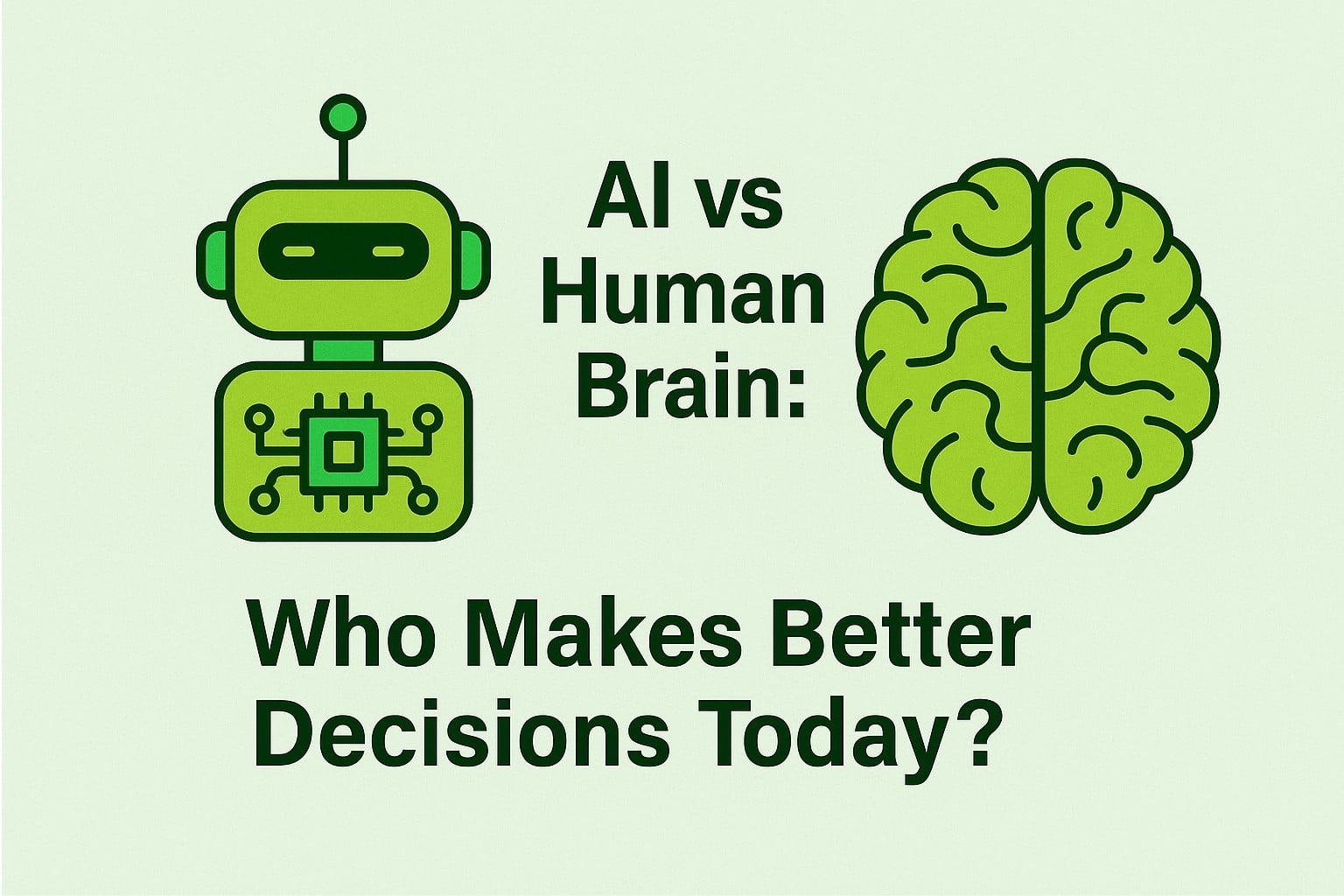
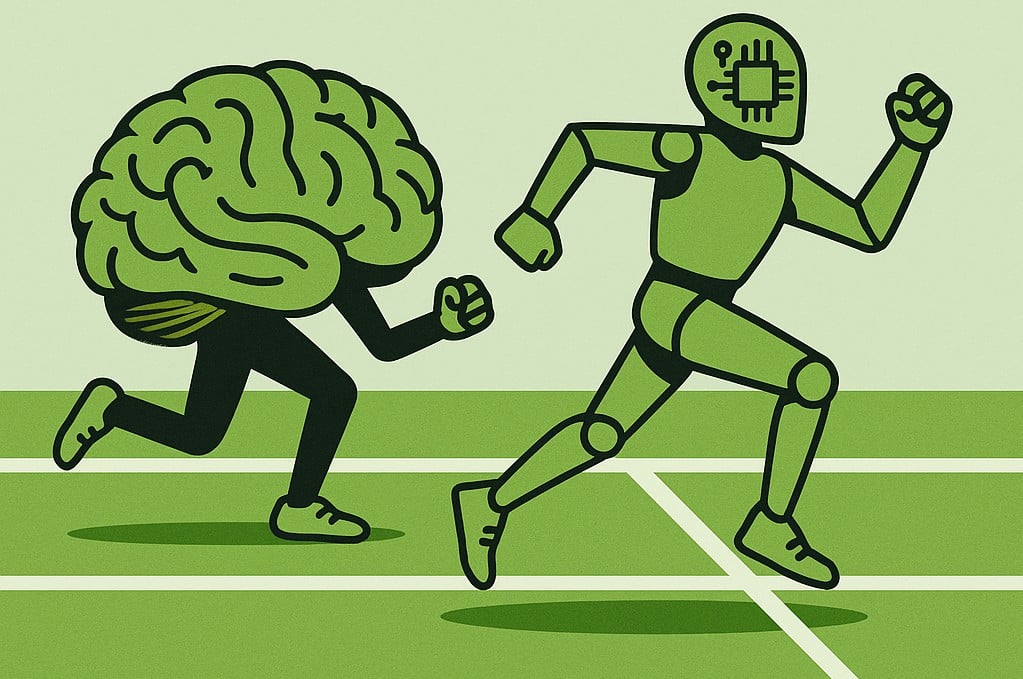
The smartest use of AI in daily life is not about speed or shortcuts. It is about letting machines handle the data while you hold onto direction. When you ask not just “What did AI suggest?” but “Why does this matter to me?” you turn technology into a partner rather than a crutch.

How Is Wild Creek Studio Shaping The Future With The Human Algorithm?

While many businesses rush to automate, Wild Creek Studio asks a different question: how can AI serve human judgment rather than replace it? That question is at the heart of the Human Algorithm, our framework for helping leaders move beyond tools and trends.

At our first Human Algorithm event at IIT Madras Research Park, more than 100 founders, marketers, and decision-makers came together to explore what leadership looks like in an AI-first world. The focus was not on dashboards or hacks. It was on clarity, trust, and strategies that last.

For us, the Human Algorithm is not a campaign. It is a movement. By combining machine intelligence with human wisdom, we are helping leaders shape businesses that grow with purpose and confidence.

If you want to be part of this journey, Connect with Wild Creek Studio and discover how the human algorithm can help your organization think better, not just faster.

Final Thoughts

AI will keep getting faster. Data will keep getting sharper. But leadership is not defined by what machines achieve. It is defined by the choices humans make with them.

The Human Algorithm is an invitation to lead differently. Pause when others rush. Ask the harder questions. Bring judgment, empathy, and imagination into every decision. The leaders who dare to think better, not just faster, will be the ones who shape the future.

Frequently Asked Questions

Can AI make better decisions than humans in all situations?

No. AI excels at data-driven tasks, but humans outperform in ambiguity, ethics, and unpredictable events. Machines process new information logically, while humans apply intuition and context, essential for complex, real-world decisions.

How does human creativity compare to AI creativity?

Generative AI can remix data into creative outputs, but often lacks emotional depth. Human creativity, driven by cognitive processes and diverse forms of intelligence, thrives on originality, refinement, and meaning, areas where artificial systems fall short.

What challenges does AI face when making complex decisions?

AI, rooted in computer science and deep learning, struggles when new or disruptive events arise. Its use of AI depends on historical data, making neural networks less reliable than humans, who can adapt with foresight and intuition.

How do neural networks in AI compare to neurons in our brain?

Neural networks in computer systems mimic brain-like connections but lack true cognitive abilities. Unlike human neurons, which enable complex cognitive processes, AI networks only perform pattern recognition and information processing for specific tasks without intuition or meaning.

Can artificial intelligence ever match or surpass the capabilities of the human brain?

AI powered by machine learning, artificial neural networks, and large language models excels at complex tasks and data-driven problem solving. Yet it lacks adaptability, creativity, and ethical grounding. Unlike AI agents, real brains integrate cognitive functions and diverse intelligences seamlessly.

Is AI as “real” as the human brain?

No. AI systems simulate limited forms of intelligence through algorithms, but they lack consciousness and working memory. The human brain, powered by the nervous system, adapts in different ways, blending emotion, common sense, and lived experience.

What are the energy requirements of AI compared to the human brain?

AI systems demand far more computational power and energy consumption than the human brain. While the brain performs complex tasks with remarkably less energy, AI relies on data centers and hardware to handle cognitive tasks efficiently.

How do brain-machine interfaces aim to synchronize AI and human brain functions?

Brain-machine interfaces connect neural activity and synaptic connections with artificial neural networks and large language models, translating human language into signals that machines process. This enables AI agents to collaborate with people, improving decision-making and extending cognitive capacities effectively.

Does AI work like the human brain?

No. While AI mimics certain brain functions, the difference between AI and the human brain is significant. AI processes data and patterns, while the human brain integrates intuition, creativity, memory, and emotions, enabling more profound understanding and adaptive decision-making.

What is the difference between AI and human intelligence?

The difference between the human brain and artificial intelligence lies in adaptability and depth. AI excels at data-driven tasks, while humans bring intuition, creativity, and ethics. Artificial intelligence and human brain complement each other but are not interchangeable.

0 comments
Newer Posts
Older Posts

Recent Posts

  • Free SEO Audit Tools: Which Ones Actually Help You Grow?

  • Bing vs Google: Which Search Engine Delivers Better Results Today?

  • What Is SaaS SEO and How Can It Grow Your Software Business?

  • What Is AEO and How It Influences AI Search Results?

Recent Case Studies

  • [Case Study] How We Helped a Website Get Back 90% of Lost Traffic by Removing Half Its Content

  • [SEO Case Study] How Wild Creek Web Studio Transformed a Banking Client’s Online Presence

  • [SEO Case Study] How We Drove Growth for a B2B Industrial Client

  • SEO Case Study: How We Boosted Organic Traffic by 49.92% for a Leading Metal Fabrication Manufacturer

Wild Creek Web Studio

Wild Creek Web Studio

With over 18+ years of industry expertise and a roster of 100+ satisfied clients, we specialize in providing top-notch SEO services, SEO consulting, and PPC services.

More About Us
  • Services
    • SEO Services
    • Paid Marketing
    • Social Media Marketing
    • Consulting & Strategy
  • Human Algorithm
  • Free SEO Tools
    • Word and Character Counter
    • Case Converter Tool
    • Color Converter Tool
    • JavaScript Compress Tool
More Web Tools

Latest Blogs

Free SEO Audit Tools: Which Ones Actually Help You Grow?
Bing vs Google: Which Search Engine Delivers Better Results Today?
What Is SaaS SEO and How Can It Grow Your Software Business?
What Is AEO and How It Influences AI Search Results?

© 2025 – All Right Reserved. Wild Creek Web Studio.

Facebook Twitter Linkedin
  • Privacy Policy
  • GDPR Policy
  • Cookie Policy
  • Disclaimer
  • SCAM Alert
  • About Wild Creek
    • Awards
    • Case Studies
    • Portfolio
    • Testimonials
  • Services
    • SEO Services
    • Paid Marketing Services
    • Social Media Marketing
    • Consulting and Strategy
  • Resources
    • Blogs
    • Free SEO Tools
    • Digital Marketing Glossary
  • Contact