Between June and September 2025, Google Search Console recorded 3,424 clicks to wildcreekstudio.com. In the same four months of 2026 it recorded 846, a fall of 75%. Impressions, which count how often our pages appeared in Google results, fell from 2,657,709 to 859,444, a fall of 68% (figures as of 10 October 2026).
A tidy explanation is available: AI Overviews took our clicks. The data does not support saying that, and the rest of this article explains why, using four published studies, Google’s own documentation and our own numbers.
Key Takeaways
- AI Overviews, the AI-written summaries Google shows above regular results, are linked to fewer clicks on websites in all four studies cited here, although the size of the gap differs by method and year.
- The only randomized experiment we found, a preliminary U.S. study of Chrome users, measured 38% fewer outbound organic clicks when an AI Overview appeared.
- Part of the click gap predates AI Overviews. Seer Interactive found that queries that later triggered one already had a lower click-through rate in June 2024.
- Google’s spam policy targets mass-produced pages that add no value to users. It does not turn on whether AI helped write the page.
- Google states that optimizing for generative AI search is still SEO, so ask any provider selling GEO or AEO to name the work that is different.
- Your own Search Console data, with clicks and impressions read together by query type, will tell you more than any industry average.
Why does this matter for your leads and cost per acquisition?
AI changes your numbers where your leads start with an informational question. If those searches now end on the results page, fewer visitors enter your funnel, and the cost of each organic lead rises unless something replaces those visits. If your leads come mainly from commercial searches, the effect depends on how often an AI summary appears on them, which you can check in an afternoon using the checklist near the end.
For a founder or a marketing head facing a board, the useful question is how much of your pipeline depends on the queries affected. Whether AI affects search has already been answered by the studies below.
What is the impact of AI on SEO?
The impact of AI on SEO is the change in how websites earn visibility and clicks now that search engines write answers directly on the results page and software can produce web pages at almost no cost.
Two separate changes sit inside that definition, and agencies often blur them. The first is on the results page. Google AI Overviews are AI-generated answer summaries shown above the regular results, and they often answer the question without a visit to any website. Pew Research Center found that 60% of searches beginning with question words such as who, what, when or why produced an AI summary in March 2025, so informational content feels this first. The second change is on the production side. Software can now draft a page in minutes, which is why Google’s spam policy has become a practical concern for ordinary businesses. Our glossary carries the short versions of the terms used here.
How much do AI Overviews reduce clicks?
All four studies below find fewer clicks when an AI summary appears. The size of the gap varies with method and year, so treat the figures as a direction and not as a forecast for your site.
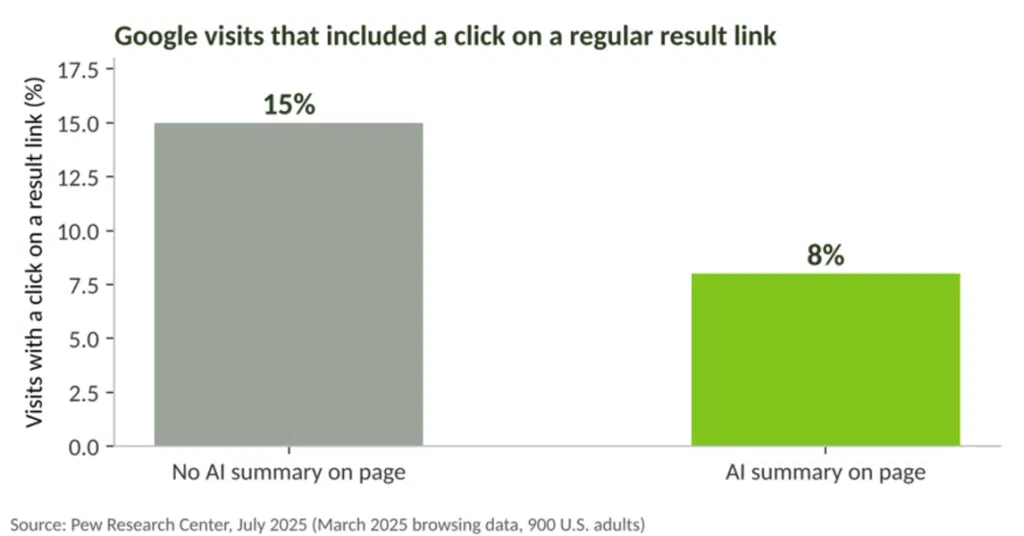
Google users who saw an AI summary clicked a regular result link in 8% of visits, against 15% of visits without one, according to Pew Research Center (July 2025). The analysis covered March 2025 browsing data from 900 U.S. adults. Only 1% of visits to pages with an AI summary included a click on a link inside the summary.
When an AI Overview appears, it reduces outbound organic clicks by 38% and raises the probability of a zero-click search by 33%, according to a pre-registered field experiment by Saharsh Agarwal (Indian School of Business) and Ananya Sen (Carnegie Mellon University) (preliminary draft, April 2026). More than 1,000 U.S. participants were randomly assigned to see or not see AI Overviews over two weeks in January 2026. The authors found no effect on sponsored clicks or on overall search frequency.
That experiment matters because it is the only study here that randomizes who sees an AI Overview, which is the closest any of them comes to showing cause. It also reports that removing AI Overviews did not change users’ survey answers about how easy it was to find information or how good the results were. The authors label the draft preliminary, the participants were U.S. Chrome users recruited through Prolific, so the results may not carry over to other countries. An exploratory third group, sent to a Gemini-powered conversational interface, suggested even larger reductions in engagement with publishers.
| Study | What it measured | Headline finding | Main limit |
| Pew Research Center, July 2025 | Browsing data from 900 U.S. adults, March 2025 | Link clicks in 8% of visits with an AI summary, 15% without | Observational; one month; U.S. only |
| Ahrefs, April 2025, updated with December 2025 data | Average position-one CTR for informational and AI Overview keywords; 300,000 keywords in the original study; desktop Search Console data | 34.5% lower position-one CTR in the original study; about 58% in the update | Correlational; compares actual CTR with a forecast |
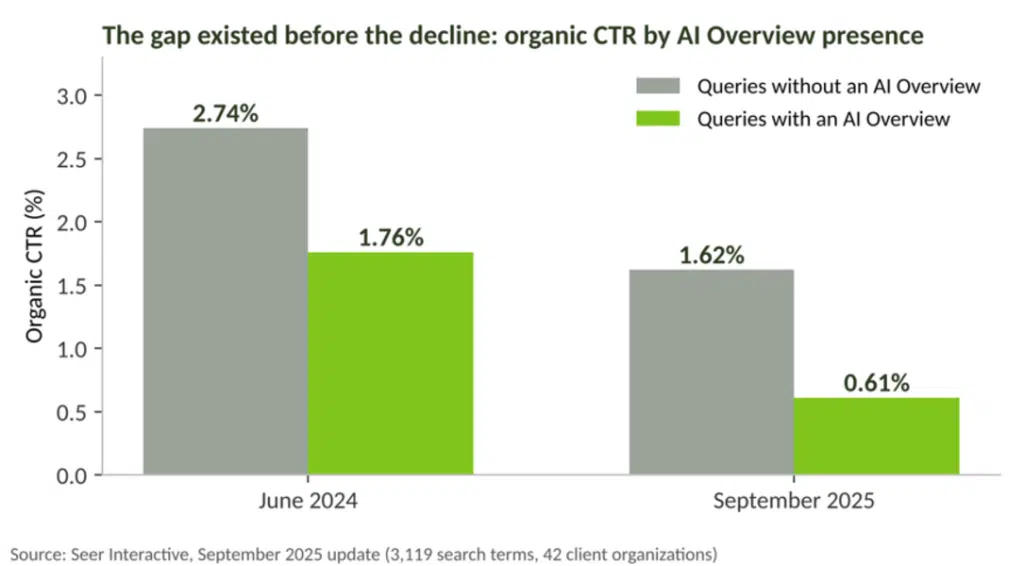
| Seer Interactive, September 2025 update | 3,119 informational search terms across 42 client organizations; 25.1 million organic impressions; June 2024 to September 2025 | Organic CTR of 0.61% with an AI Overview against 1.62% without, in September 2025 | One agency’s client set; Seer notes the gap existed before AI Overviews |
| Agarwal and Sen, April 2026 (preliminary) | Randomized field experiment, more than 1,000 U.S. participants, two weeks | 38% fewer outbound organic clicks when an AI Overview appears | Preliminary; U.S.; Chrome extension; short window |
Table 1. Four studies on AI Overviews and clicks. Sources are listed in full under Sources & Further Reading.
The Seer Interactive data adds a second layer, because it separates brands that were cited inside the AI Overview from those that were not. Seer reports the figures below for the third quarter of 2025.
In the third quarter of 2025, organic click-through rate was 0.70% on queries where an AI Overview cited the brand, 0.52% where it did not, and 1.45% where no AI Overview appeared, according to Seer Interactive (September 2025 update, 3,119 search terms across 42 client organizations). Seer states that it cannot prove citation causes the higher rate, because stronger brands may be cited more often.
What does the evidence not show?
The evidence shows that click rates fall where AI summaries appear. It does not show that AI Overviews alone explain the traffic loss on any given site. Three findings keep that conclusion honest.
First, the gap was there before. In June 2024, Seer measured organic CTR of 2.74% on queries without an AI Overview and 1.76% on queries that later triggered one. By September 2025 the figures were 1.62% and 0.61%. Seer’s reading is that AI Overviews tend to appear on query types that already produced fewer clicks. Second, queries without any AI Overview also lost click-through rate over the same period, which Seer attributes to broader shifts in behaviour, such as people seeking answers in ChatGPT, Perplexity or social platforms before Google. Third, the randomized experiment is the cleanest evidence we have, and it is preliminary.
Our own data adds a complication. By our own calculation from the figures above, clicks per impression moved from 0.129% in June to September 2025 to 0.098% in the same months of 2026. Most of our loss therefore came from appearing less often, and a smaller part from being clicked less often. That is a visibility problem more than a click-through problem, and the cause is not established. Candidates include changes to our own content, changes in how impressions are counted, seasonality and AI Overviews themselves. I would be misleading you if I picked one.
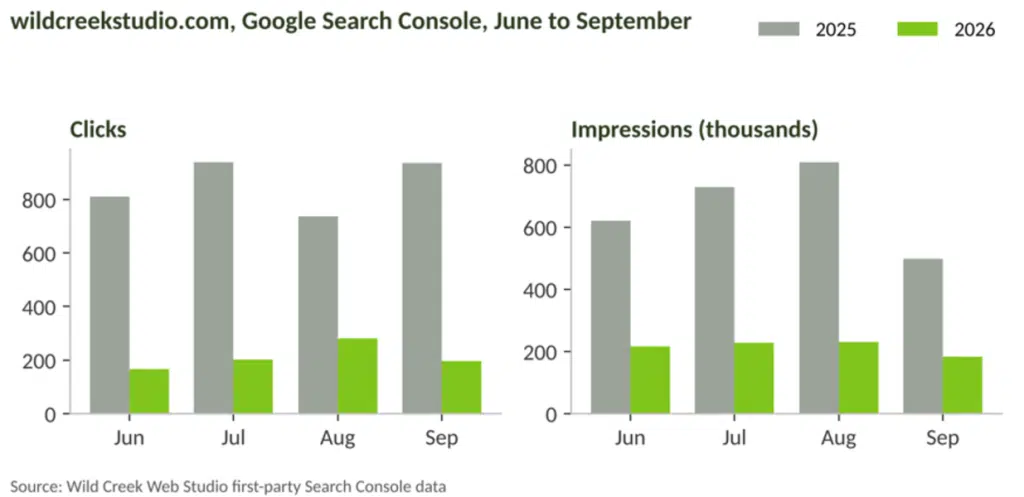
Look at impressions and clicks side by side. On our site, impressions fell almost as far as clicks, which is a different problem from losing clicks to an AI summary.
Does AI-written content hurt your SEO?
Google’s spam policy judges what a page does for users, not which tool produced it. The policy defines the risk precisely: “Scaled content abuse is when many pages are generated for the primary purpose of manipulating search rankings and not helping users.” Its examples include using generative AI tools to generate many pages without adding value for users. Google’s separate guidance on generative AI content adds that generative AI “can be particularly useful when researching a topic, and to add structure to original content.”
The advice that circulated in 2022 and 2023, when this article first appeared, treated AI writing tools as either a shortcut to rankings or a penalty waiting to happen. Neither reading matches Google’s current wording. The failure Google describes is volume without substance. If you publish AI-assisted pages, each one should carry something a generic draft cannot supply, such as first-hand data, a client detail you are permitted to share, or a named author who can be held to the claims. We cover the editing side in human-centered SEO, and we have written up a case study on recovering lost traffic by removing half of a site’s content for readers who already have a thin-content problem.
How effective is AI as an SEO tool, and where does judgement come in?
AI tools work well for speeding up research, clustering keywords, drafting outlines and checking pages at volume, and they work poorly at deciding what your business should say and to whom. That split is the Human Algorithm, Wild Creek’s own working framework for combining what the tools and data say with a human judgement call. It is our practice, not an industry standard, and other practitioners draw the line in different places.
| Task | What the tool and the data do | What a person decides |
| Keyword research | Pull search volume, difficulty and related queries | Which queries sit close to a buying decision in your market |
| Content | Draft structure and summarize sources | The claim the page makes, the first-hand evidence behind it, and whether every fact is true |
| Technical audits | Crawl the site and flag errors at scale | Which fixes affect revenue and which are noise |
| Measurement | Report impressions, clicks and AI citations | Whether a change is lost visibility or lost click-through, as in our own data above |
Table 2. The Human Algorithm split of work between tools and people. Wild Creek’s proprietary framework.
Is optimizing for AI search different from SEO?
Google says no. Its guide to generative AI features states: “From Google Search’s perspective, optimizing for generative AI search is optimizing for the search experience, and thus still SEO.” That statement covers Google’s own features. It says nothing about ChatGPT or Perplexity, whose citation behaviour we did not research for this article.
The same guide describes query fan-out, where Google runs several related searches on the user’s behalf to build an answer. For a lawn-care query, its example shows related searches about herbicides, chemical-free weed removal and prevention. The practical reading is that a page answering the neighbouring questions has more chances to be used than a page answering one. Our guides on ranking in AI Overviews and measuring AI search visibility go through the steps, and our AI SEO and GEO services apply them for clients.
If a provider sells GEO as something separate from SEO, ask them to name the work that is different and the number it should move.
What should you do about it this week?
Start with your own Search Console data, because industry averages cannot tell you which of your queries lost clicks. The steps below take an afternoon and produce one chart you can show a board.
Three mistakes are worth avoiding. Reports show clicks without impressions, so a visibility loss and a click-through loss look identical. Teams publish AI drafts in bulk to make up for lost traffic, which is the pattern Google’s policy describes. And agencies sell a new AI deliverable without naming the metric it is meant to change.
- Export the 16 months of clicks and impressions that Search Console keeps and chart them on the same page. If both fell together, look at content and indexing first. If impressions held while clicks fell, look at which queries now show AI summaries.
- Split your queries into question-style informational searches and commercial searches, and compare the trend for each group.
- Search your ten most valuable informational queries in a logged-out window and record whether an AI summary appears and whether it cites you. Treat this as a sample, not a measurement.
- List every page published with AI help in the last year and mark the ones that contain something a generic draft could not, such as original data or a named expert.
- Ask your agency which work it added for AI search that ordinary SEO does not cover, and which number it expects to change.
Your next step
Build the impressions and clicks chart before your next marketing review, and write one sentence under it saying whether you are looking at a visibility problem or a click-through problem. The two have different fixes, and a report that shows only clicks cannot tell them apart. If you would like a second reading of that chart, our SEO team does this review for clients.
Frequently Asked Questions
Will AI replace SEO?
Google states that optimizing for generative AI search is still SEO, so the discipline is changing and not disappearing. What has changed is where the clicks go and what a report must show, as the studies above indicate. The related question of whether AI replaces the people doing the work is covered in our piece on whether AI will replace digital marketers.
Is AI-generated content bad for SEO?
Google’s policy does not treat AI-generated content as a problem by itself, but publishing many AI pages without adding value for users may violate its spam policy on scaled content abuse. Google’s guidance says generative AI can help with research and with structuring original content. The test is whether each page gives a reader something they could not get from a generic summary.
How do I know whether AI Overviews are affecting my traffic?
Compare clicks and impressions together, by query type, over the 16 months of data Search Console keeps. If clicks fell while impressions held, an AI summary on your informational queries is a plausible cause, and you can sample those queries by hand to check. If impressions fell as well, as ours did, the first place to look is your own content and indexing.
Is GEO different from SEO?
Google treats GEO, generative engine optimization, as part of SEO when it concerns Google’s own AI features. Work specific to other assistants, such as ChatGPT, is outside what Google’s documentation covers, and the evidence for it is thinner. Ask any provider to specify which assistants they target and how they measure results.
Is SEO still worth the investment for a small business?
SEO still produces clicks, but fewer of them on informational queries than before. Pew found that people clicked a regular result link in 8% of visits with an AI summary and 15% without one, so the channel is smaller and not gone. Whether it pays for your business depends on how much of your pipeline starts with informational searches, which is the number to check before you decide.
Sources & Further Reading
- Pew Research Center. Google users are less likely to click on links when an AI summary appears in the results. Pew Research Center, 22 July 2025. https://www.pewresearch.org/short-reads/2025/07/22/google-users-are-less-likely-to-click-on-links-when-an-ai-summary-appears-in-the-results/
- Ryan Law and Xibeijia Guan, Ahrefs. AI Overviews Reduce Clicks by 34.5% (updated: AI Overviews Reduce Clicks by 58%). Ahrefs blog, April 2025, updated with December 2025 data. https://ahrefs.com/blog/ai-overviews-reduce-clicks/
- Seer Interactive. Google Organic CTR Study: Click-Through Rates, With and Without AI Overviews (September 2025 update). Seer Interactive blog, 2025. https://www.seerinteractive.com/blog/aio-impact-on-google-ctr-september-2025-update
- Saharsh Agarwal and Ananya Sen. Google AI Overviews and Publisher Traffic: Evidence from a Field Experiment (preliminary draft). Working paper, April 2026. https://www.tse-fr.eu/sites/default/files/TSE/documents/sem2026/eco_platforms/agarwal_google_search_aio.pdf
- Google Search Central. Spam Policies for Google Web Search. Google for Developers, page last updated 28 August 2026. https://developers.google.com/search/docs/essentials/spam-policies
- Google Search Central. Google Search’s guidance on using generative AI content on your website. Google for Developers. https://developers.google.com/search/docs/fundamentals/using-gen-ai-content
- Google Search Central. Google’s Guide to Optimizing for Generative AI Features on Google Search. Google for Developers, page last updated 10 July 2026. https://developers.google.com/search/docs/fundamentals/ai-optimization-guide
- Wild Creek figures (clicks and impressions) come from the wildcreekstudio.com Google Search Console property as of 10 October 2026. The clicks-per-impression comparison is the our own calculation from those figures.