Wild Creek Web Studio
  • About Wild Creek
    • Awards
    • Case Studies
    • Portfolio
    • Testimonials
  • Services
    • SEO Services
    • Paid Marketing Services
    • Social Media Marketing
    • Consulting and Strategy
  • Resources
    • Blogs
    • Free SEO Tools
    • Digital Marketing Glossary
  • Contact
Do you really need SEO for your business?

Why are SEO services so expensive? Is SEO Really Worth It?

Look at this big fat word called the “Search Engine Optimization”! It isn’t as difficult as you might think. Are you worried about How much SEO will cost you? But, before you decide whether your business needs SEO or not, let us start with a Mini-SEO-Dictionary.
Do you really need SEO for your business?

Search Engine Optimization (SEO) is the process of optimizing your website for search engines like Google, Yahoo and Bing. Search engines use various algorithms to rank web pages based on their relevance. Almost 89% of marketers believe that SEO is a successful strategy.

So here are the 3 main SEO jargons out of our Mini-SEO-Dictionary that you must keep in mind.

Title Tag – They allow companies to accurately describe what their websites contain on the search result pages and help users know what the page is about.

Meta Description – Meta descriptions are a unique type of content that showcases what a specific webpage or web domain can provide. They can be a couple of sentences long, and they normally follow the title tag in terms of the description of the landing page.

Keywords – Words or phrases that allow your website to be found by people who might be interested in the services or products you offer are called keywords.

In this Article

Toggle
  • SEO – the need of the hour
  • SEO – an income and expense!
    • Why is SEO an Income?
    • SEO is a profitable expense!
  • Top 3 factors influencing your SEO costing
    • 1. Location:
    • 2. Your site’s ranking and technical health:
    • 3. The current competition in the market:
  • Why is SEO a long process? Algorithms today!
  • Why should you be hiring SEO experts?

SEO – the need of the hour

Search engines use different algorithms to rank the websites that are most relevant to the search terms. The algorithm looks at the links that point toward a website, the content inside, keywords, and over 200 different ranking factors that play a crucial role. If a website is considered relevant to a search term, then the search engine will rank that site higher in search listings. If you are interested in learning more about the importance of SEO today you can read this article.

The primary focus of on-page SEO optimization is to make sure your website is coded and designed so that Google can easily read it and understand what your website is about.

If you optimize your website properly, you will increase the search engine rankings, thus, increasing your website traffic.

Being up higher on the results helps sell more of your product. It boosts your online brand exposure and reach, allowing you to be seen by more interested customers and convert them into customers.

Although it may seem costly at first, SEO saves money over time because it’s cheaper to advertise through search engines than other channels. Invest in SEO today and receive its benefits in the long run!

SEO – an income and expense!

How much do SEO services cost? – This is the question that most entrepreneurs have in their minds while adopting SEO practices in their business. So in this section let us help you understand how SEO is an investment and an expense.

Why is SEO an Income?

Search engines like Google and Bing are an enormous funnel of potential customers. If a website performs well in search engine results, then it will attract new visitors.

A well-positioned website will generate a huge amount of leads if the right approach to SEO is followed. Search engines are constantly changing their algorithms to reward sites that are valuable to customers.

SEO is a profitable expense!

Organic searches are categorized as a necessary business expense since they drive customers to your website. Without a suitable lead generator, your website is at serious risk of going un-discovered because people will not be able to find it online!

As a result, SEO is an expensive endeavor. But, what if we say SEO services cost isn’t an expenditure but an investment? What? Surprising? Read on then.

SEO is an investment in your future business. Businesses that invest in SEO see a return on their investment in 3 to 6 months (depending on the business category and competition). A ranked product niche can put eCommerce startups in front of their customers in a few months, even if they have just started out.

Top 3 factors influencing your SEO costing

You see, there is no one size fits for all pricing when it comes to SEO. So here are the top 3 factors which will determine your SEO pricing.

1. Location:

The number of local businesses you compete alongside and your company’s geographical location will have an impact on how much an SEO costs. Having your business in busy local neighborhoods may cost more due to the amount of competition and traffic. Thus, location always plays a crucial role in determining the cost of SEO.

2. Your site’s ranking and technical health:

Your SEO costs will be influenced by the health of your site’s technical aspects. Your odds of investing in expensive SEO services are higher if you have a long way to go in ranking your site high. Google’s algorithm changes constantly, so what worked a few years ago may no longer be effective.

There are some instances where your SEO cost may be lower. For instance, if the necessary steps were taken with regards to optimizing your site long ago and only need fine-tuning, or if one is starting with a completely new website. This results in not having to spend time and money on reworking on building something from scratch.

3. The current competition in the market:

Effective SEO pricing starts by evaluating your own goals, resources, and assets. You need to make sure that you take a critical look at the social media campaigns and content marketing strategies of competitors as your base for comparison.

  • See what they’re doing in terms of both quantity and quality of engagement on each platform.
  • Are they using Twitter? If so, how much?
  • Do they have an active Facebook page with several posts and shares per week?
  • Is the company engaging with its community or do they just promote their products?
  • And is the website easy or difficult to navigate through visually?

Ranking highly on Google requires more than just an optimised site and relevant content – any webmaster can do these things with time and effort! How much your site needs SEO depends on how low its current ranking is, and what goals you have for your future marketing efforts. These are a few things that you should consider while doing the competitor research and in return, you will also get to know the estimated cost that you will be spending on SEO.

Below is the list of the Top 6 SEO tools

  • Ahrefs
  • Semrush
  • KWFinder
  • Moz
  • Ubersuggest
  • Google Search Console

Why is SEO a long process? Algorithms today!

The reason why it’s a long process is that many factors affect your Google ranking:

  • Content on your website & how good it is,
  • Links pointing to your website,
  • The relevance of your content,
  • Other relevant factors.

It takes time to test each factor, and the overall effect of each change may not be visible instantly. There is a lot of trial and error and patience involved too. But gaining visibility on Google is a long-term strategy and it would not be wise to expect overnight results.

According to us, Quality content is the real SEO!

Here’s a small case study you will be interested in to know the power and the SEO process.

Nathan Gotch believes that an effective squeeze page explicitly designed to entice readers with a little something extra to opt-in is the key to bringing in new business prospects for your organization. As a result, the question was: how do you create a squeeze page that is a success? To create a 74.5% conversion rate squeeze page, Gotch crafted a nine-step process!

Here are the 9 Valuable lessons that we learned from the case study. These small practices can be a game-changer in your overall SEO success.

  1. It is important to select the right audience for your emails on a squeeze page because this will deter people from mistaking your content for spam.
  2. Offer lead magnets in order to get visitors on their mailing list to opt-in right away instead of boring them with a tedious subscription process.
  3. With all the fancy design templates and graphics-covered pages out there, it can be tempting to want to spend a lot of time on your squeeze page. The best solution is to keep it simple.
  4. Benefit-driven headlines can be used as an effective strategy to make your subscriber feel like they’re getting benefits out of their subscription. This goes along the lines of simplicity.
  5. Pages must be swift, straight to the point and easy to use. No flashy banners or other unnecessary things should be tacked on.
  6. Asking for information visitors don’t want to give (or have already given you) can be a huge turn-off. Besides, answering your questions isn’t always a pleasant activity. Again keep it minimum.
  7. When generating leads and prospects, don’t assume they’re aware of what you’re expecting. As the seller, it is your responsibility to be the one to educate them with each and every step.
  8. “Subscribe” has been a popular call to action for so long. While it’s still one of the most effective words, right now it can be seen as pretty old-school. Instead of saying “subscribe”, ask your readers to join you instead. Nobody enjoys being asked to subscribe.
  9. Every sales page should make a prospect feel comfortable giving you their contact info and be assured that they’re speaking with a professional. If the doubt crosses their mind, stop and start over!

Why should you be hiring SEO experts?

Search engine optimization is complex. You need to know about the latest algorithms and code changes, but this knowledge is continuously changing. There are lots of SEO companies out there, but we’ve got a solution that will make your head spin!

At Wild Creek, we utilize a team-based approach to businesses seeking a competitive edge through digital marketing that extends beyond search engine optimization. We bring together SMO, Web Design and Development to create an effective and efficient plan of attack.

We make sure clients are producing highly engaging content that effectively sells their story on the pages of their website as well as on social media platforms where they need exposure.

0 comments
Top Digital Marketing Company in India - Good Firms

Wild Creek Web Studio Builds your Brands Digital Presence Like No One, says GoodFirms

When it comes to helping a business grow, digital assistance makes sense-through ROI-based digital marketing, leading digital marketing companies to build a stronger and more profitable online presence for their client businesses. Wild Creek Web Studio is a trusted digital marketing partner for many seeking immediate assistance for their online transformation.

Top Digital Marketing Company in India - Good Firms

Driving growth for more than 100 brands from 2003, Wild Creek Web Studio has established itself as a result-driven digital marketing company that thinks, eats, and breathes digital and brings many online promotion services to its customers worldwide. Officially founded in 2009, the company’s headquarters is   in Tamil Nadu, and the company sincerely looking forward to spreading its operations across the globe.

The company believes in getting its client websites to reach the top of the search engines with maximized results and an unmatched reputation in the digital world. For 17+ years, the company has successfully maintained its practice of earning leads up to 5 times its original capacity, and its delighted customer base is 99%. More importantly, the company believes in implementing a holistic approach to market its client businesses and helps grow its web presence. Besides, perfect digital strategy is utilized to grow their customer brands organically. Increasing organic visitors and growing revenues remain the ultimate aim behind all promotional campaigns. The ROI-focused paid campaigns are run to acquire more leads and more conversions.

Exceptional digital marketing services at Wild Creek are made available based on a 360-degree approach. They have perfected their methods to meet clients’ needs, specifically looking for SEO, Facebook Ads, Google Adwords, and more. From sustaining organic traffic through SEO to gaining high-quality visitors using paid ads, the company plugs and plays the right tools for brand promotion. Unique web and social media content are crafted to fit your brand and voice, and significant digital space is leveraged by shaping the available data and analytics. The company provides an in-depth consultation using in-depth insight, targeted solutions, and market positioning.

Wild Creek Web Studio works hard to establish the brand identity of its client businesses. Its significant contribution can be seen in the online reputation management practices undertaken by the company to help companies establish their digital footprints. The company is admired and recognized worldwide by global businesses and third-party companies. It aims to be the most promising digital marketing company in India in the GoodFirms ranking list, the finest review and rating firm in the world.

About the Author

As a Content Writer at GoodFirms, Anna Stark bridges the gap between service seekers and providers. Anna’s dominant role lingers to form every company’s achievement and critical attributes into words. She strongly believes in the charm of words and equips new approaches that work with concepts, something new to create, and something unique to enhance the firm’s identity.

0 comments
Blogging - How many blog posts each month

Blogging – Frequency and Relevance Every Business Needs To Know

The vastness of the internet is unimaginable – nearly 1.14 billion websites with over 50 billion webpages! With the advent of new industries like Automation, Artificial Intelligence, Big Data, and BlockChain, and increased competition among others like retail, manufacturing, electronics and eCommerce, it has become exceedingly challenging to differentiate yourself from the rest of the pack.

Needless to say, an online presence is a must if you are in business – small, medium or big. Nowadays, an online presence doesn’t mean just maintaining a website and showing all your products/services, an ‘About Us’ and a ‘Contact Us’ section. You must have a website that is engaging, motivating, and informative. One foolproof way to attract new customers and build a solid online presence is by frequently publishing blog posts on a website.

Having a blog section on your website increases your reach by leaps and bounds. Blogging on your website about your product/business drives up to 67% of traffic. And good traffic means a higher conversion rate. So if you’re not blogging, it’s like throwing money away. And why would you not want to get in on the bandwagon?

Blogging - How many blog posts each month

Blogging Regularly

Regular blogging makes your website more relevant. It helps your website rank higher on SERPs while converting searchers into customers. Blogging statistics (published in 2022) revealed that on average, 61% of online users purchase a product after reading an informative blog. When readers get first-hand information about a product, industry trends or vital information, they start trusting the company. This trust later transforms into brand loyalty.

Blogs also help keep your target audience engaged. A well-written blog answers several doubts that tend to go unnoticed. For example, customers of Microsoft could greatly benefit from reading a blog about the breakthroughs the company is making on AI and Machine Learning, two niches that are hot in the world market now.

Now that we’ve established the importance of blogging, how frequently you should blog is the next question.

In this Article

Toggle
  • Key Factors That Determine Blogging Frequency
    • Resources and Blog Goals
    • Target Audience
    • Business Model and Niche
  • Quality over Quantity
  • SMM and Blogging
  • Conclusion

Key Factors That Determine Blogging Frequency

An ideal blog post frequency is subjective. It differs based on niches, target audiences, and many such important factors.

Resources and Blog Goals

Some businesses require publishing a blog daily while others require one or two per week. Therefore determining your blog goals well ahead of the commitment can help you handle the work better. Consider investing in correct SEO tools that prove effective for your blogging goals. Never exhaust the writer’s resources by bombarding them with too many irrelevant topics. Thorough research and development are key to successful blogging strategies. Be aware of the changing scenarios in your industry, generate new relevant ideas, edit and repurpose irrelevant or older blogs, and have a scheduled publishing cycle.

Target Audience

Now, this is a crucial step. Before starting on the blogging journey, make sure to have your target audience at the forefront of your mind. Figuring out customer’s needs and doubts and having a basic understanding of the buyer mindset will help you determine the blog topics and concepts. If yours is a niche that is constantly evolving and is home to a wide range of customers, then your blogging frequency should be relatively higher, sometimes even once every few days for you to stay ahead of the competitors.

Business Model and Niche

As mentioned earlier, each niche requires a different approach. A clear-cut business model will help you answer a lot of customer’s questions and provide perspectives that you never knew existed. Based on this, you can develop and hire the required resources (for example, a content writing company focussing on technical writing). The more pages your website has the better, as it provides curated spaces for your customers to explore and buy.

Quality over Quantity

This cannot be said enough. There are over 570 million blogs on the internet as of 2021, but how many get seen and how many stay in trend are what’s important. Any business can have blogs that go up daily but blogs that make the conversion are the ones in which great efforts have been put into.

Search Engine Optimization (SEO) is at the top of every digital marketing strategy. A carefully crafted blog with the right use of SEO keywords will make your website authentic and generate organic traffic. Once you’ve managed to get organic buyers interested in your product, sales should come as easy as pie.

Creating backlinks to legitimate websites makes your site trustworthy. Backlinking also gives you a higher ranking and search engines will automatically begin to boost your website (or brand). In order for blogs to flourish, groundwork – aka content strategy is vital. A killer content strategy widens your market, generates steady flow of potential customers, and broadens revenue mediums.

SMM and Blogging

How often do you dive into Instagram, FaceBook or Twitter? We bet it’s way more than you go to a company’s website! Social Media Marketing makes your brand relatable. When an audience is constantly reminded of your brand, they are more likely to purchase your product. This simple strategy can be achieved with the right SMM strategies. Sharing snippets of blog posts on the right social media handles raises the customer bar for newer, trendier, and millennial customers. It also increases the click rate, and more clicks just mean more business right? Blogging about the purpose of your brand and its ideologies will create an emotional connection with your TG and could also nurture genuine lead development. And this broadcast on your social media handles creates brand awareness. SMM helps you keep track of current industry developments and deals. It also offers you a sense of what your audience really needs.

Conclusion

With all this being elaborated, blogging about your brand, its products, its associates and achievements helps people get familiarized and accustomed to you. A well-informed consumer is always the one who is willing to invest in the right products. Therefore with these pointers, we hope that you can find out exactly how frequently you should blog. And with the help of experts in the digital marketing industry, there is no stopping the success of your business. So here’s to you, happy blogging!

0 comments
Learning and Development Company Lead Generation Case Study

(Lead Generation Case Study) How We Generated Leads with 8000% ROI for a Learning and Development Company

1 year ago, we were contacted by a learning and development company to generate leads for an upcoming experiential learning program. Unlike other L & D training programs, this was a premium training offered to a specific set of entrepreneurs, business owners and leaders of various organizations.

In this Article

Toggle
  • Background:
  • Challenges identified by Wild Creek:
  • Wild Creek Digital Strategy and Solution:
  • Results Achieved:
  • Conclusion:

Background:

The company is a leader in the learning and development space for over 18 years helping individuals, businesses and organizations through ROI driven powerful learning strategies for peak performance & growth.

In the post-pandemic world, they had launched a new training program for business leaders combining travel and nature to de-stress, re-energize, get clarity, and see the world from a new perspective.

They wanted to generate high quality leads for this unique training program.

Challenges identified by Wild Creek:

After a discussion with the client to understand the requirements, we identified a few challenges using our Digital Diagnostic Framework.

  1. Brand Awareness – Even though the company was in the business for over 18 years, it was entirely driven by the personal branding of the founders.
  2. Target Audience Segmenting – As this was a premium program, targeting the right audience was highly critical.

Wild Creek Digital Strategy and Solution:

For this lead generation campaign, our goal was to find decision-makers who would be interested in this premium training program.

To achieve the client’s goal and to make the lead generation process more effective, we implemented our unique 3-Step Process to address the challenges faced by the client.

Step #1 – Target Audience: Our first step was to define & refine the primary audience who are leaders, self-learners, interested in personal growth and could be interested in a program like this.

Step #2 – Awareness: To improve the lead generation process, we worked with their branding consultant and created content to publish on their social media channels, specifically Facebook & Instagram.

These posts were then promoted to the audience identified under step #1 as part of our lead generation strategy.

Step #3 – Automated lead generation:  Once we had sufficiently warmed up the target audiences, we started a social media lead generation campaign with a simple and clear value proposition.

This entire process was automated so that the client would be able to process these leads in the least amount of time.

Results Achieved:

  • 39,734 People Reached
  • 59,569 Ad Impressions
  • 255 Facebook Leads
  • 3% CTR (a good CTR for Facebook ads is between 2-5%)
  • 6% Conversion.
  • 8000% ROI

Social Media Lead Generation Case Study Screenshot

Conclusion:

By the end of the customized campaign, with a targeted approach to improve awareness followed by a lead generation activity, we were able to provide the client with an 8000% ROI.

Do you need help generating leads for your business? Contact us today, and let’s discuss how we can work together to reach your goals!

0 comments
Get Your Business Ahead of Competitors With This Tested Research on Brand Positioning

Get Your Business Ahead of Competitors With This Tested Research on Brand Positioning

Brand positioning has an extensive effect on the market. It’s one vital factor that influences customers whenever they have to make a choice and select one product over another. It’s the reason why certain companies get all the love from super customers while others feel mostly ignored by their audience. It’s what sets successful businesses apart from those that are utter failures? 

And every aspiring entrepreneur, especially you, must understand that great results in business aren’t a product of luck but rather of branding and brand positioning.

Now, 95% of customers are subconsciously attracted to strong, well-positioned brands. So, whatever your sector or specialty, effectively establishing your brand position will provide you with a competitive advantage in the oversaturated market we currently find ourselves in.

And to assist you in determining which position is appropriate for your company, we carried out extensive brand positioning research and unlocked the secrets of how to accurately position your brand. 

But before moving on, let’s take a quick look at brand positioning.

In this Article

Toggle
  • What Does Brand Positioning Actually Mean?
  • Why It’s Critical to Position Your Brand
  • Here’s Why This Survey is Necessary
  • Why did We ask This Question?
  • Here are the Findings From our Survey
  • This is What it All Means
  • Here’s How it Plays out in Reality
  • However, is There Another Way? 

What Does Brand Positioning Actually Mean?

The significance of brand positioning in the marketplace and the reasons why a company has to have a distinctive position in the crowded market of today are often lost on new business owners.

Simply put, brand positioning is the position your brand occupies in the minds of your target market. It’s how clients react to and engage with your offerings, as well as how your brand differentiates itself from competitors. For every marketing strategy to succeed, it must clearly position a brand.

Brand positioning is oftentimes problematic since it occurs whether or not you want it to. No matter what image you have of your company, your target market will categorize any company they come into contact with based on elements like cost, tone, marketing, packaging, office design, domain name, and website. 

It’s worth noting that “automatic positioning” takes place when a business doesn’t intentionally brand itself or when its goods or services aren’t excellent enough for buyers, and they write it off in their thoughts.

To avoid getting automatically positioned, you must intentionally develop a strong brand identity for your company. And that begins with getting a great crowdsourced business name. 

Why It’s Critical to Position Your Brand

Why It's Critical to Position Your Brand

Many businesses, like Juicero and Essential Items, made the mistake of developing goods that didn’t appeal to their target market. This ultimately resulted in their downfall very rapidly. 

New entrepreneurs must make an effort to offer exceptional products that solve a particularly upsetting problem if they want to stand out in their industry. That’s exactly what today’s leading brands like Netflix, Amazon, and Tesla did during their early days. 

And the greatest method to convey your brand’s uniqueness, beliefs, and integrity are via positioning. But in order to achieve this objective, you must first pinpoint your target market and discover the brand positioning they are drawn to. And here’s where our survey comes in.

Here’s Why This Survey is Necessary

Our goal was to determine which brands people favored and how their choices varied based on their age and demographics.

This understanding can help you choose a position that is acceptable for your brand, regardless of whether you run a small, moderate, or large firm or are thinking of branding or rebranding an already existing one. 

But in order to reach the objectives of our poll, we had to ask American consumers: “Would you prefer to support a contemporary and inventive corporation or a historic and recognized organization?”

Why did We ask This Question?

Recognize that selecting an engaging tone for your firm is one of the most important and significant decisions you’ll need to make while creating or reviving your brand. This decision is important since it aids business owners, product managers, and brand managers in determining the course of their organizations.

Consider how these companies would have fared if:

  • Steve Jobs had chosen the name Executex for his company and not Apple. 
  • The name of Ayds diet candy had changed to something sweeter.
  • Phil Knight hadn’t replaced Blue Ribbon Sports with Nike.
  • Shoestore had remained Shoestore instead of Zappos
  • Jeff Bezos kept Cadabra as his company name.
  • Hydrox had chosen an attractive name.

Understand that your brand’s tone influences your company’s personality, visibility, and the feelings that customers get when they think about it. You must give careful consideration to your tone while naming and branding your company.

Here are the Findings From our Survey

Even if the survey’s findings were partially expected, they were nevertheless somewhat startling.

Our findings from the 301 individuals are as follows:

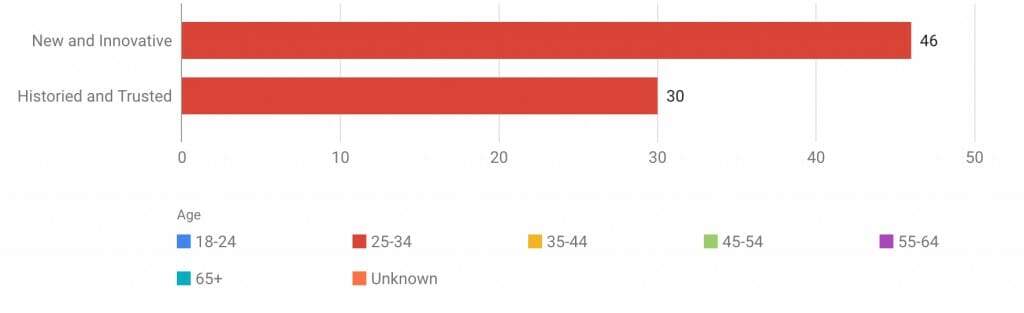
  • Young individuals (ages 25 to 34) strongly prefer young startups and modern businesses. In this area, more than half of our survey respondents chose new, cutting-edge brands over classic and time-tested ones.

Young individuals (ages 25 to 34) strongly prefer young startups and modern businesses.
Courtesy: Squadhelp

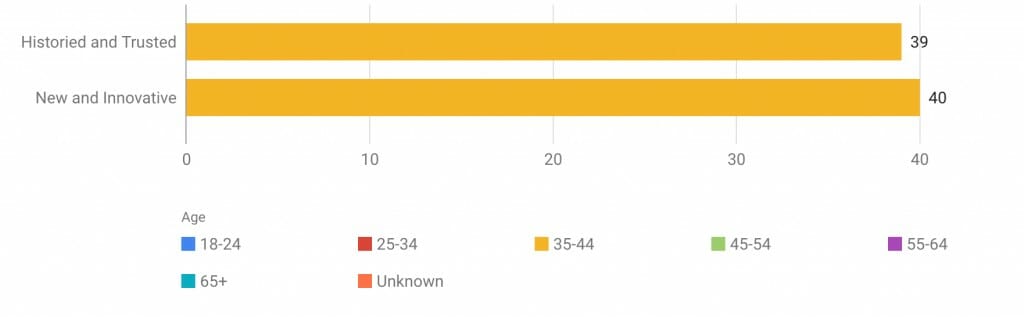
  • Younger consumers (35–45) preferred modern, innovative, cutting-edge businesses over established, well-respected ones. It’s crucial to remember that the group was evenly split between the two choices.

Younger consumers (35–45) preferred modern, innovative, cutting-edge businesses over established, well-respected ones.
Courtesy: Squadhelp

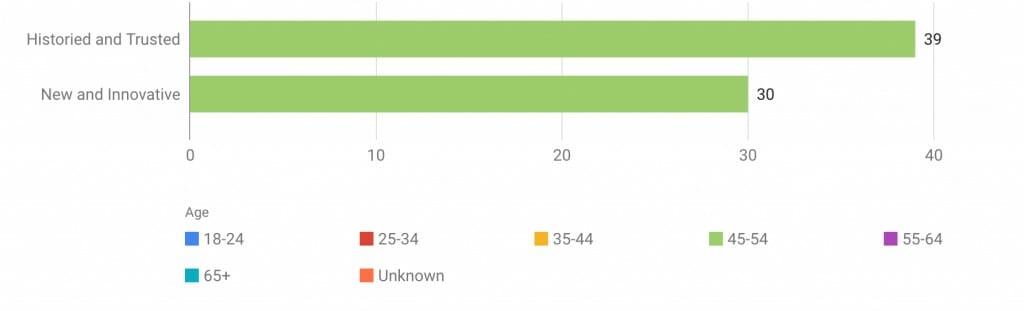
  • Customers within the age brackets 45–54 and 55–65 expressed more interest in well-known companies with a trusted track record of dependability.

Customers within the age brackets 45–54 and 55–65 expressed more interest in well-known companies with a trusted track record of dependability.Courtesy: Squadhelp

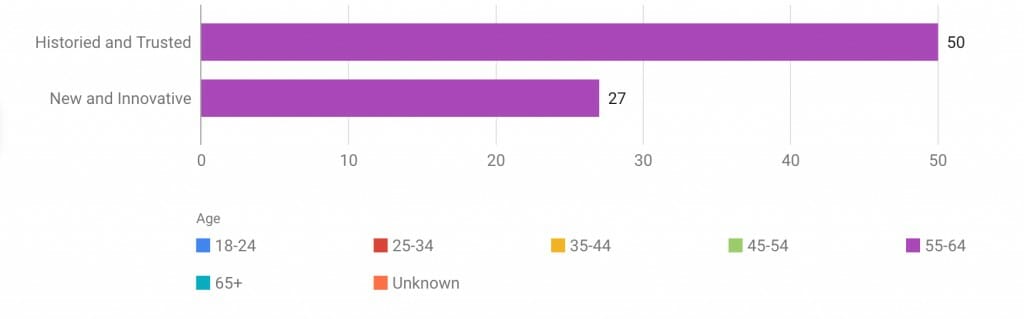
  • 55 to 65-year-olds were especially drawn to well-known and respectable companies.

55 to 65-year-olds were especially drawn to well-known and respectable companies.
Courtesy: Squadhelp

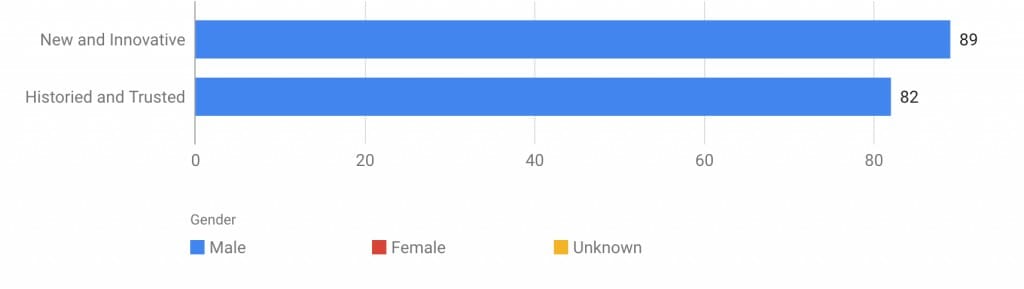
  • The survey found that men had little to no inclination for either a classic or modern brand.

The survey found that men had little to no inclination for either a classic or modern brand.
Courtesy: Squadhelp

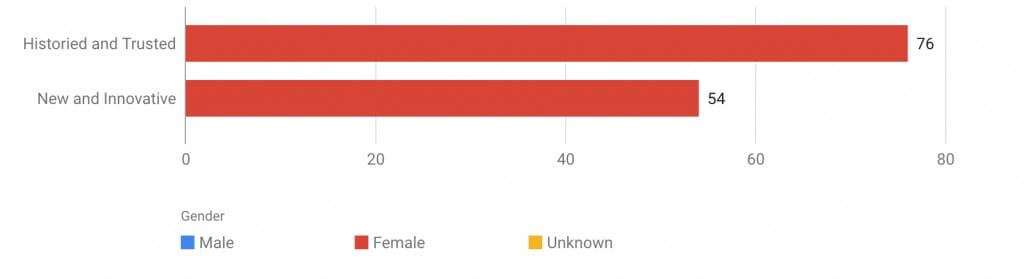
  • The study shows that women favor trusted, established, traditional companies over modern ones.

The study shows that women favor trusted, established, traditional companies over modern ones.
Courtesy: Squadhelp


  • Overall, 153 of 301 respondents chose reputable, classic businesses, while 148 chose modern, cutting-edge firms. The outcome obviously demonstrates that customers are almost evenly drawn to both viewpoints. So focus on picking a position that aligns with the demographic you’re attempting to engage.

153 of 301 respondents chose reputable, classic businesses, while 148 chose modern, cutting-edge firms.
Courtesy: Squadhelp

This is What it All Means

Who are we targeting

The survey’s findings make it abundantly evident that the majority of young people are drawn to cutting-edge and contemporary firms. Therefore, if you’re marketing to a younger audience, consider adapting your business to its target market by giving it a distinctive, modern, and creative brand identity.

However, if you want to appeal to an older demographic, such as Baby Boomers and older Gen Xers, you’ll need to take the conventional approach and give your business a classic name because individuals between the ages of 45 and 65 have a strong affinity for established brands.

The report makes it clear why business owners should think about the tone of their brand and ask themselves, “Who are we targeting?” prior to identifying or positioning their company. 

Here’s How it Plays out in Reality

Lululemon is a fantastic illustration of a firm in a strong position. The unique business model of Lululemon provides much more than just clothing. 

The firm has been providing exciting brand interaction through courses for years, and their partnership with Mirror-a home interactive boutique fitness class-shows that the brand’s creative fire is still blazing two decades after Chip Wilson, the company’s founder, set the tone.

Another top-notch illustration of a well-placed brand is Hulu. The brand made a calculated move by selecting a name that, by being “fresh and imaginative,” shifted the brand’s tone scale from normal to extreme. We can confidently say that they made the proper name choice given their user base of 46+ million users. 

The reason Hulu is successful is that its tone is ideal for both its service and target audience. The bulk of their target market is made up of young individuals, from millennials to Gen Xers, and our poll revealed that this demographic desires a brand that is “modern, creative, and innovative.” 

However, is There Another Way? 

Yes, the smart real estate company, Compass, is a great example of a brand that successfully blends traditional and modern elements into its business. Everyone knows that real estate is a very traditional sector, but Compass appeals to both older and younger customers by bringing some cutting-edge elements into the market. 

Hence, when positioning your company, be careful to identify and build your brand around the demographics of your target market. If you do this well enough, then your business is sure to succeed in pulling the attention and love of your target audience.

0 comments
6 Low-Value SEO Techniques That You Should Avoid at All Costs

Here Are 6 Low-Value SEO Techniques That You Should Avoid at All Costs

You brewed splendid content, kept it visually appealing, practiced the best marketing strategies, and it has still not resulted in SERP? No good traffic to your website and business?

6 Low-Value SEO Techniques That You Should Avoid at All Costs

6 Low-Value SEO Techniques That You Should Avoid at All Costs

Oh! Then maybe, you’ve hit a roadblock with some outdated SEO tactics. What are they? Why is it essential to revisit your existing strategy?

Get going down!

In this Article

Toggle
  • Not all SEO tactics work in favor, said the famous search engines.
    • 1. Never write for search engines, please!
    • 2. Backlinks are a serious thing!
    • 3. Playing the keyword game all wrong
    • 4. Go beyond Google
    • 5. Content Spinning & Plagiarism
    • 6. Outdated Website Design
  • What to do instead? – A quick recap

Not all SEO tactics work in favor, said the famous search engines.

Many web pages suffer from search engine ranking failure. Why’s that?

Change is constant, and the same is true for SEO practices. So, should you be keeping an eye on the ever-evolving practices? Well, that’s a partial yes to that question.

Nevertheless, there are a few low-value or even terrible SEO tactics that you might be ignoring. Check them out.

1. Never write for search engines, please!

Always remember, search engines can’t be fooled. The majority of search engines clearly define the guidelines for optimization. Pleasing SEO for ranking is acceptable, but providing skillful content with valuable information takes priority anytime.

This principle also governs content posting frequency. Search engines often ignore low-quality content. The hack of frequent posting fails miserably if your content quality is not on similar expectations.

Produce consistently valuable content for your readers. It can be just a few times a month too. But what are you leaving for the audience that they would want to get back to you again? It’s like a subtle CTA. Try experimenting with different publication schedules to see what works best.

2. Backlinks are a serious thing!

Backlinks play a crucial role in getting discovered by search engines. They help to build content relevance and domain authority. But the craze of buying backlinks was a long back story. Now, search engines prefer websites that have more backlinks earned than bought.

Nevertheless, backlink slots are still sold frequently. A monthly guaranteed number of backlinks is a great way to ensure your SEO success. But in reality, quality and relevance rarely meet expectations through this approach.

What are you going to do to earn those many backlinks? Businesses can survive without physically acquiring links or buying them. Creating invariant and link-worthy content is the solution.

That simply means striving to bring authority content that makes the audience a part of the journey. It can become a source for them to discover, explore, like, share, trust, and connect with your content in resonance. But, it’s a long journey that requires consistency and commitment.

3. Playing the keyword game all wrong

Just read this sentence below –

Keyword stuffing is bad because keyword stuffing will reduce the user experience and might result in bad keyword practice.

Is something off in it? That’s precisely how search engines feel when content is stuffed with keywords. Sorry to say, but that practice has died out long.

Of course, keywords are the main ingredients in this SEO recipe. But it’s essential to know the SEO tactics to avoid – overstuffing or underusing keywords. So, by that, we also mean the over usage of anchor text.

Outdated and flawed SEO keyword techniques can adversely affect your web ranking and user experience. Search engines know the black hat methods and can penalize your website. Additionally, keyword-driven content is also outdated SEO. It might also miss the search intent.

Use descriptive keywords for anchor text when linking to a page or idea – if needed and only suitable. Relevant, natural, and long-tail keywords which are more organic can gain attention seamlessly. Besides, short keywords are no longer fetching anything since the usage of specific/targeted search intent has become more prevalent.

For example, Google voice search, Alexa, and Echo devices need specific search queries to draw the relevant information. Don’t forget to target each keyword only once. It is actually more detrimental to focus on the same phrase on multiple pages or posts.

Then it becomes keyword cannibalization. You are causing your own web pages to compete with each other and hurt their search engine rankings. So be wary of it and thoroughly check the exact keywords and search intents across the site.

4. Go beyond Google

The majority of people have traditionally focused their SEO efforts on Google. Due to its popularity, this approach may make sense. Nevertheless, shutting yourself off from other platforms can lead to significant traffic loss.

There are a variety of search engines other than Google. Such as Yahoo, Bing, DuckDuckGo, Yandex, etc. Consider optimizing your content for search engines beyond Google. This way, you can diversify your presence across the search engines while attracting traffic.

5. Content Spinning & Plagiarism

Do you know that the most common SEO error is duplicate content? Also, the most outdated SEO practice is to have such content on your website.

Be it ideas, strategies, or simply rewording content can escape direct plagiarism but gives a clear picture in the litmus test by the search engine algorithms.

In today’s world, where we have both free and paid versions of AI content generators and paraphrasing tools, content spinning has become a business of its own, encouraging a legitimate theft of copyrighted content.

We understand that creating content needs ideas. But producing your original still depends on your creativity. Simply repurposing someone’s work can never make you rank higher on the SERPs.

Make sure your articles are unique by refining your brand voice. Make your posts more personal that offer a solution to the reader. Only then can you prevent your website from being downgraded.

6. Outdated Website Design

In simple terms, an outdated website design leads to obsolete SEO tactics. How’s that? Every time the SEO guidelines keep changing, a website needs an improvement on the same level to match the user experience.

A failure which leads to lengthy load times, unpleasant user experience, impacted online presence, faded credibility, low attraction rates, and trust issues. All this can directly influence the user experience and business as a whole.

Websites are the first person modern customers encounter from your business. An updated website design not only works as a facelift but when matched with up-to-date SEO practices, can help in faster page loads, seamless user experience, attractive site performance, and security.

What to do instead? – A quick recap

  • Write captivating, valuable, and fresh content for the audience alone. The search engine rankings will automatically fall in place.
  • Backlinks are invaluable only when earned. Although buying backlinks is a process followed in many instances, never forget their reputation, which compromises quality and relevance.
  • One of the black hat SEO practices comes from keyword usage. Keyword stuffing and overuse of anchor texts result in bad taste, and search engines ignore those web pages. Go with search intent and long-tail keywords that naturally occur.
  • Focus on alternative search engines to have an expanded brand presence and authority.
  • Always curate and create fresh content free from spinning and plagiarism. Make your content a reliable partner for a customer/prospect who wants to vouch for it.
  • A straightforward, attractive, accessible website design can amplify things further.

Finally, SEO is a multidimensional approach. It’s interconnected with many aspects, be it content, user experience, or technicalities. Google or other search engines mainly focus on organizing a content repository based on various parameters to deliver the best answers for any search query.

To do so, they focus on original, qualitative content that brings a new perspective to the reader. The rankings happen with many algorithms behind them. Sure, there’s enough weightage on employing SEO to get featured on the top list. But, there’s more harm in ignoring the unethical SEO practices you should not use anymore.

Now that’s just a confined list of some bad SEO practices to avoid. You need an expert who can guide you to the right ranking approaches. Wild Creek Studio stands as your best partner in all things digital marketing. Want to know more? Get in touch! Are you revisiting your SEO strategy today?

0 comments
Under the SEO Hood - How Effective is AI

How effective is Artificial Intelligence in SEO?

From the characters Maria (Metropolis) and Gort (The Day the Earth Stood Still) to C-3PO (Star Wars) and Agent Smith (The Matrix), humans have dabbled with the idea that intelligent life will exist at some time. That time has now come – Artificial Intelligence (AI) has become a household term these days and has already torn down several technological barriers to help human lives.

Intelligence, Intentionality, and Adaptability are the 3 core qualities of AI, and its applications have reached far and wide across countries and sectors. Transportation, Health Care, Retail & eCommerce, Smart Cities, Cinema, and Telecommunications – the list is too comprehensive to ponder upon. Maybe a little less heard of, but AI has deeply impacted digital marketing as well.

Under the SEO Hood - How Effective is AI

In this Article

Toggle
  •  What is AI-Powered SEO?
  • How AI is used in SEO
    • Text Search:
    • Content Creation:
    • Local Search:
    • Keyword Research:
    • SEO Scaling:
  • Benefits of Using AI for Your SEO Strategy
  • Future of SEO with AI
  • Conclusion

 What is AI-Powered SEO?

Were you baffled when you found news article suggestions on American Politics on your smartphone when you googled Joe Biden a few days back? Or maybe a post on Best Places in India to Travel in Winter appeared when you searched Google for travel suggestions that made you go OMG.

This is SEO in action, powered by AI tools that track your searches, cross-reference it with keywords in recent and relevant articles, and throw you these suggestions. If you clicked any of the suggestions, the AI software in the background knows exactly what to recommend to you for the next few weeks!

Some of the popular AI SEO tools include Bright Edge, Can I Rank, Linkhunter, MarketBrew, Squirrly, and many more. The algorithms in these AI-powered SEO tools are built, tested, and calibrated to become a digital marketer’s delight!

How AI is used in SEO

Currently and broadly, AI tools for SEO are used to increase search traffic, generate content that help rank websites higher, find new outlets for keyword research, manage local/global searches, and help increase ranking for existing and new topics. Here we explore some broad applications of AI SEO that show how effective it can be for your business:

Text Search:

AI in text search learns from a user to provide the most relevant, most useful results the next time the user searches for something. The AI can also automatically adapt, if the user starts a series of different topics.
For instance, if you’re looking to buy a Macbook Pro laptop and you googled only the keywords “macb”, your top results will show the closest shops/stores/e-commerce sites that are selling this product.

Content Creation:

An absolute blockbuster of an application of AI SEO, content creation involves finding the best keywords based on a company’s target group, link-building, keyword optimization, and topic suggestion for specific niches. It’s possible to make several leaps ahead in content creation with AI.

Some AI SEO tools also offer keyword insights that you can leverage to stay ahead of competition and create better content. When customers/users are already on your website, AI can understand their search intent and guide them to the right page. It also aids in getting visual content like graphs, images, and infographics ready for improving user engagement.

And optimization? AI allows your existing content to be repurposed by recommending new and better search terms to be included and the ideal length of a blog or website content.

Note: Mind you, AI does have its limitations in content creation – when content needs empathy, passion and high levels of creativity, human writers will always do a better job!

Local Search:

If you’ve been grinding it online to ensure your company shows up in local SEO searches but haven’t seen much traction, then AI is here to help! AI marketing gives a leg-up to SEO features like SEO audits, Google My Business (business profile, google posts, search engine visibility), and citation building.

Automating local SEO could start with something as simple as a Content Management Software like WordPress or Drupal. These AI-powered SEO software can distribute and coordinate your content over different platforms and can improve overall productivity.

Keyword Research:

Closely tied with all three of the above points, finding the right keywords is something that comes naturally for AI in SEO. There is a bevy of AI-based keyword research tools that can support in picking the best keywords to effectively improve website search traffic and spread them across your website. But it all started with Google’s Hummingbird – which paved the way for semantic analysis capability for search engines.

If you’re a new business and you’ve been trying to research a competitor’s keywords to find out what sticks, then AI might make it much easier for you.

SEO Scaling:

Did you know AI algorithms can crunch large amounts of data created by companies and organize them into insightful information that can help scale SEO efforts? Performing site-wide audits, content repurposing strategy suggestions, resolution of content duplication issues are some of the SEO scaling activities that AI can perform, leading to time-and-money saving for marketing professionals.

Benefits of Using AI for Your SEO Strategy

If you really want to leapfrog competition and stay ahead with your SEO efforts, AI is definitely a must in your digital marketing blueprint. But understanding what it brings to the table is also important. Check out the broad benefits of AI in SEO:

  • Better Ranking: In a lightning-paced technological world, search engines are constantly updating their algorithms and building advanced machine learning tools to ensure that SEO also becomes conducive for companies trying to build their online presence.
  • Faster, More Efficient: It’s a no-brainer that AI can help you become faster, more efficient, and more focussed in your SEO efforts. Through AI-powered tools, tedious and time-draining tasks can be eliminated, allowing you to be more productive in business-related work. AI is also really accurate and up-to-date when it deploys its algorithms in SEO, so you can rest assured that whatever suggestions you get – whether it’s about keywords or a piece of content, it’s for the betterment of your SEO.
  • Enhanced User Experience: Ultimately all businesses are trying to capture bigger audiences, wider demographics, and farther geographies. When the UX part of your SEO is set on an upward graph, you are guaranteed results. With AI, this can easily be taken care of.

Future of SEO with AI

It’s important to note that AI is evolving rapidly, and as we tumble into an era of machine learning, deep learning, and neural networks, accepting and adopting AI in SEO are of paramount importance. For those who haven’t heard – Google’s RankBrain is the AI on the backend that collects, analyzes, and judges content on websites. As this powertrain of an AI tool becomes better (and it will), it will become crucial to get your SEO right.

Content Quality and Link Relevance – these two buzzwords are exactly how you can get your future SEO strategy right with the help of AI. Any average content or mildly irrelevant links in your website or blogs can negatively affect your SEO. For this, a bit of human intervention would be required, as there is a slight possibility of your AI SEO tool throwing you the 1-odd not-so-important keyword or topic.

Conclusion

There is little doubt that AI will touch every aspect of digital marketing in the future, but the preparedness of your mindset, methods, and attitude will determine how seamlessly you and your business can blend into the working of AI. AI is certainly beneficial for SEO, but it has cast shadows of doubts in some people about the security of their jobs. While this may be true for some industries, it may not necessarily affect digital marketing. Last piece of advice? Don’t wait any further to make some inroads into bringing in AI for your SEO strategy.

For more inputs and advice, contact us at Wild Creek Web Studio and see REAL CHANGE in your digital marketing efforts.

0 comments
What is AI's Effect on Digital Marketing

What is AI’s effect on digital marketing?

In 2017, Jimmy got a jerk on The Tonight Show by Jimmy Fallon when Sophia, the robot made with artificial intelligence, said – “I’m getting more laughs than you; maybe I should host the show! No wonder Jimmy felt a jab for his hosting job!

https://www.wildcreekstudio.com/wp-content/uploads/2022/10/Jimmy-Fallon-Sophia-Rock-Paper-Scissors.mp4

Furthermore, “I’m here to dominate humans, too!” – said Sophia making it clear that AI is here to take over the world through its indispensable support in our day-to-day lives. Among many sectors leaning towards artificial intelligence, AI in digital marketing has seen rumbling changes. 

Mimicking humans is cool, but how insightfully are the decisions taken in favor of business and marketing? What are the other benefits of AI in digital marketing, and how will the future be? Wait no more! Let’s scroll.

In this Article

Toggle
  • Artificial Intelligence
  • The Connection Between AI and Digital Marketing 
  • 5 AI-driven Concepts That Have an Effect on Digital Marketing
    • Chatbots 
    • Predictive Marketing
    • Personalized online experiences
    • AI-Powered Content Creation
    • Ad Targeting
  • What Does the Future Hold for Marketers?

Artificial Intelligence

An artificial intelligence (AI) system is an advanced technique capable of performing tasks that generally require human intelligence. The term refers to the creation of systems with characteristics of human intelligence that can comprehend, interpret, synthesize, derive patterns, or become familiar with experiences. Yes, the definition sounds intriguing. But how does it get along with the dynamics of digital marketing? Let’s explore! 

The Connection Between AI and Digital Marketing 

Digital marketing has transformed dramatically over the last five years. Marketing landscapes are becoming increasingly competitive and fragmented, making marketers encounter various challenges.

In such scenarios, how would one maintain relevance and sustainability, strengthen brand loyalty and retain customers? 

That’s where AI and machine learning are instrumental in helping digital marketers be smarter and more effective. Today, AI and digital marketing are inextricably linked.

Since digital marketing activities allow us access to a wealth of data, artificial intelligence can help us interpret that information more effectively to formulate and implement more robust digital marketing strategies.

There are many ways AI can be used in digital marketing today, from implementing programmatic campaigns to AI-enabled customer experience management. From understanding customers to catering to their needs, from reasoning the data to providing insights and more. 

For instance, just imagine how popular OTT platform Netflix is suggesting recommendations to make your watching experience more enriching? An AI works behind the scenes in the OTT business to make these things work via deep learning technology for personalized experiences.  

Okay, that’s quite the jargon. Now, back to AI in digital marketing. Here are more ways AI is transforming this sector on a varied spectrum. 

5 AI-driven Concepts That Have an Effect on Digital Marketing

In 2025, the global AI market is expected to reach $190.61 billion.  A business can use artificial intelligence in two ways. AI forecasts product demand, builds customer profiles, manages ads, and the like on the backend. On the other hand, marketers can use AI to enhance customer satisfaction, leading to stronger brands and more sales. Here are the 5 AI-driven concepts creating ripples in digital marketing.

Chatbots 

https://www.wildcreekstudio.com/wp-content/uploads/2022/10/Hello-I-am-Chatterbot.mp4

In an age of automation, bots have become ubiquitous, particularly in marketing. Chatbots are computer programs that enable a computer to converse with a user. And the best part is automation and bots are invaluable for managing processes and generating leads.

It is possible to program them to respond differently depending on user choice or requests. Users can ask a chatbot what services they want more information about, and the bot will either respond or direct them to better information based on their answers.

AI (artificial intelligence) powers advanced bots, but most chatbots have elaborate conversation trees and specific responses. The main criterion of chatbots is to never miss out on any customer’s needs. It takes care of all things, be it FAQs, helping them navigate through a product/service, assisting in making informed decisions, or marketing your products one-on-one, chatbots cover for you. 

Predictive Marketing

As the name suggests, predictive marketing is the ability to estimate marketing success and prepare the business to ace the future. It estimates future trends by analyzing historical data using data mining, artificial intelligence, and machine learning. Best of all, AI will make it easier for marketers to do so more accurately.

A user’s online behavior is collected by AI every time they browse the internet, and patterns are derived based on the data. In addition to buying frequency, this data reveals the brand preferences of the user. Using AI, companies can better figure out what their customers want. You can predict your target customer’s purchasing behavior with it. It helps companies predict demand and supply, which allows them to manage their production plan.

Personalized online experiences

Are you interested in automating your digital marketing while still keeping it specific? Absolutely, you can. Personalization using AI is an excellent combination for high-grade customization. As businesses compete for clients, they can gain an advantage, boosting sales, and that too after a post-pandemic business setup. Marketers can automate pay-per-click (PPC) ads, conversion rates, display ads, search engine marketing (SEM), SEO, keyword research, and social media marketing (SMM). What? Are you not convinced? 

https://www.wildcreekstudio.com/wp-content/uploads/2022/10/Wanna-see-a-movie-with-me-spongebob-squarepants.mp4
  • From the news headlines that flash on your mobile’s Google discover to the recommendations you receive on online shopping, 
  • From suggesting your type of TV shows/movies to receiving notifications on your awaiting cart, 
  • Suggesting the things you need to buy in your groceries to sending you WhatsApp notifications about “its grooming time.” 

Your data is constantly on the marketers’ radar and so are the AI machines like Alexa and Google echo creepily throwing an ear on your conversations. 

There’s no choice in this, really! You’re just a thought away from realizing the staunch foundation AI is creating in this realm. If that’s not how tailored your life has become, from Bigbasket recommendations in the morning to Nykaa sending nighttime skincare routine, we’re already missing the message – AI’s effect on digital marketing is broader, deeper, and more robust.  

AI-Powered Content Creation

Content creation is a human job. Its creative essence that never dies, and it’s easy to differentiate a machine-made copy from the man-made one. But that’s just an emotional side of a writer pulling one part of a string to your ear. Some recent developments are happening faster on the science side of content, and it’s nothing but AI again. 

Creating content now is not taking days and months. All you need to do is set the context, problem, and solution. Although it’s a hard truth to gulp, and our gut instinct denies it without a second thought, AI is making foolproof copies using solid research and data. Hubspot, Concurred, BrightEdge, Grammarly, and Jasper are a few content creating and strategizing AI-influenced tools that are making their markets lucrative for a wide range of creators.  

Will it chuck the jobs of creative writers? For now, the answer remains a subtle no. That’s a long-term savior – the human touch. 

Ad Targeting

A crucial part of targeted advertising is persuading your prospects. But how do you influence someone you don’t know? No doubt, digital advertising has significantly benefited from artificial intelligence. Platforms like Facebook, Google, and Instagram use targeted marketing as the best possible strategy. Users’ information is analyzed by these platforms, including age, gender, interests, and demographics, to show them the most relevant ads, improving their effectiveness.

Utilizing artificial intelligence can help you create virtual assistants, predict consumer segments, or design smarter approaches to provide personalized customer experiences. Data tailored to a specific market can help marketers predict whether buyers will be interested in purchasing before enticing them with a sale.

Thus, helping marketing professionals to anticipate trends, allocate budgets strategically, and tap the right markets. By doing so, businesses can reduce waste and ensure their digital advertising is effective.

What Does the Future Hold for Marketers?

Nothing wrong with a marketer finding their place uncertain in this paradigm shift. But, the good news is AI can create more jobs than we think it destroys. When the manual tasks are automated, like forecasting and customer segmentation, your focus will be more on dealing with real marketing challenges like strategizing the whole game. Being tech-savvy, learning, and unlearning with the changing marketing dynamics can help you stay abreast of the changes. Even more? Why not get in touch with Wild Creek, which handles all things digital marketing? Contact us today! 

0 comments
Will AI have an impact on SEO Here's what you need to know!

Will AI have an impact on SEO? Here’s what you need to know!

Over eight decades ago, Alan Turing, a British cryptanalyst, paved the way for the idea of artificial intelligence to be born. To quote his wise words ‘What we want is a machine that can learn from experience’ and now that we have built it, we have inferred that AI can not only learn, but it can almost make specific tasks performed by humans obsolete. So, can we say AI is the future? Or is the human race at risk? Well, let’s debate that later.

Now on to the matter at hand. Artificial Intelligence is taking over all avenues possible and is growing at a rapid pace. Ranking number one has become more primal due to the challenging competition. Hence relying on artificial intelligence might seem like the way to go.

Will AI have an impact on SEO Here's what you need to know!

Let’s look at AI-driven content creation. Creating a satisfying, marketing-worthy copy could take long hours for a content writer, but with the help of AI and a few keywords, this task can be achieved much quicker. AI content can increase productivity by automating high-quality, engineered, data-based copies.

In this Article

Toggle
  • How does AI-driven content creation work?
  • Ways in Which AI-Generated Content Affects SEO
    • Moving Away From Black Hat SEO
    • Content Optimization
    • AI Creating Superior Content & Optimal SEO Strategy
  • What Threats Does AI-Generated Content Pose?

How does AI-driven content creation work?

When a marketer puts down specific descriptions like the tone of voice, ideas, and keywords, for a certain product, AI tools generate target-oriented content. It is essentially software that does the work for you. The process uses NLP (Natural Language Processing) and NLG (Natural Language Generation) to create relatable content that feels more human-made. With all the information you’ve provided, it also looks for similar data that the AI has access to and helps build copies that resonate with a potential buyer, thereby, eventually making the sale.

Apart from writing the content for you, it can also provide you with future topics with outlines, bringing to light all the angles that are less explored. For this, the tools might use certain NLP strategies. And with all this power in hand, you can now go on to create copies that not only rank higher in SERPs, but can bring you profits.

One AI-driven tool that is revolutionizing how we create content is the Chat AI PowerBrain app for iOS and Android. This advanced Chat AI application harnesses the power of Chat GPT and GPT-4 to provide lightning-fast, intelligent responses for various writing tasks, from essays and emails to tweets and more. In addition, using PowerBrainAI.com‘s chatbot assistant, you can elevate your writing style and productivity, ensuring your content is engaging, relevant, and tailor-made for your audience. 

Ways in Which AI-Generated Content Affects SEO

While AI tools can help you with the basic grammar checks to generate full-on articles, does it alter SEO? The answer is yes it does. Simply for the fact that Google will not differentiate human inputs from that of a robot. The dispute here is whether to create authentically creative information that will ultimately satisfy the end user or simply optimize it with AI content creation tools.

Google guidelines insist on creating genuine, relevant, and reliable content but like everything else, this policy could also be subject to change. According to the search engines, they will be able to crawl and index your website to the user. The rules around web spam are emerging stricter from Google, so this is also a point to be noted for SEO-generated content.

Moving Away From Black Hat SEO

Black hat SEO is where SEO tactics are manipulated into violating the search engine guidelines and eventually making it possible to rank higher. AI SEO content writing will emerge successful in tampering with this practice, thereby resulting in less will full and faulty SEO. The results of black hat SEO techniques are, however, short-lived. It will eventually produce less keyword stuffing and generate authentic backlinks.

Content Optimization

AI content optimizes your webpage and enables improved strategies, marketing, and quality. According to Adobe’s latest digital briefing, top companies are twice more likely to be using AI to optimize and market their content. AI can pinpoint gaps in optimization thereby nulling errors. With the speed and effectiveness that AI offers, we can manage and eliminate real-time marketing challenges. And we all know that digital visibility amps up your digital marketing strategy.

AI Creating Superior Content & Optimal SEO Strategy

AI and GPT 3 have completely changed the way content is perceived today. Digital visibility is paramount when marketing online. AI can make sure to create and enhance content depending on the ever-changing SEO algorithms. So doesn’t that make all the other problems petite?

AI can be used to create social media copies, meta, content analysis, strategies, understanding user intent, increasing targeted web traffic, and much more.

What Threats Does AI-Generated Content Pose?

Just because Elon Musk said ‘AI is a bigger threat than nukes’ does it make it true? We think it can be partly true, when not monitored ethically. Artificial Intelligence, in this context, is here to enhance the way content is delivered.

Creativity is one of the avenues where an AI could lack the human touch. While an AI can write about virtually anything, it can also get diluted when it comes to resonating with the readers. But is there a way to find out whether what you read is written by a genuine writer or a bot? Well, the chances of that happening are low.

While we can argue that AI content has reached a level of human-generated content, will you pick up a book (‘The day a computer writes a novel’) that was actually written by a bot? While some would, the chances of it sinking into your philosophies are arguably less.

AI has all the power and access it needs to create engaging content, but it is based on clear statistics. And when have we ever been interested in that?

In conclusion, we can say that AI does not pose life-altering threats when ‘handled with care’. It must be what it is, just a tool designed by humans to create and enhance performance.

The Wild Creek Web Studio has a team of award-winning professionals who help accelerate your digital presence and offer proven results to captivate the targeted audience.

0 comments
Become an expert in your niche

Become an expert in your niche – Unveiling the power of authority content!

Let’s say it louder and clearer – keyword-rich content is not a hero anymore!

https://www.wildcreekstudio.com/wp-content/uploads/2022/09/deadpool-shocked.mp4

Surprised? Yes, there’s no longer a need to catch the attention of Google. Besides, fluffing keywords might make you fall into a spammer zone, resulting in the world ignoring your content and the efforts it took. Then, what should be your content marketing strategy? Authority content! Although on a tortoise pace, authority content gives businesses an edge in representing their brand. And rightfully so, audiences want content that solves their problems, not stuff that sells. Seems interesting? Get your coffee!

In this Article

Toggle
  • What is authority content?
    • A trendsetter –
    • An intense investigator –
    • Holistic content hub –
    • Makes you stand out –
  • How to build authority content?
    • Start with intense research.
    • Target your audience.
    • Make it a visual treat.
    • Figures can get attention.
    • Add a face to your content.
    • Get your content to talk.
  • How to improve your content authority?

What is authority content?

Before we understand what authority content is, let’s decode what it is not. Writing for search engines, ranking on SERPs, or simply creating namesake content isn’t enough. Besides, authority content is also free of mistakes, backed by data, and not cluttered.

Authority content is a piece of quality information that can elevate you to a leading expert in your field. It requires no specific marketing as audiences flock to your website for superior content brewing at your end. By definition –

The goal of Authority Content is to consistently create and distribute valuable information, resources, and stories that build interest, awareness, engagement, and conviction, tailored to your target audience, allowing you to identify potential customers of your products or services.

Quite a mouthful definition there, so let’s break it down.

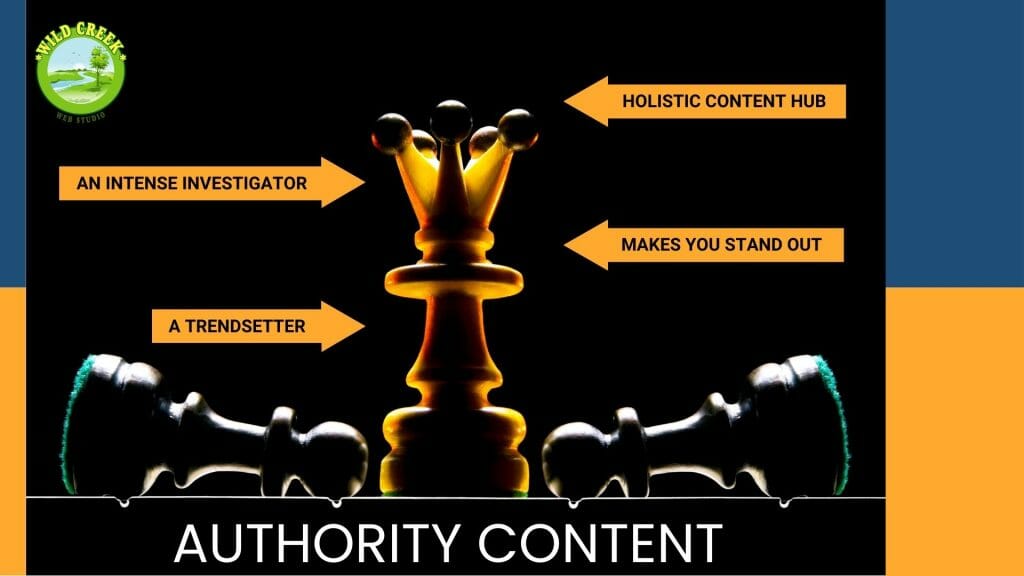
What is authority content

What is an authority content, then? In essence, it is information that brings out thought leadership. Also, it makes your business –

A trendsetter –

If you’re learning how to create great content from your competitor and implementing similar strategies, then you’re probably missing on this authority bus. Authority content is impossible until you change your status from a follower to a trendsetter. By that, we don’t mean to curate “not available on the web” content. But, delivering content that brings your views and uniqueness on an existing industry pain point can set you apart from the pack. Now, this brings down to being an –

An intense investigator –

Generating great content obviously boils down to the research done to bring the best solutions for your customer’s problems. It establishes trust in your brand and helps you achieve a reliable status. Ever observed – “We found in our research that XYZ” – gets more attention than “Our company is an expert in XYZ.” People need trustworthy content which comes from extensive research and accurate information. That will help you create a –

Holistic content hub –

Healthy content is generated with no goal other than providing value to customers. Authority content aims never to market or sell the business but to add value to your customers selflessly. It is about helping them with the information that they need. It could be a how-to video, a podcast, an e-book, a webinar, an engaging speech, etc., that could help you meet their expectations. What else?

Makes you stand out –

Do you know any familiar names in the content marketing industry? Let us give our two cents here. Have you heard about Neil Patel or Seth Godin? While one writes extensively long-form content, the other writes blogs with less than 200 words. But, people always flock to their website for all things content & marketing. Why? That’s because of their originality. They never create content for its sake or catch up with the blogging race. Instead, their focus is to provide value to the subscribers with the right kind of content. Creating original and organic content narrows it to the target readers, who in the long-term (or short) become your leads (undoubtedly).

Now we get your next question, how to do that? Read on!

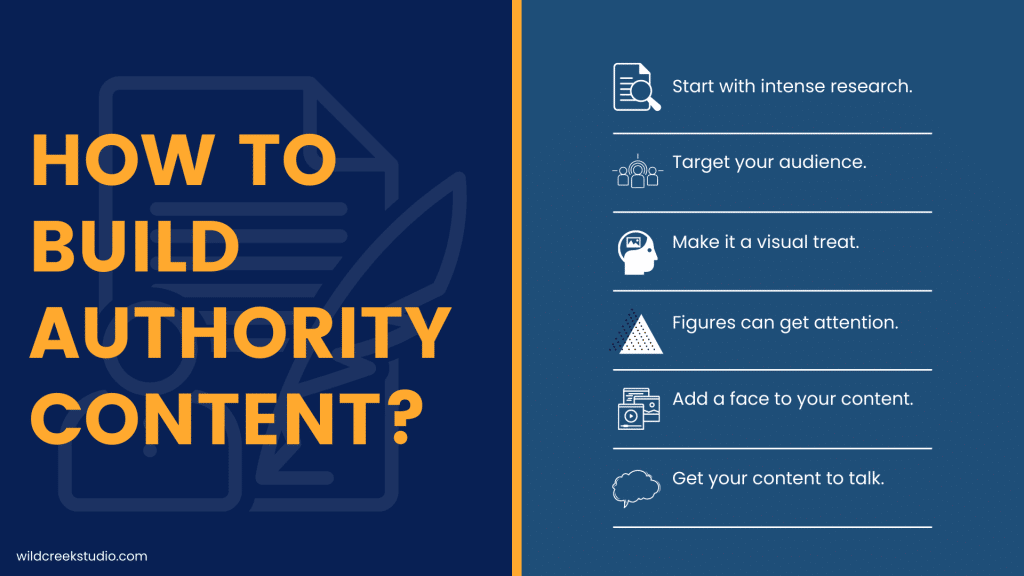
How to build authority content?

Authority content is always provided with experience and passion. As stated, it comes with detailed topical research, top-notch curation, and referencing to authority resources. To make authority content, multiple actions can help you achieve it. Here are a few things that work best for most businesses.

How to build authority content

Start with intense research.

By that, we don’t mean to read the top 10 blogs on the SERPs. That’s not even 1/4th of the content you can help your target audience with. Get to your competitor’s page, and analyze the content they curate. Yes, we mean it. We said examine, not follow! It gives an idea of the taste and engagement customers want in your niche. What’s best you could deliver from your side to drive that traffic to your website? That’s the challenge we want you to look at.

Target your audience.

We understand the temptation to give the best content. We always end up giving more in a single piece. But how specifically are you addressing that issue in a single blog, video, or tutorial? The attention span (usually short) of the audience plays a vital role here. For example, we can write 5000 words when choosing “Fruits” as a topic. Now, if we can break it into a specific parameter, say, “Citric fruits,” it can cut some slack for you. But narrowing it down to something like, “Munch on these citrus fruits this monsoon” can get more attention. In addition, helping your audience understand why they landed on your page and showing them relevant information can help establish authority.

Make it a visual treat.

How much content is too much content? We can safely say a loaded plain text is nothing but skippable content. Research says our brain processes visual information faster than mere text. So, why not cut down a bit of text and offer it in a presentable way?

Figures can get attention.

https://www.wildcreekstudio.com/wp-content/uploads/2022/09/numbers-dont-lie-statistics.mp4

This is an extension of the above visuals. As much as an infographic can concise the text, incorporating relevant statistics to get your readers’ attention can work well too. Stats give a sense of proof to the data provided in your content and help them connect with your information quicker than usual.

Add a face to your content.

Let’s give you this scenario. ‘Authority Content 101 by ABCD website’ or ‘Authority Content 101 by James, CEO, ABCD company’. Which one are you likely to click? The majority of customers trust credible sources to match their problems with solutions. So, when publishing content, it’s always suggested to make sure it goes by the name of established niche experts from your team. It is basically the author, that enhances the authority of your content. They represent your business, expertise, and a reliable solution the customers seek. Credibility matters. For instance, why do we scroll to product reviews on Amazon when we want to buy something? The reviews offer a clear picture and push us to make informed decisions. Isn’t it? That’s the same with content, too.

Get your content to talk.

How engaging is your content? All the figures, stats, research, and face goes in vain if the content is not talking. It should apparently be like a friend who understood your problem. Ever wondered why Hubspot Blogs are a hit? They are usually long-form content but put with a conversational tone. They never miss placing the reader on track at the end of every paragraph. Short paragraphs, intriguing Q & A, and decisive words make them experts in their niche.

Furthermore, consistent scheduling, patterned content, and a unique signature style writing with naturally flown keywords are other ways to build an authority content. Now, if your content authority is already set, how can one improve it? The guidelines await.

How to improve your content authority?

  1. Start with a content audit on your website.
  2. Make a list of content across web pages and categorize it.
  3. Identify your buyer personas and see if there’s a match to the existing content.
  4. Find gaps and bridge them accordingly.
  5. Page load speed also plays a vital role in a better user experience.
  6. Check if the SEO practices are followed – Title tag, meta description, image alt text, and relevant H1.
  7. Keyword strategy plays a crucial role. Like said, do not fluff. Use keywords naturally.
  8. High-quality backlinks often suggest a healthy link profile. Keep an eye out for irrelevant links accumulating over time. A link audit can reveal this.
  9. When all is in place, it’s time to focus on providing relevant and readable content to the audience.
  10. Strategize, implement, evaluate, and repeat.

So folks, to wrap up, Google is an expert search engine that knows the worth of sites that deserve it. The key here is to learn and unlearn constantly. Authority content sells without you specifically working on it. It does get attention for a reason, yes. It establishes you as a thought leader in your niche. However, it does so in a consistent, meaningful, and sustainable way, ultimately leading to results.

Great content touches every level of your marketing funnel effortlessly. From attention to interest and desire to action, the leads are converted into sales with a rightful approach. It also establishes a long-term relationship between a business and a customer. Not to forget about the customer loyalty here. We know, by now, that’s your last sip of coffee and this process looks all daunting, but we have got you covered – Wild Creek, an exceptional digital marketing suite is connecting businesses to customers. Contact us today!

0 comments
Newer Posts
Older Posts

Recent Posts

  • Free SEO Audit Tools: Which Ones Actually Help You Grow?

  • Bing vs Google: Which Search Engine Delivers Better Results Today?

  • What Is SaaS SEO and How Can It Grow Your Software Business?

  • What Is AEO and How It Influences AI Search Results?

Recent Case Studies

  • [Case Study] How We Helped a Website Get Back 90% of Lost Traffic by Removing Half Its Content

  • [SEO Case Study] How Wild Creek Web Studio Transformed a Banking Client’s Online Presence

  • [SEO Case Study] How We Drove Growth for a B2B Industrial Client

  • SEO Case Study: How We Boosted Organic Traffic by 49.92% for a Leading Metal Fabrication Manufacturer

Wild Creek Web Studio

Wild Creek Web Studio

With over 18+ years of industry expertise and a roster of 100+ satisfied clients, we specialize in providing top-notch SEO services, SEO consulting, and PPC services.

More About Us
  • Services
    • SEO Services
    • Paid Marketing
    • Social Media Marketing
    • Consulting & Strategy
  • Human Algorithm
  • Free SEO Tools
    • Word and Character Counter
    • Case Converter Tool
    • Color Converter Tool
    • JavaScript Compress Tool
More Web Tools

Latest Blogs

Free SEO Audit Tools: Which Ones Actually Help You Grow?
Bing vs Google: Which Search Engine Delivers Better Results Today?
What Is SaaS SEO and How Can It Grow Your Software Business?
What Is AEO and How It Influences AI Search Results?

© 2025 – All Right Reserved. Wild Creek Web Studio.

Facebook Twitter Linkedin
  • Privacy Policy
  • GDPR Policy
  • Cookie Policy
  • Disclaimer
  • SCAM Alert
  • About Wild Creek
    • Awards
    • Case Studies
    • Portfolio
    • Testimonials
  • Services
    • SEO Services
    • Paid Marketing Services
    • Social Media Marketing
    • Consulting and Strategy
  • Resources
    • Blogs
    • Free SEO Tools
    • Digital Marketing Glossary
  • Contact