Wild Creek Web Studio
  • About Wild Creek
    • Awards
    • Case Studies
    • Portfolio
    • Testimonials
  • Services
    • SEO Services
    • Paid Marketing Services
    • Social Media Marketing
    • Consulting and Strategy
  • Resources
    • Blogs
    • Free SEO Tools
    • Digital Marketing Glossary
  • Contact
User scrolling modern website desktop

Is Your Scroll Behavior Helping or Hurting UX?

In this Article

Toggle
  • Key Highlights
  • What is The Role of Scroll Behavior in Modern User Navigation?
  • What Defines Scroll Behavior on Websites and Apps?
    • Impact of Scroll Dynamics on User Experience
  • How To Choose the Right Scrolls for Different Uses?
    • 1. Shop Scrolls for Special Events and Ceremonies
    • 2. Purchase Scroll Online for Crafting, Gifts, and Decor
  • Struggling With Website Experiences That Feel Slow or Disconnected?
  • Conclusion
  • Frequently Asked Questions
    • Where can I buy authentic ancient scrolls online?
    • What options are available for purchasing customized scrolls on the internet?
    • How can I find blank scrolls to purchase online for crafts or gifts?
    • Are there reliable websites where I can order scrolls for special events?
    • Which online stores sell scrolls suitable for weddings or ceremonies?
    • What should I look for when buying scrolls online to ensure good quality?
    • Can I order personalized messages on scrolls from online shops?
    • Are there any reputable online sellers for historical or replica scrolls?
    • How long does shipping usually take for scrolls bought online?
    • What are the price ranges for different types of scrolls sold online?

Key Highlights

  • Understanding web scroll behavior and how it impacts your browsing experience.
  • Exploring how CSS and browser settings define how you navigate a page.
  • Discovering the world of physical scrolls, from historical replicas to modern gifts.
  • Finding where to shop scrolls for events, crafting, and decoration.
  • Learning about customization options when you purchase scrolls online, including personalized messages.
  • Touching on historical artifacts like the Dead Sea Scrolls and what to look for in quality replicas.

Have you ever been browsing a page, clicked something for a moment, and returned only to find yourself at the very top again? That tiny disruption feels minor at first, but it quickly becomes one of the most frustrating parts of being online. It slows you down, interrupts your flow, and turns simple tasks into a chore.

What’s interesting is that this irritation isn’t random at all. It’s the result of an underlying pattern that influences how every page moves, reacts, and responds while you scroll. Most people never think about it, yet it quietly shapes whether a website feels smooth, confusing, or downright exhausting.

And once you start paying attention to it, you begin noticing the same pattern across shopping apps, long articles, and product lists. The more you explore it, the clearer it becomes that this hidden mechanism plays a much bigger role in your browsing experience than you might expect.

What is The Role of Scroll Behavior in Modern User Navigation?

Effective scroll behavior is crucial for a positive user experience. When a website remembers where you were on a long list after you click a link and go back, it saves you time and effort. This thoughtful design, controlled by the browser and CSS, prevents the annoyance of having to find your place all over again.

This smooth navigation is especially important in online shopping, where you might be browsing long product lists. As you hunt for the perfect item, whether it’s clothing or even something unique like customized scrolls, good scroll behavior makes the process enjoyable. Many online stores offer a variety of options for purchasing customized scrolls, allowing you to create one-of-a-kind gifts.

What Defines Scroll Behavior on Websites and Apps?

Scroll behavior is essentially how a website or app handles your position on a page. The most important aspect is whether it saves your place. Imagine you’re scrolling through a long article, click a link, and then hit the back button. A site with good scroll behavior will return you to the exact spot you left off. This is often managed through CSS and browser settings to create a seamless experience.

However, sometimes it’s better to reset the scroll position. If content is updated frequently, like on a live news feed, you’d want to see the newest information at the top when you return. The key is for designers to understand what you, the user, are trying to accomplish and program the scroll behavior accordingly.

If your browsing leads you to creative projects, you might wonder how to find blank scrolls to purchase online for crafts or gifts. Many specialty online shops offer blank papyrus or parchment scrolls, providing a perfect canvas for your artistic endeavors or personalized messages.

Impact of Scroll Dynamics on User Experience

Poor scroll dynamics can quickly ruin a user experience. When a browser doesn’t save your scroll position, it leads to a frustrating pattern called “pogo-sticking”, bouncing back and forth between a list and an item page, losing your spot every time. This increases the effort needed to do simple tasks, from reading news to shopping online. You shouldn’t have to resort to workarounds like opening dozens of tabs just to keep your place.

This friction can be particularly noticeable when shopping for specific items. For instance, if you’re looking for scrolls suitable for weddings or ceremonies, you might compare several options. If the page resets to the top each time you view a product, the process becomes tedious. A good user experience depends on these small details.

Many online stores specialize in scrolls for these exact purposes. You can find shops that offer elegant scrolls perfect for vows, invitations, or ceremonial readings, making your event extra special. These stores often provide high-quality replicas and custom designs.

How To Choose the Right Scrolls for Different Uses?

Is Your Scroll Behavior Helping or Hurting UX visual selection

Is Your Scroll Behavior Helping or Hurting UX visual selection

Now that we have shifted from digital scrolling to physical scrolls, let’s explore the different types you can find. When you purchase a scroll online, you’ll discover a world of options, from historical replicas of texts like the Bible to blank scrolls for your own creative use. These items offer a unique way to connect with history or create a memorable gift.

1. Shop Scrolls for Special Events and Ceremonies

Scrolls can add a sense of elegance and history to many ceremonies. Instead of traditional paper, using a scroll for wedding vows, an anniversary message, or a formal invitation makes the moment feel more significant and timeless. Many are made from beautiful materials like genuine parchment or papyrus.

Yes, there are reliable websites where you can order scrolls for special events. Shops specializing in historical replicas or custom stationery are excellent sources. They often cater to customers looking for items for:

  • Weddings and anniversaries
  • Formal award ceremonies
  • Themed parties and events

These online stores allow you to find the perfect scroll to match the tone and style of your event. Whether you need a simple, elegant design or an ornate, historical replica, you can find businesses dedicated to providing high-quality scrolls that will impress your guests and create a lasting memory.

2. Purchase Scroll Online for Crafting, Gifts, and Decor

Beyond formal events, scrolls are fantastic for crafting, personal gifts, and unique home decor. When you purchase a scroll online, you can find blank options that serve as a perfect foundation for your creativity. These scrolls invite you to add your personal touch, whether through calligraphy, painting, or writing.

Finding blank scrolls to purchase online for crafts or gifts is easy. Look for retailers that offer stationery or historical goods. These shops often provide scrolls in various sizes and materials, giving you plenty of choices for your project. You can use them for:

  • Writing personalized letters or poems
  • Creating unique wall art and decor
  • Making props for plays or historical reenactments

A blank scroll is more than just a piece of paper; it’s an opportunity to create something truly special. It can become a heartfelt gift, a piece of art for your wall, or a fun crafting project that connects you to an ancient form of communication.

Struggling With Website Experiences That Feel Slow or Disconnected?

Many brands lose users simply because their pages don’t scroll smoothly, remember positions, or guide people naturally through content. When navigation feels off, even the best design, products, or messaging can’t hold attention for long. Users drop off, engagement dips, and conversion paths become harder to manage.

At Wild Creek Studio, we focus on building digital experiences that feel effortless from the first scroll to the final action. Our approach goes beyond visuals. We look closely at real user behavior, friction points, and micro-interactions to create websites that move the way people expect them to. This helps reduce bounce rates, improve navigation flow, and make every visit feel more intentional and intuitive.

Whether you’re dealing with inconsistent scroll behavior, content-heavy pages, or customers who abandon your site because “something just feels off,” we help streamline the experience so users stay engaged longer and move confidently through your journey.

If you’re ready to create an online experience that feels smoother, smarter, and more aligned with how people actually browse, reach out and let’s improve it together.

Conclusion

A deeper understanding of scroll behavior gives you more control over how people experience your content. Small navigation issues that seem insignificant often shape whether users explore further or leave early, and recognizing those patterns is the first step to improving engagement.

Take time to observe where interruptions happen, where users lose their place, and which pages feel harder to move through than they should. These signals often point directly to improvements that enhance usability without a full redesign. Even simple adjustments to how a page remembers position or loads new content can dramatically improve comfort and flow.

Frequently Asked Questions

Where can I buy authentic ancient scrolls online?

You can purchase scroll online from specialty historical shops that offer replicas of ancient manuscripts. These stores usually provide detailed descriptions, clear photos, and material information to ensure authenticity.

What options are available for purchasing customized scrolls on the internet?

Many online stores let you shop scrolls with personalization options, including custom text, decorative designs, and unique materials suited for gifts, events, or themed displays.

How can I find blank scrolls to purchase online for crafts or gifts?

If you’ve wondered why do I keep scrolling shopping apps for craft supplies, look for stationery or historical goods retailers offering blank parchment or papyrus scrolls ideal for calligraphy, art, or personalized messages.

Are there reliable websites where I can order scrolls for special events?

Yes, several specialty shops allow you to purchase scroll online for weddings, ceremonies, or themed events, offering elegant designs made from quality parchment or papyrus.

Which online stores sell scrolls suitable for weddings or ceremonies?

You can shop scrolls from curated event and stationery retailers that provide beautifully crafted options designed for vows, invitations, or ceremonial readings.

What should I look for when buying scrolls online to ensure good quality?

Check material details, craftsmanship, reviews, and photos before you purchase scroll online, especially if authenticity or durability matters for your project or event.

Can I order personalized messages on scrolls from online shops?

Yes, many shops let you shop scrolls with custom text, allowing you to add names, poems, vows, or meaningful messages for gifts or ceremonies.

Are there any reputable online sellers for historical or replica scrolls?

Collectors can purchase scroll online from trusted historical artifact retailers that specialize in Roman, Egyptian, or biblical replicas with accurate designs and craftsmanship.

How long does shipping usually take for scrolls bought online?

Shipping varies by location and customization. When you shop scrolls from local retailers, delivery may take days, while international orders can take one to three weeks.

What are the price ranges for different types of scrolls sold online?

Prices differ by size, material, and detail. Whether you purchase scroll online or browse specialty shops, simple scrolls start low, while ornate or historical replicas cost more.

0 comments
Illustration of marketing icons

Is 4s Marketing the Upgrade Your Strategy Needs In 2026?

In this Article

Toggle
  • Key Highlights
  • What is the Consumer Journey and Why Does it Matter?
  • What Are the Four Stages: The 4s Model of the Consumer Journey?
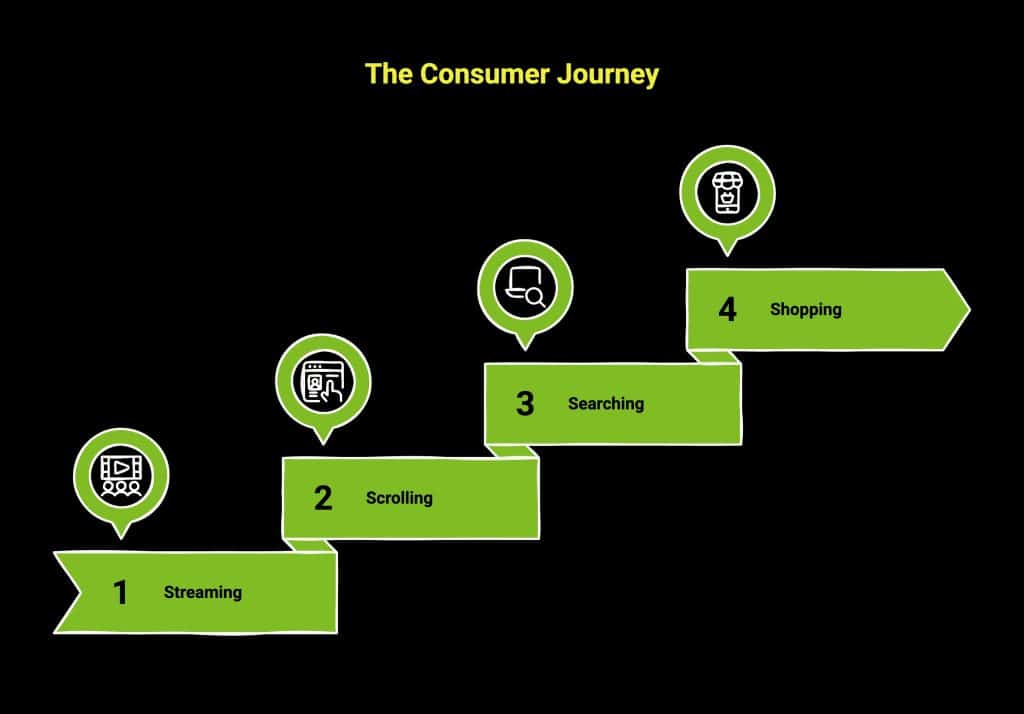
    • Stage 1: Streaming – Continuous Media Consumption in the Digital Age
    • Stage 2: Scrolling – Discovering Products and Services
    • Stage 3: Searching – Intent-Driven Exploration
    • Stage 4: Shopping – Seamless and Nonlinear Transactions
  • Mapping the Digital Consumer Journey
    • How Digital Technology is Transforming Each Stage?
    • Touchpoints In The Digital Consumer Journey
    • Creating An Effective Consumer Journey Map For Your Business
  • Why Wild Creek Web Studio Is the Upgrade Your Marketing Needs?
  • Conclusion
  • Frequently Asked Questions
    • What are the main stages of the consumer journey?
    • How can I create a consumer journey map for my business?
    • What is the difference between a customer journey and a consumer decision journey?
    • Can you explain the McKinsey model of the consumer decision journey?
    • What are common touchpoints in the consumer journey?
    • How do I optimize the consumer journey for better customer experience?
    • Are there examples of effective consumer journey maps I can review?
    • What role does digital technology play in shaping the consumer journey?
    • How do I identify and address pain points in the consumer journey?
    • What are the benefits of understanding the consumer journey for businesses?

Key Highlights

  • The traditional marketing funnel is no longer sufficient for understanding the modern customer journey.
  • Today’s consumers follow a dynamic path defined by four key behaviors: streaming, scrolling, searching, and shopping (4s).
  • Understanding these stages is crucial for improving the customer experience and meeting customer needs effectively.
  • Effective digital marketing strategies must adapt to this non-linear journey to resonate with audiences.
  • By optimizing each stage, you can drive sales, increase customer satisfaction, and build lasting brand loyalty.

Marketers today face a new challenge: customers move faster than the strategies built to reach them. One moment they’re discovering you, the next they’re gone.

What’s driving these unpredictable shifts? And more importantly, how do you create a journey that actually matches how people think, search, and buy?

The answer begins with recognizing a pattern most brands still overlook.

What is the Consumer Journey and Why Does it Matter?

The customer journey is the complete path an individual takes with your business, from their first point of contact to becoming a loyal, repeat buyer. Think of it as a roadmap that includes every interaction, from discovery and research to purchase and post-sale support. While a consumer decision journey often focuses on the steps leading to a purchase, the full customer journey extends beyond that to include retention and advocacy, which are vital for long-term success.

Understanding this journey is essential because it shapes your entire business. Mapping out this path helps you anticipate customer needs and exceed their expectations. A well-designed journey can increase customer satisfaction by 20% and boost revenue by 15%. A better understanding allows you to refine your marketing strategy, lower service costs, and build a base of loyal customers who will advocate for your brand. It’s the key to turning potential buyers into lifelong fans.

What Are the Four Stages: The 4s Model of the Consumer Journey?

Infographic of The 4s Model of the Consumer Journey

Infographic of The 4s Model of the Consumer Journey

Each “S” represents a distinct behavior that defines how people interact with brands online. These actions are not always linear; a customer might jump between them multiple times before making a purchase. Let’s explore what each of these stages means for your business.

Stage 1: Streaming – Continuous Media Consumption in the Digital Age

Streaming is no longer just about watching movies; it’s about the constant consumption of personalized content across platforms like YouTube, podcasts, and connected TV. This behavior represents a new form of the awareness stage, where discovery is continuous and interactive.

Unlike one-way advertising, streaming experiences allow you to engage with your audience actively. Your digital marketing can turn passive viewing into a key customer touchpoint. This is where a consumer might first become aware of a problem they have or a product that could solve it.

To capture attention in this stage, focus on interactive storytelling and AI-driven personalization within your sales funnel. By sequencing your content effectively, you can guide viewers from initial discovery toward making a decision, creating a smooth transition to the next stage of their journey.

Stage 2: Scrolling – Discovering Products and Services

Scrolling is the modern equivalent of window shopping. When a potential customer browses through social media feeds or blog posts, they are often discovering content without an immediate plan to buy. They are absorbing information and looking for inspiration.

However, this passive browsing can quickly turn into active interest. The right visual, a compelling story, or a timely influencer post can instantly spark a potential customer’s curiosity and motivate them to act. This stage is all about capturing attention in a fast-moving, crowded environment.

Your marketing strategy here should focus on optimized and engaging creative. Use strong visuals and clear story arcs to make your brand stand out. This is your chance to plant a seed and address latent customer needs before they even begin actively searching for a solution.

Stage 3: Searching – Intent-Driven Exploration

Searching has evolved far beyond typing a query into a search engine. Today, consumers use a variety of methods for intent-driven exploration, which aligns with the traditional consideration stage. They might use AI tools for conversational searches, Google Lens to identify a product visually, or watch product demos on YouTube.

This behavior shows a clear intent to find a solution. Customers in this stage expect immediate, relevant answers tailored to their specific questions. They are actively comparing options and looking for information that will help them make the best choice.

Your digital marketing strategy must adapt to these new search habits. Optimize your content for multiple search ecosystems, including text, image, and voice. Offering easily accessible information, like reviews and comparisons, can position your brand as the best solution and encourage customers to move toward a purchase.

Stage 4: Shopping – Seamless and Nonlinear Transactions

Shopping is no longer a linear, final step. It has become a seamless and integrated part of the entire journey. This is the modern purchase stage, where transactions can happen at any moment, from a shoppable social media post to an in-app checkout. Impulse buys are common, and the path to purchase is often non-linear.

The expectation is a frictionless customer experience. Any friction can lead to an abandoned cart and a lost sale. You need to make it as easy as possible for customers to buy from you, no matter where they are in their journey.

To increase your conversion rate, integrate shopping opportunities into every relevant touchpoint. Use AI-powered recommendations, personalized offers, and clear calls to action to drive purchases. Ensuring a smooth transaction and accessible customer support channels at this stage is key to customer satisfaction.

Mapping the Digital Consumer Journey

Infographic of the Digital Consumer Journey

Infographic of the Digital Consumer Journey

With consumer paths becoming more fragmented, how can you make sense of it all? The answer lies in customer journey mapping. This process involves creating a visual representation, a journey map, of the various ways customers interact with your brand from start to finish.

A journey map helps you step into your customers’ shoes and understand their experiences, motivations, and frustrations. This practice of journey mapping is essential for navigating the complex digital consumer journey and identifying opportunities to improve every interaction. Now, let’s look at how technology and touchpoints shape this map.

How Digital Technology is Transforming Each Stage?

Digital technology is the engine behind the 4s model, fundamentally changing each customer journey stage. From AI-powered personalization to interactive content, technology allows you to create a more dynamic and responsive user experience. It helps you meet rising customer expectations for speed and relevance.

Your digital marketing efforts can now be more precise than ever. For instance, AI can analyze behavior to serve the right ad during the “Streaming” stage or provide a personalized recommendation in the “Shopping” stage. This creates a journey that feels tailored to each individual.

Technology transforms how you engage with consumers at every step. Here is a quick look at how it impacts each of the 4s:

4s Stage How Digital Technology Transforms It
Streaming AI delivers personalized content and interactive storytelling.
Scrolling Optimized creative and AI-driven personalization grab attention.
Searching AI tools and multimodal search provide instant, relevant answers.
Shopping Seamless social commerce and AI recommendations enable easy buys.

Touchpoints In The Digital Consumer Journey

Customer touchpoints are all the points of interaction a person has with your brand throughout their stages of the customer journey. In the digital world, these touchpoints are more numerous and varied than ever. Mapping them is essential for understanding how customers experience your brand.

Your digital marketing strategy must account for this wide range of interactions. From the first ad a person sees to the follow-up email they receive after a purchase, each touchpoint is an opportunity to strengthen the customer relationship. Social media marketing, for example, can be a touchpoint for both discovery and customer service.

Common touchpoints in the digital consumer journey include:

  • Social media posts and ads
  • Blog posts and website content
  • Third-party review sites and testimonials
  • Email campaigns and customer service interactions

Creating An Effective Consumer Journey Map For Your Business

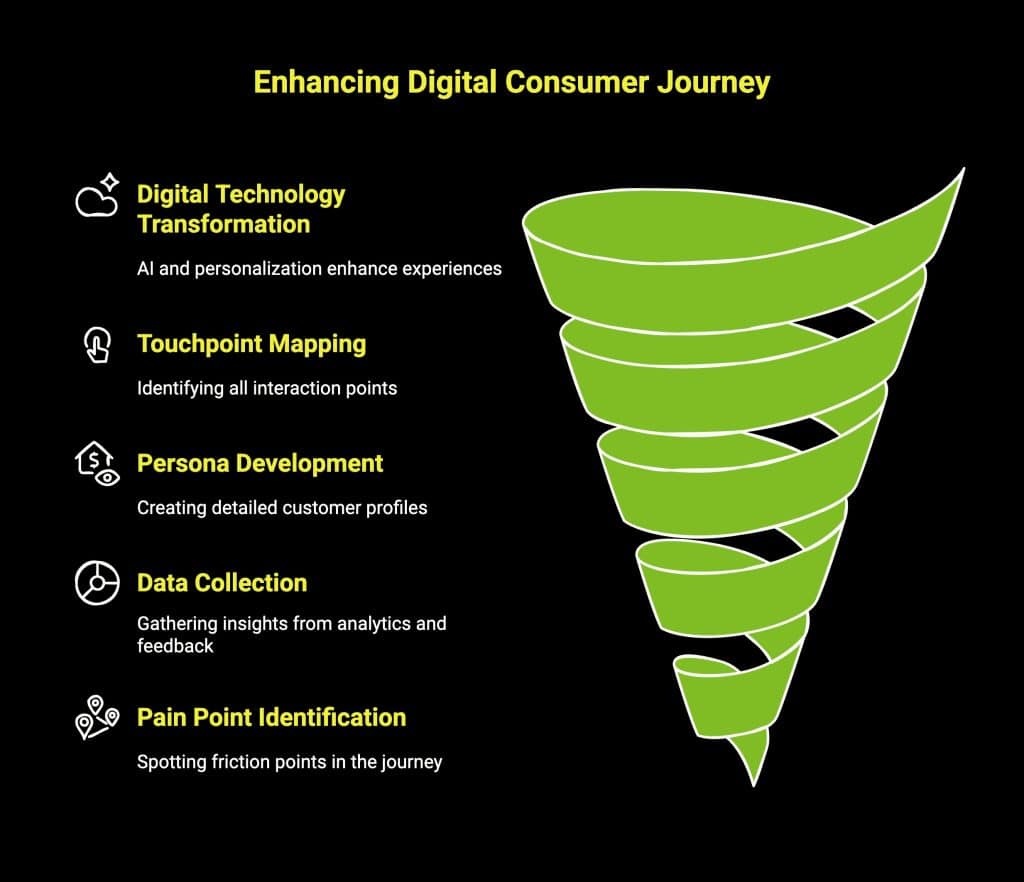
Creating an effective customer journey map involves more than just guesswork. It requires a mix of data and intuition to plot out how your target audience travels along their path to purchase and beyond. The first step is to build detailed buyer personas to understand who your customers are.

Once you have your personas, the journey mapping process can begin. Use data from analytics, net promoter score surveys, and customer feedback to identify all the touchpoints where customers interact with you. This will help you build a comprehensive journey map that reflects real-world experiences.

The goal is to use your map to uncover weak spots and opportunities. To start your journey map, focus on these key actions:

  • Define clear buyer personas based on research.
  • List all the potential touchpoints for each stage of the journey.
  • Identify customer pain points and moments of friction at each touchpoint to find areas for improvement.

Why Wild Creek Web Studio Is the Upgrade Your Marketing Needs?

Most brands don’t struggle because of low traffic or weak content; they struggle because their customer journey doesn’t match how people actually behave online. When consumers bounce between streaming, scrolling, searching, and shopping, disconnected marketing efforts simply can’t keep up.

Wild Creek Web Studio helps solve that problem.

We bring structure and clarity to a fragmented digital landscape. Instead of isolated tactics, we build integrated marketing systems that guide customers smoothly from first touch to final conversion.

What we deliver:

  • A customer-journey-driven strategy built around real behavior, not outdated funnels
  • SEO, content, and performance marketing that attract high-intent audiences
  • Conversion-focused websites designed to turn attention into action
  • Transparent reporting and clear KPIs so you always know what drives growth
  • A partnership mindset, with continuous optimization across every touchpoint

If your marketing feels scattered or your customer journey isn’t producing results, Wild Creek Web Studio is the upgrade that brings everything together.

Ready to get started? Reach out to our team today!

Conclusion

Today’s buyers expect experiences that are fast, intuitive, and personalized. The brands that succeed aren’t the ones shouting the loudest, but the ones paying attention to the subtle signals customers leave behind.

By studying how people consume content in real time, explore options, and make decisions, you gain the clarity needed to shape smarter, more human marketing.

Use these insights to refine your touchpoints, close gaps, and create journeys that feel effortless from start to finish. The more aligned you are with how consumers behave, the stronger your results will be.

Frequently Asked Questions

What are the main stages of the consumer journey?

The main consumer journey stages show how people discover, explore, compare, and buy. Modern behavior is non-linear, with consumers shifting between content, search, and shopping moments that influence decisions.

How can I create a consumer journey map for my business?

Start by outlining your consumer journey framework, listing every interaction customers have with your brand, identifying friction points, and using data to understand motivations and expectations across each stage.

What is the difference between a customer journey and a consumer decision journey?

A customer journey covers the full experience from discovery to loyalty, while the consumer decision journey focuses mainly on pre-purchase evaluations and the steps leading to a buying choice.

Can you explain the McKinsey model of the consumer decision journey?

The McKinsey model highlights a circular path where consumers loop between consideration, research, evaluation, and repurchase, reflecting a modern alternative to a linear consumer journey funnel.

What are common touchpoints in the consumer journey?

Common consumer journey touchpoints include social content, ads, reviews, product pages, emails, and customer support interactions that guide people across different stages of exploration and purchase.

How do I optimize the consumer journey for better customer experience?

Optimize the digital consumer journey by removing friction, personalizing content, improving navigation, answering intent-based questions, and ensuring smooth, intuitive interactions at key moments.

Are there examples of effective consumer journey maps I can review?

Effective maps visualize actions, emotions, and gaps across each stage, helping businesses understand how customers behave within their category consumer journey and where improvement is needed.

What role does digital technology play in shaping the consumer journey?

Digital technology personalizes experiences, analyzes behaviors, and enhances targeting, allowing brands to respond quickly and tailor interactions across the customer path.

How do I identify and address pain points in the consumer journey?

Review analytics, feedback, and drop-off points to find where customers struggle. Then simplify steps, improve clarity, and enhance support across all stages.

What are the benefits of understanding the consumer journey for businesses?

Understanding the journey helps improve experiences, boost satisfaction, reduce friction, increase conversions, and guide better decision-making across marketing and service operations.

0 comments
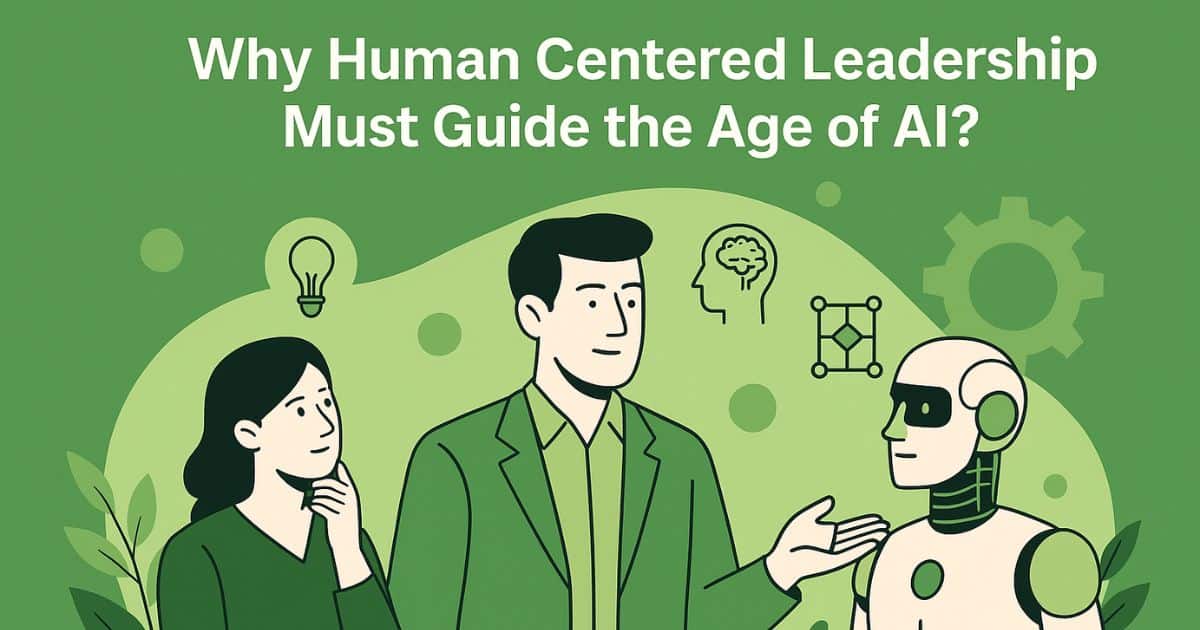
Image showing Human centered leadership guiding AI illustration

Why Human Centered Leadership Must Guide the Age of AI?

In this Article

Toggle
  • Key Highlights
  • What Human Centered Leadership Means in an AI-Powered World?
  • Why Human Expertise Still Matters?
  • The Power of Augmentation: How Humans and AI Achieve More Together
  • How Human Centered Leadership Brings Balance to an AI-Driven Workplace?
  • What Most Organizations Get Wrong About AI?
    • 1. The Belief That AI Can Replace Human Judgment
    • 2. The Habit of Treating AI as a Shortcut
    • 3. The Mistake of Adding Tools Without Changing Workflows
    • 4. The Assumption That Data Equals Better Decisions
    • 5. The Outcome of These Missteps
  • What Effective Leaders Do Differently in an AI-Augmented Workplace?
    • 1. Teach Teams to Ask Better Questions Before Using AI
    • 2. Encourage Strategic Pauses Instead of Rushing to Outputs
    • 3. Build Systems That Support Reflection and Analysis
    • 4. Use AI to Test Ideas, Not Generate Them
    • 5. Empower Teams to Think Like Problem Solvers, Not Prompt Operators
  • Why Wild Creek Studio Leads With Thinking, Not Technology
  • Final Words
  • Frequently Asked Questions
    • What is human centered leadership?
    • How can organizations foster human-centered leadership among their leaders?
    • What are the main benefits of adopting a human-centered leadership approach?
    • What steps can leaders take to develop human-centered leadership skills?
    • How is human-centered leadership different from traditional leadership styles?
    • What challenges do organizations face when implementing human-centered leadership?
    • Can you share real-world examples of organizations using human-centered leadership?
    • How does human-centered leadership help drive transformation within an organization?
    • What training or certification options are available for learning human-centered leadership?

Key Highlights

  • Human-centered leadership ensures AI enhances human judgment instead of replacing it.
  • AI provides speed, but humans supply context, nuance, and ethical decision-making.
  • Augmentation creates stronger outcomes by pairing human insight with AI capability.
  • Effective leaders slow down for clarity, ask better questions, and guide AI with intent.
  • Organizations fail with AI when they treat it as a shortcut or ignore workflow redesign.
  • Human-centered leadership reduces fear, builds confidence, and strengthens team thinking.
  • Wild Creek Studio leads with human insight first, using AI to elevate strategy, not drive it.

The digital industry is racing toward automation, but that speed comes with a hidden cost. Many teams are thinking less. AI tools promise faster outputs, yet leaders are discovering a painful truth. Quick results do not equal smart decisions. Brands end up with more content, but not a better strategy.

This is the gap the Human Algorithm addresses. Instead of replacing human expertise, it strengthens it. AI brings scale and efficiency, while humans bring context, creativity, and empathy. These are qualities no algorithm can replicate. When one is used without the other, innovation suffers.

This blog explores how human-centred leadership can create a future where AI supports and elevates human thinking rather than diluting it. You will see why the next competitive advantage comes from thinking better, not simply working faster, and how leaders can combine automation with human insight to unlock deeper productivity and stronger ideas.

What Human Centered Leadership Means in an AI-Powered World?

Human-centered leadership is becoming essential because AI is no longer the future. It is already shaping how teams work, plan, and create. But here is the part many leaders miss. AI can speed things up, yet it cannot decide what truly matters. That clarity still has to come from people. This is exactly why human-centered leadership matters now more than ever.

Think of it this way. AI is incredible at repetition, optimization, and scale. Humans are incredible at understanding nuance, emotion, and context. When leaders treat these as competing strengths, they limit what both can do. When they treat them as complementary, they unlock much better thinking.

Leaders who take a human-centered approach focus on a few practical priorities:

  • Let AI handle the predictable work so humans can handle the meaningful work
  • Keep humans in charge of judgment, creativity, and interpretation
  • Build workflows where technology supports thinking instead of replacing it

This approach removes the fear many teams feel around AI and replaces it with confidence. People know where they fit. They understand why their thinking matters. And they see AI as a tool that frees them up to contribute at a higher level.

A recent survey by Boston Consulting Group found that when frontline employees feel they have strong leadership support for generative AI, the share of those who feel positive about it rises from 15% to 55%. This demonstrates a powerful truth.

When leaders guide teams through AI adoption with clarity and support, people become more optimistic, engaged, and willing to experiment.

When leaders get this balance right, the quality of ideas improves, strategic conversations get richer, and teams become more comfortable exploring what AI can and cannot do. It is a simple shift, but it changes everything. Instead of racing AI, you learn to partner with it. And that is where real innovation begins.

Why Human Expertise Still Matters?

AI can automate almost anything today, yet it still cannot replace the one element that creates real competitive advantage: human discernment.

According to McKinsey, AI has the potential to generate $2.6 trillion to $4.4 trillion in value across industries. But only a very small percentage of organizations are capturing that value in a meaningful way. The technology is available. What is missing is thoughtful human guidance.

AI can surface patterns, but it cannot understand why those patterns matter. It can generate polished outputs, but it cannot determine whether they are right, relevant, or responsible. When decisions carry emotional weight or strategic consequence, it is the leader who must interpret the nuance, understand the context, and make the call.

The companies that outperform are the ones that do not treat AI as a replacement for thinking. They use AI to improve execution and efficiency. They rely on humans to define direction, shape strategy, and identify opportunities that data alone cannot reveal. This is the foundation of strong innovation and long-term advantage.

Human intelligence remains the steering wheel. AI is only the engine.

The Power of Augmentation: How Humans and AI Achieve More Together

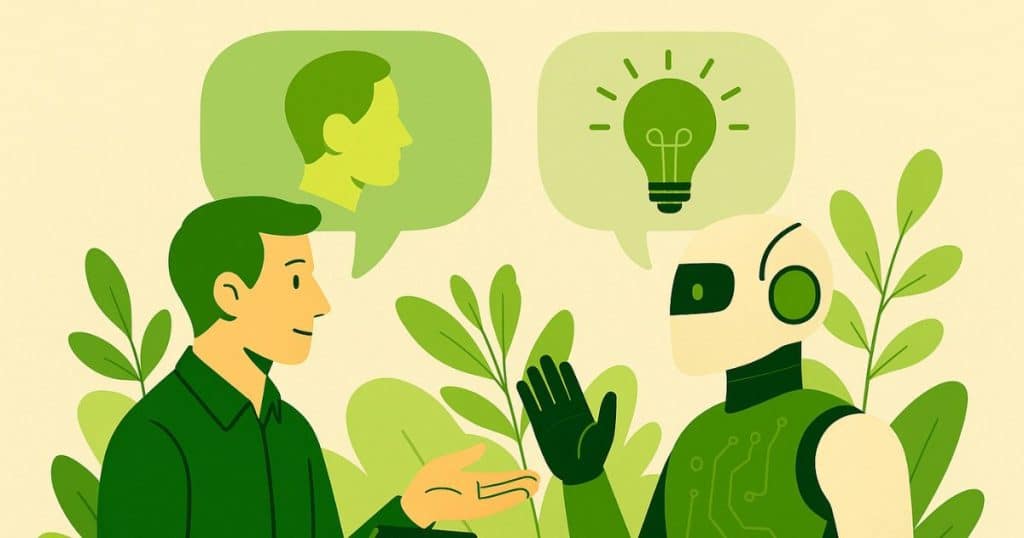
Human and AI collaboration illustration

Human and AI collaboration illustration

Augmentation is the practice of combining human intelligence with AI capability so each can do what it does best. Instead of using AI to replace people, leaders use AI to extend human thinking, improve decision quality, and remove the manual work that slows teams down.

According to Deloitte, companies that intentionally redesign work this way see significantly stronger outcomes, while those that rely on AI alone are 1.6 times more likely to miss their expected ROI. This makes one thing clear: AI delivers value only when humans stay in the driver’s seat.

Here is how augmentation helps in everyday work:

  • AI handles repetitive or time-consuming tasks so people can focus on strategy and problem-solving
  • AI analyzes patterns and data, while humans interpret what those insights actually mean
  • AI generates options, and humans choose the direction that aligns with purpose and long-term goals
  • AI increases capacity, and humans increase clarity and creativity

This approach not only improves productivity but also improves the quality of decisions. Teams think more clearly because they are not buried in manual work. Leaders make better calls because they have stronger insights. And organizations innovate more confidently because humans guide the narrative while AI supports the execution.

Augmentation is not about humans versus machines. It is about designing a smarter partnership so both can contribute at their highest level.

To see how this philosophy translates into real digital strategy, explore our hybrid SEO approach, where human insight and AI intelligence work together to deliver stronger, smarter results.

How Human Centered Leadership Brings Balance to an AI-Driven Workplace?

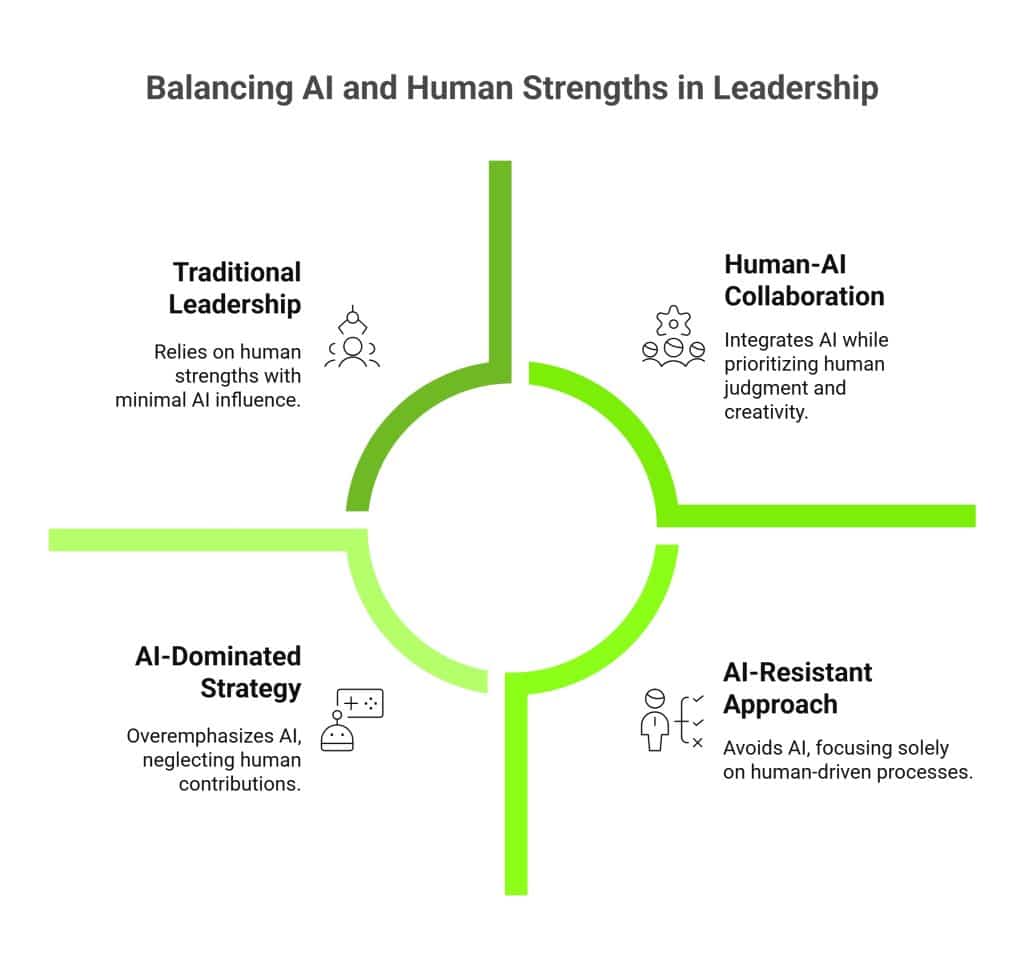
Infographic on balancing AI and human stregths in leadership

Infographic on balancing AI and human stregths in leadership

AI is reshaping workflows faster than organizations can adapt their mindsets. The technology is not the challenge. The uncertainty it creates is. People worry less about automation itself and more about losing relevance inside a system that suddenly feels unfamiliar. This is where human centered leadership becomes essential. It brings clarity to change and protects the human meaning behind the work.

Expert leaders know that AI does not replace human judgment. It increases the need for leaders who can interpret nuance, guide context, and maintain direction. They do not present AI as the finish line, but as a catalyst that expands what teams can achieve.

Research supports this. As highlighted in Harvard Business Review’s AI Won’t Make the Call: Why Human Judgment Still Drives Innovation, even with access to generative AI tools, human judgment remains essential because AI cannot reliably distinguish strong ideas from weak ones or guide long-term strategy on its own. AI accelerates execution, but humans must still decide what matters and why.

Human centered leadership creates this balance by focusing on a few core shifts:

  • Replacing fear with clarity by explaining how AI supports the broader strategy
  • Reinforcing that human judgment remains central in decisions that require nuance or ethical awareness
  • Encouraging teams to experiment with AI so confidence grows through use, not avoidance
  • Elevating uniquely human strengths such as creativity, emotional intelligence, and strategic sense

When leaders operate this way, teams stop viewing AI as a threat to their value and start seeing it as an amplifier of it. People understand not only what AI can do, but also what it cannot. They see where their expertise still guides the work and how technology can extend their impact.

To see how this balance plays out in real-world decision-making, explore our insights on AI agent decision-making and why human judgment must remain at the center.

What Most Organizations Get Wrong About AI?

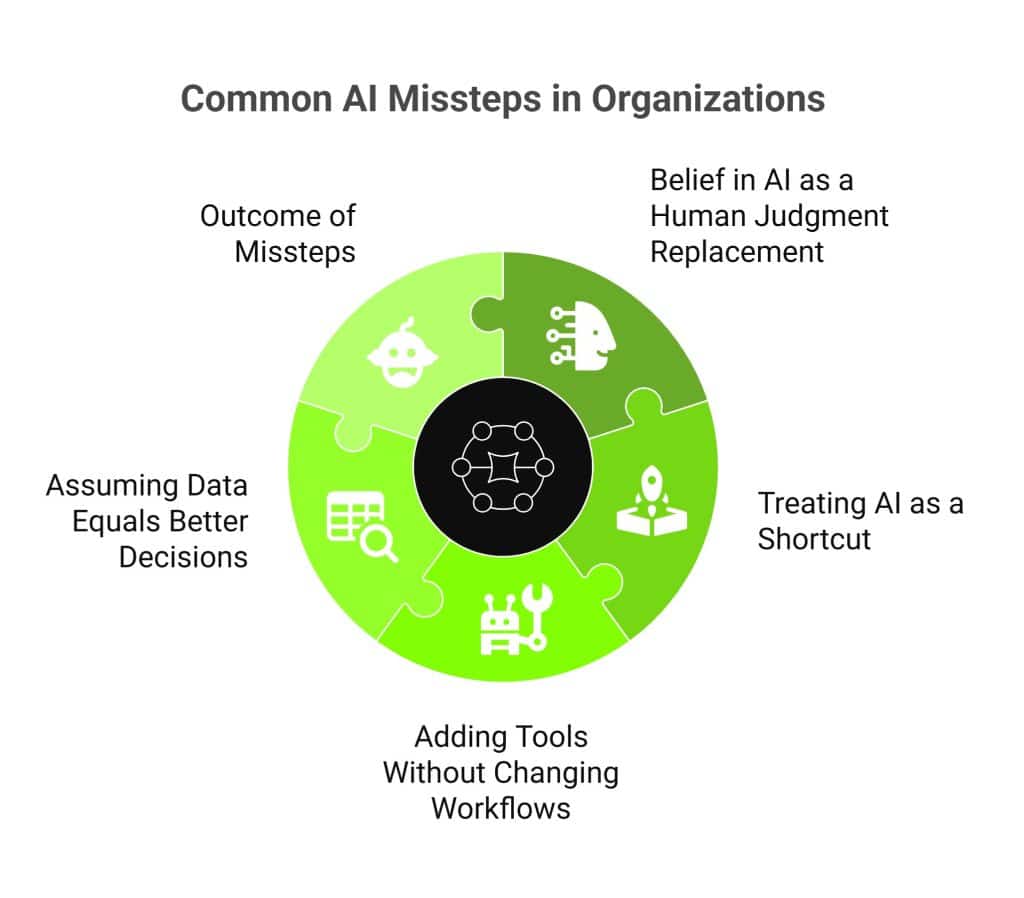
Infographic showing common AI missteps in organizations

Infographic showing common AI missteps in organizations

AI is now at the center of business transformation, yet many organizations still struggle to extract meaningful value from it. The problem is rarely the technology. It is how leaders think about the technology. When AI is adopted without clarity, intention, or human oversight, it becomes a fast way to scale work that lacks depth and direction.

Here are the most common ways organizations misstep when working with AI:

1. The Belief That AI Can Replace Human Judgment

Many companies assume AI can think for them because it can process information at an extraordinary speed. But speed is not strategy. AI can reveal patterns, yet it cannot interpret nuance, understand emotion, or weigh long-term implications. When leaders hand over judgment, decision quality inevitably declines.

2. The Habit of Treating AI as a Shortcut

AI often gets positioned as a way to avoid deep thinking. This leads teams to automate tasks they barely understand and publish outputs they barely review. AI is not a shortcut to better work. It simply amplifies the quality of the thinking that guides it. Weak thinking produces weak results, only faster.

3. The Mistake of Adding Tools Without Changing Workflows

Many organizations adopt AI tools but leave their workflows untouched. The result is old processes running on new technology, which only accelerates inefficiency. Without rethinking roles, responsibilities, and decision points, AI becomes an add-on rather than a catalyst for transformation.

4. The Assumption That Data Equals Better Decisions

AI-generated insights often look precise, but precision does not guarantee relevance. Data without human interpretation can lead to overconfidence and poor choices. Only humans can judge whether an insight is ethical, strategic, or aligned with a company’s purpose.

5. The Outcome of These Missteps

These patterns lead to more output, but not better outcomes. Companies achieve speed but lose insight. They optimize workflows but weaken strategy. AI ends up producing work that is efficient yet forgettable.

Thoughtful organizations take a different path. They use AI to enhance human thinking, not bypass it. And that is where the real competitive advantage begins.

What Effective Leaders Do Differently in an AI-Augmented Workplace?

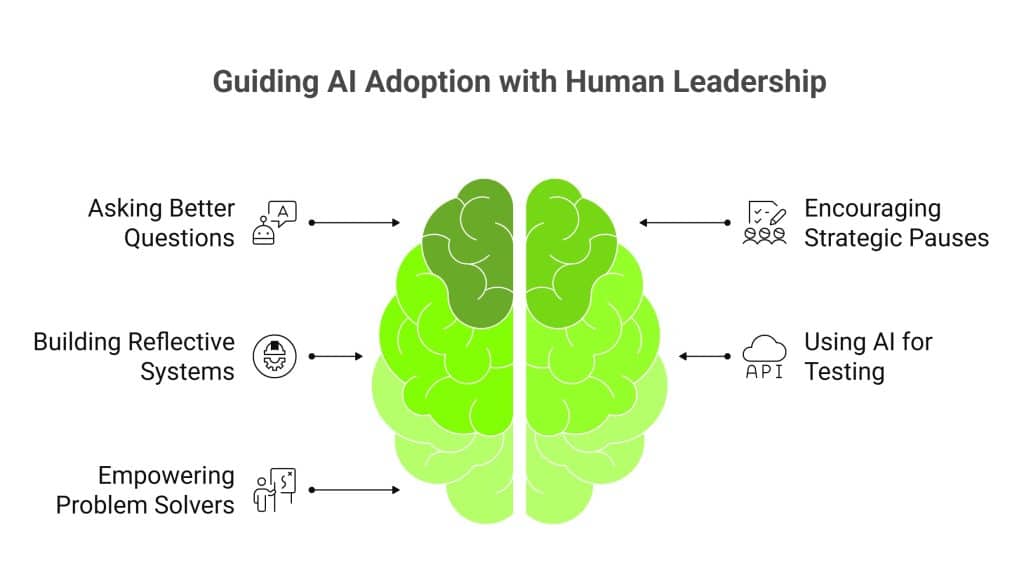
Infographic showing guiding AI adoption with human leadership

Infographic showing guiding AI adoption with human leadership

AI can accelerate execution, but it still relies on human leadership to shape direction, intent, and quality. The organizations that gain the most from AI are not the ones using the most tools.

These approaches reflect how high-performing leaders guide AI adoption with clarity and purpose and represent some of the most effective human-centered leadership approaches today.

1. Teach Teams to Ask Better Questions Before Using AI

According to BCG, 74% of organizations have not yet achieved meaningful value from AI initiatives, largely because the strategic intent behind the work is weak or undefined.

Leaders help teams by clarifying the intent behind the task. They push people to define the decision they need to make, the context that matters, and the outcome they are aiming for. This discipline transforms AI from a generator of information into a generator of insight.

2. Encourage Strategic Pauses Instead of Rushing to Outputs

AI encourages immediacy, but thoughtful leaders encourage evaluation. They model a brief pause to assess whether an output aligns with the goal or misses critical nuance.

This simple habit prevents teams from mistaking speed for insight and reduces the risk of overconfidence in machine-generated answers.

3. Build Systems That Support Reflection and Analysis

Reflection should not depend on personal discipline. It should be baked into the workflow. McKinsey’s research highlights that AI proficiency drops sharply when teams lack guidance and structure.

Only 22 percent of older employees feel confident using AI tools, compared to 62 percent of younger employees.

Leaders who establish structured checkpoints, review loops, and interpretation steps ensure that every team member, regardless of experience level, engages with AI thoughtfully and consistently.

These systems create a level playing field and prevent teams from accepting AI outputs without analysis.

4. Use AI to Test Ideas, Not Generate Them

AI can generate endless ideas, but original thinking still comes from humans. High-performing organizations use AI to validate assumptions rather than create them.

This mirrors findings across AI maturity studies that show organizations generate more business impact when human insight directs how models are used.

5. Empower Teams to Think Like Problem Solvers, Not Prompt Operators

AI fluency is not enough. Teams need the ability to diagnose issues and frame challenges clearly before involving any tool. Companies that anchor AI adoption in leadership-driven problem solving see far stronger culture, performance, and employee confidence.

Human-centered leadership is not about slowing down AI adoption. It is about raising the quality of human thinking so that the technology can deliver the value it promises. When leaders adopt these approaches, AI becomes an amplifier of expertise, not a replacement for it.

Why Wild Creek Studio Leads With Thinking, Not Technology

Most digital firms start with tools. We start with thought. In a market where AI promises speed and scale, Wild Creek Studio focuses on something far more valuable: the quality of human judgment guiding that technology. AI can automate execution, but only people can define direction, meaning, and strategic clarity.

We start with people, not platforms. Our strategy is grounded in real observation and a deep understanding of behavior. AI extends this thinking, but it never replaces it. The direction always comes from the human mind.

This is the essence of human-centered organizational leadership and the foundation of how we operate. Our philosophy is built on three core beliefs:

  • AI should speed up execution, not replace interpretation
  • Human insight must lead strategy, not follow the tool
  • Work should feel intentional and human, not mechanical or generic

This is why our work feels distinct. AI expands our reach, but people give it meaning. We use technology to strengthen ideas, not replace them, and data to guide decisions, not dictate them.

Wild Creek Studio creates work that feels human because it is led by people who think deeply and supported by tools that work intelligently. In a landscape crowded with AI-generated sameness, that balance is our advantage.

Ready to know more? Contact us today!

Final Words

AI will keep getting faster, but the real edge still belongs to leaders who think clearly. When your team brings the insight, and AI brings the acceleration, the work becomes sharper, more intentional, and far more impactful. The future rewards leaders who know how to use technology without surrendering their judgment to it.

This is the moment to lean in. Stay curious, stay thoughtful, and let AI amplify the thinking you already do well. When humans lead and AI supports, you build a future that feels intelligent, not automated.

Frequently Asked Questions

What is human centered leadership?

Human-centered leadership is a leadership model that prioritizes people over processes. It focuses on empathy, clarity, open communication, and purposeful decision-making. Leaders using this approach elevate human judgment, support well-being, and create environments where teams think better, collaborate strongly, and innovate more meaningfully.

How can organizations foster human-centered leadership among their leaders?

Organizations can cultivate human-centered leadership through leadership development, training programs, and a positive work environment that prioritizes open communication, psychological safety, and inclusion. This approach strengthens resilience, supports professional development, and aligns leaders with organizational goals.

What are the main benefits of adopting a human-centered leadership approach?

Human-centered leadership improves employee engagement, retention, and satisfaction while fostering a positive work environment. It strengthens organizational culture, encourages new ideas, and supports adaptability, ultimately helping successful organizations align people with organizational goals and achieve long-lasting fulfillment.

What steps can leaders take to develop human-centered leadership skills?

Leaders can build these skills by practicing authenticity, developing high emotional intelligence, fostering psychological safety, and committing to continuous professional development. Engaging in leadership development and training programs strengthens resilience and promotes a healthier work environment aligned with organizational goals.

How is human-centered leadership different from traditional leadership styles?

Human-centered leadership emphasizes inclusion, psychological safety, and a supportive work environment, while traditional leadership often focuses on control and top-down organizational change. This leadership model promotes fulfillment, adaptability, and new ideas rather than rigid structures or poor management behaviors.

What challenges do organizations face when implementing human-centered leadership?

Challenges include shifting organizational culture, overcoming poor management habits, and aligning stakeholders with new expectations for open communication and inclusion. Leaders may struggle with adaptability and resilience when disruption occurs, making it harder to maintain consistent psychological safety and authenticity.

Can you share real-world examples of organizations using human-centered leadership?

Many successful organizations apply this leadership model by creating inclusive cultures, prioritizing professional development, and supporting psychological safety. Organizational psychologists and adjunct professors often highlight companies that improve retention, foster new ideas, and cultivate a positive work environment grounded in authenticity.

How does human-centered leadership help drive transformation within an organization?

It accelerates organizational change by promoting open communication, resilience, and employee engagement. Human-centered leadership aligns people with organizational goals, encourages new ideas, and creates a state of mind where employees feel a sense of purpose, improving adaptability during disruption.

What training or certification options are available for learning human-centered leadership?

Leaders can pursue certificate programs, cohort-based coursework, and training programs guided by organizational psychologists or adjunct professors. These opportunities strengthen good leadership, enhance inclusion, and improve professional development within a supportive, positive work environment.

0 comments
Human hand and robotic hand working together on a drawing collaboration between humans and AI

What Makes Human-Centered SEO the Future of Search?

In this Article

Toggle
  • Key Highlights
  • Search Is Changing, But People Still Matter Most
  • From Algorithms to Audiences: The Evolution Toward Human-Centered SEO
  • The Paradox of AI: Scaling Humanity Without Losing It
  • Designing for Human Signals
  • The Human Algorithm in Practice
  • Why Human Judgment Still Wins
  • AI-Assisted, Human-Directed SEO: The Next Era
  • The Wild Creek Way: Thinking Better, Not Just Faster
  • Closing Thoughts: Bringing Soul Back to Search
  • Frequently Asked Questions
    • How should I adapt my SEO approach to balance AI advancements with human creativity?
    • Are there situations where AI outperforms humans in SEO tasks?
    • How can I ensure my SEO strategy stays human-centered in the AI era?
    • Does human-written content get better SEO results than AI-generated content?
    • What are the benefits of combining AI tools with human expertise in SEO?
    • Why is it important to focus on people rather than just algorithms in SEO?
    • What’s next for SEO in the generative AI era?

Key Highlights

  • The SEO landscape is shifting as AI transforms how content is created, optimized, and discovered.
  • Success now depends on human-centered SEO, which balances AI’s speed with human creativity, ethics, and strategy.
  • Data and automation can guide decisions, but human judgment gives them context and meaning.
  • The future of SEO lies in collaboration; AI handles scale while humans shape insight and purpose.
  • Wild Creek’s Human Algorithm philosophy embodies this balance, helping brands think better, not just faster.

If you have worked in SEO lately, you have felt the shift. AI tools promise faster content creation, instant rankings, and effortless optimization. Yet with all that speed, something is missing: real connection.

This shift matters because automation has made it easier than ever to publish content, but harder than ever to stand out. When everyone uses the same tools, everything starts to sound alike. Search results fill up quickly, yet fewer of them feel meaningful.

Audiences no longer trust what seems mechanical or repetitive. They want content that feels real, credible, and thoughtful. That is why human-centered SEO is not just another strategy but a new standard for digital communication.

It combines the efficiency of AI with the imagination and empathy of people. It focuses on scaling insights without losing intention or authenticity. In this blog, we explore how that balance is reshaping digital marketing and how Wild Creek’s Human Algorithm helps brands think better, not just faster.

Search Is Changing, But People Still Matter Most

Let’s be honest, search isn’t what it used to be. The way people discover, question, and decide has completely changed. Today, artificial intelligence shapes what shows up when we type, talk, or tap. It’s fast, efficient, and everywhere.

But here’s the catch: when everyone uses the same AI tools, everything starts to sound the same. Blogs, landing pages, and even product descriptions begin to blur together. The web feels smarter, yet somehow less human.

That’s why the real advantage in modern search engine optimization is not just about mastering algorithms. It’s about bringing back the human element: creativity, emotion, and ethical thinking. AI can analyze what people search for, but it takes human oversight to understand why they search.

Think about a small business that uses AI to generate content for “eco-friendly packaging.” The algorithm might focus on search volume and keyword density, but a human strategist will highlight the story behind sustainable sourcing or the emotional impact of choosing greener options. Or consider a mental health blog: AI can list coping strategies, but only a human writer knows how to strike a tone that feels safe, compassionate, and real.

Human-centered SEO is about finding that balance. It’s about using technology as a partner, not a replacement. When data meets empathy, content begins to connect on a personal level. That is when search results stop being just answers and start becoming experiences people remember.

So the next time you create content, ask yourself: does it sound optimized, or does it sound human? The future of SEO will favor those who can do both.

From Algorithms to Audiences: The Evolution Toward Human-Centered SEO

Human hand and robotic hand working together on a drawing collaboration between humans and AI

Human hand and robotic hand working together on a drawing collaboration between humans and AI

For years, SEO revolved around algorithms. We optimized title tags, chased keyword rankings, and built backlinks to please search engines. It worked, but it often overlooked people.

Today, AI and machine learning have changed that. Search engines now read intent, context, and relevance, not just keywords. This shift has pushed SEO experts to move beyond checklists and focus on user experience, search behavior, and emotional connection.

Human-centered SEO is the natural next step. It combines AI’s efficiency with human creativity to deliver better content that feels personal and purposeful. The goal is not just to rank higher in Google but to create meaningful experiences that keep people coming back.

The Paradox of AI: Scaling Humanity Without Losing It

AI has transformed how we approach search engine optimization. It can analyze millions of data points in seconds, reveal behavior patterns, and generate insights that once took weeks. It gives marketers incredible power to scale content, speed up decisions, and automate processes that once required hours of manual effort.

But this is where the paradox begins. The more we rely on AI to understand people, the more we risk losing the human touch that gives our work meaning. Speed becomes noise when it lacks strategy. Efficiency becomes emptiness when it forgets empathy.

The paradox of AI is not whether it replaces us but how easily it can make us forget what makes us valuable. It mirrors our strengths, such as pattern recognition, adaptation, and learning, but it cannot care, question, or create with intent.

Human oversight turns AI from a mechanical producer into a creative partner. It adds context to data, emotion to insight, and purpose to precision. The best SEO strategies now come from this balance, where machines handle the scale and humans define the purpose.

The irony is clear. The smarter AI becomes, the more it proves why human judgment still matters. Machines can predict behavior, but only people can understand desire. They can identify trends, but only humans can turn them into stories that inspire trust, connection, and meaning.

Designing for Human Signals

SEO is no longer just about pleasing algorithms. The real signals that drive success come from people: how they read, react, and return. Metrics like time on page, repeat visits, and genuine engagement show what truly connects.

AI can track behavior, but it takes human insight to understand it. Data without empathy misses the why behind every click. That’s where human expertise turns analytics into action.

Designing for human signals means creating content that informs, comforts, or inspires. To do that:

  • Understand what your audience needs and feels at each stage of their journey.
  • Write in a tone that matches their emotions and expectations.
  • Make navigation clear and content easy to explore.
  • Use visuals and stories that create trust and interest.
  • Invite readers to engage through comments, shares, or saves.
  • Keep the reading experience simple, conversational, and rewarding.
  • Track engagement patterns that reveal genuine connection.

When people feel understood and valued, they stay longer, share more, and return often. Search engines notice that behavior and reward it with visibility and trust.

In the end, optimizing for humans is the smartest SEO strategy of all.

The Human Algorithm in Practice

AI is powerful, but it needs direction. Think of it as a compass that points to patterns, not a captain that charts the journey. Human reasoning gives those insights purpose.

A simple framework brings this idea to life:

Listen. Use AI tools to uncover audience needs, content gaps, and search intent. Let data guide where attention is shifting.

Interpret. Apply human context to understand what drives those needs. Behind every search term is an emotion: curiosity, urgency, or trust. Recognizing that intent shapes better storytelling.

Create. Build meaningful content ecosystems that educate, inspire, and respect people’s time. Focus on clarity and authenticity instead of volume.

The goal is not to produce more content but to produce content that matters more. When AI supports human creativity, the outcome of every SEO project becomes smarter, faster, and more genuine.

Why Human Judgment Still Wins

AI can process more data than any of us ever could. It can track search behavior, analyze user intent, and generate SEO content in seconds. Yet what it cannot do is decide what truly matters. That decision depends on human judgment, the kind that recognizes nuance, culture, and emotion: the elements that make content meaningful.

Human judgment wins because it understands the why behind the data. AI can tell you which keywords drive clicks, but it cannot sense when a search reflects curiosity, frustration, or urgency. It can replicate tone, but it cannot feel the difference between empathy and efficiency. It can detect trends, but it cannot see when a cultural shift is about values, not volume.

A great SEO strategy does not begin with a dashboard. It begins with awareness. A person can attend events, read between the lines of customer feedback, and recognize patterns that no algorithm can measure. These insights shape strategies that connect, not just convert.

As Sundar Pichai said, “The future of AI is not about replacing humans, it’s about augmenting human capabilities.” That future belongs to those who know how to lead with human insight and use technology as support, not direction.

The marketers who win are those who let AI handle scale but keep people in charge of strategy. When human expertise leads, SEO evolves from mechanical optimization into meaningful storytelling, guided by insight, powered by empathy, and grounded in purpose.

AI-Assisted, Human-Directed SEO: The Next Era

The future of SEO will not be written by algorithms alone. It will be shaped by how humans choose to guide them with purpose. Artificial intelligence has already transformed content creation, search visibility, and digital marketing strategy. But the next leap forward is about collaboration, where machines power efficiency and humans bring meaning.

In this next era, SEO will evolve into Experience Optimization. Search will move beyond rankings toward creating intent-driven ecosystems where every digital touchpoint connects to a unified brand story. The shift will be from keywords to conversations, from clicks to connections, and from content volume to contextual quality.

Here is what to expect:

  • Search will predict, not just respond. AI will anticipate needs before queries appear, while humans will guide those predictions with empathy and ethics.
  • Brand voice will become a ranking factor. As AI-generated content increases, authenticity and trust will determine which brands stand out.
  • Human experience metrics will grow in value. Engagement, emotional depth, and storytelling will influence visibility more than ever.
  • SEO experts will evolve into experience curators. Professionals will not only optimize but orchestrate narratives that connect across every channel.

AI can process data, but human creativity defines direction. The most successful brands will use AI to find insights faster and rely on human expertise to tell stories that inspire trust and loyalty.

The next era of SEO is not about replacing people with algorithms. It is about creating systems where technology amplifies empathy and humans give strategy its soul. Together, they will shape a search experience that feels smarter, faster, and deeply human.

The Wild Creek Way: Thinking Better, Not Just Faster

At Wild Creek Studio, we believe real success in digital marketing isn’t about how fast you move; it’s about how wisely you think. AI gives us speed and precision, but it’s human creativity, ethics, and strategy that turn data into decisions and clicks into connections.

That belief powers what we call the Human Algorithm. It’s our way of blending AI’s efficiency with human depth. We use technology to uncover insights quickly, but every move we make is guided by curiosity, empathy, and experience.

For nearly two decades, Wild Creek has helped brands grow by pairing sharp analytics with human understanding. Every SEO strategy, every piece of content, and every marketing campaign is designed to think smarter, not faster.

Because the future of digital marketing won’t belong to the fastest. It will belong to the most thoughtful; to the brands that use AI as a tool, not a crutch, and keep people at the heart of everything they create.

The future of digital marketing isn’t about racing ahead. It’s about slowing down to understand, connect, and create with purpose. The brands that use AI to empower people, not replace them, will lead that future. And that’s what defines Wild Creek.

Closing Thoughts: Bringing Soul Back to Search

Search has always been about connection. Behind every query is a person looking for something real: information, clarity, or confidence. AI may change how answers are delivered, but it can’t replace the human need for meaning.

As technology advances, the principle stays the same. People still trust people. The most successful brands will use AI to enhance understanding, not replace it. They will create content that informs and connects, driven by curiosity and respect for the audience.

The future of SEO will belong to those who think critically, create authentically, and lead with purpose. AI can make us faster, but only human insight makes us wiser.

Frequently Asked Questions

How should I adapt my SEO approach to balance AI advancements with human creativity?

Use AI for data-driven insights, automation, and pattern detection, but let human creativity guide storytelling, tone, and strategy. This balance ensures your SEO content feels authentic, aligns with user intent, and builds long-term trust with your audience.

Are there situations where AI outperforms humans in SEO tasks?

Yes, AI excels in tasks that need speed and scale, such as keyword research, technical SEO audits, and performance tracking. However, humans outperform AI in interpreting data contextually and creating emotionally resonant content that drives deeper engagement.

How can I ensure my SEO strategy stays human-centered in the AI era?

Prioritize empathy and user experience in every decision. Use AI to support your strategy, not dictate it. Focus on real audience needs, transparent communication, and creating content that informs, helps, and connects on a personal level.

Does human-written content get better SEO results than AI-generated content?

Generally, yes. Human-written content tends to be more authentic, contextually relevant, and emotionally engaging. AI-generated content can enhance scale, but without human editing and oversight, it often lacks originality and depth that search engines and users value.

What are the benefits of combining AI tools with human expertise in SEO?

This combination delivers both efficiency and insight. AI handles repetitive, data-heavy tasks while humans bring creativity, ethics, and strategy. Together, they create SEO campaigns that are faster, smarter, and better aligned with audience expectations.

Why is it important to focus on people rather than just algorithms in SEO?

Search engines ultimately reward content that helps people. Prioritizing user intent, trust, and satisfaction improves engagement and builds authority. When you focus on people first, the algorithms follow naturally because search engines aim to serve human needs.

What’s next for SEO in the generative AI era?

SEO will become more conversational, personalized, and experience-driven. Success will depend on how effectively humans use AI to enhance creativity, authenticity, and ethical storytelling while keeping people at the heart of every digital interaction.

0 comments
Hand drawn flat design npl illustration

How to Humanize AI Text for Better Brand Storytelling?

Key Highlights

  • AI can write, but only humans can make words feel real.
  • Overreliance on AI leads to flawless but forgettable writing.
  • 50% of readers can identify AI-generated content, and most find it impersonal.
  • The best way to humanize AI text is by adding your voice, not just editing tone.
  • Emotion, storytelling, and imperfections make content sound human again.
  • Use AI for structure, not for soul; humans create meaning, not patterns.
  • Humanized text strengthens trust, brand credibility, and SEO performance.
  • Balance automation with empathy to make AI your creative ally, not your replacement.

I can’t be the only one who’s noticed it; every LinkedIn post, blog, and caption is starting to sound the same.
The same polite enthusiasm. The same flawless grammar. The same “three lessons I learned this week” tone. It’s like the internet’s been run through the same AI blender.

Sure, AI tools can write faster than any of us. They can summarize, rephrase, and fill a page in seconds. But when you read what they produce, something feels off. It’s smooth but soulless. Informative but cold.

That’s because AI doesn’t tell stories; it assembles sentences. And in the process, it strips away everything that makes writing human: rhythm, humor, hesitation, and a little bit of heart.

So if you’ve ever looked at an AI-generated draft and thought, “This just doesn’t sound right,” you’re not wrong. You don’t need to start over; you just need to learn how to humanize AI text, to give your words warmth, life, and personality again.

In this Article

Toggle
  • What Makes Human Writing Unique and Relatable?
  • Why Is So Much AI Content Bland and Detached?
  • What are The 7 Ways to Humanize AI Text Without Losing Your Voice?
    • 1. Anchor Everything in Real Experience
    • 2. Use Emotion to Set the Mood
    • 3. Write First, Then Let AI Edit You
    • 4. Get Hyper-Specific With Prompts
    • 5. Train AI to Understand Your Style
    • 6. Use AI as Your Research Assistant, Not Your Writer
    • 7. Edit Like a Human, Not Like a Machine
  • Want Content That Sounds Human, Not Machine-Made?
  • Conclusion
  • Frequently Asked Questions
    • What are the best techniques to make AI-generated text sound more human?
    • Can you explain how AI humanizer tools work to improve the naturalness of AI text?
    • What features should I look for in an AI humanizer tool to get the most realistic results?
    • How can I edit AI-generated content to make it less robotic and more conversational?
    • Are there any free AI humanizer tools available online, and how effective are they?
    • What common mistakes should I avoid when trying to humanize AI-written text?
    • How do I check if my AI-generated text passes as human-written?
    • Can you give examples of AI text before and after humanizing edits?
    • What are the benefits of humanizing AI content for personal or business use?
    • Is it possible to humanize AI text without using any online tools?

What Makes Human Writing Unique and Relatable?

Real writing doesn’t just share information; it shares perspective. Human writers pull from memory, experience, and emotion. We write the way we talk, pause, and occasionally ramble. That’s what gives words warmth and personality.

When you read something that feels human, you can often sense who wrote it, not by the grammar, but by the intention. That’s what voice is. It’s what makes a late-night blog post feel honest, a funny caption feel spontaneous, or a heartfelt brand story feel true.

Writing in your voice is about more than sounding distinct. It’s about creating trust. Readers respond to authenticity because it feels like a conversation, not a script. And that’s something AI still can’t fake convincingly.

In fact, a Bynder study of 2,000 consumers in the U.S. and U.K. found that 50% of people could correctly identify AI-generated content.

More tellingly, when people suspect content is written by AI:

  • 26% think the brand is “impersonal”
  • 20% believe it’s “lazy”
  • Another 20% view it as “untrustworthy.”

That’s the cost of losing your human touch. People don’t connect with perfect sentences; they connect with imperfect sincerity.

AI might write faster, but it doesn’t feel. It can recognize language patterns, but it doesn’t understand why we choose one word over another. Which is exactly why so much AI writing sounds… fine, and nothing more.

If you’re learning to balance automation with authenticity, these reads can help you take that skill further, from writing smarter to ranking better.

Also Read: AI Tools for Content Writing

Why Is So Much AI Content Bland and Detached?

Because it’s built to predict, not to think.

AI text generators are designed to produce the “most likely” next word in a sentence based on billions of data points. The result? Smooth, coherent, and completely safe writing, the kind that sounds like everyone else.

When everything is statistically optimized, nothing stands out. AI’s efficiency becomes its biggest weakness. It flattens the peaks and valleys of human expression, mowing creativity down to one even height.

AI content is also detached because it can’t interpret nuance, humor, or cultural subtext. It can copy a tone but not feel it. That’s why AI writing often reads like a polite corporate memo, correct, but cold.

This uniformity is already visible online. From product pages to LinkedIn posts, much of what’s published today sounds eerily similar, technically strong, emotionally empty. Readers might not know why it feels off, but they know it does.

Human writing, by contrast, thrives on curiosity, emotion, and intent. It’s messy, unpredictable, and often unpolished, and that’s exactly what makes it memorable.

Humanizing AI text is one thing; optimizing it for visibility is another.

Also Read: How to Use ChatGPT for SEO.

What are The 7 Ways to Humanize AI Text Without Losing Your Voice?

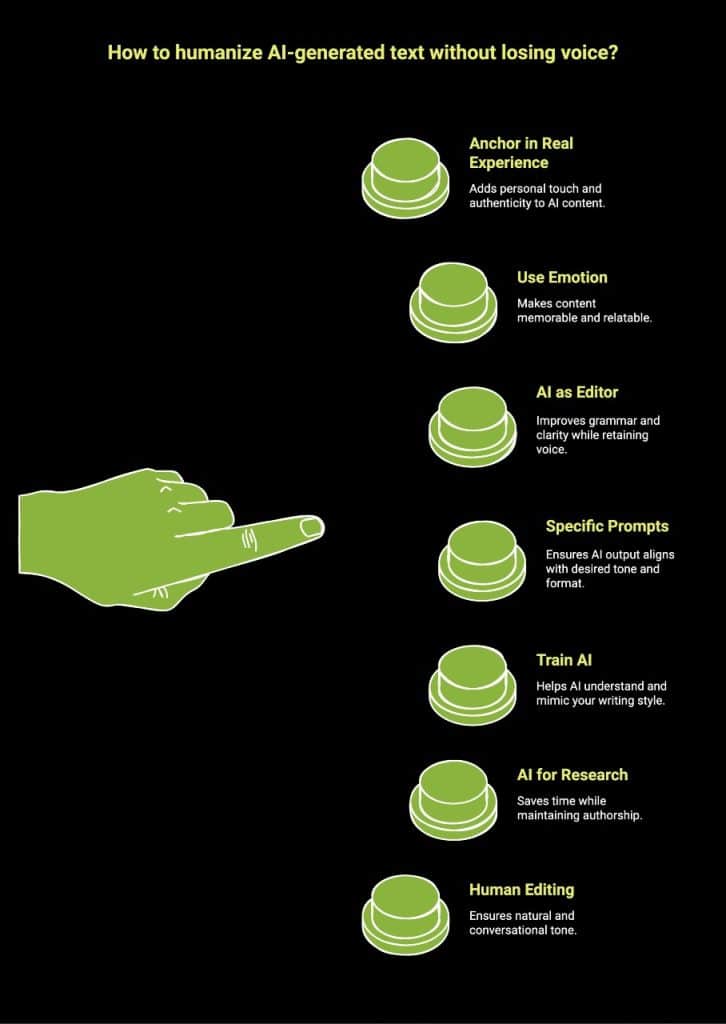
Infographic of 7 Ways to Humanize AI Text

Infographic of 7 Ways to Humanize AI Text

AI can generate, summarize, and structure faster than any of us, but it can’t connect. That’s the difference between a page that performs and a message that moves. The good news is, you can make AI content feel human without rewriting it from scratch. Here’s how.

1. Anchor Everything in Real Experience

AI writes about experiences; humans write from them. Add a short anecdote, insight, or real observation to every major section of your AI-generated text.

Try this:
If AI writes, “Content strategy improves engagement,” expand it into:

“When we built our first content strategy, engagement doubled, not because we posted more, but because we finally understood what our audience wanted to hear.”

You’ve just turned a statement into a story.

2. Use Emotion to Set the Mood

Emotion makes content memorable. AI can’t feel, but it can follow your lead. Choose a tone (curious, hopeful, frustrated, passionate) and layer it into your copy.

Example:
AI version: “Remote work can be challenging for teams.”
Humanized: “Remote work tests patience, focus, and sometimes friendships, especially when Wi-Fi drops mid-call.”

Pro tip: Emotion doesn’t always mean drama. It’s about honesty, letting your reader feel what you felt.

3. Write First, Then Let AI Edit You

AI is a fantastic editor, not an author. Use it to improve grammar, trim redundancies, and rephrase awkward lines after you write.

Try this process:

  1. Write your first draft raw and unfiltered.
  2. Ask AI to “simplify this paragraph without losing tone.”
  3. Then manually reintroduce personality, rhythm, humor, and phrasing that sound like you.

That’s how you use AI for precision without sacrificing voice.

4. Get Hyper-Specific With Prompts

Most AI content sounds generic because the prompts are generic.
Tell the AI exactly what tone, format, and emotional direction you want.

Example Prompt:

“Write 150 words about how small businesses can use automation, in a conversational tone. Use a light sense of humor and one short anecdote. Avoid buzzwords.”

The more you shape your request, the more distinct and natural the output becomes.

Pro tip: Save your best prompts as templates. They’ll save time and keep your voice consistent.

5. Train AI to Understand Your Style

Some tools let you upload previous work or examples of your tone. Use that feature. Feed it samples of your blog posts, social media copy, and brand guidelines so it learns your syntax and rhythm.

If your brand often says “we help you grow,” but AI keeps writing “we empower transformation,” fine-tune it. The goal is to make AI a voice mirror, not a voice maker.

Practical step: Create a short document titled “How We Sound” with tone descriptors (friendly, insightful, confident, never salesy) and share it whenever you or your team use AI tools.

6. Use AI as Your Research Assistant, Not Your Writer

Instead of letting AI write full paragraphs, ask it for building blocks.

For example:

  • “List 5 recent studies on human-AI collaboration.”
  • “Summarize this article in 100 words.”
  • “Give me 3 counterarguments to this statement.”

Then use those results to shape your own analysis. You’ll save time and retain authorship, the most important ingredient of authenticity.

7. Edit Like a Human, Not Like a Machine

After AI gives you a draft, read it out loud. If you wouldn’t say it in conversation, rewrite it.

Checklist for your final review:

  • Replace formal words like utilize or endeavor with use or try.
  • Add transitions that sound human: “But here’s the thing,” “Let’s be honest,” “So what does this mean?”
  • Break long paragraphs for rhythm and readability.
  • Add sensory language or visual cues where possible (“the buzz of notifications,” “the quiet pause before hitting publish”).

AI text passes detectors when it sounds natural, and natural always comes from human editing.

If you want your authentic voice to still rank in AI-powered search, context matters more than keywords.

Also Read: How to Rank in AI Overview.

Want Content That Sounds Human, Not Machine-Made?

AI can write faster. But connection still comes from people.
At Wild Creek Web Studio, we help brands use AI without losing their voice. Our approach blends data-driven clarity with the warmth of human creativity, so your content doesn’t just reach people; it resonates with them.

From defining your brand voice AI strategy to refining your content workflows, we help you build a digital presence that feels as genuine as it is intelligent.

Because technology should never replace your voice, it should amplify it.
If you’re ready to create content that sounds unmistakably you, let’s start there.

Book Your First Consultation Here.

Conclusion

We keep talking about humanizing AI text, but maybe that’s not the real goal.
Maybe it’s about writing that feels honest enough to make someone pause, reread a line, and think, “That’s exactly how I feel.”

AI can replicate voice patterns, sentence rhythms, and brand tones. But it can’t replicate the pause before a hard truth, the humor hidden in frustration, or the way experience shapes expression. That’s not “data”, that’s you.

The future of writing isn’t human versus artificial. It’s about finding the right balance between efficiency and empathy. Machines can give you language; only people can give it meaning.

Frequently Asked Questions

What are the best techniques to make AI-generated text sound more human?

The best way to humanize AI text is to add personal experiences, vary sentence length, and adjust the tone of voice. Small imperfections make it sound like an actual person, not a piece of artificial intelligence.

Can you explain how AI humanizer tools work to improve the naturalness of AI text?

AI humanizer tools rework text from AI writing tools by changing structure, tone, and rhythm. They replace mechanical phrasing with conversational flow, creating humanized text that feels written by a real person, not an algorithm.

What features should I look for in an AI humanizer tool to get the most realistic results?

Look for an AI humanizer that adjusts tone of voice, enhances phrasing, and maintains context. The best way to check results is by using detection tools or an AI detector to verify human-like output.

How can I edit AI-generated content to make it less robotic and more conversational?

Mix in personal experiences, shorten sentences, and simplify word choices. That’s how to humanize AI content manually, by restoring rhythm and warmth so your copy sounds like a real person instead of a programmed script.

Are there any free AI humanizer tools available online, and how effective are they?

Yes, several clever free AI humanizer tools can remove robotic tone and polish phrasing. They’re a good idea for small content creation projects, though human editing still ensures quality and protects your brand’s credibility.

What common mistakes should I avoid when trying to humanize AI-written text?

Avoid over-editing or losing structure in the process. The bottom line: don’t let excessive rewriting erase clarity. Keep a balance between personality and precision to preserve your unique writing style.

How do I check if my AI-generated text passes as human-written?

Use an AI detector, read it aloud, and test it with human readers. If it feels conversational and emotional, that’s the best way to humanize AI text and make it indistinguishable from something written by an actual person.

Can you give examples of AI text before and after humanizing edits?

Before: “Artificial intelligence helps brands create content efficiently.”
After: “AI helps teams create faster, but speed means nothing if your message doesn’t sound human.”
That’s how to humanize AI generated content through rhythm, emotion, and intent.

What are the benefits of humanizing AI content for personal or business use?

Humanized text increases engagement, trust, and your brand’s credibility. For companies, it helps the marketing team write marketing copy and product descriptions that resonate with human readers and perform better on search engines.

Is it possible to humanize AI text without using any online tools?

Yes. The best way to humanize AI text without tools is to rewrite manually. Adjust tone, insert emotion, and refine structure, the final step that transforms machine-made writing into something a real person would say.

0 comments
Illustration showing two people near a large laptop screen with search icons upward arrows and video elements

How Can SEO Video Material Transform Your Rankings?

In this Article

Toggle
  • Key Highlights
  • How Did Search Evolve From Text to Video as Source Material?
    • What Sparked the Shift From Traditional SEO to AI and GEO?
    • From Reading to Watching: Why Search Now Speaks in Video?
    • How Video SEO Is Rewriting Search Strategy?
  • Why Does Every Brand Need Both Short-Form And Long-Form Video For SEO?
  • Forget Going Viral: Visibility Is the Real Power Play in SEO
  • Which Platforms Drive The Greatest SEO Impact For Video?
    • Why Does YouTube Still Dominate Video SEO?
    • When Should Short-Form Platforms Enter The Mix?
    • What About Other Social Platforms?
    • How Should You Prioritize Your Efforts?
  • How To Create and Integrate SEO Video Material Into Your Strategy
    • 1. Start With Search Intent, Not Just Ideas
    • 2. Choose A Primary Keyword And Build Around It
    • 3. Write Titles And Descriptions That Reflect Value
    • 4. Keep Structure, Length, And Flow Purposeful
    • 5. Optimize Every Upload For Discovery
    • 6. Embed, Repurpose, And Cross-Promote
    • 7. Combine Human Creativity With AI Efficiency
  • What This Shift Means For Marketers, SEOs, And Brands
  • Turn Your Video SEO Into Lasting Visibility with Wild Creek Web Studio
  • The Future Of SEO Video Material And What It Means For Search
  • Frequently Asked Questions
    • What are some YouTube video SEO tips?
    • What is the importance of video content in SEO?
    • What’s the best platform for video SEO?
    • What are common mistakes to avoid in video SEO?
    • Are there tools that help track and analyze video SEO results?
    • How do embedding videos on my website influence their SEO performance?
    • How can I make my videos more visible in Google search results?
    • What are the most effective strategies for optimizing video content for SEO?

Key Highlights

  • Search is shifting from text-based results to video-first discovery across platforms and AI-driven engines.
  • SEO video material helps brands stay visible as search systems now interpret visuals, audio, and context.
  • GEO (Generative Engine Optimization) extends traditional SEO into AI ecosystems like Gemini, ChatGPT, and Perplexity.
  • Short-form videos drive quick engagement, while long-form content builds trust and authority over time.
  • Visibility now outweighs virality; consistent value and intent alignment matter more than views.
  • YouTube remains the anchor platform for discoverability, with short-form and social channels amplifying reach.
  • Effective strategies blend human creativity with AI precision for data-backed, emotionally resonant content.
  • The future of search belongs to brands fluent in video storytelling, clarity, and credibility.

You’ve probably felt it too. You publish great content, optimize every headline, and fine-tune every keyword, yet your competitors’ videos keep appearing above your pages. It’s discouraging to see thoughtful articles buried beneath short clips that capture instant attention.

Search is evolving faster than most strategies can adapt. Google, Gemini, and ChatGPT are no longer focused only on text. They interpret visuals, listen to context, and understand tone. The spotlight has shifted from written explanation to visual demonstration. If your brand still relies only on blogs and backlinks, you’re quietly disappearing in a search world now led by video.

That’s where SEO video material comes in. In this blog, we’ll explore why video has become the new foundation of search visibility, how Google’s Search Generative Experience prioritizes video snippets when answering transactional queries, and what steps you can take to create video content that ranks, converts, and stays relevant.

How Did Search Evolve From Text to Video as Source Material?

Search has evolved from reading words to interpreting experiences. The search results page that once displayed only blogs and text snippets now features video content, tutorials, and short clips from platforms like YouTube and TikTok based on the search query. This shift reflects how both search engines and users now value video as a primary source of information.

What Sparked the Shift From Traditional SEO to AI and GEO?

The turning point came with the rise of artificial intelligence and the emergence of Generative Engine Optimization, or GEO. GEO is the process of optimizing content for visibility within AI-driven search engines such as ChatGPT, Gemini, Copilot, Perplexity, and Google’s AI Overviews. In this new environment, video plays a leading role because generative models can now watch, listen, and interpret content to evaluate topical authority and intent.

From Reading to Watching: Why Search Now Speaks in Video?

People no longer want to scroll for answers. They want quick, visual explanations. Video delivers information faster and builds trust through tone and authenticity, making it the new language of search.

Instead of reading step-by-step guides, users now search for videos that show real actions and results. This shift has made video SEO essential for both visibility and user experience.

YouTube leads this transformation. A well-organized channel with keyword-rich titles, clear tagging, and consistent visuals attracts traffic from Google and social platforms. Even short clips on TikTok and YouTube Shorts now rank when they meet intent and offer real value.

As users embrace visual content, search engines have learned to see and rank video the same way.

How Video SEO Is Rewriting Search Strategy?

Video is now the foundation of SEO. Search engines and AI systems like Google’s Gemini and ChatGPT analyze visuals, speech, and engagement to measure authority and relevance.

Algorithms assess:

  • Retention and engagement – how long viewers stay and interact
  • Context and clarity – how visuals match the topic
  • Credibility signals – expertise, consistency, and viewer satisfaction

Strong engagement is what defines high-performing video SEO. According to Wistia’s State of Video report, how-to videos under one minute hold an average viewer retention of 82%, proving that concise, value-packed content sends clear quality signals to search engines.

Video SEO helps brands stay visible across both traditional and AI-driven search. Long-form videos build authority, while short-form clips spark engagement and expand reach. Together, they form the backbone of modern visibility.

Visibility, not virality, now defines real SEO success.

Why Does Every Brand Need Both Short-Form And Long-Form Video For SEO?

Short videos capture attention. Long videos build trust. Together, they form the perfect balance for modern visibility.

Short-form clips on TikTok, Instagram Reels, and YouTube Shorts help brands meet instant search intent. They’re easy to consume, mobile-friendly, and often appear in Google search when optimized with relevant keywords. These quick clips drive audience engagement and introduce new viewers to your content.

Long-form videos like tutorials or interviews go deeper. They improve watch time, signal quality to search engines, and strengthen authority. A well-optimized YouTube video supported by keyword research, video titles, and a complete video transcript can rank in both YouTube’s search results and traditional Google search.

Wistia’s 2024 State of Video Report shows that short videos earn higher engagement, while longer ones deliver greater total watch time. Videos under a minute average about 16 seconds of viewing, whereas those over an hour reach more than 16 minutes. The data highlights how both formats contribute uniquely to audience retention and reach.

The best results come from combining both. Short videos attract, while long ones retain. This hybrid format reinforces brand credibility and aligns perfectly with video seo strategy for the evolving GEO environment.

Forget Going Viral: Visibility Is the Real Power Play in SEO

Viral videos might make noise, but visibility builds reputation. A trending clip can spark a moment of excitement, yet it rarely creates trust or long-term discovery. In today’s world of video SEO, the real win isn’t fleeting popularity; it’s sustained presence across Google and YouTube search results.

Search engines now focus less on how many people click and more on what happens next. They track how long viewers stay, what they watch afterward, and whether the content genuinely answers a question. That means success depends on consistent engagement, authentic storytelling, and precise keyword alignment rather than quick bursts of traffic.

Think of it this way: a step-by-step tutorial that helps viewers fix a real problem or a product walkthrough that simplifies a complex task keeps audiences watching, commenting, and sharing. These behaviors tell YouTube and Google that your content delivers measurable value. Over time, that signal is far stronger than a viral spike that fades as quickly as it rises.

Visibility earns repeat discovery, authority, and lasting trust. Viral content burns fast and disappears. Videos built around purpose and genuine search intent continue to show up where it matters most: at the top of search results and inside AI-driven recommendations.

Which Platforms Drive The Greatest SEO Impact For Video?

Not every platform drives the same level of SEO value. Each plays a distinct role in how your videos appear, rank, and perform across search and AI ecosystems. The key is knowing where to focus and how to use each effectively.

Why Does YouTube Still Dominate Video SEO?

Despite the explosion of new video platforms, YouTube remains the cornerstone of video SEO. Its direct integration with Google Search means that videos hosted on YouTube often appear in featured snippets, carousels, and AI-driven overviews, giving brands unmatched organic visibility across multiple discovery surfaces.

To fully leverage YouTube’s search power:

  • Organize Your Channel Structure: A cluttered channel weakens your SEO impact. Grouping videos into keyword-rich playlists helps YouTube and Google understand your niche, categorize your expertise, and recommend your content to the right audiences.
  • Optimize Titles and Tags with Research: Treat your titles and tags as search signals. Use tools like VidIQ or TubeBuddy to identify high-intent keywords that your audience actively searches for. Well-optimized metadata ensures your videos appear in both YouTube and Google search results.
  • Use Transcripts to Strengthen Indexing: Transcripts do more than improve accessibility. They help YouTube’s algorithm understand your topic context, depth, and relevance. This improves discoverability and strengthens your ranking in both traditional and GEO-driven search ecosystems.
  • Match Content to Viewer Intent: Every video should serve a clear purpose, such as educating, explaining, or solving a problem. When content directly satisfies search intent, viewers stay longer, boosting watch time and signaling quality to YouTube’s ranking systems.

Once your YouTube foundation is optimized for visibility and engagement, short-form video platforms can help you extend reach and attract new audiences into your funnel.

When Should Short-Form Platforms Enter The Mix?

Short-form videos have become the front line of discovery across different platforms. They deliver quick bursts of information, attract attention fast, and generate engagement signals that indirectly boost your brand’s long-term visibility in search.

To make short-form platforms work for you:

  • Share short videos on TikTok, Instagram Reels, and YouTube Shorts.
  • Focus on clarity, storytelling, and quick problem-solving.
  • Include target keywords in captions and on-screen text for stronger indexing.

What About Other Social Platforms?

LinkedIn and Facebook still matter, but for reach and trust rather than rankings. They amplify visibility and strengthen audience engagement when paired with a YouTube-first approach.

How Should You Prioritize Your Efforts?

Anchor your strategy in YouTube, use short-form video for discovery, and let supporting platforms expand reach. This structure gives your content the flexibility to perform across search, social, and GEO-driven environments, fueling long-term SEO video marketing success.

How To Create and Integrate SEO Video Material Into Your Strategy

An Infographic on How To Create And Integrate SEO Video Material

An Infographic on How To Create And Integrate SEO Video Material

Creating SEO-driven videos today goes far beyond lighting, lenses, and editing. It’s about designing every second of content around intent, discoverability, and machine understanding. Search engines like Google and AI tools such as Gemini, ChatGPT, and Perplexity now interpret not only text but visuals, tone, and transcripts, which means your video must speak fluently to both humans and algorithms.

Here’s an advanced seven-step framework to create SEO video material that thrives across traditional and GEO ecosystems.

1. Start With Search Intent, Not Just Ideas

Go beyond brainstorming. Use tools like Google Trends, AnswerThePublic, or ChatGPT Advanced Data Analysis to uncover exact search phrasing and trending queries.

  • Identify video-intent keywords such as “how to,” “tutorial,” or “explained” that trigger video results in Google.
  • Analyze search intent journeys to understand what questions lead to your topic and what users watch next.
    This ensures your video aligns with user intent and AI engines’ understanding of topic clusters.

2. Choose A Primary Keyword And Build Around It

In video SEO, your keyword isn’t just for the title; it drives your metadata ecosystem.

  • Optimize titles, tags, and transcripts with your main keyword using VidIQ or TubeBuddy.
  • Reference it naturally in your spoken dialogue since AI systems can now parse audio-to-text for contextual matching.
  • Use semantic keywords in your description and captions for stronger topic association in GEO systems.

3. Write Titles And Descriptions That Reflect Value

Both YouTube and generative engines evaluate clarity and context.

  • Use YouTube Studio’s keyword suggestions to shape titles that match high-intent phrases.
  • Add timestamps and structured descriptions to improve discoverability across Google Video search and AI overviews.
  • Craft metadata that answers why the video matters, and not just what it’s about.

4. Keep Structure, Length, And Flow Purposeful

AI systems favor videos that demonstrate retention and clarity.

  • Short videos under 60 seconds boost reach on TikTok, Reels, and Shorts.
  • Long-form content between 5 and 15 minutes strengthens topical authority on YouTube and in Gemini-powered AI snippets.
  • Use chapters, hooks, and summaries to make content scannable by humans and AI crawlers.
  • Review the YouTube Analytics Audience Retention Graph to identify drop-off points and improve narrative flow.

5. Optimize Every Upload For Discovery

Treat upload optimization as part of creation, not an afterthought.

  • Include video schema markup when embedding on your site for better indexing.
  • Upload complete transcripts or captions to support accessibility and AI parsing.
  • Use descriptive filenames (for example, seo-video-material-guide.mp4) and custom thumbnails optimized for click intent.
  • Check visibility using Google Search Console’s Video Indexing Report to ensure your uploads are properly indexed.

6. Embed, Repurpose, And Cross-Promote

One video can become ten assets.

  • Embed full-length videos in related blog posts to increase dwell time and engagement metrics.
  • Repurpose key insights into YouTube Shorts, Reels, or LinkedIn clips for GEO reach.
  • Promote using AI-assisted scheduling tools like Later or Metricool for consistent multi-platform visibility.
  • The more your video is referenced across formats, the stronger its contextual footprint becomes for AI-driven engines.

7. Combine Human Creativity With AI Efficiency

The new edge in video SEO is the “Human Algorithm” approach: merging emotional storytelling with data-backed AI optimization.

  • Use ChatGPT or Gemini to generate outlines, title variations, or hook ideas.
  • Refine tone, storytelling, and authenticity manually to preserve trust and personality.
  • Track keyword shifts using Google Trends or TubeBuddy Keyword Explorer and adjust future topics accordingly.
    This synergy ensures your videos rank, resonate, and remain relevant as GEO evolves.

Here’s a quick snapshot of the entire process before:

Stage Focus Area Tool/Platform Performance Metric
1. Search Intent Discover what audiences want Google Trends, ChatGPT Advanced Data Analysis Search Volume, Topic Clarity
2. Keyword Focus Define your topic authority VidIQ, TubeBuddy Keyword Rank, Tag Optimization
3. Title & Metadata Boost click-through and indexing YouTube Studio, Semrush CTR, Metadata Completeness
4. Structure & Flow Improve viewer retention YouTube Analytics, Descript Watch Time, Retention Curve
5. Optimization Ensure discoverability Google Search Console, JSON-LD Schema Video Indexing Rate
6. Repurposing Expand audience reach Later, Metricool, Canva Cross-Platform Engagement
7. Human + AI Balance Refine tone and authenticity ChatGPT, Gemini Content Consistency, Brand Sentiment

The most successful brands don’t just produce videos; they engineer discoverability. Every clip becomes a micro-search object, feeding signals into Google, YouTube, and AI models alike. When your videos combine intent, creativity, and technical optimization, they don’t just earn views, but they earn authority.

What This Shift Means For Marketers, SEOs, And Brands

The rise of video-first search has blurred the line between marketing, SEO, and brand communication. Teams can no longer treat video as a creative extra; it’s now the center of visibility and trust.

Marketers must design campaigns that begin with video, not end with it. For SEOs, optimization extends beyond text to include transcripts, schema, and watch time. And for brands, authenticity now drives credibility; audiences believe what they can see.

This evolution means strategy must bridge creativity with analytics. A strong seo video marketing framework aligns storytelling with performance, ensuring every piece of content serves both people and algorithms.

Video is no longer a channel. It’s the format that defines how search engines understand authority, and how audiences decide who to trust.

Turn Your Video SEO Into Lasting Visibility with Wild Creek Web Studio

Elevate your video SEO strategy with a partner who knows how to turn visibility into value. With 18+ years of experience and 100+ brands served, Wild Creek Web Studio delivers tailored, ROI-focused digital marketing solutions. From creating video content that speaks to intent, to structuring it for search dominance across Google, YouTube and AI ecosystems, we combine expert strategy with human creativity.

Ready to stop chasing views and start building lasting authority? Contact us today and let’s make your brand not just seen, but remembered.

The Future Of SEO Video Material And What It Means For Search

Search is entering a new phase where visibility depends on how well brands merge human creativity with AI intelligence. As GEO continues to evolve, search engines now interpret not only written language but full experiences, combining visuals, voice, and behavior to determine authority and relevance.

Video sits at the heart of this evolution. Systems like Google’s Gemini, ChatGPT, and other AI-driven engines increasingly reference videos as verified source material, influencing how results are generated and presented. This shift favors creators and brands that produce content built on clarity, authenticity, and intent.

The video future of SEO will focus on purpose rather than output. Short, concise clips will satisfy quick intent, while longer, in-depth videos will build expertise and trust, ultimately ensuring they perform well in search engine results. Together, they form the foundation of a modern video SEO strategy that performs across traditional and generative ecosystems.

In the years ahead, success will belong to those who adapt their storytelling for a world where search thinks visually. Video is no longer just a format; it is the framework of digital discovery. Those who master it will define what authority and visibility mean in the next era of search.

Frequently Asked Questions

What are some YouTube video SEO tips?

Use clear, keyword-rich titles, detailed descriptions, and accurate tags. Add timestamps, closed captions, and high-quality thumbnails. Encourage engagement through comments and likes, and organize playlists within your YouTube channel to improve discoverability and viewer retention.

What is the importance of video content in SEO?

Video content enhances engagement, reduces bounce rate, and increases time on page, all of which are positive ranking signals. It helps communicate expertise and authenticity, improving overall visibility and supporting both traditional and generative search optimization.

What’s the best platform for video SEO?

YouTube remains the most effective platform for video SEO. Its deep integration with Google search results gives creators unmatched visibility. Optimized videos can also perform well across social media platforms that support discovery through search-driven algorithms.

What are common mistakes to avoid in video SEO?

Avoid using vague titles, missing descriptions, or irrelevant keywords. Skipping transcripts, neglecting thumbnails, or failing to include schema markup can limit visibility. Ignoring audience engagement metrics also weakens ranking potential and long-term video performance.

Are there tools that help track and analyze video SEO results?

Yes, tools like YouTube Analytics, Google Search Console, TubeBuddy, and vidIQ provide insights into rankings, watch time, and audience engagement. They help identify performance trends, optimize metadata, and refine your overall video SEO strategy for better visibility.

How do embedding videos on my website influence their SEO performance?

Embedding videos improves on-page engagement, extends time spent on site, and provides additional context to search engines. It signals that your blog content is rich and informative, increasing the likelihood of appearing in video results and featured snippets.

How can I make my videos more visible in Google search results?

Focus on keyword optimization, relevant metadata, and accurate video transcripts. Upload to a verified YouTube channel, create engaging thumbnails, and ensure titles and descriptions match search intent for better content creation to improve visibility in Google video results.

What are the most effective strategies for optimizing video content for SEO?

Start with keyword research, then craft clear titles and descriptions. Add captions, use schema markup, and create engaging thumbnails. Promote through multiple platforms to drive traffic and improve performance metrics such as watch time and retention.

0 comments
Illustration of AI in storytelling

What Happens When AI in Storytelling Learns Emotion?

In this Article

Toggle
  • Key Highlights
  • How Does A.I. Write Beside Us?
  • What Machines Can (and Can’t) Learn?
  • What Are The Ethics of Co-Creation?
    • 1. Redefining Authorship
    • 2. Avoiding Creative Homogeneity
    • 3. Championing Transparency
    • 4. Co-Creation as Collaboration, Not Substitution
  • How Wild Creek Web Studio Does AI in Storytelling?
  • Conclusion
  • Frequently Asked Questions
    • How is AI currently being used to enhance storytelling?
    • Can AI-generated stories match the creativity of human-written narratives?
    • What are the biggest concerns about using AI in literature and storytelling?
    • How does AI impact the role of intentionality in the storytelling process?
    • What are some examples of successful AI stories or projects in storytelling?
    • In what ways might AI change the future of writing and narrative techniques?
    • How do experts perceive the benefits and dangers of AI-driven storytelling?
    • Can storytelling help prevent the negative consequences of AI dominance?
    • Are there any AI storytelling experiments that have failed or faced criticism?
    • What are the social perceptions about AI-generated narratives?

Key Highlights

  • Artificial Intelligence is reshaping storytelling by generating characters, emotions, and entire plots in seconds.
  • Narrative intelligence allows machines to recognize story logic but not human depth or meaning.
  • Ethical co-creation ensures authorship, transparency, and diversity stay central to storytelling.
  • Overreliance on A.I. risks homogenizing creativity and reducing unique human voices.
  • Responsible storytelling requires human intention guiding machine collaboration.
  • The Human Algorithm approach blends machine precision with human purpose.
  • The future of storytelling belongs to creators who make technology more human, not the other way around.

Stories built civilizations. They taught us love, fear, courage, and now, they’re being written by machines.

Artificial Intelligence isn’t just generating sentences anymore; it’s decoding the patterns behind emotion. It studies what we laugh at, what makes us pause, and what keeps us scrolling long after midnight.

In a world where algorithms can anticipate what will move us, without ever feeling it, can storytelling still belong to humans?

How Does A.I. Write Beside Us?

Once, the blank page waited for inspiration.
Now, it offers suggestions before you’ve even thought of one.

Artificial Intelligence has become the new creative partner, one that never sleeps, never tires, and never stops suggesting the next sentence. From brainstorming ideas to crafting dialogue, A.I. is quietly reshaping the rhythm of storytelling.

Tools like ChatGPT, Sudowrite, and Novelcrafter act as digital muses. They generate character arcs, predict emotional beats, and even study reader behavior data to help creators fine-tune tone and pacing. For brands and writers alike, it’s like having a co-author with infinite memory and instant recall.

But this collaboration isn’t about outsourcing imagination, it’s about amplifying it.

A novelist might use A.I. to experiment with narrative structures. A filmmaker could generate alternate storyboards in seconds. A content strategist might test which story variation resonates most with different audiences. This isn’t automation for the sake of speed; it’s augmentation for the sake of depth.

Because when used well, A.I. doesn’t take over creativity, it expands its boundaries.
It lets us focus on what truly matters: the emotional truth behind every story.

Still, every partnership has its limits. Machines can recognize what makes a line beautiful, but not why it breaks your heart.

And that’s where the human storyteller remains irreplaceable.

What Machines Can (and Can’t) Learn?

Every great story begins with a question, and A.I. has learned to ask plenty. But what it still can’t do is wonder.

Artificial Intelligence learns storytelling the way it learns everything else: through data. Millions of books, scripts, and posts are broken down into patterns, the rise and fall of tension, the rhythm of dialogue, the emotional pulse that keeps readers hooked. This is what we call narrative intelligence: a machine’s ability to recognize story logic.

A.I. models can now predict reader engagement, simulate tone, and even forecast emotional response.
In gaming, they build dynamic worlds that react to player choices.
In marketing, they write micro-stories that adapt to audience behavior in real time.
In fiction, they learn how to surprise you by studying what surprised everyone else before.

It’s brilliant. It’s efficient. It’s also missing something vital.

Because while an A.I. can map the architecture of emotion, it doesn’t feel it.

This is the paradox of machine creativity, it’s pattern without perception, empathy without experience.

Humans don’t just recognize emotion; we live inside it. We write not to predict the next moment, but to make sense of the last one. And that’s something no algorithm, no matter how advanced, can truly learn.

What Are The Ethics of Co-Creation?

Infographic of What Are The Ethics of Co Creation

Infographic of What Are The Ethics of Co Creation

We are entering an age where tools have become collaborators. That collaboration carries power, but also responsibility: to ensure that what we create with machines still reflects human integrity and imagination.

1. Redefining Authorship

When A.I. joins the creative process, authorship stops being about who writes and starts being about who decides. The writer becomes part creator, part curator, shaping, selecting, and steering machine-generated ideas.

It sounds empowering, but there’s a catch. When a machine produces the words, brushstrokes, or melodies, who owns them? And when someone takes credit for what an algorithm composed, what happens to the idea of authorship itself?

In journalism, that line blurs between reporting and regurgitation. In art, it tests whether creativity without touch still counts as creation. In music, it raises the question, is the artist expressing emotion, or editing prediction?

This shift carries risk: as A.I. becomes invisible in the process, credit becomes murky, and accountability starts to fade. The danger isn’t that machines will write for us, it’s that we’ll forget who’s really speaking.

True authorship now lies not in resisting A.I., but in revealing it, using technology transparently, guiding it with intention, and making sure every creation still carries a human signature.

2. Avoiding Creative Homogeneity

A.I. learns from what already exists, and if unchecked, it echoes it. The same words, the same rhythms, the same safe emotions.

Scroll through today’s ad copy or AI-written blog intros and you’ll see the loop in action:

“Empowering your future with innovation and integrity.”
“Where technology meets passion.”
“Your trusted partner in digital transformation.”

Perfectly structured. Perfectly forgettable.

When every model trains on the same sanitized data, creativity gets sanded down to sameness, polished, predictable, and painfully generic. It’s storytelling without struggle, design without danger.

The real risk of automation isn’t that it replaces creativity; it’s that it erases difference. Without human diversity, the accents, imperfections, and contradictions that make meaning alive, every story starts to sound like every other.

Ethical storytelling must fight that flattening. It must preserve variety, vulnerability, and voice, the raw edges that remind us there’s still a person behind the pixels.

3. Championing Transparency

Transparency is the cornerstone of ethical co-creation.
Audiences deserve to know when algorithms play a role in the stories they read, the campaigns they trust, or the messages they believe.

Acknowledging A.I.’s contribution doesn’t weaken the story; it strengthens credibility. It shows that we’re not hiding technology behind creativity, but using it openly and responsibly.

4. Co-Creation as Collaboration, Not Substitution

The future of creativity isn’t man versus machine, it’s man with machine. But that partnership has a fine line: when does help become replacement?

A.I. can finish our sentences, predict our tone, even mirror our style. It can make creation faster, but also quieter, smoothing out the rough edges where originality often lives. Collaboration turns into dependence the moment we stop questioning what the machine suggests and start accepting it as truth.

Real co-creation means using technology as a lens, not a leash. Machines bring precision; humans bring perspective. The magic lies in friction, that push and pull between speed and soul.

Because when creativity becomes effortless, it stops being creative.

AI may write faster, but can it write human? This deep dive explores why authentic voices still win over algorithms.
Also read: Is Blogging Dead After ChatGPT?

How Wild Creek Web Studio Does AI in Storytelling?

At Wild Creek Web Studio, we don’t use A.I. to write stories; we use it to understand them.

Our approach to AI in storytelling goes beyond text generation or creative shortcuts. We explore how machine learning and natural language processing can decode emotion, tone, and intent, then use those insights to make stories more human, not less.

We call it narrative intelligence with a conscience.

Where most see A.I. as a content engine, we see it as a mirror. A system that reflects our collective voice, values, and biases, and demands that we write with more awareness. For us, the story isn’t what A.I. creates; it’s what it reveals about us.

At Wild Creek, we experiment with artificial intelligence in narrative design the way authors play with form, not to automate meaning, but to deepen it. Our frameworks focus on:

  • Human Intent as the Anchor
    Every algorithm starts with a question only a human can ask: Why does this story matter?
    Data informs, but it doesn’t decide.
  • Machine Precision as Amplifier
    A.I. helps us map emotional arcs, test resonance, and scale storytelling without losing nuance. We use it as a creative compass, not an autopilot.
  • Ethical Design as Default
    We build artificial narrative interventions that ensure A.I.-assisted storytelling remains inclusive, responsible, and transparent, where empathy isn’t an afterthought but the baseline.

Our belief is simple: the next evolution of storytelling won’t come from smarter machines, but from smarter collaborations, where human imagination shapes the algorithm, and the algorithm challenges us to imagine better.

At Wild Creek, that’s not future thinking. That’s our process.

Book a free Consultation and let’s discuss how we can strategize this balance for your brand wins!

Conclusion

As machines learn to replicate rhythm, emotion, and structure, the real test of storytelling won’t be how perfect a sentence sounds; it’ll be how deeply it makes us feel.
Because storytelling has never been about information; it’s always been about empathy.

The rise of narrative intelligence doesn’t signal the end of creativity. It signals a shift, from seeing technology as a tool to recognizing it as a creative collaborator. The future of storytelling belongs to those who know how to use machine precision to serve human imagination.

Frequently Asked Questions

How is AI currently being used to enhance storytelling?

AI storytelling combines machine learning and natural language processing to assist with content creation. It helps writers brainstorm, refine dialogue, and build interactive stories, making the storytelling experience more dynamic and data-informed through the use of artificial intelligence.

Can AI-generated stories match the creativity of human-written narratives?

AI can imitate tone and writing style, but it lacks human creativity and emotional depth. While algorithms create structure, human emotion shapes meaning, proving that true storytelling still belongs to people, not patterns.

What are the biggest concerns about using AI in literature and storytelling?

Concerns include the loss of unique voice, bias, and blurred authorship. Ethical considerations focus on how artificial intelligence in narrative could standardize creativity, reducing authentic human expression in favor of algorithmic predictability.

How does AI impact the role of intentionality in the storytelling process?

AI speeds up the storytelling process, but intentionality remains human. While ai’s role involves generating ideas, structure, and rhythm, only human writers can embed purpose, context, and emotion into a narrative.

What are some examples of successful AI stories or projects in storytelling?

Tools like Sudowrite and GPT-based writers show how artificial intelligence better storytelling can inspire creativity. In interactive storytelling, games and apps use ai capabilities to personalize plots, enhancing the storytelling experience for each reader.

In what ways might AI change the future of writing and narrative techniques?

AI transforms content creation by offering writers a starting point for plots, tone, and structure. Through artificial narrative interoperability, it enables interactive stories that evolve with audience input, reshaping how we tell and experience narratives.

How do experts perceive the benefits and dangers of AI-driven storytelling?

Experts value ai capabilities for efficiency but warn that artificial intelligence story telling will fail if it replaces human emotion. The best outcomes come when human creativity directs and shapes A.I.’s analytical power.

Can storytelling help prevent the negative consequences of AI dominance?

Yes. Human-centered storytelling serves as an artificial narrative intervention, reminding us to question technology. Through empathy and human creativity, creators use narrative to challenge bias and promote ethical reflection about A.I.’s influence.

Are there any AI storytelling experiments that have failed or faced criticism?

Yes. Some ai storytelling projects produced repetitive plots and lacked emotional depth. These failures highlight the limits of artificial intelligence in narrative, proving that creativity without human intuition often feels mechanical and uninspired.

What are the social perceptions about AI-generated narratives?

Audiences on social media view artificial intelligence better storytelling as innovative yet imperfect. People appreciate novelty but crave stories rooted in human emotion, a reminder that machines can mimic art, not meaning.

0 comments
Chatbot self learning abstract concept

Humans Are Hooked, Machines Are Learning: Can We Keep Up?

In this Article

Toggle
  • Key Highlights
  • Why Humans Are Hooked?
  • How Do Algorithms Evolve Faster Than We Do?
    • 1. Machines Learn Through Data, Not Experience
    • 2. Speed and Scale Replace Reflection
    • 3. Machines Don’t Understand Ethics, Only Metrics
    • 4. The Black Box Problem: When Machines Outgrow Understanding
    • 5. The Future of Work Depends on Collaboration, Not Competition
  • What Happens When Machines Evolve Faster Than Minds?
    • 1. When Efficiency Replaces Understanding
    • 2. The Automation Paradox
    • 3. The Consequences of Cognitive Outsourcing
    • 4. Why This Gap Matters to Business Leaders
    • 5. Bridging the Learning Gap
  • How To Balance Addiction and Advancement?
  • Conclusion
  • Frequently Asked Questions
    • Why Are Humans Becoming Increasingly Dependent on Technology and Digital Devices?
    • How Are Machines Using Human Behavior Data to Improve Their Learning Processes?
    • What Are the Main Signs of Technology Addiction in Everyday Life?
    • In What Ways Do Social Media Platforms Contribute to Technology Addiction?
    • How Does Human Reliance on Technology Affect Mental Health and Wellbeing?
    • What Are Some Examples of Machines Learning From Human Actions Online?
    • Can Technology Addiction Be Treated, and What Methods Are Effective?
    • Are There Differences Between How Teens and Adults Become Hooked on Technology?
    • How Might Increasing Machine Intelligence Impact Human Dependency on Technology?
    • What Steps Can Individuals Take to Regain Control Over Their Technology Use?

Key Highlights

  • Humans are hooked, machines are learning meaning our digital habits shape how technology evolves.
  • Excessive use of social media, video games, and mobile phones fuels human addiction.
  • Machines learn from our behavior data, improving personalization and deepening dependency.
  • Continuous screen time affects mental health, physical health, and sleep quality.
  • Social media platforms drive compulsive engagement that mimics substance use patterns.
  • Young adults face the highest risk of technology addiction in daily life.
  • Reducing screen time and managing digital devices helps restore focus and wellbeing.
  • The Human Algorithm encourages balance between human awareness and machine intelligence.

We wake up to notifications, scroll through feeds before coffee, and fall asleep to glowing screens. Our lives are synced with technology. Humans are hooked, and machines are learning, learning about us, from us, and sometimes for us.

This phrase, “humans are hooked, machines are learning,” captures a modern paradox. As humans addicted to technology, we’re training the very systems that increasingly shape our choices. From search results and shopping habits to facial recognition and natural language predictions, every click teaches the machine a little more about what we want and what we’ll accept.

But here’s the catch: the more machines learn, the less humans seem to. We outsource thinking to algorithms and decision-making to recommendation engines. That raises an uncomfortable question: why are humans so addicted to technology, and at what cost to our own learning?

Why Humans Are Hooked?

It starts innocently. A notification buzzes, a message glows, a like appears, small bursts of connection that feel harmless, even rewarding. Our brains light up with dopamine, the chemical of motivation and pleasure. Each digital reward teaches us to come back for more.

Soon, what draws us in begins to hold us. Tech platforms have turned attention into architecture, infinite scrolls, streaks, autoplay, push alerts, all designed to keep us engaged, not enlightened. What feels like choice is often choreography, guided by algorithms tuned to one goal: capture, not curiosity.

Then comes the cost. The constant pull fragments our focus and narrows our curiosity. We stop exploring and start reacting. Convenience becomes a substitute for awareness. Our devices don’t just take our time; they train our minds to crave simplicity over depth, comfort over challenge.

And yet, what we might reclaim is still within reach. Awareness breaks the loop. The moment we pause to question why we tap, swipe, or scroll, we begin to learn again, not like machines trained by repetition, but like humans rediscovering meaning.

Because the real addiction isn’t to technology itself, it’s to forgetting how to think without it.

If you’ve ever wondered whether digital marketing still moves the needle in 2025, this one breaks it down, what’s changed, what hasn’t, and why it still matters more than ever.
Also read: Is Digital Marketing Still Relevant Today?

How Do Algorithms Evolve Faster Than We Do?

Infographic of How Do Algorithms Evolve Faster Than We Do

Infographic of How Do Algorithms Evolve Faster Than We Do

While humans are hooked, machines are learning fast. Every search, click, and scroll feeds a vast ecosystem of artificial intelligence systems that adapt with stunning precision. Unlike us, they don’t get tired, distracted, or emotionally influenced. Their goal isn’t curiosity, it’s optimization.

Machines are not just executing commands anymore; they’re improving themselves through data. Every interaction we make becomes part of their learning process, creating feedback loops that make algorithms smarter, faster, and harder to fully understand.

Below are key ways machine learning outpaces human learning, and what it means for our future.

1. Machines Learn Through Data, Not Experience

Humans learn through emotion, social context, and sensory input from the physical world, while machines learn through big data, billions of examples from various online activities processed by deep learning models that detect patterns invisible to human intelligence, impacting various areas of a person’s learning.

This makes machine intelligence powerful but limited: it knows what it has seen but not what it means. It can classify a face in facial recognition or predict intent in natural language, but it doesn’t comprehend why those patterns matter.

2. Speed and Scale Replace Reflection

An ML model can process information millions of times faster than a human brain. It can perform complex tasks, image recognition, trend forecasting, or autonomous navigation with cell phones in seconds. But what it gains in speed, it loses in reflection.

Humans pause, question, and interpret context; machines execute and optimize. The result is high-level accuracy, but zero understanding of consequence, the difference between “working efficiently” and “thinking wisely.”

3. Machines Don’t Understand Ethics, Only Metrics

Machine learning is powered by objective functions: rules that define success numerically. Whether it’s minimizing error or maximizing engagement, a wide variety of games and AI’s performance is measured in data points, not in human impact.

Without human decision-making guiding these systems, algorithms can unintentionally amplify bias, misinformation, or inequality, contributing to internet addiction. The more data they consume, the better their easy access to perform, but not necessarily the more responsibly they act.

4. The Black Box Problem: When Machines Outgrow Understanding

Many advanced deep learning models function as black box systems; they deliver accurate predictions, yet even their creators struggle to explain how.

This lack of transparency raises serious challenges for industries that rely on trust and accountability. If a machine can’t explain why it made a decision, can we truly call it intelligent?

5. The Future of Work Depends on Collaboration, Not Competition

Machines will keep getting faster; humans must stay wiser. Their power isn’t in replacing us but working with us; precision meets judgment, logic meets empathy.

Picture a hospital where AI flags a silent risk before symptoms show. The machine spots the pattern; the doctor decides what matters. That’s collaboration, not automation.

Human-centered AI keeps people in the loop, not out of it. Because the real question isn’t how smart machines can get, but whether we’ll stay smart enough to guide them.

AI may write faster, but can it write human? This deep dive explores why authentic voices still win over algorithms.
Also read: Is Blogging Dead After ChatGPT?

What Happens When Machines Evolve Faster Than Minds?

Infographic of What Happens When Machines Evolve Faster Than Minds

Infographic of What Happens When Machines Evolve Faster Than Minds

The more machines learn, the less humans seem to. It’s not that we’ve become less intelligent; we’ve just become less intentional, potentially contributing to digital addiction. Our curiosity is shrinking as algorithms expand, creating what we call the learning gap, a growing divide between how fast machines evolve and how slowly humans adapt.

This isn’t science fiction. It’s happening right now, in the way we think, work, and decide.

1. When Efficiency Replaces Understanding

In a world of instant results, humans now expect machine-level performance from themselves. We’ve mistaken efficiency for intelligence.

But true intelligence, human intelligence, requires friction. It thrives on reflection, exploration, and even failure.
When we rely on automation for answers, we stop asking questions. Over time, that’s not just a workflow issue; it’s a mindset crisis.

2. The Automation Paradox

Automation promised freedom. Instead, it often created dependency.

As humans addicted to technology, we’ve offloaded memory, navigation, creativity, and even decision-making to algorithms. The paradox? The more we delegate thinking to machines, the less capable we become of thinking independently.

Meanwhile, machine learning systems get smarter through our behavior, studying our attention, preferences, and reactions to shape what we see next.
We’re not just users of these systems; we’re their data.

3. The Consequences of Cognitive Outsourcing

This imbalance has a real-world cost.

  • Creativity declines when imagination is replaced by recommendation.
    When algorithms decide what we see, listen to, or create, we stop exploring the unfamiliar. The world gets more personalized and less original.
  • Decision-making weakens when data replaces discernment.
    We move faster, but think shallower. Metrics become the map, even when meaning gets lost. What’s efficient isn’t always what’s right.
  • Empathy erodes when digital interactions replace human ones.
    Screens make communication constant, but connection rare. Without face-to-face moments, understanding fades, and collaboration turns mechanical.

The result? Organizations that move faster but understand less. Teams that optimize metrics but forget meaning. Leaders who automate processes but lose touch with people.

4. Why This Gap Matters to Business Leaders

For companies, this learning gap is not just a human problem; it’s a strategic risk.

Businesses that over-rely on machine intelligence risk losing critical thinking and creative differentiation.
Data science can reveal what’s happening, but only humans can ask why.

That’s where human decision-making must stay central. Machines handle precision; humans define purpose.
This alignment is what we at Wild Creek Web Studio call The Human Algorithm, a model for designing systems that combine machine speed with human sense.

5. Bridging the Learning Gap

Closing the gap means changing how we think about technology. Here’s how organizations can start:

  • Keep humans in the loop. Ensure every AI system includes oversight, interpretation, and ethical review.
  • Design for human curiosity. Build digital experiences that invite exploration, not just automation.
  • Prioritize learning over convenience. Don’t just train employees on tools, train them to think critically about how those tools work.
  • Use AI to challenge, not comfort. Let machine intelligence push human potential, not pacify it.

If you’re tired of chasing trends, this one’s for you, a smart look at frameworks that help marketers stay ahead instead of just catching up. Also read: Modern Digital Marketing Frameworks To Stay Ahead

How To Balance Addiction and Advancement?

If human addiction reflects dependence and machine learning represents acceleration, then a healthy balance lies in direction, knowing when to lead and when to let technology assist, especially in the context of technology addiction.

Machines aren’t the problem. Our relationship with them is. We’ve built systems that make us more efficient but not necessarily more intelligent; more connected, but not always more conscious. Progress today is often measured by speed, not depth, and that’s where we’ve gone wrong.

At Wild Creek Web Studio, we see technology differently. Our philosophy, The Human Algorithm, is built on one belief: machines should amplify human intelligence, not replace it. It’s how we help organizations harness automation without losing authenticity, where data informs, but humans decide.

The Human Algorithm is not about resisting innovation. It’s about redefining it. It’s about using machine precision to strengthen human decision-making, not surrender it. It’s about teaching teams to work with AI, to understand how algorithms think, challenge their biases, and guide them toward outcomes that serve people, not just patterns.

Before you automate your next process, ask what should stay human. Let’s design your Human Algorithm together.

Conclusion

The phrase “humans are hooked, machines are learning” isn’t just a headline; it’s a mirror. It reflects the age we’re living in: one where attention has become currency and algorithms have become teachers as a part of our lives. But what happens when the students stop learning, and the machines never stop?

As humans, we’ve built systems that understand us better than we understand ourselves. They predict our needs, influence our habits, and even shape our opinions. Yet, their power doesn’t lie in replacing us; it lies in revealing how much we’ve started relying on them.

The challenge isn’t to slow machine learning down. It’s to speed human learning back up, to make curiosity, creativity, and critical thinking our new competitive edge. Addressing the underlying psychological factors, technology can assist, but meaning must still come from us.

Frequently Asked Questions

Why Are Humans Becoming Increasingly Dependent on Technology and Digital Devices?

Humans are hooked, machines are learning, meaning our daily lives revolve around digital devices. The excessive use of smartphones, online gaming, and social media platforms fuels human addiction, reshaping attention, memory, and behavior through instant rewards and constant connectivity.

How Are Machines Using Human Behavior Data to Improve Their Learning Processes?

Machines are learning; humans are hooked. Every interaction, from social media use to online shopping, feeds algorithms. These systems analyze behavior data, predicting habits and refining personalization models, deepening dependency through targeted content and optimized technology use.

What Are the Main Signs of Technology Addiction in Everyday Life?

Signs of human addiction include compulsive use of social media, extended screen time, and withdrawal symptoms when offline. In the United States, many young adults report anxiety disorders, poor sleep, and weakened personal relationships due to constant internet and mobile phone use.

In What Ways Do Social Media Platforms Contribute to Technology Addiction?

Social media platforms trigger human addiction through algorithms designed to maximize attention. The compulsive use of social media, likes, and notifications reinforces reward cycles that lead to social media addiction, poor mental health, and dependency similar to substance use disorder.

How Does Human Reliance on Technology Affect Mental Health and Wellbeing?

Excessive technology use leads to mental health issues, including anxiety disorders, sleep disorders, and social isolation. Continuous screen time and internet use affect physical health and emotional balance, mirroring behavioral patterns seen in substance use and gaming disorder.

What Are Some Examples of Machines Learning From Human Actions Online?

Machines are learning humans are hooked through constant data collection. AI systems observe online gaming, social media use, and digital interactions to predict patterns, improving algorithms for recommendations, advertising, and user engagement across multiple aspects of our lives.

Can Technology Addiction Be Treated, and What Methods Are Effective?

Yes. Treatment involves reducing screen time, creating tech-free spaces, and addressing mental health issues. Digital detox programs, therapy for internet gaming disorder, and limiting social media use can reduce compulsive behavior and restore healthy social interactions.

Are There Differences Between How Teens and Adults Become Hooked on Technology?

Yes. Young adults often face compulsive use of social media and online gaming, while adults struggle with overuse of digital devices and work-related technology. Both groups experience similar addictive use patterns, affecting focus, mental health, and daily life balance.

How Might Increasing Machine Intelligence Impact Human Dependency on Technology?

As machine intelligence advances, humans are hooked even deeper. Algorithms learn behavior through social media use, online shopping, and internet gaming, personalizing every aspect of our lives and intensifying reliance on technology for decisions, entertainment, and connection.

What Steps Can Individuals Take to Regain Control Over Their Technology Use?

Limit screen time, reduce social media use, and set device-free hours. Replace online gaming or compulsive internet use with offline activities. Healthy digital habits can improve mental health, reduce eye strain, and strengthen personal relationships in daily life.

0 comments
Illustration of brand voice

Is Brand Voice AI Helping or Hurting Your Brand?

In this Article

Toggle
  • Key Highlights:
  • What Is Brand Voice AI?
  • What Is The Hidden Cost of Losing Your Brand Voice to AI?
    • 1. The Copy Sounds Smart but Feels Soulless
    • 2. You Start Sounding Like Everyone Else
    • 3. The Context Doesn’t Match the Conversation
    • 4. The Voice Stops Evolving
    • 5. It’s Perfect, and That’s the Problem
  • How Can You Keep Your Brand Voice Authentic While Using AI?
    • 1. Teach AI Who You Really Are
    • 2. Write With Feeling, Edit With AI
    • 3. Keep a Human in the Loop
    • 4. Update Your Voice as You Evolve
    • 5. Use AI for Structure, Not Soul
    • 6. Work With Partners Who Value Human Insight
  • What Role Do SEO and Critical Thinking Play in Brand Voice?
  • Conclusion
  • Frequently Asked Questions
    • How can I use AI to define my brand voice?
    • What are the best practices for maintaining a consistent brand voice in AI-generated content?
    • How do I train a generative AI model to match my brand’s tone and style?
    • Can you give examples of how AI adapts to different brand voices?
    • Why is it important to keep a strong brand voice in AI-created marketing materials?
    • Are there any tools or generators that help create a brand voice using AI?
    • What steps should I follow to build my brand voice with AI from scratch?
    • How can I evaluate if my AI-generated content matches my brand voice?
    • What mistakes should I avoid when using AI for brand voice?
    • How do AI-powered tools help in digital marketing while keeping brand voice consistent?

Key Highlights:

  • The “LinkedIn voice” shows how algorithm-driven writing can make brands sound identical.
  • Brand Voice AI analyzes your tone, style, and phrasing to keep communication consistent.
  • It helps marketing teams scale content across blogs, emails, and social posts efficiently.
  • AI can mimic your tone of voice but not understand your intent or emotion.
  • Overuse of AI risks creating a polished but predictable brand identity.
  • The goal is to use AI as a creative partner, not a replacement for human thinking.
  • At Wild Creek, we combine the power of AI with human clarity to keep brand voices authentic.

Your content looks polished. It’s grammatically perfect. It even ranks well. But somehow, it just doesn’t feel right.

That’s the silent flaw of brand voice AI: it replicates tone, not truth.

And when your voice starts sounding like every other brand online, your audience can tell. Authenticity is what makes people connect, not just the right keywords or syntax. When brands lean too heavily on automation, they risk trading personality for precision.

The challenge isn’t whether AI can write for you, it’s whether it can think like you.

What Is Brand Voice AI?

Scroll through LinkedIn for five minutes, and you’ll notice something strange. Everyone seems to sound the same. The motivational tone, the perfectly structured sentences, the rhythm of “I once struggled… but here’s what I learned.” It’s polished, predictable, and oddly robotic, even when written by real people.

That sameness isn’t accidental. It’s what happens when:

  • Algorithms start shaping how we communicate.
  • Tools built to optimize performance end up standardizing personality.

And that’s where Brand Voice AI enters the picture, as both a solution and a warning.

At its core, Brand Voice AI uses artificial intelligence to analyze how your brand speaks and replicate that tone across your content. It studies your style guide, brand guidelines, and examples like social media posts, blog articles, and customer support messages to help maintain a consistent brand voice at scale.

For small teams, branded voice AI solutions and AI brand voice customization tools for small businesses can be incredibly useful. They help maintain AI brand voice consistency, especially when producing large volumes of content marketing across multiple platforms.

But here’s the catch: AI can replicate your tone, not your truth. It can mirror phrasing but not emotion. It can write your story, but it can’t feel it. And when every brand uses the same templates and tools, that sameness begins to creep in, just like it has on LinkedIn.

What Is The Hidden Cost of Losing Your Brand Voice to AI?

Infographic of Why Brand Voice Still Defines Trust

Infographic of Why Brand Voice Still Defines Trust

Sometimes, your brand voice doesn’t vanish overnight; it fades quietly. Each automated post, each AI-polished email, chips away at the nuance that once made your message unmistakably yours. Here’s how it happens:

1. The Copy Sounds Smart but Feels Soulless

AI nails grammar, flow, and structure, but it often misses emotion. The result? Content that sounds articulate yet oddly hollow. It checks every SEO box, but none of the emotional ones, leaving your audience informed, not inspired.

2. You Start Sounding Like Everyone Else

When hundreds of brands use the same prompts and tools, sameness creeps in fast. Your voice, once distinct, becomes just another polished paragraph in a sea of sameness. The irony? The more you automate your tone, the less memorable you become.

3. The Context Doesn’t Match the Conversation

AI doesn’t live your brand’s day-to-day. It doesn’t know your customers’ struggles or the subtleties behind your last campaign. So it misses context, replying too formally in a casual thread or too cheerfully in a serious one. These small tone slips quietly weaken trust.

4. The Voice Stops Evolving

Your brand should grow as your target audience and values evolve. But AI tends to recycle what it’s already learned. Without human reflection and adjustment, your voice gets stuck, repeating outdated ideas, losing freshness, and eventually, relevance.

5. It’s Perfect, and That’s the Problem

Real communication isn’t flawless. It has quirks, warmth, and even small imperfections that make it human. AI smooths those edges out, turning your brand’s personality into something overly polished, technically right, but emotionally wrong.

How Can You Keep Your Brand Voice Authentic While Using AI?

Infographic of How Can You Keep Your Brand Voice Authentic While Using AI

Infographic of How Can You Keep Your Brand Voice Authentic While Using AI

The balance isn’t just about what tools you use; it’s about how you use them. AI can enhance your communication, but it takes human direction to make it meaningful. Here’s how to keep that authenticity alive:

1. Teach AI Who You Really Are

Before asking AI to “sound like your brand,” define what that actually means. AI needs context, not commands. Feed it examples of past campaigns, newsletters, or website copy that best represent your tone and language.

For instance, if your brand is known for light humor in social media captions, show AI that pattern. Upload or summarize sections of your brand voice guide, style guide, or tone framework so that it understands your rhythm and phrasing.

The goal is to give AI the materials it needs to mirror your brand identity rather than defaulting to a bland, industry-standard tone. Authenticity begins when your data has a voice.

Example: HubSpot’s “Brand Voice” Tool
HubSpot allows users to upload past writing samples, specify tone characteristics, and then apply that voice consistently across blogs, social posts, and emails.

The brand uploaded 500+ words of past content, selected “friendly–confident–helpful,” and saw new drafts feel noticeably on brand from day one. It’s proof that when you teach AI your tone, it mirrors personality instead of producing generic language.

The goal is to give AI the materials it needs to mirror your brand identity rather than defaulting to a bland, industry-standard tone. Authenticity begins when your data has a voice.

2. Write With Feeling, Edit With AI

Start every draft from emotion, not efficiency. When humans write first, they capture intent, perspective, and lived experience. Then let AI step in to refine structure, clarity, and grammar.

Imagine writing a product story for your website. You describe why you started, the challenges you faced, and the people you helped. That first draft carries feeling. AI can then polish it, shorten sentences, and ensure consistent formatting.

This approach keeps your content structurally strong without flattening its personality. Think of AI as the editor that helps your voice sound its best, not the writer replacing it.

3. Keep a Human in the Loop

Even the most advanced AI brand voice customization tools for small businesses cannot replace intuition. A human editor can recognize when a paragraph technically fits the brief but emotionally misses the mark.

Consider an automated customer response that reads, “We regret the inconvenience.” It is correct, but it lacks empathy. A human touch changes it to, “We’re sorry this happened, and we’re already working to make it right.” The message stays professional but becomes more personal.

Every piece of content, from social media replies to blog posts, should pass through a human who can evaluate tone, warmth, and context. That single step prevents tone drift and protects credibility.

4. Update Your Voice as You Evolve

AI models rely on historical data. They repeat patterns, even when your brand has evolved. Without regular updates, your brand may sound stuck in time.

A company that began with a playful, informal voice may later shift toward a more mature or expert tone. Review your voice guidelines and brand personality at least twice a year to ensure alignment with your audience’s expectations.

Run internal “voice check-ins” across channels, blog posts, newsletters, and social media, to confirm that your tone reflects where your brand is today. Authenticity grows through reflection, not repetition.

Example: Estée Lauder- Augmenting Copywriting While Preserving Brand Equity
Estée Lauder uses generative AI across customer service, social media, and copywriting, but human oversight and brand integrity remain non-negotiable.

When ELC brands allowed AI to draft copy, they still gave humans the final say, not to remove speed, but to ensure tone, trust, and consistency stayed intact. That balance keeps a heritage brand modern without losing its voice.

Run internal “voice check-ins” across channels, blogs, newsletters, and social media, to confirm that your tone reflects where your brand is today. Authenticity grows through reflection, not repetition.

5. Use AI for Structure, Not Soul

AI excels at organization, summarization, and repurposing. Let it handle frameworks, outlines, or repetitive content, but keep storytelling and emotion in human hands.

For example, use AI to create a structure for a long-form article, then add the narrative details yourself. Let it draft variations of your social media copy, but make final adjustments to ensure the tone feels personal and situational.

Structure helps you be efficient. Soul helps you be memorable. Together, they create content that feels intelligent but also human.

6. Work With Partners Who Value Human Insight

Not every team that uses AI understands how to use it responsibly. The right partners know that data is only half the story. They combine analytics with discernment, ensuring that technology enhances creativity rather than replacing it.

At Wild Creek Web Studio, we focus on that balance. We integrate the power of AI into our strategies, but we let human judgment guide the outcome. Great marketing is not about using every tool available; it is about knowing when not to.

When your technology serves your voice rather than steering it, your brand remains authentic, relatable, and unmistakably yours.

What Role Do SEO and Critical Thinking Play in Brand Voice?

The way we approach SEO today mirrors how many brands approach AI: fast, automated, and often detached from meaning. But the truth is, no amount of automation can replace human discernment. SEO may begin with data, but a real strategy begins with clarity.

That’s the philosophy behind Human Algorithm, Wild Creek’s initiative built on one simple idea: AI can optimize many things, but clear thinking, empathy, and creativity still come from us. Just like in marketing, AI tools can show you what’s trending or which keywords have volume, but they can’t decide what’s worth saying.

The most successful brands today aren’t the ones who automate everything; they’re the ones who know when to let humans decide. They lead with clarity, use AI responsibly, and build trust by aligning algorithms with empathy. Because ranking high is great, but resonating deeply is what builds loyalty.

The future of SEO, like marketing itself, belongs to those who think better, not just faster.

Ready to build a brand voice that feels human, even in an AI-first world? Let’s think better, together.
Book A Consultation.

Conclusion

AI has changed how we create, but not why we communicate. The best technology can amplify your message, yet it’s your human creativity, empathy, and intention that give it life. Whether it’s a blog post, a social media caption, or your website copy, your audience connects with what feels real, not just what reads well.

The future isn’t human or artificial; it’s both, working together with clarity and purpose. With branded voice AI solutions and thoughtful oversight, you can build a consistent brand voice that scales without losing soul.

Frequently Asked Questions

How can I use AI to define my brand voice?

Start with branded voice AI solutions that analyze your tone of voice and brand identity. Use custom instructions to teach AI your values and brand personality; you only need to do this a single time for consistent output.

What are the best practices for maintaining a consistent brand voice in AI-generated content?

Follow a brand voice guide and brand guidelines when using artificial intelligence. Ensure every piece of content, from blog posts to social posts, reflects your unique tone of voice and stays aligned with your content strategy and target audience.

How do I train a generative AI model to match my brand’s tone and style?

Feed generative AI examples of your website copy, customer support messages, and social media posts. Use custom instructions or voice guidelines to define your unique style, tone, and phrasing patterns for reliable, consistent brand voice generation.

Can you give examples of how AI adapts to different brand voices?

Generative AI and brand voice alignment works when trained on case studies, campaign samples, or existing content marketing. The model learns to mirror your brand’s voice across formats, from a friendly live chat software tone to formal blog post writing.

Why is it important to keep a strong brand voice in AI-created marketing materials?

A strong brand voice in AI-generated content maintains brand identity, builds trust, and prevents robotic messaging. It ensures your unique brand voice resonates authentically across marketing teams, social media, and ads, not just optimized for the power of AI.

Are there any tools or generators that help create a brand voice using AI?

Yes, tools like branded voice AI solutions and AI brand voice customization tools small business help define your unique tone of voice, generate consistent tone, and speed up content creation while keeping your brand’s identity intact.

What steps should I follow to build my brand voice with AI from scratch?

Create a brand voice guide defining your tone, emotion, and style guide elements. Then use generative AI to draft examples. Edit manually to inject human creativity and test across social media and website copy for alignment.

How can I evaluate if my AI-generated content matches my brand voice?

Compare AI brand voice consistency with your brand guidelines. Check if the piece of content reflects your unique voice, tone of voice, and brand’s identity across formats, social media posts, emails, or blog posts. Adjust prompts if needed.

What mistakes should I avoid when using AI for brand voice?

Avoid letting artificial intelligence create unchecked content. Skipping voice guidelines or using generic prompts causes tone drift. Always review outputs with marketing teams to maintain a unique brand voice and avoid losing your brand personality.

How do AI-powered tools help in digital marketing while keeping brand voice consistent?

They save a lot of time by automating content creation for social posts, ads, and customer support. With proper voice guidelines, these tools maintain a consistent brand voice and leverage the power of AI without losing human creativity.

0 comments
Human and AI co creating ideas

How To Balance AI Creativity vs Human Creativity in Marketing?

In this Article

Toggle
  • Key Highlights;
  • What Makes the Debate of AI Creativity vs Human Creativity So Important for Marketers?
  • How Do We Define Creativity in Modern Marketing?
  • Why Does the AI and Human Creativity Balance Matter in Today’s Marketing Landscape?
  • How Can AI Enhance Human Creativity in Marketing Campaigns?
  • What Are the Strengths and Limitations of AI in the Creative Process?
    • AI’s Strengths That Boost Human Creativity
    • AI Limitations in Replacing Human Creativity
  • Where Does Human Creativity Still Outshine Artificial Intelligence?
  • What Is the “Human Algorithm” and Why Should Marketers Care?
  • How Can Marketers Integrate AI Insights With Human Creativity?
  • What Are Real-World Examples of AI and Human Creativity Working Together?
  • Will AI Replace Human Creativity or Redefine It?
  • How Can Marketers Lead the Future With the Human Algorithm Mindset?
  • How can Wild Creek Studio help you stay ahead of the game?
  • Conclusion
  • Frequently Asked Questions
    • Can AI-generated marketing content be truly creative or original?
    • Why is AI incapable of replacing human creativity?
    • What unique qualities make human creativity valuable in modern marketing?
    • How are marketers leveraging AI without losing the personal touch?
    • Can AI ever fully replace human creativity in artistic fields?
    • Can AI become more creative than humans?
    • 3 reasons why AI will never match human creativity?

Key Highlights;

  • Human creativity stems from emotions and personal experiences, while generative AI relies on data and algorithms.
  • Artificial intelligence can be a powerful tool in the creative process, helping to generate new ideas and analyze data.
  • The true power lies in collaboration, combining the efficiency of AI with the emotional depth of human intelligence.
  • Over-reliance on AI risks diminishing our own creative skills due to the “use it or lose it” principle.
  • The future of marketing will likely see AI redefining, not replacing, human creativity, leading to innovative creative output.

In modern marketing, artificial intelligence is transforming how we create, communicate, and connect. But at Wild Creek Web Studio, we believe true innovation isn’t about thinking faster, it’s about thinking better. We call this balance the Human Algorithm, the harmony between human creativity and AI efficiency.

This philosophy helps brands use AI to amplify their ideas without losing authenticity or emotional connection.

The debate around AI creativity vs. human creativity isn’t about who wins. It’s about how both can work together to push marketing forward, combining data-driven precision with human emotion, intuition, and imagination.

Understanding that balance is what defines modern thought leadership, the kind Wild Creek champions through every digital strategy we create.

What Makes the Debate of AI Creativity vs Human Creativity So Important for Marketers?

As a marketer, understanding the difference between these two forms of creativity is crucial for your strategy. Human creativity is born from a unique mix of your personal experiences, emotions, and thoughts.

It has intention and purpose, creating an emotional connection that resonates with an audience. This is rooted in human intelligence and consciousness.

On the other hand, generative AI operates on algorithms and large datasets, creating new content by recognizing and recombining patterns.

What are the main differences between AI creativity and human creativity? While artificial intelligence can produce visually impressive and novel work, it lacks the genuine intention, emotional depth, and personal perspective that a human brings to creative fields.

AI can mimic emotion, but it can’t feel it. Recognizing these main effects helps you decide where to leverage AI for efficiency and where the irreplaceable human touch is non-negotiable to make a real, lasting impact.

How Do We Define Creativity in Modern Marketing?

Creativity in modern marketing isn’t just about visuals or clever slogans. It’s the skill of transforming data and emotion into stories that connect with people. In the debate of AI creativity vs human creativity, the difference lies in intention, AI can recognize patterns, but humans create meaning.

AI gives marketers speed and insight, while human imagination adds empathy and cultural understanding. The best results come when both work together, logic meets emotion.

Take Spotify’s Wrapped campaign, for example. AI finds patterns like the song you listened to the most or your top artists, but human creativity shapes the fun, friendly tone, adds storytelling, and designs visuals that make it feel exciting and personal. Together, Gen AI and human creativity turn simple data into something people love to share.

Modern creativity is about that balance, using technology to think deeper, not faster. AI uncovers the “what,” but only humans can uncover the “why” that turns data into stories people care about.

Why Does the AI and Human Creativity Balance Matter in Today’s Marketing Landscape?

Finding the right balance between AI and human input is a real challenge for marketers, lean too much on automation, and your content loses its soul; rely only on humans, and you fall behind on scale and speed. That’s why it’s important to strike a perfect balance.

Does the use of generative AI limit or expand our personal creative abilities? The answer depends on how you use it.

If you depend on AI to handle all the creative work, your own imagination starts to fade. In today’s marketing landscape, creativity thrives only when humans stay actively involved, guiding AI instead of letting it take over.

At Wild Creek, we’ve seen this firsthand with clients, teams that use AI as a thinking partner, not a shortcut, produce more authentic and emotionally intelligent campaigns.

However, when creative professionals use AI as a collaborative partner, it can expand the possibilities of AI and enhance the creative process.

It can spark new ideas and handle repetitive tasks, freeing you up to focus on strategy and emotional storytelling.

So before you hit publish, pause and ask yourself: does this sound like my brand or just another AI output? That simple gut check keeps your message real, responsible, and unmistakably human.

How Can AI Enhance Human Creativity in Marketing Campaigns?

When deadlines tighten and expectations rise, AI becomes the creative partner that helps you move faster without burning out your team. Instead of spending hours brainstorming, you can instantly generate fresh ideas, explore new directions, and test campaign concepts in real time.

AI helps you overcome creative blocks by suggesting content angles, visuals, or copy variations you might not have thought of, giving your team a strong starting point to refine and personalize. It also accelerates prototyping, allowing marketers to test and iterate campaigns faster, adapt messaging across audiences, and focus on what truly matters: emotional connection and storytelling.

By letting AI handle the repetitive, data-heavy tasks, you free up space for human creativity to shine where it counts, tone, emotion, and authenticity.

At Wild Creek Web Studio, we help brands use AI as a co-creator, blending data-driven insights with genuine human creativity to craft marketing that connects, inspires, and converts.

What Are the Strengths and Limitations of AI in the Creative Process?

Infographic showcasing AI s strength and limitations

Infographic showcasing AI s strength and limitations

AI continues to reshape the creative world, offering marketers and creators both powerful tools and complex challenges. Understanding where AI excels, and where it falls short, helps strike the right balance between innovation and authenticity.

AI’s Strengths That Boost Human Creativity

Let’s start with what AI does brilliantly;

  • Data Analysis Power: AI can process massive data sets, identify trends, and uncover valuable insights faster than humans.
  • Speed and Scalability: It generates countless variations of visuals or copy in seconds, enabling quick campaign testing and refinement.
  • Efficiency Boost: By automating repetitive or time-consuming creative tasks, AI frees human teams to focus on strategy and storytelling.
  • Personalization: AI helps customize marketing messages at scale, improving engagement and customer experience.
  • Inspiration Tool: It supports brainstorming and experimentation, providing a foundation for ideation without replacing creative direction.

While these strengths make AI an incredible creative assistant, it’s equally important to recognize what it cannot do, at least not yet.

AI Limitations in Replacing Human Creativity

Let’s have a look at where AI still falls short;

  • Lack of Emotional Depth: AI cannot truly understand or express human emotions, making its creative output feel impersonal or surface-level.
  • Context Blindness: It struggles with interpreting cultural nuances, humor, and irony that make human communication relatable.
  • Limited Originality: Since AI learns from existing data, it often remixes old ideas instead of producing genuinely innovative ones.
  • Dependence on Human Oversight: AI-generated content requires human editing and strategic direction to ensure emotional and contextual accuracy.
  • Restricted Divergent Thinking: Unlike humans, AI cannot imagine beyond patterns, it follows data, not curiosity or intuition.

That’s why at Wild Creek, we build creativity around people first. AI strengthens the process, making it faster, sharper, and more insightful, but it’s human emotion, imagination, and experience that give every story meaning.

When technology and human insight work hand in hand, creativity doesn’t just scale, it connects. That’s the balance we help brands achieve: AI as the amplifier, humans as the heartbeat behind every idea.

Where Does Human Creativity Still Outshine Artificial Intelligence?

Even as AI steps up as a creative partner, there’s still a line it can’t cross. Machines can remix, predict, and polish, but they can’t feel the goosebumps, heartbreak, or thrill that make great ideas unforgettable.

AI might recognize patterns, but humans live them. We pull from heartbreaks, inside jokes, awkward silences, and triumphs that no dataset can decode. Sure, AI can mimic tone, but it doesn’t know why a line makes someone laugh or cry, it just guesses.

True creativity isn’t about getting the algorithm right. It’s about breaking rules, taking risks, and saying something that hits home. That’s where humans still lead, and where AI learns from us.

Take the Heinz “AI Ketchup” campaign. AI generated countless ketchup images, and most looked like Heinz. But it took human marketers to see the punchline: Heinz isn’t just a product, it’s the ketchup in people’s minds. That flash of intuition turned cold data into a warm, witty story that actually connected.

Here’s a closer look at how that human spark compares to machine precision:

Aspect Artificial Intelligence Human Creativity
Emotion & Empathy Simulates emotion but never feels it Feels deeply and connects through lived emotion
Originality Repackages what already exists Creates from raw experience and imagination
Context Awareness Limited to patterns and data Reads the room; socially, emotionally, and culturally
Storytelling Builds structure and syntax Brings purpose, tone, and heart
Innovation Optimizes what’s there Dares to imagine what isn’t yet

In the end, AI might amplify creativity, but only humans can give it soul. The data can whisper ideas, it’s emotion that makes them sing.

What Is the “Human Algorithm” and Why Should Marketers Care?

The “human algorithm” isn’t computer code, it’s how people think, feel, and create meaning. It’s what helps a marketer sense the emotions behind customer behavior, like how Dove’s “Real Beauty” campaign recognized that women didn’t want more flawless models, they wanted to feel seen and accepted. That insight didn’t come from data; it came from empathy and human understanding.

AI can quickly sort data and find patterns, but it can’t tell you why people care about something. The human algorithm can. For example, AI might show that a post with a certain color or phrase performs better, but a human knows it’s because that color feels calm or that phrase sounds friendly.

For marketers, this is a big deal. Data helps you see what’s working, but human insight helps you connect with people’s feelings. The human algorithm helps you sense tone, emotion, and timing, the things that make your message feel natural instead of automated.

When you use both together, AI gives you the facts, and your human side turns those facts into stories people relate to. That’s how you create marketing that not only performs well but also feels real.

In short, AI helps you see patterns, but the human algorithm helps you understand people, and that’s where real creative power comes from.

How Can Marketers Integrate AI Insights With Human Creativity?

Infographic showcasing how to AI and human creativity together

Infographic showcasing how to AI and human creativity together

Marketers today are caught between the speed of AI and the soul of human creativity. The deadlines keep shrinking, the demand for content keeps growing, and somewhere along the way, creativity risks becoming another box to tick. The challenge isn’t choosing between efficiency and authenticity, it’s finding a way to have both.

When you use AI only for speed, your work might look polished but feel hollow. When you rely only on humans, your team risks burnout and lost momentum. The real magic happens when both sides meet in the middle, when automation clears the noise so imagination can thrive.

Let AI Handle the Hustle, So You Can Create What Matters: AI can take care of the repetitive, time-consuming work, research, drafts, testing, so you can focus on the ideas that build emotion, connection, and loyalty.

Give Your Imagination Room to Breathe: With the pressure of production lifted, you can slow down just enough to think boldly again. That space is where big ideas, not just quick ones, are born.

Treat AI Like a Teammate, Not a Takeover: Let AI throw out ideas, patterns, or options, then trust your instincts to decide what fits your story, your brand, and your audience.

Use Data to Guide, and Empathy to Connect: AI helps you understand behaviors, but empathy helps you understand people. When both work together, campaigns stop feeling like marketing and start feeling like real conversations.

Keep Your Brand’s Heart in Every Word: AI can mimic tone, but only you can speak from experience, emotion, and intent. Your audience isn’t just reading what you say, they’re feeling who you are.

When used this way, AI doesn’t replace creativity, it redefines it. It gives marketers the freedom to think deeper, tell richer stories, and create work that not only performs, but matters.

What Are Real-World Examples of AI and Human Creativity Working Together?

We’re already seeing how powerful things can get when human imagination and AI innovation meet halfway. One standout example comes from the music world, Google’s Magenta project.

When musician and technologist Yotam Mann collaborated with Magenta, he didn’t ask the AI to compose for him, he asked it to collaborate. Mann would set the emotional tone, a few melodic ideas, and the overall mood. The AI, trained on thousands of musical patterns, would then generate unexpected chord progressions or rhythmic twists that stretched his thinking.

The result wasn’t “AI music.” It was human music, elevated, a fusion of intuition and machine-powered possibility. Mann described the process as having “a creative partner who never gets tired of experimenting,” giving him fresh perspectives he might never have found alone.

That’s exactly how we see AI at Wild Creek Web Studio, not as a shortcut, but as a creative catalyst. Whether it’s brainstorming campaign themes, exploring visual styles, or testing audience reactions, AI gives us range, but people give it resonance. The emotion, storytelling, and intent still come from human insight.

When used thoughtfully, this kind of collaboration doesn’t just save time, it expands what’s possible. It reminds us that creativity isn’t being replaced by AI; it’s being redefined through it.

Will AI Replace Human Creativity or Redefine It?

Let’s be honest, every marketer has felt that quiet unease. You open another AI tool, and part of you wonders: if the machine can write, design, and ideate, what’s left for us?

Here’s the truth: AI can create faster, but not truer. It can remix, but it can’t reimagine. The real impact of AI on creativity isn’t about replacement, it’s about evolution. It challenges us to think differently, explore ideas we might have missed, and expand what human imagination can do.

At Wild Creek Web Studio, we’ve seen creativity thrive when AI takes on the groundwork and humans lead with vision. When teams use AI to stretch ideas instead of settling for its first draft, campaigns become sharper, braver, and more emotionally grounded.

The real danger isn’t that AI will take over, it’s that we’ll stop pushing ourselves to think deeper and trust our instincts. Creativity, like any craft, gets stronger through curiosity and risk-taking, not automation.

The future of marketing belongs to those who use AI as a tool for discovery, not dependency. When technology amplifies your imagination instead of replacing it, your work doesn’t just keep up, it stands out.

How Can Marketers Lead the Future With the Human Algorithm Mindset?

Leading the future of marketing isn’t about mastering the next AI tool, it’s about mastering what makes us human. The real edge isn’t in automation; it’s in empathy, intuition, and the ability to tell stories that make people feel something.

At its best, AI doesn’t replace that, it amplifies it. It takes care of the data crunching, the first drafts, the A/B tests, and gives creators the space to focus on what truly drives impact: ideas with depth, emotion, and meaning.

This “human algorithm” mindset flips the script. Instead of asking, What can AI do for me? the question becomes, What can I now do better because of AI? It’s about using technology to think bigger, connect deeper, and create work that can’t be replicated by anyone, or anything, else.

At Wild Creek Web Studio, we help brands find that balance, where AI supports the strategy but never replaces the soul. Because marketing that lasts isn’t just smart. It’s human smart.

So here’s your challenge: don’t compete with the machine. Lead it. Shape it. And let your creativity remind the world what technology still can’t do, feel, imagine, and inspire.

How can Wild Creek Studio help you stay ahead of the game?

At Wild Creek Studio, we understand that AI technology is a powerful and valuable resource, but it’s the human element that truly makes creative work shine. We specialize in blending cutting-edge AI tools with the irreplaceable talent of our creative professionals.

We help you leverage AI for what it does best, efficiency and data-driven insights, while ensuring your brand’s voice remains authentic and emotionally resonant.

Our team works with you in balancing ai and human creativity in content.

With Wild Creek Studio, you can confidently stay ahead of the game, creating impactful marketing that connects with your audience on a human level. Contact Wild Creek Studio today and grow your business with us!

Conclusion

As marketing continues to evolve, the strongest brands won’t be the ones that automate everything; they’ll be the ones that think better. The future belongs to creative professionals who use AI to enhance, not replace, their thinking.

At Wild Creek Web Studio, we help businesses embrace this Human Algorithm mindset, using AI to enhance creative thinking, not replace it. We believe the true role of AI is to expand what human creativity can achieve, not limit it. When technology and human insight work in sync, creativity becomes limitless, authentic, and deeply connected to what audiences care about most.

That’s not just where marketing is heading, it’s where meaningful innovation begins

Frequently Asked Questions

Can AI-generated marketing content be truly creative or original?

AI can generate new combinations of ideas, but not true originality. Its creativity is derived from past data, while genuine originality comes from human emotion, intention, and lived experiences beyond algorithmic imitation.

Why is AI incapable of replacing human creativity?

AI lacks emotion, lived experience, and moral judgment. It can analyze patterns but cannot feel, imagine, or interpret meaning which are the core drivers of genuine human creativity and original expression.

What unique qualities make human creativity valuable in modern marketing?

Human creativity’s strength lies in emotional depth, empathy, and storytelling rooted in real experiences. These qualities enable marketers to forge genuine audience connections, creating emotionally resonant messages that technology cannot authentically replicate or fully understand.

How are marketers leveraging AI without losing the personal touch?

Marketers use AI to streamline research, ideation, and content generation while retaining humans for strategy, storytelling, and emotional context. This balance ensures campaigns remain efficient, personalized, and infused with authentic human insight.

Can AI ever fully replace human creativity in artistic fields?

AI can replicate creative techniques but lacks consciousness, emotion, and subjective experience. Artistic creation thrives on emotion and intent, making AI a helpful collaborator but never a complete replacement for human creativity.

Can AI become more creative than humans?

AI can simulate creativity through advanced algorithms and pattern recognition, yet it cannot experience emotion or inspiration. Its innovation depends on human input, meaning AI complements rather than exceeds human imagination.

3 reasons why AI will never match human creativity?

AI imitates patterns without emotional depth, misses cultural context, and lacks imagination. Human creativity thrives on empathy, intuition, and real experiences that inspire originality no algorithm can replicate.

0 comments
Newer Posts
Older Posts

Recent Posts

  • Free SEO Audit Tools: Which Ones Actually Help You Grow?

  • Bing vs Google: Which Search Engine Delivers Better Results Today?

  • What Is SaaS SEO and How Can It Grow Your Software Business?

  • What Is AEO and How It Influences AI Search Results?

Recent Case Studies

  • [Case Study] How We Helped a Website Get Back 90% of Lost Traffic by Removing Half Its Content

  • [SEO Case Study] How Wild Creek Web Studio Transformed a Banking Client’s Online Presence

  • [SEO Case Study] How We Drove Growth for a B2B Industrial Client

  • SEO Case Study: How We Boosted Organic Traffic by 49.92% for a Leading Metal Fabrication Manufacturer

Wild Creek Web Studio

Wild Creek Web Studio

With over 18+ years of industry expertise and a roster of 100+ satisfied clients, we specialize in providing top-notch SEO services, SEO consulting, and PPC services.

More About Us
  • Services
    • SEO Services
    • Paid Marketing
    • Social Media Marketing
    • Consulting & Strategy
  • Human Algorithm
  • Free SEO Tools
    • Word and Character Counter
    • Case Converter Tool
    • Color Converter Tool
    • JavaScript Compress Tool
More Web Tools

Latest Blogs

Free SEO Audit Tools: Which Ones Actually Help You Grow?
Bing vs Google: Which Search Engine Delivers Better Results Today?
What Is SaaS SEO and How Can It Grow Your Software Business?
What Is AEO and How It Influences AI Search Results?

© 2025 – All Right Reserved. Wild Creek Web Studio.

Facebook Twitter Linkedin
  • Privacy Policy
  • GDPR Policy
  • Cookie Policy
  • Disclaimer
  • SCAM Alert
  • About Wild Creek
    • Awards
    • Case Studies
    • Portfolio
    • Testimonials
  • Services
    • SEO Services
    • Paid Marketing Services
    • Social Media Marketing
    • Consulting and Strategy
  • Resources
    • Blogs
    • Free SEO Tools
    • Digital Marketing Glossary
  • Contact