Key Highlights
Here are the key takeaways from our guide on LinkedIn ads:
- LinkedIn ads are managed through the Campaign Manager, allowing you to target a specific professional audience.LinkedIn ads target professionals using job role, industry, and company data, making them ideal for B2B marketing
- Different LinkedIn ad types support specific goals like awareness, lead generation, and direct engagement
- Campaign success depends on aligning the objective, audience targeting, ad format, and messaging
- LinkedIn ad sizes and formats impact how creatives perform across placements and devices
- LinkedIn ads cost more than other platforms, but often deliver higher-quality leads
- Factors like targeting precision, competition, and ad relevance directly affect LinkedIn advertising cost in India
- Choosing the right strategy and avoiding common mistakes improves ROI and campaign performance
Most ad campaigns don’t fail because of low traffic; they fail because they reach the wrong people. You may be getting clicks, impressions, even engagement, but if those users aren’t decision-makers, they rarely turn into real business opportunities.
According to LinkedIn, 4 out of 5 members influence business decisions, which makes the platform fundamentally different from most social channels. Instead of targeting interests or behaviour, LinkedIn ads focus on professional data like job roles, industries, and companies, where buying intent is more relevant.
The hesitation usually comes down to cost. LinkedIn ads are more expensive than other platforms, but the real question is whether they deliver better outcomes. This guide breaks down how LinkedIn ads work, what impacts their cost, and when they are the right choice for your business.
Is LinkedIn Advertising Right For Your Business?
LinkedIn advertising is not a one-size-fits-all channel. It works exceptionally well in the right context and poorly when expectations do not align with how the platform actually drives results.
Before you invest in LinkedIn marketing, the goal is simple. Self-qualify quickly based on your primary goal, target audience, and deal economics.
This Is NOT For You If:
LinkedIn will feel expensive and underperform if your business depends on scale, speed, or low-cost conversions.
- B2C or Low-Ticket Products: If you are selling products priced under ₹2,000 to a broad audience, LinkedIn is rarely the right channel.
Example: A D2C skincare brand running single-image ads or carousel ads targeting a wide audience will struggle. The platform is not built for impulse buying, and even strong creatives with good ad specs will not offset the cost.
Platforms like Instagram or Google Shopping are a better fit for this type of target audience.
- You Need Instant Conversions: LinkedIn is not built for quick wins. Users are in a professional mindset, not a buying rush.
Example: If you expect someone to click a cta button, open a new tab, and purchase immediately from a landing page URL, you will likely see poor results.
Even with formats like LinkedIn lead gen forms, conversions typically require follow-ups, demos, or nurturing.
- You Have a Limited Budget: LinkedIn requires room for testing. Costs per click and per lead are significantly higher.
Example: Running one single ad unit with a minimal budget and expecting consistent lead gen will not work. You need multiple creatives, variations in intro text, and audience testing to find what resonates.
Without this, even strong social proof or a well-optimised LinkedIn page will not deliver results.
This IS For You If:
LinkedIn is one of the most effective channels when your business aligns with the platform’s value creation.
- You Sell High-Ticket B2B Services: If your product or service has a high contract value, LinkedIn is a great way to reach the right people.
Example: A SaaS company offering enterprise HR software can run lead gen ads targeting HR Directors. Even if a single LinkedIn lead gen costs ₹3,000 to ₹8,000, one converted deal can justify the entire campaign.
Formats like lead-gen forms reduce friction, while single-image or carousel ads help explain the product clearly.
- Decision Maker Targeting Matters: LinkedIn’s biggest advantage is precision targeting based on job roles and company data.
Example: A consulting firm can target CFOs in mid-sized companies and drive traffic to a LinkedIn article or a gated report. Instead of chasing volume, they reach people who can actually approve budgets.
Using thought-leader ads or thought-leadership content from subject-matter experts builds credibility before pitching.
- You Have a Longer Sales Cycle: If your sales process involves multiple touchpoints, LinkedIn fits naturally into that journey.
Example: A B2B agency can:
- Run video ads introducing the problem and solution
- Retarget with newsletter ads or case studies
- Capture leads using LinkedIn lead gen forms
- Follow up with a personalised message, text, or email
This layered approach works better than sending cold traffic directly to a landing page.
LinkedIn works best when you treat it as a precision channel, not a volume channel. If your primary goal is to reach decision-makers, build trust through thought-leadership content, and convert through structured lead gen, it can deliver outcomes that other platforms cannot.
If not, it will simply feel expensive without delivering meaningful results.
What Most Businesses Get Wrong About LinkedIn Ads?
Many businesses assume LinkedIn ads don’t work because they compare them directly with cheaper platforms. The reality is that LinkedIn is not built for low-cost traffic; it’s built for precision targeting.
A common mistake is expecting high volume at low cost. LinkedIn typically delivers fewer clicks, but those clicks come from more relevant users. When campaigns are structured correctly, this often leads to higher-quality leads and stronger business outcomes.
Another issue is treating LinkedIn like other social platforms. Without proper targeting, messaging, and format alignment, campaigns become expensive and fail to deliver results. The platform works best when the focus is on relevance and intent, not just reach.
How Does a LinkedIn Ad Campaign Work?
Most campaigns fail because the steps don’t connect. You can have a clear goal, but if targeting, format, or optimisation is off, results drop. A LinkedIn campaign works as a sequence; each step depends on the previous one.
Campaign Flow
Each step builds on the previous one. If one stage is misaligned, the entire campaign underperforms.
- Objective: Defines what you want (awareness, leads, conversions)
- Targeting: Decides who sees your ads
- Format: Determines how users engage
- Budget: Controls reach and delivery
- Optimisation: Improves performance over time
The outcome depends on how well these steps are connected, not just how well each is executed individually.
Where Most Campaigns Break?
Even well-structured campaigns fail when these common issues are overlooked:
- Over-targeting: Audiences become too narrow, limiting reach and increasing costs
- Weak messaging: Ads fail to communicate a clear value, leading to low engagement
- Poor landing pages: Users drop off due to slow, irrelevant, or mismatched pages
- No optimisation loop: Campaigns are launched but not refined based on performance
LinkedIn ads don’t require more budget; they require better alignment. Fixing these gaps often improves results without increasing spend.
What Types of LinkedIn Ads Can You Use?
LinkedIn offers multiple ad formats, each built for a specific goal, visibility, engagement, or lead generation. Choosing the right format depends on what action you want users to take and how they interact with content on the platform.
1. Sponsored Content
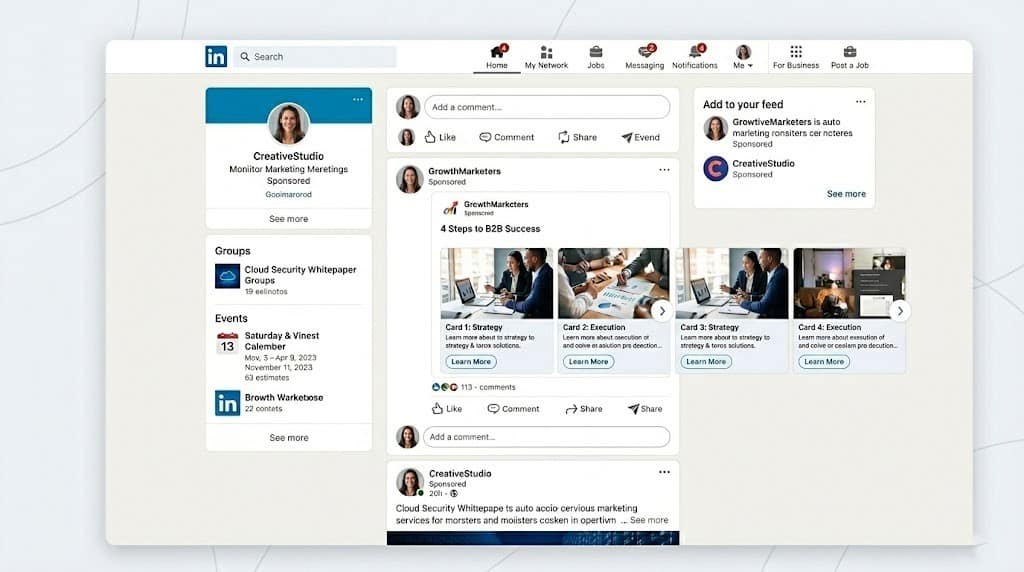
Sponsored content is the most widely used LinkedIn ad format because it appears directly in the feed, where professionals already engage with content.
- Appears in the LinkedIn feed alongside organic posts
- Best for brand awareness, engagement, and content promotion
- Supports single image, carousel, and video formats
- Works well for top and mid-funnel campaigns
This format is ideal when your goal is to reach a broader audience and build visibility without interrupting the user experience.
2. Message and Conversation Ads
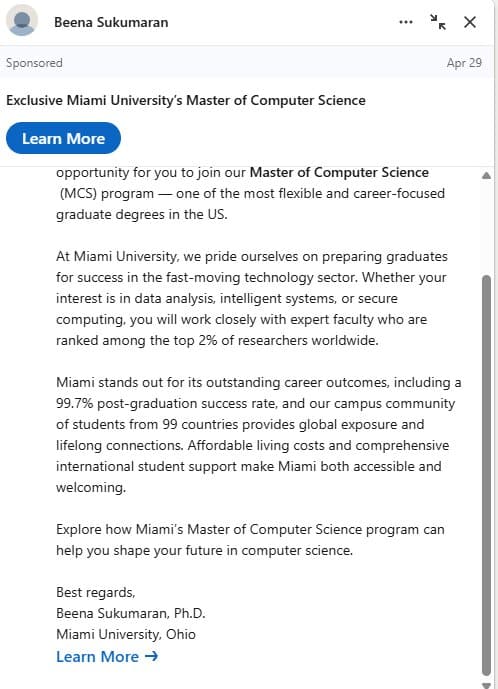
Message and Conversation Ads allow you to reach users directly in their LinkedIn inbox, making them more personal and action-focused than feed-based formats. They are designed to drive direct engagement rather than passive visibility.
- Message Ads: Send a single, direct message with a clear call-to-action, such as visiting a page or submitting a lead form
- Conversation Ads: Offer multiple response options, guiding users through a structured interaction based on their choices
- Best suited for lead nurturing, event promotions, and targeted outreach campaigns
- Works well when you want a direct response instead of general engagement
This format is most effective when your goal is to initiate conversations and move users toward a specific action quickly.
3. Dynamic Ads
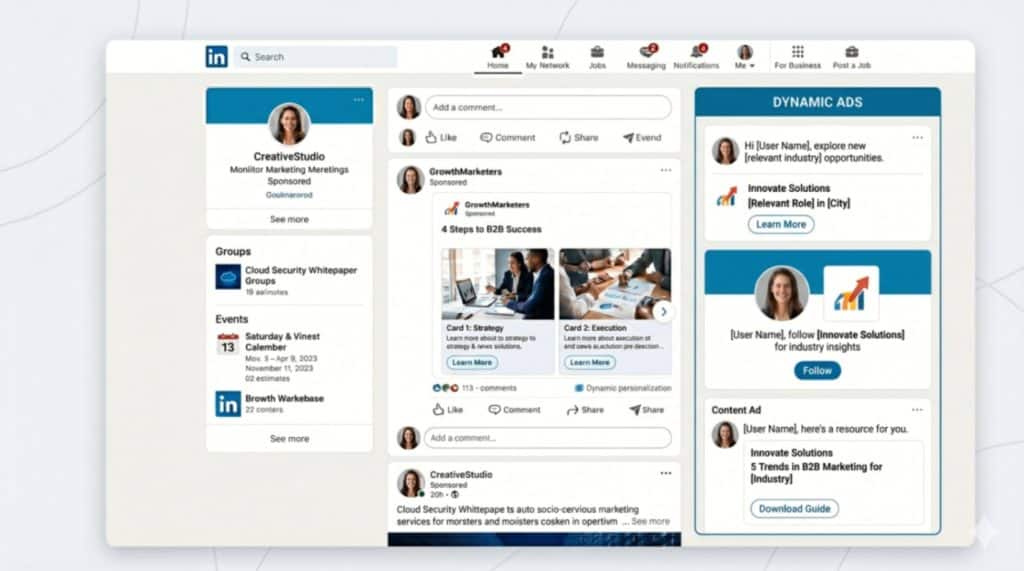
Dynamic Ads use LinkedIn profile data to personalise the message for each user, making them more attention-grabbing than standard display formats. Instead of generic messaging, these ads, especially for product launches, adapt to the viewer, which improves engagement.
- Personalised using profile details such as name, company, or job role
- Appear in the right-hand column on desktop
- Follower Ads: Used to grow your Company Page audience
- Spotlight Ads: Used to drive traffic to a website or landing page
- Best suited for increasing brand visibility and driving targeted actions
This format works best when personalisation can improve attention and reinforce your brand with a specific audience.
4. Text Ads
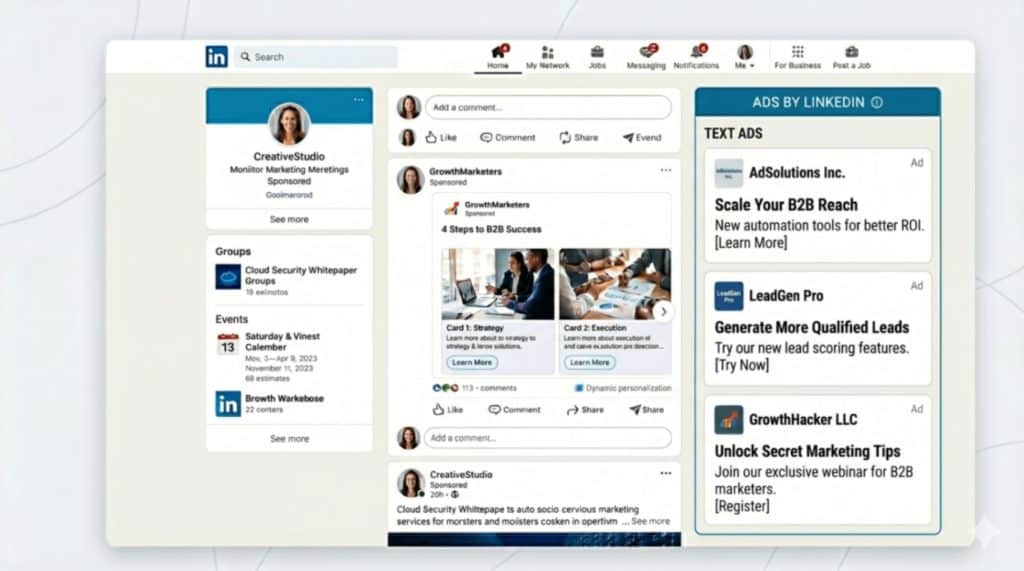
Text Ads are the simplest LinkedIn ad format, designed for quick campaigns with minimal creative effort. They focus on short messaging and direct clicks rather than visual engagement.
- Appear in the sidebar or top section on desktop
- Use a short headline, a brief description, and a small image
- Lower cost compared to other LinkedIn ad formats
- Best suited for driving website traffic and testing messaging
- Works well for campaigns with a limited budget or quick setup needs
This format is useful when your goal is to generate clicks efficiently without investing heavily in creative production.
5. Lead Generation Forms
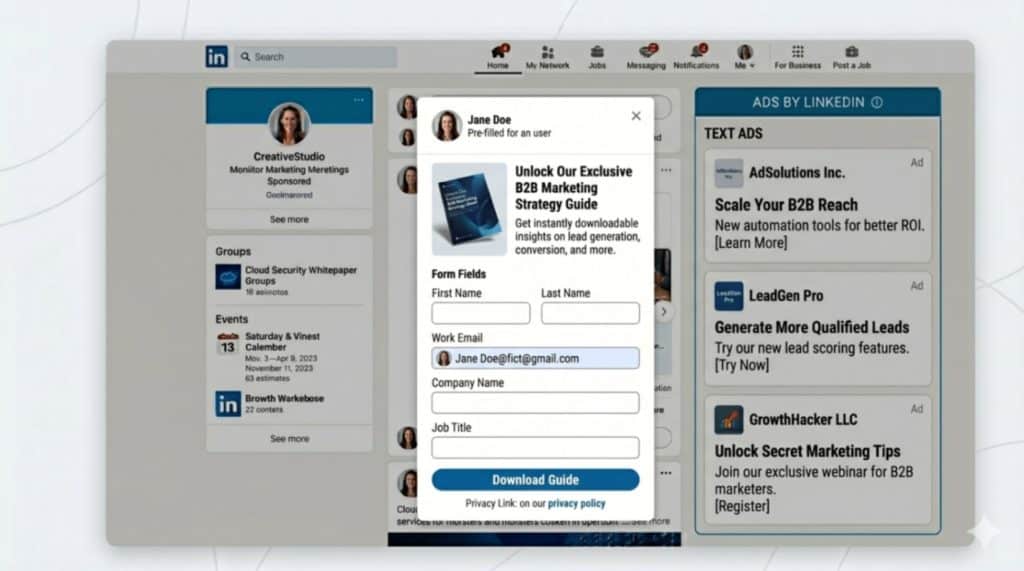
Lead Generation Forms allow users to submit their details directly within LinkedIn, removing the need to visit an external landing page. This reduces friction and improves conversion rates.
- Captures user data instantly using pre-filled LinkedIn profile information
- Eliminates the need for external landing pages
- Can be integrated with sponsored content and message ads
- Best suited for high-intent lead generation campaigns
- Works well for demos, consultations, and gated content
This format is most effective when your goal is to capture leads quickly with minimal drop-off.
Which One Should YOU Start With?
If your goal is visibility, start with sponsored content. If you want leads, combine sponsored content with lead generation forms. For direct outreach, use message or conversation ads. The right choice is not about using every format. It’s about starting with one that matches your objective and scaling based on performance.
How LinkedIn Targeting Work And Why It’s Expensive?
LinkedIn targeting feels precise for a reason. Unlike most ad platforms that rely heavily on behaviour or interests, LinkedIn is built on self-reported professional data. That changes both how targeting works and why costs are higher.
Let’s break this down clearly.
How LinkedIn Targeting Actually Works?
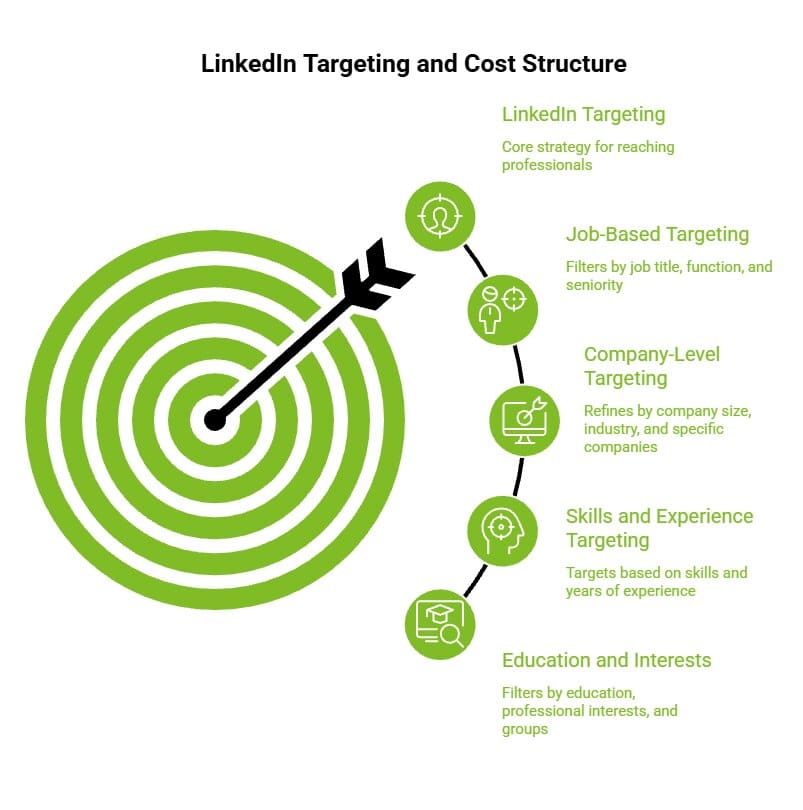
LinkedIn allows you to target users based on who they are professionally, not just what they do online. This includes:
1. Job-Based Targeting
You can target users by:
- Job title (e.g., “Marketing Manager”, “CFO”)
- Job function (Marketing, Finance, HR)
- Seniority (Entry, Manager, Director, VP, CXO)
Example: A B2B SaaS company selling payroll software can target HR Managers and Finance Heads, instead of broad “business interest” audiences like on Facebook.
2. Company-Level Targeting
You can refine audiences by:
- Company size (e.g., 11–50, 51–200, 1,000+ employees)
- Industry (IT, Healthcare, Manufacturing)
- Specific companies (Account-Based Marketing)
Example: A cybersecurity firm can run ads only to employees working at Fortune 500 tech companies, making campaigns highly focused.
3. Skills and Experience Targeting
Target based on:
- Skills listed on profiles (e.g., “SEO”, “Python”, “Project Management”)
- Years of experience
Example: An edtech platform offering data science courses can target users with “Excel” or “SQL” skills, indicating they are likely to upskill.
4. Education and Interests (Professional Context)
You can filter by:
- Degree, field of study, universities
- Groups, content engagement, and professional interests
Example: A business school can target users who studied commerce or engineering and are now in mid-level roles, ideal for MBA programmes.
5. Matched Audiences (First-Party Data)
This includes:
- Website visitors (retargeting)
- Email lists (CRM targeting)
- Account-based lists (ABM)
Example: If someone visited your pricing page but didn’t convert, you can retarget them with a case study or demo offer.
What Makes LinkedIn Targeting So Powerful?
LinkedIn’s biggest advantage is intent + accuracy.
- Users update their job roles themselves
- Data reflects real professional identity
- Targeting aligns with business decision-making roles
This is why LinkedIn is widely used for:
- B2B lead generation
- Hiring and recruitment ads
- High-ticket services (consulting, SaaS, enterprise tools)
Why LinkedIn Ads Are Expensive?
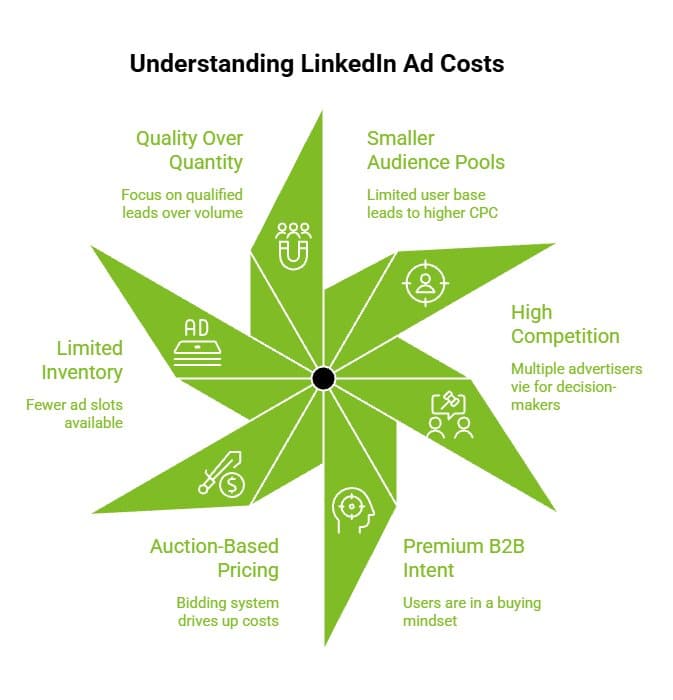
Now the important part. LinkedIn targeting is powerful, but that precision comes at a cost.
1. Smaller, High-Value Audience Pools
LinkedIn audiences are naturally narrower.
Example: Targeting “CMOs in SaaS companies with 200+ employees” might give you only 20,000–50,000 users globally.
Compare that to Facebook, where similar targeting could reach millions.
Smaller audience + high demand = higher cost per click (CPC)
2. High Competition for Decision-Makers
Everyone wants to reach the same people:
- Founders
- CXOs
- Directors
Example: If five SaaS companies are targeting “VP of Sales”, they are bidding against each other for a very limited audience.
This drives up CPC and cost per lead (CPL)
3. Premium B2B Intent
LinkedIn users are often in a professional mindset, not a browsing mindset.
Example: A CFO seeing an ad about financial automation software is closer to a buying decision than a casual social media user.
Higher intent = advertisers willing to pay more
4. Auction-Based Pricing Model
LinkedIn ads run on a bidding system:
- You bid for clicks, impressions, or conversions
- Higher competition increases bid prices
Example: If your bid is ₹300 per click and competitors are bidding ₹500, your ads may not get impressions unless you increase bids.
5. Limited Inventory Compared to Other Platforms
LinkedIn has:
- Fewer daily active users than Facebook or Instagram
- Less ad inventory available
Less supply + high advertiser demand = higher prices
6. Quality Over Quantity Approach
LinkedIn is not designed for cheap traffic. It is designed for:
- Qualified leads
- High-value conversions
Example: Spending ₹5,000 to acquire a CFO lead may sound expensive, but if that lead converts into a ₹5 lakh deal, the ROI makes sense.
How Much Do LinkedIn Ads Cost in India?
LinkedIn ad costs in India are based on an auction system, where pricing depends on your audience, competition, and campaign objective. Instead of a fixed rate, you control spending through your budget and bidding strategy.
Compared to other platforms, LinkedIn ads are generally more expensive. However, the cost is often justified by higher lead quality, especially for B2B campaigns targeting decision-makers.
Here’s a typical cost range you can expect:
| Ad Metric | Average Cost (INR) |
| Cost Per Click (CPC) | ₹150 – ₹250 |
| Cost Per 1,000 Impressions (CPM) | ₹400 – ₹650 |
| Cost Per Lead (CPL) | ₹1,500 – ₹4,000+ |
These numbers can vary based on how competitive your audience is and how well your ads perform. Higher costs do not always mean poor performance. What matters is whether the leads generated justify the spend.
What You’ll Actually Get From LinkedIn Ads?
LinkedIn is often more expensive than other platforms, but it delivers higher-quality B2B leads, with studies showing it generates up to 2x higher conversion rates for B2B marketers than other social platforms.
Typical Outcome by Budget Stage
- ₹30K (Learning Phase):
Limited data, testing creatives and targeting, inconsistent results - ₹50K–₹1L (Initial Leads):
Early conversions, better audience clarity, and improving cost efficiency - ₹1L+ (Scalable Results):
Stable performance, predictable CPL, and consistent lead flow
LinkedIn rewards optimisation over time, not quick launches.
Why Most Campaigns Fail Early
- Expecting immediate leads without a learning phase
- Over-targeting, which limits delivery and increases costs
- Weak messaging that doesn’t clearly communicate value
- Stopping campaigns before optimisation improves performance
Early performance is not failure, it’s data collection.
Time vs ROI Expectations
- Week 1–2: Testing phase, higher CPC, low conversions
- Week 3–4: Improved targeting, initial lead flow
- Month 2+: Optimised campaigns with better ROI
ROI improves with iteration, not just budget increases. LinkedIn ads work best when treated as a system, test, learn, optimise, and scale. Skipping this process leads to high costs without results.
How Do LinkedIn Ads Compare to Other Platforms?
The main difference between LinkedIn and other platforms lies in audience intent. While platforms like Facebook and Instagram focus on broad, interest-based targeting, LinkedIn is built around professional data, making it more effective for B2B campaigns.
| Factor | LinkedIn Ads | Facebook / Instagram Ads | Google Ads |
| Primary Intent | Professional / business | Social / entertainment | Search / problem-solving |
| Targeting Method | Job role, company, industry, seniority | Interests, behaviour, demographics | Keywords (search queries) |
| Audience Type | Decision-makers, professionals | General consumers | Users with active intent |
| Cost (CPC/CPL) | High | Low–Medium | Medium–High |
| Lead Quality | High (B2B focused) | Medium | High (intent-driven) |
| Best Use Case | B2B lead generation, high-value services | Brand awareness, B2C campaigns with CTV ads | Capturing demand, conversions |
LinkedIn ads are more expensive because you are paying to reach a specific professional profile, not a broad audience. This makes them more effective for industries where who you reach matters more than how many people you reach.
Facebook and Instagram are better suited for scale and visibility, where the goal is to reach a large audience at a lower cost. Google Ads, on the other hand, works best when users are already searching for a solution, making it well-suited to capturing existing demand.
If your goal is to reach decision-makers in a specific role or industry, LinkedIn is the stronger choice. If your goal is reach or demand capture, other platforms may perform better.
What Are The Biggest Mistakes In LinkedIn Ads?
Most LinkedIn campaigns don’t fail because of budget, they fail because of misalignment between targeting, messaging, and intent.
- Poor targeting:
Too broad wastes the budget, too narrow limits delivery. Many campaigns target multiple job roles or industries at once, reducing relevance.
Example: Targeting “marketing professionals” instead of “Head of Marketing in SaaS companies” leads to lower-quality leads.
- Weak creatives:
Ads without a clear value proposition get ignored. Generic messaging like “Learn more” or “Grow your business” doesn’t communicate why users should care.
Example: A SaaS ad saying “Improve efficiency” performs worse than “Reduce reporting time by 40%.”
- No funnel alignment:
Running conversion ads to cold audiences rarely works. Users who don’t know your brand are unlikely to book demos or sign up immediately.
Example: Promoting a demo directly instead of offering a guide or case study first.
- Ignoring post-click experience:
Even strong ads fail if the landing page doesn’t match expectations. Slow load times, unclear messaging, or too many steps reduce conversions.
Example: An ad promising a free audit leading to a generic homepage instead of a dedicated form.
Most LinkedIn ad failures come from strategy gaps, not the platform. Fixing these issues improves performance without increasing spend.
Should You Invest In LinkedIn Ads?
Not every business needs LinkedIn ads. The platform works best when your revenue depends on reaching the right people, not just more people.
- YES – High-ticket B2B: If your sales involve decision-makers, longer cycles, or high-value deals, LinkedIn helps you reach a qualified audience.
- MAYBE – Limited budget: It can work, but requires careful targeting and patience during the learning phase before results stabilise.
- NO – Mass audience or low-cost products: If your focus is volume and low acquisition cost, other platforms are more efficient.
If your LinkedIn ads are not delivering consistent results, the issue is usually in the strategy. With the right approach, LinkedIn can become a reliable source of high-quality leads.
Should You Run LinkedIn Ads In-House Or Hire An Agency?
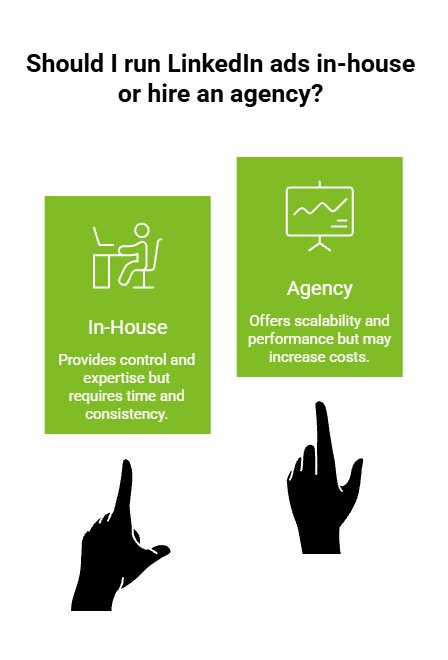
The decision is not about cost alone, it’s about capability. LinkedIn ads require continuous testing, audience refinement, and performance analysis. Without a structured approach, campaigns often generate traffic but fail to convert into qualified leads.
Running ads in-house gives you control, but it also demands time, expertise, and consistency. Hiring an agency shifts execution to specialists who focus on improving performance and scaling results. The right choice depends on how prepared you are to manage optimisation, not just launch campaigns.
In-House Works If:
- You have dedicated time to test creatives, audiences, and bidding strategies consistently
- You understand how LinkedIn targeting, funnel stages, and ad formats work together
- You can analyse metrics like CTR, CPL, and conversion rates and act on them
- You are in an early testing phase and want to validate messaging before scaling
Agency Makes Sense If:
- You need a predictable and scalable lead pipeline
- Your CPL is increasing, but lead quality or conversions are not improving
- You lack the time or in-house expertise to optimise campaigns effectively
- You want structured testing, faster learning cycles, and performance-focused execution
What Most Businesses Get Wrong
Many businesses switch to an agency too late after spending heavily on underperforming campaigns. Others hire too early without a clear offer or positioning, leading to poor results regardless of execution. The key is timing. If your challenge is execution and optimisation, an agency helps. If your challenge is to offer clarity or messaging, fix that first.
The decision is not about control, it’s about whether you can consistently improve performance and generate results over time.
How Can Wild Creek Web Studio Help You Run High-ROI LinkedIn Ads?
Many businesses run LinkedIn ads but struggle to see consistent results. The issue is rarely the platform; it’s the lack of a clear strategy, poor targeting, and a misaligned campaign structure that lead to high costs without meaningful returns.
That’s where Wild Creek Web Studio comes in.
With 18+ years of experience and 100+ brands served, the focus is not just on running ads but on building campaigns aligned with business outcomes such as qualified leads, conversions, and revenue.
Instead of relying only on tools or templates, the approach combines data, strategy, and execution to ensure every campaign delivers measurable impact.
What makes our LinkedIn ad strategy different:
- Strategy-first approach: Campaigns are built around clear goals and expected outcomes
- Targeting precision: Focus on reaching decision-makers based on role, industry, and company
- Conversion-focused creatives: Messaging designed to drive action and improve lead quality
- Continuous optimisation: Ongoing testing and refinement to improve performance and reduce wasted spend
If you want to turn LinkedIn ads into a consistent lead generation channel, get in touch with Wild Creek Web Studio and start building campaigns that deliver measurable results.
Conclusion
LinkedIn ads are built for precision, not scale. If your goal is to reach decision-makers, generate qualified leads, or engage a specific professional audience, the platform offers a clear advantage. However, results depend on how well your campaign is structured, targeting, ad format, and messaging must work together to drive meaningful outcomes.
To get the most out of LinkedIn advertising, focus on clear objectives, relevant audiences, and continuous optimization. Start with a defined goal, choose the right format, and refine performance over time. If you want to scale efficiently and avoid wasted spend, working with Wild Creek Web Studio
Frequently Asked Questions
Can I run LinkedIn ads without a company page?
Yes, you can run certain LinkedIn ads, like Message Ads, without a Company Page. However, most ad formats require one, and having a Company Page improves credibility, branding, and overall campaign performance.
What are the benefits of working with a LinkedIn ads agency?
Working with a LinkedIn ads agency helps you plan, execute, and optimise LinkedIn document ads campaigns effectively. They improve targeting, creatives, and bidding strategies, reduce wasted spend, and focus on generating higher-quality leads and better overall ROI.
How does LinkedIn advertising compare to Facebook and Instagram?
LinkedIn advertising targets professionals based on job role and company, making it ideal for B2B. Facebook and Instagram focus on interests and behaviour, better suited for B2C campaigns and broad audience reach.
Do You Need a LinkedIn Ads Agency?
You may need a LinkedIn ads agency if your campaigns aren’t generating quality leads, costs are high, or scaling becomes difficult. An agency helps optimise targeting, creatives, and strategy to improve performance and ROI.
What is the LinkedIn Ad Library, and how can I use it?
The LinkedIn Ad Library is a public database where you can view active ads running on the platform. You can use it to analyse competitors, study ad creatives, and understand messaging trends to improve your own campaigns.
What is a LinkedIn advertising agency, and how can it help?
A LinkedIn advertising agency helps plan, manage, and optimise campaigns. It improves targeting, creatives, and bidding strategies to generate better leads and maximise ROI from LinkedIn ads.
What is the average LinkedIn advertising cost in India?
LinkedIn advertising cost in India varies based on targeting and competition. On average, CPC ranges from ₹150 to ₹250, while the cost per lead can go higher depending on audience quality and campaign goals.
What are the different LinkedIn ad types available?
LinkedIn ad types include sponsored content, message ads, dynamic ads, text ads, and lead generation forms. Each format serves different goals, such as awareness, engagement, or lead capture.