Key Highlights
- Brand loyalty goes beyond simple repeat purchases; it involves a deep emotional attachment from loyal customers.
- Building genuine customer loyalty is challenging due to high competition and the failure of simple discounts to create lasting bonds.
- True brand loyalty is driven by psychological factors, consistency, and a strong brand identity that resonates with consumer values.
- Successful brands create exceptional customer experiences and deliver value beyond the product itself.
- Measuring brand loyalty involves looking past repeat purchases and considering metrics like customer engagement.
- Lasting customer retention is achieved when loyalty becomes a core part of your business strategy, reducing dependency on acquiring new customers.
Most brands see steady traffic, decent conversions, and consistent campaigns, yet struggle to get customers to return. If repeat purchases depend on discounts or reminders, it is not loyalty; it is dependency. That is where most strategies break.
The gap is not in visibility or effort. It is in preference. Customers may engage, buy, and even return occasionally, but still switch the moment a better option appears. This makes growth unpredictable and forces constant acquisition just to maintain momentum.
Building brand loyalty is not about increasing activity. It is about creating a reason to stay that competitors cannot easily replace. This guide will help you understand what actually drives loyalty, where most brands go wrong, and how to build a system that turns one-time buyers into consistent customers.
Why Most Businesses Misunderstand Brand Loyalty?
Brand loyalty is often defined as repeat purchases, but that definition misses the real point. A customer can return multiple times and still switch the moment a better option appears. That is not loyalty, it is convenience.
This misunderstanding leads to poor decisions. Businesses assume retention equals loyalty, so they invest in discounts, rewards, and frequent campaigns. These tactics drive activity, but they do not build preference or foster positive experiences. As a result, building brand loyalty gets reduced to short-term tactics instead of a long-term strategy.
True brand loyalty is when customers choose your brand even when alternatives exist. It is driven by trust, consistency, and perceived value over time. When this is missing, businesses keep chasing repeat purchases without ever creating a loyal customer base that fosters stability.
The difference matters because it changes how you approach growth. If building brand loyalty relies on incentives, it remains fragile. If it is built on preference, it becomes a long-term advantage.
What are the Financial Benefits of Brand Loyalty?
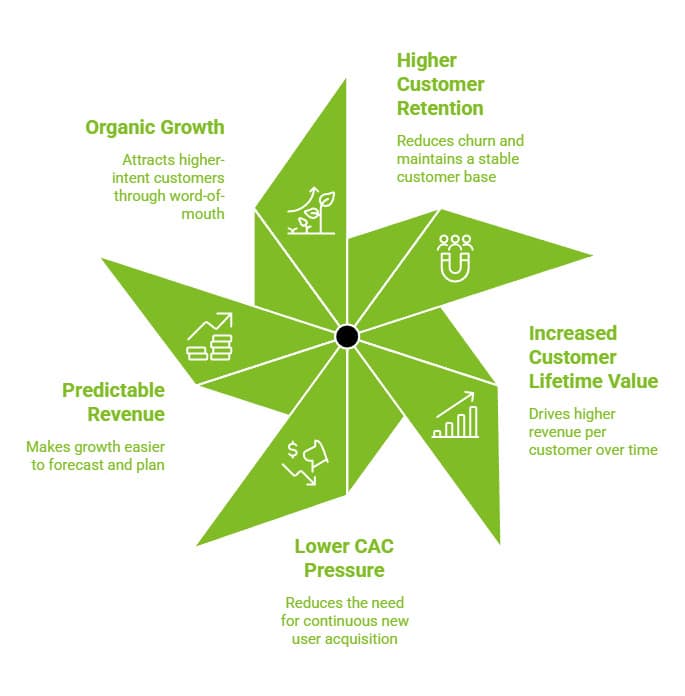
Most businesses treat loyalty as a marketing outcome, but its real value is financial. When customers return by choice, the business spends less to win revenue repeatedly, driven by customer feedback. That means lower churn cost, better margins, and more predictable growth.
Here’s why the benefits of brand loyalty matter financially:
- Higher Customer Retention: Reduces churn and lowers dependency on constant acquisition, helping maintain a stable customer base without repeated spend, thereby enhancing overall marketing efforts.
- Increased Customer Lifetime Value (CLV): Drives higher revenue per customer over time, improving margins as more value is generated from existing relationships.
- Lower CAC Pressure: Loyal customers bring referrals and repeat purchases, reducing the need to continuously invest in acquiring new users.
- Predictable Revenue: Makes growth easier to forecast and plan, allowing better allocation of budgets, inventory, and resources.
- Organic Growth: Word-of-mouth reduces reliance on paid marketing while attracting higher-intent customers who are more likely to convert.
These advantages of brand loyalty go beyond immediate gains and shape how sustainable your growth becomes.
3 Core Reasons Why Brand Loyalty Fails?
Building brand loyalty is harder than it looks because choice is abundant and differentiation is weak. Loyalty does not break due to dissatisfaction; it breaks because nothing meaningful, such as an emotional connection, prevents customers from switching.
Low Switching Costs Turn Satisfaction Into Instability
Satisfaction no longer protects loyalty. When alternatives are easy to access, even a good experience is not enough to retain customers. Loyalty fails when there is no friction or consequence in leaving.
Discounts Replace Preference With Price Dependency
Discounts train customers to optimise for price, not value. Over time, this shifts behaviour from choosing your brand to choosing the best deal, eroding positioning and making loyalty economically fragile.
Engagement Creates Visibility, Not Commitment
Engagement signals attention, not intent. Customers may interact frequently yet still evaluate alternatives at the moment of purchase. Loyalty fails when brands mistake activity for actual preference.
Loyalty breaks when it depends on convenience or incentives. It holds when customers have a reason to stay that competitors cannot easily replicate.
Which Type of Loyalty Actually Drives Growth?
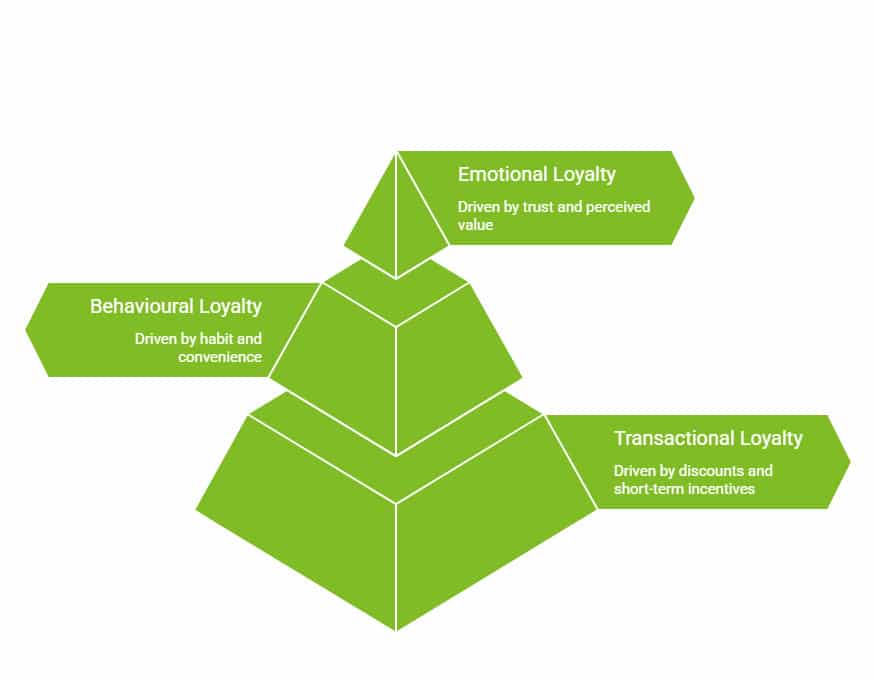
Not all brand loyalty contributes to growth. Some forms create repeat purchases without stability, while others drive long-term revenue, retention, and pricing power. The difference lies in what motivates the customer to stay, often involving different strategies.
Transactional Loyalty: Drives Volume, Not Stability
Transactional loyalty is built on discounts, rewards, or short-term incentives, including early access to exclusive benefits and deals. It can increase conversions quickly, but it does not create a reason to stay once the offer disappears. Customers are not choosing the brand; they are choosing the deal. As a result, revenue becomes promotion-dependent, and retention weakens the moment incentives are removed.
Behavioural Loyalty: Looks Strong, Breaks Easily
Behavioural loyalty is driven by habit or convenience, which is an interesting aspect of consumer behaviour. Customers return regularly, which makes retention appear strong, but their preference is shallow. When a competitor offers a better experience or becomes more accessible, switching happens without hesitation. What looks like loyalty is often just inertia.
Emotional Loyalty: The Only Type That Compounds
Emotional loyalty is driven by trust, identity, and perceived value. Customers actively choose the brand even when alternatives are available, providing a strong competitive advantage. This reduces comparison behaviour and strengthens long-term relationships. Over time, it leads to higher lifetime value, better retention, and organic growth through repeat purchases and referrals.
If your growth depends on discounts or convenience, your loyalty is replaceable. Sustainable growth comes from building emotional preference, where customers stay because they want to, not because they have to.
What Actually Drives Strong Brand Loyalty?
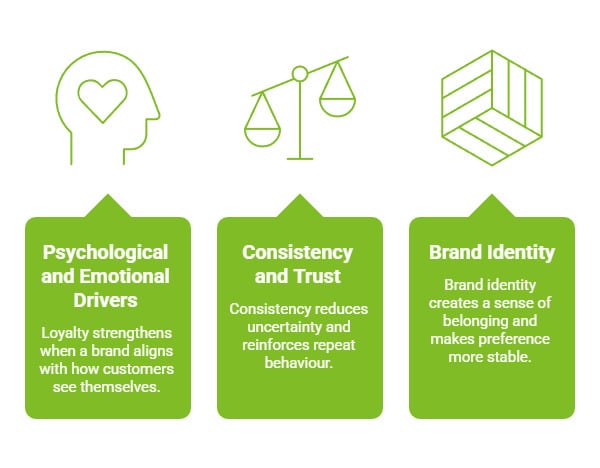
Strong brand loyalty is not built through price or visibility. It forms when customers stop evaluating alternatives and start choosing a brand by default. This shift happens when specific drivers become a key factor that removes the need to compare.
Psychological and emotional drivers
Loyalty strengthens when a brand aligns with how customers see themselves. This is not about features, but about identity, familiarity, and perceived fit. When customers feel understood, decisions become instinctive rather than analytical. The brand moves from being an option to being a natural choice.
Consistency and trust over time
Consistency does more than build trust. It reduces uncertainty at every interaction. When customers know what to expect across product, service, and communication, they stop reassessing their choices. The decision becomes easier each time, which reinforces repeat behaviour without active evaluation.
Brand Identity Turns Preference Into Commitment
Brand identity defines what a brand stands for and why it matters. When this aligns with customer values, a sense of belonging emerges, making preference more stable and harder to replace. Brands like Patagonia do not rely on product alone. Their positioning creates a reason to stay that goes beyond utility, making the relationship more durable over time.
Loyalty does not come from a single factor. It forms when comparison reduces, decisions become easier, and preference gains meaning. If customers are still evaluating alternatives, loyalty has not been built yet.
Brand Loyalty Examples: What Do Successful Brands Do Differently?
Most brands focus on selling better products. Strong brands focus on making the choice easier to repeat. The difference lies in how they design experience, value, and consistency, which play a key role in building brand loyalty and providing a competitive edge over time.
Instead of relying on campaigns, they build systems that keep customers engaged. This is what turns occasional buyers into consistent users and strengthens customer brand loyalty.
Global brands and their loyalty systems
Brands like Amazon and Sephora show how loyalty is built through structured value, not just promotions.
Amazon Prime goes beyond free shipping and enhances the online shopping experience. It combines convenience, entertainment, and exclusive access into a single subscription. This bundled value makes staying within the ecosystem feel natural, reducing the need to switch.
Sephora’s Beauty Insider program uses a tiered system to reward engagement. Customers unlock benefits as they spend more, creating a sense of progress and exclusivity that encourages repeat behaviour.
These are not just loyalty programs. They are systems designed to reinforce habits, a core principle in brand loyalty in marketing.
Indian brands are building strong customer loyalty
In India, brands like Amul, Tata, and Asian Paints build loyalty by focusing on consistency, value, and relevance. Instead of relying on short-term offers, they become part of everyday routines through reliable quality and strong customer trust.
This approach reflects a deeper understanding of types of brand loyalty, where long-term preference for a particular brand is built through familiarity and repeated positive feelings and experiences. Over time, this creates strong brand loyalty that is harder for competitors to disrupt.
Successful brands do not rely on isolated tactics. They design systems and experiences that make repeat behaviour easier, turning preference into a consistent pattern over time.
Brand Loyalty vs Customer Retention: What’s the Real Difference?
Brand loyalty and customer retention are often used interchangeably, but they represent different outcomes. Retention measures whether customers stay, and a high retention rate indicates customer loyalty. Loyalty explains why they stay, which is why building brand loyalty is more critical for long-term growth.
A business can retain customers due to convenience, lack of alternatives, or switching barriers. Loyalty, however, exists when customers actively choose the brand even when other options are available.
Key Differences Between Brand Loyalty and Customer Retention
| Factor | Customer Retention | Brand Loyalty |
| Definition | Measures repeat business over time | Reflects preference and trust |
| Driver | Convenience, pricing, switching barriers | Experience, consistency, identity |
| Customer behaviour | Stays because they have to | Stays because they want to |
| Stability | Can change quickly | More resistant to competition |
| Growth impact | Maintains revenue | Drives long-term growth and advocacy |
Retention is an outcome. Loyalty is the reason behind it. If retention is driven by convenience or lack of alternatives, it breaks when conditions change. Only loyalty makes it durable, where customers stay even when better options exist.
How Does Brand Loyalty Work in Marketing?
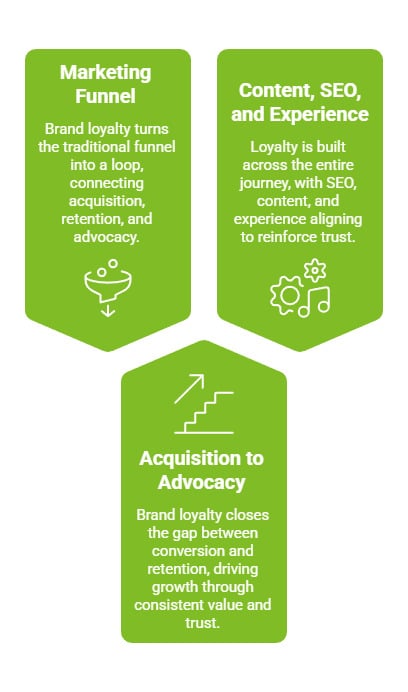
Brand loyalty in marketing is not a final stage. It is a system that connects acquisition, retention, and advocacy into a continuous loop. Instead of replacing customers, businesses build on existing relationships, making building brand loyalty central to long-term marketing success.
When loyalty is strong, marketing shifts from conversion to reinforcement. The focus moves from persuading new customers to increasing value from existing ones.
Where loyalty fits in the marketing funnel?
The traditional funnel ends at conversion, but real growth begins after the first purchase. Brand loyalty turns the funnel into a loop. Acquisition brings customers in. Retention keeps them engaged through meaningful customer interactions. Advocacy brings in new customers through referrals and trust. This reduces reliance on constant acquisition and allows marketing to build momentum over time.
From acquisition to retention to advocacy
Most businesses optimise for acquisition but lose customers after the first purchase. The gap between conversion and retention is where growth breaks. Brand loyalty in marketing closes this gap. Consistent value drives retention, while trust drives advocacy. When this system works, each stage strengthens the next instead of operating in isolation.
The role of content, SEO, and experience
Loyalty is built across the entire journey. SEO brings intent, content builds understanding, and experience reinforces trust. If these elements do not align, customers drop off after the first interaction. When they do, customers return more often, reducing the need for repeated acquisition.
Brand loyalty works when marketing stops chasing attention and starts building continuity. Once customers return by choice, growth becomes less about effort and more about momentum.
How Do You Build Brand Loyalty That Actually Lasts?
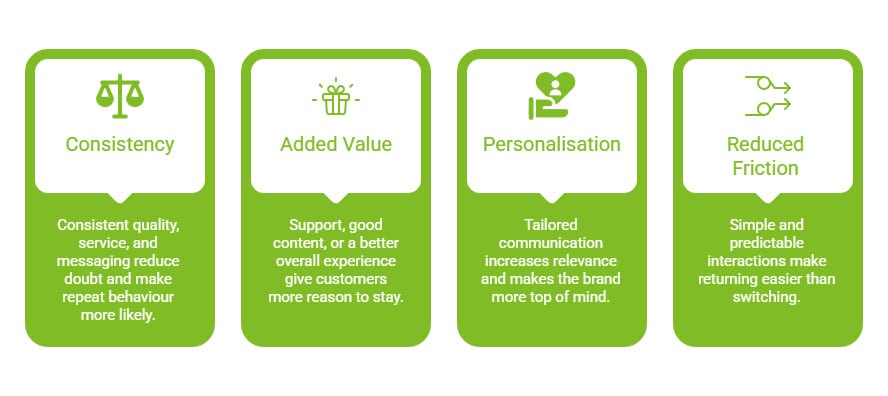
Brand loyalty is not built at the point of purchase. It forms through repeated interactions that make choosing the same brand easier over time. When each experience reduces effort and uncertainty, customers stop evaluating alternatives.
Most brands lose customers after acquisition because the experience does not give them a reason to return. Loyalty forms only when the post-purchase journey reinforces the decision.
Consistency Removes the Need to Re-evaluate
When experience varies across touchpoints, customers start questioning their choice. Even small inconsistencies introduce doubt. When quality, service, and messaging stay aligned, decisions become predictable. This reduces comparison and makes repeat behaviour more likely.
Added Value Creates a Reason to Return
A product can trigger the first purchase, but it rarely drives the second on its own. When brands add value through support, good content, or a better overall experience, customers gain more from staying than switching. This shifts behaviour from one-time purchase to ongoing engagement.
Personalisation Increases Relevance and Response
Generic communication gets ignored because it does not reflect customer intent. When interactions are shaped by behaviour and preferences, they feel timely and useful. This increases engagement and makes the brand more top of mind during the next decision.
Reduced Friction Makes Behaviour Repeatable
Friction interrupts momentum. Delays, confusion, or extra steps create reasons to leave. When interactions are simple and predictable, actions require less effort. This makes returning easier than switching, reinforcing repeat behaviour over time.
Loyalty does not come from individual actions. It builds when every interaction makes the next decision easier. When effort decreases and value increases, customers return without reconsidering alternatives.
What Mistakes Prevent Businesses from Building Brand Loyalty?
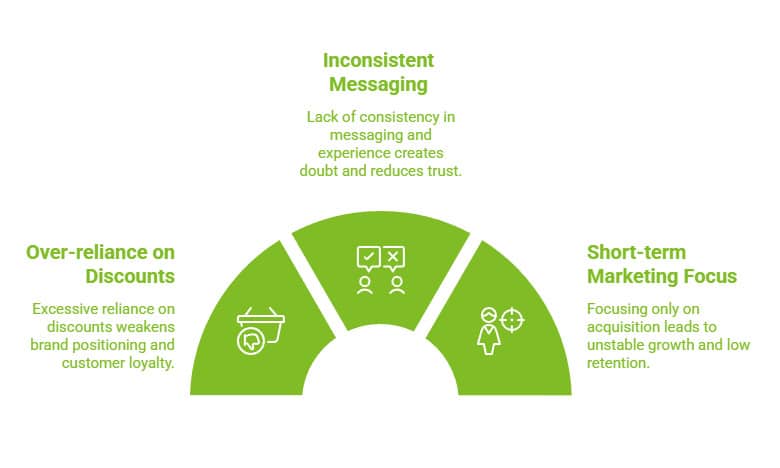
Most brands do not fail due to a lack of effort. They fail because the approach is misaligned. Building brand loyalty breaks down when short-term tactics replace long-term consistency.
Many businesses focus on activity, not impact. They drive sales, but fail to create preference. Over time, this weakens customer brand loyalty and makes growth dependent on constant acquisition.
Here are the key mistakes that quietly weaken strong brand loyalty:
Over-reliance on discounts and incentives
Discounts can drive repeat purchases, but they rarely build real loyalty. When price becomes the reason to buy, customers follow the best deal. This creates dependency on promotions, attracts price-sensitive buyers, and weakens brand positioning. Over time, loyalty turns transactional and easy to replace.
Inconsistent messaging and experience
Inconsistency creates doubt. When messaging, service, or experience varies across channels, customers struggle to understand what the brand stands for. This lack of clarity reduces trust and increases switching behaviour. Consistency is what turns a good experience into a repeat choice.
Short-term marketing focus
Focusing only on acquisition creates unstable growth. Businesses bring customers in but fail to keep them engaged after the first purchase. Without a long-term approach, retention drops and loyalty never develops. This increases marketing costs and prevents sustainable growth.
These mistakes often go unnoticed because they deliver short-term results. But over time, they weaken customer relationships and make loyalty harder to build.
When Does Brand Loyalty Become a Growth Driver?
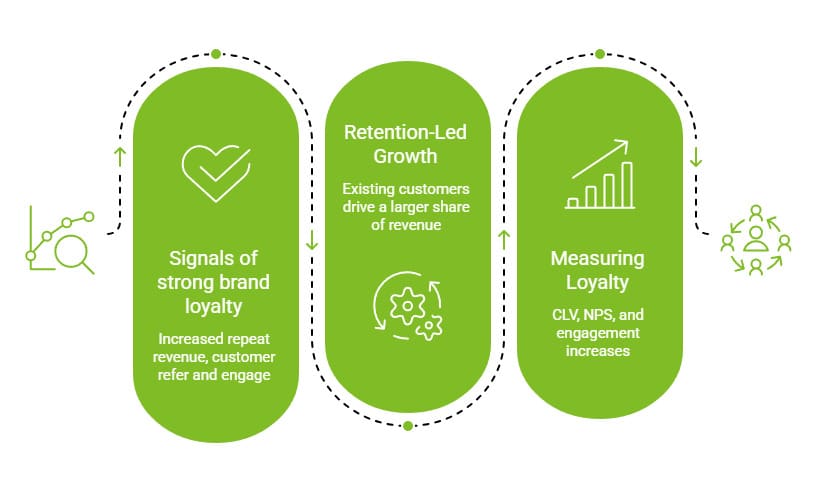
Brand loyalty becomes a growth driver when customers return and recommend the brand without incentives. At this point, growth no longer depends on constant acquisition. It compounds through existing customers, making building brand loyalty central to scale.
The shift happens when behaviour becomes predictable. Customers do not need to be persuaded each time. They return by default.
Signals of strong brand loyalty
Not all signals indicate real loyalty. Focus on behaviours that reduce acquisition pressure:
- Repeat revenue contribution increases
- Customers refer without prompting
- Engagement continues after purchase
- Retention holds even without offers
These signals show preference, not dependency.
The Real Shift: From Acquisition-Led to Retention-Led Growth
Most businesses generate sales but fail to convert them into stable growth. When loyalty is weak, every revenue cycle depends on new acquisition. When loyalty strengthens, existing customers drive a larger share of revenue. This reduces marketing pressure, lowers acquisition costs, and stabilises growth.
Measuring Loyalty That Drives Growth
Repeat purchases alone are not enough. Loyalty becomes valuable when it shows up across behaviour:
- Customer Lifetime Value (CLV) increases as customers stay longer
- Net Promoter Score (NPS) reflects willingness to recommend
- Engagement shows continued interaction beyond transactions
Together, these indicate whether customer brand loyalty is actually compounding.
Brand loyalty becomes a growth driver when customer behaviour shifts from occasional to consistent. At that point, growth is no longer driven by effort alone, but by the strength of existing relationships.
How Can Wild Creek Web Studio Help You Build Brand Loyalty Strategically?
Building brand loyalty requires more than campaigns or rewards. It depends on how consistently your brand is experienced across every touchpoint.
Wild Creek Web Studio focuses on turning visibility into long-term preference. We align SEO, content, and user experience to help customers not just discover your brand, but return to it.
Our approach includes:
- Consistent brand experience across channels
- Content that builds trust, not just traffic
- Optimised customer journeys to reduce friction
- Data-driven strategies that improve retention
With 18+ years of experience, we help businesses move from one-time conversions to repeat-driven growth.
If your current strategy brings traffic but not loyalty, it is time to rethink the approach. Contact Wild Creek Web Studio to build a system that drives lasting brand loyalty.
Conclusion
Building brand loyalty goes beyond repeat purchases. It is driven by consistent experience, trust, and how well your brand aligns with what customers value. When loyal customers act as brand ambassadors and choose your brand by preference, not convenience, growth becomes more stable and less dependent on constant acquisition.
The focus should shift from short-term tactics to long-term relationships. When done right, loyalty compounds over time and strengthens every stage of your business.
If you want to build a stronger loyalty strategy, connect with Wild Creek Web Studio and explore how we can help.
Frequently Asked Questions
Can you share some lesser-known brands that have strong customer loyalty?
Brands like Glossier, Notion, Liquid Death, Allbirds, and Gymshark have built strong customer brand loyalty through community-driven marketing, clear positioning, and consistent brand experience, encouraging customers to return by preference rather than price.
What strategies do global leaders use to foster brand loyalty among customers?
Global brands focus on consistency, seamless user experience, and value-driven ecosystems like subscriptions or tiered rewards. These strategies support building brand loyalty by reducing friction and reinforcing repeat behaviour over time.
What psychological factors influence consumers to stay loyal to a brand?
Trust, familiarity, and identity alignment play a key role in customer brand loyalty. When customers relate to a brand and feel confident in its experience, they are more likely to choose it consistently without comparing alternatives.
How do loyalty programs contribute to building brand loyalty?
Loyalty programs encourage repeat behaviour through rewards, but their real impact lies in engagement. When designed well, they create ongoing interaction and reinforce brand preference over time.
How does brand loyalty impact customer retention rates?
Brand loyalty improves retention by making customers stay by choice rather than convenience. Strong customer brand loyalty reduces churn, increases repeat purchases, and creates more stable long-term growth.