
Key Highlights
- Generative Engine Optimisation (GEO) requires a new approach to ROI measurement, as traditional search engine optimisation metrics fall short.
- The core of GEO ROI measurement focuses on brand visibility, engagement, and authority, not just clicks.
- Effective ROI calculation connects GEO efforts to tangible business outcomes, even without direct attribution.
- Your GEO SEO strategy must adapt to how AI tools like ChatGPT and Gemini influence user behaviour.
- Tracking mentions, share of voice, and influenced revenue provides a clearer picture of GEO’s impact.
- Leveraging specialised SEO tools is essential for accurate data collection and analysis.
Most teams struggle with GEO ROI, not because it is difficult to measure, but because they are measuring the wrong things. Traditional SEO frameworks rely on clicks, traffic, and direct conversions, but GEO operates in environments where influence happens before any of these signals appear.
This creates a blind spot. Your brand may already be shaping decisions inside AI-generated responses, yet standard reporting shows little to no impact. The problem is not visibility. It is how that visibility is interpreted.
This guide helps you rethink GEO ROI measurement by focusing on what actually reflects impact. Instead of relying only on traffic and conversions, it shifts the focus to visibility, influence, and how your brand appears in critical decision-making moments.
What Is GEO ROI Measurement and Why Does It Matter?
GEO ROI measurement is the process of evaluating the business model and its impact on your presence in AI-generated search results. It focuses on how often your brand is surfaced, how it is represented, and how that visibility influences decisions before users take action.
This matters because the way people discover information is changing. Increasingly, users rely on AI tools like ChatGPT and Gemini to compare options, validate choices, and form opinions. In many cases, these decisions are shaped before a user ever clicks on a website.
This shifts how ROI should be understood in the context of digital marketing. Traditional models assume value starts at the click, but GEO creates value earlier in the journey. Your brand can influence awareness, trust, and preference without generating immediate traffic.
As a result, measuring GEO ROI is not just about tracking performance, but about recognising where influence happens and how it contributes to business outcomes over time.
How Is GEO ROI Different From Traditional SEO ROI?
Traditional SEO ROI is built on measurable actions across various marketing channels. It tracks what users do after they click, whether that is visiting a page, filling a form, or completing a purchase. This makes SEO ROI relatively straightforward because every step in the journey is visible and attributable.
GEO works differently. GEO ROI measurement is not based on actions alone, but on the influence that happens before action, contributing to brand awareness. Your brand may appear in AI-generated responses, shape user perception, and guide decisions long before a user visits your website.
This is where traditional SEO thinking fails. It assumes value begins at the click, while GEO creates value before the click even happens.
Key Differences Between SEO ROI and GEO ROI
| Aspect | Traditional SEO ROI | GEO ROI Measurement |
| Core Focus | Measurable actions (clicks, conversions) | Influence before action (visibility, perception) |
| Attribution | Direct and trackable | Indirect and influenced |
| User Journey | Starts after click | Starts before click |
| Key Metrics | Traffic, rankings, conversions | Mentions, citations, share of voice |
| Data Visibility | Fully trackable within analytics | Partially visible across platforms |
| Decision Impact | After the user visits the site | Before the user visits the site |
This is why applying traditional SEO ROI models to GEO often results in underreporting its true business impact.
How Do I Measure the ROI of GEO Efforts?
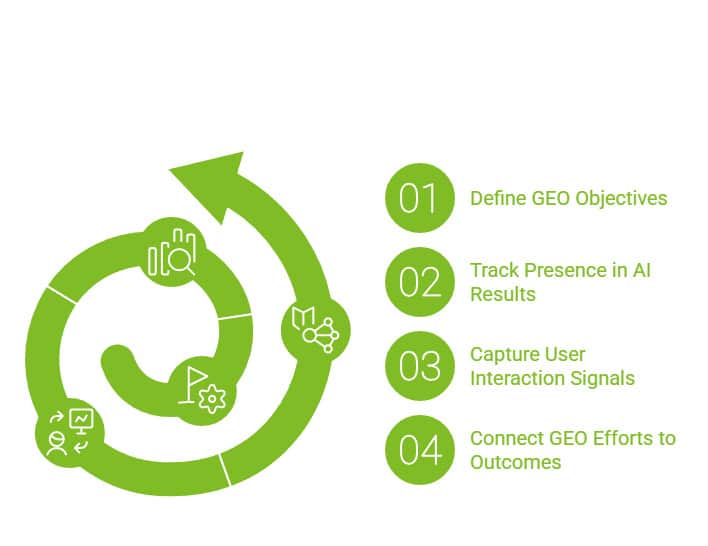
GEO ROI is often misunderstood, not because data is missing, but because it is measured using the wrong framework. GEO does not follow click-based behaviour, which means traditional SEO measurement only captures a fraction of its impact.
To make GEO ROI measurement meaningful, you need a structured approach that connects visibility, user signals, and business outcomes, where each step solves a different gap.
Step 1: Define GEO Objectives (Solves the Direction Problem)
Without clear objectives, GEO performance looks inconsistent. Most teams default to tracking traffic or rankings, which are not reliable indicators in AI-driven search.
The goal here is to define what success looks like in environments where influence happens before clicks. Visibility in AI responses, authority through citations, and inclusion in decision-driven queries become the starting point. These objectives ensure you are measuring what actually reflects progress.
Step 2: Track Presence in AI-Generated Results (Solves the Visibility Problem)
GEO impact begins with visibility, but most teams do not track it systematically. If you do not know where your brand appears, you cannot measure improvement or compare against competitors.
Tracking a fixed set of high-intent queries across platforms like ChatGPT, Gemini, and Perplexity creates a baseline. Over time, this reveals patterns in mentions, citations, and share of voice. Visibility moves from being anecdotal to something measurable and comparable.
Step 3: Capture User Interaction Signals from AI Discovery (Solves the Attribution Gap)
The biggest measurement gap in GEO is attribution. Influence often happens inside AI responses, but engagement happens later through other channels.
To bridge this, you need signals that indicate user intent after exposure. Branded search growth, leads referencing AI discovery, and behavioural patterns from AI-referred traffic help connect visibility to real interest. These signals do not provide perfect attribution, but they reveal whether GEO is influencing decisions.
Step 4: Connect GEO Efforts to Business Outcomes (Solves the Validation Problem)
Visibility and engagement alone are not enough. ROI becomes meaningful only when it is linked to outcomes stakeholders care about.
This requires shifting from direct attribution to influenced outcomes. Tracking AI-influenced leads, changes in pipeline quality, and sales feedback helps validate impact. When these signals align with visibility trends, GEO moves from being an awareness activity to a measurable contributor to growth.
GEO ROI becomes measurable when these steps are connected. Visibility explains where you appear, interaction signals show user intent, and business outcomes confirm whether that influence translates into real impact.
What Metrics Should You Track for GEO ROI Measurement?
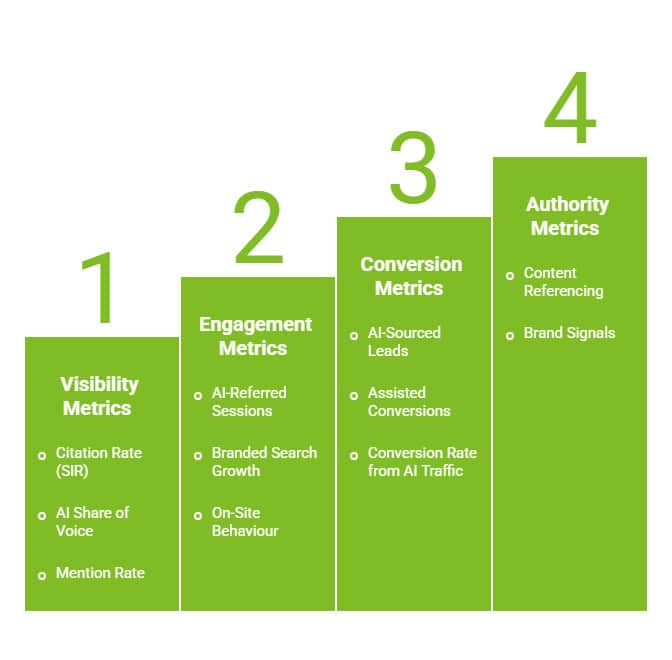
The biggest mistake in measuring GEO is treating ROI as a single metric. GEO ROI measurement works as a system, where each metric reflects a different stage of how influence builds and converts into outcomes.
Instead of tracking metrics in isolation, you need to view them as a journey. Each layer answers a different question, and together, they explain whether GEO is actually working.
1. Visibility Metrics (Can You Be Seen?)
Everything starts with visibility. If your brand is not appearing in AI-generated responses, nothing else matters. This is where most GEO strategies either succeed or fail early.
- Citation Rate (SIR): Shows how often your content is referenced across key prompts, indicating whether AI systems recognise your authority
- AI Share of Voice: Measures how your presence compares to competitors, highlighting gaps in positioning
- Mention Rate: Tracks how frequently your brand appears in relevant responses, even without links
Visibility metrics tell you whether you are part of the conversation at all.
2. Engagement Metrics (Do Users Respond?)
Visibility alone does not create value. The next question is whether users react to that visibility.
- AI-Referred Sessions: Indicates whether AI exposure leads users to visit your site
- Branded Search Growth: Reflects increasing awareness when users search for your brand after seeing it in AI responses
- On-Site Behaviour: Shows the quality of traffic through metrics like time on site and pages per session
These signals help you understand whether visibility is turning into interest.
3. Conversion Metrics (Does It Influence Outcomes?)
The real test of GEO is not clicks, but sustainable growth influence. This is where you evaluate whether visibility and engagement are shaping decisions.
- AI-Sourced Leads: Identifies users who report AI as their discovery source
- Assisted Conversions: Shows GEO’s role across the journey, even if it is not the final touchpoint
- Conversion Rate from AI Traffic: Evaluates how effectively AI-influenced users convert
These metrics connect GEO activity to pipeline and revenue.
4. Authority Metrics (Are You Trusted Repeatedly?)
Authority determines whether your visibility is consistent and sustainable. AI systems prioritise sources they trust, which means authority directly impacts long-term performance.
- Content Referencing: Tracks how often your brand is cited across trusted sources and platforms
- Brand Signals: Measures how accurately and consistently your brand is represented in AI outputs
Strong authority ensures your presence is not temporary, but repeatable.
No single metric defines GEO performance. The real value comes from combining visibility, engagement, conversion, and authority signals into a unified view. This is what makes GEO ROI measurement both interpretable and actionable.
How Do You Calculate GEO ROI in Practice?
The challenge in calculating GEO ROI is not mathematical; it is conceptual. The formula remains the same, but the definition of value expands beyond what is immediately measurable.
In GEO, revenue needs to reflect influence across the journey, not just outcomes at the end. This is what makes the calculation meaningful rather than misleading.
Basic ROI Formula for Reference
The starting point remains the same:
ROI = (Revenue – Cost of Investment) / Cost of Investment × 100
- Revenue: For GEO, this reflects influenced revenue, not just directly attributed sales
- Cost of Investment: Includes tools, content, team effort, and external support
This formula still applies, but what changes is how revenue is defined.
GEO ROI Calculation Based on Influenced Revenue
Instead of relying only on last-click attribution, GEO ROI is calculated using influenced revenue.
The model works as follows:
- Identify users exposed to your brand through AI platforms
- Estimate the share of revenue influenced by those interactions
- Use that value as the revenue input in your ROI calculation
This shifts the focus from exact attribution to consistent estimation, which is more aligned with how GEO actually works.
Practical Example of GEO ROI Calculation
The challenge is not applying the formula, but deciding what counts as revenue. A practical example makes this clearer.
| Metric | Value |
| Total GEO Investment | ₹8,00,000 |
| Total Revenue from New Customers | ₹80,00,000 |
| % Influenced by AI Discovery | 15% |
| Influenced Revenue | ₹12,00,000 |
| Net Gain | ₹4,00,000 |
| GEO ROI | 50% |
In this scenario, ₹12,00,000 is treated as influenced revenue and used in the ROI formula. The result is a 50% return, even without direct attribution.
GEO ROI is not about precision, but consistency. Businesses that apply the same influenced revenue model over time gain a clearer picture of performance than those trying to track every interaction directly.
What Tools Help Track and Measure GEO ROI?
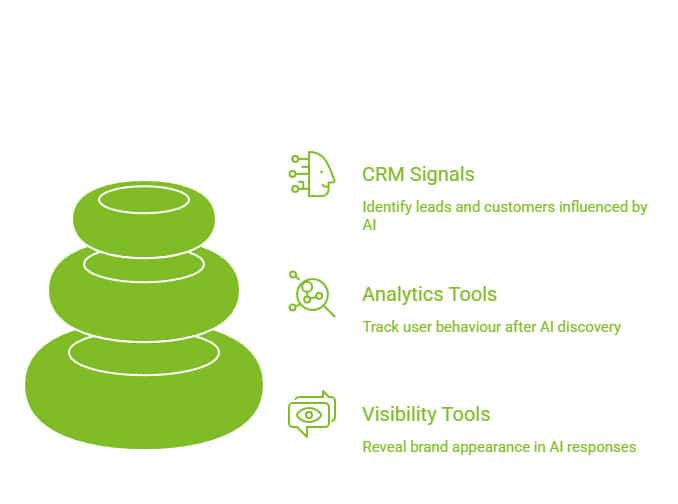
Tracking GEO ROI requires combining analytics tools with specialised platforms designed for AI search visibility. No single tool provides a complete view, which is why a structured GEO ROI measurement approach connects visibility, engagement, and conversion data to understand real business impact.
Visibility Tools: Where Your Brand Appears in AI Responses
Visibility tools are not just for tracking mentions. They answer a more important question: where does your brand appear in AI-driven decision moments?
- BrandViz.AI: Reveals how frequently your brand appears across AI queries and how that visibility compares to competitors, helping you understand your share of voice
- GeoAnalyzer: Shows why certain content gets picked by AI systems, giving insight into how well your content aligns with AI retrieval patterns
- Semrush AI Toolkit: Tracks trends in mentions, citations, and inclusion, helping you identify whether your visibility is growing consistently over time
These tools do not just report presence. They show whether you are visible enough to influence decisions.
Analytics Tools: What Users Do After AI Discovery
Once visibility exists, the next question is: do users respond to it?
- Google Analytics 4 (GA4): Reveals how users behave after AI-driven discovery, including engagement depth and conversion patterns
- Custom Traffic Segments: Helps isolate AI-influenced users, making it easier to understand whether these users behave differently from other traffic sources
These signals help you evaluate whether visibility is translating into interest and intent.
CRM Signals: What Converts from AI Influence
The final layer answers the most important question: Does GEO influence outcomes?
- CRM Data: Identifies leads and customers influenced by AI discovery through source tracking or sales feedback
- Lead Attribution Inputs: Captures signals like “How did you hear about us?” to connect AI visibility with pipeline contribution
This is where GEO moves from visibility to measurable business impact.
GEO ROI becomes measurable when these tools work together. Visibility shows where you appear, behaviour reveals how users respond, and conversion data confirms whether that influence drives outcomes.
What Challenges Make GEO ROI Difficult to Measure?
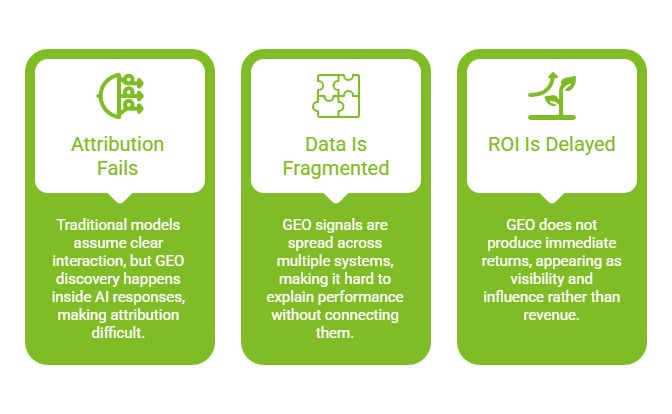
GEO ROI feels difficult to measure, not because the impact is unclear, but because traditional ROI thinking does not map to how AI-driven discovery works. What you are seeing in your data often does not reflect what is actually influencing decisions.
This creates three core points of friction in GEO ROI measurement.
Attribution Fails
Traditional models assume that value can be traced back to a clear interaction. In GEO, discovery often happens inside AI responses, while conversions occur later through different channels. As a result, the initial touchpoint is rarely captured in standard reporting, particularly in an attribution model scenario. This creates a gap where visibility exists, but measurable credit does not follow, making ROI appear lower than it actually is.
Data Is Fragmented
GEO signals are spread across multiple systems. Visibility sits in AI tracking tools, engagement in analytics platforms, and conversions in CRM data. When these are analysed separately, they fail to explain performance. Only by connecting these layers can the metrics to track ROI of GEO efforts reflect how visibility translates into real outcomes.
ROI Is Delayed
GEO does not produce immediate returns in the way traditional channels do. Early progress appears as mentions, inclusion, and visibility, not revenue. If evaluated too early, performance can look weak or inconsistent. In reality, impact builds over time as visibility compounds and begins to influence pipeline and conversions.
GEO ROI becomes clearer when these frictions are understood. The challenge is not measuring impact, but interpreting signals that do not follow traditional patterns.
How Do You Prove GEO ROI to Stakeholders and Leadership?
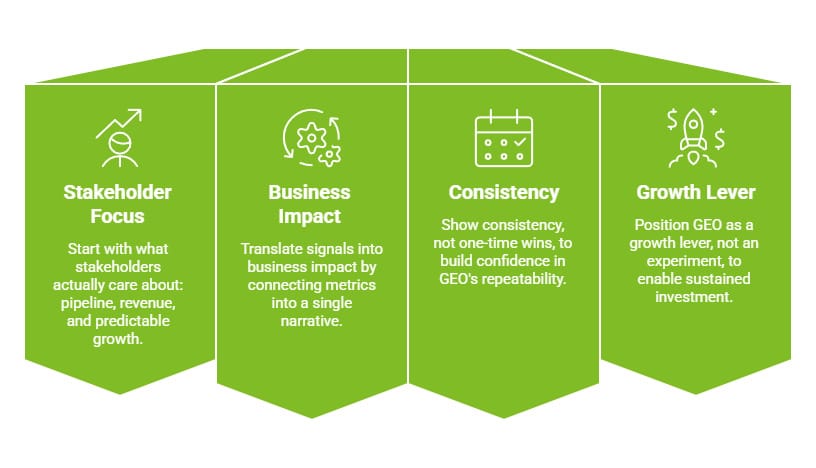
The challenge in GEO ROI measurement is not collecting data, but framing it in a way that leadership understands. What matters to stakeholders is not visibility or mentions alone, but how those signals connect to pipeline, revenue, and predictable growth within the context of effective marketing strategies.
To prove GEO ROI, the focus needs to shift from reporting activity to communicating business impact.
Start with What Stakeholders Actually Care About
Leadership decisions are driven by three questions:
- Is this contributing to the pipeline?
- Is it influencing revenue outcomes?
- Can it become a predictable growth channel?
GEO needs to be mapped directly to these outcomes. Visibility alone does not matter unless it connects to how opportunities are created and progressed.
Translate Signals into Business Impact
Metrics only become meaningful when they explain outcomes. Instead of reporting visibility, engagement, and conversions separately, they need to be connected into a single narrative.
For example, increasing visibility across AI responses, followed by growth in branded search and higher-quality leads, shows a clear path from discovery to revenue influence. This makes GEO easier to understand and justify.
Show Consistency, Not One-Time Wins
Stakeholders do not act on isolated results. They look for signals that show consistency over time.
Tracking how visibility leads to engagement, and how that engagement begins to influence the pipeline, builds confidence that GEO is not experimental, but repeatable. This is what turns it into a predictable growth channel.
Position GEO as a Growth Lever, Not an Experiment
GEO should not be framed as an emerging tactic. It should be positioned as a layer that influences how buyers discover and evaluate options before entering the funnel.
When presented this way, GEO becomes part of the growth strategy, not just SEO initiatives. This is what enables sustained SEO investment and long-term buy-in.
GEO ROI becomes easier to prove when it is communicated in terms of pipeline, revenue influence, and predictability. The goal is not to explain every interaction, but to show how GEO contributes to growth in a way leadership can act on.
What Does a High-Performing GEO ROI Strategy Look Like?
A high-performing GEO strategy is not defined by how much data you track, but by how well that data explains business impact. Most teams measure activity. Advanced teams measure contribution.
The difference lies in how signals are connected across the journey.
GEO Maturity Model
| Level | What It Looks Like | Outcome |
| Low | Tracks traffic and rankings | Misses GEO’s impact entirely |
| Mid | Tracks mentions and some engagement signals | Partial visibility, unclear ROI |
| High | Connects visibility, engagement, and influenced revenue | Scalable and predictable growth |
Most teams operate in the middle. They see improvements in visibility but struggle to explain how that translates into outcomes.
Average vs High-Performing Teams
| Area | Average Teams | High-Performing Teams |
| Measurement Approach | Track metrics in isolation | Connect signals across the journey |
| Visibility | Monitor mentions occasionally | Track consistent query sets over time |
| Engagement | Review traffic and behaviour separately | Link engagement to visibility trends |
| Conversion | Focus on last-touch conversions | Use influenced revenue and assisted conversions |
| Decision Making | React to short-term changes | Evaluate long-term trends and patterns |
This is where the gap becomes clear. Average teams collect data. High-performing teams structure it to explain impact.
What High-Performing Teams Do Differently?
High-performing teams treat GEO as a system, not a set of metrics. Their focus is not on tracking more, but on connecting what they already track.
- They align visibility, engagement, and conversion signals into a single performance view
- They use influenced revenue models to reflect contribution, not just outcomes
- They track performance across consistent query sets to identify patterns
- They prioritise trend direction over short-term fluctuations
This is what allows them to move from reporting activity to explaining growth.
How to Move to a High-Performing Strategy?
The shift is not about adding complexity, but improving interpretation.
- Connect visibility data with engagement and conversion signals
- Build a consistent reporting system across tools
- Standardise tracking using fixed query sets
- Focus on trend direction instead of isolated results
These changes turn fragmented tracking into a structured system that can scale.
A high-performing GEO strategy is not defined by visibility alone, but by how consistently that visibility translates into measurable business outcomes. The difference is not effort, but how effectively teams structure, interpret, and communicate performance across the organisation.
When Does GEO ROI Become Meaningful for Your Business?
GEO ROI becomes meaningful when visibility begins to influence decisions and connect to business outcomes. This does not happen instantly. It develops in stages, and each stage reflects a different level of impact.
Understanding this progression is key to interpreting performance correctly and avoiding early misjudgment.
How GEO ROI Develops Over Time
| Phase | What You See | What It Means |
| 0–1 month | Mentions and inclusion begin to appear | Visibility is being established |
| 1–3 months | Branded search and engagement increase | Users are responding to visibility |
| 3–6 months | Leads reference AI discovery | Visibility starts influencing decisions |
| 6+ months | Pipeline and revenue impact become visible | GEO contributes to measurable business outcomes |
In the early stage, progress is driven by visibility. Your brand begins appearing in AI responses, but this does not immediately translate into revenue. At this point, comparing performance with the average ROI of SEO can lead to incorrect conclusions.
As visibility compounds, engagement follows. Users begin searching for your brand, interacting with your content, and exploring further. This indicates that awareness is turning into interest.
The next stage is where GEO starts influencing decisions. Leads referencing AI discovery signal that visibility is no longer passive; it is shaping how users evaluate options.
Over time, these signals connect to business outcomes. Pipeline impact becomes clearer, lead quality improves, and ROI becomes easier to demonstrate.
How Wild Creek Web Studio Helps You Turn GEO ROI Into Real Impact
Understanding GEO ROI measurement is one thing. Turning it into consistent business outcomes is where most teams struggle.
Wild Creek Web Studio is an SEO agency that helps you move beyond fragmented tracking and build a structured approach that connects visibility, engagement, and revenue. Instead of relying on traditional models, we focus on how GEO actually influences decision-making in AI-driven search.
Our approach ensures your GEO efforts are not just visible, but measurable and aligned with real business outcomes. If your current strategy is difficult to track, explain, or scale, we help you fix that.
Book a strategic consultation to turn your GEO efforts into a predictable growth channel.
Conclusion
In conclusion, understanding Geo ROI measurement is essential for businesses looking to maximise their online presence and make informed decisions. By focusing on the unique aspects of GEO strategies and how they differ from traditional SEO, you can establish clear objectives, track relevant metrics, and ultimately link your efforts to tangible business outcomes. Remember that measuring GEO ROI is not without its challenges, but with the right tools and a strategic approach, it can lead to meaningful insights and growth. If you’re ready to elevate your GEO efforts, reach out to Wild Creek Web Studio for expert guidance and support in measuring and improving your GEO ROI.
Frequently Asked Questions
What formulas are commonly used to measure SEO ROI?
To understand how to calculate SEO ROI from your SEO activities, use: (Revenue – Cost) ÷ Cost × 100. Some teams also use influenced revenue models to capture indirect impact from organic search and AI-driven discovery.
How does GEO differ from SEO in terms of ROI measurement?
Traditional SEO focuses on direct traffic and conversions, while GEO ROI measurement tracks visibility, citations, and influence in AI-generated responses, where user actions often happen after the initial interaction.
What SEO ROI trends should businesses watch in 2026?
Businesses should track AI-driven search behaviour, zero-click interactions, and the shift toward influence-based attribution, as traditional click-based models become less reliable for measuring long-term SEO performance.
How do I know if my GEO strategy is actually working?
Look for consistent increases in AI mentions, branded search growth, and leads referencing AI discovery, and conduct thorough keyword research. These signals indicate that your visibility is influencing decisions, even if direct conversions are not immediately visible.
How can I benchmark my SEO ROI against industry standards?
Benchmark your SEO ROI by comparing organic conversions, cost per acquisition, and organic search traffic against industry standards. Align your SEO campaign with business goals, track customer lifetime value, and evaluate the financial impact to ensure positive ROI and strong business results.
How effective is GEO really right now?
GEO is increasingly effective, complementing search engine optimisation by boosting organic traffic and social media visibility. Strong content creation, technical SEO, and optimisation efforts improve search rankings, lead generation, and accurate ROI; delivering higher ROI, measurable business value, and clear brand impact for business owners.
What are the latest statistics on SEO ROI?
Latest 2026 data shows SEO delivers strong ROI, with a median 748% return (~$22 per $1 invested). Organic search drives ~53% of website traffic and leads cost 84% less than average, proving SEO’s high business value and long-term impact.