Key Highlights
- Facebook Ads help businesses reach a highly specific target audience across social media
- Campaign structure and ad set strategy matter more than the amount of money spent
- Facebook ads cost in India varies based on competition, audience, and advertising goals
- Choosing the right type of ad improves ad performance and conversions
- Poor ad copy and weak targeting increase customer acquisition cost
- Tools like Facebook Ads Manager and Meta Pixel improve tracking and optimisation
- Long-term success depends on testing, optimisation, and following best practices
Most businesses approach Facebook Ads with one simple expectation. Spend money, get results. But once campaigns go live, things rarely go as planned. Costs go up, performance feels inconsistent, and it becomes hard to tell what is actually working.
The issue is not the platform. With billions of active users, Facebook Ads remain one of the most powerful tools in social media advertising. The real challenge is how campaigns are set up, how the target audience is defined, and how decisions are made after launch.
In this guide, you will learn how Facebook Ads actually work, how to use Facebook Ads Manager effectively, how to structure a strong Facebook campaign, and how to optimise your advertising efforts for better, more predictable results.
What Are Facebook Ads and How Does Facebook Advertising Work?
Facebook Ads are paid campaigns run through Meta platforms like Facebook, Instagram, Messenger, and Audience Network to reach a defined target audience and drive actions such as awareness, traffic, or conversions.
Unlike search ads that capture existing demand, Facebook Ads are designed to create demand. They introduce your product or service to users based on behaviour, interests, and demographics, making them effective for discovery, especially in competitive markets.
To run Facebook advertising, you need:
- A Facebook business page
- An ad account inside Meta Ads Manager
From there, campaigns are built around clear objectives such as engagement, video views, or conversions. Performance depends on how well your goal, audience, and messaging align.
Facebook Ads operate on an auction system where multiple advertisers compete for the same audience. However, delivery is not based only on budget. The platform prioritises relevance, meaning ad quality and expected engagement directly influence performance.
Each time a user opens their feed, Facebook evaluates ads based on:
- Bid amount
- Ad quality
- Expected engagement
This is why a well-targeted, high-quality ad can outperform a higher-budget campaign with weak messaging.
Once live, ad delivery depends on audience clarity, engagement signals like clicks or video views, frequency, and placement strategy. Using automatic placements allows the system to optimise where ads appear across platforms.
After launch, campaigns enter a learning phase where the algorithm tests different combinations to find what works best. Performance may fluctuate during this stage, so frequent changes should be avoided until results stabilise.
Why Do Most Facebook Ads Fail Even With the Right Setup?
Even when campaigns are set up correctly, performance often drops due to execution gaps. The issue is not the platform, but how inputs are aligned. Understanding these failure points helps you fix problems at the source instead of reacting later.
Where Does Misalignment Typically Happen?
Most failures come from disconnects between key campaign elements. Even small gaps can reduce relevance and impact delivery.
Common issues include:
- The audience does not match the offer
- Ad copy does not reflect user intent
- The objective is not aligned with the funnel stage
When these elements are not aligned, Facebook receives weak signals, which leads to inconsistent performance.
Why Does This Affect Performance So Much?
Facebook’s system prioritises relevance and expected engagement. If your inputs are unclear, the platform cannot optimise effectively.
This results in:
- Higher costs
- Lower reach
- Poor conversion rates
Even well-structured campaigns struggle if the core inputs are not aligned.
Setting up alone does not drive results. Alignment between audience, message, and objective is what determines performance.
What Actually Drives Results in Facebook Ads?
Once failure points are clear, the focus shifts to improving inputs. Facebook Ads performance is not driven by budget alone. It depends on how well your targeting, creatives, and tracking work together to guide the algorithm.
What Are the Core Performance Drivers?
Three inputs directly influence results. These shape how Facebook understands and delivers your ads.
- Audience clarity ensures your ads reach the right users
- Creative quality drives engagement and interaction
- Conversion tracking signals what success looks like
When these are strong, Facebook can optimise delivery more effectively.
What Happens When These Inputs Are Weak?
Weak inputs reduce the system’s ability to learn and improve. This leads to inefficient delivery and unstable performance.
Typical outcomes include:
- Poor engagement despite impressions
- Rising cost per click or lead
- Inconsistent results across campaigns
Improvement comes from refining inputs, not constantly changing settings.
Better inputs create better outputs. Strong targeting, clear creatives, and accurate tracking drive consistent results.
What Types of Facebook Ads Should You Choose?
Once you understand how Facebook Ads work, the next decision is choosing the right type of ad. This is where many campaigns start to break, not because of budget, but because the format and objective don’t match the goal.
The right choice depends on what you want to achieve and where your audience is in the funnel.
1. Ad Formats Based on Content
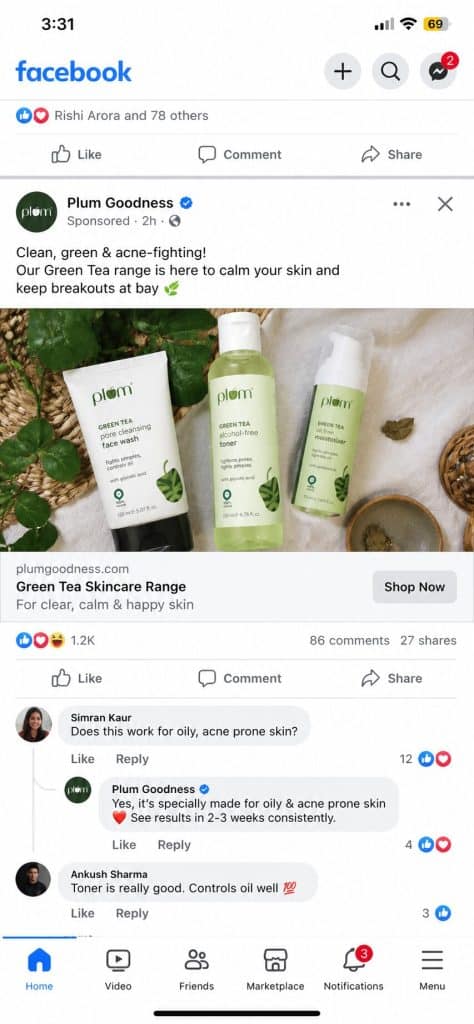
The format you choose directly affects how users interact with your ad. Some formats are better for quick consumption, while others are designed for deeper engagement.
Here are the most commonly used formats:
- Image ads work best for simple, direct messaging
- Video ads are more effective when you need attention and engagement
- Carousel ads allow you to showcase multiple products or features
- Instant Experience creates an immersive, full-screen mobile experience
The key is to match the format to the message. A complex offer in a static image often underperforms, while a simple message does not need a video.
Tools to use: Meta Creative Hub, Canva
2. Ad Types Based on Goals
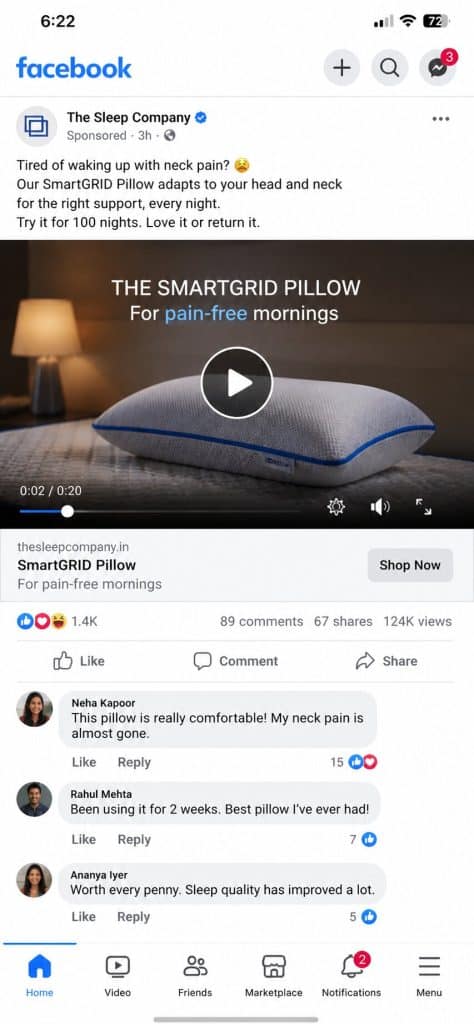
While format defines how your ad looks, the campaign objective defines how it performs. Facebook uses this objective to decide who sees your ad and what action to optimise for.
Common objectives include:
- Website traffic when the goal is to bring users to your site
- Lead generation when you want to capture potential customers
- Conversions when the focus is on purchases or sign-ups
- Engagement when visibility and interaction matter
If the objective is misaligned, performance suffers even if everything else is correct. This is one of the most common reasons for poor results.
Tool to use: Facebook Ads Manager
3. Retargeting and Dynamic Ads
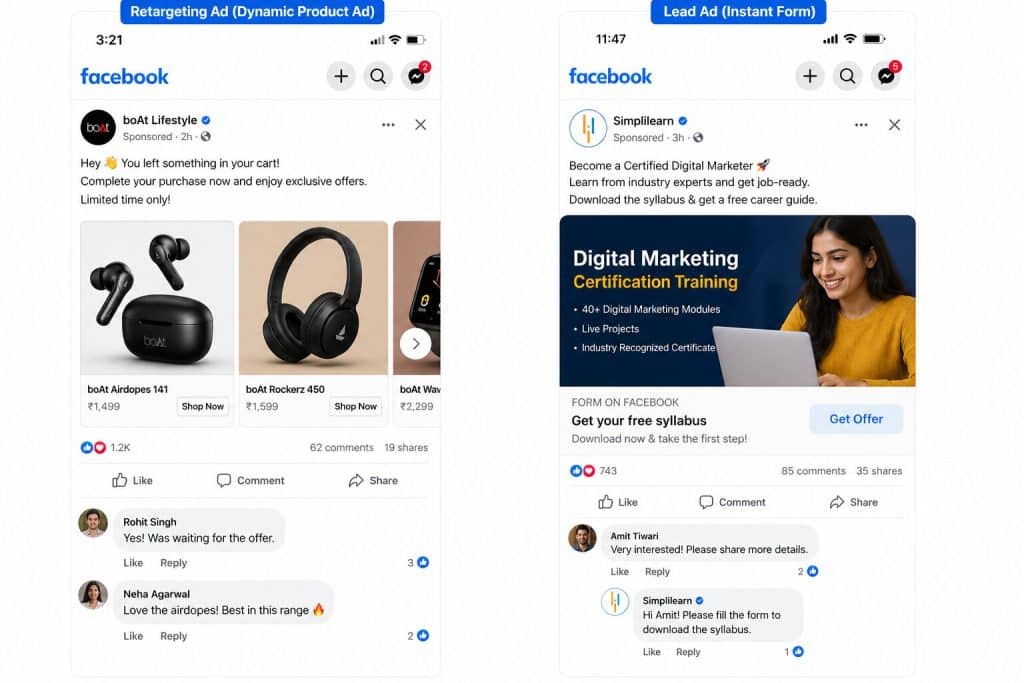
Once you start getting traffic, the focus shifts from reach to efficiency. This is where retargeting becomes important. Retargeting ads allow you to reconnect with users who have already interacted with your business. Instead of starting from scratch, you build on existing interest.
Dynamic ads take this further by using data from the Facebook pixel to automatically show relevant products or services based on user behaviour.
This improves relevance, which in turn improves conversions.
| Ad Type | Use Case | Funnel Stage |
| Image Ads | Awareness | Top |
| Video Ads | Engagement | Top to Middle |
| Lead Ads | Lead capture | Middle |
| Retargeting Ads | Conversions | Bottom |
Tools to use: Meta Pixel, Events Manager
Choosing the right ad type ensures your campaign starts with the right intent, instead of trying to fix poor performance later through optimisation. Once the ad type is clear, the next step is building the campaign structure correctly.
How Do Facebook Ads Fit Into a Full Marketing Funnel?
After understanding performance drivers, the next step is placing Facebook Ads within a broader strategy. They work best when supporting a structured funnel, guiding users from discovery to conversion instead of forcing immediate results from cold audiences.
How Do Facebook Ads Work at Each Funnel Stage?
Facebook Ads perform different roles depending on where the user is in the journey.
- The top of the funnel focuses on awareness and reach
- Middle of funnel builds engagement and captures leads
- Bottom of funnel converts through retargeting
Each stage requires different messaging and ad formats.
What Happens Without a Funnel Structure?
Without a clear funnel, campaigns rely on cold audiences to convert immediately. This reduces efficiency and increases costs.
Common issues include:
- Low conversion rates from new audiences
- Higher acquisition costs
- Inconsistent performance across campaigns
A structured funnel improves both efficiency and predictability.
Facebook Ads work best as part of a journey, not a shortcut. A clear funnel improves targeting, messaging, and overall campaign performance.
How Do You Structure a Facebook Ad Campaign Correctly?
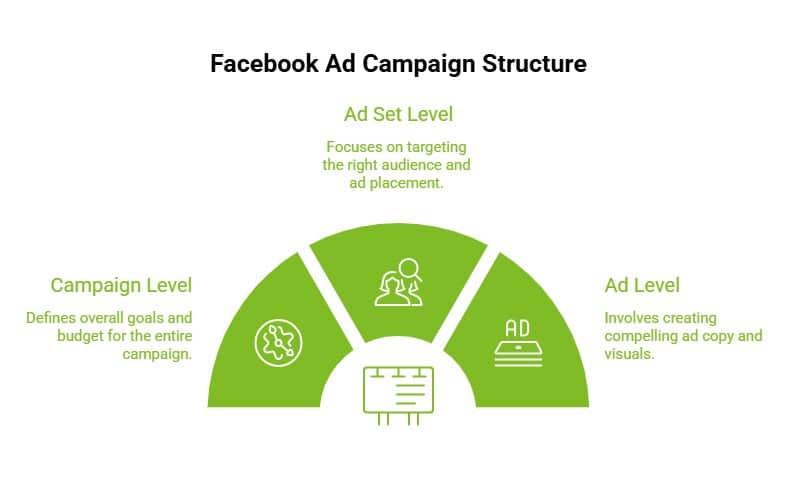
Once the ad type is clear, the next step is structuring the campaign properly. Even strong creatives fail if the structure is weak.
A Facebook campaign is built across three levels, and each level controls a different part of performance.
1. Campaign Level
At the campaign level, you define the direction of your entire setup. This is where decisions about goals and budget are made.
You typically set:
- Advertising goals based on your objective
- Campaign budget to control overall spend
- Campaign budget optimisation, if you want Facebook to distribute spend automatically
Using campaign budget optimisation helps allocate budget to better-performing ad sets, which improves efficiency over time.
Tool to use: Facebook Ads Manager
2. Ad Set Level
Once the direction is set, the focus moves to targeting. This happens at the ad set level.
Here, you define:
- Your target audience based on behaviour, interests, or data
- Ad placement, either manual or automatic
- Budget and schedule, including start and end dates
This is where most performance differences come from. Even small targeting changes can significantly impact results.
3. Ad Level
After structure and targeting, execution comes into play. This is handled at the ad level.
This is where you create the actual ad, including:
- Clear and relevant ad copy
- Visuals that match the message
- A strong call to action
Relying on a single ad limits performance. Testing multiple variations helps identify what works best.
Tools to use: Meta Ads Library, Canva, ChatGPT
When the campaign, ad set, and ad levels are aligned, Facebook has clearer signals to deliver ads to the right audience more efficiently. After structure, the next major decision is budget and cost planning.
How Much Do Facebook Ads Cost in India?
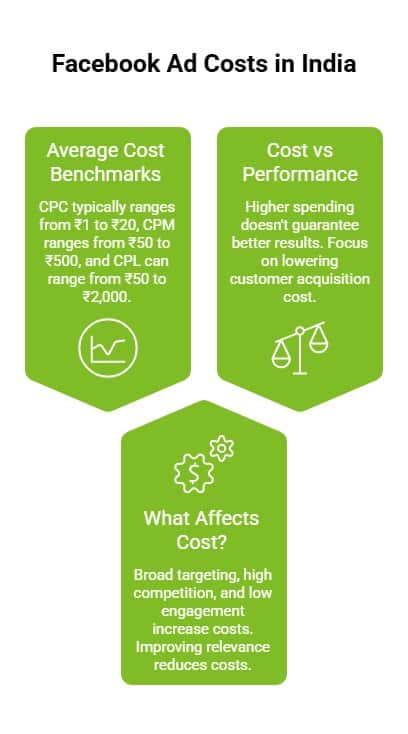
With structure in place, the next logical question is cost. While Facebook Ads are flexible in terms of spend, costs vary based on how well campaigns are set up.
The cost of Facebook ads in India is influenced more by efficiency than by budget size.
1. Average Cost Benchmarks
To set expectations, here are common ranges:
- CPC typically ranges from ₹1 to ₹20
- CPM ranges from ₹50 to ₹500
- CPL can range from ₹50 to ₹2,000
These numbers vary depending on industry and competition.
2. What Affects Cost?
Costs are not fixed. They increase or decrease based on performance signals.
Common factors include:
- Broad or poorly defined targeting
- High competition within your niche
- Low engagement or weak creatives
Improving relevance often reduces costs over time.
3. Cost vs Performance
Higher spending does not guarantee better results. What matters is how efficiently your budget is used.
The focus should always be on lowering customer acquisition cost, not just increasing reach.
Tools to use: Ads Manager dashboard, Google Analytics
The goal is not to spend more, but to spend better by improving targeting, creative quality, and conversion tracking. Cost efficiency also depends heavily on how well your creatives fit each placement.
What Ad Sizes and Creative Formats Perform Best?
After cost, execution details become important. Even strong campaigns can underperform if creatives are not optimised for placements.
Ad size and format directly impact how your ads appear and perform, especially on mobile devices.
1. Standard Sizes
Each placement has preferred dimensions. Using the right size ensures better visibility:
- Feed ads perform best in 1:1 or 4:5
- Stories require a 9:16 format
- Carousel ads use a 1:1 format
2. Common Mistakes
Many performance issues come from avoidable creative errors.
These include:
- Overloading visuals with text
- Using low-quality or unclear images
- Not having a clear message
Consistency in design and clarity in messaging improve engagement significantly.
Tools to use: Meta Ads Guide, Figma
Well-formatted creatives improve visibility, reduce wasted impressions, and make the ad experience smoother for mobile users. However, even strong creatives can be stopped if they fail Meta’s advertising rules.
What Facebook Advertising Policies Can Affect Your Campaigns?
Before scaling campaigns, it is important to understand platform rules. Ignoring policies can disrupt performance regardless of how well your ads are built.
Facebook advertising policies define what can and cannot be promoted.
1. Common Violations
Some of the most frequent issues include:
- Misleading or exaggerated claims
- Promoting restricted categories without compliance
- Using personal attributes in targeting or messaging
2. What Happens After Rejection?
If an ad is rejected, it must be edited or appealed before it can run again. Repeated violations can impact your ad account over time.
Tool to use: Meta Account Quality dashboard
Reviewing policies before launch helps prevent delays, rejected ads, and unnecessary interruptions to campaign performance. Once compliance is clear, the next question is whether Facebook Ads are the right fit for your business model.
When Do Facebook Ads Actually Work Well for Businesses?
With all elements in place, it becomes easier to understand when Facebook Ads deliver strong results.
They work best when targeting, messaging, and funnel are clearly aligned.
Best Use Cases
Facebook Ads are particularly effective for:
- E-commerce brands with visual products
- Local service businesses targeting specific areas
- SaaS products looking to generate leads
Worth It If
Facebook Ads are a good fit when:
- You clearly understand your target audience
- You are willing to test and optimise consistently
Not Worth It If
They tend to underperform when:
- Decisions are based on guesswork
- There is an expectation of instant results without iteration
Facebook Ads work best when they support a clear funnel, not when they are expected to create results without a strategy. Even with the right fit, poor execution can still weaken campaign performance.
Where Do Most Facebook Ad Campaigns Go Wrong?
Even with the right setup, mistakes can reduce performance. Most issues come from execution rather than strategy.
Common Mistakes
Some of the most common problems include:
- Weak or overly broad targeting
- Poor ad copy that does not resonate
- No testing or variation in creatives
Where Budgets Fail
Budget inefficiencies usually come from:
- Scaling campaigns too quickly
- Ignoring performance data
- Not improving creatives over time
Most failed campaigns are not beyond repair. They usually need better targeting, stronger creatives, and more disciplined testing. The next step is knowing how to improve performance without making random changes.
What Happens Immediately After Launch and Why Do Campaigns Drop Early?
Once your campaign goes live, the focus shifts from setup to stability. This is where most campaigns lose momentum, not because of poor setup, but because of premature changes.
Facebook enters a learning phase, testing audiences, placements, and delivery patterns. Performance often fluctuates during this stage, which can be misleading if you expect immediate consistency.
Most early failures come from reacting too quickly. Common mistakes include:
- Pausing campaigns within the first few days
- Making frequent edits to targeting or creatives
- Judging performance before enough data is collected
Each of these actions resets the learning phase, delaying optimisation and increasing costs.
Instead, focus on controlled observation. Early signals like click-through rate and cost per click can indicate direction, but not outcomes. Strong campaigns are not the ones that start perfectly, but the ones that are allowed to stabilise, gather data, and improve through structured optimisation.
How Can Wild Creek Studio Help You Get Better Results from Facebook Ads?
Once you understand Facebook Ads, the real challenge is execution. Most campaigns underperform due to weak structure, poor targeting, and a lack of optimisation, not because of the platform.
Wild Creek Studio focuses on improving performance where it actually matters:
- Structuring campaigns for clearer delivery and better results
- Refining the target audience to reduce wasted spend
- Improving ad copy and creatives to increase conversions
- Using data from Facebook Ads Manager and Meta Pixel for optimisation
- Scaling campaigns without unnecessarily increasing customer acquisition cost
The focus is not just on running ads, but on making them work consistently.
Get your Facebook Ads audited by Wild Creek Studio and identify what’s holding your performance back.
Conclusion
Facebook Ads can deliver strong results, but only when used strategically. Success depends on how well you structure campaigns, define your audience, and optimise performance over time.
Instead of focusing only on the amount of money you spend, focus on building a system that improves results consistently. Start with clear goals, test continuously, and refine your approach. That is how Facebook Ads become a reliable growth channel instead of a cost centre.
Frequently Asked Questions
How do I create a Facebook ad campaign from start to finish?
Start by setting up a Facebook business page and ad account in Facebook Ads Manager. Choose your campaign objective, define your target audience, set a budget and schedule, create your ad, and launch. Monitor performance and optimise based on data.
What types of Facebook ads are available, and which is best?
Facebook offers image, video, carousel, and Instant Experience ads. The best type depends on your goal. Video ads work well for engagement, while lead and retargeting ads are more effective for conversions.
How much does it typically cost to run Facebook ads in India?
Costs vary by industry and targeting. On average, CPC ranges from ₹1 to ₹20, CPM from ₹50 to ₹500, and CPL from ₹50 to ₹2,000. Efficient targeting and strong creatives help reduce overall costs.
How do I choose the right audience for my Facebook ads?
Start with a defined target audience based on demographics, interests, and behaviour. Use custom audiences from your data and lookalike audiences to expand reach. Refining audiences over time improves ad performance.
What are some common mistakes when running Facebook ads?
Common mistakes include broad targeting, weak ad copy, no testing, and scaling too quickly. Ignoring performance data and not optimising creatives also leads to higher customer acquisition costs.
How do I measure Facebook ad performance effectively?
Track key metrics like click-through rate, cost per click, conversion rate, and return on ad spend. Use Facebook Ads Manager and tools like Meta Pixel and Google Analytics to analyse and improve results.
What budget options are available for Facebook and Instagram ads?
Facebook and Instagram ads offer flexible budgeting at both the campaign and ad set level. You can choose a daily budget for consistent spending or a lifetime budget for total campaign control. With campaign budget optimisation, Facebook automatically distributes spend across ad sets for better performance.