Key Highlights
- Online shopping behaviour has shifted to fast, research-driven decisions where users compare, validate, and switch quickly before buying
- Consumers no longer follow a linear journey; they move across platforms, devices, and touchpoints before making a purchase decision
- Buying decisions are driven by trust signals, friction, delivery clarity, pricing transparency, and social proof rather than just product or price
- Most conversions are won or lost during research and evaluation, not at checkout, making visibility across platforms critical
- Modern consumers expect low effort, high certainty, and consistent experiences across channels, including social channels, before committing to a purchase.
- Brands that reduce friction, build trust, and stay visible across touchpoints convert better and retain customers longer
- At Wild Creek Web Studio, we turn consumer behaviour insights into actionable strategies that improve conversions and drive measurable growth.
Online shopping is becoming the default. Global ecommerce sales are projected to reach $6.4 trillion worldwide in 2026. Yet most businesses are still solving the wrong problem. They see drop-offs and assume it is about price or traffic.
It is not.
Users are not leaving because they are uninterested. They leave because the decision breaks. Trust is missing, the process feels hard, the value is unclear, or there is no urgency to act.
In this blog, we break down consumer behaviour towards online shopping through the consumer decision-making process, so you can understand what actually drives decisions and how to turn that into higher conversions.
What is Online Consumer Behaviour?
Online consumer behaviour is simply how people find, evaluate, and buy products online. It includes everything from discovering a product to leaving a review after purchase.
What makes it different from offline shopping is speed and access. Consumers can compare prices, read reviews, and check alternatives within minutes. This makes them more informed, but also quicker to switch if something doesn’t feel right.
The key point is this: every click, search, and cart action tells a story. Understanding that behaviour helps businesses see not just what people buy, but why they decide to buy or not.
How Has Consumer Behaviour Changed in the Digital Age?
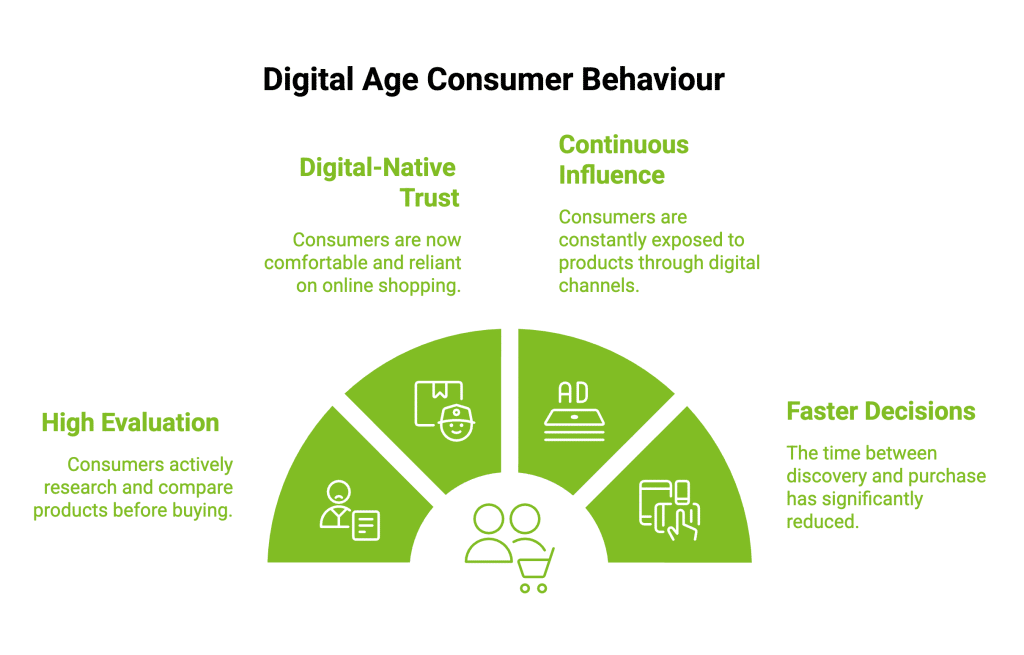
Consumer behaviour has shifted from a linear, store-led process to a fast, high-information decision system. The biggest change is not just where people shop, but how they evaluate, decide, and act.
Here are the key shifts that define customer behaviour in the digital age:
1. From Low Information to High Evaluation
Earlier, decisions were based on limited exposure and brand familiarity. Today, consumers actively validate choices before buying by searching, comparing, and reading multiple reviews across social media platforms. The impact is that decisions are now evidence-driven. Reviews, ratings, and transparent pricing influence outcomes more than brand recall alone.
2. From First-Time Buyers to Digital-Native Trust
The pandemic accelerated adoption, but more importantly, it removed hesitation. Consumers who were once unsure about online payments or delivery systems now see them as reliable.
This has permanently expanded the online buyer base and raised expectations for speed, consistency, and service reliability.
3. From Intent-Based Shopping to Continuous Influence
Shopping is no longer a planned activity. Consumers are constantly exposed to products through social media, ads, and content. Discovery happens passively, often before intent is fully formed.
As a result, decisions are shaped in micro-moments, and brands must capture attention instantly to stay relevant.
4. From Deliberation to Faster Decisions
With constant exposure and easy access to information, the time between discovery and purchase has reduced significantly. Consumers can move from interest to checkout within minutes.
This increases impulsive buying behaviour, especially when combined with urgency triggers like limited-time offers or low-stock signals.
This shift matters because it changes how decisions are made. Consumers are more informed, less patient, and quicker to act. Brands that win are the ones that reduce effort, build immediate trust, and influence decisions at the right moment.
Before consumers buy, they validate. Here’s how the information search process impacts evaluation and final decisions.
What Factors Actually Drive Online Consumer Behaviour?
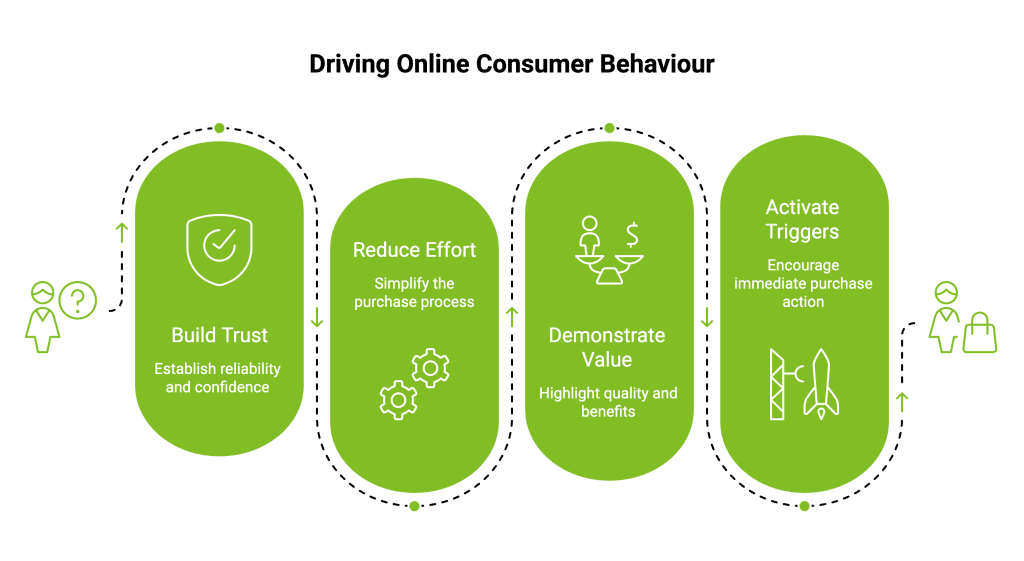
Online buying decisions are not driven by a long list of factors but by a simple flow of how different types of consumers think and act. Instead of treating each element separately, it is more useful to group them into four core drivers that reflect real decision-making.
Here are the key factors that actually drive online consumer behaviour:
- Trust
This is the first and most important filter. Users need to feel confident that the product and platform are reliable. Since they cannot physically inspect what they are buying, they rely on signals like reviews, ratings, clear return policies, and secure payment options. If trust is not established, users do not move forward.
- Effort
Once trust is in place, ease of purchase becomes critical. If the process feels complicated, users drop off. Too many steps, slow-loading pages, or a confusing interface increase friction. A smooth, fast, and intuitive checkout experience makes it easier to complete the purchase.
- Value
Users evaluate whether the product is worth the price. This is not just about finding the lowest cost but about the overall perception of value. Product quality, brand credibility, pricing, and added benefits like discounts or free shipping all contribute to this judgment. The goal is to feel like they are making a smart decision.
- Triggers
Even after deciding to buy, users often delay. This is where triggers play a role in pushing action. Social proof, such as positive reviews or best-seller tags, builds confidence, while urgency, like limited-time offers or low-stock alerts, encourages immediate decisions.
Want more people to discover your brand before they even start comparing? Learn how to boost your brand awareness and stay top of mind throughout the buying journey.
What is the Consumer Decision-Making Process in Online Shopping?
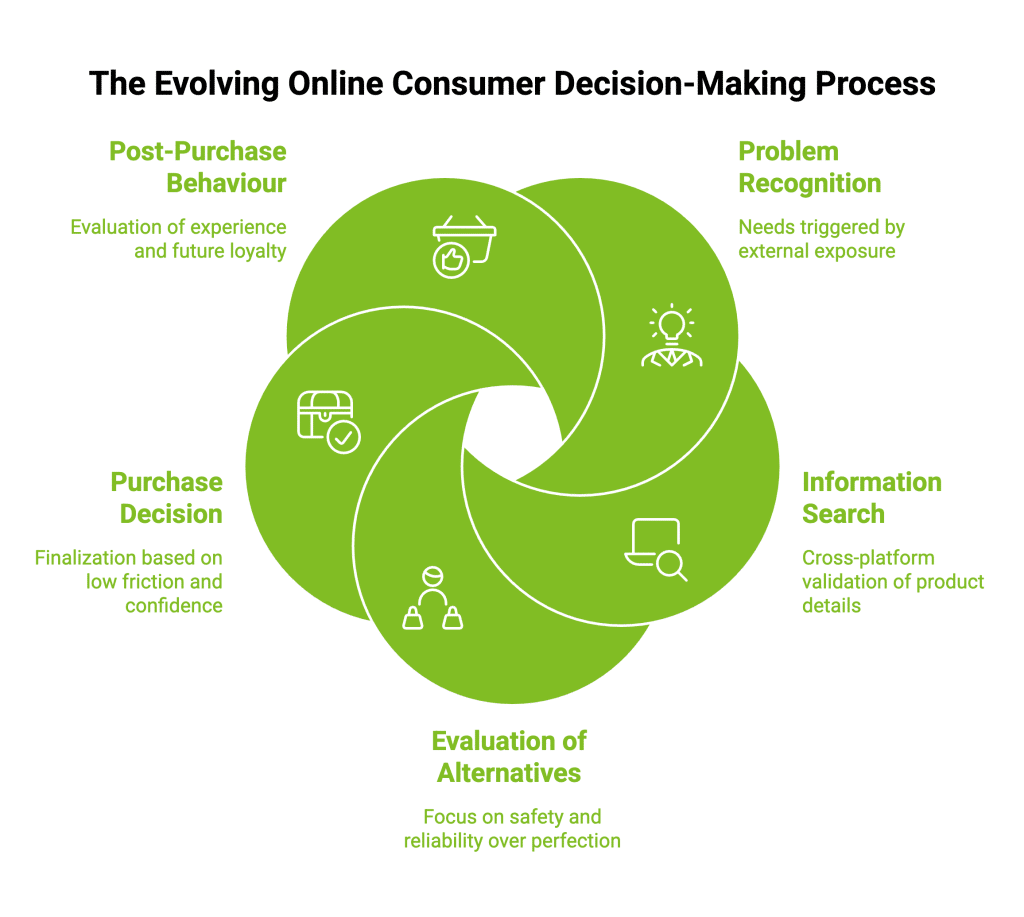
Online purchasing still follows a structured process, but the way decisions are formed has fundamentally changed.
Consumers no longer move step by step. They loop between stages, validate repeatedly, and can exit at any point if confidence drops.
At its core, the process is not just about choosing a product. It is about building enough confidence to act.
Here is how the consumer decision-making process works today:
1. Problem Recognition
In online environments, needs are often triggered rather than actively identified.
Consumers encounter products through ads, social content, or recommendations before they begin searching. This means:
- Demand is often created by exposure
- The starting point of the decision is influenced externally
Decision role: If a product captures attention in the moment, it enters consideration. If not, the decision never begins.
2. Information Search
Consumers do not rely on a single source to understand a product. They move across platforms to validate what they see.
They typically check:
- Search results for options and comparisons
- Marketplaces for reviews and ratings
- Social content for real usage and outcomes
Decision role: This stage is about reducing uncertainty. A product that appears consistently across sources is more likely to be trusted and considered further.
3. Evaluation of Alternatives
Consumers are not trying to find the perfect option. They are trying to avoid making a bad choice.
Instead of deep comparison, they focus on signals such as:
- Review quality and recency
- Clarity of product information
- Overall perceived reliability
Decision role: The product that feels safest and easiest to justify moves forward, even if it is not the cheapest.
4. Purchase Decision
Even after selecting a product, the decision is not final.
At checkout, small friction points can interrupt the process:
- Unexpected costs
- Complicated checkout flows
- Delivery uncertainty
Decision role: Conversion happens only when effort is low, and confidence remains intact. Any friction at this stage can reverse the decision.
5. Post-Purchase Behaviour
The decision continues after the purchase.
Consumers evaluate whether their expectations were met through:
- Delivery speed
- Product experience
- Ease of returns or support
Decision role: This stage determines future behaviour. A positive experience reinforces the choice and drives repeat purchases and reviews. A negative one breaks trust and influences other potential buyers.
The Core Shift
The online decision-making process is no longer a straight funnel. It is a confidence-building loop.
- Consumers move back and forth between stages
- Decisions are continuously validated, not made once
- Any break in trust or experience can stop the process
Winning brands are not just those with better products. They are the ones who maintain confidence at every stage of the decision journey.
What Do Modern Online Consumers Expect Today?
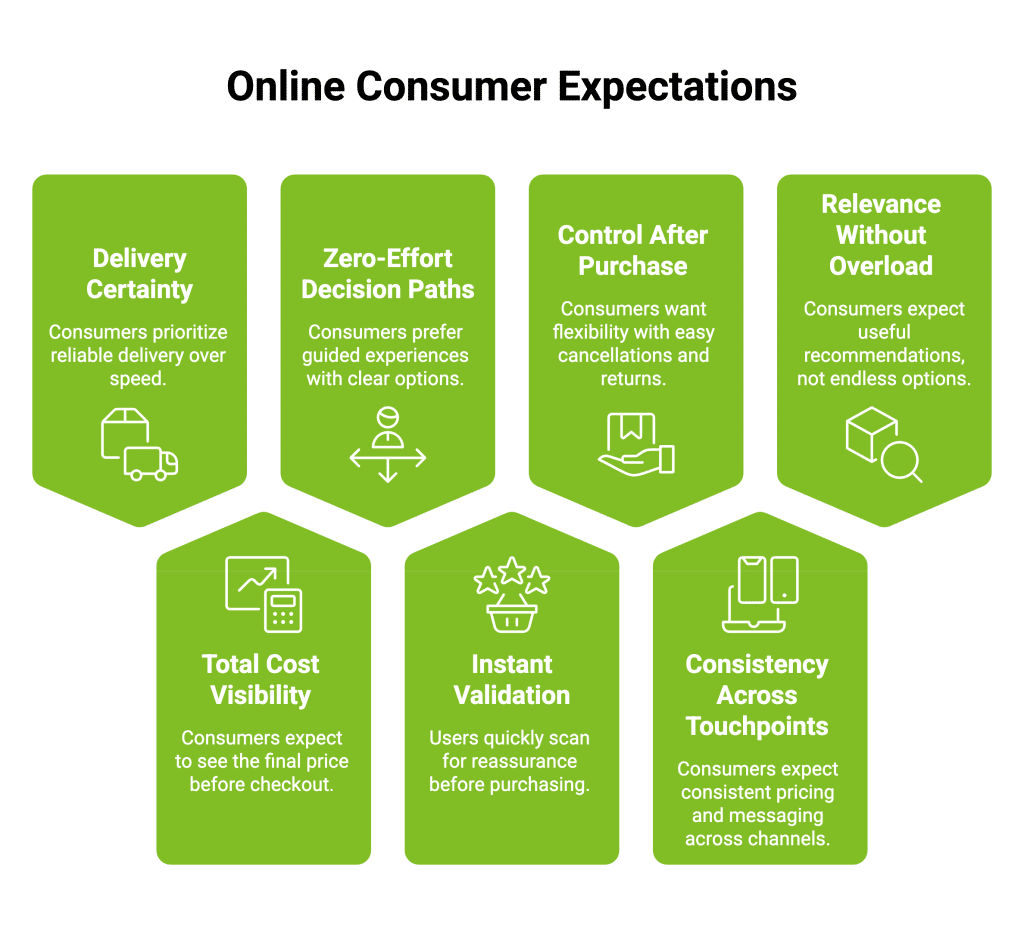
Modern consumers don’t just compare products. They compare effort, risk, and certainty before buying. Their expectations are shaped by the best experience they’ve had anywhere, influencing their entire customer journey.
Here are the expectations that actually influence online purchasing behaviour:
- Delivery Certainty Over Speed: Consumers care less about “fast” and more about “reliable.” A clear delivery date builds confidence, while vague timelines create hesitation and delay decisions.
- Total Cost Visibility Before Checkout: Consumers calculate the final price early. If extra charges appear at the last step, it breaks trust and often leads to cart abandonment.
- Zero-Effort Decision Paths: Too many choices or steps create friction. Consumers prefer guided experiences with clear options, defaults, and minimal thinking required.
- Instant Validation Before Buying: Before purchasing, users quickly scan for reassurance. Visible ratings, top reviews, and real-user content act as instant proof and reduce doubt.
- Control After Purchase: Consumers want flexibility after buying. Easy cancellations, simple returns, and clear tracking reduce perceived risk and make them more comfortable completing the purchase.
- Consistency Across Touchpoints: Consumers move between platforms before buying. If pricing, messaging, or experience changes across channels, it creates doubt and resets the decision process.
- Relevance Without Overload: Consumers expect useful recommendations, not endless options. Focused, relevant suggestions help decision-making, while too many choices slow it down.
How Does Omnichannel Behaviour Influence Online Shopping?
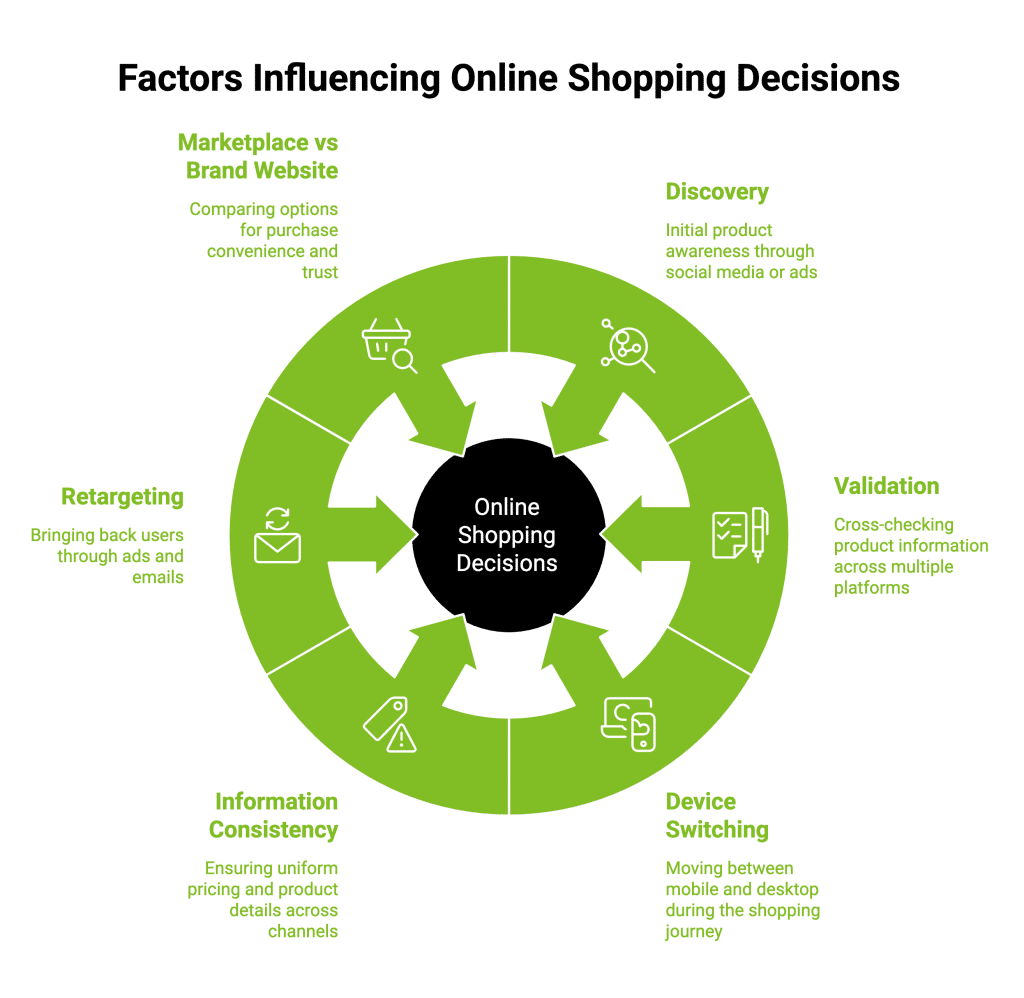
Consumers no longer follow a straight path. They move across platforms, devices, and sources before buying, constantly validating their choices. Each touchpoint either builds confidence or creates doubt.
Here’s how omnichannel behaviour actually shapes decisions:
1. Discovery Happens on One Platform, Purchase on Another
Consumers rarely buy where they first discover a product. A typical journey starts with discovery on social media or ads, moves to search for comparison, and ends on a marketplace or brand site. If a brand is missing at any stage, it loses the chance to stay in consideration.
2. Repeated Validation Across Channels (and the Risk of Inconsistency)
Consumers don’t trust a single source. They cross-check the same product across reviews, videos, and websites to reduce risk.
At the same time, they notice inconsistencies such as:
- Different prices across platforms
- Conflicting product details
- Mismatch in ratings or reviews
Consistency in messaging, pricing, and product information across platforms strengthens trust. Any gap creates hesitation and forces consumers to re-evaluate, often delaying or cancelling the purchase.
3. Device Switching During the Journey
Users frequently switch between mobile and desktop depending on context. Discovery often happens on mobile, while detailed comparison or final purchase may happen on a desktop. A poor experience on either device breaks continuity and increases drop-offs.
4. Inconsistent Information Creates Drop-Offs
Consumers expect the same price, offers, and product details everywhere. If they see different prices or conflicting information across platforms, it creates doubt and forces them to re-evaluate, often delaying or cancelling the purchase.
5. Retargeting Influences Final Decisions
Most users do not convert on the first visit. Retargeting through ads, emails, or notifications brings them back and reinforces the product in their mind. Repeated exposure increases familiarity and pushes them closer to conversion.
6. Marketplaces vs Brand Websites Decision
Consumers often compare where to buy rather than what to buy. Marketplaces offer trust, faster delivery, and easy returns, while brand websites may offer better pricing or exclusivity. The final decision depends on which option feels safer and more convenient.
This shows that online shopping is not a single journey but a series of connected interactions. Winning brands are the ones that stay consistent, visible, and trustworthy across every touchpoint.
Want to go beyond visibility and actually build real connections? Learn how to master different levels of brand engagement and turn attention into loyalty.
What Are the Emerging Trends in Online Consumer Behaviour?
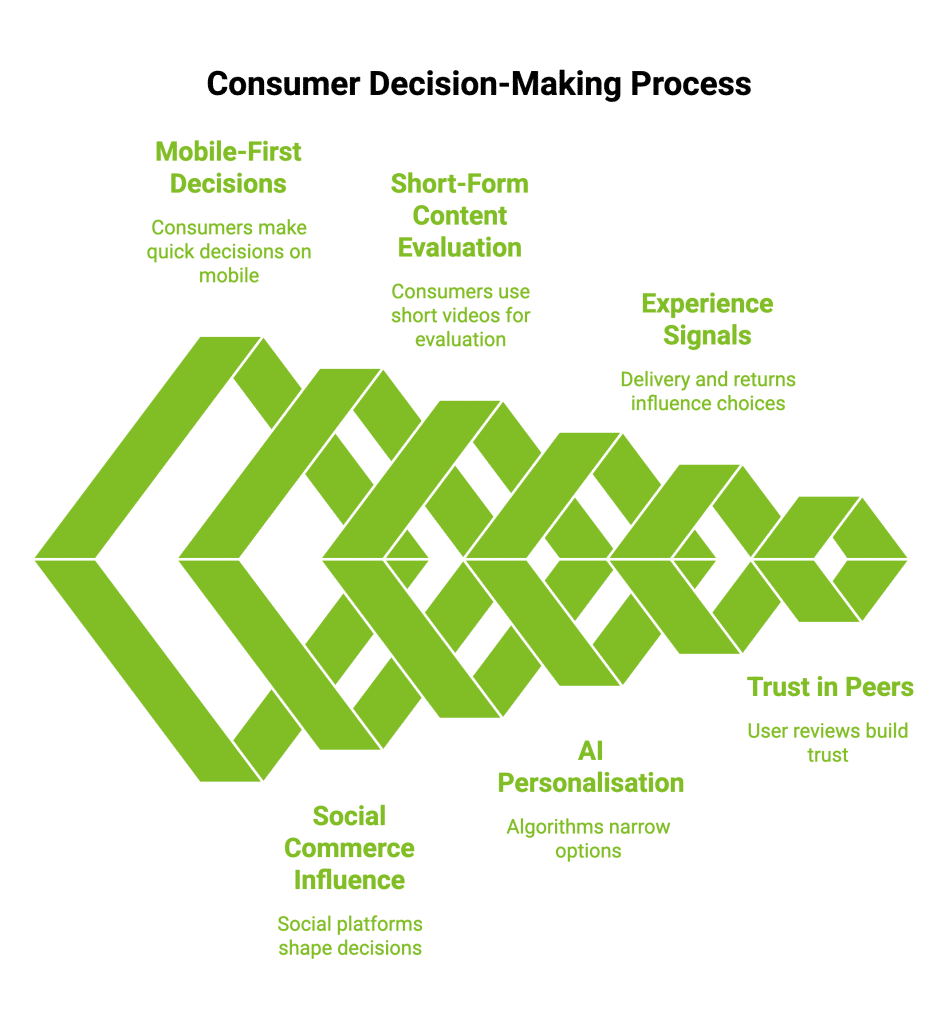
Consumer behaviour keeps evolving as technology, platforms, and expectations change. These trends are not just shifts in preference; they are changing how decisions are made.
Here are the key trends shaping behaviour today:
1. Mobile-First Decisions Happen Faster and Earlier
Consumers are not just browsing on mobile. They are deciding on mobile.
The first interaction, product evaluation, and purchase often happen within minutes. This leads to:
- Faster, more impulse-driven decisions
- Immediate drop-off if the experience feels slow or confusing
Mobile reduces patience. If a product is not easy to understand or buy, it is not seriously considered.
2. Social Commerce Collapses Discovery to Purchase
Social platforms now enable the full decision journey in one place.
Instead of moving across multiple sites, users can see a product, build trust, and purchase within the same feed.
This changes behaviour by:
- Reducing comparison across multiple options
- Increasing reliance on social proof and creator influence
- Shifting decisions from analysis to context and trust
The decision is often made based on who presents the product, not just what the product offers.
3. Short-Form Content Replaces Deep Research
Consumers increasingly rely on short videos to evaluate products.
Quick demonstrations, before-and-after visuals, and real usage clips allow users to form opinions rapidly.
This leads to:
- Decisions based on quick validation rather than detailed comparison
- Faster elimination of options that are not immediately clear
- Less time spent researching alternatives
If a product cannot be understood quickly, it is often ignored.
4. AI Personalisation Narrows the Consideration Set
Algorithms now shape what consumers see before they actively search.
Personalised feeds, recommendations, and retargeting ads repeatedly surface the same products.
This results in:
- Fewer options being considered
- Higher familiarity with algorithm-selected products
- Decisions made within a limited, curated set
Consumers are choosing from what is shown, not from the full range of available options.
5. Experience Signals Drive Final Decisions
Once a product is shortlisted, the final decision is often based on experience-related factors.
These include:
- Delivery speed
- Ease of returns
- Ratings and recent reviews
These signals reduce perceived risk. When products are similar, consumers choose the option that feels more reliable and convenient.
6. Trust Has Shifted from Brands to Other Consumers
Consumers place more trust in real user experiences than in brand messaging.
User-generated content, reviews, and comments play a central role in decision-making.
This leads to:
- Greater influence of peer validation
- Increased skepticism toward polished marketing claims
- Decisions based on relatability and perceived authenticity
A product is often chosen because it feels proven by others, not because it is positioned as superior.
The Bigger Shift
Across all these trends, one clear pattern emerges:
- Decisions are faster
- Fewer options are evaluated
- External signals play a larger role than independent research
Consumer decision-making is becoming more reactive, more guided by platforms, and more dependent on trust signals than ever before.
Want to Turn Consumer Behaviour into Conversions? Here’s How Wild Creek Web Studio Can Help
Understanding how people buy is useful. Turning that understanding into consistent conversions and revenue is what actually matters.
At Wild Creek Web Studio, we focus on bridging that gap. We take what users do, how they browse, compare, and decide, and turn it into clear, actionable improvements across your funnel.
Here’s how we do it:
- We align your strategy with real user behaviour: We map how your audience actually discovers and evaluates products, then structure your funnel to match that journey.
- We optimise for conversions, not just traffic: More visitors mean nothing if they don’t convert. We focus on improving actions that drive revenue.
- We identify and fix drop-offs: From weak trust signals to friction in checkout, we pinpoint exactly where users are leaving and fix it.
- We ensure consistency across every touchpoint: Whether users come from search, ads, or social, we make the experience seamless so decisions don’t reset.
- We keep improving based on real data: Consumer behaviour keeps changing, so we continuously test, refine, and optimise for better performance.
If you’re looking to go beyond theory and actually turn consumer behaviour into measurable growth, we help you make it happen.
Final Words
Online shopping today is all about how people decide.
Consumers don’t follow a straight path. They discover, compare, validate, and decide quickly. What looks simple is actually driven by trust, convenience, and confidence. For businesses, the focus is clear. Remove friction, build trust, and make decisions easier.
The takeaway is simple. Consumer behaviour follows patterns. The brands that understand and act on them are the ones that win.
Frequently Asked Questions
What is the difference between complex and habitual buying behaviour?
Complex buying behaviour involves high consumer involvement, thorough research, and evaluation of significant differences between products. Habitual buying behaviour occurs with low involvement, little difference between options, and is driven by purchasing habits, brand loyalty, and routine decisions.
What are the 7 O’s of consumer Behaviour?
The 7 O’s of consumer behaviour include Occupants (target audience), Objects (types of products), Objectives (specific needs), Organisations (who influence decisions), Occasions (when buying happens), Operations (payment methods), and Outlets (online store or physical stores).
How does online shopping affect the consumer?
Online shopping transforms customer behaviour by offering convenience, lower prices, and real-time comparisons. It enhances customer experience but increases reliance on product reviews, social media engagement, and data analytics, influencing purchasing habits and consumer expectations.
Why is consumer behaviour important for e-commerce marketing?
Understanding consumer buying behaviour helps businesses identify pain points, target the right audience, and improve marketing strategy. It enables better customer experience, personalisation, and the use of data analytics to convert potential customers and build a strong customer base.
What are the 4 types of consumer behaviour?
The four types of shopping behaviour are complex buying behaviour, habitual buying behaviour, variety-seeking behaviour, and dissonance-reducing behaviour. These depend on the level of involvement, perceived differences, and psychological factors influencing the buyer’s journey and decision-making process.
What is purchasing behaviour?
Purchasing behaviour refers to how consumers select, evaluate, and buy products based on personal factors, psychological factors, and cultural norms. It includes the information search phase, evaluation, and decision influenced by customer feedback, purchase history, and shopping experience.