Key Highlights
- SEO alone is not enough; AEO is needed for AI search visibility
- AI prefers structured, clear, direct-answer content over keyword-heavy pages
- Most sites miss AI visibility due to poor structure, missing schema, and unclear answers
- An AEO audit checks how well AI can understand and extract your content
- Schema markup helps AI interpret content and improves chances of visibility
- AI rankings depend on clarity, authority, trust, and technical performance
- AEO optimisation increases the chances of being cited in AI-generated answers
You’ve done your SEO. Your site is live. But when users ask ChatGPT or Google’s AI Overview a question your business should answer, your website doesn’t show up.
That’s not a rankings problem. That’s an AEO certification problem.
AI search is already shaping how people find answers. If your site is not built for it, you lose visibility, leads, and ground to competitors. Common gaps include missing structured data, unclear content, weak answer formats, and limited authority signals. When conducting an AEO audit checklist, the main steps typically include assessing your website’s structured data implementation, reviewing content clarity and direct answer formats, evaluating authority signals such as backlinks and author credentials, and identifying gaps that may impact visibility in AI-driven search environments.
Competitors who have adapted are getting picked first, and the gap continues to grow. This article explains what is holding your site back and how an AEO audit helps fix it.
What Is an AI Audit?
An AI audit reviews how well your website performs in AI-driven search environments. It checks whether your content can be understood, selected, and used by systems like ChatGPT and Google’s AI Overview. Unlike traditional SEO audits that focus on rankings and keywords, an AI audit evaluates how your content is interpreted and summarised.
It focuses on whether your pages deliver clear answers related to the international supply chain, follow a logical structure, and include signals AI systems rely on. The audit covers key areas such as content clarity, question-based headings, structured data, internal linking, and topical focus. It also evaluates authority signals like credibility, consistency, and alignment with user intent.
Is Your Website Structured for AI Summarisation?
AI answer engines do not read your website like a person. They scan, parse, and extract, looking for the clearest and most direct answer to a query. If your content does not make that easy, especially in comparison to traditional search results, it gets ignored.
The issue is not content quality. It is how the content is structured and presented. If answers are buried, unclear, or spread across sections, AI systems struggle to extract them. So the real question is not whether your content is good. It is whether AI can quickly locate, understand, and use the most relevant parts. If you are looking for a sample or template for an AEO audit checklist, you can often find downloadable examples on reputable SEO blogs, industry forums, or through professional SEO associations’ resource sections. These templates typically offer structured formats that make it easier for both humans and AI to summarise and audit website effectiveness.
What AI Is Actually Looking For?
When AI processes a page, it looks for three things: what the page is about, which questions it answers, and how clearly those answers are presented. If this is not immediately clear, the content is skipped.
AI systems do not read content like users. They scan for structure, extract key lines, and prioritise pages that deliver answers without effort. Long paragraphs, vague sections, or delayed answers reduce your chances of being selected.
Structure plays a direct role here. Headings should reflect real user questions, not broad or generic topics. This helps AI match your content with search intent more accurately.
Example:
Instead of writing: “Many businesses struggle with visibility due to multiple content and technical factors,”
write: “Websites often do not appear in AI results because their answers are not clear or easy to extract.”
The Structural Elements That Matter
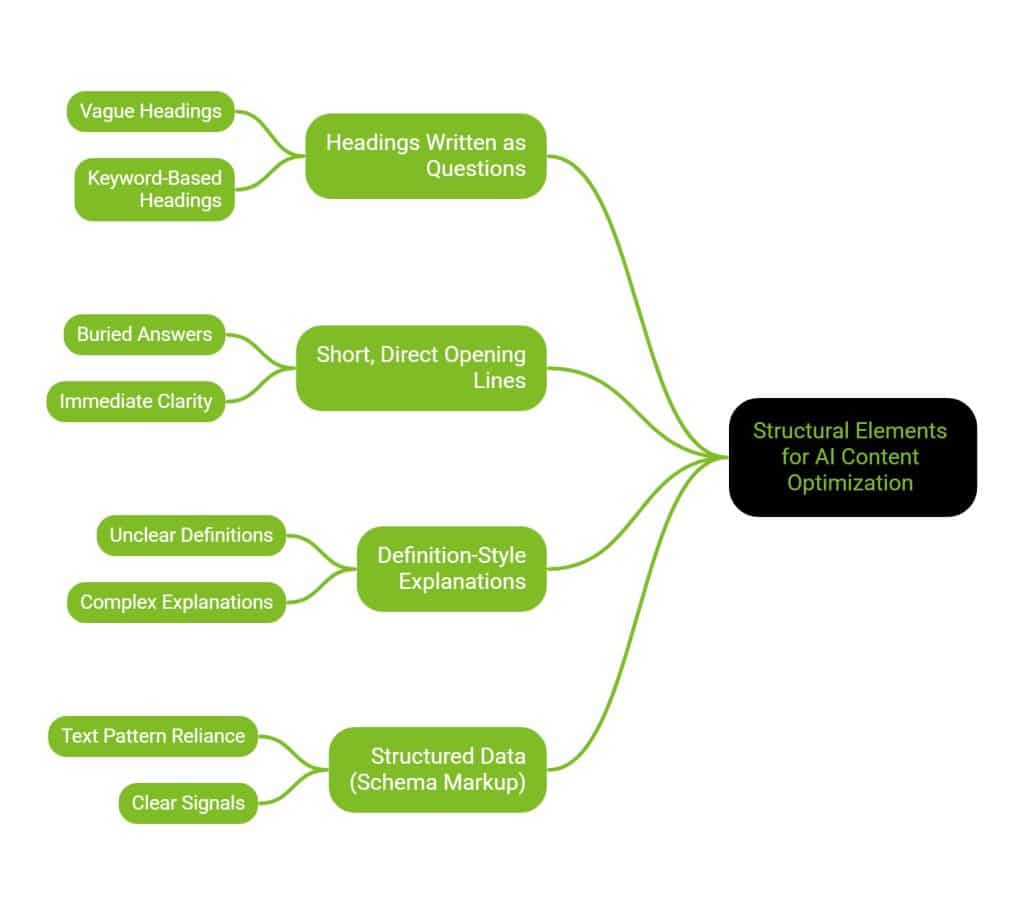
A few elements can improve your chances significantly:
- Headings Written as Questions
Headings should reflect real user queries. This makes it easier for AI systems to match your content with search intent.
What this means:
If your headings are vague or keyword-based, your content may never be matched to real queries. Clear, question-led headings increase the chances of being retrieved and used in AI answers.
- Short, Direct Opening Lines
Each section should begin with a clear answer in the first 1–2 lines. AI systems extract early, not after long explanations.
What this means:
If your answer is buried, the page is skipped. Content that delivers immediate clarity is far more likely to be selected and surfaced in AI-generated results.
- Definition-Style Explanations
Key terms should be explained in simple, direct language. This improves clarity and makes content easier to interpret.
What this means:
When definitions are unclear or overly complex, AI systems struggle to extract usable answers. Clear explanations improve both accuracy and authority in AI outputs.
- Structured Data (Schema Markup)
Schema helps AI systems understand the type and context of your content without guessing.
What this means:
Without schema, your content depends entirely on interpretation. With it, you provide clear signals that increase eligibility for rich results and improve how your content is processed.
Without structured data, AI relies only on text patterns. With it, you provide clear signals about what your content represents.
If your content is not easy to scan, segment, and summarise, it becomes less likely to appear in AI-generated results. The focus is not on rewriting everything, but on improving clarity, structure, and how information is presented.
What Are the Primary AEO Blockers for SME Websites in 2026?
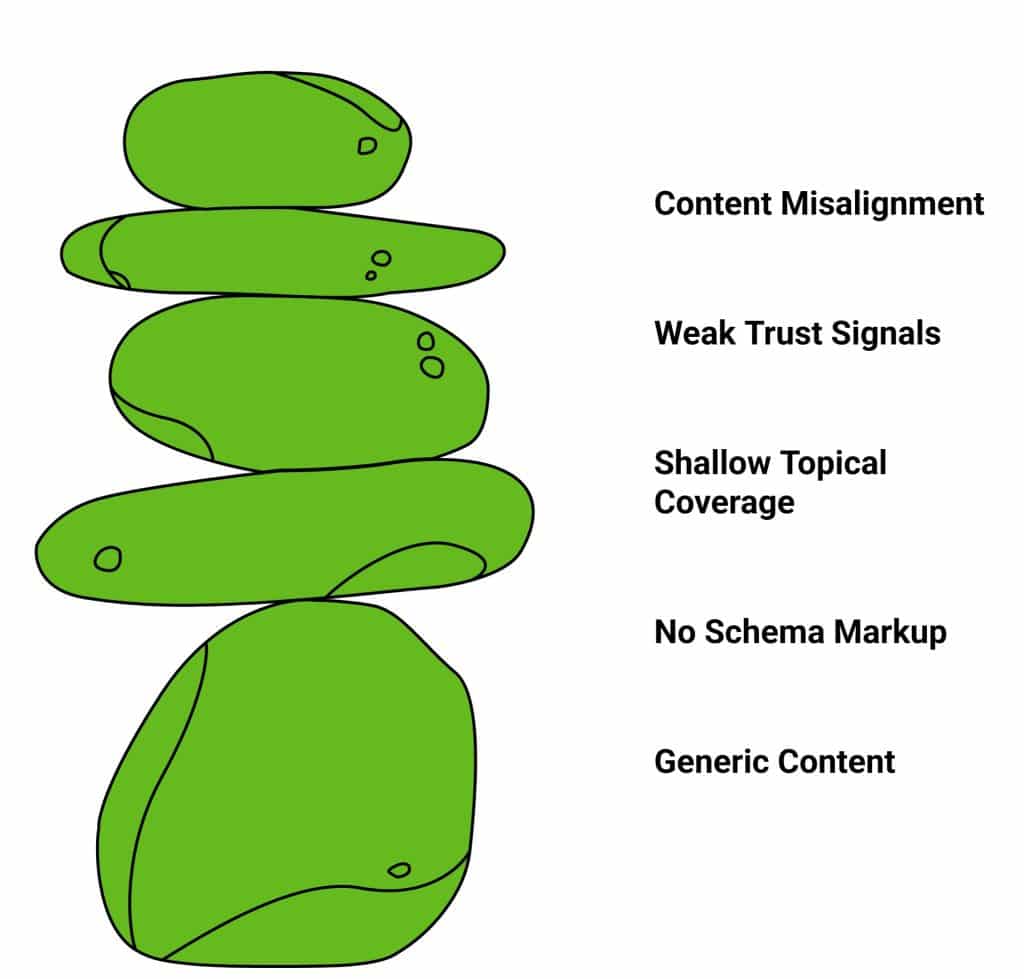
Most SME websites do not lack content. They lack clarity, structure, and signals that AI systems rely on to select answers, including factors such as AEO status. These gaps are not always visible, but they directly determine whether your content is used or ignored in AI-generated results.
1. Content That Explains but Does Not Answer
Many pages explain topics without directly answering them. AI systems prioritise clarity over completeness, which means descriptive content often gets ignored. If the answer is not immediate and obvious, the page is skipped.
2. Missing or Weak Schema Signals
Without structured data, AI systems are forced to interpret content on their own. This creates uncertainty. When competitors provide clear schema signals, their content becomes easier to process and more likely to be selected as a preferred supplier.
3. Surface-Level Topic Coverage
Covering a topic once is not enough. AI systems favour sources that show depth and connection across multiple pages. When content lacks supporting subtopics and internal links, it signals limited authority.
4. Low Trust and Verifiability
If a page does not clearly show who created it, why it is credible, or where the information comes from, it is less likely to be used. AI systems prioritise content that can be verified through strong trust signals.
5. Misalignment with Real Queries
Content built around keywords instead of real questions often fails to match AI search behaviour. If phrasing does not reflect how users actually ask, the content becomes difficult for AI systems to retrieve and surface.
These blockers are not always obvious, but they directly affect how your website performs in AI results. Running an audit AEO helps uncover these gaps and align your content with how AI search actually works.
What Are The Core Elements That Directly Impact AI Search Visibility?
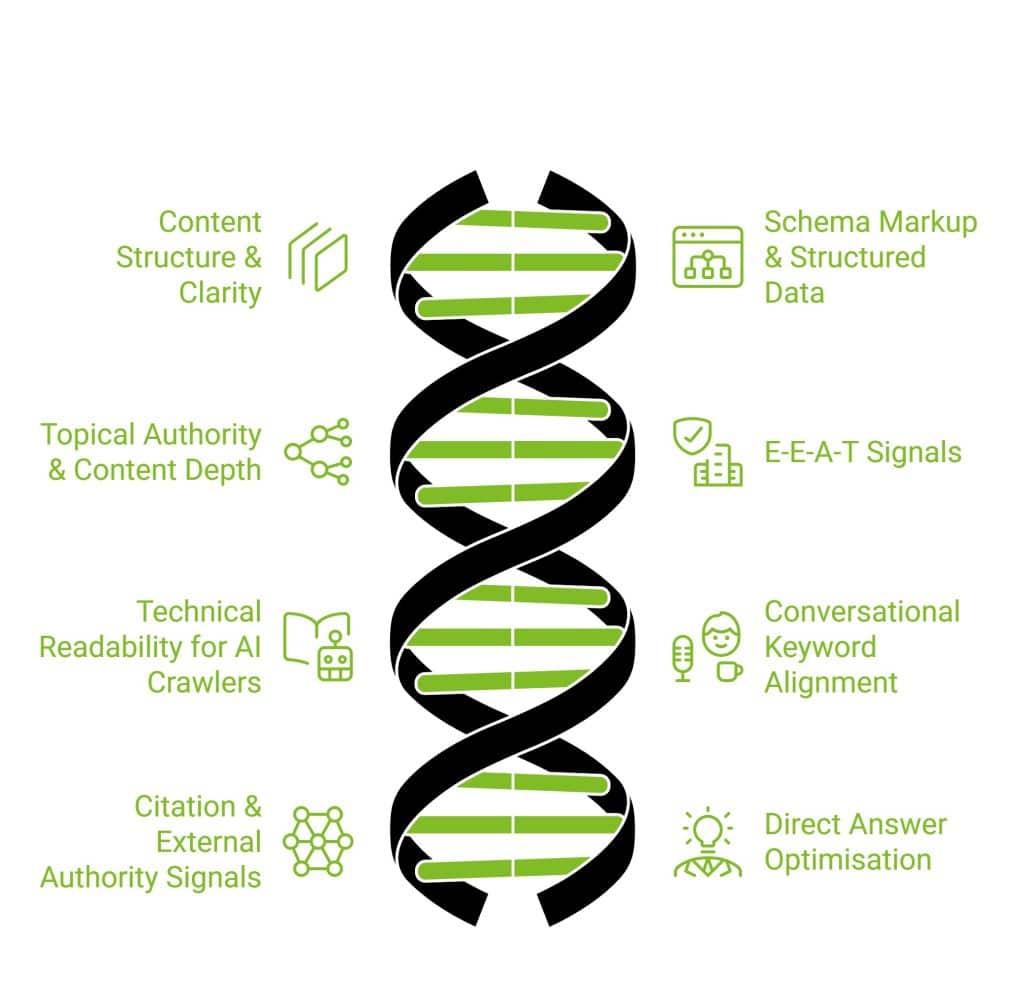
An effective AEO audit focuses on how easily AI systems can understand, extract, and trust your content. Each element below highlights what directly impacts your visibility in AI-generated results.
1. Content Structure & Clarity
This forms the base of AI visibility. Content needs to be easy to scan and summarise. Clear, question-based headings and direct answers at the start of sections improve extractability.
What changes in real terms:
According to Banecs, pages with structured, scannable content often see 30% lifts in AI-visible surfaces or CTR, as clearer formatting improves extractability for featured snippets and AI-generated answers.
2. Schema Markup & Structured Data
Structured data removes guesswork for AI engines. Using schema types like Article, FAQ, and Organisation helps define content purpose clearly.
What changes in real terms:
According to Lantern Digital, websites implementing valid schema often achieve higher eligibility for rich results, with a 5–30% lift in CTR depending on query type, industry, and the specific schema applied.
3. Topical Authority & Content Depth
AI engines evaluate overall expertise, not just single pages. Strong topic coverage with connected content improves authority.
What changes in real terms:
Sites with well-developed content clusters often see higher visibility across multiple related queries and improved ranking consistency, as AI systems favour sources that demonstrate depth rather than isolated content.
4. E-E-A-T Signals
Credibility plays a major role in content selection. Author details, reliable sources, and trust indicators strengthen authority.
What changes in real terms:
Content backed by clear expertise and trust signals is more likely to be referenced. Studies show that authoritative content is significantly more likely to be cited in search features and AI-generated answers.
5. Technical Readability for AI Crawlers
Even strong content can fail if it is not accessible. Clean structure, fast loading speed, and proper indexing are essential.
What changes in real terms:
Improving page speed and crawlability has been linked to better indexing rates and faster content discovery, which directly affects whether pages are considered for AI-generated responses.
6. Conversational Keyword Alignment
AI search relies on natural language queries. Content should match how users actually ask questions.
What changes in real terms:
Pages optimised for conversational queries often capture long-tail traffic increases of 20% or more, as they align better with real user intent and AI query patterns.
7. Citation & External Authority Signals
External validation strengthens credibility. Mentions on trusted platforms and consistent business information improve trust.
What changes in real terms:
Brands with strong external mentions and consistent citations are more likely to be recognised as reliable sources, increasing their chances of being surfaced in AI-generated answers.
8. Direct Answer Optimisation
AI engines prioritise content that delivers clear, standalone answers. Concise responses improve extraction.
What changes in real terms:
Content structured with direct answers and lists has a higher likelihood of being featured in snippets and AI summaries, as it reduces the effort required for extraction and reuse.
Together, these elements highlight what may be limiting your AI visibility and where focused improvements can make a measurable difference.
How Do You Conduct an AEO Audit?
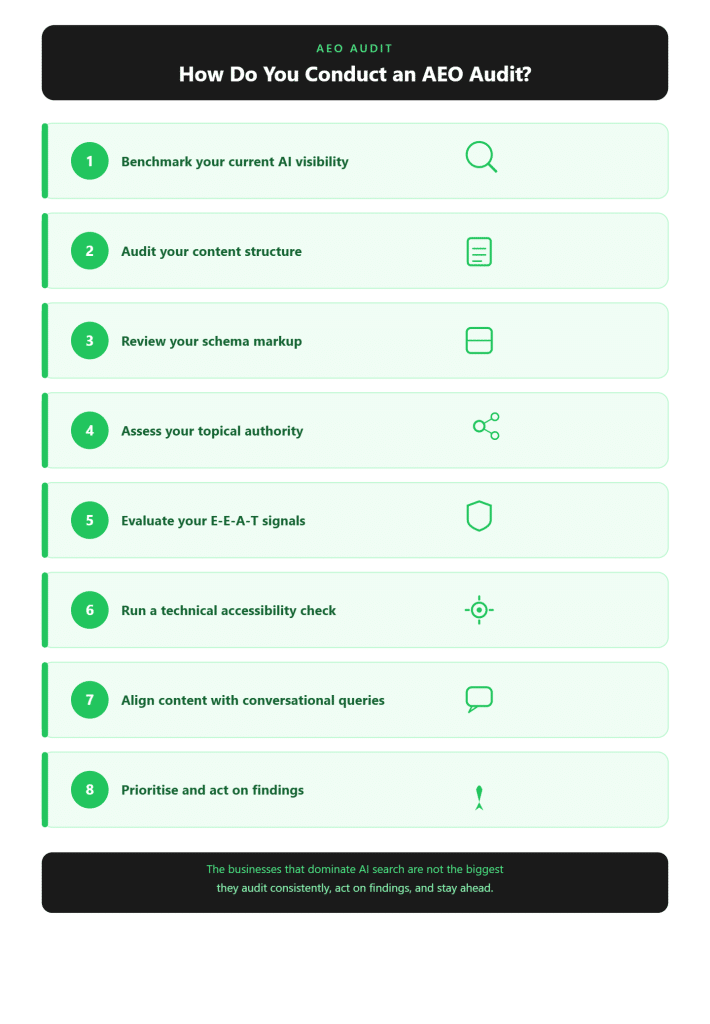
An AEO audit is not just a checklist. It is a process of identifying what is blocking your website from appearing in AI-generated answers and fixing the highest-impact gaps first.
Step 1: Benchmark Your Current AI Visibility
Before fixing anything, check if your website is visible at all.
Search your target queries on:
How to search properly:
- Use real user-style queries, not keywords
Example:- “What is AEO audit?”
- “Why is my website not showing in AI search?”
- Try 5–10 variations of the same intent
- Check both informational and problem-based queries
What to analyse:
- Does your website appear?
- Which competitors are cited repeatedly?
- What format do answers follow (lists, short paragraphs, definitions)?
Impact:
This step shows whether you have a visibility problem or a deeper content issue. It sets the direction for the entire audit.
Step 2: Audit Your Content Structure (High Impact Fix)
AI systems prefer content that is easy to extract, not just well-written.
How to do it:
- Open key pages and check:
- Is the answer given in the first 2–3 lines?
- Are headings clear and question-based?
- Are paragraphs short and scannable?
- Compare your page with top AI-cited results
What to fix first:
- Add direct answers at the top
- Break long paragraphs
- Use structured headings (H2, H3)
Impact:
Improves extractability, which directly increases chances of being selected in AI answers.
Step 3: Review Your Schema Markup (Understanding Layer)
Even strong content can fail if AI cannot interpret it properly.
Use:
How to do it:
- Paste your page URL into the tools
- Check for:
- Missing schema
- Errors or warnings
- Unsupported types
What to prioritise:
- FAQ schema
- Article schema
- Organisation schema
Impact:
Helps AI systems understand your content clearly, increasing the likelihood of being used in generated answers.
Step 4: Assess Your Topical Authority (Depth Matters)
AI engines prefer sources that cover a topic completely, not partially.
How to do it:
- Search your core topic (e.g., “AEO audit”)
- Compare your content vs competitors:
- Do they cover more subtopics?
- Are their articles interlinked?
What to fix:
- Build content clusters (main topic + supporting pages)
- Add internal links between related content
Impact:
Stronger topical coverage increases trust and improves selection frequency in AI responses.
Step 5: Evaluate Your E-E-A-T Signals (Trust Layer)
AI systems prioritise credible and trustworthy sources.
How to do it:
Check if your site clearly shows:
- Author name and expertise
- About page with business details
- Real examples, case studies, or proof
What to improve:
- Add author bios
- Include real insights, not generic content
- Show experience through examples
Impact:
Improves credibility, which directly affects whether AI systems trust and cite your content.
Step 6: Run a Technical Accessibility Check
If AI crawlers cannot access your content, nothing else matters.
Use:
- Google Search Console → search.google.com/search-console
How to do it:
- Check indexing status
- Identify crawl errors
- Review page experience metrics
What to fix first:
- Pages not indexed
- Slow-loading pages
- Mobile usability issues
Impact:
Ensures your content is discoverable and usable by AI systems.
Step 7: Align Content with Conversational Queries
AI search is driven by how people ask questions, not just keywords.
How to do it:
- Use platforms like:
- Perplexity AI
- ChatGPT
- Type your topic and observe:
- Suggested questions
- Follow-up queries
What to update:
- Add natural language questions
- Include long-tail queries
- Answer follow-up intent within the same page
Impact:
Improves alignment with real user intent, increasing chances of being selected in AI-generated answers.
Step 8: Prioritise Fixes Based on Impact (What Matters Most)
Do not fix everything at once.
Fix in this order:
- Content structure (fastest impact)
- Schema implementation
- Content depth and authority
- Technical issues
Most businesses identify problems but struggle to act on them in the right order. This is where a structured approach makes a difference.
What Is The Best Toolkit For Auditing Structured Data?
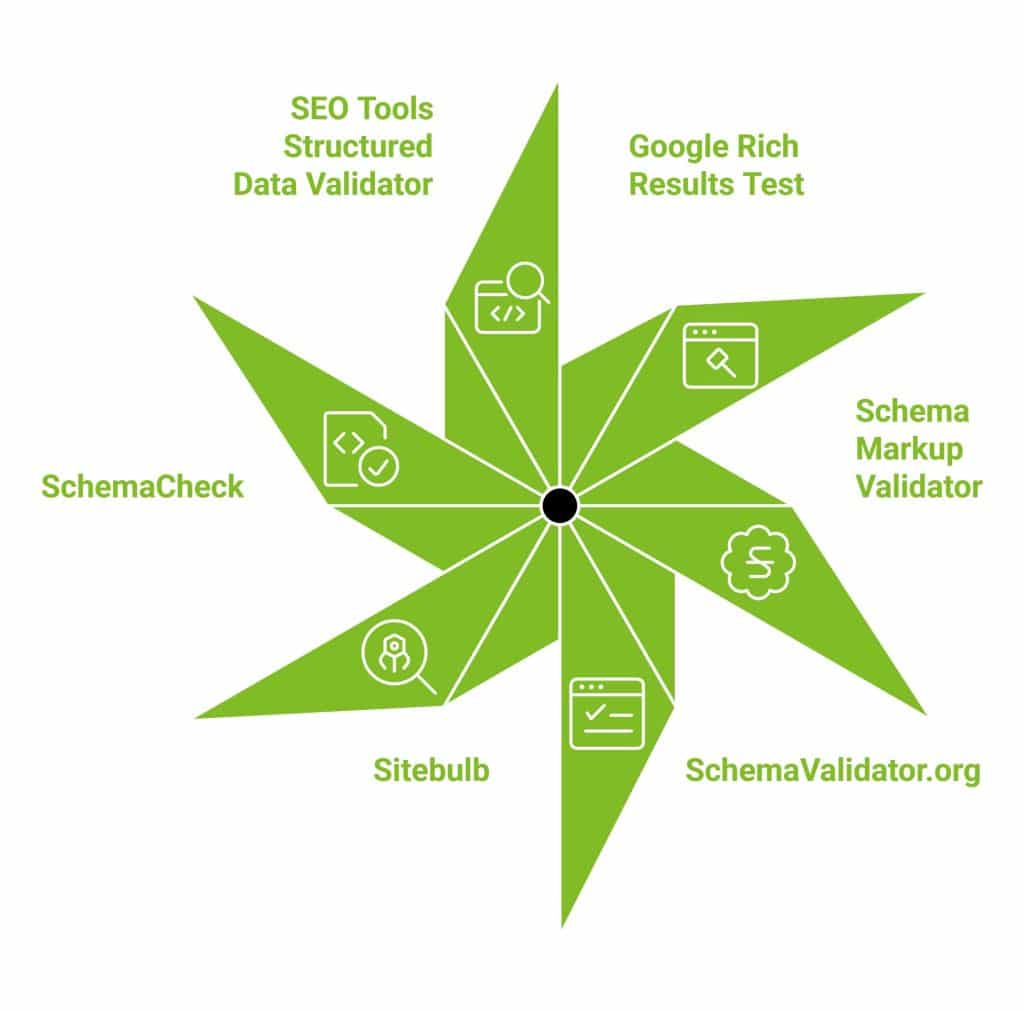
Several tools are available to audit structured data and check whether your schema is valid, complete, and usable by AI systems. Each tool focuses on a different part of the process, so using more than one gives better results.
- Google Rich Results Test:
This is the most important tool for real-world validation.
- Paste a URL or code snippet, and it simulates how Google crawls and interprets your structured data.
- It shows whether your page is eligible for rich results and highlights errors with field-level detail.
Impact:
Directly improves your chances of appearing in rich results and AI-generated answers by fixing issues that affect eligibility and visibility.
- Schema Markup Validator (Schema.org):
This tool checks whether your schema follows official standards. It focuses on technical correctness and helps identify structural issues in your markup.
- Paste your JSON-LD, Microdata, or RDFa markup to check it against official Schema.org standards.
- It validates property types, structure, and relationships without focusing on search engine-specific requirements.
Impact:
Ensures your markup is structurally correct, helping AI systems accurately understand your content without misinterpretation.
- SchemaValidator.org:
A lightweight tool for quick validation.
- Paste your structured data and get instant feedback on syntax and formatting.
- It is especially useful during development when making frequent updates.
Impact:
Reduces errors early, making your structured data clean and ready before deployment, which improves overall AI readability.
- Sitebulb:
A more advanced option for full-site audits.
- A full-site crawler that audits structured data across all pages.
- After running a crawl, it groups issues by type and severity, helping you identify patterns and large-scale problems.
Impact:
Uncovers site-wide issues that affect multiple pages, improving consistency and strengthening overall AI search visibility.
- SchemaCheck:
A modern tool that flags outdated schema types and checks eligibility based on current Google rules.
- Enter a URL to analyse schema relevance based on current search guidelines.
- It flags outdated schema types and suggests improvements with actionable recommendations.
Impact:
Keeps your structured data aligned with evolving AI and search requirements, preventing visibility loss over time.
- SEO Tools Structured Data Validator:
Allows you to test structured data by URL or code and provides a full report on errors, warnings, and detected schema types.
No single tool covers everything. Some validate syntax, others check eligibility, and some analyse your entire site. Using a combination helps catch most issues and ensures your content is properly understood by search engines and AI systems.
Why Do Most Websites Still Struggle to Appear in AI Search Results?
Most businesses can identify issues in their content, but struggle to prioritise and act on them. This often leads to gaps that prevent their pages from being selected in AI-generated answers.
A structured AEO audit helps bring clarity to this. It evaluates how well a website supports AI visibility by analysing content structure, schema usage, topical depth, and trust signals. More importantly, it highlights what is actually limiting visibility and what needs to be fixed first.
This is where Wild Creek Web Studio fits in. Instead of approaching AEO as a generic extension of SEO, the focus stays on diagnosing the exact barriers affecting AI search performance and translating them into clear, actionable improvements.
For businesses aiming to strengthen their presence in AI-driven results, this kind of focused evaluation becomes a key step in moving from scattered efforts to a more outcome-driven approach.
If your website is not showing up where it should, it is time to fix what matters.
Call Wild Creek Web Studio today and get a clear, actionable AEO audit that shows you exactly what to fix, where to start, and how to improve your visibility in AI-driven search.
Conclusion
AI search is already influencing how customers find and choose businesses. If your website is not appearing in AI-generated answers, it is not just a visibility issue; it is a missed opportunity. An AEO audit helps you identify exactly where the gaps are and what needs to be improved. From content structure to trust signals, small changes can make a clear difference. The decision is straightforward. Continue relying only on traditional SEO and risk falling behind, or take action now and prepare your website for how search works today.
Frequently Asked Questions
How does optimisation for AI search work?
It involves structuring content clearly, using schema markup, and aligning with real user questions. This helps AI systems quickly understand, extract, and present your content as direct answers in AI-generated search results.
Is there any certification for AEO or AI readiness?
There is no official certification for AEO or AI readiness yet. Instead, businesses rely on audits that assess content structure, clarity, and performance to determine how well a website is prepared for AI-driven search visibility.
What is the difference between SEO and AEO?
SEO focuses on improving rankings in traditional search engines through keywords and backlinks. AEO focuses on structuring content so it can be directly selected, interpreted, and displayed within AI-generated answers and conversational search results.
Which documents do I need to provide during an AEO audit?
Provide access to Google Search Console, GA4, CMS, and keyword tools. Share sitemap, robots.txt, content inventory, and top pages. Include conversion goals, audience details, and competitor list. Add schema details and performance reports to assess SEO and AI visibility gaps effectively.