Key Highlights
- Search is now intent-driven, not just keyword-based
- Agentic SEO uses AI agents for continuous optimisation
- Replaces manual work with automated, feedback-driven systems
- Focuses on covering multiple user intents
- Enables real-time updates and faster execution
- Scales SEO while maintaining relevance
- Requires quality search data and human oversight
- Moves SEO from one-time tasks to continuous improvement
Search is changing fast, and static SEO tactics are starting to show limits. As search systems rely more on AI, content is no longer ranked only by keywords or links, but by how well it answers layered, intent-driven queries. This shift is where agentic SEO enters the picture. It brings structured workflows, task-based execution, and continuous feedback into optimisation
Agentic SEO emphasises the importance of keyword research as a foundational element, allowing marketers to uncover opportunities and create content that aligns with user intent effectively. The key question now is whether this approach simply adds efficiency or actually defines the next phase of search optimisation. This article explains how agentic SEO works and how to build its workflows.
What is Agentic SEO?
Agentic SEO is an approach where AI agents take an active role in planning, creating, improving, and measuring SEO work. Instead of relying on fixed rules or one-time automation, it uses systems, including analytics platforms, that can set goals, break them into tasks, act on them, and learn from results.
Search engines are evolving. They no longer just match keywords; they evaluate how well content answers complex queries. With features like AI-generated results and query fan-out, answer engine optimisation is essential as content needs to cover topics more deeply and clearly.
Agentic SEO changes how SEO specialists work by using autonomous AI agents to handle and improve different parts of the optimisation process. This allows strategies to run more efficiently, with less manual effort and more consistent results over time, enhancing their overall SEO efforts.
Agentic SEO supports this shift by:
- Creating content that answers multiple layers of intent
- Updating pages based on performance signals
- Scaling optimisation without losing relevance
Example:
A digital publisher with 8,000 articles faces a different SEO challenge than e-commerce sites. Older content can gradually lose rankings as competitors publish fresher, more detailed articles, while manually reviewing thousands of URLs becomes impractical for busy editorial teams.
What AI agents analyse
Agents compare the article against the latest top-ranking competitors for its target keyword to identify missing subtopics, weak or thin sections, outdated information, search intent gaps, and questions competitors are answering more effectively.
What the system can produce
From there, it can recommend or draft improvements automatically - refreshed introductions, better heading structures, expanded topic coverage, improved content formatting, and additional supporting sections based on current search trends.
For example:
- A health publisher might add a symptoms comparison table that competitors now rank for
- A finance publisher might expand a short paragraph on tax implications into a detailed section targeting high-volume related searches
The result is a living content library that continuously improves over time. Instead of relying on manual audits or large-scale quarterly content refresh projects, publishers can keep articles competitive in search results through ongoing automated optimisation.
What Makes Agentic SEO Different From Basic Automation?
Most SEO teams have used automation in some form. Scheduled crawls, bulk metadata exports, automated rank tracking alerts - these tools save time, but they follow a fixed set of rules a human wrote in advance. If the rule says “flag pages with a meta description under 120 characters,” the tool flags them. It does not ask whether those pages matter, whether fixing them will move the needle, or what else might be more urgent right now. The rule runs. The report lands. A human decides what to do next.
Agentic SEO operates on an entirely different logic.
Automation Follows Rules. Agents Make Decisions.
A basic automation tool executes exactly what it is told, nothing more. An agentic system is given a goal, not a script. Instead of running a predefined workflow, the agent assesses the current state of a site, interprets signals from search performance data, identifies what is actually causing a problem, and determines the most appropriate response. It is not matching conditions to outputs. It is reasoning toward an outcome.
The difference becomes clear in practice. A rule-based tool might flag 200 pages with thin content. An agent evaluates those 200 pages, cross-references them against ranking data, traffic trends, and competitor coverage, and concludes that 12 of them represent genuine ranking opportunities worth acting on immediately, while the remaining 188 are low-traffic pages where content investment would deliver negligible return.
Agents Prioritise Tasks Dynamically
This is where agentic SEO delivers its most significant operational advantage. Priorities in SEO shift constantly. A competitor publishes a comprehensive guide on a term you were ranking second for. Google updates how it interprets a category of queries. A high-converting page drops three positions overnight. Basic automation cannot respond to any of this in context. It continues executing its scheduled tasks regardless of what changed this morning.
Agents reprioritise in response to what is actually happening. If a high-value page loses ranking, that task surfaces to the top of the queue automatically. If a content gap emerges because a competitor just claimed an AI Overview citation your page previously held, the agent identifies it, assesses its commercial importance, and schedules the appropriate corrective action before a human has even opened their dashboard.
The practical outcome is an SEO operation that allocates effort intelligently rather than treating every flagged issue as equally important. Rules tell a system what to do. Agents figure out what needs doing, in what order, and why.
How Agentic SEO Works: Agents, Tasks, and Feedback Loops
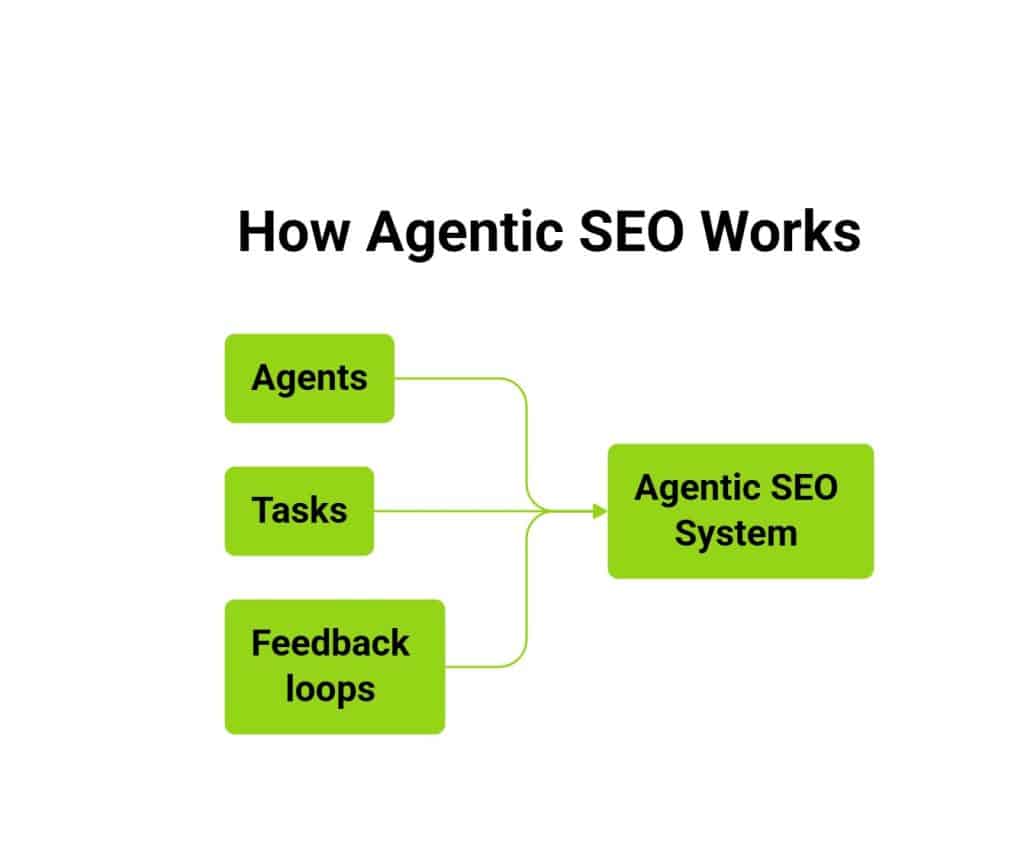
Agentic SEO runs on a simple system in which AI agents handle tasks and improve their performance through continuous feedback. Instead of one-time optimisation, it works as an ongoing cycle.
- Agents act as decision-makers. They understand the goal, such as improving rankings or covering a topic better, and decide what actions to take.
- Tasks are the actions they perform. This includes keyword mapping, content creation, internal linking, and updating pages based on search intent.
- Feedback loops keep the system improving. Performance data, such as rankings, clicks, and engagement, feeds back into the process. Based on this, agents adjust content, refine structure, and prioritise
- Agentic SEO revolutionises digital marketing by employing advanced AI tools that autonomously manage and execute comprehensive SEO strategies, far surpassing traditional methods what to do next.
Why Feedback Loops Matter?
In traditional SEO:
- Content update goes live and sits untouched for weeks or months
- Someone manually pulls a ranking report to check performance
- Underperforming pages get scheduled for a follow-up fix
- Competitors move into the gap during the waiting period
- Action to adjustment cycle can stretch across an entire quarter
Agentic SEO:
- Agents monitor results in real time the moment a page goes live
- Feedback loop instantly catches ranking gains and losses
- System recalibrates and implements corrections automatically
- No ticket raised, no sprint scheduled, no delay
This distinction matters more than it might first appear. Traditional SEO treats optimisation as a series of discrete projects with gaps in between. Agentic SEO treats it as a permanent, self-correcting system where every action generates data, every data point informs the next action, and no performance signal goes unread. The loop never closes because it is never meant to. That is precisely what makes it effective.
How is Agentic SEO Different From Traditional SEO?
Agentic SEO transforms the content strategy landscape by utilising AI to autonomously plan, execute, and optimise content based on user intent and emerging search trends, ensuring more effective and efficient digital marketing efforts.
| Aspect | Traditional SEO | Agentic SEO |
| Approach | Manual, step-based execution | AI-driven, continuous system |
| Workflow | Fixed and planned | Dynamic and adaptive |
| Execution | Human-led tasks | AI agents perform tasks |
| Updates | Periodic updates | Real-time improvements |
| Decision-making | Based on predefined strategy | Based on live performance data |
| Speed | Slower to react | Faster and ongoing |
| Optimisation | One-time or scheduled | Continuous loop-based optimisation |
| Focus | Keywords and rankings | Intent, performance, and refinement |
The table highlights a major shift in how SEO operates. Traditional SEO follows a project-based approach, while Agentic SEO works as an ongoing system that continuously adapts to changing search trends, competitor strategies, and algorithm updates. This allows teams to focus less on repetitive execution and more on strategy, editorial direction, and brand alignment.
How Agentic SEO Supports AI Search and AI Overviews?
Search has fundamentally shifted. Google’s AI Overviews, ChatGPT Search, and Perplexity no longer just rank pages, they synthesise answers directly from content, drawing on sources that best satisfy the full intent of a query. Traditional SEO was built for a ten blue links world. Agentic SEO is built for this one.
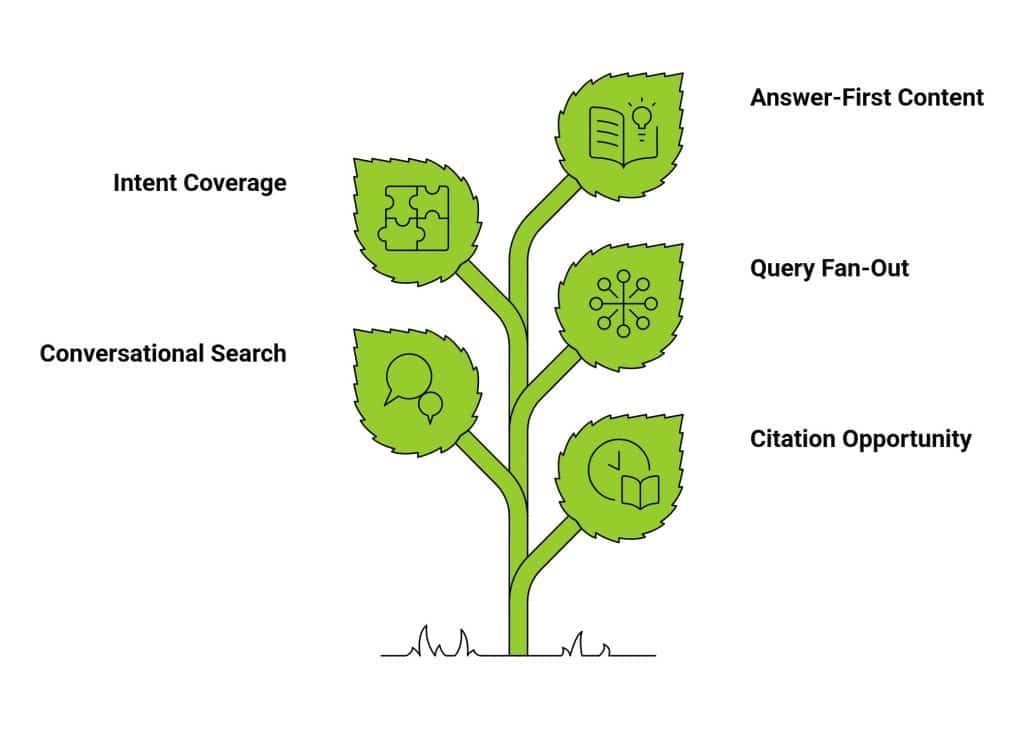
1. AI Overviews and the Citation Opportunity
AI Overviews don’t reward the highest domain authority. They reward the most directly useful, semantically complete content. Agentic SEO systems continuously monitor which pages are being cited in AI generated answers and which aren’t, then autonomously identify the gaps in structure, depth, or entity coverage that are costing a page its citation slot. Instead of waiting for a quarterly content audit, agents act the moment citation signals shift.
2. Conversational Search and Multi-Turn Intent
Users increasingly search the way they talk, in follow-up questions, refinements, and natural language sequences rather than isolated keyword strings. Agentic SEO maps these conversational patterns, identifying how a single topic branches across multiple query variations and ensuring content answers not just the first question, but the follow ups that come after it.
3. Query Fan-Out: One Intent, Many Signals
When a user types a single query into an AI powered search engine, the intelligent system internally expands it into dozens of related sub-queries, a process known as query fan-out. Agentic SEO addresses this by auditing whether a page’s content covers the full semantic surface area of a topic. If an AI search engine fans out a query into eight related concepts and your content only addresses three, agents detect and flag that coverage gap automatically.
4. Intent Coverage and Semantic Completeness
A page that answers one intent well but ignores adjacent intents is invisible to AI search for most of the queries it could have captured. Agentic systems analyse the full intent landscape around a topic, informational, navigational, transactional, and investigational, and ensure content is structured to satisfy each layer. Semantic completeness isn’t a one time copywriting task. It’s an ongoing signal that agents track and optimise continuously.
5. Answer-First Content Structure
AI Overviews consistently pull from content that leads with a direct answer before expanding into detail, a structure that mirrors how large language models retrieve and synthesise information. Agentic SEO enforces this at scale, auditing page structures across an entire site to ensure the most citation worthy answer appears in the first paragraph, not buried in section four. Agents can flag, prioritise, and in some workflows even draft rewrites for pages that bury their lead.
Building an Agentic SEO Workflow: From Strategy to Execution
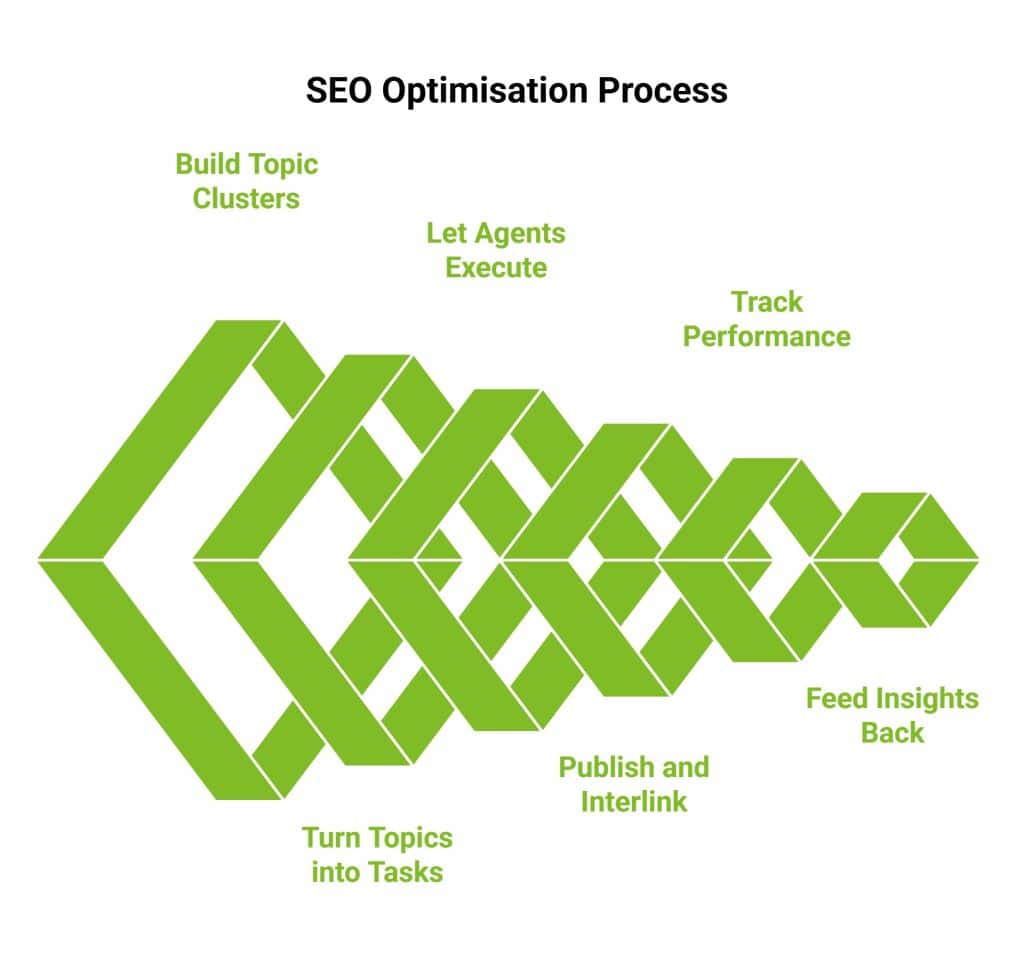
Agentic AI revolutionises SEO by utilising intelligent agents that adaptively optimise content and performance based on generative AI and real-time data analysis and user intent shifts. Agentic SEO works best when it follows a clear, structured flow. Here’s how the process moves from planning to continuous improvement:
1. Define a Clear SEO Goal
Set a specific target like:
- Rank for “agentic SEO” cluster
- Increase organic traffic by 30%
This gives agents a clear direction instead of vague optimisation.
2. Build Topic Clusters (Not Just Keywords)
Group related queries under one topic.
Example:
- Main topic: Agentic SEO
- Subtopics: how it works, tools, benefits, mistakes
This ensures coverage of multiple search intents, not just one keyword.
3. Turn Topics Into Task Lists
Break each topic into actions:
- Create new pages for missing subtopics
- Update weak-performing content
- Add internal links between related pages
Now strategy becomes executable work.
4. Let Agents Execute Specific Tasks
Each agent handles a defined job:
- Content agent → writes or improves articles
- Optimisation agent → fixes headings, structure, intent match
- Linking agent → connects related pages
This avoids random automation and keeps roles clear.
5. Publish and Interlink Automatically
Content goes live and gets connected:
- New pages link to pillar pages
- Existing pages get updated with fresh links
This builds authority across the topic, not isolated pages.
6. Track Real Performance Signals
Measure what actually happens:
- Which pages are getting impressions but low clicks
- Which content is dropping in rankings
- Where users are not engaging
This replaces guesswork with real data.
7. Feed Insights Back Into Tasks
Turn data into new actions:
- Low CTR → rewrite title and meta
- Ranking drop → improve content depth
- Missing intent → add new sections
Agents adjust based on what the data shows.
8. Run the Loop Continuously
The system keeps repeating:
- Find gaps → fix → measure → improve
No waiting for monthly audits or manual reviews.
Agentic SEO enables businesses to enhance their search visibility through automated optimisation strategies that adapt to changing search intent and improve performance across vast online content landscapes.
What Happens When the Workflow Breaks?
Even the best agentic SEO systems can fail if the foundation is weak. Instead of fixing problems, the workflow can end up scaling them.
- Bad Intent Mapping
If search intent is misunderstood, agents optimise pages for the wrong audience or purpose, leading to poor rankings and low engagement. - Weak Data
Agents rely entirely on data. Incomplete or outdated data results in inaccurate decisions and ineffective optimisation. - Poor Clustering
Weak topic structures create overlapping content, inconsistent internal linking, and poor prioritisation across the site. - Over-Automation
Removing human oversight completely can lead to content that feels off-brand, low quality, or factually weak. Strategy and editorial judgment still need human involvement.
Is Agentic SEO the Future?
AI search has changed what optimisation actually means. Ranking for a keyword is no longer the end goal when AI Overviews, ChatGPT Search, and Perplexity are synthesising answers and surfacing them before a user ever clicks a result. Content now needs to be semantically complete, intent-matched, and structured to be selected as a source by an AI system, not just indexed by a crawler.
That shift changes what SEO teams are responsible for. As agents take over execution, monitoring, and routine updates, human expertise moves toward strategy, editorial judgment, and brand decisions that no autonomous system can make alone. The teams that thrive will not be the ones who resist this change or hand everything to automation. They will be the ones who build hybrid workflows where agents handle the volume and humans direct the vision, a model where scale and quality are no longer in conflict.
Will Traditional SEO Still Matter?
Traditional SEO is still important. Core fundamentals like technical SEO, site structure, page speed, backlinks, and crawlability continue to shape search performance. Agentic SEO does not replace these principles. It changes how they are executed at scale.
Instead of handling every task manually, AI agents automate monitoring, optimisation, and updates, allowing SEO teams to focus more on strategy, creativity, and brand direction.
Is Agentic SEO the Future?
Agentic SEO is becoming a major part of the future of search optimisation. As artificial intelligence-driven search evolves, businesses need systems that can continuously adapt to ranking changes, user behaviour, and new search patterns.
Unlike traditional SEO, where content updates happen occasionally, agentic SEO continuously improves pages by identifying missing topics, updating content, refining internal links, and adjusting structure based on real-time performance data. This ongoing optimisation helps content stay competitive without relying entirely on manual updates.
Struggling to Keep Up With Changing Search Trends?
If your content is ranking but not improving in visibility, the shift in how search works could be the reason. Search is no longer just about keywords, it focuses on how well your content adapts, updates, and answers layered queries over time. This is where many strategies start to fall behind. To successfully implement agentic SEO in a business, you will need skills such as advanced content analysis, data-driven optimisation, and a strong understanding of user intent. Tools like AI-powered SEO platforms, real-time analytics dashboards, and automated content update systems can help support these skills, ensuring your content stays relevant and adapts to ever-changing search trends.
Wild Creek Studio approaches this differently. Instead of one-time optimisation, the focus stays on building agentic SEO workflows that continuously improve. This includes structuring content around intent, identifying gaps, and refining pages based on real performance signals.
The result is content that does not stay static, but evolves with search behaviour and maintains visibility where it matters.
If your SEO is not adapting as fast as search is changing, it may be time to rethink the approach.
Conclusion
Agentic SEO represents a significant evolution in search optimisation, prioritising adaptability and user engagement. This innovative approach not only streamlines the optimisation process but also incorporates feedback loops that enhance performance over time, adapting to algorithm changes effectively. By shifting away from traditional search engines and methods, businesses can embrace a dynamic strategy that caters to changing market demands and user behaviours. As you consider the future of your SEO practices, remember that staying ahead means being open to new methodologies like Agentic SEO. If you’re ready to take your search optimisation efforts to the next level, get in touch for a consultation today!
Frequently Asked Questions
How do agentic SEO work for content and technical optimisation?
For content optimisation, AI agents can identify gaps and suggest updates to keep information fresh. In agentic SEO, these agents also continuously monitor for technical issues like broken links or slow page speeds, often flagging them for automatic or human-approved fixes to complete various SEO tasks efficiently using advanced SEO tools.
Are there any risks or challenges in adopting agentic SEO?
Yes, challenges in adopting agentic SEO within search ecosystems include a high dependency on data quality and reliable data sources, as poor data can lead to flawed strategies. This is why implementing precise schema markup is essential. There’s also the risk of autonomous AI agents producing generic content. This is why human oversight from skilled SEO professionals is crucial for maintaining quality and brand alignment.
Which Businesses or Industries Can Benefit Most From Agentic SEO?
Industries with rapidly changing trends and high competition, like e-commerce, finance, and healthcare, can benefit immensely from agentic SEO that incorporates large language models to optimise product descriptions. Any business focused on digital marketing and looking to scale its efforts to improve search results and drive organic traffic will find a well-managed SEO agent invaluable.
How Is Success Measured in an Agentic SEO Strategy Beyond Rankings?
Beyond rankings, success in agentic SEO and generative engine optimisation (GEO) is measured by improvements in user engagement, conversion rates, and overall organic traffic. Performance data from tools like Google Search Console can show how well SEO workflows are aligning content with user search intent, providing a more holistic view of success.
Does Agentic SEO replace human SEO teams?
No, agentic SEO systems do not replace human teams. They support them by handling repetitive tasks like content updates, analysis, and technical fixes optimisation. Human input is still needed for strategy, quality control, and ensuring the content aligns with brand voice and business goals.
How long does it take to see results with Agentic SEO?
Results can start appearing faster than traditional SEO because updates happen continuously rather than in cycles. However, the impact depends on factors like competition, content quality, and how well the workflow is set up, as well as the inclusion of various use cases. Over time, the continuous improvement model leads to more stable and scalable growth.