
Key Highlights
- Query fan-out expands one search into multiple sub-queries, changing how content gets selected in AI results
- AI search relies on synthesis, combining information from different sources instead of ranking individual pages
- Visibility depends on covering multiple angles of a topic, not just targeting a single keyword
- Websites appearing across fan-out queries are more likely to be cited in AI-generated answers
- Query fan-out differs from keyword expansion by focusing on intent, sub-topics, and hidden queries
- Content needs clear structure, direct answers, and question-based sections for better extraction
- Strong topical coverage, trust signals, and external validation improve chances of AI visibility
You published the content, did the keyword research, and built strong clusters, yet your brand is missing when AI tools answer your customers. Why is your content not showing up when it should? The answer is not poor SEO or weak content. It is a visibility gap caused by query fanout.
AI search expands one query into multiple sub-queries and selects content that covers those paths. A 2026 analysis of over 173,000 URLs found that domains ranking across these fan-out queries are 161% more likely to be cited in Google’s AI model Overviews than those targeting only one keyword.
This query fan-out AI mode guide explains how this shift works and what you need to change now to regain visibility.
What Is Fan-Out Query?
Query fan-out is how modern AI search works, and this search feature allows systems like Google AI Mode, ChatGPT, and Perplexity AI to expand a single prompt into multiple related sub-queries before creating an answer.
Query fan-out examples:
Search: best running shoes for marathon training
AI may also check:
- Top marathon running shoes 2026
- Running shoes for long-distance cushioning
- Marathon shoe weight and drop comparison
- Running shoes for flat feet for long distances
All of this happens instantly. AI breaks a query into subtopics and runs multiple searches together to go deeper than traditional search.
What it changes:
Content visibility depends on how well a topic is covered across multiple angles, not just one page or keyword. Brands with wider, connected coverage are more likely to be included, while narrow or single-angle content gets overlooked.
This is where tools like a query fan-out generator help identify missing query paths and improve coverage.
How Query Fan-Out Powers AI Mode and LLM Search?
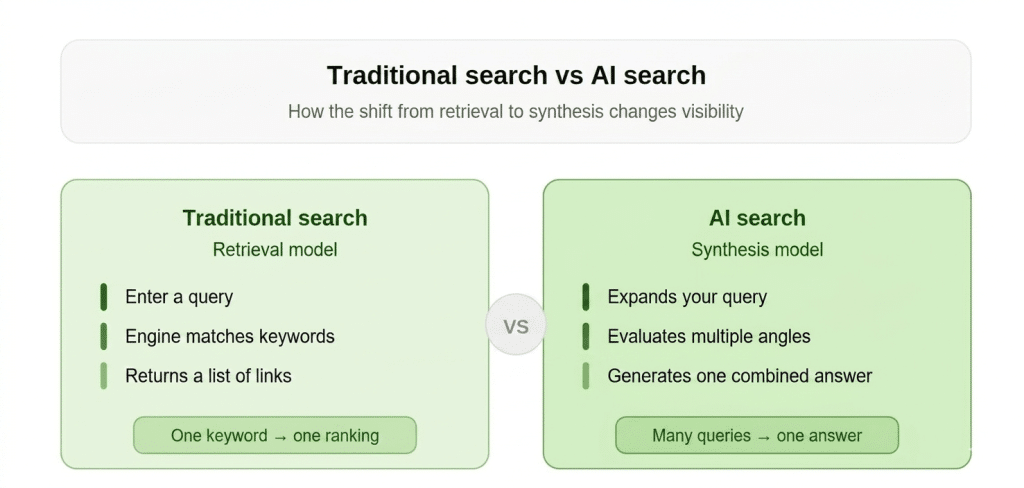
Query fan-out is the process where AI systems break a single user query into multiple related questions, gather information from different sources, and combine it into one final answer.
What it is:
Traditional search works on retrieval. You enter a query, and the engine returns a list of matching pages.
AI search works on synthesis. It expands your query, evaluates multiple angles, and generates a single, combined response instead of showing links.
Traditional search = retrieval
AI search = synthesis
What it changes:
Visibility is no longer tied to ranking for one keyword or page. AI systems select content that appears useful across multiple related queries, not just one.
This means a single page is rarely enough. Brands that cover a topic from different angles such as comparisons, use cases, supporting details, and validation signals are more likely to be included.
Instead of competing for one position on a results page, you are competing to be part of the final answer. That shifts the focus from isolated rankings to consistent presence across the entire query journey.
Query Fan-Out vs. Keyword Expansion: What’s the Difference?
These two sound similar, but they work very differently. Confusing query fan-out vs keyword expansion search is one of the main reasons brands miss out on AI visibility.
| Factor | Keyword Expansion | Query Fan-Out |
| Who does it | You (the marketer) | In real time, every search, considering search intent for better results |
| When it happens | During planning | In real time, every search |
| Goal | Rank for more keyword variations | Build a complete answer |
| What it targets | Search volume and phrases | Intent, sub-topics, hidden questions |
| Visibility in tools | Yes | No, most queries are not tracked |
| Success signal | Ranking for multiple terms | Being cited across multiple AI sub-queries |
| Content approach | More pages targeting keywords | Deeper, connected topic coverage |
The core distinction is this: keyword expansion helps you rank for more terms. Query fan-out determines whether your content is rich enough to appear throughout the full research process the AI runs on your buyer’s behalf.
You can do keyword expansion perfectly and still be invisible in AI search. That’s the gap most brands are sitting in right now.
Real-World Query Fan-Out Examples
The best way to understand query fan-out is to see it in action. Here’s what actually happens when a real user types a real query into an AI search system.
Example 1: Product comparison in AI‑driven search
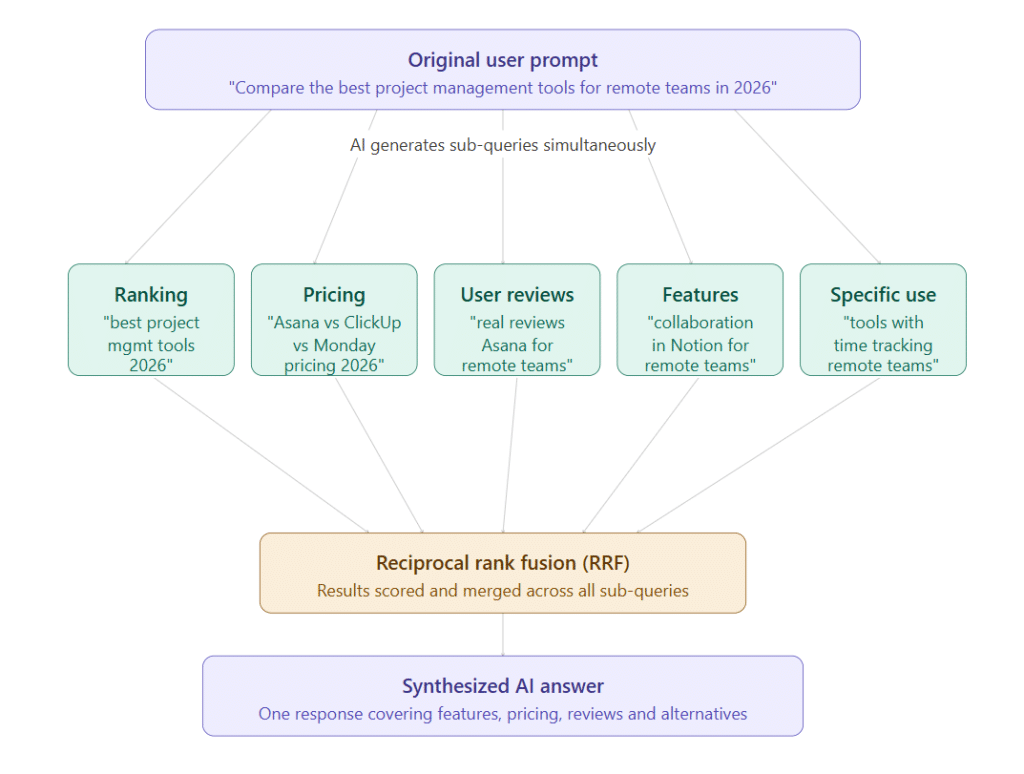
Original user prompt:
“Compare the best project management tools for remote teams in 2026, focusing on pricing, collaboration features, and user reviews.”
How query fan‑out works:
Behind the scenes, an AI search system (like Google AI Mode or a LLM‑powered chat interface) breaks this into sub‑queries such as:
- best project management tools for remote teams 2026
- Asana vs ClickUp vs Monday.com pricing 2026
- real user reviews of Asana for remote teams
- collaboration features in Notion for remote project management
- project management tools with time tracking for remote teams
Why this changes outcomes:
AI does not rely on a single page anymore. It selects brands that appear consistently across multiple sub-queries. If your content only covers one angle, you are less likely to be included. Brands with connected content across comparisons, pricing, and reviews have higher chances of being cited repeatedly.
AI systems like ChatGPT and Google AI Mode pull results from all of these at once and combine them into one answer.
Example 2: Local service provider evaluation
Original user prompt:
“What are the best web design agencies in Singapore for SaaS startups, and how do their pricing and client reviews compare?”
How query fan‑out works:
A generative AI engine or AI search mode deconstructs this query into:
- web design agencies Singapore for their target audience
- best web design agencies Singapore 2026
- full‑service web design agency pricing in Singapore
- SaaS web design agency case studies in Singapore
- reviews of web design agencies Singapore SaaS
Why this changes outcomes:
Visibility depends on consistency across multiple signals. Agencies that only focus on services get overlooked, while those with strong proof points, pricing clarity, and external validation appear more often. AI prioritises brands it can verify from multiple angles, not just one page.
Again, one query triggers multiple searches. AI combines pricing, features, reviews, and comparisons into one response.
How to Engineer Your Content for Query Fan-Out?
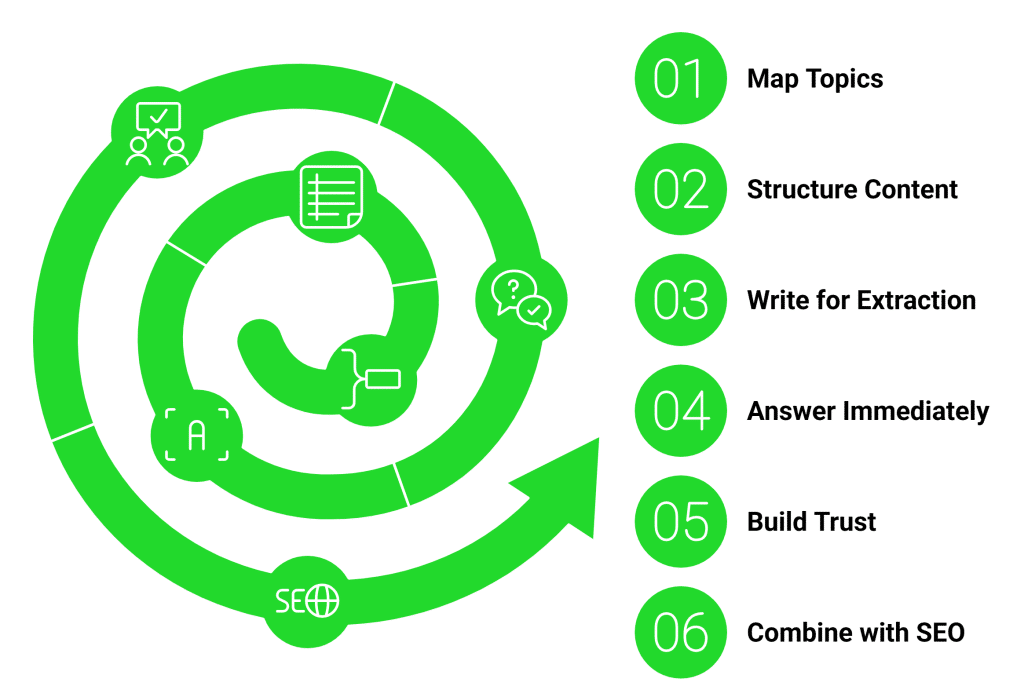
Optimising for query fan-out SEO means aligning your content with how AI generates synthetic queries that expand a single query into multiple paths. Please ensure your content aligns with that behaviour, not just one keyword.
1. Map topics using fan-out logic
Start with your main topic, then think beyond it. Ask what follow-up questions a user would naturally have. AI does the same thing automatically.
For example, a topic like “marathon training shoes” does not stop at product webpages. It expands into cushioning, durability, pricing, foot type, and comparisons. These are all separate sub-queries.
If your content only covers one angle, you miss the rest of the search paths.
2. Structure content around sub-queries
Your headings should reflect real questions, not just keywords. AI scans for clear sections that answer specific intents.
A page targeting “project management tools” should not stay generic. It needs sections for pricing, features, comparisons, user reviews, and ease of use.
Each section increases your chances of appearing in different fan-out queries and provides comprehensive answers.
3. Write for extraction
AI does not read your entire page. It pulls specific sections that directly answer a query.
Keep sections focused. One idea per section works best. Research shows that passages around 134 to 167 words are more likely to be picked in AI Overviews.
Clear, structured answers improve your visibility across multiple queries.
4. Answer immediately
Do not delay the answer. Start each section with a direct response.
AI prioritises content that gives quick, clear answers. If your point is buried under long introductions, it is likely to be skipped.
Think of it as answering the question first, then adding explanation.
5. Build trust beyond your site
Many fan-out queries focus on trust. AI checks third-party sources before selecting content.
Reviews, comparisons, and mentions on platforms like G2, Capterra, or forums influence visibility. If your brand is only present on your own site, you miss these signals.
External validation strengthens your chances of being selected.
6. Combine with traditional SEO
Fan-out does not replace SEO. It builds on it.
Pages that already rank well are more likely to be picked by AI. Technical SEO, site speed, and structure still matter. They help AI access and understand your content better.
What SEO Mistakes Are Costing You Visibility in AI Search?
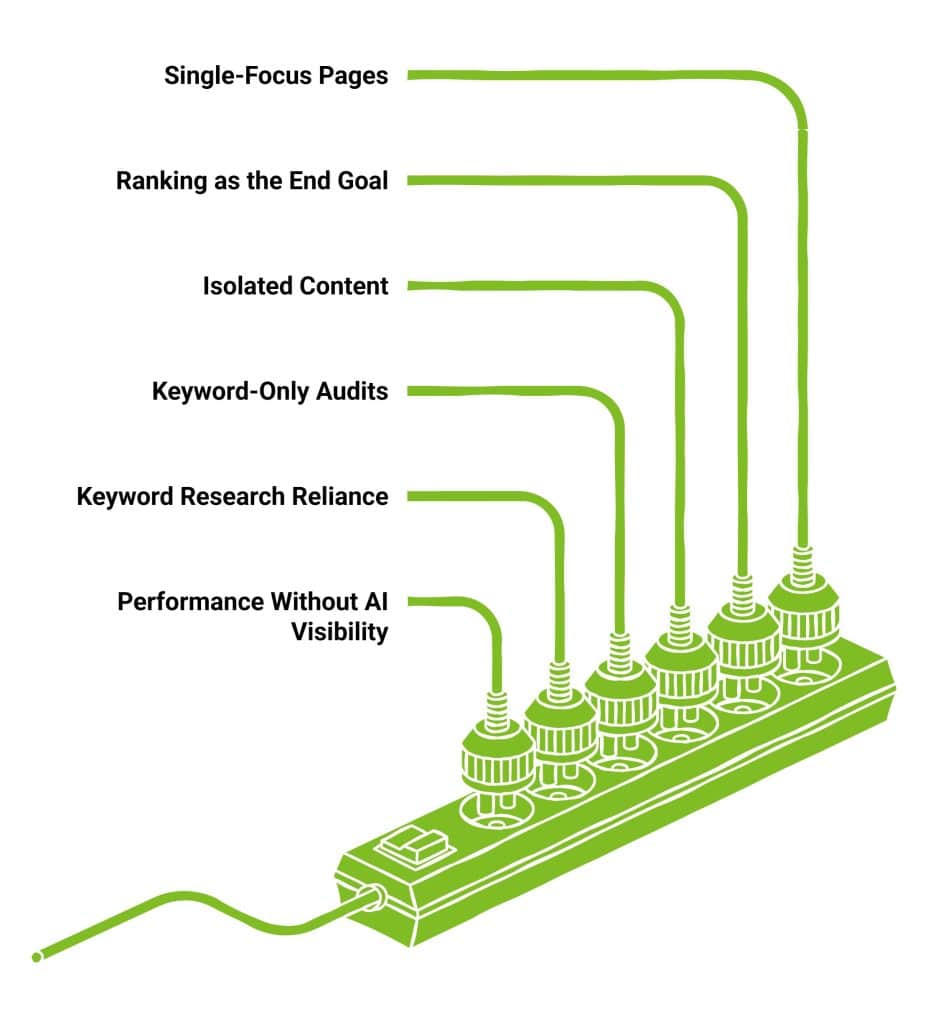
Query fan-out is not just changing strategy. It is exposing gaps in how most SEO is still executed. These are the common mistakes limiting visibility in AI-generated results.
1. Focusing only on one keyword per page
Many strategies still follow the “one keyword, one page” model. AI does not work this way. It pulls from multiple queries and angles, so single-focus pages often get ignored.
2. Treating rankings as the end goal
Ranking on page one does not guarantee inclusion in AI answers. AI systems select content based on relevance across multiple sub-queries, not just position in search results.
3. Building isolated content instead of connected topics
Creating standalone pages without linking them into a broader topic reduces authority. AI favours brands that cover a subject across multiple connected pieces.
4. Auditing only for keywords, not coverage
Traditional audits miss gaps because they focus on rankings. They do not check whether your content answers follow-up questions, comparisons, or supporting queries.
5. Relying only on keyword research
Keywords show demand, but they do not reveal the full query path. AI expands beyond keywords into intent layers, which many strategies fail to cover.
6. Measuring performance without AI visibility
Tracking rankings and traffic alone hides the real issue. If your content is not being cited in AI-generated answers, you are missing a growing share of visibility.
These mistakes do not affect traditional SEO performance immediately, which is why they often go unnoticed. But in AI search, they directly determine whether your content is selected or skipped.
Why Query Fan-Out Matters for Brands Building AI-Search Authority?
AI search no longer rewards brands that optimise for a single keyword or page. With query fan-out, AI systems explore multiple related questions, including those users might ask of models like Claude, compare sources, and validate information before generating an answer. This shifts the advantage to brands that cover topics in depth, not just individually.
Brands that build structured, connected content across key sub-topics are more likely to be repeatedly discovered and cited during this process. This creates consistent visibility, not just for one query, but across the entire decision journey.
This is where the competitive edge lies. While many businesses still focus on isolated rankings, early adopters of query fan-out strategies gain broader coverage, stronger authority signals, and higher chances of being included in AI-generated answers.
Losing Traffic Due to AI Search Changes?
If your rankings look stable but traffic is dropping, AI search is likely the reason. Your content may still perform in traditional results, but it is not being selected in AI-generated answers. This is where most brands lose visibility without realising it.
Wild Creek Studio helps fix this gap. The focus is not just on keywords, but on aligning your content with query fan-out SEO. This includes mapping sub-queries, improving content structure, and ensuring your pages cover the full range of user intent that AI systems evaluate.
The result is a stronger presence across AI search platforms and measurable search optimisation benefits, not just rankings.
If your content is not showing up where users are searching today, it is time to act. Reach out to Wild Creek Studio and start improving your AI search visibility now.
Conclusion
AI search is already changing how users find information. If your content is not aligned with query fan-out SEO, you risk losing visibility even if your rankings look strong. This is no longer optional. It is a shift in how search works.
The choice is clear. Continue relying only on keyword-based SEO and fall behind, or adapt your strategy to match how AI expands and evaluates queries. Brands that act early gain stronger visibility and long-term search optimisation benefits.
Review your content, identify gaps, and start building coverage across sub-queries. If you need a structured approach, working with a team that understands this shift can make the process faster and more effective. The sooner you adapt, the easier it is to stay visible.
Frequently Asked Questions
Is query fan-out relevant beyond AI search engines?
While query fan-out is a core search technique for AI search engines, the principle of understanding user intent more deeply is relevant everywhere. This approach helps deliver better search results and more comprehensive AI responses, making it a valuable concept for any platform that aims to provide detailed answers rather than just links.
How does understanding query fan-out benefit content strategy?
Understanding query fan-out helps you evolve your content strategy from targeting keywords to covering topics. By anticipating the related search queries an AI will generate, you can use content mapping to create comprehensive content that answers a user’s initial question and their likely follow-up questions, boosting your authority.
Does query fan-out change how answer engines select top results?
Yes, query fan-out fundamentally changes result ranking. An answer engine using this method evaluates content across dozens of related searches. The top AI search results aren’t just from the best page for the original query; they come from sources that consistently perform well across the entire fan-out, like in Google Search.
How do I optimise my blog for query fan‑out in Google AI Mode?
To optimise your blog for query fan-out in Google AI Mode, focus on topical authority. Instead of targeting single keywords, build content clusters that cover a subject comprehensively. This search engine optimisation strategy ensures your blog addresses the many sub-queries the AI generates, increasing your chances of being cited.
What should I do if my page ranks for the main query but not the fan‑out sub‑queries?
If your page has good rankings for a main query but not for fan-out sub-queries, it’s a sign your content isn’t comprehensive enough. Audit your page to identify missing subtopics and update it to provide more depth, or create new pages within your content clusters to cover those specific search queries.
How often should I update my content to keep up with AI search changes?
To keep up with AI search changes, you should regularly review your content’s performance and relevance. There’s no fixed schedule, but monitoring fan-out patterns and adding new content or updating existing articles quarterly can help maintain your visibility and topical authority as search engines evolve.