A client came to us in July with a demand that is now common: “Our competitor keeps showing up as a source in ChatGPT answers and we do not. Fix our schema.” Their developer had already installed a schema plugin, checked every box it offered, and waited. Nothing changed. That is because the plugin had wrapped FAQPage markup around content that was not visible anywhere on the page, and Organization schema that still listed an address the business had moved out of two years earlier. The schema was technically present. It was also, for a citation-hungry AI crawler, close to worthless.
This happens because most advice on structured data for AI search treats schema markup like a lever you pull for citations. It is not a lever. It is closer to a passport: it does not get you into the country on its own, but you cannot get in without one, and a damaged one can get you turned away at the border. This checklist is built around that distinction, and around what the most rigorous testing on this exact question has actually found, not around what schema vendors would like you to believe it can do.
Key Takeaways
- Structured data does not reliably increase AI citations on its own. A large-scale controlled test found that adding schema to pages produced no meaningful citation lift on ChatGPT or Google AI Mode, and a small decline on Google AI Overviews.
- Pages already cited by AI tools are still far more likely to carry JSON-LD schema than pages that are not cited. Correlation and causation point in different directions here, and both facts matter for how you prioritize your time.
- Most AI crawlers, including GPTBot and ClaudeBot, fetch JavaScript files but do not execute them. If your structured data or your core content is injected client-side, a large share of AI systems never see it.
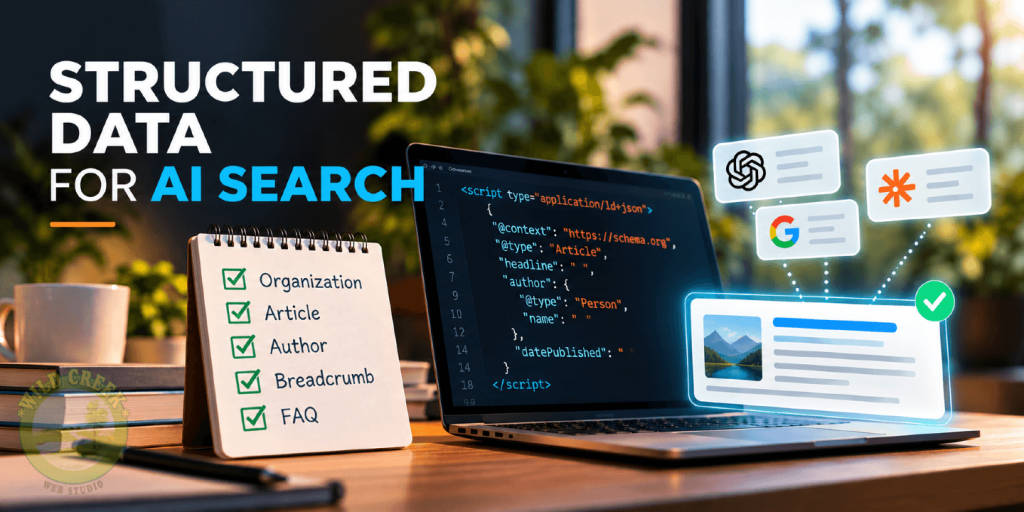
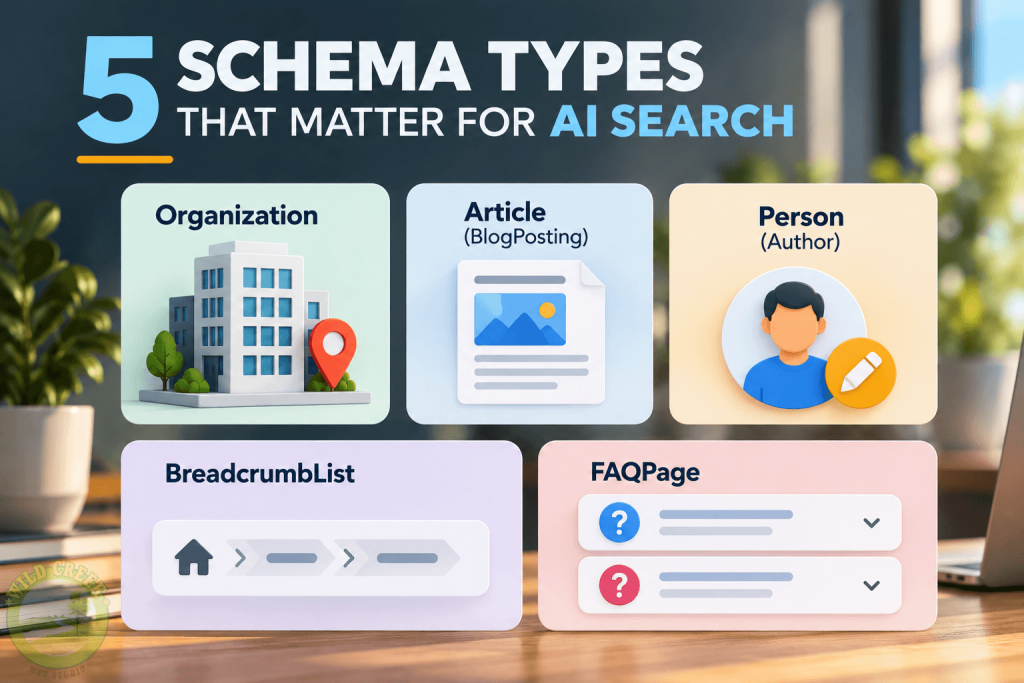
- Five schema types cover almost every practical case for a content or service site: Organization, Article or BlogPosting, Person or Author, BreadcrumbList, and FAQPage, used only where the FAQ content is genuinely visible on the page.
- The checklist below is a hygiene and eligibility exercise, not a guarantee. Pair it with genuinely extractable, well-structured content, because that is what the citation actually rewards.
Why This Matters for Your Traffic and Cost Per Acquisition
If AI answer engines are already sending a meaningful share of your category’s research traffic to competitors, being unciteable is not a technical footnote. It is a slow leak in your top of funnel that shows up later as a higher cost per lead, because you are relying more heavily on paid channels to do what earned visibility used to do for free. Structured data will not plug that leak by itself, but a site with broken or absent schema is disqualifying itself from a channel before the content quality question is even asked.
What Does Structured Data Actually Do for AI Search Visibility?
Structured data is a standardized format, most commonly JSON-LD, that describes what a piece of content is (an article, an organization, a person, a product) rather than just what it says, giving search engines and AI systems an unambiguous way to identify entities, authorship, dates, and relationships on a page. It does not write your content for you, and our existing guide to structured data for SEO covers the traditional rich-snippet case in more depth. What it does here is remove ambiguity that would otherwise force an AI crawler to guess.
That distinction matters because the causal evidence is thinner than most agencies imply.
Ahrefs tracked 1,885 pages that added JSON-LD schema between August 2025 and March 2026 against a control group of 4,000 pages that did not, measuring citation changes across Google AI Overviews, Google AI Mode, and ChatGPT. The result: a 2.4 percent change on Google AI Mode and a 2.2 percent change on ChatGPT, both statistically indistinguishable from zero, and a 4.6 percent decline on Google AI Overviews. Source: Ahrefs, “We Tracked 1,885 Pages Adding Schema. AI Citations Didn’t Move,” 2026.
Adding schema, on its own, did not move citations in that test.
In a separate analysis of six million URLs, Ahrefs found that pages already cited by AI systems were almost three times more likely to carry JSON-LD than pages that were not cited, with 53 percent of cited pages having schema present. Source: Ahrefs, 2026.
Here is the honest read: schema correlates with getting cited, but the controlled test suggests it is not the thing doing the causing. The likelier explanation is that sites disciplined enough to implement schema correctly are also the sites that structure their content clearly, update it consistently, and build the kind of technical foundation that both schema and AI extraction reward independently. Schema is a symptom of a well-run site, not the cure for a poorly run one. We cannot rule out a smaller, harder-to-isolate effect of schema itself, and the sample and time window in any single study will always miss some of that. Treat the correlation as a signal worth reading, not as proof that adding a plugin will move your numbers.
Schema will not make a mediocre page citable. It will make a genuinely good page easier for a machine to trust, which is a different and much smaller job than most vendors are selling you.
Which Schema Types Are Actually Worth Your Time?
For a typical content, services, or SaaS site, five schema types cover almost every situation that matters for AI visibility, and chasing more than that is usually wasted engineering time. Our guide to implementing schema markup walks through the technical how-to for each; this table is about prioritization.
| Schema type | What it signals | Where it earns its place |
| Organization | Brand identity, official name, logo, social profiles | Every site, once, in the global template |
| Article or BlogPosting | Authorship, publish and update dates, headline | Every blog post or article page |
| Person or Author | Who wrote it and their credentials, tied to entity clarity | Author pages and byline blocks |
| BreadcrumbList | Where this page sits in your site hierarchy | Any page more than one level deep |
| FAQPage | Direct question and answer pairs | Only where that exact text is visibly rendered on the page |
HowTo, Product, LocalBusiness, and Event schema are worth adding when your content genuinely is a step-by-step process, a product listing, a physical location, or an event, but they are situational rather than universal. Do not add HowTo schema to an explainer that is not actually a sequence of steps just because a plugin offers it. Google has also been trimming which rich result types it supports. In a June 2025 developer blog post, Google confirmed it was retiring several structured data-driven features, including the sitelinks search box, as part of an effort to simplify search results. Chasing deprecated types wastes implementation time that belongs on the five that still matter.
What Do AI Crawlers Actually Need From Your Site to Read That Schema?
Before any schema type matters, the crawler has to be able to see it, and this is where most implementations quietly fail.
In a December 2024 study, Vercel and MERJ analyzed real crawler traffic and found that none of the major AI crawlers currently render JavaScript, including OpenAI’s GPTBot, OAI-SearchBot, and ChatGPT-User, and Anthropic’s ClaudeBot. GPTBot fetched JavaScript files in roughly 11.5 percent of its requests, and ClaudeBot in roughly 23.84 percent, but in both cases the crawlers downloaded the files as text without executing them. Source: Vercel and MERJ, “The Rise of the AI Crawler,” December 17, 2024.
If your schema, or your content, only exists after a script runs in the browser, you have built a page for humans and for the search bots that render JavaScript, and a blank page for most of the AI systems you are trying to reach.
Practically, this means checking that your JSON-LD is present in the raw server response, not injected after page load by a JavaScript framework. It means confirming your robots.txt is not accidentally blocking GPTBot, ClaudeBot, or PerplexityBot while you were focused on traditional search bots, a check worth running alongside a broader technical SEO audit. And it means validating your markup against what is actually visible on the page, because schema that describes content a crawler cannot otherwise verify from the rendered HTML looks, to an AI system doing its own consistency checks, exactly like the kind of manipulation Google’s structured data guidelines explicitly prohibit.
Where Does Your Site Sit on the AI Visibility Maturity Curve?
We use a three-stage framework across client AEO audits to describe how ready a site actually is for AI citation, separate from how much schema it has installed. This is Wild Creek’s own working framework, not an industry standard, and other practitioners may draw these lines differently.
| Stage | What it looks like | Typical gap |
| Early-stage AI Inclusion | Site is crawlable by major AI bots, has basic Organization and Article schema, robots.txt is not blocking AI user agents | Content is not structured for extraction; long paragraphs bury the direct answer |
| Mid-stage AI Discoverability | Schema is accurate and matches visible content, key pages have clear answer-first sections, JSON-LD is server-rendered | Authorship and entity signals are thin, so AI systems have less reason to trust the source |
| Mature AI Visibility | Consistent entity presence across the site and off-site profiles, content answers questions in the first sentences, technical crawlability is monitored on an ongoing basis | Diminishing returns from further schema work; the ceiling is now content depth and earned authority |
Most sites we audit sit in early-stage, not because they lack schema entirely, but because the schema they have does not match a site that is otherwise built for extraction. The same tracking discipline carries into how we evaluate ranking in AI Overviews once the technical basics are in place.
Your Structured Data Checklist for AI Search
Work through this on your own site this week, not as a one-time project you revisit next year.
- Fetch three or four important pages with a plain HTTP request, not a browser, and confirm your JSON-LD is present in that raw response.
- Open your robots.txt and confirm GPTBot, ClaudeBot, PerplexityBot, and Google-Extended are not blocked, unless you have a deliberate reason to exclude them.
- Pull up your live JSON-LD next to the rendered page and confirm every property matches something a reader can actually see, especially on FAQ and Organization schema.
- Check your Article and Person schema for stale bylines, outdated job titles, or addresses and social links that no longer apply.
- Drop any deprecated rich result types Google has retired, and skip HowTo or Product schema on pages that are not genuinely steps or products.
A schema audit that only checks whether the code validates is not an audit. It is a syntax check wearing an audit’s clothes.
Our Take
Do the checklist above, and then stop treating schema as the project. The sites winning AI citations right now are not winning because of superior JSON-LD. They are winning because their content answers the question in the first two sentences, their authorship is verifiable, and their technical foundation does not accidentally hide any of that from a crawler that will never run their JavaScript. Fix your schema this week because it takes an afternoon and removes an easy disqualifier. Then spend the rest of your quarter on the content and entity work that actually earns the citation, which is the same discipline behind our Human Algorithm approach to AI-era marketing.
Frequently Asked Questions
Does adding schema markup guarantee my page gets cited by ChatGPT or Google AI Mode?
No. A controlled 2026 Ahrefs study of 1,885 pages found that adding JSON-LD schema produced no statistically meaningful citation increase on ChatGPT or Google AI Mode, and a small decline on Google AI Overviews. Schema removes ambiguity for a crawler, but it does not compensate for weak or hard-to-extract content, and no legitimate technique can guarantee a citation on any AI platform.
Which schema type matters most if I can only implement one?
Organization and Article or BlogPosting schema together give you the most coverage for the least effort, because they establish who is publishing and what the content is. Do not implement FAQPage schema as your first move unless your page already has genuinely visible question and answer content, since mismatched FAQ schema is one of the more common mistakes we find in client audits.
Do I need to worry about JavaScript rendering if my site already ranks well in Google?
Yes, because Google’s crawler and most AI crawlers behave differently. Google has invested heavily in rendering JavaScript for years, while a December 2024 Vercel and MERJ study found that GPTBot and ClaudeBot fetch JavaScript files without executing them. Ranking well in traditional Google search does not confirm that GPTBot or ClaudeBot can read your content or your schema.
How often should I re-check my structured data once it is implemented?
Re-validate after any CMS update, theme change, or plugin update, since these are the most common points where schema silently breaks or drifts out of sync with visible content. Beyond that, a quarterly check against the checklist in this article is enough for most sites, since structured data does not degrade on its own between changes to the underlying page.
Is llms.txt a replacement for structured data?
No. llms.txt is an emerging, informal convention some sites use to point AI systems toward a curated summary of their content, but it has no formal adoption commitment from major AI labs and does not carry the standardized, machine-parseable entity data that schema.org markup does. Treat it as a supplementary signal at most, not a substitute for correct structured data.
Sources & Further Reading
- Louise Linehan and Xibeijia Guan, “We Tracked 1,885 Pages Adding Schema. AI Citations Didn’t Move.” Ahrefs, 2026. https://ahrefs.com/blog/schema-ai-citations/
- Giacomo Zecchini, Alice Alexandra Moore, Malte Ubl, and Ryan Siddle, “The Rise of the AI Crawler.” Vercel and MERJ, December 17, 2024. https://vercel.com/blog/the-rise-of-the-ai-crawler
- Google Search Central, “General structured data guidelines.” Google, accessed 2026. https://developers.google.com/search/docs/guides/sd-policies
- Google Search Central Blog, “Simplifying Search results.” Google, June 2025. https://developers.google.com/search/blog/2025/06/simplifying-search-results