
Ask your agency one question this week: which parts of my marketing are you doing with AI, and who checks the output? Most founders I speak with have never asked it. They have heard that AI is transforming marketing, they have seen the tools, and they assume someone competent is handling the details. The evidence says the distance between using AI and getting results from it is wider than the headlines suggest, and that distance is where your budget either works or leaks.

Key Takeaways
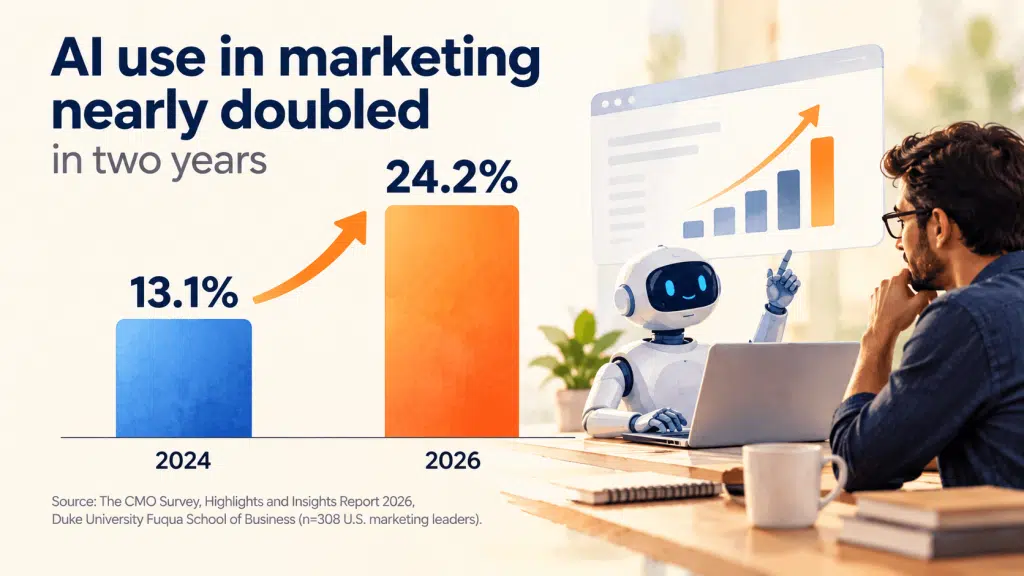
- AI accounted for 24.2% of marketing activities in 2026, up from 13.1% in 2024, according to The CMO Survey from Duke University Fuqua School of Business.
- Adoption is running ahead of execution: in the same survey, no marketing technology activity scored above 5 on a 7-point performance scale.
- Measured productivity gains are modest. A Danish study of 25,000 workers in 11 AI-exposed occupations found average time savings of 3% and no significant effect on earnings or recorded hours.
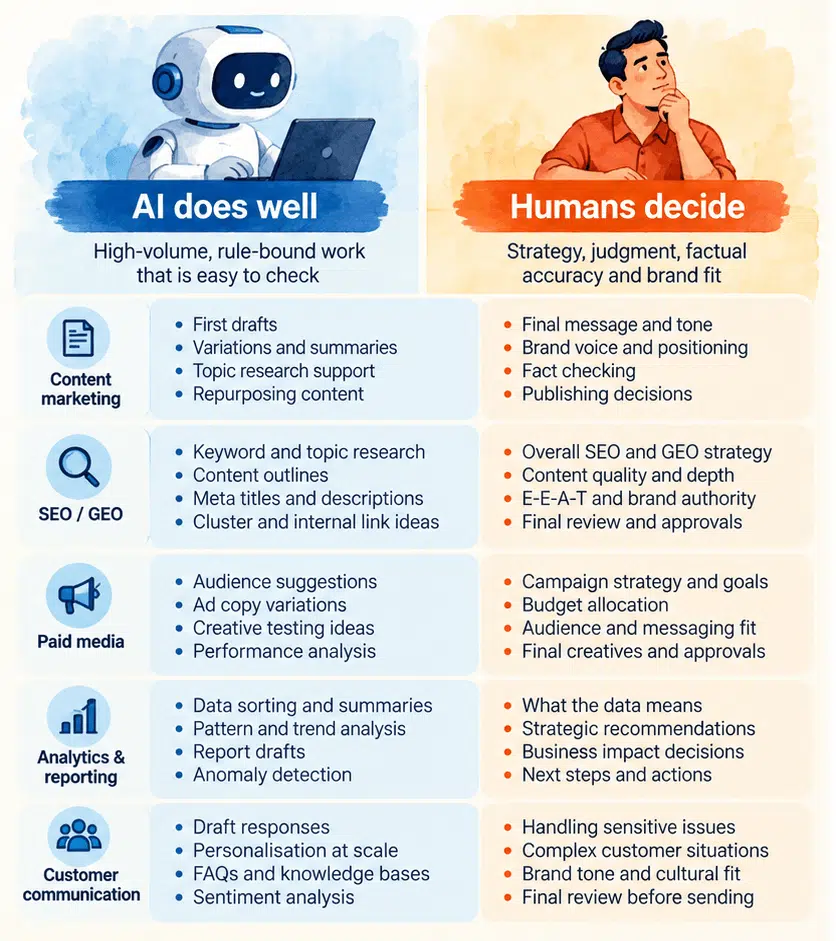
- AI performs well on high-volume, rule-bound work that is easy to check, such as first drafts, data sorting, and variant testing. Strategy, factual accuracy, and brand judgment stay with a person.
- An AI agent acts on its own across several steps, which makes it a different risk from a chatbot that only answers. Put approval gates in front of any action on live pages, bids, or budgets.
Why does AI in digital marketing matter for your budget?
AI matters for your budget because it changes two numbers you already track: what it costs to produce marketing work, and where customers find you. Cheaper drafting and analysis can lower production cost, while AI-generated answers in search can change which brands get seen at all. Both feed into cost per acquisition, and neither effect is guaranteed.
If you run a team of one, the first effect is the one you feel on Monday morning. If you report to a board, the second effect is the one that will eventually show up as a question about why branded and informational traffic moved. The second effect is the one our GEO work is built around, and it is a separate job from using AI tools internally.
AI in digital marketing is the use of machine learning and generative AI systems to produce, analyse, personalise, or automate marketing work, including content drafting, audience targeting, bidding, reporting, and search optimisation.
Our glossary carries the shorter entries for the terms used below.
How much are companies using AI in marketing?
U.S. marketing leaders reported that AI accounted for 24.2% of their marketing activities in 2026, up from 13.1% in 2024. That figure comes from The CMO Survey, run by Duke University Fuqua School of Business, which invited 2,111 marketing leaders at for-profit U.S. companies in January 2026 and received 308 responses, a 14.6% response rate. Every figure in this section is self-reported by those respondents.
AI use in marketing nearly doubled in two years, from 13.1% of marketing activities in 2024 to 24.2% in 2026.
Source: The CMO Survey, Highlights and Insights Report 2026, Duke University Fuqua School of Business (n=308 U.S. marketing leaders). Link
The same report shows where that use is concentrated. Content creation leads, and data analysis and reporting has nearly doubled since Fall 2023.
Share of companies using AI for each marketing application (The CMO Survey, Duke University Fuqua School of Business, self-reported)
| Application | Fall 2023 | 2026 |
| Content creation | 49.2% | 73.9% |
| Content personalization | 52.8% | 65.4% |
| Improving marketing ROI by optimizing content and timing | 36.6% | 49.5% |
| Marketing automation | 28.0% | 48.9% |
| Data analysis and reporting | 24.8% | 46.3% |
| Targeting decisions | 31.7% | 45.2% |
| Predictive analytics for customer insights | 32.9% | 41.5% |
| Generative Engine Optimization (GEO) | Not asked | 41.5% |
Two readings of this table deserve a caution. First, the report also states that companies project AI will account for 55.9% of marketing activities within three years, and a projection is an expectation, not a measurement. Second, the 41.5% figure for Generative Engine Optimization (GEO), the practice of getting content to appear in AI-generated search results, comes from a question that was not asked in 2023. The report does not say how much work counts as using it, so I read that number as a sign of attention more than a sign of proven results. If you want to see how we approach it in practice, our page on measuring AI search visibility covers what holds up and what does not.
Is AI in marketing paying off?
The evidence is mixed. Marketing leaders in The CMO Survey report improvements from AI, but those reports are self-assessments. A separate Danish study of 25,000 workers found small average time savings and no significant effect on earnings or recorded hours. Gains exist, and the independent dataset I found puts them at the modest end.
AI chatbots had no significant impact on earnings or recorded hours in any of 11 exposed occupations, with confidence intervals ruling out effects larger than 1%.
Source: Anders Humlum and Emilie Vestergaard, Large Language Models, Small Labor Market Effects, Becker Friedman Institute Working Paper 2025-56, University of Chicago, May 2025. Two adoption surveys (late 2023 and 2024) covering 25,000 workers and 7,000 workplaces in Denmark, linked to administrative labor market data. The authors describe the average time savings as 3%. Link
The execution gap is the part I would show a board. The CMO Survey report puts it this way: “Yet technology adoption is consistently outrunning execution. No marketing technology activity scores above 5 on a 7-point performance scale, and performance levels have not improved over the past two years.”
No marketing technology activity scored above 5 on a 7-point performance scale in the 2026 survey, and performance levels had not improved over the previous two years.
Source: The CMO Survey, Highlights and Insights Report 2026, Duke University Fuqua School of Business. Link
What this evidence does and does not show matters, because it is tempting to string it into a chain: more AI adoption leads to time saved, which leads to lower cost, which leads to more revenue. Each link is plausible, and none of them is established by the sources above. The CMO Survey figures are self-reported by 308 respondents at a 14.6% response rate, so leaders with good AI results may be more likely to answer. The Danish study measures chatbots in 2023 and 2024, in Denmark, across 11 occupations that are not limited to marketing, and it tracks wages and hours rather than marketing return. The same paper notes that randomized controlled trials have reported productivity effects ranging from 15% to 50%, so task-level gains can be much larger than what shows up in payroll data. A real gain on one task does not guarantee a gain in revenue, and an absence of wage effects does not prove an absence of benefit to the business.
“AI can produce a draft in minutes. Checking whether the draft is true, on brand, and worth publishing still takes a person with the context to judge it.”
Where does AI help across marketing channels, and where does it need you?
AI is most useful where the work is high-volume, rule-bound, and easy to check, and least reliable where the work depends on brand judgment, accountability, or facts that cannot be verified quickly. That is the logic behind the Human Algorithm™, Wild Creek’s own proprietary framework for pairing AI-era efficiency with human clarity and judgement. It is not an industry standard, and other practitioners may draw the line between machine and person in a different place. The table applies it channel by channel, and the right-hand column is the part I would not delegate.
Division of labor by channel (Wild Creek’s working view, not a measured benchmark)
| Channel | What AI handles well | What stays with a person |
| Content | Drafting, outlines, variations, repurposing | Factual accuracy, brand voice, originality, final approval |
| SEO | Keyword clustering, pattern-spotting in crawl and Search Console data, draft meta descriptions | Choosing what to target, judging search intent, approving changes to live pages |
| AI search visibility | Running question sets and summarizing which brands appear | Deciding which questions matter commercially, interpreting answers that change from run to run |
| Paid media | Creative variants, in-platform bid and budget automation, anomaly flags | Goals and budget limits, lead quality, confirming that tracked conversions are real |
| Social | Caption drafts, scheduling, sorting comments | Tone in live conversation, crisis response, deciding what the brand will not say |
| Email and personalization | List segmentation, subject-line variants, send-time optimization | Consent and privacy, offer strategy, which segments deserve a message |
| Analytics and reporting | First-pass summaries, anomaly detection, dashboards | Verifying figures against the source, explaining why a number moved, deciding what to do next |
Planning frameworks change less than the tooling does. A sound framework still starts with the audience you are targeting and the medium through which you reach them, and AI mainly lowers the cost of producing a version of the message for each segment. It does not tell you which segments are worth a message, and producing more versions for the wrong segments simply wastes money faster. In paid media in particular, the platforms already automate much of the bidding, so the control sits in the goals and conversion data you feed them. Our paid performance work starts there for that reason. For the search side of this question, our review of AI and SEO covers the evidence in more detail.
What is an AI SEO agent, and how does it differ from a chatbot?
An AI SEO agent is a software system that uses a large language model to plan and carry out multi-step SEO tasks, such as crawling pages, pulling Search Console data, and proposing or applying changes, with limited step-by-step supervision. A chatbot answers a prompt and stops. An agent keeps going, which is where both the value and the risk come from.
AI chatbot versus AI agent in SEO work (Wild Creek’s working comparison)
| Aspect | AI chatbot | AI agent |
| How it works | Responds to one prompt in one exchange | Plans and runs several steps using connected tools |
| Typical SEO task | Draft a meta description, explain an audit finding | Crawl a site, pull Search Console data, flag issues, open a ticket |
| Main risk | A wrong answer that you can read before using it | A wrong action repeated across many pages before anyone reads it |
| Oversight needed | Review of the output | Approval gates, activity logs, and a way to roll back changes |
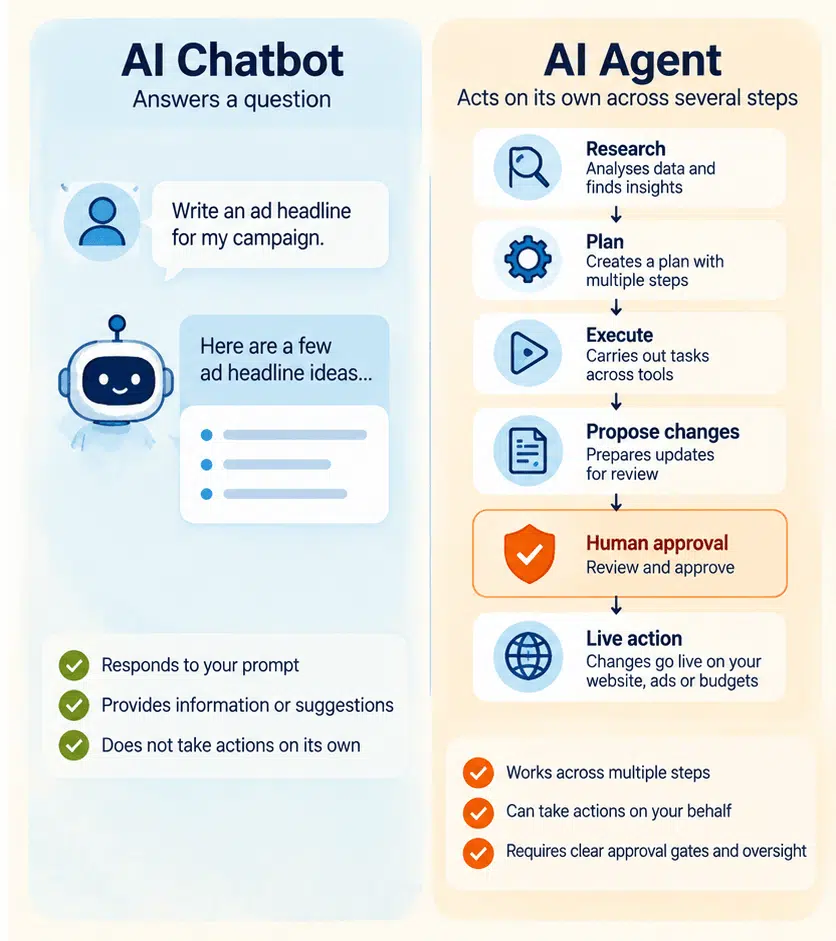
My recommendation is to start agents on read-only work, such as pulling data and flagging issues, and to require human approval before a page is published or changed. That recommendation rests on risk reasoning about how errors compound at scale, not on a controlled study, so treat it as one sensible approach rather than the only one. We cover the mechanics on our AI-powered SEO agents page.
Will AI replace digital marketers?
The evidence reviewed here does not show replacement so far. The Danish study found no significant impact on earnings or recorded hours in any of the 11 occupations it covered, though it measures chatbots over 2023 and 2024 and says nothing about what agents will do later. What the data does show is that tasks inside marketing jobs are shifting toward drafting with a tool and then checking the result.
That shift favors marketers who can judge output, because the tool will produce something for any prompt. It is also why the checking step cannot be handed back to the same tool. A person needs to own the claim that goes out under your brand name.
How does Wild Creek use AI in its own audit and reporting work?
In our own audit and reporting work, we use AI tools for the first pass and people for the final call. The first pass includes sorting crawl and Search Console exports, drafting summaries of what changed, and flagging pages that need a closer look. A person then checks every figure against the source data before it reaches a client report. We have also built some of these checks ourselves, such as the WC Content Quality Inspector.
I am deliberately not quoting a time-saved figure here. The published evidence above shows how much that number varies by task and team, and a single figure from one agency would read as more certain than it is.
“Before you approve any AI-driven spend, ask who checks the output and what they check it against.”
What should you do about AI in your marketing this week?
Start with an inventory, because most teams cannot say where AI is already in their workflow. The common mistakes are buying a tool before defining the task it should do, measuring output volume instead of cost per lead, and letting AI-assisted claims go out without a source behind them. Good looks like a short list of named tasks, a named reviewer for each, and a before-and-after record that your finance lead would accept.
- Ask your agency or team to list every marketing task where AI is used and who reviews the output.
- Pick one task, such as first drafts or monthly reporting, and record the time it takes with and without AI for four weeks.
- Trace every AI-assisted statistic, quote, and claim to a source before it is published.
- Require human approval before any AI agent changes live pages, bids, or budgets.
- Run your five most important customer questions through the AI search tools your buyers use, and log whether your brand appears.
Send the first checklist question to your agency before Friday and read the answer closely. If the reply names tasks and reviewers, you have a partner who is using AI with controls. If it names tools and promises, ask the question again with a request for one example of output that was rejected during review.
Frequently Asked Questions
How is AI used in digital marketing today?
AI is used most for content creation, personalization, automation, and data analysis. In The CMO Survey 2026, 73.9% of companies reported using it for content creation and 46.3% for data analysis and reporting. Use for search visibility work, such as GEO, was reported by 41.5% of companies, though the report does not define how much work that includes.
What is the difference between an AI chatbot and an AI agent?
A chatbot responds to a single prompt, while an agent plans and completes several steps using connected tools. For SEO, that means a chatbot can draft a meta description, and an agent can crawl a site and flag or change pages. The second carries more risk because its mistakes can repeat at scale.
Is AI worth using for a small business with no marketing team?
AI can be worth using for a small business on narrow tasks such as first drafts and summarizing reports, provided you expect modest gains. The Danish study above found small time savings, so plan for a small saving and keep a person in charge of accuracy and tone. Start with one task and measure it for a month before adding more.
How do I know whether my agency is using AI well?
An agency is using AI well when it can name the tasks where AI is used, the person who reviews each output, and an example of work that was rejected. Ask for those three things in writing. If the answer is a list of tool names without reviewers, the process has no controls yet.
Sources & Further Reading
- The CMO Survey, Duke University Fuqua School of Business, Highlights and Insights Report 2026 (35th edition, fielded January 7 to 29, 2026).
- Anders Humlum (University of Chicago Booth School of Business) and Emilie Vestergaard (University of Copenhagen), Large Language Models, Small Labor Market Effects, Becker Friedman Institute Working Paper 2025-56, University of Chicago, May 2025.