
The usual advice on martech is to buy more of it: a CRM, an automation platform, an analytics suite, and then an AI add-on for each. The research points the other way. Gartner’s 2025 Marketing Technology Survey found that only 49% of the tools organizations pay for are actively used, and only 15% of organizations qualify as high performers. In our reading of that evidence, growth tends to stall when nobody owns the software a business already has, more often than when the software is missing.

Key Takeaways
- Martech, short for marketing technology, is the set of software tools a business uses to attract, convert, and keep customers, from email platforms and CRMs to analytics and automation.
- Gartner’s 2025 survey reports that only 49% of martech tools are actively used, so the first growth lever for most businesses is using what they own, not buying more.
- The martech market is no longer expanding: Chiefmartec counted 15,505 products in 2026, up 0.79%, which means more choice is not the same as a better fit.
- In India’s MSME sector, finding the right digital tools is itself a barrier, with 35.6% of 7,835 surveyed MSMEs finding it somewhat or very challenging.
- A stack audit that assigns every tool an owner, a purpose, and a connected data source takes a few hours and usually exposes both waste and gaps.
What is martech, and what does “marteching” mean?
Martech, short for marketing technology, is the collection of software platforms a business uses to plan, run, and measure marketing, including CRM systems, email tools, analytics, content management, advertising platforms, and automation.
“Marteching” is an informal way of describing the act of building and running that stack with a business goal in mind. It is not a formal industry term.
Most small and mid-size businesses already do some marteching without calling it that. A website with analytics, an email list, a CRM spreadsheet that grew into a proper system, and a social scheduler are all martech. The more useful questions are whether the pieces share data and whether anyone can say what each one earns.
The table below groups the main layers of a typical stack. It is a simplified map for orientation, and real products often straddle two layers.
| Layer | What it does | Question to ask before buying |
| Customer data (CRM) | Stores contacts, deals, and history in one place | Does sales actually update it, or does it live in someone’s inbox? |
| Email and messaging | Sends campaigns and triggered follow-ups | Is the list segmented, or does everyone get the same message? |
| Analytics | Shows where visitors come from and what they do | Which three numbers does leadership review each month? |
| Content and web (CMS) | Publishes and manages your site and content | Can a non-developer update a page this week? |
| Advertising and search | Runs paid campaigns and tracks search visibility | Do conversions flow back into the CRM so cost per lead is visible? |
| Automation and AI | Handles repetitive tasks and drafts at scale | Who reviews the output before a customer sees it? |
Why do most martech stacks go underused?
Most stacks go underused because tools are bought for a campaign or a job title and then outlive both. Gartner’s surveys put utilization below half, and the causes it names are low adoption, complexity, and the difficulty of proving return on investment. The result is a stack that costs full price and delivers a fraction of its capability.
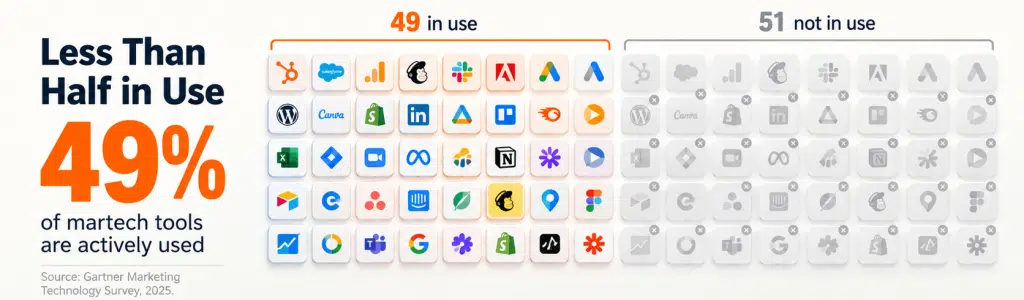
Gartner’s 2025 Marketing Technology Survey reports that martech utilization has dropped to 49%, and that only 15% of organizations qualify as high performers, defined as those that meet strategic goals and demonstrate positive ROI.
Source: Gartner, Marketing Technology topic page, 2025. Gartner does not state the sample size on this page.
The trend is not new. In October 2022 Gartner published a survey of 324 marketers, fielded in May and June 2022, which found that marketers used just 42% of their martech stack capabilities. The 2022 figure measures capabilities and the 2025 figure measures tools, so the two numbers describe related but different things and should not be read as a clean trend line. What they do share is the same message: more than half the paid-for potential is idle.
The supply side makes the problem harder. Chiefmartec’s annual landscape, produced by Scott Brinker and Frans Riemersma, counted 15,384 solutions across 49 categories in 2025 and 15,505 products in 2026.
The Chiefmartec 2026 landscape reports that the martech market grew just 0.79% to 15,505 products, with 1,488 products added and 1,367 removed in the year.
Source: Chiefmartec, 2026 Marketing Technology Landscape Supergraphic, May 5, 2026. The count is compiled by the Chiefmartec team from vendor research and is not a census.
Read that churn figure as a warning for buyers. Roughly one product in the landscape disappears for each one that appears, so a tool chosen today may be acquired, merged, or shut down within a contract cycle. Favor vendors with clear export options, and keep your customer data in a system you control.
How does martech help a small or mid-size business grow?
Martech helps a smaller business grow when it connects three things: a record of every customer and lead, a way to reach them at the right moment, and a report that ties spending to revenue. Without all three, each tool produces activity that no one can credit to a result. With them, the owner can see which channel earns money and which only earns clicks.
The tool-selection problem is sharper for smaller firms than most vendors admit. The India SME Forum’s December 2025 report, “The State of Digitalisation in Indian MSMEs,” surveyed 7,835 MSMEs during 2024-25. It found that 53.8% had adopted at least one digital tool and that 46.2% still operated fully offline. Among the firms that had digitized, email use stood at 95.4% and CRM software at 71.8%.
The India SME Forum reports that 35.6% of 7,835 surveyed Indian MSMEs (2,787 respondents) find “finding the right digital tools” somewhat or very challenging, and 36.8% (2,879 respondents) find “navigating and setting up digital tools” somewhat or very challenging.
Source: India SME Forum, The State of Digitalisation in Indian MSMEs, December 2025. The survey used a convenience-based, voluntary sampling approach and describes its findings as indicative rather than statistically representative.
Two cautions apply. The report is a voluntary survey run through the Forum’s own network, so it likely over-represents firms that are already engaged with digital topics. The executive summary also gives 52.6% for the tool-finding challenge, while the detailed section reports 35.6%, which suggests the headline figure uses a wider definition; this article uses the detailed figure. Even at the lower number, more than a third of respondents say the hard part is choosing and setting up tools, not paying for them.
That matches what a first-time founder tends to feel. A low-cost tool is rarely out of budget. The harder gap is a person who can say which three tools matter this year, connect them, and read the results. That judgement is where the Human Algorithm approach applies: the software supplies speed and data, and a person decides what to do with them.
How do you audit a martech stack?
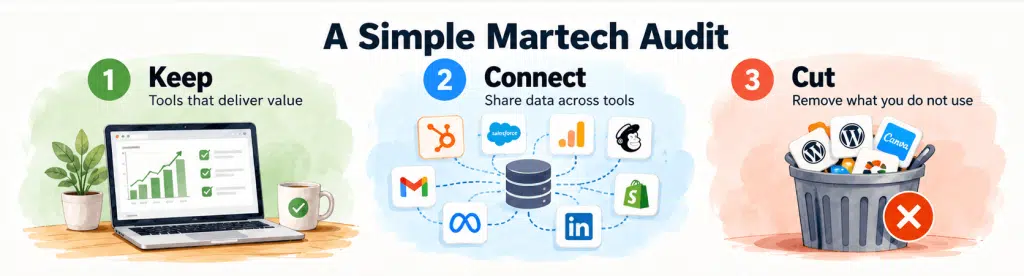
You audit a martech stack by listing every paid tool, naming its owner and purpose, and checking whether it shares data with the rest of the stack. Tools with no owner or no purpose are cut, tools that work in isolation are connected, and tools that earn their keep are kept. The whole exercise fits in a single working session for most small teams.
| Decision | Test the tool must pass | Typical action |
| Keep | Has a named owner, a stated purpose, and a metric reviewed at least quarterly | Renew, and document how the metric is read |
| Connect | Useful, but its data does not reach the CRM or the reporting view | Set up the integration before the renewal date |
| Cut | No owner, overlaps another tool, or no one can name what it produced | Cancel at renewal and export the data first |
This Keep, Connect, Cut sequence is a simple working method proposed in this article, and it is not an industry standard. Other practitioners structure audits differently, and Gartner’s own guidance on the topic recommends comparing cost to utilization and mapping the ecosystem, which fits the same idea.
A common mistake, often encouraged by vendors, is starting with the tool list instead of the revenue question. If your board asks for cost per acquisition, work backward from that number to the three systems that touch it. Everything else is a candidate for cutting. For measurement basics, the guide to analysing Google Analytics website traffic is a sensible place to start.
Where do automation and AI fit in a martech stack?
Automation and AI sit on top of a working stack and multiply whatever is already there. Automation handles repetitive steps such as follow-up emails and lead routing, while AI drafts and sorts at volume. They scale a clean process and a messy one with equal efficiency. The benefits of automating digital marketing tasks are real once the underlying process is sound.
Buy the second tool only after someone can explain what the first one earned.
The commonly told story runs in a chain: better tools produce better data, better data enables personalization, and personalization lifts conversion and revenue. Each link is plausible, but the chain is a hypothesis and not a proven mechanism. A business may see no lift if its data is incomplete, if its audience is too small to segment meaningfully, or if the revenue change comes from pricing or seasonality instead. The Gartner finding that only 15% of organizations qualify as high performers suggests that owning the tools does not by itself produce the outcome.
For a startup deciding where to begin, a documented digital marketing strategy for a startup should come before any platform purchase. Paid acquisition, covered on our performance marketing page, belongs in the stack only once conversion tracking works.
What should you check this week?
Use the list below as a one-hour starting point. It does not require a consultant, only access to your billing records and the people who use each tool.
- List every marketing tool you pay for, including the ones billed to a personal card, with its monthly or annual cost and renewal date.
- Write a named owner next to each tool, and mark any tool where the answer is “nobody” or “the person who left”.
- Check the last login or last campaign sent for each tool, and flag anything unused for 90 days.
- Confirm that your website form, CRM, and email platform pass data to each other, and test it with one real lead.
- Pick the one number leadership needs next quarter, such as cost per lead or revenue per channel, and confirm which tool reports it.
The cheapest martech saving is the tool you stop paying for because you finally asked who uses it.
Your next step
Open a spreadsheet today and build the tool list from the first bullet above, then book thirty minutes with each tool owner before the next renewal date arrives. Cancel anything without an owner, and put the renewal dates for the rest on one shared calendar. Once the stack reports cleanly, the data is ready to guide SEO and digital visibility work, where the same discipline of owning, connecting, and measuring applies.
Frequently Asked Questions
What is martech in simple terms?
Martech is the software a business uses to run its marketing, such as email platforms, CRMs, analytics, and automation. If a tool helps you find, convert, or keep customers, it belongs in your martech stack. The stack matters less for its size than for whether the tools share data and whether someone owns each one.
How many martech tools does a small business need?
Most small businesses need a short core: a website with analytics, a CRM, and an email platform, with advertising and automation added when there is a clear use for them. There is no verified industry number for the right count, and the India SME Forum data suggests that choosing tools is the hard part, not owning many. Start with the fewest tools that let you see a lead from first touch to sale.
Why is martech utilization so low?
Gartner reports that martech utilization fell to 49% in 2025 and points to low adoption, stack complexity, and difficulty proving ROI as common barriers. Tools are often bought for a single campaign and left without an owner. Assigning each tool a named owner and a reviewed metric addresses the most common cause.
Should I use AI tools in my martech stack?
AI tools earn a place in your stack when they support a process you already run well, such as drafting follow-ups or sorting leads, and when a person reviews the output. They do not repair weak data or an unclear strategy. Add them after the core tools are connected, and measure whether they change a number leadership already tracks.
Sources & Further Reading
- Marketing Technology (2025 Gartner Marketing Technology Survey summary), Gartner Marketing, 2025.
- Gartner Survey Finds Marketers Utilize Just 42% of Their Martech Stack Capabilities, Gartner Newsroom, October 3, 2022.
- Scott Brinker and Frans Riemersma. 2026 Marketing Technology Landscape Supergraphic: Peak Martech Achieved! (Maybe), Chiefmartec, May 5, 2026.
- Scott Brinker and Frans Riemersma. 2025 Marketing Technology Landscape Supergraphic: 100X growth since 2011, but now with AI, Chiefmartec, May 6, 2025.
- India SME Forum. The State of Digitalisation in Indian MSMEs (Breaking Barriers, Building Futures), December 2025.