
Key Highlights
- The target audience is defined using real data from tools like Google Analytics, Search Console, and CRM systems
- Behaviour and intent matter more than demographics when identifying high-converting users
- Analysing traffic sources like organic search, direct traffic, and referral traffic reveals what drives results
- Segmentation helps separate high-intent users from general web traffic across different channels
- Buyer personas turn raw data into clear, actionable audience profiles for campaigns
- Continuous validation using campaign performance ensures your targeting stays accurate and effective
Most websites today are getting traffic, but very few actually understand what that traffic means. You open your Google Analytics account, see numbers like page views or new users going up, and think things are working. But are they? Is that traffic helping your business goals, or just inflating your reports?
What you really want is clarity. You want to know where your website visitors are coming from, which marketing channels are actually driving results, and why some pages perform while others don’t. Without that, it’s hard to make confident decisions or improve your marketing efforts.
This blog will show you how to use Google Analytics to identify your target audience, understand user behaviour, and turn raw traffic data into actionable audience insights.
What Is a Target Audience in Marketing?
A target audience in marketing refers to a specific group of people a business aims to reach based on shared characteristics such as behaviour, intent, demographics, and needs. It is not just about who can buy your product, but who is most likely to engage, respond, and convert. These are the people your messaging should speak to directly.
Instead of targeting a broad customer base, businesses narrow their focus to a defined audience with clear intent. This makes marketing more relevant, measurable, and effective. This distinction becomes clearer when you compare it with a commonly confused concept: the target market.
Target Audience vs Target Market: What’s the Difference?
A target market is a broader group of potential customers, while a target audience is a more specific segment within that market, defined for a particular campaign or message. Think of it as moving from a wide lens to a focused view.
| Aspect | Target Market | Target Audience |
| Scope | Broad | Specific |
| Purpose | Overall business direction | Campaign-level targeting |
| Definition Basis | General characteristics | Behaviour, intent, and context |
| Example | Small business owners | Startup founders aged 25–40 searching for marketing tools |
For example:
- Target market: Small business owners
- Target audience: Startup founders aged 25–40 actively searching for marketing automation tools
This level of precision allows you to create messaging that feels relevant rather than generic. And that directly influences how your campaigns perform.
Why Does Target Audience Clarity Directly Impact Marketing Performance?
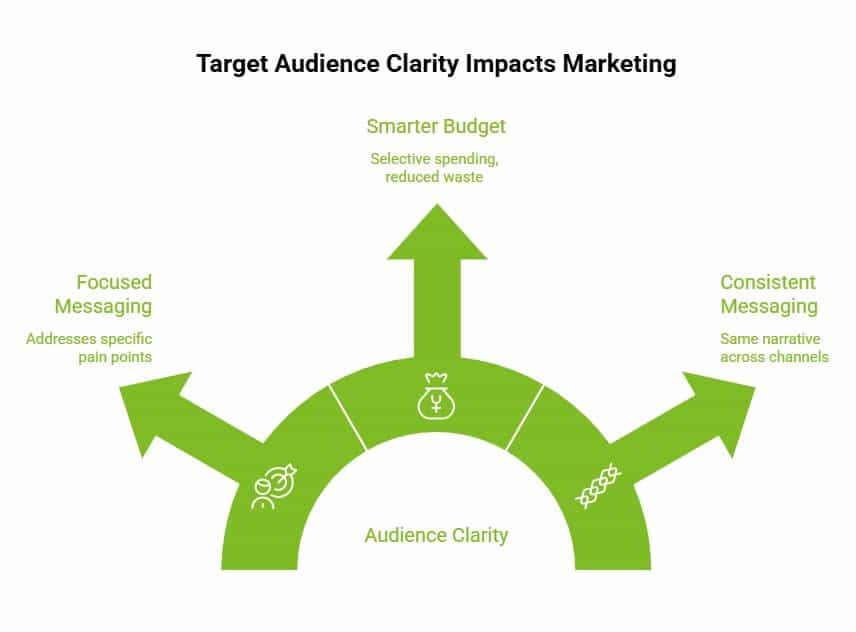
Once your target audience is clearly defined, marketing stops being broad and reactive. Decisions become more deliberate, from who you target to how you communicate and where you spend.
1. More Focused Messaging and Higher Conversions
Instead of writing generic messaging, you start addressing specific pain points, intent, and expectations.
This changes how you execute:
- Campaigns speak directly to a defined audience
- Content is built around real problems, not assumptions
- Calls to action feel relevant, not forced
As a result, engagement improves, and conversions become more consistent.
2. Smarter Budget Decisions
Without audience clarity, the budget is spread too widely. With clarity, spending becomes selective.
This shifts behaviour:
- Campaigns target only high-intent segments
- Low-performing audiences are excluded early
- Budget is allocated based on actual response, not guesswork
This reduces wasted spend and improves overall return.
3. Consistent Messaging Across Channels
When the audience is clearly defined, messaging does not change from one channel to another.
Instead:
- Social media, email, and ads follow the same narrative
- Content aligns with a single audience profile
- Brand positioning becomes clearer over time
This consistency improves recognition and strengthens overall marketing performance.
Target audience clarity does not just improve results. It changes how marketing decisions are made, making them more focused, consistent, and easier to scale. Once this shift is in place, the next step is identifying your audience with the same level of precision.
How Do You Identify Your Target Audience Step by Step?
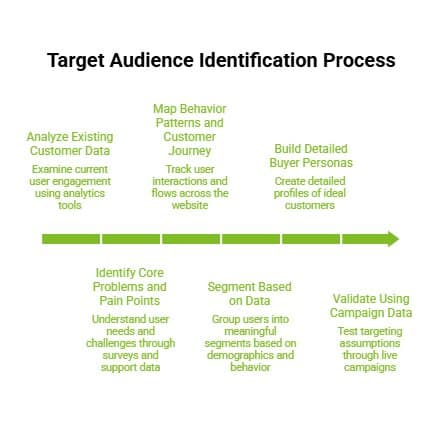
Identifying your target audience works best when each step builds on the previous one. You begin with existing data, move into understanding intent, then refine behaviour, and finally validate through performance. This sequence keeps your decisions grounded in real data, not assumptions.
1. Analyse Existing Customer Data
The process starts with your current users. Before defining a new audience, you need clarity on who is already engaging with your website.
Use:
- Google Analytics 4 to analyse website visitors, page views, number of sessions, session source, and engagement time
- Google Search Console to understand queries from Google search and identify organic traffic trends
- CRM tools like HubSpot or Zoho CRM to segment users based on purchase history and lifecycle stage
- Google Tag Manager to ensure accurate data collection across events and pages
Focus on:
- Which marketing channels drive consistent traffic
- Which users convert or return frequently
- Which pages attract the most organic visitors
This step establishes a baseline. Once you know who is engaging, the next step is to understand why they are engaging.
2. Identify Core Problems and Pain Points
After identifying your users, shift focus to intent. Behavioural data alone does not explain what users are trying to achieve.
Use:
- Customer surveys via tools like Typeform or Google Forms
- Customer support data from tools like Zendesk or Freshdesk
- Community platforms like Reddit and Quora to observe real discussions
- Review platforms like G2 or Trustpilot for product-level feedback
Look for:
- Repeated questions or complaints
- Gaps in existing solutions
- Decision-making triggers
This step clarifies what drives user actions. With that understanding, you can now analyse how users behave across your website.
3. Map Behaviour Patterns and Customer Journey
Once intent is clear, analyse how users interact with your website across different touchpoints.
Use:
- Hotjar or Microsoft Clarity for heatmaps, scroll tracking, and session recordings
- Mixpanel or Amplitude for tracking user journeys and event-based behaviour
- GA4 exploration reports to analyse user flows and drop-offs
Analyse:
- Entry and exit points
- Drop-off stages in funnels
- Actions linked to a conversion event or key event
This reveals how users move, where they hesitate, and what drives conversions. With behaviour mapped, the next step is to organise users into structured groups.
4. Segment Based on Data
With both intent and behaviour defined, group users into meaningful segments.
Use:
- GA4 audience builder for segmenting based on engagement metrics and behaviour
- CRM segmentation tools for lifecycle and value-based grouping
- Looker Studio to visualise segments across multiple data sources
Segment using:
- Demographics
- Geographic location
- Behaviour patterns
- Interaction or purchase history
This step separates high-intent users from general traffic and helps prioritise efforts across different channels and marketing channels.
5. Build Detailed Buyer Personas
Once segments are defined, convert them into clear buyer personas. This makes your audience easier to target and communicate with.
Use:
- HubSpot persona builder or Xtensio for structured persona creation
- Insights from GA4, CRM, and surveys
Include:
- Role or profession
- Primary goal
- Key challenge
Example:
- Role: Marketing Manager
- Goal: Improve campaign performance
- Challenge: Limited resources
These personas guide content creation, messaging, and advertising campaigns. However, they still need validation through real performance.
6. Validate Using Campaign Data
The final step is testing your assumptions through live campaigns. This ensures your targeting aligns with actual user behaviour.
Use:
- Google Ads to test intent-driven targeting
- Meta Ads Manager for interest and behaviour-based targeting
- LinkedIn Ads for professional and B2B audience validation
Track:
- Engagement metrics
- Conversion rate
- Cost per acquisition
- Performance across different channels
You can also combine campaign data with Looker Studio dashboards to monitor performance across data sources in a single report.
If results match expectations, your audience targeting is accurate. If not, refine your segments and revisit earlier steps. This closes the loop. Audience identification becomes an ongoing system, continuously improving through data, behaviour, and performance.
What Does Effective Target Audience Segmentation Look Like?
Before you can improve marketing performance, you need clarity on who you are targeting and how they behave. This is where segmentation becomes essential.
Target audience segmentation divides your audience into groups based on shared characteristics that influence decisions, engagement, and conversion. Instead of treating all website visitors the same, segmentation allows you to align messaging, channels, and content with specific audience needs.
1. Demographic vs Behavioural Segmentation
Most businesses begin with demographic segmentation because it is easy to access. This includes attributes like age, gender, income, and marital status. While useful for defining broad groups, it does not explain how users interact with your brand.
Behavioural segmentation fills this gap. It focuses on engagement patterns, usage behaviour, and purchase actions across different channels. This includes metrics like engagement time, number of sessions, and interaction patterns.
In practice, behavioural data is far more actionable because it reflects real intent and helps improve conversion rate and campaign effectiveness.
2. Psychographic Segmentation
Once behaviour is understood, psychographic segmentation adds another layer of depth.
It includes:
- Interests
- Lifestyle
- Values
This becomes especially important when decisions are influenced by perception, trust, and brand alignment. Strong psychographic insights help build brand awareness and long-term loyalty.
Why Segmentation Matters?
Segmentation is not just about organising data. It directly impacts how effective your marketing efforts are.
It helps you:
- Personalise communication across marketing channels
- Improve relevance based on user intent
- Increase conversions through targeted messaging
Without segmentation, even well-executed campaigns struggle to connect with the right audience.
What Are Real Target Audience Examples?
Once segmentation is defined, the next step is understanding how it applies in real-world scenarios. Different business models require different audience strategies, and each behaves differently across channels.
1. Startup Example
Target: Early-stage founders
Focus: Product validation and rapid feedback
Startups typically rely on a focused audience to test ideas quickly. These users engage actively but expect clear value.
Takeaway:
This works because the audience is tightly defined, reducing noise and improving feedback quality.
2. SMB Example
Target: Local users within a specific geographic area
Focus: Value and affordability
For SMBs, relevance matters more than scale. Traffic often comes from direct, referral, and local organic sources. Trust and accessibility play a key role.
Takeaway:
Local relevance drives performance here, not reach. Narrow targeting improves conversion over broad visibility.
3. SaaS Example
Target: Marketing professionals or business teams
Focus: Efficiency and ROI
SaaS audiences are performance-driven. They evaluate tools based on measurable outcomes such as conversion rates, automation, and impact.
Takeaway:
This audience evaluates based on outcomes, not features, which changes how messaging should be structured.
4. Enterprise Example
Target: Multiple stakeholders across departments
Focus: Scale, integration, and long-term value
Enterprise decisions involve multiple layers. Messaging must address both technical requirements and business outcomes.
Decision-making is multi-layered, so messaging must align with different priorities across stakeholders.
Which Tools Help You Find and Analyse Your Target Audience?
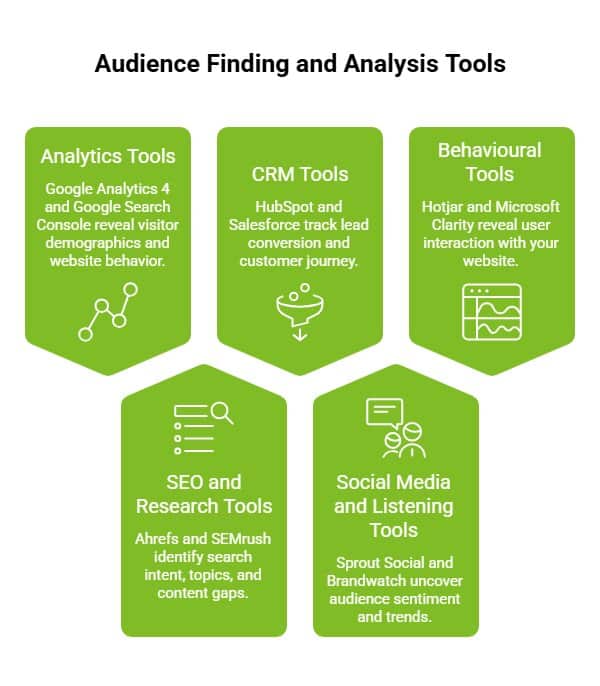
Understanding your audience requires structured data collection across multiple data sources. The right tools help transform raw data into detailed insights.
1. Analytics Tools
Tools like Google Analytics 4 and Google Search Console reveal who your visitors are and how they arrive.
They help you understand:
- Where your traffic is coming from
- Which channels drive engaged users
- How do different audience segments behave on your site
This gives a baseline view of audience composition and behaviour.
2. SEO and Research Tools
Tools such as Ahrefs and SEMrush reveal what your audience is actively searching for.
They help you identify:
- Search intent behind keywords
- Topics your audience cares about
- Gaps between what users search and what you offer
This aligns your content with real demand.
3. CRM Tools
Platforms like HubSpot and Salesforce reveal which audience segments actually convert.
They provide visibility into:
- Which leads turn into customers
- How different segments move through the funnel
- What drives revenue, not just traffic
This connects audience insights to business outcomes.
4. Social Media and Listening Tools
Tools like Sprout Social and Brandwatch reveal how your audience thinks and reacts.
They uncover:
- Engagement patterns across platforms
- Audience sentiment and preferences
- Emerging conversations and trends
This helps refine messaging and positioning.
5. Behavioural Tools
Tools such as Hotjar and Microsoft Clarity reveal how users interact with your website.
They show:
- Where users engage or drop off
- What elements attract attention
- Where friction exists in the experience
This helps improve usability and on-site engagement.
Each tool reveals a different layer of your audience. Together, they turn scattered data into a clearer, more actionable understanding of who you are targeting.
How Does the Target Audience Influence Marketing Strategy?
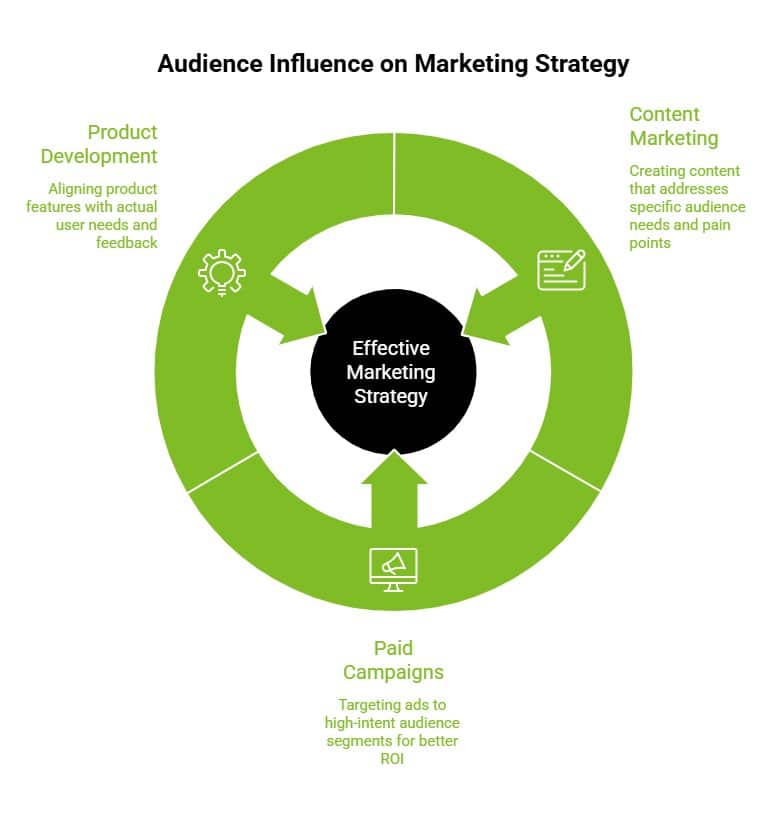
Once your audience is clearly defined, it starts shaping every part of your marketing strategy. Decisions become more focused, and execution becomes more efficient.
1. Content Marketing
Content is no longer created for reach. It is built to match specific pain points, needs, and search intent.
This changes how content performs:
- Topics attract qualified traffic, not just volume
- Messaging aligns with real problems, improving engagement
- Content moves users closer to conversion, not just awareness
Insight:
Content becomes a filtering mechanism. It attracts the right audience while naturally excluding low-intent traffic.
2. Paid Campaigns
Audience clarity directly impacts how campaigns are structured and optimised.
Instead of broad targeting:
- Ads focus on high-intent segments
- Budget is allocated to audiences that convert
- Performance improves without increasing spend
Insight:
Better targeting reduces wasted impressions, which lowers cost per acquisition rather than just improving click metrics.
3. Product Development
Audience insights influence what gets built and prioritised.
This shifts product decisions:
- Features are aligned with actual user needs
- Feedback loops become more actionable
- Adoption improves because the product solves real problems
Insight:
Audience clarity reduces feature guesswork. It ensures development effort is tied to demand, not assumptions.
When the audience is clearly defined, strategy becomes more precise. Each decision, content, ads, and product, is guided by who you are trying to serve, not just what you want to promote.
What Are the Most Common Mistakes in Target Audience Analysis?
Even with access to tools and data, mistakes in audience analysis are common. Most issues arise from misinterpreting data or relying on incomplete insights.
- Targeting too broadly across multiple marketing channels
Broad targeting reduces relevance and leads to a lower conversion rate despite high traffic. - Ignoring behavioural data and relying only on demographics
Demographics define the user, but behaviour defines intent. Ignoring this limits campaign effectiveness. - Not updating audience insights as market conditions change
Audience behaviour evolves with industry trends, platforms, and competition. - Over-relying on assumptions instead of actual data collection
Decisions based on assumptions often misalign with real user behaviour. - Focusing only on acquisition and ignoring post-click behaviour
High user acquisition means little if engagement metrics and conversions are weak. - Not segmenting by lifecycle stage or intent
New users and returning users require different messaging and targeting. - Ignoring device and platform differences
Behaviour varies across mobile, desktop, and social media channels. - Relying on a single report instead of combining data sources
A single report does not provide a complete picture. Multiple data sources are needed for accurate insights.
Each of these mistakes creates a gap between audience expectations and marketing execution.
When Should You Refine Your Target Audience?
Audience analysis is not static. As your business grows and your marketing channels evolve, your audience definition must adapt.
You should refine your target audience:
- When entering new markets or expanding your online presence
New regions often have different behaviour patterns and expectations. - When performance declines across key metrics
Drops in engagement, conversion rate, or web traffic often indicate misalignment. - When launching new products or services
New offerings may attract different segments or shift existing behaviour. - When traffic sources or marketing channels change
A shift from organic search to paid or social media traffic often signals a change in audience mix. - When customer behaviour patterns evolve
Changes in engagement time, content performance, or navigation behaviour indicate shifting expectations. - When scaling advertising campaigns
As budgets increase, even small targeting inefficiencies become costly. - When expanding into new platforms or content formats
Different platforms attract different audience segments and behaviours.
Regular refinement ensures your strategy stays aligned with real user behaviour, improving both efficiency and outcomes over time.
Where Do Audience Insights Usually Break Down and How Can You Fix It?
Identifying your target audience is only the first step. The real challenge is turning that insight into consistent marketing decisions. Most businesses already have the data, but it sits across tools and does not translate into action.
This creates a gap between what you know and what you do next.
Wild Creek Web Studio focuses on closing that gap by connecting audience data across sources and turning it into a usable decision framework.
Instead of tracking isolated metrics, the approach focuses on:
- Identifying which channels bring high-intent users
- Understanding which content drives real engagement
- Connecting traffic behaviour to conversion outcomes
- Aligning campaigns with actual audience behaviour
This shifts the focus from reporting to execution.
If your data shows activity but not progress, the issue is usually not visibility. It is interpretation and application.
Book a strategy call with Wild Creek Web Studio to audit your audience data and identify clear growth opportunities.
Conclusion
A clearly defined target audience is the foundation of every successful marketing strategy. It helps you reach the right people at the right time, improve conversions, and build stronger relationships with your customers.
More importantly, it gives your business a real competitive advantage. The next step is simple. Start with your data, validate your assumptions, and refine continuously. Because the better you understand your audience, the better your marketing performs.
Frequently Asked Questions
What is a target audience in marketing?
A target audience is a specific group of consumers most likely to engage with your product based on common characteristics like demographic information, behaviour, and needs. Defining this group helps create effective marketing campaigns and supports business growth.
How to identify the target audience for a new product?
The best way is to combine market research, data analysis, and customer behaviour insights. Analyse website visits, run focus groups, and study demographic data to identify ideal customers and build accurate customer personas.
Why is understanding your target audience important in marketing?
A strong understanding of your target audience ensures your marketing messages match real user intent. This improves engagement, builds brand loyalty, and supports a more effective marketing strategy.
What are the different types of target audiences?
Target audiences can be grouped based on demographic information, behaviour, personality traits, and interests. For example, a Gen Z digital marketing target audience on social media platforms behaves differently from enterprise buyers.
What tools help you find the target audience?
Common tools to find the target audience include Google Analytics, CRM platforms, and social media platforms. These tools provide valuable insights into customer behavior and help refine your audience targeting strategy.
What common mistakes should you avoid in audience targeting strategy?
Avoid targeting too broadly, ignoring behavioural data, and relying only on assumptions. A weak audience targeting strategy reduces alignment with the needs of your target audience and impacts marketing performance.