
Key Highlights
- LSI keywords are related terms that clarify the topic context beyond a single keyword
- Google prioritises context and intent, not LSI as a ranking system
- Natural use of related terms improves readability and expands search coverage
- Keyword ideas come from autocomplete, related searches, PAA, tools, and competitors
- Avoid keyword stuffing and forced placement; focus on clear explanations
- Semantic SEO wins by fully answering queries and connecting ideas
- Wild Creek Web Studio delivers intent-driven SEO that drives qualified traffic and long-term growth
Most content does not rank because it focuses on one keyword instead of the full topic. Search engines like Google now prioritise context and intent, not just exact keyword matches.
But many people still repeat the same keyword again and again. This makes the content feel forced and misses a lot of related searches. With systems like Natural Language Processing, search engines now expect content to sound natural and cover topics properly.
That is where LSI keywords come in. In this guide, you will learn what they are, if they still matter, and how to use them to improve rankings and get more traffic.
What is an LSI Keyword in SEO?
LSI keywords are terms related to your main keyword that help add context to your content. Instead of repeating one phrase, you include related words that clarify what your page is about.
For example, if your main keyword is “Apple,” terms like iPhone, MacBook, iOS, and Apple Store signal that you are referring to the tech company, not the fruit.
But here’s where most people get it wrong.
LSI keywords are often treated like a ranking factor or a checklist to follow. They are not. Search engines like Google do not rely on latent semantic indexing in the way most SEO guides suggest.
What people call “LSI keywords” today is really just a way to describe topical context. With systems powered by Natural Language Processing, search engines understand relationships between concepts, not just related terms.
So the idea is useful, but the way it is commonly explained is outdated.
Do LSI Keywords Still Work Today?
Not in the way most people think.
Search engines like Google don’t use LSI as a system anymore. That idea comes from older search models, not how modern search works.
What has replaced it is semantic understanding. With systems powered by Natural Language Processing, search engines evaluate how well your content explains a topic, connects ideas, and matches user intent.
That is why pages that include related terms still perform well. Not because they are using LSI keywords, but because they are covering the topic properly.
So the principle still holds, but the approach has changed:
- LSI keywords as a tactic do not matter anymore
- Topical coverage and clarity do
If your content explains the topic clearly, relevant terms will appear naturally. That is what search engines reward today.
Want to build a strong SEO foundation? Start with your core topics by learning how to choose the right seed keywords in this detailed guide.
LSI Keywords vs Semantic SEO: What Matters for Rankings Today
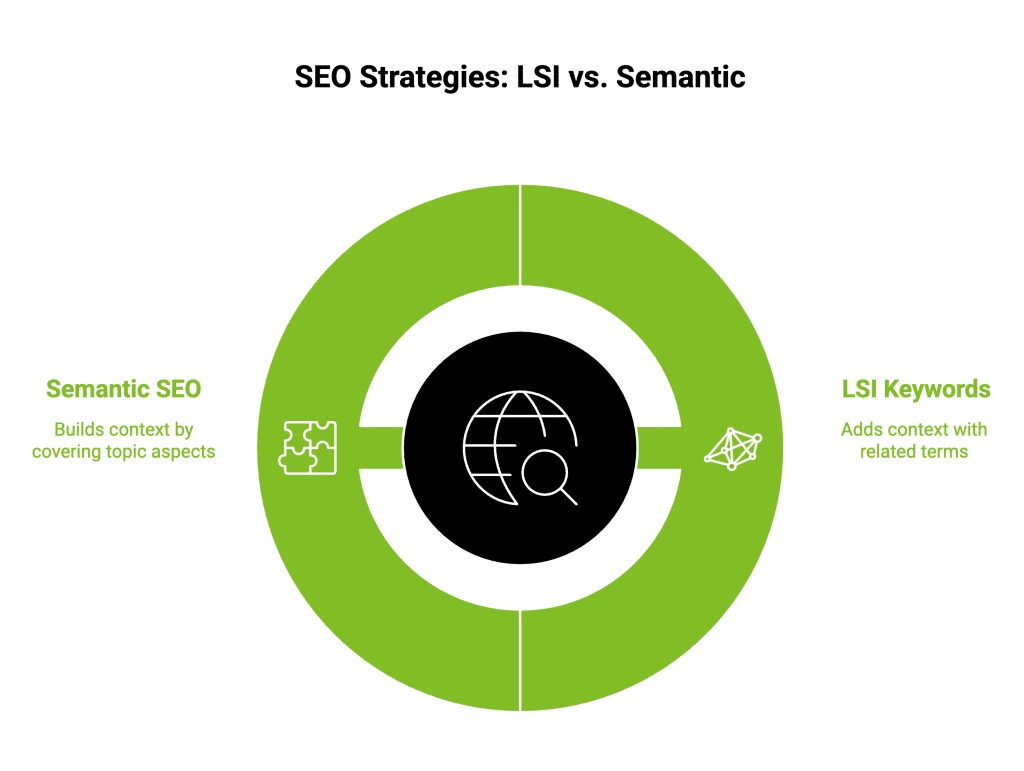
The real shift in SEO is simple. Search engines no longer focus on keywords alone. They focus on meaning, and that is what semantic SEO is about.
LSI keywords were designed to add context using related terms. That still helps, but it is no longer enough to rank.
Search engines like Google now evaluate content using semantic SEO principles, powered by systems like Natural Language Processing.
Instead of checking for keywords, search engines now evaluate:
- Whether the page fully answers the query
- Whether it covers the important aspects of the topic
- Whether ideas are connected clearly
That is the difference:
- LSI keywords help you add context
- Semantic SEO helps you build context
This is why some pages rank and others do not:
- One includes keywords but stays surface-level
- The other uses semantic SEO to explain the topic clearly and add depth
The second page wins.
So the shift is straightforward:
- Stop asking if you used enough keywords
- Start focusing on semantic SEO and explaining the topic properly
LSI Keywords vs Synonyms vs Long-Tail Keywords: What’s the Difference?
One of the biggest reasons people get confused about LSI keywords is that they mix them up with synonyms and long-tail keywords. While they may seem similar, they serve very different roles in SEO.
This table compares both approaches and helps you decide when to use LSI keywords vs semantic SEO:
| Type | What It Means | Role in SEO | Example |
| LSI Keywords | Contextually related terms connected to the main topic | Help search engines understand topic depth and relevance | SEO tools, backlinks, and site audit |
| Synonyms | Words with the same or similar meaning | Improve readability and avoid repetition | Buy → Purchase |
| Long-Tail Keywords | Specific, detailed search phrases | Target precise user intent and lower competition queries | best SEO tools for small businesses |
LSI keywords help you rank, but these proven SEO strategies to boost sales show you how to convert that traffic.
What Are the Benefits of Using LSI Keywords in SEO?
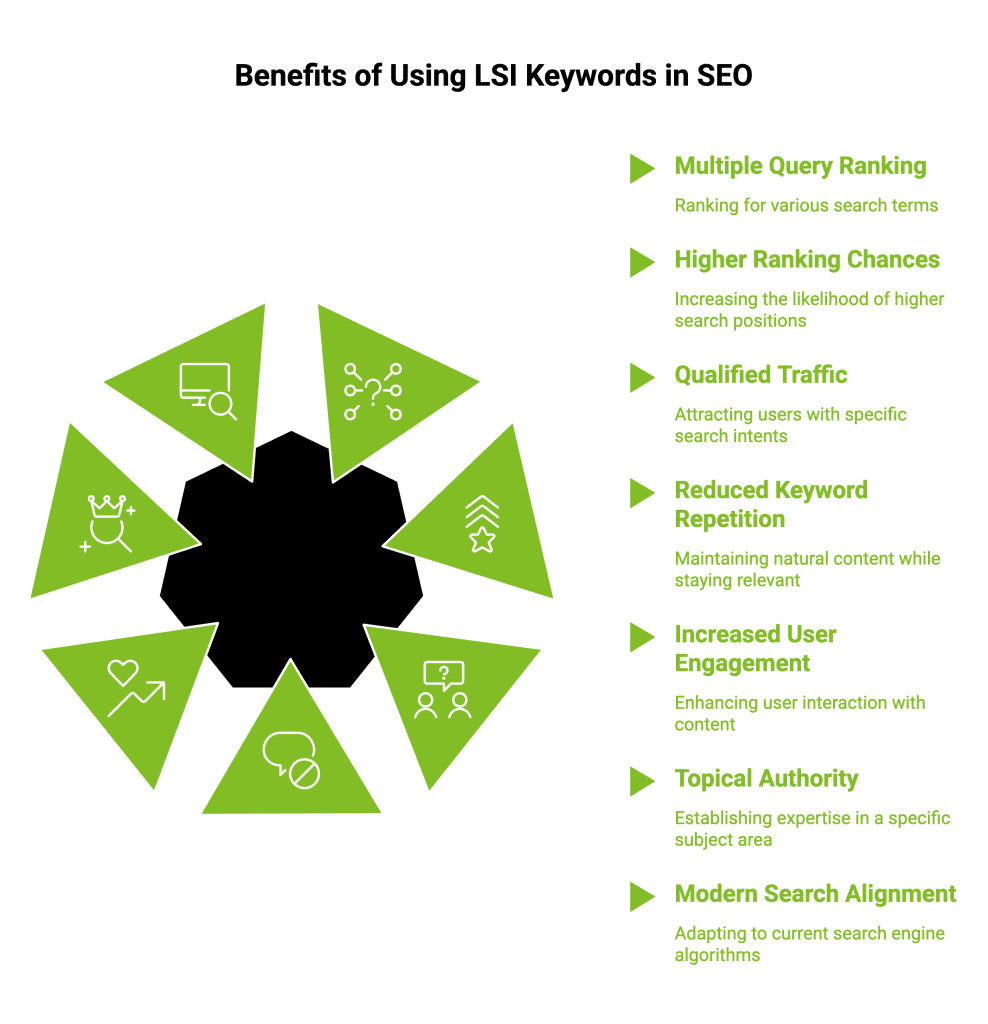
Using LSI keywords is not about adding extra words. It is about helping your content perform better by making it clearer, more complete, and easier to match with user intent.
Here is what that actually leads to:
- Helps your page rank for multiple queries instead of relying on a single keyword, increasing overall search visibility
- Improves your chances of ranking higher by making it easier for search engines to understand what your content covers
- Brings in more qualified traffic by aligning your content with different variations of user intent
- Reduces the need for keyword repetition, keeping your content natural while still maintaining strong relevance
- Increases user engagement because the content reads smoothly and answers related questions more effectively
- Strengthens your topical authority, helping you rank consistently across a group of related keywords over time
- Aligns your content with how modern search works, improving visibility in both traditional results and AI-driven search experiences.
How to Do LSI Keyword Research (Step-by-Step)
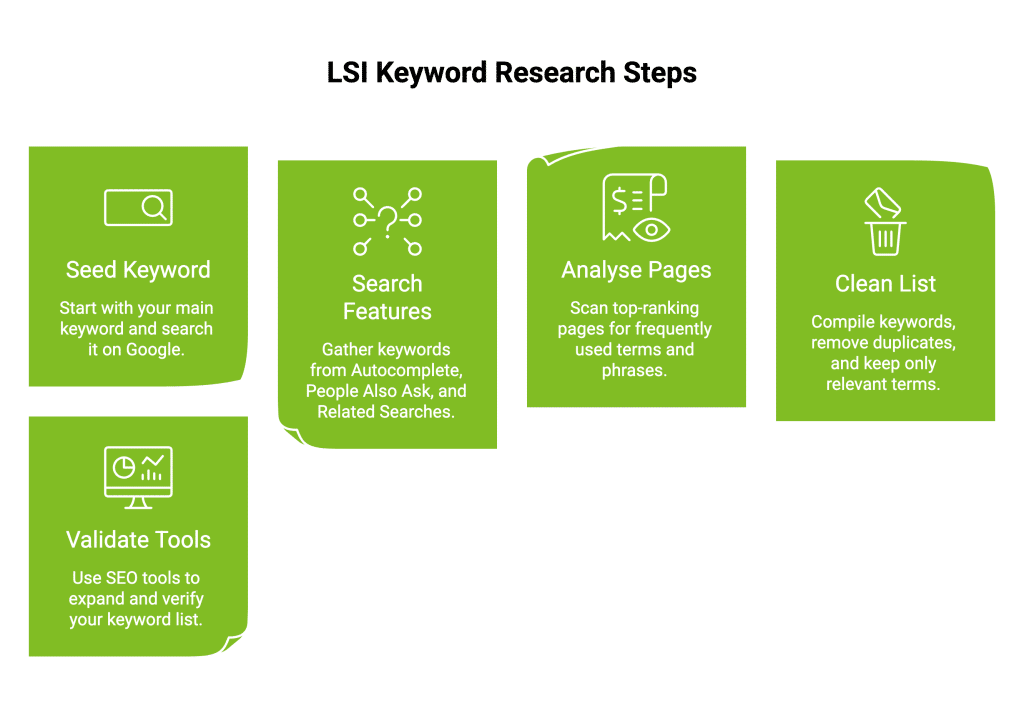
LSI keyword research is about identifying which related terms and topics your content needs to cover. The goal is not to collect as many keywords as possible, but to understand what search engines expect for your topic.
Here is a clear, step-by-step process:
Step 1: Start With a Seed Keyword
Begin with your main keyword and search it on Google.
Look at the results carefully. Notice:
- What type of content is ranking
- What angle are the top pages taking
This helps you understand the intent behind the keyword before you start collecting related terms.
Step 2: Extract Keywords From Search Features
Next, gather keywords directly from search results.
Focus on:
- Autocomplete suggestions
- “People Also Ask” questions
- Related searches at the bottom
These are based on real user behaviour and show what people commonly search alongside your main topic.
Step 3: Analyse Top-Ranking Pages
Open the top-ranking pages and scan their content.
Pay attention to:
- Frequently used terms
- Phrases that appear across multiple pages
When certain words or topics show up repeatedly, they are strong indicators of what your content should include.
Step 4: Build a Clean Keyword List
Now compile everything into a simple list.
At this stage:
- Remove duplicate terms
- Keep only relevant keywords
- Focus on terms that clearly relate to your topic
This gives you a refined list of meaningful LSI keywords.
Step 5: Validate With SEO Tools
Finally, use tools like Ahrefs or SEMrush to expand and verify your list.
These tools help you:
- Find additional keyword variations
- Check search volume
- Confirm relevance
Good LSI keyword research helps you understand what your content needs to include. Once you have that clarity, writing becomes much easier and more focused.
How to Use LSI Keywords in Your Content?
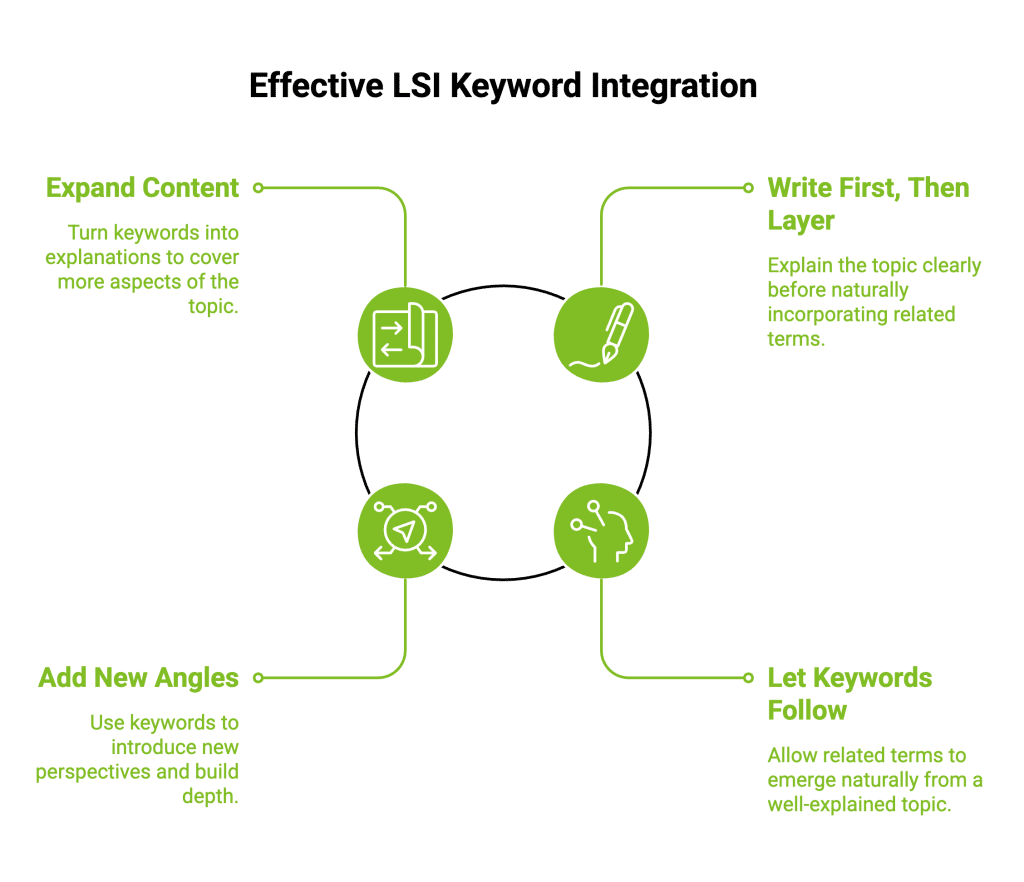
Using LSI keywords is not about inserting terms into your content. It is about expanding your content so it answers more of the topic clearly.
Most people try to fit keywords into sentences. High-ranking content does the opposite. It uses those keywords as signals for what needs to be explained.
1. Expand Your Content Instead of Forcing Keywords
Every LSI keyword represents something users want to know. Instead of inserting it, turn it into part of your explanation.
For example, if your topic is “SEO tools” and you come across a keyword like “keyword research tools,” a weak approach would be to mention it once in a sentence. A stronger approach is to add a short explanation of what keyword research tools do and why they matter. This way, the keyword fits naturally because the topic is actually being covered.
2. Write First, Then Layer Keywords
Start by explaining the topic clearly, then bring in related terms where they already fit.
For instance, writing “LSI keywords are important LSI keywords for SEO” sounds forced and repetitive. A clearer version would be “Using related terms helps search engines understand your topic better.” The meaning stays the same, but the sentence flows naturally.
3. Use Keywords to Add New Angles
Each keyword should introduce something new, not repeat what is already there.
If your topic is “on-page SEO” and you find a term like “meta tags importance,” do not just mention it. Instead, explain what meta tags are, why they matter, and how to optimise them. That is how keywords help you build depth.
4. Let Keywords Follow the Explanation
When a topic is explained properly, related terms appear on their own.
For example, if you are writing about “technical SEO” in detail, you will naturally mention things like crawl errors, indexing issues, and site speed without needing to force them in. They show up because they are part of the topic.
LSI keywords work best when they disappear into the content. If your page feels clear, complete, and easy to follow, you are already using them the right way.
Good strategy is one thing, execution is another. Here are free SEO tools that make implementation simple.
What Are the Common Myths About LSI Keywords?
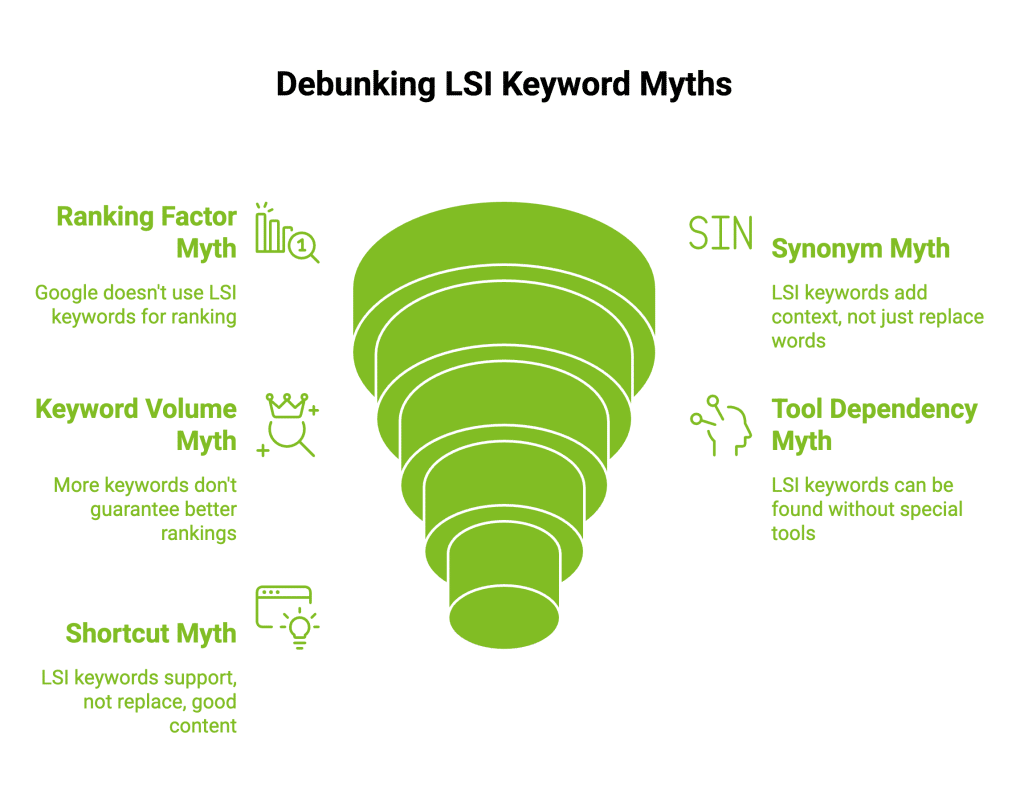
LSI keywords are one of the most misunderstood concepts in SEO. A lot of outdated advice still circulates, which leads to confusion and poor implementation. Let’s clear up the most common myths.
Myth 1: Google Uses LSI Keywords as a Ranking Factor
This is the biggest misconception. Search engines like Google do not use traditional latent semantic indexing keywords as part of their ranking algorithm. The term comes from older information retrieval systems, not modern search. What actually matters is context, relevance, and how well your content covers a topic.
Myth 2: LSI Keywords Are Just Synonyms
LSI keywords are not simply different words with the same meaning. They are contextually related terms that help explain and expand a topic. Synonyms replace a word, while LSI keywords add depth and meaning to the content.
Myth 3: More LSI Keywords Means Better Rankings
Using more keywords does not guarantee better results. In fact, overusing them can make your content feel forced and harder to read. Search engines prioritise clarity and usefulness, not keyword volume.
Myth 4: You Need Special Tools to Find LSI Keywords
Many people believe that without tools, they cannot find LSI keywords. In reality, most useful keywords come directly from search behaviour, such as autocomplete suggestions, related searches, and top-ranking pages. Tools can help, but they are not essential.
Myth 5: LSI Keywords Are a Shortcut to Ranking
There is no shortcut in SEO. LSI keywords do not replace strong content, clear structure, or user-focused writing. They only support content that is already valuable and well-organised.
What Are the Common Mistakes to Avoid When Using LSI Keywords?
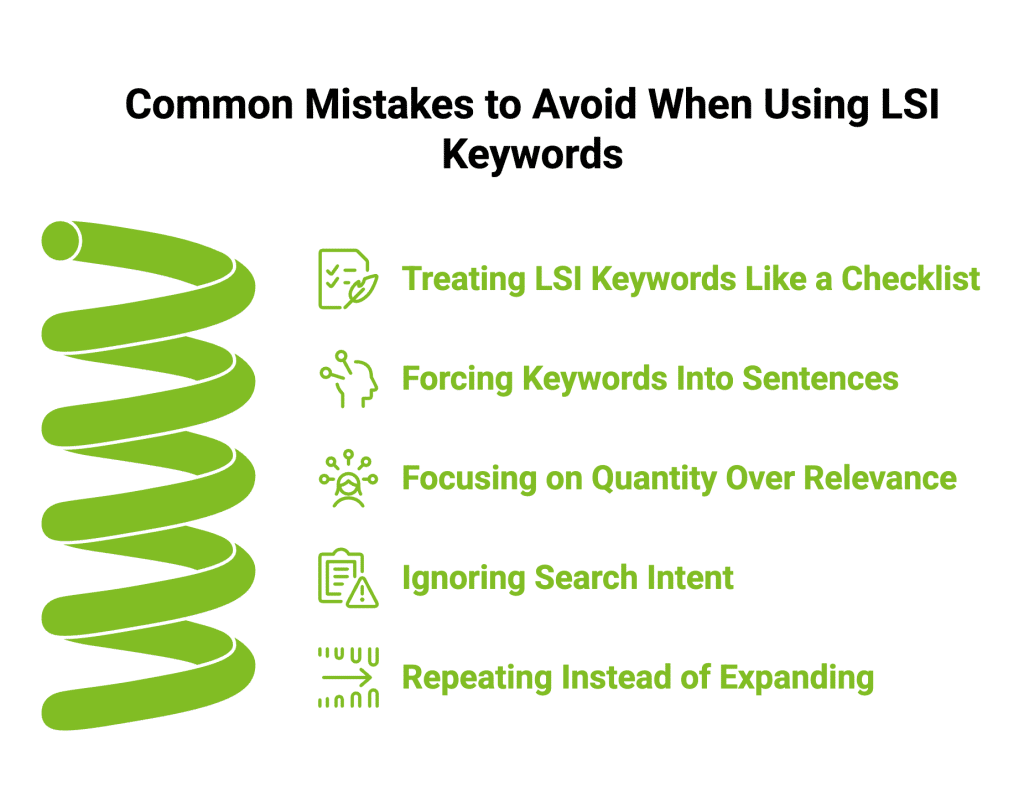
Even when people understand LSI keywords, they often use them the wrong way. This usually leads to weak content that does not perform well in search.
Here are the most common mistakes you should avoid:
1. Treating LSI Keywords Like a Checklist
This often leads to shallow content that lacks depth. Trying to include every keyword turns your content into a scattered list instead of a focused, valuable resource.
LSI keywords should guide what you explain, not what you force into the page.
2. Forcing Keywords Into Sentences
When keywords feel unnatural, the content becomes harder to read and less trustworthy. This affects user engagement and can hurt performance in search. If it does not fit smoothly, it is better to leave it out.
3. Focusing on Quantity Over Relevance
Using too many loosely related keywords weakens your main topic. Instead of building authority, it creates confusion for both users and search engines. Relevance always matters more than volume.
4. Ignoring Search Intent
If your content does not match what users are actually looking for, it will struggle to rank. Keywords represent intent, not just phrases. Your content needs to answer the real question behind the search.
5. Repeating Instead of Expanding
Rewriting the same idea in different ways does not improve content quality. It increases length without adding value. Strong content introduces new insights, not repeated explanations.
How Can Wild Creek Web Studio Help You Stay Ahead in SEO?
Most SEO strategies fail for one reason. They are still built on outdated ideas about keywords.
At Wild Creek Web Studio, we take a different approach. We focus on how modern search actually works, combining semantic SEO, search intent optimisation, and evolved keyword strategies that go beyond basic targeting.
We do not treat SEO like a checklist. We treat it as a system built around clarity, depth, and real user behaviour.
Here is what that means for you:
- Your strategy is guided by modern keyword thinking, where topics matter more than individual terms
- Your content is built using semantic SEO, helping you rank across multiple related queries instead of relying on a single keyword
- Your pages are aligned with search intent, so you attract users who are more likely to engage and convert
- Your SEO decisions are based on how search engines interpret content today, not outdated tactics
- Your growth compounds over time because your content builds authority across an entire topic, not just isolated keywords
We have seen what works and what does not. After 18+ years and working with 100+ brands, the pattern is clear.
Final Words
LSI keywords are not the strategy. They are a signal. A signal that your content is either shallow or complete.
If you are still thinking in terms of adding keywords, you are solving the wrong problem. Search has moved forward. It now rewards content that connects ideas, answers real questions, and builds clear context.
That is the real shift.
Instead of asking, “Did I include enough keywords?”, start asking, “Did I fully explain this topic?”
Because when your content is clear, complete, and aligned with intent, everything else falls into place. Rankings, traffic, and authority are simply the result. LSI keywords were the starting point. Understanding how to build meaning is what actually gets you ahead.
Frequently Asked Questions
What are the applications of LSI?
LSI is used in search engine optimisation to improve the relevance of your content, connect different terms, and match search queries. It helps content creators build relevant content, improve search visibility, and deliver better user experience.
What does LSI stand for in SEO?
LSI stands for Latent Semantic Indexing in search engine optimisation. It refers to identifying related search terms and semantic keywords that help search engines understand the context of your content and improve search engine rankings.
What are LSI keywords, and how do we use them?
LSI keywords are related search terms connected to your primary keyword. Use relevant LSI keywords naturally in your piece of content, headings, meta descriptions, and image alt text to improve relevance without increasing keyword density.
Are LSI Keywords still relevant?
LSI keywords remain relevant in the world of seo because they improve the relevance of your content. While not direct ranking factors, they help match search queries, enhance seo performance, and increase your chances of ranking.
Do LSI Keywords Factor Into Your SEO Ranking?
LSI keywords do not directly impact search engine rankings, but they influence seo performance. By improving the context of your content and aligning with search queries, you help search engines deliver more relevant results.
How do you add LSI keywords to your page?
Add LSI keywords by including related search terms in headings, anchor text, and meta descriptions. Use keyword research tools or Google Keyword Planner to find them, then place them naturally across web pages following SEO best practices.