Key Highlights
- Answer Engine Optimisation (AEO) structures content so search engines and AI platforms can deliver it as direct answers.
- Brands adopting AEO frameworks saw up to 40% higher visibility in generative AI search results.
- Zero-click searches now account for about 69% of Google searches (2025, CXL), making AEO essential for maintaining visibility even when users do not visit the website.
- Core AEO services include question research, AI-friendly content structuring, schema markup, and semantic optimisation.
- Conducting an AEO audit with a checklist ensures content aligns with user intent and maximises answer-driven performance.
- Tools like AnswerThePublic, SEMrush, Ahrefs, Google Analytics, and schema validators help track and improve AEO results.
- Wild Creek Web Studio helps brands combine AEO with SEO and digital marketing strategies to boost visibility, traffic, and measurable results.
Search is changing fast. Today, many users get answers directly on the results page rather than clicking a link to a website. In fact, about 69% of Google searches now end without a click (CXL, 2025). This shift is driven by featured snippets, voice assistants, and AI-generated answers.
For businesses and marketers, ranking on Google alone is no longer enough. Your content now needs to be the answer that search engines and AI tools surface. Without answer-focused optimisation, even well-ranked pages can miss valuable visibility.
This is where Answer Engine Optimisation (AEO) comes in. In this guide, you will learn what AEO is, its benefits, and how to run an AEO audit with a practical checklist to improve visibility in answer-driven search results.
What is Answer Engine Optimisation (AEO)?
Answer Engine Optimisation (AEO) is the process of optimising content so search engines, AI platforms, and voice assistants can deliver it as a direct answer to a user’s query. Instead of only appearing as a search result, your content is structured so platforms can quickly extract and present the answer.
This means creating content that clearly responds to real user questions. Well-structured headings, concise explanations, lists, and schema markup help search engines understand and surface your content when users look for quick answers.
When done well, AEO increases your chances of appearing in featured snippets, People Also Ask sections, voice search responses, and AI-generated summaries, helping your brand become a trusted source for answers.
Want to improve your overall search visibility? Learn practical strategies in our guide on how to rank higher in Google search results.
How Does AEO Differ from Traditional SEO?
As search evolves, businesses are discovering that ranking for keywords alone isn’t enough. Answer Engine Optimisation (AEO) focuses on making your content the answer that search engines and AI platforms deliver directly to users.
The table below highlights the key differences between traditional SEO and AEO.
| Aspect | Traditional SEO | Answer Engine Optimisation (AEO) | Generative Engine Optimisation (GEO) |
| Focus | Page rankings | Direct answer visibility | AI-generated responses and citations |
| Content format | Long, keyword-rich content | Concise, structured answers | Context-rich, authoritative content with clear entities |
| User interaction | Drives clicks to your site | Delivers immediate answers in search results | Content is referenced or summarised by AI systems |
| Optimization goal | Improve SERP positions | Appear in featured snippets, voice search, and AI summaries | Become a trusted source for generative AI responses |
| Performance metric | Organic traffic and rankings | Answer visibility and AI-driven engagement | AI citations, brand mentions, and generative search visibility |
| Business impact | Increased website traffic and lead generation | Greater brand visibility and authority in search answers | Long-term brand presence and discovery within AI ecosystems |
It is important to note that AEO and traditional SEO are complementary strategies rather than competing approaches.
Strong SEO foundations, such as technical optimisation, content quality, and authority, help content rank, while AEO ensures that the same content is structured in a way that allows search engines and AI systems to extract and deliver it as direct answers.
Together, they create a more complete search strategy that captures both clicks and answer-driven visibility.
What Are the Benefits of Answer Engine Optimisation?
Answer Engine Optimisation (AEO) transforms how your content interacts with search engines, AI platforms, and voice assistants. By structuring content to provide direct answers, AEO creates visibility, authority, and engagement in ways traditional SEO alone cannot. Here’s a detailed look at the AEO benefits:
1. Increased Answer Visibility Across Platforms
AEO ensures your content can appear in featured snippets, People Also Ask boxes, AI-generated summaries, and voice search results. This visibility puts your content at the forefront of user queries, even when users don’t click through. It’s especially valuable for competitive keywords, as appearing as the answer can position your brand above top-ranking pages, giving you an advantage in crowded search results.
2. Enhanced Brand Authority and Trust
When search engines or AI platforms cite your content as the answer, it signals that your brand is a reliable and authoritative source. Over time, this builds credibility with both users and platforms, improving your content’s perceived expertise. Being consistently featured as a trusted answer can also support overall SEO performance, as authoritative content is more likely to be linked to and referenced by other websites.
3. Voice Search and AI-Driven Traffic
Voice assistants like Alexa, Siri, and Google Assistant rely on content that provides short, accurate, and easy-to-read answers. AEO optimises your content for this type of interaction, increasing the chances your brand is delivered in voice search responses. As voice search grows, this benefit allows businesses to capture traffic that might otherwise be inaccessible through traditional keyword-driven SEO.
4. Zero-Click Engagement Benefits
Even when users don’t click through to your site, appearing as the direct answer in search results enhances brand exposure and recognition. With zero-click searches steadily rising, AEO ensures that your brand is part of the conversation. Your content can be cited by AI summaries, snippets, and knowledge panels, creating trust and recall even without traditional engagement metrics like pageviews.
5. Competitive Advantage in Saturated Markets
Many businesses still optimise primarily for traditional SEO metrics such as rankings and backlinks. AEO gives your content a distinct edge by targeting featured snippets, People Also Ask, and AI-driven answers. This allows you to stand out in crowded markets where competitors may not be visible in answer-driven results, positioning your brand as the go-to resource for key queries.
6. Improved User Experience and Relevance
AEO encourages content to be clear, concise, and semantically relevant, making it easier for users and AI platforms to understand. Users get the information they need immediately, which reduces bounce rates and increases satisfaction. A well-structured answer not only helps AI deliver accurate responses but also signals to search engines that your content is valuable, potentially boosting overall SEO performance.
7. Agentic AI and Future-Proofing
As AI systems become more agentic and capable of completing tasks, they increasingly rely on structured, reliable information sources. AEO prepares your content for this shift by making it easier for AI agents to interpret, reference, and deliver your information in automated workflows, conversational interfaces, and next-generation search experiences.
To better understand how related queries shape user behaviour, explore our guide on discovering search intent through “People Also Search For” insights.
What Are AEO Services?
Answer Engine Optimisation (AEO) services are SEO-focused services designed to help your content become the direct answer in search results and AI-driven interfaces such as Google Featured Snippets, voice assistants, and AI-generated summaries.
Instead of only trying to rank webpages, AEO focuses on structuring content so search engines and AI systems can extract clear answers to user questions.
What Are Some Core AEO Services?
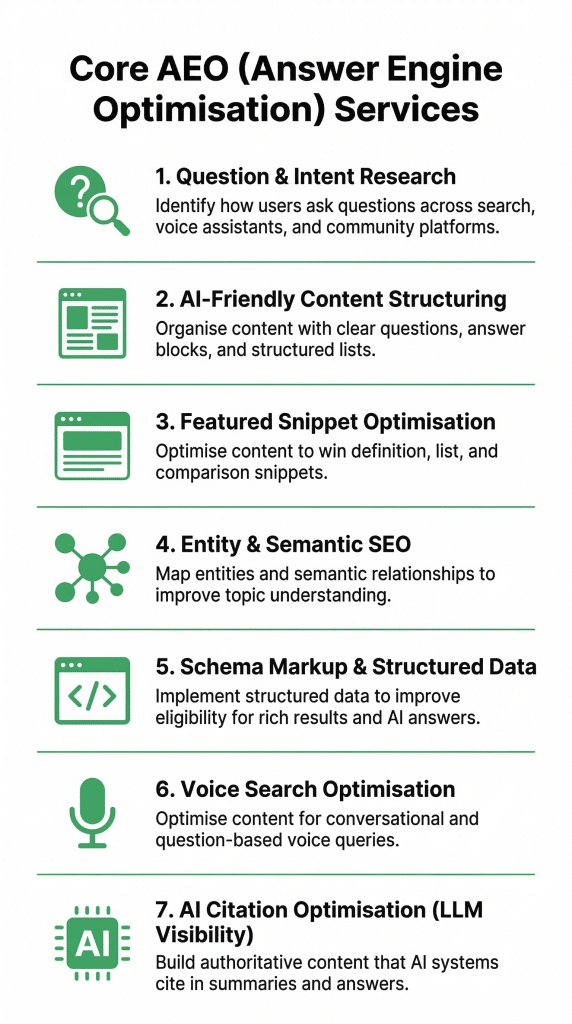
Infographic on core AEO services
Many Answer Engine Optimisation (AEO) practices, such as structuring content with clear answers and targeting question-based queries, can be managed in-house, while more advanced tasks like schema implementation, entity optimisation, and AI visibility monitoring often require specialist tools or agency expertise.
Here are some core AEO services that form the foundation of an effective answer-driven search strategy and help your content appear in AI summaries, featured snippets, and voice search results.
1. Question & Intent Research
AEO begins with identifying how people ask questions, not just which keywords they search.
This includes research across:
- “People Also Ask” questions
- Voice search queries
- Conversational queries
- AI assistant prompts
- Community platforms like Reddit and Quora
Typical deliverables:
- Question-based keyword clusters
- Conversational search queries
- Topic-level intent mapping
Example queries optimised for AEO:
- What is inward remittance?
- Which app has the best exchange rate for sending money to India?
- How long does a US to India money transfer take?
2. AI-Friendly Content Structuring
AEO services optimise content so AI models and search engines can easily extract answers.
This involves:
- Clear question-based headings
- Direct answer blocks (40–60 word summaries)
- Structured lists and tables
- Context-rich definitions
- Entity relationships
Example structure:
H2: What Is Inward Remittance?
Answer block: A 40–50-word direct answer that AI can extract.
Detailed explanation: Additional context, examples, and FAQs.
3. Featured Snippet Optimisation
AEO services optimise pages to win Google Featured Snippets, which are often the source used by voice assistants and AI search results.
Common snippet formats optimised:
- Definition snippets
- Step-by-step lists
- Comparison tables
- Quick facts
Example snippet formats:
- “What is X?”
- “How to do X?”
- “X vs Y comparison”
4. Entity & Semantic SEO
AEO heavily relies on entity recognition and semantic relationships so search engines understand the context of your content.
This includes:
- Entity mapping
- Knowledge graph alignment
- Semantic keyword expansion
- Topic cluster architecture
For example, a remittance page may include entities like:
- transfer fees
- exchange rates
- international wire transfer
- inward remittance
- SWIFT transfers
5. Schema Markup & Structured Data
Structured data helps search engines interpret content more clearly.
Common schemas used in AEO:
- FAQ schema
- HowTo schema
- Article schema
- Organization schema
- Product schema
These increase the likelihood of appearing in:
- rich results
- voice answers
- AI summaries
6. Voice Search Optimisation
Voice search queries tend to be longer and conversational.
AEO services optimise content for queries like:
- “What is the cheapest way to send money from the US to India?”
- “Which remittance service has the best exchange rate?”
This requires:
- natural language content
- conversational phrasing
- concise answer blocks
7. AI Citation Optimisation (LLM Visibility)
AEO now extends to ensuring brands are mentioned or cited by AI systems such as ChatGPT, Google AI Overviews, and Perplexity.
This includes:
- building authoritative topical coverage
- structured comparisons
- brand mentions in communities
- citation-worthy content.
Want to understand why some websites rank higher than others? Explore our guide on understanding domain authority and its role in SEO.
What Is an AEO Audit?
An AEO audit evaluates how well your website and content are optimised to appear as direct answers in search engines, AI platforms, and voice assistants. It focuses on whether your content can be easily extracted and presented in answer-driven results.
So, How To Conduct an AEO Audit? (8 Key Areas to Review)
An AEO audit evaluates how well your website and content are optimised to appear as direct answers in search engines, AI platforms, and voice assistants. It focuses on whether your content can be easily extracted and presented in answer-driven results.
| Audit Area | What to Check | Priority |
| Answer Readiness | Does the page provide a clear, direct answer to the primary question within the first 40–60 words of the section? | High |
| Question & Intent Alignment | Does the content target real user queries, including conversational and voice-style searches? | High |
| Content Structure | Are headings, lists, tables, and short paragraphs used to make answers easy for search engines and AI to extract? | High |
| Schema Markup | Are FAQ, HowTo, or Q&A schema correctly implemented and validated? | High |
| Semantic & Entity Optimisation | Are relevant entities, related terms, and topic clusters used to strengthen contextual understanding? | Medium |
| Featured Snippet Potential | Is the content formatted to capture featured snippets (short definitions, lists, tables)? | High |
| AI Citation Potential | Is the content authoritative, well-structured, and supported with examples or data that AI systems can reference? | Medium |
| Content Freshness | Is the page updated with current data, examples, and insights to maintain relevance in AI and search results? | Medium |
Which Tools Can Help Businesses Track and Improve Their AEO Performance?
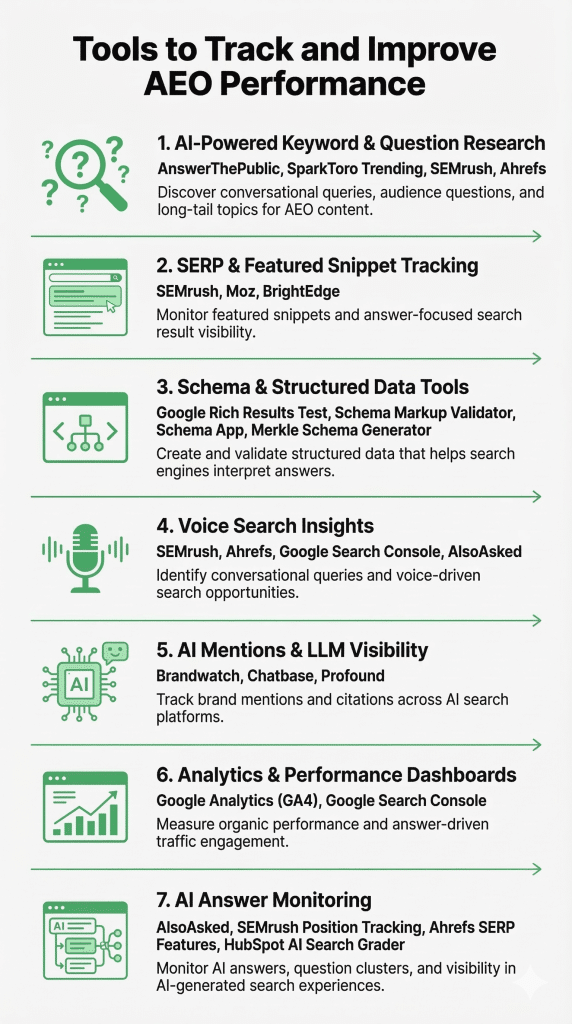
Infographic on tools to track and improve AEO performance
Optimising for Answer Engine Optimisation (AEO) requires structured content, schema signals, and the right set of tools to track performance, uncover opportunities, and refine strategies. Here are some of the most useful tools, organised by function:
1. AI‑Powered Keyword & Question Research
- AnswerThePublic – Question and idea discovery: A search listening tool that reveals real user questions and queries to inform AEO‑focused content.
- SparkToro Trending – Audience and question research: Helps uncover what topics, questions, and conversations your target audience is engaging with across the web.
- SEMrush – All‑in‑one SEO and content insights: Identifies long‑tail and conversational queries critical for AEO planning.
- Ahrefs – Discover user query patterns and cluster question‑based keywords.
2. SERP & Featured Snippet Tracking
- SEMrush – Monitors featured snippet visibility and position changes.
- Moz – Tracks search feature appearances and keyword performance.
- BrightEdge – Enterprise‑level tool for tracking how content performs in answer‑rich SERP features and structured result placements.
3. Schema & Structured Data Tools
- Google Rich Results Test & Schema Markup Validator: Google’s official tool for validating structured data and previewing rich results.
- Schema App – Generate, test, and deploy structured data easily.
- Merkle Schema Markup Generator – Helps you create JSON‑LD markup for structured answers.
4. Voice Search Insights
- SEMrush – Identify question-based keywords, track featured snippets, and analyse how content performs for conversational search queries.
- Ahrefs – Discover long-tail questions, “People Also Ask” opportunities, and featured snippet rankings.
- Google Search Console – Monitor impressions and clicks for natural language queries that often trigger voice or AI answers.
- AlsoAsked – Map-related questions and topic clusters that commonly appear in voice and conversational search.
5. AI Mentions & LLM Visibility
- Brandwatch – Track when your content or brand is referenced across AI and social channels.
- Chatbase – Examine how AI chat platforms interpret or cite your content.
- Profound – Tracks brand visibility and citations across AI search platforms such as ChatGPT, Perplexity, and other LLM interfaces.
6. Analytics & Performance Dashboards
- Google Analytics / GA4 – See organic performance, engagement, and user behaviour from answer‑driven traffic.
- Google Search Console – Identify search features where your pages appear (snippets, people also ask, zero‑click).
7. AI Answer Monitoring
- AlsoAsked – Visualises related questions and People Also Ask clusters to monitor how topics expand in AI-driven search results.
- SEMrush Position Tracking – Tracks featured snippets and SERP features that often power AI and voice answers.
- Ahrefs SERP Features Report – Identifies when pages appear in featured snippets or other answer-driven results.
- Google Search Console – Helps detect question-based queries and impressions that may trigger AI summaries or answer boxes.
- HubSpot AI Search Grader – Evaluates how visible your brand is across AI-driven search experiences and provides recommendations to improve AI discoverability.
Key Insight: Using these tools together helps you track AEO performance holistically, uncover optimisation opportunities, and stay ahead of evolving AI search trends.
If you want to expand your brand’s digital presence, social media is a powerful starting point. Read our guide on boosting brand awareness with social media strategies.
What Are the Limitations of AEO?
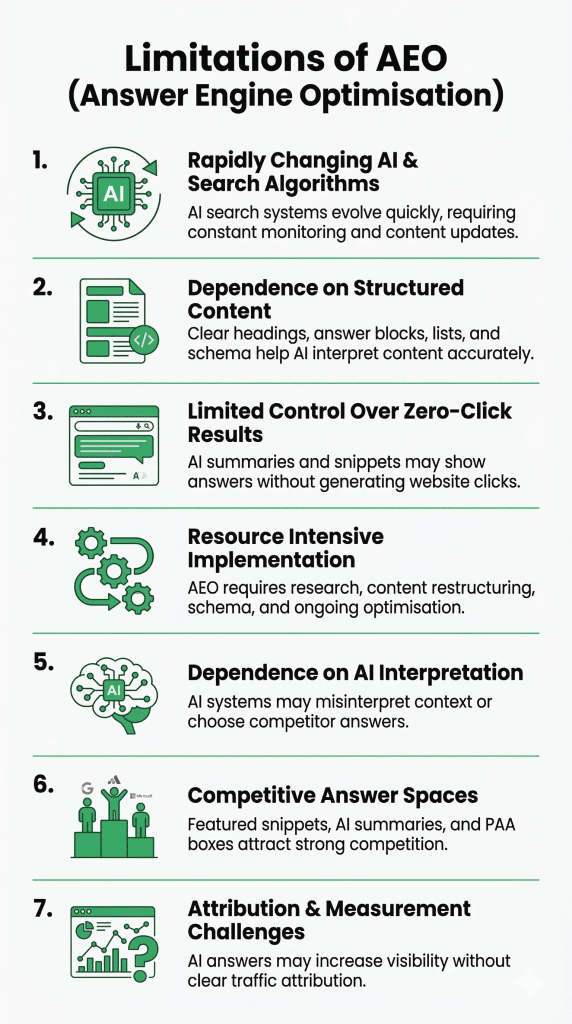
Infographic on limitations of AEO
While the AEO answer engine optimisation can significantly boost visibility, there are several factors businesses need to consider to achieve consistent results:
1. Rapidly Changing AI and Search Algorithms
AI-powered search engines and voice assistants evolve constantly, which means strategies that work today may lose effectiveness as algorithms and AI models update. To stay ahead, regularly monitor AI-driven search results, track which queries display your content, and refresh high-value pages to align with emerging trends.
2. Dependence on Clear and Structured Content
AEO performs best when content is concise and well-organised. Complex topics or poorly formatted content may not be recognised as direct answers. Breaking down information into question-based headings, short answer blocks, lists, and tables, along with schema markup, helps search engines and AI understand the content hierarchy and context.
3. Limited Control Over Zero-Click Results
Even optimised content may not receive clicks because answers appear directly in AI summaries or featured snippets. To maximise engagement, include callouts, links to deeper resources, visuals, or examples to encourage users to explore more of your content while building brand authority.
4. Resource Intensive
AEO requires research, content restructuring, semantic optimisation, and schema implementation, which can be demanding for smaller teams. Focus on high-impact pages and top questions first, leverage tools for research and schema generation, and consider outsourcing or automating repetitive tasks.
5. Dependency on AI Interpretation
AI systems may misinterpret nuanced content or select competitor answers, even when your content is optimised. Using clear, unambiguous language, providing multiple supporting examples, and building context-rich entity relationships helps reinforce authority and increases the chances of being selected as the answer.
6. Competitive Answer Spaces
Featured snippets, People Also Ask boxes, and AI summaries are highly competitive. Many brands target the same queries, making it harder to maintain visibility. Offering unique examples, comparisons, case studies, and up-to-date data, combined with traditional SEO, helps your content stand out while capturing both clicks and answer-driven exposure.
7. Attribution Complexity
AEO performance can be difficult to measure because AI answers, featured snippets, and voice results often display information without generating clicks or clearly attributing the source. This means brands may gain visibility but see limited traffic in analytics. Tracking impressions, brand mentions, and presence in AI answers alongside traditional SEO metrics can help better assess AEO’s impact.
Modern SEO is shifting toward automation and data-driven optimisation. Learn why programmatic SEO is becoming the future of search engine optimization.
How Can Wild Creek Web Studio Amplify Your Digital Growth?
Looking to turn your website into a growth engine? Wild Creek Web Studio helps brands boost visibility, drive traffic, and generate measurable results. With 18+ years of experience and over 100+ satisfied clients, we combine modern design, data-driven SEO, PPC, and digital strategy to deliver real business impact.
From high-performing websites to full-funnel marketing campaigns and social media engagement, we craft digital experiences that attract the right audience, build credibility, and drive conversions. Our focus on clarity, strategy, and measurable results makes us the go-to partner for brands ready to amplify their digital impact.
Final Words
Answer Engine Optimisation is how modern search works. AI, voice assistants, and featured snippets prioritise clear, structured answers over traditional ranking alone. By combining AEO with traditional SEO, structuring content effectively, adding schema, and tracking performance, your content can become the go-to answer for your audience.
AEO improves visibility while building authority, trust, and brand recognition in zero-click environments. The more intentional your strategy, the better your chances of standing out, earning AI citations, and turning search exposure into real business impact.
With AEO, your content is not just seen, it is used, trusted, and remembered.
Frequently Asked Questions
What is AEO SEO?
AEO SEO (Answer Engine Optimisation) is the practice of optimising content so search engines and AI systems can directly extract clear answers. It focuses on structured content, concise responses, and semantic relevance to increase visibility in AI-generated results.
How can local businesses benefit from answer engine optimisation?
Answer engine optimisation helps local businesses appear in AI-generated answers and voice searches for local queries. By providing clear information about services, locations, and pricing, businesses can increase visibility, attract nearby customers, and generate more qualified leads.
How to use answer engine optimisation?
Use AEO strategies to structure AEO content for search platforms by aligning with user intent, optimising for natural language processing, and combining keyword research with content strategy. Focus on content quality, brand visibility, and search rankings.
What is the difference between AEO T2 and AEO T3?
AEO T2 focuses on traditional search results and keyword rankings, while AEO T3 emphasises generative engine optimisation, AI-driven search behaviours, and enhanced brand visibility across evolving search platforms.
What is the best answer engine optimisation for AI?
The best AEO uses generative AI insights, aligns AEO content with search intent, leverages original research and technical SEO, and prioritises brand visibility, content quality, and organic search results for measurable success metrics.
What are the best options for Answer Engine Optimisation in AI?
The best AEO options combine generative engine optimisation, structured AEO content, keyword research, alignment with user intent, and technical SEO, ensuring high content quality, brand visibility, and strong performance across search platforms and organic search results.
Is AEO replacing SEO?
AEO complements rather than replaces search engine optimisation. While it emphasises AI-driven content and natural language processing, traditional SEO remains critical for search rankings, domain authority, and visibility metrics across traditional search engines and organic search results.
How does getting cited by AI answer engines help increase website authority?
Being cited by AI answer engines enhances brand visibility and signals trust to search platforms, improving domain authority, reinforcing content quality, and increasing overall brand awareness, which strengthens organic search results and the future of search performance.