Key Highlights
- Customer journey maps reveal motivations, emotions, and friction points that data alone cannot show.
- They help you understand the journey from the customer’s viewpoint, not internal assumptions.
- Mapping supports a clearer strategy through the 4S principles of Scope, Sequence, Speed, and Synergy.
- A strong journey map requires clear goals, focused personas, real stages, and evidence-backed insights.
- End-to-end mapping shows how each stage drives the next, shaping loyalty and long-term outcomes.
- E-commerce journey mapping reduces cart abandonment and improves conversions through transparency and friction removal.
- Wild Creek Web Studio helps businesses turn journey insights into actionable growth strategies.
If your customers keep dropping off midway, hesitating before they purchase, or disappearing without converting, the issue is rarely the product. It is the overall experience. Most businesses do not have a full picture of what their customers actually encounter, and that blind spot leads to friction, missed opportunities, and uneven results.
A customer journey map changes that. By visualising every touchpoint and emotion your customer experiences, you can clearly see what is working, where they get stuck, and how to create a smoother, more persuasive path to conversion.
In this blog, you will learn what a customer journey map is, why it matters, and how it fits into the 4S marketing framework to make your strategy more focused, efficient, and customer-led.
What Is a Customer Journey Map?
A customer journey map is a clear picture of how a customer moves from discovering your brand to becoming a buyer. It highlights what they do, what they look for, and what holds them back at each stage.
It helps you see the journey from the customer’s viewpoint, not the company’s assumptions. You can quickly spot confusing moments, missing information, or touchpoints that need improvement.
In the 4S marketing framework, this supports scope because it gives you the clarity you need to understand your customer before planning any marketing action.
For a deeper look at how customers move from strangers to loyal buyers, explore The 5 A’s of Converting Strangers Into Customers.
Why Is Customer Journey Mapping Important?
Customer journey mapping is important because it shows you what customers actually experience at every step. With a clear view of their questions, frustrations, and motivations, you can understand what helps them move forward and what pushes them away.
This clarity makes it easier to fix weak points in the journey and strengthen the moments that matter most. It also helps your marketing, sales, and support efforts work together with a shared focus on improving the overall experience.
By understanding these insights early, you can make smarter decisions that keep customers engaged and guide them smoothly from one stage to the next.
How to Create a Customer Journey Map Using a Structured 4S Approach?
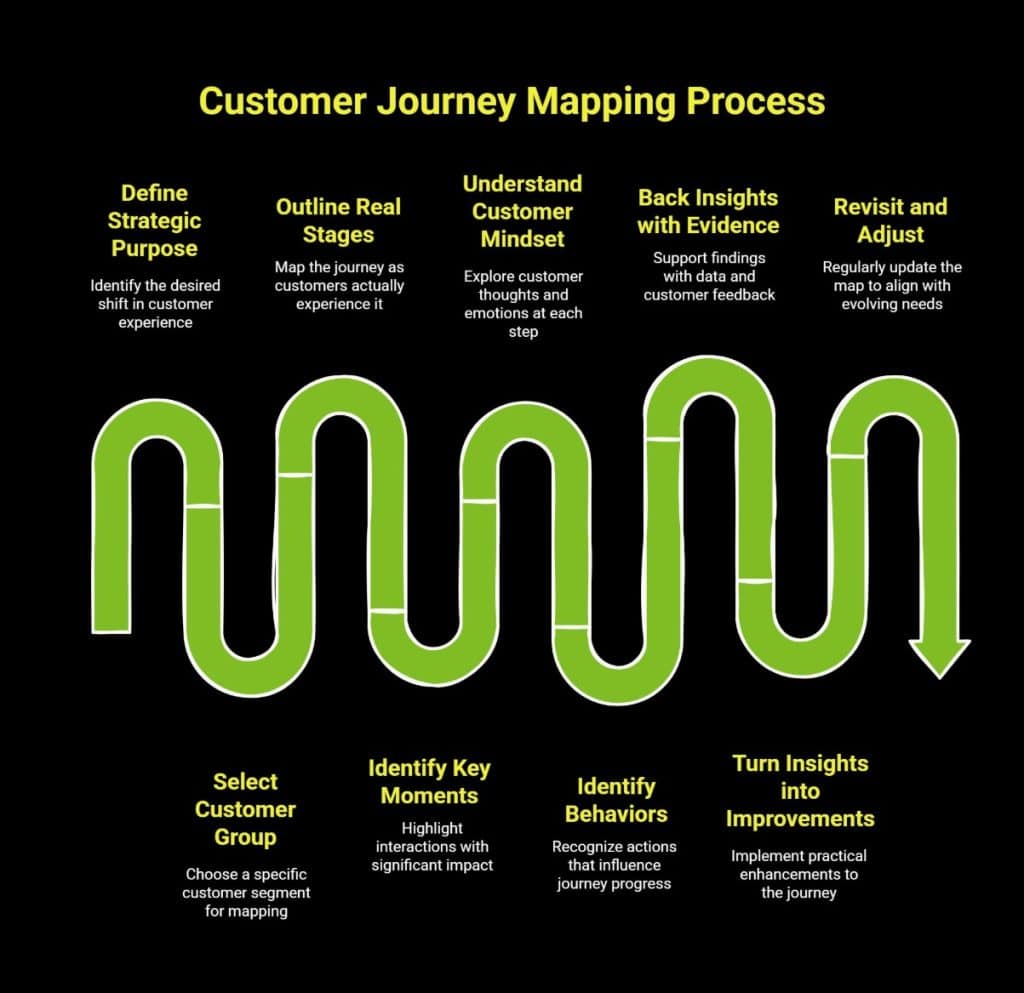
Infographic showing customer journey mapping process
Creating a customer journey map becomes far more effective when you follow a structured process that helps you understand the customer’s world with clarity and intention. Below is a step-by-step approach that gives you depth, direction, and practical insights you can use immediately.
1. Define the Journey’s Strategic Purpose
Start by identifying the specific shift you want to create in the customer experience. A journey map becomes meaningful only when it is built with intention.
For example, you may want to shorten the time it takes for a user to decide, reduce confusion during onboarding, or strengthen loyalty after purchase.
When this purpose is clear, every part of the map is tied to a measurable business outcome. This directly reflects strategic clarity, which is essential before any action can be taken.
2. Select the Customer Group That Will Move the Needle
Choose a customer segment that has a direct influence on your goal. Rather than mapping “all customers,” focus on a group whose decisions matter most. For instance, new visitors, repeat buyers, hesitant evaluators, or long-term users.
Each has a different mindset and expectation. By narrowing the focus, you gain deeper insight into a real customer journey instead of diluting the map with general assumptions. This aligns with understanding Scope in a meaningful way.
3. Outline the Real Stages Customers Move Through
Map the journey the way customers actually experience it, not the way your internal processes describe it. Replace internal terms like “MQL” or “pipeline” with customer-focused stages such as “I am researching,” “I am comparing,” or “I am ready to decide.”
This reframes the map around customer intent, and once the sequence is visible, it becomes easier to understand how each stage influences the next. This mirrors the logic of Sequence, where order shapes decisions.
4. Identify the Moments That Shape Perception
Not every touchpoint is equally important. Focus on the interactions that carry emotional or functional weight because these moments often decide whether a customer will continue or stop.
It could be a pricing page, a demo request form, a checkout step, a support interaction, or even a well-timed email. Highlighting these high-impact moments brings clarity to where improvements matter most and prevents wasted effort.
5. Understand the Customer’s Mindset at Each Step
At every important moment, uncover what customers are trying to accomplish, what information they need, and what doubts stand in their way.
For example, a customer might be excited but confused, or ready to buy but unsure about value. When you explore mindset alongside actions, you uncover the emotional drivers behind behaviour. This makes your improvements more human, relevant, and experience-driven.
6. Identify the Behaviours That Slow or Accelerate Progress
Look not only for what frustrates customers, but also for what helps them move smoothly from one step to the next. These behavioural patterns often reveal simple but powerful improvements.
For example, clear explanations, better timing, transparent pricing, or a more intuitive interface can significantly increase momentum.
By understanding behaviours, you move beyond surface-level pain points and tap into changes that speed up decision-making.
7. Back Every Insight with Real Evidence
A journey map becomes far more valuable when insights are supported by data such as drop-off rates, page analytics, support logs, or customer interviews.
Evidence helps you see the scale of each issue and prevents you from prioritising based on assumptions. This creates a more confident and actionable map that teams can rely on with clarity.
8. Turn Insights into Experience Improvements
Once the journey is understood, convert your findings into practical enhancements. This may include simplifying steps, adding clarity where customers hesitate, strengthening reassurance at key moments, or improving communication across touchpoints.
Good opportunities should make the journey feel easier, faster, and more intuitive. This is where the map directly fuels decision-making and performance.
9. Revisit the Journey as Customer Expectations Change
A journey map is never final because customers evolve, markets shift, and internal processes change. Revisit the map regularly to check whether the experience still aligns with customer expectations.
Adjust and refine based on new data and learnings. This keeps your customer experience relevant and ensures the journey remains aligned with future goals, not past assumptions.
Creating a customer journey map is not just an exercise in documentation. It is a strategic tool that helps you understand your customer deeply, refine your experience thoughtfully, and make better decisions with confidence.
How Can End-to-End Customer Journey Mapping Help You See the Full Lifecycle?
End-to-end customer journey mapping gives you a complete view of how customers move from their first interaction with your brand to the moment they choose to stay loyal and recommend you.
This wide-lens approach matters because today’s customer journey is no longer linear. Research by Uniform Market shows that customers switch between six different channels before making a decision.
The lifecycle itself is straightforward. It begins with Awareness, when customers first come across your brand. It progresses into Consideration, where they compare options and assess whether your solution meets their needs. From here, they reach the Purchase stage, where interest becomes action.
The next stage is Retention, where their experience after buying shapes long-term loyalty. The final stage is Advocacy, when satisfied customers start recommending or promoting your brand.
Understanding the full path helps you see how each stage influences the next. A strong first impression can support faster consideration.
A smooth purchase experience can strengthen retention. A helpful post-purchase moment can encourage advocacy.
This complete view aligns naturally with the thinking behind the 4S marketing framework by giving you clarity, structure, and a more strategic way to improve the journey from beginning to end.
How Do You Map an E-commerce Customer Journey That Actually Converts?
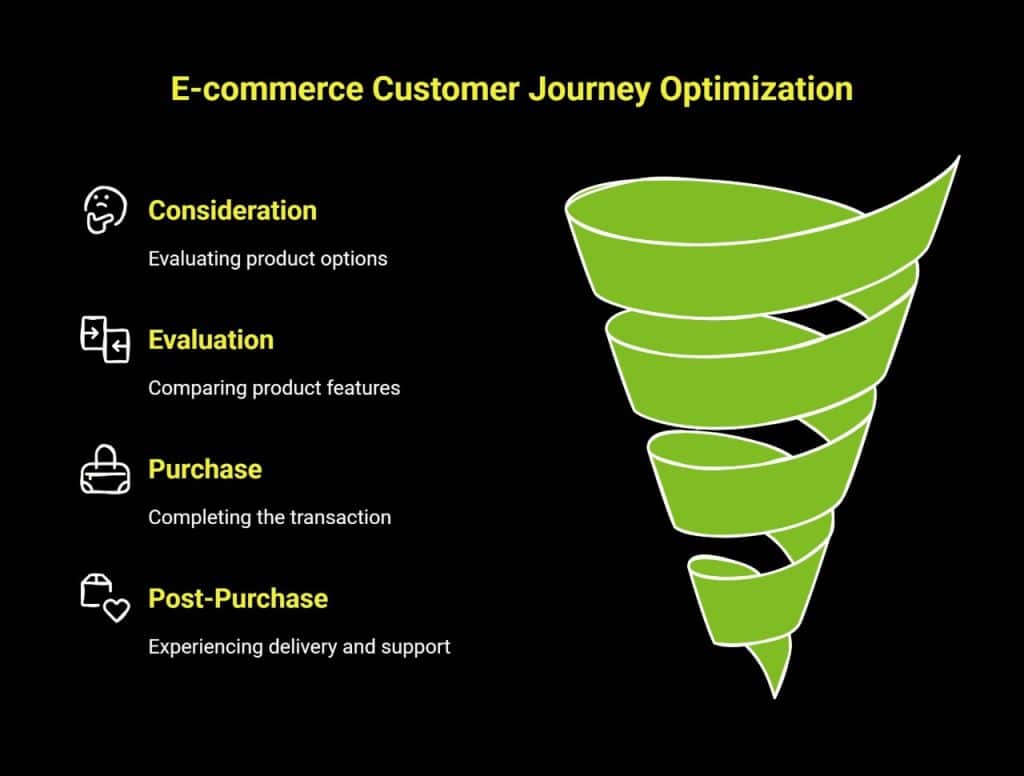
Infographic showing E commerce journey optimization
In the world of e-commerce, the journey doesn’t simply end at checkout-it starts much earlier and often veers off path at unexpected moments.
Studies by Convertcart reveal that the global average shopping cart abandonment rate is around 70%, meaning nearly 7 out of 10 shoppers never complete the checkout. This underscores how fragile the e-commerce customer journey map is; every touchpoint must be optimised.
When mapping the e-commerce journey, capture not only the stages of consideration, evaluation, purchase, and post-purchase, but also the micro-moments when buyers pause, compare, and decide whether to continue or jump elsewhere.
For example, unexpected shipping fees are cited by 48% of shoppers as the main reason they abandon carts. Knowing this, a journey map must highlight where transparency breaks down in checkout, delivery expectations, or trust building.
To apply this effectively:
- Start by plotting the customer’s path from discovery to checkout to repeat purchase, including all devices and channels.
- Use recorded research to identify specific pain points like confusing shipping terms, forced log-ins, or slow page load times.
- Quantify impact by referencing industry benchmarks and comparing your own metrics.
- Prioritise fixes that deliver the biggest returns; reducing cart abandonment by even a few percentage points can drive substantial revenue.
- Finally, track post-purchase behaviour; loyalty and advocacy in e-commerce often come from frictionless returns, fast delivery, and communication after the sale.
By using solid data, you transform a customer journey map from a visual exercise into a strategic instrument. For ecommerce businesses, doing this well means not just improving conversion today, but building the foundation for repeat customers and sustainable growth.
What Makes a B2C Customer Journey Map Essential for Consumer Success?
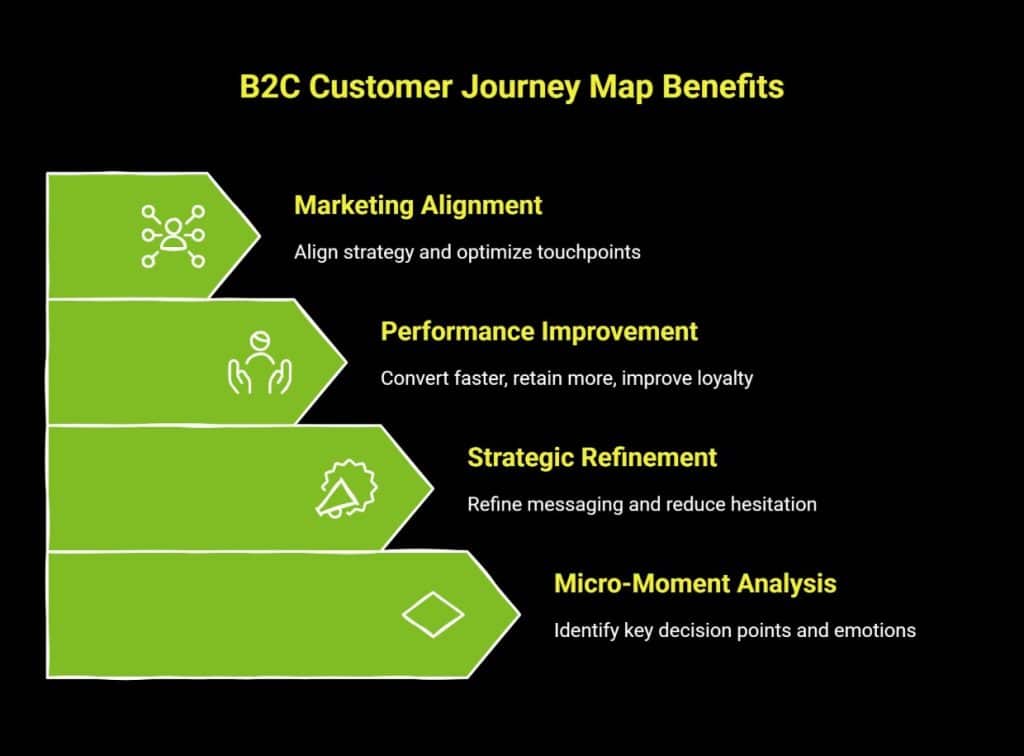
Infographic showing B2C customer journey benefits
In a B2C environment, decisions are often quick, emotionally influenced, and shaped by many micro-touchpoints. According to research from Hanover Research, nearly 47% of companies use journey mapping to identify and enhance touchpoints across the buyer experience. This statistic highlights that journey mapping is not just a buzzword; it is a recognised strategic tool.
When consumers engage with a brand today, they don’t follow a neat linear path. They research on multiple channels, compare options, check social proof, and may abandon or return at any time.
Mapping the B2C journey gives you insight into:
- Where consumers pause and re-think their decision?
- Which emotions, such as doubt, excitement, or urgency, play in each stage?
- Which touchpoints (social media, online reviews, influencer mentions) disrupt or accelerate movement?
By analysing these micro-moments, you can refine messaging, reduce hesitation, and connect with consumers at exactly the right time.
For instance, if your map shows a large drop-off during comparison, you might introduce real-time chat or comparison tools to reduce friction.
Ultimately, a strong B2C customer journey map translates directly into better performance. It helps you convert faster, retain more, and improve overall loyalty.
With clearer visibility into the path a consumer takes, you can align your marketing strategy, optimise key touchpoints, and deliver an experience that feels intuitive and connected.
How the 4S Framework Becomes More Effective With Journey Mapping
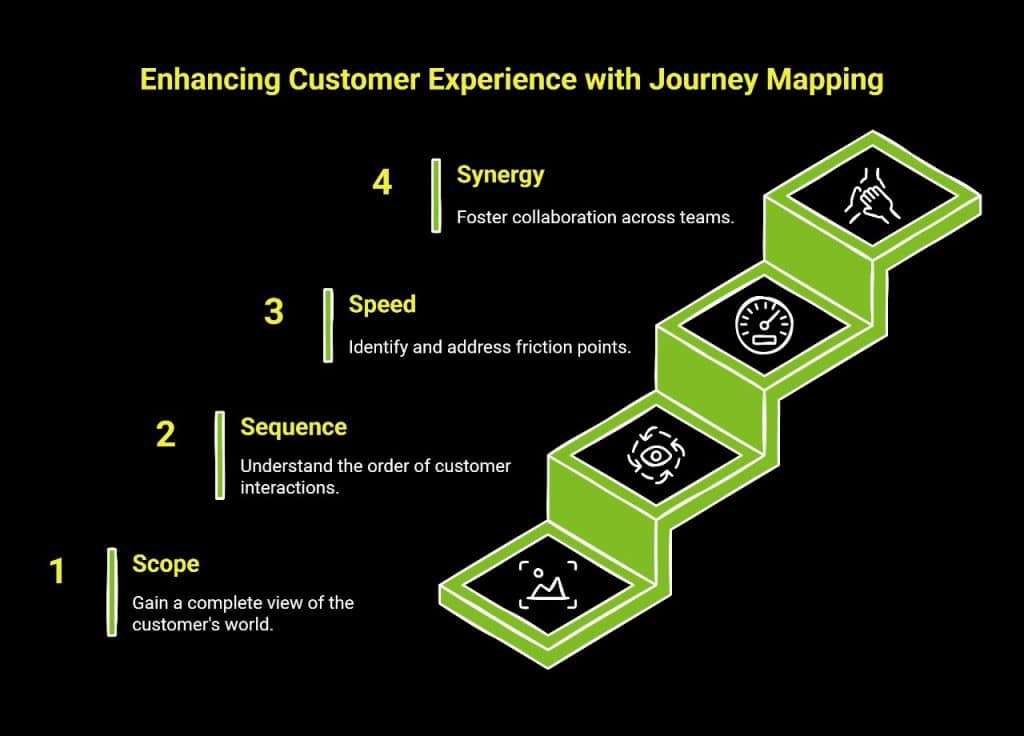
Infographic on enhancing customer experience with journey mapping
Customer journey mapping and the 4S marketing framework work well together because both focus on understanding how customers move, decide, and interact with your brand.
A journey map gives you the clarity you need, and the 4S framework turns that clarity into structured action. When combined, they create a more organised and customer-centred approach to improving your experience.
Here’s how journey mapping supports each 4S principle:
- Scope: Journey mapping gives you a complete view of the customer’s world. It shows you what customers expect, what confuses them, and what motivates them across the entire lifecycle. This depth of understanding forms the foundation for every strategy built within the 4S framework.
- Sequence: A journey map helps you see the order in which customers move through awareness, evaluation, purchase, and post-purchase moments. With this sequence visible, you can prioritise improvements that follow the customer’s natural flow instead of tackling issues at random.
- Speed: Mapping the journey highlights friction points, unclear steps, and moments where customers slow down or drop off. When you address these barriers, the experience becomes faster and more intuitive. This supports the Speed principle by helping customers progress with less effort.
- Synergy: A clear journey map creates a shared understanding across marketing, sales, product, and support teams. Everyone can see how their work impacts the customer experience, which makes alignment and collaboration easier. This strengthens overall consistency and creates a unified journey.
When customer journey mapping is aligned with the 4S marketing framework, you gain both insight and structure. You understand the customer more deeply and have a clear way to prioritise and coordinate the improvements that follow.
Grow Smarter With Wild Creek Web Studio
Most businesses struggle online not because they lack potential, but because they lack clarity. Traffic comes in but doesn’t convert, competitors outrank them easily, and marketing feels scattered with no real direction. We understand how frustrating that can be.
At Wild Creek Web Studio, we help you cut through that confusion. With over 18 years of experience, we focus on building strategies that deliver measurable outcomes, not noise. We combine technical SEO, performance-driven content, and tailored digital planning to improve visibility, attract the right customers, and build lasting authority.
Everything we do is grounded in data and aligned with your goals, so you always know why a strategy matters and how it contributes to growth. If you are ready to move from uncertain efforts to confident, structured marketing, we are here to help you turn clarity into real momentum.
Ready to Improve Your Customer Journey? Let’s Talk.
Final Words
Great customer experiences don’t happen by accident. They happen when you intentionally design every moment with clarity and purpose. A customer journey map gives you the power to spot what others miss and fix what slows your customers down.
Start small. Pick one stage of your journey and make it better today. Even a single improvement can shift how customers feel, decide, and return.
Your customers are already moving. The question is whether they are moving with you. Now is the time to create the journey they actually want to follow.
Frequently Asked Questions
Are there templates for creating a customer journey map?
Yes. Many templates offer a visual representation of the entire customer journey, helping you map customer needs, customer actions, and touch points across different stages. These tools use customer data, customer persona details, and best practices to improve customer satisfaction and retention.
Can you give an example of a simple customer journey map?
A basic customer experience map might include initial awareness, the consideration stage, the checkout process, and customer support. Each stage of the customer journey lists customer interactions, customer’s perspective, and user experience insights to reveal valuable insights aligned with business goals.
What mistakes should I avoid when making a customer journey map?
Avoid ignoring customer surveys, relying only on assumptions, or skipping parts of the customer lifecycle. Failing to reflect the current state, buyer journey, or entire journey reduces journey analytics’ usefulness and weakens actionable insights for digital marketing, sales reps, and your customer journey mapping process.
Who in a company should be involved in customer journey mapping?
The customer service team, sales team, marketing, product, customer success, and any team member who interacts with potential customers should join the journey mapping process. This collaboration ensures real customer experiences shape a comprehensive view of the customer’s journey.
What are the 5 A’s of a customer journey map?
The 5 A’s typically include Awareness, Appeal, Ask, Act, and Advocate. These stages of the customer journey describe how potential customers move from discovery to brand loyalty, helping teams gain a deeper understanding of the buyer’s journey and overall customer experience.
Any quick way to visualise customer journey maps?
You can quickly visualise the user journey using simple diagrams, a service blueprint, flowcharts, or live chat transcripts. These tools offer a great way to map the entire customer experience and highlight customer touchpoints for a strategic approach.
What are some recommended resources for journey mapping?
Use customer journey map examples, buyer persona guides, market research tools, and customer feedback platforms. These resources help you understand customer behaviour, uncover customer pain points, and use customer journey maps effectively to gain a competitive advantage and improve customer service.
Why customer journey mapping is important for e-commerce?
Customer journey mapping is important for e-commerce because it highlights friction, improves conversions, and strengthens customer experience journey mapping. It helps brands understand online behaviour, refine content, and use customer journey map marketing to deliver smoother paths from discovery to purchase and retention.
What are the main benefits of customer journey mapping?
The main benefits of customer journey mapping include clearer insight into customer expectations, reduced friction, and stronger engagement. It improves customer experience journey mapping, supports better decisions, and helps customer journey map marketing teams create targeted messages that lead to higher satisfaction, conversions, and repeat sales.
What mistakes should I avoid when making a customer journey map?
Avoid skipping research, overlooking emotional triggers, or ignoring key touchpoints. Many teams miss the benefits of customer journey mapping by relying on assumptions. A strong customer experience journey mapping process and accurate customer journey map marketing insights ensure your map reflects real behaviour and needs.