Key Highlights
- AI content is fast but often generic, flat, and lacks emotion or cultural nuance
- Human editing adds personality, storytelling, clarity, and brand voice
- AI content editing involves reviewing drafts, correcting errors, improving flow, and enhancing context
- AI limitations: pattern-based writing, limited emotional intelligence, repetitive phrasing, misses cultural nuances, lacks creativity
- Human editing strategies: infuse brand voice, improve readability, fact-check, add context, optimize SEO naturally, correct grammar and style
- Editing checklist: review tone/style, check readability, verify facts, enhance engagement, SEO optimization, final proofread
- Tools for human editing: Grammarly, Hemingway, Wordtune, Jasper, Frase, Originality.ai, GPTZero
- Humanizing content: localize language, adjust tone, add empathy, humor, and storytelling
- Human-edited content benefits: higher engagement, improved SEO, brand consistency, error prevention, audience relevance
- Wild Creek Studio helps refine AI content into polished, authentic, and engaging output
- FAQs cover AI detection, legality, editing, consistency, and limits of AI tools
Can AI truly replace the creativity and intuition that humans bring to content creation? With AI tools promising instant text and image generation, it’s natural to wonder where the human touch still fits in. Yet many businesses struggle when the output feels robotic, lacks personality, or fails to connect with their audience.
This blog explains how to edit AI content effectively, showing how a human touch can transform automated drafts into engaging, authentic content. By exploring common pitfalls of AI-generated content and practical editing strategies, you’ll gain a clear understanding of how to make AI work for you, without losing creativity, context, or authenticity.
What is AI Content Editing and How Does It Work?
AI content editing focuses on refining, restructuring, and improving content that has already been produced by artificial intelligence tools. Unlike AI content creation, which involves generating text or visuals from prompts, AI content editing begins after the draft is ready. The goal is to make machine-generated content sound natural, align with the brand voice, and connect with real audiences.
Editors carefully review the AI-generated draft to correct inaccuracies, enhance flow, adjust tone, and improve clarity. They also ensure SEO optimization, add missing context, and bring in emotion and creativity that AI often overlooks. In essence, AI content editing is where human skill turns an automated draft into high-quality, authentic content.
Why Does AI-Generated Content Lack Depth and Personality?
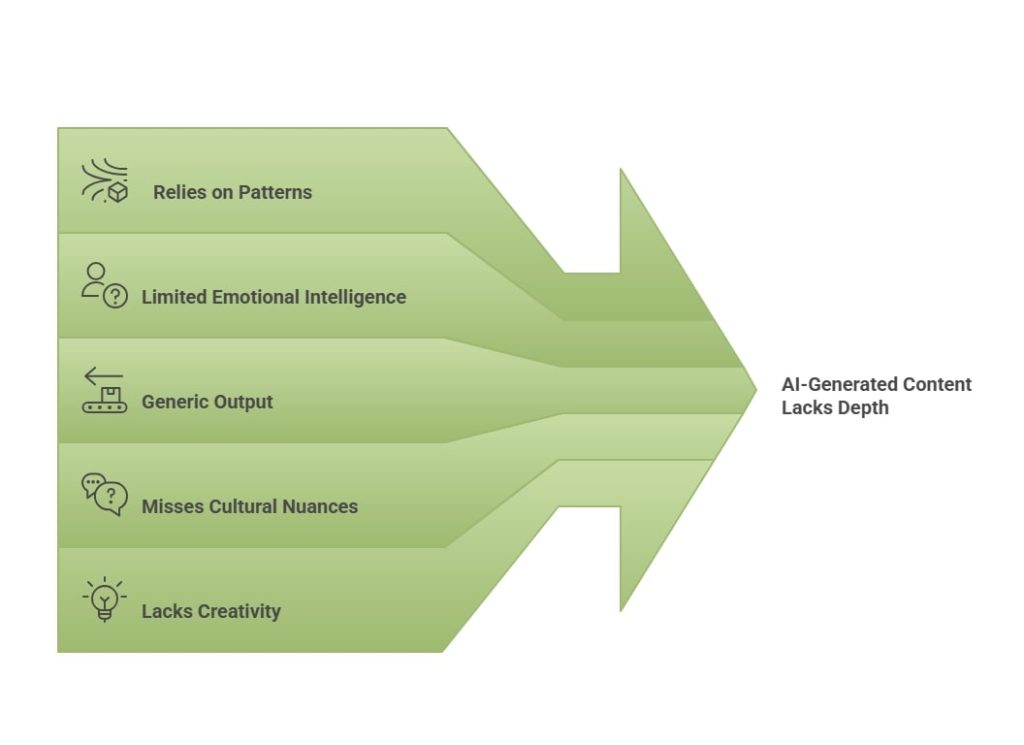
Infographic of Why Ai generated content lack of depth
1. Relies on Patterns, Not Experiences
AI generates content by analyzing data and identifying patterns, but it lacks personal experiences or storytelling ability. For example, if asked to describe a sunrise at a beach, AI might write, “The sun rises over the water, casting orange and yellow hues.” A human, however, could capture the moment more vividly: “The first rays of the sun kissed the gentle waves, and the salty breeze carried the scent of morning as seagulls danced above.”
2. Limited Emotional Intelligence
AI struggles to convey emotions, humor, or empathy, which are crucial for connecting with readers. For instance, when writing about a farewell party, AI may produce a generic sentence like, “Everyone said goodbye at the party.” A human could describe it as, “Tears glistened in eyes as friends exchanged hugs and laughter, trying to hold onto memories of countless shared moments.”
3. Generic and Repetitive Output
AI can quickly generate content, but it often feels formulaic and lacks a unique voice. A product review from AI might read, “The phone is good. It has a fast processor and a clear camera.” A human reviewer could make it engaging: “Snapping photos feels like a breeze with this phone, and apps open instantly, making every task seamless and satisfying.”
4. Misses Cultural Nuances
Subtle language cues, local expressions, and context are difficult for AI to interpret accurately. For example, AI might describe a traditional festival as “People celebrate with food and music.” A human could convey it more authentically: “Families gather to savor spicy tamales, laughter echoing as children chase fireworks in the warm night air.”
5. Lacks Creativity
AI cannot innovate or think beyond its programming, so imaginative ideas and fresh perspectives are missing. For instance, AI might describe a story plot plainly: “A hero defeats a villain to save the town.” A human storyteller could make it compelling: “Against the backdrop of a stormy night, the hero’s courage ignited hope as the villain’s shadow receded, leaving the town to breathe freely again.”
Because of these limitations, human editing is essential to add personality, depth, and authenticity to AI-generated content, transforming flat drafts into writing that resonates with real readers.
Why AI-Generated Content Often Feels Flat
AI content tools are fast and efficient, but their output often lacks depth, personality, and emotional resonance. This is because AI relies on patterns rather than real experiences, struggles to convey emotions, produces generic or repetitive content, misses cultural nuances, and cannot think creatively beyond its programming.
For example, AI describing a sunrise at a beach might write, “The sun rises over the water, casting orange and yellow hues.” A human could make it vivid and emotional: “The first rays of the sun kissed the gentle waves, and the salty breeze carried the scent of morning as seagulls danced above.”
Similarly, AI might describe a festival as “People celebrate with food and music,” while a human could capture, “Families gather to savor spicy tamales, laughter echoing as children chase fireworks in the warm night air.”
How Can Human Editing Enhance AI-Generated Content?
Even the most advanced AI tools cannot fully replicate the creativity, context, and authenticity of human writing. Human editing is essential to transform AI drafts into content that truly connects with readers.
- Adding personality and brand voice: AI might write, “Our product is good and useful.” A human editor can turn it into, “Our product makes your mornings easier and your tasks lighter, just like a trusted companion you can rely on every day.”
- Improving clarity and readability: AI can produce long, awkward sentences such as, “The software is designed in a manner that allows for efficient use by users.” Human editing simplifies it to, “The software is easy to use and helps you work efficiently.”
- Fact-checking and adding context: AI may state, “The city has many historic sites.” A human editor can enhance it: “The city boasts landmarks like the 18th-century cathedral and cobblestone streets that tell centuries of history.”
- Optimizing for SEO naturally: Instead of keyword stuffing, human editors incorporate terms seamlessly: “Travelers exploring Rome will enjoy hidden gems beyond the Colosseum, perfect for an authentic Italian experience.”
- Correcting grammar and style: AI might produce, “Each of the team members are responsible for their tasks,” which human editing fixes to, “Each team member is responsible for their tasks.”
By combining AI efficiency with human insight, businesses can create quality content that is not only accurate and optimized but also engaging, memorable, and truly reflective of their brand. Start leveraging human editing today to turn automated drafts into compelling stories that resonate with your audience.
Fix AI’s Weak Spots With Human Editing Checklist
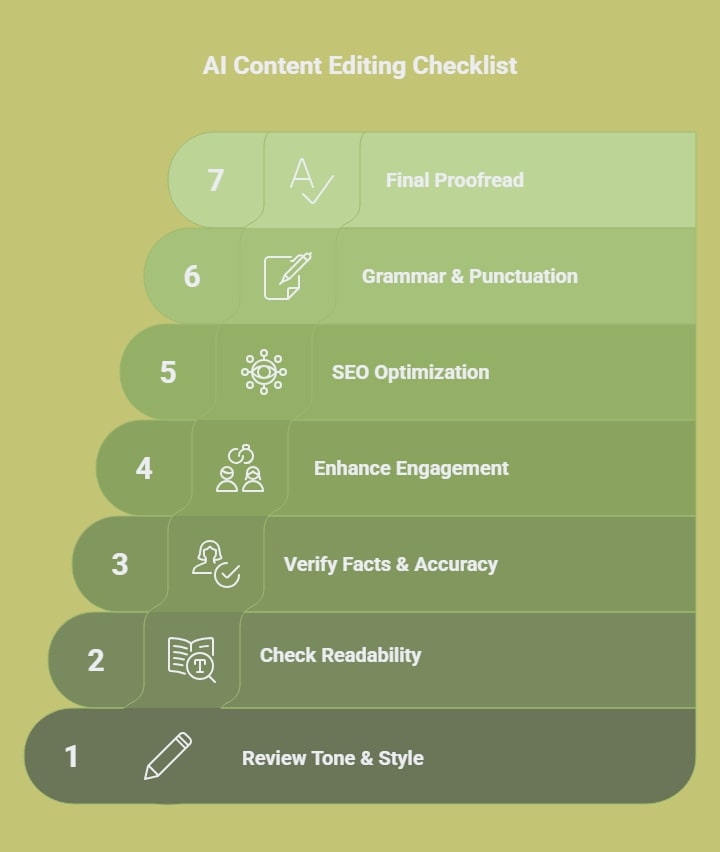
Infographic of AI content editing checklist
To make the most of AI-generated drafts, follow this practical checklist with actionable tips and examples:
- Review tone and style: Ensure the content reflects your brand voice. For instance, change “Our software helps users” to “Our software empowers you to breeze through tasks,” if your brand voice is friendly and approachable.
- Check readability: Break up long sentences and simplify complex phrasing. AI might write, “The implementation of this feature allows for enhanced productivity in multiple workflows,” which can be edited to, “This feature helps you work faster and smarter.”
- Verify facts and accuracy: Confirm dates, statistics, names, and references. AI may misstate facts like “The Eiffel Tower was built in 1900”, correcting it to 1889 ensures credibility.
- Enhance engagement: Add storytelling, anecdotes, or examples to make content relatable. For a travel blog, replace “The city has many parks” with “Families flock to Sunflower Park, where children chase ducks across the pond and locals enjoy morning yoga sessions.”
- SEO optimization: Integrate target keywords naturally into headings, meta descriptions, and content. Avoid keyword stuffing; for example, instead of repeating “best travel tips” multiple times, use variations like “top travel hacks” or “must-know travel advice.”
- Grammar and punctuation: Correct errors and awkward phrasing. AI may write, “Each of the team members are responsible for their tasks,” which should be, “Each team member is responsible for their tasks.”
- Final proofread: Read aloud to catch repetitive phrases, robotic patterns, or inconsistent tone. Experienced editors should also look for AI quirks, like repeated sentence starters or unnatural transitions, and smooth them out.
Following this checklist ensures AI-generated content becomes polished, engaging, and professional, ready to capture readers’ attention and reflect your brand’s authenticity.
What Tools Turn AI Drafts Into Polished Content?
While human editing is essential for refining AI-generated content, leveraging the right tools can make the process faster, more accurate, and effective. These tools assist editors in improving grammar, clarity, SEO performance, and even detecting AI-generated patterns that need more human touch.
1. Grammar & Clarity Platforms
Grammar and clarity platforms are essential tools for refining AI-generated content. They go beyond simple spell-checking to suggest improvements in punctuation, sentence structure, readability, and word choice. These tools help ensure your content is error-free, easy to read, and aligned with your brand’s style guide.
Here’s a quick comparison of how these tools can help:
| Tool | Key Editing Features | Best For |
| Grammarly | Grammar, punctuation, style suggestions, tone detection | Polishing AI-generated drafts for professional writing |
| Hemingway | Readability scoring, sentence simplification, passive voice detection | Making content concise and easy to read |
| Wordtune | Rewriting suggestions, tone adjustment, sentence variation | Improving clarity and adapting content for different audiences |
| Jasper | Brand voice alignment, content phrasing suggestions, SEO integration | Refining AI-generated marketing copy |
| Frase | Content gap analysis, SEO suggestions, structure improvement | Optimizing AI-generated blog posts and long-form articles |
2. AI Detectors and Analysis Software
AI detectors and analysis tools help editors identify sections of content that may feel robotic, repetitive, or lacking originality. These tools are especially useful for spotting predictable phrasing or overused patterns in AI-generated drafts, allowing editors to focus on adding creativity, context, and personality.
- Originality.ai evaluates content for AI-generated text, plagiarism, and SEO compliance. It provides a percentage score indicating how likely the content was created by AI versus written by a human. Editors can use this score to pinpoint sentences that need more authentic phrasing or deeper insights.
- GPTZero, on the other hand, focuses on detecting predictability and burstiness in text. It highlights parts of the content that follow overly structured or formulaic patterns typical of AI. By reviewing these flagged sections, human editors can introduce natural variations, storytelling elements, or emotional nuance.
Humanizing AI Content for Target Audiences
AI-generated content often reads like a set of facts on autopilot, it can be accurate, but it usually lacks the subtle touches that make writing relatable and memorable. Human editors bring these touches, shaping content so it resonates with your audience on a personal level. By tailoring language, tone, and storytelling, editors turn robotic drafts into content that feels authentic, approachable, and engaging.
1. Localizing Language and Tone
Human editors adapt AI-generated content to match the preferences, culture, and expectations of specific audiences. This involves:
- Adjusting vocabulary and idioms: Swap generic phrases like “make use of” with local-friendly terms such as “use” or “try out.”
- Modifying tone: Make it formal, casual, or conversational depending on your readers. For example, a casual blog post could say, “You won’t believe how easy this is!” instead of a stiff, AI-style sentence.
- Aligning cultural references: Replace generic examples with locally relevant ones, like swapping “Fourth of July” with “National Day” for Singapore readers.
This localization makes content feel personal and relevant, increasing the likelihood that readers will connect and engage.
2. Adding Empathy, Humor, and Storytelling
Facts alone don’t make content memorable. Human editors inject emotion, personality, and narrative to create a connection:
- Share relatable anecdotes: Start with a small story, e.g., “When I first tried this productivity tool, I spent an hour figuring out the settings… only to discover a hidden shortcut that saved me days!”
- Inject light humor: A playful observation, like, “Even my coffee needed a coffee this morning”, can make the content feel more human.
- Use empathetic language: Show readers you understand their challenges, e.g., “Ever felt overwhelmed by endless to-do lists? Here’s a simple trick to ease the chaos.”
By incorporating these elements, editors transform AI drafts into content that doesn’t just inform, it entertains, relates, and builds trust. Every small tweak adds warmth, personality, and credibility, making your brand feel like it’s speaking directly to the reader.
How To Turn AI Editing Into A Seamless Workflow?
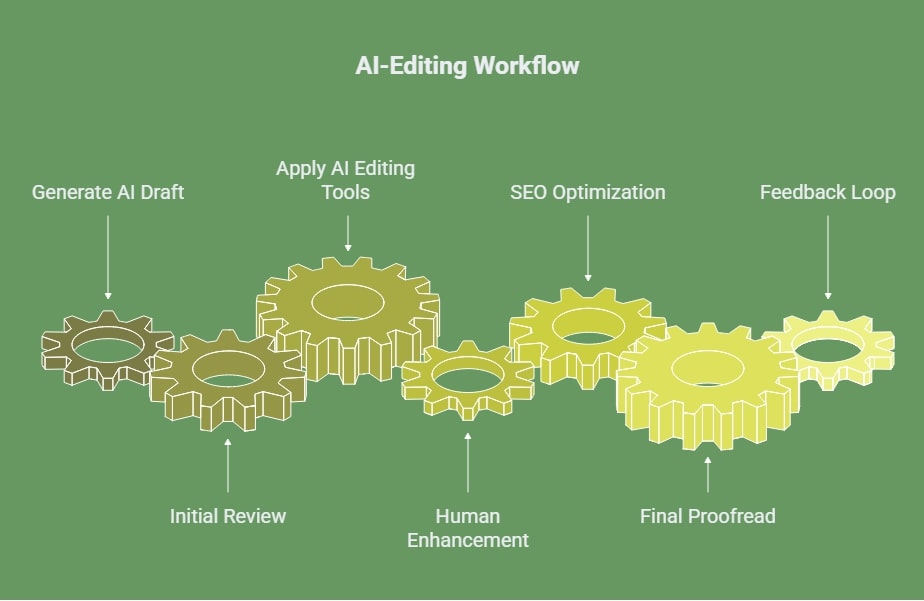
A visual representation of a Ai editing workflow configuration 1
Editing AI-generated content becomes faster, easier, and more consistent when you follow a structured workflow. A repeatable process helps teams produce polished, engaging, and SEO-ready content every time. Here’s a step-by-step guide to making AI editing work for you:
1. Generate the AI Draft
Start with a clear prompt in your AI content tool to create the first draft. A well-defined prompt saves time and gives you content that is closer to what you need.
Tip: Include specifics like tone, audience, and word count in your prompt to get a stronger starting point.
2. Initial Review
Skim the draft to spot glaring errors, off-topic sections, or missing context. This step ensures you don’t spend time polishing content that needs major revisions.
Example: Highlight a paragraph where AI lists generic tips without examples, then note what’s missing before editing.
3. Apply AI Editing Tools
Use grammar, clarity, and style platforms to fix language issues and improve readability. This helps your draft sound professional and easy to understand.
Quick tip: Tools like Grammarly or Hemingway can point out overly long sentences, passive voice, or unclear phrasing.
4. Human Enhancement
Add creativity, personality, and audience-specific touches. Include empathy, humor, storytelling, or local references to make the content relatable and engaging.
Example: Turn “The software is useful for managing tasks” into “This software takes the stress out of your to-do list, letting you focus on what really matters.”
5. SEO Optimization
Integrate keywords, meta descriptions, and headings naturally without sacrificing readability. This ensures your content performs well in search while still feeling human.
Tip: Use variations of your keywords to avoid repetition and keep the content smooth.
6. Final Proofread
Read through the draft carefully to catch any remaining errors and ensure tone, style, and messaging are consistent. Reading aloud often helps spot awkward phrasing.
7. Feedback Loop
Track performance metrics and audience engagement to refine future prompts and editing practices. Continuous learning helps your workflow get smarter over time.
Example: If readers bounce from a section, consider reworking that part with more engaging storytelling or clearer explanations next time.
By turning AI editing into a structured workflow, teams can save time, maintain quality, and ensure human creativity consistently enhances AI-generated content. With practice, this approach makes AI a reliable partner rather than just a shortcut.
Why Should Businesses Prioritize Human-Edited Content Over Fully Automated AI Content?
AI can produce content instantly, but speed alone doesn’t make it memorable or persuasive. Without human insight, AI drafts often feel generic, flat, or disconnected from what readers actually care about. Human editing adds the depth, personality, and context that turn automated text into content that resonates, builds trust, and drives real engagement.
Here’s why human-edited content gives businesses a real advantage:
- Enhanced quality and engagement: Editors add nuance, storytelling, and personality, transforming robotic text into content that captivates readers.
- Improved SEO performance: Human oversight ensures keywords, headings, and meta descriptions are naturally integrated, balancing search visibility with readability.
- Brand consistency: Every piece reflects your company’s tone, values, and messaging, reinforcing brand identity across channels.
- Error prevention: Humans catch factual inaccuracies, awkward phrasing, or culturally insensitive language that AI may miss, protecting credibility.
- Audience relevance: Editors tailor content to specific demographics, regions, and interests, creating a stronger connection with readers.
Human-edited content is more than polished, it’s purposeful. By blending AI efficiency with human creativity and insight, businesses produce content that not only informs but also engages, persuades, and leaves a lasting impression. Investing in human editing ensures your content works harder for your audience and your brand.
How Wild Creek Studio Helps You Perfect AI-Generated Content
Struggling to make your AI-generated content sound less robotic? At Wild Creek Studio, we specialize in bridging the gap between artificial intelligence and human connection. Our expert editors refine your AI drafts, transforming them into engaging, high-quality content that truly represents your brand. We understand that a successful content marketing strategy relies on more than just speed; it requires authenticity and a deep understanding of your audience.
Our content creation process involves using a combination of advanced tools and human expertise. We act as your professional AI humanizer, applying industry best practices to improve readability, inject personality, and ensure every piece of content meets the highest standards of quality. Let our team of professional editors handle the refinement, so you can focus on what you do best, running your business. Contact us today.
Conclusion
AI content editing provides efficiency and speed, the human touch remains essential for creating compelling and relatable content. Human editors infuse depth, personality, and empathy into AI-generated material, transforming it into something that truly resonates with audiences. By prioritizing human-edited content, businesses can enhance their brand’s voice, engage readers more effectively, and stand out in a crowded digital landscape. Remember, the integration of AI and human creativity can lead to the best outcomes. If you’re ready to elevate your content strategy, contact Wild Creek Studio today to see how we can help you perfect your AI-generated writing!
Frequently Asked Questions
Why was my content flagged as AI?
Content is usually flagged as AI-generated when it shows patterns typical of machine-generated text. This can include overly structured sentences, repetitive phrasing, lack of emotional nuance, or predictability in word choice. AI detectors analyze these patterns to determine the likelihood that the content was produced by an AI tool. Human editing can reduce these markers and make content feel more natural and authentic.
Is it legal to use AI content?
Yes, using AI-generated content is legal in most contexts. However, you must ensure the content does not infringe on copyrights, contain plagiarism, or violate local regulations. Businesses and creators should also disclose AI usage where necessary, especially in academic, legal, or professional settings.
Is it okay to use AI for editing?
Absolutely. AI tools can help improve grammar, readability, style, and SEO, making the editing process faster and more efficient. However, human oversight remains crucial to ensure the content aligns with your brand voice, adds creativity, and resonates with your audience. Combining AI assistance with human editing yields the most polished and engaging results.
How do professional editors improve AI-generated writing?
Professional editors enhance AI output by infusing it with a human touch. Through a detailed editing process, they refine the tone, check for accuracy, and add emotional nuance. This improves content quality and ensures the final draft is polished, engaging, and perfectly aligned with your brand’s voice.
Can I use automated tools to check grammar and style in AI content?
Yes, you can and should use automated AI tools to check for grammar mistakes and ensure adherence to a style guide. These content generation tools are excellent for streamlining the initial creation process, but they work best when followed by a final review from a human editor to catch what they miss.
How can AI content editing improve content consistency across multiple platforms?
AI content editing promotes consistency by establishing a unified workflow for all content creation. By applying the same style guide and editing standards to blog posts, social media updates, and marketing copy, you ensure a coherent brand voice across every channel, strengthening your brand identity.
Can AI content editing tools replace professional human editors?
No, AI tools cannot fully replace professional human editors. Despite the power of AI, these tools lack the human creativity, critical thinking, and emotional understanding that content writers provide. Human input remains essential for creating content that is truly authentic, nuanced, and impactful.