Key Highlights
- An AI website audit goes beyond simple reports, providing a roadmap with actionable insights.
- Boost your SEO optimization by identifying and fixing critical technical errors quickly.
- AI tools analyze your site speed and Core Web Vitals to improve user experience.
- Evaluate your content quality to find new opportunities and enhance relevance in search results.
- AI audits can also monitor your competitors, revealing their strategies and keyword rankings.
- Get on-brand content rewrites and suggestions to improve performance on Google and AI search platforms.
A website that does not rank or convert quietly drains time, budget, and opportunity. Many businesses make changes without knowing whether they address real problems, leaving performance stuck and growth uncertain.
Traditional SEO audits often take days to complete and require technical expertise, which delays progress and slows decision-making.
This blog shows how AI website audits simplify the process by analysing issues in minutes, turning complex data into clear actions, and helping you boost visibility, performance, and traffic with confidence.
How Do You Perform An AI Website Audit In Minutes?
Website audits help keep your site running smoothly. Traditional SEO audits can be slow, confusing, and time-consuming, often taking hours of manual work. AI-powered website audits make the process faster and easier by delivering clear, useful insights in just minutes.
Step 1: Set Up Your AI Tool And Connect Your Website
Choose an AI website audit tool and create an account. After logging in, enter your website URL to begin the audit process.
For better results, connect Google Search Console and Google Analytics. These tools provide traffic and performance data, helping the AI deliver more accurate recommendations. Most tools include simple setup guides, so technical skills are not required.
Step 2: Ask The AI To Run A Full Website Audit
Once your site is connected, let the AI handle the analysis. Instead of checking pages manually, provide clear instructions about what you want reviewed.
You can ask the AI to check technical SEO issues, content quality, site speed, and mobile usability. The AI scans every page quickly and identifies issues related to performance, structure, and user experience.
Step 3: Review The AI Findings And Suggestions
AI tools present results in a clear and organized way. They focus on the most important issues first, helping you understand what needs attention.
Common suggestions include improving page speed, fixing mobile usability issues, and updating content. These insights help you prioritize changes that can improve search visibility and user experience.
Step 4: Apply The Recommended Improvements
One major benefit of AI audits is the clarity of the recommendations. Each issue comes with simple guidance on how to fix it.
For example, the AI may suggest compressing images, improving layouts for mobile users, or updating weak content. You can make changes yourself or share the report with your development or content team.
Step 5: Rerun The Audit To Check Progress
After applying the fixes, rerun the audit to confirm improvements. This step helps ensure issues have been resolved and shows how your site’s performance has improved.
The updated report highlights remaining problems and confirms which fixes are working well.
Step 6: Monitor Website Performance Over Time
AI tools are useful beyond one-time audits. Regular monitoring helps you catch new issues as your site grows and changes.
By running audits consistently, you can keep your website optimized, track performance trends, and address problems early before they affect rankings or user experience.
What Makes AI Website Audits Different From Traditional SEO Audits?
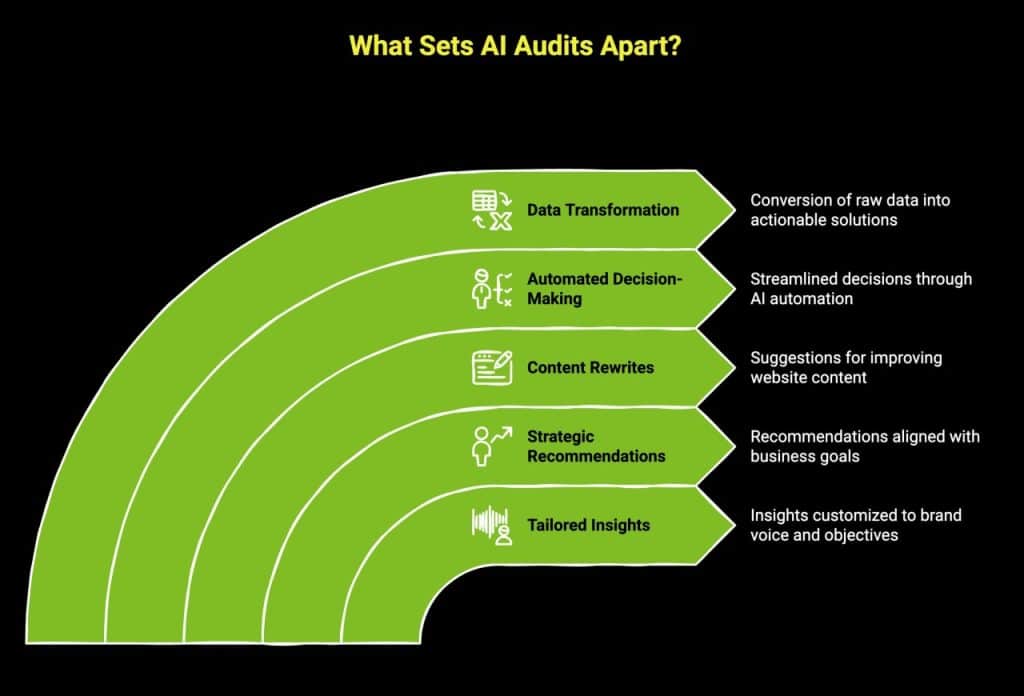
Infographic showcasing what sets AI audits apart from traditional SEO audits
As AI technology rapidly evolves, it is reshaping how businesses approach website optimization. Traditional SEO audits have long helped improve search engine performance, but AI-driven website audits offer advanced capabilities that streamline the process and improve the quality of insights.
Below is a closer look at how AI website audits differ from traditional SEO audits and why they matter for modern digital marketing strategies.
1. Personalized, Strategy-Focused Insights
Traditional SEO audits usually focus on technical issues like broken links, missing meta tags, and on-page optimization. While these elements are essential for website health, they are often generic and disconnected from a brand’s broader business goals.
AI website audits provide personalized insights by considering brand voice, positioning, and specific business objectives. AI analyzes technical elements along with overall content context, helping businesses prioritize improvements that directly support strategic goals and create a more focused SEO approach.
For example, AI tools such as Semrush’s AI Visibility Toolkit can track how a brand performs across AI-powered platforms like ChatGPT and provide clear recommendations to improve visibility in AI-driven search results.
2. Actionable, Real-Time Recommendations
Traditional SEO audits often deliver long lists of technical issues that require manual review and decision making. This process can feel overwhelming and time consuming.
AI audits provide real-time, prioritized recommendations that focus on the most important performance gaps. Instead of only listing problems, AI tools guide businesses toward data-driven decisions and faster improvements, reducing guesswork and speeding up optimization.
For instance, AI tools may suggest improvements to content structure, technical SEO fixes, or adjustments for AI-driven search platforms, all prioritized by urgency and potential impact.
3. Optimization for AI Search Engines and Traditional Platforms
Traditional SEO mainly focuses on ranking higher on search engines like Google and Bing. However, AI-powered search tools such as ChatGPT, Gemini, and Google’s AI Overview have changed how people discover information.
AI website audits help ensure content is optimized for both traditional search engines and AI-powered tools. While traditional SEO targets keyword rankings and organic traffic, AI SEO focuses on how content appears in AI-generated responses and summaries.
An AI audit reviews content structure and relevance for AI systems, offering recommendations to improve visibility across both traditional and AI-driven search platforms.
4. Automation and Time Efficiency
Traditional SEO audits often require hours of manual work, including reviewing content, checking site performance, and analyzing backlinks. This can be especially demanding for large websites.
AI-powered audits automate these tasks and analyze large volumes of data in minutes. They quickly identify key issues and provide instant recommendations, allowing teams to focus more on improvements rather than manual analysis.
AI tools, like Semrush, can also automate link-building suggestions, content optimization, and visibility tracking, saving time and effort.
5. Continuous Monitoring and Adaptability
Traditional SEO audits are often one-time checks where issues are fixed and then forgotten. This approach does not account for constant changes in algorithms, user behavior, and technology.
AI website audits provide continuous monitoring, helping websites stay aligned with both SEO and AI SEO best practices. These tools track performance over time and update recommendations based on algorithm changes, AI requirements, and user engagement patterns.
By using AI audits regularly, businesses can keep their websites optimized throughout their entire lifecycle.
6. Enhanced Keyword and Topic Research
Traditional SEO audits focus mainly on specific keywords and on-page optimization. While effective, AI SEO looks more at topic clusters and conversational search behavior.
AI audits identify trending topics and user questions, helping businesses target long-tail and conversational queries commonly used in AI tools like ChatGPT. This topic-based approach aligns better with modern search behavior, where searches are more detailed and intent driven.
For example, AI tools can surface related questions your audience is likely asking on AI platforms, helping you expand reach beyond traditional keyword targeting.
How Can We Use Persona Prompts To Bring a Human Touch to AI Website Audits?
As businesses increasingly rely on AI for website audits, the real challenge is making sure the results are not only efficient but also human-centred. AI tools can quickly scan websites, identify SEO issues, and suggest fixes, but how do we make these insights feel more relevant, empathetic, and aligned with the user experience? This is where persona prompting comes in.
Persona prompts give AI a sense of identity, a voice shaped by human qualities like empathy, creativity, and intuition. By guiding AI to understand its role and context, persona prompts improve the quality of insights and recommendations, making them more natural, approachable, and actionable.
Let’s explore how persona prompts add a human touch to AI-powered website audits.
1. Creating Relatable, Human-Like AI Insights
Traditional SEO audits often feel cold and overly technical. Reports usually list broken links, keyword gaps, or slow pages. While important, these insights often lack context and empathy.
With persona prompting, AI can communicate findings using relatable language and human judgment. For example, instead of simply flagging missing metadata, an AI with a supportive content strategist persona might say:
“Let’s refine your meta descriptions so visitors can quickly understand what each page offers. This can help improve both click-through rates and search visibility.”
If the AI takes on a technical expert persona, it might explain performance issues more clearly:
“This page loads slowly because the images are not optimized. Think about how frustrating it feels to wait for a slow page. Optimizing these images can greatly improve user experience.”
By assigning a persona, the audit becomes practical guidance instead of a basic list of problems.
2. Optimizing Content Strategy With A Brand-Focused Persona
AI audits sometimes miss how SEO fits into a brand’s overall voice and content strategy. Traditional audits focus on keywords and technical fixes but often ignore tone and audience intent. This can lead to recommendations that work for SEO but feel disconnected from the brand.
Persona prompts help align AI insights with brand identity. For a playful and conversational brand, an AI with a friendly content marketer persona might suggest:
“Your content could feel more engaging with a lighter tone. Let’s rewrite these sections to sound more inviting and relatable.”
For a professional brand, an AI acting as a consultative advisor may say:
“To strengthen authority, consider revising your headings to clearly reflect your expertise. This supports SEO and reinforces thought leadership.”
Persona prompts ensure AI recommendations stay true to brand values.
3. Enhancing User Experience Recommendations With Empathy
When reviewing user experience, AI often focuses only on technical factors like speed and mobile layout without considering how users feel.
With persona prompting, AI can take on empathetic roles such as a UX consultant or customer advocate. Instead of simply reporting slow load times, it may say:
“A slow page can frustrate users, especially on mobile. Optimizing images here can help visitors feel less impatient and more engaged.”
This approach helps businesses prioritize fixes that improve both performance and emotional user response.
4. Facilitating Better Communication Across Teams
Persona prompts also improve communication across departments. An AI with a technical lead persona can translate complex issues into clear tasks for developers, while a content strategist persona can guide writers more effectively.
For example, the AI might say to developers:
“The JavaScript on your homepage is delaying content loading. Removing unused scripts will improve page rendering.”
For content teams, it might suggest:
“Your blog posts are informative, but they lack engagement. Adding visuals and clearer calls to action could improve reader response.”
Persona-driven audits turn insights into clear, team-specific action plans.
5. Creating Consistent Brand Voice Across Interactions
AI can also help maintain brand voice consistency. By assigning a brand voice ambassador persona, AI ensures recommendations align with the desired tone across all pages.
For formal brands, AI may suggest: “This section should sound more precise and professional to match your brand’s authoritative tone.”
For conversational brands, it may say: “Let’s make this section warmer and more friendly, so it connects better with readers.”
Maintaining a consistent tone across content builds trust and strengthens brand recognition over time.
What are the Key Features of AI-Based Website Analysis?
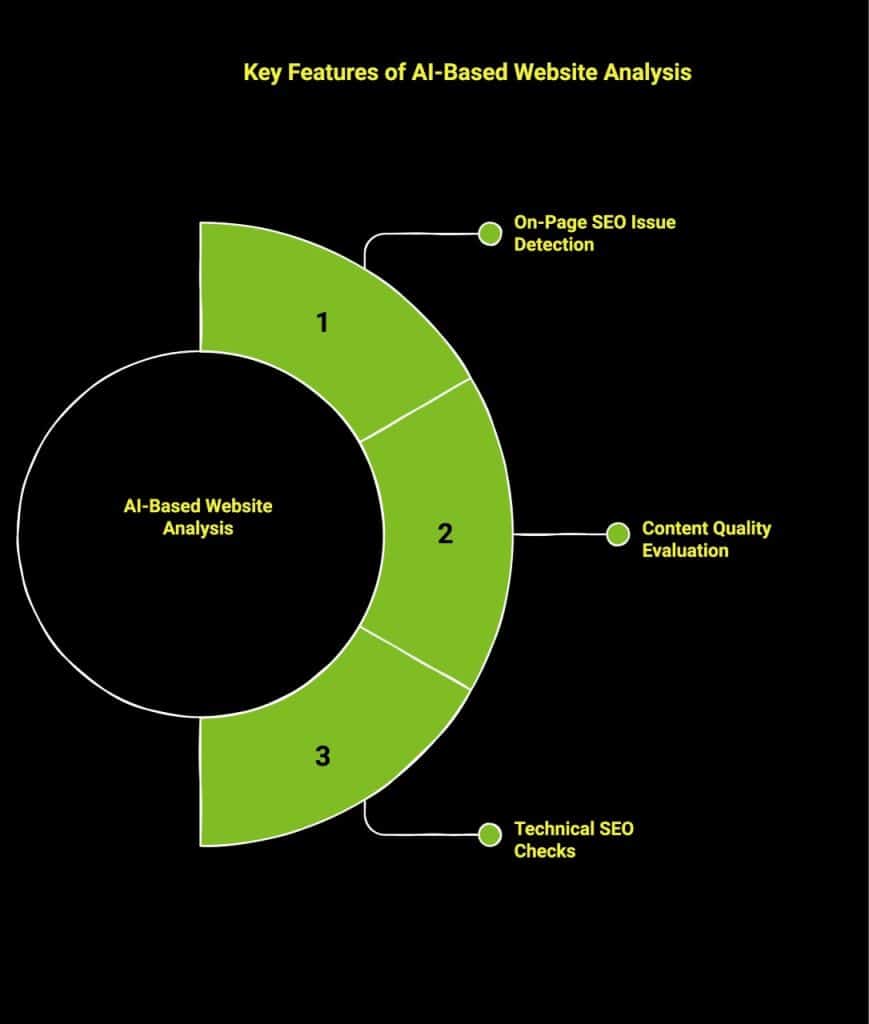
Infographic showcasing the key features of AI based website analysis
AI-powered website analysis tools provide a fast, comprehensive, and highly accurate evaluation of your site’s overall performance. They simplify complex SEO work by automating full-site scans that identify errors, analyse content quality, and evaluate user experience. Instead of merely pointing out issues, these tools explain why they matter and provide actionable steps to fix them, helping you make smarter decisions and drive measurable improvements.
Here’s what makes AI-driven audits so effective:
1. On-Page SEO Issue Detection And Accuracy
AI-based audit tools review every page with exceptional precision, scanning titles, headings, metadata, and content structure in seconds. They detect issues such as duplicate tags, missing keywords, weak internal linking, and improper formatting. Unlike manual audits that risk oversight, AI processes hundreds of metrics simultaneously, ensuring nothing is missed.
Beyond identifying errors, these tools offer detailed recommendations, empowering you to optimise on-page elements and strengthen search visibility with confidence.
2. Content Quality And Relevance Evaluation
Great content is essential for ranking and engagement, and AI helps assess whether your pages truly satisfy user intent. These tools analyse readability, topical depth, keyword performance, internal competition, and search intent alignment to reveal improvement opportunities.
AI identifies pages with strong impressions but low clicks, outdated content holding performance back, and new keyword possibilities you may be missing. Some systems even assist with rewriting and optimisation, ensuring every page adds value and improves results.
3. Technical SEO Checks: Broken Links, Errors, And More
AI audits uncover hidden technical problems that can quietly damage your rankings. They detect broken links, indexing issues, slow page performance, JS rendering errors, and schema markup problems that affect crawling and user experience. Automation ensures you can fix critical errors quickly, preventing ranking drops and improving site reliability.
Instead of manually checking every page and script, AI performs a full crawl and presents clean, prioritised reports that highlight what needs urgent attention.
By combining precision, speed, and actionable insight, AI-powered website analysis transforms complex SEO work into clear decisions that improve performance and unlock long-term growth.
How AI Website Analysis Evaluates Site Speed and Performance?
AI-powered website analysis offers a far more advanced and accurate way to measure site performance than traditional manual audits. Instead of relying on surface-level loading checks, AI examines real user experience data, Core Web Vitals, and behavioural patterns to understand how speed affects engagement, conversions, and search visibility.
Here’s how AI breaks down and improves performance step by step:
1. Evaluating Real Experience Through Performance Metrics
AI website content analysis tools measure real-world interactions rather than basic load times. By analysing metrics like Largest Contentful Paint, First Input Delay, and Cumulative Layout Shift, they reveal how quickly users can see and interact with content. Combined with Search Console data and website performance AI audit results, these insights help identify the technical stress points affecting rankings and behaviour.
2. Identifying and Prioritising Speed Improvements
After scanning your site, the best AI for website analysis provides a prioritised list of optimisation actions. Fixes may include compressing large media, optimising CSS and JavaScript, enabling caching, or upgrading hosting. Clear recommendations allow improvements to be implemented progressively, resulting in faster load times and a smoother user experience.
3. Analysing Competitive Performance for Benchmarking
AI SEO website content audit tool insights compare your performance against competitors to reveal strengths, weaknesses, and market gaps. These audits assess keyword structure, content depth, and UX speed benchmarks, helping shape more effective strategies based on proven success.
4. Monitoring Competitors for Search Opportunities
AI agents for website visitor behavior analysis and automated crawling tools identify ranking signals and structural patterns behind competitor success. By analysing metadata, backlinks, keyword placement, and content hierarchy, AI shows opportunities to outperform instead of imitate.
5. Turning Performance Data Into Strategy
AI transforms complex datasets into clear priorities for both rapid wins and long-term growth. By merging crawl diagnostics, performance metrics, and behavioural analytics, AI identifies high-ROI actions and enables adaptive optimisation aligned with evolving search expectations.
AI website analysis transforms performance improvement from guesswork into an evidence-based strategy that delivers faster websites, smarter decisions, and stronger organic growth.
Partner With Wild Creek Web Studio To Create AI-Powered Website Audits With a Human Advantage
AI tools can scan pages, flag issues, and generate long checklists. But real website performance is not only about technical metrics. It is about how real humans experience your brand, what they feel when they land on your site, and whether they trust you enough to take action. That is where Wild Creek Web Studio makes the difference.
With more than 18 years of digital expertise and proven results across 100+ brands, we combine AI efficiency with deep human insight to deliver website audits that go far beyond surface reporting. We use persona-based analysis, behavioral thinking, and strategic interpretation to uncover what truly matters for growth and conversion.
What makes Wild Creek Studios’ AI-Assisted Website Audits different:
- Review based on real audience perspective and emotional experience.
- Insights focused on business impact instead of automated checklists.
- Actionable recommendations that connect user behavior with brand goals.
- A human-centered approach that strengthens user trust and engagement.
If you want website insights that drive clarity, connection, and measurable results, we would love to help you elevate your digital experience. Contact us today.
Conclusion
Conducting an AI website audit can significantly enhance your site’s performance and SEO strategy. By leveraging the power of AI, you can uncover critical insights that traditional audits might miss, ensuring your site remains competitive in a fast-paced digital landscape. The integration of on-page SEO checks, content quality evaluations, and technical assessments all work together to provide a comprehensive view of your website’s health. As you implement the improvements identified in your audit, you’ll not only boost your site’s speed and performance but also enhance user experience.
Frequently Asked Questions
Are there free AI website audit tools that provide detailed reports?
Yes. Many AI audit platforms offer free scans that analyse your URL and deliver actionable recommendations without payment. These reports help identify real optimisation opportunities so you can assess the tool’s usefulness before upgrading.
How accurate are AI website audit tools at finding SEO issues?
AI audit tools are highly accurate because they analyse hundreds of data signals simultaneously. By applying current search best practices, they detect issues and opportunities more comprehensively than manual reviews.
How often should I run an AI website audit on my site?
A monthly AI audit is ideal for tracking performance and catching new issues early. Rapidly changing or large sites may benefit from weekly scans to maintain visibility and technical health.
What steps should I take after getting an AI website audit report?
Begin by prioritising the highest-impact issues, implement improvements in a structured sequence, and regularly track progress. Reviewing changes over time helps refine results and maintain long-term performance while preventing recurring problems through consistent optimisation.
Can you perform an AI-based audit of my website and highlight areas for SEO improvement?
Yes. An AI-powered audit can identify technical problems, content gaps, and ranking opportunities. Once your site is reviewed, you’ll receive clear recommendations outlining improvement priorities to support better visibility, stronger performance, and meaningful, measurable search growth.
Which AI tools are best for auditing website content quality and relevance?
Best AI tools for website analysis include Surfer SEO, Clearscope, and MarketMuse, which analyse keyword relevance, topical depth, readability, and competitor benchmarks. If you’d like personalised recommendations tailored to your site, I can review it and advise.