Key Highlights
- The traditional marketing funnel is no longer sufficient for understanding the modern customer journey.
- Today’s consumers follow a dynamic path defined by four key behaviors: streaming, scrolling, searching, and shopping (4s).
- Understanding these stages is crucial for improving the customer experience and meeting customer needs effectively.
- Effective digital marketing strategies must adapt to this non-linear journey to resonate with audiences.
- By optimizing each stage, you can drive sales, increase customer satisfaction, and build lasting brand loyalty.
Marketers today face a new challenge: customers move faster than the strategies built to reach them. One moment they’re discovering you, the next they’re gone.
What’s driving these unpredictable shifts? And more importantly, how do you create a journey that actually matches how people think, search, and buy?
The answer begins with recognizing a pattern most brands still overlook.
What is the Consumer Journey and Why Does it Matter?
The customer journey is the complete path an individual takes with your business, from their first point of contact to becoming a loyal, repeat buyer. Think of it as a roadmap that includes every interaction, from discovery and research to purchase and post-sale support. While a consumer decision journey often focuses on the steps leading to a purchase, the full customer journey extends beyond that to include retention and advocacy, which are vital for long-term success.
Understanding this journey is essential because it shapes your entire business. Mapping out this path helps you anticipate customer needs and exceed their expectations. A well-designed journey can increase customer satisfaction by 20% and boost revenue by 15%. A better understanding allows you to refine your marketing strategy, lower service costs, and build a base of loyal customers who will advocate for your brand. It’s the key to turning potential buyers into lifelong fans.
What Are the Four Stages: The 4s Model of the Consumer Journey?
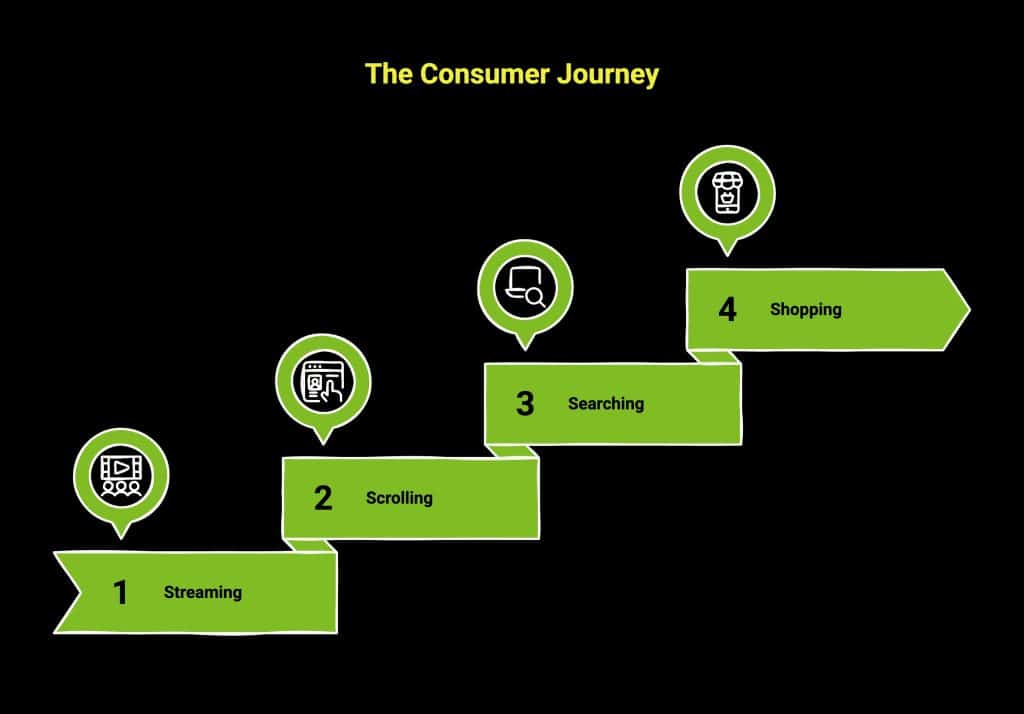
Infographic of The 4s Model of the Consumer Journey
Each “S” represents a distinct behavior that defines how people interact with brands online. These actions are not always linear; a customer might jump between them multiple times before making a purchase. Let’s explore what each of these stages means for your business.
Stage 1: Streaming – Continuous Media Consumption in the Digital Age
Streaming is no longer just about watching movies; it’s about the constant consumption of personalized content across platforms like YouTube, podcasts, and connected TV. This behavior represents a new form of the awareness stage, where discovery is continuous and interactive.
Unlike one-way advertising, streaming experiences allow you to engage with your audience actively. Your digital marketing can turn passive viewing into a key customer touchpoint. This is where a consumer might first become aware of a problem they have or a product that could solve it.
To capture attention in this stage, focus on interactive storytelling and AI-driven personalization within your sales funnel. By sequencing your content effectively, you can guide viewers from initial discovery toward making a decision, creating a smooth transition to the next stage of their journey.
Stage 2: Scrolling – Discovering Products and Services
Scrolling is the modern equivalent of window shopping. When a potential customer browses through social media feeds or blog posts, they are often discovering content without an immediate plan to buy. They are absorbing information and looking for inspiration.
However, this passive browsing can quickly turn into active interest. The right visual, a compelling story, or a timely influencer post can instantly spark a potential customer’s curiosity and motivate them to act. This stage is all about capturing attention in a fast-moving, crowded environment.
Your marketing strategy here should focus on optimized and engaging creative. Use strong visuals and clear story arcs to make your brand stand out. This is your chance to plant a seed and address latent customer needs before they even begin actively searching for a solution.
Stage 3: Searching – Intent-Driven Exploration
Searching has evolved far beyond typing a query into a search engine. Today, consumers use a variety of methods for intent-driven exploration, which aligns with the traditional consideration stage. They might use AI tools for conversational searches, Google Lens to identify a product visually, or watch product demos on YouTube.
This behavior shows a clear intent to find a solution. Customers in this stage expect immediate, relevant answers tailored to their specific questions. They are actively comparing options and looking for information that will help them make the best choice.
Your digital marketing strategy must adapt to these new search habits. Optimize your content for multiple search ecosystems, including text, image, and voice. Offering easily accessible information, like reviews and comparisons, can position your brand as the best solution and encourage customers to move toward a purchase.
Stage 4: Shopping – Seamless and Nonlinear Transactions
Shopping is no longer a linear, final step. It has become a seamless and integrated part of the entire journey. This is the modern purchase stage, where transactions can happen at any moment, from a shoppable social media post to an in-app checkout. Impulse buys are common, and the path to purchase is often non-linear.
The expectation is a frictionless customer experience. Any friction can lead to an abandoned cart and a lost sale. You need to make it as easy as possible for customers to buy from you, no matter where they are in their journey.
To increase your conversion rate, integrate shopping opportunities into every relevant touchpoint. Use AI-powered recommendations, personalized offers, and clear calls to action to drive purchases. Ensuring a smooth transaction and accessible customer support channels at this stage is key to customer satisfaction.
Mapping the Digital Consumer Journey
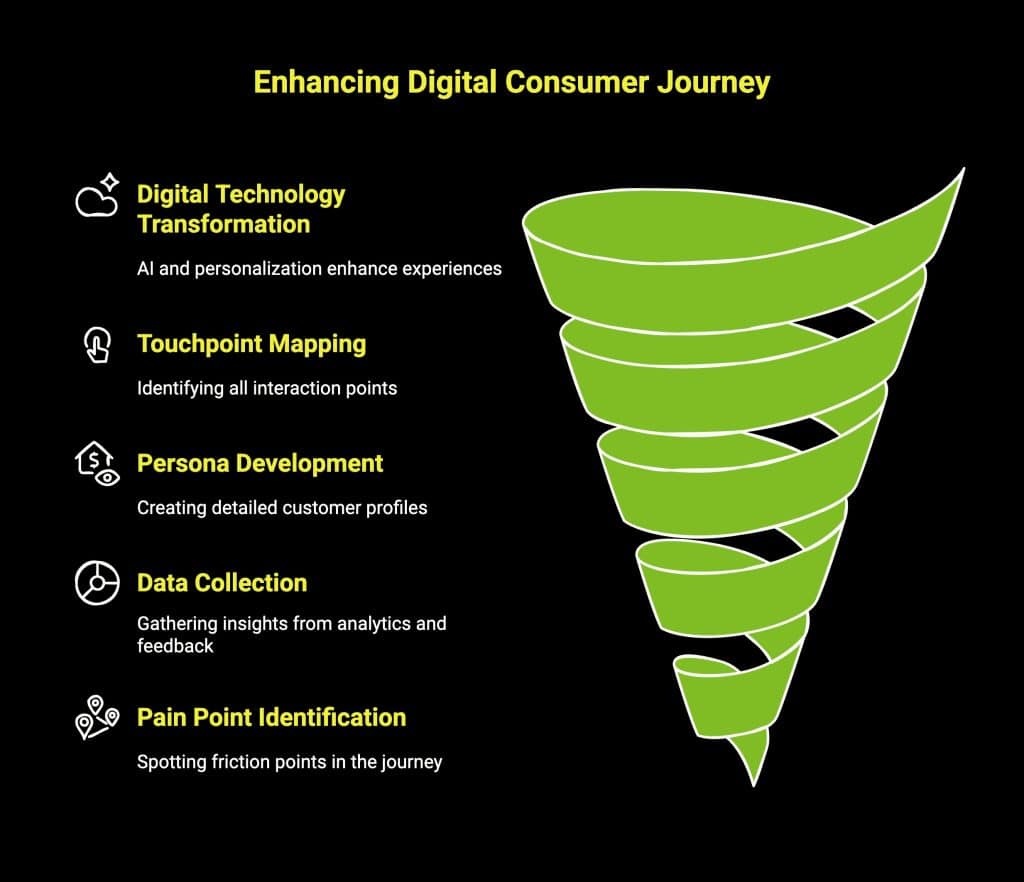
Infographic of the Digital Consumer Journey
With consumer paths becoming more fragmented, how can you make sense of it all? The answer lies in customer journey mapping. This process involves creating a visual representation, a journey map, of the various ways customers interact with your brand from start to finish.
A journey map helps you step into your customers’ shoes and understand their experiences, motivations, and frustrations. This practice of journey mapping is essential for navigating the complex digital consumer journey and identifying opportunities to improve every interaction. Now, let’s look at how technology and touchpoints shape this map.
How Digital Technology is Transforming Each Stage?
Digital technology is the engine behind the 4s model, fundamentally changing each customer journey stage. From AI-powered personalization to interactive content, technology allows you to create a more dynamic and responsive user experience. It helps you meet rising customer expectations for speed and relevance.
Your digital marketing efforts can now be more precise than ever. For instance, AI can analyze behavior to serve the right ad during the “Streaming” stage or provide a personalized recommendation in the “Shopping” stage. This creates a journey that feels tailored to each individual.
Technology transforms how you engage with consumers at every step. Here is a quick look at how it impacts each of the 4s:
| 4s Stage | How Digital Technology Transforms It |
| Streaming | AI delivers personalized content and interactive storytelling. |
| Scrolling | Optimized creative and AI-driven personalization grab attention. |
| Searching | AI tools and multimodal search provide instant, relevant answers. |
| Shopping | Seamless social commerce and AI recommendations enable easy buys. |
Touchpoints In The Digital Consumer Journey
Customer touchpoints are all the points of interaction a person has with your brand throughout their stages of the customer journey. In the digital world, these touchpoints are more numerous and varied than ever. Mapping them is essential for understanding how customers experience your brand.
Your digital marketing strategy must account for this wide range of interactions. From the first ad a person sees to the follow-up email they receive after a purchase, each touchpoint is an opportunity to strengthen the customer relationship. Social media marketing, for example, can be a touchpoint for both discovery and customer service.
Common touchpoints in the digital consumer journey include:
- Social media posts and ads
- Blog posts and website content
- Third-party review sites and testimonials
- Email campaigns and customer service interactions
Creating An Effective Consumer Journey Map For Your Business
Creating an effective customer journey map involves more than just guesswork. It requires a mix of data and intuition to plot out how your target audience travels along their path to purchase and beyond. The first step is to build detailed buyer personas to understand who your customers are.
Once you have your personas, the journey mapping process can begin. Use data from analytics, net promoter score surveys, and customer feedback to identify all the touchpoints where customers interact with you. This will help you build a comprehensive journey map that reflects real-world experiences.
The goal is to use your map to uncover weak spots and opportunities. To start your journey map, focus on these key actions:
- Define clear buyer personas based on research.
- List all the potential touchpoints for each stage of the journey.
- Identify customer pain points and moments of friction at each touchpoint to find areas for improvement.
Why Wild Creek Web Studio Is the Upgrade Your Marketing Needs?
Most brands don’t struggle because of low traffic or weak content; they struggle because their customer journey doesn’t match how people actually behave online. When consumers bounce between streaming, scrolling, searching, and shopping, disconnected marketing efforts simply can’t keep up.
Wild Creek Web Studio helps solve that problem.
We bring structure and clarity to a fragmented digital landscape. Instead of isolated tactics, we build integrated marketing systems that guide customers smoothly from first touch to final conversion.
What we deliver:
- A customer-journey-driven strategy built around real behavior, not outdated funnels
- SEO, content, and performance marketing that attract high-intent audiences
- Conversion-focused websites designed to turn attention into action
- Transparent reporting and clear KPIs so you always know what drives growth
- A partnership mindset, with continuous optimization across every touchpoint
If your marketing feels scattered or your customer journey isn’t producing results, Wild Creek Web Studio is the upgrade that brings everything together.
Ready to get started? Reach out to our team today!
Conclusion
Today’s buyers expect experiences that are fast, intuitive, and personalized. The brands that succeed aren’t the ones shouting the loudest, but the ones paying attention to the subtle signals customers leave behind.
By studying how people consume content in real time, explore options, and make decisions, you gain the clarity needed to shape smarter, more human marketing.
Use these insights to refine your touchpoints, close gaps, and create journeys that feel effortless from start to finish. The more aligned you are with how consumers behave, the stronger your results will be.
Frequently Asked Questions
What are the main stages of the consumer journey?
The main consumer journey stages show how people discover, explore, compare, and buy. Modern behavior is non-linear, with consumers shifting between content, search, and shopping moments that influence decisions.
How can I create a consumer journey map for my business?
Start by outlining your consumer journey framework, listing every interaction customers have with your brand, identifying friction points, and using data to understand motivations and expectations across each stage.
What is the difference between a customer journey and a consumer decision journey?
A customer journey covers the full experience from discovery to loyalty, while the consumer decision journey focuses mainly on pre-purchase evaluations and the steps leading to a buying choice.
Can you explain the McKinsey model of the consumer decision journey?
The McKinsey model highlights a circular path where consumers loop between consideration, research, evaluation, and repurchase, reflecting a modern alternative to a linear consumer journey funnel.
What are common touchpoints in the consumer journey?
Common consumer journey touchpoints include social content, ads, reviews, product pages, emails, and customer support interactions that guide people across different stages of exploration and purchase.
How do I optimize the consumer journey for better customer experience?
Optimize the digital consumer journey by removing friction, personalizing content, improving navigation, answering intent-based questions, and ensuring smooth, intuitive interactions at key moments.
Are there examples of effective consumer journey maps I can review?
Effective maps visualize actions, emotions, and gaps across each stage, helping businesses understand how customers behave within their category consumer journey and where improvement is needed.
What role does digital technology play in shaping the consumer journey?
Digital technology personalizes experiences, analyzes behaviors, and enhances targeting, allowing brands to respond quickly and tailor interactions across the customer path.
How do I identify and address pain points in the consumer journey?
Review analytics, feedback, and drop-off points to find where customers struggle. Then simplify steps, improve clarity, and enhance support across all stages.
What are the benefits of understanding the consumer journey for businesses?
Understanding the journey helps improve experiences, boost satisfaction, reduce friction, increase conversions, and guide better decision-making across marketing and service operations.