Key Highlights
- AIO in SEO means optimising content for AI systems that generate answers, not just rank pages.
- Visibility is moving from page position to AI citation and inclusion.
- Traditional SEO tactics alone are no longer enough in AI-driven search.
- AI Overviews reduce click dependence and increase authority dependence.
- Structured content, entity clarity, and schema improve AI comprehension.
- Machine learning prioritises context, credibility, and engagement signals.
- Human strategy ensures optimisation supports brand and business goals.
- Indian brands must shift from ranking focus to authority focus.
Search is no longer just about rankings, backlinks, and keyword density. AI Overviews, answer engines, and generative search results becoming more prominent, brands are quietly losing visibility. Your page may still rank on page one, but if an AI system summarises the answer above you, users may never click through.
The broader AI ecosystem is expanding rapidly. According to Grand View Research, the global artificial intelligence market was valued at USD 196.63 billion in 2023 and is projected to grow at a compound annual growth rate of 36.6 percent from 2024 to 2030. As AI adoption accelerates across industries, search behaviour is evolving alongside it.
Marketing leaders across India are now facing a new challenge. How do you optimise for AI systems that interpret, summarise, and recommend information instead of simply listing websites? Traditional SEO tactics alone are no longer enough in an AI-driven search environment.
This guide breaks down what AIO in SEO means, how AI optimisation works, how AI Overviews are impacting traffic patterns, and what strategic shifts businesses must make to remain visible, authoritative, and competitive in the evolving search landscape.
What is AIO in the Context of SEO?
AIO stands for AI Optimisation. In SEO, it means structuring your content so AI-driven search systems can easily understand, interpret, and feature it in generated answers.
Search engines now analyse and summarise information, not just rank pages. So you are no longer writing only for users, but also for AI systems that extract and present responses.
Unlike traditional SEO, which focuses on keywords and rankings, AI optimisation emphasises:
- Clear structure and logical formatting
• Context-rich, entity-driven content
• Structured data and schema markup
• Information that is easy to extract and validate
A practical example
Before AIO: Your page ranks number three for “best CRM for startups” but only receives traffic when users scroll and click.
After AIO: Your content is structured with entity clarity, comparison tables, and concise definitions. The same page is now cited directly inside an AI Overview summary. Even if users do not click immediately, your brand is surfaced as an authoritative source.
That shift changes visibility from “position on a page” to “presence inside the answer.”
When AI systems can process your content confidently, your chances of being cited in AI summaries increase. Visibility shifts from ranking positions to authority recognition.
What Are AI Overviews and Why Do They Matter?
AI Overviews are AI-generated summaries that appear at the top of search results, answering queries by consolidating insights from multiple sources. Instead of showing only website links, search engines now interpret content and present direct responses.
This affects visibility in clear ways:
- Informational queries may experience lower click-through rates
- Only well-structured, authoritative sources are cited
- Brand credibility becomes a stronger ranking signal
Tools like Google Search Console and SEMrush Organic Research can help monitor shifts in impressions and CTR after AI Overviews appear for key queries. Tracking these patterns is essential to understanding how AI-driven results are impacting your traffic.
AI Overviews matter because discoverability now depends not just on ranking position, but on being selected as a trusted reference.
How Does AI SEO Optimisation Work?
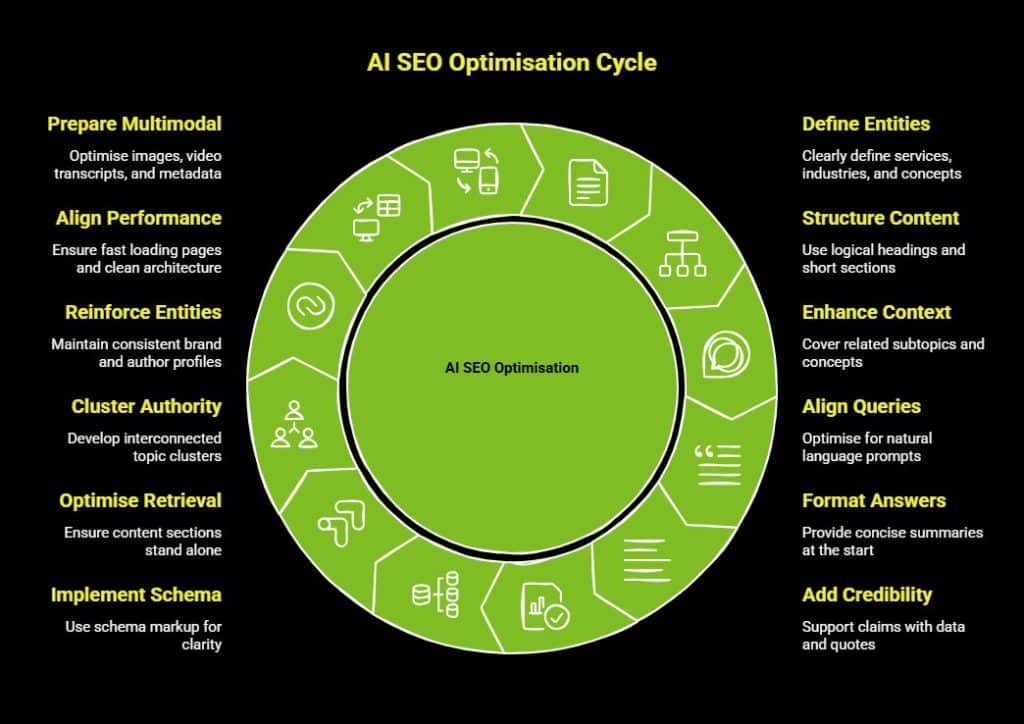
Infographic on How Does AI SEO Optimisation Work visual selection 1
AI SEO optimisation works by making your content machine-readable, context-rich, and extractable for generative search systems. Instead of optimising purely for rankings, it prepares content to be selected, summarised, and cited by AI engines. Core Elements of AI optimisation include:
- Semantic clarity and entity definition
Clearly define services, industries, tools, locations, and related concepts so AI systems understand relationships between entities. - Structured content hierarchy
Use logical headings, short sections, and direct answers to make information easy to extract into AI-generated summaries. - Context depth over keyword density
Cover related subtopics and supporting concepts to demonstrate topical authority rather than repeating primary keywords. - Conversational query alignment
Optimise for natural language prompts. AnswerThePublic and AlsoAsked help identify real user questions that AI systems frequently surface. - Answer-first formatting
Provide concise summaries at the start of sections so AI systems can pull high-confidence responses. - Evidence and credibility signals
Support claims with data, studies, expert quotes, and referenced insights to strengthen trust weighting. - Structured data and schema implementation
Use schema markup to define content type, FAQs, organisation details, and services for clearer machine interpretation. - Retrieval optimisation
Ensure content sections can stand independently within AI context windows. Each section should deliver complete, extractable insight. - Authority clustering
Develop interconnected topic clusters to signal depth and subject expertise across a theme. - Brand and author entity reinforcement
Maintain consistent author profiles and brand mentions across the web to strengthen recognition signals. - Technical performance alignment
Fast loading pages, clean architecture, and crawl clarity support AI systems in processing content accurately. - Multimodal readiness
Optimise images, video transcripts, and structured metadata to increase eligibility across AI-driven discovery formats.
Where Tools Support Execution
Tools like Surfer SEO, Clearscope, MarketMuse, and Frase assist with semantic coverage and question mapping. However, tools support optimisation. Structured expertise and strategic alignment determine long-term AI visibility.
Execution tools provide insights. Authority comes from structured expertise and consistent depth.
How Do AI and Machine Learning Reshape Modern Search Visibility?
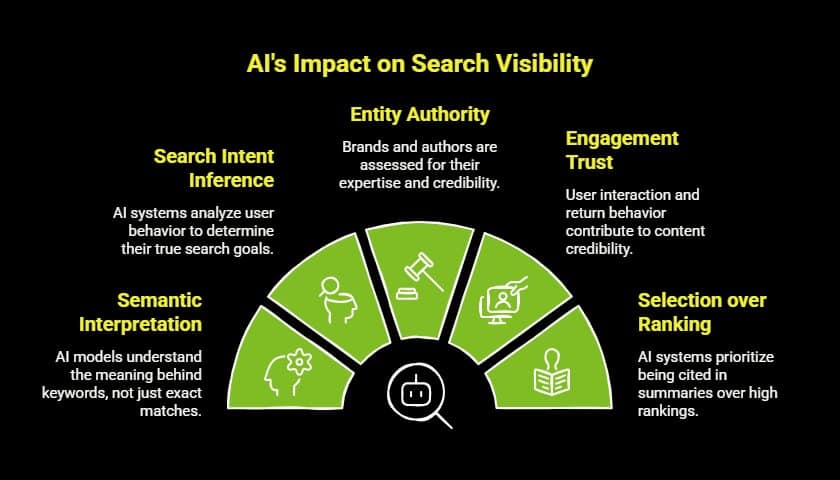
Infographic on How Do AI and Machine Learning Reshape Modern Search Visibility visual selection
AI and machine learning no longer simply rank pages. They interpret meaning, assess authority, and determine which sources deserve to shape the answer itself.
This fundamentally changes how visibility works.
- AI models no longer match keywords. They interpret meaning.
Exact-match optimisation has less influence. Semantic depth and contextual clarity now carry more weight. - Search intent is inferred, not assumed.
AI systems evaluate behavioural signals and query patterns to determine what users truly want, even when the query is vague. - Authority is evaluated at the entity level.
It is no longer just about domains. Brands and authors are assessed for expertise, consistency, and external validation. - Engagement influences trust weighting.
Time spent, interaction patterns, and return behaviour contribute to credibility signals. - Visibility shifts from ranking to selection.
AI systems summarise multiple sources. Being position three is less important than being cited within the generated response.
Platforms like Google Search Central documentation, Bing Webmaster Tools, and Perplexity AI query testing provide insight into how AI systems surface content.
Modern search rewards clarity, authority, and relevance. Optimisation must therefore align with how intelligent systems process and prioritise information.
Why Human Decision Making Still Matters in AIO?
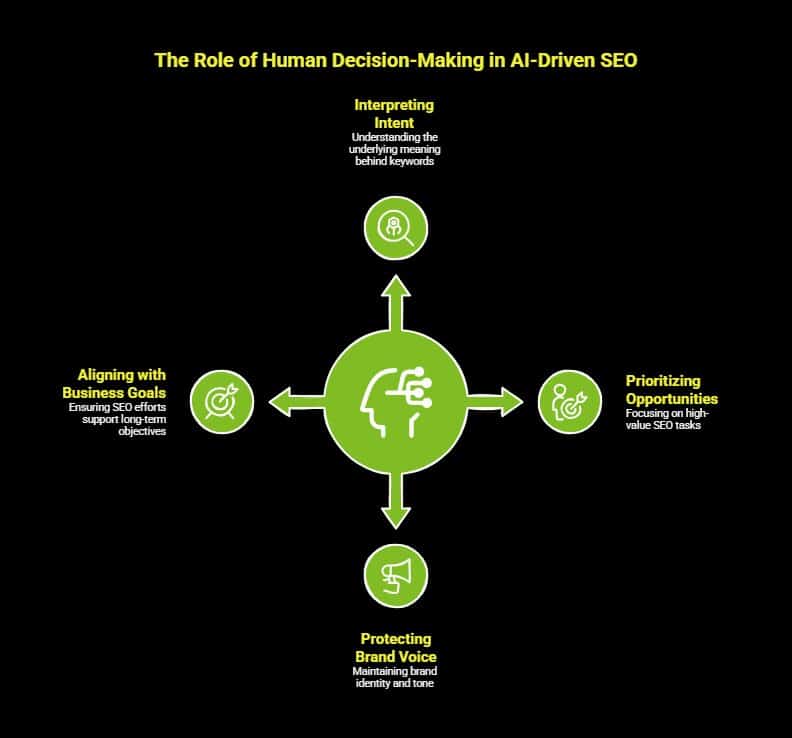
Infographic on Why Human Decision Making Still Matters in AIO visual selection
AI can analyse data, map entities, and suggest optimisation improvements at scale. But it cannot understand brand positioning, commercial nuance, or audience psychology. That is where human decision-making becomes essential.
AIO in SEO requires more than structured formatting. It demands strategic judgement.
Human experts:
- Interpret intent beyond surface-level keywords
• Prioritise high-value opportunities over high-volume ones
• Protect brand voice and differentiation
• Align optimisation with long-term business goals
Without strategic oversight, automation often produces content that feels interchangeable. It may be technically optimised, but it lacks distinctiveness and positioning power.
AI identifies patterns. Humans define direction. Technology improves efficiency. Strategic thinking builds authority. In AI-driven search, sustainable visibility belongs to brands that combine machine intelligence with human clarity.
Is AIO the Future of SEO or Just a Trend?
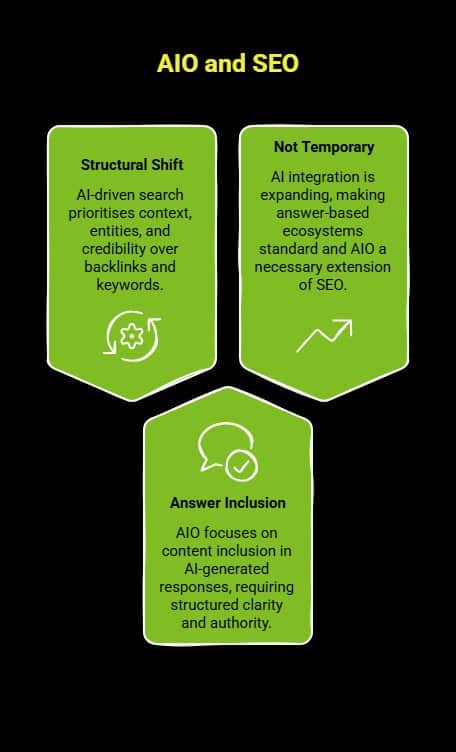
Infographic on Is AIO the Future of SEO or Just a Trend visual selection
Search is shifting from ranking pages to generating answers. As AI systems interpret intent, summarise content, and recommend sources, optimisation must evolve. The question is no longer whether AI affects SEO. It is whether brands are adapting fast enough.
1. The Structural Shift in Search
AI-driven search changes the foundation of visibility. Instead of rewarding pages purely on backlinks and keywords, systems now prioritise context, entities, and credibility. This reflects a long-term transformation in how relevance is calculated.
2. From Rankings to Answer Inclusion
Traditional SEO focused on page position. AIO focuses on whether your content is included in AI-generated responses. Visibility now depends on structured clarity, authority signals, and semantic depth rather than ranking alone.
3. Why This Is Not Temporary?
AI integration is expanding across platforms, including generative search and conversational interfaces. As machine learning models mature, answer-based ecosystems will become standard. AIO is not replacing SEO. It is becoming a necessary extension of it.
AIO represents an evolution of search, not a trend. Brands that align early will shape authority, while late adopters will compete for shrinking traditional visibility.
How Should Indian Brands Prepare for AI-Driven Search?
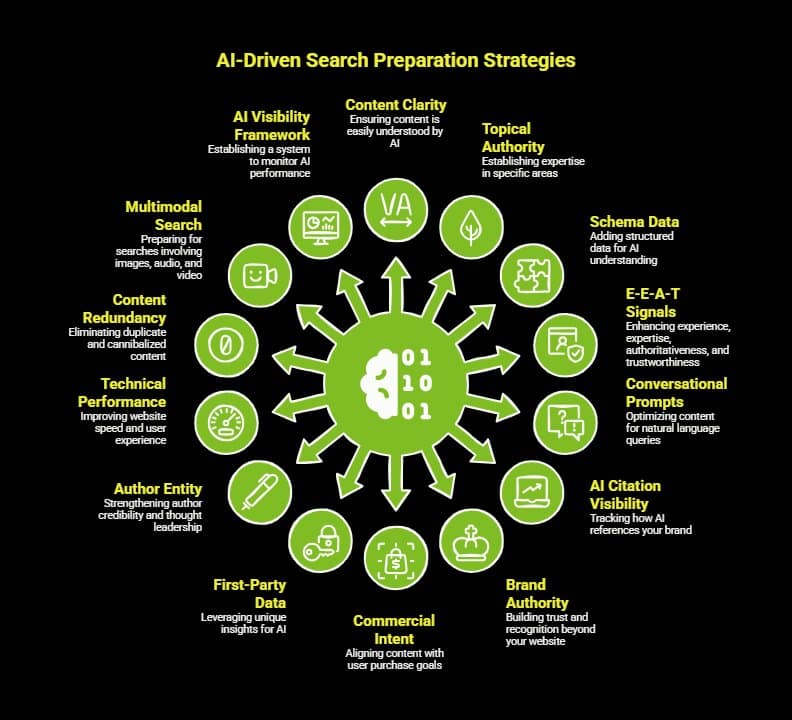
Infographic on How Should Indian Brands Prepare for AI Driven Search visual selection
AI-driven search is no longer experimental. It is actively reshaping how users discover information. For Indian brands, this means visibility depends not just on ranking, but on being understood, trusted, and cited by intelligent systems that summarise answers.
1. Audit Content for Entity Clarity
AI models interpret relationships between entities such as services, industries, locations, and people. If these are unclear, your content becomes difficult to interpret.
Focus on:
- Clearly defining primary services and concepts
- Maintaining consistent terminology across pages
- Aligning content with user intent rather than keyword stuffing
- Structuring headings logically
- Implementing schema markup for better machine readability
When entities are precise and structured, AI systems can confidently extract and reference your content.
2. Strengthen Topical Authority Clusters
Single blog posts rarely build authority anymore. AI systems evaluate depth across related topics to determine subject expertise.
Strengthen authority by:
- Creating pillar pages around core themes
- Developing supporting content for subtopics
- Interlinking strategically to show topic relationships
- Eliminating redundant or overlapping content
Topical clustering signals expertise and increases the probability of citation in AI-generated summaries.
3. Add Schema and Structured Data
Structured data acts as a translation layer between your content and AI systems. Without it, context may be misunderstood or ignored.
Prioritise:
- Article schema for blogs
- FAQ schema for direct answers
- Organisation schema for credibility
- Product or service schema where relevant
Structured data improves contextual clarity and enhances eligibility for rich and AI powered results.
4. Improve E-E-A-T Signals
AI-driven systems prioritise Experience, Expertise, Authoritativeness, and Trustworthiness. Content must demonstrate credibility, not just claim it.
Strengthen E E A T through:
- Publishing expert-driven content
- Highlighting author credentials
- Referencing credible studies and statistics
- Updating outdated content regularly
- Building high-quality backlinks
Authority compounds over time and protects visibility against volatility.
5. Optimise for Conversational Prompts
Search behaviour is increasingly conversational. Users ask complete questions, especially through voice and AI assistants.
Adapt by:
- Using question-based headings
- Writing in natural, direct language
- Covering long tail intent-driven queries
- Providing concise summaries within sections
Conversational optimisation increases the likelihood of being selected for AI summaries.
6. Track AI Citation Visibility
Traditional SEO tracking measures rankings and traffic. AI optimisation requires monitoring citation presence and visibility within summaries.
Track:
- Whether your brand appears in AI-generated answers
- Topic-wise citation trends
- Branded search growth
- Engagement quality rather than just sessions
Measuring citation visibility ensures your strategy evolves alongside search intelligence.
7. Build Brand Authority Beyond Your Website
AI systems evaluate signals across the web, not just your domain. Brand authority today is ecosystem-driven.
Indian brands should strengthen:
- High-quality media mentions
- Industry publications and digital PR
- LinkedIn and executive visibility
- Podcast and webinar participation
- Consistent brand narratives across platforms
When your brand is referenced and trusted externally, AI models are more likely to surface and cite it confidently.
8. Align Content With Commercial Intent Layers
AI search increasingly interprets intent with precision. Informational visibility alone is insufficient.
Brands must map content across:
- Awareness-stage education
- Evaluation-driven comparisons
- Decision-focused landing pages
- Objection-handling content
Structured commercial alignment ensures visibility converts into revenue impact.
9. Invest in First-Party Data and Original Insights
AI systems favour unique value. Rewritten commentary rarely earns citation priority.
To stand out:
- Publish proprietary research
- Share anonymised case insights
- Introduce internal frameworks
- Present industry benchmarks
Original contributions increase credibility and citation probability in AI summaries.
10. Strengthen Author Entity and Thought Leadership
AI models recognise people as entities. Authority is increasingly tied to visible expertise.
Brands should:
- Maintain consistent author profiles
- Highlight credentials and experience
- Connect authors to industry speaking and LinkedIn
- Publish perspective-led content
Strong author entities reinforce trust and elevate content weighting.
11. Improve Technical Performance Signals
AI-driven discovery still relies on technical clarity.
Ensure:
- Strong Core Web Vitals
- Logical internal linking
- Clean URL architecture
- Crawl efficiency and indexing hygiene
Technical performance enables AI systems to parse and interpret content with accuracy.
12. Reduce Content Redundancy and Cannibalisation
Overlapping pages weaken authority signals. AI models struggle with duplicated intent.
Indian brands should:
- Consolidate similar content
- Merge thin pages
- Clarify topic ownership
- Strengthen canonical structures
Clear content architecture improves entity precision and authority depth.
13. Prepare for Multimodal Search Evolution
Search is becoming multimodal, blending text, images, and video.
Optimise:
- Image metadata and alt descriptions
- Video transcripts
- Structured product data
- Visual explainers
Multimodal readiness expands visibility beyond traditional text-based search.
14. Develop an AI Visibility Monitoring Framework
Traditional rank tracking is no longer sufficient.
AI optimisation requires:
- Monitoring citation presence in generative answers
- Prompt-based brand testing
- Topic-level visibility audits
- Tracking branded search growth
Measurement must evolve alongside search intelligence.
Preparing for AI-driven search requires a shift from chasing rankings to building structured authority. Indian brands that invest in clarity, credibility, and intelligent optimisation today will maintain stronger visibility as search continues to evolve.
What Are the Benefits of Investing in AIO Early?
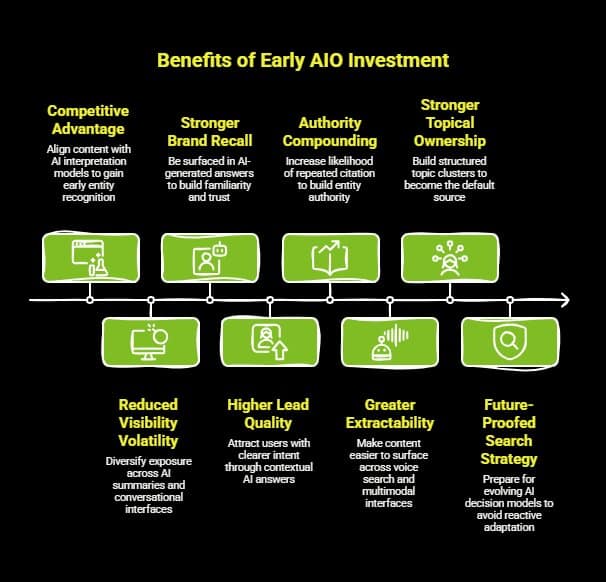
Innfographic on What Are the Benefits of Investing in AIO Early visual selection
Early adoption of AIO positions your brand ahead of competitors who still optimise only for traditional rankings. By aligning content with AI interpretation models today, you build authority patterns that become increasingly difficult to replicate later.
1. Competitive Advantage
Optimising for AI systems increases the likelihood of being cited in AI Overviews and generative responses. Early movers establish stronger entity recognition before competitors adapt.
2. Reduced Visibility Volatility
Traditional rankings fluctuate with algorithm updates. AIO diversifies exposure across AI summaries, conversational interfaces, and structured knowledge systems, reducing dependence on a single ranking position.
3. Stronger Brand Recall
Being surfaced within AI-generated answers creates association at the point of decision. Repeated exposure builds familiarity, trust, and authority even before a website visit occurs.
4. Higher Lead Quality
AI-aligned content attracts users with clearer intent. Visitors arriving through contextual AI answers tend to be more informed, better qualified, and closer to conversion.
5. Authority Compounding Over Time
AI systems reinforce trusted sources. Early optimisation increases the likelihood of repeated citation, which compounds entity authority across related topics.
6. Greater Extractability and Discoverability
Structured, AI-ready content becomes easier to surface across voice search, conversational queries, and emerging multimodal interfaces.
7. Stronger Topical Ownership
By building structured topic clusters early, brands signal depth across themes. This increases the probability of becoming the default source within a category.
8. Future-Proofed Search Strategy
Search behaviour is shifting rapidly. Investing in AIO prepares your brand for evolving AI decision models, reducing the risk of reactive, late-stage adaptation.
Investing in AIO early strengthens authority, stabilises visibility, improves recall, and enhances lead quality. In an AI-driven ecosystem, proactive optimisation compounds faster than reactive adjustments.
How Can Wild Creek Studio Support Your AIO Strategy?
Adapting to AIO in SEO requires structured execution, technical clarity, and strategic oversight. Wild Creek Studio applies its Human Algorithm philosophy, combining AI-assisted analysis with human-led decision-making to guide optimisation efforts.
Their work typically focuses on:
- Structuring content around clearly defined entities and topical clusters
- Improving machine readability through logical formatting and schema implementation
- Strengthening credibility signals aligned with E-E-A-T principles
- Monitoring performance through visibility, impressions, and engagement trends, not rankings alone
Rather than relying solely on automation, the approach balances data insights with business context. In an AI-driven search environment, this ensures optimisation remains aligned with long-term brand and growth objectives.
Ready to future-proof your SEO for an AI-driven search landscape? Speak with our team and get a customised AIO strategy built around your business goals.
Final Thoughts
AIO in SEO marks a decisive shift from chasing rankings to building machine-readable authority. As AI Overviews and answer engines reshape visibility, brands must optimise for clarity, structure, and credibility, not just keywords. Success now depends on being understood and cited by intelligent systems.
Businesses that invest early in AI optimisation strengthen authority, stabilise traffic, and attract higher intent audiences. In an AI-driven search landscape, strategic adaptation is no longer optional.
Frequently Asked Questions
Is AIO suitable for beginners wanting better SEO results?
Yes. AIO supports beginners by aligning content creation, structure, and clarity with modern search engine optimisation principles. Even without advanced expertise, focusing on content quality, intent alignment, and basic keyword research improves visibility in both traditional search and emerging AI search environments.
Are there any drawbacks to using AIO for SEO?
The main risk is relying too heavily on automation. While artificial intelligence optimisation tools support content optimisation, strategy still requires human judgement. Without direction from experienced SEO professionals, content may lack differentiation, weakening overall digital marketing impact.
How will AI optimisation shape the future of SEO?
AI optimisation will move SEO strategy beyond rankings toward authority and structured answers. As generative AI, Google SGE, and other generative engines evolve, visibility will depend on contextual depth, natural language processing, and alignment with intelligent search engine results systems.
How can you get featured in AI Overviews?
To appear in Google AI summaries, focus on structured answers, strong E E A T signals, and clear formatting such as logical headings and concise summaries. An effective answer engine optimisation improves inclusion probability within AI-generated responses.
What is AIO or AI overview optimisation?
AIO, also known as generative engine optimisation, refines content so that large language models and AI systems can extract and feature it. It combines structured formatting, entity clarity, and strategic internal linking within a broader content strategy.
What is an answer engine?
An answer engine uses artificial intelligence and a language model to deliver direct responses instead of link lists. Unlike traditional search, it interprets intent in real time and surfaces synthesised insights from authoritative sources.
How do AIO plugins help WordPress sites with SEO optimisation?
AIO plugins improve schema markup, metadata, structured formatting, and technical checks. They support stronger organic traffic performance by aligning WordPress content with both search engine optimisation standards and AI-driven discovery systems.