Key Highlights
- Organic traffic drops often stem from algorithm shifts, technical issues, or declining content relevance.
- Customer journey maps reveal emotional blockers and experience gaps that raw data misses.
- Mapping highlights friction points causing users to abandon key stages.
- End-to-end visibility helps teams focus on improvements that truly move metrics.
- E-commerce gains clarity on checkout issues, trust gaps, and value misalignment.
- The 4S framework strengthens journey clarity, sequence, speed, and team alignment.
- Wild Creek Web Studio can help diagnose drops and rebuild a stronger, conversion-focused journey.
Noticing your organic traffic suddenly dip can be stressful. One day, everything looks stable, and the next, your numbers are trending downward, impacting leads, sales, and performance targets. For many marketers and business owners, the biggest challenge isn’t the drop itself, but not knowing why it’s happening.
When organic traffic declines without warning, countless questions appear: Is this a Google update? A technical issue? A competitor outperforming us? Or something we accidentally changed? Without clarity, it’s easy to panic or make the wrong decisions.
The truth is, most drops have identifiable causes, and once you understand the reason, recovery becomes much more manageable.
In this blog, we’ll walk through how to confirm a real traffic drop, the most common reasons it happens, how to diagnose the root cause, and what steps you can take to regain visibility.
Confused About a Traffic Decline? These 10 Causes Might Explain It
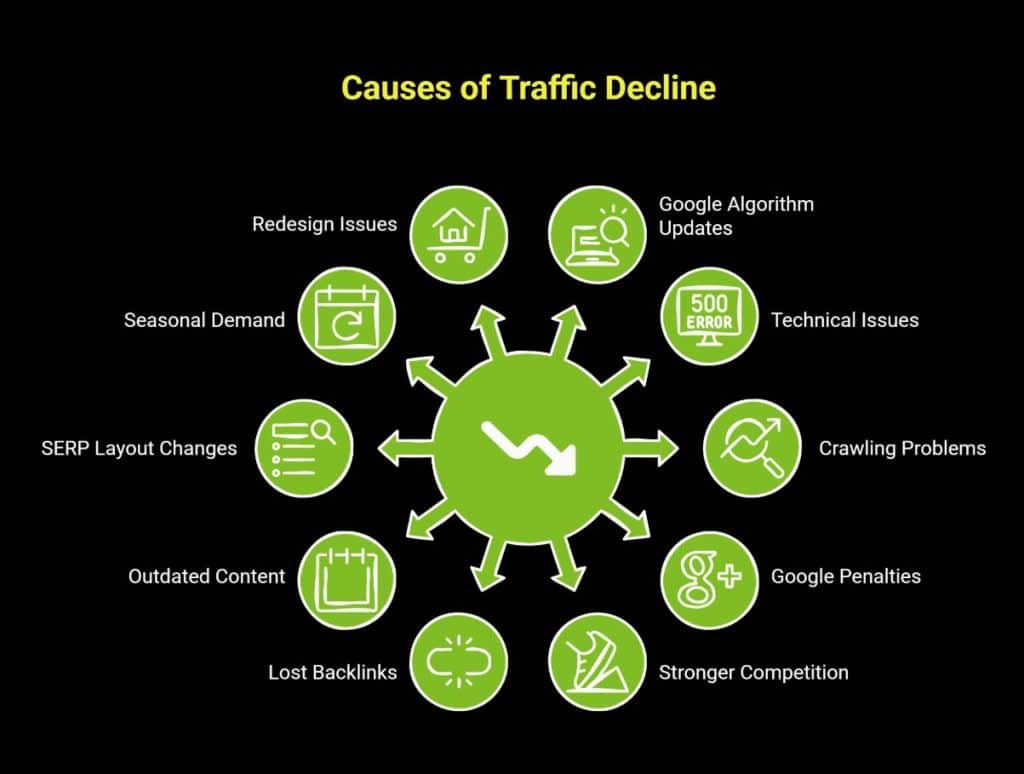
Infographic showing causes of traffic decline
Once you confirm a real decline, the next step is understanding why it happened. Organic traffic rarely drops without a cause, and identifying the reason quickly is key to recovery.
Most drops come from Google algorithm updates, technical or indexing issues, penalties, or competitors improving their performance. Let’s look at the most common causes in detail.
1. Google Algorithm Shake-Ups
If your traffic dropped suddenly within a short period, one of the most likely causes is a Google algorithm update. These updates adjust how Google evaluates content quality, expertise, backlinks, user experience, and search intent. When ranking criteria shift, pages that previously performed well may lose visibility if they no longer align with what Google prioritizes.
This often affects:
- Pages with thin or outdated content
- Sites with weak authority signals or low-quality backlinks
- Content that does not align well with user intent
- Websites with slow performance or poor UX
How to investigate?
Check whether the date your traffic fell matches a confirmed update. Tools such as Semrush Sensor, MozCast and RankRanger track volatility across industries. If multiple websites in your niche also show fluctuations, the decline is likely update-related rather than due to a technical problem.
If the update targeted content quality, review your pages for depth, structure and E-E-A-T signals. If it targets spam or backlinks, audit your link profile before making changes.
2. Technical Roadblocks & Accessibility Hiccups
Organic traffic can drop immediately if your website becomes temporarily inaccessible to users or Googlebot. Even a short period of downtime, slow server response or high error rate can interrupt crawling and impact rankings, especially for high-traffic pages.
Typical triggers include:
- 4xx or 5xx server errors
- Hosting or CDN outages
- Expired SSL certificates
- Slow page load times during peak traffic
- A misconfigured firewall or a bot blocking
If Google repeatedly encounters failures such as “Server Unavailable” or “Page Not Found”, it may reduce crawl frequency, which affects how quickly updates to your site are indexed.
How to investigate?
- Open Google Search Console → Page Indexing / Page Experience to look for sudden increases in errors or affected pages.
- Use uptime monitoring tools such as UptimeRobot, Pingdom or StatusCake to check for service interruptions linked to the timing of the drop.
- If rankings start correcting themselves after restoring uptime, this confirms the cause.
3. Crawling & Indexing Glitches
Your site can appear fine to users but still be invisible to search engines if crawling or indexing fails. When key pages are excluded from the index, rankings and traffic fall quickly.
Common causes include:
- Accidental noindex or nofollow tags
- Blocked pages in robots.txt
- Incorrect canonical tags pointing away from the intended URL
- Redirect chains or loops, preventing crawling
- Orphan pages with no internal links
- Crawl budget wasted on duplicate or auto-generated pages
These issues typically lead to messages such as Crawled but not indexed, Duplicate without user-selected canonical or Discovered but not indexed in Search Console.
How to investigate?
- Check Google Search Console → Page Indexing for errors and patterns.
- Review internal linking and sitemap structure to confirm that important pages are prioritised.
- Analyze server logs or crawl results using Screaming Frog, Sitebulb, or JetOctopus to verify whether Googlebot is accessing the affected pages.
Fixing indexing barriers often results in traffic recovering gradually once Google re-crawls and processes those pages.
4. Google Penalty Power Plays
A sharp and sudden decline across multiple pages at once can be a sign of a Google penalty. Penalties can be manual (applied directly by Google reviewers) or algorithmic (triggered automatically when the system detects violations of search guidelines).
Penalties commonly target:
- Unnatural or paid backlinks
- Thin or duplicated content
- Keyword stuffing
- Automatically generated content
- Misleading or manipulative SEO practices
How to investigate?
- Check the Manual Actions section in Search Console to see if a penalty is documented.
- For suspected algorithmic penalties, compare keyword visibility trends in Semrush or Ahrefs to pinpoint precisely when shifts occurred and which pages were impacted.
If the issue is backlinks, run a full audit and clean up any spammy or artificial patterns. If it’s content quality, focus on rewriting, expanding, or improving the parts that feel weak. Don’t rush to delete anything. It’s usually better to fix what you have.
Once you’ve addressed the root problem, the next step is rebuilding trust and boosting your site’s authority. If you want help with that, you might find this guide useful: How to Rank Higher in Google Search Results.
5. Rising Competitors Stealing the Spotlight
Traffic can decline simply because competitors have improved rather than your site becoming worse. If competitors produce more comprehensive content, acquire stronger backlinks, or optimize better for user intent, they may outrank pages that once performed well.
This type of drop is usually gradual. You may notice stable impressions but falling clicks and rankings as competitor pages earn more SERP visibility and richer result placements.
How to investigate?
- Use competitor tracking tools in Semrush, Ahrefs, or Similarweb to compare rankings and backlink profiles for keywords experiencing decline.
- Look at differences between your content and top-ranking competitors, such as length, structure, depth, examples, expertise signals, or multimedia support.
- Identify the gap, then update or expand your pages rather than starting over.
6. Backlink Loss: A Hidden Hit
Backlinks are a core trust and authority signal. If you lose links from authoritative or niche-relevant domains, Google may downgrade your perceived credibility, resulting in dropped rankings and traffic.
Links can disappear when content is updated or removed, publishers clean up outbound links, domains expire or change ownership, or external sites restructure their content. In other cases, low-quality or spam links pointing to your site can trigger algorithmic suppression.
How to investigate?
- Audit your backlink profile using Ahrefs or Semrush to check for sudden decreases in referring domains.
- Focus especially on lost links connected to pages that previously ranked well.
If you discover toxic links instead of lost legitimate links, prepare a disavow file and rebuild authority through legitimate outreach and content worth linking to.
7. Outdated Content Holding You Back
Content can lose rankings when it becomes outdated or no longer satisfies search intent. If your page lacks depth, misses recent information, or does not clearly answer the user’s question, Google may prioritize fresher and more detailed alternatives. This is a common challenge for many websites, but don’t worry, it can be easily fixed with a little update work!
For example, a blog post about “Best SEO tools for 2022” will naturally lose visibility in 2024 if competitors publish updated lists with new tools and current pricing.
Similarly, a generic guide on “How to start a podcast” may fall behind a more comprehensive version that includes the latest platform features, equipment comparisons, and step-by-step visuals.
How to investigate?
- Review pages with declining rankings and compare them to top-ranking content.
- Check whether your content addresses questions users search today rather than the version they looked for years ago.
- Updating or expanding content often recovers traffic more efficiently than writing new pages.
By keeping your content current, relevant, and thorough, you can reclaim its ranking power and continue to meet the evolving needs of your audience.
8. SERP Features Taking Over the Spotlight
Organic traffic can decline even when rankings remain stable if the search results page becomes crowded with new features above traditional listings.
Elements such as AI overviews, featured snippets, People Also Ask boxes, video carousels, product results, and additional ads often capture attention before users reach standard organic results. When this happens, clicks drop even though your ranking position has not changed.
A study showed that when AI-enhanced SERP formats appear, average organic click-through rates can fall by more than half, dropping from 1.41% to 0.64%. This demonstrates how strongly modern SERP layouts influence user behavior and traffic performance.
How to investigate?
- Check Google Search Console → Performance and filter keywords where impressions stayed consistent, but clicks and CTR fell noticeably.
- If rankings are unchanged but CTR is declining, it is likely caused by new SERP features rather than a ranking issue.
- Manually search your affected queries and identify which SERP elements now appear above your listing.
If this is the cause, improving CTR strategies such as optimizing title and meta descriptions for stronger engagement, adding structured data and producing content formats like videos or FAQs can help reclaim visibility.
9. Seasonal Traffic Shifts: When Timing Matters
Sometimes a drop in organic traffic has nothing to do with rankings or technical issues. It simply happens because fewer people are searching for the topic at that time of year. Many industries experience predictable seasonal patterns where interest rises and falls based on timing, weather, or events.
For example, travel queries typically decrease after summer, tax-related searches peak early in the year, and fitness or wellness topics surge in January. When overall search demand drops, impressions and clicks fall naturally even if your rankings are unchanged.
The key sign of seasonal decline is that both impressions and clicks decrease together, rather than just clicks or rankings. This indicates a shift in user behavior rather than an SEO performance problem.
How to investigate?
- Check year-over-year performance in Google Analytics or Search Console to see if the same patterns occurred in previous years.
- Use Google Trends to compare current keyword search interest with historical demand.
If rankings remain steady but impressions and clicks decline, seasonal fluctuation is the likely explanation.
Understanding these patterns can help with planning content schedules, campaigns, and expectations instead of assuming something went wrong.
10. Redesign or Migration Bumps in the Road
A redesign or site migration can improve user experience, but it can also disrupt organic traffic if key SEO elements are not handled correctly. Even small structural changes can affect how Google crawls, indexes, and understands your pages.
Traffic drops after redesigns typically come from issues such as:
- Missing or incorrect redirects
- Pages removed or merged without proper mapping
- Updated URLs that were not communicated to Google
- Lost metadata or structured data
- Weakened internal linking
- Changes in content placement or hierarchy
These issues make it harder for Google to connect your new pages with their previous authority. As a result, rankings fall and traffic declines, sometimes gradually and sometimes immediately after launch.
How to investigate
- Run a crawl of your website using tools like Screaming Frog, Sitebulb, or JetOctopus to identify redirect errors, broken pages, and missing metadata.
- Check Google Search Console for new indexing issues that appeared after the redesign.
- Review internal linking and compare the old site structure with the new one to ensure important pages still receive sufficient visibility.
Fixing these issues early helps Google reprocess the site correctly and can speed up traffic recovery.
What Not to Do When Traffic Drops?
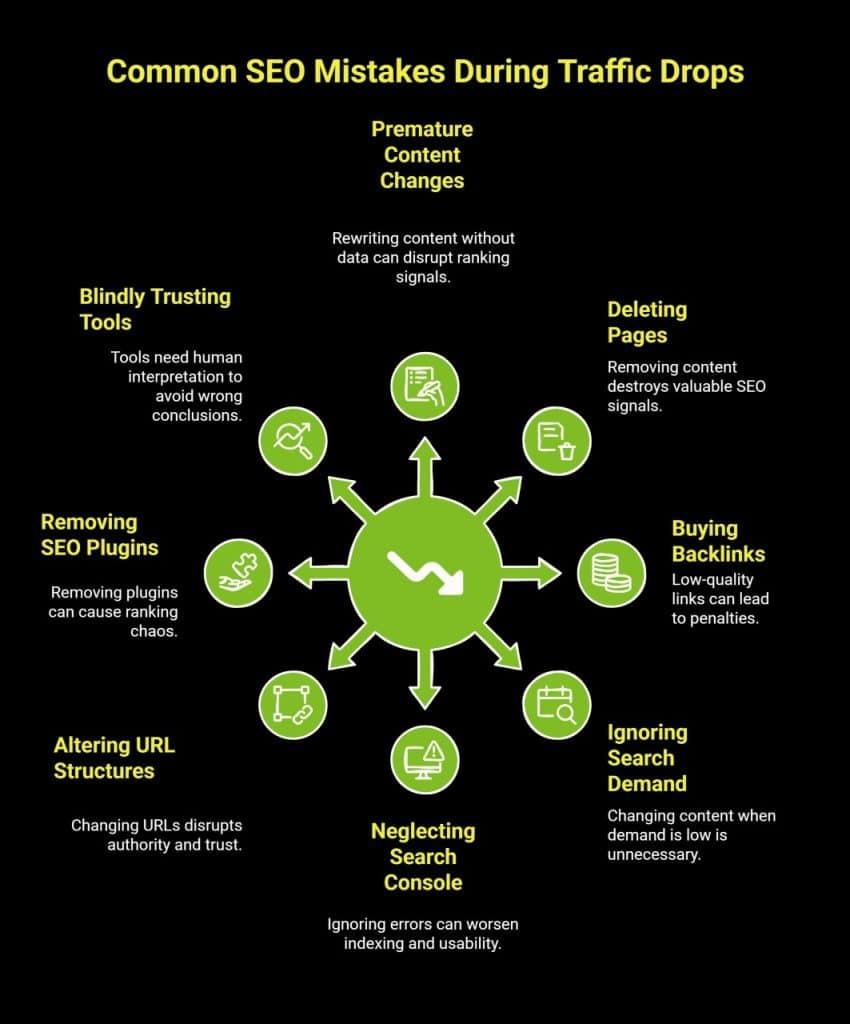
Infographic on common SEO mistakes during traffic drops
A sudden drop in organic traffic can feel urgent to fix, but reacting without data can cause more damage. These are the common mistakes that often make a decline worse and the real SEO reasons you should avoid them.
1. Don’t Jump the Gun with Changes Without the Right Data
Some people immediately rewrite large sections of content, replace headings, remove keywords or change layouts when traffic drops. Google might still be evaluating the existing version of the page.
Why this can worsen the situation:
- Undoing ranking signals that were working
- Resetting content history and engagement data
- Making it impossible to track what caused the drop
- Slowing down Google’s reevaluation process
Changes made without proper diagnosis can deepen the decline instead of helping it. Wait until you’ve identified the root cause before making any changes.
2. Don’t Delete Pages Just Because They Lost Rankings
Deleting content feels like a cleanup, but it destroys valuable SEO signals.
Why this harm recovery:
- Any backlinks to the URL structure lose all value
- Internal link flow breaks and weakens related pages
- Topical authority is reduced if a topic disappears
- Google must reprocess new content from scratch
A declining page usually needs improvement, not removal. Focus on optimizing rather than removing valuable content.
3. Don’t Fall for the Cheap Backlink Trap
Traffic drops often tempt site owners to purchase backlinks as a shortcut.
Why this is dangerous:
- Low-quality links look unnatural to Google’s systems
- Risk of both algorithmic and manual penalties
- Long recovery time if spam needs to be cleaned up
Rebuild authority through credible and relevant sources, not shortcuts. Quality backlinks take time to develop but pay off in the long run.
4. Don’t Assume SEO Is the Problem If Search Demand Has Dropped
If fewer people are searching, rankings are not the issue. Changing content unnecessarily can break what was working.
Why this create new problems:
- You alter content that Google still trusts
- You disconnect the page from its established signals
- You waste time fixing something that was not broken
Drops driven by seasonal demand require patience, not major content adjustments. Focus on optimizing content only when necessary.
5. Don’t Ignore Google Search Console Errors
Some assume warnings in Search Console are not urgent. When they are related to indexing, mobile usability or crawling, they are extremely urgent.
Why delay makes recovery harder:
- Google may crawl your site less frequently
- Important pages may be excluded from results
- Usability failures can hurt rankings quickly
Fix Core Web Vitals, indexing issues, and server errors immediately to prevent further ranking drops.
6. Don’t Change URL Structures in the Midst of a Drop
Renaming slugs or changing categories while traffic is already falling forces Google to reprocess the site again.
Why rankings drop further:
- Authority is temporarily lost during redirect processing
- Pages take time to regain previous trust signals
- Redirect chains or errors can appear unintentionally
Structural changes should be planned, not reactive. Avoid making URL or category changes while experiencing traffic instability.
7. Don’t Panic and Remove SEO Plugins or Structured Data
During troubleshooting, some people panic and remove plugins that control SEO elements.
Why this can cause sudden ranking chaos:
- Metadata may disappear
- Canonical tags may change or break
- Schema markup may stop working completely
These are critical trust signals, and removing them without a controlled plan can lead to ranking issues. Only adjust SEO plugins or structured data if you fully understand the impact.
8. Don’t Trust SEO Tools Blindly Without Context
Tools are helpful for spotting trends, but they are not decision makers.
Why this leads to wrong conclusions:
- Automated alerts do not understand intent or business goals
- Tools sometimes misclassify harmless issues as severe?
- Important human signals like expertise and user satisfaction are overlooked
Data needs interpretation. Work with an experienced SEO strategist to connect insights to practical solutions.
Traffic drops happen to everyone. What matters most is staying calm, analyzing the real cause, and making smart decisions instead of reacting blindly.
Why SEO Still Needs Human Decision-Makers?
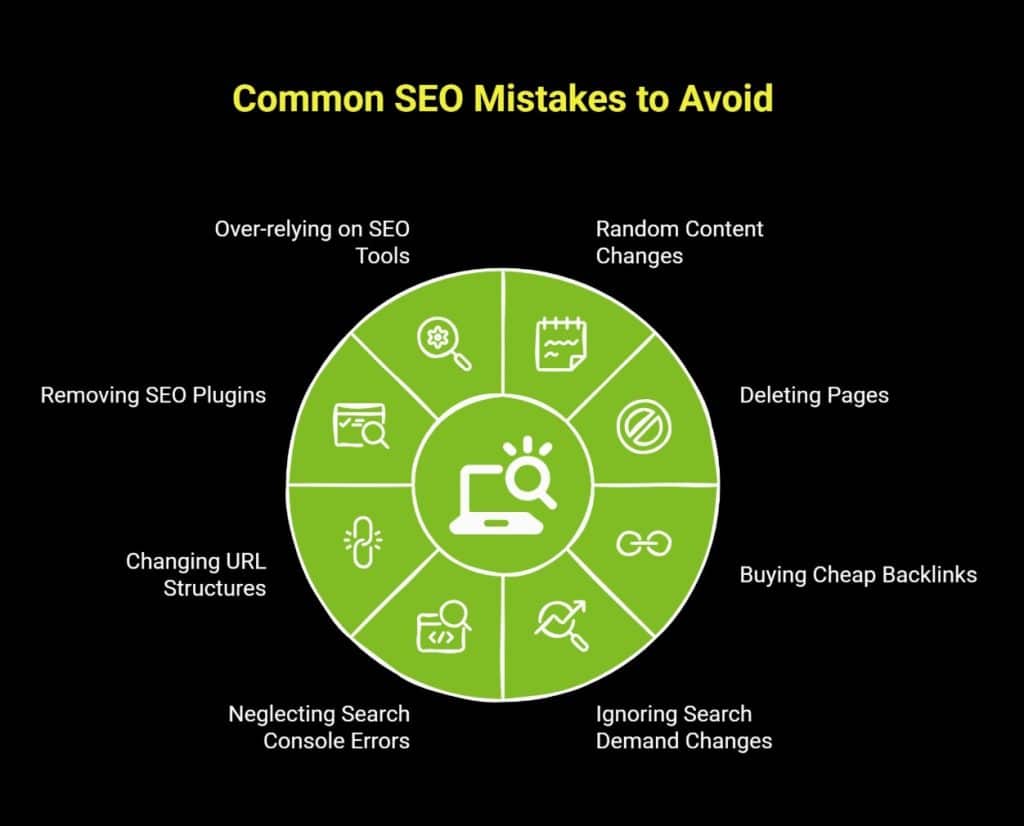
Infographic on common SEO mistakes to avoid
Tools can show numbers, charts, and performance curves, but they cannot explain the real reason your traffic dropped or what the correct next step should be. They present symptoms, not causes. Understanding the cause requires human judgment, context, and strategic thinking.
SEO decisions depend on more than data alone. A tool cannot interpret search intent shifts, competitive activity, brand positioning, or user motivation.
It cannot determine whether a drop is caused by seasonality, SERP layout changes, or a competitor publishing something better. Without human interpretation, there is a real risk of misreading the data and solving the wrong problem.
Traffic recovery comes from combining analytics with experience. Tools identify patterns. Humans decide what they mean and what actions will genuinely drive progress.
That balance is what leads to confident decisions and long-term growth that automation alone cannot achieve.
Why Work With Wild Creek Web Studio
Wild Creek Web Studio is a performance-focused digital marketing partner with over 18 years of experience helping businesses achieve measurable growth. We have worked with 100+ brands, delivering real improvements in visibility, leads, and ROI.
Here’s what makes us different:
- Results first: We focus on outcomes that matter, such as conversions, revenue, and sustainable growth.
- Custom strategies: No generic templates. Every plan is built around your audience and business goals.
- Proven performance: Clients have achieved significant increases in leads and conversions through our data-driven approach.
- Full-service expertise: SEO, paid marketing, social media, analytics, and consulting under one unified strategy.
- Transparent partnership: Clear communication, clear reporting, and clear direction.
Wild Creek is not just an agency. We are your growth partner focused on long-term success, not short-term wins.
Ready to grow with confidence? Contact us now!
Final Words
A drop in organic traffic is not a setback. It is a signal. Instead of reacting out of urgency, treat it as the insight that pushes your strategy forward. The brands that grow are the ones that pause, investigate and act with intention.
Use this moment to sharpen your focus, refine what matters, and make smarter decisions driven by evidence rather than assumptions. Every fluctuation is an opportunity to rebuild stronger and rise higher than before.
Now is the time to analyze with clarity, adjust with purpose, and move confidently.
Your next step determines the direction of your growth.
Frequently Asked Questions
What should I check first when my organic traffic decreases?
When you see a traffic drop, first use Google Analytics and Search Console to confirm the decline and identify which pages are affected. Then, check for major technical SEO issues like crawl errors or indexing problems. Investigating for a recent Google update or manual action is also a critical early step.
Can technical SEO problems lead to a sudden organic traffic drop?
Yes, absolutely. Technical issues are a very common cause of sudden traffic drops. Problems like incorrect robots.txt directives, server errors, or widespread index errors can prevent Google from crawling and indexing your site, causing your pages to disappear from search engine results. Use Google Search Console to find and fix these crawl errors.
How important are backlinks in maintaining organic traffic?
Backlinks are extremely important for maintaining organic search traffic. They are a key signal of your site’s authority and trustworthiness to search engines. A strong backlink profile helps improve your search rankings, and losing high-quality links can directly lead to a drop in authority and, consequently, a decline in traffic.
Is AI-generated content impacting my site’s organic traffic performance?
AI content can help scale production, but low-quality or generic output may negatively affect engagement and trust. If users do not find value, rankings and visibility can fall, and Google organic traffic dropped becomes a likely outcome.
Why did my Google ranking suddenly drop?
Sudden ranking drops usually come from algorithm updates, indexing problems, technical errors, or stronger competitor content. Reviewing analytics and search console trends helps identify the trigger so you can reverse performance loss and stabilize search visibility effectively.
Why organic traffic decrease, and how do I handle it?
There are many reasons for drop in organic traffic, including algorithm changes, slow pages, outdated content, broken links, seasonal patterns, or penalties. Diagnose the source using analytics, update affected pages, improve technical performance, and monitor recovery progress.
Is not Google clever enough to know that the newly created subdomain is part of the same domain?
Google treats subdomains as separate entities in many ranking scenarios. Authority does not automatically transfer. You must build structure, internal links, and clear navigation so search engines understand the relationship and evaluate content correctly.
How important is it to follow E-E-A-T guidelines?
E-E-A-T is critical for trust and rankings, especially in competitive or sensitive industries. Demonstrating expertise, accuracy, transparency, and real experience increases credibility, improves user engagement, and strengthens long-term organic visibility.