Key Highlights
- AI has progressed through seven evolutionary stages from rule-based systems to advanced generative models.
- We are currently in Stage 4: Deep Learning and Generative AI, not human-level intelligence.
- Early AI followed strict rules; modern AI learns from data and recognizes complex patterns.
- Neural networks and deep learning breakthroughs accelerated perception, prediction, and creativity.
- Early signs show a move toward Stage 5: integrated, collaborative AI across real-world systems.
- AGI and ASI remain future possibilities, not current realities.
- Wild Creek Web Studio helps brands navigate AI adoption with clarity and measurable strategy.
Everywhere you look, AI is making headlines. New tools launch daily, companies rush to integrate automation, and people wonder if machines are about to surpass human intelligence. But beneath the noise lies an essential question that most still can’t answer confidently: What stage of AI are we really in?
Take, for example, the recent success of ChatGPT, an AI that can generate human-like text based on simple prompts. It’s a massive leap forward, yet it’s still limited. Despite its impressive capabilities, AI like ChatGPT struggles with nuanced conversations and understanding context the way humans do.
This highlights the gap that still exists between current AI and true human-level thinking. While some assume AI is already close to achieving human-level intelligence, others believe we’re still working with basic prototypes.
Without a clear understanding of the different stages of AI development, it becomes nearly impossible for businesses, creators, and everyday users to adapt and prepare for what’s coming next.
In this blog, we’ll break down the stages of artificial intelligence in a way that’s simple and realistic, and explain where we currently stand in that evolution.
How Many Stages of AI Are There?
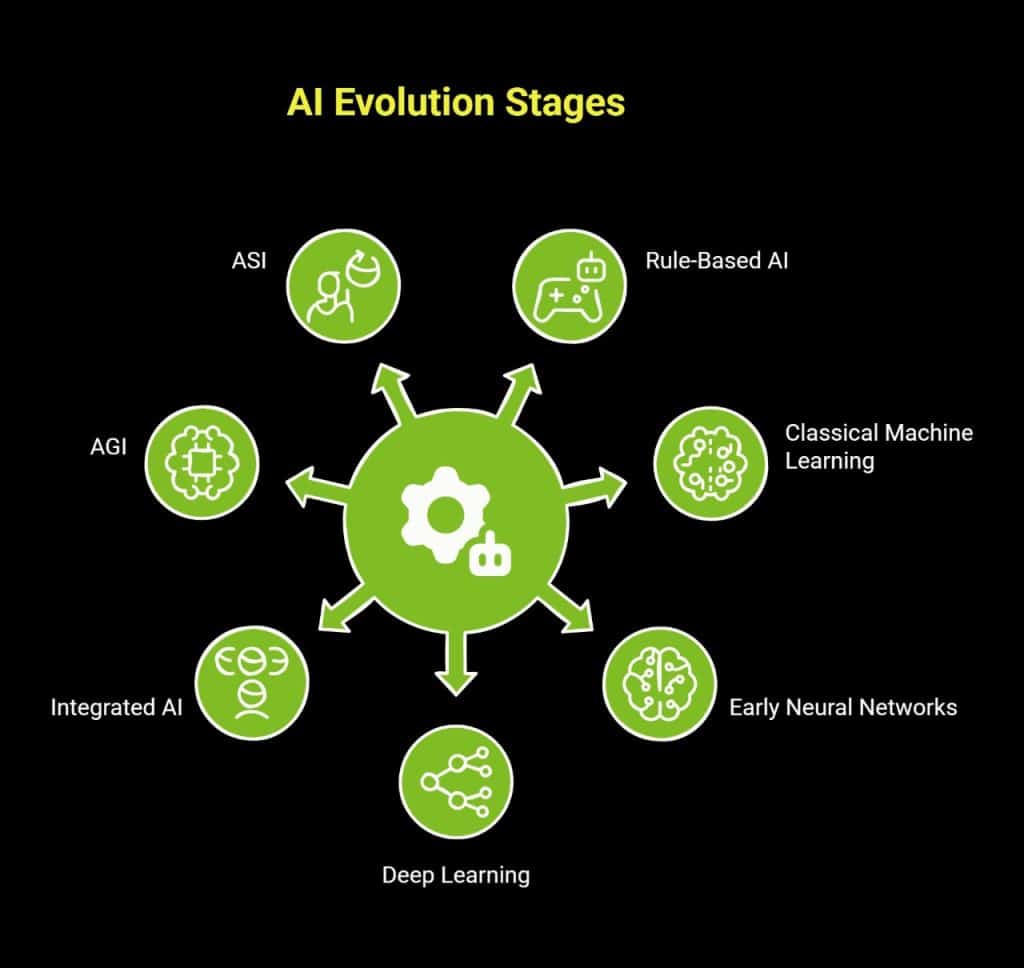
Infographic showing AI evolution stages
To understand what stage of AI we are in, we need a clear view of how artificial intelligence evolves. AI doesn’t leap from simple automation to human-level thinking overnight. It progresses through defined stages, each marked by new levels of capability, autonomy, and real-world impact.
While many people reference the classic three-tier model (ANI, AGI, ASI), a more detailed and realistic framework expands the journey into seven stages, offering sharper insight into where we stand today and how far we still have to go.
Here is a concise overview of these stages:
Stage 1 (1950s–1980s): Rule-Based and Symbolic AI
Stage 1 represents the earliest phase of artificial intelligence, built entirely on explicit, human-written rules rather than learning from data. These systems processed information by following predefined logical pathways, which allowed them to simulate structured reasoning but only within very narrow boundaries.
Examples of Stage 1 AI include:
- MYCIN (1970s): A medical expert system designed to diagnose bacterial infections.
- DENDRAL (1960s): A chemical analysis system that interpreted molecular structures.
- XCON (early 1980s): A configuration tool used by Digital Equipment Corporation to assemble computer systems.
These early expert systems were groundbreaking because they automated decision-making for the first time. However, they lacked adaptability and context awareness.
If anything fell outside the programmed rules, the system simply couldn’t respond. This limitation ultimately revealed the need for AI that could learn and improve, thereby ushering in the next era of machine learning.
Stage 2 (1980s–2000s): Classical Machine Learning
Stage 2 marks a major shift in the evolution of AI. Instead of relying solely on predefined rules, systems in this era began learning from data. Algorithms could identify patterns, make predictions, and improve performance over time through training, rather than depending entirely on manual programming.
This period introduced foundational techniques such as decision trees, Bayesian networks, support vector machines, and early neural networks. Unlike symbolic AI, machine learning could adapt to new information, making it far more practical for real-world applications.
Real-world breakthroughs that defined Stage 2 include:
- IBM Deep Blue (1997): The computer system developed by IBM defeated world chess champion Garry Kasparov in a six-game match, marking a landmark moment for machine learning and search algorithms.
- Spam filtering algorithms (late 1990s): Email service providers adopted machine-learning techniques (e.g., Bayesian filters) to detect unsolicited bulk email by analysing large datasets rather than purely rule-based heuristics.
This stage transformed AI from rigid automation into adaptable intelligence driven by data. It also set the foundation for deep learning, large-scale computing, and the explosive growth that followed.
Stage 3 (2000s–2010s): Early Neural Networks and Pattern Recognition
Stage 3 marks the point where AI began to move beyond basic statistical learning and started leveraging neural network architectures to recognize patterns in images, speech, and text.
Unlike traditional machine-learning models, neural networks could extract complex features from raw data, enabling major breakthroughs in perception-driven tasks.
This era introduced deeper layers of computation, stronger hardware acceleration (like GPUs), and rapidly expanding datasets, making AI more powerful, accurate, and useful in everyday applications. These advances paved the way for modern deep learning.
Some pivotal innovations that define Stage 3 are:
- Google Brain Project (2011): A large-scale neural network that learned to recognize objects such as cats directly from YouTube video data, without manual labeling.
Source: - ImageNet / AlexNet Breakthrough (2012): Deep convolutional neural networks dramatically improved image recognition accuracy, cutting the error rate nearly in half and reshaping modern AI research.
Stage 4 (2010s–Present): Deep Learning and Generative AI
Stage 4 represents one of the most transformative periods in the evolution of artificial intelligence. With the rise of deep neural networks and transformer-based architectures, AI moved beyond identifying patterns to understanding context, generating original content, and interacting more naturally with humans.
This era is defined by unprecedented scale, multimodal capabilities, and mainstream adoption across industries, from healthcare and finance to creative media and education.
Rather than simply analyzing data, AI in this stage learns from massive datasets, adapts rapidly, and produces results that often resemble human-level reasoning and creativity.
The shift from narrow automation to generative capability has reshaped expectations and opened the path toward more advanced forms of intelligence.
Notable advancements that illustrate Stage 4 include:
- GPT-3 by OpenAI (2020): A groundbreaking 175-billion-parameter language model capable of generating coherent long-form text, answering complex questions, and producing code. It demonstrated how transformers could achieve near-human fluency in language tasks.
- DALL·E (2021): OpenAI’s model that generates original images from text prompts, showcasing the power of multimodal learning and making creative AI widely accessible.
This stage is where we are today, an era defined by generative capability, accelerated innovation, and rapid integration of AI into everyday life. It has set the foundation for the next major leap: truly collaborative and autonomous intelligence.
Stage 5 (Emerging): Integrated and Collaborative AI
Stage 5 represents the moment when AI begins to shift from a powerful tool into a truly collaborative partner. Instead of operating in isolation, artificial intelligence becomes tightly integrated across systems, environments, and workflows. In this stage, AI works alongside humans, anticipates needs, understands context, and coordinates actions across complex, real-world scenarios.
This is where AI moves beyond producing outputs and becomes capable of assisting with higher-level reasoning and decision-making.
Work becomes more intelligent, decisions become faster and more accurate, and humans begin to focus on strategic oversight rather than manual execution. Stage 5 sets the foundation for a world where AI functions confidently as a co-pilot.
What Stage 5 looks like in action:
- Autonomous driving ecosystems where vehicles communicate with each other and with smart infrastructure to optimize safety and traffic flow
- Intelligent enterprise automation where AI predicts outcomes, allocates resources, and collaborates across departments instead of just automating repetitive tasks.
Stage 6 (Future): Artificial General Intelligence (AGI)
Stage 6 represents the point where artificial intelligence reaches human-level reasoning and cognitive ability. Unlike today’s systems that excel only at narrow, specialized tasks, Artificial General Intelligence would be able to understand context, learn across different domains, adapt independently, and solve unfamiliar problems without explicit programming.
Even though AGI does not exist yet, research efforts continue to move toward this milestone. A large survey of AI experts suggests that more than half believe there is a 50% chance that AGI could be developed by around 2040 to 2061, although opinions vary widely.
The potential impact of AGI is enormous, with the ability to transform fields such as medicine, climate science, education, and advanced research.
What AGI could look like in action:
- Systems capable of independent reasoning and decision-making
- Machines that understand meaning rather than just patterns
- Intelligence that transfers knowledge across disciplines
If achieved, AGI would represent one of the most significant technological milestones in human history, reshaping how we live, work, and innovate.
Stage 7 (Future): Artificial Superintelligence (ASI)
Stage 7 represents the point where artificial intelligence surpasses human intelligence across every dimension, including creativity, reasoning, emotional understanding, and strategic problem-solving.
Artificial Superintelligence would not only match human cognitive ability but exceed it by operating at speeds and scales far beyond what the human brain can achieve.
ASI remains theoretical, and no system today is close to reaching this level. It raises complex questions around safety, ethics, and control, as its capabilities could potentially outpace human oversight. The goal among researchers is to ensure aligned, safe development long before such systems ever emerge.
What ASI could look like in action:
- Intelligence capable of solving global challenges such as disease, climate strategy, and resource optimization
- Systems that innovate and discover scientific breakthroughs autonomously
- Machines capable of analyzing and coordinating global-scale decisions with precision and efficiency
If realized, ASI would become the most transformative force in human history, with the potential to reshape civilization in ways that are difficult to fully imagine today.
The Reality of AI’s Current Position
AI is advancing rapidly, reshaping how we work, communicate, and create. As Andrew Ng put it, “Just as electricity transformed almost everything 100 years ago, today I actually have a hard time thinking of an industry that I don’t think AI will transform in the next several years.”
Right now, we find ourselves in the era of deep learning and generative AI. Technologies like ChatGPT and other AI-driven creative platforms have proven that machines can understand language, generate content, and process data at a scale we’ve never seen before. Yet, as we marvel at these breakthroughs, it’s crucial to acknowledge the limitations that remain.
AI is still far from achieving true independent thought. It doesn’t understand context in the same way humans do, nor does it have the ability to reason across diverse fields without direction. Its capabilities are grounded in the data it’s trained on, and it still requires human oversight to ensure that outputs are accurate and relevant.
So, what does this mean for us right now? We are at a unique juncture, AI is powerful enough to spark major changes across industries, but it’s still in its developmental stages.
This period is pivotal. How we handle AI adoption, governance, and safety today will shape how it evolves and integrates into society in the years to come.
We’re not just talking about tools; we’re discussing an entire shift in how we interact with and rely on intelligence, both human and artificial. The decisions made now will lay the groundwork for how AI will transform our future.
Are We Already Seeing the Shift Toward Stage 5?
We’re starting to see early signs that we’re moving toward Stage 5 of artificial intelligence, the stage of integrated and collaborative intelligence. While we’re still deeply entrenched in the age of deep learning and generative AI, these advancements are building the foundation for what comes next.
So, how can we tell Stage 5 is already on the horizon? Here’s a closer look at the key indicators:
1. AI Becoming Essential for Business Operations
AI is no longer just a tool sitting on the sidelines. It’s becoming a central part of business operations. Companies across industries are embedding AI into everything from sales to customer service, making it a crucial part of their day-to-day workflow.
2. AI in High-Stakes, Real-Time Applications
AI isn’t just running simulations anymore; it’s making decisions in real-time, high-pressure scenarios. Think of AI-assisted surgery or clinical decision systems, where the stakes are high, and decisions need to be made quickly. This shows AI’s growing role in critical, life-or-death situations.
3. AI Operating Across Connected Systems
We’re seeing a major shift from isolated devices to collaborative systems. AI is now working across networks, not just single machines. A great example is autonomous vehicles that communicate with traffic infrastructure, creating smarter and more efficient transportation ecosystems.
4. Multiple AI Systems Collaborating
AI isn’t just about individual systems anymore. We’re entering a stage where multiple AI agents collaborate to solve complex problems. Research is already underway to enable AI systems to work together, planning, negotiating, and making decisions collectively. It’s a new way of tackling challenges, one that’s much more dynamic and adaptable.
5. The Growing Need for AI Governance and Safety
As AI becomes more autonomous and integrated into everything from healthcare to transportation, we’re seeing an increasing focus on AI governance and safety. With more power comes more responsibility, and there’s a concerted effort to develop ethical guidelines and regulatory frameworks that can help steer AI in a responsible direction.
These are clear indicators that AI is moving beyond just enhancing individual tasks. It’s becoming more interwoven into the fabric of our society and decision-making processes. Stage 5 is emerging, and with it, we’re stepping into a new era where AI collaboration, integration, and ethical oversight are front and center.
This is a pivotal moment, AI is transforming industries, but how we manage its growth and development will define the next chapter. We’re witnessing a revolution, and it’s happening right in front of us.
Why Knowing Our Place in the AI Timeline Matters?
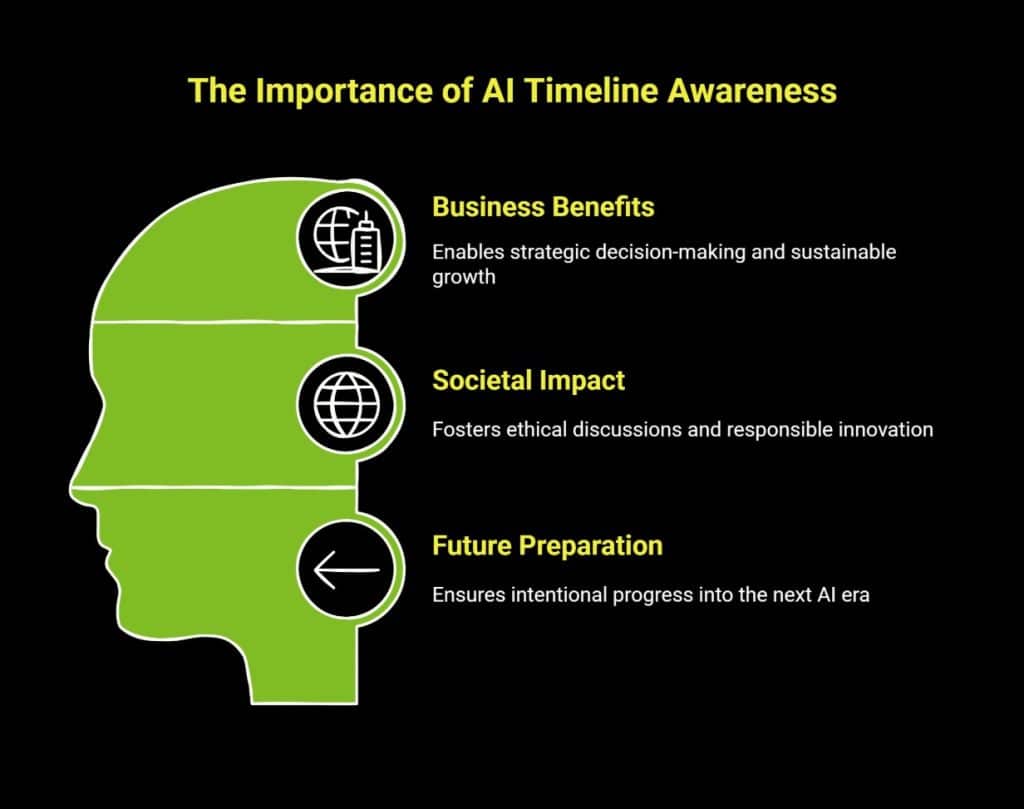
Infographic showing the importance of AI timeline awareness
Understanding where we truly stand in the evolution of AI is essential. It shapes how businesses plan, how society prepares, and how individuals adapt to the changes already unfolding around us. When the current stage of AI is misunderstood, people either imagine capabilities that don’t yet exist or fear outcomes that aren’t realistic. Both extremes slow progress and lead to poor decisions.
How It Helps Businesses?
For organizations, clarity about AI’s real capabilities enables smarter, more strategic decision-making. Leaders can focus on solutions that deliver real value rather than chasing hype or reacting impulsively.
This understanding makes it easier to:
- Identify practical opportunities that drive measurable outcomes
- Avoid investing in unrealistic or immature solutions
- Build sustainable long-term adoption strategies
- Train teams for real-world implementation, not theoretical concepts
How It Supports Society?
When society understands AI accurately, discussions about ethics, safety, and governance become grounded and productive rather than fear-driven. It encourages responsible innovation instead of restrictive backlash.
It also allows us to:
- Reduce misinformation and confusion
- Develop thoughtful policies and safety frameworks
- Prepare education systems and future workforce pathways
How It Prepares Us for What Comes Next?
This is a pivotal transition period. AI is powerful enough to transform industries, yet early enough that thoughtful planning still matters. The choices made now will shape how smoothly we move into the next era of collaborative and integrated AI systems.
Understanding our position today ensures we step into the future intentionally instead of reacting to it under pressure.
Why Partner With Wild Creek Web Studio?
At Wild Creek Web Studio, we help brands grow with clarity and confidence. For more than 18 years, we have worked alongside businesses to strengthen their digital presence, improve visibility, and achieve measurable results that matter.
We take the time to understand your goals and build strategies that create real impact. No generic templates. No confusing jargon. Just thoughtful guidance and meaningful outcomes. When you work with us, you get a team that treats your success like our own.
If you are ready to scale with purpose and move forward with a partner who believes in long-term growth, we are here to help you get there. Contact us today!
Final Words
Understanding the stages of AI is crucial for grasping how technology continues to evolve and impact our lives. From early symbolic AI to the potential of self-evolving and conscious AI, each phase brings unique developments that shape our interaction with technology.
As we navigate through the current deep learning era and look ahead to integrated and collaborative AI, recognizing these stages allows us to anticipate future advancements and their implications.
Staying informed not only enhances our knowledge but also prepares us for the changes that lie ahead.
Frequently Asked Questions
How many stages of AI are there, and why do frameworks differ?
There is no universally agreed-upon number of AI stages. Different frameworks exist because each AI researcher or organization may emphasize different milestones in the evolution from simple automation toward human intelligence.
What is the current stage of AI, according to experts?
According to most AI experts, we are in the era of deep learning and generative AI, an advanced form of narrow intelligence. This stage is defined by a powerful AI system, like a large language model, that excels at specific tasks but lacks the general understanding or consciousness of a human.
Are we close to achieving Artificial General Intelligence (AGI)?
No, we are not close to achieving Artificial General Intelligence. While AI research is advancing rapidly, creating machine intelligence with the broad cognitive abilities of the human brain is a monumental challenge. Most experts believe that true AGI is still decades away, if not more.
What’s actually going on with AI?
AI is rapidly advancing, with foundation models, computer vision, reinforcement learning, and natural language processing improving dramatically. AI applications now shape daily life, customer service, data science, software engineering, social media, and medical conditions, creating powerful technology that impacts business processes and society.
What is stage 7 of AI?
Stage 7 of AI refers to Artificial Superintelligence, where intelligent machines surpass human reasoning and human capabilities across a wide range of tasks. It represents the future of AI, where AI robots and agentic AI systems outperform human performance in the physical world.
What is the final stage of AI called?
The final stage of AI is called Artificial Superintelligence. It goes beyond artificial narrow intelligence and limited memory models to achieve theory of mind and far beyond, potentially transforming the United States, federal agencies, nuclear energy, intellectual property, and competitive edge across industries.
What level of AI is ChatGPT?
ChatGPT is a form of Artificial Narrow Intelligence operating within the deep learning era of foundation models. It uses natural language processing to complete tasks, generate text, and assist with use cases, but it does not possess human reasoning or general intelligence.
What are the stages of artificial intelligence that have reached AGI?
None of the different stages of artificial intelligence have reached AGI yet. The current stage of artificial intelligence is advanced but still narrow, focused on specialized tasks rather than full human reasoning or general adaptive learning across domains.
What are the OpenAI stages of artificial intelligence?
The open AI stages of AI generally align with stages of AI intelligence, progressing from Artificial Narrow Intelligence to future Artificial General Intelligence and potentially Artificial Superintelligence. Today’s focus remains on responsible progress, foundation models, and scalable stages of AI evolution.
Could an ASI pose an existential threat to our species?
Yes, many researchers believe Artificial Superintelligence could theoretically pose a risk if misaligned with human values. Proper governance, safety research, and thoughtful stages of AI adoption will be crucial for protecting human beings and ensuring a beneficial impact.