Key Highlights
- The SEO cost in India varies based on your business goals, scope of work, and competition level.
- Search engine optimisation pricing models include monthly retainers, hourly rates, and project-based fees.
- Low-cost SEO packages often fail because they lack a human-led strategy and focus on vanity metrics instead of real results.
- Factors like industry competition, keyword difficulty, and content marketing needs influence the final SEO cost.
- Choosing the right SEO agency depends on aligning their strategies with your business goals to achieve higher organic traffic.
Trying to understand SEO cost in India can feel confusing. Every agency seems to promise results, yet each one explains pricing differently. Some talk about rankings. Others talk about traffic. Very few clearly explain what you are actually paying for. It is natural to feel unsure about which direction to trust.
You are not just asking how much does it cost for SEO. You are really asking what that investment will do for your business. Will low-cost SEO services in India help you grow, or will they just tick boxes? Is the average cost of SEO linked to real outcomes, or just activity reports?
In this guide, we simplify everything. You will understand how SEO cost per month in India is structured, what drives SEO marketing cost, and how to evaluate proposals based on ROI, not just price. By the end, you will be able to make a confident and informed decision.
What Is the Average SEO Cost in India?
The average cost of SEO in India typically ranges between ₹15,000 and ₹60,000 per month for growing businesses. However, this varies significantly depending on deliverables, competition, and business objectives.
SEO cost in India refers to the investment required to improve organic visibility through technical optimisation, content creation, authority building, and conversion alignment. It is not a single service but a combination of ongoing strategic activities.
Average SEO Cost Breakdown in India
| Service Type | SEO Cost Per Month in India |
| Freelancer | ₹5,000 – ₹25,000 |
| Small Agency | ₹15,000 – ₹50,000 |
| Mid-Size Agency | ₹40,000 – ₹1,00,000 |
| Enterprise SEO | ₹75,000 – ₹1,50,000+ |
Why such variation?
SEO marketing cost depends on how aggressively you want to grow and how competitive your niche is.
How Much Does It Cost for SEO Based on Business Size?
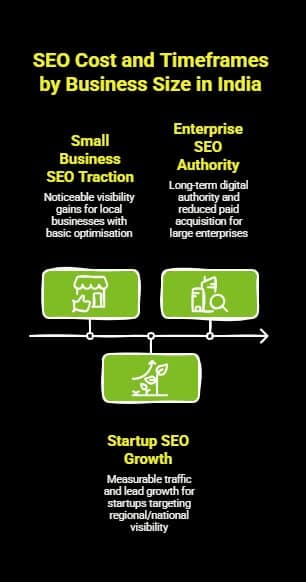
Infographic on How Much Does It Cost for SEO Based on Business Size visual selection
SEO cost in India is not one size fits all. What you invest depends on where your business stands today and how aggressively you want to grow. A local service provider, a funded startup, and an enterprise brand will require very different levels of strategic depth, content scale, and authority building.
1. Low-Cost SEO Services for Small Businesses
Small businesses often explore low-cost SEO services in India, typically ranging from ₹8,000 to ₹20,000 per month. These plans focus on foundational optimisation rather than aggressive scaling.
They usually include:
- Limited keyword targeting
• Basic on-page optimisation
• Minimal content creation
• Low-volume link building
For hyper-local or low-competition niches, this can generate consistent visibility.
ROI Example: A local clinic investing ₹12,000 per month may generate 8 to 12 additional enquiries within 4 to 6 months. Even one or two conversions can recover the monthly investment.
Time Expectation: Noticeable traction usually appears within 3 to 6 months.
Growth Velocity: Stable but gradual. Ideal for establishing presence, but expansion slows once competition intensifies.
This tier offers affordability and controlled risk. However, long-term authority and scalable growth require deeper strategic investment.
2. SEO Marketing Cost for Growing Startups
Startups targeting regional or national visibility generally invest between ₹25,000 and ₹70,000 per month. At this stage, SEO shifts from basic optimisation to structured growth planning.
This level typically includes:
- A structured content roadmap aligned with business goals
• Technical SEO audits and implementation
• Conversion-focused optimisation
• A strategic authority-building framework
Here, ROI becomes measurable. With consistent execution, meaningful traffic and lead growth often begin within six to nine months. The focus moves from rankings alone to revenue contribution.
3. Enterprise SEO Cost in Competitive Niches
Industries such as fintech, SaaS, healthcare, and real estate demand a significantly higher SEO marketing cost, often between ₹75,000 and ₹1,50,000 or more per month.
Enterprise SEO usually involves:
- Advanced technical architecture optimisation
• High authority backlink acquisition
• Large-scale content production across funnel stages
• Data-driven tracking tied to business metrics
At this level, SEO is no longer just a marketing activity. It becomes a strategic growth engine that reduces paid acquisition dependency and builds long-term digital authority.
Why Do Low-Cost SEO Packages Often Fail?
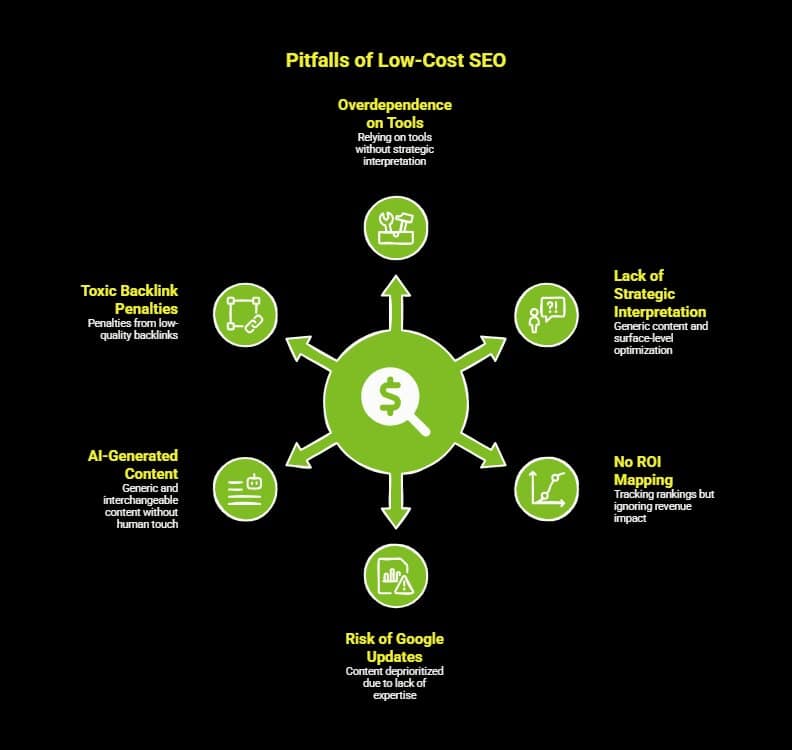
Infographic on Why Do Low Cost SEO Packages Often Fail visual selection
Low-cost SEO services in India often appear attractive at first. More keywords, quick rankings, and lower retainers. But the issue is not just price. Most cheap SEO packages focus on visible activity instead of business outcomes, which eventually leads to flat growth.
1. Overdependence on Tools Instead of Strategy
Many agencies rely heavily on tools like SEMrush, Ahrefs, Moz, Ubersuggest, and Google Keyword Planner. These tools provide data, but not direction.
- Ahrefs shows authority gaps
• SEMrush highlights keyword opportunities
• Google Search Console shows impressions
• Screaming Frog finds crawl errors
What they cannot do is define positioning, revenue alignment, or content differentiation. SEO requires judgement, not just dashboards.
2. Lack of Strategic Interpretation
Technical audits can be generated using Sitebulb, Lighthouse, or PageSpeed Insights. Content scoring can be done through Surfer SEO. But interpretation drives results.
Without analysing search intent, competitor positioning, and content differentiation, campaigns become repetitive. Generic blogs. Surface-level optimisation. Minimal authority building. Over time, performance stalls due to a lack of strategic depth.
3. No ROI Mapping
Low-cost SEO often tracks rankings but ignores revenue impact.
According to BrightEdge, organic search drives 53 percent of total website traffic across industries. But traffic without buyer intent alignment does not generate sales.
Effective SEO connects:
- Google Analytics 4 revenue tracking
• Google Tag Manager event tracking
• CRM attribution
• Heatmaps like Hotjar or Microsoft Clarity
Without revenue mapping, even cheap SEO becomes expensive.
4. Risk of Google Helpful Content Updates
Google’s Helpful Content Updates prioritise original, experience-driven insights. Thin or templated content is increasingly deprioritised.
Low-cost SEO often relies on scaled publishing without depth. When updates roll out, rankings drop because the content lacks expertise and differentiation.
5. AI-Generated Content Without Human Differentiation
Many low-budget packages now use AI to mass-produce blogs. While technically optimised, this content often lacks positioning, brand voice, and original insight.
Without human refinement, AI content becomes generic, interchangeable, and less defensible in competitive niches.
6. Toxic Backlink Penalties
To reduce costs, some agencies build low-quality backlinks from irrelevant or spammy domains.
Over time, toxic link profiles can trigger manual actions or algorithmic suppression, making recovery more expensive than the original SEO investment.
In short, low-cost SEO fails when it prioritises activity over outcomes. Sustainable growth requires strategic interpretation, authority building, and revenue alignment, not just deliverables.
What Factors Influence SEO Consultant Cost in India?
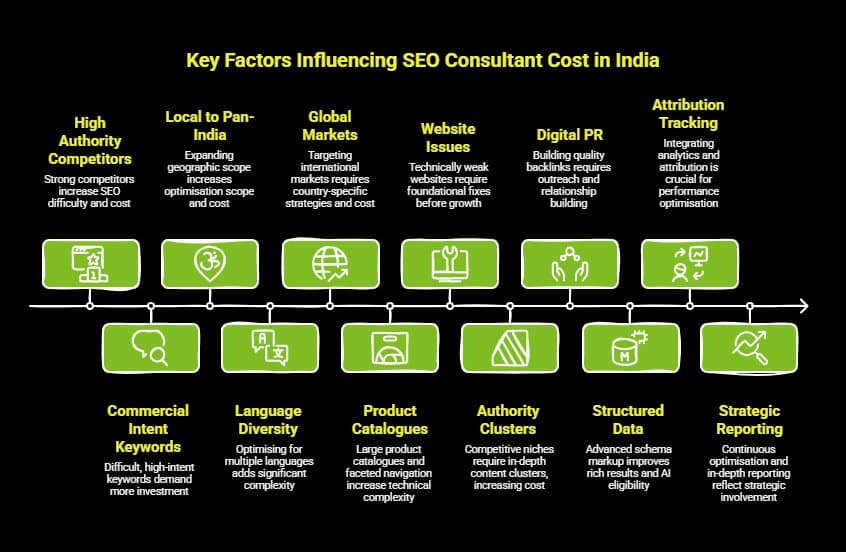
Infographic on What Factors Influence SEO Consultant Cost in India visual selection
SEO consultant cost in India depends on measurable factors. Pricing reflects competition, complexity, and execution depth. Before comparing quotes, it is important to understand what actually drives workload and investment levels.
1. Industry Competition
If your niche has strong, high authority competitors, ranking becomes harder.
Agencies analyse competition using:
- Ahrefs Domain Rating
• SEMrush Competitive Gap
• Similarweb traffic comparison
The stronger your competitors, the more authority and content depth required. Higher competition increases SEO cost per month in India.
2. Keyword Difficulty and Commercial Intent
High-intent commercial keywords are harder to rank and convert.
Difficulty is analysed through:
- Ahrefs Keyword Difficulty
• SEMrush Keyword metrics
• SERP-level manual evaluation
• Search Console performance data
High competition keywords demand stronger content positioning and authority building, raising investment levels.
3. Geographic Targeting Impact
Local SEO for one city is very different from national SEO across India.
Targeting:
- Single-city local keywords
• Multi-city service areas
• Pan-India campaigns
Each expansion layer increases optimisation scope, content volume, and backlink requirements.
4. Multilingual SEO Requirements
India’s linguistic diversity adds complexity.
Optimising for:
- Hindi and English
• Regional languages
• Transliteration queries
Requires structured hreflang implementation, localisation strategy, and language-specific keyword research. This significantly increases execution effort.
5. International SEO
Targeting the US, UK, UAE, or global markets requires:
- Country-specific keyword research
• International link acquisition
• Technical hreflang mapping
• Currency and compliance adjustments
International SEO complexity increases cost compared to domestic campaigns.
6. E-Commerce SEO Complexity
E-commerce SEO involves:
- Large product catalogues
• Faceted navigation management
• Canonicalisation
• Category optimisation
• Product schema
Scaling SEO across hundreds or thousands of URLs demands advanced technical and structural planning.
7. Technical Health of the Website
A technically weak website increases foundational workload.
Audits typically evaluate:
- Crawl errors
• Core Web Vitals
• Indexing issues
• Mobile usability
Extensive fixes raise initial investment before growth activities begin.
8. Content Production Depth
Competitive niches require authority clusters, not isolated blogs.
Content scope includes:
- Pillar pages
• Supporting topic clusters
• Case studies
• Industry-specific landing pages
Greater depth equals higher investment.
9. Link Acquisition and Digital PR
Quality backlinks require:
- Outreach campaigns
• Relationship building
• Guest publishing
• Brand mentions
The larger the authority gap, the more effort required.
10. Schema Implementation and Structured Data
Advanced SEO increasingly depends on:
- FAQ schema
• Product schema
• Organisation schema
• Review and rating markup
Structured data improves eligibility for rich results and AI summaries. Implementation complexity impacts cost.
11. Analytics and Attribution Setup
Serious SEO requires revenue tracking integration:
- Google Analytics 4
• CRM attribution
• Conversion tracking
• Event mapping
Without a proper attribution infrastructure, performance optimisation becomes limited.
12. Ongoing Optimisation and Reporting Depth
Basic reporting tracks rankings. Strategic SEO includes:
- Conversion analysis
• Funnel performance review
• Competitor monitoring
• Continuous content refinement
Higher reporting depth reflects higher strategic involvement. Ultimately, the SEO consultant cost in India is shaped by competition, keyword difficulty, technical conditions, content scope, and authority needs. Pricing reflects strategic effort, not arbitrary numbers.
How Are 2026 SEO Updates Changing SEO Cost in India?
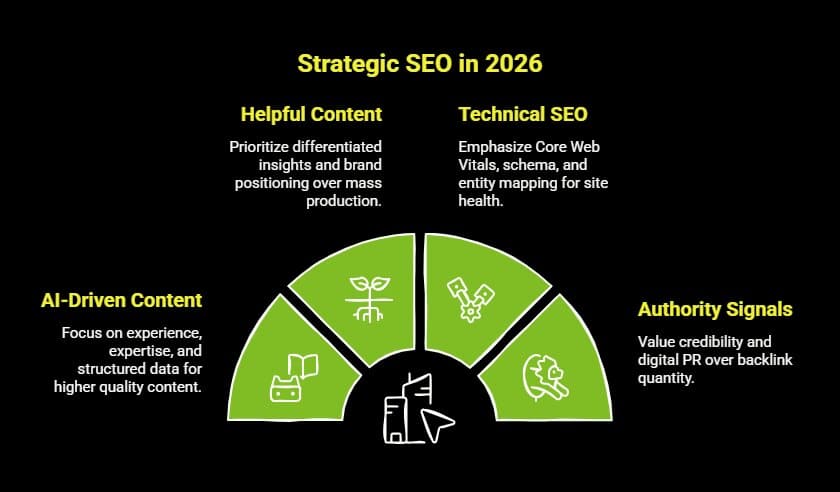
Infographic on How Are 2026 SEO Updates Changing SEO Cost in India visual selection
Search is evolving rapidly. The rise of AI Overviews, entity-based indexing, and Helpful Content updates is reshaping how SEO works and, in turn, how SEO consultant cost in India is structured.
1. AI-Driven Search Requires Higher Content Depth
Google increasingly prioritises:
- Experience-driven content
• Expert authorship signals
• Structured data implementation
• Entity clarity
This raises the bar for content quality and strategic planning.
2. Helpful Content Updates Penalise Thin SEO
Mass-produced blogs and low-effort content strategies are being deprioritised. Businesses now need:
- Differentiated insights
• Strong brand positioning
• Topic clusters instead of isolated posts
Higher-quality production increases investment requirements but also increases defensibility.
3. Technical SEO Complexity Is Increasing
Core Web Vitals, schema implementation, and structured entity mapping are no longer optional.
Sites that ignore technical health experience visibility volatility increase long-term recovery costs.
4. Authority Signals Matter More Than Ever
Backlink quantity is less important than credibility, digital PR, and brand mentions.
Authority-building strategies require deeper outreach and relationship-driven link acquisition, influencing pricing models.
In 2026 and beyond, SEO cost in India will reflect strategic depth rather than checklist execution. The focus is shifting from “how many keywords” to “how strong is your authority footprint.”
Businesses that adapt early will experience compounding returns. Those relying on outdated, low-cost tactics may face higher correction costs later.
What Is Google SEO Cost vs Overall SEO Marketing Cost?
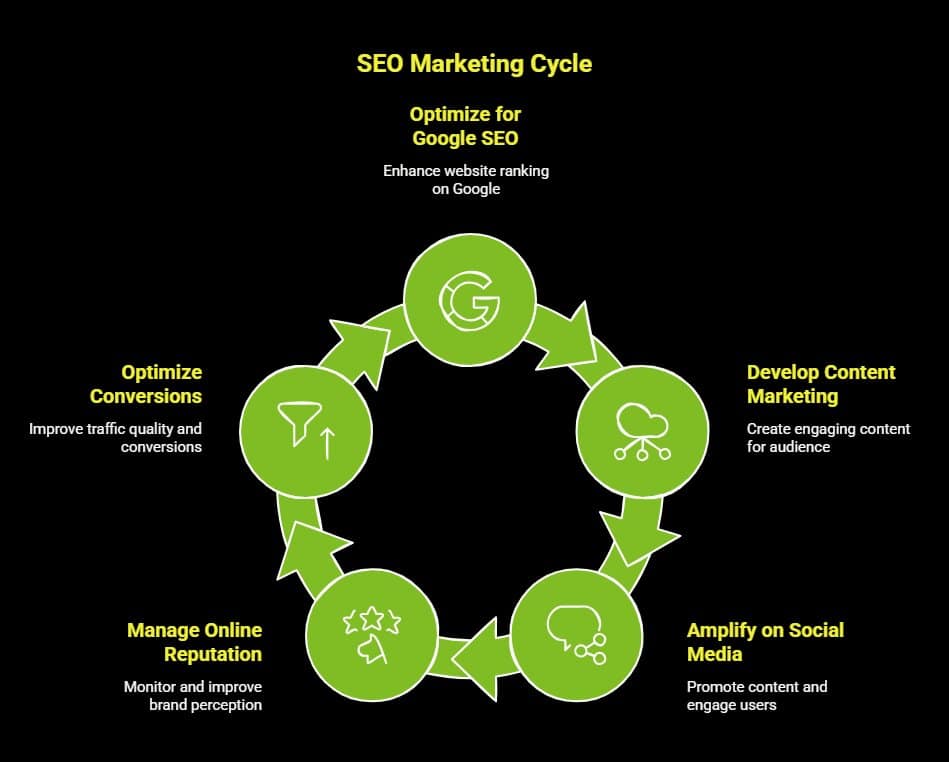
Infographic on What Is Google SEO Cost vs Overall SEO Marketing Cost visual selection
When businesses evaluate SEO cost in India, they often assume it only includes ranking on Google. However, Google SEO is just one component of a broader SEO marketing investment. Understanding this distinction helps you evaluate pricing properly and avoid underestimating the real scope required for sustainable growth.
What Does Google SEO Cost Cover?
Google SEO cost refers specifically to optimising your website to rank higher on Google Search. This includes:
- On-page optimisation such as meta tags, keyword placement, internal linking, and content refinement
• Technical SEO covering crawlability, indexing, Core Web Vitals, and site architecture
• Off-page SEO, including backlink acquisition and authority building
Since Google dominates search traffic in India, this becomes the core cost component in most SEO plans.
What Is Included in the Overall SEO Marketing Cost?
SEO marketing cost goes beyond Google rankings. It integrates multiple digital efforts that strengthen visibility and conversions across channels. A comprehensive plan may include:
- Content marketing such as blogs, landing pages, and resource guides
• Social media amplification to expand reach
• Online reputation management through review monitoring
• Conversion rate optimisation to improve traffic quality
This broader approach ensures SEO supports long-term brand authority, not just rankings.
Can an SEO Cost Calculator Give Accurate Estimates?
Online SEO cost calculators offer rough estimates based on preset assumptions. However, they rarely consider your industry competition, technical gaps, and revenue goals. A customised audit-based quote is always more reliable than automated pricing tools.
| SEO Component | Focus Area | Contribution to Overall Cost |
| Google SEO | On-page, technical, and off-page optimisation | Core cost component |
| Content Marketing | Blogs, articles, and videos | high cost, often bundled |
| Social Media Marketing | Content promotion and engagement | Additional cost supports SEO |
| Online Reputation | Reviews and brand monitoring | Varies, often integrated |
Ultimately, Google SEO builds visibility, while overall SEO marketing builds authority and revenue alignment. The final SEO cost reflects how integrated your growth strategy needs to be.
SEO vs Paid Ads: Which Is More Cost-Effective in the Long Run?
Infographic on SEO vs Paid Ads Which Is More Cost Effective in the Long Run visual selection
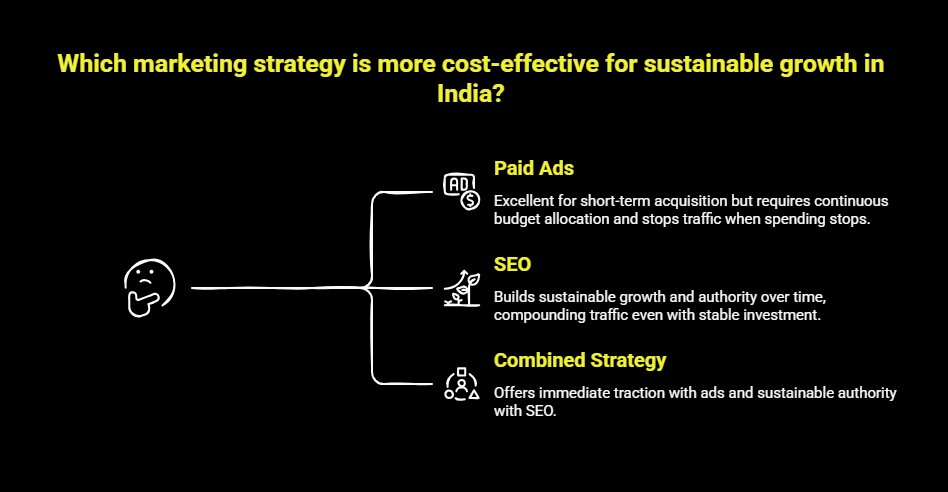
When evaluating SEO cost in India, many businesses compare it directly with Google Ads or paid campaigns. The real question is not which is cheaper, but which builds sustainable growth.
1. Paid Ads Cost Structure
Paid advertising requires:
- Continuous budget allocation
• Cost per click payments
• Bidding against competitors
• Ongoing creative testing
Once you stop spending, traffic stops immediately. Paid channels are excellent for short-term acquisition but do not build long-term authority.
2. SEO Cost Structure
SEO marketing cost involves:
- Technical optimisation
• Content creation
• Authority building
• Conversion alignment
Unlike ads, SEO compounds. Rankings and authority continue delivering traffic even when the monthly spend stabilises.
3. Cost Comparison Example
If you spend ₹1,50,000 per month on Google Ads at an average cost per click of ₹50, you generate 3,000 clicks.
If SEO helps you generate 5,000 organic visits per month after 8 to 12 months of consistent investment, the long-term cost per acquisition often becomes significantly lower.
Paid ads rent visibility. SEO builds digital assets.
For growth-focused businesses, the ideal strategy often combines both. Ads for immediate traction. SEO for sustainable authority.
Is Monthly SEO Better Than One-Time SEO?
Infographic on Is Monthly SEO Better Than One Time SEO visual selection
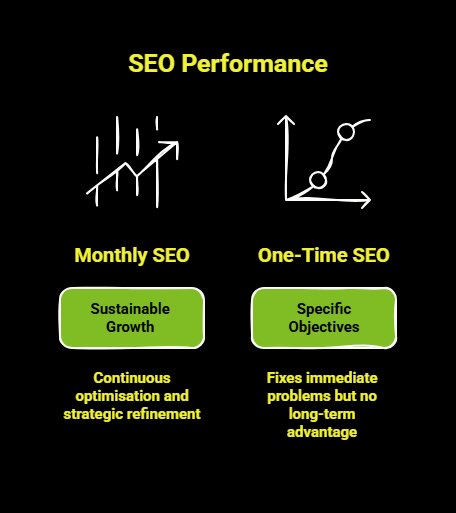
Choosing between a one-time SEO project and a monthly retainer depends on your growth expectations. While one-time SEO can fix specific issues, it does not provide a sustained competitive advantage. SEO is dynamic, and long-term success requires consistent optimisation and strategic refinement.
When Does One-Time SEO Make Sense?
A one-time SEO engagement is suitable for specific objectives such as:
- Technical audits
• Website migration support
• Penalty recovery
• Initial strategy planning
It addresses immediate problems but does not guarantee long-term ranking stability.
Why Monthly SEO Drives Sustainable Growth?
Monthly SEO ensures continuous progress through:
- Ongoing content development
• Regular backlink acquisition
• Continuous technical optimisation
• Monthly reporting and performance analysis
Search algorithms evolve frequently, and competitors continuously optimise their websites. Without consistent effort, rankings decline over time.
Think of SEO like building strength. One session may help, but sustained performance requires ongoing commitment.
In most growth-driven scenarios, monthly SEO delivers better compounding returns than one-time optimisation.
Want to measure what actually drives revenue from search? Explore our guide on how to track SEO performance and turn rankings into real business outcomes.
How Do You Calculate SEO ROI Before Investing?
Infographic on How Do You Calculate SEO ROI Before Investing visual selection
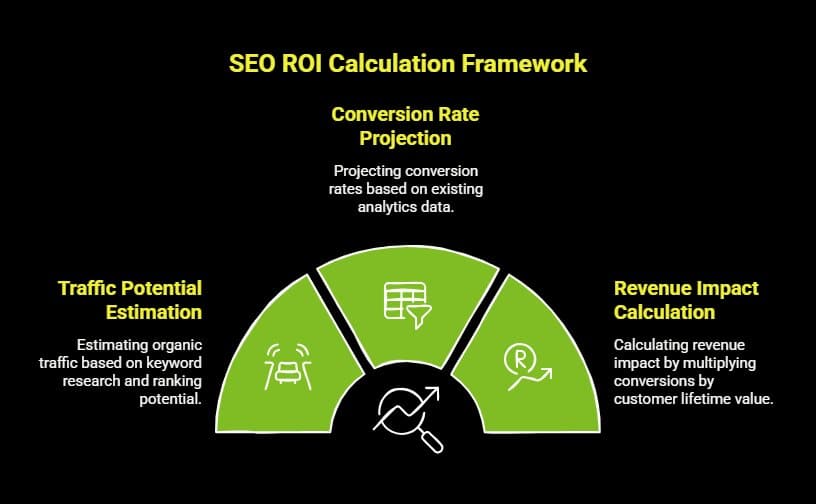
Before committing to any SEO marketing cost, it is important to estimate potential return. While exact projections are impossible, structured calculations can provide a realistic financial picture and help you decide whether a proposed SEO plan aligns with your revenue goals.
Step 1: Estimate Traffic Potential
Use keyword research tools to identify search volumes for your target keywords. Analyse how much traffic you could realistically capture if you rank on the first page. This gives you a directional estimate of organic opportunity.
Step 2: Project Conversion Rate
Review your existing analytics data to estimate how much organic traffic typically converts into leads or customers. If your average conversion rate is 2 per cent, apply that to projected traffic numbers for estimation.
Step 3: Calculate Revenue Impact
Multiply projected conversions by your average customer lifetime value.
Example:
Projected organic traffic: 5,000 visitors per month
Estimated conversion rate: 2 per cent
Projected customers: 100
Average customer value: ₹12,000
Estimated revenue potential: ₹12,00,000 per month
Now compare this revenue potential with your SEO cost per month in India. This shifts your perspective from expense evaluation to growth assessment.
By calculating ROI in advance, you avoid choosing low-cost SEO packages purely based on price and instead focus on value creation. The right SEO investment should generate measurable business returns over time.
Why Choose Wild Creek Web Studio for Strategic SEO Growth?
If you are serious about investing wisely in SEO costs in India and want more than surface-level optimisation, Wild Creek Web Studio brings the right balance of data intelligence and strategic clarity. With over 18 years of experience and 100-plus satisfied clients, the team focuses on measurable growth, not just rankings.
Wild Creek Web Studio does not treat SEO as a checklist activity. While advanced tools support keyword research, technical audits, and competitive analysis, every recommendation is filtered through commercial intent and business impact. This Human + Algorithm approach ensures your SEO marketing cost is aligned with revenue goals, not vanity metrics.
From ambitious startups to competitive service businesses, Wild Creek Web Studio builds structured, transparent, and performance-driven SEO frameworks tailored for the Indian market. Every campaign is built around realistic timelines, authority building, and long-term digital positioning.
If you are evaluating SEO consultant cost in India and want clarity before committing to a pricing plan, book a strategy consultation with Wild Creek Web Studio today. Move beyond reactive optimisation and adopt a smarter, ROI focused SEO growth strategy.
Final Thoughts
SEO cost in India is not just a number on a proposal. It reflects your growth ambition, competitive landscape, and long-term strategy. Whether you choose low-cost SEO services or a comprehensive monthly plan, the real focus should be on ROI, not rankings alone.
When evaluated through traffic potential, conversion impact, and revenue contribution, SEO becomes a strategic investment. Budget wisely, prioritise human led strategy, and choose a partner aligned with your business goals for sustainable organic growth.
Frequently Asked Questions
Do SEO prices in India vary significantly from year to year?
Yes, how SEO pricing evolves depends on changes in digital marketing trends, search engine algorithms, and the level of competition across competitive industries. As demand for professional SEO services grows among Indian businesses, pricing may adjust gradually in the long run.
Can small businesses succeed with affordable Indian SEO packages?
Small businesses can succeed with affordable packages if the SEO work focuses on the right keywords, local SEO services, and quality content. A clear business model, a defined target audience, and structured content optimisation can improve online presence without overspending.
How does SEO pricing in India compare to other countries?
SEO companies in India generally offer more cost-effective solutions compared to Western markets. Despite lower pricing, many SEO experts deliver professional SEO aligned with global standards, making India attractive for e-commerce SEO and performance-driven digital marketing.
What is the cost of SEO in India?
The cost depends on the number of keywords targeted, the number of pages optimised, the level of expertise required, and the competition in search results. Professional SEO services in competitive industries naturally demand higher investment than basic optimisation for small websites.
How much do you usually charge for SEO services?
A leading SEO company typically customises pricing based on specific needs, scope of SEO strategies, and reporting expectations, such as monthly reports. Charges reflect effort, complexity, and alignment with business growth goals rather than fixed packages.
Beginner local SEO – tools I can use or hire someone?
You can begin with tools like Google Business Profile and basic content optimisation. However, professional local SEO services ensure better targeting of the right keywords, improved search engine results, and stronger positioning against competitors in search results.
Why do you need SEO services?
SEO services strengthen your online presence and improve visibility in search engine results beyond paid channels like Google Ads. Strategic SEO strategies help businesses attract the right target audience, compete effectively, and generate sustainable growth in the long run.