Key Highlights
- Seed keywords are broad, foundational terms that anchor your entire SEO strategy.
- They act as the starting point for structured keyword research and long tail expansion.
- Strong seed selection improves content direction, topical authority, and internal structure.
- Effective discovery combines business insight, competitor review, tools, and community research.
- Expanding seed keywords into clusters creates scalable, intent-aligned content frameworks.
- A strategic, human-filtered seed keyword approach improves relevance, rankings, and ROI.
If you have ever brainstormed topics for your website or searched for ways to improve your Google ranking, you have likely encountered seed keywords without even realising it. These simple terms are the absolute foundation of any successful SEO strategy. Think of them as the starting point for all your keyword research efforts. Getting your seed keywords right makes every other step, from content creation to audience targeting, significantly easier.
Yet many businesses jump straight into tools, dashboards, and search volume metrics without defining their true starting point. The result is scattered content, overlapping pages, and campaigns that chase trends instead of building authority. When there is no clarity at the seed level, even the most advanced SEO efforts struggle to deliver consistent returns.
In this guide, we break down what seed keywords mean, how to find and analyse them, and how to use them to build structured, revenue-aligned campaigns. You will also see how a human-led approach strengthens data-driven keyword strategy for long-term growth.
What Are Seed Keywords in SEO?
Seed keywords are broad, high-level terms that define the primary category your business operates in. They are the simplest words someone would use to describe your product, service, or area of expertise. If you reduce your offering to its most essential label, what remains is typically your seed keyword.
For example, a cybersecurity company may begin with terms like firewall or endpoint security. A SaaS business might start with CRM or automation. An SEO agency may use SEO or keyword research. These terms are not detailed or commercially refined. They are research inputs that anchor your entire keyword strategy.
On their own, seed keywords are competitive and generic. Their value does not lie in ranking for them directly. Instead, they help you generate more specific opportunities that reflect real user intent. When expanded and analysed, they uncover:
- Long tail variations aligned with user problems
- Intent-driven queries across awareness and decision stages
- Topic clusters that structure your content roadmap
In structured SEO planning, seed keywords bring direction. They ensure your research, content, and campaign architecture grow from a defined category rather than scattered ideas.
Why Are Seed Keywords Important for SEO Strategy?
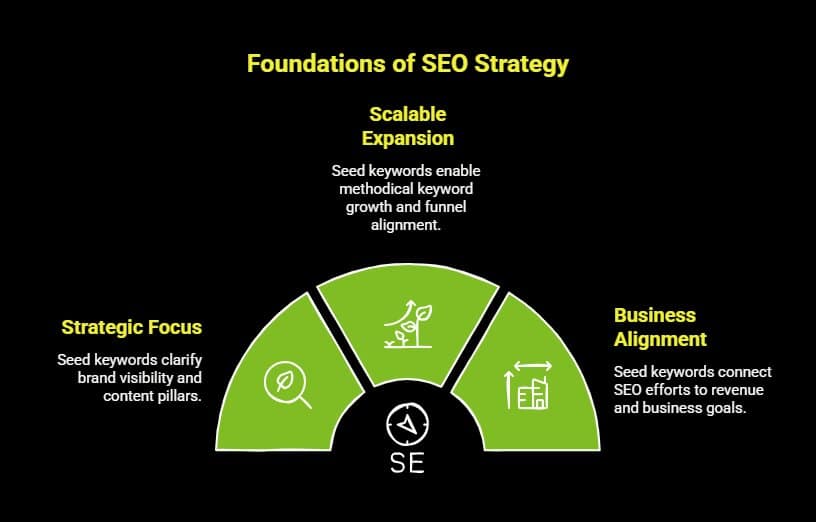
Infographic on Why Are Seed Keywords Important for SEO Strategy visual selection
Before you scale content or optimise pages, you need direction. Seed keywords provide that direction. They define the core topics your business wants to be visible for and anchor your entire keyword framework.
Without clear seed terms, SEO efforts become scattered. With them, your strategy gains structure and depth.
1. They Establish Strategic Focus
Seed keywords clarify what your brand should rank for. They help you:
- Build content around defined topic pillars
- Avoid keyword cannibalisation
- Strengthen semantic relevance
- Improve internal linking structure
Search engines reward depth and consistency within subject areas.
2. They Enable Scalable Keyword Expansion
Once defined, seed keywords act as inputs for expansion. Through research, they uncover:
- Long tail variations
- Funnel-specific intent stages
- Commercially aligned opportunities
This allows you to grow coverage methodically rather than chase isolated high-volume terms.
3. They Align SEO with Business Goals
Well-chosen seed keywords connect directly to your core offerings. This ensures your SEO strategy supports revenue priorities rather than vanity metrics.
In short, seed keywords bring clarity before execution.
Want to turn rankings into revenue? Explore 10 essential SEO strategies that directly impact sales, conversion rates, and long-term growth.
How Seed Keywords Influence Content Creation?
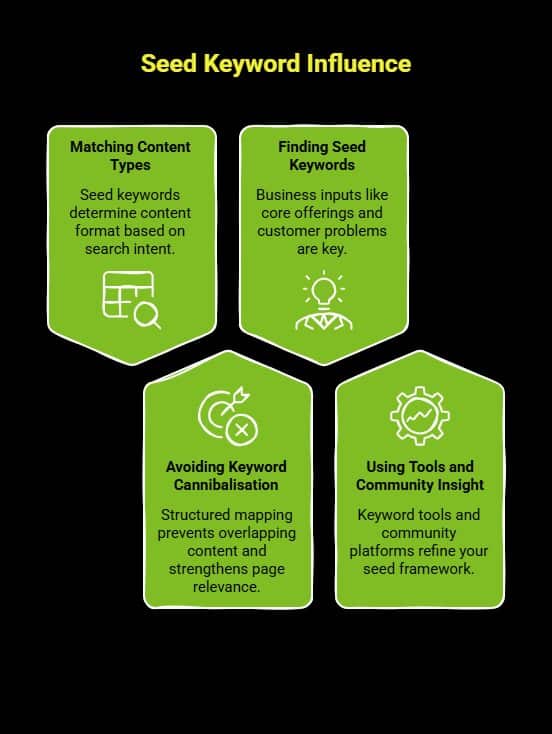
Infographic on How Seed Keywords Influence Content Creation visual selection
Seed keywords do more than generate ideas. They determine what you publish, how you structure it, and how pages connect across your website. When mapped correctly to intent, they prevent overlap, improve clarity, and create scalable content architecture.
1. Matching Content Types to Seed-Driven Intent
Each seed keyword expands into variations aligned with specific search intent. Those variations should determine the content format.
- Informational intent → comprehensive guides and educational blogs
- Comparison intent → versus pages and evaluation content
- Transactional intent → service pages and landing pages
- Category intent → pillar or structured category pages
When mapped properly, each keyword variation is assigned to a specific page. This prevents multiple pages from targeting the same term and competing against each other.
2. Avoiding Keyword Cannibalisation Through Mapping
Without structured keyword mapping, websites often create overlapping content around similar terms. This confuses search engines and dilutes ranking signals.
By mapping one primary keyword and clear supporting variations to each page, you:
- Reduce internal competition
- Strengthen page relevance
- Improve internal linking clarity
Keyword mapping ensures expansion leads to structure, not duplication.
3. Finding Seed Keywords Using Business Inputs
Strong seed keywords originate from business clarity. Start with your core offerings, revenue drivers, and customer problems. These themes anchor your content to commercial priorities rather than generic search volume.
4. Using Tools and Community Insight
Keyword tools validate demand and competition. Community platforms reveal real language and emerging themes. Combined, they refine your seed framework and strengthen alignment with audience intent.
When seed keywords are expanded, mapped, and structured correctly, content becomes purposeful and non-competitive, building authority instead of fragmentation.
When seed keywords are mapped to intent and structured carefully, content becomes organised, purposeful, and non-competitive. Instead of isolated articles, you build interconnected assets that strengthen topical authority over time.
Want to know if your SEO foundation is actually working? Discover how a structured SEO audit uncovers gaps, technical issues, and missed opportunities before they impact your organic traffic.
How to Turn Seed Keywords Into Target Keywords?
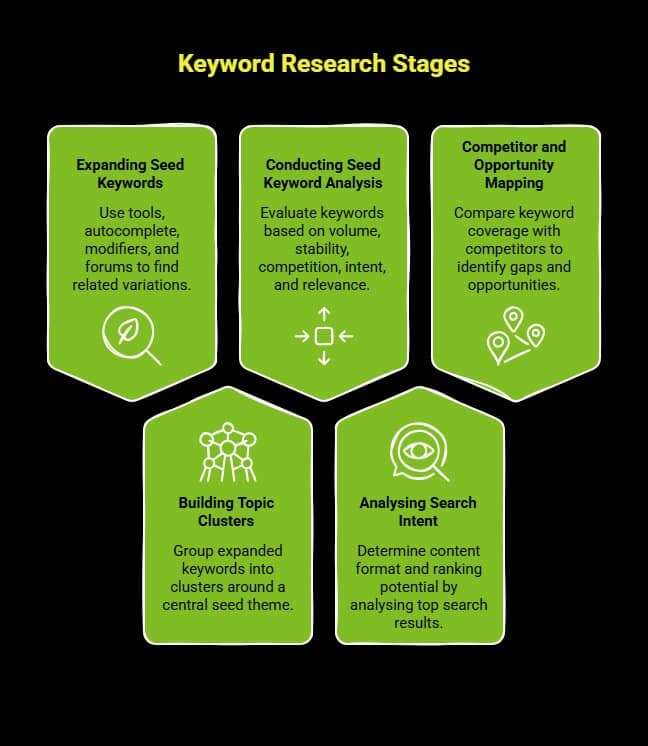
Infographic on How to Turn Seed Keywords Into Target Keywords visual selection
Once your seed keywords are defined, the real work begins. Expansion and analysis turn broad categories into structured, revenue-aligned opportunities. This stage connects keyword research with business outcomes, ensuring your content plan is intentional rather than reactive.
1. Expanding Seed Keywords into Targetable Variations
Seed keywords act as inputs for discovery. When entered into tools or search engines, they generate refined queries that reflect clearer user intent.
You can expand them by:
- Using keyword tools to extract related variations
- Reviewing Google autocomplete and People Also Ask sections
- Adding modifiers such as how to, best, pricing, services, near me
- Studying industry forums and community discussions
This expansion transforms one broad term into multiple long tail opportunities. These variations are often less competitive and more commercially specific, making them stronger targets for structured content creation.
2. Building Topic Clusters from Expanded Keywords
Expansion alone creates lists. Structure creates authority.
Once you generate variations, group them into clusters around a central seed theme. The seed becomes your pillar topic, while related long tail queries form supporting cluster pages.
For example, if the seed keyword is B2B marketing, cluster pages may include B2B content strategy, B2B lead generation tactics, and B2B marketing automation tools. This interlinked structure signals topical depth to search engines and improves internal navigation.
Clusters convert expansion into strategic architecture.
3. Conducting Seed Keyword Analysis for ROI
After expansion, prioritisation becomes critical. Evaluate keywords based on search volume, trend stability, competition, intent, and commercial relevance. The objective is not broad coverage, but selecting terms that can realistically rank and attract qualified traffic.
4. Analysing Search Intent Before Execution
Search intent determines content format and ranking potential. Before creating content, analyse the current top results for your target keyword.
If search results show informational guides, create educational content. If service pages dominate, align with transactional intent. Matching the dominant format increases ranking probability and improves user engagement.
Intent alignment prevents wasted content effort.
5. Competitor and Opportunity Mapping
Comparing your keyword coverage with competitors highlights clear gaps. Tools allow you to identify keywords where competitors rank strongly, and you have no presence.
Focus on:
- Moderate difficulty keywords with proven traffic
- Terms competitors rank for weakly
- Untapped long tail variations
Balancing keyword difficulty with opportunity ensures steady, achievable growth instead of chasing unrealistic targets.
When expansion, clustering, and analysis work together, seed keywords evolve from broad ideas into a structured, ROI driven SEO framework.
What Is Seed Keyword Analysis & How Does It Improve ROI?
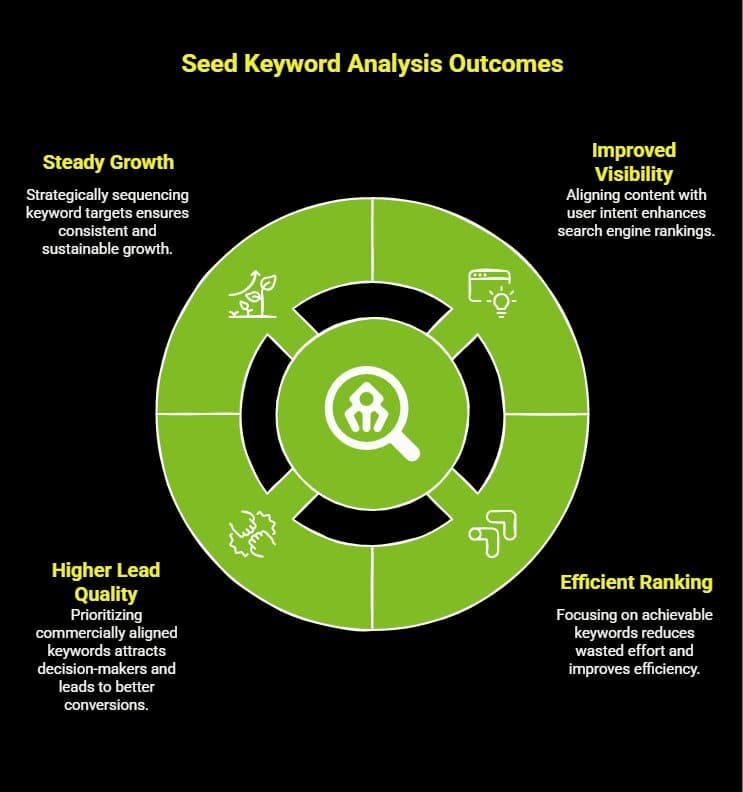
Infographic on What Is Seed Keyword Analysis How Does It Improve ROI visual selection
Identifying seed keywords is only the first step. Analysing them determines whether your SEO efforts translate into measurable growth. Seed keyword analysis filters broad ideas through intent, competition, and commercial relevance to ensure strategic investment rather than content volume.
1. Evaluating Search Intent and Relevance
Seed keyword analysis begins with understanding intent. A broad term can reflect informational curiosity, comparison research, or buying readiness. Reviewing current search results reveals what users expect and what Google prioritises.
If intent and content format are misaligned, rankings suffer. Aligning content with dominant intent improves visibility and engagement, directly impacting conversion potential.
2. Measuring Competition and Ranking Feasibility
Every seed keyword carries a different level of competitive pressure. Analysing keyword difficulty, domain authority of ranking sites, and content depth helps determine realistic targets.
Instead of chasing high volume but highly competitive terms, focus on opportunities where your authority can compete. This reduces wasted effort and improves ranking efficiency.
3. Mapping Commercial Value
Not all traffic contributes to revenue. Seed keyword analysis evaluates whether expanded variations align with your services, pricing model, and buyer journey.
Questions to assess commercial value include:
- Does this keyword attract decision makers?
- Does it relate directly to our offering?
- Can it lead to a measurable business action?
Prioritising commercially aligned keywords improves lead quality, not just traffic numbers.
4. Using Data to Sequence Growth
Opportunity mapping balances search volume against difficulty. Targeting moderate competition keywords first builds authority and momentum. As domain strength increases, more competitive terms become achievable.
Strategic sequencing ensures steady growth rather than unpredictable spikes.
Seed keyword analysis transforms research into direction. By aligning intent, feasibility, and commercial relevance, it ensures your SEO investment contributes directly to long-term ROI rather than vanity metrics.
Can You Rely Only on SEO Tools for Seed Keyword Research?
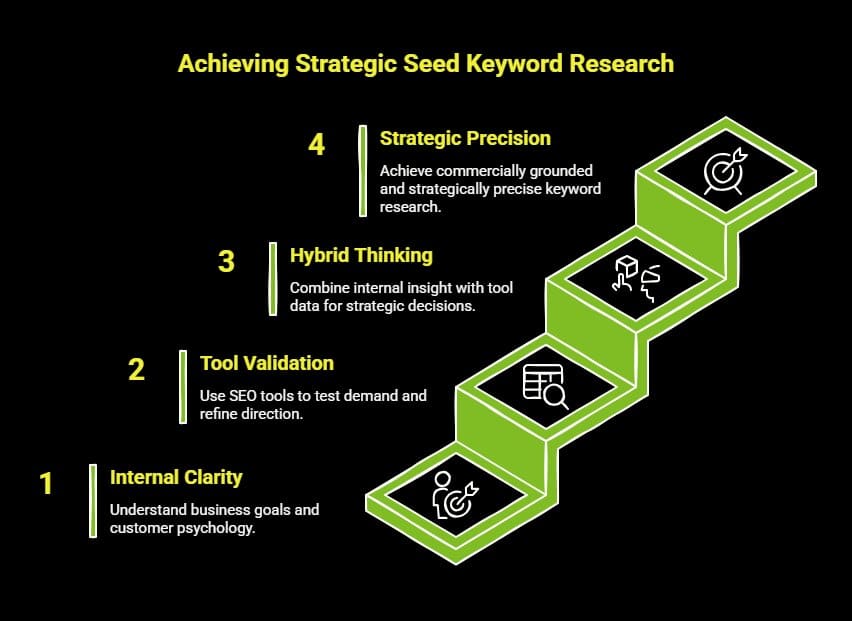
Infographic on Can You Rely Only on SEO Tools for Seed Keyword Research visual selection
SEO tools are powerful and necessary in modern keyword planning. However, data alone does not build a strategy. Search volume and keyword difficulty metrics cannot fully capture business goals, positioning nuance, or customer psychology.
What SEO Tools Actually Provide?
Keyword platforms such as Ahrefs, SEMrush, and Google Keyword Planner offer measurable insights:
- Search volume trends
- Related keyword variations
- Competition levels
- Basic intent indicators
These inputs help validate and expand seed ideas efficiently. They reduce guesswork and accelerate discovery.
Where Tools Fall Short?
Tools analyse search behaviour, not business strategy. They do not understand:
- Your revenue priorities
- Your competitive differentiation
- Your brand positioning
- Sales level objections or buyer hesitation
Without human filtering, data can lead to inflated keyword lists that lack commercial alignment.
The Right Approach: Hybrid Thinking
The strongest seed keyword strategy combines internal clarity with tool validation. Start with business insight and customer understanding. Then use tools to test demand, refine direction, and assess opportunity.
For example, a tool may show high search volume for a broad term like marketing. While attractive in data, it is too generic, highly competitive, and misaligned with specific service intent. Targeting it would dilute focus and waste resources.
In this structure, tools guide decisions. Human judgment defines them.
Relying only on SEO tools limits strategic depth. When human insight filters data, seed keyword research becomes commercially grounded and strategically precise.
What Are Common Mistakes in Seed Keyword Research?
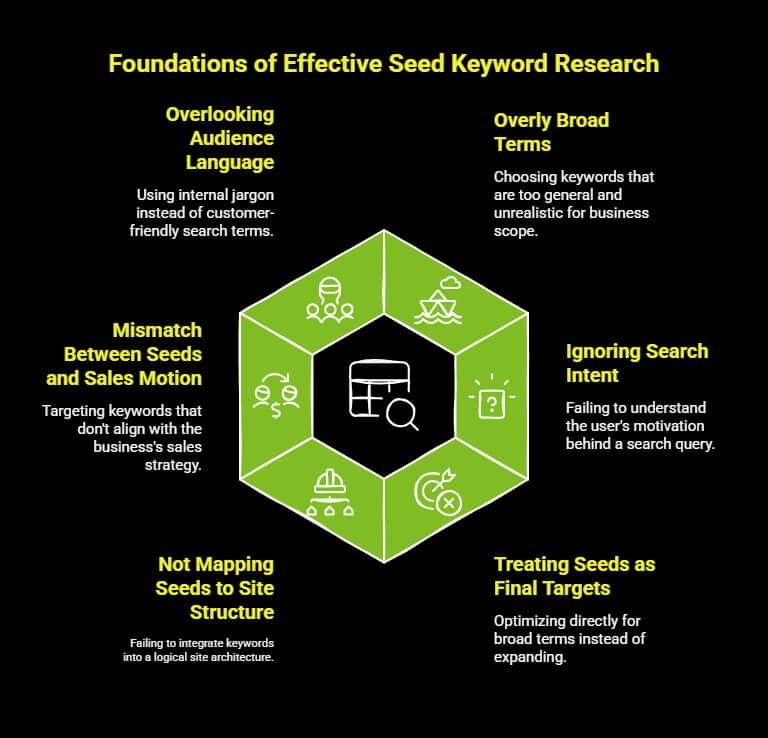
Infographic on What Are Common Mistakes in Seed Keyword Research visual selection
Seed keyword research rarely fails because of poor tools. It fails due to weak strategic filtering. Small errors at the seed stage can create long-term inefficiencies across content, site architecture, and revenue alignment.
1. Choosing Overly Broad Terms
Broad keywords may show high search volume, but they are often unrealistic targets. A local bakery attempting to rank for desserts competes globally. Volume without positioning clarity leads to wasted effort.
Seed keywords must reflect realistic authority and business scope.
2. Ignoring Search Intent
Not every high-volume term aligns with conversion potential. Without filtering by informational, commercial, or transactional intent, campaigns attract traffic that does not convert.
Intent should define both keyword selection and content format.
3. Treating Seed Keywords as Final Targets
Seed keywords are starting points, not ranking goals. Optimising directly for broad terms often leads to diluted content and internal competition.
The correct move is expansion into specific, intent-aligned variations.
4. Not Mapping Seeds to Site Structure
Even well-chosen seed keywords fail without structural planning. If seeds are not mapped to pillar pages, clusters, and internal linking logic, content becomes fragmented.
Without architectural alignment, authority cannot compound.
5. Mismatch Between Seed Keywords and Sales Motion
A B2B company targeting B2C queries creates traffic misalignment. For example, targeting “free marketing tools” when selling enterprise consulting services attracts the wrong audience.
Seed keywords must reflect how your business actually sells and converts.
6. Overlooking Audience Language
Internal jargon rarely matches how customers search. If keyword selection reflects internal terminology instead of real user phrasing, visibility declines.
Research must reflect search behaviour, not internal descriptions.
Strong seed keyword research requires a realistic scope, intent analysis, and audience alignment. When these factors are ignored, strategy becomes reactive. When applied correctly, seed keywords create a scalable and focused framework.
Why Choose Wild Creek Web Studio to Build a Smarter SEO Foundation?
Seed keywords are just the starting point. The real advantage lies in how they are structured, prioritised, and aligned with revenue.
At Wild Creek Web Studio, we combine 18+ years of digital expertise with our Human Algorithm methodology to turn keyword research into scalable growth systems. We do not chase volume. We build authority frameworks.
Our approach ensures:
- Clear topic clusters
- Strong internal architecture
- Intent-aligned content
- Measurable, revenue-focused growth
If you are ready to move beyond fragmented keyword lists and build a structured SEO engine, book a strategy call with Wild Creek Web Studio.
Final Thoughts
Seed keywords are not just the beginning of keyword research. They define the direction of your entire SEO strategy. When chosen thoughtfully and expanded strategically, they bring structure, relevance, and commercial focus to your campaigns.
Instead of chasing scattered search terms, you build authority around defined categories that reflect real user intent. If you want sustainable growth, start at the seed level. Clarity at the foundation determines performance at scale.
Frequently Asked Questions
How often should you update your list of seed keywords?
Review your right seed keywords at least twice a year. Market shifts, related searches, and changes in search engine results affect visibility. Major updates to your marketing strategy or content marketing focus should also trigger a fresh round of competitor analysis.
What are examples of seed keywords in different industries?
Seed keywords are broad core terms that define your main topics. In fitness, examples include a workout or a diet. In finance, a mortgage or investment. These potential seed keywords later expand into specific phrases and keyword ideas.
What steps can you follow to expand seed keywords into targeted terms?
Start by entering core terms into a keyword tool or search bar to view autocomplete suggestions and related searches. Analyse keyword suggestions, review search engine results, and use analytics tools to identify specific keywords aligned with conversion rates.
What role do seed keywords play in keyword research?
Seed keywords form the base of search engine optimisation. They help generate keyword phrases, uncover related searches, and structure your marketing strategy. From these broad terms, you develop focused keyword ideas that drive organic traffic.
What is the difference between a seed keyword and a primary keyword?
A seed keyword is a broad starting point used to generate keyword suggestions and potential seed keywords. A primary keyword is a refined, page-level target chosen to improve search engine results and conversion rates.
What are the best free tools for keyword research?
Google Keyword Planner, autocomplete suggestions in the search bar, and analytics tools like Google Search Console help identify keyword ideas and related searches. These tools support search engine optimisation, but should be combined with competitor analysis.
How do you confirm seed keywords match your target audience?
Validate potential seed keywords by reviewing search engine results, analysing related searches, and assessing organic traffic trends. Ensure the keyword phrases reflect real audience intent and align with your content marketing goals and conversion rates.
How to fetch keyword by using seed keyword?
To fetch keywords using a seed keyword, enter the broad term into a research tool like Google Keyword Planner or Semrush. Analyse related variations, autocomplete suggestions, and intent modifiers. Filter results by relevance, competition, and commercial value before mapping them to content.
What does seed keyword mean?
A seed keyword is a broad, foundational term that represents your main business category. It serves as the starting point for keyword research, helping you generate more specific, intent-aligned variations that guide content creation and SEO strategy.
What is the use of seed keywords?
The use of seed keywords is to define the core topics your business should build visibility around. They act as the starting point for keyword research, helping you expand into long tail variations, map search intent, and structure content clusters strategically.