Key Highlights
- Machine learning, a subset of artificial intelligence, is changing search engine optimisation by enabling systems to learn from data.
- Google uses machine learning algorithms like RankBrain and BERT to understand search queries and user behaviour better.
- Integrating machine learning into SEO strategies helps with advanced data analysis, content optimisation, and predictive analytics.
- SEO professionals can leverage AI-powered tools for tasks like keyword research, competitor analysis, and improving user experience.
- The shift is moving from simple keywords to understanding the deeper user intent behind search queries.
- While powerful, machine learning complements human expertise rather than replacing SEO specialists entirely.
Search rankings are no longer determined by keywords alone. If you are still optimising pages purely around density and backlinks, you are already behind.
Search engines today learn. They interpret. They predict.
According to SEOClarity’s research on the impact of generative AI, AI-driven search experiences are already influencing how results are displayed and interacted with, reshaping click behaviour and visibility patterns.
This means rankings are no longer just about blue links. Machine learning systems now evaluate context, intent, and behavioural signals to determine what users see.
Machine learning in SEO is fundamentally reshaping how websites rank, how content is evaluated, and how user behaviour influences visibility. For Indian businesses competing in saturated digital markets, understanding this shift is not optional. It is strategic.
In this blog, you will understand what machine learning SEO means, how it works, and how to apply it intelligently without losing human direction.
What Is Machine Learning in SEO?
Machine learning in SEO refers to the use of AI algorithms that analyse data patterns to improve search rankings, predict trends, and optimise content based on user behaviour and search intent.
Unlike rule-based automation, machine learning systems evolve by analysing massive data sets. They identify patterns humans may miss and adjust strategies accordingly.
In simple terms, SEO using machine learning moves from reactive optimisation to predictive optimisation.
How Does Google Use Machine Learning in Search?
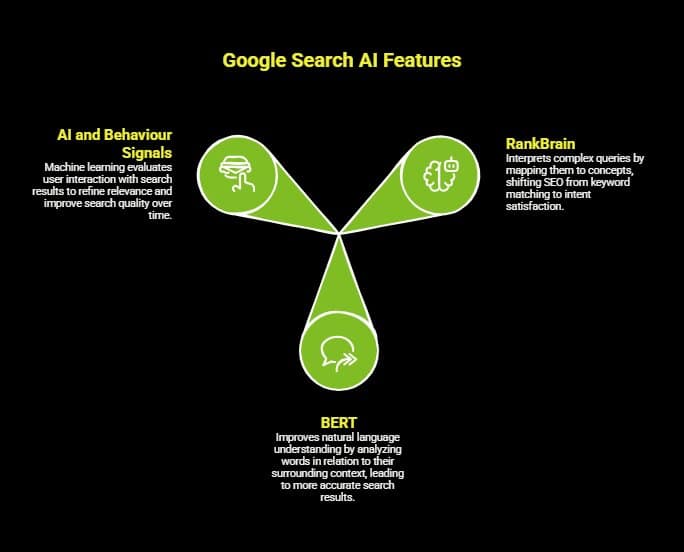
How Does Google Use Machine Learning in Search visual selection
Google’s search engine is powered by adaptive machine learning systems, not fixed ranking rules. These systems analyse search queries, content structure, and user behaviour in real time. Instead of matching keywords mechanically, Google uses AI models to understand intent, context, and satisfaction signals.
Frameworks like TensorFlow, transformer-based models, and neural matching systems enable this continuous learning. Let’s look at the core components shaping rankings today.
1. RankBrain and Query Interpretation
RankBrain helps Google interpret complex or unfamiliar queries by mapping them to concepts rather than exact keywords.
It analyses patterns and relationships between words to determine intent. For example, a search like “best budget laptop for students in India” is understood in terms of affordability, use case, and geography, even if pages do not match the exact phrasing.
This shifts SEO from keyword matching to intent satisfaction.
2. BERT and Context Understanding
BERT improves Google’s ability to understand natural language by analysing words in relation to the surrounding context.
Unlike earlier systems, it processes queries bidirectionally, helping interpret conversational or long-tail searches more accurately. This is especially important for nuanced queries where small words change meaning.
For SEO, this means clear, natural, context-rich content performs better than keyword-stuffed pages.
3. AI and Behaviour Signals
Machine learning also evaluates how users interact with search results.
Google does not publicly confirm that individual behavioural metrics such as click-through rate or dwell time are used directly as ranking factors. However, its machine learning systems analyse aggregated interaction signals to refine relevance and improve search quality over time.
Behavioural indicators that influence ranking stability include:
- Click-through rate
• Dwell time
• Return-to-search behaviour
• Engagement depth
If users consistently engage with a page and do not return to search quickly, it signals strong intent satisfaction. If engagement is weak, the system may reassess relevance.
Google’s machine learning models continuously combine query interpretation, contextual understanding, and large-scale interaction data to improve results. For modern SEO, relevance, clarity, and user experience matter more than mechanical optimisation alone.
Understood. I’ll include only the two strategic sections and leave out the case scenario.
What Is Generative Engine Optimisation and AI Search Visibility?
Search visibility is no longer limited to traditional blue-link rankings. AI-driven systems such as Google’s Search Generative Experience, ChatGPT, and Bing Copilot now generate summarised answers directly within search interfaces.
Generative Engine Optimisation focuses on positioning your brand within these AI-generated responses, not just ranking on page one.
To strengthen AI search visibility:
- Build strong topical authority across content clusters
• Use clear, structured formatting for machine readability
• Support claims with credible data and references
• Demonstrate consistent expertise within your niche
In AI-led search environments, authority and clarity influence whether your content is cited, summarised, or surfaced in conversational results. Optimising for generative engines ensures your brand remains visible as search behaviour evolves.
How Are AI Search Summaries Affecting Click Behaviour?
AI summaries are reshaping user interaction with search results.
For informational queries, users may receive direct answers within the search interface, reducing traditional click-through patterns. However, for commercial and transactional searches, AI summaries often act as pre-qualification layers, guiding users toward trusted sources for deeper evaluation.
This shift changes performance dynamics:
- Visibility inside summaries influences brand exposure
• Click-through rates may vary by intent type
• High-authority content gains stronger placement
• Engagement quality becomes more important than raw traffic
SEO strategy must now focus on being the trusted source that AI systems reference. Ranking alone is no longer the sole indicator of success. Visibility within summaries and sustained engagement define modern search performance.
How Is Machine Learning Changing SEO?
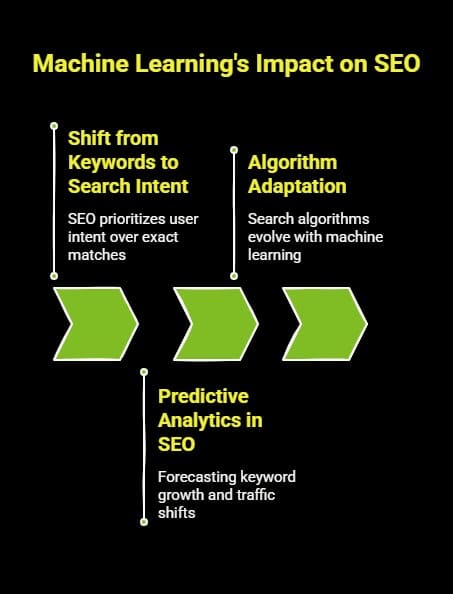
How Is Machine Learning Changing SEO visual selection
Machine learning is transforming SEO from rule-based optimisation to data-driven strategies. Algorithms analyse vast datasets to identify patterns in search behaviour, intent, and performance shifts. This enables SEO professionals to focus on strategy rather than repetitive tasks. Machine learning interprets trends, clusters topics, forecasts demand, and refines optimisation tactics faster than traditional methods.
1. Shift from Keywords to Search Intent
SEO once revolved around keyword placement. Today, machine learning prioritises intent over exact matches.
Search engines analyse context, behaviour, and language patterns to understand why users search. Tools like SEMrush Intent Filters, Ahrefs SERP analysis, and Google NLP API classify queries into informational, transactional, or commercial categories.
Instead of creating multiple thin pages for keyword variations, you build comprehensive content aligned with intent. Platforms such as Surfer SEO and MarketMuse analyse top-ranking pages to identify semantic depth and entity coverage.
The result is stronger topical authority and higher relevance in modern search systems.
2. Predictive Analytics in SEO
Machine learning enables forecasting, not just reporting.
Tools like BrightEdge, SEMrush Trends, and Google Analytics 4 predictive insights analyse historical data and behaviour patterns to anticipate keyword growth, traffic shifts, and ranking volatility.
Predictive analytics helps you:
- Forecast emerging keyword trends
- Identify rising content themes
- Estimate the traffic impact of optimisation
- Detect early ranking instability
This proactive model ensures your strategy adapts before competitors react.
3. Algorithm Adaptation
Search algorithms continuously evolve using machine learning. Rankings shift based on real-time behavioural and contextual signals.
Tools such as MozCast, SEMrush Sensor, and Google Search Console segmentation help track volatility and detect unusual fluctuations.
AI-driven anomaly detection flags sudden drops in impressions or clicks and connects them to potential algorithm updates.
SEO is no longer “set and forget.” It requires constant monitoring and fast response powered by intelligent data analysis.
How to Use Machine Learning for SEO?
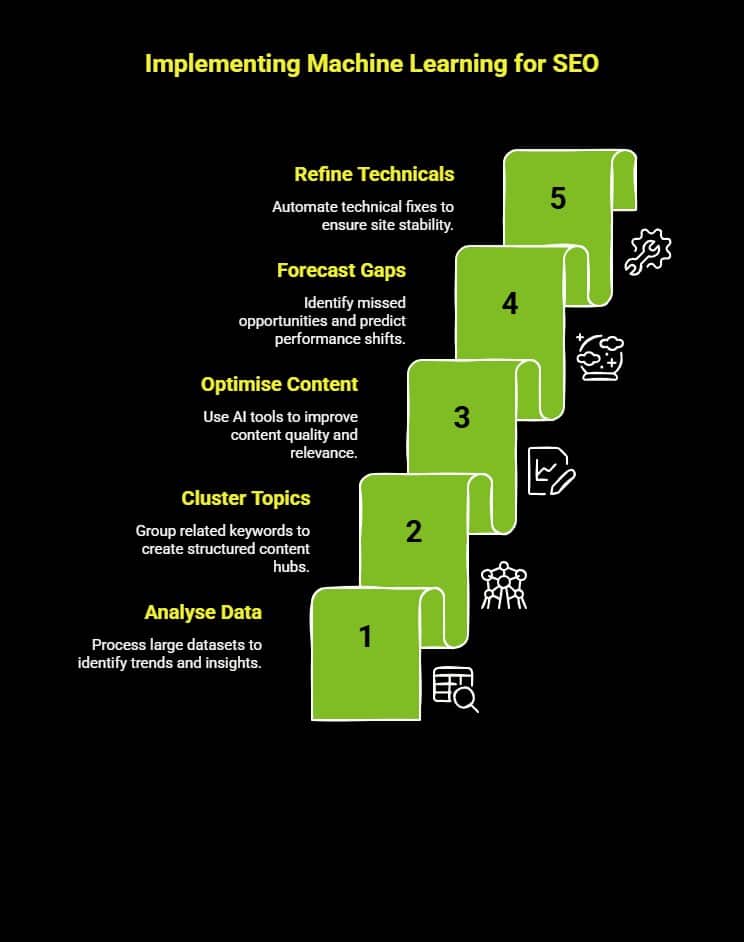
How to Use Machine Learning for SEO visual selection
You do not need to build AI systems from scratch. Most leading SEO platforms already integrate machine learning. The advantage comes from applying them within a structured workflow rather than using tools in isolation.
Step 1: Analyse Data at Scale
Start by analysing search behaviour, competitor visibility, and ranking patterns. Machine learning processes large datasets quickly and identifies trends that manual reviews often miss.
This includes:
- Search intent patterns
• Keyword ranking volatility
• Competitor movement
• Content performance gaps
The goal is insight before action.
Step 2: Cluster and Structure Topics
Modern keyword research relies on semantic clustering instead of isolated keyword targeting.
Tools such as Keyword Insights, Ahrefs Keyword Explorer, and SEMrush Keyword Magic Tool group related queries automatically. This enables:
- Topic hubs
• Pillar and cluster architecture
• Reduced keyword cannibalisation
• Stronger topical authority
Clustering transforms scattered keywords into a structured strategy.
Step 3: Optimise Content Intelligently
AI-powered platforms analyse top-ranking competitors and suggest improvements.
Examples include:
- Surfer SEO for real-time optimisation scoring
• Clearscope for entity refinement
• MarketMuse for topical depth
These tools evaluate semantic coverage, structure, and competitive benchmarks. Human editing ensures positioning, tone, and commercial alignment.
Step 4: Forecast and Identify Gaps
Machine learning surfaces missed opportunities and predicts performance shifts.
Platforms like SEMrush Competitive Research, Similarweb, and BrightEdge Share of Voice identify:
- Content gaps
• SERP feature opportunities
• Backlink weaknesses
• Cannibalisation risks
This accelerates strategic prioritisation.
Step 5: Refine Through Technical Automation
AI-driven crawlers prioritise technical fixes based on impact.
Common tools include:
These detect crawl errors, indexing issues, and structured data gaps. Machine learning improves issue prioritisation, enabling faster resolution and sustained ranking stability.
When applied through this structured cycle, machine learning does not replace SEO strategy. It strengthens analysis, improves speed, and enables continuous refinement.
What Are Real SEO Machine Learning Examples?
Machine learning already powers practical SEO execution. It analyses thousands of ranking pages to identify structural patterns and semantic relationships. It clusters keywords by intent and detects engagement signals at scale.
| Application | SEO Impact |
| Topic Clustering | Builds structured content hubs and reduces cannibalisation |
| Content Optimisation | Aligns with top-ranking entity and semantic patterns |
| Predictive Keyword Analysis | Anticipates demand shifts and emerging queries |
| Behaviour Analysis | Improves engagement and user experience signals |
| SERP Volatility Monitoring | Detects algorithm impact early |
| Algorithm Volatility Forecasting | Reduces ranking shock during updates |
Businesses should prioritise these applications based on their SEO maturity. Start with clustering and optimisation for foundation building. As authority grows, integrate forecasting and volatility monitoring to protect and scale performance.
Machine learning improves speed and analytical depth. Strategic judgement ensures sustainable growth. That balance creates a competitive advantage.
What Are the Best SEO Machine Learning Tools?
Machine learning has reshaped modern SEO tools into intelligent recommendation engines. Instead of offering isolated metrics, these platforms analyse ranking patterns, competitor structures, and semantic signals to generate precise optimisation guidance. Choosing the right tools ensures your strategy is data-informed rather than assumption-driven.
- Surfer SEO: Uses NLP and SERP data to generate real-time content guidelines, helping optimise structure, term usage, and on-page relevance based on top-ranking competitors.
- MarketMuse: Applies AI-driven topic modelling to identify content gaps, recommend authority-building clusters, and strengthen overall domain expertise.
- Clearscope: Compares your draft with high-performing pages and suggests semantically relevant terms to improve comprehensiveness and ranking depth.
- SEMrush: Offers predictive keyword insights, intent-based clustering, and competitive data analysis powered by machine learning.
- BrightEdge: Provides enterprise-level AI recommendations, forecasting performance trends and detecting ranking volatility early.
The best SEO machine learning tools enhance speed, analytical depth, and optimisation accuracy. However, their true value emerges when combined with strategic human oversight that aligns insights with brand goals and market realities.
What are the Benefits of SEO and Machine Learning Together?
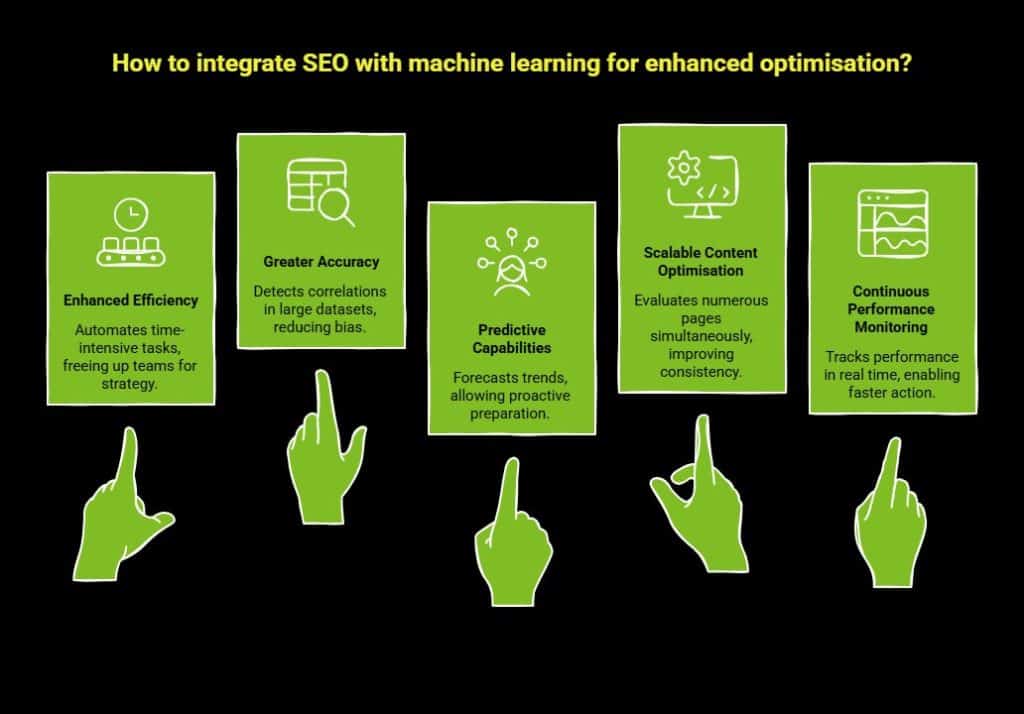
What Are the Benefits of SEO and Machine Learning Together visual selection
When SEO integrates with machine learning, optimisation shifts from manual interpretation to intelligent analysis. Instead of reacting to ranking changes, businesses gain systems that process patterns in real time. This combination delivers speed, precision, and strategic clarity.
1. Enhanced Efficiency
Machine learning automates time-intensive tasks such as keyword clustering, SERP analysis, content scoring, and large-scale data processing. What once required hours of manual work can now be completed in minutes. Teams can redirect effort toward strategy, positioning, and growth planning.
2. Greater Accuracy
Human analysis struggles with massive datasets. Machine learning detects correlations across user signals, search intent shifts, and ranking volatility. This reduces bias and improves optimisation decisions based on meaningful SEO data.
3. Predictive Capabilities
Machine learning models analyse historical performance, competitor behaviour, and ranking fluctuations to forecast trends. Businesses can prepare for seasonal demand, emerging search queries, and algorithm sensitivity before visibility drops.
4. Scalable Content Optimisation
AI models evaluate hundreds of pages simultaneously. They identify content gaps, semantic weaknesses, and optimisation opportunities across entire websites. This enables consistent performance improvements without slowing production.
5. Continuous Performance Monitoring
Unlike periodic audits, machine learning enables ongoing technical and performance tracking. It flags crawl issues, site speed declines, and keyword movement in real time, allowing faster corrective action.
SEO and machine learning together create a proactive optimisation system. Algorithms manage complexity at scale. Human expertise ensures strategic alignment, commercial focus, and long-term authority growth.
Can Machine Learning Replace SEO Experts?
As AI tools become more sophisticated, many businesses wonder whether automation can fully replace human SEO professionals. While machine learning significantly improves speed and analytical depth, it does not eliminate the need for strategic thinking, contextual judgement, and creative decision-making in optimisation.
- Data Processing at Scale: Machine learning can analyse massive datasets, detect ranking patterns, cluster keywords, and identify behavioural signals faster than any manual process.
- Automation of Repetitive Tasks: Tasks like technical audits, content scoring, and SERP tracking can be streamlined through intelligent systems.
- Pattern Recognition: Algorithms identify correlations and trends that may not be immediately visible through manual analysis.
However, machine learning cannot:
- Interpret brand nuance and positioning
- Align SEO strategy with business goals
- Make ethical optimisation decisions
- Develop creative differentiation strategies
- Prioritise actions based on market context
Machine learning enhances SEO performance but does not replace experts. The strongest outcomes emerge when automation supports human strategy, ensuring that data-driven insights are applied with critical thinking and long-term vision.
How Does Wild Creek Web Studio Apply Machine Learning in SEO?
Wild Creek Web Studio integrates machine learning into a structured, Human Algorithm framework that balances automation with strategic thinking. The focus is not on tools alone, but on delivering measurable business impact.
The Wild Creek Approach
- Faster ranking velocity through structured keyword clustering and search intent alignment
• Reduced content production time using data-backed briefs and optimisation workflows
• Improved lead conversion rates through commercially aligned landing pages
• Higher topical authority built through strategic content architecture
• Greater ranking stability through proactive monitoring and refinement
• Transparent reporting tied to growth and revenue goals
Wild Creek Web Studio does not treat AI as a shortcut. It applies intelligent systems within a broader strategy designed for sustainable visibility and long-term authority.
If you are looking for structured, data-informed SEO that aligns with business growth, connect with Wild Creek Web Studio to build future-ready search performance.
Final Thoughts
Machine learning has permanently changed how search rankings are determined. Optimisation is no longer about keyword density or manual tweaks. It is about intent alignment, structured authority, and continuous adaptation to intelligent ranking systems.
Businesses that treat SEO as a static checklist will struggle. Those that combine data-driven systems with strategic oversight will scale visibility, stability, and conversions. Technology accelerates insight. Human expertise defines direction.
If you want your SEO strategy built for how search works today, not how it worked five years ago, connect with Wild Creek Studio to develop a smarter, future-ready approach.
Frequently Asked Questions
What are some real-world examples of machine learning being used in SEO?
Real-world examples include AI-powered recommendation systems that analyse big data and multiple data sources to improve search engine results. Tools use deep learning and different types of machine learning to process unlabeled data, identify patterns in search data, and enhance content strategy.
What challenges should I expect when adopting machine learning for SEO?
Challenges include managing complex data collection, interpreting large volumes of data points, and adapting to evolving search engine algorithms. Translating insights into actionable content creation and link-building strategies requires human intelligence and industry experience to deliver consistent, better results.
How can Indian businesses start using machine learning for better SEO results?
Indian businesses can begin by analysing search data, identifying relevant keywords, and aligning efforts with their target audience. Using AI tools to refine topic ideas, strengthen internal linking, and improve quality content ensures scalable growth across digital marketing and social media channels.
Does SEO use machine learning?
Yes. Modern SEO relies on machine learning models to analyse new data, interpret behaviour patterns, and refine search engine results. Systems powered by deep learning continuously adapt using fresh data points, improving visibility and guiding smarter optimisation decisions.
How are AI and machine learning shaping on-page SEO in 2025?
AI is transforming content performance by refining pieces of content through smarter structuring, advanced internal linking, and optimisation for voice search technologies. It also supports stronger ad design, ensuring SEO integrates seamlessly with broader digital marketing initiatives.
Which performance metrics should be tracked?
Track organic visibility in search engine results, engagement across social media, improvements in content performance, and traffic trends derived from search data. Monitoring these metrics ensures your content strategy delivers measurable impact while saving valuable time through automation.
Which machine learning algorithms are most effective for SEO?
The most effective algorithms for SEO include natural language processing models, deep learning neural networks, and clustering algorithms used in recommendation systems. These help analyse search data, interpret search engine algorithms, process large data points, and improve quality content alignment with user intent.