Key Highlights
- Information search drives how consumers discover, compare, and choose brands.
• Brands win decisions during search, not at the final purchase moment.
• Google’s Messy Middle shows consumers looping between exploration and evaluation.
• Search behaviour varies by type, intent, and decision context.
• Men and women search differently, influencing evaluation and brand preference.
• Factors like risk, involvement, social proof, and urgency shape search depth and speed.
• Wild Creek Web Studio helps brands strengthen search visibility and guide confident purchase decisions.
Ever wondered why some brands get chosen instantly while others get ignored, even when they offer similar products? The answer often lies in how consumers search for information before making a decision. Today’s buyers don’t just walk into a store and pick something off the shelf. They research, compare, evaluate, and validate every choice using endless online and offline sources.
For marketers, the biggest challenge is understanding how consumers search and what influences them during that search. If you don’t appear in the right moments of discovery and evaluation, your brand is forgotten long before the purchase happens. Winning the search stage is no longer optional; it’s a competitive advantage.
In this blog, we will explore the role of information search in consumer behaviour, why it shapes evaluation and purchase decisions, and how it fits into Google’s new consumer decision-making model, often referred to as the “messy middle.”
What is Information Search Behaviour in Consumers?
Information search in consumer behaviour is the stage where people start digging for answers after realizing they need something.
It’s the moment when a problem or desire triggers curiosity, and consumers begin exploring options, comparing brands, checking reviews, and asking questions to figure out which choice feels right.
This search can happen in two ways:
- Internal search: Consumers rely on memory, such as recalling a brand they’ve used before or something a friend once recommended.
- External search: Consumers consult outside sources like Google searches, YouTube reviews, social media opinions, expert recommendations, or advice from people they trust.
And in today’s digital landscape, most consumers move through multiple sources before feeling confident enough to buy.
Why does this matter?
Because the way people search shapes what they eventually evaluate and purchase. If a brand shows up with helpful, trustworthy information at the right discovery moments, it has a powerful advantage.
Understanding this behaviour isn’t just useful to marketers, it’s essential. It’s how you influence decisions long before the customer reaches the checkout page.
How Information Search Shapes Modern Purchase Decisions?

Infographic showing consumer decision making funnel
Information search is one of the strongest forces influencing how consumers decide what to buy. At the moment someone begins searching, they reveal what matters to them, what problems they need solved, and what will make them trust one brand over another.
These search moments determine which brands are even considered and which ones are filtered out long before a final decision is made.
A Simple Real-World Example:
Imagine someone is looking to buy running shoes. They do not start by walking into a store. They begin with search queries like: “Best running shoes for flat feet”, “Nike vs Adidas for beginners”, “Are carbon plate shoes worth it?”
They read expert reviews, watch YouTube comparisons, scan customer feedback, and review price differences. The brands that show up with clear, helpful, trustworthy information immediately become top choices for evaluation.
Those that do not appear are never considered. The purchase decision is largely shaped before the shopper ever arrives on a product page.
How Google’s New Consumer Decision-Making Model Explains This Behaviour
Google’s consumer research report, Decoding Decisions: Making Sense of the Messy Middle, reveals that today’s buying journey no longer follows a straight, predictable path.
Instead, once a purchase trigger occurs, consumers enter what Google calls the Messy Middle, a dynamic space where they continuously move between exploring options and evaluating them.
Inside the Messy Middle, consumers display two mental modes:
- Exploration, where they search widely and discover options
- Evaluation, where they compare, filter, and assess alternatives
The more information they find, the more confident they become. The quality, clarity, and availability of information shape which brand they ultimately choose.
What This Means for Marketers
Google’s findings show that purchase decisions are often won inside the Messy Middle, not at the final checkout stage.
The brands that provide strong, credible, easily accessible information during exploration and evaluation earn trust faster and dramatically increase their chance of being selected.
Consumers rely heavily on:
- Search visibility
• Expert and peer reviews
• Social proof
• Product comparisons
• Transparent content that reduces uncertainty
Modern purchasing outcomes are shaped by how well a brand supports consumers during information search and evaluation. The battle for attention, trust, and preference is won long before the buyer clicks “buy now.”
Want to understand how search intent shapes decisions and influences visibility? Explore our guide on search intent to see how search patterns reveal real customer needs.
How Consumers Search for Information: Key Search Types Explained

Infographic showing types of consumer searches you need to know
Consumers do not all search for information in the same way. The depth, method, and intensity of the search depend on factors such as product involvement, perceived risk, budget, prior experience, and urgency.
Understanding the various types of information search in consumer behaviour helps marketers design content and touchpoints that match real consumer needs at different stages.
1. Internal vs External Information Search
Consumers begin with an internal search, relying on memory, past experiences, brand familiarity, or recommendations they already know. If that information is insufficient, they move to external search, seeking new details from sources such as search engines, reviews, expert content, friends, social media, and comparison tools.
2. Active vs Passive Search
Sometimes consumers intentionally and actively research a purchase. This is common for higher involvement products such as smartphones, insurance, or travel. In other situations, they are passively exposed to information through ads, social feeds, influencers, or word of mouth, and that exposure shapes future decisions even if they were not searching deliberately.
3. Online vs Offline Search
Modern searches are heavily digital, but offline information remains influential. Online search includes Google queries, blogs, review platforms, YouTube, social media, and e-commerce comparison tools. Offline search includes store visits, discussions with peers, product trials, and printed materials. Consumers frequently combine both to form a complete evaluation.
4. Prepurchase vs Ongoing Search
Some searches are prepurchase and occur right before making a buying decision. Others are ongoing searches, where people follow topics or categories out of interest, such as technology enthusiasts or fashion followers. Ongoing search builds brand familiarity and affects future decisions long before a need arises.
Understanding these different search behaviours helps marketers tailor content to meet consumers wherever they are in their decision journey.
When brands address each type effectively, they strengthen visibility, trust, and preference at every stage of evaluation.
Looking to convert search visibility into growth? Explore our guide on building a customer acquisition strategy to turn research behaviour into measurable results.
How the Internet Search Behaviour of Men and Women Differ?
Research shows that men and women often approach online search and decision-making differently. A study titled “Online Shopping: Do Men Behave Differently than Women?” found that for male respondents, perceived usefulness is the strongest factor influencing their intention to continue shopping online.
While for female respondents, perceived ease of use and perceived trust play a more significant role.
These behavioural tendencies influence how each group searches, compares options, and evaluates brands online. Here’s a quick overview that highlights the key differences:
| Aspect | Men | Women |
| Research Style | Fast, direct, solution-focused | Detailed, exploratory, comparison-driven |
| Primary Search Goal | Access useful information quickly | Build trust and confidence before deciding |
| Content Preference | Technical specifications and expert reviews | User reviews, testimonials, and community feedback |
| Decision Speed | Generally faster once convinced | More time invested in evaluation |
| Evaluation Approach | Logical and performance-oriented | Experiential and trust-oriented |
| Trust Influencers | Data, measurable results, authoritative sources | Social proof and real user experiences |
| Typical Search Queries | Specific queries like “best 4K monitor under $300.” | Broader queries like “which monitor is best for home and work?” |
| Preferred Platforms | Review sites and comparison tools | Social platforms, forums, and community discussions |
| Risk Perception | Lower risk once facts seem solid | Higher risk until socially validated |
While these are broad patterns rather than rules, they reveal opportunities for marketers to tailor messaging, content formats, and search strategies to better match different decision-making styles.
Why Consumers Search the Way They Do?
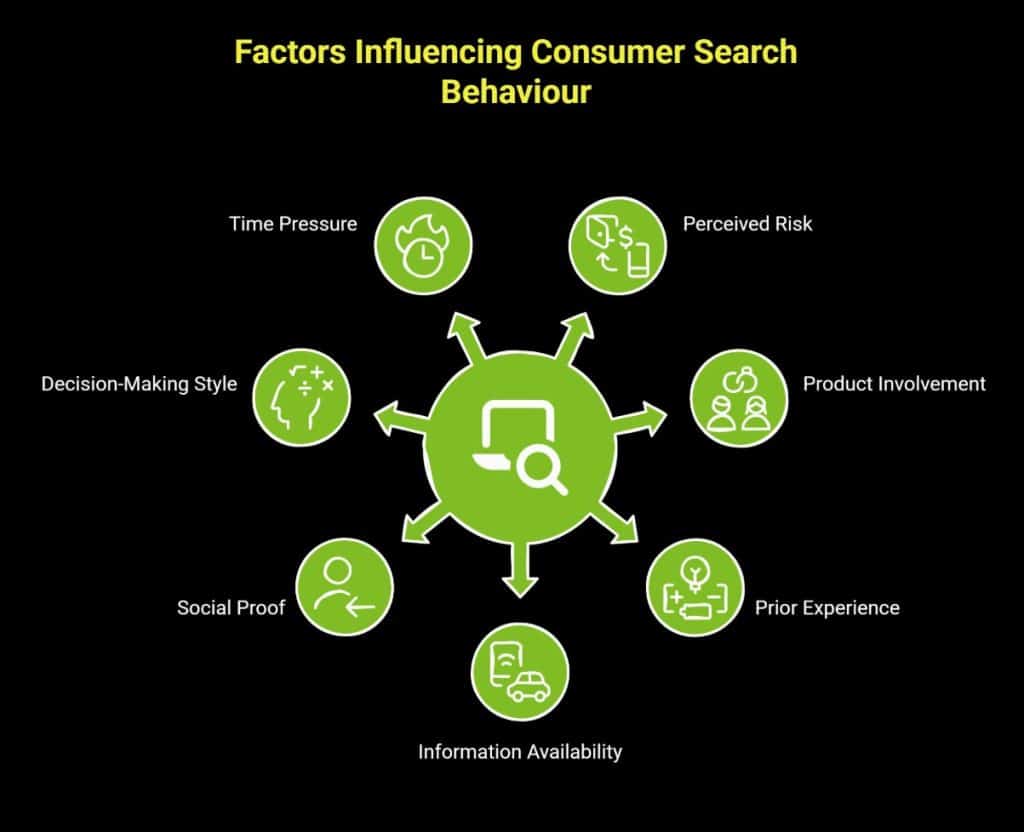
Infographic showing factors influencing consumer search behaviour
The way consumers search for information is shaped by a combination of psychological, emotional, and practical influences. These factors determine how intensely they research, which sources they trust, and how quickly they move from curiosity to decision.
For marketers, understanding why these factors affect search behaviour is key to designing experiences that guide consumers through evaluation and ultimately influence purchase choice.
Here are some factors that significantly shape information search behaviour:
1. Perceived Risk and Decision Complexity
When consumers believe there is something significant at stake, their search behaviour becomes more detailed and cautious. High-risk purchases, such as financial products, healthcare decisions, luxury items, or long-term commitments, create anxiety and uncertainty. To reduce that risk, consumers seek more proof, expert insights, and validation before deciding.
Why it influences search:
High stakes trigger the psychological need for security and control. Consumers want to make sure they are not making an expensive or emotionally costly mistake. This leads to longer search cycles, deeper evaluation, and more reliance on credible sources.
Marketing takeaway:
If you operate in a high-risk category, your content must lower perceived risk through transparency, data, expert endorsement, reviews, and scenario-based guidance, not persuasion alone.
2. Level of Product Involvement and Personal Relevance
Products tied to personal goals, identity, health, or performance drive more intense search behaviour. Someone buying a fitness tracker, skincare treatment, or home office setup invests time because the outcomes directly impact their lifestyle.
Why it influences search:
High involvement activates emotional investment. Consumers want not just a product, but the right product that aligns with self-image, values, and desired results.
Marketing takeaway:
Provide deep, real-world context: use cases, community voices, real performance demonstrations, before-and-after stories, and personalised guidance.
3. Prior Experience and Familiarity
Consumers who know a category well rely more on internal memory and shortcuts. They may purchase quickly based on brand preference. In contrast, unfamiliar categories generate uncertainty, which drives heavier search and comparison.
Why it influences search:
Lack of experience increases cognitive load. Consumers compensate by gathering external information until they feel capable of judging options.
Marketing takeaway:
Challenger brands must educate to build competence and trust. Established brands must reinforce recall and consistency to reduce effort.
4. Depth and Availability of Online Information
Consumers continue searching until they feel they understand enough to decide confidently. When information is fragmented, confusing, or overly promotional, search becomes longer and more frustrating.
Why it influences search:
Humans avoid cognitive friction. Clear, structured, easy-to-follow information reduces mental effort and speeds decision-making.
Marketing takeaway:
Create not “more content” but better pathways: comparison pages, structured FAQs, transparent pricing, guided buying tools, and evidence-based claims.
5. Social Proof and Community Influence
Consumers trust people more than brands. Reviews, ratings, testimonials, influencer perspectives, and online conversations strongly shape evaluation.
Why it influences search:
Humans depend on social validation to assess uncertainty. If other people approve a product, the perceived risk drops and confidence increases.
Marketing takeaway:
Make social proof unavoidable and visible at key evaluation moments, not buried in subpages.
6. Decision-Making Style: Emotional vs Analytical
Different consumers process information differently. Some make intuitive, feeling-based decisions guided by brand story, alignment, and relatability. Others require analytics, facts, and performance proof.
Why it influences search:
Cognitive diversity means no single message resonates with all. Emotional buyers want connection. Analytical buyers want certainty.
Marketing takeaway:
Combine emotional relevance with rational clarity: storytelling plus specifications, results plus evidence.
7. Time Pressure and Urgency
When consumers feel rushed, they shorten the search process and depend more on heuristics such as popularity tags, best-seller filters, or time-limited offers.
Why it influences search:
Time constraints reduce cognitive processing ability. The brain switches to instinctive decision shortcuts.
Marketing takeaway:
Structure navigation and messaging that supports fast, low-effort decision making when urgency exists.
Information search is not just a step in the journey. It is a confidence-building phase where uncertainty transforms into certainty.
Every factor that influences search changes how likely a brand is to be chosen. The brands that understand and design for these influences win consumer preference before the final purchase moment ever arrives.
What It Means to Partner With Wild Creek Web Studio
Growing online is harder than ever. There is too much noise, constant algorithm shifts, and countless marketing tactics that promise big results but rarely deliver. At Wild Creek Web Studio, we understand how frustrating it can feel to invest in digital efforts without seeing meaningful progress.
That is why we focus on clarity, strategy, and measurable outcomes. With 18+ years of experience, we work closely with you to understand your goals, simplify the complexity, and build digital strategies that truly move the needle.
Our team brings together expertise in SEO, paid campaigns, social media, and digital consulting, all designed to support sustainable growth rather than short-term spikes.
We believe marketing should feel transparent, collaborative, and grounded in reality. When you partner with us, you are choosing a team that listens first, customises solutions, and works alongside you to grow with confidence, step by step.
Ready to transform how you grow online? Let’s start the conversation.
Final words
Modern consumers choose the brands that help them decide with confidence. If your search experience removes friction, answers real questions, and builds trust, you win the decision long before the purchase click happens.
Now is the time to ask: Are you showing up where decisions are shaped, or only where they finish?
The brands that guide instead of push, support instead of sell, and provide clarity instead of noise are the ones people remember.
Build for the way people really search and choose. Take action now and become the brand they confidently say yes to.
Frequently Asked Questions
How does information search differ for services versus products?
Information search for services is shaped by consumer behaviour, reliance on personal sources, and limited consumer reports. Because services are intangible, consumers depend on personal experience, public sources, and information processing across various channels to reduce risk and support informed decision making.
What factors determine the amount of information a consumer seeks?
Consumer information search varies with prior knowledge, concept of motivation, situational influences, internal knowledge, and perceived risk. The target market, information overload, low involvement products, and available information sources shape information search patterns during the information search phase of consumer buying behaviour.
How does online information affect the behaviour of a search?
Online buying behaviour is influenced by consumer information from search engine optimisation, marketing programs, and public sources. Access to various channels, the Yellow Pages, and digital consumer reports plays a crucial role in the evaluation of alternatives, shaping store buying and the industrial buying process.
What is the concept of the information search process in consumer Behaviour?
The information search process begins after problem recognition, when the consumer searches for relevant information from various sources to evaluate alternatives. It is a key stage of the consumer buying process, shaping the decision process and influencing consumer attitude and purchase outcomes.
How do consumers’ buying habits differ from one another?
Consumers differ due to internal factors, personal factors, trait theory of personality, and external factors like marketing efforts and physical location. Some buy low-involvement products with little thought, while others gather much information, compare various alternatives, and experience cognitive dissonance after purchase.
What values could colour a consumer’s view of a product?
Consumer buying behaviour is influenced by values tied to product quality, customer service, brand trust, and the type of information received. Cultural beliefs, past experiences, typology of needs, and organisational buying behaviour can reshape perception and determine preference for a particular brand.
Which search platforms should businesses prioritise?
Businesses should prioritise traditional search engines, mobile phones, social platforms, and review channels where consumer searches begin. A strong online presence during the buyer’s journey provides valuable insights, increases marketing effectiveness, supports product development, and ensures visibility at a deeper level in the purchase process.
Why are information search behaviour of customers important to a marketer?
Understanding consumer search behaviour gives marketers insight into how customers discover, compare, and choose brands. It reveals motivations, barriers, and opportunities to provide relevant content, guide decisions, improve messaging, and influence preferences early in the customer journey where choices are shaped.
What is the importance of consumer decision-making roles in the information search process?
Consumer decision-making roles determine who gathers information, who influences evaluation, and who finalises purchase decisions. These roles shape search behaviour, helping marketers tailor communication, target the right decision stakeholders, and support confident choices with the right information at the right moment.
Is search and evaluation on consumer behaviour important?
Yes, search and evaluation in consumer behaviour is crucial because it determines which brands enter the consideration set. It helps reduce uncertainty, compare alternatives, build trust, and ultimately guide consumers toward confident purchase decisions before they reach the final buying stage.