Key Highlights
- Fact-checking AI outputs is essential to avoid misinformation and maintain credibility.
- Human review is necessary because AI lacks contextual understanding, nuance, and the ability to fully verify sources.
- Plagiarism detection tools like Turnitin, Copyscape, and Grammarly help ensure originality in AI content.
- Effective AI fact-checking combines automated tools with human oversight for accuracy and reliability.
- Five key steps for fact-checking include cross-verifying with credible sources, checking context, using fact-checking tools, inspecting citations, and applying human review.
- AI has limitations such as false confidence, reliance on training data, outdated information, and difficulty assessing source reliability.
- Context strongly influences AI accuracy, as statements can be true in one scenario but misleading in another.
- Wild Creek Studio helps businesses refine AI-generated content by combining AI tools with expert human review for accuracy, clarity, and trustworthiness.
- Final takeaway: AI can speed up content creation, but only with careful fact-checking and human input can it deliver reliable, credible, and meaningful results.
AI tools can produce content at lightning speed, but speed doesn’t guarantee accuracy. Businesses and writers increasingly face a common problem: AI-generated text may look convincing yet contain errors, misleading statements, or outdated information. Without careful verification, relying on AI can damage credibility, misinform audiences, and erode trust.
This blog shows how fact-checking techniques and human oversight can help you ensure AI-generated content is reliable and accurate. You’ll learn practical strategies to verify sources, spot errors, and maintain content integrity, making your AI-assisted content trustworthy and impactful.
One key aspect of content credibility is originality. Plagiarism detection tools like Turnitin, Copyscape, and Grammarly can scan AI-generated text, compare it against billions of published sources, and highlight any copied or inadequately paraphrased sections. When combined with manual source verification, these tools help ensure your content is not only factually correct but also original and high-quality.
Why It’s Important to Fact Check AI Responses?
Laptop screen showing a checklist and a magnifying glass for search or review
AI can produce content quickly and convincingly, but speed doesn’t guarantee accuracy. AI models generate responses based on patterns in the data they were trained on, which means they can sometimes include outdated information, misinterpret facts, or combine unrelated ideas in a way that seems plausible but can lead to hallucination or inaccuracy.
Fact-checking AI responses is crucial to prevent the spread of misinformation, maintain credibility, and ensure that the content aligns with real-world facts. Even when AI provides sources or citations, these may be incomplete, misrepresented, or inaccurate, making human verification essential.
By thoroughly reviewing AI outputs, verifying claims against trusted scholarly sources, and applying contextual judgment, content creators can produce accurate, reliable, and meaningful material. Fact-checking AI responses not only protects your audience from errors but also strengthens trust in your brand or platform, enhancing your visibility in search results.
Why is human review essential for AI-generated content?
Illustration of a robot and human working on a laptop
AI can create content quickly, but it cannot fully understand context or verify facts on its own. For example, an AI might generate an article on health tips that correctly mentions “vitamin C helps immunity” but then incorrectly states a dosage for children, or mixes up symptoms for different conditions. Similarly, in finance content, AI could confuse interest rates across countries, giving readers misleading advice.
A human reviewer brings critical thinking, domain knowledge, and context awareness to catch these mistakes. They can clarify ambiguous statements, correct factual errors, and ensure that the content reflects real-world accuracy. For instance, a human editor can spot that a source cited by AI is outdated or irrelevant, preventing readers from being misinformed.
Without human oversight, these errors could damage credibility, mislead audiences, or harm a brand’s reputation. By combining AI with human review, automated drafts are transformed into content that is reliable, accurate, and contextually meaningful.
How can AI fact-checking techniques identify misinformation?
AI fact-checking tools help spot potential misinformation by analyzing content against trusted sources and patterns of reliability:
- Compare Against Verified Sources: AI scans text against databases, fact-checking websites, and reputable publications to flag statements that don’t match verified information.
- Detect Contradictions and Inconsistencies: Algorithms highlight claims that conflict with known facts or previously established data.
- Identify Unsupported Statements: AI flags assertions that lack citations or credible references, helping focus human review where it’s needed most.
- Prioritize Review for High-Risk Content: By marking suspicious claims, AI directs attention to the parts of content most likely to contain errors.
While AI can efficiently flag questionable content, pairing it with human judgment ensures context, nuance, and credibility are fully assessed.
What Are the Steps to Verify AI-Generated Information?
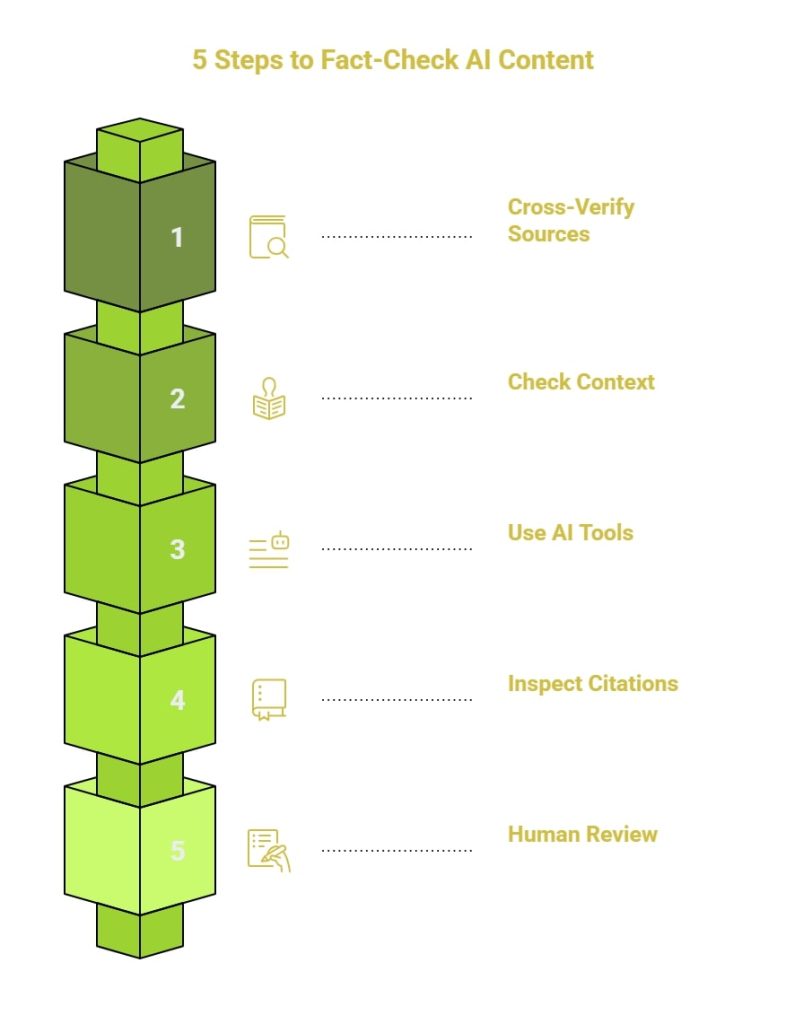
Infographic illustrating 5 steps to fact check AI contentInfographic illustrating 5 steps to fact check AI content
Maintaining the accuracy of AI-generated content is essential for building trust. A structured approach to fact-checking helps ensure your information is both credible and reliable.
1. Cross-Verify with Credible Sources
Never rely solely on AI outputs. For statistics or claims, verify the original data to ensure the source of the claims and their authenticity. This prevents the spread of outdated or false information.
Cross-check facts against trusted sources like:
- Google results or Wikipedia for general claims.
- Google Scholar for academic or research-based information.
- Library catalogs to see if a cited book or article exists.
- Reputable news organizations for current events.
2. Check Context and Relevance
AI can generate content that sounds plausible but may misinterpret the topic or audience intent. For instance, a GPT model might produce medically accurate facts created by skilled programmers but mix them up in a way that confuses context. Always review whether the AI’s statements make sense within your topic and intended readership.AI can produce content that seems accurate but may misplace information or misunderstand the intended context. This can make statements technically correct yet confusing or irrelevant to your topic or audience.
To assess whether AI-generated content fits your needs, ask:
- Is the information in the right place? Ensure each fact or statement supports the overall narrative.
- Does it answer the prompt accurately? Check that the AI’s response aligns directly with your intended question or topic.
- Are there hidden assumptions? Identify any misinterpretations caused by ambiguities in your prompt that may have led the AI astray.
By reviewing context and relevance, you can ensure AI content is coherent, focused, and suitable for your readers.
3. Use AI Fact-Checking Tools
There are two main types of fact-checking tools: manual verification sites and automated AI checkers. Using both together gives a stronger and more reliable fact-checking process.
- Manual fact-checking sites: Platforms like Snopes and FactCheck.org are run by experts who review claims thoroughly. They help confirm whether a statement or URL is accurate and trustworthy.
- Automated AI tools: Tools such as Originality.AI’s scan content quickly and flag claims that may need verification. Even AI-generated text can benefit from this extra layer of automated checking.
By combining human-verified sources and AI-powered tools, you can ensure content is both accurate and credible.
4. Inspect Citations and References
AI-generated content can include errors, misrepresented studies, or even fabricated references. Carefully checking each source ensures that every claim is backed by real, reliable, and relevant information. Tools like Zotero or EndNote not only help organize references but also allow you to quickly verify publication details, authorship, and relevance, making the verification process more efficient and accurate.
When inspecting citations, watch for these red flags and why they matter:
- Fake articles attributed to real authors: Verifying authorship ensures the source is trustworthy and credible.
- Citations that don’t support the claim: Cross-checking claims against the source prevents spreading misinformation.
- Links that lead to unrelated or non-existent pages: Confirming links ensures readers can access the original content and that your references are valid.
Thorough citation inspection guarantees that AI-assisted content remains factual, credible, and dependable.
5. Human Review and Editing
No AI tool can replace the insight and judgment of a human reviewer. Editors or subject matter experts catch subtle errors, clarify ambiguous statements, and identify misleading phrasing that AI might overlook-including nuances related to the funding organization behind the content. Human input ensures the final material is not only factually correct but also aligned with human-centered AI principles, contextually accurate, and fully understandable. This final step safeguards credibility and reinforces the quality that only human oversight can guarantee
During your final review, consider:
- Is the information true, misleading, or factually incorrect?
- Can you re-prompt the AI to fix some of its errors?
- Does the content as a whole make sense and meet your needs?
Frustrated by AI Mistakes? Here’s How Wild Creek Studio Helps
AI-generated content can save time, but it often comes with errors, misleading statements, or even false claims and context gaps that undermine credibility. Many businesses and content creators struggle with fact-checking AI-generated content while keeping their workflow efficient.
This is where Wild Creek Studio makes a difference. By combining advanced AI tools with expert human review, Wild Creek ensures every piece of content is accurate, reliable, and contextually sound. From verifying sources and checking for inconsistencies to refining tone and clarity, Wild Creek Studio handles the heavy lifting so you can focus on creating high-quality content.
Contact Wild Creek Studio today and let our team of experts help you fact-check, refine, and perfect your content with ease.
Conclusion
AI can generate content quickly, but the accuracy and validity of what AI produces is never guaranteed on its own. Knowing how AI can fact check content helps you leverage its strengths while avoiding errors, misleading statements, or context gaps. By combining AI tools with careful human review, cross-verification, and attention to context, you can produce content that is both efficient and trustworthy.
With the right techniques, including AI-assisted verification and expert oversight, the first step in fact-checking becomes a seamless part of your workflow, ensuring every piece of content maintains credibility and delivers value to your audience.
Frequently Asked Questions
How can artificial intelligence help with fact checking?
AI can quickly scan text, compare claims against verified sources, highlight inconsistencies, and flag unsupported statements, helping humans identify errors and verify information efficiently.
Can AI help detect fake news more effectively than humans?
AI can analyze patterns, cross-check multiple sources, and flag suspicious content faster than humans, but human judgment is still essential to understand context, nuance, and subtle misinformation.
How can I quickly check if an AI-generated answer is factual?
The fastest method is to use lateral reading. Break the AI output, which is a composite of multiple unidentifiable sources, including any organization name or logo, into specific claims, then open a new browser tab and use search engines to verify each claim against reliable sources. Never take the AI’s answer at face value, especially if your AI prompt was complex.
What tools are best for fact-checking AI outputs?
A combination of tools is best. Use manual sites like Snopes or FactCheck.org for debated topics and automated checkers like Originality.AI or a similar tool to scan text. For academic claims, use Google Scholar. No single AI tool is perfect, so combining them with lateral reading provides fewer pieces of information that lead to trustworthy results.
How do I spot hidden bias or misinformation in AI content?
Look for loaded language, unsourced claims, or a one-sided perspective. The easiest way to spot false information in an AI output is to inspect its citations. If the sources are fake, non-existent, or don’t support the claim, none of these bits of information should lead you to question the validity of the claims and the overall validity of the claims in the entire response.
Can AI completely replace human editors in content verification?
No, an AI tool cannot replace human review. Humans are essential for judging context, nuance, and the overall reliability of factual claims. AI lacks the critical thinking needed for thorough editing, making the most important method of analysis a final check by a person necessary to ensure true accuracy and quality.