Key Highlights
- AI creates drafts fast but lacks originality and emotional depth.
- Writers bring unique perspectives, analysis, and storytelling.
- Cultural and linguistic nuance is beyond AI’s current reach.
- AI works best as a tool, not a replacement.
- Demand for writers continues to grow in the digital economy.
- Ethical oversight keeps humans essential in writing.
- The Human Algorithm framework blends AI speed with human clarity.
You’ve spent years sharpening your craft, only to watch an AI tool generate a 1,000-word article in less than a minute. The fear is instant: what if clients stop needing me at all?
Across industries, writers are asking the same question: Will AI replace us? Businesses are dazzled by the speed, while writers quietly wonder if their creativity and voice have just been downgraded. Yet demand is far from shrinking, with India’s digital content market expected to touch USD 35 billion by 2030, a clear sign that human storytelling remains indispensable.
But here’s the truth: AI may be fast, but it is not human. It cannot feel the rush of storytelling, the nuance of culture, or the empathy of experience. That is why human writers will continue to be irreplaceable. This blog explores exactly why.
What Is AI Writing?
You sit down to write a blog, but instead of typing, you feed a short instruction into a tool. Within seconds, the screen lights up with a complete article. Convenient? Yes. But also unsettling.
This is what we refer to as AI writing. It is the process of generating text using Large Language Models (LLMs), systems trained on billions of words from books, articles, and websites. By analysing these patterns, AI produces sentences that look natural and human-like.
The catch is simple: AI only imitates, it does not understand. It cannot feel emotion, recall personal experiences, or make value-based judgements. While this makes AI fast and efficient, it also means the output often lacks originality, depth, and human connection.
That is where the role of real writers becomes non-negotiable. Machines generate content, but humans create meaning.
The rise of AI in content links directly to SEO shifts. Learn more in: What Is LLMO & How Does It Impact Your SEO Strategy in 2025?
How Does AI Writing Work?
Artificial Intelligence Concept
On the surface, AI appears intelligent. You type a prompt, and within moments, it responds with structured text. But what is happening underneath is pure prediction, not real thought.
| Step | Process |
| Prompt Analysis | The AI interprets your instruction (topic, tone, style). |
| Data Retrieval | It searches through patterns in its training data for relevant context. |
| Text Generation | It produces sentences word by word, following the patterns it identifies. |
The result is content that appears polished but lacks genuine comprehension. This lack of understanding is why fact-checking and editing are always essential.
Even industry leaders echo this view. N. R. Narayana Murthy, founder of Infosys, explained it best:
“There is a mistaken belief that artificial intelligence will replace human beings. Human beings will not allow artificial intelligence to replace them. Computers have made our lives comfortable in certain areas. AI is assistive.”
His reminder is powerful. Just as computers became tools rather than replacements, AI too will remain a partner, not a master.
And that distinction between prediction and creativity is exactly why human clarity still wins.
How Has AI Changed The Writing Industry And Where Does It Actually Help?
AI and Machine Intelligence Concept
You open LinkedIn and see yet another brand boasting, “This blog was written entirely by AI in under five minutes.” The pressure builds. As a writer, you start questioning: if machines can write so fast, do clients even need me anymore?
This fear is not unfounded. AI has already changed the writing industry in visible ways. Marketing teams use it for speed. Startups rely on it to publish daily updates. Even journalists are experimenting with AI-generated summaries for sports or stock market news. On the surface, it looks like AI is replacing writers one task at a time.
But here is the truth: AI is only effective for certain parts of the writing process, not the whole. It thrives on structure, data, and repetition. It struggles with creativity, context, and emotional depth. The industry shift is not about humans being eliminated, but about humans learning where AI can make them more productive.
Where AI Helps Writers The Most
- Breaking Writer’s Block: Instead of staring at a blank page, AI can generate a quick outline to get you moving.
- Summarising Information: AI condenses long reports into short insights, saving hours of manual effort.
- Scaling Repetitive Tasks: Product descriptions, social captions, FAQs. AI can produce these at scale in minutes.
- Boosting SEO: Many tools suggest keywords, meta descriptions, and headings to improve rankings.
- Multilingual Drafts: AI can translate or generate text across languages, making global reach easier.
Why This Matters to Writers in India?
India’s content landscape is unique. With IBEF and IAMAI reporting that 98% of internet users access content in Indic languages, and 57% of urban users prefer regional language content, the demand for vernacular content is exploding. AI can help with translations, but cultural understanding is what makes writing resonate. A phrase that works in Hindi may not connect in Tamil, and a colloquial expression in Marathi may fall flat in Bengali.
As The Indian Express notes, “AI can’t replace a writer’s personal journey, their failures, triumphs, and everything in between.” That lived experience and human nuance is what gives writing its edge, especially in India’s diverse linguistic and cultural landscape.
This is where the differentiation becomes sharper:
- Writers who integrate AI into their workflow become more efficient.
- Writers who depend only on AI risk losing cultural authenticity and trust.
AI is not here to replace your voice. It is a support system that frees you from low-value tasks, so you can focus on what really matters: storytelling, strategy, and cultural nuance that only humans can deliver.
Worried about staying relevant in the AI era? Read: How to Future-Proof Your Career in the Age of Artificial Intelligence
Can AI Eliminate Writers Completely?
You might have heard the scary prediction: “AI will replace all writers in the next few years.” The thought is unsettling. Imagine pouring years into honing your craft, only to see a machine draft articles faster and cheaper. The fear is that if brands can cut costs, they will no longer need humans.
But the reality is more nuanced. While AI has speed, it lacks empathy, judgement, and lived experience. That is why it cannot fully eliminate writers. As Satya Nadella, CEO of Microsoft, said:
“AI will not replace people, but people who use AI will replace those who do not.”
This means writers who embrace AI as a partner will thrive, while those who resist may struggle. Let us break down the real reasons why AI cannot replace human writers.
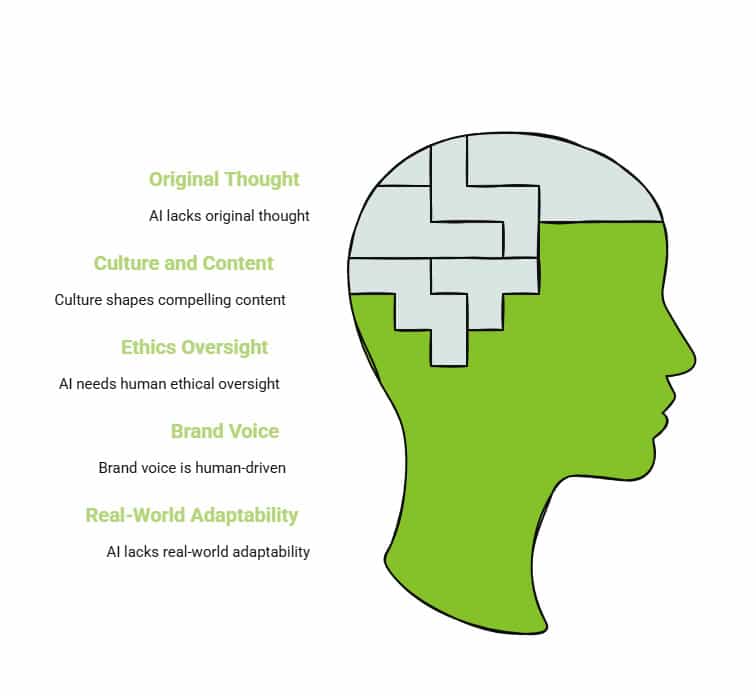
Reasons Why AI Cannot Replace Writers?
Why AI Cannot Replace Human Writers
While AI offers speed and convenience, it falls short in areas that define meaningful writing. Here are the core reasons why human writers remain irreplaceable.
1. Original Thought Beats Pattern Prediction
AI generates content by predicting the next word in a sequence. It is imitation, not invention. That is why most AI text feels repetitive, familiar, or safe. It cannot bring a fresh perspective or a bold, contrarian idea.
Writers, on the other hand, draw from real experiences, insights, and imagination. An opinion column, a thought leadership piece, or even a satirical take requires originality that AI cannot replicate.
2. Culture Shapes Content
Words are never neutral. A campaign that works in Mumbai may not resonate in Chennai. A joke that lands with Gen Z may offend Gen X. Cultural nuance is critical to connection.
AI lacks a lived cultural context. It may generate grammatically perfect content, but it risks being tone-deaf. Human writers instinctively know how to craft stories tailored to different communities, audiences, and platforms. This cultural intelligence is the difference between building trust and losing credibility.
3. Ethics Demand Human Oversight
AI sometimes fabricates facts, misquotes statistics, or reproduces hidden biases from its training data. In sectors such as health, finance, or education, this can be both dangerous and costly.
Writers and editors act as ethical filters. They take responsibility for accuracy, tone, and fairness. In fact, a Content Marketing Institute report found that only 4% of marketers fully trust AI-generated content that humans have not edited. The rest insist on human oversight for credibility. Without humans, brands risk reputational damage.
4. Brand Voice Is Human-Driven
Brands are not built on speed; they are built on trust and consistency. Every brand has a unique voice, whether warm, witty, authoritative, or conversational, that connects with its audience over time.
AI struggles to maintain that consistency. Its default tone often feels generic. Writers craft a brand voice through storytelling, emotional appeal, and subtle language choices. Authenticity is not a machine’s strength. It is a human one.
5. Adaptability In Real Situations
Writing is rarely straightforward. A client may change direction overnight. A product recall may require an urgent crisis response. A cultural event may demand sensitivity.
AI cannot handle ambiguity. If the prompt is vague, it produces vague content. Humans excel at interpreting messy, incomplete instructions and turning them into clear communication. In high-stakes contexts, adaptability is priceless. That is why in times of crisis, companies call writers, not algorithms.
Instead of just theory, here is what this means for you as a writer or marketer:
| Concern Many Writers Have | The Reality | What You Should Do |
| Will AI take my job? | No, but it will change your job. | Use AI for drafting and research. Focus your energy on strategy and storytelling. |
| Can brands replace humans with AI? | Some may try, but risk losing trust and quality. | Position yourself as the human layer of quality control. |
| Is it worth upskilling? | Absolutely. Writers using AI are already 40% more productive. | Learn prompt engineering, editing AI drafts and SEO-driven storytelling. |
| Where is my opportunity? | In areas AI cannot handle, such as cultural content, brand voice, ethics and creativity. | Build expertise in niches requiring originality and context. |
AI may automate tasks, but it cannot eliminate the role of writers. The ones who thrive will be those who adapt, utilizing AI for speed while maintaining creativity, culture, and credibility firmly human.
Wondering if AI made blogs irrelevant? See the truth in: Is Blogging Dead After ChatGPT? Key Insights Revealed
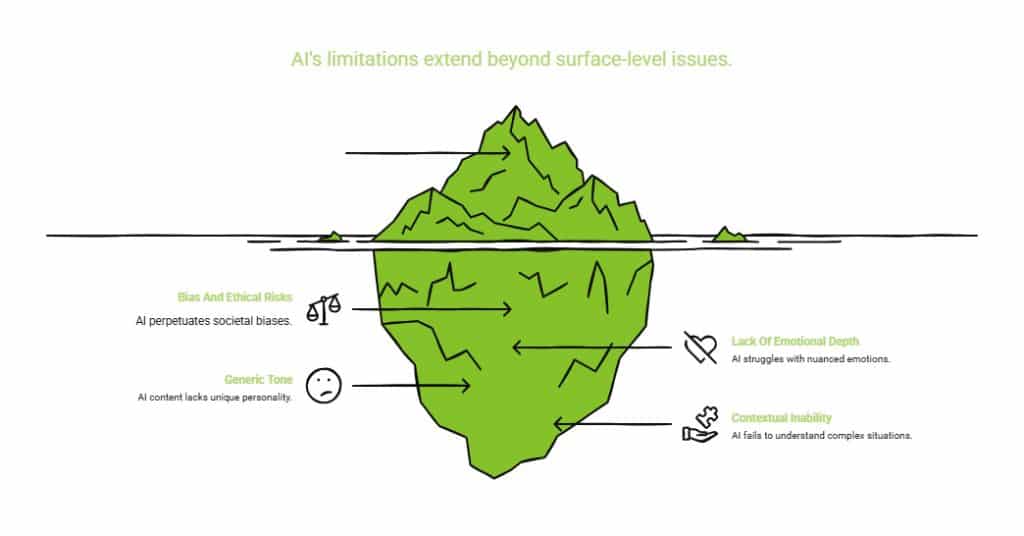
What Are AI’s Main Limitations For Creative And Trustworthy Content?
AI s Limitations in Creativity and Trustworthiness
You have probably seen it happen. An AI tool generates a blog that looks perfect at first glance. The grammar is clean, the flow is logical, and the sentences are crisp. However, once you dig deeper, problems emerge: a fabricated statistic, a cultural misstep, or a tone that feels oddly hollow. Publishing such content without human review is risky and costly.
That is the heart of AI’s weakness. It can mimic language, but it cannot grasp meaning, nuance, or consequence. Here are the biggest limitations that prevent AI from completely replacing writers.
1. Hallucinations And Inaccuracies
AI sometimes fabricates information with total confidence. It can cite sources that do not exist, invent statistics, or misstate facts. For businesses, this can mean reputational damage and financial loss.
AI-generated outputs may contained factual errors, underscoring the importance of human fact-checking. Writers ensure accuracy, credibility, and trustworthiness, qualities no brand can risk losing.
2. Bias And Ethical Risks
AI learns from online data, which is often biased and inaccurate. Without human filters, it can unintentionally reinforce stereotypes, exclude voices, or promote misinformation.
For example, generative models have been criticised for gender and cultural biases in their output. Human oversight provides the ethical judgement needed to create fair and inclusive content.
3. Lack Of Emotional Depth
AI can copy the form of emotion, but not the experience. It cannot truly understand grief, humour, or love. This makes its writing feel flat when genuine emotional resonance is needed.
A machine may generate a condolence message, but it cannot feel the pain of loss. Human writers infuse empathy, sensitivity, and authenticity into their words, making content relatable and trustworthy.
4. Generic Tone And Missing Voice
Even the most advanced AI tools tend to default to a neutral, one-size-fits-all style. The output often feels polished but bland. For brands that rely on a strong, distinctive voice, this is a major disadvantage.
Consumers trust a brand before making a purchase. That trust comes from voice, personality, and consistency, which remain uniquely human strengths.
5. Inability To Handle Complex Or Evolving Contexts
Real-world communication is rarely static. Writers often deal with ambiguity, shifting briefs, and rapidly changing events. AI struggles in such scenarios, producing vague or inaccurate content when prompts are not crystal clear.
Humans adapt. They read between the lines, interpret messy inputs, and craft communication that works even in uncertain situations. This adaptability ensures that content remains relevant and responsible.
AI limitations, such as hallucinations, bias, lack of empathy, generic tone, and poor adaptability, are not minor flaws. They are core barriers that stop machines from fully replacing writers.
Check out this guide that breaks the myths and shares 26 SEO best practices that actually work.
Where Should Writers Use AI And How To Build An Efficient Workflow?
Every writer knows the frustration of spending hours on repetitive tasks, such as writing product descriptions, drafting similar emails, or condensing long reports into concise notes. These chores drain energy that could be better spent on creativity and strategy. This is where AI can help, not as a rival, but as a reliable assistant.
Used correctly, AI reduces workload and speeds up routine writing, leaving more time for high-value tasks that require originality and human judgement. The key is to understand where AI fits in your workflow and where it should never be used.
Practical Ways Writers Can Use AI
- Breaking The Blank Page: AI can generate a quick outline or draft, helping you overcome writer’s block.
- Summarising Content: It condenses research papers, reports and articles into digestible insights, saving time.
- Scaling Simple Copy: Social captions, FAQs and product descriptions can be produced at scale in minutes.
- Improving Readability: AI tools help with grammar, clarity, and sentence restructuring to achieve a smoother flow.
- Repurposing Content: Turn a blog into social posts, newsletters or scripts with AI assistance.
- Multilingual Support: AI can assist in creating initial drafts in regional languages, which can then be refined by human editors.
Building An Efficient Workflow
The most successful writers do not hand over their work entirely to AI. Instead, they design a process that blends AI speed with human creativity.
- Drafting: Use AI to generate outlines, first drafts, or bullet points.
- Editing: Apply human judgement to refine tone, check facts, and add originality.
- Voice Alignment: Ensure the content matches the brand’s personality and intent.
- Final Review: Writers take full responsibility for accuracy, ethics, and context before publishing.
This workflow lets AI handle the heavy lifting while writers focus on storytelling, strategy and cultural sensitivity. In fact, research by HubSpot shows that marketers who use AI for repetitive tasks save up to 3 hours per day, which can be redirected to more creative work.
AI should never replace the role of a writer. It should free writers from low-value tasks, allowing them to focus on high-value work, such as strategy, storytelling, and building trust.
At Wild Creek, we call this our Human + Algorithm approach. AI for speed, humans for creativity. Contact us to see how we make it work.
What Does The Future Of Writers Look Like In An AI-Driven World?
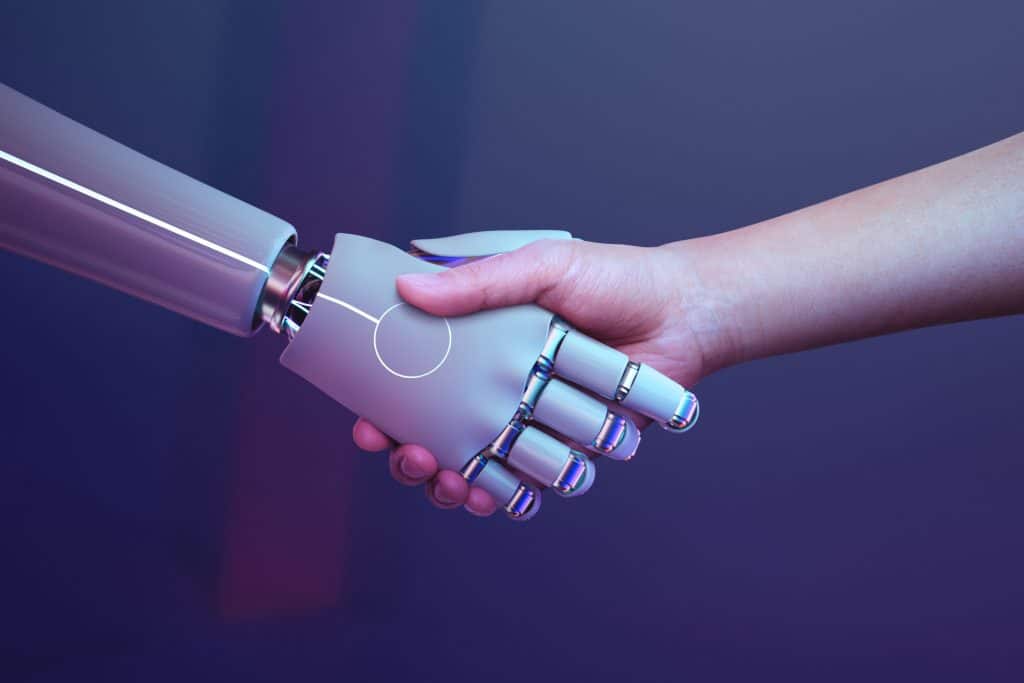
Human and AI Collaboration
Every industry is asking the same question: what happens when AI becomes more powerful? For writers, the worry is sharper. Will clients still pay for words when machines can generate thousands in seconds? The uncertainty is real, and so is the pressure.
Yet history offers perspective. When computers entered offices, typists feared for their jobs. However, new roles emerged, such as content strategists, digital marketers, and social media managers, that no one had imagined before. The same shift is happening now. AI is not the end of writing, but the evolution of it.
This evolution is already shaping clear paths for writers. Here are the most important ways the profession will transform in an AI-driven world.
1. Writers Become Strategic Partners
Instead of just creating words, writers will guide how content shapes business goals. They will move higher up the value chain, working on storytelling, audience analysis and brand positioning.
2. The Rise Of Hybrid Roles
New roles are already appearing: AI content editor, content strategist, and narrative designer. Writers who learn AI tools will find themselves in demand for hybrid jobs that combine creativity with technology.
3. Demand For Authenticity Will Increase
In a world full of machine-generated noise, authentic human stories will stand out even more. Audiences will crave real voices, personal experiences and cultural nuance. Writers who bring authenticity will become irreplaceable.
4. Niches And Specialisations Will Thrive
Writers who specialise in industries like health, finance, law or education will continue to be valued. AI cannot replace subject expertise or ethical responsibility. Specialisation will be a strong defence against automation.
5. Global And Local Storytelling Will Grow
As brands expand globally while also targeting local communities, the demand for writers who understand cultural nuance and multilingual audiences will rise. AI may translate, but it cannot fully adapt tone or intent.
Statistics That Point To The Future
These shifts are not just predictions, they are already backed by data and industry research.
- According to the Content Marketing Institute, 89% of marketers already utilise generative AI for content creation, but 96% still rely on human review before publishing.
- The Indian digital content market alone is expected to reach USD 35 billion by 2030, ensuring steady demand for skilled human writers.
Writers who adapt will not just survive but lead. The future belongs to those who combine human insight with AI efficiency, positioning themselves as creators of trust, strategy and authenticity in a machine-assisted world.
Struggling To Balance AI Speed With Human Creativity?
Most businesses face the same challenge: AI helps with speed, but the content often feels generic, lacks voice, and risks losing audience trust. Without the right balance, your brand message gets lost in the noise.
At Wild Creek Web Studio, we solve this by blending AI efficiency with human-led clarity and creativity. Our Human Algorithm approach ensures your content is fast, strategic, and truly authentic.
Here’s how we make the difference:
- Authentic Storytelling: We keep your brand voice consistent and trustworthy.
- AI-Powered Efficiency: Use technology smartly without losing human touch.
- Tailored Strategies: Content crafted for your goals, not one-size-fits-all templates.
- Trusted Expertise: Years of experience helping brands stand out in crowded markets.
Ready to turn AI into your competitive advantage?
👉 Book a clarity call with Wild Creek Web Studio today.
Conclusion
AI may change the way we write, but it will not erase the role of writers. Machines bring speed, yet only humans bring originality, empathy, and cultural understanding. That is why the value of writers remains strong in an AI-driven world.
Writers who embrace AI as an assistant while sharpening their creativity, strategy, and storytelling will remain in demand. Those who adapt now will be the ones shaping tomorrow’s conversations and leading the future of content.
Frequently Asked Questions
Will AI-generated novels ever win major literary awards?
Not anytime soon. Awards value originality, emotional depth and authentic perspectives. AI may create technically sound stories, but it lacks lived experience and genuine voice that judges look for in meaningful literature.
Has AI already replaced writers in any fields or industries?
No. AI automates routine tasks like product descriptions or data-heavy summaries. Human writers are still needed for strategy, storytelling, and quality control to ensure content resonates with audiences and maintains trust.
What skills make human writers unique compared to AI?
Human writers excel in storytelling, emotional connection and critical thinking. They bring originality, cultural awareness and ethical judgement, qualities that AI cannot replicate, making them essential for content that is impactful and trustworthy.
Can AI completely replace content writers in the future?
Unlikely. AI may get smarter, but writing requires empathy, judgement and cultural nuance. These human elements are critical in communication, and cannot be fully replaced by algorithms, no matter how advanced.
How are businesses currently using AI for writing?
Most businesses use AI for first drafts, outlines, summaries, and SEO optimisation. However, they still rely on human writers for editing, storytelling, brand voice, and ensuring the final content connects authentically with audiences.
Is AI writing good enough for creative fields like poetry or scripts?
AI can mimic structure and style but struggles with originality and emotional resonance. Poetry, film scripts, and creative storytelling rely heavily on personal experience and cultural context, areas where humans excel far beyond machines.
What are the risks of publishing unedited AI-generated content?
The risks include factual errors, plagiarism, generic tone and cultural insensitivity. Without human review, content may harm brand credibility or even cause reputational and legal damage. Human oversight remains essential for quality control.
How can writers future-proof their careers against AI?
Writers should upskill in AI tools, SEO, content strategy and brand storytelling. By blending technology with creativity and cultural sensitivity, they can remain valuable and in demand despite growing AI adoption.
Can AI ever match the creativity of human authors?
No. AI can remix information and generate patterns, but it lacks lived experiences, emotions, and originality. Human authors create meaning through empathy, cultural context, and unique perspectives, qualities AI cannot truly replicate.
Has AI already replaced writers in any fields or industries?
No. AI has automated certain routine tasks like product descriptions, sports updates, and financial reports. However, it has not replaced writers in any field, as strategy, creativity, and contextual storytelling still demand human expertise.