Key Highlights
- Human-centered leadership ensures AI enhances human judgment instead of replacing it.
- AI provides speed, but humans supply context, nuance, and ethical decision-making.
- Augmentation creates stronger outcomes by pairing human insight with AI capability.
- Effective leaders slow down for clarity, ask better questions, and guide AI with intent.
- Organizations fail with AI when they treat it as a shortcut or ignore workflow redesign.
- Human-centered leadership reduces fear, builds confidence, and strengthens team thinking.
- Wild Creek Studio leads with human insight first, using AI to elevate strategy, not drive it.
The digital industry is racing toward automation, but that speed comes with a hidden cost. Many teams are thinking less. AI tools promise faster outputs, yet leaders are discovering a painful truth. Quick results do not equal smart decisions. Brands end up with more content, but not a better strategy.
This is the gap the Human Algorithm addresses. Instead of replacing human expertise, it strengthens it. AI brings scale and efficiency, while humans bring context, creativity, and empathy. These are qualities no algorithm can replicate. When one is used without the other, innovation suffers.
This blog explores how human-centred leadership can create a future where AI supports and elevates human thinking rather than diluting it. You will see why the next competitive advantage comes from thinking better, not simply working faster, and how leaders can combine automation with human insight to unlock deeper productivity and stronger ideas.
What Human Centered Leadership Means in an AI-Powered World?
Human-centered leadership is becoming essential because AI is no longer the future. It is already shaping how teams work, plan, and create. But here is the part many leaders miss. AI can speed things up, yet it cannot decide what truly matters. That clarity still has to come from people. This is exactly why human-centered leadership matters now more than ever.
Think of it this way. AI is incredible at repetition, optimization, and scale. Humans are incredible at understanding nuance, emotion, and context. When leaders treat these as competing strengths, they limit what both can do. When they treat them as complementary, they unlock much better thinking.
Leaders who take a human-centered approach focus on a few practical priorities:
- Let AI handle the predictable work so humans can handle the meaningful work
- Keep humans in charge of judgment, creativity, and interpretation
- Build workflows where technology supports thinking instead of replacing it
This approach removes the fear many teams feel around AI and replaces it with confidence. People know where they fit. They understand why their thinking matters. And they see AI as a tool that frees them up to contribute at a higher level.
A recent survey by Boston Consulting Group found that when frontline employees feel they have strong leadership support for generative AI, the share of those who feel positive about it rises from 15% to 55%. This demonstrates a powerful truth.
When leaders guide teams through AI adoption with clarity and support, people become more optimistic, engaged, and willing to experiment.
When leaders get this balance right, the quality of ideas improves, strategic conversations get richer, and teams become more comfortable exploring what AI can and cannot do. It is a simple shift, but it changes everything. Instead of racing AI, you learn to partner with it. And that is where real innovation begins.
Why Human Expertise Still Matters?
AI can automate almost anything today, yet it still cannot replace the one element that creates real competitive advantage: human discernment.
According to McKinsey, AI has the potential to generate $2.6 trillion to $4.4 trillion in value across industries. But only a very small percentage of organizations are capturing that value in a meaningful way. The technology is available. What is missing is thoughtful human guidance.
AI can surface patterns, but it cannot understand why those patterns matter. It can generate polished outputs, but it cannot determine whether they are right, relevant, or responsible. When decisions carry emotional weight or strategic consequence, it is the leader who must interpret the nuance, understand the context, and make the call.
The companies that outperform are the ones that do not treat AI as a replacement for thinking. They use AI to improve execution and efficiency. They rely on humans to define direction, shape strategy, and identify opportunities that data alone cannot reveal. This is the foundation of strong innovation and long-term advantage.
Human intelligence remains the steering wheel. AI is only the engine.
The Power of Augmentation: How Humans and AI Achieve More Together

Human and AI collaboration illustration
Augmentation is the practice of combining human intelligence with AI capability so each can do what it does best. Instead of using AI to replace people, leaders use AI to extend human thinking, improve decision quality, and remove the manual work that slows teams down.
According to Deloitte, companies that intentionally redesign work this way see significantly stronger outcomes, while those that rely on AI alone are 1.6 times more likely to miss their expected ROI. This makes one thing clear: AI delivers value only when humans stay in the driver’s seat.
Here is how augmentation helps in everyday work:
- AI handles repetitive or time-consuming tasks so people can focus on strategy and problem-solving
- AI analyzes patterns and data, while humans interpret what those insights actually mean
- AI generates options, and humans choose the direction that aligns with purpose and long-term goals
- AI increases capacity, and humans increase clarity and creativity
This approach not only improves productivity but also improves the quality of decisions. Teams think more clearly because they are not buried in manual work. Leaders make better calls because they have stronger insights. And organizations innovate more confidently because humans guide the narrative while AI supports the execution.
Augmentation is not about humans versus machines. It is about designing a smarter partnership so both can contribute at their highest level.
To see how this philosophy translates into real digital strategy, explore our hybrid SEO approach, where human insight and AI intelligence work together to deliver stronger, smarter results.
How Human Centered Leadership Brings Balance to an AI-Driven Workplace?
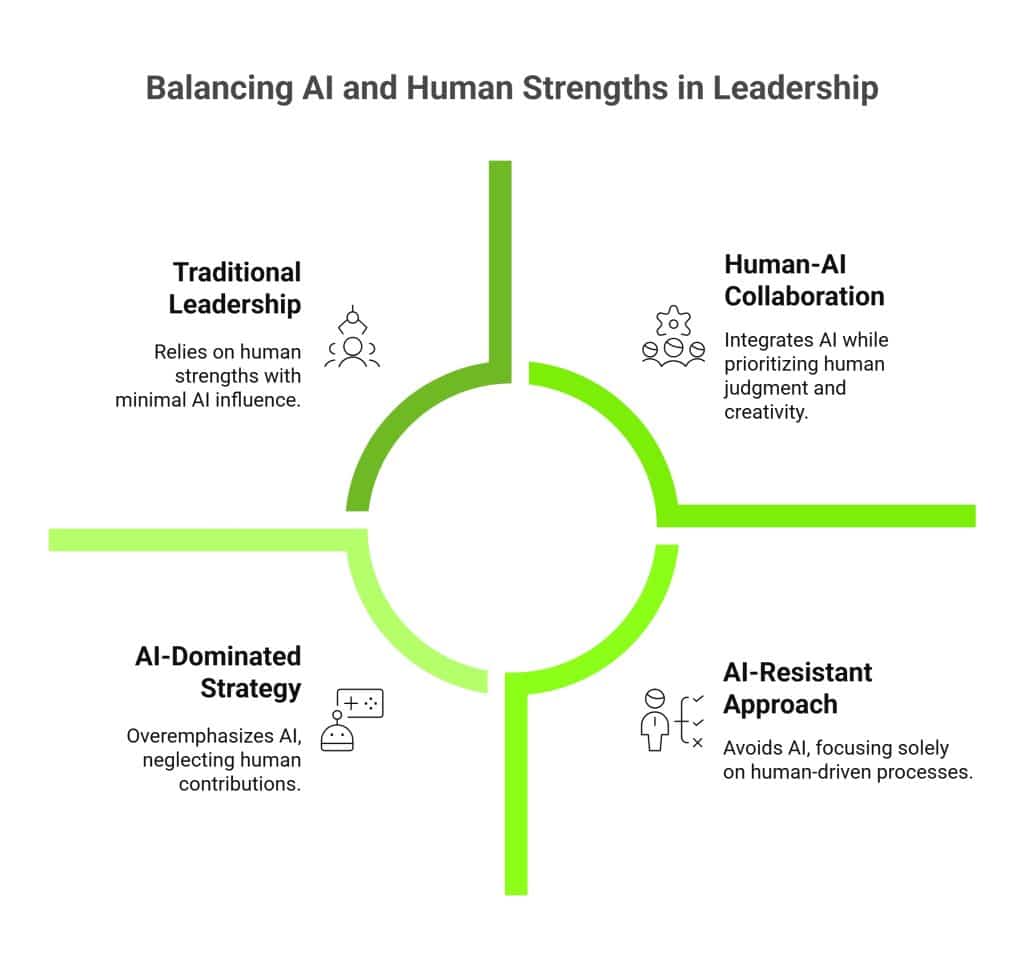
Infographic on balancing AI and human stregths in leadership
AI is reshaping workflows faster than organizations can adapt their mindsets. The technology is not the challenge. The uncertainty it creates is. People worry less about automation itself and more about losing relevance inside a system that suddenly feels unfamiliar. This is where human centered leadership becomes essential. It brings clarity to change and protects the human meaning behind the work.
Expert leaders know that AI does not replace human judgment. It increases the need for leaders who can interpret nuance, guide context, and maintain direction. They do not present AI as the finish line, but as a catalyst that expands what teams can achieve.
Research supports this. As highlighted in Harvard Business Review’s AI Won’t Make the Call: Why Human Judgment Still Drives Innovation, even with access to generative AI tools, human judgment remains essential because AI cannot reliably distinguish strong ideas from weak ones or guide long-term strategy on its own. AI accelerates execution, but humans must still decide what matters and why.
Human centered leadership creates this balance by focusing on a few core shifts:
- Replacing fear with clarity by explaining how AI supports the broader strategy
- Reinforcing that human judgment remains central in decisions that require nuance or ethical awareness
- Encouraging teams to experiment with AI so confidence grows through use, not avoidance
- Elevating uniquely human strengths such as creativity, emotional intelligence, and strategic sense
When leaders operate this way, teams stop viewing AI as a threat to their value and start seeing it as an amplifier of it. People understand not only what AI can do, but also what it cannot. They see where their expertise still guides the work and how technology can extend their impact.
To see how this balance plays out in real-world decision-making, explore our insights on AI agent decision-making and why human judgment must remain at the center.
What Most Organizations Get Wrong About AI?
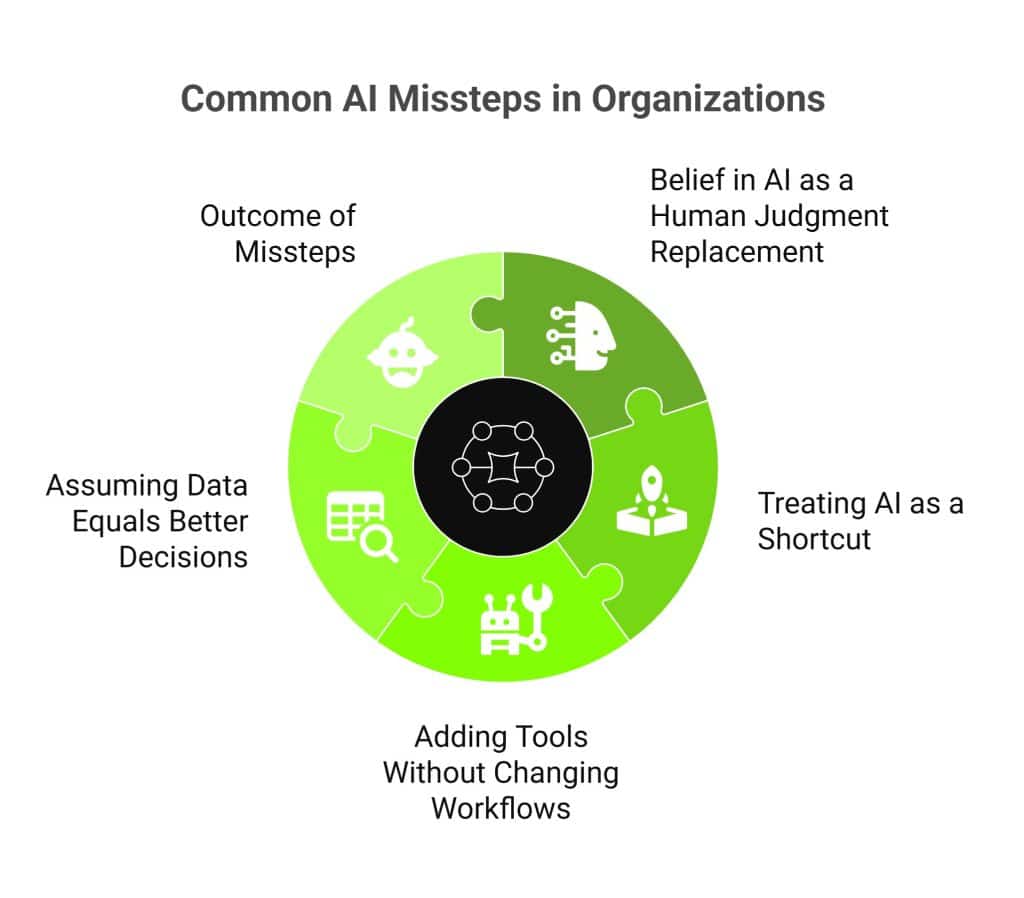
Infographic showing common AI missteps in organizations
AI is now at the center of business transformation, yet many organizations still struggle to extract meaningful value from it. The problem is rarely the technology. It is how leaders think about the technology. When AI is adopted without clarity, intention, or human oversight, it becomes a fast way to scale work that lacks depth and direction.
Here are the most common ways organizations misstep when working with AI:
1. The Belief That AI Can Replace Human Judgment
Many companies assume AI can think for them because it can process information at an extraordinary speed. But speed is not strategy. AI can reveal patterns, yet it cannot interpret nuance, understand emotion, or weigh long-term implications. When leaders hand over judgment, decision quality inevitably declines.
2. The Habit of Treating AI as a Shortcut
AI often gets positioned as a way to avoid deep thinking. This leads teams to automate tasks they barely understand and publish outputs they barely review. AI is not a shortcut to better work. It simply amplifies the quality of the thinking that guides it. Weak thinking produces weak results, only faster.
3. The Mistake of Adding Tools Without Changing Workflows
Many organizations adopt AI tools but leave their workflows untouched. The result is old processes running on new technology, which only accelerates inefficiency. Without rethinking roles, responsibilities, and decision points, AI becomes an add-on rather than a catalyst for transformation.
4. The Assumption That Data Equals Better Decisions
AI-generated insights often look precise, but precision does not guarantee relevance. Data without human interpretation can lead to overconfidence and poor choices. Only humans can judge whether an insight is ethical, strategic, or aligned with a company’s purpose.
5. The Outcome of These Missteps
These patterns lead to more output, but not better outcomes. Companies achieve speed but lose insight. They optimize workflows but weaken strategy. AI ends up producing work that is efficient yet forgettable.
Thoughtful organizations take a different path. They use AI to enhance human thinking, not bypass it. And that is where the real competitive advantage begins.
What Effective Leaders Do Differently in an AI-Augmented Workplace?
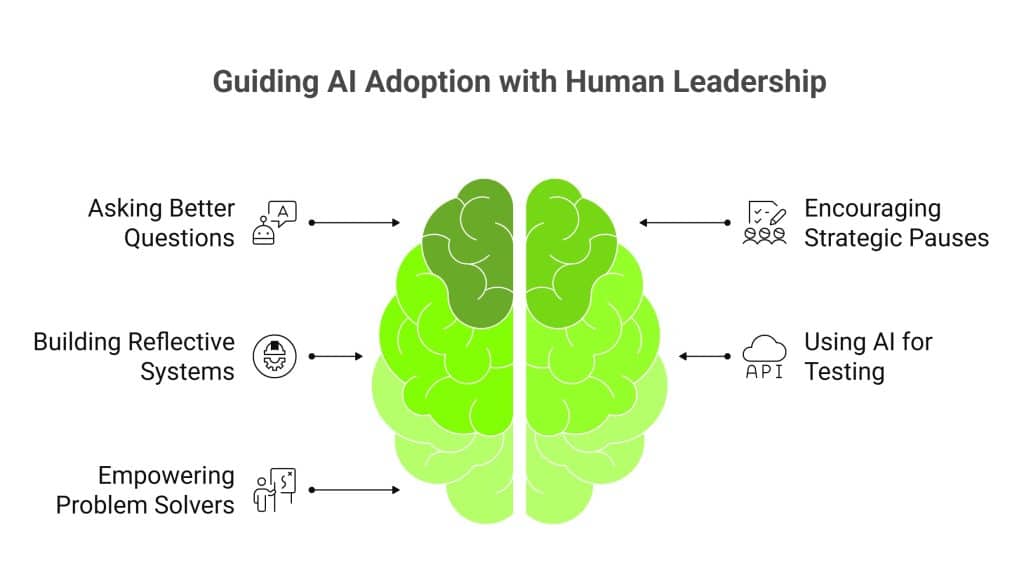
Infographic showing guiding AI adoption with human leadership
AI can accelerate execution, but it still relies on human leadership to shape direction, intent, and quality. The organizations that gain the most from AI are not the ones using the most tools.
These approaches reflect how high-performing leaders guide AI adoption with clarity and purpose and represent some of the most effective human-centered leadership approaches today.
1. Teach Teams to Ask Better Questions Before Using AI
According to BCG, 74% of organizations have not yet achieved meaningful value from AI initiatives, largely because the strategic intent behind the work is weak or undefined.
Leaders help teams by clarifying the intent behind the task. They push people to define the decision they need to make, the context that matters, and the outcome they are aiming for. This discipline transforms AI from a generator of information into a generator of insight.
2. Encourage Strategic Pauses Instead of Rushing to Outputs
AI encourages immediacy, but thoughtful leaders encourage evaluation. They model a brief pause to assess whether an output aligns with the goal or misses critical nuance.
This simple habit prevents teams from mistaking speed for insight and reduces the risk of overconfidence in machine-generated answers.
3. Build Systems That Support Reflection and Analysis
Reflection should not depend on personal discipline. It should be baked into the workflow. McKinsey’s research highlights that AI proficiency drops sharply when teams lack guidance and structure.
Only 22 percent of older employees feel confident using AI tools, compared to 62 percent of younger employees.
Leaders who establish structured checkpoints, review loops, and interpretation steps ensure that every team member, regardless of experience level, engages with AI thoughtfully and consistently.
These systems create a level playing field and prevent teams from accepting AI outputs without analysis.
4. Use AI to Test Ideas, Not Generate Them
AI can generate endless ideas, but original thinking still comes from humans. High-performing organizations use AI to validate assumptions rather than create them.
This mirrors findings across AI maturity studies that show organizations generate more business impact when human insight directs how models are used.
5. Empower Teams to Think Like Problem Solvers, Not Prompt Operators
AI fluency is not enough. Teams need the ability to diagnose issues and frame challenges clearly before involving any tool. Companies that anchor AI adoption in leadership-driven problem solving see far stronger culture, performance, and employee confidence.
Human-centered leadership is not about slowing down AI adoption. It is about raising the quality of human thinking so that the technology can deliver the value it promises. When leaders adopt these approaches, AI becomes an amplifier of expertise, not a replacement for it.
Why Wild Creek Studio Leads With Thinking, Not Technology
Most digital firms start with tools. We start with thought. In a market where AI promises speed and scale, Wild Creek Studio focuses on something far more valuable: the quality of human judgment guiding that technology. AI can automate execution, but only people can define direction, meaning, and strategic clarity.
We start with people, not platforms. Our strategy is grounded in real observation and a deep understanding of behavior. AI extends this thinking, but it never replaces it. The direction always comes from the human mind.
This is the essence of human-centered organizational leadership and the foundation of how we operate. Our philosophy is built on three core beliefs:
- AI should speed up execution, not replace interpretation
- Human insight must lead strategy, not follow the tool
- Work should feel intentional and human, not mechanical or generic
This is why our work feels distinct. AI expands our reach, but people give it meaning. We use technology to strengthen ideas, not replace them, and data to guide decisions, not dictate them.
Wild Creek Studio creates work that feels human because it is led by people who think deeply and supported by tools that work intelligently. In a landscape crowded with AI-generated sameness, that balance is our advantage.
Ready to know more? Contact us today!
Final Words
AI will keep getting faster, but the real edge still belongs to leaders who think clearly. When your team brings the insight, and AI brings the acceleration, the work becomes sharper, more intentional, and far more impactful. The future rewards leaders who know how to use technology without surrendering their judgment to it.
This is the moment to lean in. Stay curious, stay thoughtful, and let AI amplify the thinking you already do well. When humans lead and AI supports, you build a future that feels intelligent, not automated.
Frequently Asked Questions
What is human centered leadership?
Human-centered leadership is a leadership model that prioritizes people over processes. It focuses on empathy, clarity, open communication, and purposeful decision-making. Leaders using this approach elevate human judgment, support well-being, and create environments where teams think better, collaborate strongly, and innovate more meaningfully.
How can organizations foster human-centered leadership among their leaders?
Organizations can cultivate human-centered leadership through leadership development, training programs, and a positive work environment that prioritizes open communication, psychological safety, and inclusion. This approach strengthens resilience, supports professional development, and aligns leaders with organizational goals.
What are the main benefits of adopting a human-centered leadership approach?
Human-centered leadership improves employee engagement, retention, and satisfaction while fostering a positive work environment. It strengthens organizational culture, encourages new ideas, and supports adaptability, ultimately helping successful organizations align people with organizational goals and achieve long-lasting fulfillment.
What steps can leaders take to develop human-centered leadership skills?
Leaders can build these skills by practicing authenticity, developing high emotional intelligence, fostering psychological safety, and committing to continuous professional development. Engaging in leadership development and training programs strengthens resilience and promotes a healthier work environment aligned with organizational goals.
How is human-centered leadership different from traditional leadership styles?
Human-centered leadership emphasizes inclusion, psychological safety, and a supportive work environment, while traditional leadership often focuses on control and top-down organizational change. This leadership model promotes fulfillment, adaptability, and new ideas rather than rigid structures or poor management behaviors.
What challenges do organizations face when implementing human-centered leadership?
Challenges include shifting organizational culture, overcoming poor management habits, and aligning stakeholders with new expectations for open communication and inclusion. Leaders may struggle with adaptability and resilience when disruption occurs, making it harder to maintain consistent psychological safety and authenticity.
Can you share real-world examples of organizations using human-centered leadership?
Many successful organizations apply this leadership model by creating inclusive cultures, prioritizing professional development, and supporting psychological safety. Organizational psychologists and adjunct professors often highlight companies that improve retention, foster new ideas, and cultivate a positive work environment grounded in authenticity.
How does human-centered leadership help drive transformation within an organization?
It accelerates organizational change by promoting open communication, resilience, and employee engagement. Human-centered leadership aligns people with organizational goals, encourages new ideas, and creates a state of mind where employees feel a sense of purpose, improving adaptability during disruption.
What training or certification options are available for learning human-centered leadership?
Leaders can pursue certificate programs, cohort-based coursework, and training programs guided by organizational psychologists or adjunct professors. These opportunities strengthen good leadership, enhance inclusion, and improve professional development within a supportive, positive work environment.