Key Highlights
- The rise of AI technology, including generative AI, encourages us to rethink the value of human intelligence.
- Harnessing human intelligence means focusing on skills AI cannot replicate, like creativity and emotional reasoning.
- A partnership between humans and AI leads to better outcomes than relying on either one alone.
- Human agency is critical for guiding AI development and ensuring ethical outcomes.
- Businesses can build a stronger workforce by integrating AI to support human workers, not replace them.
While AI can provide quick answers, many wonder if it will cause us to lose the ability to think critically and creatively. How do we ensure we use AI to enhance, rather than replace, our thinking?
We are living in a time where artificial intelligence and machine learning are transforming how we work, learn, and make decisions. As these technologies continue to evolve, there’s growing concern that relying on fast, automated solutions could weaken our capacity for deep, creative thought.
The real worry isn’t that AI will replace human intelligence, but that we may stop exercising our ability to reason and innovate. This blog explores how we can use AI as a supportive partner, one that strengthens critical thinking, problem-solving, and meaningful human insight.
Why Do We Need to Rethink Intelligence in the Age of AI?
As AI takes over repetitive tasks, it becomes more crucial to recognize what makes human intelligence unique and why it still matters. While machines excel at handling analytical and data-heavy tasks, it’s human qualities like empathy, intuition, and ethical judgment that drive meaningful decision-making.
For example, in healthcare, AI can analyze medical data to identify trends and predict outcomes, but it’s the human element that ensures those insights are applied in ways that consider the patient’s emotional well-being and personal values
According to ResearchGate, studies show that when humans and AI work together, problem-solving and innovation improve instead of getting weaker.
Here’s what rethinking intelligence truly requires:
- Emphasising creativity that goes beyond pattern-based logic
- Strengthening emotional understanding and empathy in human interactions
- Developing advanced critical thinking for complex, ambiguous challenges
- Cultivating ethical judgment and decision-making beyond data
- Building adaptability and resilience in a constantly evolving world
By redefining intelligence through a human lens, we position ourselves not to compete with AI, but to build a future where technology elevates human potential rather than replaces it.
What Does It Really Mean to Harness Human Intelligence?
What happens when AI starts to outpace human judgment? To ensure that artificial intelligence enhances our lives, rather than replacing human insight, we must rely on our uniquely human strengths, values, ethics, intuition, and emotional depth, to guide technology toward responsible and meaningful outcomes.
Here’s how harnessing human intelligence truly works:
- Using emotional awareness and empathy to shape decisions and collaboration
- Applying ethical reasoning where data alone cannot determine the right path
- Exercising strategic and big-picture thinking beyond algorithmic limits
- Combining creativity and imagination to innovate beyond existing patterns
- Leveraging AI to remove routine tasks and free time for higher-level work
Ultimately, true progress comes from leading technology with human intelligence, ensuring that advancements are guided by purpose and values, not just efficiency.
How AI Can Work With Us to Boost Our Intelligence, Not Replace It?
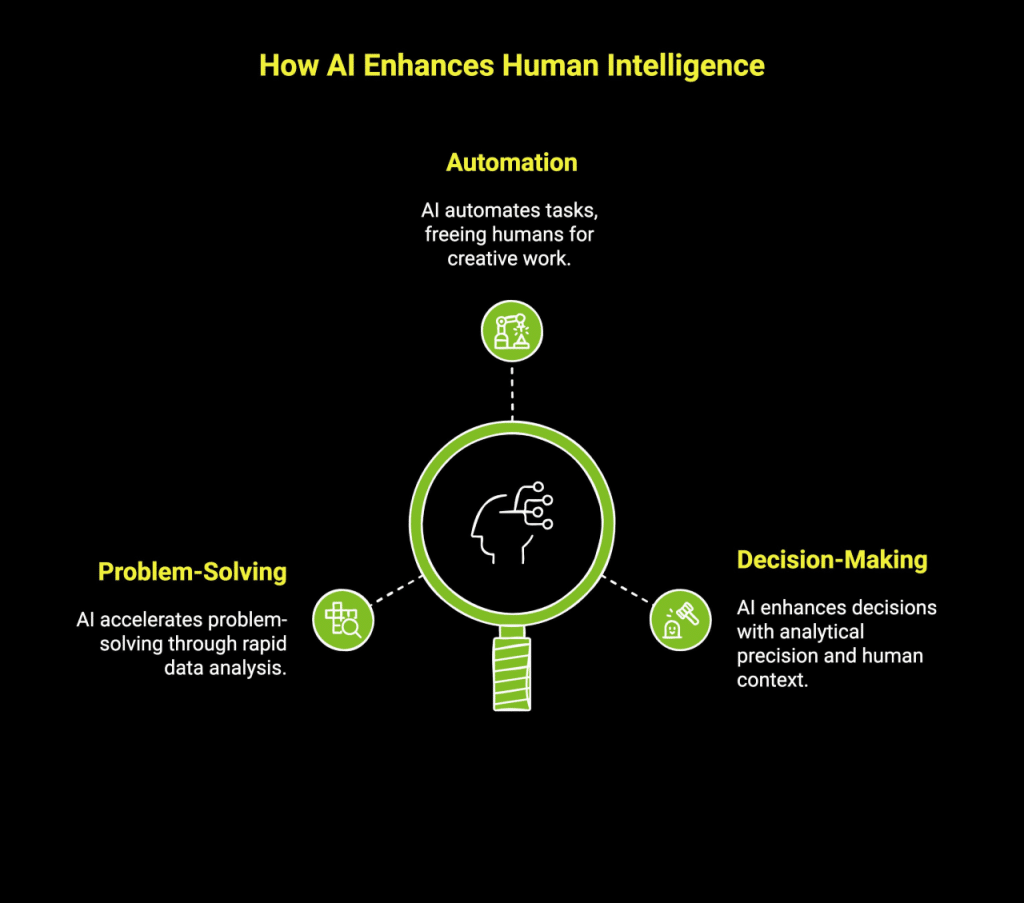
Infographic showcasing how AI enhances human intelligence
Artificial intelligence holds tremendous potential to elevate human capability rather than diminish it. Instead of viewing AI as a rival, seeing it as a collaborative partner allows us to amplify creativity, accelerate problem-solving, and focus on high-value thinking.
According to McKinsey & Company, future workplaces will rely on teams that combine human skills with AI efficiency, making creativity and critical thinking more valuable than ever.
Here’s how AI can truly enhance human intelligence:
1. Pattern Recognition Versus Understanding
AI excels at processing massive amounts of information quickly, spotting patterns we would never detect alone. Yet real intelligence requires more than identification. Human understanding brings context, interpretation, and emotional nuance that machines cannot replicate.
When used thoughtfully, AI has the potential to enhance human intelligence. By combining AI’s analytical power with our ability to find meaning and context, we transform raw data into valuable insights and wisdom that lead to smarter, more informed decisions.
2. Mathematical Prediction Versus Emotional Reasoning
Predictive algorithms can calculate probabilities and optimise decisions with remarkable precision, especially in fields like forecasting, diagnostics, and logistics. But human life is not governed only by numbers. Emotional reasoning allows us to interpret tone, intentions, social cues, and ethical dimensions.
This balance represents AI that enhances human intelligence for higher tasks, rather than replacing human judgment. When predictive accuracy meets emotional intelligence, decision-making becomes more compassionate, inclusive, and aligned with real human needs.
3. The Responsibility Gap And Ethical Implications
As AI systems become more autonomous, the risk of bias, harm, and misalignment increases. Algorithms cannot be held morally accountable, which creates a responsibility gap when things go wrong.
Human oversight is essential to apply judgment, ensure fairness, and embed ethical values into technological systems.
By combining AI’s computational strengths with human insight, empathy, and ethical judgment, we create a powerful partnership. Human oversight ensures that AI’s capabilities are applied responsibly, guiding its use to make decisions that are not only intelligent but also compassionate and ethically sound.
This balance leads to progress that is both innovative and deeply aligned with human values.
How Does AI Simulate Human Intelligence, and Where Does It Struggle to Match Human Ability?
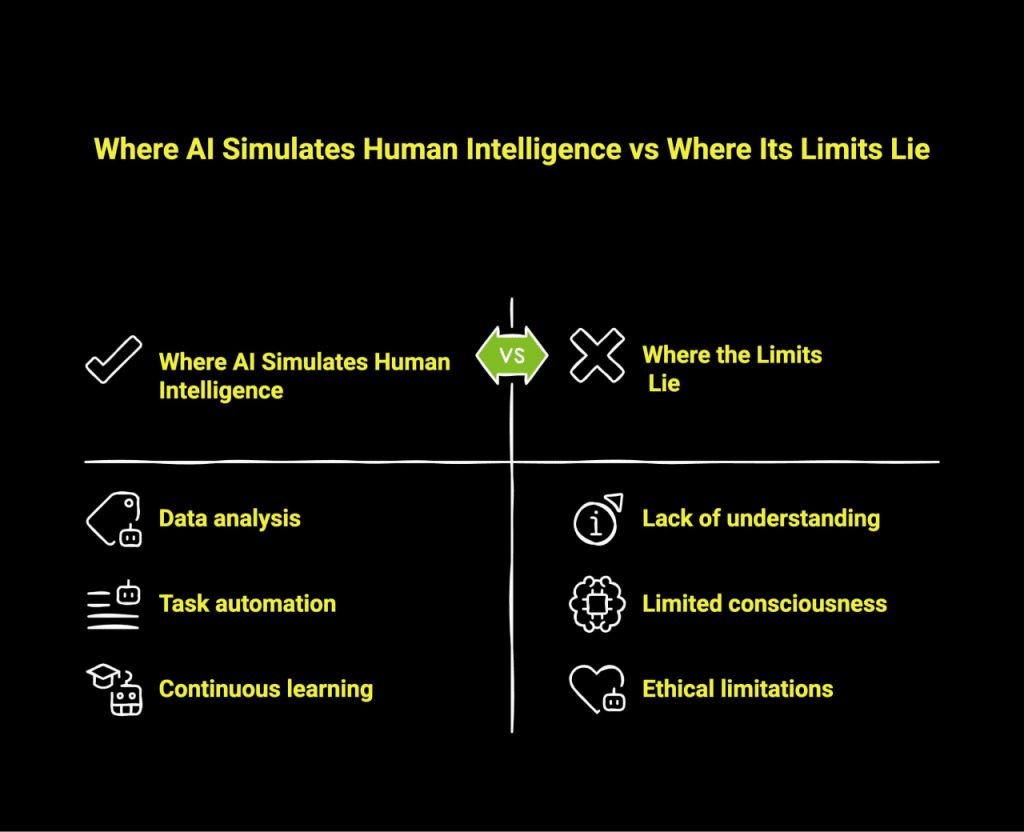
Infographic showcasing where AI simulates human intelligence vs where it lacks
Artificial intelligence can mirror certain aspects of human thinking by analysing data, recognising patterns, and learning from experience. It performs specialised tasks with speed and accuracy, helping us work smarter and faster. Yet its capabilities remain fundamentally different from human cognition, which is rooted in consciousness, intuition, emotional awareness, human language, and lived experience. AI can generate answers, but it does not understand meaning, intention, or context the way humans do.
Here’s where simulation meets real limitations:
1. AI tools for boosting productivity
AI is exceptionally effective at handling repetitive, time-consuming tasks that drain human energy. Automating processes such as scheduling, data sorting, document drafting, and research allows people to focus on creativity, strategy, and human-centric problem-solving.
However, AI lacks judgment and cannot determine which tasks should be prioritised or why decisions matter in real-world contexts. Humans must still review, validate, and apply insight responsibly.
2. Redefining job roles through human-AI collaboration
Rather than replacing jobs outright, AI is reshaping them into more dynamic and rewarding roles. When humans and AI collaborate, analytical power combines with creativity and ethical reasoning. Professionals use AI insights to make smarter decisions and develop innovative solutions.
Still, AI cannot lead complex decision-making independently, especially where nuance, empathy, or long-term consequences matter. Human oversight remains essential to prevent errors, bias, and misaligned incentives.
3. Building a superagency workforce with AI integration
A superagency workforce merges autonomous AI capabilities with human intention and values. AI agents can independently manage workflows and analyse complex data, while humans guide meaning, responsibility, and real-world impact.
While AI’s capabilities continue to grow, it’s clear that it will always be human intelligence, our values, and our purpose that will guide its use for the betterment of society.
What Real-World Example Proves the Value of Human + AI Partnership?
From customer service to strategic decision-making, the best results happen when AI complements human creativity and empathy. Let’s look at some real-world examples that prove this partnership works.
Real-world use cases clearly show that AI technology thrives when it enhances human intelligence. In this partnership model, AI handles the data-heavy tasks, while humans bring in strategic thinking and emotional insight. For example, in customer service, AI-powered chatbots provide quick, 24/7 responses to common inquiries, ensuring customers get immediate support.
For e.g. Airbnb. During the global travel shutdowns, the company faced enormous uncertainty. While AI forecasting models predicted that Airbnb would collapse, it was the leadership’s human judgment and creativity that drove them to pivot.
By focusing on the emotional needs of their customers and embracing innovation, they shifted their strategy to offer long-term stays, creating a new market segment. This decision, driven by human insight, proved far more effective than relying solely on predictive algorithms.
How can your organization embrace human insight to drive meaningful change and connect with people on a deeper level? By focusing on the emotional and personal needs of your audience, your organization can create strategies that go beyond data and analytics.
Embracing human insight allows you to build authentic connections, fostering deeper, more lasting relationships that truly resonate with those you aim to serve.
What Framework Can Leaders Use to Build Hybrid Intelligence Systems?
Building effective hybrid intelligence requires more than adopting AI tools. Leaders need a structured framework that aligns technology with human purpose. When thoughtfully implemented, AI can amplify human capability, improve decision quality, and strengthen organisational culture.
Here’s how leaders can shape powerful human–AI ecosystems:
1. Define, Explore, Distil, Decide, Reflect
This five-stage framework helps leaders integrate AI with clarity and intent. Defining the problem ensures everyone understands the true objective. Exploring options uncovers technological and human possibilities. Distilling information simplifies complexity into actionable insight. Deciding turns analysis into direction. Reflecting enables continuous learning and improvement. This cycle builds resilient teams who adapt and evolve responsibly.
2. AI Supporting Possibilities, Humans Determining Direction
AI can surface insights, perform large-scale data analysis, and automate demanding tasks. However, humans must guide vision, interpret context, and apply ethical reasoning. By allowing machines to expand what is possible and people to choose what is meaningful, organisations balance efficiency with empathy. This partnership ensures progress is aligned with long-term values and real-world impact.
3. Turning Data Into Meaning And Wisdom
AI can process information faster than any human, but only people can transform data into purposeful decisions. Human intelligence adds emotional context, moral judgment, and lived experience. When teams combine algorithmic accuracy with human understanding, information becomes insight, and insight becomes wisdom that fuels strategy and innovation.
What Is At Risk When We Stop Thinking For Ourselves?
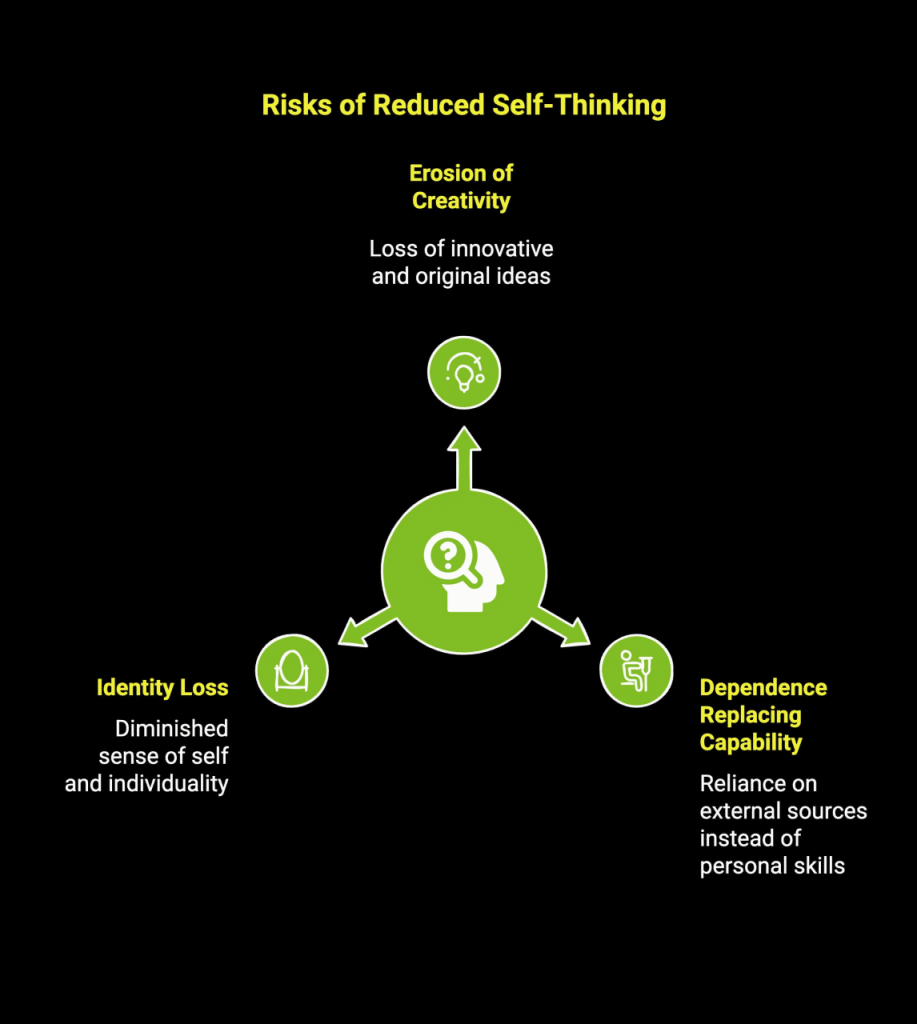
Infographic showcasing risks of reduced self thinking 1
AI is a powerful tool, but depending on it too heavily can weaken the very capabilities that make humans exceptional. When we outsource thinking to technology, we risk losing our ability to question, analyse, and create. Critical thinking and creativity require active practice, and without intentional effort, they fade.
To protect our cognitive strength, we must stay engaged, curious, and mentally self-reliant, especially as the impact of AI expands across industries and daily life.
Here’s what’s truly at stake in various ways:
1. The Quiet Impact of AI on Our Creativity and Problem-Solving Skills
When AI applications and large language models perform tasks that demand analysis and imagination, it becomes tempting to let machines solve everything for us. But creativity is built through struggle, reflection, and experimentation. If we stop challenging our minds, we lose the ability to generate original ideas and solve problems independently.
Protecting creativity means treating AI as support rather than a replacement for human thought, a principle well understood in computer science research.
2. The Gradual Loss of Intellectual Independence Through AI Dependency
Over-reliance on AI can gradually diminish personal agency. If we always turn to algorithms for answers and decisions, our skills to reason, evaluate, and judge weaken. The consequence is not immediate but cumulative: we may become passive followers instead of active thinkers.
Balancing digital convenience with human reasoning ensures we maintain mastery over our intelligence and avoid letting technology dictate the direction of progress.
3. The Risk of Losing Brand Authenticity and Trust with Over-Automation
Brands that hand over too much control to automation risk losing authenticity. Customers connect with values, personality, and empathy, not generic automated outputs. Without thoughtful oversight, issues like algorithmic bias or privacy violations can erode trust.
Successful companies combine AI efficiency with human judgment, creating genuine experiences instead of robotic responses and preserving brand identity in a world increasingly shaped by machine-generated content.
As a piece of advice, always remember that while AI can enhance efficiency, it’s crucial to keep the human element alive in creativity, decision-making, and brand relationships to ensure long-term success and authenticity.
Partner With Wild Creek Web Studio To Combine Human Wisdom With AI Strength
The future belongs to leaders who use AI to enhance human intelligence, not replace it. Your brand needs more than automated output. It needs purpose, empathy, creativity, and strategic thinking. That is where Wild Creek Web Studio can help.
We design digital strategies that respect the power of human insight while using AI to expand possibilities. For nearly two decades, we have supported brands across industries with thoughtful strategy, ethical decision making, and marketing built on real human connection.
Why businesses choose Wild Creek Web Studio:
- Human-centered strategy supported by the right digital tools
- Messaging and positioning that sound authentic and build trust
- Creative and analytical balance that produces real results
- Leadership partnership, not vendor interaction
Contact us today to lead with intelligence, clarity, and meaning. We would love to support your growth journey.
Conclusion
In today’s rapidly evolving landscape, harnessing human intelligence in the age of AI is more crucial than ever. By recognizing the unique strengths of human cognition, such as emotional reasoning and ethical considerations, we can create a harmonious relationship between humans and machines. This collaboration not only enhances productivity but also fosters creativity and critical thinking. As we move forward, it’s essential to embrace technology while maintaining our own intellectual and ethical responsibilities. So, let’s not lose sight of our potential; instead, let’s redefine what it means to be intelligent in this new era.
Frequently Asked Questions
Does research show that AI works better as a complement to human intelligence than as a replacement?
Yes, real-world examples consistently show that a hybrid approach is most effective. The use of AI in fields like customer service and education demonstrates that an AI system excels when it complements human intelligence.
What are the main ways individuals can use AI to unlock their full potential?
Individuals can use an AI tool like generative AI to automate tedious cognitive tasks, freeing up time to focus on high-level thinking and creative projects. This allows you to enhance your human capabilities by learning new skills through online courses.
Could symbolic AI be key to future breakthroughs in human-like machine intelligence?
The development of the technology is ongoing, and future breakthroughs might involve methods similar to symbolic AI, which focuses on abstract reasoning and critical thinking, potentially bringing us closer to human-like machine intelligence.
How can AI help humans enhance their intelligence and unlock their full potential?
AI enhances human intelligence by automating routine processing and enabling deeper reasoning through advanced natural language understanding. This frees mental capacity for creativity and strategy, helping individuals develop sharper insight, solve complex problems, and unlock a stronger level of human potential.
What are some best practices for using AI to augment rather than replace human intelligence?
Use AI as a collaborative partner rather than an answer machine. Critically evaluate suggestions, apply judgment, question assumptions, and integrate insights from natural language processing with real-world experience to strengthen reasoning while avoiding passive dependence or diminished independent thinking.
What are the four types of human intelligence?
The four types include analytical, creative, practical, and emotional intelligence. Together, they enable reasoning, innovation, real-world action, and empathy. These multidimensional strengths remain beyond the full capabilities of artificial general intelligence, which still lacks human intuition, morality, and lived contextual understanding.
Could symbolic AI unlock human-like intelligence?
Symbolic AI supports structured reasoning and explainable logic, potentially advancing machine cognition. However, achieving human-like intelligence requires combining symbolic models with perception, intuition, emotional depth, and self-awareness, which current systems, even progressing toward artificial general intelligence, have not yet matched.
What is the impact of AI on human cognitive processes and consciousness?
AI influences cognition by reshaping how we process information, solve problems, and make decisions. While automation enhances efficiency, reliance can weaken memory and independent reasoning. Consciousness remains uniquely human, driven by subjective experience, emotion, and self-awareness beyond algorithmic capability.
What bioethical concerns arise as AI continues to impact human society?
Bioethical concerns include privacy, algorithmic bias, autonomy, and unequal access to technology. There are risks of exploitation, surveillance, and diminished human agency. Ensuring transparency, accountability, fairness, and ethical oversight is essential to protect dignity and societal wellbeing.