Key Highlights
- AI automates tasks but cannot replace human strategy, judgment, or creativity.
- Marketers must think better, not just work faster, to stay relevant.
- AI excels at content production, data analysis, pattern recognition, and routine tasks.
- Humans provide cultural insight, storytelling, strategic judgment, and context interpretation.
- AI frees marketers to focus on meaningful decisions and customer experiences.
- Creativity, emotional intelligence, and strategy now define marketing success.
- Wild Creek Studio helps brands pair human insight with AI efficiency for smarter marketing.
If you work in marketing, you have probably wondered at least once whether AI is coming for your job. The question is understandable. 60% of marketers already use AI tools every day, and the momentum behind automation makes it easy to assume the human role will eventually shrink.
But here is the shift many people overlook. AI is transforming the mechanics of marketing, not the meaning of it. Tools can accelerate production, analyze patterns, and streamline operations, yet they still depend on human clarity, intent, and imagination. The advantage is no longer about working faster. It is about thinking better.
This article explores how marketing is evolving in an AI-led world, what skills will matter most, and why the future belongs to professionals who can combine human depth with machine efficiency.
Are We Asking the Wrong Question When We Wonder if AI Will Replace Marketers?
Human and AI collaboration in marketing
The conversation around AI and jobs often begins with a false premise. The question “Will AI replace marketers?” assumes that marketing is primarily an operational function.
It treats marketing as a series of tasks that can be automated rather than a discipline built on interpretation, intention, and judgment. When the foundation of the question is flawed, the conclusions that follow are flawed as well.
A more constructive approach is to examine how AI is redefining the expectations placed on marketers. AI has not eliminated the need for human involvement. Instead, it has revealed the difference between output and intelligence, between activity and expertise, between automated content creation and meaningful marketing strategy.
Where Does AI Deliver Real Value in Modern Marketing?
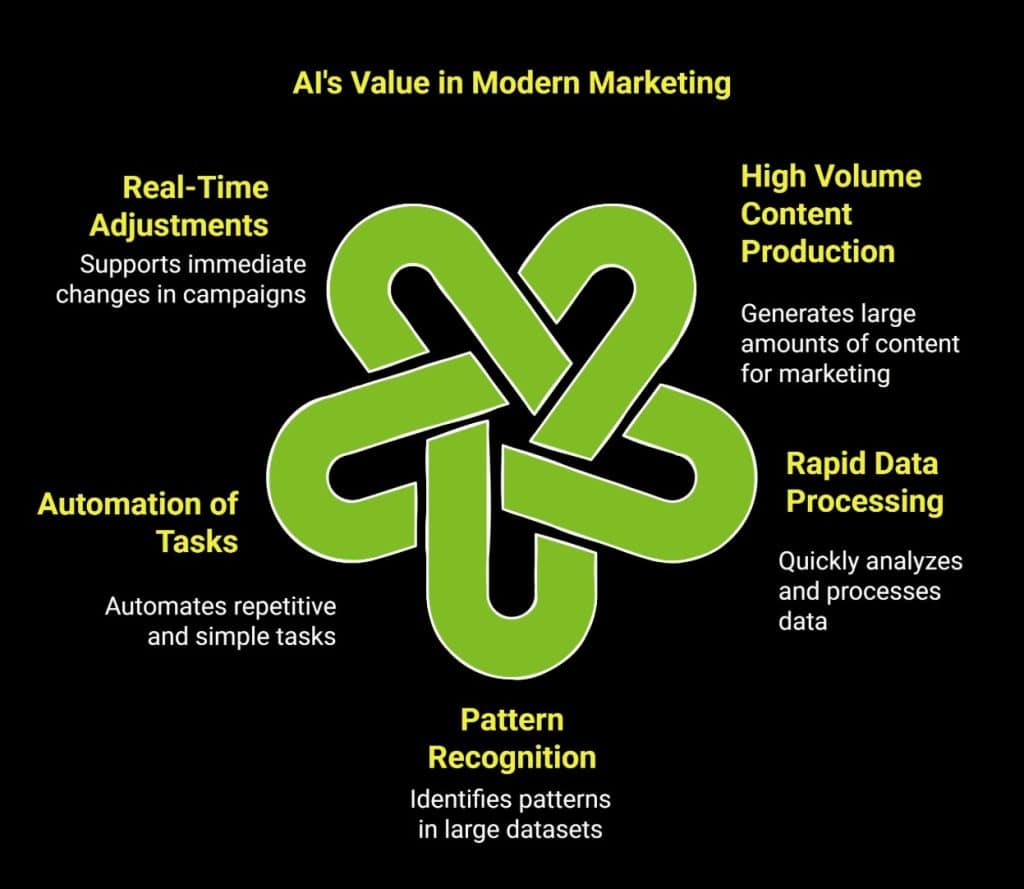
Infographic on AI s value in modern marketing
Before we discuss how marketers evolve, it is important to recognize the areas where AI genuinely excels and delivers clear operational value across the marketing industry and digital marketing agencies.
- High volume content production for content marketing and social media posts
- Rapid data processing and data analytics
- Pattern recognition across large datasets
- Automation of repetitive or low complexity tasks
- Supporting real-time adjustments in ad campaigns and simple customer service interactions
Where Does AI Fall Short in Real-World Marketing?
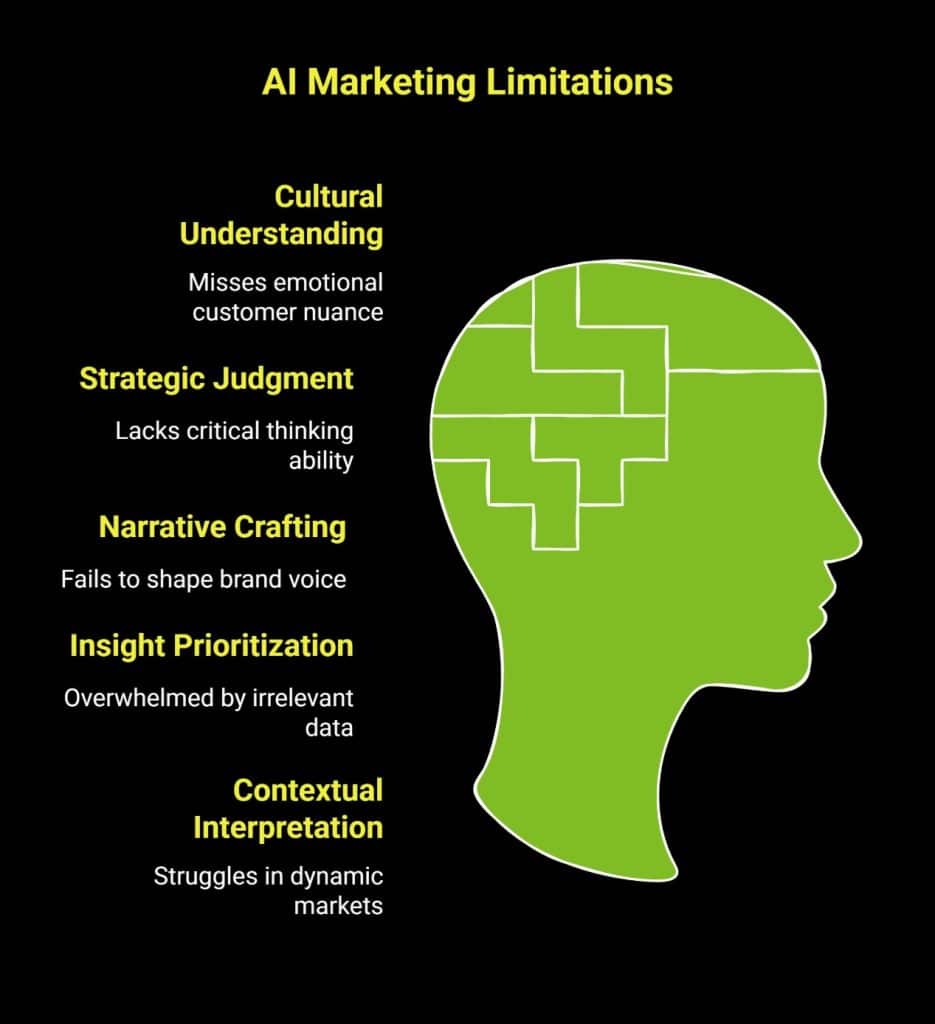
Infographic on AI marketing limitations
And just as clearly, there are areas where technology cannot substitute for human intuition, judgment, or creativity.
- The ability to understand cultural and emotional nuance in customer behavior
- Strategic judgment about what matters and why
- The skill to craft narratives that shape perception and maintain a consistent brand voice
- The discernment to prioritize insights over noise
- The capacity to interpret context, timing, and intent in fast-changing markets
These human capabilities are not marketing accessories. They are the foundation of meaningful work. AI may reshape the tools we use, but it does not replace the thinking that guides them, especially in marketing roles that depend on human connection and emotional intelligence.
And this is where the real gap will appear: average marketers will let AI run, but great marketers will guide it, shape it, and keep the human heartbeat in every decision.
This is why the real question is not whether AI replaces marketers. The real question is whether marketing teams evolve into marketing professionals whose thinking cannot be replicated by any model.
You can see this same dynamic in SEO, as described in our article Experts’ Thoughts on How AI Is Changing Everything in SEO.
What Happens When AI Takes Over the Work Marketers Never Enjoyed Anyway?
AI has stepped in to handle many of the repetitive tasks that used to slow marketers down, and that shift is more helpful than harmful. Work that once felt like a daily grind now takes a fraction of the time, which means marketers finally get room to think instead of constantly racing to produce.
According to Exploding Topics, 71% of marketers say generative AI will allow them to focus more on strategic work. That insight alone shows how the role is evolving.
When people worry that AI will replace digital marketers, they are usually picturing the tasks AI already does well. The first draft of a blog. A quick research outline. A few content variations. A performance report that appears in seconds. These tasks are helpful, but they have never been the foundation of real marketing expertise or strategic thinking.
What AI truly offers is relief from the operational clutter. It removes the routine tasks that kept marketers busy but did not necessarily move strategy forward or improve customer experiences.
Where AI Creates Breathing Room for Better Thinking
Here are some of the responsibilities AI now handles with ease, giving marketers more time and space to focus on meaningful decisions and deeper thinking
- Manual content variations
- Routine optimization checks
- Initial research summaries or deep research support
- Basic reporting and consolidation
- Low complexity campaign tasks
- Simple tasks like answering customer questions
- A B testing insights generated at scale
This shift is not just about speed. It is about elevation. When execution becomes effortless, the ability to understand people, shape messages, interpret natural language, and guide marketing strategy becomes even more important.
AI is not replacing digital marketing. It is refining it. By taking over the routine work, it highlights the parts of the job that genuinely require human thinking and gives marketers the space to operate at a higher level.
This isn’t just a marketing story. The writing world is facing the same shift, where AI handles the workload but humans guard the craft, something we break down in Will AI Replace Writers?
Is AI Quietly Raising the Bar for What Counts as Good Marketing?
Robot head with AI chip and circuit lines
AI has made it incredibly easy to produce decent content. That alone has changed the standard. When anyone can generate a polished blog, a set of headlines, or a campaign outline in seconds, good enough stops being good enough.
The real shift is this. AI has removed many of the old limitations. Deadlines, heavy production work, and slow drafting cycles are no longer excuses. So the question clients and audiences are asking has changed from “Did you deliver?” to “Did you think?”. The difference shows immediately. AI can generate information, but only humans can turn it into insight.
This is where human creativity and judgment become essential. Steve Jobs captured it well when he said, “Creativity is just connecting things.” AI can recognize patterns, but it cannot decide which connection gives a message emotional weight or cultural relevance.
That leap still belongs entirely to humans and remains a major competitive advantage.
AI has exposed the gap between producing content and shaping ideas. Content creators who rely on predictable patterns or surface-level messaging will blend into AI-generated noise. Marketers who bring perspective, context, and original thinking will stand out more clearly.
AI is not raising the bar by replacing marketers.
It is raising the bar by revealing which marketers are truly thinking.
The difference becomes even clearer when you look at how the human mind works versus AI, a theme explored in AI vs Human Brain.
AI vs Human Marketers: What Truly Sets Them Apart
As AI becomes more integrated into marketing, many people still confuse capability with expertise. Placing AI and human marketers side by side shows that the value they create is fundamentally different. This comparison makes those differences clear.
| Area | What AI Does Well | What Human Marketers Do Better |
| Data and Behavior | Processes large datasets and identifies patterns in customer behavior | Interprets the meaning behind patterns and connects insights to strategy |
| Content Creation | Generates blog posts, social media posts, ad copy, and product descriptions | Shapes brand voice, adds creativity, and ensures messages resonate emotionally |
| Customer Interaction | Handles simple customer service questions and routine tasks | Builds relationships and creates personalized customer experiences |
| Strategy | Suggests options based on trends and data outputs | Chooses direction using judgment, context, and long-term thinking |
| Efficiency | Automates repetitive work and speeds up production | Uses freed up time for deeper research and strategic decision making |
| Brand Building | Offers variations and recommendations | Protects identity, positioning, and coherence across channels |
| Role in Marketing Teams | Acts as an operational assistant | Acts as the orchestrator and decision maker |
This blend of human strategy and AI-driven scalability is also redefining modern SEO practices, a perspective we unpack in Hybrid SEO.
How Can Marketers Integrate AI Into Their Workflows Effectively?
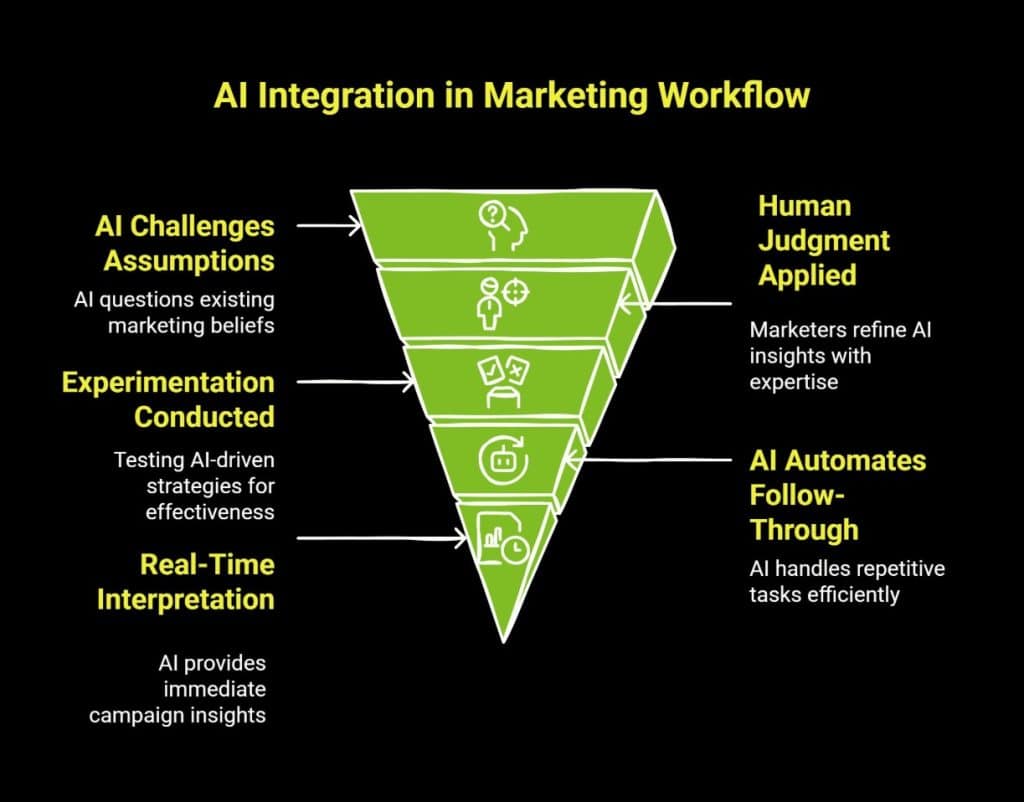
Infographic showing AI integration in Marketing
Integrating AI isn’t about adding more tools. It’s about redesigning workflows so AI handles the mechanical work while marketers focus on the thinking that shapes real outcomes. Effective integration starts with intention, not automation.
Here’s the mindset that makes AI genuinely useful:
- Use AI to challenge your assumptions, not just generate content.
- Pair AI output with human judgment, because insight, not information, drives strategy.
- Treat experimentation as part of the job, not an optional extra.
Where Should Marketers Actually Use AI in Their Workflow?
Instead of scattering AI across tasks, marketers should place it where it creates real leverage.
Here are the smartest integration points:
- Insight Acceleration, Not Just Quick Research: Marketers can use AI to surface contradictions, cross-reference trends, and highlight blind spots that manual research often misses.
- Thought-Starter Drafts That Save Cognitive Load: AI can produce structured outlines, idea maps, or narrative angles. You keep the creative direction, but AI removes the blank-page friction.
- Automating Follow-Through, Not Strategic Thinking: AI works well for repetitive actions, compiling reports, updating sheets, tagging content, or generating variations. Your mental energy is reserved for decision-making.
- Real-Time Signal Interpretation for Campaigns: Instead of waiting for weekly reports, AI can scan behaviors, suggest hypotheses, and identify early patterns.
You decide whether the insight is meaningful. - Turning Tribal Knowledge Into Usable Systems: With a few prompts, AI can convert scattered team notes, meeting discussions, and past campaigns into clear guidelines, checklists, or playbooks the entire team can follow.
AI integration succeeds when it reduces operational friction and strengthens human thinking.
The tool shouldn’t replace the marketer; it should clear the path so the marketer can operate at a higher level.
What Makes These Marketing Roles More Valuable as AI Expands?
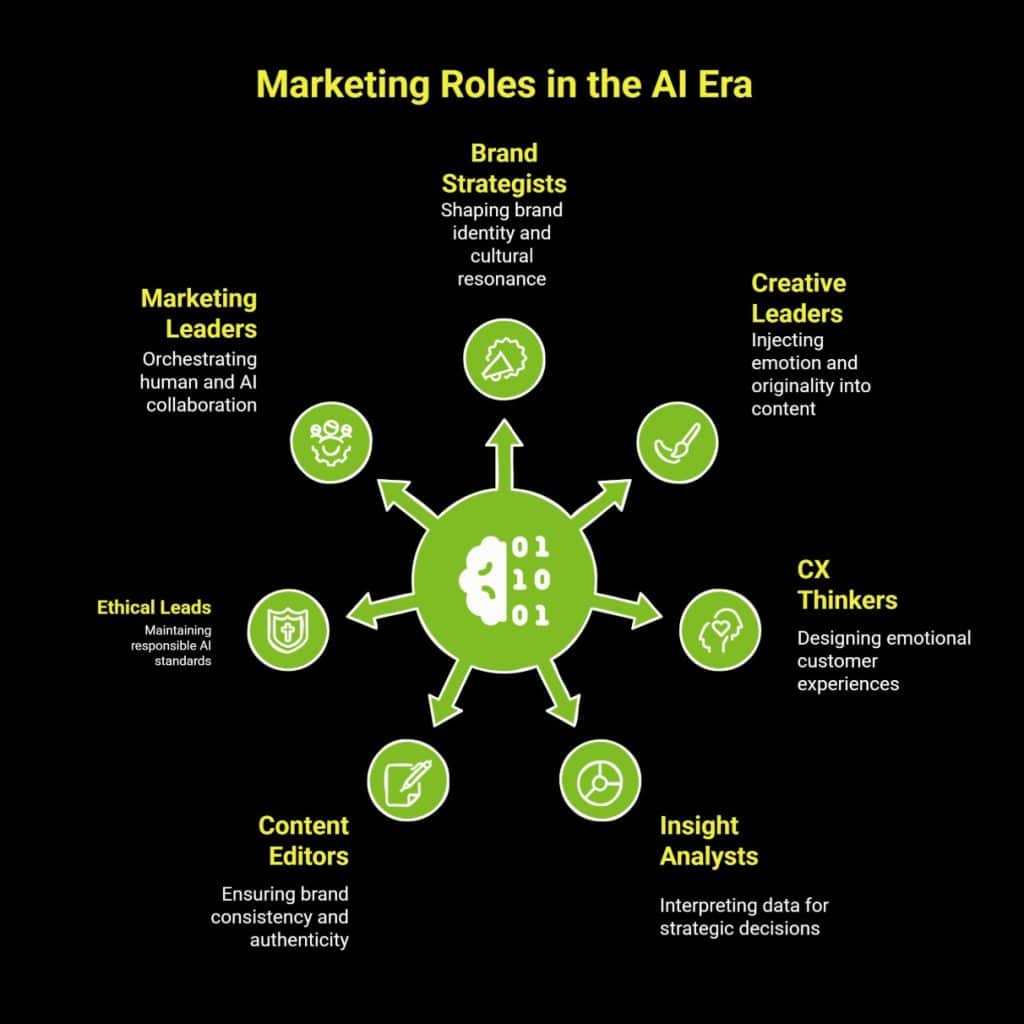
Infographic showing marketing roles in the AI era
AI is changing the pace of marketing, but it is also exposing which roles rely on human judgment, emotional intelligence, and contextual understanding. As automation increases, certain positions don’t become less important; they become irreplaceable. These roles carry the thinking, interpretation, and decision-making that AI cannot replicate.
Before we look at which roles are rising in importance, here’s the key shift to understand:
AI has made execution effortless, which means the value now sits in direction, interpretation, and the areas only humans can lead.
Here are the marketing roles that will matter even more in an AI-first landscape:
1. Brand Strategists Who Define Meaning, Not Just Messaging
AI can generate content, but it cannot decide what a brand stands for.
Brand strategists become essential for shaping identity, positioning, and long-term story architecture work that requires cultural insight and deep interpretation.
2. Creative Leaders Who Give Ideas Emotional Weight
AI can remix patterns, but it cannot understand emotion, timing, or cultural nuance.
Creative directors, copy leads, and designers become even more valuable because they inject originality, tone, and resonance into brand communication.
3. Customer Experience Thinkers Who Understand Human Behavior
AI can optimize touchpoints, but it cannot anticipate how people feel. CX strategists and journey designers remain crucial as they shape the emotional arc of an experiencesomething far beyond algorithms.
4. Insight Analysts Who Turn Data Into Direction
AI produces patterns. Humans decide what the patterns mean. Analysts who can interpret signals, question assumptions, and translate data into strategic decisions will be in even higher demand.
5. Content Editors and Voice Guardians Who Keep Brands Human
AI can write at scale, but staying on-brand, consistent, and credible requires a human editor.
These roles ensure that content carries personality, nuance, and authenticity in generic outputs.
6. Ethical & Governance Leads Who Keep AI Responsible
As AI becomes more integrated into marketing systems, brands need leaders who can evaluate bias, protect user privacy, and maintain responsible standards.
This area will grow rapidly as AI regulations tighten globally.
7. Marketing Leaders Who Can Orchestrate Humans + AI Together
The future belongs to leaders who know how to blend machine efficiency with human insight.
They understand when to use automation, when to rely on judgment, and how to build teams that think beyond execution.
These roles matter because they carry the one thing AI can’t replicate: the human ability to think with depth, empathy, and intention.
Why Wild Creek Web Studio Champions the Human Algorithm?
Wild Creek Web Studio believes the future of marketing will be shaped by how well teams think, not how fast they produce. AI can automate output, but it cannot replace clarity, judgment, or the ability to understand what truly moves people. That is why we focus on strengthening the one skill every great marketer needs. Better thinking.
Our Human Algorithm approach helps brands pair human insight with AI efficiency so technology becomes a lever, not a crutch. Instead of chasing tools, we help teams ask better questions, make smarter decisions, and use AI to enhance strategy rather than replace it.
If AI brings the speed, we help bring the sense. That is the difference Wild Creek Web Studio aims to create for every brand we work with.
If you are building a team that wants to think better, not just faster, we would love to hear from you.
Final Words
AI is already woven into marketing, but the real advantage still belongs to the people who know how to use it with intention. The marketers who will lead the next decade are not the ones who generate the most output. They are the ones who bring clarity, judgment, and originality to the work.
This moment is an invitation to raise your standards. To use AI for scale while relying on your own insight for meaning. To build marketing that thinks harder instead of working faster.
If you choose to think better, you will never compete with AI. You will make AI compete to keep up with you.
Frequently Asked Questions
Have marketers already lost jobs to AI technology?
Some operational roles have shifted due to automation, but marketers have not been broadly replaced. AI mainly removes repetitive tasks, not strategic roles. The real change is that marketers who rely only on execution are becoming less relevant.
Are digital marketing jobs safe from AI automation?
Digital marketing jobs are safe when they involve strategy, creativity, judgment, and human insight. Tasks like research, reporting, and content variations may be automated, but roles requiring interpretation, innovation, and brand building remain secure and increasingly valuable.
Can AI be creative enough to replace human marketers?
AI can generate creative outputs, but it cannot originate intent, cultural understanding, emotional nuance, or brand perspective. Creativity in marketing requires context and judgment, which AI cannot replicate, so it cannot fully replace human marketers.
Will AI replace digital marketers?
AI will not replace digital marketers, but it will replace marketers who rely only on production. Those who combine AI efficiency with human thinking, insight, and strategy will remain essential and in demand.
Can AI replace digital marketing?
AI can support digital marketing through automation and optimisation, but it cannot replace the discipline entirely. Digital marketing depends on strategy, human context, and understanding people, which requires skills beyond machine capabilities.
Will AI replace content marketers?
AI can generate drafts, ideas, and content variations, but it cannot replace content marketers who shape narratives, maintain brand voice, and create meaning. Content marketers who use AI intelligently will only increase their value.
Will AI completely replace marketers in the future?
AI may transform how marketers work, but complete replacement is unlikely. Marketing requires empathy, judgment, and contextual decision-making. AI enhances the work, but humans still lead strategy, storytelling, and direction.
What is the 30% rule in AI?
The 30 per cent rule suggests AI can automate roughly thirty per cent of tasks in many professions. This means AI handles routine work while humans focus on higher-value activities like strategy, creativity, and decision-making.
Do you think AI is taking away Marketing Jobs?
AI is shifting job responsibilities, not eliminating them. Routine tasks are automated, but strategic and creative roles are growing. Marketers who evolve and use AI intelligently remain secure and increasingly valuable.
Is digital marketing dying because of AI?
Digital marketing is not dying. It is evolving. AI is changing the tools and workflows, but the demand for strategic marketers who understand people, culture, and brand meaning is stronger than ever.