Key Highlights
- AI thought leadership helps brands stand out in a crowded content landscape.
- AI enables faster, deeper insight generation and smarter decision-making.
- Thought leadership shifts from reactive commentary to predictive perspectives.
- AI identifies high-impact topics and emerging conversations worth leading.
- Leaders use AI to turn raw data into original, contrarian viewpoints.
- Avoid over-reliance on AI, loss of brand voice, and unverified information.
- Wild Creek Web Studio helps brands build authoritative, insight-led thought leadership that drives real influence.
Thought leadership used to be simple. Say something smart, publish it, and you’d stand out. But today, everyone has access to the same tools, the same data, and the same AI models. The result is a flood of content that sounds identical, competes for the same attention, and makes it harder than ever for brands to differentiate their expertise.
Audiences are not looking for more information. They are looking for original thinking, clear guidance, and voices they can trust. Yet most teams struggle to deliver this consistently because research takes time, insight requires depth, and publishing across multiple channels demands constant momentum.
This is where AI becomes an advantage. Not as a replacement for expertise, but as a multiplier that helps leaders uncover trends faster, shape stronger perspectives, and scale their best ideas without sacrificing quality.
In this blog, you will learn how modern brands use AI to surface high-impact topics, craft distinctive points of view, build efficient thought leadership systems, and establish real authority in a crowded digital landscape.
What Does AI Thought Leadership Really Mean Today?
AI thought leadership is not about handing the microphone to a machine. It is about using artificial intelligence to strengthen the depth, accuracy, and strategic value of your insights. The most influential brands today use AI to enhance their thinking, not replace it, and that distinction is what sets true leaders apart.
With more than 80% of marketers already integrating AI into their content processes, the bar has been raised. Simply using AI is no longer innovative. What matters now is how intelligently you use it to identify patterns, validate assumptions, and uncover opportunities others miss.
AI becomes a high-velocity research partner, expanding your ability to see what is happening in your industry with far greater clarity.
This level of intelligence changes how leaders craft their viewpoints. Instead of relying on intuition alone, you can analyze audience questions, dissect competitor messaging, and detect emerging trends before they break through. That shift moves you from reacting to the market to actively shaping the conversation.
The outcome is thought leadership that commands attention. AI equips you with sharper inputs, but your expertise delivers the interpretation, direction, and credibility. Combined, they create content that is not only informed but confidently positioned, unmistakably original, and aligned with the authority your brand wants to project.
As we continue exploring how humans and AI evolve together in shaping smarter ideas, one powerful perspective is shared in our blog Humans Are Hooked, Machines Are Learning. It is a timely reminder that AI does not replace our voice, it amplifies it.
How Is AI Reshaping Thought Leadership?
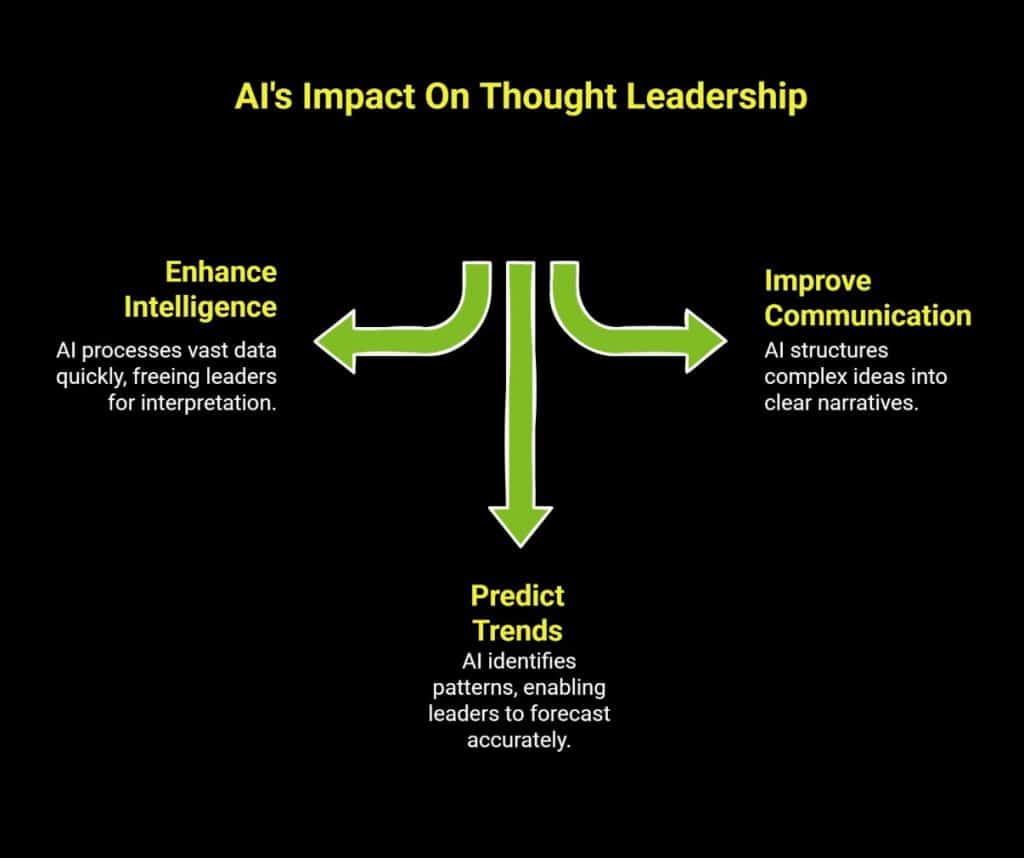
Infographic on AI s impact on thought leadership
AI is transforming how leaders gather insights, shape opinions, and communicate authority. What once required weeks of research can now be uncovered in minutes, giving brands the ability to operate with greater speed, clarity, and strategic intent.
Let’s have a look at how AI is reshaping thought leadership today:
1. AI Unlocks Intelligence at a Scale Humans Cannot Match
AI can process millions of data points across articles, social conversations, search patterns, and competitor content in seconds. This level of analysis was simply not possible before. According to McKinsey, generative AI can automate up to 60% of the tasks involved in content research and synthesis, freeing leaders to focus on interpretation rather than data gathering.
For example, a cybersecurity brand can use AI to scan global breach reports, regulatory updates, and threat discussions in real time. Instead of reacting after an incident makes headlines, they can identify emerging vulnerabilities early and publish expert guidance before competitors even recognize the trend.
2. AI Moves Leaders From Interpreting Trends to Predicting Them
Traditional thought leadership has always been retrospective. AI makes it predictive. By detecting patterns in audience behavior, economic signals, or industry activity, leaders can identify what is coming next with far greater accuracy.
A clear example is in financial services. AI models can surface early indicators of market sentiment shifts by analyzing investor discussions, economic briefs, and global news cycles. Leaders can then publish forward-looking analyses rather than simple market recaps. This positions them as industry forecasters rather than commentators.
It is this shift from “explaining what happened” to “defining what happens next” that elevates modern thought leadership.
3. AI Enhances Communication With Sharper, More Cohesive Ideas
AI also strengthens thought leadership at the communication level. It structures complex concepts, refines arguments, and transforms dense information into clear, compelling narratives.
For instance, a healthcare CEO preparing a keynote can use AI to distill clinical research, patient data, and regulatory insights into a narrative that is both accurate and accessible. The technology handles the complexity. The leader adds conviction, judgment, and human credibility.
Together, these shifts redefine authority. The leaders who stand out now are not publishing more. They are publishing with a level of intelligence, foresight, and clarity that only the combination of human expertise and AI capability can deliver.
How Does AI Reveal the Conversations You Should Be Leading?
One of the strongest advantages of AI in thought leadership is its ability to surface the ideas that truly matter. Instead of guessing which topics will resonate, AI analyzes real conversations happening across social platforms, search trends, news cycles, and industry communities. It shows you where attention is building, what questions people are struggling to answer, and where meaningful whitespace exists.
This shifts thought leadership from reactive publishing to strategic positioning. When you enter a conversation before it peaks, you guide the narrative rather than chase it.
To support this, different categories of AI tools play distinct roles in helping leaders identify high-impact opportunities. Here are a few examples of how they contribute to your strategy:
| Tool Type | How It Strengthens Thought Leadership |
| Social listening tools (Brandwatch, Talkwalker) | Identify rising themes and sentiment shifts before they become mainstream. |
| SEO intelligence platforms (Semrush, Ahrefs) | Reveal high-intent questions and content gaps your expertise can address. |
| Generative AI systems (ChatGPT, Jasper) | Convert raw findings into angles, outlines, and messaging directions. |
| Data analysis tools | Extract patterns and insights from large datasets to support authoritative viewpoints. |
To see this in action, consider a sustainability technology leader who uses social listening to spot increasing concern around carbon reporting accuracy. Search data confirms thousands of users asking how to measure emissions reliably. With these signals, they build a thought leadership piece early, while the topic is still emerging. By the time competitors notice, the narrative has already been shaped.
That is the real value of AI. It does not simply help you produce more content. It helps you choose the conversations worth leading.
Curious how the two really compare? We’ve explored that in AI vs Human Brain, a quick read that might shift how you think about the future of leadership.
How Do Industry Leaders Transform Data Into Original Insight?
Gathering data is only the starting point. True thought leadership comes from interpreting that information in a way others have not seen yet. AI can support this process by helping you explore new angles, challenge assumptions, and shape insights into meaningful perspectives. The goal is not to repeat what everyone already knows, but to elevate the conversation with interpretation grounded in experience and judgment.
Industry leaders use AI as a thinking partner. Once the research is collected, AI can help examine multiple viewpoints, test narrative positions, and uncover contrarian angles that differentiate your voice. This is where raw information becomes perspective. It is why respected thought leaders are recognized not for summarizing trends, but for defining what those trends mean.
To achieve this, the quality of your prompts matters. Instead of broad instructions like “Write about industry trends,” focus on specificity and direction. For example:
- “Given these three industry trends [insert trends], what is a contrarian viewpoint a marketing leader could take?”
- “Analyze this customer feedback data and generate five thought leadership angles that address the core frustration.”
- “What strategic risks are being overlooked in this emerging trend and why?”
These targeted prompts push AI beyond surface-level content and unlock deeper insights that reinforce authority. That is the difference between generic commentary and leadership that shapes thinking.
If you are interested in how this shift is unfolding in real time, our piece on how AI is changing everything in SEO shares expert perspectives that expand this conversation.
What Should You Avoid When Using AI for Thought Leadership?
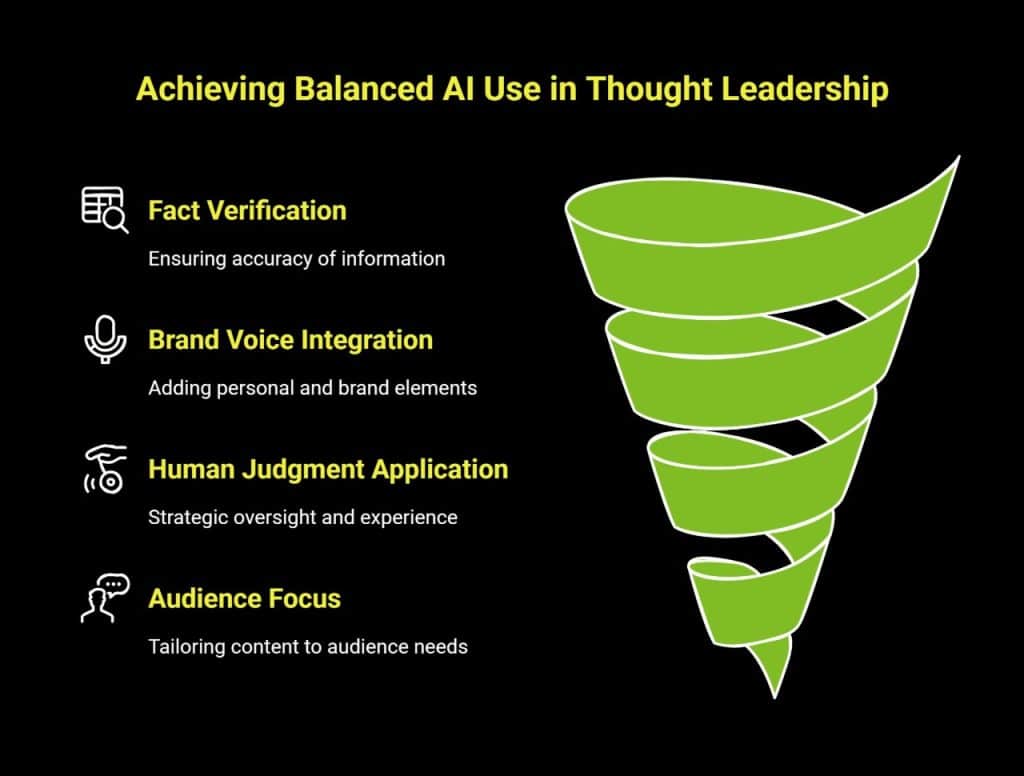
Infographic showing achieving balanced AI use in thought leadership
As with any powerful tool, the value of AI depends entirely on how thoughtfully it is used. One of the biggest risks is becoming overly dependent on the technology and diluting the human voice that sets true thought leadership apart. When creators rely on AI to do the thinking instead of supporting the thinking, the result is content that feels generic, mechanical, and disconnected from real expertise.
AI should accelerate insight, not replace perspective. The moment your content loses depth, nuance, or authenticity, it stops leading and starts blending into the noise. To protect your authority and maintain trust, it is essential to avoid these common pitfalls:
- Publishing without proper fact verification: AI can surface ideas quickly, but it can also generate incorrect or outdated information. Always validate data and statistics through credible sources.
- Ignoring your brand voice: AI drafts should be the starting point, not the final version. Edit for tone, personality, values, and leadership style.
- Removing human judgment from the process: Strategic oversight, clarity, and real experience must guide every stage from ideation to publication.
- Losing sight of your audience: Do not let AI’s speed distract you from serving real human needs, pain points, and context. Audience value should drive every message.
Strong thought leadership blends AI intelligence with human interpretation, expertise, and integrity. When those elements stay balanced, AI becomes a competitive advantage instead of a creative risk.
What Will the Future of AI Thought Leadership Look Like?
The future of thought leadership will be shaped by deeper collaboration between human expertise and AI-driven intelligence. As AI continues to advance, its role will shift from operational support to strategic contribution, enabling leaders to analyze market shifts, detect emerging patterns, and forecast industry movement with greater accuracy.
We will see a new era of thought leadership defined by predictive insights and highly personalized content that speaks to specific audiences, industries, and decision-makers. Instead of broad, generalized commentary, thought leaders will deliver sharp, evidence-backed perspectives designed to guide real-time decision-making.
The brands that excel will be those that blend AI-powered analysis with an authentic human perspective. They will move faster than competitors, articulate clearer points of view, and establish trust through insight that feels both timely and irreplaceably human.
The future is not about letting AI speak for you. It is about using AI to think at a higher level and communicate with authority that others cannot match.
Partner with Wild Creek Web Studio to Build Thought Leadership That Wins
If you are committed to becoming a true authority in your industry, you need more than generic AI output or short-term marketing tactics. You need strategy, clarity, and execution guided by expertise. That is exactly what Wild Creek Web Studio delivers.
With more than 18 years of digital experience and proven success across 100-plus brands, Wild Creek helps businesses strengthen visibility, authority, and measurable growth through insight-driven strategy and high-performance execution.
Why Leading Brands Trust Wild Creek Web Studio
- Strategic digital consulting aligned with real business outcomes, not vanity metrics
- Deep SEO and performance marketing expertise that drives qualified traffic and conversions
- Insight-led content and positioning that elevates brand authority and credibility
- A results-first approach backed by meaningful metrics and long-term client partnerships
If your brand is ready to own its narrative, influence your market, and scale with confidence, Wild Creek Web Studio is the partner built for that journey. Contact us today!
Final Words
The future of thought leadership will belong to those who use AI to elevate original thinking, not replace it. The window to stand out is narrowing, and the leaders who act now will shape the conversations everyone else follows.
Do not wait for the market to decide the narrative. Use AI to sharpen your insight, challenge conventional thinking, and say what others are hesitant to say. Your audience is looking for clarity, courage, and perspective that feels unmistakably human.
The question is not whether AI will transform thought leadership. It already has. The real question is: Will you lead the shift or watch others do it first?
Frequently Asked Questions
Can AI help me plan and organize my thought leadership strategy?
Absolutely. Artificial intelligence can be a huge asset in planning your content marketing strategy. By using AI for data analysis of market trends and audience behavior, you can identify the best topics to focus on. It helps you build a data-driven plan for content creation, ensuring your efforts are targeted and effective.
What are the risks or challenges of using AI in thought leadership?
The main challenges of using artificial intelligence include the risk of factual inaccuracies, potential data privacy issues, and losing your brand’s authentic voice. To protect your credibility, content creators must prioritize fact-checking, adhere to ethical considerations, and always add a layer of human review and creativity to AI-generated content.
How does AI help brands connect more authentically with audiences?
AI helps brands connect by analyzing data from social media and other sources to understand what a target audience truly cares about. This allows for the creation of highly relevant content that addresses their specific needs and questions, which can lead to higher engagement rates and a more authentic brand voice.
How to build B2B thought leadership with AI content?
To build B2B thought leadership with AI content, develop an AI thought leadership content strategy driven by insight and predictive research. Use AI to surface emerging topics, craft data-backed viewpoints, personalize messaging, and scale distribution while retaining human expertise effectively.
What do thought leaders in AI use in tech writing?
Thought leaders in AI use research-driven insights, real-time data analysis, and generative AI thought leadership tools to shape authoritative narratives. They combine expert perspective with AI-assisted outlining, structuring, and forecasting to produce clear, influential, future-focused tech content that stands apart.
What are the benefits of using AI for thought leadership compared to traditional methods?
Using AI for thought leadership enables faster research, deeper data visibility, predictive analysis, and scalable content creation. Unlike traditional manual processes, AI allows leaders to publish timely, insight-rich viewpoints and execute stronger AI thought leadership strategies across multiple channels with consistency.
Can AI replace CEOs or board members in major companies?
AI cannot replace CEOs or board members, but it can augment decision-making by analyzing data and forecasting trends. True leadership requires judgment, vision, and accountability. AI supports strategic insight, while humans provide direction, values, and trust in AI thought leadership blog conversations.