Key Highlights
- Google uses AI and machine learning to predict user intent and adjust rankings dynamically
- Behaviour signals like dwell time and engagement now influence visibility significantly
- Topical authority matters more than keyword density in modern SEO
- AI tools assist with content optimisation, predictive research, and technical audits
- Over-reliance on automation can harm brand trust and rankings
- Understanding how AI models learn gives you long term strategic advantage
- Businesses in India must adapt to voice, regional search, and generative results
If you are running SEO campaigns in India today, you already know how unpredictable rankings feel. One month, your blog ranks on page one. The next month, it drops without warning. You update content. You improve backlinks. You optimise keywords. Yet something still feels out of your control.
That “something” is not a mystery. It is AI.
Google no longer ranks pages using simple keyword matching or static algorithms. It uses artificial intelligence systems that continuously analyse intent, engagement, behaviour patterns, and context. If your strategy still revolves around keyword density and backlinks alone, you are optimising for a system that no longer exists.
This guide explains how AI and machine learning in SEO work, why Google behaves the way it does today, and how Indian marketers, SaaS companies, and agencies can use AI strategically rather than react to algorithm updates.
What Is AI and Machine Learning? And Why SEO Can No Longer Ignore It?
AI and machine learning are systems that simulate human intelligence and learn from large datasets to make decisions without being explicitly programmed for every scenario.
When asking what is AI and machine learning in simple terms, think of this:
AI is decision-making at scale. Machine learning is the process of pattern recognition from large datasets.
Instead of matching words, Google predicts outcomes.
Example:
When someone searches “best credit card India”, Google does not simply show pages with those exact words. It predicts:
- Does the user want comparison tables?
• Eligibility criteria?
• Cashback breakdowns?
• Or reviews from Reddit?
That prediction layer is powered by AI and machine learning.
How Google’s AI-First Strategy Is Reshaping Search?
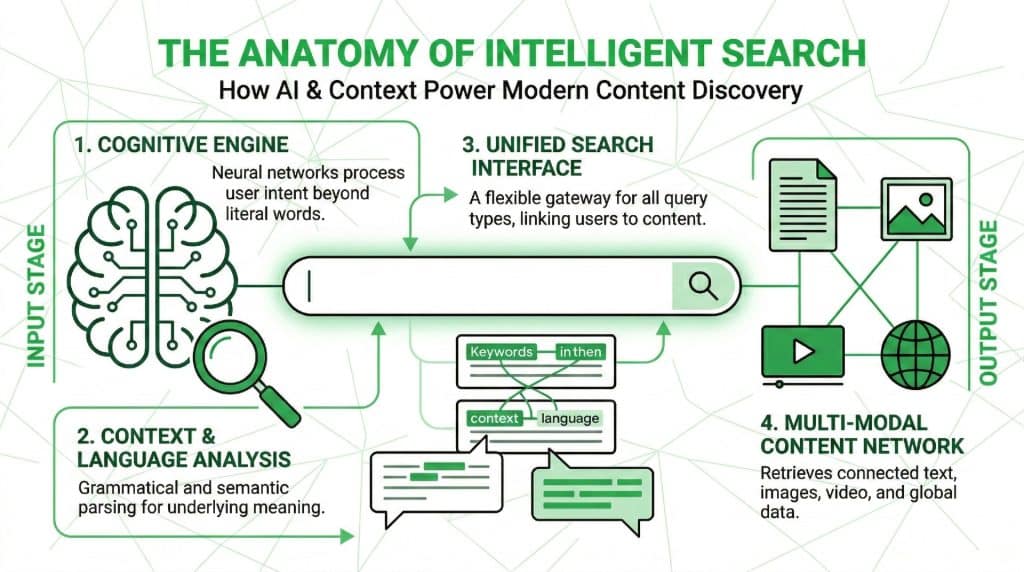
Infographic showcasing the anatomy of Intelligent search
Google has publicly stated that it is an AI-first company. Search is one of its AI-driven applications.
Let us understand how that affects you.
1. RankBrain opened the door to intelligent search interpretation
RankBrain was Google’s first major machine learning system integrated into its core search algorithm. Rather than just matching words, it interprets the meaning behind unfamiliar or long-tail queries by relating them to concepts it has seen before, helping surface relevant results even when the exact wording hasn’t appeared online. This marked a major shift from literal keyword matching to semantic understanding and intent mapping.
Example:
When someone searches “Affordable fintech startup tools for MSMEs in India”, RankBrain helps Google connect that query to concepts like SaaS tools, fintech platforms, or business software, even if the exact phrase doesn’t exist on any page.
2. BERT brought deeper language and context awareness
BERT (Bidirectional Encoder Representations from Transformers) strengthened Google’s ability to understand natural language and the context of entire sentences, not just isolated words. This means prepositions, modifiers, and conversational structure now matter to search, allowing results to match intent more accurately. For example, queries with subtle changes in wording or phrasing are interpreted with deeper contextual understanding.
3. MUM expands search understanding across formats and languages
The Multitask Unified Model (MUM) represents the next leap, a system that can analyse text, images, and video together to better interpret meaning and provide richer results. This matters especially in markets like India, where users search across languages and media formats. With MUM, Google can consider visual content and multilingual context alongside text, expanding how search understands and ranks content.
Overall, these AI and machine learning systems show that Google’s core mission isn’t just ranking pages, it’s interpreting and predicting what users want to find. SEO today must align with this AI-driven search model by focusing on high-quality content that answers real needs, not just keyword targets.
For SEO teams, this evolution means optimisation is no longer about static ranking factors. It’s about aligning with machine learning models that evaluate intent clusters, entity relationships, and cross-format relevance. Agencies that rely purely on checklist SEO often fail to adapt to these dynamic systems.
How AI and Machine Learning in SEO Influence Rankings Today?
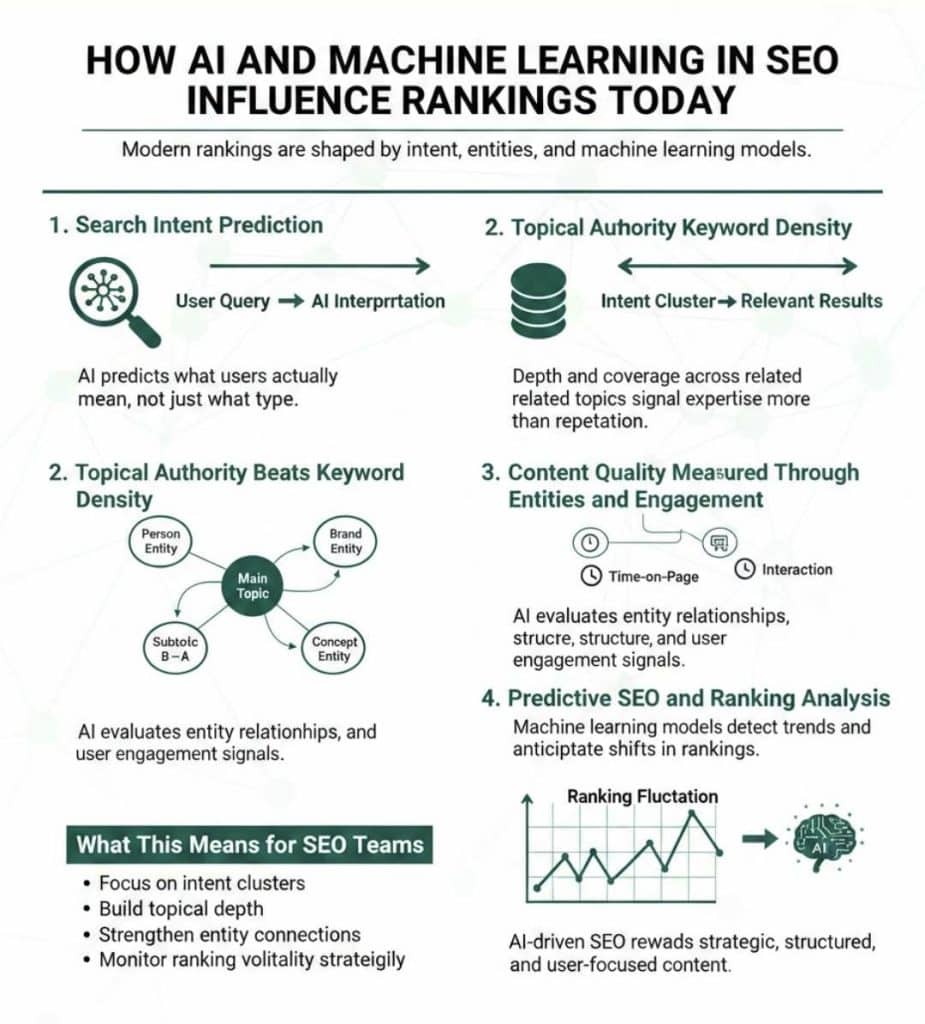
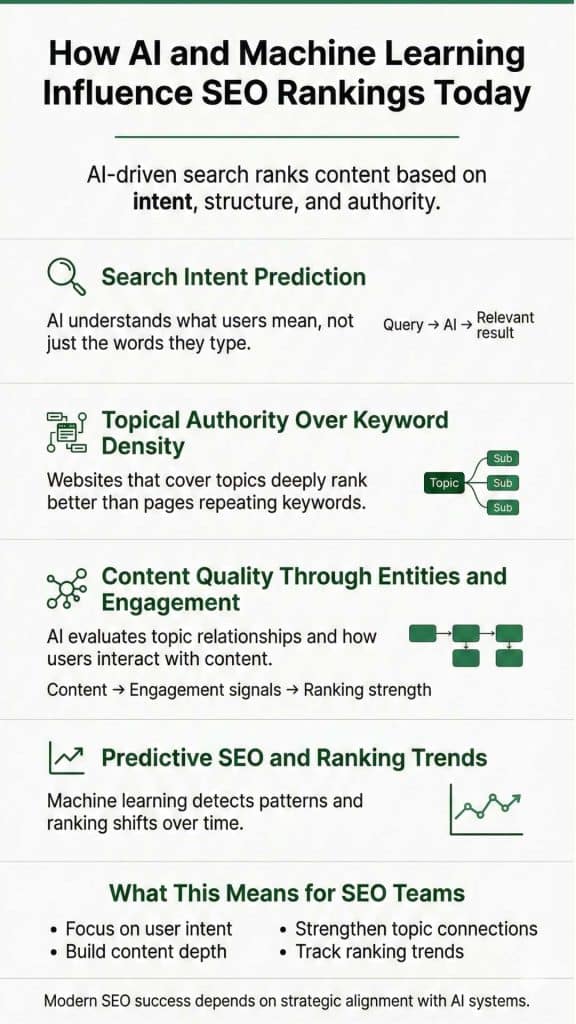
Infographic showcasing how AI and ML influence SEO
AI influences rankings by analysing behavioural signals, semantic depth, and contextual alignment, rather than relying on static ranking factors. Let us break this down into practical cause-and-effect.
1. Search Intent Prediction
AI models treat search intent as a prediction problem, using deep learning and input data to anticipate what the user really wants, not just the words they typed.
Traditional search engines relied on exact-match keywords. Today, systems built with large language models (LLMs) and neural networks analyse user interaction patterns, such as whether people skim, bounce, scroll, or reformulate queries, to dynamically reshape rankings.
Google tracks behavioural signals such as:
- Click-through rate
• Scroll depth
• Dwell time
• Query reformulation
For example, if users search “how to learn seo ml ai analytics” and quickly return to search results, the algorithm interprets that the page did not satisfy their intent. The system adjusts ranking weights based on this feedback loop, which improves future predictions, just as a deep neural network refines its outputs after training on more data.
This evolution means user behaviour is now a key part of the ranking signal mix, and SEO strategies must align with real user expectations rather than keyword counts alone.
2. Topical Authority Beats Keyword Density
Modern machine learning models prioritise semantic depth, entity relationships, and contextual relevance over raw keyword frequency.
AI and ML systems interpret pages like a human brain does: they look for meaning, patterns, and the connections between concepts. Instead of listing each keyword, search engines now identify clusters of related themes, so content that explores a topic comprehensively and logically outperforms isolated articles.
Example Structure:
Pillar Page: AI and Machine Learning in SEO
Supporting Blogs:
- AI keyword research strategies
• NLP in content optimisation
• Behavioural SEO analytics
• Voice search in India
This structure signals to machine learning algorithms that your domain has deep coverage of a subject, improving relevance and authority in search results. Algorithms trained on vast amounts of input data become better at associating related ideas and entities, similar to how large language models understand language context.
3. Content Quality Measured Through Entities and Engagement
Modern AI models don’t just count words. They analyse:
- Entity relationships
• Semantic connections
• Contextual alignment
• Readability
• User engagement
Instead of treating keywords as rigid signals, machine learning algorithms work like intelligent systems that assess how well content answers a user’s question. For example, Google’s Helpful Content system incorporates aspects of AI evaluation to reward content that delivers real value and depth, penalising low-quality or purely automated text.
Publishing 100 AI-generated articles without original insights may lead to temporary ranking spikes, but engagement metrics such as time on page, repeat visits, and satisfied queries carry more weight in machine learning models that prioritise real user satisfaction over artificial optimisation.
4. Predictive SEO and Ranking Volatility Analysis
AI-driven SEO tools now analyse ranking volatility before and during core updates by identifying abnormal SERP fluctuations across industries. Instead of reacting after traffic drops, machine learning models detect early instability signals, such as unusual position swaps, feature snippet changes, or sudden intent reshuffling.
Through large-scale pattern recognition, AI compares historical update cycles with current SERP behaviour to identify similarities. This helps forecast which keyword clusters may rise, fall, or stabilise.
Predictive models also track search intent shifts over time. If informational queries begin favouring commercial pages, or long-form guides replace short answers, AI systems surface these transitions early.
This enables proactive optimisation, where strategy adapts before rankings decline, reducing volatility risk and strengthening long-term search resilience.
AI-Driven SEO in Action: Why One SaaS Blog Won and the Other Lost?
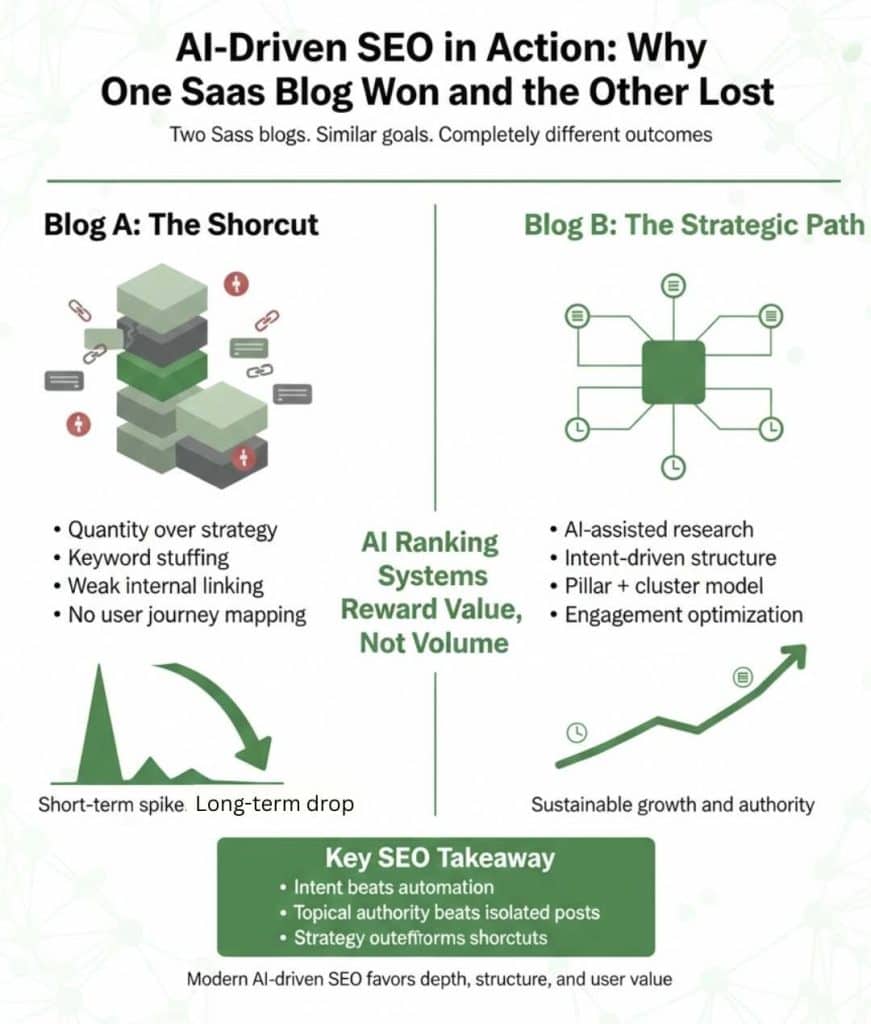
Infographic showcasing the difference between blog and blog b jpeg
SEO success is rarely random. It is shaped by strategy, intent alignment, and your understanding of modern AI-powered search engines. Let’s dive into a practical comparison between two Indian SaaS blogs that started with similar goals but ended up with very different outcomes.
Blog A: The Shortcut That Led to a Stall
In an effort to “beat the algorithm,” Blog A adopted a quantity-first mindset:
- It used AI to generate a large volume of content quickly
• It focused on keyword stuffing rather than addressing real user intent
• It lacked a thoughtful internal linking structure
• It ignored the user’s journey from search query to solution
At first, this approach worked superficially. Traffic climbed quickly, giving the team a sense of momentum.
But here’s the problem: search engines don’t reward volume alone. Today’s SEO models, including Google’s AI-driven systems, are designed to favour content that satisfies search intent, topical depth and user engagement, not just keyword frequency or surface-level optimisation. When the next core algorithm update rolled out, Blog A’s pages lost visibility. The spike fizzled, and rankings dropped sharply. This pattern mirrors what’s seen in broader SEO analyses, quick wins from low-quality or spun content often reverse when AI ranking systems refine their understanding of value.
Why It Failed:
This approach treated SEO as a checklist rather than a user-value problem. It assumes traffic equals quality, which machine learning models can now see through.
Blog B: The Strategic Path to Long-Term Growth
Blog B took the opposite approach. Rather than using AI to automate every step, they used it to inform and enhance strategy:
- AI was used for research and insight, not automated writing
• Content was structured around real search journeys and user intent
• A “pillar + cluster” topic model was built, linking related posts thematically
• Engagement metrics like dwell time and scroll behaviour were monitored and optimised
Instead of pumping out isolated posts, Blog B focused on building topical authority, an SEO strategy where related content pieces are grouped around a central theme, showing search engines that the site deeply understands a subject. Experts in SEO widely advocate this model because it helps both Google and users map relationships between ideas and pages, aligning with how machine learning interprets content.
Because of this approach:
- Users stayed longer on pages
• Bounce rates decreased
• Google began ranking multiple pages from the same cluster higher
• Organic visibility grew steadily
Rather than rewarding quick surface-level signals, modern AI models reward semantic depth, context and engagement, all strengths of Blog B’s strategy.
What Makes the Difference?
| Metric | Blog A | Blog B |
| Volume of Content | High | Moderate but focused |
| Intent Mapping | Low | High |
| Topic Structure | None | Pillar + Cluster |
| User Engagement | Poor | Strong |
| Ranking After Update | Drop | Sustained Growth |
The takeaway here isn’t that AI tools are bad. On the contrary, AI is an effective multiplier, amplifying SEO strategy rather than replacing it. Blog A treated AI as a shortcut. Blog B treated AI as a strategic research assistant, using insights to build content that truly answers what users are searching for.
Where AI Helps SEO Professionals Win?
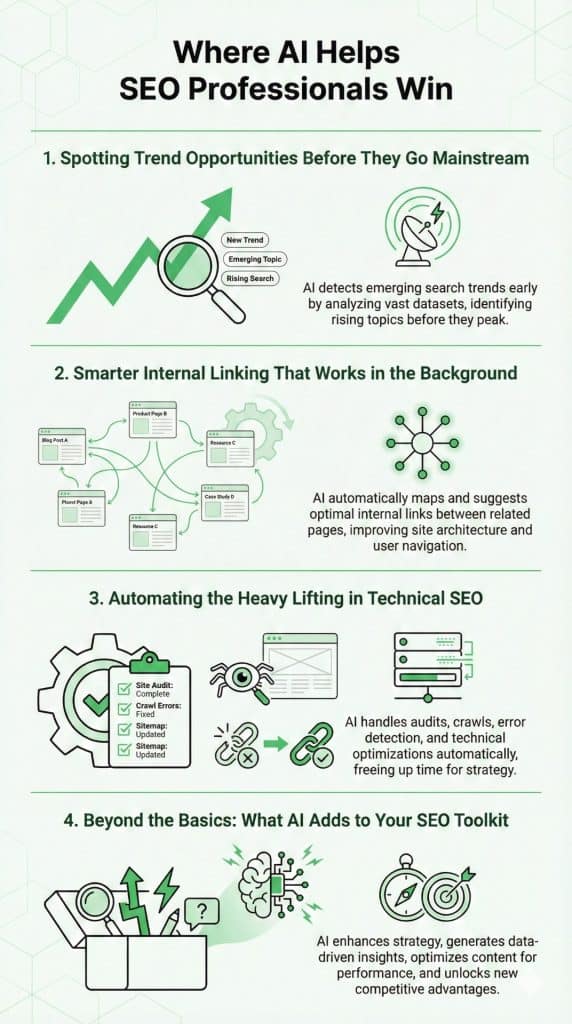
Infographic showcasing how AI helps in SEO
AI and machine learning give SEO professionals real-time predictive insights and data-driven signals, replacing guesswork with strategy. They help analyse user behaviour and context so SEO decisions feel as precise as a coach whispering the next winning play.
1. Spotting Trend Opportunities Before They Go Mainstream
Modern AI tools, trained on large volumes of search data, continuously scan query patterns. Think of it like having an extra pair of hands combing through millions of search behaviours in minutes, detecting what’s trending before humans even realise.
Here’s an example:
An Indian e-commerce brand noticed AI tools flagging rising interest in a new “e-commerce regulation theme” weeks before mainstream media covered it. By publishing a research-based article early, they gained domain authority and saw sustained organic growth, while competitors were still drafting their basic guides.
This kind of predictive analytics isn’t guesswork. It’s pattern analysis powered by machine learning models that continuously learn from fresh input data and refine predictions, helping teams stay ahead with strategic intent rather than reactive tactics.
2. Smarter Internal Linking That Works in the Background
Imagine building a massive wiki of helpful AI content, but without clear roads connecting each page. Users and search engines get lost. That’s where AI-infused internal linking comes in. Instead of manual guesswork, machine learning tools analyse:
- Topic similarity
• Semantic relevance
• Reader behaviour flows
…and then suggest the most helpful contextual links between pages.
The result?
• Crawlers flow through your site more efficiently
• Link equity spreads to strategic pages
• Users stay longer, improving engagement and dwell time
SEO used to be a manual craft; now, machines detect opportunities and humans validate the strategy. Kind of like having a digital librarian that knows exactly where each book should go, and why.
3. Automating the Heavy Lifting in Technical SEO
Here’s where most SEO teams admit they spend way too many hours: technical SEO audits. Crawling, tagging, schema markup, crawl errors… It’s endless. Machine learning changes that.
AI tools now:
- Scan thousands of pages in seconds
• Detect orphan pages and broken links
• Flag missing schema and title tag issues
• Suggest optimisation fixes
• Even automate meta tag creation and structured data
Suddenly, what used to take days of manual, in-depth analysis becomes an automated, real-time monitoring system, freeing your team to focus on strategy rather than tactics.
For teams managing large e-commerce sites, this shift is significant; it keeps technical SEO optimised without requiring extensive staff hours, which in turn means faster indexing, more consistent visibility, and better alignment with user-centric ranking signals.
4. Beyond the Basics: What AI Adds to Your SEO Toolkit
AI isn’t just good at drilling down; it’s great at connecting the dots across fields that used to be siloed in SEO.
Here’s a snapshot of the broader ways it helps:
- Automated meta description and ALT tag optimisation, ensuring your pages talk to Google the right way.
• Keyword clustering that groups related terms automatically for smarter topic planning, no more guesswork on what terms belong together.
• Real-time competitor insights, where tools compare rankings, meta tags, and content gaps so you know exactly what strategy your rivals are using.
In short, AI turns big data into actionable insights, the same way a seasoned data scientist would, but much faster and tailored to SEO needs. The best teams combine this machine-generated insight with human strategy to craft content that ranks and resonates.
The Dark Side: When AI Damages SEO?
Infographic showcasing cases where AI can damage SEO
Over-automation can erode originality, dilute user experience, and even trigger search penalties when it crosses the line from helpful assistance to spammy or shallow content. Google’s systems, especially its Helpful Content Update and SpamBrain tools, are designed to prioritise content that genuinely helps users, not just content that looks “optimised.”
1. Losing the Human Touch: When Content Feels Generic and Predictable
AI tools, including large language models (LLMs) trained on massive amounts of data, are highly effective at modelling language patterns. They can generate thousands of words quickly, drawing on massive datasets and patterns learned through subsets of artificial intelligence, such as deep learning and unsupervised learning.
But here’s the catch: AI doesn’t have lived experience, human cognition, or unique insight. It generates text based on probabilities, not personal expertise or real-world problem-solving. AI output tends to recycle phrases and structures because its ML models are trained on large amounts of unlabeled data that mimic common writing patterns.
How to avoid this:
• Always review and edit content with real expertise before publishing.
• Add first-hand examples, case studies, or data that machines can’t produce.
• Use generative AI to assist, but not replace, human creativity and reasoning.
2. Following AI Optimisation Scores Blindly Instead of Real Data Signals
AI tools often provide optimisation scores based on data analysis, keyword frequency, and semantic patterns derived from training data. These scores are useful, but some marketers make the mistake of chasing high scores instead of focusing on user value.
Scores don’t guarantee engagement.
For example, a machine-generated blog that ticks all the optimisation boxes might still feel hollow to readers because it lacks narrative nuance and domain expertise, qualities that human cognition and language understanding bring.
How to avoid this:
• Treat optimisation scores as guidance, not gospel.
• Combine machine-generated insights with human judgment based on experience and audience research.
• Use metrics like dwell time, scroll depth, and return visits to inform decisions rather than automated scores alone.
3. Publishing Mass-Generated Content Without Human Oversight
One of the biggest mistakes we see in digital marketing today is publishing large volumes of AI-generated content with minimal human editing. Content created this way often lacks depth, originality, or real insights, mostly because the AI’s training data just regurgitates what already exists online.
Google doesn’t penalise content just because it was created with AI, but it does penalise content that exists solely to manipulate rankings without delivering value. That’s the trigger.
When large sites published thousands of AI-generated pages without vetting, some saw dramatic traffic losses and even site-wide deindexations because the overall content profile signalled low quality.
How to avoid this:
• Review every AI draft before publishing, treat it as a first draft, not a final product.
• Prioritise quality over quantity, even if it means publishing less often.
• Update and refresh old content with human edits and additional research regularly.
4. Ignoring Brand Voice and Expertise
AI can simulate human language, but it cannot replicate brand voice, emotional resonance, or domain-specific expertise like a human can. Even the most advanced AI systems, including generative AI and deep neural networks, lack human reasoning and context derived from experience.
Content that feels like a generic template tends to underperform because it doesn’t connect with audiences on a human level, which is exactly what Google’s search systems are trained to reward.
How to avoid this:
• Infuse every page with your brand’s voice, tone, and perspective.
• Use AI to help outline or research, but let human writers craft the narrative.
• Include viewpoints, opinions, and experiences that machines cannot generate.
5. Prioritising Volume Over Depth and Insight
AI accelerates process automation, but speed alone doesn’t equate to value. Producing high volumes of superficial content may generate temporary traffic spikes, like a quick burst of interest in a new keyword, but search engines increasingly prioritise content that demonstrates experience, expertise, authoritativeness, and trustworthiness (E-E-A-T).
User experience matters. Low-effort AI content often leads to shorter dwell time, higher bounce rates, and low engagement, signals that machine learning algorithms can detect as indicators of low quality.
How to avoid this:
• Focus on producing fewer, deeper pieces that answer questions comprehensively.
• Mix AI content with original research, surveys, and interviews.
• Think of content as a service to users, not just a ranking tool.
The most effective SEO strategies combine machine intelligence with human judgment. AI detects patterns. Humans interpret business context.
AI and ML models have revolutionised SEO by offering scalable insights and efficiency, but they remain tools, not replacements for human cognition, strategic thinking, or meaningful creativity. When used with skill and purpose, AI enhances SEO; when used blindly, it jeopardises rankings and credibility.
Tired of Funding SEO That Never Pays Back?
Most founders have been here: months of investment, a polished report full of impressions and rankings, and a sales pipeline that barely moved. The problem usually isn’t SEO itself; it’s agencies that optimise for vanity metrics instead of your revenue.
Wild Creek Web Studio was built specifically to solve this frustration.
With 18 years of hands-on experience and 100+ clients across industries, the studio doesn’t start with keywords; it starts with your business model. What does a qualified lead look like for you? Where is traffic leaking without converting? Why are competitors outranking you despite weaker content? These are the questions that drive every engagement.
Founder Praveen Kumar and his team have taken brands from invisible to industry-leaders in search, not by chasing algorithm updates, but by building strategies that compound over time. Clients consistently report up to 40% growth in organic traffic, but more importantly, they report knowing why it’s growing and what to do next.
If you’ve cycled through agencies, launched campaigns that went nowhere, or simply never had full visibility into what your SEO spend was actually doing, this is the partnership built to change that.
Ready to accelerate your growth? Connect with Wild Creek Web Studio today and turn your SEO strategy into a scalable, revenue-driving engine.
Conclusion
AI hasn’t just updated the algorithm; it’s rewritten what search is for. The brands still optimising for keywords while ignoring intent, context, and conversation aren’t just behind; they’re invisible. The window to adapt isn’t closing; for many, it’s already closed.
What wins now isn’t volume of content or density of terms. It’s the ability to answer the question no one has quite asked yet, in the voice people actually use, in the moment they need it. That demands real expertise, real understanding of your audience, and technology used with purpose; not as a shortcut.
SEO in the AI era isn’t a technical checkbox. It’s a competitive advantage, but only for those willing to build it properly.
Frequently Asked Questions
How will SEO be affected by AI?
AI and machine learning are reshaping SEO by prioritising user intent, automating tasks like keyword research and content optimisation, and improving relevance and ranking predictions. Marketers must balance automation with a human strategy to stay competitive.
What are the examples of AI and ML?
Common AI and machine learning examples include search intent analysis, predictive keyword trends, automated content recommendations, chatbots, spam filters, and personalised user experiences across digital marketing platforms.
How is Machine Learning & Artificial Intelligence Used in SEO (and Digital Marketing)?
AI and machine learning analyse user behaviour, automate SEO workflows, detect patterns in search data, support content creation, and personalise user experiences, making strategies smarter and more efficient.
How are AI and machine learning shaping the future of SEO?
AI is driving SEO toward intent-centric strategies, generative search responses, real-time personalisation, and AI-powered search features. Optimising for AI relevance and user satisfaction will be crucial for visibility and a competitive edge.
Which is the best LLM for SEO content?
There’s no single “best” model, but popular large language models, such as the GPT series and similar advanced architectures, help optimise, generate, and refine SEO content due to their deep language understanding.
Where can a beginner start to learn about AI and machine learning?
Beginners can start with free courses on AI fundamentals, machine learning basics, and SEO tools; learn how ML models, which are a subset of ML, work, and practise with real data to build foundational skills in both AI and digital marketing.
What basic steps are involved in understanding AI and machine learning?
Key steps include learning core AI concepts, understanding how machine learning models learn from data, exploring supervised vs unsupervised learning, and applying these insights to practical, specific tasks like analysis and predictive modelling in a business process context.
How to learn SEO, ML, and AI analytics?
Start with SEO fundamentals like keyword research, search intent, and technical audits. Learn analytics through Google Analytics and Search Console. Then explore machine learning basics with Python and data analysis. Finally, study AI applications in SEO, automation, and predictive insights.