Key Highlights
- SEO performance metrics connect rankings, traffic, engagement, and revenue into measurable business outcomes.
- Tracking SEO performance goes beyond vanity metrics like impressions and surface-level rankings.
- A structured SEO audit reveals technical, content, and conversion gaps affecting growth.
- Measuring and analysing SEO performance requires both tools and human interpretation.
- Monitoring SEO performance over time builds transparency and stakeholder trust.
- SEO performance marketing aligns organic search with pipeline and revenue goals.
- Wild Creek’s Human Algorithm approach blends AI data with strategic thinking to prove ROI.
Many Indian businesses invest months into SEO without being able to clearly answer one simple question: is it actually driving revenue? Rankings look good. Traffic seems steady. But when the board asks about ROI, the answers become unclear.
The problem is not SEO itself. The problem is vanity tracking. Metrics like impressions and raw traffic numbers often create comfort, not clarity. They make reports look impressive but fail to connect effort to outcomes. This weakens stakeholder confidence and delays real strategic decisions.
This guide will help you understand the only SEO performance metrics that truly matter. You will learn how to measure SEO performance accurately, how to analyse SEO performance intelligently, and how to track SEO performance in a way that proves real business impact.
What Are SEO Performance Metrics?
SEO performance metrics are measurable indicators that evaluate how well your website performs in organic search. They provide data-driven insight into your visibility, relevance, and overall impact in search engines.
SEO performance goes beyond rankings. It reflects how effectively your website attracts the right audience, aligns with search intent, and contributes to business objectives. These metrics replace assumptions with evidence, allowing you to assess progress objectively.
In simple terms, SEO performance metrics turn optimisation efforts into measurable outcomes. They create clarity, accountability, and direction for sustainable organic growth.
Why Are SEO Performance Metrics Important for Business Growth?
SEO performance metrics are important because they connect organic search efforts to real business impact. Without measurement, SEO becomes difficult to evaluate or improve.
Structured tracking helps businesses understand whether their organic presence is driving visibility, qualified traffic, and commercial results. It enables informed decisions, early detection of performance shifts, and continuous optimisation.
Ultimately, SEO performance metrics ensure that search engine optimisation functions as a strategic growth channel, not just a marketing activity.
Which Core SEO Performance Metrics Should You Track?
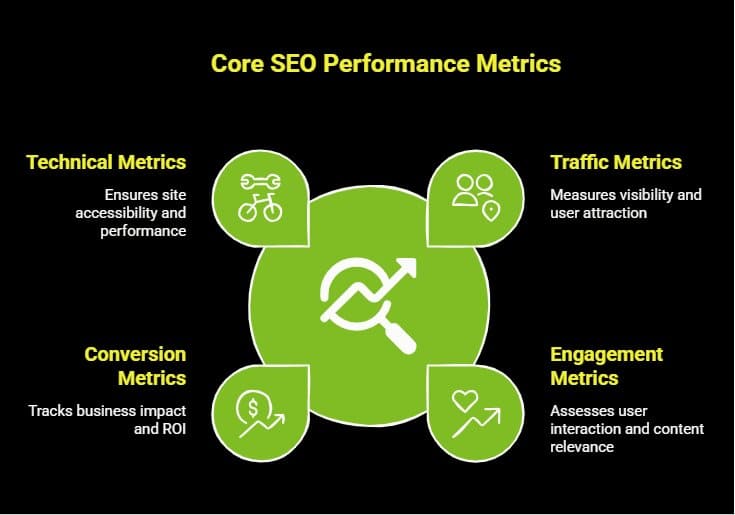
Infographic on Which Core SEO Performance Metrics Should You Track visual selection
There are dozens of metrics available across analytics and SEO tools. But tracking everything creates distraction, not direction. To understand real progress, you need a focused set of SEO performance metrics that connect visibility, user behaviour, and revenue. These can be grouped into four core areas: traffic, engagement, conversions, and technical health.
1. Traffic Metrics
Traffic metrics show whether your SEO efforts are increasing visibility and attracting relevant users. However, growth in numbers alone is not enough. You must assess whether the traffic aligns with business goals and search intent.
- Organic Traffic
The number of users arriving from unpaid search results. A steady upward trend indicates improved rankings and stronger keyword positioning.
Tools: Google Analytics 4, Google Search Console.
- Impressions and Keyword Visibility
Impressions show how often your pages appear in search results. Rising impressions often signal expanding topical authority, even before traffic increases.
Tools: Google Search Console, SEMrush, Ahrefs.
- Click Through Rate
CTR measures how effectively your search listings convert visibility into clicks. Low CTR with deep impressions usually means your titles or meta descriptions need optimisation.
Tools: Google Search Console, SERP preview tools.
Together, these metrics indicate whether your SEO strategy is improving discoverability.
2. Engagement Metrics
Once users land on your site, engagement metrics reveal whether your content meets expectations. Increasing traffic with poor engagement often points to an intent mismatch or weak user experience.
- Bounce Rate
The percentage of visitors who leave after viewing one page. High bounce rates may signal irrelevant content or slow load times.
Tools: Google Analytics 4, Hotjar, Microsoft Clarity.
- Average Session Duration
Shows how long users stay active on your site. Longer sessions usually reflect meaningful engagement and content depth.
Tools: Google Analytics 4.
- Pages Per Session
Indicates how effectively internal links guide users through your website. Strong navigation improves both engagement and conversions.
Tools: Google Analytics 4, Screaming Frog.
These metrics help you evaluate content relevance and user journey effectiveness.
3. Conversion Metrics
Conversion metrics are where SEO performance translates into business impact. Traffic and engagement matter, but conversions prove ROI.
- Organic Conversions
The number of leads, sign-ups, demo bookings, or sales generated from organic traffic.
Tools: Google Analytics 4, Google Tag Manager, CRM systems like HubSpot.
- Organic Conversion Rate
The percentage of organic visitors who complete a defined action. This reflects targeting accuracy and landing page effectiveness.
Tools: GA4, CRM dashboards.
- Return on Investment
Revenue generated from organic search compared to SEO investment. This is the metric leadership teams care about most.
Tools: GA4 attribution reports, Looker Studio, CRM revenue tracking.
Without tracking conversions, SEO performance remains incomplete.
4. Technical Metrics
Technical metrics ensure search engines can crawl, index, and evaluate your site without obstacles. Even high-quality content cannot rank if technical issues exist.
- Page Speed
Faster pages improve user experience and reduce bounce rates.
Tools: Google PageSpeed Insights, GTmetrix.
- Core Web Vitals
Google’s performance signals measure loading speed, interactivity, and visual stability.
Tools: Google Search Console, Lighthouse.
- Crawl Errors and Index Coverage
Errors that prevent search engines from accessing or indexing your pages can directly impact rankings.
Tools: Google Search Console, Screaming Frog, and Ahrefs Site Audit.
Technical health supports and protects your organic growth.
Bringing It All Together
Traffic shows visibility. Engagement shows relevance. Conversions show business impact. Technical metrics safeguard performance. When analysed collectively through tools like GA4, Search Console, and Looker Studio dashboards, these SEO performance metrics provide a clear, actionable view of ROI.
That clarity is what turns SEO from an activity into a growth system.
How to Measure SEO Performance Accurately?
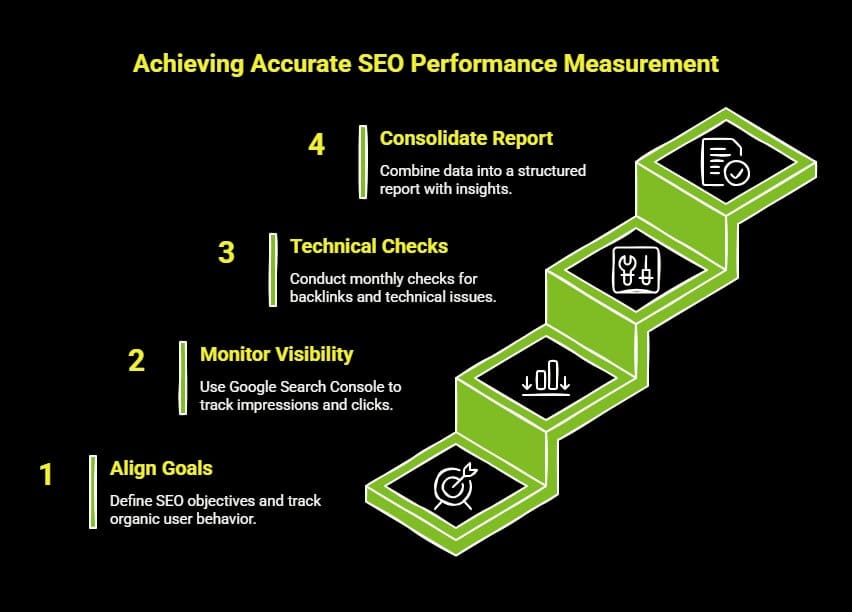
Infographic on How to Measure SEO Performance Accurately visual selection
Measuring SEO performance accurately requires structure, not more dashboards. Follow this streamlined process to ensure your SEO performance metrics reflect real business impact.
Step 1: Align Goals With Organic Behaviour
Start by defining what SEO should achieve:
- Leads and demo requests
• Revenue from organic traffic
• Growth in non-branded visibility
Then track how organic users behave in Google Analytics 4:
- Organic traffic by landing page
• Engagement rate
• Conversions and organic conversion rate
• Revenue attribution
Segment by device, location, and page type for clearer insights.
Step 2: Monitor Search Visibility in Google Search Console
Use Google Search Console to track:
- Impressions
• Click-through rate
• Average keyword position
• Index coverage and crawl errors
If impressions grow but clicks stagnate, optimise metadata. If clicks rise but conversions fall, improve landing pages.
Step 3: Run Monthly Technical and Authority Checks
Use tools like Ahrefs, SEMrush, Screaming Frog, and PageSpeed Insights to monitor:
- Backlink quality
• Technical crawl issues
• Core Web Vitals
• Competitor movement
Focus on patterns and trends, not isolated fluctuations.
Step 4: Consolidate Into One Structured Report
Combine visibility, traffic, engagement, conversions, and technical health into a single monthly report. Add short insights explaining what changed and why.
Accurate measurement is not about tracking everything. It is about consistently tracking what influences growth and ROI.
How to Analyse SEO Performance for Better Decisions?
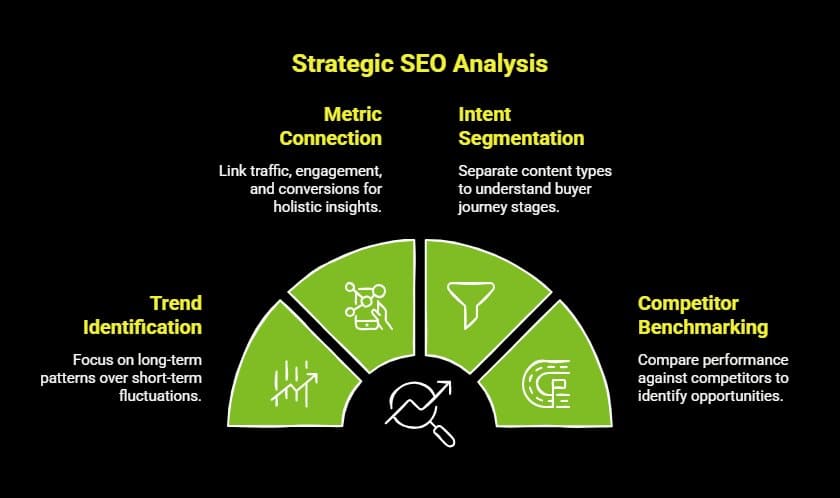
Infographic on How to Analyse SEO Performance for Better Decisions visual selection
Analysis transforms raw numbers into a strategic direction. Without interpretation, SEO performance reports become static documents rather than growth drivers. Effective analysis focuses on relationships between metrics, not isolated values.
1. Identify Trends Instead of Reacting to Fluctuations
Short-term ranking drops or traffic spikes can be misleading. Instead, examine patterns over time. Compare monthly and quarterly data to determine whether improvements are consistent.
Look at keyword clusters rather than individual terms. Sustainable growth across a category signals strategic strength.
2. Connect Traffic, Engagement, and Conversions
To analyse SEO performance properly, cross-reference key indicators. High traffic with high bounce rates may indicate intent mismatch. Strong engagement with low conversions could point to weak calls to action.
Ask practical questions:
• Are commercial pages attracting qualified visitors?
• Are informational pages supporting downstream conversions?
• Is organic traffic contributing to pipeline growth?
Connecting these insights ensures your SEO performance marketing aligns with revenue goals.
3. Segment by Intent and Landing Page Type
Separate informational, commercial, and transactional content. Each serves a different stage of the buyer journey. Growth in informational content without corresponding commercial traction may indicate a funnel imbalance.
4. Compare Against Competitors
SEO performance cannot be measured in isolation. Benchmark against competitors by analysing:
- Share of voice across core keyword clusters
• Visibility trends compared to competitors over time
• Ranking gap analysis to identify missed opportunities
Competitor benchmarking reveals whether growth reflects true market gains or simply overall industry movement.
When analysis includes intent segmentation, you gain clarity on where optimisation efforts should focus next.
How to Perform an SEO Audit That Improves Performance?
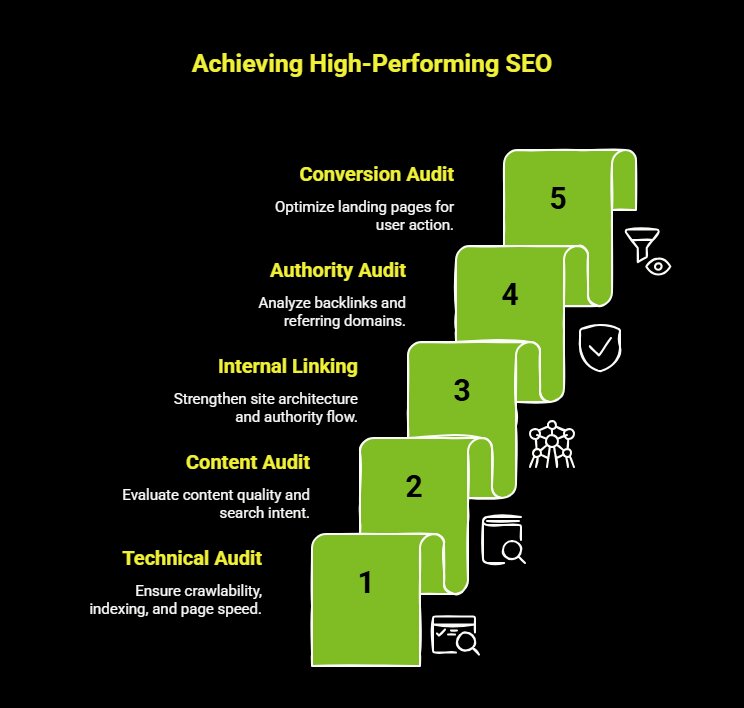
Infographic on How to Perform an SEO Audit That Improves Performance visual selection
An SEO audit is not a one-time checklist. It is a structured evaluation of technical health, content quality, authority signals, internal architecture, and conversion pathways. A strong audit identifies obstacles that restrict performance and prioritises corrective action.
1. Conduct a Technical Audit
Start with crawlability and indexing. Review broken links, duplicate URLs, slow-loading pages, and mobile usability. Core Web Vitals influence both user experience and rankings. Even small technical inefficiencies can suppress visibility across the site.
2. Perform a Content and Intent Audit
Evaluate whether each page satisfies search intent. Remove or consolidate thin pages. Update outdated statistics. Strengthen keyword alignment without over-optimisation.
Compare content depth against top-ranking competitors. If they provide clearer structure, stronger authority, or better answers, that gap must be addressed.
3. Run an Internal Linking Audit
Internal architecture determines how authority flows across your site.
Review:
- Orphan pages with no internal links
• Internal link depth from the homepage
• Anchor text distribution and contextual relevance
Strong internal linking strengthens topical clusters and improves crawl efficiency. Weak structure limits authority consolidation.
4. Review Authority and Backlink Health
Analyse referring domains and link relevance. Remove toxic links and identify high-quality link-building opportunities. Authority remains essential for sustainable rankings.
5. Audit Conversion Pathways
Finally, evaluate how visibility translates into action. Ensure landing pages guide users clearly toward the next step. Strong traffic without defined pathways weakens overall performance impact.
A high-performing SEO audit connects structure, intent, authority, and conversion. It does not just diagnose problems. It builds a prioritised roadmap for measurable improvement.
How to Monitor SEO Performance Over Time?
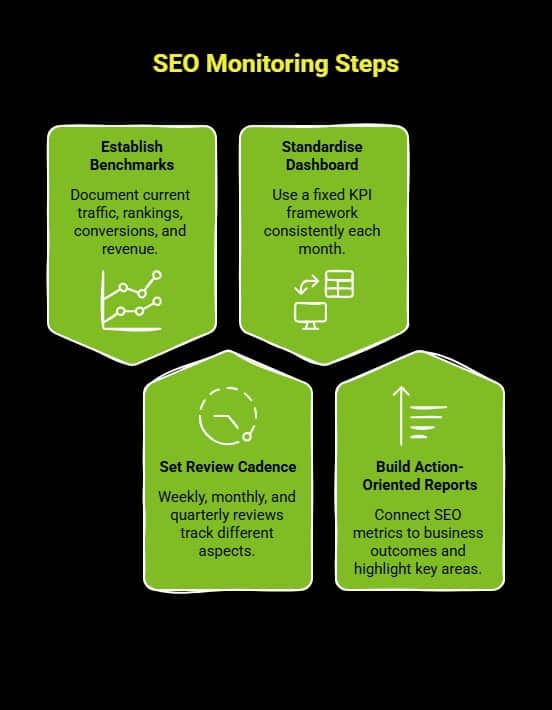
Infographic on How to Monitor SEO Performance Over Time visual selection
Monitoring ensures that progress remains consistent and measurable. SEO growth is cumulative, and regular review prevents unnoticed declines. Structured oversight transforms performance tracking into strategic management.
1. Establish Baseline Benchmarks
Before optimisation begins, document current traffic levels, ranking positions, conversion rates, and organic revenue. These benchmarks serve as reference points for future evaluation. Without baselines, improvement cannot be measured objectively.
2. Set a Consistent Review Cadence
Weekly checks help identify technical disruptions. Monthly reviews track engagement and ranking shifts. Quarterly reviews assess broader strategic impact.
This structured cadence prevents overreaction while maintaining accountability.
3. Standardise Your Dashboard Structure
Define one fixed KPI framework and use it consistently each month. Avoid changing reporting formats or introducing new metrics without context.
A stable dashboard helps identify real performance trends instead of creating confusion through shifting benchmarks.
4. Build Clear and Action-Oriented Reports
Reports should connect SEO performance metrics to tangible business outcomes. Highlight:
- Growth in non-branded visibility
• Improvements in conversion rates
• Revenue contribution from organic search
• Identified risks or emerging gaps
Monitoring is not about collecting data repeatedly. It is about ensuring that SEO performance remains aligned with measurable ROI and long-term business growth.
What Are Common Mistakes When Tracking SEO Performance?
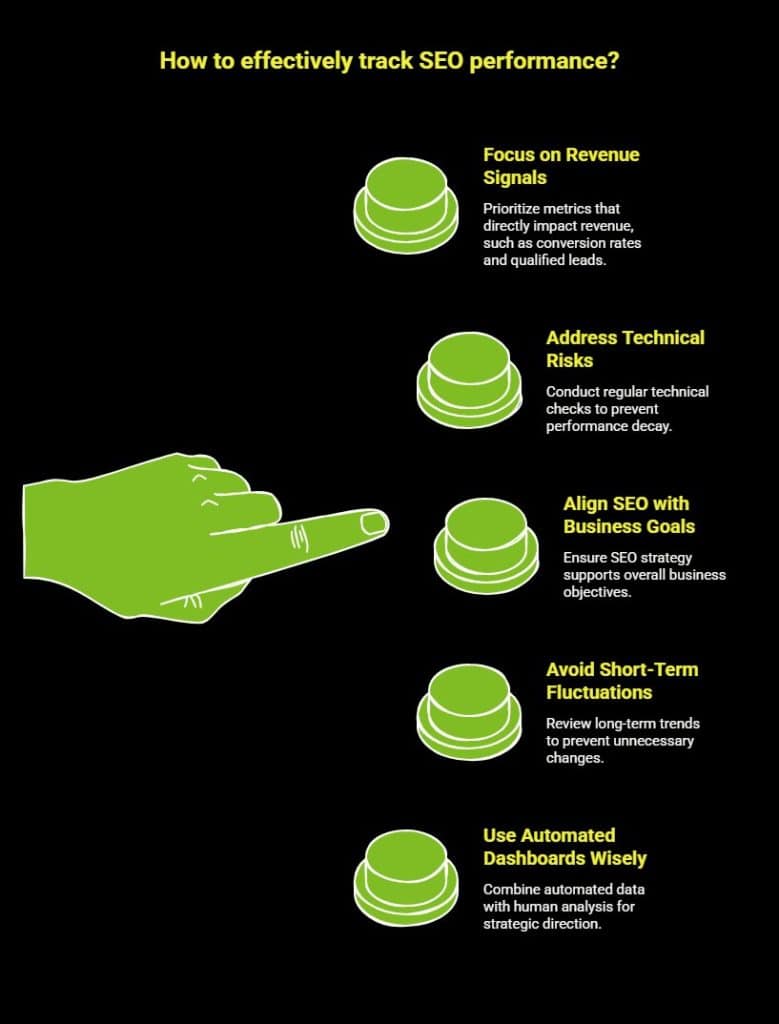
infographic on What Are Common Mistakes When Tracking SEO Performance visual selection
Many businesses assume SEO is tracked properly because dashboards exist. But data without interpretation leads to misdirection. If metrics are not tied to outcomes, decisions become reactive, and ROI suffers.
1. Chasing Vanity Metrics Instead of Revenue Signals
Traffic spikes and ranking improvements can create false confidence.
Common traps include:
- Measuring total traffic without intent segmentation
• Ranking for low-commercial keywords
• Tracking impressions without analysing click-through rate
• Ignoring conversion impact
The consequence is growth without revenue. Avoid this by prioritising qualified leads, conversion rates, and revenue attribution.
2. Overlooking Technical Performance Risks
Technical weaknesses quietly suppress growth.
Often ignored issues include:
- Crawl and indexation errors
• Poor Core Web Vitals
• Broken internal links
• Thin or duplicate content
These gaps reduce visibility and harm user experience. Conduct monthly technical checks to prevent performance decay.
3. Failing to Align SEO With Business Goals
When SEO operates separately from business strategy, reports become surface-level.
Warning signs include:
- Traffic growth without conversion tracking
• Keyword tracking without intent classification
• Engagement metrics without funnel mapping
To avoid this, define pipeline and revenue KPIs before measuring anything else.
4. Overreacting to Short-Term Fluctuations
Daily ranking shifts rarely reflect real impact. Constant adjustments create instability.
Instead:
- Review month-on-month trends
• Analyse quarterly growth patterns
• Evaluate revenue contribution consistency
Strategic patience prevents unnecessary changes.
5. Relying Only on Automated Dashboards
Tools surface data but cannot interpret competitive context or commercial intent.
Without human analysis, strategy becomes metric-driven instead of outcome-driven.
Use tools for insight, but apply judgement for direction.
Effective SEO tracking requires clarity, consistency, and commercial alignment. When metrics connect directly to outcomes, SEO becomes predictable, defensible, and strategically valuable.
Why Work With Wild Creek Web Studio to Improve SEO Performance Metrics?
Wild Creek Web Studio specialises in turning SEO performance metrics into measurable business outcomes. Instead of sending automated dashboards filled with surface-level data, their approach focuses on interpreting insights, identifying growth bottlenecks, and aligning organic performance with revenue goals.
Through their Human Algorithm framework, Wild Creek Studio combines AI-powered analytics with strategic human decision-making. This ensures your traffic, engagement, and conversion metrics are analysed in context, not isolation. The result is clear reporting that connects visibility to the pipeline and ROI.
From structured SEO audits and intent-driven content optimisation to technical performance refinement and conversion pathway analysis, every recommendation is prioritised based on impact. The goal is not more data. The goal is better decisions.
If you are looking for an SEO partner that values transparency, commercial clarity, and long-term growth, Wild Creek Web Studio helps you transform tracking into predictable performance.
Final Thoughts
Improving SEO performance metrics is not about tracking more data. It is about tracking the right data with clarity and purpose. When visibility, engagement, conversions, and technical health are analysed together, SEO becomes a measurable growth engine rather than a reporting exercise.
For Indian businesses, consistent monitoring and strategic interpretation are what transform organic efforts into revenue impact. With the right framework and disciplined execution, SEO shifts from uncertain investment to predictable, ROI-driven performance.
Frequently Asked Questions
How do I know if my SEO strategy is improving my traffic?
Review growth in organic search traffic and overall website traffic in Google Analytics. Use Google Search Console to monitor search engine results, average CTR, and keyword ranking improvements. Rising user engagement, stronger performance for relevant keywords, and better visibility for target search terms signal progress.
What is the difference between an SEO audit and ongoing SEO performance measurement?
An SEO audit is the first step in identifying technical gaps like duplicate content, weak site speed, poor mobile device experience, and backlink issues. Ongoing measurement tracks key SEO metrics, user behaviour, and keyword movement to maintain steady SEO success.
Which tools are best for a comprehensive SEO performance check?
For a complete performance check, use Google Analytics for SEO data and conversion tracking, and use Google Search Console for search engine optimisation insights. Tools like Ahrefs or SEMrush analyse domain authority, backlink profile, number of backlinks, and competitor keyword research.
How can I use Google PageSpeed Insights to improve SEO performance?
Enter your URL to evaluate site speed, mobile usability, and performance across mobile devices. The tool highlights issues affecting user engagement and visibility in search engine results. Improving speed directly supports stronger rankings and better overall digital marketing outcomes.
What does SEO performance mean?
SEO performance measures how effectively your search engine optimisation efforts improve visibility in search engine results, attract your target audience, and increase conversions. It is assessed using the most important SEO metrics, including traffic, engagement, backlinks, and revenue contribution.
How do you measure SEO performance?
Track key metrics such as organic search traffic, average CTR, average number of pages per session, and keyword ranking. Analyse user behaviour, conversions, and revenue attribution. Consistent evaluation of these important SEO metrics ensures measurable SEO success.
What are SEO performance metrics?
SEO performance metrics are measurable indicators that evaluate traffic, engagement, authority, and conversions. They include domain authority, backlink profile, number of backlinks, keyword performance for relevant search terms, and other important SEO metrics that guide strategic decisions.
Do I need technical SEO knowledge to use SEO tools effectively?
Basic knowledge helps, especially for interpreting keyword research, link-building opportunities, and technical errors. While tools provide valuable insights, understanding how SEO data connects to digital marketing strategy ensures accurate optimisation and sustainable long-term results.