Key Highlights
- AI-generated content speeds up production and reduces workload without sacrificing quality.
- Rising content demands make AI essential for scaling across formats and channels.
- AI performs best when guided by human insight, creativity, and editing.
- Different AI tools serve various needs: brainstorming, drafting, or SEO performance.
- AI reshapes content roles, shifting teams toward strategy and value rather than volume.
- The future belongs to brands using AI for relevance, personalization, and continuous optimization.
- Wild Creek Studio helps brands use AI strategically to drive real, measurable growth.
Content demands are exploding, and most teams cannot keep up. 95% of marketing leaders say content demand is rising, yet only 14 % feel confident they have the tools to meet it. No wonder writers feel stretched, deadlines feel tighter, and creativity feels harder to sustain.
That pressure is exactly why AI-generated content has moved from novelty to necessity. Not to replace human creativity but to support it when the workload becomes unsustainable.
In this blog, we will break down what AI-generated content really is, why it is becoming essential, the tools reshaping the landscape, its benefits and limitations, and how teams can use it to strengthen rather than substitute human creative work.
What Exactly Is AI-Generated Content and How Does It Work?
Most explanations of AI-generated content are overly simple. You type a prompt, the system produces text, and that is the end of it. But modern AI models work in ways that are far more nuanced and far more interesting than a basic request-and-response system.
1. How AI Interprets Your Intent?
When you give AI an instruction, it does more than read keywords. It infers the tone, purpose, and structure you are aiming for. A request for a bold headline prompts a different response than a request for a neutral explanation because the system is constantly predicting what style best matches your intention.
2. How AI Reconstructs Learned Patterns?
AI does not pull facts from the web. It generates content by drawing on patterns it has learned from massive datasets. You can see this clearly when a travel brand asks an AI to write a blog post about Bali.
The AI does not understand the island and it does not search for information. Instead, it recreates typical elements of travel writing such as sensory descriptions, cultural references, and itinerary-style structure.
The result feels human because it imitates the patterns of travel storytelling, not because the AI knows anything about Bali.
3. How Modern Models Use Context and Memory?
Newer systems can analyze long documents, remember earlier parts of a conversation, and even use external tools. An AI can review a 40-page report, identify major trends, transform those insights into a summary, and then rewrite the summary as an email for a CEO.
This is layered reasoning built from overlapping context windows, which is what makes modern AI feel more capable than earlier models.
Why Human Judgment Still Matters?
AI can generate drafts, reduce research time, and structure content ideas, but humans elevate the output. They bring voice, accuracy, experience, ethics, emotional intelligence, and brand nuance.
These qualities give content depth and authenticity, and they are the reason AI-supported teams consistently outperform teams that rely on AI alone.
Why AI Content Creation Tools Are Exploding Right Now?
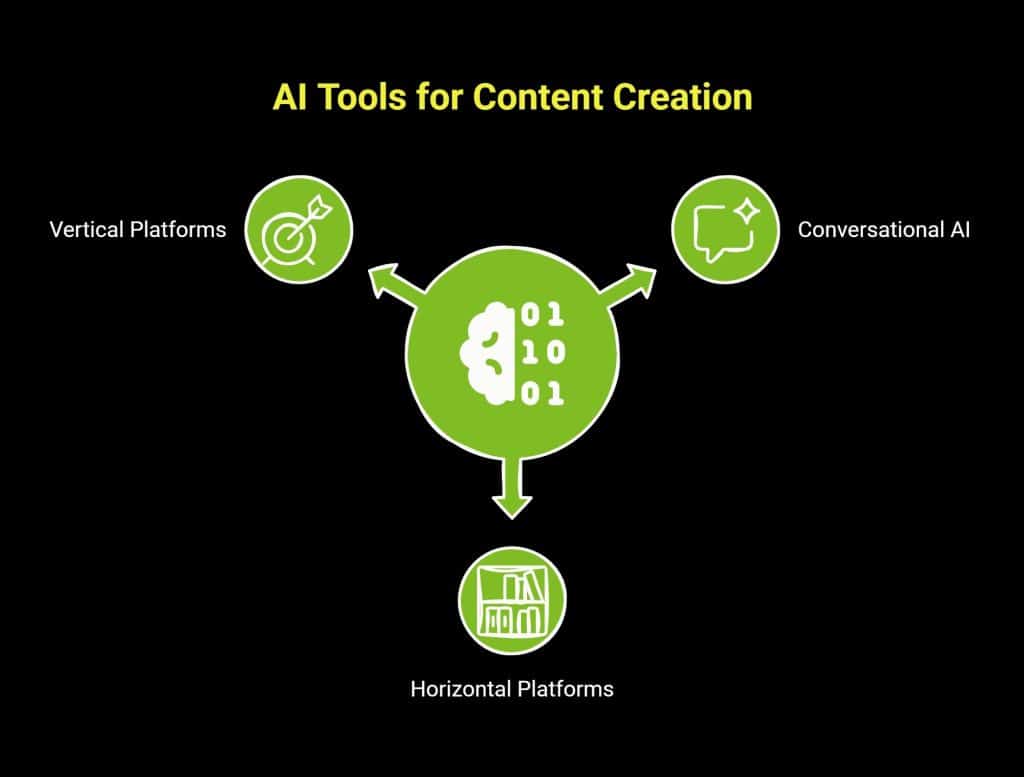
Infographic showing AI tools for content creation
Content demands are increasing at a pace that many teams can no longer manage manually. Brands are expected to publish high-quality content more frequently across more platforms, and to personalize it for different audiences at the same time. With limited time and resources, staying competitive has become a significant challenge.
This pressure is driving the rapid adoption of AI content creation tools. Instead of spending hours researching, outlining, drafting, and revising, teams can now use AI to accelerate the early stages of content production, freeing human creativity for what matters most: strategy, storytelling, and refinement.
Consider a simple example. A retail brand that once spent an entire day writing product descriptions now uses AI to generate first drafts in minutes.
The team still edits for accuracy and brand voice, but the heavy lifting is gone. The time saved is redirected into campaign ideas and creative work that actually moves the brand forward.
This kind of transformation is happening everywhere. A 2024 study published on ResearchGate found that 74% of marketing professionals reported higher productivity after integrating AI into their content workflows, particularly for drafting and optimization tasks.
This combination of rising content demands, workflow efficiency, and measurable results explains why adoption is accelerating so quickly. AI is not replacing content creators. It is becoming a powerful partner that allows them to deliver more value in less time.
What Kind of AI Tools Are Out There for Content Creation
Today’s content-creation landscape includes a wide variety of AI tools. They range from quick drafting assistants to full-scale platforms that embed brand voice, audience data, and optimization logic. The key is to understand what each category offers so you pick tools that actually fit your strategy, not just chase buzz.
1. Conversational AI Tools
These are tools you talk with, ask a question, give a prompt, and get a response. They’re great for brainstorming, early-stage writing, and research. Think of them as a co-writer who helps you get started, not someone who finishes the job for you.
Examples:
- ChatGPT: Ideal for generating ideas, drafting blog intros or rewriting snippets in different tones.
- Claude / Google Gemini: Useful for exploring new angles and digging into conversational outputs.
These tools make creation faster, but they often need human editing and direction to hit your brand voice or perform in search.
2. Horizontal Content Platforms
These are AI tools built for marketing teams, designed to work across formats and channels. They come with templates, workflows, and copy-ready features.
Examples:
- Jasper AI: Lets you produce blogs, ads, social posts, landing page copy using templates.
- Copy.ai: Great for short-form copy, testing different headlines, email sequences, or ad variants.
These tools help scale content creation but may lack deep specificity around your niche market or technical SEO needs.
Vertical / Enterprise Platforms
Here’s where things get strategic. These AI tools go beyond generic templates. They integrate your brand data, your audience insights, and your competitive context, and they generate content that’s optimised for your site, not just generic copy.
Example:
- Conductor Writing Assistant: Uses your brand’s guidelines, your site performance, and your competitor data to build content designed to rank and resonate.
This category is for teams that want content that performs, not just content that publishes.
So, Which Category Should You Use?
- Need speed and volume? Start with conversational or horizontal tools to knock out first drafts and short-form content.
- Need performance, brand differentiation, and SEO strength? Invest in a vertical platform that adapts to your business context.
- Want the best of both? Combine them: use one tool for ideation, another for drafting, and a third for optimization.
By choosing wisely across these categories, you’ll build a toolkit that supports your content flow from idea to publish without forcing you to adopt every shiny tool. The question becomes less about “Can I use AI?” and more about “Which one will get me the best result?”
AI-powered content management tools bring value by streamlining workflow, boosting collaboration and optimizing content at every stage, beyond just writing, driving efficiency and consistency.
Why AI-based Content Matters for Modern Marketing Teams
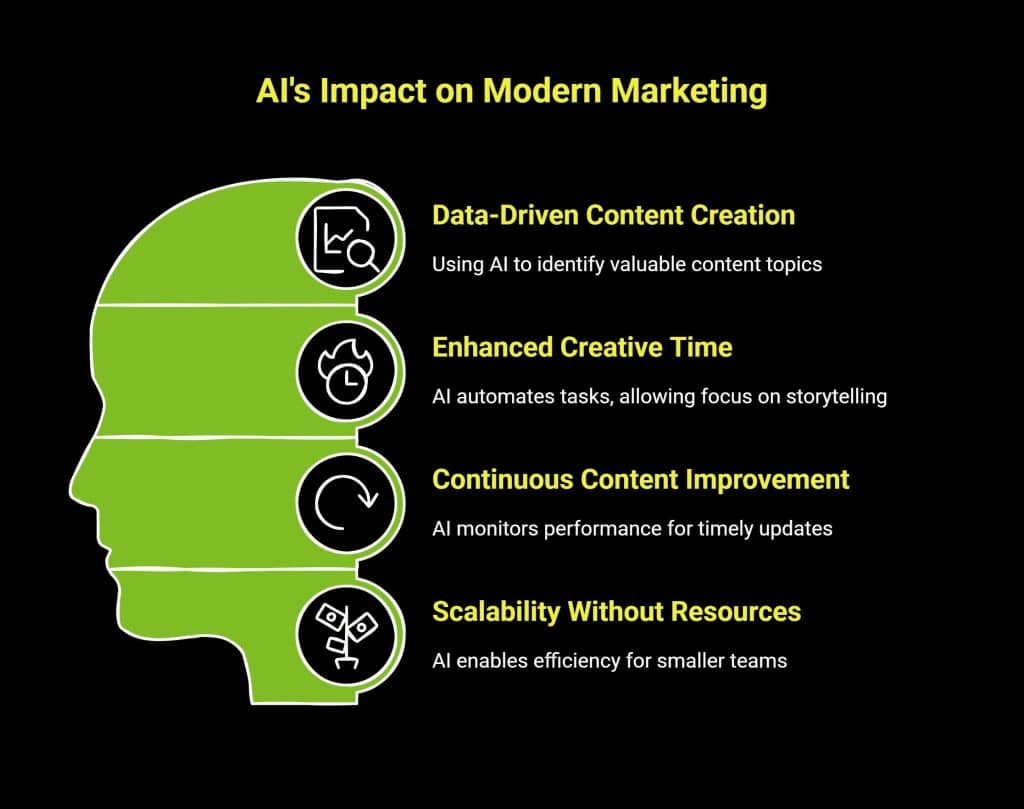
Infographic showing AI s impact on modern marketing
Content demands have increased dramatically, and marketing teams are expected to produce more, perform better and personalize deeper without additional time or resources.
AI matters because it enables teams to make smarter decisions, move faster, and continuously improve content instead of simply producing more of it. This shift is redefining AI for content marketing, turning content from a static asset into a measurable growth engine.
Here is what is driving real impact, backed by research rather than assumptions.
1. Create Content Based on Real Opportunity
Instead of guessing what to create next, leading marketers are using AI to dig into real-world data search behaviour, competitor gaps and audience signals to pick topics that deliver value, not just volume.
One large-scale field experiment conducted by Cornell University found that adding AI-generated metadata on a video platform increased valid watches by 1.6% and watch duration by 0.9%.
Even more interesting, when human creators revised the AI titles, the gains jumped to 7.1% in views and 4.1% in duration. That kind of insight shows that content guided by data and AI performs better because the audience actually cares.
2. Make Creative Time More Valuable
AI isn’t meant to take over writing. It’s designed to handle time-intensive tasks like research, outlining, and repurposing so creative teams can focus on storytelling, brand identity, and audience connection.
According to a review of AI in marketing published in Science Direct, these tools enable more automation of routine work while allowing humans to move into higher value roles. The better teams do this, the more strategic their content becomes.
3. Keep Improving Content After It Goes Live
Published content often becomes stale when search behaviour or competitive positioning shifts. AI helps monitor performance signals and highlight which pieces need updating or expansion.
This prevents traffic decline and ensures content assets continue delivering value long after the original publish date. Instead of reacting months later, teams can improve continuously and stay ahead.
4. Help Teams Scale Without Heavy Resources
AI allows smaller marketing teams to operate with the efficiency and momentum usually associated with larger departments. By reducing manual workload and speeding up production cycles, teams can execute bigger goals without increasing headcount. It levels the playing field and lets strategy win over budget size.
AI matters because it changes how teams think, operate and measure content. It reduces guesswork, accelerates meaningful work and transforms content into an asset that grows over time.
The combination of AI intelligence and human creativity produces better results than either alone. AI is not here to replace marketers. It is here to help them win.
AI-Generated Content: What It Helps With and Where It Falls Short
AI opens up powerful opportunities for content teams, but it also comes with constraints that require human direction and responsible use.
Understanding both sides helps teams leverage AI where it makes the biggest difference while avoiding the most common pitfalls.
| Benefits | Limitations |
| Speeds Up Research and Drafting: AI accelerates information gathering, outlining, and first-draft creation, saving time on repetitive tasks. | Risk of Inaccuracy: AI may produce inaccurate or incomplete information without expert review, potentially harming brand credibility. |
| Consistent Messaging Across Channels: AI ensures consistent brand tone and messaging across various platforms, reducing the need for constant oversight. | Lacks Emotional Depth and Context: Struggles with emotional nuance and cultural context, and cannot create authentic, relatable storytelling. |
| Scalable Personalization: AI tailors content based on user behavior, intent, and audience segments, providing a personalized experience at scale. | Repetitive or Generic Output: AI-generated content can be formulaic or repetitive without a clear strategy and brand voice, leading to a lack of originality. |
| Real-Time Optimization: AI helps teams continuously optimize content based on data insights, improving performance and adjusting strategies quickly. | Human Oversight Needed for Quality: AI requires human direction to ensure content aligns with brand values and maintains high standards. |
| Increased Efficiency for Smaller Teams: AI allows smaller teams to operate at a larger scale without needing additional staff. | Creativity Can Suffer with Overuse: Over-reliance on AI may stifle human creativity and originality, leading to a lack of unique insights and ideas. |
AI is most effective when used as a collaborative partner. It accelerates execution, supports decision-making and expands capability, but human creativity, judgment and brand understanding remain essential to producing meaningful and trustworthy content.
How AI Is Reshaping the Role of Content Teams Today
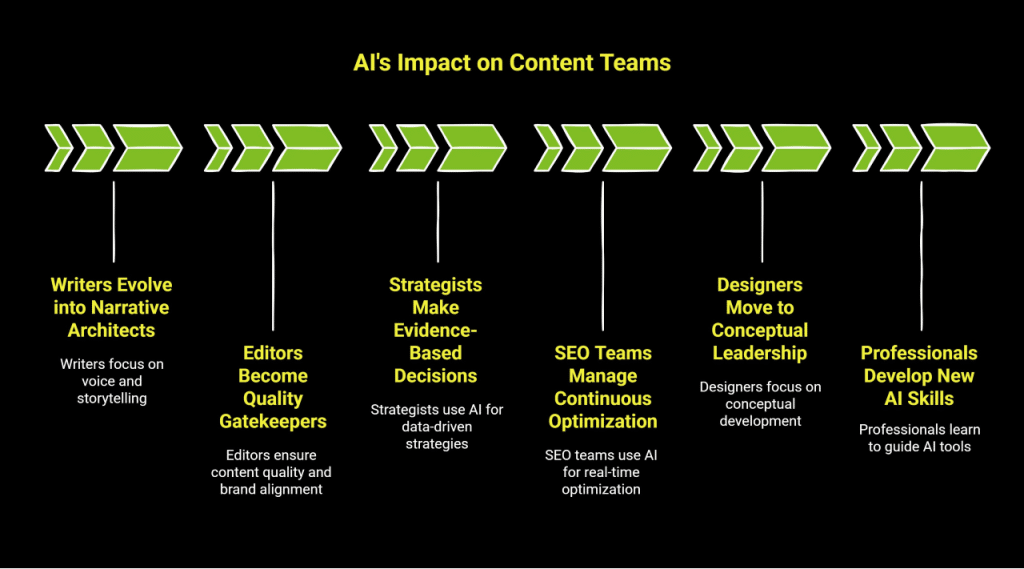
Infographic showing AI s impact on content teams
AI is not removing roles. It is redefining what those roles look like and pushing content teams to work in ways that are more strategic, analytical and performance-driven. Instead of focusing on volume and manual production, teams are shifting toward insight, direction and measurable outcomes. Here is how that transformation is playing out inside real marketing environments.
1. Writers Are Evolving Into Narrative Architects
Writers are no longer expected to churn out long drafts from scratch. AI now speeds up early stages like research, organization of ideas and building rough structures.
This gives writers space to focus on what AI cannot replicate: voice, originality, perspective and storytelling that resonates with real human experience. Modern writers shape the why and angle behind content, rather than spending most of their time generating raw text.
2. Editors Are Becoming Quality Gatekeepers and Context Specialists
Instead of fixing grammar line by line, editors now evaluate depth, insight, accuracy and trustworthiness. Their responsibility is to ensure that AI-assisted content reflects brand standards, aligns with audience expectations and avoids generic or superficial output.
They refine ideas, not just sentences, and act as the final filter that ensures content adds value rather than noise.
3. Content Strategists Are Making Faster, Evidence-Based Decisions
AI provides visibility into what people are searching for, where competitors are weak, and which topics represent real growth potential. Strategists can now prioritize content based on measurable opportunity instead of editorial intuition.
This results in strategies grounded in demand mapping, topic clustering, seasonality and performance forecasting, rather than trial and error.
4. SEO Teams Are Managing Optimization as a Continuous Workflow
SEO is no longer a one-time step after publishing. AI tools surface ranking drops, content decay signals, shifting search intent and internal linking opportunities in real time. SEO specialists can respond immediately instead of waiting for monthly or quarterly audits.
This turns SEO into an always-on system that protects performance instead of reacting after losses occur.
5. Designers and Video Creators Are Moving From Production to Conceptual Leadership
AI tools now handle time-consuming tasks like resizing assets, generating variations, removing backgrounds or converting scripts into short-form video. This frees creative teams to focus on conceptual development, visual identity, experimentation and bigger ideas that meaningfully strengthen brand presence.
6. Content Professionals Need New Skills to Lead AI, Not Follow It
Modern marketing content roles involve guiding AI rather than letting it decide outcomes. That means developing new skills such as building effective prompts, evaluating tool capabilities, training AI models on brand voice and understanding performance analytics.
For writers, integrating content writing and AI is becoming an essential skill that improves efficiency without compromising craft.
Strong creators are no longer defined by how fast they write or design, but by how well they direct, interpret and elevate AI output.
When teams shift from execution to direction, they create content that is more strategic, differentiated and performance-driven. AI changes the workflow, but humans still shape the thinking, quality and emotional connection behind the work.
SEO and AI: What Marketers Need to Know Right Now
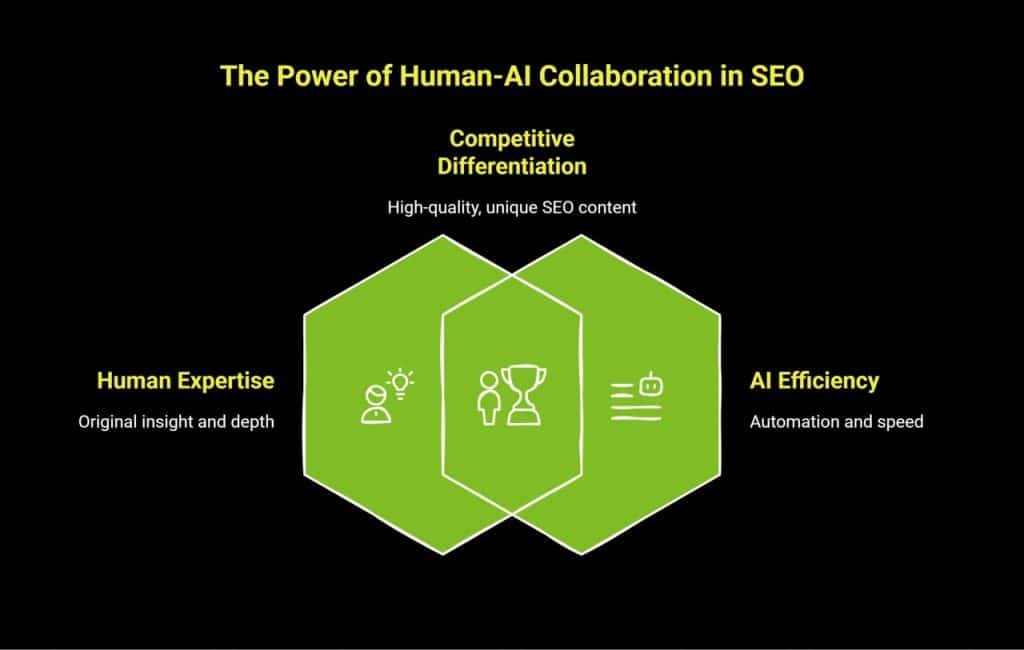
Infographic showing the power of human ai collaboration in SEO
AI is reshaping how search engines surface, evaluate and reward content. These changes directly affect how marketers plan strategies, structure content and optimize for visibility and performance.
1. AI-Generated Content Is Rapidly Increasing Online
According to a study published on Arxiv.org, around 30% of the text currently published on the web originates from AI-generated sources.
With this surge, search engines are raising the bar. Automated outputs that simply repackage existing information are no longer enough. Ranking increasingly depends on original insight, human expertise and depth, not production speed or keyword volume.
2. Human-AI Teams Outperform AI Alone in Creative and Strategic Work
A comprehensive analysis published in Nature Human Behaviour, covering 106 experiments, found that human–AI teams tend to produce higher-quality results in creative and complex problem-solving tasks compared to AI or humans working independently.
For SEO-driven content, this reinforces a practical truth: AI improves efficiency, but human refinement is what creates competitive differentiation.
What This Means for SEO Teams
- AI should support production and research, not replace human judgment and experience.
- Search engines reward real expertise, credible perspective and unique thinking.
- The strongest results come from AI for speed and structure combined with human insight for originality and trust.
- SEO advantages now stem from strategy and depth, not publishing volume.
AI can accelerate output. Humans still create meaning, trust and competitive advantage.
For a deeper perspective on how AI is transforming search and the ranking landscape, explore expert thoughts on how AI is changing everything in SEO.
What’s Coming Next for AI-Driven Content?
AI is shifting the focus of content creation from speed to strategy. Instead of simply helping teams produce more, AI is increasingly shaping what should be created and why.
As AI-generated content grows across the web, original perspective and expertise will become the true differentiators. Search engines will prioritize content that demonstrates real experience and credibility, rather than automated rephrasing. As Sundar Pichai noted, “AI is one of the most important things humanity is working on. It is more profound than electricity or fire.”
The format of content itself is evolving. AI is enabling multi-format creation where a single concept can become video, audio, text and interactive experiences instantly. Teams that adopt multi-modal workflows will reach audiences wherever they choose to engage, not just through traditional articles.
With 68% of marketers already building or exploring AI-led content strategies, the competitive edge will belong to those who combine AI’s scale with human insight, creativity and accountability.
The future will not reward content that is simply produced faster. It will reward content that is more intelligent, more relevant and more human.
Why Work With Us at Wild Creek Web Studio
AI is changing the content landscape fast, and many brands are struggling to keep up. Publishing more is easy. Publishing strategically is not. Without real expertise guiding AI systems, businesses end up with content that is generic, underperforming and invisible in search. We see this challenge every day.
That is where we step in.
At Wild Creek Studio, we help brands use AI the right way to scale intelligently, maintain authenticity and drive measurable results. With more than 18 years of experience and over 100 successful brand partnerships, we know how to combine AI-powered efficiency with human insight, creativity and performance strategy.
We create content systems that do more than generate text. We build frameworks that improve rankings, strengthen brand authority and deliver growth backed by real data. We believe AI should enhance your voice, not replace it, and we work closely with teams to ensure every piece of content has purpose and impact.
If you want AI-driven content that performs instead of just publishing, Contact us today!
Final Words
AI is already reshaping the content world, and staying still is the fastest way to fall behind. Now is the time to stop experimenting casually and start using AI with intention and strategy.
Pick one part of your content workflow and improve it with AI this week. Whether it is research, optimization or repurposing, small steps create real momentum.
The advantage will belong to teams that combine AI intelligence with human insight and originality. The rest will be drowned out by sameness.
The real question is not whether you will use AI, but how well you will.
Frequently Asked Questions
Which AI writing tools offer the best quality output?
The top AI for content writing tools are Jasper and Copy.ai. They offer strong ai writing assistant features, tone of voice control, plagiarism checker, and marketing copy support, helping content writers boost productivity and improve content quality across social media and email campaigns.
How can I use Canva’s AI assistant for content creation?
Use Canva’s ai features to generate social media posts, visual content and ad copy with text prompts. It simplifies repetitive tasks like formatting, video editing and image generation, making the content creation process faster for marketing campaigns across social platforms.
What are the best AI tools for content creation in 2025?
Leading tools include Jasper for content generation, Writesonic for social media content, and Descript for video creation and video content. They support keyword research, social content, customer support materials, AI content recommendation and new content development to boost productivity across marketing campaigns and social media channels.
Are there any free AI tools that help with content creation?
Yes. Tools like ChatGPT and Canva offer a free plan or free version for social media content, image generators and google docs integration. They help create ad copy, visual content and google search optimized posts with minimal learning curve and strong use cases.
How do I create AI-generated content?
Start with a clear brief and target audience, then use AI for content writing tools to draft efficiently. Human editing is essential for accuracy, flow, and creativity, turning quick drafts into polished content that reflects your brand and expertise.
What is the 30% rule for AI?
The 30 percent rule suggests limiting automation to roughly a third of the workflow so human creativity still leads. This balance keeps quality high while using AI content optimization to enhance structure, clarity, and search visibility without losing authentic voice.
How do you feel about AI generated content?
AI-generated content is valuable when used thoughtfully. It helps scale ideas faster, but the best results come when humans add depth and perspective. I appreciate how AI-powered content creation supports creators without replacing originality, emotional nuance, or lived expertise.
Is AI going to replace content creators and writers soon?
No. Artificial intelligence will augment, not eliminate. It excels at speed and structure, but humans provide storytelling, judgment and real experience. Writers who use AI content personalization and strategy will thrive, while those relying solely on automation risk sounding identical and forgettable.