Key Highlights
- Human-AI collaboration in SEO combines automation speed with strategic human judgment.
- Generative AI can automate 60–70 percent of marketing tasks, but leadership drives value.
- AI-assisted SEO improves efficiency; humans ensure originality and authority.
- Google’s AI search rewards expertise and trust, not content volume.
- Collaborative SEO outperforms tool-only strategies in backlinks and engagement.
- Predictive AI spots trends; human strategy turns them into a competitive advantage.
- The future of SEO with AI belongs to brands that Think Better, not Faster.
AI has fundamentally reshaped how SEO operates, and you are likely feeling it already. Keyword research that once took hours is now automated. Technical audits that required manual crawling are completed in minutes. Content drafts appear in seconds. What was once considered experimental is now everyday practice. AI-assisted SEO has moved from curiosity to core workflow.
According to McKinsey’s report on The Economic Potential of Generative AI, generative AI could automate 60 to 70 percent of the time spent on routine marketing activities. But here is the tension you might be sensing: automation does not automatically create differentiation. If everyone has access to the same tools, speed alone cannot be the advantage.
That is where the real shift begins. The brands that win will not be those who use AI most aggressively. They will be the ones who structure human-AI collaboration in SEO, aligning machine efficiency with human strategic judgment. In this article, we will explore how to balance both, why authority still matters, and what the future of SEO with AI truly demands.
What Is Human-AI Collaboration in SEO?
Before debating whether AI will redefine search, we need clarity on what human-AI collaboration in SEO actually means. It is not simply using AI tools. It is a structured workflow where AI handles scale, speed, and pattern recognition, while humans guide positioning, interpretation, and authority.
AI can analyze thousands of queries, detect SERP patterns, cluster topics, and complete technical audits in minutes. This expands visibility and accelerates execution. But SEO is not only computational. It is strategic.
Humans define narrative framing, competitive differentiation, ethical standards, and credibility. They turn data into insight and insight into authority. According to Google’s Search Quality Evaluator Guidelines, content is judged through Experience, Expertise, Authoritativeness, and Trust(E-E-A-T). These signals cannot be automated. They are built through judgment and domain depth. AI increases capacity. Human oversight converts that capacity into a competitive advantage.
Why Is AI Assisted SEO Alone Not Enough?
If AI improves speed and pattern recognition, why is that not sufficient? Because efficiency does not create differentiation. AI adoption in SEO is widespread, yet performance outcomes vary dramatically. The divide is no longer about access to tools. It is about how they are used.
When organizations lean too heavily on AI-assisted SEO without strategic direction, the consequences are predictable. Content becomes structurally similar across competitors. Insights remain surface-level. Pages feel interchangeable. Over time, engagement declines as audiences detect repetition rather than perspective.
Research from BrightEdge shows that 84 percent of marketers now use AI in some part of their SEO workflow, yet ranking performance differs widely across industries. Adoption alone does not create an advantage. Distinction does.
AI increases output and accelerates execution. But it does not define positioning, shape narrative, or build authority. Without human calibration, automation scales sameness and gradually erodes brand equity.
That is why structured human-AI collaboration in SEO becomes essential. It ensures automation strengthens differentiation instead of diluting it.
How Is AI Reshaping the Future of SEO With AI Search Engines?
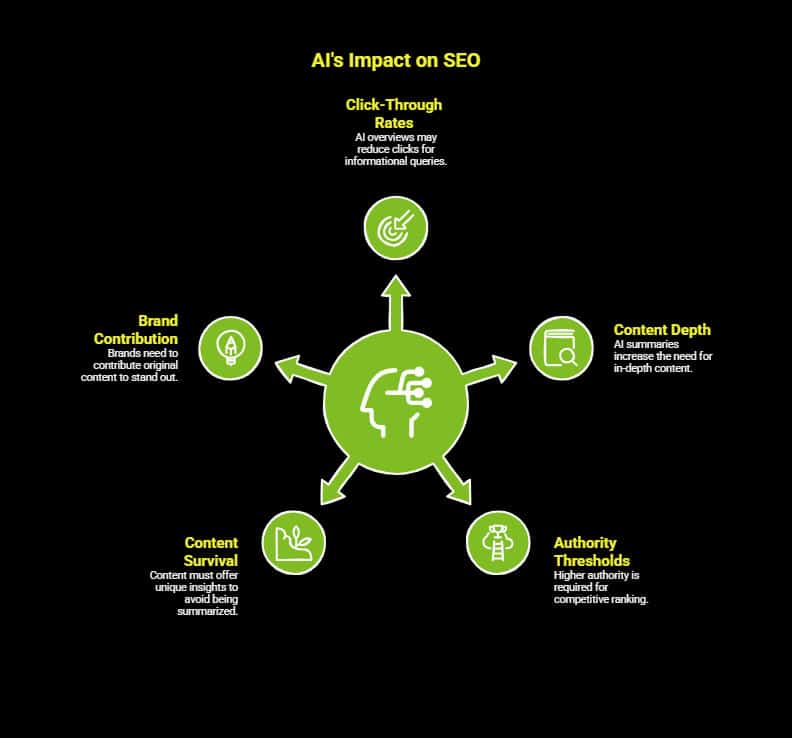
Infographic on How Is AI Reshaping the Future of SEO With AI Search Engines visual selection
The shift becomes more significant when we examine how AI is transforming search itself.
Search engines are no longer just ranking links. They are synthesizing information directly on the results page through AI-generated overviews and summaries.
According to Statista, Google controls over 90 percent of the global search market share, making its AI integration highly influential. As AI-driven features expand, visibility dynamics are shifting.
This evolution directly affects:
- Click-through rates for informational queries
- Content depth expectations
- Authority thresholds required for competitive ranking
Surface-level content is increasingly at risk of being summarized and bypassed. Pages that lack original insight may become background training material for AI overviews rather than destinations for engagement.
The future of SEO with AI search engines will reward brands that move beyond aggregation and into contribution.
What Must Content Do to Survive AI Overviews?
To remain visible and valuable in AI-driven search environments, content must offer signals that cannot be easily replicated or summarized.
It should include:
- Proprietary data that introduces new information
- First-hand frameworks grounded in lived experience
- Opinionated insight that takes a clear strategic stance
- Strong authorship signals that reinforce expertise and credibility
AI can generate answers at scale.
Humans must generate authority at depth.
That is the essence of human-AI collaboration in SEO. It is not about competing with AI systems. It is about ensuring your expertise remains indispensable within them.
What Does Collaborative SEO Look Like in Practice?
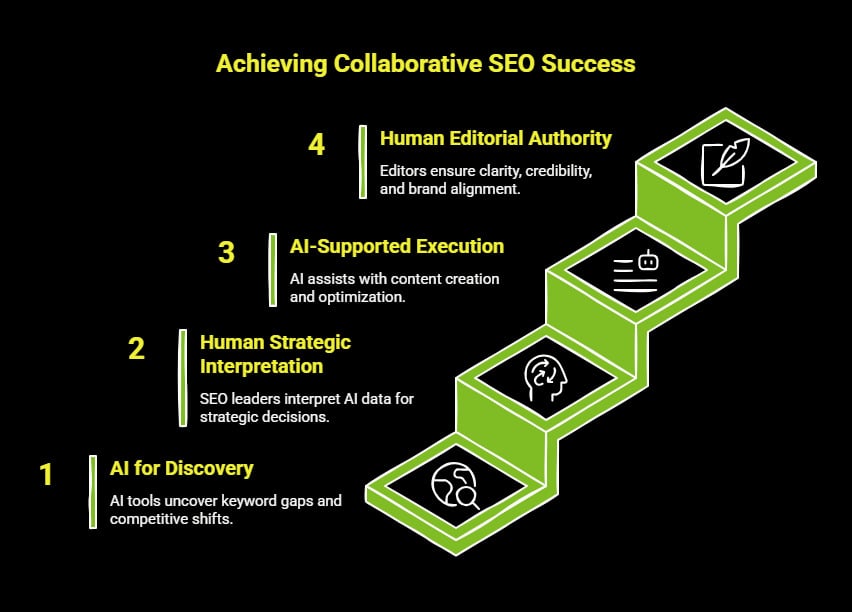
Infographic on What Does Collaborative SEO Look Like in Practice visual selection
Collaborative SEO is a structured workflow where AI accelerates research and execution while human experts guide positioning, authority, and decision-making. The system works only when responsibilities are clearly defined, and strategy leads automation.
Phase 1: AI for Discovery
AI handles scale. Platforms like Semrush, Ahrefs, and BrightEdge uncover keyword gaps, competitive shifts, and SERP volatility. Google Search Console surfaces live performance data, while Google Trends and Exploding Topics detect emerging patterns.
AI assistance in SEO enables teams to:
- Spot accelerating topics
- Identify ranking instability
- Analyze intent at scale
- Surface technical issues
AI reveals signals. It does not set priorities.
Phase 2: Human Strategic Interpretation
Data without context creates noise. SEO leaders interpret AI outputs through business alignment and authority feasibility. Not every high-volume term deserves investment. Not every trend strengthens positioning.
This stage focuses on:
- Revenue alignment
- Intent qualification
- Differentiation opportunities
- Long-term authority building
This is where human-AI collaboration in SEO becomes strategic rather than reactive.
Phase 3: AI-Supported Execution
Once direction is clear, AI compresses timelines. Tools like ChatGPT, Jasper, and Copy.ai assist with structured drafting. Surfer SEO and Frase guide optimization. Technical tools such as Screaming Frog automate audits.
AI-assisted SEO improves:
- Draft velocity
- Metadata accuracy
- Internal linking suggestions
- Technical diagnostics
Speed increases. Strategy remains intact.
Phase 4: Human Editorial Authority
Automation stops here.
Human editors validate data, inject proprietary insights, refine arguments, and align messaging with brand authority. This layer ensures clarity, credibility, and trust.
Without human calibration, collaborative SEO becomes mechanical. With it, human-AI collaboration in SEO becomes a durable advantage.
According to Gartner, 80 percent of enterprises will adopt generative AI APIs by 2026. Adoption is accelerating. Integration determines advantage. That distinction will define the future of SEO with AI.
What Is the Human Algorithm Framework and Why Does It Matter?
Collaboration must be systematized to scale effectively. Without defined roles, AI adoption becomes fragmented. A structured human-AI collaboration in an SEO framework clarifies responsibilities and maintains strategic direction.
How Should AI and Humans Divide Responsibilities?
A clear division of roles strengthens execution without diluting authority.
| Layer | AI Responsibility | Human Responsibility |
| Research | Pattern detection | Market interpretation |
| Content | Draft acceleration | Strategic differentiation |
| Technical | Issue identification | Priority alignment |
| Authority | Source aggregation | Credibility validation |
Why Does Structured Integration Outperform Tool-Only Workflows?
As AI tools become accessible to all competitors, differentiation shifts toward integration quality.
Organizations that operationalize human-AI collaboration in SEO gain:
- Efficiency without dilution
- Scale without generic messaging
- AI assistance in SEO without authority erosion
The future of SEO with AI will not reward tool adoption alone. It will reward disciplined integration.
Automation is widespread. Strategic clarity remains rare. And rare advantages compound over time.
How Can AI Help You Predict Future SEO Trends?
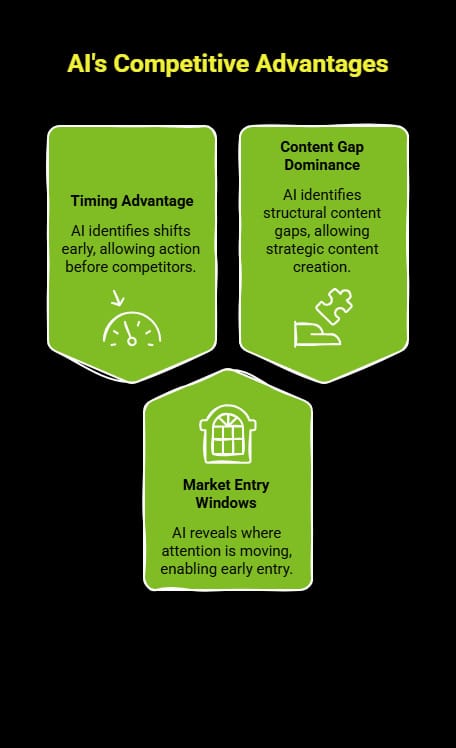
Infographic on How Can AI Help You Predict Future SEO Trends visual selection
AI is often described as a forecasting engine. But its real advantage is not prediction alone. It is timing. When used correctly, AI surfaces shifts early enough for you to act before competitors saturate a space. That timing edge is what turns insight into advantage.
Where Does AI Create a Competitive Timing Advantage?
AI analyzes large search datasets in real time, identifying early directional changes in query patterns, topic clusters, and SERP behaviour.
This enables you to:
- Identify emerging topic acceleration before peak competition
- Spot expanding SERP features such as AI Overviews
- Detect rising competitors, increasing content velocity
- Track search momentum across related keyword clusters
Acting during early momentum stages allows brands to establish authority before markets mature.
How Does This Create Market Entry Windows?
Every emerging search trend has a window. Early entry allows you to:
- Capture rankings before saturation
- Earn backlinks while competition is limited
- Shape narrative framing within a category
- Establish topical authority before others scale content
AI reveals where attention is moving. Strategic execution determines whether you enter early or chase late.
How Does AI Support Content Gap Dominance?
Beyond trends, AI helps identify structural content gaps within competitive landscapes. It highlights underserved questions, weak authority pages, and missing cluster depth.
Brands that move quickly can dominate these gaps, not by producing more content, but by producing earlier, deeper, and more strategically positioned content.
As predictive capabilities improve, the advantage will not be access to AI. It will be how effectively you use it to control timing, capture emerging search territory, and secure durable authority before competition intensifies.
What Does the Future of SEO With AI Actually Look Like?
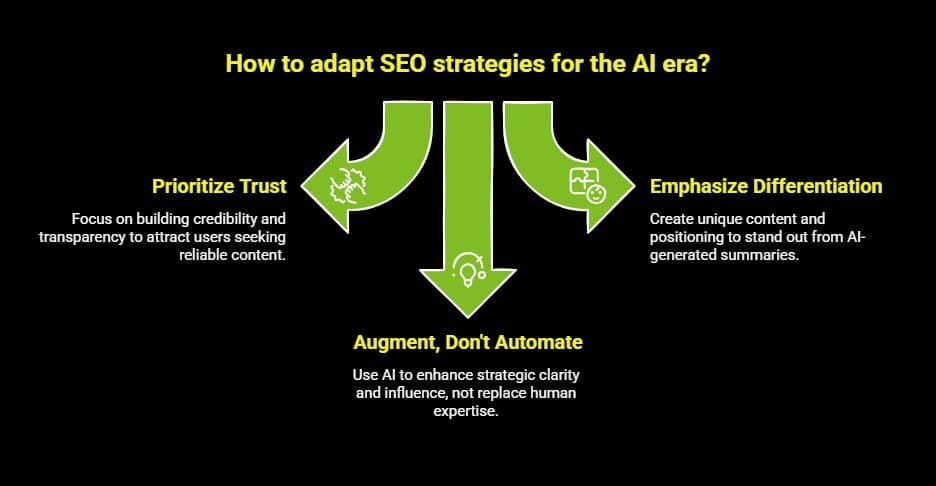
Infographic on What Does the Future of SEO With AI Actually Look Like visual selection
The future of SEO with AI will not be defined by automation dominance. It will be defined by trust and differentiation. According to Forrester’s research, consumers are using AI, but they still do not fully trust it. That insight changes the trajectory of search. As AI-generated content becomes more common, credibility will become a stronger competitive filter.
Three shifts will shape what comes next:
1. Trust Will Outrank Volume
As AI output scales, audiences will gravitate toward content that demonstrates real expertise, transparency, and human accountability. Authority will outweigh sheer production.
2. Differentiation Will Determine Visibility
AI search engines summarize the average. Brands that provide original analysis, distinct positioning, and structured insight will stand out instead of being absorbed into summaries.
3. Augmentation Will Replace Pure Automation
Automation increases efficiency. Augmentation increases influence. The brands that win will use AI to enhance strategic clarity, not replace it.
AI will reshape workflows. Human credibility will determine who leads.
Why Does Human Judgment Matter More as AI Expands?
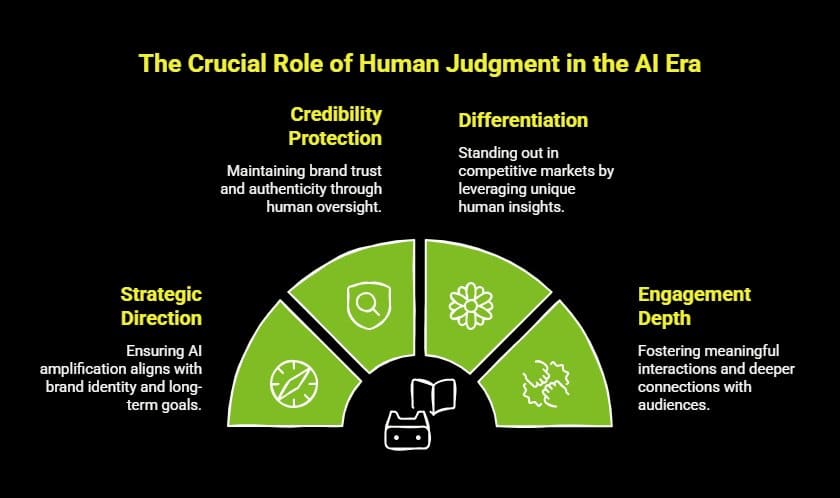
Infographic on Why Does Human Judgment Matter More as AI Expands visual selection
As AI adoption increases, content homogeneity rises with it. When everyone uses the same tools, speed becomes baseline. The differentiator shifts from production volume to strategic judgment. As Satya Nadella noted at Microsoft Build, “AI is not about replacing humans. It’s about amplifying human ingenuity.” Amplification without direction produces sameness.
In SEO, sameness has measurable consequences:
- Reduced backlink velocity
- Lower brand recall
- Weak differentiation in competitive SERPs
- Declining engagement depth
Human oversight ensures amplification aligns with identity, expertise, and long-term positioning. AI accelerates execution. Humans protect credibility. The more automated the ecosystem becomes, the more valuable discernment becomes.
How Does SEO Collaboration Improve Measurable Performance?
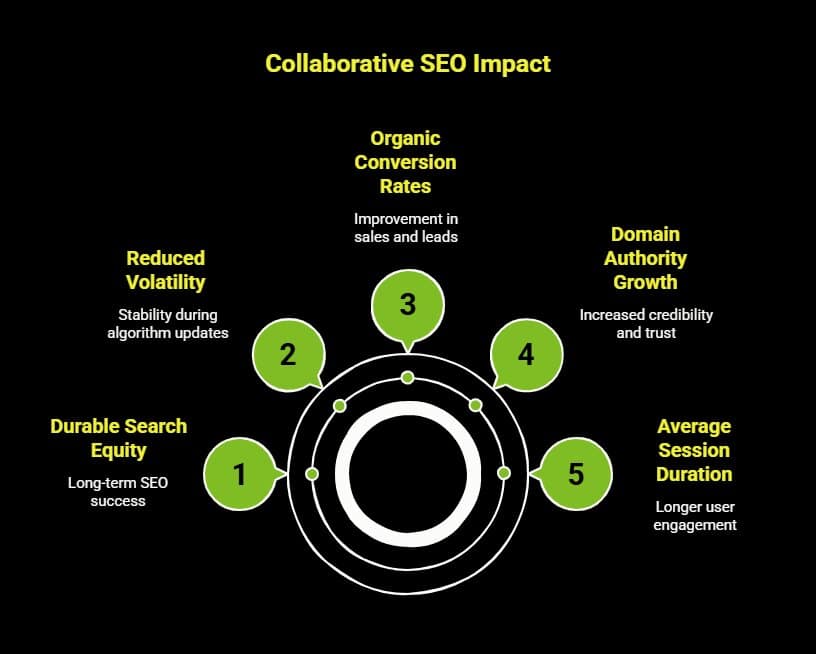
Infographic on How Does SEO Collaboration Improve Measurable Performance visual selection
SEO performance is measured through stability, engagement, authority growth, and conversion impact. Speed alone does not improve these metrics. Strategic layering does.
Which Ranking Factors Still Dominate in an AI Era?
According to Backlinko’s ranking factors analysis, content depth and authority signals remain dominant ranking drivers.
Additionally, Semrush research indicates that pages featuring expert citations earn 38 percent more backlinks than generic informational pages.
These findings reinforce a simple truth: authority compounds.
How Does Collaborative SEO Translate Into Business Impact?
When teams collaborate on SEO processes effectively, measurable outcomes improve across:
- Ranking stability during algorithm updates
- Organic conversion rates
- Domain authority growth
- Average session duration
AI assistance in SEO improves operational efficiency. Human strategy improves impact alignment.
Collaborative SEO frameworks blend machine precision with human credibility. That blend reduces volatility and strengthens long-term visibility. Over time, this structured integration builds durable search equity rather than reactive gains.
Why Work With a Strategy-Led SEO Partner?
If human-AI collaboration in SEO is the future, then tool adoption alone is not enough.
The real advantage lies in how AI is structured into your strategy. Many teams use automation. Few integrate it into disciplined frameworks that protect authority while accelerating growth.
Wild Creek Studio approaches SEO through a clarity-driven model often described as the Human Algorithm philosophy. AI expands analytical depth and execution speed, while human expertise defines positioning, differentiation, and long-term authority.
This means:
- Data guides decisions, but strategy sets direction
- Content velocity never compromises credibility
- SEO performance aligns with measurable business outcomes
In an AI-saturated landscape, competitive advantage does not come from thinking faster.
Schedule a strategic consultation and assess how your current SEO model integrates AI with human judgment. Because in an AI-saturated landscape, the brands that win Think Better, not Faster.
Conclusion: Authority Is Built Through Collaboration
Automation has changed SEO permanently, but it has not replaced strategy. AI can accelerate research, compress execution timelines, and uncover predictive insights at scale. Yet when every competitor has access to the same tools, speed stops being the differentiator.
Human-AI collaboration in SEO is what turns efficiency into authority. The future of SEO with AI will reward brands that combine machine precision with human judgment, building depth, trust, and a durable competitive advantage rather than temporary gains.
Frequently Asked Questions
What is human-AI collaboration in SEO?
Human-AI collaboration in SEO combines artificial intelligence with a human-led search engine optimization strategy. AI SEO tools handle keyword research, content optimization, and technical SEO issues, while SEO professionals guide content strategy, search intent alignment, and long-term online visibility.
How does collaborative SEO improve search rankings?
Collaborative SEO strengthens search engine rankings by aligning AI-powered content creation with expert-driven content marketing. AI SEO tools analyze search queries and search trends, while SEO specialists refine internal links, user experience, and authority signals to improve organic traffic and search visibility.
Is AI-assisted SEO replacing SEO professionals?
AI-assisted SEO improves efficiency across SEO tasks like content briefs, topic clusters, and technical audits. However, SEO professionals remain essential for interpreting user intent, refining content strategy, and adapting to evolving search engine algorithms and the future of search.
How can I use AI to predict future SEO trends?
AI SEO tools use machine learning and large language models to analyze search queries, voice search growth, and emerging search features. Human insight then determines whether those trends align with business goals, search visibility objectives, and evolving search engine results.
What is the future of SEO with AI search engines?
The future of SEO with AI search engines involves generative experience features, AI search results, and evolving search algorithms. Success will depend on combining artificial intelligence with strong SEO content, user experience design, and structured content optimization strategies.
Why is AI assistance in SEO not sufficient alone?
AI assistance in SEO improves speed in content creation and traditional keyword research, but it cannot independently build brand authority, emotional trust, or strategic differentiation. Human oversight ensures sustainable organic results and resilient search engine rankings.
Can AI completely replace the need for human SEO experts in the future?
The rise of artificial intelligence and AI models like Google Gemini is reshaping digital marketing, but AI cannot fully replace SEO specialists. Human expertise is required to interpret search intent, refine SEO strategies, and navigate the future of search engine optimization.